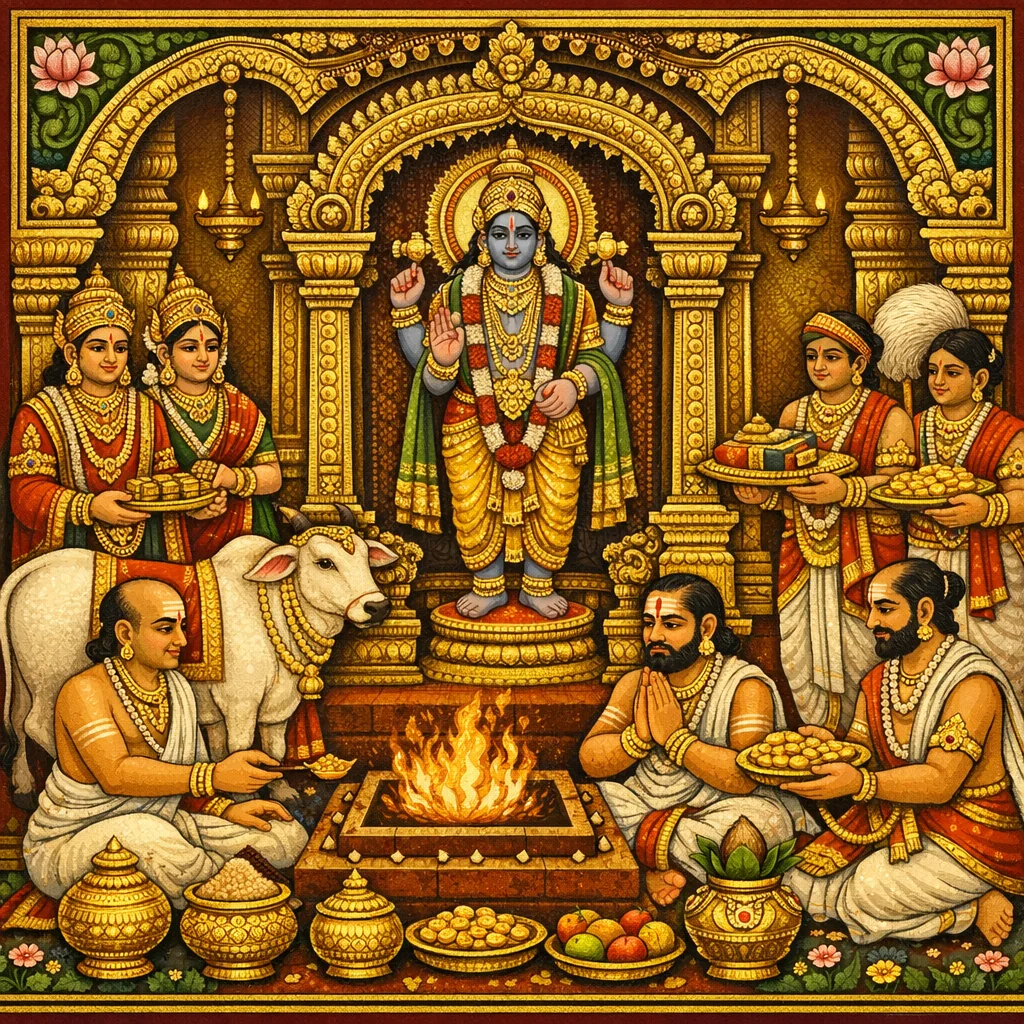
Adhyaya 66
Chapter 66: साधारणप्रतिष्ठाविधानम् (The Procedure for General Consecration)
Agni sets forth a standardized sādhāraṇa (general) consecration rite usable for many deities and sacred establishments, from individual installations to communal (samūha) consecrations on the Vāsudeva model. It opens with an invocation sequence—Ādityas, Vasus, Rudras, Sādhyas, Viśvedevas, Aśvins, and Ṛṣis—then explains mantra formation: extracting a bīja from the deity’s name by phonetic segmentation according to mātrā (quantity) and long elements, and completing it with bindu, praṇava (Oṁ), and a reverential formula. Agni then details the ritual order: preparatory fasting on the monthly Dvādaśī, arranging ritual bases and vessels, cooking barley caru with kapilā-cow milk while reciting “tad viṣṇoḥ,” consecrating with Oṁ, and performing a homa cycle with vyāhṛtis, Gāyatrī, and deity-specific offerings to Sūrya, Prajāpati, Antarikṣa, Dyauḥ, Brahmā, Pṛthivī, Soma, and Indra. The rite extends to planetary and cosmic powers (grahas, lokapālas, mountains, rivers, oceans) and concludes with pūrṇāhuti, release of vows, dakṣiṇā, feeding Brahmins, and merit statements linking gifts (maṭha, prapā, house, roads/bridges) to heavenly rewards—showing the Agni Purana’s characteristic fusion of Vāstu, ritual, and social Dharma.
Shlokas
Verse 1
आग्नेये सभागृहस्थापनं नाम पञ्चषष्टितमो ऽध्यायः गोपुच्छहस्तक इति घ, चिह्नितपुस्तकपाठः देवाज्ञां प्राप्य इति ग, चिह्नितपुस्तकपाठः अथ षट्षष्टितमो ऽध्यायः साधारणप्रतिष्ठाविधानं भगवानुवाच समुदायप्रतिष्ठाञ्च वक्ष्ये सा वासुदेववत् आदित्या वसवो रुद्राः साध्या विश्वे ऽश्विनौ तथा
In the Agni Purāṇa: “The Installation of an Assembly Hall” is the sixty-fifth chapter. (Variant readings in marked manuscripts: “gopuccha-hastaka” in one; “having obtained the command of the deity” in another.) Now begins the sixty-sixth chapter: “The Procedure for General Consecration.” The Blessed Lord said: “I shall also explain communal (collective) consecration; it is to be performed in the manner prescribed for Vāsudeva. (Invoke) the Ādityas, the Vasus, the Rudras, the Sādhyas, the Viśvedevas, and likewise the Aśvins.”
Verse 2
ऋषयश् च तथा सर्वे वक्ष्ये तेषां विशेषकं यस्य देवस्य यन्नाम तस्याद्यं गृह्य चाक्षरं
And with regard to all the sages as well, I shall explain their distinctive classification. Whatever the name of whatever deity, one should take its first syllable as the basis.
Verse 3
मात्राभिर्भेदयित्वा तु दीर्घाण्यङ्गानि भेदयेत् प्रथमं कल्पयेद्वीजं सविन्दुं प्रणवं नतिं
Having differentiated the sounds by their mātrās (units of quantity), one should also distinguish the long components. First, one should construct the bīja (seed-syllable) together with the bindu (nasal dot), along with the praṇava (Oṁ) and the nati (formula of obeisance).
Verse 4
सर्वेषां मूलमन्त्रेण पूजनं स्थापनं तथा नियमव्रतकृच्छ्राणां मठसङ्क्रमवेश्मनां
For all—deities and sacred establishments—worship and consecratory installation are to be performed by means of the mūla-mantra (root-mantra). Likewise, the prescriptions apply to observances, vows (vrata), expiatory austerities (kṛcchra), and to maṭhas (monasteries), entrances/passages, and dwelling-houses.
Verse 5
मासोपवासं द्वादश्यां इत्य् आदिस्थापनं वदे शिलां पूर्णघटं कांस्यं सम्भारं स्थापयेत्ततः
I shall describe the preliminary rite of installation, beginning with: “the monthly fast on the Dvādaśī.” Thereafter one should set in place a stone base, a water-filled pot (pūrṇa-ghaṭa), a bronze vessel (kāṃsya), and the requisite ritual materials.
Verse 6
ब्रह्मकूर्चं समाहृत्य श्रपेद् यवमयं चरुं क्षीरेण कपिलायास्तु तद्विष्णोरिति साधकः
Having gathered the sacred brahma-kūrca, the practitioner should cook a caru (oblatory porridge) made of barley, using the milk of a kapilā cow (tawny in color), while reciting the mantra “tad viṣṇoḥ”.
Verse 7
प्रणवेनाभिघार्यैव दर्व्या सङ्घट्टयेत्ततः साधयित्वावतार्याथ विष्णुमभ्यर्च्य होमयेत्
Having first consecrated the offering with the Praṇava (Oṁ), one should then stir and unite it with the ritual ladle. After preparing it properly and setting it down, one should worship Lord Viṣṇu and then perform the homa, the fire-offering.
Verse 8
व्याहृता चैव गायत्र्या तद्विप्रासेति होमयेत् विश्वतश् चक्षुर्वेद्यैर् भूरग्नये तथैव च
He should offer oblations with the Vyāhṛtis and with the Gāyatrī, uttering “tad-viprāsa…”, and likewise make offerings to Bhūr-Agni with the epithets “Viśvataś-cakṣus” and “Vedyā”.
Verse 9
सूर्याय प्रजापतये अन्तरिक्षाय होमयेत् द्यौः स्वाहा ब्रह्मणे स्वाहा पृथिवी महाराजकः
One should offer oblations (into the fire) to Sūrya, to Prajāpati, and to the mid-region (Antarikṣa), uttering: “To Dyauḥ (Heaven) svāhā,” “to Brahmā svāhā,” and “to Pṛthivī (Earth), the great sovereign (mahārājaka).”
Verse 10
तस्मै सोमञ्च राजानं इन्द्राद्यैर् होममाचरेत् अङ्गानि कल्पयेदिति ख, ङ, चिह्नितपुस्तकद्वयपाठः प्रणवं गतिमिति ख, चिह्नितपुस्तकपाठः एवं हुत्वा चरोर्भागान् दद्याद्दिग्बलिमादरात्
For that rite, one should perform the homa to King Soma, together with Indra and the other gods. Having thus made the oblations, one should then, with care, present the portions of the caru (sacrificial rice-cake) as the directional bali-offerings (dig-bali).
Verse 11
समिधो ऽष्टशतं हुत्वा पालाशांश्चाज्यहोमकं कुर्यात् पुरुषसूक्तेन इरावती तिलाष्टकं
Having offered eight hundred fuel-sticks (samidh) into the fire, one should also perform an ājya-homa, a ghee-offering, with palāśa wood, using the Puruṣa-sūkta; then the Irāvatī (mantra/rite) and the tila-aṣṭaka—an eightfold sesame offering—are to be performed.
Verse 12
हुत्वा तु ब्रह्मविष्ण्वीशदेवानामनुयायिनां ग्रहाणामाहुतीर्हुत्वा लोकेशानामथो पुनः
Having offered oblations (āhuti) to the Grahas, the planetary deities who attend Brahmā, Viṣṇu, and Īśa (Śiva), one should then again offer oblations to the Lokapālas, the lords and guardians of the worlds.
Verse 13
पर्वतानां नदीनाञ्च समुद्राणां तथाअहुतीः हुत्वा च व्याहृतीर्दद्द्यात् स्रुवपूर्णाहुतित्रयं
Having offered oblations into the fire while invoking the mountains, the rivers, and likewise the oceans, one should then offer the Vyāhṛtis—three full ladle-offerings (sruva).
Verse 14
वौषडन्तेन मन्त्रेण वैष्णवेन पितामह पञ्चगव्यं चरुं प्राश्य दत्वाचार्याय दक्षिणां
O Grandfather (Pitāmaha), with a Vaiṣṇava mantra ending in the exclamation “vauṣaṭ,” one should partake of the pañcagavya and the cooked offering (caru), and then give the prescribed dakṣiṇā to the officiating ācārya.
Verse 15
तिलपात्रं हेमयुक्तं सवस्त्रं गामलङ्कृतां प्रीयतां भगवान् विष्णुरित्युत्सृजेद्व्रतं बुधः
A wise man should formally conclude the vow (vrata) by offering a vessel of sesame seeds adorned with gold and accompanied by cloth, and by presenting a decorated cow, saying: “May the Blessed Lord Viṣṇu be pleased.”
Verse 16
मासोपवासादेरन्यां प्रतिष्ठां वच्मि पूर्णतः यज्ञेनातोष्य देवेशं श्रपयेद्वैष्णवं चरुं
Now I shall fully describe another rite of consecration (pratiṣṭhā), beginning with the monthly fast. Having satisfied Deveśa, the Lord of the gods, through a sacrifice (yajña), one should cook the Vaiṣṇava offering (caru).
Verse 17
तिलतण्डुलनीवारैः श्यामाकैर् अथवा यवैः आज्येनाधार्य चोत्तार्य होमयेन्मूर्तिमन्त्रकैः
Using sesame, rice-grains, wild rice (nīvāra), foxtail millet (śyāmāka), or barley—having supported them with ghee and then lifted the offering for oblation—one should perform the homa (fire-offering) while reciting the mūrti-mantras that invoke the deity’s forms.
Verse 18
विष्ण्वादीनां मासपानां तदन्ते होमयेत् पुनः ॐ विष्णवे स्वाहा ॐ विष्णवे निभूयपाय स्वाहा ॐ विष्णवे शिपिविष्टाय स्वाहा ॐ नरसिंहाय स्वाहा ॐ पुरुषोत्तमाय स्वाहा द्वादशाश्वत्थसमिधो होमयेद्घृतसम्प्लुताः
After the monthly offerings beginning with those to Viṣṇu, one should again make oblations at their conclusion: “Oṃ, to Viṣṇu, svāhā”; “Oṃ, to Viṣṇu Nibhūyapāya, svāhā”; “Oṃ, to Viṣṇu Śipiviṣṭa, svāhā”; “Oṃ, to Narasiṃha, svāhā”; “Oṃ, to Puruṣottama, svāhā.” One should offer twelve aśvattha (sacred fig) kindling-sticks, drenched in ghee, into the fire.
Verse 19
विष्णो रराटमन्त्रेण ततो द्वादश चाहुतीः एवं दत्वा इति ख, ङ, चिह्नितपुस्तकपाठः एतान् दत्वा इति घ, चिह्नितपुस्तकपाठः ॐ विष्णवे प्रवृषाय स्वाहा इति घ, चिह्नितपुस्तकपाठः इदं विष्णुरिरावती चरोर्द्वादश आहुतीः
Then, using the “Viṣṇu Rarāṭa” mantra, one should offer twelve oblations. (Some manuscripts read “having thus offered,” while others read “having offered these.”) In another reading the oblation-formula is: “Oṃ, to Viṣṇu Pravṛṣā (Giver of Rain), svāhā.” Thus are to be made twelve oblations of the sacrificial porridge (caru) to Viṣṇu and to Irāvatī.
Verse 20
हुत्वा चाज्याहुतीस्तद्वत्तद्विप्रासेति होमयेत् शेषहोमं ततः कृत्वा दद्यात् पूर्णाहुतित्रयं
Having likewise offered the ghee-oblations, one should perform the homa with the mantra ending in “tad viprāse,” as prescribed. Then, after completing the remaining/auxiliary offerings (śeṣa-homa), one should present the three concluding full oblations (pūrṇāhuti).
Verse 21
युञ्जतेत्यनुवाकन्तु जप्त्वा प्राशीत वै चरुं प्रणवेन स्वशब्दान्ते कृत्वा पात्रे तु पैप्पले
Having recited the anuvāka beginning with “yuñjate…”, one should partake of the caru, the consecrated rice-porridge. Then, appending the praṇava “Oṃ” at the end of one’s prescribed formula, it should be placed in a vessel made of pippala (the sacred fig).
Verse 22
ततो मासाधिपानान्तु विप्रान् द्वादश भोजयेत् त्रयोदश गुरुस्तत्र तेभ्यो दद्यात्त्रयोदश
Thereafter one should feed twelve Brahmin priests who preside over the months; and as the thirteenth among them is the Guru (preceptor). To those Brahmins one should give thirteen gifts/fees (dakṣiṇā).
Verse 23
कुम्भान् स्वाद्वम्बुसंयुक्तान् सच्छत्रोपानहान्वितान्
One should donate water-pots (kumbha) filled with sweet, pleasant water, furnished with a good umbrella and accompanied by sandals.
Verse 24
गावः प्रीतिं समायान्तु प्रचरन्तु प्रहर्षिताः इति गोपथमुत्सृज्य यूपं तत्र निवेशयेत्
“May the cows attain contentment and move about joyfully”—having thus released them along the cow-path (gopatha), one should then set up the sacrificial post (yūpa) at that very place.
Verse 25
दशहस्तं प्रपाअराममठसङ्क्रमणादिषु गृहे च होममेवन्तु कृत्वा सर्वं यथाविधि
In places such as a public water-shelter (prapā), a garden, a monastery (maṭha), during transitional/threshold rites (saṅkramaṇa) and the like, and also in a house, one should perform only the fire-offering (homa), maintaining the ten-hasta measure, and then complete everything according to the prescribed rule.
Verse 26
पूर्वोक्तेन विधानेन प्रविशेच्च गृहं गृही अनिवारितमन्नाद्यं सर्वेष्वेतेषु कारयेत्
Following the procedure previously stated, the householder should enter the house; and in all these rites he should ensure that food and provisions are offered without restriction, kept freely available for guests and dependents.
Verse 27
द्विजेभ्यो दक्षिणा देया यथाशक्त्या विचक्षणैः आरामं कारयेद्यस्तु नन्दने स चिरं वसेत्
The wise should give dakṣiṇā, the priestly honorarium, to the twice-born according to their means. Whoever causes an ārāma, a pleasure-grove, to be made dwells for a long time in Nandana, Indra’s celestial garden.
Verse 28
मठप्रदानात् स्वर्लोके शक्रलोके वसेत्ततः प्रपादानाद्वारुणेन सङ्क्रमेण वसेद्दिवि
By gifting a maṭha, a monastery, one dwells in heaven—indeed in the world of Śakra (Indra). By gifting a prapā, a public drinking-water station, one dwells in the celestial realm through the auspicious passage associated with Varuṇa.
Verse 29
इष्टकासेतुकारी च गोलोके मार्गकृद्गवां नियमव्रतकृद्विष्णुः कृच्छ्रकृत्सर्वपापहा
One who builds a brick causeway or bridge, and one who makes a path for cattle in Goloka; one who undertakes disciplines and vows; one devoted to Viṣṇu; and one who performs the Kṛcchra expiatory observance—each becomes a destroyer of all sins.
Verse 30
गृहं दत्वा वसेत्स्वर्गे यावदाभूतसम्प्लवं अञ्जतेत्यनुवाकस्तु इति ग, ङ, चिह्नितपुस्तकपाठः स्वाद्वन्नसंयुक्तानिति ख, ग, घ, ङ, चिह्नितपुस्तकचतुष्टयपाठः समुदायप्रतिष्ठेष्टा शिवादीनां गृहात्मनां
Having gifted a house, one dwells in heaven until the cosmic dissolution. (Some manuscripts add: “the anuvāka beginning with ‘añjate…’ ”; another group reads: “provided with sweet food.”) One should also undertake the collective establishment, installing Śiva and other deities as the indwelling presences of the house.
Frequently Asked Questions
It provides a transferable ritual template—mantra construction, homa cycles, dig-bali, pūrṇāhuti, and gifting—that can be applied to multiple deities and to multiple built spaces (temples, monasteries, houses, thresholds, and public works).
It integrates phonetics (bīja formation), Vedic mantra-corpora (Gāyatrī, Puruṣa-sūkta), ritual technology (caru/ājya homa, counts, materials), and social Dharma (feeding, donations, public infrastructure) into one coherent consecration system.
Maṭha (monastery), saṅkrama/praveśa (threshold or transitional entry contexts), gṛha (house), prapā (water-shelter), and ārāma (garden), alongside general deity installations.