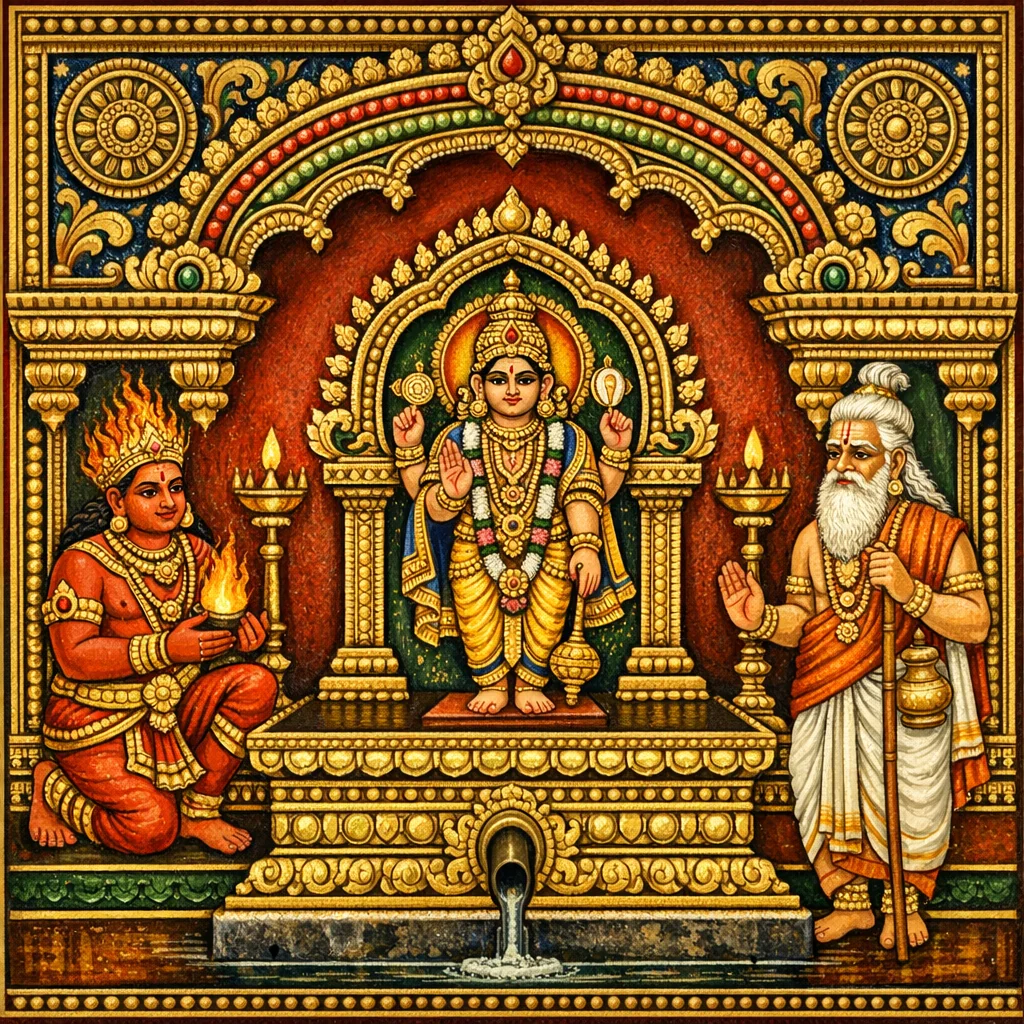
Adhyaya 45
Chapter 45 — Piṇḍikā-Lakṣaṇa (Characteristics and Measurements of the Pedestal/Plinth)
Bhagavān Agni opens a technical yet ritually charged teaching on piṇḍikā-lakṣaṇa, treating the pedestal/plinth as essential for proper installation and iconographic correctness. He sets key proportional canons: the piṇḍikā’s length equals the image, its height is half the image, and its construction follows sixty-four puṭa (courses/layers), marking a standardized architectural grammar. The chapter then gives procedural rules—leaving specified blank bands/lines, forming and purifying the koṣṭhaka (compartment/cell), and maintaining symmetry on both sides—expressing the vāstu principle that purity, evenness, and measured segmentation yield auspiciousness and durability. Later verses extend measurement to iconographic detail using traditional units (yava, gola, aṃśa, kalā, tāla, aṅgula), prescribing proportions for facial features and bodily breadths and linking the auspicious result with Lakṣmī. It concludes with compositional elements—personified wealth, attendant women with cāmara, Garuḍa, and emblems such as the cakra—showing pedestal, icon, and entourage as one consecration-ready sacred ensemble within Isāna-kalpa praxis.
Shlokas
Verse 1
इत्य् आदिमहापुराणे आग्नेये प्रतिमालक्षणं नाम चतुश् चत्वारिंशोध्यायः अथ पञ्चचत्वारिंशोध्यायः पिण्डिकालक्षणकथनं भगवानुवाच पिण्डिकालक्षणं वक्ष्ये दैर्घ्येण प्रतिमासमा उच्छ्रायं प्रतिमार्धन्तु चतुःषष्टिपुटां च ताम्
Thus ends the forty-fourth chapter of the Agni Purāṇa, entitled “Characteristics of Images (Iconographic Rules).” Now begins the forty-fifth chapter: “Description of the Characteristics of the Piṇḍikā (pedestal/plinth).” The Blessed Lord said: “I shall describe the defining features of the piṇḍikā: in length it should equal the image; in height it should be half the image; and it should be constructed with sixty-four courses/layers (puṭa).”}]}}
Verse 2
त्यक्त्वा पङ्क्तिद्वयं चाधस्तदूर्ध्वं यत्तु कोष्ठकम् सार्धाङ्गुलं तथायाममिति ङ, चिह्नितपुस्तकपाठः मणिविद्याधराविति घ, चिह्नितपुस्तकपाठः चतुःषष्टिपदामिति ङ, चिह्नितपुस्तकपाठः समन्तादुभयोः पार्श्वे अन्तस्थं परिमार्जयेत्
Leaving two lines blank below and two lines blank above, the ruled writing-cell (koṣṭhaka) should be made one-and-a-half finger-breadths in height; and on both sides, all around, one should carefully smooth and cleanse the intervening space (the inner margins and gaps). (Variant readings are noted in marked manuscripts.)
Verse 3
ऊर्ध्वं पङ्ग्क्तिद्वयं त्यक्त्वा अधस्ताद् यत्तु कोष्ठकम् अन्तः सम्मार्जयेत् यत्नात् पार्श्वयोरुभयोः समम्
Leaving the two upper lines aside, one should carefully sweep and cleanse from within the compartment (koṣṭhaka) that lies below, doing so with effort and evenly on both sides.
Verse 4
तयोर्मध्यगतौ तत्र चतुष्कौ मार्जयेत्ततः चतुर्धा भाजयित्वा तु ऊर्ध्वपङ्क्तिद्वयं बुधः
There, after removing the two groups of four that lie in the middle between the two (lines), the learned person should then divide the upper pair of lines into four parts.
Verse 5
मेखला भागमात्रा स्यात् खातं तस्यार्धमानतः भागं भागं परित्यज्य पार्श्वयोरुभयोः समं
The girdle-band (mekhalā) should measure one ‘part’; the trench (khāta) should be made to half that measure. Leaving aside a portion on each side, it is to be kept equal on both flanks.
Verse 6
दत्वा चैकं पदं वाह्ये प्रमाणं कारयेद् बुधः त्रिभागेण च भागस्याग्रे स्यात्तोयविनिर्गमः
Having allowed one pada on the outer side, the wise person should establish the measurements; and at the front of that portion, the outlet for water should be made at one-third of the division.
Verse 7
नानाप्रकारभेदेन भद्रेयं पिण्डिका शुभा अष्टताला तु कर्तव्या देवी लक्ष्मीस्तया स्त्रियः
O auspicious one, this blessed offering-ball (piṇḍikā) is to be fashioned in various types; it should be made to the measure of eight tālas. By that rite/measure, the Goddess Lakṣmī bestows auspiciousness upon women.
Verse 8
भ्रुवौ यवाधिके कार्ये यवहीना तु नासिका गोलकेनाधिकं वक्त्रमूर्ध्वं तिर्यग्विवर्जितं
The eyebrows are to be made one yava (barley-grain unit) larger, while the nose is to be one yava smaller. The face is to be made larger by one gola (a round measure) and set upward, avoiding any sideways (oblique) tilt.
Verse 9
आयते नयने कार्ये त्रिभागोनैर् यवैस्त्रिभिः तदर्धेन तु वैपुल्यं नेत्रयोः परिकल्पयेत्
When the eyes are to be made elongated, one should form their length with three yavas reduced by one-third; and with half of that, one should determine the breadth of the eyes.
Verse 10
कर्णपाशो धिकः कार्यः सृक्कणीसमसूत्रतः नम्रं कलाविहीनन्तु कुर्यादंशद्वयं तथा
The ear-loop/ornament (karṇapāśa) should be made slightly larger and aligned on the same guiding line as the corners of the mouth (sṛkkaṇī). It should also be made gently sloping, without adding a ‘kalā’ (extra decorative subdivision), to the extent of two parts (aṃśa-dvaya).
Verse 11
ग्रीवा सार्धकला कार्या तद्विस्तारोपशोभिता नेत्रं विना तु विस्तारौ ऊरू जानू च पिण्डिका
The neck should be made to a measure of one-and-a-half kalās and beautified by its proper breadth. Excluding the eye-measure, the breadth-measures are to be set for the thighs, the knees, and the calves (piṇḍikā).
Verse 12
अङ्घ्रिपृष्ठौ स्फिचौ कट्यां यथाभागं प्रकल्पयेत् सप्तांशोनास् तथाङ्गुल्यो दीर्घं विष्कम्भनाहतं
One should proportionately model the backs of the feet, the buttocks, and the waist according to their proper shares. Likewise, the total length is to be fixed by the breadth-measure (viṣkambha), with the finger-units (aṅgula) reduced by seven parts.
Verse 13
नेत्रैकवर्जितायामा जङ्घोरू च तथा कटिः मध्यपार्श्वं च तद्वृत्तं घनं पीनं कुचद्वयं
Her bodily proportions—excluding only the eyes—are long and well formed: her shanks and thighs, and likewise her waist; the middle of her sides is rounded; and her pair of breasts is compact, firm, and full.
Verse 15
तत्रेयमिति ङ, चिह्नितपुस्तकपाठः तालमात्रौ स्तनौ कर्यौ कटिः सार्धकलाधिका लक्ष्म शेषं पुरावत्स्यात् दक्षिणे चामुबुजं करे
Here the reading is as follows—according to the variant noted in the marked manuscript: the two breasts should be made to the measure of one tāla; the waist should be increased by one and a half kalā (sārdha-kalā). The remaining proportions are as stated earlier; and in the right hand there should also be a lotus.
Verse 16
वामे वित्त्वं स्त्रियौ पार्श्वे शुभे चामरहस्तके दीर्घघोणस्तु गरुडश् चक्राङ्गाद्यानथो वदे
On the left is the personification of wealth; at the sides are two auspicious women holding chāmara fly-whisks. Garuḍa, with an elongated beak, is shown as the mount; and then I shall describe the discus (cakra) and the other emblems.
Frequently Asked Questions
The chapter emphasizes strict proportional standards for the piṇḍikā: length equal to the image, height equal to half the image, and construction specified as sixty-four puṭa (courses/layers), alongside symmetry and cleaning of the koṣṭhaka and precise placement of features and drainage outlets.
By treating measurement, symmetry, and purity as dharmic disciplines that make a form fit for consecration (pratiṣṭhā), the chapter aligns craftsmanship with sādhana—right form becomes a support for right presence, devotion, and auspicious order (Lakṣmī) in sacred space.