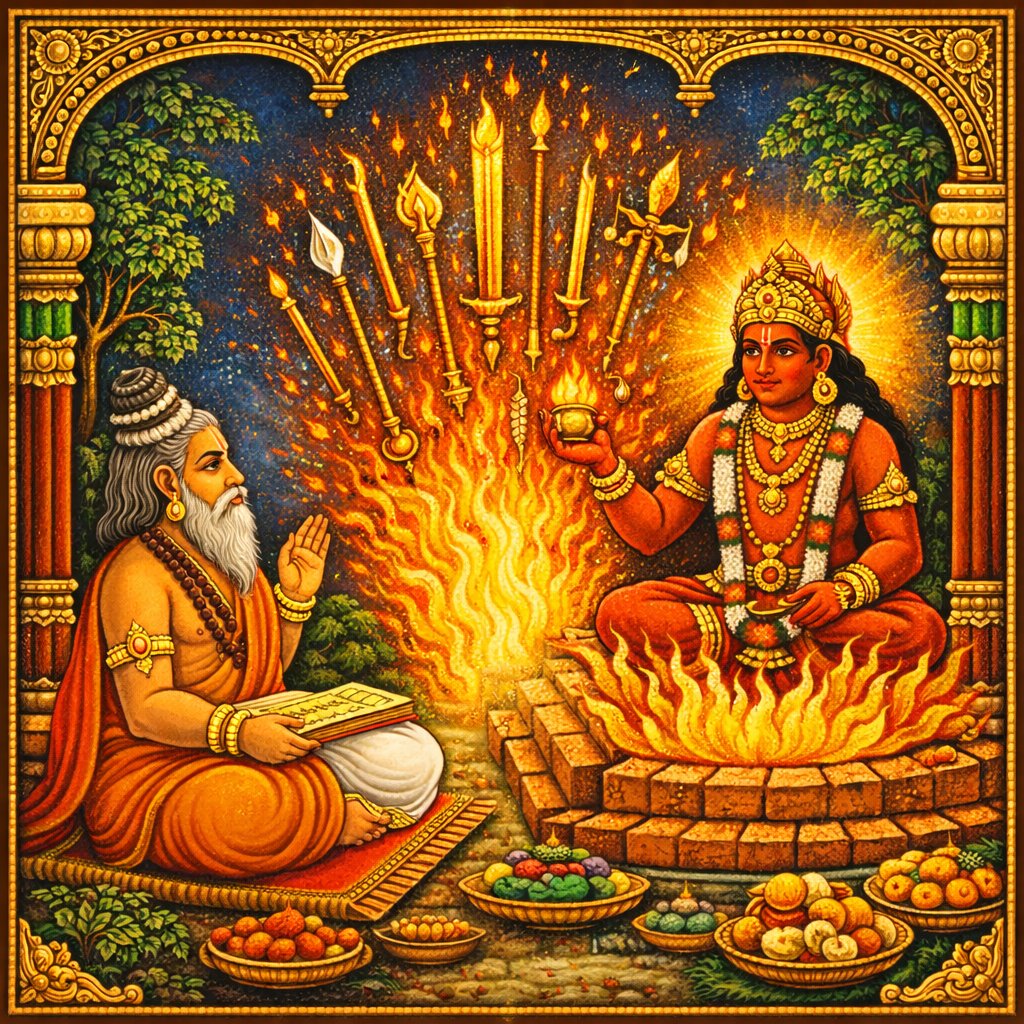
Agneya-vidya
The Science of Ritual Worship
Comprehensive instructions on Agni-based rituals, temple worship procedures, mantra recitation, and the sacred science of fire ceremonies.
Adhyayas in Agneya-vidya
Adhyaya 17
Chapter 17 — सृष्टिविषयकवर्णनम् (An Account Concerning Creation)
Lord Agni continues instructing Sage Vasiṣṭha, turning from avatāra tales to cosmogony and portraying creation as Viṣṇu’s līlā, both saguṇa and nirguṇa. The chapter gives a Sāṅkhya-tinged emanation order: Brahman as the unmanifest; Viṣṇu’s entry into prakṛti and puruṣa; the rise of mahat and the threefold ahaṅkāra; and the evolution of tanmātras into the mahābhūtas from ākāśa to pṛthivī. From sāttvika ahaṅkāra come the presiding deities and mind (manas); from tamasic/taijasa come the sense-faculties. It then explains the “Nārāyaṇa-waters,” the golden cosmic egg (hiraṇyāṇḍa), and Brahmā as Hiraṇyagarbha dividing the egg into heaven and earth, establishing space, directions, time, and inner forces (kāma, krodha, rati). Creation proceeds through atmospheric phenomena, birds, Parjanya, and the Vedic meters and mantras for yajña, culminating in the manifestation of Rudra, Sanatkumāra, and the seven mind-born Brahmarṣis, and in Brahmā’s androgynous division into male and female to generate beings—linking cosmology to ritual order and sacrificial efficacy.
Adhyaya 18
Svāyambhuva-vaṁśa-varṇanam (Description of the Lineage of Svāyambhuva Manu)
Agni continues his encyclopedic teaching by turning from cosmogony to genealogical dharma: the Svāyambhuva lineage is presented as sacred history that authorizes ritual order, kingship, and the graded emergence of beings. The chapter opens with Svāyambhuva Manu’s progeny (Priyavrata, Uttānapāda, and Śatarūpā), then highlights Dhruva’s tapas, culminating in Viṣṇu granting him an enduring cosmic station (Dhruva as the pole star). The line proceeds to Pṛthu’s rise from Vena—an ideal of rājarṣi rule—where Earth (Vasundharā) is “milked” to sustain crops and life, symbolizing dharmic extraction of resources for the common good. It then recounts the Pracetases’ austerities, their marriage to Māriṣā, and the birth of Dakṣa, who expands creation through daughters given to Dharma, Kaśyapa, Soma, and others. Closing catalogues (Viśvedevas, Sādhyas, Maruts, Vasus, Rudras; Skanda’s epithets; Viśvakarmā the divine architect) reaffirm the Purāṇic method: lists and lineages serve as ritual-knowledge indexes linking cosmology to social, artisanal, and devotional practice.
Adhyaya 19
Chapter 19 — कश्यपवंशवर्णनम् (Description of Kaśyapa’s Lineage)
Agni shifts from cosmogenesis to genealogical cosmology, presenting Kaśyapa’s progeny as a map of how divine, semi-divine, and hostile lineages populate the worlds across the manvantaras. It opens with the Tuṣitas and the roster of Ādityas (including Viṣṇu/Indra and solar deities), then turns to Diti’s descendants—Hiraṇyakaśipu and Hiraṇyākṣa—affirming the cyclical rise of adversarial powers “yuga after yuga.” Key Dānava branches (Prahlāda, Bali, Bāṇa) are enumerated, and Prahlāda’s viṣṇu-bhakti is set as a moral measure within demonic genealogies. The account expands to Kaśyapa’s wives and prolific offspring (Pulomā, Kālakā; Vinatā, Kadrū, Surasā, Surabhī, etc.), explaining the origins of birds, nāgas, animals, and plant life as a taxonomic pratisarga (secondary creation). The closing verses codify cosmic administration—who presides over classes of beings and directions (Citraratha, Vāsuki, Takṣaka, Garuḍa; guardians of the quarters)—culminating in a structured hierarchy that mirrors ritual order and upholds dharmic governance.
Adhyaya 20
Sargaviṣayaka-varṇana — The Topics of Primary Creation (Sarga)
Lord Agni begins a structured cosmological teaching by classifying creation (sarga) in graded order—from subtle principles to embodied life, and finally to grace-oriented results. He first sets out the prākṛta (primordial/material) sequence: Mahat (cosmic intellect) arises as Brahmā’s first creative emanation; from the tanmātras the gross elements (bhūtas) emerge; and then comes the vaikārika/aindriyaka phase concerning the senses and their functions. He further lists developmental strata—immobile beings, animal births (tiryaksrotas/stairyag-yoni), devas (ūrdhvasrotas), and humans (vāk-srotas)—culminating in an “anugraha-sarga” that reveals a moral-spiritual dimension (sāttvika/tāmasa) within manifested life. The chapter then turns from categories to genealogy: sages and divine beings arise through Dakṣa’s daughters and ṛṣi lineages; Rudra’s birth and epithets are given; and Sati’s rebirth as Pārvatī is noted. It closes by re-centering ritual practice—worship taught by Nārada and other sages (snāna-pūrvaka, Svāyambhuva tradition)—as the effective means to gain both bhukti and mukti through Viṣṇu and other deities.
Adhyaya 21
Chapter 21 — सामान्यपूजाकथनम् (Teaching on General Worship)
This chapter codifies a “general worship” (sāmānya-pūjā) template usable for Viṣṇu and other deities as a modular ritual architecture: begin with a universal salutation to Acyuta with His full retinue, then expand through attendant divinities, mandalic placements, and protective/empowering components. It enumerates a worship-grid including threshold and site powers (Dvāra-Śrī, Vāstu), cosmic supports (Kūrma, Ananta), and abstract virtues mapped onto lotus symbolism of dharma and its opposites. Deity-specific adaptations follow: Viṣṇu’s emblems and bījas (śrīṃ, hrīṃ, klīṃ), Śiva’s general procedure (starting with Nandin and Mahākāla), and Sūrya worship with nyāsa-like assignments (heart/head/eye), kavaca elements, and planetary integrations including Rāhu–Ketu. Rules for mantra construction are given (praṇava, bindu, dative + namaḥ), culminating in homa with sesame and ghee as the puruṣārtha-yielding completion. Manuscript variants are noted, reflecting a living ritual transmission.
Adhyaya 22
Chapter 22 — स्नानविधिकथनं (Instruction on the Rite of Bathing)
This chapter prescribes snāna (ritual bathing) as an essential prerequisite for worship, joining bodily purification to mantra-guarded inner discipline. It begins by taking purificatory earth (mṛttikā) with the Nṛsiṃha/Siṃha mantra, dividing it, and using one portion for “mental bathing” (manaḥ-snāna), declaring purity to be first inward. After immersion and ācamana, the practitioner performs nyāsa and establishes a protective enclosure (rakṣā/digbandha) through lion-mantra recitation, with alternate protective formulas (Tvaritā or Tripurā) noted. Centering the heart in Hari-jñāna by the eight-syllabled mantra, the rite consecrates tīrtha-water with Vāsudeva-japa, cleanses the body with Vedic mantras, and worships the embodied deity (mūrti). Aghamarṣaṇa, donning clean garments, palm-water purification, prāṇāyāma under the Nārāyaṇa mantra, arghya with the twelve-syllabled mantra, and extensive japa follow, including invocations from the yogapīṭha through the dikpālas, ṛṣis, and pitṛ-gaṇas. It concludes by dismissing beings to their stations, withdrawing the ritual “limbs,” and proceeding to the worship space, establishing a reusable template for other pūjās via a root-mantra-based concluding snāna.
Adhyaya 23
Chapter 23 — पूजाविधिकथनम् (The Account of the Rules of Worship)
Spoken by Nārada to the brāhmaṇas, this chapter sets out a disciplined Vaiṣṇava pūjā sequence. It begins with bodily and verbal restraint—washing the feet, ācamanam, silence, and protective rites—then moves into inner yogic purification: sitting east-facing, forming mudrā, and visualizing bīja (yaṃ at the navel as fierce wind; kṣauṃ in the heart as a radiant treasury), burning impurities with flames in all directions and bathing the subtle body in nectar descending like the moon and circulating through suṣumnā and the nāḍīs. Ritual exactness follows with hand-purification, astramantra and vyāpaka placements, and full nyāsa on the limbs (heart, head, śikhā, armor, weapon, and eyes). The chapter details altar arrangement (vardhanī on the left, materials on the right), consecration by mantra-sprinkling, and construction of the yogapīṭha with directional placements of virtues and counter-qualities. A lotus-maṇḍala is contemplated, the deity is invoked from the heart into the maṇḍala, and standard upacāras are offered per Puṇḍarīkākṣa-vidyā (arghya, pādya, ācāmana, madhuparka, snāna, garments, ornaments, incense, lamp). Worship extends to attendant emblems and directional lords, concludes with japa, pradakṣiṇā, stuti, arghya, and the identity-affirmation “ahaṃ brahma; haris tvam,” and then shifts from one-form worship to the nine-vyūha scheme with finger- and body-placements, noting key manuscript variants.
Adhyaya 24
Chapter 24 — कुण्डनिर्माणादिविधिः (Procedure for Constructing the Fire-pit and Related Rites)
In this chapter, Nārada proclaims the agni-kārya that brings success in desired aims and begins with precise, vāstu-like specifications for constructing the homa-kuṇḍa: measuring and excavating with a cord, forming the mekhalā (raised rim), and shaping the yoni-channel with graded widths, a prescribed slope, and proper orientation. It then presents alternative kuṇḍa forms—circular, half-moon, lotus-like—and proportional rules for implements (śruk/śruva and the sruva bowl), stressing exact aṅgula-based measurements. The chapter next turns to ritual procedure: layering darbha, placing vessels, preparing praṇīta water, sprinkling and consecrating ghee (ājya-saṃskāra), and performing homa with the Praṇava (Om) as the unifying mantra-principle. The rite is linked to saṃskāras from garbhādhāna through samāvartana, integrating domestic and life-cycle ceremonies into Vaiṣṇava fire-worship. Finally, it deepens into internal cosmological meditation—bīja purification, brahmāṇḍa visualization, liṅga transformation—culminating in guru-led initiation elements, offerings to Viśvaksena, and the teaching that the bhoktā gains worldly fulfillment while the mumukṣu dissolves into Hari, thus uniting bhukti and mukti through disciplined ritual science.
Adhyaya 25
Explanation of the Vāsudeva and Related Mantras (वासुदेवादिमन्त्रनिरूपणम्)
This chapter begins with Nārada asking for the defining marks of worship connected with the Vāsudeva-mantra system and the fourfold vyūha (Vāsudeva, Saṅkarṣaṇa, Pradyumna, Aniruddha). The text then codifies mantra formation: starting with praṇava and “namo” formulas, specifying vowel bījas (a, ā, aṃ, aḥ), and distinguishing aṅga and upāṅga by long/short vowels and placement rules. It proceeds to nyāsa practice—six-limbed bīja-nyāsa and twelve-limbed mūla-nyāsa—assigning mantra parts to heart, head, śikhā, kavaca, eyes, astra, and other bodily loci. Detailed bīja-clusters are linked to divine emblems (Garuḍa/Vainateya, the conch Pāñcajanya, Kaustubha, Sudarśana, Śrīvatsa, Vanamālā, Ananta), uniting iconographic devotion with phonemic ritual. The chapter expands into cosmological and psycho-physical correspondences: elements (bhūtas), Vedas, lokas, senses (indriyas), inner faculties (buddhi, ahaṅkāra, manas, citta), and graded vyūha enumerations up to twenty-six principles. Finally, it outlines maṇḍala worship with directional arrangements, dikpālas, central pericarp deities, and concludes with results-oriented worship (stability, royal victory), including Viśvarūpa and Viśvaksena.
Adhyaya 26
Explanation of the Characteristics of Mudrās (मुद्रालक्षणकथनं)
After the previous chapter’s display of mantras, the teaching turns to mudrā-lakṣaṇa: the defining marks and operative forms of ritual hand-gestures that generate sannidhya (divine presence) and related effects. Nārada presents Añjali as the foremost gesture of reverent salutation, held at the heart, establishing devotion as the gateway to technical procedure. The chapter then details precise hand formations—beginning with a left fist and upright thumb and the right thumb’s clasping role—showing exact bodily choreography as part of mantra-vidyā. It distinguishes common (sādhāraṇa) and uncommon (asādhāraṇa) mudrās within a ritual vyūha, and sets an ordered sequence of eight gestures produced by successive releasing/unfolding from the little finger onward. Variant manuscript readings are noted regarding bīja usage and aims such as siddhi, followed by the introduction of Varāha-mudrā and a sequential set of aṅganā-mudrās. The procedure culminates by contracting and mirroring the formation on the right side, affirming that correct configuration yields mudrā-siddhi—successful ritual accomplishment through disciplined form.
Adhyaya 27
Dīkṣāvidhi-kathana (Explanation of the Rite of Initiation)
This chapter shifts from mudrā-pradarśana to a step-by-step account of dīkṣā. Nārada outlines a Vaiṣṇava initiation centered on worship of Hari in a lotus-like maṇḍala, beginning with protections (Narasiṃha-nyāsa; scattering mantra-charged mustard seeds with phaṭ) and installing Śakti in a prāsāda-form. It proceeds through consecrations and purifications (herbs, pañcagavya, sprinklings with kuśa and “Nārāyaṇa”-ending formulas), kumbha-worship and fire-worship, and a cooked offering made under the four vyūha names (Vāsudeva, Saṅkarṣaṇa, Pradyumna, Aniruddha). A doctrinal-ritual bridge follows: the deśika contemplates and installs tattvas on the disciple by nyāsa in creation order (Prakṛti to Earth), then withdraws and purifies them by homa in saṃhāra-krama, culminating in pūrṇāhuti aimed at release from bondage. The chapter notes multiple manuscript variants for key mantras and actions, and ends with eligibility guidance (householder, sādhaka, poor/ascetics/children) and the possibility of śaktidīkṣā.
Adhyaya 28
Abhiṣeka-vidhāna (The Procedure for Consecratory Bathing)
This chapter shifts from initiations to a focused teaching on abhiṣeka, the consecratory bathing rite that grants siddhi to the ācārya and the disciple-practitioner and also serves to relieve disease. Nārada outlines a carefully ordered ritual setting: jewel-adorned kumbhas bearing images are arranged in sequence from the center and then from the east, mapping the directions in a cosmological layout. The rite is strengthened by repetition—ideally a thousand times, or alternatively a hundred—indicating graded performance according to capacity. Within the maṇḍapa and maṇḍala, Viṣṇu is installed on a pedestal oriented to the east and north-east, aligning iconographic focus with vāstu spatial logic. The officiants and the putraka are prepared, worship is offered to the abhiṣeka itself, and the ceremony proceeds with auspicious sound such as gīta (songs/recitations). The chapter concludes with the transmission of yogapīṭha-related requisites and the guru’s declaration of samaya vows; secrecy and discipline qualify the disciple for the full privileges of the tradition.
Adhyaya 29
The Description of the Sarvatobhadra Maṇḍala (सर्वतोभद्रमण्डलकथनम्)
This chapter prescribes a strict ritual‑architectural method for constructing and empowering the Sarvatobhadra Maṇḍala as a consecrated kṣetra for mantra‑sādhana. After purified ground and preliminary worship, it lays out a square grid into lotus‑based enclosures (pīṭha, vīthikā, gateways), assigns directional deities and Vedic divisions, and sets multi‑tier placements for elements, senses, and inner faculties. It then details liturgical technique—colors, pigment materials, cleaning and marking sequences, and exact measures (aṅgula, hasta, kara)—together with japa standards (bīja, mantra, vidyā) and puraścaraṇa discipline. The later portion reads the maṇḍala as inner yogic anatomy—nāḍīs, the heart‑lotus, rays of seed‑power—culminating in graded contemplations from gross sound‑formed embodiment to subtle luminous heart‑form and the supreme beyond thought. Finally it presents expanded vyūha layouts (9, 25, 26 and more), rules for door ornaments, and the auspicious martyeṣṭya maṇḍala, showing how sacred design orders both worship and realization.
Adhyaya 30
Chapter 30: मण्डलविधिः (Maṇḍala-vidhi) — Procedure for the Maṇḍala
This chapter concludes the prior discussion on maṇḍala features and turns at once to prescriptive ritual method. Nārada sets out the worship-sequence within a lotus maṇḍala: the practitioner installs and worships Brahmā at the lotus center (madhye padme) together with his aṅgas (auxiliary limbs/attendants), so the maṇḍala becomes a living field of divinity, not a mere diagram. The eastern lotus-sector is assigned to Viṣṇu Padmanābha, expressing a directional theology that maps deities to petals/quarters for orderly upāsanā. Thus Agneya-vidyā is exemplified—sacred geometry as a procedural interface uniting iconographic placement, mantra-structured worship, and dharmic order—signaled from the opening verses as precise ritual cartography harmonizing devotion with repeatable practice.
Adhyaya 31
Chapter 31 — मार्जनविधानं (The Procedure of Mārjana / Purificatory Sprinkling)
Lord Agni teaches a protective rite called mārjana—purificatory sprinkling performed for one’s own safety and for the protection of others. The chapter begins with namaskāra verses to the Supreme Self (paramātman) and to Viṣṇu’s avatāras (Varāha, Narasiṃha, Vāmana, Trivikrama, Rāma, Vaikuṇṭha, Nara), grounding the rite in the claim that protection is effected through truth (satya), remembrance (smṛti), and mantra‑power. The liturgy then unfolds as an apotropaic practice: it pacifies and destroys sorrow, sin, hostile rites (abhicāra), diseases classified in ways resembling doṣa/sannipāta categories, poisons of many origins, and spirit‑afflictions (grahas, pretas, ḍākinīs, vetālas, piśācas, yakṣas, rākṣasas). Sudarśana and Narasiṃha are invoked as guardians of the directions, and repeated “cut/cut” formulas strike at pain and pathology. The rite culminates by identifying kuśa‑grass with Viṣṇu/Hari and the apamārjanaka as a “weapon” that wards off disease, integrating ritual materials, mantra‑japa, and devotional metaphysics into a single protective technology of Agneya‑vidyā.
Adhyaya 32
Saṃskāra-kathana (Account of the Saṃskāras)
Continuing the instruction in Agneya-vidyā (ritual worship), Lord Agni opens by placing saṃskāras in initiatory settings such as Nirvāṇa-dīkṣā and prescribing a complete set of forty-eight consecratory rites that raise the practitioner toward a “divine” way of life. He lists the life-cycle saṃskāras—garbhādhāna, puṃsavana, sīmantonnayana, jātakarma, and nāmakaraṇa—then extends the scheme into domestic and śrauta spheres: the pākayajñas, periodic śrāddha observances, seasonal rites, and the haviryajñas (including ādhāna, agnihotra, darśa, and paurṇamāsa). The teaching culminates in the Soma-sacrificial systems, naming major forms (Agniṣṭoma and its expansions) and linking the Aśvamedha with “golden” epithets and eight ethical qualities (dayā, kṣānti, ārjava, śauca, etc.), thus joining ritual potency to moral refinement. The chapter closes by defining the practical sādhana that completes saṃskāra—japa, homa, pūjā, and dhyāna—through which one attains both bhukti and mukti and lives “like a god,” free from disease and inner deficiency.
Adhyaya 33
Chapter 33 — पवित्रारोहणविधानं (The Procedure for Pavitrārohaṇa / Installing the Sacred Thread or Consecratory Amulet)
Agni opens by defining pavitrārohaṇa as Hari’s calendrically fixed annual worship-season, from Āṣāḍha through Kārtika, preferring the Pratipad tithi, while other deities follow their own tithi order (e.g., Śiva/Brahmā from Dvitīyā onward). The rite is presented as a complete worship-technology: choosing and making the pavitra thread (ideally brāhmaṇī-spun, otherwise purified), tripling and ninefolding the strands, specifying knot-counts (including 12-granthi forms), and placing it on the icon from knees/waist/navel up to higher regions, with garland and mālā standards of 108/1008 and aṅgula-based lengths. Agni then teaches protective and purificatory liturgy—vastu-apasāraṇa, kṣetrapāla and threshold worship, bali offerings—and a detailed bhūta-śuddhi that dissolves tanmātras and elements by mantra-udghātas (earth→water→fire→air→ākāśa), followed by inner-body purification, divine-body visualization, and mānasa-yāga in the heart-lotus. The chapter culminates in nyāsa, kavaca/astra protections, installation of Vaiṣṇava vyūhas and āvaraṇas, tying the rakṣā-sūtra, and observing vrata disciplines (fasting, restraint from kāma/krodha), granting worldly completeness and spiritual fruition.
Adhyaya 34
Chapter 34 — होमादिविधिः (The Procedure for Homa and Related Rites)
Agni sets forth a stepwise homa-vidhi, beginning with purification of space and self and culminating in fire-installation, offerings, and contemplations that link ritual skill to liberation. The practitioner sanctifies the yāga-sthāna with sprinkling mantras, draws a Veda-bodied maṇḍala, and performs threshold rites—toṛaṇa worship, directional placements, dvārapāla veneration, and obstacle-removal with Astra-mantra flowers. After bhūta-śuddhi, nyāsa, and mudrā come protections: mustard casting, pañcagavya preparation, and installing many kalaśas, including ten for the lokapālas and a northeast kumbha with vardhanī for Hari and Astra. The rite then turns to homa mechanics: arranging implements (śruk/śruva, paridhi, idhma), preparing praṇītā/prokṣaṇī waters, cooking caru, drawing ritual lines, displaying yoni-mudrā, and installing Agni in the kuṇḍa. Its inner theology is stated: Kuṇḍa-Lakṣmī (Prakṛti, trigunātmikā) is meditated at the fire’s center; Agni is proclaimed the womb of beings and mantras and the giver of mukti. Finally, prescribed counts of samidh and oblations (including 108) are offered while visualizing the seven-tongued Vaiṣṇava Fire blazing like myriad suns.
Adhyaya 35
Chapter 35: पवित्राधिवासनादिविधिः (Method of Consecrating the Pavitra and Related Rites)
Lord Agni instructs Sage Vasiṣṭha in the adhivāsana (consecratory installation) of pavitras and the protective and preparatory rites around them. The rite begins with sampāta purification—homa oblations and sprinkling—then mantra-empowerment with the Narasiṃha mantra and concealment/protection through the Astra mantra. Ritual vessels are wrapped, set in place, sprinkled with bilva-infused water, and re-energized by mantra repetition. Spatial liturgy is stressed: protective acts are stationed beside the kumbha; implements are assigned to directions and linked to the Vyūhas (Saṅkarṣaṇa, Pradyumna, Aniruddha), with purificants such as ash with sesame, cow-dung, and clay marked by svasti-mudrā. Further placements employ hṛdaya/śiras/śikhā mantras for darbha-water, incense, and directional offerings; a puṭikā holds sandal, water, akṣata, curd, and dūrvā. The house is cordoned with a triple thread, mustard seeds are scattered, doors are propitiated, and a Viṣṇu-kumbha rite produces ‘Viṣṇu-tejas’ that destroys sins. The pavitra is offered with gandha-puṣpa-akṣata—first to the guru and parivāra, then to Hari with a root-mantra—followed by prayer, bali-offerings, kumbha preparation, maṇḍala readiness, night vigil with Purāṇa recitation, and stated allowances/limits for certain participants, never omitting the gandha-pavitraka.
Adhyaya 36
Pavitrāropaṇa-vidhāna (The Procedure for Installing the Pavitra)
Lord Agni teaches Sage Vasiṣṭha an annual expiatory and purificatory rite centered on the pavitra (pavitraka)—a consecrated thread/cord/garland used to remedy lapses in regular worship. After morning bathing, worship of the dvārapālas, and preparation in a secluded place, old consecration materials and stale offerings are removed; the deity is re-installed and worship renewed with pañcāmṛta, kaṣāya decoctions, and fragrant water, followed by fire offerings and naimittika pūjā. The rite includes kumbha-invocation (Viṣṇu-kumbha), supplication to Hari, and mantric sanctification with hṛdādi-mantras; then the pavitra is worn/placed and offered to associated ritual agents (dvārapālas, āsana, guru, attendants). Atonement is sealed by pūrṇāhuti; optional 108 counts and abundant flower and garland offerings signify completeness. It concludes with seeking forgiveness, bali and dakṣiṇā, honoring brāhmaṇas, and finally visarjana—sending the pavitra to Viṣṇu-loka. Donating the used pavitra to a brāhmaṇa yields merit proportional to its strands, uplifting one’s lineage and leading to ultimate mokṣa.
Adhyaya 37
Chapter 37 — सर्वदेवपवित्रारोहणविधिः (Procedure for Installing the Pavitra for All Deities)
Lord Agni moves from the earlier teaching on installing Viṣṇu’s pavitra to a general rite for all deities (sarvadeva-pavitrāropaṇa). He defines the pavitra as a sanctifying implement marked with auspicious signs, to be joined with correct mantra-sound and consecrated homa-fire, where material purity, sonic precision, and the power of oblation converge. The chapter supplies invocation and offering formulas: the deity, praised as the womb/source and creator of the universe, is invited with the retinue, and the pavitraka is offered in the morning. The rite is explicitly named pavitrāropaṇa and upheld as a purifier that “yields the fruit of year-long worship,” functioning as an annual audit that seals and perfects prior offerings. Agni also gives deity-specific acceptance formulas—especially for Śiva, Sūrya, Vāṇeśvara, and Śaktideva—and expands the symbolism of the sacred thread (sūtra) as pervaded by Nārāyaṇa, Aniruddha, Saṅkarṣaṇa, Kāmadeva, and Vāsudeva, linking purification to protection, prosperity, health, learning, progeny, and the four puruṣārthas. The cycle concludes with dispatching/releasing the pavitraka to the heavenly realm, while noting manuscript variant readings (pāṭhabheda) that reflect the chapter’s transmission history.
Adhyaya 38
Chapter 38 — देवालयनिर्माणफलं (The Merit of Constructing a Temple)
Agni declares that founding a divine abode—above all a shrine of Vāsudeva—wipes away sins gathered over countless births, and that the merit reaches even supporters who simply rejoice. The chapter sets out a graded doctrine of sacred construction: building, maintaining, plastering, sweeping, supplying bricks, and even a child’s play of making a sand-temple are dharmic acts leading to Viṣṇuloka and the uplift of one’s lineage, while deceitful or merely showy works yield no heavenly fruit. It then links architectural grades (single-, three-, five-, eight-, and sixteen-unit forms) to corresponding cosmic attainments, culminating in bhukti-mukti for higher temples and mokṣa through supreme Vaiṣṇava sanctuaries. Ethical counsel follows: wealth is transient but becomes meaningful when directed to temple-building, gifts to the twice-born, and kīrtana, with praise held especially potent. The discourse expands into metaphysics—Viṣṇu as the source and all-pervader—connecting temple establishment with non-return from rebirth. It compares the merits of temple-building with image-making and installation, ranks materials, and proclaims limitless fruit in pratimā-pratiṣṭhā rites. Finally, by Yama’s injunction, temple-builders and image-worshippers are exempt from hellish seizure, and the chapter turns toward formal consecration teachings attributed to Hayagrīva for Brahmā and the gods.
Adhyaya 39
Chapter 39 — भूपरिग्रहविधानम् (Bhū-parigraha-vidhāna: Procedure for Acquiring and Ritually Securing Land)
Hayagrīva sets forth a ritual-technical program centered on pratiṣṭhā (consecration) and its prerequisites, beginning with the lawful acquisition and purification of land. The chapter grounds authority in a Pañcarātra/Tantric lineage by listing key tantras (starting with the Hayśīrṣa Tantra), then addresses eligibility and right practice: who may perform consecration, what marks a false teacher, and how a true guru is known by tantric mastery rather than outward signs. It then gives vāstu-based planning: deities should face the settlement, and placements follow directional logic (Agni/fire, Yama, Caṇḍikā, Varuṇa, Vāyu, Nāga, Kubera/Guha, and Īśāna-sector deities). After architectural cautions on proportion and boundary limits, it prescribes bhūmi-śodhana and bhūta-bali offerings to remove obstructive beings, including scattering saktu in eight directions with the eight-syllable mantra, followed by ploughing and cow-treading to stabilize the site. The closing verses define a measurement chain (trasareṇu → hair-tip → louse → yava → aṅgula → kara → padma-hasta), linking ritual purity with precise construction science.
Adhyaya 40
Chapter 40 — भूपरिग्रहो नाम (Bhū-parigraha) / अर्घ्यदानविधानम् (Arghya-dāna-vidhāna)
Lord Agni grounds the land-ritual in the mythic ontology of the Vāstu-Puruṣa, a formidable being subdued by the gods and laid upon the earth so that the site becomes a consecrated body. The practitioner employs a 64-pada maṇḍala grid, assigning deities and forces to padas and half-padas, and offers prescribed substances—ghee, akṣata, flowers, grains, meats, honey, milk-products, and colored materials—to nourish benefic powers and neutralize obstructive influences (asuric forces, pāpa, roga). Before construction, bali offerings are made to ancillary beings (rakṣasas, mātṛ-gaṇas, piśācas, pitṛs, kṣetrapālas), stressing ritual completeness and site-harmony. The chapter then details pratiṣṭhā procedures: kumbha installations (Mahīśvara/Vāstu-form with Vardhanī; Brahmā and the dikpālas), pūrṇāhuti, pradakṣiṇa of the maṇḍala, thread-and-water tracing, trenching, central pit preparation, arghya to four-armed Viṣṇu, and auspicious deposits (white flowers, dakṣiṇāvarta conch, seeds, earth). It concludes with a Vāstu-śāstra warning to excavate to the water-level to find and remove śalya (hidden foreign obstructions), noting omens and harms (wall disturbance, householder suffering) if neglected—uniting metaphysical purity with engineering diligence.
Adhyaya 41
Chapter 41 — शिलाविन्यासविधानं (The Procedure for Laying the Stones / Foundation Setting)
Agni opens the teaching on śilā-vinyāsa and pāda-pratiṣṭhā, treating temple building as a consecratory rite rather than mere engineering. The chapter lays out the sequence: prepare the maṇḍapa and ritual arrangements; perform kumbha-nyāsa and iṣṭakā-nyāsa; fix door-pillar proportions; partly refill the excavation and worship Vāstu on a leveled surface. It gives material standards (well-fired bricks measured in aṅgulas) and an alternative stone-based installation using multiple kumbhas. Purificatory waters (pañca-kaṣāya, sarvauṣadhi-jala, gandha-toya) and Vedic mantra sets (Āpo hi ṣṭhā, Śaṃ no devī, Pavamanī, Varuṇa hymns), with Śrī-sūkta, accompany the joining and stabilizing of stones. A fire-rite follows with āghāra, ājya-bhāga, vyāhṛti oblations, and prāyaścitta provisions. The officiant maps deities and śaktis onto bricks and directions, performs garbhādhāna at the center, installs womb-vessels containing metals, gems, and weapons, invokes Earth in a lotus-shaped copper vessel, and completes pit rites (sprinkling gomūtra, night-time garbhādhāna, and gifting). The chapter closes with pīṭha-bandha proportions, repeating vāstu-yajña after completion, praising the merit of temple intention and construction, and giving directional rules for village gateways.
Adhyaya 42
Chapter 42 — प्रासादलक्षणकथनं (Prāsāda-lakṣaṇa-kathana: Characteristics of the Temple/Prāsāda)
Hayagrīva sets forth a generally applicable canon for prāsāda (temple) construction, starting from a square site divided into sixteen parts and moving through core (garbha) placement, wall allotments, and proportional elevation. The chapter then shifts from a “common” template to a measurement system anchored in the pratimā and its pedestal (piṇḍikā), deriving garbha and wall dimensions and prescribing a śikhara twice the wall-height. It specifies circumambulatory extents, rathaka projections, and cord-based setting-out (sūtra) for the śikhara and śukanāsa, along with iconographic and ornamental placements (siṃha motif, vedī, kalaśa). Door geometry is standardized (height twice width), with auspicious materials such as udumbara and guardian deities (Caṇḍa–Pracaṇḍa, Viśvaksena, Śrī). The surrounding complex is integrated: the prākāra is one-fourth the prāsāda’s height, the gopura slightly lower, and directional icons (Varāha, Narasiṃha, Śrīdhara, Hayagrīva, Jāmadagnya, etc.) sacralize the space. Manuscript variants are noted where fractional measures differ, underscoring śāstric precision and dharmic auspiciousness in built form.