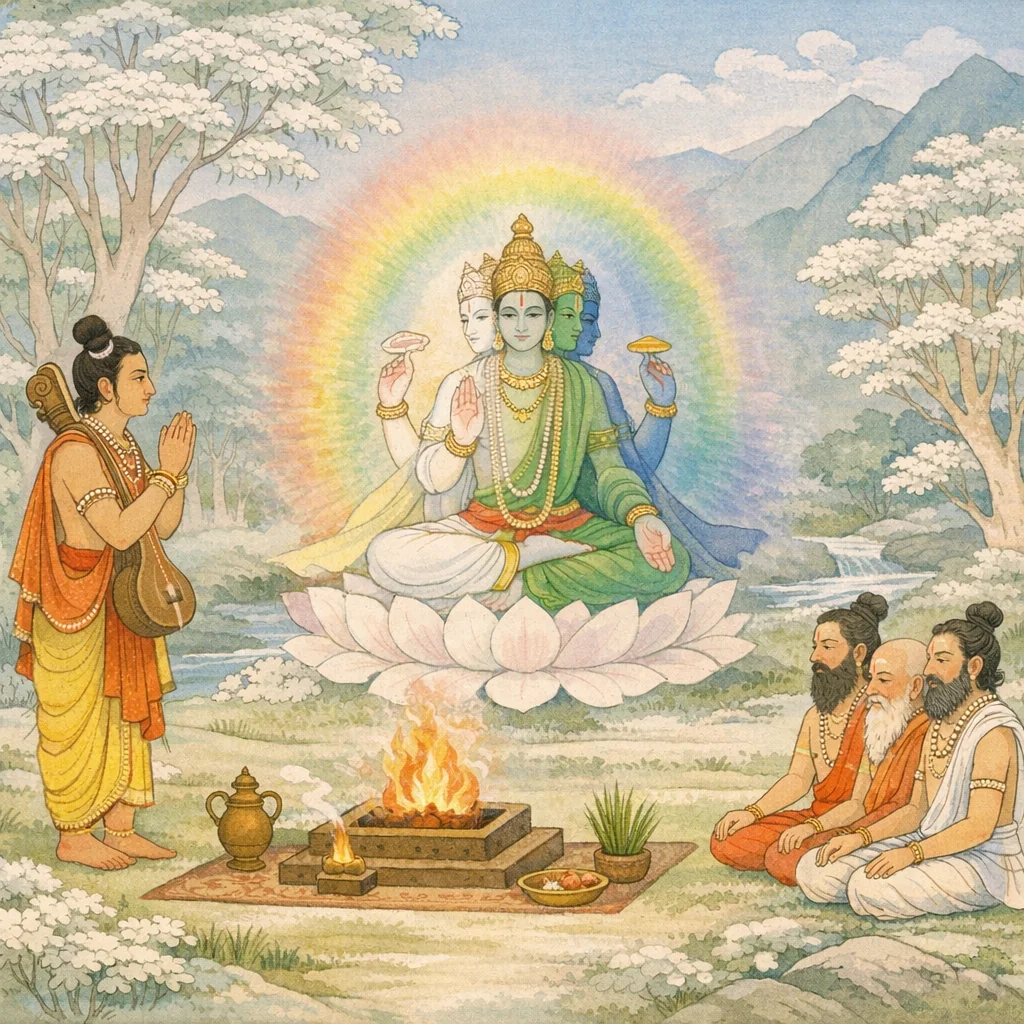
Adhyaya 340
धर्मस्य बहुद्वारत्वम् — Nārada’s Audience with Indra (Śānti-parva 340)
Upa-parva: Mokṣa-dharma (Liberation Teachings) — Nārada–Indra Exemplum Cluster
Yudhiṣṭhira requests Bhīṣma to articulate the श्रेष्ठ dharma for those situated in the āśrama framework, noting Bhīṣma’s prior mokṣadharma-grounded teachings. Bhīṣma replies with a general thesis: dharma is universally enjoined, yields verifiable outcomes aligned with truth, and because it is बहुद्वार (multi-access), no sincere practice is inherently futile. He adds an epistemic caution: persons tend to recognize as definitive the conclusion they reach in a given domain, implying the need for authoritative exempla and disciplined inquiry. To anchor the discussion, Bhīṣma introduces a received narrative: Nārada once approached Indra’s abode, was honored, and questioned by Indra about any remarkable observations from his three-world traversal. Indra frames Nārada as an omniscient-like witness with no unknown in the world, requesting a report of what he has heard, experienced, or seen. Nārada then begins a विस्तृत (extended) account, and Bhīṣma invites Yudhiṣṭhira to listen in the same manner as Indra did, establishing the chapter as a proem to subsequent instruction.
Chapter Arc: युधिष्ठिर के शोक-शांत मन में भीष्म एक दिव्य उपाख्यान का द्वार खोलते हैं—श्वेतद्वीप में नारद को स्वयं भगवान् का साक्षात् दर्शन हुआ, और उस दर्शन में परम रहस्य प्रकट हुआ। → नारद श्वेतद्वीप के अलौकिक लोक में प्रवेश करते हैं, जहाँ इन्द्रिय-आहार-रहित, चन्द्रकान्ति-सम भक्तजन एकाग्र होकर केवल भगवान् के चिन्तन में स्थित हैं। वहाँ भगवान् का रूप क्षण-क्षण बदलती प्रभा में दीखता है—कहीं चन्द्र से अधिक विशुद्ध, कहीं अग्निवर्ण, कहीं तोते-पंख सा हरित, कहीं स्फटिक-सा उज्ज्वल, कहीं नीलाञ्जन-सा गम्भीर—और उनके पास वेदी, कमण्डलु, मणि, कुश, अजिन, दण्ड, तथा ज्वलित हुताशन जैसे वैदिक-दैवी चिह्न उपस्थित हैं। इस बहुरूपता के भीतर ‘एक’ को पहचानने का प्रश्न तीव्र होता जाता है। → भगवान् नारद को अपने व्यूह-स्वरूपों का परिचय कराते हैं—वासुदेव, संकर्षण आदि के रूप में अपनी दिव्य व्यवस्था का रहस्य बताते हैं, और साथ ही लोकहितार्थ अवतार-कार्य का संकेत देते हैं: नरक (भौम), मुर, पीठ आदि दानवों का वध, प्राग्ज्योतिषपुर का दमन—यह सब धर्म-स्थापन के लिए होने वाला है। → नारद यह दिव्य संवाद देवताओं तक पहुँचाते हैं; परम्परा से यह ज्ञान आगे बढ़ता है। भीष्म युधिष्ठिर से कहते हैं कि यह उपाख्यान उन्होंने नारद-वचन के आधार पर, पितृ-परम्परा से प्राप्त रूप में सुनाया है। निष्कर्ष स्पष्ट होता है—पुरुषोत्तम ही जगत् के माता-पिता और गुरु हैं; राजन् को उनकी निरन्तर पूजा और अनन्य भक्ति में स्थित होना चाहिए।
Shlokas
Verse 1
अरी-क्ा् एकोनचत्वारिशर्दाधिकत्रिशततमो< ध्याय: श्वेतद्वीपमें नारदजीको भगवान्का दर्शन, भगवान्का वासुदेव-संकर्षण आदि अपने व्यूह स्वरूपोंका परिचय कराना और भविष्यमें होनेवाले अवतारोंके कार्योकी सूचना देना और इस कथाके श्रवण-पठनका माहात्म्य भीष्म उवाच एवं स्तुत: स भगवान् गुहौस्तथ्यैश्व नामभि: । त॑ मुनि दर्शयामास नारदं विश्वरूपधृक्,भीष्मजी कहते हैं--युधिष्ठिर! इस प्रकार गुह्म तथा सत्य नामोंसे जब नारदजीने भगवानकी स्तुति की, तब उन्होंने विश्वरूप धारण करके उन्हें दर्शन दिया
Bhishma said: When the Blessed Lord had thus been praised by the names ‘Guhya’ and ‘Satya’, He—assuming the universal form—granted His vision to the sage Narada. The passage underscores that sincere, truth-aligned devotion draws divine revelation, and that the Lord discloses Himself in forms suited to the seeker’s capacity.
Verse 2
किंचिच्चन्द्राद् विशुद्धात्मा किंचिच्चन्द्राद् विशेषवान् | कृशानुवर्ण: किंचिच्च किंचिद्धिष्ण्याकृति: प्रभु:,उनका वह स्वरूप कुछ चन्द्रमासे भी अधिक निर्मल और कुछ चन्द्रमासे भी विलक्षण था। कुछ अग्निके समान देदीप्यमान और कुछ नक्षत्रोंक समान जाज्वल्यमान था
Verse 3
शुकपत्रनिभ: किंचित् किंचित्स्फटिकसंनिभ: । नीलाञठ्जनचयप्रख्यो जातरूपप्रभ: क्वचित्,कुछ तोतेकी पाँखके समान हरा, कुछ स्फटिकमणिके समान उज्ज्वल, कहींसे कज्जलराशिके समान काला और कहींसे सुवर्णके समान कान्तिमान् था
Bhīṣma said: “It appeared in shifting hues—at times green like a parrot’s feather, at times bright like crystal; somewhere it looked dark like a heap of collyrium, and elsewhere it shone with the radiance of gold.”
Verse 4
प्रवालाड्कुरवर्णश्न श्वेतवर्णस्तथा क्वचित् | क्वचित् सुवर्णवर्णाभो वैदूर्यसदृश: क्वचित्,कहीं नवांकुरित पल्लवके समान था। कहीं श्वेतवर्ण दिखायी देता था, कहीं सुनहरी आभा दिखायी देती थी और कहीं-कहीं वैदूर्यमणिकी-सी छटा छिटक रही थी
Bhīṣma said: “At times it appeared like the hue of fresh coral-red sprouts; at times it looked white. Sometimes it shone with a golden radiance, and sometimes it displayed a luster like the vaidūrya gem.”
Verse 5
नीलवैदूर्यसदृश इन्द्रनीलनिभ: क्वचित् | मयूरग्रीववर्णा भो मुक्ताहारनिभ: क्वचित्,कहीं नीलवैदूर्य, कहीं इन्द्रनीलमणि, कहीं मोरकी ग्रीवाके सदृश वर्ण और कहीं मोतीके हारकी-सी कान्ति दृष्टिगोचर होती थी
Bhīṣma said: “At times its lustre appeared like blue vaidūrya (cat’s-eye), at times like the sapphire (indranīla); sometimes it showed the hue of a peacock’s neck, and sometimes it shone like a necklace of pearls.”
Verse 6
एतान् बहुविधान् वर्णान् रूपैर्बिभ्रत्सनातन: । सहस्ननयन: श्रीमान् शतशीर्ष: सहस्रपात्
Bhīṣma said: “That Eternal Being assumes these many kinds of forms and appearances. Radiant with majesty, He is described as having a thousand eyes, a hundred heads, and a thousand feet.”
Verse 7
ओड्कारमुद्गिरन् वकत्रात् सावित्रीं तदन््वयाम्,सबको वशमें रखनेवाले वे भगवान् नारायण हरि एक मुखसे तो ओड़्कार तथा उससे सम्बन्ध रखनेवाली गायत्रीका जप करते थे एवं अन्यान्य मुखोंसे चारों वेदों और उनके आरण्यकभागका गान कर रहे थे
Bhishma said: From one of His mouths, the blessed Lord Narayana Hari—who brings all beings under His governance—uttered the sacred syllable Om and recited the Savitri (Gayatri) connected with it; and with His other mouths He simultaneously chanted the four Vedas along with their Aranyaka portions.
Verse 8
शेषेभ्यश्चैव वक््त्रेभ्यश्तुर्वेदान् गिरन् बहुन् । आरण्यकं जगौ देवो हरिनारायणो वशी,सबको वशमें रखनेवाले वे भगवान् नारायण हरि एक मुखसे तो ओड़्कार तथा उससे सम्बन्ध रखनेवाली गायत्रीका जप करते थे एवं अन्यान्य मुखोंसे चारों वेदों और उनके आरण्यकभागका गान कर रहे थे
Bhishma said: “From his remaining mouths, the self-mastered Lord Hari-Nārāyaṇa chanted the four Vedas in many recitations, and he also sang the Āraṇyaka portions. Thus, while one mouth was engaged in the sacred utterance and the Gāyatrī connected with it, the other mouths continuously voiced the Vedic revelation.”
Verse 9
वेदिं कमण्डलुं शुभ्रान् मणीनुपानहौ कुशान् | अजिन् दण्डकाष्ठं च ज्वलितं च हुताशनम्
Bhīṣma said: “(He possessed) the sacrificial altar, the water-pot, bright gems, sandals, and sacred kuśa grass; also the antelope-skin and the staff-wood, and the blazing sacrificial fire.”
Verse 10
त॑ प्रसन्न प्रसन्नात्मा नारदो द्विजसत्तम:
Bhīṣma said: “Nārada—the foremost among the twice-born—approached him with a serene countenance and a heart made tranquil.”
Verse 11
तमुवाच नत मूर्ध्ना देवानामादिरव्यय:,मस्तक झुकाकर चरणोंमें पड़े हुए नारदजीसे देवताओंके आदिकारण अविनाशी श्रीहरिने इस प्रकार कहा
Bhishma said: “Then the imperishable Lord Hari, the primordial cause of the gods, addressed Narada—who had bowed his head and fallen at His feet—speaking in this manner.”
Verse 12
श्रीभगवानुवाच एकतक्ष द्वितश्वैव त्रितश्वैव महर्षय: । इमं देशमनुप्राप्ता मम दर्शनलालसा:,श्रीभगवान् बोले--देवर्षे! महर्षि एकत, द्वित और त्रित--ये सब भी मेरे दर्शनकी इच्छासे इस स्थानपर आये हुए थे
The Blessed Lord said: “O divine sage! The great seers Ekata, Dvita, and Trita also came to this very place, eager for the vision of Me.”
Verse 13
नच मां ते ददृशिरे न च द्रक्ष्यति कश्नन । ऋते हौकान्तिकश्रेष्ठात् त्वं चैवैकान्तिकोत्तम:,किंतु उन्हें मेरा दर्शन न प्राप्त हो सका। वास्तवमें मेरे अनन्य भक्तके सिवा और कोई मनुष्य मेरा दर्शन नहीं कर सकता। तुम तो मेरे अनन्य भक्तोंमें श्रेष्ठ हो; इसीलिये तुम्हें मेरा दर्शन हुआ है
Others have neither seen Me, nor will anyone else see Me. Except for the foremost among single-minded devotees, no person can truly behold Me. You are the best among those unwaveringly devoted to Me; therefore you were granted My vision.
Verse 14
ममैतास्तनव: श्रेष्ठा जाता धर्मगृहे द्विज । तास्त्वं भजस्व सततं साधयस्व यथागतम्,विप्रवर! धर्मके घरमें जो अवतीर्ण हुए हैं, वे नर-नारायण आदि चारों भाई मेरे ही स्वरूप हैं; अतः तुम सदा उनका भजन किया करो तथा जो कार्य प्राप्त हो, उसका साधन करो
Bhishma said: “O twice-born one, these excellent manifestations are born in the house of Dharma and are in truth my own forms. Therefore, O best of Brahmins, worship them constantly, and accomplish whatever duty comes to you in due course, as it arrives.”
Verse 15
वृणीष्व च वर विप्र मत्तस्त्वं यदिहेच्छसि । प्रसन्नो5हं तवाद्येह विश्वमूर्तिरिहाव्यय:,द्विजश्रेष्ठ! मैं अविनाशी विश्वरूप परमेश्वर आज तुमपर प्रसन्न हुआ हूँ; अतः तुम मुझसे जो कुछ चाहते हो, वह वर माँग लो
Bhishma said: “O Brahmin, choose a boon from me—whatever you desire here. Today I am pleased with you here, I who am the imperishable Lord of the universe in cosmic form; therefore ask of me whatever you wish.”
Verse 16
नारद उवाच अद्य मे तपसो देव यमस्य नियमस्य च । सद्यः फलमवाप्तं॑ वै दृष्टो यदू भगवान् मया,नारदजीने कहा--देव! जब मैंने आप भगवानका दर्शन पा लिया, तब मुझे तप, यम और नियम--सबका फल तत्काल ही मिल गया
Narada said: “O Lord, today I have at once obtained the fruit of my austerities, and of my disciplines of restraint and observance; for I have beheld the Blessed One with my own eyes.”
Verse 17
वर एष ममात्यन्तं दृष्टस्त्वं यत्ू सनातन: । भगवन् विश्वदृक् सिंह: सर्वमूर्तिर्महान् प्रभु:,भगवन्! आप सम्पूर्ण विश्वके द्रष्टा, सिंहके समान निर्भय, सर्वस्वरूप, महान् एवं सनातन प्रभु हैं। आपका जो दर्शन हो गया, यही मेरे लिये सबसे बड़ा वरदान है
Nārada said: “This is the supreme boon for me—that I have beheld you, the Eternal One. O Blessed Lord, you are the seer of the whole universe, fearless like a lion, assuming all forms, the great and sovereign Master. To have your vision is itself my highest reward.”
Verse 18
भीष्म उवाच एवं संदर्शयित्वा तु नारदं परमेछिनम् उवाच वचन भूयो गच्छ नारद मा चिरम्,भीष्मजी कहते हैं--युधिष्ठिर! इस प्रकार दर्शन देकर भगवानने ब्रह्मपुत्र नारदजीसे फिर कहा, “नारद! जाओ, विलम्ब न करो
Bhishma said: “O Yudhishthira, having thus granted his vision to Narada, the son of Brahma, the Lord again addressed him: ‘Narada, go—do not delay.’”
Verse 19
इमे हानिन्द्रियाहारा मद्धक्ता श्चन्द्रवर्चस: | एकाग्राश्निन्तयेयुर्मा नैषां विघ्नो भवेदिति,'ये इन्द्रिय और आहारसे शून्य, चन्द्रमाके समान कान्तिमान् मेरे भक्तजन एकाग्रभावसे मेरा चिन्तन कर सकें और इनके ध्यानमें किसी प्रकारका विघ्न न हो, इसके लिये तुम्हें यहाँसे चले जाना चाहिये
Bhishma said: “These devotees of mine—free from the demands of the senses and from dependence on food, radiant like the moon—should be able to contemplate me with single-pointed concentration. So that no obstacle may arise in their meditation, you ought to depart from this place.”
Verse 20
सिद्धा होते महाभागा: पुरा होकान्तिनो5भवन् | तमोरजोभिरननिमिुक्ता मां प्रवेक्ष्यन्त्यसंशयम्,“यहाँ निवास करनेवाले ये सभी महाभाग सिद्ध हो चुके हैं। ये पहले भी मेरे अनन्य भक्त रहे हैं। ये तमोगुण और रजोगुणसे मुक्त हैं; अतः निःसंदेह मुझमें ही प्रवेश करेंगे
Bhīṣma said: “All these blessed beings who dwell here have already attained perfection. Even in former times they were my exclusive devotees. Freed from the darkness of tamas and the agitation of rajas, they will, without doubt, enter into Me alone.”
Verse 21
'जो नेत्रोंसे देखा नहीं जाता, त्वचासे जिसका स्पर्श नहीं होता, गन्ध ग्रहण करनेवाली प्राणेन्द्रियसे जो सूँघनेमें नहीं आता, जो रसनेन्द्रियकी पहुँचसे परे है; सत्त्व, रज और तम नामक गुण जिसपर कोई प्रभाव नहीं डाल पाते, जो सर्वव्यापी, साक्षी और सम्पूर्ण जगत्का आत्मा कहलाता है, सम्पूर्ण प्राणियोंका नाश हो जानेपर भी जो स्वयं नष्ट नहीं होता है, जिसे अजन्मा, नित्य, सनातन, निर्गुण और निष्कल बताया गया है, जो चौबीस तत्त्वोंसे परे पचीसवें तत्त्वके रूपमें विख्यात है, जिसे अन्तर्यामी पुरुष, निष्क्रिय तथा ज्ञानमय नेत्रोंसे ही देखने योग्य बताया जाता है, जिसमें प्रवेश करके श्रेष्ठ द्विज यहाँ मुक्त हो जाते हैं, वही सनातन परमात्मा है। उसीको वासुदेव नामसे जानना चाहिये
Bhishma said: That Reality which cannot be seen by the eyes, cannot be touched by the skin, cannot be smelled by the organ that apprehends scent, and lies beyond the reach of taste; upon which the qualities called sattva, rajas, and tamas have no power; which is all-pervading, the Witness, and is spoken of as the Self of the entire universe; which does not perish even when all beings perish; which is declared unborn, eternal, primeval, without attributes, and partless; which is renowned as the twenty-fifth principle beyond the twenty-four; which is described as the Inner Ruler, the inactive Person, to be beheld only with eyes made of knowledge—entering into which the best of the twice-born attain liberation here: that alone is the everlasting Supreme Self. That should be known by the name Vāsudeva.
Verse 22
सत्त्वं रजस्तमश्वैव न गुणास्तं भजन्ति वै । यश्न सर्वगतः साक्षी लोकस्यात्मेति कथ्यते,'जो नेत्रोंसे देखा नहीं जाता, त्वचासे जिसका स्पर्श नहीं होता, गन्ध ग्रहण करनेवाली प्राणेन्द्रियसे जो सूँघनेमें नहीं आता, जो रसनेन्द्रियकी पहुँचसे परे है; सत्त्व, रज और तम नामक गुण जिसपर कोई प्रभाव नहीं डाल पाते, जो सर्वव्यापी, साक्षी और सम्पूर्ण जगत्का आत्मा कहलाता है, सम्पूर्ण प्राणियोंका नाश हो जानेपर भी जो स्वयं नष्ट नहीं होता है, जिसे अजन्मा, नित्य, सनातन, निर्गुण और निष्कल बताया गया है, जो चौबीस तत्त्वोंसे परे पचीसवें तत्त्वके रूपमें विख्यात है, जिसे अन्तर्यामी पुरुष, निष्क्रिय तथा ज्ञानमय नेत्रोंसे ही देखने योग्य बताया जाता है, जिसमें प्रवेश करके श्रेष्ठ द्विज यहाँ मुक्त हो जाते हैं, वही सनातन परमात्मा है। उसीको वासुदेव नामसे जानना चाहिये
Bhīṣma said: That Supreme Self is not conditioned by the three guṇas—sattva, rajas, and tamas. He is described as all-pervading, the inner Witness, and the very Self of the world. In this teaching, Bhīṣma directs the listener away from sensory and material measures of reality and toward the imperishable ground of dharma: the unborn, eternal, attributeless Lord who remains unchanged even when all beings perish, and who is to be known as Vāsudeva.
Verse 23
न दृश्यक्षक्षुषा योडसौ न स्पृश्य: स्पर्शनेन च । न प्रेयश्वैव गन्धेन रसेन च विवर्जित:,भूतग्रामशरीरेषु नश्यत्सु न विनश्यति । अजो नित्य: शाश्वतश्न निर्गुणो निष्कलस्तथा 'जो नेत्रोंसे देखा नहीं जाता, त्वचासे जिसका स्पर्श नहीं होता, गन्ध ग्रहण करनेवाली प्राणेन्द्रियसे जो सूँघनेमें नहीं आता, जो रसनेन्द्रियकी पहुँचसे परे है; सत्त्व, रज और तम नामक गुण जिसपर कोई प्रभाव नहीं डाल पाते, जो सर्वव्यापी, साक्षी और सम्पूर्ण जगत्का आत्मा कहलाता है, सम्पूर्ण प्राणियोंका नाश हो जानेपर भी जो स्वयं नष्ट नहीं होता है, जिसे अजन्मा, नित्य, सनातन, निर्गुण और निष्कल बताया गया है, जो चौबीस तत्त्वोंसे परे पचीसवें तत्त्वके रूपमें विख्यात है, जिसे अन्तर्यामी पुरुष, निष्क्रिय तथा ज्ञानमय नेत्रोंसे ही देखने योग्य बताया जाता है, जिसमें प्रवेश करके श्रेष्ठ द्विज यहाँ मुक्त हो जाते हैं, वही सनातन परमात्मा है। उसीको वासुदेव नामसे जानना चाहिये
Bhīṣma said: That Supreme Reality is not an object of sight for the eye, nor can it be touched by the organ of touch; it is not grasped by smell, and it lies beyond taste as well. When the bodies of all beings perish, it does not perish. It is unborn, eternal, everlasting—beyond the guṇas and without parts. In this teaching, Bhīṣma points Yudhiṣṭhira toward the imperishable Self that remains untouched by sensory change and bodily destruction, grounding ethical life in the recognition of an unchanging inner reality.
Verse 24
द्विर्दावशेभ्यस्तत्त्वेभ्य: ख्यातो य: पञजचविंशक: । पुरुषो निष्क्रियश्वैव ज्ञानदृश्यश्ष॒ कथ्यते,'जो नेत्रोंसे देखा नहीं जाता, त्वचासे जिसका स्पर्श नहीं होता, गन्ध ग्रहण करनेवाली प्राणेन्द्रियसे जो सूँघनेमें नहीं आता, जो रसनेन्द्रियकी पहुँचसे परे है; सत्त्व, रज और तम नामक गुण जिसपर कोई प्रभाव नहीं डाल पाते, जो सर्वव्यापी, साक्षी और सम्पूर्ण जगत्का आत्मा कहलाता है, सम्पूर्ण प्राणियोंका नाश हो जानेपर भी जो स्वयं नष्ट नहीं होता है, जिसे अजन्मा, नित्य, सनातन, निर्गुण और निष्कल बताया गया है, जो चौबीस तत्त्वोंसे परे पचीसवें तत्त्वके रूपमें विख्यात है, जिसे अन्तर्यामी पुरुष, निष्क्रिय तथा ज्ञानमय नेत्रोंसे ही देखने योग्य बताया जाता है, जिसमें प्रवेश करके श्रेष्ठ द्विज यहाँ मुक्त हो जाते हैं, वही सनातन परमात्मा है। उसीको वासुदेव नामसे जानना चाहिये
Bhishma said: That Reality which is renowned as the twenty-fifth principle beyond the twenty-four constituents is called the Puruṣa. He is actionless, and is to be apprehended only by the eye of knowledge. Entering into Him, the best of the twice-born attain liberation here; therefore that eternal Supreme Self should be understood as Vāsudeva.
Verse 25
यं प्रविश्य भवन्तीह मुक्ता वै द्विजसत्तमा: । स वासुदेवो विज्ञेय: परमात्मा सनातन:,'जो नेत्रोंसे देखा नहीं जाता, त्वचासे जिसका स्पर्श नहीं होता, गन्ध ग्रहण करनेवाली प्राणेन्द्रियसे जो सूँघनेमें नहीं आता, जो रसनेन्द्रियकी पहुँचसे परे है; सत्त्व, रज और तम नामक गुण जिसपर कोई प्रभाव नहीं डाल पाते, जो सर्वव्यापी, साक्षी और सम्पूर्ण जगत्का आत्मा कहलाता है, सम्पूर्ण प्राणियोंका नाश हो जानेपर भी जो स्वयं नष्ट नहीं होता है, जिसे अजन्मा, नित्य, सनातन, निर्गुण और निष्कल बताया गया है, जो चौबीस तत्त्वोंसे परे पचीसवें तत्त्वके रूपमें विख्यात है, जिसे अन्तर्यामी पुरुष, निष्क्रिय तथा ज्ञानमय नेत्रोंसे ही देखने योग्य बताया जाता है, जिसमें प्रवेश करके श्रेष्ठ द्विज यहाँ मुक्त हो जाते हैं, वही सनातन परमात्मा है। उसीको वासुदेव नामसे जानना चाहिये
Bhishma said: “That Reality, entering into which the best of the twice-born become liberated here, is to be understood as Vāsudeva—the eternal Supreme Self.”
Verse 26
पश्य देवस्य माहात्म्यं महिमानं च नारद | शुभाशुभै: कर्मभियों न लिप्पति कदाचन,“नारद! उस परमात्मदेवका माहात्म्य और महिमा तो देखो, जो शुभाशुभ कर्मोंसे कभी लिप्त नहीं होता है
Bhishma said: “Behold, O Nārada, the greatness and majesty of the Divine. Though actions may be auspicious or inauspicious, He is never tainted by them at any time.”
Verse 27
सत्त्वं रजस्तमश्नेति गुणानेतान् प्रचक्षते । यत्ते सर्वशरीरेषु तिष्ठन्ति विचरन्ति च
Bhīṣma said: These are declared to be the three guṇas—sattva, rajas, and tamas. They abide in all embodied beings and continually move and operate within them, shaping conduct and experience.
Verse 28
'सत्त्व, रज और तम--ये तीन गुण बताये जाते हैं, जो सम्पूर्ण शरीरोंमें स्थित रहते हैं और विचरते हैं ।। एतान् गुणांस्तु क्षेत्रज्ो भुड्क्ते नैभि: स भुज्यते | निर्गुणो गुणभुक् चैव गुणस्रष्टा गुणाधिक:,“इन गुणोंको क्षेत्रज्ञ स्वयं भोगता है, किंतु इन गुणोंके द्वारा वह क्षेत्रज्ञ भोगा नहीं जाता; क्योंकि वह निर्गुण, गुणोंका भोक्ता, गुणोंका स्रष्टा तथा गुणोंसे उत्कृष्ट है
Bhishma said: Sattva, rajas, and tamas are declared to be the three qualities; they abide in all embodied beings and move about within them. Yet it is the Knower of the Field (the conscious self) who experiences these qualities; the self is not itself experienced or overpowered by them. For the self is beyond qualities—an experiencer of the qualities, the source from which their play is projected, and superior to them all.
Verse 29
जगत्प्रतिष्ठा देवर्षे पृथिव्यप्सु प्रलीयते । ज्योतिष्याप: प्रलीयन्ते ज्योतिर्वायौ प्रलीयते,'देवर्ष! यह सम्पूर्ण जगत् जिसपर प्रतिष्ठित है, वह पृथ्वी जलमें विलीन हो जाती है। जलका तेजमें और तेजका वायुमें लय होता है
Bhīṣma said: “O divine seer, the earth—on which the whole world stands—dissolves into water. Water, in turn, is absorbed into light (fire), and that light is absorbed into wind. Thus, what seems most solid and dependable is shown to be contingent, moving toward subtler principles in the cosmic dissolution.”
Verse 30
खे वायु: प्रलयं याति मनस्थाकाशमेव च । मनो हि परम भूतं तदव्यक्ते प्रलीयते,“वायुका आकाभशमें लय होता है, आकाश मनमें विलीन होता है। मन उत्कृष्ट भूत है। वह अव्यक्त प्रकृतिमें लीन होता है
Bhīṣma said: At dissolution, the wind merges into space, and space itself merges into the mind. The mind is indeed the highest of the elemental principles; and that mind, in turn, dissolves into the Unmanifest (Prakṛti). In this teaching, Bhīṣma traces the inward course of dissolution to show that what seems most solid and external finally resolves into subtler causes, urging the listener toward detachment and discernment of the ultimate ground beyond sensory phenomena.
Verse 31
अव्यक्तं पुरुषे ब्रह्मन् निष्क्रिये सम्प्रलीयते । नास्ति तस्मात् परतर: पुरुषाद् वै सनातनात्,“ब्रह्मन्! अव्यक्तका निष्क्रिय पुरुषमें लय होता है। उस सनातन पुरुषसे उत्त्कृष्ट दूसरी कोई वस्तु नहीं है
Bhishma said: “O Brahmin, the unmanifest principle dissolves into the actionless Person. Therefore, beyond that eternal Person there is nothing higher.”
Verse 32
नित्यं हि नास्ति जगति भूतं स्थावरजड्भमम् | ऋते तमेक॑ पुरुषं वासुदेव॑ सनातनम्,'संसारमें उस एकमात्र सनातन पुरुष वासुदेवको छोड़कर कोई भी चराचर भूत नित्य नहीं है
Bhīṣma said: In this world, nothing among beings—whether immobile or moving—is truly eternal. Only that one everlasting Person, Vāsudeva, stands apart from the perishable flow of saṃsāra. The teaching directs the mind from attachment to transient forms toward devotion to the imperishable divine reality.
Verse 33
सर्वभूतात्मभूतो हि वासुदेवो महाबल: । पृथिवी वायुराकाशमापो ज्योतिश्न॒ पञचमम्
Bhīṣma said: “Vāsudeva, mighty in power, has become the very Self (Ātman) of all beings. Earth, wind, space, water, and light—these five great elements are encompassed in him.”
Verse 34
“महाबली वासुदेव सम्पूर्ण भूतोंके आत्मा हैं। पृथ्वी, जल, तेज, वायु और आकाश--ये पाँच महाभूत हैं ।। ते समेता महात्मान: शरीरमिति संज्ञितम् । तदा विशति यो ब्रद्यान्नदृश्यो लघुविक्रम:,“वे सब महाभूत एक साथ मिलकर ही शरीर नाम धारण करते हैं। ब्रह्म! उस समय अदृश्यभावसे जो शीघ्रगामी चेतन उसमें प्रवेश करता है, वही जीवात्मा है
Bhīṣma said: “Mighty Vāsudeva is the inner Self of all beings in their entirety. Earth, water, fire, wind, and space—these are the five great elements. When these great elements come together, they are collectively designated as the ‘body’. Then, O Brahmin, the unseen, swift-moving conscious principle that enters into it is what is called the individual self (jīva).”
Verse 35
उत्पन्न एव भवति शरीर चेष्टयन् प्रभु: । न विना धातुसंघातं शरीरं भवति क्वचित्,“उसका शरीरमें प्रवेश करना ही उत्पन्न होना बताया जाता है। वही शरीरको चेष्टाशील बनाता है। वही इसके संचालनमें समर्थ है। कहीं भी पाँचों भूतोंके मिलित समुदायके बिना कोई शरीर नहीं होता
“Its entering into the body is what is spoken of as ‘birth’. It makes the body active and is able to direct its workings. Nowhere does any body exist without the combined aggregate of the elements.”
Verse 36
न च जीवं विना ब्रह्मन् वायवश्रैष्टयन्त्युत । स जीव: परिसंख्यात: शेष: संकर्षण: प्रभु:,“ब्रह्मम! जीवके बिना प्राणवायु चेष्टा नहीं करती। वह जीव ही शेष या भगवान् संकर्षण कहा गया है
Bhīṣma said: “O Brahmin, without the jīva, even the vital winds (prāṇa) do not set themselves into activity. That very jīva is spoken of as Śeṣa—indeed the Lord Saṅkarṣaṇa—who upholds and draws together the powers of life.”
Verse 37
तस्मात् सनत्कुमारत्वं योडलभत् स्वेन कर्मणा । यस्मिंश्न॒ सर्वभूतानि प्रलयं यान्ति संक्षयम्
Bhīṣma said: “Therefore, by his own deeds he attained the state of Sanatkumāra—he in whom all beings, at the time of dissolution (pralaya), pass into final destruction.”
Verse 38
तस्मात् प्रसूतो यः कर्ता कारणं कार्यमेव च,“उस प्रद्यम्नसे जिसकी उत्पत्ति हुई है, वह (अहंकार ही) तन्मात्रा आदिका कर्ता, परम्परा-सम्बन्धसे महाभूतोंका कारण तथा महत्तत्त्वका कार्य है
Bhishma said: Therefore, that which is born from it becomes the agent (the doer); it is itself both cause and effect—producing the subtle elements (tanmātras) and, through an unbroken chain of succession, serving as the cause of the great elements (mahābhūtas), while standing as an effect of the principle of Mahat.
Verse 39
तस्मात् सर्व सम्भवति जगत् स्थावरजड्रमम् । सोडनिरुद्ध: स ईशानो व्यक्त: स सर्वकर्मसु,“उसीसे समस्त चराचर जगतकी उत्पत्ति होती है। वही “अनिरुद्ध/ एवं “ईशान' कहलाता है। वह (कर्तृत्वके अभिमानरूपसे) सम्पूर्ण कर्मोामें व्यक्त होता है
Bhishma said: From Him the entire universe comes into being—both the immovable and the insentient. He is known as Aniruddha and as Īśāna; and He becomes manifest in all actions, as the inner agent through whom deeds are carried out.
Verse 40
यो वासुदेवो भगवान क्षेत्रज्ञो निर्गुणात्मकः । ज्ञेय: स एव राजेन्द्र जीव: संकर्षण: प्रभु:,'राजेन्द्र! जो भगवान् वासुदेव क्षेत्रज्ञस्वरूप एवं निर्गुणरूपसे जाननेयोग्य बताये गये हैं, वे ही प्रभावशाली संकर्षणरूप जीवात्मा हैं। संकर्षणसे प्रद्युम्नका प्रादुर्भाव हुआ है, जो मनोमय कहलाते हैं। प्रद्युम्मसे जो अनिरुद्ध प्रकट हुए हैं, वे ही अहंकार और ईश्वर हैं
Bhīṣma said: “O king, that very Blessed Lord Vāsudeva—known as the Knower of the Field (kṣetrajña), the inner witness, and as beyond the guṇas—is to be understood as the sovereign Saṅkarṣaṇa, the living self (jīva), the Lord.”
Verse 41
संकर्षणाच्च प्रद्युम्नो मनो भूत: स उच्यते । प्रद्युम्नाद् योडनिरुद्धस्तु सो5हंकार: स ईश्वर:,'राजेन्द्र! जो भगवान् वासुदेव क्षेत्रज्ञस्वरूप एवं निर्गुणरूपसे जाननेयोग्य बताये गये हैं, वे ही प्रभावशाली संकर्षणरूप जीवात्मा हैं। संकर्षणसे प्रद्युम्नका प्रादुर्भाव हुआ है, जो मनोमय कहलाते हैं। प्रद्युम्मसे जो अनिरुद्ध प्रकट हुए हैं, वे ही अहंकार और ईश्वर हैं
Bhishma said: “From Saṅkarṣaṇa arises Pradyumna, who is spoken of as the principle of mind (manas). From Pradyumna arises Aniruddha; he is the principle of ‘I’-sense (ahaṅkāra) and is also called the Lord (Īśvara).”
Verse 42
मत्त: सर्व सम्भवति जगत् स्थावरजड्भमम् | अक्षरं च क्षरं चैव सच्चासच्चैव नारद,“नारद! मुझसे ही समस्त स्थावर-जंगमरूप जगत्की उत्पत्ति होती है। क्षर और अक्षर तथा असत् और सत् भी मुझसे ही प्रकट हुए हैं
Bhīṣma said: “O Nārada, from me arises this entire world—both the immobile and the moving. From me also manifest the imperishable (akṣara) and the perishable (kṣara), and likewise being (sat) and non-being (asat).”
Verse 43
मां प्रविश्य भवन्तीह मुक्ता भक्तास्तु ये मम । अहं हि पुरुषो ज्ञेयो निष्क्रिय: पजचविंशक:,'यहाँ जो मेरे भक्त हैं, वे मुझमें ही प्रवेश करके मुक्त होते हैं। मैं ही पचीसवें तत्त्व निष्क्रिय पुरुषरूपसे जानने योग्य हूँ
Bhishma said: “Those who are devoted to me attain liberation here by entering into me alone. I am to be known as the inactive Puruṣa—the twenty-fifth principle—standing apart from all action and change.”
Verse 44
निर्गुणो निष्कलश्रैव निर्द्धन्द्ो निष्परिग्रह: । एतत् त्वया न विज्ञेयं रूपवानिति दृश्यते
Bhīṣma said: “He is without qualities, without parts, beyond the pairs of opposites, and free from all possessions and attachments. This is not something you can grasp as an object of ordinary knowing—yet He is perceived as though endowed with form.”
Verse 45
माया होषा मया सृष्टा यन्मां पश्यसि नारद
Bhīṣma said: “Nārada, what you see as ‘me’ is only a māyā—an appearance fashioned by my own power.”
Verse 46
मयैतत् कथितं सम्यक् तव मूर्तिचतुष्टयम्,“मैंने अपने वासुदेव, संकर्षण आदि चार स्वरूपोंका तुम्हारे सामने भलीभाँति वर्णन किया है। मैं ही जीव नामसे प्रसिद्ध हूँ, मुझमें ही जीवकी स्थिति है; परंतु तुम्हारे मनमें ऐसा विचार नहीं उठना चाहिये कि मैंने जीवको देखा है
Bhīṣma said: “I have rightly explained to you my fourfold manifestation (the four mūrtis).”
Verse 47
अहं हि जीवसंज्ञातो मयि जीव: समाहित: । नैवं ते बुद्धिरत्राभूद् दृष्टो जीवो मयेति वै,“मैंने अपने वासुदेव, संकर्षण आदि चार स्वरूपोंका तुम्हारे सामने भलीभाँति वर्णन किया है। मैं ही जीव नामसे प्रसिद्ध हूँ, मुझमें ही जीवकी स्थिति है; परंतु तुम्हारे मनमें ऐसा विचार नहीं उठना चाहिये कि मैंने जीवको देखा है
Bhishma said: “I am indeed known by the name ‘jīva’ (the living self), and within me the jīva is established. Yet you should not form the notion here that ‘I have seen the jīva’—as though it were an object grasped by ordinary perception.”
Verse 48
अहं सर्वत्रगो ब्रह्मन् भूतग्रामान्तरात्मक: । भूतग्रामशरीरेषु नश्यत्सु न नशाम्यहम्,“ब्रह्मन्! मैं सर्वव्यायी और समस्त प्राणिसमुदायका अन्तरात्मा हूँ। सम्पूर्ण भूतसमुदाय और शरीरोंके नष्ट हो जानेपर भी मेरा नाश नहीं होता है
Bhishma said: “O Brahmin, I am all-pervading Brahman, the inner Self within the entire multitude of beings. Even when the whole host of creatures and their bodies perish, I do not perish.”
Verse 49
सिद्धा हि ते महाभागा नरा होकान्तिनो5भवन् । तमोरजो भ्यां निर्मुक्ता: प्रवेक्ष्यन्ति च मां मुने,“मुने! ये महाभाग श्वेतद्वीपनिवासी सिद्ध हैं। ये पहले मेरे अनन्य भक्त रहे हैं। ये तमोगुण और रजोगुणसे मुक्त हो गये हैं; इसलिये मेरे भीतर प्रवेश करेंगे
Bhishma said: “Those blessed men are indeed perfected; they were once wholly devoted to Me. Freed from the darkness of tamas and the agitation of rajas, they will enter into Me, O sage.”
Verse 50
हिरण्यगर्भो लोकादिद्षतुर्वक्त्रो डनिरुक्तग: । ब्रह्मा सनातनो देवो मम बह्नर्थचिन्तक:,“जो सम्पूर्ण जगत्के आदि, चतुर्मुख, अनिर्वचनीय-स्वरूप, हिरण्यगर्भ एवं सनातन देवता हैं, वे ब्रह्मा मेरे बहुत-से कार्योंका चिन्तन करनेवाले हैं
Bhishma said: “Brahmā—Hiraṇyagarbha, the primal source of the worlds, the four-faced one, whose nature is beyond full description, the eternal deity—keeps in mind and deliberates upon my many purposes and undertakings.”
Verse 51
ललाटाच्चैव मे रुद्रो देव: क्रोधाद् विनि:सृत: । पश्यैकादश मे रुद्रान् दक्षिणं पार््वमास्थितान्,“मेरे क्रोधवश ललाटसे मेरे ही रुद्रदेवका प्राकट्य हुआ है। देखो, ये ग्यारह रुद्र मेरे दाहिने भागमें विराजमान हैं
Bhishma said: “From my very forehead, through the force of anger, the god Rudra manifested forth. Behold—these eleven Rudras of mine are stationed upon my right side.”
Verse 52
द्वादशैव तथा55दित्यान् वामपाश्चे समास्थितान् । अग्रतश्वैव मे पश्य वसूनष्टौ सुरोत्तमान्,“इसी प्रकार मेरे बायें भागमें बारह आदित्य विराज रहे हैं। अग्रभागमें सुरश्रेष्ठ आठ वसु विद्यमान हैं। इन सबको प्रत्यक्ष देखो
Bhishma said: “In the same manner, behold the twelve Adityas stationed on my left side. And in front of me, see the eight Vasus, the foremost among the gods. Look upon them directly.”
Verse 53
नासत्यं चैव दस्लं च भिषजौ पश्य पृष्ठत: । सर्वान् प्रजापतीन् पश्य पश्य सप्त ऋषींस्तथा,'मेरे पृष्ठभागमें भी दृष्टिपात करो, जहाँ नासत्य और दख्न-ये दोनों देववैद्य अश्विनीकुमार स्थित हैं। इनके सिवा मेरे विभिन्न अंगोंमें समस्त प्रजापतियों, सप्तर्षियों, सम्पूर्ण वेदों, सैकड़ों यज्ञों, ओषधियों तथा अमृतको भी देखो। तप तथा नाना प्रकारके यम- नियम भी यहाँ मूर्तिमान् हैं
Bhishma said: “Look also behind me: there stand Nāsatya and Dasra, the two divine physicians—the Aśvin twins. And beyond them, behold within my various limbs all the Prajāpatis; behold also the Seven Seers.”
Verse 54
वेदान् यज्ञांश्र शतश: पश्यामृतमथौषधी: । तपांसि नियमांश्वैव यमानपि पृथग्विधान्,'मेरे पृष्ठभागमें भी दृष्टिपात करो, जहाँ नासत्य और दख्न-ये दोनों देववैद्य अश्विनीकुमार स्थित हैं। इनके सिवा मेरे विभिन्न अंगोंमें समस्त प्रजापतियों, सप्तर्षियों, सम्पूर्ण वेदों, सैकड़ों यज्ञों, ओषधियों तथा अमृतको भी देखो। तप तथा नाना प्रकारके यम- नियम भी यहाँ मूर्तिमान् हैं
Bhishma said: “Behold within me the Vedas and hundreds of sacrifices; behold also the nectar of immortality and the healing herbs. Here too are embodied austerities, disciplines, and the variously defined restraints (yamas) and observances (niyamas).”
Verse 55
तथाष्टगुणमैश्वर्यमेकस्थं पश्य मूर्तिमत् । श्रियं लक्ष्मी च कीर्ति च पृथिवीं च ककुझिनीम्,“आठ प्रकारके ऐश्वर्य भी यहाँ एक ही जगह साकाररूपसे प्रकट हैं, इन्हें देखो। श्री, लक्ष्मी, कीर्ति, पर्वतोंसहित पृथ्वी तथा वेदमाता सरस्वतीदेवी भी मेरे भीतर विराजमान हैं, उन सबका दर्शन करो। नारद! ये नक्षत्रोंमें श्रेष्ठ आकाशचारी ध्रुव दिखायी दे रहे हैं, इनकी ओर भी दृष्टिपात करो
Bhīṣma said: “So too, behold here—gathered in one place and made manifest—the eightfold forms of sovereign power. See Prosperity and Fortune, and also Fame; see the Earth, rich with her mountains.”
Verse 56
वेदानां मातरं पश्य मत्स्थां देवीं सरस्वतीम् | ध्रुवं च ज्योतिषां श्रेष्ठ पश्य नारद खेचरम्,“आठ प्रकारके ऐश्वर्य भी यहाँ एक ही जगह साकाररूपसे प्रकट हैं, इन्हें देखो। श्री, लक्ष्मी, कीर्ति, पर्वतोंसहित पृथ्वी तथा वेदमाता सरस्वतीदेवी भी मेरे भीतर विराजमान हैं, उन सबका दर्शन करो। नारद! ये नक्षत्रोंमें श्रेष्ठ आकाशचारी ध्रुव दिखायी दे रहे हैं, इनकी ओर भी दृष्टिपात करो
Bhishma said: “Behold Sarasvatī, the divine Mother of the Vedas, abiding within me. And behold Dhruva as well—foremost among the heavenly lights—moving through the sky, O Nārada.”
Verse 57
अम्भोधरान् समुद्रांश्ष सरांसि सरितस्तथा । मूर्तिमन्तः पितृगणांश्षतुर: पश्य सत्तम,'साधुशिरोमणे! बादल, समुद्र, सरोवर और सरिताओंको भी मेरे भीतर मूर्तिमान् देख लो। चारों प्रकारके पितृगण भी सशरीर प्रकट हैं, इनका भी दर्शन कर लो
Bhishma said: “O best of the good, foremost among the virtuous—behold within me the embodied forms of the rain-bearing clouds, the oceans, the lakes, and the rivers. See also the four classes of the Pitṛs (ancestral beings) manifest here with bodies.”
Verse 58
त्रींश्वेवेमान् गुणान् पश्य मत्स्थान् मूर्तिविवर्जितान् । देवकार्यादपि मुने पितृकार्य विशिष्यते,“मेरे शरीरमें स्थित हुए मूर्तिरहित इन तीन गुणोंको भी मूर्तिमान् देख लो। मुने! देवकार्यसे भी पितृकार्य बढ़कर है
Bhishma said: “Behold these three guṇas, abiding in my very being—though in themselves formless, see them as if embodied. O sage, even beyond rites offered to the gods, the duty owed to the ancestors is held to be superior.”
Verse 59
देवानां च पितृणां च पिता होको5हमादित: । अहं हयशिरा भूत्वा समुद्रे पश्चिमोत्तरे
Bhīṣma said: “From the very beginning, I am the primordial Father of both the gods and the ancestors. Assuming the form of Hayashiras (the Horse-headed one), I abide in the ocean to the north-west.”
Verse 60
मया सृष्ट: पुरा ब्रह्मा मां यज्ञमयजत् स्वयम्
Bhīṣma said: “In former times I created Brahmā; and Brahmā, of his own accord, worshipped me—who am of the very nature of sacrifice.”
Verse 61
ततस्तस्मिन् वरान् प्रीतो दत्तवानस्म्यनुत्तमान् । 'पूर्वकालमें मेरे द्वारा उत्पन्न किये गये ब्रह्माने स्वयं ही मुझ यज्ञपुरुषका यजन किया था। इससे प्रसन्न होकर मैंने उन्हें उत्तम वरदान दिये थे |। ६० ई ।। मत्पुत्रत्वं च कल्पादौ लोकाध्यक्षत्वमेव च,(वे वरदान इस प्रकार हैं--) “ब्रह्मन! तुम प्रत्येक कल्पके आदिदमें मेरे पुत्ररूपसे उत्पन्न होओगे। तुम्हें लोकाध्यक्षका पद प्राप्त होगा। तुम्हारा पर्यायवाची नाम होगा, अहंकारकर्ता। तुम्हारी बाँधी हुई मर्यादाका कोई उल्लंघन नहीं करेगा
Bhishma said: “Then, pleased with him, I granted him unsurpassed boons. In former times, Brahmā—who had been brought forth by me—himself performed worship of me as the Lord of Sacrifice. Delighted by that act, I bestowed upon him excellent gifts: that at the beginning of each cosmic cycle he would be born as my son, and that he would attain the office of overseer of the worlds.”
Verse 62
अहंकारकृतं चैव नाम पर्यायवाचकम् । त्वया कृतां च मर्यादां नातिक्रंस्पति कश्नन,(वे वरदान इस प्रकार हैं--) “ब्रह्मन! तुम प्रत्येक कल्पके आदिदमें मेरे पुत्ररूपसे उत्पन्न होओगे। तुम्हें लोकाध्यक्षका पद प्राप्त होगा। तुम्हारा पर्यायवाची नाम होगा, अहंकारकर्ता। तुम्हारी बाँधी हुई मर्यादाका कोई उल्लंघन नहीं करेगा
Bhīṣma said: “And your synonymous name will be ‘Ahaṅkārakṛt’—the maker of ego. Moreover, no one will ever transgress the boundary (maryādā) that you have established.”
Verse 63
त्वं चैव वरदो ब्रह्मन् वरेप्सूनां भविष्यसि । सुरासुरगणानां च ऋषीणां च तपोधन,“ब्रह्म! तुम वर चाहनेवाले साधकोंको वर देनेमें समर्थ होओगे। कठोर व्रतका पालन करनेवाले महाभाग तपोधन! तुम देवताओं, असुरों, ऋषियों, पितरों तथा नाना प्रकारके प्राणियोंके सदा ही उपासनीय होओगे
Bhīṣma said: “O Brahman, you will indeed become a bestower of boons to those who seek boons. O treasure of austerity, you will be ever worthy of worship by the hosts of gods and demons, and by the sages as well.”
Verse 64
पितृणां च महाभाग सततं संशितव्रत । विविधानां च भूतानां त्वमुपास्थो भविष्यसि,“ब्रह्म! तुम वर चाहनेवाले साधकोंको वर देनेमें समर्थ होओगे। कठोर व्रतका पालन करनेवाले महाभाग तपोधन! तुम देवताओं, असुरों, ऋषियों, पितरों तथा नाना प्रकारके प्राणियोंके सदा ही उपासनीय होओगे
“O greatly blessed one, steadfast in your vows, you will be ever worthy of worship by the Pitṛs (the ancestral spirits) and by beings of many kinds.”
Verse 65
प्रादुर्भावगतश्चाहं सुरकार्येषु नित्यदा । अनुशास्यस्त्वया ब्रह्मन् नियोज्यश्व सुतो यथा,“ब्रह्मन! जब मैं देवताओंका कार्य सिद्ध करनेके लिये अवतार धारण करूँ, उन दिनों सदा तुम मुझपर शासन करना और पुत्रकी भाँति मुझे प्रत्येक कार्यमें नियुक्त करना”
“And whenever I manifest (incarnate) to accomplish the gods’ work, O Brahman, you shall ever command and instruct me, and appoint me to every task as one would a son.”
Verse 66
सहस्रोदरबाहुश्च अव्यक्त इति च क्वचित् । इस प्रकार वे सनातन भगवान् श्रीहरि अपने स्वरूपमें नाना प्रकारके रंग धारण किये हुए थे। उनके हजारों नेत्र, सैकड़ों (हजारों) मस्तक, हजारों पैर, हजारों उदर और हजारों हाथ थे। वे अपूर्व कान्तिसे सम्पन्न थे और कहीं-कहीं उनकी आकृति अव्यक्त थी,एतांश्रान्यांश्व॒ रुचिरान् ब्रह्मणेडमिततेजसे । अहं दत्त्वा वरान् प्रीतो निवृत्तिपरमो5भवम् “नारद! अमित तेजस्वी ब्रह्माको ये तथा और भी बहुत-से सुन्दर वर देकर मैं प्रसन्नतापूर्वक निवृत्तिपरायण हो गया
Bhīṣma said: “In some places He is spoken of as ‘unmanifest’ (avyakta). Thus the eternal Lord Hari, while remaining Himself, assumed many hues and forms. He appeared with thousands of eyes, hundreds and thousands of heads, thousands of feet, thousands of bellies, and thousands of arms—endowed with an unprecedented radiance; and in certain aspects His form was beyond manifestation. Having granted these and many other beautiful boons to Brahmā of immeasurable splendor, I became pleased and turned wholly toward withdrawal and repose. ‘Nārada, after bestowing such excellent boons upon the mighty Brahmā and others as well, I withdrew, intent on cessation.’”
Verse 67
निर्वाणं सर्वधर्माणां निवृत्ति: परमा स्मृता | तस्मान्निवृत्तिमापन्नश्चरेत् सर्वाज्रनिर्वृतः,“समस्त कर्मोंसे उपरत हो जाना ही परम निवृत्ति है; अतः जो निवृत्तिको प्राप्त हो गया है, वह सभी अंगोंसे सुखी होकर विचरण करे
Bhīṣma said: “The highest remembrance is this: the quiescence of all dharmas—complete withdrawal from every binding course of action—is nirvāṇa. Therefore, one who has attained that state of withdrawal should move through life with every limb and faculty at peace, untroubled and content.”
Verse 68
विद्यासहायवन्तं च आदित्यस्थं समाहितम् । कपिल प्राहुराचार्या: सांख्यनिश्चितनिश्चया:,'सांख्यशास्त्रके सिद्धान्तका निश्चय करनेवाले आचार्यगण मुझे ही विद्याकी सहायतासे युक्त, सूर्यमण्डलमें स्थित एवं समाहितचित्त कपिल कहते हैं
Bhīṣma said: “The teachers who are firmly settled in the settled conclusions of Sāṅkhya declare me to be Kapila—one supported by knowledge, abiding in the solar sphere, and possessed of a collected, steady mind.”
Verse 69
हिरण्यगर्भो भगवानेष च्छन्दसि सुष्ठत: । सो<हं योगरतिर्ब्रह्मन् योगशास्त्रेषु शब्दित:,'वेदमें जिनकी स्तुति की गयी है, वे भगवान् हिरण्यगर्भ मेरे ही स्वरूप हैं! ब्रह्मन! योगीलोग जिसमें रमण करते हैं, वह योगशास्त्रप्रसिद्ध पुरुषविशेष ईश्वर भी मैं ही हूँ
Bhīṣma said: “Hiraṇyagarbha, the Blessed One praised in the Vedas, is none other than my own form. O brahmin, that distinct Lord spoken of in the Yoga treatises—in whom yogins delight—is also I.”
Verse 70
एषोऊहं व्यक्तिमागत्य तिष्ठामि दिवि शाश्वत: । ततो युगसहस्रान्ते संहरिष्ये जगत् पुन:,“इस समय मैं सनातन परमात्मा ही व्यक्तरूप धारण करके आकाशमें स्थित हूँ। फिर एक सहखस् चतुर्युग व्यतीत होनेपर मैं ही इस जगत्का संहार करूँगा
Bhishma said: “I, the eternal Supreme Self, have now assumed a manifest form and abide in the heavens. Then, when a thousand yugas have reached their end, I shall again withdraw the world into dissolution.”
Verse 71
कृत्वा55त्मस्थानि भूतानि स्थावराणि चराणि च । एकाकी विद्यया सार्थ विहरिष्ये जगत् पुन:,“उस समय सम्पूर्ण चराचर प्राणियोंको अपनेमें लीन करके मैं अकेला ही अपनी विद्या- शक्तिके साथ सूने संसारमें विहार करूँगा
Bhīṣma said: “Having drawn all beings—both the immobile and the mobile—back into my own Self, I shall remain alone; and, accompanied only by my power of knowledge, I shall roam once more through the emptied world.”
Verse 72
ततो भूयो जगत् सर्व करिष्यामीह विद्यया । अस्मिन् मूर्तिश्चतुर्थी या सासृजच्छेषमव्ययम्,“तदनन्तर सृष्टिका समय आनेपर फिर उस विद्याशक्तिके ही द्वारा संसारके सारे चराचर प्राणियोंकी सृष्टि करूँगा। मेरी जो चार मूर्तियाँ हैं, उनमें जो चौथी वासुदेव मूर्ति है, उसने अविनाशी शेषको उत्पन्न किया है
Bhishma said: “Thereafter, once again, by that very power of sacred knowledge, I shall bring forth here the entire universe of beings. Among my four manifested forms, the fourth—Vāsudeva—brought into being the imperishable Śeṣa.”
Verse 73
स हि संकर्षण: प्रोक्त: प्रद्युम्नं सोडप्यजीजनत् । प्रद्युम्नादनिरुद्धो5हं सर्गो मम॒ पुन: पुन: ७३ ।। “उस शेषको ही संकर्षण कहा गया है। संकर्षणने प्रद्युम्मको प्रकट किया है और प्रद्यम्नसे अनिरुद्धका आविर्भाव हुआ है। वह सब मैं ही हूँ। बारंबार उत्पन्न होनेवाला यह सृष्टिविस्तार मेरा ही है
Bhishma said: “That very Śeṣa is declared to be Saṅkarṣaṇa; and he, in turn, brought forth Pradyumna. From Pradyumna arises Aniruddha. All of that is truly I. This unfolding of creation—manifesting again and again—is my own.”
Verse 74
अनिरुद्धात् तथा ब्रह्मा तन्नाभिकमलोद्धव: । ब्रह्मण: सर्वभूतानि चराणि स्थावराणि च,“मेरी अनिरुद्ध मूर्तिसे ब्रह्मा उत्पन्न हुए हैं, जिनका प्राकट्य मेरे नाभिकमलसे हुआ है। ब्रह्मासे समस्त चराचर भूत उत्पन्न हुए हैं
Bhishma said: “From Aniruddha, Brahmā is born—manifesting from the lotus that springs from His navel. From Brahmā arise all beings, both moving and unmoving.”
Verse 75
एतां सृष्टि विजानीहि कल्पादिषु पुनः पुन: । यथा सूर्यस्य गगनादुदयास्तमने इह,“कल्पके आदिमें बारंबार इस सृष्टिको मैं प्रकट करता हूँ (और अन्तमें इसका संहार कर डालता हूँ)। इस बातको तुम अच्छी तरह समझ लो। जैसे आकाशसे सूर्यका उदय होता है और आकाशमें ही वह अस्त होता है--ये उदय-अस्तके क्रम सदा चलते रहते हैं (उसी प्रकार मुझसे ही जगत्की उत्पत्ति होती है और मुझमें ही उसका लय होता है। यह सृष्टि और संहारका क्रम यों ही चला करता है)
Bhīṣma said: Understand well that this creation arises again and again at the beginnings of the aeons. Just as the sun here appears to rise from the sky and, in that very sky, to set—so too the cycle of manifestation and dissolution proceeds continually: the world comes forth from the Supreme and returns into the Supreme.
Verse 76
नष्टे पुनर्बलात् काल आनयत्यमित्युति: । तथा बलादहं पृथ्वीं सर्वभूतहिताय वै,“जैसे अमिततेजस्वी काल सूर्यके अदृश्य होनेपर पुनः बलपूर्वक उसे दृष्टिपथमें ला देता है, उसी प्रकार मैं भी समस्त प्राणियोंके हितके लिये इस पृथ्वीको समुद्रके जलसे बलपूर्वक ऊपर लाता हूँ
Bhīṣma said: “Just as mighty Time, of immeasurable radiance, when the sun has vanished, brings it back by force into the field of sight—so too do I, for the welfare of all beings, raise this earth up by power from the waters of the ocean.”
Verse 77
(भीष्म उवाच नारदस्त्वथ पप्रच्छ भगवन्तं जनार्दनम् | केषु केषु च भावेषु त्वं द्रष्टव्यो महाप्रभो ।। भीष्मजी कहते हैं--युधिष्ठचि!र! तदनन्तर नारदजीने भगवान् जनार्दनसे पूछा --“'महाप्रभो! किन-किन स्वरूपोंमें आपका दर्शन (और स्मरण) करना चाहिये? ।। श्रीभगवानुवाच शृणु नारद तच्त्वेन प्रादुर्भावान् महामुने । मत्स्य: कूर्मो वराहश्व नरसिंहश्व॒ वामन: ।। रामो रामश्न रामश्न कृष्ण: कल्की च ते दश । श्रीभगवान् बोले--महामुनि नारद! तुम मेरे अवतारोंके नाम सुनो--मत्स्य, कूर्म, वराह, नरसिंह, वामन, परशुराम, श्रीराम, बलराम, श्रीकृष्ण तथा कल्कि--ये दस अवतार हैं ।। पूर्व मीनो भविष्यामि स्थापयिष्याम्यहं प्रजा: ।। लोकान् वेदान् धरिष्यामि मज्जमानान् महार्णवे । पहले मैं “मत्स्य” रूपसे प्रकट होऊँगा और समस्त प्रजाको निर्भय अवस्थामें स्थापित करूँगा। महासागरमें डूबते हुए लोकों और वेदोंकी भी रक्षा करूँगा ।। द्वितीयं कूर्मरूपं मे हेमकूटनिभं सुत ।। मन्दरं धारयिष्यामि अमृतार्थे द्विजोत्तम । वत्स! मेरा दूसरा अवतार होगा कूर्म--कच्छप। उस समय मैं हेमकूट पर्वतके समान कच्छपरूप धारण करूँगा। द्विजश्रेष्ठ] जब देवता अमृतके लिये क्षीरसागरका मन्थन करेंगे, तब मैं अपनी पीठपर मन्दराचलको धारण करूँगा ।। मग्नां महार्णवे घोरे भाराक्रान्तामिमं पुनः ।।) सत्त्वैराक्रान्तसर्वाड्ां नष्टां सागरमेखलाम् । आनयिष्यामि स्वस्थान वाराहं रूपमास्थित:
Bhīṣma said: Then Nārada questioned the Blessed Lord Janārdana: “Great Lord, in which forms should You be beheld and remembered?” The Blessed Lord said: “Listen, Nārada, in truth, to My manifestations, O great sage. Matsya, Kūrma, Varāha, Narasiṃha, Vāmana; and Rāma, Rāma, and Rāma; Kṛṣṇa and Kalkī—these are My ten (principal) descents. First I shall become the Fish and set living beings in safety; I shall uphold the worlds and the Vedas when they are sinking in the vast ocean. Second, I shall take the form of the Tortoise, like Hemakūṭa; for the sake of nectar I shall bear Mount Mandara upon My back when the gods churn the Ocean of Milk. Again, when the earth has sunk in the dreadful ocean, crushed by burden and assailed in every limb by beings, lost and girdled by the sea, I shall bring her back to her own place, having assumed the form of the Boar.”
Verse 78
नारसिंहं वपु: कृत्वा हिरण्यकशिपुं पुन:
Bhīṣma said: “Assuming the form of Narasiṃha, he again confronted (and subdued) Hiraṇyakaśipu.”
Verse 79
विरोचनस्य बलवान् बलि: पुत्रो महासुर:,विरोचनके एक बलवान पुत्र होगा, जो महासुर बलिके नामसे विख्यात होगा। उसे देवता, असुर तथा राक्षसोंसहित सम्पूर्ण लोक भी नहीं मार सकेंगे। वह इन्द्रको राज्यसे भ्रष्ट कर देगा
Bhīṣma said: “To Virocana there will be born a mighty son—Bali, the great Asura. He will become renowned by that name. Even the entire world, including the gods, the Asuras, and the Rākṣasas, will be unable to slay him; and he will cast Indra down from his sovereignty.”
Verse 80
अवध्य: सर्वलोकानां सदेवासुररक्षसाम् । भविष्यति स शक्रं वा स्वराज्याच्च्यावयिष्यति,विरोचनके एक बलवान पुत्र होगा, जो महासुर बलिके नामसे विख्यात होगा। उसे देवता, असुर तथा राक्षसोंसहित सम्पूर्ण लोक भी नहीं मार सकेंगे। वह इन्द्रको राज्यसे भ्रष्ट कर देगा
Bhīṣma said: “He will be invincible to all the worlds, even including the gods, asuras, and rakshasas. He will come to be, and he will even drive Śakra (Indra) from his own sovereignty.”
Verse 81
त्रैलोक्येडपह्ते तेन विमुखे च शचीपतौ । अदित्यां द्वादशादित्य: सम्भविष्यामि कश्यपात्,जब वह त्रिलोकीका अपहरण कर लेगा और शचीपति इन्द्र युद्धमें पीठ दिखाकर भाग जायँगे, उस समय मैं कश्यपजीके अंश और अदितिके गर्भसे बारहवाँ आदित्य वामन बनकर प्रकट होऊँगा
Bhīṣma said: “When he has seized the three worlds, and when Śacī’s lord (Indra) turns away and flees from the battle, then I shall be born from Kaśyapa—entering Aditi’s womb—as the twelfth Āditya, appearing as Vāmana.”
Verse 82
(जटी गत्वा यज्ञसद: स्तूयमानो द्विजोत्तम । यज्ञस्तवं करिष्यामि श्रुत्वा प्रीतो भवेद् बलि: ।। द्विजश्रेष्ठ] उस समय सब लोग मेरी स्तुति करेंगे और मैं जटाधारी ब्रह्मचारीके रूपमें बलिके यज्ञमण्डपमें जाकर उसके उस यज्ञकी भूरि-भूरि प्रशंसा करूँगा, जिसे सुनकर बलि बहुत प्रसन्न होगा ।। किमिच्छसि वटो ब्रूहीत्युक्तो याचे महद् वरम् । दीयतां त्रिपदीमात्रमिति याचे महासुरम् ।। जब वह कहेगा कि “ब्रह्मचारी ब्राह्मण! बताओ, क्या चाहते हो?” तब मैं उससे महान् वरकी याचना करूँगा। मैं उस महान् असुरसे कहूँगा कि “मुझे तीन पग भूमिमात्र दे दो” ।। स दद्यान्मयि सम्प्रीतः प्रतिषिद्धश्न मन्त्रिभि: | यावज्जलं हस्तगतं त्रिभिविक्रमणैर्वृतम् ।।) ततो राज्यं प्रदास्यामि शक्रायामिततेजसे । देवता: स्थापयिष्यामि स्वस्वस्थानेषु नारद
Bhīṣma said: “Assuming the guise of a matted-haired brahmacārin, praised by the assembly, I shall go to Bali’s sacrificial hall and extol his sacrifice; hearing it, Bali will be delighted. When he asks, ‘Young ascetic, tell me—what do you desire?’ I shall request a great boon from that mighty Asura: ‘Grant me only as much land as can be covered in three steps.’ Though his ministers may try to dissuade him, in his joy he will consent—until the water of donation is taken in hand—and then, with three strides, the whole will be encompassed. Thereafter I shall restore the kingdom to Indra of immeasurable splendor, and I shall re-establish the gods in their respective stations, O Nārada.”
Verse 83
वह अपने मन्त्रियोंके मना करनेपर भी मुझपर प्रसन्न होनेके कारण वह वर मुझे दे देगा। ज्यों ही संकल्पका जल मेरे हाथपर आयेगा, त्यों ही तीन पगोंसे त्रिलोकीको नापकर उसका सारा राज्य अमिततेजस्वी इन्द्रको समर्पित कर दूँगा। नारद! इस प्रकार मैं सम्पूर्ण देवताओंको अपने-अपने स्थानोंपर स्थापित कर दूँगा ।। बलिं चैव करिष्यामि पातालतलवासिनम् | दानवं च बलिं श्रेष्ठमवध्यं सर्वदैवतै:
I shall indeed make Bali—dwelling in the netherworld—the foremost of the Dānavas, a Bali whom all the gods must ever regard as inviolable. In doing so, the cosmic order is restored: each being is set in its proper station, and power is restrained by a vow that honors merit, promise, and rightful place rather than mere force.
Verse 84
साथ ही सम्पूर्ण देवताओंके लिये अवध्य श्रेष्ठ दानव बलिको भी पातालतलका निवासी बना दूँगा ।। त्रेतायुगे भविष्यामि रामो भृगुकुलोद्वह: । क्षत्रं चोत्सादयिष्यामि समृद्धबलवाहनम्,फिर त्रेतायुगमें भूगुकुलभूषण परशुरामके रूपमें प्रकट होऊँगा और सेना तथा सवारियोंसे सम्पन्न क्षत्रियकुलका संहार कर डालूँगा
“Moreover, I shall even consign Bali—the foremost among the Daityas, deemed invincible by all the gods—to dwell in the netherworld. And in the Tretā age I shall be born as Rāma, the exalted scion of the Bhṛgu lineage (Paraśurāma), and I shall uproot the Kṣatriya order, though it is rich in armies and mounts.” The passage frames a divine, age-bound intervention: when power becomes oppressive and dharma is eclipsed, a higher agency manifests to restrain and reset the moral order, even through severe corrective action.
Verse 85
संध्यांशे समनुप्राप्ते त्रेताया द्वापरस्य च । अहं दाशरथी रामो भविष्यामि जगत्पति:,तदनन्तर जब त्रेता और द्वापरकी सन्ध्या उपस्थित होगी, उस समय मैं जगत्पति दशरथनन्दन रामके रूपमें अवतार लूँगा
Bhishma said: “When the twilight junction arrives between the Tretā and the Dvāpara ages, I shall become Rāma, the son of Daśaratha—the Lord of the world—taking incarnation at that time.”
Verse 86
त्रितोपघाताद वैरूप्यमेकतो<थ द्वितस्तथा । प्राप्स्येते वानरत्वं हि प्रजापतिसुतावृषी,त्रित नामक मुनिके साथ विश्वासघात करनेके कारण एकत और द्वित--ये दो प्रजापतिके पुत्र ऋषि विरूप वानरयोनिको प्राप्त होंगे
Bhishma said: “Because of their treacherous injury to the sage named Trita, the two Prajāpati-born seers, Ekata and Dvita, will incur deformity and indeed attain birth among monkeys. Thus, betrayal of trust brings a fitting moral consequence, marking the betrayer with disgrace and a fall in status.”
Verse 87
तयोयें त्वन्वये जाता भविष्यन्ति वनौकस: । महाबला महावीर्या: शक्रतुल्यपराक्रमा:,उन दोनोंके वंशमें जो वनवासी वानर जन्म लेंगे, वे महाबली, महापराक्रमी और इन्द्रके तुल्य पराक्रम प्रकट करनेमें समर्थ होंगे
Bhīṣma said: “Those who will be born in the lineage of those two as forest-dwelling monkeys will be of great strength and great heroism, capable of displaying prowess equal to that of Śakra (Indra).”
Verse 88
ते सहाया भविष्यन्ति सुरकार्ये मम द्विज । ततो रक्ष:पतिं घोरं पुलस्त्यकुलपांसनम्
O brāhmaṇa, they will become my allies in the work of the gods. Thereafter I shall confront the dreadful lord of the Rākṣasas—one who is a disgrace to the lineage of Pulastya.
Verse 89
द्वापरस्य कलेश्रैव संधौ पार्यवसानिके
Bhīṣma says: “At the concluding junction—at the very end—of the Dvāpara age and the onset of the Kali age…,”
Verse 90
(कंसं केशिं तथा कालमरिष्टं च महासुरम् | चाणूरं च महावीर्य मुष्टिके च महाबलम् ।। प्रलम्बं धेनुकं॑ चैव अरिष्टं वृषरूपिणम् । कालीयं च वशे कृत्वा यमुनाया महाह्दे ।। गोकुले तु ततः पश्चाद् गवार्थे तु महागिरिम् । सप्तरात्रं धरिष्यामि वर्षमाणे तु वासवे ।। अफफक्रान्ते ततो वर्षे गिरिमूर्थन्यवस्थित: । इन्द्रेण सह संवाद करिष्यामि तदा द्विज ।।) उस समय कंस, केशी, कालासुर, महादैत्य अरिष्टासुर, महापराक्रमी चाणूर, महाबली मुष्टिक, प्रलम्ब, धेनुकासुर तथा वृषभरूपधारी अरिष्टको मारकर यमुनाके विशाल कुण्डमें स्थित कालियनागको वशमें करके गोकुलमें इन्द्रके वर्षा करते समय गौओंकी रक्षाके लिये महान् पर्वत गोवर्धनको सात दिन-रात अपने हाथसे छत्रकी भाँति धारण किये रहूँगा। ब्रह्म! जब वर्षा बन्द हो जायगी, तब पर्वतके शिखरपर आरूढ़ हो मैं इन्द्रके साथ संवाद करूँगा ।। तत्राहं दानवान् हत्वा सुबहून् देवकण्टकान्
Bhīṣma said: “I shall slay Kaṁsa, Keśin, Kāla, and the great demon Ariṣṭa; also Cāṇūra of mighty prowess and Muṣṭika of great strength. Having killed Pralamba and Dhenuka, and Ariṣṭa who assumes the form of a bull, and having brought Kāliya under control in the vast pool of the Yamunā, I shall thereafter, in Gokula, protect the cattle by holding aloft the great mountain Govardhana like an umbrella for seven nights while Vāsava (Indra) pours down rain. When that rain has ceased, standing upon the mountain’s summit, I shall then speak with Indra, O brāhmaṇa.”
Verse 91
वसानस्तत्र वै पुर्यामदितेरविप्रियंकरम्,कुशस्थलीं नयिष्यामि हत्वा वै दानवोत्तमम् | वहाँ रहकर देवमाता अदितिका अप्रिय करनेवाले भूमिपुत्र नरकासुर, मुर तथा पीठ नामक दानवोंका संहार करूँगा एवं नाना प्रकारके धन-धान्यसे सम्पन्न जो प्राग्ज्योतिषपुर नामक रमणीय नगर है, वहाँ दानवराज नरकका वध करके उसका सारा वैभव कुशस्थलीमें पहुँचा दूँगा
Bhishma said: “Dwelling there in that city, I shall remove what is displeasing to Aditi by slaying the foremost of the Dānavas. Having killed the demon-king Naraka, I shall bring his amassed splendor and wealth to Kuśasthalī.”
Verse 92
हनिष्ये नरकं भौम॑ मुरं पीठ च दानवम् । प्राग्ज्योतिषं पुरं रम्यं नानाधनसमन्वितम्
Bhishma said: “I shall slay Naraka (the son of Bhūmi), and also Mura and the demon Pīṭha. I shall seize and subdue the delightful city of Prāgjyotiṣa, richly furnished with many kinds of wealth.”
Verse 93
धारयामास देवेशो हस्तैर्यज्ञपतिस्तदा । यज्ञोंके स्वामी उन भगवान् देवेश्वर विष्णुने उस समय अपने हाथोंमें यज्ञवेदी, कमण्डलु, चमकीले मणिरत्न, उपानह, कुशा, मृगचर्म, दण्ड-काष्ठ और प्रज्वलित अग्नि-- ये सब वस्तुएँ ले रखी थीं,(कूृकलासं नृगं चैव मोचयिष्ये ह वै पुन: ।। तत्र पौत्रनिमित्तेन गत्वा वै शोणितं पुरम् | बाणस्य च पुरं गत्वा करिष्ये कदनं महत् ।।) गिरगिटकी योनिमें पड़े हुए राजा नृगका भी उद्धार करूँगा। उसी अवतारमें अपने पौत्र अनिरुद्धके निमित्त बाणासुरकी राजधानी शोणितपुरमें जाकर वहाँकी असुरसेनाका महान् संहार कर डालूँगा ।। महेश्वरमहासेनौ बाणप्रियहितैषिणौ
Bhishma said: At that time the Lord of the gods, the Master of sacrifice, held in His hands the implements of worship—the altar, the water-pot, shining gems, sandals, sacred kuśa grass, a deer-skin, a staff of wood, and the blazing fire. Again, I shall deliver King Nṛga, who has fallen into the womb of a lizard. And in that same descent, for the sake of My grandson Aniruddha, I shall go to Śoṇitapura, the city of Bāṇa, and there bring about a great slaughter of the asura host—though Maheśvara and the great general Skanda stand as protectors, seeking what is dear and beneficial to Bāṇa.
Verse 94
ततः सुतं बलेजिंत्वा बाणं बाहुसहस्रिणम्
Then, having overcome the son by strength, he subdued Bāṇa, the lord famed for his thousand arms—showing that sheer might, when unchecked by dharma, can be brought under restraint by superior power and rightful order.
Verse 95
य: कालयवन: ख्यातो गर्गतेजोडभिसंवृत:
Bhīṣma said: “He who became renowned as Kālayavana, enveloped in the fiery spiritual power associated with Garga…”
Verse 96
भविष्यति वधस्तस्य मत्त एव द्विजोत्तम | द्विजोत्तम! गर्गाचार्यके तेजसे उत्पन्न होकर शक्तिशाली बना हुआ जो कालयवन नामक विख्यात असुर होगा, उसका वध भी मेरे ही द्वारा सम्भव होगा ।। जरासंधश्न बलवान् सर्वराजविरोधन:,गिरिव्रजमें जरासंध नामक एक बहुत समृद्धिशाली और बलवान असुर राजा होगा, जो सम्पूर्ण राजाओंसे वैर मोल लेता फिरेगा। मेरे ही बौद्धिक प्रयत्नसे उसका भी वध हो सकेगा
Bhishma said: “O best of Brahmins, his death will indeed come about through me. O best of Brahmins! There will arise a famed asura called Kālayavana—made powerful by the fiery energy of the preceptor Garga—and his slaying too will be possible through my agency. And there will be Jarāsandha, mighty and exceedingly prosperous, an asura-king dwelling at Girivraja, who will roam as an enemy to all kings; by my own intellectual effort, his destruction also can be brought about.”
Verse 97
भविष्यत्यसुर: स्फीतो भूमिपालो गिरिव्रजे । मम बुद्धिपरिस्पन्दाद् वधस्तस्य भविष्यति,गिरिव्रजमें जरासंध नामक एक बहुत समृद्धिशाली और बलवान असुर राजा होगा, जो सम्पूर्ण राजाओंसे वैर मोल लेता फिरेगा। मेरे ही बौद्धिक प्रयत्नसे उसका भी वध हो सकेगा
Bhishma said: “In Girivraja there will arise a powerful and prosperous asura-like king. Through the deliberate exertion of my own intellect, his destruction will also come to pass.”
Verse 98
शिशुपालं वधिष्यामि यज्ञे धर्मसुतस्य वै । समागतेषु बलिषु पृथिव्यां सर्वराजसु,धर्मपुत्र युधिष्ठिरके यज्ञमें भूमण्डलके समस्त बलवान राजा पधारेंगे, उनके बीचमें मैं शिशुपालका वध कर डालूँगा
Bhīṣma said: “At the sacrifice of Dharmasuta (Yudhiṣṭhira), when all the kings of the earth—mighty and eminent—have assembled, I will slay Śiśupāla in their very presence.”
Verse 99
वासवि: सुसहायो वै मम त्वेको भविष्यति । युधिष्िरं स्थापयिष्ये स्वराज्ये भ्रातृभि: सह,एकमात्र इन्द्रकुमार अर्जुन मेरा सखा एवं सुन्दर सहायक होगा। मैं राजा युधिष्ठिरको उनके भाइयोंसहित पुन: राजपदपर प्रतिष्ठित करूँगा
Bhīṣma said: “Arjuna, the son of Indra, will be my single trusted companion and capable helper. With his support, I shall restore Yudhiṣṭhira—together with his brothers—to his rightful sovereignty.”
Verse 100
एवं लोका वदिष्यन्ति नरनारायणावृषी । उद्युक्तौ दहत: क्षत्रं लोककार्यार्थमीश्वरौ
“Thus will people speak: the bull-like sages Nara and Nārāyaṇa—those sovereign lords—rose in readiness and burned down the warrior power, doing so for the sake of the world’s welfare.”
Verse 101
उस समयके लोग कहेंगे कि “ये ईश्वररूप नर और नारायण नामक ऋषि ही एक साथ उद्यत हो लोकहितके लिये क्षत्रियजातिका संहार कर रहे हैं ।। कृत्वा भारावतरणं वसुधाया यथेप्सितम् । सर्वसात्वतमुख्यानां द्वारकायाश्व सत्तम
Bhīṣma said: “In that time, people will declare: ‘These two—Nara, who bears the form of the Lord, and the sage named Nārāyaṇa—have risen together, and for the welfare of the world they are bringing about the destruction of the Kṣatriya race.’ Having thus accomplished the desired lightening of the earth’s burden, O best of men, (they will be spoken of) in connection with the foremost among the Sātvatas and with Dvārakā as well.”
Verse 102
कर्माण्यपरिमेयाणि चतुर्मूर्तिधरो हाहम्
Bhīṣma says: “My deeds are beyond measure—alas, I bear a fourfold form.”
Verse 103
कृत्वा लोकान् गमिष्यामि स्वानहं ब्रह्मसत्कृतान् श्रीकृष्ण, बलभद्र, प्रद्यम्म और अनिरुद्ध--इन चार स्वरूपोंको धारण करनेवाला मैं असंख्य कर्म करके ब्रह्माजीके द्वारा सम्मानित अपने धामको चला जाऊँगा ।। हंस: कूर्मश्न मत्स्यश्न प्रादुर्भावा द्विजोत्तम,द्विजश्रेष्ठ) हंस, कूर्म, मत्स्य, वराह, नरसिंह, वामन, परशुराम, दशरथनन्दन राम, यदुवंशी श्रीकृष्ण तथा कल्कि--ये सब मेरे अवतार हैं
Bhishma said: “Having brought forth the worlds, I shall depart to my own abode, honored by Brahmā. Assuming the fourfold manifestation—Śrī Kṛṣṇa, Balabhadra, Pradyumna, and Aniruddha—I, after performing innumerable acts, will go to my own realm, revered by the Creator. The Haṃsa, the Tortoise, the Fish, the Boar, Narasiṃha, the Dwarf, Paraśurāma, Rāma the son of Daśaratha, Śrī Kṛṣṇa of the Yadu line, and Kalki—these are all my incarnations.”
Verse 104
वराहो नरसिंहश्न॒ वामनो राम एव च । रामो दाशरथिश्रैव सात्वत: कल्किरेव च,द्विजश्रेष्ठ) हंस, कूर्म, मत्स्य, वराह, नरसिंह, वामन, परशुराम, दशरथनन्दन राम, यदुवंशी श्रीकृष्ण तथा कल्कि--ये सब मेरे अवतार हैं
Bhishma said: “The Boar, the Man-Lion, the Dwarf, and Rama; Rama the son of Dasharatha, the Sātvata (Krishna), and Kalki as well—these are my incarnations.” In this teaching context, the statement affirms that the Supreme upholds dharma across ages by assuming diverse forms suited to the needs of the world, thereby guiding beings back toward righteousness and protection of the good.
Verse 105
यदा वेदश्रुतिर्नष्टा मया प्रत्याहता पुन: । सवेदा: सश्रुतीकाश्च कृताः पूर्व कृते युगे,जब-जब वेद-श्रुति लुप्त हुई है, तब-तब अवतार लेकर मैंने पुनः उसे प्रकाशमें ला दिया है। मैंने ही पहले सत्ययुगमें वेदोंसहित श्रुतियोंको प्रकट किया था
Bhīṣma said: “Whenever the Vedic tradition (śruti) has been lost, I have again restored it and brought it back to light. Indeed, in the ancient Kṛta (Satya) Yuga, I had already made manifest the Vedas together with their śruti traditions.”
Verse 106
वाग्यत: प्रणतो भूत्वा ववन्दे परमेश्वरम् । उनका दर्शन करनेके पश्चात् प्रसन्नचित्त हुए द्विजश्रेष्ठ नारदने मौनभावसे नतमस्तक हो उन प्रसन्न हुए परमेश्वरकी वन्दना की,अकिक्रान्ता: पुराणेषु श्रुतास्ते यदि वा क्वचित् | अकिक्रान्ताश्व॒ बहव: प्रादुर्भावा ममोत्तमा: मेरे जो अवतार अबतक व्यतीत हो चुके हैं, उन्हें सम्भवतः तुमने पुराणोंमें सुना होगा। मेरे कई उत्तमोत्तम अवतार हो चुके हैं
Bhishma said: “With speech restrained and with reverent humility, he bowed and offered praise to the Supreme Lord. ‘Those manifestations of mine that have already passed may perhaps have been heard by you somewhere in the Purāṇas; indeed, many excellent divine appearances of mine have occurred.’”
Verse 107
लोककार्याणि कृत्वा च पुन: स्वां प्रकृतिं गता: । न होतद् ब्रह्मणा प्राप्तमीदृ्श मम दर्शनम्
“Having accomplished the works meant for the welfare of the world, they returned again to their own original state. Such a vision of me is not something that is obtained even by Brahmā.”
Verse 108
एतत् ते सर्वमाख्यातं ब्रह्मनू भक्तिमतो मया
Bhīṣma said: “O Brahman, devoted as I am, I have now fully related all this to you.”
Verse 109
पुराणं च भविष्यं च सरहस्यं च सत्तम । ब्रह्मन्! साधुप्रवर! तुम मुझमें भक्तिभाव रखनेवाले हो, इसलिये मैंने तुमसे भूत और भविष्यके सारे अवतारोंका रहस्यसहित वर्णन किया है || १०८ # ।। भीष्म उवाच एवं स भगवान् देवो विश्वमूर्तिधरोडव्यय:
Bhīṣma said: “O best of the virtuous, O Brahmin! Because you bear a spirit of devotion toward me, I have therefore described to you—together with their inner mystery—the entire account of the incarnations of the past and of the future.” Thus that Blessed Lord, the divine and imperishable One who bears the form of the whole universe, was spoken of.
Verse 110
नारदो5पि महातेजा: प्राप्यानुग्रहमीप्सितम्
Bhīṣma said: “Even Nārada, a sage of great spiritual radiance, having obtained the desired favor (through divine grace), (proceeded accordingly).”
Verse 111
इदं महोपनिषदं चतुर्वेदसमन्वितम्
Bhīṣma said: “This is the great Upaniṣadic teaching, complete and harmonized with the four Vedas.”
Verse 112
सांख्ययोगकृतं तेन पउ्चरात्रानुशब्दितम् नारायणमुखोदगीतं नारदो5श्रावयत् पुन:
Bhīṣma said: “He then composed a teaching grounded in Sāṅkhya and Yoga, which came to be known as the Pañcarātra. That doctrine—sung forth from the very mouth of Nārāyaṇa—was later recited again by Nārada for others to hear.”
Verse 113
ब्रह्मण: सदने तात यथादृष्टं यथाश्रुतम् यह महान् उपनिषद् (ज्ञान) चारों वेदोंके विज्ञानसे सम्पन्न है। इसमें सांख्य और योगका सिद्धान्त कूट-कूटकर भरा है। इसकी पांचरात्र आगमके नामसे प्रसिद्धि है। साक्षात् नारायणके मुखसे इसका गान हुआ है। तात! इस विषयको नारदजीने श्वेतद्वीपमें जैसा देखा और सुना था, वैसा ही ब्रह्माजीके भवनमें सुनाया था ।। युधिछिर उवाच एतदाश्नर्यभूतं हि माहात्म्यं तस्थ धीमत:
Yudhiṣṭhira said: “Dear one, just as it was seen and just as it was heard in Brahmā’s own abode—this great Upaniṣadic teaching is complete with the full discernment of the four Vedas. The principles of Sāṅkhya and Yoga are packed into it in abundance. It is renowned by the name of the Pāñcarātra Āgama. It was sung directly from the mouth of Nārāyaṇa Himself. And on this very subject, Nārada related in Brahmā’s dwelling exactly what he had seen and heard in Śvetadvīpa. Truly, this is a wondrous account of the greatness of that wise Lord.”
Verse 114
पितामहो<5पि भगवांस्तस्माद् देवादनन्तर:
Yudhiṣṭhira said: “Even the revered Grandsire, though divine, stands immediately after that god in rank.”
Verse 115
कथं स न विजानीयात् प्रभावममितौजस: । भगवान् ब्रह्मा तो उन्हीं नारायणसे प्रकट हुए हैं। फिर वे उन महातेजस्वी नारायणका प्रभाव कैसे नहीं जानते होंगे? ।। ११४ $ ।। भीष्म उवाच महाकल्पसहस्राणि महाकल्पशतानि च,भीष्मजीने कहा--राजेन्द्र! अबतक सैकड़ों और हजारों महाकल्प बीत चुके हैं, कितने ही सर्ग और प्रलय समाप्त हो चुके हैं। सर्गके आरम्भमें ब्रह्माजी ही प्रजावर्गके सृष्टिकर्ता माने गये हैं
Bhishma said: “How could he fail to know the majesty of the immeasurably powerful One? For even the blessed Brahmā is manifested from that very Nārāyaṇa. Therefore, how could anyone not recognize the greatness and sovereign power of that supremely radiant Nārāyaṇa? The point is ethical as well as theological: true understanding begins with acknowledging the highest source, and humility before that source is itself a form of dharma.”
Verse 116
समतीतानि राजेन्द्र सर्गाश्न प्रलयाश्व ह । सर्गस्यादौ स्मृतो ब्रह्मा प्रजासर्गकर: प्रभु:,भीष्मजीने कहा--राजेन्द्र! अबतक सैकड़ों और हजारों महाकल्प बीत चुके हैं, कितने ही सर्ग और प्रलय समाप्त हो चुके हैं। सर्गके आरम्भमें ब्रह्माजी ही प्रजावर्गके सृष्टिकर्ता माने गये हैं
Bhīṣma said: “O king, countless ages have already passed—many creations and dissolutions have come to an end. At the beginning of each creation, Brahmā is remembered as the sovereign lord who brings forth the multitude of beings.”
Verse 117
जानाति देवप्रवरं भूयश्वातो5थिकं नृप । परमात्मानमीशानमात्मन: प्रभवं तथा,नरेश्वर! वे अपनी उत्पत्तिके कारणभूत देवप्रवर नारायणको इससे भी अधिक जानते हैं। उन्हें सर्वेश्वर और परमात्मा समझते हैं
Bhishma said: “O king, they know the foremost of the gods—Nārāyaṇa—still more deeply than this. They recognize Him as the Supreme Self, the Lord of all, and also as the very source from whom their own being arises. The teaching underscores that true wisdom culminates in discerning the highest divine principle as both sovereign and origin, grounding devotion and conduct in that recognition.”
Verse 118
ये त्वन्ये ब्रह्मसदने सिद्धसंघा: समागता: । तेभ्यस्तच्छावयामास पुराणं वेदसम्मितम्,ब्रह्मलोकमें ब्रह्माजीके अलावा जो दूसरे-दूसरे सिद्धसमुदाय निवास करते हैं, उनके लिये नारदजीने यह वेदतुल्य पुरातन पांचरात्र सुनाया था
Bhīṣma said: “And those other assemblies of perfected beings who had gathered in Brahmā’s celestial court—Nārada recited to them that ancient Purāṇa, regarded as equal in authority to the Veda.”
Verse 119
तेषां सकाशात् सूर्यस्तु श्रुत्वा वै भावितात्मनाम् । आत्मानुगामिनां राजन् श्रावयामास वै तत:,तेषामकथयत् सूर्य: सर्वेषां भावितात्मनाम् । पवित्र अन्तः:करणवाले उन सिद्धोंके मुखसे भगवान् सूर्यने इस माहात्म्यको सुना। राजन! सूर्यने सुनकर अपने पीछे चलनेवाले साठ हजार भावितात्मा मुनियोंको इसका श्रवण कराया। लोकमें तपते हुए सूर्यके आगे चलनेके लिये जिन ऋषियोंकी सृष्टि हुई है, उन भावितात्माओंको भी सूर्यदेवने भगवान्की यह महिमा सुनायी थी
Bhīṣma said: “O King, the Sun-god, having heard this sacred account from those perfected sages of purified inner being, then recited it to the great-souled seers who follow in his train. Thus Sūrya proclaimed this divine glory to all those disciplined, spiritually matured ascetics—those ṛṣis who were brought forth to go before the blazing Sun in the world.”
Verse 120
षट् षष्टि्हि सहस्राणि ऋषीणां भावितात्मनाम् | सूर्यस्य तपतो लोकान् निर्मिता ये पुर: सरा:
Bhīṣma said: “Sixty-six thousand sages—men of disciplined and perfected selves—were brought forth as the forerunners, as the Sun blazed in austerity, fashioning the worlds.”
Verse 121
सूर्यानुगामिभिस्तात ऋषिभिस्तैर्महात्मभि:
Bhīṣma said: “O dear one, by those great-souled sages who follow the course of the Sun.”
Verse 122
देवानां तु सकाशाद् वै ततः श्रुत्वासितो द्विज:
Bhīṣma said: “Then, having heard it directly from the presence of the gods, the brāhmaṇa Asita understood the matter as it truly was.”
Verse 123
(एवं परम्पराख्यातमिदं शान्तनुमाश्रितम् ।) मम चापि पिता तात कथयामास शान्तनुः,इस प्रकार परम्परया प्राप्त होकर यह उत्तम ज्ञान महाराज शान्तनुको मिला। तात! फिर पिता शान्तनुने मुझे इसका उपदेश दिया
Thus this teaching, handed down through an unbroken lineage, came to be preserved with King Śāntanu. And, dear one, my own father Śāntanu in turn recounted it to me—so that the wisdom might remain anchored in rightful succession and transmitted without distortion.
Verse 124
ततो मयापि श्रुत्वा च कीर्तितं तव भारत | सुरैर्वा मुनिभिव्वापि पुराणं यैरिदं श्रुतम्
Bhīṣma said: “Therefore, O Bhārata, having myself heard it, I have also recounted it to you—the ancient sacred account that was heard and preserved by the gods and by the sages.”
Verse 125
इदमाख्यानमार्षेयं पारम्पर्यागतं नृप
Bhīṣma said: “O king, this is a sacred, seer-sanctioned narrative, handed down through an unbroken lineage of tradition.”
Verse 126
नावासुदेवभक्ताय त्वया देयं कथंचन । नरेश्वर! इस प्रकार यह ऋषिसम्बन्धी आख्यान परम्परासे प्राप्त हुआ है। जो भगवान् वासुदेवका भक्त न हो, उसे किसी तरह भी इसका उपदेश तुम्हें नहीं देना चाहिये || १२५३ || (आख्यानमुतन्तमं चेदं श्रावयेद् यः सदा नृप । तदैव मनुजो भक्त: शुचिर्भूत्वा समाहित: ।। प्राप्रुयादचिराद् राजन् विप्णुलोक॑ सनातनम् ।) नरेश्वर! जो मनुष्य सदा इस उत्तम उपाख्यानको सुनायेगा, वह भक्त मनुष्य पवित्र एवं एकाग्रचित्त होकर शीघ्र ही भगवान् विष्णुके सनातनलोकको प्राप्त होगा ।। मत्तोडन्यानि च ते राजन्नुपाख्यानशतानि वै
Bhishma said: O king, you must never impart this teaching to one who is not devoted to Vāsudeva. Thus has this account, connected with the sages, come down through an unbroken tradition. Whoever is not a devotee of the Blessed Lord Vāsudeva should not, in any manner, be instructed in it by you. And, O ruler, the man who regularly recites or causes this excellent sacred narrative to be heard becomes a devotee—purified and collected in mind—and soon attains the eternal realm of Vishnu. Moreover, O king, I have hundreds of other instructive tales to tell you.
Verse 127
सुरासुरैर्यथा राजन् निर्मथ्यामृतमुद्धूतम्
Bhīṣma said: “O King, just as the gods and the asuras, by churning, brought forth the nectar of immortality.”
Verse 128
यश्चेदं पठते नित्यं यश्चेदं शृणुयान्नर:
Bhīṣma said: “Whoever regularly recites this, and whoever, as a man, listens to it…”
Verse 129
एकान्तभावोपगत एकान्तेषु समाहित: । प्राप्य श्वेतं महाद्वीपं भूत्वा चन्द्रप्रभो नर:
Bhīṣma said: Having entered a state of single-pointed inwardness, and remaining composed in solitary places, that man—on reaching the great White Island—becomes radiant like the moon.
Verse 130
स सहस्ारार्चिषं देवं प्रविशेन्नात्र संशय: । जो मनुष्य प्रतिदिन इसका पाठ करेगा और जो इसे सदा सुनेगा, वह भगवानके प्रति अनन्यभावको प्राप्त होकर उनके अनन्य भक्तोंमें एकाग्रचित्तसे अनुरक्त हो श्वेत नामक महाद्वीपमें पहुँच जायगा और वह मनुष्य चन्द्रमाके समान कान्तिमान् रूप धारण करके उन सहस्रों किरणोंवाले भगवान् नारायणदेवमें प्रवेश करेगा, इसमें संशय नहीं है | १२८-१२९ * मुच्येदार्तस्तथा रोगाच्छुत्वेमामादित: कथाम्
Bhīṣma said: “He will enter that divine Lord of a thousand rays—of this there is no doubt. Whoever recites this account every day, and whoever continually listens to it, attains exclusive devotion to God; becoming single-mindedly attached among His one-pointed devotees, he reaches the great continent called Śveta. Taking on a radiant form like the moon, that person enters the thousand-rayed Lord Nārāyaṇa—there is no uncertainty in this. And one who is afflicted is freed, and likewise from disease, by hearing this ancient sacred account.”
Verse 131
जिज्ञासुर्लभते कामान् भक्तो भक्तगतिं व्रजेत् । इस कथाको आदिसे ही सुनकर रोगी रोगसे मुक्त हो जायगा, जिज्ञासु पुरुषको इच्छानुसार ज्ञान प्राप्त होगा और भक्त पुरुष भक्तजनोचित गतिको प्राप्त होगा ।। त्वयापि सतत राजन्नभ्यर्च्य: पुरुषोत्तम:
Bhīṣma said: “The seeker of knowledge attains the desired aims; the devotee reaches the destiny befitting devotees. By hearing this account from the very beginning, even one afflicted by illness becomes freed from disease; the inquisitive person gains knowledge according to his wish; and the devoted person attains the proper course and end of the devoted. Therefore, O king, you too should continually worship the Supreme Person.”
Verse 132
ब्रह्माण्यदेवो भगवान् प्रीयतां ते सनातनः
Bhīṣma said: “May the eternal Blessed Lord—He who is devoted to Brahmins and to the cause of sacred order—be pleased with you.”
Verse 133
युधिषछ्िर महाबाहो महाबुद्धिर्जनार्दन: । महाबाहु युधिष्छिर! ब्राह्मणहितैषी परम बुद्धिमान् सनातन पुरुष भगवान् जनार्दनदेव तुमपर सदा प्रसन्न रहें ।। वैशम्पायन उवाच श्रुत्वैतदाख्यानवरं धर्मराड़्ु जनमेजय
Vaiśampāyana said: “O mighty-armed Yudhiṣṭhira, Janārdana is of great intelligence. O mighty-armed Yudhiṣṭhira—may the blessed Lord Janārdana, the eternal Person, supremely wise and ever devoted to the welfare of brāhmaṇas, remain always pleased with you.” Vaiśampāyana continued: “Having heard this excellent narrative, King Janamejaya, the sovereign of dharma…”
Verse 134
जितं भगवता तेन पुरुषेणेति भारत
“O Bhārata, it was conquered—won—by that blessed, exalted Person.” Thus (the narrator) indicates that the decisive victory belongs not to mere human effort, but to the power and excellence of the divine or supremely virtuous agent who accomplished it.
Verse 135
नित्यं जप्यपरा भूत्वा सरस्वतीमुदीरयन् । भरतनन्दन! वे नित्यप्रति भगवन्नामके जपमें तत्पर होकर “भगवान् पुरुषोत्तमकी जय हो' ऐसी वाणी बोला करते थे || १३४ $ ।। यो हास्माकं गुरुश्रेष्ठ: कृष्णद्वेपायनो मुनि:
Vaiśampāyana said: “Becoming ever intent on recitation, he would continually utter sacred speech. O descendant of Bharata, he remained devoted day after day to japa of the Lord’s Name, repeatedly voicing words such as, ‘Victory to the Blessed Lord, the Supreme Person!’ (And thus he spoke,) ‘He who is our foremost teacher—Kṛṣṇa Dvaipāyana, the sage…’”
Verse 136
गत्वान्तरिक्षात् सततं क्षीरोदममृताशयम्
Vaiśampāyana said: Having passed through the mid-air, they went continually toward the Kṣīroda—the Ocean of Milk—regarded as the abode and repository of amṛta (immortality).
Verse 137
भीष्म उवाच एतत् ते सर्वमाख्यातं नारदोक्तं मयेरितम्
Bhīṣma said: All this has been fully explained to you—what was spoken by Nārada and now conveyed by me. In this way, the teaching is presented as a faithfully transmitted instruction, grounding its ethical authority in an established lineage of sages.
Verse 138
सौतिर्वाच एतत् ते सर्वमाख्यातं वैशम्पायन कीर्तितम्,सूतपुत्र बोले--शौनक! वैशम्पायनजीका कहा हुआ यह सारा आख्टयान मैंने तुमसे कहा है। जनमेजयने इसे सुनकर उत्तम विधिपूर्वक भगवानका यजन किया। तुमलोग भी तपस्वी और व्रतका पालन करनेवाले हो
Sauti said: “O Śaunaka, I have now related to you in full this entire narrative as it was recounted by Vaiśampāyana. Having heard it, King Janamejaya duly performed the worship and sacrificial rite for the Lord according to the highest prescribed procedure. You too are ascetics, steadfast in austerity and faithful to your vows.”
Verse 139
जनमेजयेन तच्छुत्वा कृतं सम्यग् यथाविधि । यूयं हि तप्ततपस: सर्वे च चरितव्रता:,सूतपुत्र बोले--शौनक! वैशम्पायनजीका कहा हुआ यह सारा आख्टयान मैंने तुमसे कहा है। जनमेजयने इसे सुनकर उत्तम विधिपूर्वक भगवानका यजन किया। तुमलोग भी तपस्वी और व्रतका पालन करनेवाले हो
Bhishma said: “Having heard that, King Janamejaya duly performed the rite in the proper manner, according to the prescribed rules. And you all, indeed, are ascetics of tried austerity—each of you steadfast in vows and disciplined conduct.”
Verse 140
सर्वे वेदविदो मुख्या नैमिषारण्यवासिन: । शौनकस्य महासत्र प्राप्ता: सर्वे द्विजोत्तमा:,नैमिषारण्यमें निवास करनेवाले प्रायः सभी ऋषि प्रमुख वेदवेत्ता हैं और सभी श्रेष्ठ द्विज शौनकके इस महायज्ञमें एकत्र हुए हैं
Bhishma said: “All the foremost knowers of the Vedas—those dwelling in Naimiṣāraṇya—have assembled. All the best among the twice-born have come to Śaunaka’s great sacrificial session.”
Verse 141
यजवध्वं सुहुतैर्यज्ञै: शाश्वतं परमेश्वरम् । पारम्पर्यागतं होतत् पित्रा मे कथितं पुरा,आप सब लोग विधिवत् हवन करके उत्तम यज्ञोंद्वारा उन सनातन परमेश्वरका यजन करें। यह परम्परासे प्राप्त हुआ उत्तम आख्यान मेरे पिताने पहले-पहल मुझसे कहा था
Bhīṣma said: “Perform worship through well-offered sacrifices, and adore the Eternal Supreme Lord. This sacred account, handed down through lineage, was once told to me by my father.”
Verse 339
इति श्रीमहाभारते शान्तिपर्वणि मोक्षधर्मपर्वणि नारायणीये एकोनचत्वारिंशदधिकत्रिशततमो<5ध्याय:
Thus, in the Śrī Mahābhārata, within the Śānti Parva—specifically the Mokṣa-dharma section, in the Nārāyaṇīya—ends the three-hundred-and-fortieth chapter (i.e., the 340th).
Verse 373
स मन: सर्वभूतानां प्रद्युम्न: परिपठ्यते । “जो उसी संकर्षण अथवा जीवसे उत्पन्न होकर अपने कर्म (ध्यान, पूजन आदि) के द्वारा सनत्कुमारत्व (जीवन्मुक्ति) प्राप्त कर लेता है, जिसमें समस्त प्राणी लय एवं क्षयको प्राप्त होते हैं, वह सम्पूर्ण भूतोंका मन ही “प्रद्युम्मन” कहलाता है
Bhishma said: That principle which is the “mind” of all beings is traditionally recited and understood as Pradyumna. In this teaching, Pradyumna signifies the cosmic mind into which all creatures ultimately dissolve; and by aligning one’s actions—such as meditation and worship—with that higher source, a seeker is said to attain a liberated, Sanatkumāra-like state even while living.
Verse 446
इच्छन् मुहूर्तान्नश्येयमीशो$हं जगतो गुरु: । “मैं निर्गुण, निष्कल, द्वद्धोंसे अतीत और परिग्रहसे शून्य हूँ। तुम ऐसा न समझ लेना कि ये रूपवान् हैं, इसलिये दिखायी देते हैं; क्योंकि मैं इच्छा करते ही एक ही क्षणमें अदृश्य हो सकता हूँ; क्योंकि मैं सम्पूर्ण जगत्का ईश्वर और गुरु हूँ
Bhīṣma said: “If I so will, I can vanish in a moment. Do not think that I am visible merely because I possess a form. I am beyond the pairs of opposites, free from all attachment and acquisition, and I stand as the Lord and the spiritual guide of the entire world.”
Verse 453
सर्वभूतगुणैर्युक्ति नैवं त्वं ज्ञातुमहसि । “नारद! तुम जो मुझे देख रहे हो, इस रूपमें मैंने माया रची है। तुम मुझे सम्पूर्ण प्राणियोंके गुणोंसे युक्त न जानो
Bhīṣma said: “You should not understand me in this way as being endowed with the qualities of all beings. O Nārada, the form in which you now see me is a manifestation fashioned through māyā; do not take it as my ultimate nature.”
Verse 596
पिबामि सुहुतं हव्यं कव्यं च श्रद्धयान्वितम् “एकमात्र मैं ही देवताओं और पितरोंका भी पिता हूँ। मैं ही हयग्रीवरूप धारण करके समुद्रमें वायव्यकोणकी ओर रहता हूँ और विधिपूर्वक हवन किये हुए हव्य और श्रद्धापूर्वक समर्पित किये हुए कव्यका भी पान करता हूँ
Bhishma said: “I drink the oblations properly offered into the fire, and I also partake of the ancestral offerings presented with faith. I alone am the father of both the gods and the forefathers. Assuming the form of Hayagrīva, I dwell in the ocean toward the north‑western quarter, and I receive—according to rite—the havya offered in sacrifice and the kavya dedicated with reverence.”
Verse 776
हिरण्याक्ष॑ वधिष्यामि दैतेयं बलगर्वितम् | जिसके सारे अंग प्राणियोंसे भरे हुए हैं तथा जो समुद्रसे घिरी हुई है, वही यह पृथ्वी जब भारी भारसे दबकर घोर महासागरमें निमग्न हो जायगी, उस समय मैं वाराहरूप धारण करके इसे पुनः अपने स्थानपर ला दूँगा। उसी समय बलके घमंडमें भरे हुए हिरण्याक्ष नामक दैत्यका वध कर डालूँगा
Bhishma said: “I shall slay Hiraṇyākṣa, the Daitya swollen with pride in his strength. When this Earth—encircled by the ocean and filled throughout with living beings—sinks into the dreadful great sea under the pressure of an unbearable burden, then I will assume the form of the Boar and restore her to her proper place. At that very time I will destroy the demon named Hiraṇyākṣa, intoxicated by the arrogance of power.”
Verse 783
सुरकार्ये हनिष्यामि यज्ञघ्नं दितिनन्दनम् | तदनन्तर देवताओंके कार्यके लिये नरसिंहरूप धारण करके यज्ञनाशक दितिनन्दन हिरण्यकशिपुका संहार कर डालूँगा
Bhishma said: “For the welfare of the gods I shall slay the destroyer of sacrifice, the son of Diti. Thereafter, to accomplish the gods’ purpose, I will assume the form of Narasiṃha and kill Hiraṇyakaśipu, Diti’s son, who brings ruin upon the yajña.”
Verse 886
हरिष्ये रावणं रौद्रं सगणं लोककण्टकम् । ब्रह्मन्! वे देवकार्यकी सिद्धिके लिये मेरे सहायक होंगे। तदनन्तर मैं पुलस्त्यकुलांगार भयंकर राक्षसराज रावणको, जो समस्त जगतके लिये भयावह होगा, उसके गणोंसहित मार डालूँगा
Bhishma said: “O Brahmin, I shall rely on those who will aid me in accomplishing the gods’ purpose. Thereafter I will destroy Ravana, the fierce king of the Rakshasas, the scourge of the worlds, together with his followers—Ravana, the dreadful ember of Pulastya’s lineage, who will become a terror to all creation.”
Verse 893
प्रादुर्भाव: कंसहेतोर्मथुरायां भविष्यति । फिर द्वापप और कलिकी संधिका समय बीतते-बीतते कंसका वध करनेके लिये मथुरामें मेरा अवतार होगा
Bhishma said: “My manifestation will occur in Mathurā for the sake of dealing with Kaṃsa—so that, as the ages turn, I may appear there to bring about Kaṃsa’s destruction.”
Verse 903
कुशस्थलीं करिष्यामि निवेशं द्वारकां पुरीम् । वहाँ मैं बहुत-से देवकण्टक दानवोंको मारकर कुशस्थलीको द्वारकापुरीके नामसे बसाऊँगा और उसीमें निवास करूँगा
Bhishma said: “I shall establish my dwelling at Kuśasthalī, founding there the city called Dvārakā. After slaying many Dānava foes who are a thorn to the Devas, I will settle in that very city.”
Verse 926
कुशस्थलीं नयिष्यामि हत्वा वै दानवोत्तमम् | वहाँ रहकर देवमाता अदितिका अप्रिय करनेवाले भूमिपुत्र नरकासुर, मुर तथा पीठ नामक दानवोंका संहार करूँगा एवं नाना प्रकारके धन-धान्यसे सम्पन्न जो प्राग्ज्योतिषपुर नामक रमणीय नगर है, वहाँ दानवराज नरकका वध करके उसका सारा वैभव कुशस्थलीमें पहुँचा दूँगा
Bhishma said: “I shall bring (the wealth) to Kushasthali after slaying the foremost of the Dānavas. Dwelling there, I will destroy Narakāsura—the earth-born oppressor who acts against Aditi, the Mother of the gods—along with Mura and the Dānava named Pīṭha. Then, in the delightful city called Prāgjyotiṣapura, rich in many kinds of wealth and grain, I will kill Naraka, the king of the Dānavas, and convey all his splendor to Kushasthali.”
Verse 933
पराजेष्याम्यथोद्युक्ती देवी लोकनमस्कृतौ । बाणासुरका प्रिय और हित चाहनेवाले विश्व-वन्दित देवता भगवान् शंकर और कार्तिकिय भी जब मेरे साथ युद्धके लिये उद्यत होंगे, तब उन दोनोंको पराजित कर दूँगा
Bhishma said: “Even if the revered divine pair—worshipped by the worlds—Lord Śaṅkara and Kārtikeya, praised by all and seeking the welfare of Bāṇāsura, should rise to fight against me, I would still defeat them both.”
Verse 943
विनाशयिष्यामि तत: सर्वान् सौभनिवासिन: । तदनन्तर सहस्र भुजाओंसे सुशोभित बलिपुत्र बाणासुरको पराजित करके शाल्वके सौभ विमानमें रहनेवाले समस्त योद्धाओंका विनाश कर डालूँगा
“Then I shall destroy all those who dwell in Saubha. After that, having defeated Bāṇāsura—the son of Bali, splendid with a thousand arms—I shall annihilate all the warriors residing in Śālva’s aerial fortress, Saubha.”
Verse 1013
करिष्ये प्रलयं घोरमात्मज्ञातिविनाशनम् | साधुशिरोमणे! पृथ्वीदेवीकी इच्छाके अनुसार उसका भार उतारकर मैं द्वारकाके समस्त यादव-शिरोमणियोंका नाश करके अपनी जातिका विनाशरूप घोर कर्म करूँगा
Bhishma said: “I shall bring about a dreadful dissolution—one that destroys my own kinsmen. O best among the righteous! In accordance with the wish of the Earth-goddess, after lightening her burden, I will annihilate all the foremost Yadavas of Dvārakā, and thus perform a terrible deed whose very nature is the destruction of my own lineage.”
Verse 1093
एतावदुक्त्वा वचन तत्रैवान्तर्दथे पुन: । भीष्मजी कहते हैं--युधिष्ठिर! विश्वरूपधारी अविनाशी भगवान् नारायणदेव इतनी बात कहकर वहीं पुनः अन्तर्धान हो गये
Bhishma said: “O Yudhishthira, having spoken only this much, the imperishable Lord Narayana—of universal form—vanished again on that very spot.”
Verse 1103
नरनारायणो द्र॒ष्टूं बदर्याश्रममाद्रवत् । तब महातेजस्वी नारदजी भी भगवान्का मनोवाञ्छित अनुग्रह पाकर नर-नारायणका दर्शन करनेके लिये बदरिकाश्रमकी ओर चल दिये
Bhīṣma said: “Wishing to behold Nara and Nārāyaṇa, (he) hastened toward the hermitage at Badarī. Then the radiant sage Nārada as well—having obtained the desired grace of the Lord—set out for Badarikāśrama in order to have the vision of Nara-Nārāyaṇa.”
Verse 1133
किं वै ब्रह्मा न जानीते यत: शुश्राव नारदात् । युधिष्ठिरे पूछा-पितामह! बुद्धिमान् नारायण-देवका माहात्म्य तो बड़ा ही आश्चर्यमय है। क्या ब्रह्माजी इसे नहीं जानते थे कि नारदजीके मुखसे इसका श्रवण किया?
Yudhiṣṭhira said: “Grandfather, the greatness of the wise Lord Nārāyaṇa is truly astonishing. Did Brahmā not already know it, that he had to hear it from Nārada?”
Verse 1203
तेषामकथयत् सूर्य: सर्वेषां भावितात्मनाम् । पवित्र अन्तः:करणवाले उन सिद्धोंके मुखसे भगवान् सूर्यने इस माहात्म्यको सुना। राजन! सूर्यने सुनकर अपने पीछे चलनेवाले साठ हजार भावितात्मा मुनियोंको इसका श्रवण कराया। लोकमें तपते हुए सूर्यके आगे चलनेके लिये जिन ऋषियोंकी सृष्टि हुई है, उन भावितात्माओंको भी सूर्यदेवने भगवान्की यह महिमा सुनायी थी
Bhīṣma said: “The Sun related this account to all those perfected ones whose minds were purified and disciplined. From the mouths of such holy Siddhas, the divine Sun heard this greatness. O King, having heard it, the Sun then caused it to be heard by the sixty thousand sages of purified spirit who follow in his train. And to those seers who were created to go before the blazing Sun in the world, the Sun-god also proclaimed this glory of the Lord.”
Verse 1216
मेरौ समागता देवा: श्राविताश्रेदमुत्तमम् । तात! सूर्यदेवका अनुसरण करनेवाले उन महात्मा ऋषियोंने मेरुपर्वतपर आये हुए देवताओंको वह उत्तम माहात्म्य सुनाया था
Bhīṣma said: “On Mount Meru the gods had assembled. There, those great-souled seers—devoted followers of the Sun-god—recited to the gods who had come to Meru an excellent sacred account of greatness (māhātmya), meant to inspire reverence and right conduct.”
Verse 1223
श्रावयामास राजेन्द्र पितृणां मुनिसत्तम: । राजेन्द्र! मुनिश्रेष्ठ ब्राह्मण असितने देवताओंके मुखसे उस माहात्म्यको सुनकर पितरोंको सुनाया
Bhīṣma said: “O best of kings, that foremost of sages caused the Pitṛs (ancestral Fathers) to hear (the sacred account). Having heard that greatness from the very mouths of the gods, he then recounted it to the ancestors—thus transmitting divine knowledge into the ancestral tradition, a model of faithful preservation of dharma through authorized hearing and retelling.”
Verse 1246
सर्वे ते परमात्मानं पूजयन्ते समन््ततः । भरतनन्दन! पिताजीके मुखसे इस प्रसंगको सुनकर मैंने अब तुमसे इसका वर्णन किया है। देवताओं, मुनियों अथवा जिन लोगोंने भी इस पुरातन ज्ञानको सुना है, वे सभी सब ओर परमात्माका पूजन करते हैं
Bhīṣma said: “All of them worship the Supreme Self on every side. O delight of the Bharatas, having heard this episode from my father’s own lips, I have now described it to you. The gods, the sages, and indeed any people who have heard this ancient wisdom—each of them, in every direction of life, turns to the worship of the Supreme.”
Verse 1263
यानि श्रुतानि सर्वाणि तेषां सारोड्यमुद्धृत: । राजन! तुमने मुझसे जो अन्य सैकड़ों उपाख्यान सुने हैं, उन सबका यह सारभाग निकालकर तुम्हारे सामने रखा गया है
Bhishma said: “O King, of all that has been heard, this is the essence that has been drawn out. From the many hundreds of other illustrative tales you have heard from me, I have extracted their central purport and set it before you as a distilled summary.”
Verse 1273
एवमेतत् पुरा विप्रै:ः कथामृतमिहोद्धृतम् । युधिष्ठिर! जैसे देवताओं और असुरोंने समुद्रको मथकर उससे अमृत निकाला था, उसी प्रकार प्राचीनकालमें ब्राह्मणोंने सारे शास्त्रोंकी मथकर इस अमृतमयी कथाको यहाँ प्रकाशित किया
“So it is. In ancient times, O Yudhiṣṭhira, the sages drew forth here this nectar-like tale. Just as the gods and the asuras once churned the ocean and brought out ambrosia, so too did the brāhmaṇas of old churn the entirety of the scriptures and make manifest here this story—nectar in essence.”
Verse 1333
भ्रातरश्चास्य ते सर्वे नारायणपरा5भवन् | वैशम्पायनजी कहते हैं--जनमेजय! इस उत्तम उपाख्यानको सुनकर धर्मराज युधिष्ठिर और उनके सभी भाई भगवान् नारायणके परम भक्त हो गये
Vaiśampāyana said: O Janamejaya, having heard this excellent episode, Dharmarāja Yudhiṣṭhira and all his brothers became wholly devoted to Lord Nārāyaṇa—turning their minds toward Him as the highest refuge and guiding principle of conduct.
Verse 1356
जगौ परमकं जप्यं नारायणमुदीरयन् | जो हमारे परमगुरु मुनिवर श्रीकृष्णद्वैपायन व्यास हैं, वे भी परम उत्तम नारायणमन्त्रका जप करते हुए निरन्तर उनकी महिमाका गान करते रहते हैं
Vaiśampāyana said: Uttering the name of Nārāyaṇa, he sang that supreme, most-to-be-repeated sacred formula. The sense conveyed is that even the highest teacher—sage Śrī Kṛṣṇa Dvaipāyana Vyāsa—continually practices the japa of the excellent Nārāyaṇa-mantra and keeps praising His greatness, holding devotion and remembrance as the loftiest discipline.
Verse 1366
पूजयित्वा च देवेशं पुनरायात् स्वमाश्रमम् | व्यासजी सदा ही आकाशमार्गसे अमृतनिधि क्षीर-सागरके तटपर जाकर देवेश्वर श्रीहरिकी पूजा करनेके पश्चात् पुनः: अपने आश्रमपर लौट आते हैं
Vaiśampāyana said: Having duly worshipped the Lord of the gods, he returned again to his own hermitage. The narrative underscores the ideal of reverent devotion followed by a disciplined return to one’s appointed duties and way of life.
Verse 1373
पारम्पर्यागतं होतत् पित्रा मे कथितं पुरा । भीष्मजी कहते हैं--युधिष्ठिर! नारदजीका कहा हुआ यह सारा उपाख्यान मैंने तुमसे कह सुनाया। यह पूर्वपरम्परासे पहले मेरे पिताजीको प्राप्त हुआ। फिर पिताजीने मुझसे कहा था
Bhishma said: “O Yudhishthira, I have recounted to you this entire narrative as it was spoken by Narada. It came to my father through the ancient line of transmission, and my father in turn told it to me. Thus this teaching stands upon an unbroken tradition, not upon mere personal opinion.”
Verse 10736
यत् त्वया प्राप्तमद्येह एकान्तगतबुद्धिना । वे अवतार लोकहितके कार्य सम्पन्न करके पुन: अपने मूलस्वरूपमें मिल गये हैं। मुझमें अनन्य भक्ति रखनेके कारण आज तुमने यहाँ जिस स्वरूपका दर्शन पाया है, मेरे ऐसे स्वरूपका दर्शन अबतक ब्रह्माको भी नहीं प्राप्त हो सका है
“What you have attained today, here, with a mind fixed in single-pointed contemplation is this: the Avatāras, having fulfilled their work for the welfare of the world, then merge again into their original nature. Because you bear unwavering, exclusive devotion to me, you have today beheld such a form of mine as even Brahmā has not yet obtained the vision of.”
Verse 13136
स हि माता पिता चैव कृत्स्नस्य जगतो गुरु: । राजन! तुम्हें भी सदा ही भगवान् पुरुषोत्तमकी पूजा करनी चाहिये; क्योंकि वे ही सम्पूर्ण जगत्के माता, पिता और गुरु हैं
Bhishma said: “He indeed is the mother, the father, and the teacher of the entire world. O King, you too should always worship the Blessed Lord, Purushottama, for He alone stands as the universal source of care, authority, and guidance for all beings.”
Frequently Asked Questions
It addresses pluralism in duty and practice: multiple disciplines may be valid depending on context, capacity, and aim, reducing the assumption that only a single method yields moral or spiritual success.
Seek dharma that is truth-aligned and context-appropriate, and evaluate claims with discernment; authoritative exempla and careful listening are presented as safeguards against premature certainty.
No explicit phalaśruti is stated in these verses; instead, the chapter functions as a methodological preface, establishing authority (Nārada), audience model (Indra), and the premise of dharma’s reliable efficacy.