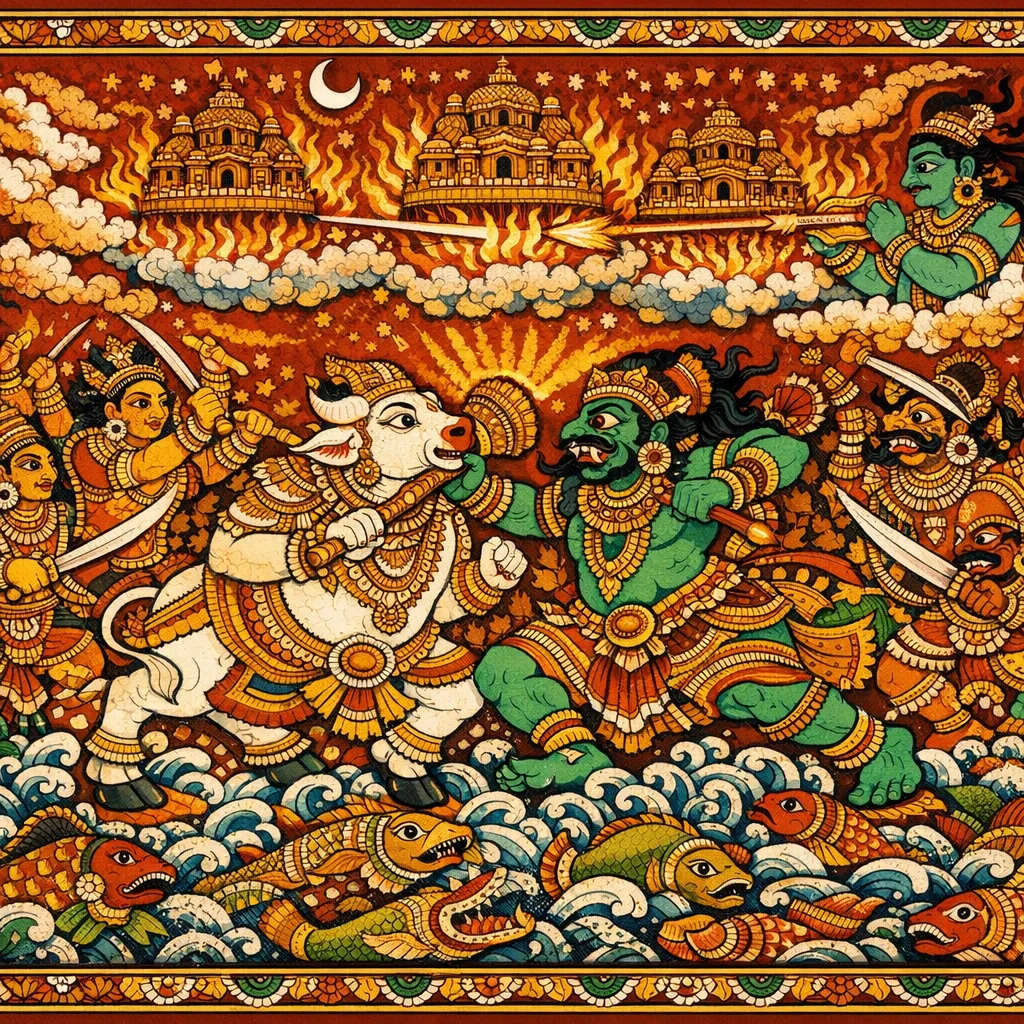
Adhyaya 140: The Burning of Tripura and Rudra’s Victory (Tripura-dahana)
त्रिपुरवधः (रुद्रविजयः)
Speaker: Sūta, Nandīśvara (Nandin/Śailādi), Vidyunmālī, Ṛṣis (inquiry about Maya)
Adhyaya 140 unfolds as Sūta’s battlefield narration of the Tripura episode, where the Devas and Rudra’s gaṇas march against the three demon-cities. The chapter emphasizes cosmic order restored through Śiva’s decisive act: the auspicious Puṣya-yoga aligns the three cities, and Hara releases the tri-divine arrow (tridaivatamaya śara) that destroys Tripura. A prominent sub-episode is Nandīśvara’s duel with Vidyunmālī, highlighting dharma-inflected speech (nīti in dialogue), prowess, and the moral framing of the Asuras as “sacrifice-defilers” (kratu-dūṣaṇa). The destruction imagery extends beyond warfare to civic collapse: palaces, gateways, shrines, and ocean-waters boil as the city falls into the sea, offering a puranic meditation on impermanence, lineage-fall through an evil son (kupu-tra-doṣa), and the consequences of adharmic power. The chapter closes with explicit phalaśruti: reciting “Rudra-vijaya” grants victory; hearing it in śrāddha yields endless merit and the fruit of all sacrifices, culminating in attainment of Rudra-loka.
Key Concepts
Shlokas in Adhyaya 140
Verse 1
*सूत उवाच उदिते तु सहस्रांशौ मेरौ भासाकरे रवौ नदद्देवबलं कृत्स्नं युगान्त इव सागरः //
Sūta said: When the thousand-rayed Sun rose upon Meru, the entire host of the gods resounded, while the ocean roared as though it were the end of the age (yugānta).
Verse 2
सहस्रनयनो देवस् ततः शक्रः पुरंदरः सवित्तदः सवरुणस् त्रिपुरं प्रययौ हरः //
Then the thousand-eyed god Indra—Śakra, the destroyer of strongholds—together with Savitṛ and Varuṇa, set out for Tripura; and Hara (Śiva) marched forth as well.
Verse 3
ते नानाविधरूपाश्च प्रमथातिप्रमाथिनः ययुः सिंहरवैर् घोरैर् वादित्रनिनदैरपि //
Those Pramathas, assuming many strange forms—fierce, violent, and maddening—moved forward, accompanied by dreadful lion-like roars and by the booming clamor of musical instruments as well.
Verse 4
ततो वादितवादित्रैश् चातपत्रैर्महाद्रुमैः बभूव तद्बलं दिव्यं वनं प्रचलितं यथा //
Then, with its many instruments being sounded, and with great parasols like towering trees, that divine army appeared like a forest set in motion.
Verse 5
तदापतन्तं सम्प्रेक्ष्य रौद्रं रुद्रबलं महत् संक्षोभो दानवेन्द्राणां समुद्रप्रतिमो बभौ //
Seeing that immense, wrathful power of Rudra rushing upon them, a tumult arose among the lords of the Dānavas—like the churning upheaval of the ocean.
Verse 6
ते चासीन्पट्टिशाञ्शक्तीः शूलदण्डपरश्वधान् शरासनानि वज्राणि गुरूणि मुसलानि च //
And there were swords, spears, tridents, staffs, axes; bows, thunderbolt-like weapons, heavy clubs, and maces as well.
Verse 7
प्रगृह्य कोपरक्ताक्षाः सपक्षा इव पर्वताः निजघ्नुः पर्वतघ्नाय घना इव तपात्यये //
Seizing their weapons, with eyes reddened in wrath, they struck down the “slayer of mountains”—like winged mountains of old rushing in, and like dense thunderclouds descending when the summer heat has run its course.
Verse 8
सविद्युन्मालिनस्ते वै समया दितिनन्दनाः मोदमानाः समासेदुर् देवदेवैः सुरारयः //
Adorned with garlands flashing like lightning, those sons of Diti—foes of the gods—arrived at the appointed time, rejoicing, and drew near to the Lord of the gods together with the deities.
Verse 9
मर्तव्यकृतबुद्धीनां जये चानिश्चितात्मनाम् अबलानां चमूर्ह्यासीद् अबलावयवा इव //
For those who had resolved only to die, and for those whose minds were uncertain even about victory, the army became bewildered—like a body whose limbs are without strength.
Verse 10
विगर्जन्त इवाम्भोदा अम्भोदसदृशत्विषः प्रयुध्य युद्धकुशलाः परस्परकृतागसः //
Roaring like thunderclouds, shining like rain-bearing clouds, those warriors—skilled in battle—fought on, each bearing mutual enmity born of wrongs done to one another.
Verse 11
धूमायन्तो ज्वलद्भिश्च आयुधैश्चन्द्रवर्चसैः कोपाद्वा युद्धलुब्धाश्च कुट्टयन्ते परस्परम् //
Smoking and blazing with moon-bright weapons, driven either by rage or by lust for battle, they strike and beat one another without restraint.
Verse 12
वज्राहताः पतन्त्यन्ये बाणैरन्ये विदारिताः अन्ये विदारिताश्चक्रैः पतन्ति ह्युदधेर्जले //
Some, struck down by the thunderbolt, fall; others are torn apart by arrows; and still others, rent by the discus, plunge indeed into the waters of the ocean.
Verse 13
छिन्नस्रग्दामहाराश्च प्रमृष्टाम्बरभूषणाः तिमिनक्रगणे चैव पतन्ति प्रमथाः सुराः //
With their garlands and wreaths torn away, and their garments and ornaments dishevelled and askew, the hosts of divine attendants—the Pramathas, and even the gods—fall amid the swarms of timi-fish and the sea-creatures called makara.
Verse 14
गदानां मुसलानां च तोमराणां परश्वधाम् वज्रशूलर्ष्टिपातानां पट्टिशानां च सर्वतः //
On all sides there should be arrayed weapons: maces (gadā) and pestles (musala), javelins (tomara) and axes (paraśvadhā), as well as the vajra, tridents (śūla), spears (ṛṣṭi) and other missiles, and also battle-axes (paṭṭiśa).
Verse 15
गिरिशृङ्गोपलानां च प्रेरितानां प्रमन्युभिः सजवानां दानवानां सधूमानां रवित्विषाम् आयुधानां महानोघः सागरौघे पतत्यपि //
And from those swift Dānavas, driven on by fierce wrath, there fell a mighty torrent of weapons—mountain-peaks and boulders hurled forth, smoke-wreathed and blazing with the sun’s brilliance—plunging even into the surging mass of the ocean.
Verse 16
प्रवृद्धवेगैस्तैस्तत्र सुरासुरकरेरितैः आयुधैस्त्रस्तनक्षत्रः क्रियते संक्षयो महान् //
There, by those weapons—hurled from the hands of gods and Asuras with ever-increasing force—even the constellations are struck with fear, and a vast destruction is wrought.
Verse 17
क्षुद्राणां गजयोर्युद्धे यथा भवति संक्षयः देवासुरगणैस् तद्वत् तिमिनक्रक्षयो ऽभवत् //
Just as, in a battle between elephants, the smaller creatures meet with destruction, so too—amid the hosts of Devas and Asuras—there occurred the destruction of the timi-fish and the makara kind (crocodile-like sea-creatures).
Verse 18
विद्युन्माली च वेगेन विद्युन्माली इवाम्बुदः विद्युर्मालघनोन्नादो नन्दीश्वरमभिद्रुतः //
Vidyunmālī rushed forward with great speed—like a rain-cloud wreathed in lightning—thundering like a mass of storm-clouds as he charged straight at Nandīśvara.
Verse 19
स तं तमोरिवदनं प्रणदन्वदतां वरः उवाच युधि शैलादिं दानवो ऽम्बुधिनिःस्वनः //
Then that Dānava—whose roar was like the deep sound of the ocean—spoke on the battlefield to Śailādi, whose face was like darkness, thundering as he addressed him.
Verse 20
युद्धाकाङ्क्षी तु बलवान् विद्युन्माल्यहमागतः यदि त्विदानीं मे जीवन् मुच्यसे नन्दिकेश्वर न विद्युन्मालिहननं वचोभिर्युधि दानव //
“I, Vidyunmālī, strong and eager for battle, have come. If you now escape from me alive, O Nandikeśvara, then—O Dānava—know that Vidyunmālī’s slaying will not be accomplished in war by words alone.”
Verse 21
तम् एवंवादिनं दैत्यं नन्दीशस्तपतां वरः उवाच प्रहरंस्तत्र वाक्यालंकारकोविदः //
To that Daitya who spoke in such a manner, Nandīśa—foremost among ascetics—replied then and there, striking as he spoke, being skilled in the ornament and force of speech.
Verse 22
दानवा धर्मकामाणां नैषो ऽवसर इत्युत शक्तो हन्तुं किमात्मानं जातिदोषाद् विबृंहसि //
“O Dānava, for those who seek dharma and righteous aims, this is not the proper occasion.” Having said so, though able to strike, why do you puff yourself up because of a fault of birth—mere pride in lineage?
Verse 23
यदि तावन्मया पूर्वं हतो ऽसि पशुवद्यथा इदानीं वा कथं नाम न हिंस्ये क्रतुदूषणम् //
If earlier I could have slain you like a mere beast, then how could I now refrain from striking you—when you are a defiler of the sacrifice?
Verse 24
सागरं तरते दोर्भ्यां पातयेद्यो दिवाकरम् सो ऽपि मां शक्नुयान्नैव चक्षुर्भ्यां समवेक्षितुम् //
Even if someone could cross the ocean by the strength of his arms, or could make the Sun fall from the sky, still he would not be able to behold Me fully with his eyes.
Verse 25
इत्येवंवादिनं तत्र नन्दिनं तन्निभो बले बिभेदैकेषुणा दैत्यः करेणार्क इवाम्बुदम् //
As Nandin was speaking thus there, the Daitya—matching him in strength—struck and pierced him with a single arrow, like the sun cleaving a cloud with its rays.
Verse 26
वक्षसः स शरस्तस्य पपौ रुधिरमुत्तमम् सूर्यस्त्वात्मप्रभावेण नद्यर्णवजलं यथा //
That arrow drank up the finest blood from his chest, just as the Sun, by its own radiance, draws up the waters of rivers and oceans.
Verse 27
स तेन सुप्रहारेण प्रथमं चातिरोपितः हस्तेन वृक्षमुत्पाट्य चिक्षेप गजराडिव //
Struck first by that excellent blow, he was hurled aside; then, tearing up a tree with his hand, he flung it—like a lordly elephant.
Verse 28
वायुनुन्नः स च तरुः शीर्णपुष्पो महारवः विद्युन्मालिशरैश्छिन्नः पपात पतगेशवत् //
Driven by the wind, that tree—its blossoms scattered—fell with a mighty roar, as though severed by lightning’s thunderbolt-like arrows, crashing to the earth like the lord of birds.
Verse 29
वृक्षमालोक्य तं छिन्नं दानवेन वरेषुभिः रोषमाहारयत्तीव्रं नन्दीश्वरः सुविग्रहः //
Seeing that tree cut down by the Dānava with excellent arrows, Nandīśvara—mighty in form—was seized by fierce and burning wrath.
Verse 30
सोद्यम्य करमारावे रविशक्रकरप्रभम् दुद्राव हन्तुं स क्रूरं महिषं गजराडिव //
Raising his hand amid a tumultuous roar, radiant with a splendor like that of the Sun and Indra, he rushed forth to slay that cruel buffalo, like a lordly elephant charging.
Verse 31
तमापतन्तं वेगेन वेगवान्प्रसभं बलात् विद्युन्माली शरशतैः पूरयामास नन्दिनम् //
As Nandī came rushing down with tremendous speed, Vidyunmālī—himself swift—violently, by sheer force, riddled Nandī with hundreds of arrows.
Verse 32
शरकण्टकिताङ्गो वै शैलादिः सो ऽभवत्पुनः अरेर्गृह्य रथं तस्य महतः प्रययौ जवात् //
Indeed, his body bristled with arrows like thorns, and yet Śailādi recovered himself once more; seizing that mighty enemy’s chariot, he sped away with great swiftness.
Verse 33
विलम्बिताश्वो विशिरो भ्रमितश्च रणे रथः पपात मुनिशापेन सादित्यो ऽर्करथो यथा //
In the battle, the chariot—its horses slowed, its charioteer struck down, and reeling in confusion—fell, brought low by a sage’s curse, just as Āditya, the Sun who rides the sun-chariot, was once cast down.
Verse 34
अन्तरान्निर्गतश्चैव मायया स दितेः सुतः आजघान तदा शक्त्या शैलादिं समवस्थितम् //
Then, emerging from within by the power of his māyā, that son of Diti struck at that moment with a śakti (spear), aiming at the mountain-like mass standing firm.
Verse 35
तामेव तु विनिष्क्रम्य शक्तिं शोणितभूषिताम् विद्युन्मालिनमुद्दिश्य चिक्षेप प्रमथाग्रणीर् //
Then the foremost leader of the Pramathas drew forth that very śakti, adorned with blood, and hurled it, aiming at Vidyunmālī.
Verse 36
तया भिन्नतनुत्राणो विभिन्नहृदयस्त्वपि विद्युन्माल्यपतद्भूमौ वज्राहत इवाचलः //
By that blow his armor was shattered; even his heart was rent. Vidyunmālī fell to the ground like a mountain struck by the vajra, with lightning flashing about him like a garland.
Verse 37
विद्युन्मालिनि निहते सिद्धचारणकिंनराः साधु साध्विति चोक्त्वा ते पूजयन्त उमापतिम् //
When Vidyunmālī had been slain, the Siddhas, Cāraṇas, and Kiṃnaras cried, “Sādhu! Sādhu!” and then worshipped Umāpati, Lord Śiva.
Verse 38
नन्दिना सादिते दैत्ये विद्युन्मालौ हते मयः ददाह प्रमथानीकं वनमग्निरिवोद्धतः //
When the Daitya was struck down by Nandin and Vidyunmālī was slain, Maya, rising in fury, burned the host of the Pramathas—like a raging forest-fire consuming a woodland.
Verse 39
शूलनिर्दारितोरस्का गदाचूर्णितमस्तकाः इषुभिर्गाढविद्धाश्च पतन्ति प्रमथार्णवे //
Their chests split open by tridents, their heads crushed by maces, and pierced deep by arrows, they fall into the ocean-like mass of the Pramathas (the tumultuous host).
Verse 40
अथ वज्रधरो यमो ऽर्थदः स च नन्दी स च षण्मुखो गुहः / मयम् असुरवीरसम्प्रवृत्तं विविधुः शस्त्रवरैर्हतारयः //
Then Vajra-bearer Indra, Yama, Kubera (the giver of wealth), Nandī, and Ṣaṇmukha Guha attacked Maya, who had advanced at the head of the Asura heroes; with excellent weapons they struck him down, having slain his foes.
Verse 41
नागं तु नागाधिपतेः शताक्षं मयो विदार्येषुवरेण तूर्णम् यमं च वित्ताधिपतिं च विद्ध्वा ररास मत्ताम्बुदवत्तदानीम् //
Then Maya swiftly pierced that Nāga—Śatākṣa, chief of the serpent-lords—with his foremost, rending arrow; and having struck Yama and also the Lord of Wealth, he roared at that moment like a raging, rain-laden cloud.
Verse 42
ततः शरैः प्रमथगणैश्च दानवा दृढाहताश्चोत्तमवेगविक्रमाः भृशानुविद्धास्त्रिपुरं प्रवेशिता यथा शिवश्चक्रधरेण संयुगे //
Then the Dānavas—struck hard by the arrows and by the hosts of Śiva’s Pramathas, their finest speed and prowess shattered—were grievously pierced and driven back into Tripura, just as Śiva, in battle, is pressed by the wielder of the discus.
Verse 43
ततस्तु शङ्खानकभेरिमर्दलाः ससिंहनादा दनुपुत्रभङ्गदाः कपर्दिसैन्ये प्रबभुः समन्ततो निपात्यमाना युधि वज्रसंनिभाः //
Then, on every side of Kapardi’s host, conches, kettle-drums, war-drums, and mṛdaṅgas resounded with lion-like roars, shattering the sons of Danu, while warriors were struck down in battle like thunderbolts of vajra.
Verse 44
अथ दैत्यपुराभावे पुष्ययोगो बभूव ह बभूव चापि संयुक्तं तद्योगेन पुरत्रयम् //
Then, when the decisive moment for the demon-city arrived, the auspicious Puṣya conjunction came to pass; and by that very alignment, the three cities (Tripura) also entered a single conjunction, becoming aligned together.
Verse 45
ततो बाणं त्रिधा देवस् त्रिदैवतमयं हरः मुमोच त्रिपुरे तूर्णं त्रिनेत्रस्त्रिपथाधिपः //
Then Hara (Śiva)—the Three-eyed Lord, ruler of the three paths—swiftly loosed at Tripura an arrow constituted of the three deities, splitting it into three.
Verse 46
तेन मुक्तेन बाणेन बाणपुष्पसमप्रभम् आकाशं स्वर्णसंकाशं कृतं सूर्येण रञ्जितम् //
By that arrow, once released, the sky was made radiant like clusters of arrow-flowers; it appeared golden, as though dyed by the sun.
Verse 47
मुक्त्वा त्रिदैवतमयं त्रिपुरे त्रिदशः शरम् धिग्धिङ् मामिति चक्रन्द कष्टं कष्टमिति ब्रुवन् //
Having discharged at Tripura the arrow formed of the three divinities, the god (among the Thirty) cried out, “Shame on me!”, repeatedly lamenting, “Alas, alas—what misery!”
Verse 48
वैधुर्यं दैवतं दृष्ट्वा शैलादिर्गजवद्गतः किमिदं त्विति पप्रच्छ शूलपाणिं महेश्वरम् //
Seeing the divine manifestation called Vaidhurya, Śailādi advanced like an elephant and asked Maheśvara, the trident-bearing Lord: “What is this?”
Verse 49
ततः शशाङ्कतिलकः कपर्दी परमार्तवत् उवाच नन्दिनं भक्तः स मयो ऽद्य विनङ्क्ष्यति //
Then Kapardī—Śiva, whose brow is adorned with the crescent moon—spoke to Nandī in deep distress: “That devotee of mine will perish today.”
Verse 50
अथ नन्दीश्वरस्तूर्णं मनोमारुतवद्बली शरे त्रिपुरमायाति त्रिपुरं प्रविवेश सः //
Then Nandīśvara—mighty as the wind that moves with the speed of thought—swiftly came to Tripura by means of an arrow, and he entered the city of Tripura.
Verse 51
स मयं प्रेक्ष्य गणपः प्राह काञ्चनसंनिभः विनाशस्त्रिपुरस्यास्य प्राप्तो मय सुदारुणः अनेनैव गृहेण त्वम् अपक्राम ब्रवीम्यहम् //
Seeing me, the gaṇa-chief—shining like gold—spoke: “A most dreadful destruction of this Tripura has been brought about by me. Therefore, depart at once by this very house; thus I tell you.”
Verse 52
श्रुत्वा तन्नन्दिवचनं दृढभक्तो महेश्वरे तेनैव गृहमुख्येण त्रिपुराद् अपसर्पितः //
Having heard those words of Nandin, steadfast in devotion to Maheśvara, he withdrew from Tripura by that very principal gateway.
Verse 53
सो ऽपीषुः पत्त्रपुटवद् दग्ध्वा तन्नगरत्रयम् त्रिधा इव हुताशश्च सोमो नारायणस्तथा //
He too—like a blazing fire—burned those three cities, as though dividing them into three parts; so did Soma, and likewise Nārāyaṇa.
Verse 54
शरतेजःपरीतानि पुराणि द्विजपुंगवाः दुष्पुत्रदोषाद्दह्यन्ते कुलान्यूर्ध्वं यथा तथा //
O best of the twice-born, ancient lineages—encircled by the scorching heat of autumn—are likewise burned upward through the generations because of the fault of an evil son.
Verse 55
मेरुकैलासकल्पानि मन्दराग्रनिभानि च सकपाटगवाक्षाणि बलिभिः शोभितानि च //
They were fashioned like Meru and Kailāsa, and also resembling the lofty peaks of Mandara—provided with doors and latticed windows, and further beautified with bali-offerings and tribute-gifts.
Verse 56
सप्रासादानि रम्याणि कूटागारोत्कटानि च सजलानि समाख्यानि सावलोकनकानि च //
“(Let there be) delightful residences furnished with lofty mansions; imposing buildings with peaked upper structures; houses provided with water (tanks or fountains); well-appointed, well-proportioned dwellings; and homes with viewing galleries (balconies or windows).”
Verse 57
बद्धध्वजपताकानि स्वर्णरौप्यमयानि च गृहाणि तस्मिंस्त्रिपुरे दानवानामुपद्रवे दह्यन्ते दहनाभानि दहनेन सहस्रशः //
In that Tripura, the houses—adorned with fastened banners and pennants, and fashioned of gold and silver—began to burn in the calamity that befell the Dānavas; countless structures, blazing like fire itself, were consumed by the conflagration.
Verse 58
प्रासादाग्रेषु रम्येषु वनेषूपवनेषु च वातायनगताश्चान्याश् चाकाशस्य तलेषु च //
Some (female spirits or subtle beings) dwell upon the lovely tops of mansions, in forests and pleasure-groves; others abide in windows and openings, and still others move about in the open expanse of the sky.
Verse 59
रमणैरुपगूढाश्च रमन्त्यो रमणैः सह दह्यन्ते दानवेन्द्राणाम् अग्निना ह्यपि ताः स्त्रियः //
Even those women—embraced by their lovers and sporting together with them—were burned by the fire of the Dānava-lords as well.
Verse 60
काचित्प्रियं परित्यज्य अशक्ता गन्तुमन्यतः पुरः प्रियस्य पञ्चत्वं गताग्निवदने क्षयम् //
Some woman, having abandoned her beloved and unable to go anywhere else, comes to ruin—like a moth entering fire—when her beloved passes into the state of the five elements (death).
Verse 61
उवाच शतपत्त्राक्षी सास्राक्षीव कृताञ्जलिः हव्यवाहन भार्याहं परस्य परतापन धर्मसाक्षी त्रिलोकस्य न मां स्प्रष्टुमिहार्हसि //
The lotus-eyed lady spoke, her eyes brimming with tears and her hands joined in reverence: “I am the wife of Havyavāhana. O tormentor of foes, Dharma is the witness of the three worlds—therefore you are not fit to touch me here.”
Verse 62
शायितं च मया देव शिवया च शिवप्रभ परेण प्रैहि मुक्त्वेदं गृहं च दयितं हि मे //
O God—O Śivaprabha (Radiant Lord)—I have laid myself down here, together with Śivā. Now go on to the farther path, leaving this house behind—for indeed this home is dear to me.
Verse 63
एका पुत्रमुपादाय बालकं दानवाङ्गना हुताशनसमीपस्था इत्युवाच हुताशनम् //
A Dānava woman, lifting up her little son, stood near Hutaśana (Agni) and addressed the Fire-god as follows.
Verse 64
बालो ऽयं दुःखलब्धश्च मया पावक पुत्रकः नार्हस्येनमुपादातुं दयितं षण्मुखप्रिय //
“This is only a child—won by me through suffering—the little son of Pāvaka (Agni). It is not fitting that he be taken away; he is beloved and dear to the Six-faced One (Ṣaṇmukha).”
Verse 65
काश्चित्प्रियान्परित्यज्य पीडिता दानवाङ्गनाः निपतन्त्यर्णवजले सिञ्जमानविभूषणाः //
Some of the Dānava women—tormented and driven by calamity—abandoned their beloveds and plunged into the ocean’s waters, their ornaments still jingling as they fell.
Verse 66
तात पुत्रेति मातेति मातुलेति च विह्वलम् चक्रन्दुस्त्रिपुरे नार्यः पावकज्वालवेपिताः //
In Tripura, the women—shaken by the tongues of fire—wailed in bewilderment, crying, “Father! Son! Mother! Maternal uncle!”
Verse 67
यथा दहति शैलाग्निः साम्बुजं जलजाकरम् तथा स्त्रीवक्त्रपद्मानि चादहत्त्रिपुरे ऽनलः //
Just as a mountain-fire burns a lake filled with lotuses, so too did the fire in Tripura burn the lotus-like faces of women.
Verse 68
तुषारराशिः कमलाकराणां यथा दहत्यम्बुजकानि शीते तथैव सो ऽग्निस्त्रिपुराङ्गनानां ददाह वक्त्रेक्षणपङ्कजानि //
Just as, in the cold season, a mass of frost scorches the lotus-blossoms in lotus-ponds, so too that fire burned up the lotus-like faces and eyes of the women of Tripura.
Verse 69
शराग्निपातात् समभिद्रुतानां तत्राङ्गनानाम् अतिकोमलानाम् बभूव काञ्चीगुणनूपुराणाम् आक्रन्दितानां च रवो ऽतिमिश्रः //
As showers of flaming arrows fell, the very tender women there, rushing in panic, raised a confused, mingled din—of waist-belts’ cords and anklets sounding together, and of their cries of distress.
Verse 70
दग्धार्धचन्द्राणि सवेदिकानि विशीर्णहर्म्याणि सतोरणानि दग्धानि दग्धानि गृहाणि तत्र पतन्ति रक्षार्थमिवार्णवौघे //
There, half-moon–shaped shrines and altar-platforms lie scorched; mansions stand shattered, gateways still bearing their arches. Burnt—burnt again—those houses collapse, as if falling into the ocean’s rushing flood in a desperate bid for protection.
Verse 71
गृहैः पतद्भिर्ज्वलनावलीढैर् आसीत्समुद्रे सलिलं प्रतप्तम् कुपुत्रदोषैः प्रहतानुविद्धं यथा कुलं याति धनान्वितस्य //
With houses collapsing and being licked by tongues of fire, the ocean’s waters became heated and distressed—just as a prosperous family is struck and pierced through by the faults of an unworthy son.
Verse 72
गृहप्रतापैः क्वथितं समन्तात् तदार्णवे तोयमुदीर्णवेगम् वित्रासयामास तिमीन्सनक्रांस् तिमिङ्गिलांस्तत्क्वथितांस्तथान्यान् //
All around, the ocean-water—heated (as if boiling) by the fierce radiance of the submerged houses—rose with a surging force, terrifying the fish along with the crocodiles, the timiṅgilas (great sea-monsters), and other creatures that were likewise scalded by that heat.
Verse 73
सगोपुरो मन्दरपादकल्पः प्राकारवर्यस्त्रिपुरे च सो ऽथ तैरेव सार्धं भवनैः पपात शब्दं महान्तं जनयन्समुद्रे //
That fortified city, complete with its gates, founded like the foot of Mount Mandara and encircled by most excellent ramparts, then in Tripura fell into the ocean together with those very palaces, raising a tremendous roar.
Verse 74
सहस्रशृङ्गैर् भवनैर् यदासीत् सहस्रशृङ्गः स इवाचलेशः नामावशेषं त्रिपुरं प्रजज्ञे हुताशनाहारबलिप्रयुक्तम् //
That Tripura which once stood with a thousand lofty pinnacles and palatial mansions—like a mountain-lord crowned with a thousand peaks—was reduced to a mere name. It became only a remnant, consumed by Fire, when the offerings and oblations were duly applied to feed the blazing conflagration.
Verse 75
प्रदह्यमानेन पुरेण तेन जगत् सपातालदिवं प्रतप्तम् दुःखं महत्प्राप्य जलावमग्नं यस्मिन्महान्सौधवरो मयस्य //
As that city burned, the whole world—down to Pātāla and up to the heavens—was scorched. Overwhelmed by immense distress, it became submerged in water; there too the great palatial enclosure of Maya, the architect, lay engulfed.
Verse 76
तद्देवेशो वचः श्रुत्वा इन्द्रो वज्रधरस्तदा शशाप तद्गृहं चापि मयस्यादितिनन्दनः //
Hearing those words, Indra—the lord of the gods, bearer of the vajra, Aditi’s son—thereupon cursed that house as well, the house belonging to Maya.
Verse 77
असेव्यमप्रतिष्ठं च भयेन च समावृतम् भविष्यति मयगृहं नित्यमेव यथानलः //
“My house will become unfit to dwell in, unstable and without secure standing; it will remain perpetually shrouded in fear—like a fire that never truly dies down.”
Verse 78
यस्य यस्य तु देशस्य भविष्यति पराभवः द्रक्ष्यन्ति त्रिपुरं खण्डं तत्रेदं नाशगा जनाः तदेतदद्यापि गृहं मयस्यामयवर्जितम् //
Whatever land is destined for ruin, the people who hasten toward destruction will behold there the broken remnant of Tripura. And this very house of Māyā still stands even today, free from decay and affliction.
Verse 79
*ऋषय ऊचुः भगवन्स मयो येन गृहेण प्रपलायितः तस्य नो गतिमाख्याहि मयस्य चमसोद्भव //
The sages said: “O Blessed Lord, tell us where that Māyā has gone—he who fled away by means of a (mystic) house. O Chamasodbhava (One born from the sacrificial ladle), explain to us the fate of Māyā.”
Verse 80
*सूत उवाच दृश्यते दृश्यते यत्र ध्रुवस्तत्र मयास्पदम् देवद्विट् तु मयश्चातः स तदा खिन्नमानसः ततश्च्युतो ऽन्यलोके ऽस्मिंस् त्राणार्थं वै चकार सः //
Sūta said: “Where Dhruva is seen—indeed, where he is beheld—there is my own station. But the god-hater, having fallen away from my realm, became then dejected at heart; and, cast down into this other world, he undertook measures for his protection.”
Verse 81
तत्रापि देवताः सन्ति आप्तोर्यामाः सुरोत्तमाः तत्राशक्तं ततो गन्तुं तं चैकं पुरमुत्तमम् //
There too dwell divine beings—the Āptoryāmas, the foremost among the gods. From there, one is unable to go onward; and that alone is the unsurpassed, supreme city.
Verse 82
शिवः सृष्ट्वा गृहं प्रादान् मयायैव गृहार्थिने विरराम सहस्राक्षः पूजयामास चेश्वरम् पूज्यमानं च भूतेशं सर्वे तुष्टुवुरीश्वरम् //
Having fashioned the house, Śiva bestowed it upon Māyā herself, who desired a dwelling. Then Sahasrākṣa (Indra) paused and worshipped the Lord; and as Bhūteśa (the Lord of beings) was being worshipped, all present praised that Supreme Lord.
Verse 83
सम्पूज्यमानं त्रिदशैः समीक्ष्य गणैर्गणेशाधिपतिं तु मुख्यम् हर्षाद् ववल्गुर् जहसुश्च देवा जग्मुर्ननर्दुस्तु विषक्तहस्ताः //
Seeing the foremost lord of Gaṇeśa’s hosts duly worshipped by the Thirty (gods), the devas, filled with joy, leapt about and laughed; then they departed, shouting aloud, their hands still clasped together in reverent salutation.
Verse 84
पितामहं वन्द्य ततो महेशं प्रगृह्य चापं प्रविमृज्य भूतान् रथाच्च संपत्य हरेषुदग्धं क्षिप्तं पुरं तन्मकरालये च //
Having first paid homage to the Grand-sire (Brahmā), and then to Maheśa (Śiva), he took up the bow and set the beings (the hosts) in order. Then, leaping down from the chariot, he cast that city—burnt by Hari’s arrow—into the ocean, the abode of makaras.
Verse 85
य इमं रुद्रविजयं पठते विजयावहम् विजयं तस्य कृत्येषु ददाति वृषभध्वजः //
Whoever recites this “Rudra-vijaya,” the bringer of victory—Vṛṣabhadhvaja (Śiva, whose banner bears the bull) grants that person success and victory in their undertakings.
Verse 86
पितॄणां वापि श्राद्धेषु य इमं श्रावयिष्यति अनन्तं तस्य पुण्यं स्यात् सर्वयज्ञफलप्रदम् //
And whoever, in the śrāddha rites for the ancestors, causes this to be recited for others to hear—his merit becomes endless, bestowing the fruit of all sacrifices.
Verse 87
इदं स्वस्त्ययनं पुण्यम् इदं पुंसवनं महत् इदं श्रुत्वा पठित्वा च यान्ति रुद्रसलोकताम् //
This is the holy Svastyayana rite; this is the great Pumsavana observance. Having heard it and also recited it, people attain the world of Rudra (Śiva).
Frequently Asked Questions
The chapter teaches that adharmic power—even when fortified as “three cities”—collapses when divine order aligns with auspicious time and unified agency. Through Nandī’s dharma-inflected rebuke of Vidyunmālī (branding him a kratu-dūṣaṇa, defiler of sacrifice) and Śiva’s tri-divine arrow released at the Puṣya conjunction, the narrative frames victory as dharma-supported, not merely martial. The phalaśruti further makes the instruction practical: recitation/hearing of “Rudra-vijaya” is itself a religious act that yields victory in undertakings and immense merit, especially when used in śrāddha.
This adhyaya is primarily Dharma and mythic-theological narrative: dharma vs sacrifice-defilement, righteous speech, and divine restoration of order. It also contains civic/architectural imagery (city-gates, ramparts, palaces, shrines, latticed windows, banners, mansions) used to depict Tripura’s grandeur and collapse, but not as prescriptive Vastu rules. A genealogical-ethical motif appears via the kupu-tra-doṣa analogy: just as an evil son burns a lineage upward through generations, so Tripura’s doom consumes its inhabitants and structures.
Puṣya-yoga is presented as the auspicious astrological conjunction that coincides with the ‘decisive moment’ of Tripura’s fall. In the text, that very alignment causes the three cities to come into conjunction, enabling Śiva’s single decisive strike with the tri-divine arrow. It functions as a puranic statement about right timing (kāla) as a force multiplier for dharmic action.
The text states that one who recites the Rudra-vijaya gains success and victory in their undertakings by the grace of Vṛṣabhadhvaja (Śiva). If it is caused to be recited for others to hear during śrāddha, the merit becomes endless and grants the fruit of all sacrifices. Hearing and reciting it is also called a holy Svastyayana and a great Puṃsavana, culminating in attainment of Rudra-loka.