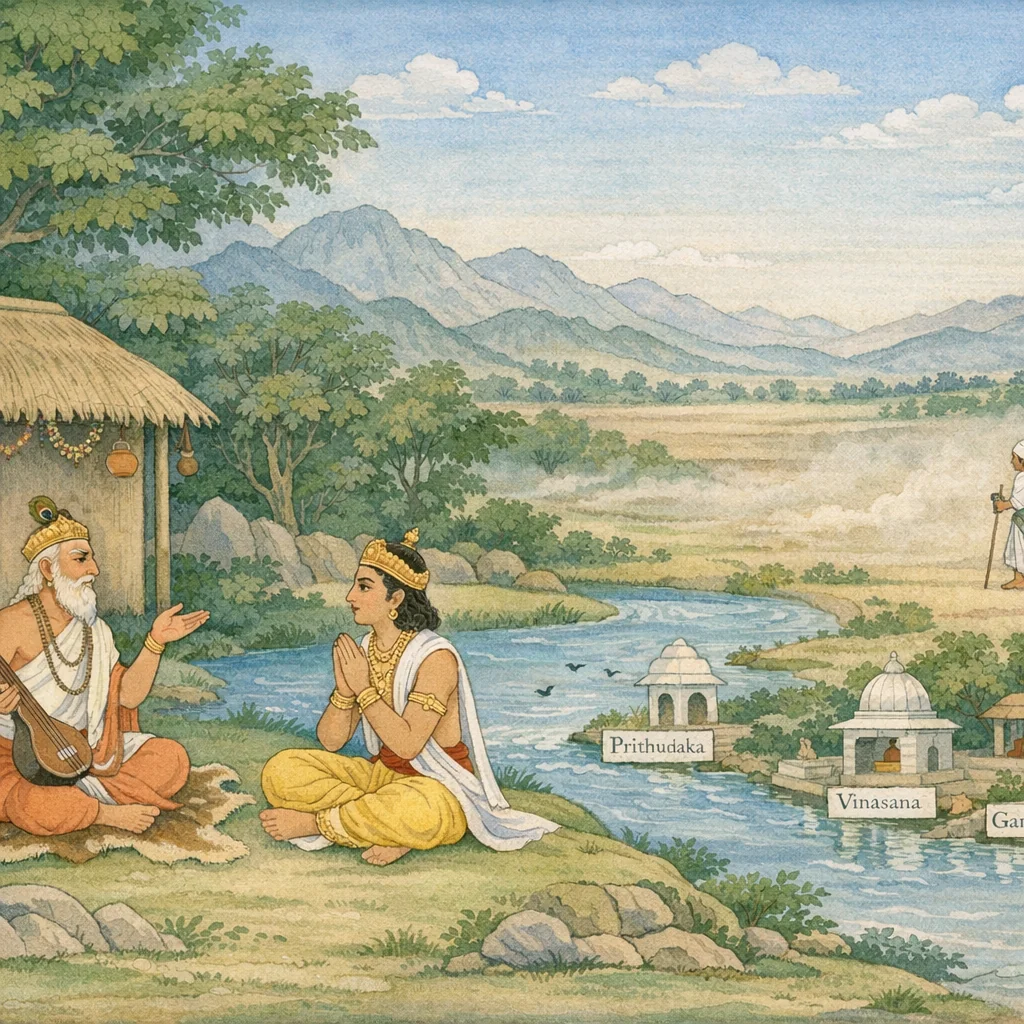
Adhyaya 83
Tīrtha-yātrā: Phalaśruti and Sacred Geography from Lohitya to Prayāga (Pulastya’s Instruction)
Upa-parva: Tīrtha-yātrā (Pilgrimage Catalogue) — Pulastya’s Discourse to Bhīṣma
Chapter 83.0 is a sustained itinerary discourse attributed to Pulastya, describing successive tīrthas and the declared ritual “fruits” associated with bathing (snāna/upaspṛśya), fasting (often trirātra), worship (arcana), circumambulation (pradakṣiṇā), and offerings to ancestors and deities (tarpaṇa). The chapter ranges across major hydrological and coastal nodes—Gaṅgā at Sāgara-saṅgama, Gaṅgā–Yamunā confluence at Prayāga, and rivers such as Godāvarī, Kāverī, Veṇṇā—along with mountains and shrines (Śrīparvata, Kālañjara, Citrakūṭa, Gokarṇa). A prominent structural feature is the repeated equivalence formula: specific observances at specific sites yield merit compared to Vedic sacrifices (aśvamedha, vājapeya, agniṣṭoma), functioning as a phala-oriented ritual index rather than a battlefield narrative. The latter portion elevates Prayāga as exceptionally meritorious, emphasizing that even hearing, naming, or touching its earth is purificatory, and closes with meta-commentary on eligibility (purity, vows) and on the salvific value of reciting or listening to the tīrtha-account. The chapter ends with narrative closure markers: speakers withdraw (Nārada/Vaiśaṃpāyana framing), and Yudhiṣṭhira reflects on the pilgrimage-based merit as a practical dharmic program.
Chapter Arc: नारद युधिष्ठिर के सम्मुख कुरुक्षेत्र की महिमा का संवाद उपस्थित करते हैं—यहाँ तक कि केवल ‘मैं कुरुक्षेत्र जाऊँगा, वहाँ निवास करूँगा’ ऐसा कह देना भी पाप-क्षय का कारण बताया जाता है। → तीर्थ-यात्रा का मानचित्र खुलता है: कुरुक्षेत्र की धूल तक की पावनता, व्रत-उपवास, ब्रह्मचर्य, और क्रमशः अनेक तीर्थों (मुञ्जवट, मिश्रक, सप्तसारस्वत, गंगाह्रद, कन्याश्रम आदि) के विशिष्ट फल—हर स्थल के साथ नियम कठोर होते जाते हैं और फल अधिक ‘राजसूय-अश्वमेध’ तुल्य घोषित होते जाते हैं। → कुरुक्षेत्र-स्तुति अपने चरम पर पहुँचती है—वायु से उड़कर आई कुरुक्षेत्र की धूल का स्पर्श भी दुष्कृतकर्मा को परम गति दे सकता है; और गंगाह्रद जैसे तीर्थ में एकाग्रचित्त ब्रह्मचर्यपूर्वक स्नान को राजसूय-अश्वमेध के फल के समकक्ष कहा जाता है। → नारद तीर्थों के नियम, रात्रि-उपवास, स्नान-विधान और फलश्रुति को व्यवस्थित रूप से समेटते हैं—युधिष्ठिर के लिए यह संदेश स्पष्ट होता है कि वनवास की पीड़ा के बीच भी धर्म का एक मार्ग ‘तीर्थ-चर्या’ है, जो अंतःशुद्धि और पुण्य-संचय का साधन बनती है। → तीर्थ-क्रम अभी आगे भी विस्तृत है—अगले स्थलों की महिमा और उनसे जुड़ी प्राचीन सिद्ध-परंपराएँ (जैसे मड़कणक आदि) आगे के अध्यायों में और गहराई से खुलने का संकेत देती हैं।
Shlokas
Verse 1
हि मय न घुक हि २ 7 - यद्यपि यहाँ पुलस्त्यजी भीष्मजीको यह प्रसंग सुना रहे हैं, तथापि इस संवादको नारदजीने युधिष्ठिरके समक्ष उपस्थित किया है; अतः नारदजी युधिष्ठिरको सम्बोधित करें, इसमें कोई अनुपपत्ति नहीं है। त्रय्शीतितमो< ध्याय: कुरुक्षेत्रकी सीमामें स्थित अनेक तीर्थोंकी महत्ताका वर्णन घुलस्त्य उवाच ततो गच्छेत राजेन्द्र कुरुक्षेत्रमभिष्टतम् । पापेभ्यो यत्र मुच्यन्ते दर्शनात् सर्वजन्तवः,पुलस्त्यजी कहते हैं--राजेन्द्र! तदनन्तर ऋषियोंद्वारा प्रशंसित कुरुक्षेत्रकी यात्रा करे, जिसके दर्शनमात्रसे सब जीव पापोंसे मुक्त हो जाते हैं
Pulastya said: “Then, O best of kings, one should proceed to Kurukṣetra, the most cherished of sacred regions, praised by the seers. For there, by the mere act of beholding it, all living beings are released from their sins.”
Verse 2
कुरुक्षेत्र गमिष्यामि कुरुक्षेत्र वसाम्पहम् | य एवं सतत ब्रूयात् सर्वपापै: प्रमुच्यते,“मैं कुरक्षेत्रमें जाऊँगा, कुरुक्षेत्रमें निवास करूँगा।” इस प्रकार जो सदा कहा करता है, वह सब पापोंसे मुक्त हो जाता है
"I shall go to Kurukṣetra; I shall dwell in Kurukṣetra." Whoever continually utters this resolve is released from all sins.
Verse 3
पांसवो5पि कुरुक्षेत्रे वायुना समुदीरिता: । अपि दुष्कृतकर्माणं नयन्ति परमां गतिम्,वायुद्वारा उड़ाकर लायी हुई कुरुक्षेत्रकी धूल भी शरीरपर पड़ जाय, तो वह पापी मनुष्यको भी परमगतिकी प्राप्ति करा देती है
Even the dust of Kurukṣetra, when lifted and carried by the wind, can lead even a person burdened with evil deeds to the highest state.
Verse 4
दक्षिणेन सरस्वत्या दृषद्धत्युत्तरेण च । ये वसन्ति कुरुक्षेत्रे ते वसन्ति त्रिविष्टपे,जो सरस्वतीके दक्षिण और दृषद्वतीके उत्तर कुरुक्षेत्रमें वास करते हैं, वे मानो स्वर्गलोकमें ही रहते हैं
Those who dwell in Kurukṣetra—south of the Sarasvatī and north of the Dṛṣadvatī—are said to live as if in Triviṣṭapa (heaven).
Verse 5
तत्र मासं वसेद् धीर: सरस्वत्यां युधिष्िर । यत्र ब्रह्मादयो देवा ऋषय: सिद्धचारणा:,(नारदजी कहते हैं--) युधिष्ठिर! वहाँ सरस्वतीके तटपर धीर पुरुष एक मासतक निवास करे; क्योंकि महाराज! ब्रह्मा आदि देवता, ऋषि, सिद्ध, चारण, गन्धर्व, अप्सरा, यक्ष और नाग भी उस परम पुण्यमय ब्रह्मक्षेत्रको जाते हैं
Ghūlastya (Nārada) said: “O Yudhiṣṭhira, a steadfast man should reside there for a month on the banks of the Sarasvatī—at that supremely meritorious Brahma-kṣetra which even Brahmā and the other gods, along with seers, Siddhas, and Cāraṇas, frequent.”
Verse 6
गन्धर्वाप्सरसो यक्षा: पन्नगाश्न महीपते । ब्रद्मक्षेत्रे महापुण्यमभिगच्छन्ति भारत,(नारदजी कहते हैं--) युधिष्ठिर! वहाँ सरस्वतीके तटपर धीर पुरुष एक मासतक निवास करे; क्योंकि महाराज! ब्रह्मा आदि देवता, ऋषि, सिद्ध, चारण, गन्धर्व, अप्सरा, यक्ष और नाग भी उस परम पुण्यमय ब्रह्मक्षेत्रको जाते हैं
O king, O Bhārata, Gandharvas and Apsarases, Yakṣas and Nāgas too go to that supremely meritorious Brahma-kṣetra.
Verse 7
मनसाप्यभिकामस्य कुरुक्षेत्र युधिष्ठिर । पापानि विप्रणश्यन्ति ब्रह्मलोक॑ च गच्छति,युधिष्ठिर! जो मनसे भी कुरुक्षेत्रमें जानेकी इच्छा करता है, उसके सब पाप नष्ट हो जाते हैं और वह ब्रह्मलोकको जाता है
Ghūlastya (Nārada) said: “O Yudhiṣṭhira, even for one who merely forms in the mind the wish to go to Kurukṣetra, sins are destroyed; and such a person attains the world of Brahmā (Brahma-loka).”
Verse 8
गत्वा हि श्रद्धया युक्त: कुरुक्षेत्र कुरूद्वह । फल प्राप्रोति च तदा राजसूयाश्चमेधयो:,कुरुश्रेष्ठ! श्रद्धासे युक्त होकर कुरक्षेत्रकी यात्रा करनेपर मनुष्य राजसूय और अश्वमेधयज्ञोंका फल पाता है
Ghūlastya (Nārada) said: “O best of the Kurus, one who journeys to Kurukṣetra with sincere faith attains, at that time, the merit equal to that of the Rājasūya and the Aśvamedha sacrifices.”
Verse 9
ततो मचक्रुकं नाम द्वारपालं महाबलम् | यक्षं समभिवाद्यैव गोसहस्रफलं लभेत्,तदनन्तर, वहाँ मचक्कुक नामवाले द्वारपाल महाबली यक्षको नमस्कार करनेमात्रसे सहस्र गोदानका फल मिल जाता है
Then, by respectfully saluting the mighty gatekeeper Yakṣa named Macakruka, one gains merit equal to a thousand gifts of cows.
Verse 10
ततो गच्छेत धर्मज्ञ विष्णो: स्थानमनुत्तमम् | सतत नाम राजेन्द्र यत्र संनिहितो हरि:,धर्मज्ञ राजेन्द्र! तत्पश्चात् भगवान् विष्णुके परम उत्तम सतत नामक तीर्थस्थानमें जाय, जहाँ श्रीहरि सदा निवास करते हैं
Then, O knower of dharma, O best of kings, one should proceed to Viṣṇu’s unsurpassed abode—the sacred ford called Satata—where Hari is ever present.
Verse 11
तत्र स्नात्वा च नत्वा च त्रिलोकप्रभवं हरिम् । अश्वमेधमवाप्रोति विष्णुलोकं॑ च गच्छति,वहाँ स्नान और त्रिलोकभावन भगवान् श्रीहरिको नमस्कार करनेसे मनुष्य अश्वमेधयज्ञका फल पाता और भगवान् विष्णुके लोकमें जाता है। इसके बाद त्रिभुवनविख्यात पारिप्लव नामक तीर्थमें जाय। भारत! वहाँ स्नान करनेसे अग्निष्टोम और अतितरात्रयज्ञोंका फल प्राप्त होता है
Having bathed there and bowed in reverence to Hari, the source of the three worlds, a person attains the merit of the Aśvamedha sacrifice and proceeds to the realm of Viṣṇu.
Verse 12
ततः पारिप्लवं गच्छेत् तीर्थ त्रैलोक्यविश्रुतम् । अग्निष्टोमातिरात्राभ्यां फल प्राप्रोति भारत,वहाँ स्नान और त्रिलोकभावन भगवान् श्रीहरिको नमस्कार करनेसे मनुष्य अश्वमेधयज्ञका फल पाता और भगवान् विष्णुके लोकमें जाता है। इसके बाद त्रिभुवनविख्यात पारिप्लव नामक तीर्थमें जाय। भारत! वहाँ स्नान करनेसे अग्निष्टोम और अतितरात्रयज्ञोंका फल प्राप्त होता है
Then one should proceed to the sacred ford called Pāriplava, renowned throughout the three worlds. O Bhārata, by bathing there a pilgrim gains merit equivalent to the Agniṣṭoma and Atirātra Soma-sacrifices.
Verse 13
पृथिवीतीर्थमासाद्य गोसहस्रफलं लभेत् | ततः शालूकिनी गत्वा तीर्थसेवी नराधिप,महाराज! वहाँसे पृथिवीतीर्थमें जाकर स्नान करनेसे सहस्र गोदानका फल प्राप्त होता है। राजन! वहाँसे तीर्थसेवी मनुष्य शालूकिनीमें जाकर दशाश्वमेधतीर्थमें स्नान करनेसे उसी फलका भागी होता है। सर्पदेवीमें जाकर उत्तम नागतीर्थका सेवन करनेसे मनुष्य अग्निष्टोमका फल पाता और नागलोकमें जाता है। धर्मज्ञ! वहाँसे तरन्तुक नामक द्वारपालके पास जाय। वहाँ एक रात निवास करनेसे सहसख्र गोदानका फल होता है। वहाँसे नियमपूर्वक नियमित भोजन करते हुए पंचनदतीर्थमें जाय और वहाँ कोटितीर्थमें स्नान करे। इससे अश्वमेधयज्ञका फल प्राप्त होता है। अश्विनीतीर्थमें जाकर स्नान करनेसे मनुष्य रूपवान् होता है
Ghulastya said: “Having reached the sacred ford called Pṛthivī-tīrtha, one gains merit equal to gifting a thousand cows. Then, O king, the pilgrim who serves the tīrthas should go to Śālūkinī; by bathing at the Daśāśvamedha-tīrtha there, he becomes a sharer in that same merit. Going on to Sarpadevī and reverently resorting to the excellent Nāga-tīrtha, a man attains the fruit of the Agniṣṭoma sacrifice and proceeds to the world of the Nāgas. O knower of dharma, from there he should go to the gatekeeper named Tarantuka; by staying there for a single night, one again gains the fruit of a thousand cow-gifts. Then, observing discipline and regulated food, he should go to the Pañcanada-tīrtha and bathe at the Koṭi-tīrtha; by this he obtains the fruit of an Aśvamedha. Bathing at the Aśvinī-tīrtha, a man becomes endowed with beauty.”
Verse 14
दशाश्रवमेधे स्नात्वा च तदेव फलमाप्नुयात् सर्पदेवीं समासाद्य नागानां तीर्थमुत्तमम्,महाराज! वहाँसे पृथिवीतीर्थमें जाकर स्नान करनेसे सहस्र गोदानका फल प्राप्त होता है। राजन! वहाँसे तीर्थसेवी मनुष्य शालूकिनीमें जाकर दशाश्वमेधतीर्थमें स्नान करनेसे उसी फलका भागी होता है। सर्पदेवीमें जाकर उत्तम नागतीर्थका सेवन करनेसे मनुष्य अग्निष्टोमका फल पाता और नागलोकमें जाता है। धर्मज्ञ! वहाँसे तरन्तुक नामक द्वारपालके पास जाय। वहाँ एक रात निवास करनेसे सहसख्र गोदानका फल होता है। वहाँसे नियमपूर्वक नियमित भोजन करते हुए पंचनदतीर्थमें जाय और वहाँ कोटितीर्थमें स्नान करे। इससे अश्वमेधयज्ञका फल प्राप्त होता है। अश्विनीतीर्थमें जाकर स्नान करनेसे मनुष्य रूपवान् होता है
Ghūlastya said: “By bathing at the Daśāśvamedha tīrtha, one attains that very same merit. Reaching Sarpadevī, the excellent sacred ford of the Nāgas, a person gains the fruit of a great sacrifice and is led toward the Nāga-world. Thus pilgrimage is taught as a dharmic discipline: through regulated travel, reverent bathing, and self-restraint, one accrues merit comparable to costly Vedic rites.”
Verse 15
अग्निष्टोममवाप्रोति नागलोकं च विन्दति । ततो गच्छेत धर्मज्ञ द्वारपालं तरन्तुकम्,महाराज! वहाँसे पृथिवीतीर्थमें जाकर स्नान करनेसे सहस्र गोदानका फल प्राप्त होता है। राजन! वहाँसे तीर्थसेवी मनुष्य शालूकिनीमें जाकर दशाश्वमेधतीर्थमें स्नान करनेसे उसी फलका भागी होता है। सर्पदेवीमें जाकर उत्तम नागतीर्थका सेवन करनेसे मनुष्य अग्निष्टोमका फल पाता और नागलोकमें जाता है। धर्मज्ञ! वहाँसे तरन्तुक नामक द्वारपालके पास जाय। वहाँ एक रात निवास करनेसे सहसख्र गोदानका फल होता है। वहाँसे नियमपूर्वक नियमित भोजन करते हुए पंचनदतीर्थमें जाय और वहाँ कोटितीर्थमें स्नान करे। इससे अश्वमेधयज्ञका फल प्राप्त होता है। अश्विनीतीर्थमें जाकर स्नान करनेसे मनुष्य रूपवान् होता है
Ghūlastya said: “By resorting to this sacred observance one attains the merit of the Agniṣṭoma sacrifice and also reaches the realm of the Nāgas. Thereafter, O knower of dharma, O great king, one should proceed to the gatekeeper named Tarantuka.”
Verse 16
तत्रोष्य रजनीमेकां गोसहस्रफलं लभेत् । ततः पञ्चनदं गत्वा नियतो नियताशन:,महाराज! वहाँसे पृथिवीतीर्थमें जाकर स्नान करनेसे सहस्र गोदानका फल प्राप्त होता है। राजन! वहाँसे तीर्थसेवी मनुष्य शालूकिनीमें जाकर दशाश्वमेधतीर्थमें स्नान करनेसे उसी फलका भागी होता है। सर्पदेवीमें जाकर उत्तम नागतीर्थका सेवन करनेसे मनुष्य अग्निष्टोमका फल पाता और नागलोकमें जाता है। धर्मज्ञ! वहाँसे तरन्तुक नामक द्वारपालके पास जाय। वहाँ एक रात निवास करनेसे सहसख्र गोदानका फल होता है। वहाँसे नियमपूर्वक नियमित भोजन करते हुए पंचनदतीर्थमें जाय और वहाँ कोटितीर्थमें स्नान करे। इससे अश्वमेधयज्ञका फल प्राप्त होता है। अश्विनीतीर्थमें जाकर स्नान करनेसे मनुष्य रूपवान् होता है
Having stayed there for a single night, one gains the merit equivalent to gifting a thousand cows. Then, proceeding to Pañcanada with disciplined conduct and regulated food, one should continue the pilgrimage observances, for such restraint is presented as the proper ethical frame within which sacred travel yields its promised fruits.
Verse 17
कोटितीर्थमुपस्पृश्य हयमेधफलं लभेत् । अश्रिनोस्तीर्थमासाद्य रूपवानभिजायते,महाराज! वहाँसे पृथिवीतीर्थमें जाकर स्नान करनेसे सहस्र गोदानका फल प्राप्त होता है। राजन! वहाँसे तीर्थसेवी मनुष्य शालूकिनीमें जाकर दशाश्वमेधतीर्थमें स्नान करनेसे उसी फलका भागी होता है। सर्पदेवीमें जाकर उत्तम नागतीर्थका सेवन करनेसे मनुष्य अग्निष्टोमका फल पाता और नागलोकमें जाता है। धर्मज्ञ! वहाँसे तरन्तुक नामक द्वारपालके पास जाय। वहाँ एक रात निवास करनेसे सहसख्र गोदानका फल होता है। वहाँसे नियमपूर्वक नियमित भोजन करते हुए पंचनदतीर्थमें जाय और वहाँ कोटितीर्थमें स्नान करे। इससे अश्वमेधयज्ञका फल प्राप्त होता है। अश्विनीतीर्थमें जाकर स्नान करनेसे मनुष्य रूपवान् होता है
Ghūlastya said: “O great king, by performing ablution at Koṭitīrtha one gains the merit of an Aśvamedha sacrifice. And by reaching the Aśvinī (Aśvinau) Tīrtha and bathing there, a person is born (or becomes) handsome and radiant.”
Verse 18
ततो गच्छेत धर्मज्ञ वाराहं तीर्थमुत्तमम् विष्णुरवाराहरूपेण पूर्व यत्र स्थितो5$भवत्
Then, O knower of dharma, one should proceed to the excellent sacred ford called Varāha-tīrtha—where in former times Viṣṇu abided, having assumed the form of the Boar.
Verse 19
ततो जयन्त्यां राजेन्द्र सोमतीर्थ समाविशेत्
Then, O king of kings, one should proceed to Somatīrtha at Jayantī—the sacred ford associated with Soma—and continue the prescribed pilgrimage in due order.
Verse 20
स््नात्वा फलमवाप्रोति राजसूयस्य मानव: । राजेन्द्र! तदनन्तर जयन्तीमें सोमतीर्थके निकट जाय, वहाँ स्नान करनेसे मनुष्य राजसूययज्ञका फल पाता है ।। १९ # || एकहंसे नर: स्नात्वा गोसहस्रफलं लभेत्,एकहंसतीर्थमें स्नान करनेसे मनुष्य सहस्र गोदानका फल पाता है। नरेश्वर! कृतशौचतीर्थमें जाकर तीर्थसेवी मनुष्य पुण्डरीकयागका फल पाता और शुद्ध हो जाता है
Ghulasthya said: “By bathing at this sacred place a person attains the merit of the Rājasūya sacrifice. O king of kings, thereafter one should go to Jayantī near the Soma-tīrtha; bathing there grants a man the fruit of the Rājasūya rite. And by bathing at Ekahaṁsa-tīrtha a man gains the merit equal to gifting a thousand cows. O lord of men, having gone to Kṛtaśauca-tīrtha, a pilgrim devoted to holy places obtains the fruit of the Puṇḍarīka sacrifice and becomes purified.”
Verse 21
कृतशौचं समासाद्य तीर्थसेवी नराधिप । पुण्डरीकमवाप्नोति कृतशौचो भवेच्च स:,एकहंसतीर्थमें स्नान करनेसे मनुष्य सहस्र गोदानका फल पाता है। नरेश्वर! कृतशौचतीर्थमें जाकर तीर्थसेवी मनुष्य पुण्डरीकयागका फल पाता और शुद्ध हो जाता है
Ghūlastya said: O king, a pilgrim who approaches the sacred ford called Kṛtaśauca attains the merit of the Puṇḍarīka sacrifice; by that act he becomes purified.
Verse 22
ततो मुञ्जवटं नाम स्थाणो: स्थान महात्मन: । उपोष्य रजनीमेकां गाणपत्यमवाप्लनुयात्,तदनन्तर महात्मा स्थाणुके मुजजवट नामक स्थानमें जाय। वहाँ एक रात रहनेसे मानव गणपतिपद प्राप्त करता है
Then one should go to the sacred place called Muñjavaṭa, the holy abode of the great-souled Sthāṇu (Śiva). By fasting and keeping vigil there for a single night, a person attains the state of being a Gaṇapati—admission into Śiva’s divine retinue.
Verse 23
तत्रैव च महाराज यक्षिणीं लोकविश्रुताम् । स््नात्वाभिगम्य राजेन्द्र सर्वान् कामानवाप्लुयात्,महाराज! वहीं लोकविख्यात यक्षिणीतीर्थ है। राजेन्द्र! उसमें जानेसे और स्नान करनेसे सम्पूर्ण कामनाओंकी पूर्ति होती है
“Right there, O great king, is the world-renowned Yakṣiṇī sacred spot. O lord of kings, by going to it and bathing there, one attains the fulfillment of all desires.”
Verse 24
कुरुक्षेत्रस्य तद् द्वारं विश्रुतं भरतर्षभ । प्रदक्षिणमुपावृत्य तीर्थसेवी समाहित:
O bull among the Bharatas, that is the famed gateway of Kurukṣetra. Having approached it and circumambulated it in the auspicious clockwise manner, the pilgrim—devoted to the service of the tīrtha—becomes calm, composed, and inwardly gathered.
Verse 25
सम्मितं पुष्कराणां च स्नात्वार्च्य पितृदेवता: । जामदग्न्येन रामेण कृतं तत् सुमहात्मना
Having bathed at the sacred Puṣkaras and duly worshipped the ancestral spirits and the gods, the great-souled Rāma Jāmadagnya performed there the prescribed rite, with reverence and disciplined observance of dharma.
Verse 26
कृतकृत्यो भवेद् राजन्नश्वमेधं च विन्दति । भरतश्रेष्ठ! वह कुरुक्षेत्रका विख्यात द्वार है। उसकी परिक्रमा करके तीर्थयात्री मनुष्य एकाग्रचित्त हो पुष्करतीर्थके तुल्य उस तीर्थमें स्नान करके देवताओं और पितरोंकी पूजा करे। राजन! इससे तीर्थयात्री कृतकृत्य होता और अश्वमेधयज्ञका फल प्राप्त करता है। उत्तम श्रेणीके महात्मा जमदग्निनन्दन परशुरामने उस तीर्थका निर्माण किया है ।। २४-२५ न ! ततो रामह्ददान् गच्छेत् तीर्थसेवी समाहित:,तदनन्तर तीर्थयात्री एकाग्रचित्त हो परशुराम-कुण्डोंपर जाय
Ghūlastya said: “O King, by performing the observances connected with this tīrtha, a pilgrim becomes fulfilled in purpose and attains the merit of an Aśvamedha sacrifice. O best of the Bharatas, there is a renowned ‘gateway’ of Kurukṣetra. Having circumambulated it, the pilgrim—steady and one-pointed in mind—should bathe in that tīrtha, held equal to Puṣkara, and then worship the gods and the ancestors. By this, O King, the pilgrim is made ‘one who has done what must be done’ and gains the fruit of the Aśvamedha. That holy place was established by the great Paraśurāma, the son of Jamadagni. Thereafter, the devoted pilgrim, composed in mind, should proceed to the Rāma-hradas (the lakes of Rāma/Paraśurāma).”
Verse 27
तत्र रामेण राजेन्द्र तरसा दीप्ततेजसा । क्षत्रमुत्साद्य वीरेण हदा: पञच निवेशिता:,राजेन्द्र! वहाँ उद्दीप्त तेजस्वी वीरवर परशुरामने सम्पूर्ण क्षत्रियकुलका वेगपूर्वक संहार करके पाँच कुण्ड स्थापित किये थे
There, O king of kings, the blazing and impetuous hero Rāma (Paraśurāma), having violently exterminated the kṣatriya order, established five sacred pools.
Verse 28
पूरयित्वा नरव्यात्र रुधिरेणेति विश्रुतम् । पितरस्तर्पिता: सर्वे तथैव प्रपितामहा:,पुरुषसिंह! उन कुण्डोंको उन्होंने रक्तसे भर दिया था, ऐसा सुना जाता है। उसी रक्तसे परशुरामजीने अपने पितरों और प्रपितामहोंका तर्पण किया
Ghūlastya said: “It is well known that he filled those pits with the blood of men. With that very blood Paraśurāma performed tarpaṇa, the rite of libation, satisfying all his forefathers—both the fathers and the great-grandfathers. O lion among men!”
Verse 29
पितर ऊचु. राम राम महाभाग प्रीता: सम तव भार्गव,पितरोंने कहा--महाभाग राम! परशुराम! भृगुनन्दन! विभो! हम तुम्हारी इस पितृभक्तिसे और तुम्हारे पराक्रमसे भी बहुत प्रसन्न हुए हैं। महाद्युते! तुम्हारा कल्याण हो। तुम कोई वर माँगो। बोलो, क्या चाहते हो?
The Fathers said: “Rāma, Rāma—O greatly fortunate Bhārgava! We are pleased with you. O Paraśurāma, descendant of Bhṛgu, O mighty one—your devotion to your ancestors and your valor have delighted us greatly. O radiant hero, may auspiciousness attend you. Choose a boon; speak—what do you desire?”
Verse 30
अनया पितृभक््त्या च विक्रमेण च ते विभो । वरं वृणीष्व भद्रं ते किमिच्छसि महाद्युते,पितरोंने कहा--महाभाग राम! परशुराम! भृगुनन्दन! विभो! हम तुम्हारी इस पितृभक्तिसे और तुम्हारे पराक्रमसे भी बहुत प्रसन्न हुए हैं। महाद्युते! तुम्हारा कल्याण हो। तुम कोई वर माँगो। बोलो, क्या चाहते हो?
The Pitṛs said: “O mighty one, we are greatly pleased with your filial devotion and with your valor. May good befall you, O radiant hero. Choose a boon—tell us, what do you desire?”
Verse 31
एवमुक्त: स राजेन्द्र राम: प्रहरतां वर: । अब्रवीत् प्राञ्जलिवर्क्यं पितृन् स गगने स्थितान्,राजेन्द्र! उनके ऐसा कहनेपर योद्धाओंमें श्रेष्ठ परशुरामने हाथ जोड़कर आकाशमें खड़े हुए उन पितरोंसे कहा--'पितृगण! यदि आपलोग मुझपर प्रसन्न हैं और यदि मैं आपका अनुग्रहपात्र होऊकँ तो मैं आपका कृपा-प्रसाद चाहता हूँ। पुनः मेरी तपस्या पूरी हो जाय
Thus addressed, O king, Rāma (Paraśurāma), foremost among warriors, spoke with joined palms to his Pitṛs who stood in the sky: “Fathers, if you are pleased with me—if I am worthy of your favor—then I seek your gracious blessing. Grant that my austerity may again be replenished and brought to fulfillment.”
Verse 32
भवन्न्तो यदि मे प्रीता यद्यनुग्राहता मयि । पितृप्रसादमिच्छेयं तप आप्यायनं पुनः,राजेन्द्र! उनके ऐसा कहनेपर योद्धाओंमें श्रेष्ठ परशुरामने हाथ जोड़कर आकाशमें खड़े हुए उन पितरोंसे कहा--'पितृगण! यदि आपलोग मुझपर प्रसन्न हैं और यदि मैं आपका अनुग्रहपात्र होऊकँ तो मैं आपका कृपा-प्रसाद चाहता हूँ। पुनः मेरी तपस्या पूरी हो जाय
“If you, revered Fathers, are pleased with me—if I am truly an object of your favor—then I seek your gracious blessing. Grant that my austerity may be replenished and brought again to full fruition, O king.”
Verse 33
यच्च रोषाभिभूतेन क्षत्रमुत्सादितं मया । ततश्न पापान्मुच्येयं युष्माकं तेजसाप्यहम्
“And what I did, overpowered by anger—I brought ruin upon the Kṣatriya order, the warrior estate. Therefore I cannot be freed from that sin, not even by your spiritual radiance and power.”
Verse 34
एतच्छुत्वा शुभं वाक््यं रामस्य पितरस्तदा,परशुरामजीका यह शुभ वचन सुनकर उनके पितर बड़े प्रसन्न हुए और हर्षमें भरकर बोले--“वत्स! तुम्हारी तपस्या इस विशेष पितृभक्तिसे पुन: बढ़ जाय
Hearing these auspicious words of Rāma, his forefathers were then greatly pleased. Filled with joy, they said: “Dear child, may your austerity increase again and again through this exceptional devotion to the ancestors.”
Verse 35
प्रत्यूचु: परमप्रीता राम॑ हर्षसमन्विता: । तपस्ते वर्धतां भूय: पितृभक्त्या विशेषत:,परशुरामजीका यह शुभ वचन सुनकर उनके पितर बड़े प्रसन्न हुए और हर्षमें भरकर बोले--“वत्स! तुम्हारी तपस्या इस विशेष पितृभक्तिसे पुन: बढ़ जाय
Greatly delighted and filled with joy, the forefathers replied to Rāma: “Dear child, may your austerity increase still more—especially through your exceptional devotion to your father and ancestors.”
Verse 36
यच्च रोषाभिभूतेन क्षत्रमुत्सादितं त्वया । ततश्न पापान्मुक्तस्त्वं पतितास्ते स्वकर्मभि:,“तुमने जो रोषमें भरकर क्षत्रियकुलका संहार किया है, उस पापसे तुम मुक्त हो गये। वे क्षत्रिय अपने ही कर्मसे मरे हैं
And as for the annihilation of the Kṣatriya order that you carried out while overcome by wrath—of that sin you are now released. Those Kṣatriyas fell because of their own deeds, their own karma.
Verse 37
हृदाक्ष तव तीर्थत्वं गमिष्यन्ति न संशय: । हृदेषु तेषु यः स्नात्वा पितृन् संतर्पयिष्यति,“तुम्हारे बनाये हुए ये कुण्ड तीर्थस्वरूप होंगे, इसमें संशय नहीं है। जो इन कुण्डोंमें नहाकर पितरोंका तर्पण करेंगे, उन्हें तृप्त हुए पितर ऐसा वर देंगे, जो इस भूतलपर दुर्लभ है। वे उसके लिये मनोवाजञ्छित कामना और सनातन स्वर्गलोक सुलभ कर देंगे!
Ghūlastya said: “O Hṛdākṣa, there is no doubt that the ponds you have made will attain the status of sacred pilgrimage-sites. Whoever bathes in these pools and offers libations (tarpaṇa) to the ancestors will have those satisfied forefathers grant a boon that is rare upon this earth—fulfilment of cherished desires and ready access to the eternal heaven.”
Verse 38
पितरस्तस्य वै प्रीता दास्यन्ति भुवि दुर्लभम् । ईप्सितं च मन:काम॑ स्वर्गलोकं च शाश्वतम्,“तुम्हारे बनाये हुए ये कुण्ड तीर्थस्वरूप होंगे, इसमें संशय नहीं है। जो इन कुण्डोंमें नहाकर पितरोंका तर्पण करेंगे, उन्हें तृप्त हुए पितर ऐसा वर देंगे, जो इस भूतलपर दुर्लभ है। वे उसके लिये मनोवाजञ्छित कामना और सनातन स्वर्गलोक सुलभ कर देंगे!
Ghūlastya said: “His forefathers, being truly pleased, will grant him what is hard to obtain in this world—his desired heart’s wish—and also the everlasting realm of heaven.”
Verse 39
एवं दत्त्वा वरान् राजन् रामस्य पितरस्तदा । आमन्त्र्य भार्गव प्रीत्या तत्रैवान्तरहितास्तत:,राजन! इस प्रकार वर देकर परशुरामजीके पितर प्रसन्नतापूर्वक उनसे अनुमति ले वहीं अन्तर्धान हो गये। इस प्रकार भृगुनन्दन महात्मा परशुरामके वे कुण्ड बड़े पुण्यमय माने गये हैं। राजन्! जो उत्तम व्रत एवं ब्रह्मचर्यका पालन करते हुए परशुरामजीके उन कुण्डोंके जलमें स्नान करके उनकी पूजा करता है, उसे प्रचुर सुवर्णराशिकी प्राप्ति होती है। कुरुश्रेष्ठ! तदनन्तर तीर्थसेवी मनुष्य वंशमूलकतीर्थमें जाय। राजन्! वंशमूलकमें स्नान करके मनुष्य अपने कुलका उद्धार कर देता है। भरतश्रेष्ठ!] कायशोधनतीर्थमें जाकर स्नान करनेसे शरीरकी शुद्धि होती है, इसमें संशय नहीं। शरीर शुद्ध होनेपर मनुष्य परम उत्तम कल्याणमय लोकोंमें जाता है
O King, having thus granted boons, the forefathers of Rāma (Paraśurāma) then, with affectionate goodwill, took leave of the Bhārgava and vanished on that very spot. Therefore those sacred pools of the great Bhṛgu-descendant Paraśurāma are regarded as exceedingly meritorious. O King, one who observes excellent vows and brahmacarya, bathes in the water of those pools, and worships there, gains abundant stores of gold. O best of the Kurus, thereafter the pilgrim should go to the tīrtha called Vaṁśamūlaka; bathing at Vaṁśamūlaka a person uplifts and redeems his lineage. Going to the tīrtha called Kāyaśodhana and bathing there brings purification of the body without doubt; and when the body is purified, a person attains supremely auspicious worlds.
Verse 40
एवं रामह्नदा: पुण्या भार्गवस्य महात्मन: । स्नात्वा हदेषु रामस्य ब्रह्मबचारी शुभव्रत:,राजन! इस प्रकार वर देकर परशुरामजीके पितर प्रसन्नतापूर्वक उनसे अनुमति ले वहीं अन्तर्धान हो गये। इस प्रकार भृगुनन्दन महात्मा परशुरामके वे कुण्ड बड़े पुण्यमय माने गये हैं। राजन्! जो उत्तम व्रत एवं ब्रह्मचर्यका पालन करते हुए परशुरामजीके उन कुण्डोंके जलमें स्नान करके उनकी पूजा करता है, उसे प्रचुर सुवर्णराशिकी प्राप्ति होती है। कुरुश्रेष्ठ! तदनन्तर तीर्थसेवी मनुष्य वंशमूलकतीर्थमें जाय। राजन्! वंशमूलकमें स्नान करके मनुष्य अपने कुलका उद्धार कर देता है। भरतश्रेष्ठ!] कायशोधनतीर्थमें जाकर स्नान करनेसे शरीरकी शुद्धि होती है, इसमें संशय नहीं। शरीर शुद्ध होनेपर मनुष्य परम उत्तम कल्याणमय लोकोंमें जाता है
Thus are the sacred ‘Rāma-lakes’ of the great-souled Bhārgava (Paraśurāma) held to be highly meritorious. A person who maintains brahmacarya and observes auspicious vows, bathes in Paraśurāma’s pools, and worships there, is said to gain abundant wealth (especially gold). Thereafter, the pilgrim should proceed to the tīrtha called Vaṁśamūlaka: bathing there is declared to uplift one’s lineage. Going on to Kāyaśodhana and bathing, one’s body is purified without doubt; and when the body is purified, one attains supremely auspicious, welfare-bestowing worlds.
Verse 41
राममभ्यर्च्य राजेन्द्र लभेद् बहुसुवर्णकम् । वंशमूलकमासाद्य तीर्थसेवी कुरूद्गह,राजन! इस प्रकार वर देकर परशुरामजीके पितर प्रसन्नतापूर्वक उनसे अनुमति ले वहीं अन्तर्धान हो गये। इस प्रकार भृगुनन्दन महात्मा परशुरामके वे कुण्ड बड़े पुण्यमय माने गये हैं। राजन्! जो उत्तम व्रत एवं ब्रह्मचर्यका पालन करते हुए परशुरामजीके उन कुण्डोंके जलमें स्नान करके उनकी पूजा करता है, उसे प्रचुर सुवर्णराशिकी प्राप्ति होती है। कुरुश्रेष्ठ! तदनन्तर तीर्थसेवी मनुष्य वंशमूलकतीर्थमें जाय। राजन्! वंशमूलकमें स्नान करके मनुष्य अपने कुलका उद्धार कर देता है। भरतश्रेष्ठ!] कायशोधनतीर्थमें जाकर स्नान करनेसे शरीरकी शुद्धि होती है, इसमें संशय नहीं। शरीर शुद्ध होनेपर मनुष्य परम उत्तम कल्याणमय लोकोंमें जाता है
Ghūlastya said: “O lord of kings, by worshipping Rāma (Paraśurāma) one obtains abundant gold. Then, O best of the Kurus, the pilgrim should proceed to the sacred ford called Vaṁśamūlaka. (There) bathing is said to uplift one’s lineage; and at the tīrtha named Kāyaśodhana, bathing brings purification of the body. When the body is purified, a person attains supremely auspicious worlds.”
Verse 42
स्ववंशमुद्धरेद् राजन् स्नात्वा वै वंशमूलके । कायशोधनमासाद्य तीर्थ भरतसत्तम,राजन! इस प्रकार वर देकर परशुरामजीके पितर प्रसन्नतापूर्वक उनसे अनुमति ले वहीं अन्तर्धान हो गये। इस प्रकार भृगुनन्दन महात्मा परशुरामके वे कुण्ड बड़े पुण्यमय माने गये हैं। राजन्! जो उत्तम व्रत एवं ब्रह्मचर्यका पालन करते हुए परशुरामजीके उन कुण्डोंके जलमें स्नान करके उनकी पूजा करता है, उसे प्रचुर सुवर्णराशिकी प्राप्ति होती है। कुरुश्रेष्ठ! तदनन्तर तीर्थसेवी मनुष्य वंशमूलकतीर्थमें जाय। राजन्! वंशमूलकमें स्नान करके मनुष्य अपने कुलका उद्धार कर देता है। भरतश्रेष्ठ!] कायशोधनतीर्थमें जाकर स्नान करनेसे शरीरकी शुद्धि होती है, इसमें संशय नहीं। शरीर शुद्ध होनेपर मनुष्य परम उत्तम कल्याणमय लोकोंमें जाता है
Ghūlastya said: “O King, by bathing at the sacred ford called Vaṁśamūlaka, a man uplifts and redeems his own lineage. Then, O best of the Bharatas, having reached the tīrtha named Kāyaśodhana, one becomes purified in body by bathing there—of this there is no doubt. When the body is purified, a person attains supremely auspicious and welfare-bringing worlds.”
Verse 43
शरीरशुद्धि: स्नातस्य तस्मिंस्तीर्थे न संशय: । शुद्धदेहश्व संयाति शुभाललोकाननुत्तमान्,राजन! इस प्रकार वर देकर परशुरामजीके पितर प्रसन्नतापूर्वक उनसे अनुमति ले वहीं अन्तर्धान हो गये। इस प्रकार भृगुनन्दन महात्मा परशुरामके वे कुण्ड बड़े पुण्यमय माने गये हैं। राजन्! जो उत्तम व्रत एवं ब्रह्मचर्यका पालन करते हुए परशुरामजीके उन कुण्डोंके जलमें स्नान करके उनकी पूजा करता है, उसे प्रचुर सुवर्णराशिकी प्राप्ति होती है। कुरुश्रेष्ठ! तदनन्तर तीर्थसेवी मनुष्य वंशमूलकतीर्थमें जाय। राजन्! वंशमूलकमें स्नान करके मनुष्य अपने कुलका उद्धार कर देता है। भरतश्रेष्ठ!] कायशोधनतीर्थमें जाकर स्नान करनेसे शरीरकी शुद्धि होती है, इसमें संशय नहीं। शरीर शुद्ध होनेपर मनुष्य परम उत्तम कल्याणमय लोकोंमें जाता है
Ghulasthya said: “For one who has bathed in that sacred ford, there is no doubt that the body becomes purified. And when the body is purified, a person attains supremely excellent, auspicious worlds, O king.”
Verse 44
ततो गच्छेत धर्मज्ञ तीर्थ त्रैलोक्यविश्रुतम् । लोका यत्रोद्धता: पूर्व विष्णुना प्रभविष्णुना,धर्मज्ञ! तदनन्तर त्रिभुवनविख्यात लोकोद्धारतीर्थमें जाय, जो तीनों लोकोंमें पूजित है। वहाँ पूर्वकालमें सर्वशक्तिमान् भगवान् विष्णुने कितने ही लोकोंका उद्धार किया था। राजन! लोकोद्धारमें जाकर उस उत्तम तीर्थमें स्नान करनेसे मनुष्य आत्मीय जनोंका उद्धार करता है
Then, O knower of dharma, one should proceed to that sacred ford renowned throughout the three worlds—the place where, in ancient times, the all-powerful Lord Viṣṇu raised up and delivered many worlds. Bathing at that excellent tīrtha is said to become a means by which a person brings uplift and deliverance to one’s own people as well.
Verse 45
लोकोद्धारं समासाद्य तीर्थ त्रैलोक्यपूजितम् । स्नात्वा तीर्थवरे राजँल्लोकानुद्धरते स्वकान्,धर्मज्ञ! तदनन्तर त्रिभुवनविख्यात लोकोद्धारतीर्थमें जाय, जो तीनों लोकोंमें पूजित है। वहाँ पूर्वकालमें सर्वशक्तिमान् भगवान् विष्णुने कितने ही लोकोंका उद्धार किया था। राजन! लोकोद्धारमें जाकर उस उत्तम तीर्थमें स्नान करनेसे मनुष्य आत्मीय जनोंका उद्धार करता है
“O king, O knower of dharma: having reached the sacred ford called Lokoddhāra—revered throughout the three worlds—one who bathes in that foremost tīrtha uplifts (delivers) his own people. Thus, after going to the world-renowned Lokoddhāra-tīrtha, which is worshipped in all the three worlds, a person, by bathing there, becomes a cause of deliverance for his relatives and dependents.”
Verse 46
श्रीतीर्थ च समासाद्य स्नात्वा नियतमानस: । अर्चयित्वा पितृन् देवान् विन्दते श्रियमुत्तमाम्,मनको वशमें करके श्रीतीर्थमें जाकर स्नान करके देवताओं और पितरोंकी पूजा करनेसे मनुष्य उत्तम सम्पत्ति प्राप्त करता है
Having reached a sacred and auspicious pilgrimage-ford, and bathing there with a disciplined and focused mind, a person who offers due worship to the ancestors and the gods attains excellent prosperity.
Verse 47
कपिलातीर्थमासाद्य ब्रह्मचारी समाहित: । तत्र स्नात्वार्चयित्वा च 9९ १०8: [_ स्वान् दैवतान्यपि
Having reached Kapila’s sacred ford, the disciplined celibate—collected in mind—bathed there and, after performing worship, also paid reverence to his own chosen deities.
Verse 48
कपिलानां सहस्रस्य फलं मानव: | कपिला-तीर्थमें जाकर ब्रह्मचर्यके पालनपूर्वक एकाग्रचित्त हो वहाँ स्नान और देवता- पितरोंका पूजन करके मानव सहस्र कपिला गौओंके दानका फल प्राप्त करता है || ४७६ || सूर्यतीर्थ समासाद्य स्नात्वा नियतमानस:,मनको वशमें करके सूर्यतीर्थमें जाकर स्नान और देवता-पितरोंका अर्चन करके उपवास करनेवाला मनुष्य अग्निष्टोमयज्ञका फल पाता और सूर्यलोकमें जाता है
A person who reaches Kapilā-tīrtha, observes brahmacarya with a one-pointed mind, bathes there, and worships the gods and the ancestors gains the merit equal to the gift of a thousand Kapilā cows.
Verse 49
अर्चयित्वा पितृन् देवानुपवासपरायण: । अग्निष्टोममवाप्रोति सूर्यलोक॑ च गच्छति,मनको वशमें करके सूर्यतीर्थमें जाकर स्नान और देवता-पितरोंका अर्चन करके उपवास करनेवाला मनुष्य अग्निष्टोमयज्ञका फल पाता और सूर्यलोकमें जाता है
Ghūlastya said: “One who, devoted to fasting, goes to the Sun’s sacred ford, bathes there, and duly worships the gods and the ancestral fathers, gains merit equal to the Agniṣṭoma sacrifice and thereafter reaches the world of the Sun.”
Verse 50
गवां भवनमासाद्य तीर्थसेवी यथाक्रमम् | तत्राभिषेकं कुर्वाणो गोसहस्रफलं लभेत्,तदनन्तर तीर्थसेवी क्रमश: गोभवनतीर्थमें जाकर वहाँ स्नान करे। इससे उसको सहस्र गोदानका फल मिलता है
A pilgrim who proceeds in due order to the sacred ford called “Gavāṁ Bhavanam” and performs the prescribed bathing there is said to obtain merit equal to the gift of a thousand cows.
Verse 51
शड्खिनीतीर्थमासाद्य तीर्थसेवी कुरूद्वह । देव्यास्तीर्थे नर: स्नात्वा लभते रूपमुत्तमम्
O bull among the Kurus, a pilgrim who reaches the sacred ford called Śaḍkhinī and bathes at that holy place of the Goddess attains an excellent, radiant form.
Verse 52
कुरुश्रेष्ठ! तीर्थयात्री पुरुष शंखिनीतीर्थमें जाकर वहाँ देवीतीर्थमें स्नान करनेसे उत्तम रूप प्राप्त करता है ।। ततो गच्छेत राजेन्द्र द्वारपालमरन्तुकम् । तच्च तीर्थ सरस्वत्यां यक्षेन्द्रस्य महात्मन:
Ghūlastya said: “O best of the Kurus, a man who undertakes pilgrimage and goes to the Śaṅkhinī ford, bathing there at the Devī-tīrtha, attains an excellent and radiant form. Thereafter, O king, he should proceed to the sacred place called Dvārapāla (also known as Arantuka). That holy ford lies on the Sarasvatī and is associated with the great Yakṣa-lord.”
Verse 53
ततो गच्छेत राजेन्द्र ब्रह्मावर्त नरोत्तम:
Then, O best of kings, that foremost of men should proceed to Brahmāvarta.
Verse 54
ततो गच्छेत राजेन्द्र सुतीर्थकमनुत्तमम्,अश्वमेधमवाप्रोति पितृलोक॑ च गच्छति । राजेन्द्र! वहाँसे परम उत्तम सुतीर्थमें जाय। वहाँ देवतालोग पितरोंके साथ सदा विद्यमान रहते हैं। वहाँ पितरों और देवताओंके पूजनमें तत्पर हो स्नान करे। इससे तीर्थयात्री अश्वमेधयज्ञका फल पाता और पितृलोकमें जाता है
Then, O best of kings, one should proceed to the unsurpassed holy ford called Sutīrthaka. By bathing there with devoted attention to the worship of the Fathers and the gods—who are said to be ever present there together—a pilgrim attains the merit of an Aśvamedha sacrifice and gains passage to the world of the ancestors. Thus pilgrimage is shown not as mere travel, but as disciplined reverence, yielding great sacrificial fruit through purity, faith, and honor to one’s lineage.
Verse 55
तत्र संनिहिता नित्यं पितरो दैवतै: सह । तत्राभिषेकं कुर्वीत पितृदेवार्चने रत:
There, the Fathers (Pitṛ) are ever present together with the gods. Therefore, one devoted to the worship of the ancestors and the deities should perform the abhiṣeka—the consecratory ritual ablution—there.
Verse 56
ततोअप्बुमत्यां धर्मज्ञ सुतीर्थकमनुत्तमम्,धर्मज्ञ! वहाँसे अम्बुमतीमें, जो परम उत्तम तीर्थ है, जाय
Then, O knower of dharma, proceed to Ambumatī—an unsurpassed sacred ford, a tīrtha of supreme excellence. O righteous one, go from there to Ambumatī, renowned as the highest of holy places.
Verse 57
काशीथ्वरस्य तीर्थेषु स्नात्वा भरतसत्तम | सर्वव्याधिविनिर्मुक्तो ब्रह्मलोके महीयते,भरतश्रेष्ठ! काशीश्वरके तीर्थोमें स्नान करके मनुष्य सब रोगोंसे मुक्त हो जाता और ब्रह्मलोकमें प्रतिष्ठित होता है
Ghūlastya said: “O best of the Bhāratas, by bathing in the sacred fords belonging to the Lord of Kāśī (Kāśīśvara), a person is freed from every disease and is honored—established—in the world of Brahmā (Brahmaloka).”
Verse 58
मातृतीर्थ च तत्रैव यत्र स्नातस्य भारत | प्रजा विवर्धते राजन्नतन्वीं श्रियमश्नुते
And there, indeed, is the sacred ford called Mātṛtīrtha: O Bhārata, for one who bathes there, his people prosper; and, O king, he attains an unfailing, ever-enduring prosperity.
Verse 59
भरतवंशी महाराज! वहीं मातृतीर्थ है, जिसमें स्नान करनेवाले पुरुषकी संतति बढती है और वह कभी क्षीण न होनेवाली सम्पत्तिका उपभोग करता है ।। ततः सीतवनं गच्छेन्नियतो नियताशन: । तीर्थ तत्र महाराज महदन्यत्र दुर्लभम्,तदनन्तर नियमसे रहकर नियमित भोजन करते हुए सीतवनमें जाय। महाराज! वहाँ महान् तीर्थ है, जो अन्यत्र दुर्लभ है
O king of Bharata’s line, that very place is the Mātṛtīrtha: a sacred ford where a man who bathes gains increase of progeny, and he comes to enjoy prosperity that does not diminish. Thereafter, living under discipline and taking measured food, one should proceed to Sītāvana. O great king, there is found there a mighty tīrtha—rare to be met with elsewhere.
Verse 60
पुनाति गमनादेव दृष्टमेक॑ नराधिप । केशानभ्युक्ष्य वै तस्मिन् पूतो भवति भारत,नरेश्वर! वह तीर्थ एक बार जाने या दर्शन करनेसे ही पवित्र कर देता है। भारत! उसमें केशोंको धो लेने मात्रसे ही मनुष्य पवित्र हो जाता है
Ghūlastya said: “O king, that sacred ford purifies merely by being approached and even by a single sight of it. O Bhārata, simply washing one’s hair in that tīrtha makes a person purified.”
Verse 61
तीर्थ तत्र महाराज श्वाविल्लोमापहं स्मृतम् । यत्र विप्रा नरव्याप्र विद्वांसस्तीर्थतत्परा:,महाराज! वहाँ श्वाविल्लोमापह नामक तीर्थ है। नरव्याप्र! उसमें तीर्थपरायण हुए विद्वान ब्राह्मण स्नान करके बड़े प्रसन्न होते हैं। भरतसत्तम! श्वाविल्लोमापनयनतीर्थमें प्राणायाम (योगकी क्रिया) करनेसे श्रेष्ठ द्विज अपने रोएँ झाड़ देते हैं तथा राजेन्द्र! वे शुद्धचित्त होकर परमगतिको प्राप्त होते हैं
Ghūlastya said: “O great king, there is a sacred ford there known as Śvāvillomapaha. O tiger among men, in that place learned Brahmins devoted to pilgrimage rites bathe and become greatly gladdened.”
Verse 62
प्रीतिं गच्छन्ति परमां स्नात्वा भरतसत्तम । श्वाविल्लोमापनयने तीर्थे भरतसत्तम,महाराज! वहाँ श्वाविल्लोमापह नामक तीर्थ है। नरव्याप्र! उसमें तीर्थपरायण हुए विद्वान ब्राह्मण स्नान करके बड़े प्रसन्न होते हैं। भरतसत्तम! श्वाविल्लोमापनयनतीर्थमें प्राणायाम (योगकी क्रिया) करनेसे श्रेष्ठ द्विज अपने रोएँ झाड़ देते हैं तथा राजेन्द्र! वे शुद्धचित्त होकर परमगतिको प्राप्त होते हैं
Ghūlastya said: “O best of the Bharatas, by bathing there they attain the highest joy. In that sacred ford called Śvāvillomāpanayana, O foremost of the Bharatas, learned Brahmins devoted to pilgrimage bathe and become greatly delighted. And, O king, by practicing prāṇāyāma at the Śvāvillomāpanayana-tīrtha, the best of the twice-born cast off their ‘bristling hairs’ (impurities), become pure in mind, and reach the supreme goal.”
Verse 63
प्राणायामैर्निर्हरिन्ति स्वलोमानि द्विजोत्तमा: | पूतात्मानश्न राजेन्द्र प्रयान्ति परमां गतिम्,महाराज! वहाँ श्वाविल्लोमापह नामक तीर्थ है। नरव्याप्र! उसमें तीर्थपरायण हुए विद्वान ब्राह्मण स्नान करके बड़े प्रसन्न होते हैं। भरतसत्तम! श्वाविल्लोमापनयनतीर्थमें प्राणायाम (योगकी क्रिया) करनेसे श्रेष्ठ द्विज अपने रोएँ झाड़ देते हैं तथा राजेन्द्र! वे शुद्धचित्त होकर परमगतिको प्राप्त होते हैं
Ghūlastya said: “O best of kings, by the discipline of prāṇāyāma the foremost among the twice-born cast off their own hairs (as a sign of purification). With minds and selves made pure, O king, they depart to the highest state.”
Verse 64
दशाश्रमेधिकं चैव तस्मिंस्तीर्थे महीपते । तत्र स्नात्वा नरव्यापत्र गच्छेत परमां गतिम्,भूपाल! वहीं दशाश्वमेधिकतीर्थ भी है। पुरुषसिंह! उसमें स्नान करके मनुष्य उत्तम गति प्राप्त करता है
O king, in that very sacred ford there is also the Daśāśvamedhika tīrtha. O tiger among men, by bathing there a person attains the highest blessed state—so, O protector of the earth.
Verse 65
ततो गच्छेत राजेन्द्र मानुषं लोकविश्रुतम् । यत्र कृष्णमृगा राजन् व्याधेन शरपीडिता:,सर्वपापविशुद्धात्मा स्वर्गलोके महीयते । राजेन्द्र! तदनन्तर लोकविख्यात मानुषतीर्थमें जाय। राजन! वहाँ व्याधके बाणोंसे पीडित हुए कृष्णमृग उस सरोवरमें गोते लगाकर मनुष्य-शरीर पा गये थे, इसीलिये उसका नाम मानुषतीर्थ है। ब्रह्मचर्यपालन-पूर्वक एकाग्रचित्त हो उस तीर्थमें स्नान करनेवाला मानव सब पापोंसे मुक्त हो स्वर्गलोकमें प्रतिष्ठित होता है
Then, O lord of kings, one should proceed to the famed pilgrimage-place called Mānuṣa. O king, there the black antelopes, tormented by a hunter’s arrows, plunged into that lake and regained human bodies; hence it is known as Mānuṣatīrtha. A person who bathes there with disciplined brahmacarya and a concentrated mind is purified of all sins and is honored in heaven.
Verse 66
विगाहा तस्मिन् सरसि मानुषत्वमुपागता: । तस्मिंस्तीर्थ नर: स्नात्वा ब्रह्मचारी समाहित:
“Having plunged into that lake, they attained human status. In that sacred ford, a man—after bathing—becomes a disciplined observer of brahmacarya, steady and collected in mind.”
Verse 67
मानुषस्य तु पूर्वेण क्रोशमात्रे महीपते
O king, about a krośa to the east of Mānuṣa lies a certain place (as here indicated).
Verse 68
आप गा नाम विख्याता नदी सिद्धनिषेविता । श्यामाकं भोजने तत्र यः प्रयच्छति मानव:
“There is a renowned river called Āpagā, frequented by perfected sages. There, the man who offers śyāmāka grains as food (to the worthy) gains merit in that sacred setting.”
Verse 69
देवान् पितृन् समुद्दिश्य तस्य धर्मफलं महत् | एकस्मिन् भोजिते विप्रे कोटिर्भवति भोजिता
When food is offered with the intention of honoring the gods and the ancestors, its merit becomes immense. If even a single brāhmaṇa is fed in such a spirit, it is as though a koṭi (ten million) have been fed—so great is the dharmic fruit of that act.
Verse 70
राजन! मानुषतीर्थसे पूर्व एक कोसकी दूरीपर आपगा नामसे विख्यात एक नदी है, जो सिद्धपुरुषोंसे सेवित है। जो मनुष्य वहाँ देवताओं और पितरोंके उद्देश्य्से भोजन कराते समय श्यामाक (साँवा) नामक अन्न देता है, उसे महान् धर्मफलकी प्राप्ति होती है। वहाँ एक ब्राह्मणगको भोजन करानेपर एक करोड़ ब्राह्मणोंको भोजन करानेका फल मिलता है ।। ६७ -:५5९ || तत्र स्नात्वार्चयित्वा च पितृन् वै दैवतानि च । उषित्वा रजनीमेकामग्निष्टोमफलं लभेत्,वहाँ स्नान करके देवताओं और पितरोंके पूजनपूर्वक एक रात निवास करनेसे अग्निष्टोमयज्ञका फल मिलता है
Ghūlastya said: “O King, to the east of Mānuṣa-tīrtha, at a distance of about one krośa, there is a river renowned by the name Āpagā, frequented by perfected sages. A person who, there, offers a meal in honor of the gods and the ancestors—especially giving the grain called śyāmāka—wins a great reward of dharma. Feeding even a single brāhmaṇa at that place is said to yield the merit of feeding ten million brāhmaṇas. And if one bathes there, worships both the ancestors and the deities, and stays for one night, one attains the merit of the Agniṣṭoma sacrifice.”
Verse 71
ततो गच्छेत राजेन्द्र ब्रह्मण: स्थानमुत्तमम् । ब्रह्मोदुम्बरमित्येव प्रकाशं भुवि भारत,भरतवंशी राजेन्द्र! तदनन्तर ब्रह्माजीके उत्तम स्थानमें जाय, जो इस पृथ्वीपर ब्रह्मोदुम्बरतीर्थके नामसे प्रसिद्ध है
Then, O best of kings, one should proceed to the supreme abode of Brahmā. O Bhārata, it is renowned upon the earth by the name ‘Brahmodumbara’—a sacred place whose very fame directs the righteous traveler onward, step by step, along the path of pilgrimage and disciplined conduct.
Verse 72
तत्र सप्तर्षिकुण्डेषु स्नातस्य नरपुड्भव । केदारे चैव राजेन्द्र कपिलस्य महात्मन:
“There, O best of men, after bathing in the pools of the Seven Ṛṣis, and also in the sacred field (Kedāra), O lord of kings—(the merit is) that of the great-souled Kapila.”
Verse 73
ब्रह्माणमधिगम्याथ शुचि: प्रयतमानस: । सर्वपापविशुद्धात्मा ब्रह्मलोक॑ प्रपद्यते
Having approached Brahmā, one who is pure and whose mind is disciplined becomes cleansed of all sins; with the self thus purified, he attains Brahmā’s world.
Verse 74
कपिलस्य च केदारं समासाद्य सुदुर्लभम् । अन्तर्धानमवाप्रोति तपसा दग्धकिल्बिष:
Having reached Kapila’s exceedingly hard-to-attain sacred field (kedāra), one whose sins have been burned away by austerity (tapas) attains the power of disappearance—becoming hidden from ordinary sight.
Verse 75
वहाँ सप्तर्षिकुण्ड है। नरश्रेष्ठ महाराज! उन कुण्डोंमें तथा महात्मा कपिलके केदारतीर्थमें स्नान करनेसे पुरुषको महान् पुण्यकी प्राप्ति होती है। वह मनुष्य ब्रह्माजीके निकट जाकर उनका दर्शन करनेसे शुद्ध, पवित्रचित्त एवं सब पापोंसे रहित होकर ब्रह्मलोकमें जाता है। कपिलका केदार भी अत्यन्त दुर्लभ है। वहाँ जानेसे तपस्याद्वारा सब पाप नष्ट हो जानेके कारण मनुष्यको अन्तर्धानविद्याकी प्राप्ति हो जाती है ।। ततो गच्छेत राजेन्द्र सरकं॑ लोकविश्रुतम् । कृष्णपक्षे चतुर्दश्यामभिगम्य वृषध्वजम्
Then, O best of kings, one should proceed to Saraka, renowned throughout the worlds. On the fourteenth day of the dark fortnight (kṛṣṇa-pakṣa), approaching Vṛṣadhvaja (Śiva), one should seek his presence.
Verse 76
तिस््र: कोट्यस्तु तीर्थानां सरके कुरुनन्दन,कुरुनन्दन! सरकमें तीन करोड़ तीर्थ हैं
Ghūlastya said: “O Kurunandana, in Saraka there are three koṭi (thirty million) tīrthas—sacred fords and places of pilgrimage.”
Verse 77
रुद्रकोट्यां तथा कूपे हृदेषु च महीपते । इलास्पदं च तत्रैव तीर्थ भरतसत्तम,राजन्! ये सब तीर्थ रुद्रकोटिमें, कूपमें और कुण्डोंमें हैं। भरतशिरोमणे! वहीं इलास्पदतीर्थ है, जिसमें स्नान और देवता-पितरोंका पूजन करनेसे मनुष्य कभी दुर्गतिमें नहीं पड़ता और वाजपेययज्ञका फल पाता है
Ghūlastya said: “O king, those sacred bathing-places are found at Rudrakoṭī, at the well, and in the pools. And there, O best of the Bharatas, is also the holy ford called Ilāspada.”
Verse 78
तत्र स्नात्वार्चयित्वा च दैवतानि थ। न दुर्गतिमवाप्रोति वाजपेयं च,राजन्! ये सब तीर्थ रुद्रकोटिमें, कूपमें और कुण्डोंमें हैं। भरतशिरोमणे! वहीं इलास्पदतीर्थ है, जिसमें स्नान और देवता-पितरोंका पूजन करनेसे मनुष्य कभी दुर्गतिमें नहीं पड़ता और वाजपेययज्ञका फल पाता है
Ghūlastya said: “O King, having bathed there and worshipped the gods, a person does not fall into misfortune and attains the merit of the Vājapeya sacrifice. All those sacred fords are there—at Rudrakoṭī, in wells and in ponds. O crest-jewel of the Bharatas, there itself is the holy place called Ilāspada; by bathing there and offering worship to the gods and the ancestors (pitṛs), a man never comes to an evil end and gains the fruit of the Vājapeya rite.”
Verse 79
किंदाने च नर: स्नात्वा किंजप्ये च महीपते । अप्रमेयमवाप्रोति दानं जप्यं च भारत,महीपते! वहाँ किंदान और किंजप्य नामक तीर्थ भी हैं। भारत! उनमें स्नान करनेसे मनुष्य दान और जपका असीम फल पाता है
Ghūlastya said: “O king, by bathing at the sacred ford named Kiṃdāna, and likewise at Kiṃjapya, a person attains immeasurable spiritual fruit—equivalent to the merit of generous giving and of sacred recitation (japa). O Bhārata, these tīrthas grant boundless reward to one who approaches them with reverence.”
Verse 80
कलश्यां वार्युपस्पृश्य श्रद्दधानो जितेन्द्रिय: । अग्निष्टोमस्य यज्ञस्य फल प्राप्रोति मानव:
Ghūlastya said: “A person who, with faith and self-mastery, touches water kept in a ritual vessel (kalaśa) attains the merit that belongs to the Agniṣṭoma sacrifice.”
Verse 81
कलशीतीर्थमें जलका आचमन करके श्रद्धालु और जितेन्द्रिय मानव अग्निष्टोमयज्ञका फल पाता है ।। सरकस्य तु पूर्वेण नारदस्य महात्मन: । तीर्थ कुरुकुलश्रेष्ठ अम्बाजन्मेति विश्रुतम्,कुरुकुलश्रेष्ठ! सरकतीर्थके पूर्वमें महात्मा नारदका तीर्थ है, जो अम्बाजन्मके नामसे विख्यात है
By sipping the water (ācamana) at Kalaśī-tīrtha with reverence, a self-controlled person is said to gain the merit of the Agniṣṭoma sacrifice. And, O best of the Kuru line, to the east of Saraka-tīrtha lies the sacred ford of the great sage Nārada, renowned by the name Ambājānma.
Verse 82
इस प्रकार श्रीमह्याभारत वनपर्वके अन्तर्गत तीर्थयात्रापर्वमें पुलस्त्यकाथिततीर्थयात्राविषयक बयासीवाँ अध्याय पूरा हुआ,तत्र तीर्थे नरः स्नात्वा प्राणानुत्सूज्य भारत । नारदेनाभ्यनुज्ञातो लोकान प्राप्रोत्यनुत्तमान् भारत! उस तीर्थमें स्नान करके मनुष्य प्राणत्यागके पश्चात् नारदजीकी आज्ञाके अनुसार परम उत्तम लोकोंमें जाता है
O Bhārata, a person who bathes at that sacred ford and then, upon the end of life, relinquishes the vital breaths (prāṇa), attains the highest worlds—having been duly permitted and blessed by Nārada.
Verse 83
शुक्लपक्षे दशम्यां च पुण्डरीकं॑ समाविशेत् । तत्र स्नात्वा नरो राजन् पुण्डरीकफलं लभेत्,शुक्लपक्षकी दशमी तिथिको पुण्डरीकतीर्थमें प्रवेश करे। राजन्! वहाँ स्नान करनेसे मनुष्यको पुण्डरीकयागका फल प्राप्त होता है इति श्रीमहाभारते वनपर्वणि तीर्थयात्रापर्वणि पुलस्त्यती र्थयात्रायां त्रय्शीतितमो<5ध्याय:
Pulastya said: “On the tenth lunar day (Daśamī) of the bright fortnight (śukla-pakṣa), one should enter the sacred ford named Puṇḍarīka. O King, having bathed there, a man attains the merit (phala) associated with Puṇḍarīka—the spiritual reward traditionally ascribed to that tīrtha.”
Verse 84
ततस्त्रिविष्टपं गच्छेत् त्रिषु लोकेषु विश्रुतम् । तत्र वैतरणी पुण्या नदी पापप्रणाशिनी
Then one should go on to Triviṣṭapa, the heavenly realm famed throughout the three worlds. There flows the sacred river Vaitaraṇī, praised as a purifier that destroys sin.
Verse 85
तदनन्तर तीनों लोकोंमें विख्यात त्रिविष्टपतीर्थमें जाय। वहाँ वैतरणी नामक पुण्यमयी पापनाशिनी नदी है ।। तत्र स्नात्वार्चयित्वा च शूलपारणिं वृषध्वजम् | सर्वपापविशुद्धात्मा गच्छेत परमां गतिम्,उसमें स्नान करके शूलपाणि भगवान् शंकरकी पूजा करनेसे मनुष्य सब पापोंसे शुद्धचित्त हो परम गतिको प्राप्त होता है
Then one should proceed to the sacred ford called Triviṣṭapa, renowned throughout the three worlds. There flows the holy river Vaitaraṇī, a purifier that destroys sin. Bathing there and worshipping Śiva—trident in hand and the bull upon his banner—one becomes cleansed within of all wrongdoing and attains the highest state.
Verse 86
ततो गच्छेत राजेन्द्र फलकीवनमुत्तमम् | तत्र देवा: सदा राजन् फलकीवनमरश्रिता:
Then, O best of kings, one should proceed to the excellent Phalakīvana. There, O king, the gods ever dwell, having taken refuge in Phalakīvana.
Verse 87
तपश्चरन्ति विपुलं बहु वर्षमहस्रकम् । दृषद्व॒त्यां नर: स्नात्वा तर्पयित्वा च देवता:
Ghūlastya said: “People undertake abundant austerities for many thousands of years. Yet, by bathing in the Dṛṣadvatī and offering due libations to the gods, one gains the sanctifying merit that such long penance seeks.”
Verse 88
अग्निष्टोमातिरात्रा भ्यां फलं विन्दति भारत | तीर्थ च सर्वदेवानां स्नात्वा भरतसत्तम
Ghūlastya said: “O Bhārata, one obtains merit comparable to that of the Agniṣṭoma and Atirātra Soma-sacrifices; and, O best of the Bharatas, by bathing at this sacred ford—held to be a pilgrimage-place of all the gods—one gains that same sanctifying reward.”
Verse 89
गोसहस्रस्य राजेन्द्र फलं विन्दति मानव: । पाणिखाते नर: स्नात्वा तर्पयित्वा च देवता:
O king, by bathing in a hand-dug water-pit and then offering due libations (tarpana) to the deities, a person gains merit equal to the gift of a thousand cows.
Verse 90
अग्निष्टोमातिरात्रा भ्यां फलं विन्दति भारत | राजसूयमवाप्रोति ऋषिलोक॑ च विन्दति
O Bhārata, by performing the Agniṣṭoma and Atirātra sacrifices one gains their proper spiritual reward; one also attains the merit of the Rājasūya and reaches the world of the Ṛṣis.
Verse 91
राजेन्द्र! वहाँसे फलकीवन नामक उत्तम तीर्थकी यात्रा करे। राजन्! देवतालोग फलकीवनमें सदा निवास करते हैं और अनेक सहस वर्षोतक वहाँ भारी तपस्यामें लगे रहते हैं। भारत! दृषद्वतीमें स्नान करके देवता-पितरोंका तर्पण करनेसे मनुष्य अग्निष्टोम और अतितरात्र यज्ञोंका फल पाता है। भरतसत्तम राजेन्द्र! सर्वदेवतीर्थमें स्नान करनेसे मानव सहस्र गोदानका फल पाता है। भारत! पाणिखाततीर्थमें स्नान करके देवता-पितरोंका तर्पण करनेसे मनुष्य अग्निष्टोम और अतिरात्रयज्ञोंसे मिलनेवाले फलको प्राप्त कर लेता है; साथ ही वह राजसूययज्ञका फल पाता एवं ऋषिलोकमें जाता है ।। ततो गच्छेत राजेन्द्र मिश्रकं तीर्थमुत्तमम् । तत्र तीर्थानि राजेन्द्र मिश्रितानि महात्मना,राजेन्द्र! तत्पश्चात् परम उत्तम मिश्रकतीर्थमें जाय। महाराज! वहाँ महात्मा व्यासने द्विजोंके लिये सभी तीर्थोका सम्मिश्रण किया है; यह बात मेरे सुननेमें आयी है। जो मनुष्य मिश्रकतीर्थमें स्नान करता है, उसका वह स्नान सभी तीर्थोर्में स्नान करनेके समान है
Ghulastya said: “O lord of kings, from here you should proceed to the excellent sacred ford called Phalakīvana. O king, the gods dwell there continually, and for many thousands of years they remain engaged in intense austerities. O Bhārata, by bathing in the Dṛṣadvatī and offering libations to the gods and the ancestors, a person gains the merit of the Agniṣṭoma and Atirātra sacrifices. O best of the Bharatas, by bathing at the Sarvadeva-tīrtha one obtains the fruit of a thousand gifts of cows. O Bhārata, by bathing at the Pāṇikhāta-tīrtha and satisfying gods and ancestors with offerings, one attains the fruits of the Agniṣṭoma and Atirātra rites; moreover, one gains the merit of the Rājasūya and reaches the world of the seers. “Then, O king of kings, one should go to the supremely excellent Miśraka-tīrtha. There, O king, the great-souled Vyāsa is said to have brought together—especially for the twice-born—the powers of all sacred fords. Whoever bathes at Miśraka, that single bath is regarded as equal to bathing in all tīrthas.”
Verse 92
व्यासेन नृपशार्दूल द्विजार्थमिति न: श्रुतम् । सर्वतीर्थेषु स सनाति मिश्रके सनाति यो नर:,राजेन्द्र! तत्पश्चात् परम उत्तम मिश्रकतीर्थमें जाय। महाराज! वहाँ महात्मा व्यासने द्विजोंके लिये सभी तीर्थोका सम्मिश्रण किया है; यह बात मेरे सुननेमें आयी है। जो मनुष्य मिश्रकतीर्थमें स्नान करता है, उसका वह स्नान सभी तीर्थोर्में स्नान करनेके समान है
Ghulastya said: “O tiger among kings, we have heard that the sage Vyāsa, for the benefit of the twice-born, brought together the merit of all sacred fords in one place. O best of kings, whoever bathes at Miśraka is as though he has bathed at every tīrtha. Therefore Miśraka is regarded as a supremely excellent pilgrimage-spot: the bath taken there yields the same fruit as bathing in all holy places.”
Verse 93
ततो व्यासवनं गच्छेन्नियतो नियताशन: । मनोजवे नर: स्नात्वा गोसहस्रफलं लभेत्,तत्पश्चात् नियमपूर्वक रहते हुए मिताहारी होकर व्यासवनकी यात्रा करे। वहाँ मनोजवतीर्थमें स्नान करके मनुष्य सहस्र गोदानका फल पाता है
Thereafter, disciplined and restrained in diet, one should proceed to Vyāsa’s forest. Having bathed at the Manojava sacred ford, a person attains merit equivalent to gifting a thousand cows.
Verse 94
गत्वा मधुवटीं चैव देव्यास्तीर्थे नर: शुचि: । तत्र स्नात्वार्चयित्वा च पितृन् देवांश्व॒ पूरुष:
Having gone to Madhuvaṭī, the Goddess’s sacred ford, a man who is pure should bathe there; and after bathing, he should duly worship both the Pitṛs (ancestral spirits) and the Devas.
Verse 95
कौशिक्या: संगमे यस्तु दृषद्धत्याश्व भारत
Ghūlastya said: “O Bhārata, whoever comes to the confluence of the Kauśikī—known in connection with Dṛṣaddhatyāśva—(gains the stated merit).”
Verse 96
ततो व्यासस्थली नाम यत्र व्यासेन धीमता,अभिगत्वा स्थलीं तस्य गोसहस्रफलं लभेत् । तत्पश्चात् व्यासस्थलीमें जाय, जहाँ परम बुद्धिमान् व्यासने पुत्रशोकसे संतप्त हो शरीर त्याग देनेका विचार किया था। राजेन्द्र! उस समय उन्हें देवताओंने पुनः उठाया था। उस स्थलमें जानेसे सहख्न गोदानका फल मिलता है
Then comes the place called Vyāsasthalī. It is the spot where the supremely wise Vyāsa, tormented by grief for his son, resolved to abandon his body, but the gods restrained him and raised him up again. O best of kings, merely visiting that sacred ground is said to yield the merit equal to gifting a thousand cows.
Verse 97
पुत्रशोकाभितप्तेन देहत्यागे कृता मति: । ततो देवैस्तु राजेन्द्र पुनरुत्थापितस्तदा
Scorched by grief over his son, he resolved to abandon his body. But then, O king, the gods restored him to life again.
Verse 98
किंदत्तं कूपमासाद्य तिलप्रस्थं प्रदाय च,किंदत्त नामक कूपके समीप जाकर एक प्रस्थ अर्थात् सोलह मुट्ठी तिल दान करे। कुरुश्रेष्ट! ऐसा करनेसे मनुष्य तीनों ऋणोंसे मुक्त हो परम सिद्धिको प्राप्त होता है। वेदीतीर्थमें स्नान करनेसे मनुष्य सहस्र गोदानका फल पाता है
Having reached the well called Kiṃdatta, one should give a prastha of sesame—about sixteen handfuls. O best of the Kurus, by doing so a man is freed from the three debts and attains the highest siddhi. And by bathing at Vedītīrtha, one gains merit equal to the gift of a thousand cows.
Verse 99
गच्छेत परमां सिद्धिमृणैर्मुक्त: कुरूद्वह । वेदीतीर्थ नर: स्नात्वा गोसहस्रफलं लभेत्,किंदत्त नामक कूपके समीप जाकर एक प्रस्थ अर्थात् सोलह मुट्ठी तिल दान करे। कुरुश्रेष्ट! ऐसा करनेसे मनुष्य तीनों ऋणोंसे मुक्त हो परम सिद्धिको प्राप्त होता है। वेदीतीर्थमें स्नान करनेसे मनुष्य सहस्र गोदानका फल पाता है
Ghūlastya said: “O best of the Kurus, one who becomes free from debts attains the highest fulfillment. A man who bathes at the sacred ford called Vedītīrtha gains merit equal to gifting a thousand cows. Near the well named Kiṃdatta, let him give in charity one prastha of sesame—sixteen handfuls. O foremost of the Kurus, by doing so a person is released from the threefold obligations and reaches supreme attainment; and by bathing at Vedītīrtha he receives the fruit of a thousand cow-gifts.”
Verse 100
अहश्न सुदिनं चैव द्वे तीर्थ लोकविश्रुते । तयो: स्नात्वा नरव्याप्र सूर्यलोकमवाप्लुयात्,अहन् और सुदिन--ये दो लोकविख्यात तीर्थ हैं। नरश्रेष्ठ)! उन दोनोंमें स्नान करके मनुष्य सूर्यलोकमें जाता है
Ghūlastya said: “Ahaḥ and Sudina are two sacred fords renowned throughout the world. O tiger among men, one who bathes in both of these tīrthas attains the world of the Sun.”
Verse 101
मृगधूमं ततो गच्छेत् त्रिषु लोकेषु विश्रुतम् तत्राभिषेकं कुर्वीत गज्जायां नृपसत्तम,नृपश्रेष्ठ तदनन्तर तीनों लोकोंमें विख्यात मृगधूम-तीर्थमें जाय और वहाँ गंगाजीमें स्नान करे
Ghūlastya said: “Then you should proceed to the sacred ford called Mṛgadhūma, renowned in the three worlds. There, O best of kings, perform the purificatory bathing (abhiṣeka) in the Gaṅgā.”
Verse 102
अर्चयित्वा महादेवमश्वमेधफलं लभेत् । देव्यास्तीर्थे नर: स्नात्वा गोसहस्रफलं लभेत्,वहाँ महादेवजीकी पूजा करके मनुष्य अश्वमेध-यज्ञका फल पाता है। देवीतीर्थमें स्नान करनेसे मनुष्यको सहस्र गोदानका फल मिलता है
By worshipping Mahādeva there, a person attains the merit of an Aśvamedha sacrifice. And by bathing at the Goddess’s sacred ford (Devī-tīrtha), a person gains merit equivalent to gifting a thousand cows.
Verse 103
ततो वामनकं गच्छेत् त्रिषु लोकेषु विश्रुतम् तत्र विष्णुपदे स्नात्वा अर्चयित्वा च वामनम्,तत्पश्चात् त्रिलोकविख्यात वामनतीर्थमें जाय। वहाँ विष्णुपदमें स्नान और वामनदेवताका पूजन करनेसे मनुष्य सब पापोंसे शुद्ध हो भगवान् विष्णुके लोकमें जाता है। कुलम्पुनतीर्थमें स्नान करके मानव अपने कुलको पवित्र कर देता है
Ghūlastya said: “Then one should go to Vāmanaka, renowned in the three worlds. There, having bathed at Viṣṇupada and having worshipped Vāmana, a person is cleansed of all sins and attains the world of Lord Viṣṇu.” (The passage further praises nearby tīrthas: bathing at Kulampunā-tīrtha is said to purify one’s lineage.)
Verse 104
सर्वपापविशुद्धात्मा विष्णुलोकं॑ स गच्छति । कुलम्पुने नर: स्नात्वा पुनाति स्वकुलं ततः,तत्पश्चात् त्रिलोकविख्यात वामनतीर्थमें जाय। वहाँ विष्णुपदमें स्नान और वामनदेवताका पूजन करनेसे मनुष्य सब पापोंसे शुद्ध हो भगवान् विष्णुके लोकमें जाता है। कुलम्पुनतीर्थमें स्नान करके मानव अपने कुलको पवित्र कर देता है
He whose inner self is purified of all sins goes to Viṣṇu’s world. And by bathing at the sacred ford called Kulampunā, a person thereafter purifies his own lineage as well.
Verse 105
पवनस्य हवदे स्नात्वा मरुतां तीर्थमुत्तमम् । तत्र स्नात्वा नरव्याप्र विष्णुलोके महीयते,नरव्याप्र! तदनन्तर पवनहृदमें स्नान करे। वह मरुद्गणोंका उत्तम तीर्थ है। वहाँ स्नान करनेसे मानव विष्णुलोकमें प्रतिष्ठित होता है
Ghūlastya said: “O tiger among men, bathe in the lake of Pavana—this is the supreme sacred ford of the Maruts. Having bathed there, a person is honored and established in Viṣṇu’s world.”
Verse 106
अमराणां ह्वदे स्नात्वा समभ्यर्च्यामराधिपम् | अमराणां प्रभावेण स्वर्गलोके महीयते,अमरह॒दमें स्नान करके अमरेश्वर इन्द्रका पूजन करे। ऐसा करके मनुष्य अमरोंके प्रभावसे स्वर्गलोकमें प्रतिष्ठित होता है
Ghūlastya said: “Having bathed in the lake of the Immortals and duly worshipped Indra, the lord of the gods, a person—by the very potency of the gods—attains honor and firm establishment in the heavenly world.”
Verse 107
शालिहोगत्रस्य तीर्थे च शालिसूर्ये यथाविधि । स््नात्वा नरवरश्रेष्ठ गोसहस्रफलं लभेत्,नरश्रेष्ठ शालिहोत्रके शालिसूर्य नामक तीर्थमें विधिपूर्वक स्नान करके मनुष्य सहस्र गोदानका फल पाता है
Ghūlastya said: “O best of men, if one bathes according to the prescribed rite at the sacred ford of Śālihotra—at the tīrtha called Śālisūrya—one obtains the merit equal to the gift of a thousand cows.”
Verse 108
श्रीकुज्जं च सरस्वत्यास्तीर्थ भरतसत्तम । तत्र स्नात्वा नरश्रेष्ठ अग्निष्टोमफलं लभेत्,भरतसत्तम नरश्रेष्ठ) श्रीकूंज नामक सरस्वतीतीर्थमें स्नान करनेसे मानव अग्निष्टोमयज्ञका फल प्राप्त कर लेता है
O best of the Bharatas, there is also a sacred ford of the Sarasvatī called Śrīkuñja. O foremost of men, by bathing there one obtains the merit equal to that of the Agniṣṭoma sacrifice.
Verse 109
ततो नैमिषकुण्जं च समासाद्य कुरूद्धह | ऋषय : किल राजेन्द्र नैमिषेयास्तपस्विन:,कुरुश्रेष्ठ! तत्पश्चात् नैमिषकुठ्जकी यात्रा करे। राजेन्द्र! कहते हैं, नैमिषारण्यके निवासी तपस्वी ऋषि पहले कभी तीर्थयात्राके प्रसंगसे कुरुक्षेत्रमें गये थे। भरतश्रेष्ठ] उसी समय उन्होंने सरस्वतीकुंजका निर्माण किया था (वही नैमिषकुंज कहलाता है)
Then, O scorcher of the Kurus, having reached the grove called Naimiṣakuñja, (he said:) O king, it is said that the ascetic sages of Naimiṣāraṇya once came to Kurukṣetra on a pilgrimage. In that very context they established a sacred grove on the Sarasvatī—hence it came to be known as Naimiṣakuñja.
Verse 110
तीर्थयात्रां पुरस्कृत्य कुरुक्षेत्र गता: पुरा । ततः कुञ्ज: सरस्वत्या: कृतो भरतसत्तम,कुरुश्रेष्ठ! तत्पश्चात् नैमिषकुठ्जकी यात्रा करे। राजेन्द्र! कहते हैं, नैमिषारण्यके निवासी तपस्वी ऋषि पहले कभी तीर्थयात्राके प्रसंगसे कुरुक्षेत्रमें गये थे। भरतश्रेष्ठ] उसी समय उन्होंने सरस्वतीकुंजका निर्माण किया था (वही नैमिषकुंज कहलाता है)
Ghūlastya said: “Long ago, setting out on a pilgrimage, the ascetic sages who dwelt in Naimiṣāraṇya went to Kurukṣetra. O best of the Bharatas, O foremost of the Kurus, it was then that they established a sacred grove on the Sarasvatī. Thereafter one should undertake the pilgrimage to that Naimiṣa-grove. O king, it is said that this very Sarasvatī-grove, created by those tapasvin sages at that time, came to be known as ‘Naimiṣakuñja.’”
Verse 111
ऋषीणामवकाश: स्याद् यथा तुष्टिकरो महान् । तस्मिन् कुण्जे नरः स्नात्वा अग्निष्टोमफलं लभेत्,वह ऋषियोंका स्थान है, जो उनके लिये महान् संतोषजनक है। उस कुंजमें स्नान करके मनुष्य अग्निष्टोमयज्ञका फल पाता है
Ghūlastya said: “This grove is a proper sanctuary for the sages—greatly pleasing and satisfying to them. A person who bathes in this thicket attains the merit equivalent to the Agniṣṭoma sacrifice.”
Verse 112
ततो गच्छेत धर्मज्ञ कन्यातीर्थमनुत्तमम् । कन्यातीर्थे नर: स्नात्वा गोसहस्रफलं लभेत्,धर्मज्ञ! तदनन्तर परम उत्तम कन्यातीर्थकी यात्रा करे। कन्यातीर्थमें स्नान करनेसे मानव सहस्र गोदानका फल पाता है
Then, O knower of dharma, one should proceed to the unsurpassed sacred ford called Kanyātīrtha. Having bathed at Kanyātīrtha, a person gains the merit equivalent to gifting a thousand cows.
Verse 113
ततो गच्छेत राजेन्द्र ब्रह्मणस्तीर्थमुत्तमम् । तत्र वर्णावर: स्नात्वा ब्राह्मण्यं लभते नर:
Then, O best of kings, one should proceed to the supreme sacred ford of Brahmā. Having bathed there, even a person of lower social standing attains the status and dignity of a brāhmaṇa.
Verse 114
ततो गच्छेन्नरश्रेष्ठ सोमतीर्थमनुत्तमम्
Then, O best of men, one should proceed to Soma-tīrtha, that unsurpassed sacred ford.
Verse 115
तत्र स्नात्वा नरो राजन् सोमलोकमवाप्नुयात् नरश्रेष्ठ! तत्पश्चात् उत्तम सोमतीर्थकी यात्रा करे। राजन! वहाँ स्नान करनेसे मानव सोमलोकको जाता है ।। ११४ $ ।। सप्तसारस्वतं तीर्थ ततो गच्छेन्नराधिप,नरेश्वर! इसके बाद सप्तसारस्वत नामक तीर्थकी यात्रा करे, जहाँ लोकविख्यात महर्षि मंकणकको सिद्धि प्राप्त हुई थी। राजन! हमारे सुननेमें आया है कि पहले कभी महर्षि मंकणकके हाथमें कुशका अग्रभाग गड़ गया, जिससे उनके हाथमें घाव हो गया। महाराज! उस समय उस हाथसे शाकका रस चूने लगा। शाकका रस चूता देख महर्षि हर्षावेशसे मतवाले हो नृत्य करने लगे
Ghūlastya said: “O King, by bathing there a man attains Somaloka, the world of Soma. O best of men, thereafter one should undertake the pilgrimage to the excellent Soma-tīrtha. O King, bathing in that place is said to lead a person to Soma’s celestial realm.”
Verse 116
यत्र मड़कणक: सिद्धो महर्षिलोंकविश्रुत: । पुरा मड़कणको राजन् कुशाग्रेणेति न: श्रुतम्,नरेश्वर! इसके बाद सप्तसारस्वत नामक तीर्थकी यात्रा करे, जहाँ लोकविख्यात महर्षि मंकणकको सिद्धि प्राप्त हुई थी। राजन! हमारे सुननेमें आया है कि पहले कभी महर्षि मंकणकके हाथमें कुशका अग्रभाग गड़ गया, जिससे उनके हाथमें घाव हो गया। महाराज! उस समय उस हाथसे शाकका रस चूने लगा। शाकका रस चूता देख महर्षि हर्षावेशसे मतवाले हो नृत्य करने लगे
“Proceed to the sacred ford called Saptasārasvata, where the great sage Maṅkaṇaka—renowned among sages—attained spiritual accomplishment. O King, we have heard that long ago Maṅkaṇaka was pierced in the hand by the tip of a blade of kuśa grass; a wound formed, and from that hand a green, vegetable-like sap began to ooze. Seeing that sap flow, the sage, overwhelmed with delight, became intoxicated with joy and began to dance.”
Verse 117
क्षत: किल करे राज॑स्तस्य शाकरसो5स्रवत् । स वै शाकरसं दृष्टवा हर्षाविष्ट:प्रनृत्तवान्,नरेश्वर! इसके बाद सप्तसारस्वत नामक तीर्थकी यात्रा करे, जहाँ लोकविख्यात महर्षि मंकणकको सिद्धि प्राप्त हुई थी। राजन! हमारे सुननेमें आया है कि पहले कभी महर्षि मंकणकके हाथमें कुशका अग्रभाग गड़ गया, जिससे उनके हाथमें घाव हो गया। महाराज! उस समय उस हाथसे शाकका रस चूने लगा। शाकका रस चूता देख महर्षि हर्षावेशसे मतवाले हो नृत्य करने लगे
Ghulastya said: “O king, it is said that his hand was once wounded, and from it there flowed the juice of a leafy vegetable. Seeing that vegetable-juice flowing, he became overwhelmed with delight and began to dance in ecstatic excitement, O lord of men.”
Verse 118
ततस्तस्मिन् प्रनृत्ते तु स्थावरं जंगमं च यत् | प्रनृत्तमुभयं वीर तेजसा तस्य मोहितम्,वीर! उनके नृत्य करते समय उनके तेजसे मोहित हो सारा चराचर जगत् नृत्य करने लगा
Then, as he began to dance, everything in the world—both the unmoving and the moving—was stirred into motion. O hero, bewildered by the radiance of his power, the whole of creation seemed to join in that dance, as though compelled by the force of his presence.
Verse 119
ब्रह्मादिभि: सुरै राजन्नषिभिश्न तपोधनै: । विज्ञप्तो वै महादेव ऋषेरथ नराधिप,राजन! नरेश्वर! उस समय ब्रह्मा आदि देवता तथा तपोधन महर्षिगण--सबने मंकणक मुनिके विषयमें महादेवजीसे निवेदन किया--
Ghūlastya said: “O king, O lord of men, Mahādeva was formally petitioned by Brahmā and the other gods, and by the ascetic seers rich in austerity, concerning that sage.”
Verse 120
नाय॑ नृत्येद् यथा देव तथा त्वं कर्तुमहसि । त॑ प्रनृत्त समासाद्य हर्षाविष्टेन चेतसा । सुराणां हितकामार्थमृषिं देवो5भ्यभाषत,“देव! आप कोई ऐसा उपाय करें, जिससे इनका यह नृत्य बंद हो जाय।” महादेवजी देवताओंके हितकी इच्छासे हर्षावेशसे नाचते हुए मुनिके पास गये और इस प्रकार बोले --
Ghūlastya said: “It is not right that you should dance in this manner, O god; you ought to act differently.” Approaching the one who was dancing, his mind seized by exhilaration, the god addressed the sage for the welfare of the gods: “O revered one, devise some means by which this dancing of theirs may be brought to an end.” Thus, desiring the gods’ good, Mahādeva went to the sage while dancing in a surge of joy and spoke in this way.
Verse 121
भो भो महर्षे धर्मज्ञ किमर्थ नृत्यते भवान् | हर्षस्थानं किमर्थ वा तवाद्य मुनिपुज़व
Ghūlastya said: “O revered great sage, knower of dharma—why are you dancing? What cause for joy has arisen for you today, O foremost among ascetics?”
Verse 122
“धर्मज्ञ महर्षे! मुनिप्रवरा आप किसलिये नृत्य कर रहे हैं? आज आपके इस हर्षातिरेकका क्या कारण है? ।। ऋषिरुवाच तपस्विनो धर्मपथे स्थितस्य द्विजसत्तम | कि न पश्यसि मे ब्रह्मन् कराच्छाकरसं ख्रुतम्
Ghūlastya said: “O sage who knows dharma, foremost among ascetics—why are you dancing? What is the cause of this extraordinary joy today?” The Ṛṣi replied: “O best of the twice-born, steadfast on the path of dharma and devoted to austerity—do you not see, O brāhmaṇa, that I have obtained sugarcane-juice from my own hand?”
Verse 123
त॑ प्रहस्याब्रवीद् देव ऋषिं रागेण मोहितम्,महर्षि रागसे मोहित हो रहे थे। महादेवजीने उनकी बात सुनकर हँसते हुए कहीं --
Then the divine Lord, smiling, spoke to the sage who had been deluded by passion. Mahādeva, having heard his words, responded with a quiet laugh.
Verse 124
अहं तु विस्मयं विप्र न गच्छामीति पश्य माम् | एवमुक्त्वा नरश्रेष्ठ महादेवेन धीमता,“विप्रवर! मुझे तो यह देखकर कोई आश्चर्य नहीं हो रहा है। मेरी ओर देखिये।' नरश्रेष्ठ! निष्पाप राजेन्द्र! ऐसा कहकर परम बुद्धिमान् महादेवजीने अंगुलीके अग्रभागसे अपने अँगूठेको ठोंका। राजन्! उनके चोट करनेपर उस अँगूठेसे बर्फके समान सफेद भस्म गिरने लगा
Ghūlastya said: “O brahmin, I feel no astonishment at this—look at me.” Having spoken thus, the wise Mahādeva, best of men, struck the tip of his thumb with the tip of his finger; and at that blow, from the thumb there began to fall ash, white like snow.
Verse 125
अड्गुल्यग्रेण राजेन्द्र स्वावड्गुष्ठस्ताडितो 5नघ । ततो भस्म क्षताद् राजन् निर्गतं हिमसंनिभम्,“विप्रवर! मुझे तो यह देखकर कोई आश्चर्य नहीं हो रहा है। मेरी ओर देखिये।' नरश्रेष्ठ! निष्पाप राजेन्द्र! ऐसा कहकर परम बुद्धिमान् महादेवजीने अंगुलीके अग्रभागसे अपने अँगूठेको ठोंका। राजन्! उनके चोट करनेपर उस अँगूठेसे बर्फके समान सफेद भस्म गिरने लगा
“O king, O sinless one,” he said, and, supremely intelligent, he struck his own thumb with the tip of his finger. Then, O king, from the place that was struck, ash—white like snow—began to fall.
Verse 126
तद् दृष्टवा व्रीडितो राजन् स मुनि: पादयोर्गत: । नान्यद् देवात् परं मेने रुद्रात् परतरं महत्,महाराज! यह अद्भुत बात देखकर मुनि लज्जित हो महादेवजीके चरणोंमें पड़ गये और उन्होंने दूसरे किसी देवताको महादेवजीसे बढ़कर नहीं माननेका निश्चय किया
O King, seeing that wondrous event, the sage was overcome with shame and fell at the feet of Mahādeva. From that moment he became firmly convinced that no other deity is higher than Rudra, the great Lord.
Verse 127
सुरासुरस्य जगतो गतिस्त्वमसि शूलधृक् । त्वया सर्वमिदं सृष्ट त्रैलोक्यं सचराचरम्,वे बोले--'भगवन्! देवता और असुरोंसहित सम्पूर्ण जगत्के आश्रय आप ही हैं। त्रिशूलधारी महेश्वरर आपने ही चराचर जीवोंसहित सम्पूर्ण त्रिलोकीको उत्पन्न किया है
Ghūlastya said: “O trident-bearing Lord, you are the refuge and final resort of the entire world, including gods and asuras. It is by you that this whole threefold universe—everything moving and unmoving—has been brought forth.”
Verse 128
त्वमेव सर्वान् ग्रससि पुनरेव युगक्षये । देवैरपि न शक्यस्त्वं परिज्ञातुं कुतो मया,'फिर प्रलयकाल आनेपर आप ही सब जीवोंको अपना ग्रास बना लेते हैं। देवता भी आपके स्वरूपको नहीं जान सकते, फिर मेरी तो बात ही क्या?
You alone swallow up all beings again at the end of the age. Even the gods are unable to fully comprehend your true nature—how then could I?
Verse 129
त्वयि सर्वे प्रदृश्यन्ते सुरा ब्रह्मादयो 5नघ । सर्वस्त्वमसि लोकानां कर्ता कारयिता च ह,भगवान् शंकरका मंकणक मुनिको नृत्य करनेसे रोकना “अनघ! ब्रह्मा आदि सब देवता आपटीमें दिखायी देते हैं। इस जगत्के करने और करानेवाले सब कुछ आप ही हैं
Ghūlasthya said: “O blameless one, in you all the gods are seen—Brahmā and the rest. You are everything for the worlds: the doer and the one who causes all deeds to be done.”
Verse 130
त्वत्प्रसादात् सुरा: सर्वे मोदन््तीहाकुतो भया: । एवं स्तुत्वा महादेवमृषिर्वचनमत्रवीत्,“आपके प्रसादसे सब देवता यहाँ निर्भय और प्रसन्न रहते हैं।” इस प्रकार स्तुति करके ऋषिने फिर महादेवजीसे कहा--
“By your grace, all the gods dwell here in joy—how could there be any fear?” Having thus praised Mahādeva, the sage then addressed him again.
Verse 131
त्वत्प्रसादान्महादेव तपो मे न क्षरेत वै । ततो देव:ः प्रह्मष्टात्मा ब्रह्मर्षिमिदमब्रवीत्,“महादेव! आपकी कृपासे मेरी तपस्या नष्ट न हो।” तब महादेवजीने प्रसन्नचित्त हो महर्षिसे कहा--
“O Mahādeva, by your grace may my austerity not be ruined.” Thereupon the god, his heart filled with joy, addressed the Brahmarṣi and spoke these words.
Verse 132
तपस्ते वर्धतां विप्र मत्प्रसादात् सहस्रधा । आश्रमे चेह वत्स्यामि त्वया सह महामुने,“ब्रह्मन्! मेरे प्रसादसे आपकी तपस्या हजारगुनी बढ़े। महामुने! मैं तुम्हारे साथ इस आश्रममें रहूँगा
Ghūlasthya said: “O brahmin, by my favor may your austerity increase a thousandfold. O great sage, I shall dwell here in this hermitage together with you.”
Verse 133
सप्तसारस्वते स्नात्वा अर्चयिष्यन्ति ये तु माम् न तेषां दुर्लभ किंचिदिहलोके परत्र च,“जो सप्तसारस्वततीर्थमें स्नान करके मेरी पूजा करेंगे, उनके लिये इहलोक और परलोकमें कोई भी वस्तु दुर्लभ नहीं होगी
“Those who bathe at the Saptasārasvata sacred ford and then worship me will find nothing unattainable—neither in this world nor in the world beyond.”
Verse 134
सारस्वतं च ते लोक॑ गमिष्यन्ति न संशय: । एवमुक्त्वा महादेवस्तत्रैवान्तरधीयत,“इतना ही नहीं, वे सरस्वतीके लोकमें जायँगे, इसमें संशय नहीं है।। ऐसा कहकर महादेवजी वहीं अन्तर्धान हो गये
“And they will also go to the world of Sarasvatī—of this there is no doubt.” Having spoken thus, Mahādeva vanished from that very spot.
Verse 135
ततस्त्वौशनसं गच्छेत् त्रिषु लोकेषु विश्रुतम् । यत्र ब्रह्मादयो देवा ऋषयश्च॒ तपोधना:,तदनन्तर तीनों लोकोंमें विख्यात औशनसतीर्थकी यात्रा करे, जहाँ ब्रह्मा आदि देवता तथा तपस्वी ऋषि रहते हैं
Then one should proceed to the sacred ford known as Auśanasa, renowned throughout the three worlds—where Brahmā and the other gods, along with ascetic seers rich in austerity, are said to dwell.
Verse 136
कार्तिकेयश्व भगवांस्त्रिसंध्यं किल भारत । सांनिध्यमकरोमज्नित्यं भार्गवप्रियकाम्यया,भारत! शुक्राचार्यजीका प्रिय करनेके लिये भगवान् कार्तिकेय भी वहाँ सदा तीनों संध्याओंके समय उपस्थित रहते हैं
Ghūlastya said: “O Bhārata, it is said that the blessed Lord Kārtikeya would unfailingly be present there at the three daily twilight rites. He did so constantly, desiring to please the Bhārgava (Śukrācārya).”
Verse 137
कपालमोचन तीर्थ सर्वपापप्रमोचनम् । तत्र स्नात्वा नरव्याप्र सर्वपापै: प्रमुच्यते,कपालमोचनतीर्थ सब पापोंसे छुड़ानेवाला है! नरश्रेष्ठ) वहाँ स्नान करके मनुष्य सब पापोंसे मुक्त हो जाता है
“Kapālamocana is a sacred ford that releases one from every sin. O tiger among men, by bathing there a person is freed from all sins.”
Verse 138
अग्नितीर्थ ततो गच्छेत् तत्र स्नात्वा नरर्षभ । अग्निलोकमवाप्रोति कुलं चैव समुद्धरेत्,नरश्रेष्ठ वहाँसे अग्नितीर्थको जाय। उसमें स्नान करनेसे मनुष्य अग्निलोकमें जाता और अपने कुलका उद्धार कर देता है
Then one should proceed to Agni-tīrtha. O bull among men, by bathing there a person attains the world of Agni and, moreover, brings deliverance to his lineage.
Verse 139
विश्वामित्रस्य तत्रैव तीर्थ भरतसत्तम । तत्र स्नात्वा नरश्रेष्ठ ब्राह्मण्यमधिगच्छति,भरतसत्तम! वहीं विश्वामित्रतीर्थ है। नरश्रेष्ठ। वहाँ स्नान करनेसे ब्राह्मणत्वकी प्राप्ति होती है
O best of the Bharatas, right there is the sacred ford of Viśvāmitra. O foremost of men, by bathing there one attains the state and merit of true brahminhood—purity, restraint, and spiritual qualification—through the sanctifying power of the tīrtha.
Verse 140
ब्रह्मययोनिं समासाद्य शुचि: प्रयतमानस: । तत्र स्नात्वा नरव्याघ्र ब्रह्मलोक॑ प्रपद्यते
Ghūlastya said: “Having reached the sacred source associated with Brahman, and being pure and disciplined in mind, one who bathes there—O tiger among men—attains the world of Brahman. The teaching emphasizes inner purity and intentional self-restraint as the ethical conditions that make a holy act spiritually transformative, not merely physical.”
Verse 141
पुनात्यासप्तमं चैव कुल नास्त्यत्र संशय: । नरश्रेष्ठ! बह्मययोनितीर्थमें जाकर पवित्र एवं जितात्मा पुरुष वहाँ स्नान करनेसे ब्रह्मलोक प्राप्त कर लेता है। साथ ही अपने कुलकी सात पीढ़ियोंतकको पवित्र कर देता है, इसमें संशय नहीं है || १४० $ ।। ततो गच्छेत राजेन्द्र तीर्थ त्रैलोक्यविश्रुतम्,राजेन्द्र! तदनन्तर कार्तिकेयके त्रिभुवनविख्यात पृथूदकतीर्थकी यात्रा करे और वहाँ स्नान करके देवताओं तथा पितरोंकी पूजामें संलग्न रहे
Ghūlastya said: “It purifies one’s lineage up to the seventh generation—of this there is no doubt. O best of men, a pure and self-controlled person who goes to the sacred ford called Brahmayoni and bathes there attains the world of Brahmā; and along with himself he sanctifies seven generations of his family—there is no uncertainty in this. Then, O king, you should proceed to a pilgrimage-ford renowned throughout the three worlds: the celebrated Pṛthūdaka, associated with Kārttikeya. Having bathed there, remain devoted to worship of the gods and the ancestors.”
Verse 142
पृथूदकमिति ख्यातं कार्तिकेयस्य वै नृप । तत्राभिषेकं कुर्वीत पितृदेवार्चने रत:,राजेन्द्र! तदनन्तर कार्तिकेयके त्रिभुवनविख्यात पृथूदकतीर्थकी यात्रा करे और वहाँ स्नान करके देवताओं तथा पितरोंकी पूजामें संलग्न रहे
Ghūlastya said: “O king, there is a sacred place renowned as Pṛthūdaka, belonging to Kārttikeya. There one should perform the ritual bathing (abhiṣeka) and remain devoted to the worship of the gods and the ancestors. Thus, after visiting this world-famed Kārttikeya-tīrtha, one should bathe there and engage in reverent offerings—uniting personal purification with gratitude to divine and ancestral sources of order.”
Verse 143
अज्ञानाजज्ञानतो वापि स्त्रिया वा पुरुषेण वा । यत् किंचिदशुभं कर्म कृतं मानुषबुद्धिना,भारत! स्त्री हो या पुरुष, उसने मानव-बुद्धिसे अनजानमें या जान-बूझकर जो कुछ भी पापकर्म किया है, वह सब पृथूदकतीर्थमें स्नान करनेमात्रसे नष्ट हो जाता है और तीर्थसेवी पुरुषको अश्वमेधयज्ञके फल एवं स्वर्गलोककी प्राप्ति होती है
Ghūlastya said: “O Bhārata, whether done in ignorance or knowingly—by a woman or by a man—whatever unwholesome deed a person commits through human frailty is destroyed merely by bathing at the sacred ford of Pṛthūdaka. And the one who serves this tīrtha gains the merit of an Aśvamedha sacrifice and attains the heavenly world.”
Verse 144
तत् सर्व नश्यते तत्र स्नातमात्रस्थ भारत । अश्वमेधफलं चास्य स्वर्गलोक॑ च गच्छति,भारत! स्त्री हो या पुरुष, उसने मानव-बुद्धिसे अनजानमें या जान-बूझकर जो कुछ भी पापकर्म किया है, वह सब पृथूदकतीर्थमें स्नान करनेमात्रसे नष्ट हो जाता है और तीर्थसेवी पुरुषको अश्वमेधयज्ञके फल एवं स्वर्गलोककी प्राप्ति होती है
Ghūlastya said: “O Bhārata, at that sacred place all sin is destroyed merely by bathing. Whoever serves that tīrtha—whether woman or man—has whatever wrongdoing they have committed, unknowingly through human frailty or knowingly by choice, washed away by a single bath at the Pṛthūdaka ford; and the pilgrim gains the merit of an Aśvamedha sacrifice and attains heaven.”
Verse 145
पुण्यमाहु: कुरुक्षेत्र कुरुक्षेत्रात् सरस्वती । सरस्वत्याश्ष तीर्थानि तीर्थेभ्यश्व पृथूदकम्,कुरक्षेत्रतीर्थको सबसे पवित्र कहते हैं, कुरुक्षेत्रसे भी पवित्र है सरस्वती नदी, सरस्वतीसे भी पवित्र हैं उसके तीर्थ और उन तीर्थोंसे भी पवित्र हैं पृधूदक
They declare Kurukṣetra to be supremely meritorious; yet more meritorious than Kurukṣetra is the river Sarasvatī. More meritorious still are the sacred fords and pilgrimage-spots upon Sarasvatī, and even beyond those, Pṛthūdaka is praised as the most sanctifying.
Verse 146
उत्तमं सर्वतीर्थानां यस्त्यजेदात्मनस्तनुम् । पृथूदके जप्यपरो नैव श्वो मरणं तपेत्,वह सब तीथर्थोमें उत्तम है, जो पृथूदकतीर्थमें जपपरायण होकर अपने शरीरका त्याग करता है, उसे पुनर्मुत्युका भय नहीं होता
“Foremost among all sacred fords is this: one who, devoted to japa, relinquishes his body at Pṛthūdaka does not thereafter suffer the fear of death again.”
Verse 147
गीत॑ सनत्कुमारेण व्यासेन च महात्मना | एवं स नियतं राजन्नभिगच्छेत् पृथूदकम्,यह बात भगवान् सनत्कुमार तथा महात्मा व्यासने कही है। राजन्! इस प्रकार तीर्थयात्री नियमपूर्वक पृथूदकतीर्थकी यात्रा करे
This instruction, O King, has been sung and affirmed by Bhagavān Sanatkumāra and by the great-souled Vyāsa. Therefore, a pilgrim who is disciplined and observant of vows should proceed in the prescribed manner to the sacred ford of Pṛthūdaka.
Verse 148
पृथूदकात् तीर्थतमं नान्यत् तीर्थ कुरूद्गह | तन्मेध्यं तत् पवित्र च पावनं च न संशय:,कुरुश्रेष्ठ! पृथूदकसे श्रेष्ठतम तीर्थ दूसरा कोई नहीं है। वही मेध्य, पवित्र और पावन है, इसमें संशय नहीं है
Ghulasthya said: “O subduer of the Kurus, there is no sacred ford more excellent than Pṛthūdaka. It alone is fit for holy rites, pure in itself, and a purifier of others—of this there is no doubt, O best of the Kurus.”
Verse 149
तत्र स्नात्वा दिवं यान्ति येडपि पापकृतो नरा: | पृथूदके नरश्रेष्ठ एवमाहुर्मनीषिण:,नरश्रेष्ठ) पापी मनुष्य भी वहाँ पृथूदकतीर्थमें स्नान करनेसे स्वर्गलोकमें चले जाते हैं, ऐसा मनीषी पुरुष कहते हैं
Having bathed there, even men who have committed sins ascend to heaven. O best of men, the wise declare that such is the power of the Pṛthūdaka sacred ford.
Verse 150
मधुस््रवं च तत्रैव तीर्थ भरतसत्तम । तत्र स्नात्वा नरो राजन् गोसहस्रफलं लभेत्,भरतश्रेष्ठ! वहीं मधुस्रव तीर्थ है। राजन! उसमें स्नान करनेसे मनुष्यको सहस्र गोदानका फल मिलता है
And right there, O best of the Bharatas, is the sacred ford called Madhusrava. O King, a man who bathes there gains the merit equal to gifting a thousand cows.
Verse 151
ततो गच्छेत राजेन्द्र तीर्थ मेध्यं यथाक्रमम् । सरस्वत्यरुणायाश्व संगमं लोकविश्रुतम्,राजेन्द्र! तदनन्तर क्रमश: लोकविख्यात सरस्वती-अरुणासंगम नामक पवित्र तीर्थकी यात्रा करे
Then, O best of kings, you should proceed in due order to the purifying sacred fords, and thereafter to the world-renowned confluence of the Sarasvatī and the Aruṇā.
Verse 152
त्रिरात्रोपोषित: स्नात्वा मुच्यते ब्रह्महत्यया । अग्निष्टोमातिरात्रा भ्यां फलं विन्दति मानव:
One who has fasted for three nights and then bathes becomes freed from the sin of brahma-slaughter. By that observance, a person gains the merit comparable to the Soma-sacrifices known as the Agniṣṭoma and the Atirātra.
Verse 153
आसप्तमं कुलं चैव पुनाति भरतर्षभ | वहाँ स्नान करके तीन रात उपवास करनेसे ब्रह्महत्यासे छुटकारा मिल जाता है। इतना ही नहीं, वह मनुष्य अग्निष्टोम और अतितरात्रयज्ञोंसे मिलनेवाले फलको भी पा लेता है। भरतश्रेष्ठ। वह अपने कुलकी सात पीढ़ियोंको पवित्र कर देता है || १५२ ई || अर्धकीलं च तत्रैव तीर्थ कुरुकुलोद्ह,कुरुकुलशिरोमणे! वहीं अर्धकील नामक तीर्थ है, जिसे पूर्वकालमें दर्भी मुनिने ब्राह्मणोंपर कृपा करनेके लिये प्रकट किया था। वहाँ व्रत, उपनयन और उपवास करनेसे मनुष्य कर्मकाण्ड और मन्त्रोंका ज्ञाता ब्राह्मण होता है, इसमें संशय नहीं है। नरश्रेष्ठ! क्रियाविहीन और मन्त्रहीन पुरुष भी उसमें स्नान करके व्रतका पालन करनेसे विद्वान् होता है, यह बात प्राचीन महर्षियोंने प्रत्यक्ष देखी है
Ghūlastya said: “O bull among the Bharatas, he purifies even his lineage up to the seventh generation.” In this pilgrimage-context, the statement underscores the ethical idea that sincere observance at a tīrtha—especially bathing and disciplined vows—can cleanse grave moral taints and extend merit beyond the individual to one’s family line.
Verse 154
विप्राणामनुकम्पार्थ दर्भिणा निर्मित पुरा । व्रतोपनयनाभ्यां चाप्युपवासेन वाप्युत,कुरुकुलशिरोमणे! वहीं अर्धकील नामक तीर्थ है, जिसे पूर्वकालमें दर्भी मुनिने ब्राह्मणोंपर कृपा करनेके लिये प्रकट किया था। वहाँ व्रत, उपनयन और उपवास करनेसे मनुष्य कर्मकाण्ड और मन्त्रोंका ज्ञाता ब्राह्मण होता है, इसमें संशय नहीं है। नरश्रेष्ठ! क्रियाविहीन और मन्त्रहीन पुरुष भी उसमें स्नान करके व्रतका पालन करनेसे विद्वान् होता है, यह बात प्राचीन महर्षियोंने प्रत्यक्ष देखी है
Ghūlastya said: “O crest-jewel of the Kuru line! Long ago, out of compassion for brāhmaṇas, the sage Darbhī manifested this sacred ford, called Ardhakīla. There, by undertaking a vow, by the rite of initiation (upanayana), and also by fasting, a man becomes a brāhmaṇa—one who knows the ritual corpus and the mantras; of this there is no doubt. O best of men! Even a person devoid of ritual practice and without mantra-learning becomes learned by bathing there and observing the vow—this the ancient great seers have directly witnessed.”
Verse 155
क्रियामन्त्रैश्व संयुक्तो ब्राह्मण: स्यान्न संशय: । क्रियामन्त्रविहीनो5पि तत्र स्नात्वा नरर्षभ | चीर्णव्रतो भवेद् विद्वान् दृष्टमेतत् पुरातनै:,कुरुकुलशिरोमणे! वहीं अर्धकील नामक तीर्थ है, जिसे पूर्वकालमें दर्भी मुनिने ब्राह्मणोंपर कृपा करनेके लिये प्रकट किया था। वहाँ व्रत, उपनयन और उपवास करनेसे मनुष्य कर्मकाण्ड और मन्त्रोंका ज्ञाता ब्राह्मण होता है, इसमें संशय नहीं है। नरश्रेष्ठ! क्रियाविहीन और मन्त्रहीन पुरुष भी उसमें स्नान करके व्रतका पालन करनेसे विद्वान् होता है, यह बात प्राचीन महर्षियोंने प्रत्यक्ष देखी है
Ghūlastya said: “One who is furnished with the proper rites and Vedic mantras becomes a true brāhmaṇa—of this there is no doubt. Yet even a man lacking ritual competence and mantras, O best of men, if he bathes there and duly observes the vow, becomes learned; the ancient sages have seen this with their own eyes, O crest-jewel of the Kuru line. There, indeed, is a sacred ford called Ardhakīla, revealed in former times by the sage Darbhī out of compassion for brāhmaṇas. By undertaking vows, the upanayana discipline, and fasting at that place, a person becomes a brāhmaṇa skilled in ritual and mantra—without doubt. Even one deficient in rites and mantras, by bathing there and keeping the vow, attains learning; such is the witnessed testimony of the elders.”
Verse 156
समुद्राश्चापि चत्वार: समानीताश्च दर्भिणा । तेषु सनातो नरश्रेष्ठ न दुर्गतिमवाप्रुयात्
“Even the four oceans can be brought together by one who bears kuśa-grass. O best of men, if a person bathes in them (thus gathered), he would not fall into an evil destiny.”
Verse 157
ततो गच्छेत धर्मज्ञ तीर्थ शतसहस्रकम्
Then, O knower of dharma, one should proceed to a hundred thousand sacred fords—undertaking extensive pilgrimage as a disciplined pursuit of righteousness and purification.
Verse 158
साहसख््रकं च तत्रैव द्वे तीर्थे लोकविश्रुते । उभयोर्हि नर: स्नात्वा गोसहस्रफलं लभेत्
“There, too, are two sacred fords renowned throughout the world—(called) Sāhasrakhaṇḍa and another. A person who bathes at both of them gains the merit equivalent to gifting a thousand cows.”
Verse 159
दान॑ वाप्युपवासो वा सहस्रगुणितं भवेत् । धर्मज्ञ! तदनन्तर वहाँसे शतसहस्र और साहस्रक-तीर्थोंकी यात्रा करे। वे दोनों लोकविख्यात तीर्थ हैं। उनमें स्नान करनेसे मनुष्यको सहस्र गोदानका फल प्राप्त होता है। वहाँ किये हुए दान अथवा उपवासका महत्त्व अन्यत्रसे सहस्रगुना अधिक है || १५७-१५८ ई || ततो गच्छेत राजेन्द्र रेणुकातीर्थमुत्तमम्,राजेन्द्र! वहाँसे उत्तम रेणुकातीर्थकी यात्रा करे। पहले उस तीर्थमें स्नान करे; फिर देवताओं और पितरोंकी पूजामें तत्पर हो जाय। उससे तीर्थयात्री सब पापोंसे शुद्ध हो अग्निष्टोमयज्ञका फल पाता है
Ghūlastya said: “Whether one gives in charity or undertakes a fast, its merit becomes a thousandfold. O knower of dharma, thereafter one should journey to the famed sacred fords known as Vāhāsa, Śata-sahasra, and Sāhasraka—tīrthas celebrated throughout the world. By bathing there a person gains the fruit of a thousand gifts of cows; and any charity or fasting performed there carries a thousand times greater significance than elsewhere. Then, O best of kings, one should proceed to the excellent Reṇukā-tīrtha. First bathe in that ford, and then devote oneself to worship of the gods and the ancestors. By this, the pilgrim is purified of all sins and attains the merit of an Agniṣṭoma sacrifice.”
Verse 160
तीर्थाभिषेकं कुर्वीत पितृदेवार्चने रत: । सर्वपापविशुद्धात्मा अग्निष्टोमफलं लभेत्,राजेन्द्र! वहाँसे उत्तम रेणुकातीर्थकी यात्रा करे। पहले उस तीर्थमें स्नान करे; फिर देवताओं और पितरोंकी पूजामें तत्पर हो जाय। उससे तीर्थयात्री सब पापोंसे शुद्ध हो अग्निष्टोमयज्ञका फल पाता है
Ghūlastya said: “O best of kings, one should perform the sacred bathing at a tīrtha and then devote oneself to the worship of the gods and the ancestors. Purified in spirit from all sins, the pilgrim attains the merit equal to that of the Agniṣṭoma sacrifice.”
Verse 161
विमोचनमुपस्पृश्य जितमन्युर्जितिन्द्रिय: । प्रतिग्रहकृतैर्दोषै: सर्व: स परिमुच्यते,विमोचनतीर्थमें स्नान और आचमन करके क्रोध और इन्द्रियोंको काबूमें रखनेवाला मनुष्य प्रतिग्रहजनित सारे दोषोंसे मुक्त हो जाता है
Having bathed and performed ācamana at the Vimocana-tīrtha, a person who has conquered anger and mastered the senses is completely released from all faults that arise from accepting gifts (pratigraha).
Verse 162
ततः पज्चवटीं गत्वा ब्रह्मचारी जितेन्द्रिय: । पुण्येन महता युक्त: सतां लोके महीयते,तदनन्तर ब्रह्मचारी एवं जितेन्द्रिय पुरुष पंचवटी-तीर्थमें जाकर महान् पुण्यसे युक्त हो सत्पुरुषोंके लोकमें प्रतिष्ठित होता है
Then, having gone to Pañcavaṭī, the celibate student—self-restrained and master of his senses—endowed with great merit, is honored and attains esteem in the world of the virtuous.
Verse 163
यत्र योगेश्वर: स्थाणु: स्वयमेव वृषध्वज: । तमर्चयित्वा देवेशं गमनादेव सिध्यति,वहाँ योगेश्वर एवं वृषभध्वज स्वयं भगवान् शिव निवास करते हैं। उन देवेश्वरकी पूजा करके मनुष्य वहाँ जानेमात्रसे सिद्ध हो जाता है
“There is a place where the Lord of Yoga—Sthāṇu, the Bull-bannered Śiva—dwells in person. Having worshipped that Lord of the gods, a person attains spiritual fulfillment merely by going there.”
Verse 164
तैजसं वारुणं तीर्थ दीप्यमानं स्वतेजसा । यत्र ब्रह्मादिभिवेंवैर्लषिभिश्व तपोधनै:,वहीं तैजस नामक वरुणदेवतासम्बन्धी तीर्थ है, जो अपने तेजसे प्रकाशित होता है। जहाँ ब्रह्मा आदि देवताओं तथा तपस्वी ऋषियोंने कार्तिकेयको देवसेना-पतिके पदपर अभिषिक्त किया था। कुरुश्रेष्ठ! तैजसतीर्थके पूर्वभागमें कुरुतीर्थ है
Ghūlastya said: “There is the Taijasa ford (Taijasa-tīrtha), sacred to Varuṇa, shining by its own radiance. It is the place where Brahmā and the other gods, together with ascetic seers rich in austerity, consecrated Kārtikeya to the office of commander of the divine hosts. O best of the Kurus, to the east of the Taijasa ford lies the Kuru ford (Kuru-tīrtha).”
Verse 165
सैनापत्येन देवानामभिषिक्तो गुहस्तदा । तैजसस्य तु पूर्वेण कुरुतीर्थ कुरूद्वह,वहीं तैजस नामक वरुणदेवतासम्बन्धी तीर्थ है, जो अपने तेजसे प्रकाशित होता है। जहाँ ब्रह्मा आदि देवताओं तथा तपस्वी ऋषियोंने कार्तिकेयको देवसेना-पतिके पदपर अभिषिक्त किया था। कुरुश्रेष्ठ! तैजसतीर्थके पूर्वभागमें कुरुतीर्थ है
Guhā (Kārttikeya) was then consecrated by the gods to the office of commander of their hosts. O best of the Kurus, to the east of the Taijasa-tīrtha lies the Kuru-tīrtha—a sacred ford associated with Varuṇa and famed for its self-luminous splendor, where Brahmā and other deities, along with ascetic seers, performed the anointing of Kārttikeya as the leader of the divine army.
Verse 166
कुरुतीर्थ नर: स्नात्वा ब्रह्मचारी जितेन्द्रिय: । सर्वपापविशुद्धात्मा ब्रह्मलोक॑ प्रपद्यते,जो मनुष्य ब्रह्मचर्यपालन और इन्द्रियसंयमपूर्वक कुरुतीर्थमें स्नान करता है, वह सब पापोंसे शुद्ध होकर ब्रह्मलोकमें जाता है
Ghūlastya said: “A man who bathes at Kuru-tīrtha while observing brahmacarya and mastering his senses becomes purified of all sins and attains the world of Brahmā (Brahmaloka).”
Verse 167
स्वर्गद्वारं ततो गच्छेन्नियतो नियताशन: । स्वर्गलोकमवाप्रोति ब्रह्मलोक॑ च गच्छति,तदनन्तर नियमपरायण हो नियमित भोजन करते हुए स्वर्गद्वारको जाय। उस तीर्थके सेवनसे मनुष्य स्वर्गलोक पाता और ब्रह्मलोकमें जाता है
Thereafter, disciplined and restrained in diet, one should proceed to the ‘Gate of Heaven’. By resorting to that sacred ford, a person attains the heavenly world and also reaches the world of Brahmā (Brahmaloka).
Verse 168
ततो गच्छेदनरकं तीर्थसेवी नराधिप । तत्र स्नात्वा नरो राजन् न दुर्गतिमवाप्रुयात्
Therefore, O lord of men, a person devoted to visiting sacred fords should go to Anaraka. Having bathed there, O king, one does not fall into an evil destiny.
Verse 169
तत्र ब्रह्मा स्वयं नित्यं देवेः सह महीपते । अन्वास्ते पुरुषव्यात्र नारायणपुरोगमै:
There Brahmā himself abides forever, together with the Goddess and the sovereign king. O tiger among men, they remain in reverent attendance, with Nārāyaṇa at their head—showing that the highest divine order is upheld through devoted service and rightful rule.
Verse 170
नरेश्वर! तदनन्तर तीर्थसेवी पुरुष अनरकतीर्थमें जाय। राजन! उसमें स्नान करनेसे मनुष्य कभी दुर्गतिमें नहीं पड़ता। महीपते! पुरुषसिंह! वहाँ स्वयं ब्रह्मा नारायण आदि देवताओंके साथ नित्य निवास करते हैं ।। सांनिध्य॑ तत्र राजेन्द्र रुद्रपत्न्या: कुरूद्गवह | अभिगम्य च तां देवीं न दुर्गतिमवाप्रुयात्,कुरुश्रेष्ठ! महाराज! वहाँ रुद्रपत्नी दुर्गीजीका स्थान भी है। उस देवीके निकट जानेसे मनुष्य कभी दुर्गतिमें नहीं पड़ता
“O lord of men! After this, the pilgrim should go to the sacred ford called Anaraka-tīrtha. O king, by bathing there a person never falls into an evil destiny. O protector of the earth, O best of men, Brahmā himself and Nārāyaṇa, together with the gods, are said to dwell there perpetually. O king of kings, O bearer of the Kuru line, the presence of Rudra’s consort is also there; having approached that goddess, O best of the Kurus, one does not attain misfortune or a degraded state.”
Verse 171
तत्रैव च महाराज विश्वेश्वरमुमापतिम् । अभिगम्य महादेवं मुच्यते सर्वकिल्बिषै:,महाराज! वहीं विश्वनाथ उमावल्लभ महादेवजीका स्थान है। वहाँकी यात्रा करके मनुष्य सब पापोंसे छूट जाता है
“Right there, O great king, is the sacred abode of Mahādeva—Viśveśvara, the Lord of Umā. By going to him and approaching in reverence, a person is released from all stains of wrongdoing.”
Verse 172
नारायणं चाभिगम्य पद्मना भमरिंदम | राजमानो महाराज विष्णुलोकं च गच्छति,शत्रुदमन महाराज! पद्मनाभ भगवान् नारायणके निकट जाकर (उनका दर्शन करके) मनुष्य तेजस्वी रूप धारण करके भगवान् विष्णुके लोकमें जाता है। पुरुषरत्न! सब देवताओंके तीर्थोंमें स्नान करके मनुष्य सब दु:खोंसे मुक्त हो चन्द्रमाके समान प्रकाशित होता है
Ghūlastya said: “O subduer of foes, O great king—having approached and beheld Nārāyaṇa, the Lotus-naveled Lord Padmanābha, a person becomes radiant and attains the world of Viṣṇu. And, O best of men, by bathing in the sacred fords of all the gods, one is freed from every sorrow and shines like the moon.”
Verse 173
तीर्थेषु सर्वदेवानां स्नात: स पुरुषर्षभ । सर्वदुःखै: परित्यक्तो द्योतते शशिवन्नर:,शत्रुदमन महाराज! पद्मनाभ भगवान् नारायणके निकट जाकर (उनका दर्शन करके) मनुष्य तेजस्वी रूप धारण करके भगवान् विष्णुके लोकमें जाता है। पुरुषरत्न! सब देवताओंके तीर्थोंमें स्नान करके मनुष्य सब दु:खोंसे मुक्त हो चन्द्रमाके समान प्रकाशित होता है
Ghūlastya said: “O bull among men, the one who has bathed in the sacred fords of all the gods becomes free from every sorrow; released from all afflictions, that person shines among people like the moon. The teaching is that pilgrimage and ritual purification, when undertaken with reverence, are portrayed as a means to inner cleansing and the lifting of grief, culminating in a luminous, ethically renewed life.”
Verse 174
ततः स्वस्तिपुरं गच्छेत् तीर्थसेवी नराधिप । प्रदक्षिणमुपावृत्य गोसहस्रफलं लभेत्,नरेश्वर! तदनन्तर तीर्थसेवी पुरुष स्वस्तिपुरमें जाय, उसकी परिक्रमा करनेसे सहस्र गोदानका फल मिलता है
Then, O king, the pilgrim devoted to visiting the sacred fords (tīrthas) should go to Svastipura. Having circumambulated it in the auspicious rightward manner (pradakṣiṇa), O lord of men, he gains merit equal to the gift of a thousand cows.
Verse 175
पावन तीर्थमासाद्य तर्पयेत् पितृदेवता: । अग्निष्टोमस्य यज्ञस्य फल प्राप्नोति भारत,तत्पश्चात् पावनतीर्थमें जाकर देवताओं और पितरोंका तर्पण करे। भारत! ऐसा करनेवाले पुरुषको अग्निष्टोमयज्ञका फल मिलता है
Having reached the purifying sacred ford, one should offer tarpana—libations of water—to the gods and to the pitṛs, the ancestral spirits. O Bhārata, the one who does so attains merit equal to that of the Agniṣṭoma sacrifice.
Verse 176
गड्ाह्दश्न तत्रैव कृपश्च भरतर्षभ । तिस््र: कोट्यस्तु तीर्थानां तस्मिन् कूपे महीपते,भरतश्रेष्ठ! वहीं गंगाहद नामक कूप है। भूपाल! उस कूपमें तीन करोड़ तीर्थोका वास है
Ghūlastya said: “O bull among the Bhāratas, there too is the well called Gaṅgā-hrada, a place of great sanctity. O king, within that well abide three crores of holy fords (tīrthas).”
Verse 177
तत्र स्नात्वा नरो राजन् स्वर्गलोकं प्रपद्यते । आपगायां नरः स्नात्वा अर्चयित्वा महेश्वरम्
O king, a man who bathes there attains the heavenly world. A man who bathes in that river and then worships Maheśvara gains the fruit of that sacred act.
Verse 178
ततः स्थाणुवर्ट गच्छेत् त्रिषु लोकेषु विश्रुतम्
Then one should proceed to Sthāṇuvarta, a place renowned throughout the three worlds.
Verse 179
तत्र स्नात्वा स्थितो रात्रि रुद्रलोकमवाप्नुयात् । तदनन्तर त्रिभुवनविख्यात स्थाणुवटतीर्थमें जाय, वहाँ स्नान करके रातभर निवास करनेवाला मनुष्य रुद्रलोकमें जाता है || १७८ $ ।। बदरीपाचनं गच्छेद् वसिष्ठस्याश्रमं ततः,अहोरात्रोपवासेन शक्रलोके महीयते । तदनन्तर बदरीपाचन नामसे प्रसिद्ध वसिष्ठके आश्रमपर जाय और वहाँ तीन रात उपवासपूर्वक रहकर बेरका फल खाय। जो मनुष्य वहाँ बारह वर्षोतक भलीभाँति त्रिरात्रोपवासपूर्वक बेरका फल खाता है, वह उन्हीं वसिष्ठके समान होता है। राजन! नरेश्वर! तीर्थसेवी मनुष्य रुद्रमार्गमें जाकर एक दिन-रात उपवास करे। इससे वह इन्द्रलोकमें प्रतिष्ठित होता है
Having bathed there, one who remains for the night is said to attain Rudra’s world. Thereafter one should go to the famed pilgrimage-site called Sthāṇuvaṭa, renowned throughout the three worlds; bathing there and staying through the night leads a pilgrim to Rudra’s realm. Next one should proceed to Badarīpācana, to the hermitage of Vasiṣṭha; by fasting for a full day and night, one is honored in Śakra’s (Indra’s) world.
Verse 180
बदरीं भक्षयेत् तत्र त्रिरात्रोपोषितो नर: । सम्यग् द्वादशवर्षाणि बदरीं भक्षयेत् तु यः,अहोरात्रोपवासेन शक्रलोके महीयते । तदनन्तर बदरीपाचन नामसे प्रसिद्ध वसिष्ठके आश्रमपर जाय और वहाँ तीन रात उपवासपूर्वक रहकर बेरका फल खाय। जो मनुष्य वहाँ बारह वर्षोतक भलीभाँति त्रिरात्रोपवासपूर्वक बेरका फल खाता है, वह उन्हीं वसिष्ठके समान होता है। राजन! नरेश्वर! तीर्थसेवी मनुष्य रुद्रमार्गमें जाकर एक दिन-रात उपवास करे। इससे वह इन्द्रलोकमें प्रतिष्ठित होता है
Ghūlastya said: “There, a man should eat the fruit of the jujube (badarī) after observing a three-night fast. Whoever, in due and disciplined manner, lives on badarī for twelve years with such austerity attains an exalted state comparable to the merit of great ascetics. And one who undertakes a full day-and-night fast is honored in Śakra’s world (Indra’s heaven).”
Verse 181
त्रिरात्रोपोषितस्तेन भवेत् तुल्यो नराधिप । रुद्रमार्ग समासाद्य तीर्थसेवी नराधिप,अहोरात्रोपवासेन शक्रलोके महीयते । तदनन्तर बदरीपाचन नामसे प्रसिद्ध वसिष्ठके आश्रमपर जाय और वहाँ तीन रात उपवासपूर्वक रहकर बेरका फल खाय। जो मनुष्य वहाँ बारह वर्षोतक भलीभाँति त्रिरात्रोपवासपूर्वक बेरका फल खाता है, वह उन्हीं वसिष्ठके समान होता है। राजन! नरेश्वर! तीर्थसेवी मनुष्य रुद्रमार्गमें जाकर एक दिन-रात उपवास करे। इससे वह इन्द्रलोकमें प्रतिष्ठित होता है
Ghūlastya said: “O king, by observing a three-night fast there, a man becomes equal to him in merit. O lord of men, a pilgrim who reaches the path sacred to Rudra and keeps a fast for a full day and night is honored in Śakra’s (Indra’s) world. After that, one should go to the well-known hermitage of Vasiṣṭha at Badarīpācana; dwelling there and fasting for three nights, one should eat the fruit of the jujube (badarī). Whoever, for twelve years, regularly eats the badarī fruit only after such three-night fasts becomes like Vasiṣṭha himself.”
Verse 182
।। एकरात्र॑ समासाद्य एकरात्रोषितो नर:
Ghūlastya said: “Having reached (the place) for a single night, the man stayed there only for that one night.”
Verse 183
तत्र स्नात्वा नरश्रेष्ठ अग्निष्टोमफलं लभेत् | धर्मज्ञ! वहाँसे परम उत्तम वाराहतीर्थको जाय, जहाँ भगवान् विष्णु पहले वाराहरूपसे स्थित हुए थे। नरश्रेष्ठ! वहाँ स्नान करनेसे अग्निष्टोमयज्ञका फल मिलता है,ततो गच्छेत राजेन्द्र तीर्थ त्रैलोक्यविश्रुतम् आदित्यलोकं व्रजति कुलं चैव समुद्धरेत् । राजेन्द्र! तत्पश्चात् उस त्रैलोक्यविख्यात तीर्थमें जाय, जहाँ तेजोराशि महात्मा सूर्यका आश्रम है। उसमें स्नान करके सूर्यदेवकी पूजा करनेसे मनुष्य सूर्यके लोकमें जाता और अपने कुलका उद्धार करता है
Ghūlastya said: “O best of men, by bathing there one obtains the merit of the Agniṣṭoma sacrifice. O knower of dharma, from there one should proceed to the supremely excellent Varāha-tīrtha, where Lord Viṣṇu once abided in the form of the Boar. O lord of kings, then one should go to that sacred ford renowned in the three worlds, the hermitage of the radiant great Sun. Bathing there and worshipping Sūrya, a person attains the Sun’s world and uplifts his lineage.”
Verse 184
आदित्यस्याश्रमो यत्र तेजोराशेमहात्मन: । तम्मिंस्तीर्थे नर: स्नात्वा पूजयित्वा विभावसुम्
There lies the hermitage of Āditya, that great-souled one who is a very mass of radiance. Having bathed at that sacred ford, a man should worship Vibhāvasu, the Radiant, joining purification with reverent devotion to the divine light.
Verse 185
सोमतीर्थे नर: स्नात्वा तीर्थसेवी नराधिप
Ghūlastya said: “O king, a man who bathes at Somatīrtha and lives in devoted attendance upon the sacred fords (tīrthas) gains the purifying merit of pilgrimage—an ethical reminder that disciplined, reverent conduct at holy places is praised as a means of inner cleansing and righteous living.”
Verse 186
ततो गच्छेत धर्मज्ञ दधीचस्य महात्मन:,धर्मज्ञ राजन! तदनन्तर महात्मा दधीचके लोक-विख्यात परम पुण्यमय, पावन तीर्थकी यात्रा करे। जहाँ तपस्याके भण्डार सरस्वतीपुत्र अंगिराका जन्म हुआ
Then, O knower of dharma, one should proceed to the sacred region of the great sage Dadhīca. O righteous king, thereafter one should undertake a pilgrimage to the tīrtha called Dadhīcaka—renowned throughout the worlds, supremely meritorious, and purifying. It is the place that is a treasury of austerity, where Aṅgiras, the son of Sarasvatī, was born.
Verse 187
तीर्थ पुण्यतमं राजन् पावन लोकविश्रुतम् । यत्र सारस्वतो यात: सोडड्विरास्तपसो निधि:,धर्मज्ञ राजन! तदनन्तर महात्मा दधीचके लोक-विख्यात परम पुण्यमय, पावन तीर्थकी यात्रा करे। जहाँ तपस्याके भण्डार सरस्वतीपुत्र अंगिराका जन्म हुआ
Ghūlastya said: “O King, there is a most holy ford, purifying and renowned throughout the world. It is the place where Sārasvata—treasury of austerity, famed for sixteen years of penance—once went. O dharma-knowing king, thereafter the great-souled Dadhīca undertook a pilgrimage to that celebrated, supremely meritorious, and purifying sacred place—where Aṅgiras, the son of Sarasvatī, was born, a veritable storehouse of ascetic power.”
Verse 188
तस्मिंस्तीर्थे नर: स्नात्वा वाजिमेधफलं लभेत् । सारस्वतीं गतिं चैव लभते नात्र संशय:,उस तीर्थमें स्नान करनेसे मनुष्य अश्वमेधयज्ञका फल पाता है और सरस्वतीलोकको प्राप्त होता है, इसमें संशय नहीं है
Bathing at that sacred ford, a person gains the merit of performing the Aśvamedha sacrifice; and he also attains the blessed course leading to the realm of Sarasvatī—of this there is no doubt.
Verse 189
ततः कन्याश्रमं गच्छेन्नियतो ब्रह्मचर्यवान् | त्रिरात्रोपोषितो राजन् नियतो नियताशन:
Then, O King, disciplined and steadfast in brahmacarya (celibate conduct), he should go to the maiden’s hermitage. Having kept a three-night fast, self-restrained and measured in food, let him approach in purity with the senses controlled—showing that the undertaking must be guided by austerity, restraint, and dharmic preparation, not by impulse.
Verse 190
ततो गच्छेत धर्मज्ञ तीर्थ संनिहतीमपि,धर्मज्ञ! तदनन्तर वहाँसे संनिहतीतीर्थकी यात्रा करे
Then, O knower of dharma, one should proceed also to the sacred ford called Saṁnihatī. After that, from there, let the dharma-minded pilgrim undertake the journey to the Saṁnihatī Tīrtha, moving step by step along the prescribed course of holy places.
Verse 191
तत्र ब्रह्मादयो देवा ऋषयश्न तपोधना: । मासि मासि समायान्ति पुण्येन महतान्विता:,उस तीर्थमें ब्रह्मा आदि देवता और तपोधन महर्षि प्रतिमास महान् पुण्यसे सम्पन्न होकर जाते हैं
At that sacred ford, Brahmā and the other gods, along with ṛṣis rich in tapas (austerity), gather month after month, endowed with great merit—so that the place continually renews and magnifies the fruits of righteous conduct and disciplined living.
Verse 192
संनिहत्यामुपस्पृश्य राहुग्रस्ते दिवाकरे । अश्वमेधशतं तेन तत्रेष्ट शाश्वतं भवेत्,सूर्यग्रहणके समय संनिहतीमें स्नान करनेसे सौ अश्वमेधयज्ञोंका अभीष्ट एवं शाश्वत फल प्राप्त होता है
Ghūlastya said: “If, at the time when the sun is eclipsed by Rāhu, one bathes at Sannihatyā, one attains the desired and enduring merit equal to that of a hundred Aśvamedha sacrifices performed there.” The saying praises sacred bathing at an eclipse as a dharmic act of lasting fruit, emphasizing purity, right timing, and faith rather than violence or display.
Verse 193
पृथिव्यां यानि तीर्थानि अन्तरिक्षचराणि च । नद्यो हृदास्तडागाश्ष् सर्वप्र्नवणानि च,पृथ्वीपर और आकाशमें जितने तीर्थ, नदी, हृद, तड़ाग, सम्पूर्ण झरने, उदपान, बावली, तीर्थ और मन्दिर हैं, वे प्रत्येक मासकी अमावस्याको संनिहतीमें अवश्य पधारेंगे। तीर्थोका संघात या समूह होनेके कारण ही वह संनिहती नामसे विख्यात है
Ghūlastya said: “All the tīrthas that are on the earth, and those that move through the mid-region (the sky) as well; the rivers, lakes, ponds, and every kind of spring—these all surely come together at Saṁnihitī on each monthly new-moon day. Because it is a confluence and gathering-place of tīrthas, it is renowned by the name Saṁnihitī.”
Verse 194
उदपानानि वाप्यश्ष तीर्थान्यायतनानि च । नि:संशयममावास्यां समेष्यन्ति नराधिप,पृथ्वीपर और आकाशमें जितने तीर्थ, नदी, हृद, तड़ाग, सम्पूर्ण झरने, उदपान, बावली, तीर्थ और मन्दिर हैं, वे प्रत्येक मासकी अमावस्याको संनिहतीमें अवश्य पधारेंगे। तीर्थोका संघात या समूह होनेके कारण ही वह संनिहती नामसे विख्यात है
Ghūlastya said: “Wells, reservoirs, sacred fords (tīrthas), and holy shrines—without doubt, O king—converge here on the new-moon day (amāvāsyā). Therefore this place is renowned as Saṁnihitī, ‘the Confluence,’ because it becomes a gathering-point of all tīrthas.”
Verse 195
मासि मासि नरव्याप्र संनिहत्यां न संशय: । तीर्थसंनिहनादेव संनिहत्येति विश्रुता,पृथ्वीपर और आकाशमें जितने तीर्थ, नदी, हृद, तड़ाग, सम्पूर्ण झरने, उदपान, बावली, तीर्थ और मन्दिर हैं, वे प्रत्येक मासकी अमावस्याको संनिहतीमें अवश्य पधारेंगे। तीर्थोका संघात या समूह होनेके कारण ही वह संनिहती नामसे विख्यात है
Ghūlastya said: “O tiger among men, there is no doubt that month after month all sacred fords (tīrthas) gather at Saṁnihatyā. Indeed, it is famed as ‘Saṁnihatyā’ precisely because of this confluence and assembling of tīrthas.”
Verse 196
तत्र स्नात्वा च पीत्वा च स्वर्गलोके महीयते । अमावास्यां तु तत्रैव राहुग्रस्ते दिवाकरे,राजन! उसमें स्नान और जलपान करके मनुष्य स्वर्गलोकमें प्रतिष्ठित होता है। जो सूर्यग्रहणके समय अमावास्याको वहाँ पितरोंका श्राद्ध करता है, उसके पुण्यफलका वर्णन सुनो--। भलीभाँति सम्पन्न किये हुए सहस्र अश्वमेध यज्ञोंका जो फल होता है, उसे मनुष्य उस तीर्थमें स्नानमात्र करके अथवा श्राद्ध करके पा लेता है। स्त्री या पुरुषने जो कुछ भी दुष्कर्म किया हो, वह सब वहाँ स्नान करनेमात्रसे नष्ट हो जाता है; इसमें संशय नहीं है। वह पुरुष कमलके समान रंगवाले विमानद्वारा ब्रह्मलोकमें जाता है
Ghūlastya said: “By bathing there and drinking its water, a person is honored and established in the heavenly world. And if, on the new-moon day (amāvāsyā), at that very place—when the sun is seized by Rāhu (during an eclipse)—one performs the ancestral śrāddha, then hear of its merit: the fruit that comes from a thousand well-performed Aśvamedha sacrifices is obtained merely by bathing at that sacred ford, or by performing śrāddha there. Whatever wrongdoing a woman or a man may have committed is destroyed simply by bathing there—of this there is no doubt. Such a person proceeds to Brahmaloka in a lotus-hued celestial chariot.”
Verse 197
यः श्राद्ध कुरुते मर्त्यस्तस्य पुण्यफलं शृणु । अश्वमेधसहस्रस्य सम्यगिष्टस्थ यत् फलम्,राजन! उसमें स्नान और जलपान करके मनुष्य स्वर्गलोकमें प्रतिष्ठित होता है। जो सूर्यग्रहणके समय अमावास्याको वहाँ पितरोंका श्राद्ध करता है, उसके पुण्यफलका वर्णन सुनो--। भलीभाँति सम्पन्न किये हुए सहस्र अश्वमेध यज्ञोंका जो फल होता है, उसे मनुष्य उस तीर्थमें स्नानमात्र करके अथवा श्राद्ध करके पा लेता है। स्त्री या पुरुषने जो कुछ भी दुष्कर्म किया हो, वह सब वहाँ स्नान करनेमात्रसे नष्ट हो जाता है; इसमें संशय नहीं है। वह पुरुष कमलके समान रंगवाले विमानद्वारा ब्रह्मलोकमें जाता है
Ghūlastya said: “Listen to the merit that accrues to a mortal who performs śrāddha. O king, whatever fruit is obtained from a thousand Aśvamedha sacrifices, each properly completed, that same fruit is gained here by merely bathing at this sacred ford—or by offering śrāddha. Even if a woman or a man has committed wrongdoing, it is destroyed simply by bathing here; of this there is no doubt. Such a person attains the Brahma-world, borne in a lotus-hued celestial chariot.”
Verse 198
स्नात एव समाप्रोति कृत्वा श्राद्ध च मानव: । यत् किंचिद् दुष्कृतं कर्म स्त्रिया वा पुरुषेण वा,राजन! उसमें स्नान और जलपान करके मनुष्य स्वर्गलोकमें प्रतिष्ठित होता है। जो सूर्यग्रहणके समय अमावास्याको वहाँ पितरोंका श्राद्ध करता है, उसके पुण्यफलका वर्णन सुनो--। भलीभाँति सम्पन्न किये हुए सहस्र अश्वमेध यज्ञोंका जो फल होता है, उसे मनुष्य उस तीर्थमें स्नानमात्र करके अथवा श्राद्ध करके पा लेता है। स्त्री या पुरुषने जो कुछ भी दुष्कर्म किया हो, वह सब वहाँ स्नान करनेमात्रसे नष्ट हो जाता है; इसमें संशय नहीं है। वह पुरुष कमलके समान रंगवाले विमानद्वारा ब्रह्मलोकमें जाता है
Ghūlastya said: “A person, having bathed and having performed the ancestral rite (śrāddha), attains the highest state. Whatever wrongful deed has been committed—by a woman or by a man—its stain is removed through bathing at that sacred place. Thus, through purification and reverent offering to the ancestors, one is led toward heavenly attainment and release from the burden of past misdeeds.”
Verse 199
स्नातमात्रस्य तत् सर्व नश्यते नात्र संशय: । पद्मवर्णेन यानेन ब्रह्मुलोकं प्रपद्यते,राजन! उसमें स्नान और जलपान करके मनुष्य स्वर्गलोकमें प्रतिष्ठित होता है। जो सूर्यग्रहणके समय अमावास्याको वहाँ पितरोंका श्राद्ध करता है, उसके पुण्यफलका वर्णन सुनो--। भलीभाँति सम्पन्न किये हुए सहस्र अश्वमेध यज्ञोंका जो फल होता है, उसे मनुष्य उस तीर्थमें स्नानमात्र करके अथवा श्राद्ध करके पा लेता है। स्त्री या पुरुषने जो कुछ भी दुष्कर्म किया हो, वह सब वहाँ स्नान करनेमात्रसे नष्ट हो जाता है; इसमें संशय नहीं है। वह पुरुष कमलके समान रंगवाले विमानद्वारा ब्रह्मलोकमें जाता है
Ghūlastya said: “For one who has only just bathed there, all (sin) is destroyed—of this there is no doubt. O king, borne in a lotus-hued celestial car, he attains the world of Brahmā. By bathing and drinking the water at that sacred ford a person becomes established in heaven. And hear the account of the merit of performing ancestral rites (śrāddha) there on the new-moon day at the time of a solar eclipse: the fruit that comes from a thousand well-completed Aśvamedha sacrifices is obtained simply by bathing at that tīrtha, or by offering śrāddha there. Whatever wrongdoing, whether by woman or man, is washed away by that bath alone; and the purified soul rises to the highest realm.”
Verse 200
अभिवाद्य ततो यक्षं द्वारपालं मचक्रुकम् कोटितीर्थमुपस्पृश्य लभेद् बहुसुवर्णकम्,तदनन्तर मचक्कुक नामक द्वारपाल यक्षको प्रणाम करके कोटितीर्थमें स्नान करनेसे मनुष्यको प्रचुर सुवर्ण-राशिकी प्राप्ति होती है
Having first paid respectful homage to the Yakṣa gatekeeper named Macakruka, one should bathe at Koṭitīrtha; by doing so, a person is said to obtain abundant gold.
Frequently Asked Questions
The choice is between merely visiting places and practicing disciplined observance: the chapter repeatedly frames merit as contingent on śauca (purity), niyama (restraint), fasting durations, and proper worship/tarpaṇa.
Sacred geography is presented as a pedagogical system: places encode memory and norms, while repeated practices (snāna, upavāsa, arcana) cultivate self-regulation and moral accountability.
Yes. The chapter includes explicit claims that hearing/reciting the tīrtha merits purifies and yields elevated outcomes, and it also states eligibility constraints (vows, cleanliness, non-deceptive conduct), implying that textual transmission itself functions as a ritual instrument.