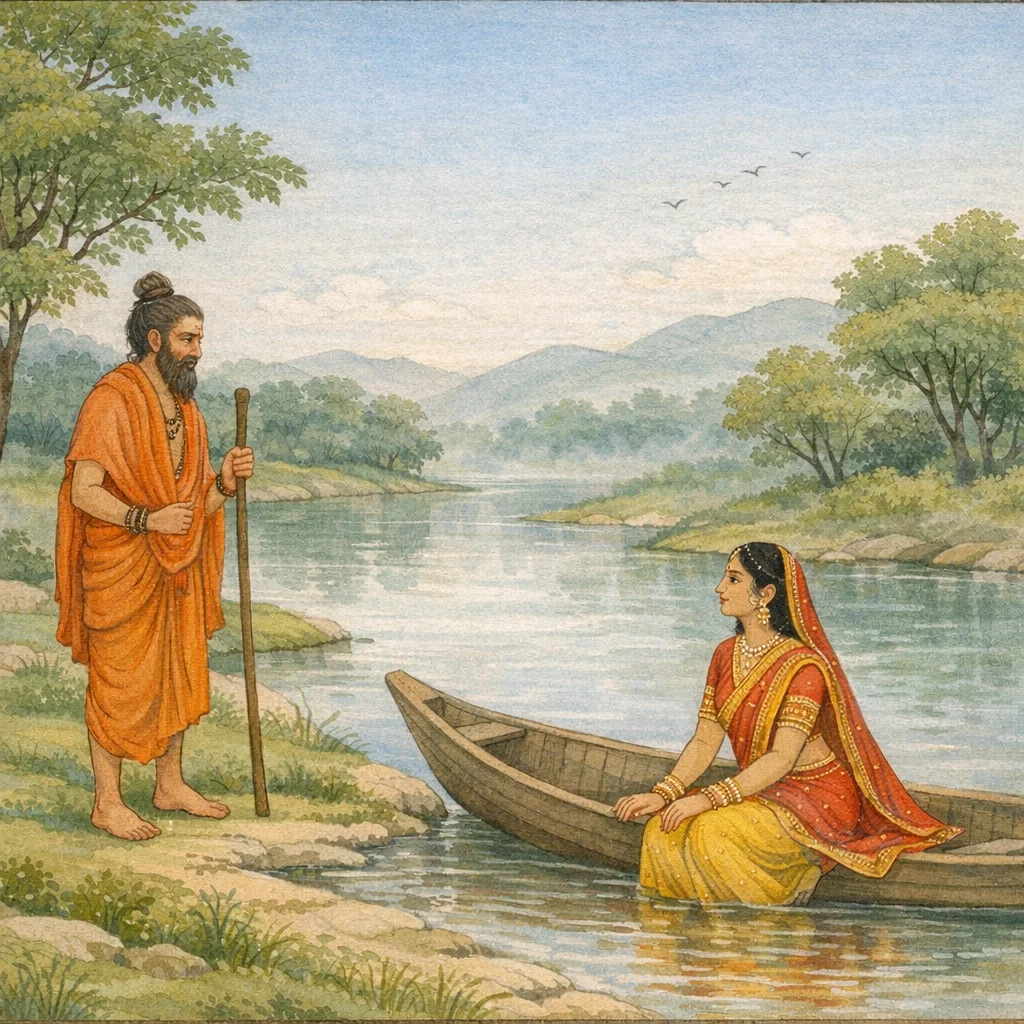
Vyāsotpatti-kathana (Account of the Birth/Origin of Vyāsa)
Adhyāya 44 unfolds as a question-and-answer inquiry: the sages ask Sūta to authoritatively clarify Vyāsa’s origin (vyāsotpatti), especially how the great yogin Vyāsa is born to Satyavatī through Parāśara. Sūta replies with a narrative set on the auspicious bank of the Yamunā during Parāśara’s tīrtha-yātrā. In a Purāṇic chain of causes, it moves through the river-crossing motif, the meeting with the Niṣāda fisher folk and their daughter Matsyagandhā (later Satyavatī), and the working of kāla-yoga—time-shaped destiny—that turns even a self-restrained ascetic toward procreative intent. The chapter’s deeper teaching is not mere biography: it presents a dharmic account of how knowledge-lineages arise, through the providential convergence of sacred place, ṛṣi-power, and divinely timed necessity. Thus Vyāsa’s authority is legitimized, and desire and restraint are read as instruments of cosmic purpose.
Shlokas
Verse 1
मुनय ऊचुः । व्यासोत्पत्तिं महाबुद्धे ब्रूहि सूत दयानिधे । कृपया परया स्वामिन्कृतार्थान्निष्कुरु प्रभो
The sages said: “O Sūta, great-minded one, ocean of compassion—tell us of the birth and origin of Vyāsa. By your supreme grace, O revered master, make us fulfilled in our purpose, O Lord.”
Verse 2
व्यासस्य जननी प्रोक्ता नाम्ना सत्यवती शुभा । विवाहिता तु सा देवी राज्ञा शन्तनुना किल
The blessed Satyavatī is declared to be the mother of Vyāsa. Indeed, that revered lady was married to King Śantanu.
Verse 3
तस्यां जातो महायोगी कथं व्यासः पराशरात् । सन्देहोऽत्र महाञ्जातस्तं भवाञ्छेत्तुमर्हति
“How, from her, was the great yogin Vyāsa born through Parāśara? A great doubt has arisen here; you are worthy to dispel it.”
Verse 4
सूत उवाच । एकदा तीर्थयात्रायां व्रजन्योगी पराशरः । यदृच्छया गतो रम्यं यमुनायास्तटं शुभम्
Sūta said: Once, as the yogin Parāśara journeyed on pilgrimage to the tīrthas, the sacred ford-places, he happened by chance to reach the beautiful and auspicious bank of the Yamunā.
Verse 5
निषादमाह धर्मात्मा कुर्वन्तं भोजनन्तदा । नयस्व यमुनापारं जलयानेन मामरम्
Then the righteous-souled one said to the Niṣāda who was preparing food: “Take me at once to the far bank of the Yamunā by a watercraft.”
Verse 6
इत्युक्तो मुनिना तेन निषादस्स्वसुतां जगौ । मत्स्यगन्धाममुं बाले पारं नावा नय द्रुतम्
Thus instructed by that sage, the Niṣāda called to his daughter: “O girl of fish-fragrance, take this venerable one quickly across to the far shore in the boat.”
Verse 7
तापसोऽयं महाभागे दृश्यन्तीगर्भसंभवः । तितीर्षुरस्ति मर्धाब्धिश्चतुराम्नायपारगः
O most fortunate lady, this ascetic—born from the womb of Dṛśyantī—seeks to cross the ocean of worldly turmoil; he has mastered the four sacred transmissions and stands steadfast in austerity.
Verse 8
इति विज्ञापिता पित्रा मत्स्यगन्धा महामुनिम् । संवाहयति नौकायामासीनं सूर्य्यरोचिषम्
Thus instructed by her father, Matsyagandhā began to gently attend and massage the great sage Sūryyarociṣ as he sat in the boat.
Verse 9
कालयोगान्महायोगी तस्यां कामातुरोऽभवत् । दृष्ट्वा योऽप्सरसां रूपं न कदापि विमोहितः
By the mysterious working of Time, that great Yogin became afflicted with desire for her—he who, even after beholding the beauty of the celestial apsarās, had never at any time been deluded.
Verse 10
ग्रहीतुकामः स मुनिर्दाशकन्यां मनोहराम् । दक्षिणेन करेणैतामस्पृशद्दक्षिणे करे
Wishing to take hold of the charming fisherman’s daughter, the sage reached out with his right hand and touched her on her right hand.
Verse 11
तमुवाच विशालाक्षीं वचनं स्मितपूर्वकम् । किमिदं क्रियये कर्म वाचंयम विगर्हितम्
He then spoke to the large-eyed lady with a gentle, smiling preface: “What is this censurable act you are attempting to do—an action unworthy of one who is self-restrained in speech?”
Verse 12
वसिष्ठस्य कुले रम्ये त्वं जातोऽसि महामते । निषादजा त्वहम्ब्रह्मन्कथं संगो घटेत नौ
O great-minded one, you have been born in the lovely lineage of Vasiṣṭha. But I, O Brahmin, am born of a Niṣāda woman—how, then, could union or association between us be fitting?
Verse 13
दुर्लभं मानुषं जन्म ब्राह्मणत्वं विशेषतः । तत्रापि तापसत्वं च दुर्लभं मुनिसत्तम
Human birth is difficult to obtain—especially birth as a brāhmaṇa. Even among such, the state of true ascetic discipline (tāpasatva) is rare, O best of sages.
Verse 14
विद्यया वपुषा वाचा कुलशीलेन चान्वितः । कामबाणवशं यातो महदाश्चर्यमत्र हि
Endowed with learning, handsome form, refined speech, noble lineage, and good conduct, he nevertheless came under the power of Kāma’s arrows—indeed, this is a great wonder here.
Verse 15
प्रवृत्तमप्यसत्कर्म कर्तुमेनं न कोऽपि ह । भुवि वारयितुं शक्तः शापभीत्यास्य योगिनः
Even though he had embarked upon an unrighteous deed, no one on earth was able to restrain him—out of fear of the yogin’s curse.
Verse 16
इति संचिन्त्य हृदये निजगाद महामुनिम् । तावद्धैर्यं कुरु स्वामिन्यावत्त्वां पारयामि न
Having thus reflected within his heart, he spoke to the great sage: “O noble lady, remain steadfast and courageous—until I can see you safely brought through, do not lose heart.”
Verse 17
सूत उवाच । इति श्रुत्वा वचस्तस्या योगिराजः पराशरः । तत्याज पाणिं तरसा सिन्धोः पारं गतः पुनः
Sūta said: Thus hearing her words, the royal sage Parāśara—foremost among yogins—swiftly released her hand and once more crossed the river to the far bank.
Verse 18
पुनर्जग्राह तां बालां मुनिं कामप्रपीडितः । कंपमाना तु सा बाला तमुवाच दयानिधिम्
Overcome again by the torment of desire, the sage seized the young maiden once more. Trembling, the girl addressed him—who was otherwise a treasury of compassion.
Verse 19
दुर्गन्धाहं मुनिश्रेष्ठ कृष्णवर्णा निषादजा । भवांस्तु परमोदारविचारो योगिसत्तमः
I am foul-smelling, O best of sages—dark-complexioned and born of the Niṣāda lineage. But you are the noblest in judgment and conduct, O foremost among yogins.
Verse 20
नावयोर्घटते सङ्गो काचकांचनयोरिव । तुल्यजात्याकृतिकयोः संगः सौख्यप्रदो भवेत्
Between two dissimilar persons, true concord does not arise—just as between glass and gold. But association between those of similar nature and disposition becomes a giver of happiness.
Verse 21
इत्युक्तेन तया तेन क्षणमात्रेण कामिनी । कृता योजनगंधा तु रम्यरूपा मनोरमा
Thus addressed by him, that lovely woman was, in a mere instant, made “of fragrance reaching a yojana,” and she became exquisitely beautiful—charming and delightful to behold.
Verse 22
पुनर्जग्राह तां बालां स मुनिः कामपीडितः । ग्रहीतुकामं तं दृष्ट्वा पुनः प्रोवाच वासवी
Tormented by desire, the sage again seized that young maiden. Seeing him intent on taking hold of her, Vāsavī spoke once more.
Verse 23
रात्रौ व्यवायः कर्तव्यो न दिवेति श्रुतिर्जगौ । दिवासंगे महान्दोषो निन्दा चापि दुरासदा
The sacred teaching declares that conjugal union is to be undertaken at night and not in the daytime. For union by day brings a great fault, and it also invites blame that is hard to dispel.
Verse 24
तस्मात्तावत्प्रतीक्षस्व यावद्भवति यामिनी । पश्यन्ति मानवाश्चात्र पिता मे च तटे स्थितः
Therefore, wait here for a while until night falls. People are watching here, and my father is also standing on the riverbank.
Verse 25
तयोक्तमिदमाकर्ण्य वचनं मुनिपुंगवः । नीहारं कल्पयामास सद्यः पुण्यबलेन वै
Hearing these words spoken by the two, the foremost of sages at once produced a veil of mist—indeed, by the power of his accumulated merit.
Verse 26
नीहारे च समुत्पन्ने तमसा रात्रिसंनिभे । व्यवायचकिता बाला पुनः प्रोवाच तम्मुनिम्
When a mist arose and darkness spread, resembling the night, the young maiden—startled at the prospect of union—spoke again to that sage.
Verse 27
योगिन्नमोघवीर्य्यस्त्वं भुक्त्वा गन्तासि मां यदि । सगर्भा स्यां तदा स्वामिन्का गतिर्मे भवेदिति
“O Yogi, your potency is unfailing. If, after enjoying me, you intend to depart, then if I should become pregnant, O Lord—what will become of my destiny?”
Verse 28
कन्याव्रतं महाबुद्धे मम नष्टं भविष्यति । हसिष्यति तदा लोकाः पितरं किं ब्रवीम्यहम्
O great-minded one, my maidenly vow will be ruined. Then people will laugh at me—what am I to say to my father?
Verse 29
पराशर उवाच । रम बाले मया सार्द्धं स्वच्छन्दं कामजै रसैः । स्वीयाभिलाषमाख्याहि पूरयाम्यधुना प्रिये
Parāśara said: “O young one, sport with me freely, together, in the delights born of desire. Speak your own wish; I shall fulfill it now, my beloved.”
Verse 30
मदाज्ञासत्यकरणान्नाम्ना सत्यवती भव । वन्दनीया तथाशेषैर्योगिभिस्त्रिदशैरपि
“Because you have made My command come true, be known by the name Satyavatī. Moreover, you shall be worthy of reverence by all—by the yogins, and even by the gods.”
Verse 31
सत्यवत्युवाच । जानते न पिता माता न वान्ये भुवि मानवाः । कन्याधर्मो न मे हन्याद्यदि स्वीकुरु मान्तदा
Satyavatī said: “My father and mother do not know, nor do any other people on earth. If you accept me now, then my maidenly vow of chastity will not be violated.”
Verse 32
पुत्रश्च त्वत्समो नाथ भवेदद्भुतशक्तिमान् । सौगन्ध्यं सर्वदांगे मे तारुण्यं च नवंनवम्
“O Lord, may I have a son equal to You, endowed with wondrous power. And may there ever be fragrance in all my limbs, and may my youthfulness remain ever fresh and renewed.”
Verse 33
पराशर उवाच । शृणु प्रिये तवाभीष्टं सर्वं पूर्णं भविष्यति । विष्ण्वंशसंभवः पुत्रो भविता ते महायशाः
Parāśara said: “Listen, beloved—everything you desire shall be fulfilled in full. A son of great renown, born from the lineage of Viṣṇu, will be born to you.”
Verse 34
किंचिद्वै कारणं विद्धि यतोऽहं कामपीडितः । दृष्ट्वा चाप्सरसारूपं नामुह्यन्मे नमः क्वचित्
Know this as the true cause: I have been tormented by desire. Yet even on beholding the form of an apsaras, my mind is not deluded—at no time do I lose my inner reverence.
Verse 35
मीनगन्धां समालक्ष्य त्वां मोहवशगोऽभवम् । न बाले भालपट्टस्थो ब्रह्मलेखोऽन्यथा भवेत्
Catching the scent of fish upon you, I fell under the sway of delusion. O young girl, the destiny written by Brahmā upon the forehead does not become otherwise.
Verse 36
पुराणकर्ता पुत्रस्ते वेदशाखाविभागकृत् । भविष्यति वरारोहे ख्यातकीर्तिर्जगत्त्रये
O fair-hipped one, your son will become a composer of Purāṇas and a divider of the branches of the Vedas; his fame will be renowned throughout the three worlds.
Verse 37
इत्युक्त्वा तां सुरम्याङ्गीं भुक्त्वा योगविशारदः । वव्राज शीघ्रं यमुनाजले स्नात्वा महामुने
Having spoken thus to that exquisitely beautiful-limbed lady, the adept in Yoga ate, and then—O great sage—departed swiftly after bathing in the waters of the Yamunā.
Verse 38
सापि गर्भं दधाराशु द्वादशात्मसमप्रभम् । असूत सूर्य्यजाद्वीपे कामदेवमिवात्मजम्
She too soon conceived, bearing within her a splendour equal to twelvefold powers; and on the island called Sūryyajā-dvīpa she gave birth to a son like Kāmadeva himself.
Verse 39
वामे कमण्डलुं बिभ्रद्दक्षिणे दण्डमुत्तमम् । पिशंगीभिर्जटाभिश्च राजितो महसां चयः
Holding a kamandalu water-pot in His left hand and an excellent staff in His right, that treasury of splendour shone forth, adorned with tawny, matted jata locks.
Verse 40
जातमात्रस्तु तेजस्वी मातरं प्रत्यभाषत । गच्छ मातर्यथाकामं गच्छाम्यहमतः परम्
But the radiant one, immediately upon being born, addressed his mother: “Go, Mother, wherever you wish; I shall depart from here to the supreme state beyond.”
Verse 41
मातर्यदा भवेत्कार्यं तव किंचिद्धृदीप्सितम् । संस्मृतश्चागमिष्यामि त्वदिच्छापूर्तिहेतवे
“Mother, whenever there arises for you some task—anything desired in your heart—then, when you remember me, I shall surely come, for the sake of fulfilling your wish.”
Verse 42
इत्युक्त्वा मातृचरणावभिवाद्य तपोनिधिः । जगाम च तपः कर्त्तुं तीर्थं पापविशोधनम्
Having spoken thus, the treasure-house of austerity bowed at his mother’s feet and then departed to a sacred tīrtha—an expiatory place that purifies sins—in order to perform tapas.
Verse 43
सापि पित्रन्तिकं याता पुत्रस्नेहाकुला सती । स्मरन्ती चरितं सूनोर्वर्णयन्ती स्वभाग्यकम्
She too went to her father’s presence. Overwhelmed with motherly affection for her son, that virtuous lady kept recalling her son’s deeds and spoke aloud of her own good fortune.
Verse 44
द्वीपे जातो यतो बालस्तेन द्वैपायनोऽभवत् । वेदशाखाविभजनाद्वेदव्यासः प्रकीर्तितः
Because the child was born upon an island (dvīpa), he came to be known as Dvaipāyana; and because he divided the Veda into its branches, he is celebrated as Vedavyāsa.
Verse 45
तीर्थराजं प्रथमतो धर्मकामार्थ मोक्षदम् । नैमिषं च कुरुक्षेत्रं गङ्गाद्वारमवन्तिकाम्
First is praised the King of tīrthas, the foremost sacred ford, bestowing Dharma, Kāma, Artha, and Mokṣa; then (are praised) Naimiṣa, Kurukṣetra, Gaṅgādvāra (Haridvāra), and Avantikā (Ujjayinī).
Verse 46
अयोध्यां मथुरां चैव द्वारकाममरावतीम् । सरस्वतीं सिंधुसङ्गं गंगा सागरसंगमम्
Ayodhyā and Mathurā, and also Dvārakā and Amarāvatī; the Sarasvatī, the confluence of the Sindhu, and the place where the Gaṅgā meets the ocean—all these sacred places are to be revered.
Verse 47
काञ्चीं च त्र्यम्बकं चापि सप्तगोदावरीतटम् । कालञ्जरं प्रभासं च तथा बदरिकाश्रमम्
And (one should visit) Kāñcī, and also Tryambaka; the bank of the Godāvarī at Saptagodāvarī; Kālañjara, Prabhāsa, and likewise Badarikāśrama.
Verse 48
महालयन्तथोंकारक्षेत्रं वै पुरुषोत्तमम् । गोकर्णं भृगुकच्छं च भृगुतुंगं च पुष्करम्
“(He spoke of) Mahālaya, and likewise the sacred Oṃkāra-kṣetra; also Puruṣottama—along with Gokarṇa, Bhṛgukaccha, Bhṛgutuṅga, and Puṣkara.”
Verse 49
श्रीपर्वतादितीर्थानि धारातीर्थं तथैव च । गत्वावगाह्य विधिना चचार परमन्तपः
He went to the sacred fords beginning with Śrīparvata, and also to Dhārā-tīrtha; bathing there according to the prescribed rite, that great ascetic—burning with intense tapas—continued his austere observances.
Verse 50
एवन्तीर्थान्यनेकानि नानादेशस्थितानि ह । पर्य्यटन्कालिकासूनुः प्रापद्वाराणसीम्पुरीम्
Thus, after wandering through many sacred tīrthas in diverse lands, the son of Kālīkā at last reached the city of Vārāṇasī.
Verse 51
यत्र विश्वेश्वरः साक्षादन्नपूर्णा महेश्वरी । भक्तानाममृतन्दातुं विराजेते कृपानिधी
There, Viśveśvara Himself and Annapūrṇā, the great Goddess, shine forth—both oceans of compassion—bestowing upon their devotees the nectar of grace.
Verse 52
प्राप्य वाराणसीतीर्थं दृष्ट्वाथ मणिकर्णिकाम् । कोटिजन्मार्जितं पापं तत्याज स मुनीश्वरः
Having reached the sacred tīrtha of Vārāṇasī and then beholding Maṇikarṇikā, that lord among sages cast off the sin amassed over tens of millions of births.
Verse 53
दृष्ट्वा लिंगानि सर्वाणि विश्वेशप्रमुखानि च । स्नात्वा सर्वेषु कुण्डेषु वापीकूपसरस्सु च
Having beheld all the sacred Liṅgas—beginning with Viśveśa—and having bathed in all the holy tanks, as well as in wells, stepwells, and lakes,
Verse 55
दण्डनायकमुख्यांश्च गणान्स्तुत्वा प्रयत्नतः । आदिकेशवमुख्यांश्च केशवान्परितोष्य च
With earnest effort he praised the gaṇas, headed by the chief commander Daṇḍanāyaka, and he also satisfied the Keśavas, headed by Ādi-Keśava.
Verse 56
लोलार्कमुख्यसूर्यांश्च प्रणम्य च पुनःपुनः । कृत्वा पिण्डप्रदानानि सर्वतीर्थेष्वतन्द्रितः
Again and again he bowed to the Sun, beginning with Lolārka, and without indolence he performed the offering of piṇḍas at all the sacred tīrthas.
Verse 57
स्थापयामास पुण्यात्मा लिंगं व्यासेश्वराभिधम् । यद्दर्शनाद्भवेद्विप्र नरो विद्यासु वाक्पतिः
That virtuous one installed a Liṅga named Vyāseśvara. O brāhmaṇa, merely by beholding it, a man becomes a master of speech in the sciences and branches of knowledge.
Verse 58
लिंगान्यभ्यर्च्य विश्वेशप्रमुखानि सुभक्तितः । असकृच्चिन्तयामास किं लिगं क्षिप्रसिद्धिदम्
Having worshipped the many Śiva-liṅgas—beginning with Viśveśa—with sincere devotion, he reflected again and again: “Which liṅga bestows swift spiritual attainment?”
Verse 59
यमाराध्य महादेवं विद्याः सर्वा लभेमहि । पुराणकर्तृताशक्तिर्ममास्तु यदनुग्रहात्
Having worshipped Mahādeva, may we obtain all sacred knowledges; and by His grace, may the power to compose a Purāṇa arise in me.
Verse 60
श्रीदमोंकारनाथं वा कृत्तिवासेश्वरं किमु । केदारेशन्तु कामेशं चन्द्रेशं वा त्रिलोचनम्
Whether as the revered Oṃkāranātha, or as Kṛttivāseśvara—indeed, what more need be said? And at Kedāra He is praised as Kāmeśa; elsewhere as Candreśa, or as the three-eyed Lord, Trilocana.
Verse 61
कालेशं वृद्धकालेशं कालशेश्वरमेव वा । ज्येष्ठेशं जम्बुकेशं वा जैगीषव्येश्वरन्तु वा
One may worship (Śiva) as Kāleśa, as Vṛddha-Kāleśa, or indeed as Kālaśeśvara; or as Jyeṣṭheśa, as Jambukeśa, or as Jaigīṣavyeśvara.
Verse 62
दशाश्वमेधमीशानं द्रुमिचण्डेशमेव वा । दृक्केशं गरुडेशं वा गोकर्णेशं गणेश्वरम्
(One should worship or remember) Īśāna famed as Daśāśvamedha; or Drumicaṇḍeśa; or Dṛkkeśa; or Garuḍeśa; and Gokarṇeśa—Gaṇeśvara, Lord of the Gaṇas.
Verse 63
प्रसन्नवदनेशं वा धर्म्मेशं तारकेश्वरम् । नन्दिकेशं निवासेशं पत्रीशं प्रीतिकेश्वरम्
Or one may worship (Śiva) by remembering these sacred names: the Lord of the serene-faced one, the Lord of Dharma, Tāreśvara, the Lord of Nandin, the Lord of Abode, Patrīśa, and Prītikeśvara.
Verse 64
पर्वतेशं पशुपतिं हाटकेश्वरमेव वा । बृहस्पतीश्वरं वाथ तिलभाण्डेशमेव वा
One may worship (the Lord) as Parvateśa, as Paśupati, or indeed as Hāṭakeśvara; or else as Bṛhaspatīśvara, or again as Tilabhāṇḍeśa.
Verse 65
भारभूतेश्वरं किं वा महालक्ष्मीश्वरं तु वा । मरुतेशन्तु मोक्षेशं गंगेशं नर्मदेश्वरम्
Or (one may worship) Bhārabhūteśvara; or indeed Mahālakṣmīśvara; likewise Maruteśa, Mokṣeśa, Gaṅgeśa, and Narmadeśvara—these Īśvaras are Śiva, present as the Liṅga at sacred places.
Verse 66
कृष्णेशं परमेशानं रत्नेश्वरमथापि वा । यामुनेशं लांगलीशं श्रीमद्विश्वेश्वरं विभुम्
One may worship Lord Śiva as Kṛṣṇeśa, as Parameśāna, or as Ratneśvara; likewise as Yāmuneśa, as Lāṅgalīśa, and as the glorious Viśveśvara—the all-pervading Supreme.
Verse 67
अविमुक्तेश्वरं वाथ विशालाक्षीशमेव वा । व्याघ्रेश्वरं वराहेशं विद्येश्वरमथापि वा
Or else, one may worship Avimukteśvara, or indeed Viśālākṣīśa; likewise Vyāghreśvara, Varāheśa, or even Vidyeśvara—all revered forms of Lord Śiva to be approached in devotion.
Verse 68
वरुणेशं विधीशं वा हरिकेशेश्वरन्तु वा । भवानीशं कपर्द्दीशं कन्दुकेश मजेश्वरम्
One may worship Śiva as Varuṇeśa, or as Vidhīśa (Lord over Brahmā), or as Harikeśeśvara; likewise as Bhavānīśa (Lord of Bhavānī), as Kaparddīśa (the Lord with matted locks), as Kandukeśa, and as Majeśvara.
Verse 69
विश्वकर्मेश्वरं वाथ वीरेश्वरमथापि वा । नादेशं कपिलेशं च भुवनेश्वरमेव वा
Or one may worship Viśvakarmēśvara, or likewise Vīrēśvara; or Nādeśa, Kapilēśa, or indeed Bhuvaneśvara—all revered forms/lingas of the Lord.
Verse 70
बाष्कुलीशं महादेवं सिद्धीश्वरमथापि वा । विश्वेदेवेश्वरं वीरभद्रेशं भैरवेश्वरम्
“Worship and remember Bāṣkulīśa, Mahādeva, and also Siddhīśvara; worship and remember Viśvedeveśvara, Vīrabhadreśa, and Bhairaveśvara.”
Verse 71
अमृतेशं सतीशं वा पार्वतीश्वरमेव वा । सिद्धेश्वरं मतंगेशं भूतीश्वरमथापि वा
Whether one worships Him as Amṛteśa (Lord of immortality), or as Satīśa (Lord of Satī), or indeed as Pārvatīśvara (Lord of Pārvatī); or as Siddheśvara (Lord of the perfected ones), as Mataṅgeśa, or again as Bhūtīśvara (Lord of the hosts of beings)—all these are names of that same Supreme Lord Śiva.
Verse 72
आषाढीशं प्रकामेशं कोटिरुद्रेश्वरन्तथा । मदालसेश्वरं चैव तिलपर्णेश्वरं किमु
“(He spoke of) Āṣāḍhīśa, Prakāmeśa, and likewise Koṭirudreśvara; also Madālaseśvara, and even Tilaparṇeśvara—what more need be said?”
Verse 73
किं वा हिरण्यगर्भेशं किं वा श्रीमध्यमेश्वरम् । इत्यादिकोटिलिंगानां मध्येऽहं किमुपाश्रये
“Should I take refuge in Hiraṇyagarbheśa, or in the auspicious Madhyameśvara? Among such countless crores of Liṅgas, which one should I rely upon and worship?”
Verse 74
इति चिन्तातुरो व्यासः शिवभक्तिरतात्मवान् । क्षणं विचारयामास ध्यानसुस्थिरचेतसा
Thus, Vyāsa—whose very self delighted in devotion to Śiva—was troubled with concern; and for a moment he reflected, his mind made steady through meditative absorption.
Verse 75
आज्ञातं विस्मृतं तावन्निष्पन्नो मे मनोरथः । सिद्धैः संपूजितं लिंगं धर्म्मकामार्थमोक्षदम्
So long as it remained unknown and forgotten, my cherished aim was unfulfilled. But this Liṅga—worshipped even by the Siddhas—bestows dharma, kāma, artha, and mokṣa.
Verse 76
दर्शनात्स्पर्शनाद्यस्य चेतो निर्मलतामियात् । उद्धाटितं सदैवास्ति द्वारं स्वर्गस्य यत्र हि
By merely beholding and touching that holy presence, one’s mind becomes pure. For in that place, indeed, the gate of heaven remains ever open.
Verse 77
अविमुक्ते महाक्षेत्रे सिद्धक्षेत्रे हि तत्परम् । यत्रास्ते परमं लिंगं मध्यमेश्वरसंज्ञकम्
In Avimukta—the great sacred field, indeed a perfected holy region—there abides the supreme Liṅga, renowned by the name Madhyameśvara.
Verse 78
न मध्यमेश्वरादन्यल्लिंगं काश्यां हि विद्यते । यद्दर्शनार्थमायान्ति देवाः पर्वणिपर्वणि
In Kāśī, indeed, there is no other Liṅga apart from Madhyameśvara—He for whose darśana (sacred vision) the gods themselves come, festival after festival and holy observance after holy observance.
Verse 79
अतः सेव्यो महादेवो मध्यमेश्वरसंज्ञकः । अस्याराधनतो विप्रा बहवः सिद्धिमागताः
Therefore Mahādeva, known as Madhyameśvara, is to be worshipped. By worshipping Him, many holy brāhmaṇas have attained siddhi—spiritual accomplishment and fulfillment.
Verse 80
यः प्रधानतया काश्या मध्ये तिष्ठति शङ्करः । स्वपुरीजन सौख्यार्थमतोऽसौ मध्यमेश्वरः
That Śaṅkara who, as the foremost Lord, abides in the very center of Kāśī for the welfare and spiritual ease of the people of His own city—therefore He is known as Madhyameśvara, “the Lord in the Middle.”
Verse 81
तुम्बुरुर्नाम गंधर्वो देवर्षिर्नारदस्तथा । अमुमाराध्य संपन्नो गानविद्याविशारदौ
Tumburu, the Gandharva, and the divine sage Nārada as well—having worshipped Him (Lord Śiva) with devotion—became fully endowed and highly accomplished masters of the science of song and music.
Verse 82
अमुमेव समाराध्य विष्णुर्मोक्षप्रदोऽभवत् । ब्रह्मा विष्णुश्च रुद्रश्च स्रष्टृपालकहारकाः
By worshipping Him alone (Śiva), Viṣṇu became a bestower of liberation. Brahmā, Viṣṇu, and Rudra are respectively the creator, the sustainer, and the remover (of the universe).
Verse 83
धनाधीशः कुबेरोऽपि वामदेवो हि शैवराट् । खट्वांगो नाम भूपालोऽनपत्योऽपत्यवानभूत्
Even Kubera, the lord of wealth, and Vāmadeva, the sovereign among Śaiva devotees—likewise a king named Khaṭvāṅga, though previously without offspring, became blessed with progeny (by Śiva’s grace).
Verse 84
अप्सराश्चन्द्रभामाख्या नृत्यन्ती निजभावतः । सदेहा कोकिलालापा लिंगमध्ये लयं गता
An Apsarā named Candrabhā, dancing in her own natural rapture, with her embodied form and cuckoo-sweet voice, entered into dissolution within the very midst of the Liṅga.
Verse 85
श्रीकरो गोपिकासूनुः सेविता मध्यमेश्वरम् । गाणपत्यं समालेभे शिवस्य करुणात्मनः
Śrīkara, the son of Gopikā, worshipped Madhyameśvara; and by the compassionate grace of Lord Śiva, he attained the state and path of the Gaṇapatya tradition, devotion centered on Gaṇeśa.
Verse 86
भार्गवो गीष्पतिश्चोभौ देवौ दैत्यसुरार्चितौ । विद्यापारंगमौ जातौ प्रसादान्मध्यमेशितुः
Bhārgava (Śukra) and Gīṣpati (Bṛhaspati)—both revered deities, honoured by the Daityas and the Devas—became consummate masters of sacred knowledge through the gracious favour of the Lord of the middle realm.
Verse 87
अहमप्यत्र संपूज्य मध्यमेश्वरमीश्वरम् । पुराणकर्तृताशक्तिं प्राप्स्यामि तरसा धुवम्
Here too, by duly worshipping Madhyameśvara—the Lord, the Supreme Ruler—I shall swiftly and certainly attain the power and competence to compose a Purāṇa.
Verse 88
इति कृत्वा मतिं धीरो व्यासः सत्यवतीसुतः । भागीरथ्यम्भसि स्नात्वा जग्राह नियमं व्रती
Thus, having resolved in his mind, the steadfast sage Vyāsa, son of Satyavatī, bathed in the waters of the Bhāgīrathī (Gaṅgā) and, as a disciplined votary, undertook the prescribed observance (niyama).
Verse 89
क्वचित्पर्णाशनो भूत्त्वा फलशाकाशनः क्वचित् । वातभुग्जलभुक्क्वापि क्वचिन्निरशनव्रती
At times he lived on leaves; at times he ate fruits and vegetables. Sometimes he subsisted only on air, sometimes only on water; and at other times he observed the vow of complete fasting—thus practising severe restraint for the sake of Śiva-realization.
Verse 90
इत्यादि नियमैर्योगी त्रिकालं मध्यमेश्वरम् । पूजयामास धर्म्मात्मा नानावृक्षोद्भवैः फलैः
Thus, observing such disciplines and restraints, the righteous yogin worshipped Madhyameśvara three times each day, offering fruits that had grown from various trees.
Verse 91
इत्थं बहुतिथे काले व्यतीते कालिकासुतः । स्नात्वा त्रिपथगातोये यावदायाति स प्रगे
Thus, when a long time had passed, Kālikā’s son, having bathed in the waters of the Tripathagā—the Gaṅgā that flows through the three worlds—came there at daybreak.
Verse 92
मध्यमेश्वरमीशानं भक्ताभीष्टवरप्रदम् । तावद्ददर्श पुण्यात्मा मध्येलिंगं महेश्वरम्
Then that virtuous soul beheld in the middle the Great Lord as the Liṅga—Īśāna known as Madhyameśvara—who grants devotees the boons they desire.
Verse 93
उमाभूषितवामांगं व्याघ्रचर्म्मोत्तरीयकम् । जटाजूटचलद्गंगातरंगैश्चारुविग्रहम्
His left side was adorned by Umā (Pārvatī); he wore a tiger-skin as his upper garment; and his beautiful form was graced by the rippling waves of the Gaṅgā moving through his matted locks.
Verse 94
लसच्छारदबालेन्दुचन्द्रिकाचन्दितालकम् । भस्मोद्धूलितसर्वाङ्गं कर्पूरार्जुनविग्रहम्
His hair shone as though bathed in the moonlight of an autumnal young moon; his entire body was dusted with bhasma, the sacred ash; and his form appeared white and lustrous like camphor and the pale bark of the Arjuna tree—thus was the auspicious saguna form of Lord Śiva described.
Verse 95
कर्णान्तायतनेत्रं च विद्रुमारुणदच्छदम् । पंचवर्षाकृति बालं बालकोचितभूषणम्
He was a child of about five years, with eyes elongated up to the ears, clad in garments of a clear coral-red hue, and adorned with ornaments befitting a young boy.
Verse 96
दधानं कोटिकन्दर्प्पदर्पहानि तनुद्युतिम् । नग्रं प्रहसितास्याब्जं गायन्तं साम लीलया
He bore a subtle radiance that humbled the pride of countless Kāma-devas; naked and utterly free of coverings, with a lotus-like face gently smiling, He playfully sang the Sāman hymns.
Verse 97
करुणापारपाथोधिं भक्तवत्सलनामकम् । आशुतोषमुमाकान्तं प्रसादसुमुखं हरम्
I adore Hara—an ocean without shore of compassion—renowned as the Lover of His devotees; Aśutoṣa, the Easily Pleased Lord, the Beloved of Umā, whose face is ever gracious in bestowing favor.
Verse 98
समालोक्य स्तुतिं चक्रे प्रेमगद्गया गिरा । योगीनामप्यगम्यन्तं दीनबन्धुं चिदात्मकम्
Beholding Him, he offered a hymn of praise in a voice choked with love—unto that Lord who is beyond the reach even of yogins, the Friend of the afflicted, whose very essence is pure Consciousness.
Verse 99
वेदव्यास उवाच । देवदेव महाभाग शरणागतवत्सल । वाङ्मनः कर्मदुष्पाप योगिनामप्यगोचर
Vedavyāsa said: “O God of gods, O greatly blessed Lord, tender to those who take refuge in You—you are beyond the reach of even yogins, and untouched by the faults arising from speech, mind, and action.”
Verse 100
महिमानं न ते वेदा विदामासुरुमापते । त्वमेव जगतः कर्ता धर्ता हर्ता तथैव च
O Lord of Umā, even the Vedas have not fully known Your greatness. You alone are the creator of the universe, its sustainer, and likewise its withdrawer (dissolver).
Verse 101
त्वमाद्यः सर्वदेवानां सच्चिदानंद ईश्वरः । नामगोत्रे न वा ते स्तः सर्वज्ञोऽसि सदाशिव
You are the primordial Lord of all the gods, the sovereign whose very nature is Existence, Consciousness, and Bliss. For You there are no limiting designations such as name or lineage; O Sadāśiva, You are omniscient.
Verse 102
त्वमेव परमं ब्रह्म मायापाशनिवर्तकः । गुणत्रयैर्न लिप्तस्त्वं पद्मपत्रमिवांभसा
You alone are the Supreme Brahman, the One who removes the bondage of Māyā. Though present amid the three guṇas, you are not tainted by them—like a lotus leaf untouched by water.
Verse 103
न ते जन्म न वा शीलं न देशो न कुलं च ते । इत्थं भूतोपीश्वरत्वं त्रिलोक्याः काममावहे
You have neither birth nor (worldly) character, neither homeland nor lineage. Yet, being such, you freely assume lordship over the three worlds, fulfilling every intention as you will.
Verse 104
न च ब्रह्मा न लक्ष्मीशो न च सेन्द्रा दिवौकसः । न योगीन्द्रा विदुस्तत्त्वं यस्य तं त्वामुपास्महे
Neither Brahmā, nor Viṣṇu the Lord of Lakṣmī, nor the gods of heaven with Indra, nor even the foremost yogins truly know the essential reality of Him—You. Therefore, we worship You alone.
Verse 105
त्वत्तः सर्वं त्वं हि सर्वं गौरीशस्त्वं पुरान्तकः । त्वं बालस्त्वं युवा वृद्धस्तं त्वां हृदि युनज्म्यहम्
From You all arises; indeed, You are all. You are Gaurī’s Lord, Purāntaka, the Destroyer of the three cities. You are the child, the youth, and the aged—You, the all-pervading Lord, I unite within my heart.
Verse 106
नमस्तस्मै महेशाय भक्तध्येयाय शम्भवे । पुराणपुरुषायाद्धा शंकराय परात्मने
Salutations to that Mahādeva, Mahēśa—Śambhu, the One to be contemplated by devotees; to the primeval Puruṣa, ever pure and stainless; to Śaṅkara, the Paramātman, the Supreme Self, the innermost Reality of all.
Verse 107
इति स्तुत्वा क्षितौ यावद्दण्डवन्निपपात सः । तावत्स बालो हृष्टात्मा वेदव्यासमभाषत
Having thus offered praise, he fell upon the ground in full prostration, stretched out like a staff. At that very moment, the boy—his heart filled with joy—spoke to Sage Vedavyāsa.
Verse 108
वरं वृणीष्व भो योगिन्यस्ते मनसि वर्तते । नादेयं विद्यते किंचिद्भक्ताधीनो यतोऽस्म्यहम्
O yoginī, choose the boon that abides in your mind. There is nothing that cannot be granted—because I am bound by devotion and am under the power of my devotee.
Verse 109
तत उत्थाय हृष्टात्मा मुनिर्व्यासो महातपाः । प्रत्यब्रवीत्किमज्ञातं सर्वज्ञस्य तव प्रभो
Then the great ascetic sage Vyāsa rose up, his heart filled with joy, and replied: “O Lord, what could ever be unknown to You, the all-knowing?”
Verse 110
सर्वान्तरात्मा भगवाञ्छर्वः सर्वप्रदो भवान् । याञ्चां प्रतिनियुङ्क्ते मां किमीशो दैन्यकारिणीम्
You are Bhagavān Śarva, the Inner Self abiding within all, the giver of every boon. Why then does the Lord appoint me—one who brings only wretchedness—to go and beg?
Verse 111
इति श्रुत्वा वचस्तस्य व्यासस्यामलचेतसः । शुचि स्मित्वा महादेवो बालरूपधरोऽब्रवीत्
Having thus heard the words of the pure-minded Vyāsa, Mahādeva—assuming the form of a child—smiled gently and spoke.
Verse 112
बाल उवाच । त्वया ब्रह्मविदां श्रेष्ठ योऽभिलाषः कृतो हृदि । अचिरेणैव कालेन स भविष्यत्यसंशयः
Bāla said: O best among the knowers of Brahman, the desire you have formed within your heart will, in a very short time, surely be fulfilled—of this there is no doubt.
Verse 113
कण्ठे स्थित्वा तव ब्रह्मन्नन्तर्याम्यहमीश्वरः । सेतिहासपुराणानि सम्यङ्निर्यापयाम्यहम्
O Brahmā, abiding in your throat as the indwelling Inner Ruler (Antaryāmin), I—Śiva, the Lord—shall rightly bring forth and set in proper order the Itihāsas and the Purāṇas, together with their traditional accounts.
Verse 114
अभिलाषाष्टकं पुण्यं स्तोत्रमेतत्त्वयेरितम् । वर्षं त्रिकालं पठनात्कामदं शम्भुसद्मनि
This “Abhilāṣāṣṭaka” is a meritorious hymn proclaimed by you. By reciting it three times a day for a full year, it becomes a bestower of desired aims in the abode and grace of Śambhu (Lord Śiva).
Verse 115
एतत्स्तोत्रस्य पठनं विद्याबुद्धिविवर्द्धनम् । सर्वसंपत्करं प्रोक्तं धर्मदं मोक्षदं नृणाम्
The recitation of this hymn is said to increase true knowledge and right discernment. It is declared to bestow every auspicious prosperity, and for human beings it grants dharma and leads to mokṣa (liberation).
Verse 116
प्रातरुत्थाय सुस्नातो लिंगमभ्यर्च्य शांकरम् । वर्षं पठन्निदं स्तोत्रं मूर्खोऽपि स्याद्बृहस्पतिः
Rising early in the morning, having bathed well, and worshipping Śaṅkara’s Liṅga, if one recites this hymn for a full year, even a dull-witted person becomes like Bṛhaspati, the divine preceptor, in wisdom.
Verse 117
स्त्रिया वा पुरुषेणापि नियमाल्लिंगसन्निधौ । वर्षं जप्तमिदं स्तोत्रं बुद्धिं विद्याञ्च वर्द्धयेत्
Whether by a woman or by a man—observed with due discipline in the presence of the Śiva-liṅga—this hymn, when recited for a full year, increases discernment and sacred knowledge.
Verse 118
इत्युक्त्वा स महादेवो बालो लिंगे न्यलीयत । व्यासोऽपि मुंचन्नश्रूणि शिवप्रेमाकुलोऽभवत्
Having spoken thus, that Mahādeva—appearing as a child—merged into the Liṅga. Vyāsa too, shedding tears, became overwhelmed with love for Śiva.
Verse 119
एवं लब्धवरो व्यासो महेशान्मध्यमेश्वरात । अष्टादश पुराणानि प्रणिनाय स्वलीलया
Thus, having obtained the boon from Maheśa—the Lord who stands as the inner ruler in the middle of all beings and worlds—Vyāsa, by his own divine play, composed the eighteen Purāṇas.
Verse 120
ब्राह्मं पाद्मं वैष्णवञ्च शैवं भागवतं तथा । भविष्यं नारदीयं च मार्कंडेयमतः परम्
“(These are) the Brāhma, the Pādma, the Vaiṣṇava, the Śaiva, and likewise the Bhāgavata; also the Bhaviṣya, the Nāradiya, and then the Mārkaṇḍeya (Purāṇa) thereafter.”
Verse 121
आग्नेयं ब्रह्मवैवर्त लिंगं वाराहमेव च । वामनाख्यं ततः कौर्मं मात्स्यं गारुडमेव च
(They are) the Āgneya, the Brahmavaivarta, the Liṅga, the Vārāha, the one called Vāmana; then the Kaurma, the Mātsya, and also the Gāruḍa (Purāṇas).
Verse 122
स्कान्दं तथैव ब्रह्माण्डाख्यं पुराणं च कीर्तितम् । यशस्यं पुण्यदं नॄणां श्रोतॄणां शांकरं यश
Likewise, the Skanda Purāṇa and the Purāṇa known as the Brahmāṇḍa are proclaimed. For those who listen, they bestow fame and merit; and the Śaiva glory—the praise of Śaṅkara—becomes renowned among the hearers.
Verse 123
सूत उवाच । अष्टादशपुराणानाम्पूर्वं नामोदितन्त्वया । कुरु निर्वचनं तेषामिदानीं वेदवित्तम
Sūta said: “Earlier you have already stated the names of the eighteen Purāṇas. Now, O best among the knowers of the Veda, please give their proper derivations and explanations.”
Verse 124
व्यास उवाच । अयमेव कृतः प्रश्नस्तण्डिना ब्रह्मयोनिना । नन्दिकेश्वरमुद्दिश्य स यदाह ब्रवीमि तत्
Vyāsa said: “This very question was asked by Taṇḍin, the Brahma-born sage. Addressing Nandikeśvara, whatever he then spoke—I shall now relate that.”
Verse 125
नन्दिकेश्वर उवाच । यत्र वक्ता स्वयन्तण्डे ब्रह्मा साक्षाच्चतुर्मुखः । तस्माद्ब्रह्मं समाख्यातं पुराणं प्रथमं मुने
Nandikeśvara said: “That Purāṇa in which, in the Svayaṃtāṇḍava—the Lord’s self-manifest dance—the direct speaker is Brahmā himself, the four-faced one: therefore, O sage, it is declared the first (foremost) among the Purāṇas, the ‘Brahma Purāṇa.’”
Verse 126
पद्मकल्पस्य माहात्म्यन्तत्र यस्यामुदाहृतम् । तस्मात्पाद्मं समाख्यातं पुराणं च द्वितीयकम्
In that (Purāṇa) the greatness of the Padma-kalpa is proclaimed. Therefore it is called the Pādma Purāṇa, and it is the second (in this enumeration).
Verse 127
पराशरकृतं यत्तु पुराणं विष्णुबोधकम् । तदेव व्यासकथितं पुत्रपित्रोरभेदतः
That Purāṇa which was composed by Parāśara and which imparts the knowledge of Viṣṇu is indeed the very same Purāṇa narrated by Vyāsa—since, in truth, father and son are non-different in their essential identity.
Verse 128
यत्र पूर्वोत्तरे खण्डे शिवस्य चरितं बहु । शैवमेतत्पुराणं हि पुराणज्ञा वदन्ति च
That Purāṇa in which, in both the earlier and the later sections, the deeds and sacred exploits of Śiva are described in abundance—learned knowers of the Purāṇas indeed declare that Purāṇa to be truly Śaiva in character.
Verse 129
भगवत्याश्च दुर्गायाश्चरितं यत्र विद्यते । तत्तु भागवतं प्रोक्तं ननु देवीपुराणकम्
That Purāṇa wherein the sacred deeds of the Blessed Goddess Durgā are found is proclaimed as “Bhāgavata”; indeed, it is the Devī‑Purāṇa.
Verse 130
नारदोक्तं पुराणन्तु नारदीयं प्रचक्षते । यत्र वक्ताऽभवत्तण्डे मार्कण्डेयो महामुनिः
That Purāṇa which was spoken by Nārada is known as the Nāradiya Purāṇa; and in that sacred assembly, the great sage Mārkaṇḍeya became the narrator.
Verse 131
मार्कण्डेयपुराणं हि तदाख्यातं च सप्तमम् । अग्नियोगात्तदाग्नेयं भविष्योक्तेर्भविष्यकम्
Indeed, the Mārkaṇḍeya Purāṇa is declared to be the seventh. Because it is connected with Agni it is called the Āgneya; and because it contains prophecies of what is to come, it is called the Bhaviṣya.
Verse 132
विवर्तनाद्ब्रह्मणस्तु ब्रह्मवैवर्तमुच्यते । लिंगस्य चरितोक्तत्वात्पुराणं लिंगमुच्यते
Because it teaches the transformations (vaivarta) pertaining to Brahmā, the cosmic principle of creation, it is called the Brahma‑vaivarta. And since it narrates the sacred account and glory of the Liṅga of Lord Śiva, that Purāṇa is called the Liṅga (Purāṇa).
Verse 133
वराहस्य च वाराहं पुराणं द्वादशं मुने । यत्र स्कन्दः स्वयं श्रोता वक्ता साक्षान्महेश्वरः
O sage, for Varāha there is the Vārāha Purāṇa, the twelfth—where Skanda himself is the listener, and the speaker is Mahādeva (Maheśvara) in person.
Verse 134
तत्तु स्कान्दं समाख्यातं वामनस्य तु वामनम् । कौर्मं कूर्मस्य चरितं मात्स्यं मत्स्येन कीर्तितम्
That indeed is declared to be the Skanda Purāṇa; and the Vāmana Purāṇa pertains to Vāmana. The Kūrma Purāṇa narrates the deeds of the Tortoise incarnation, and the Mātsya Purāṇa is proclaimed by the Fish incarnation.
Verse 135
गरुडस्तु स्वयं वक्ता यत्तद्गारुडसंज्ञकम् । ब्रह्माण्डचरितोक्तत्वाद्ब्रह्माण्डं परिकीर्तितम्
Because Garuḍa himself is the narrator, that section is known as the “Gāruḍa.” And since it recounts the account of the Brahmāṇḍa (the cosmic egg, the universe), it is celebrated as the “Brahmāṇḍa.”
Verse 136
सूत उवाच । अयमेव मयाऽकारि प्रश्नो व्यासाय धीमते । ततः सर्वपुराणानां मया निर्वचनं श्रुतम्
Sūta said: “This very question was once put by me to the wise Vyāsa. Thereupon, from him I heard the authoritative exposition regarding all the Purāṇas.”
Verse 137
एवं व्याससमुत्पन्नः सत्यवत्यां पराशरात् । पुराणसंहिताश्चक्रे महाभारतमुत्तमम्
Thus Vyāsa was born of Parāśara through Satyavatī. He then composed the compendia of the Purāṇas and also the supreme epic, the Mahābhārata.
Verse 138
पराशरेण संयोगः पुनः शन्तनुना यथा । सत्यवत्या इव ब्रह्मन्नः संशयितुमर्हसि
O Brahmin, you may rightly harbor doubt—just as Satyavatī was united first with Parāśara and later with Śantanu.
Verse 139
सकारणेयमुत्पत्तिः कथिताश्चर्य्यकारिणी । महतां चरिते चैव गुणा ग्राह्या विचक्षणैः
Thus the wondrous account of this origin—together with its causes—has been narrated. And in the deeds of the great, the discerning should grasp and adopt the virtues they embody.
Verse 140
इदं रहस्यं परमं यः शृणोति पठत्यपि । स सर्वपापनिर्मुक्त ऋषिलोके महीयते
Whoever hears this supreme secret—or even recites it—becomes freed from all sins and is honored in the realm of the ṛṣis, the seers.
Frequently Asked Questions
It narrates the account of Vyāsa’s origin: the sages ask Sūta to resolve how Vyāsa is born to Satyavatī via Parāśara, leading into the Yamunā river-crossing episode involving Matsyagandhā and the niṣāda community.
The river-crossing functions as a liminal symbol for transition into a destined event, while kāla-yoga signals that extraordinary births occur through time-conditioned cosmic necessity—aligning ascetic potency with dharmic causality to generate a bearer of revelation (Vyāsa).
This chapter’s sampled passage is primarily genealogical and sage-centered rather than iconographic; it does not foreground a distinct Śiva/Umā form, instead emphasizing providential order and the emergence of a major ṛṣi within a Śaiva Purāṇic framework.