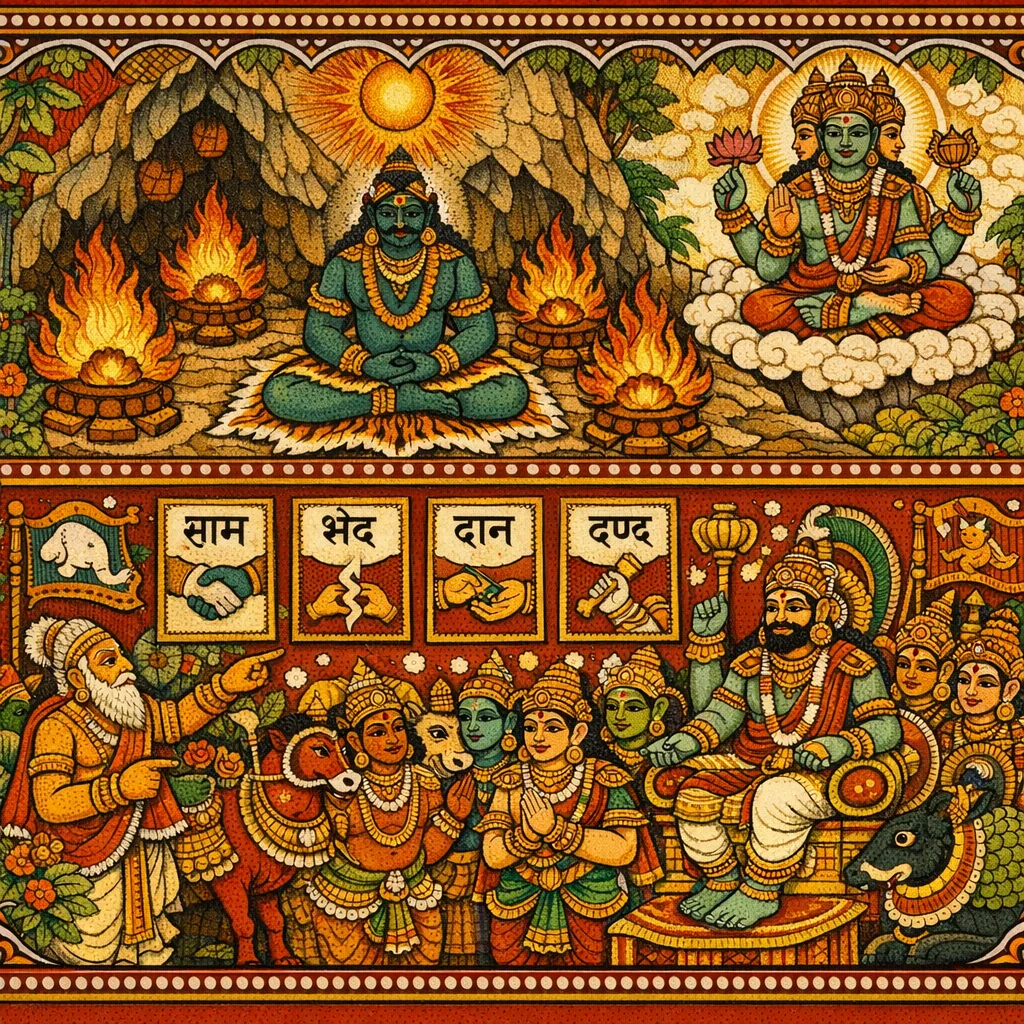
Adhyaya 148: Tārakāsura’s Austerity and Boon; Mobilization for War; Bṛhaspati’s Fourfold Policy (Sāma–Bheda–Dāna–Daṇḍa)
तारकासुरतपः-वरप्राप्ति-देवासुरसैन्यवर्णन-नीतिवादः
Speaker: तारक (Tāraka), ब्रह्मा (Brahmā / Viriñci), इन्द्र (Indra / Śatakratu / Pākaśāsana), बृहस्पति (Bṛhaspati), वायु (Vāyu)
Tāraka addresses the assembled Asuras, declaring their hereditary enmity with the Devas and urging conquest of Svarga after first gaining power through tapas. He performs fierce austerities in a cave on Mount Pāriyātra; Brahmā appears to grant a boon. Seeking invulnerability, Tāraka is told that all embodied beings must die, so he chooses a condition: he can be slain only by a child within seven days. Returning in triumph, he orders his ministers to ready an assault on Svarga; the Daitya host is portrayed with its chiefs, mounts, chariots, and banner-emblems. Vāyu reports the mobilization to Indra, who consults Bṛhaspati. The preceptor teaches the four upāyas (sāma–bheda–dāna–daṇḍa) and advises that against deeply entrenched wicked foes, only daṇḍa—forceful punishment—will succeed. Indra commands worship of the weapon-deities and war preparations, appoints Yama as commander, and the allied Deva forces—Gandharvas, Yakṣas, Nāgas, Rākṣasas, and Kiṃnaras—are described with iconographic and heraldic detail, culminating in the formidable array of Indra’s army.
Key Concepts
Shlokas in Adhyaya 148
Verse 1
*तारक उवाच शृणुध्वमसुराः सर्वे वाक्यं मम महाबलाः श्रेयसे क्रियतां बुद्धिः सर्वैः कृत्यस्य संविधौ //
Tāraka said: “Hear my words, all you Asuras of great might. Let each of you apply your intelligence to what is truly beneficial, as we deliberate together on the proper course of action.”
Verse 2
वंशक्षयकरा देवाः सर्वेषामेव दानवाः अस्माकं जातिधर्मो वै विरूढं वैरमक्षयम् //
The Devas are destroyers of our line—so say all the Dānavas. For us, indeed, it is the very law of our birth and kindred: a deep-rooted enmity that does not perish.
Verse 3
वयमद्य गमिष्यामः सुराणां निग्रहाय तु स्वबाहुबलमाश्रित्य सर्व एव न संशयः //
“Today we shall set forth to subdue the gods; relying on the strength of our own arms, all of us—without doubt—will prevail.”
Verse 4
किंतु नातपसा युक्तो मन्ये ऽहं सुरसंगमम् अहमादौ करिष्यामि ततो घोरं दितेः सुताः //
“But I do not think I am yet equipped with austerity (tapas) for an encounter with the gods. First, I shall undertake it; thereafter, O dreadful sons of Diti, the next course will follow.”
Verse 5
ततः सुरान्विजेष्यामो भोक्ष्यामो ऽथ जगत्त्रयम् स्थिरोपायो हि पुरुषः स्थिरश्रीरपि जायते //
“Then we shall conquer the gods, and thereafter enjoy the three worlds. For a man who is steadfast in his means (and strategy) becomes possessed of enduring prosperity as well.”
Verse 6
रक्षितुं नैव शक्नोति चपलश्चपलाः श्रियः तच्छ्रुत्वा दानवाः सर्वे वाक्यं तस्यासुरस्य तु //
The restless man cannot truly safeguard the restless fortunes of Śrī (prosperity). Hearing the words of that Asura, all the Dānavas listened and took heed.
Verse 7
साधु साध्वित्यवोचंस्ते तत्र दैत्याः सविस्मयाः सो ऽगच्छत्पारियात्रस्य गिरेः कन्दरमुत्तमम् //
There, the Daityas, struck with amazement, exclaimed, “Well done! Well done!” Then he went to the finest cave of Mount Pāriyātra.
Verse 8
सर्वर्तुकुसुमाकीर्णं नानौषधिविदीपितम् नानाधातुरसस्रावचित्रं नानागुहागृहम् //
It was strewn with blossoms of every season, illumined by many kinds of medicinal herbs, made wondrous by streams flowing with the essences of diverse minerals, and filled with many cave-dwellings.
Verse 9
गहनैः सर्वतो गूढं चित्रकल्पद्रुमाश्रयम् अनेकाकारबहुलं पृथक्पक्षिकुलाकुलम् //
It was concealed on all sides by dense growth, sheltered by wondrous, variegated Kalpadruma wish-fulfilling trees; rich with many diverse forms, and thronged with distinct flocks of birds.
Verse 10
नानाप्रस्रवणोपेतं नानाविधजलाशयम् प्राप्य तत्कन्दरं दैत्यश् चचार विपुलं तपः //
Reaching that cave—adorned with many springs and surrounded by reservoirs of various kinds of waters—the Daitya undertook extensive austerities (tapas) there.
Verse 11
निराहारः पञ्चतपाः पत्त्रभुग्वारिभोजनः शतं शतं समानां तु तपांस्येतानि सो ऽकरोत् //
He undertook austerities again and again for hundreds of years—living without food, practicing the five-fire penance, subsisting on leaves, and taking only water as nourishment.
Verse 12
ततः स्वदेहादुत्कृत्य कर्षं कर्षं दिने दिने मांसस्याग्नौ जुहावासौ ततो निर्मांसतां गतः //
Then, cutting from his own body—day after day—one karṣa at a time, he offered his flesh into the sacrificial fire; and thus he came to a state of being without flesh.
Verse 13
तस्मिन्निर्मांसतां याते तपोराशित्वमागते जज्वलुः सर्वभूतानि तेजसा तस्य सर्वतः //
When he had become utterly fleshless and had entered a state that was nothing but concentrated austerity, all beings on every side blazed forth under the force of his radiance.
Verse 14
उद्विग्नाश्च सुराः सर्वे तपसा तस्य भीषिताः एतस्मिन्नन्तरे ब्रह्मा परमं तोषमागतः //
All the gods became distressed, frightened by the power of his austerities; in the meantime, Brahmā attained the highest satisfaction (and was well pleased).
Verse 15
तारकस्य वरं दातुं जगाम त्रिदशालयात् प्राप्य तं शैलराजानं स गिरेः कन्दरस्थितम् उवाच तारकं देवो गिरा मधुरया युतः //
To grant Tāraka a boon, the god set out from the abode of the Thirty-three. Reaching that ‘king of mountains’ and finding him stationed in a cave of the mountain, the deity addressed Tāraka in a gentle, sweet voice.
Verse 16
*ब्रह्मोवाच पुत्रालं तपसा ते ऽस्तु नास्त्यसाध्यं तवाधुना वरं वृणीष्व रुचिरं यत्ते मनसि वर्तते //
Brahmā said: “O son, your austerity is sufficient—so let it be. For you now, nothing is unattainable. Choose a splendid boon—whatever abides in your mind.”
Verse 17
इत्युक्तस्तारको दैत्यः प्रणम्यात्मभुवं विभुम् उवाच प्राञ्जलिर्भूत्वा प्रणतः पृथुविक्रमः //
Thus addressed, the Daitya Tāraka—of great prowess—bowed to the self-born Lord (Brahmā). With folded hands and reverence, he then spoke.
Verse 18
*तारक उवाच देवभूतमनोवास वेत्सि जन्तुविचेष्टितम् कृतप्रतिकृताकाङ्क्षी जिगीषुः प्रायशो जनः //
Tāraka said: “O knower of the minds that dwell in gods and beings, you understand the conduct of creatures. For people, in most cases, long for repayment for what is done, and they are eager to conquer.”
Verse 19
वयं च जातिधर्मेण कृतवैराः सहामरैः तैश्च निःशेषिता दैत्याः क्रूरैः संत्यज्य धर्मिताम् तेषामहं समुद्धर्ता भवेयमिति मे मतिः //
“We too, by the dharma of our own kind, have entered into enmity with the gods. And by those cruel ones the Daityas have been utterly exterminated, having abandoned righteousness. Therefore it is my conviction: ‘May I become their deliverer and rescuer.’”
Verse 20
अवध्यः सर्वभूतानाम् अस्त्राणां च महौजसाम् स्यामहं परमो ह्येष वरो मम हृदि स्थितः //
“May I be invulnerable to all beings, and even to mighty, blazing weapons. Indeed, this is the highest boon—one that abides firmly in my heart.”
Verse 21
एतन्मे देहि देवेश नान्यो मे रोचते वरः तमुवाच ततो दैत्यं विरिञ्चिः सुरनायकः //
“Grant me this, O Lord of the gods; no other boon pleases me.” Then the Lord of the devas—Viriñci (Brahmā)—addressed that Daitya.
Verse 22
न युज्यन्ते विना मृत्युं देहिनो दैत्यसत्तम यतस्ततो ऽपि वरय मृत्युं यस्मान्न शङ्कसे //
O best of the Daityas, embodied beings are never found without death. Therefore, from whatever quarter it may come, choose death—since you do not fear it.
Verse 23
ततः संचिन्त्य दैत्येन्द्रः शिशोर्वै सप्तवासरात् वव्रे महासुरो मृत्युम् अवलेपेन मोहितः //
Then the lord of the Daityas, after reflecting, that great Asura—deluded by arrogance—chose death at the hands of the child within seven days.
Verse 24
ब्रह्मा चास्मै वरं दत्त्वा यत्किंचिन्मनसेप्सितम् जगाम त्रिदिवं देवो दैत्यो ऽपि स्वकमालयम् //
And Brahmā, having granted him a boon—whatever he desired in his mind—went to Tridiva, the heaven of the Thirty-Three gods; and the Daitya too departed to his own abode.
Verse 25
उत्तीर्णं तपसस्तं तु दैत्यं दैत्येश्वरास्तथा परिवव्रुः सहस्राक्षं दिवि देवगणा यथा //
But when that Daitya had successfully completed his austerities (tapas), the lords of the Daityas surrounded him—just as the hosts of gods in heaven surround Sahasrākṣa (Indra).
Verse 26
तस्मिन्महति राज्यस्थे तारके दैत्यनन्दने ऋतवो मूर्तिमन्तश्च स्वकालगुणबृंहिताः //
In that vast royal domain—ruled by Tāraka, the delight of the Daityas—the seasons themselves appeared embodied, each strengthened and made manifest by the qualities proper to its own appointed time.
Verse 27
अभवन्किंकरास्तस्य लोकपालाश्च सर्वशः कान्तिर्द्युतिर्धृतिर्मेधा श्रीरवेक्ष्य च दानवम् //
Seeing that Dānava, the guardians of the worlds in every quarter became his attendants; and even Splendour, Radiance, Fortitude, Intelligence, and Prosperity, beholding him, came under his sway.
Verse 28
परिवव्रुर्गुणाकीर्णा निश्छिद्राः सर्व एव हि कालागुरुविलिप्ताङ्गं महामुकुटभूषणम् //
Indeed, all of them were completely covered—filled with auspicious qualities and entirely without any flaw—having bodies anointed with black aloe (kālāguru) and adorned with the ornament of a great crown.
Verse 29
रुचिराङ्गदनद्धाङ्गं महासिंहासने स्थितम् वीजयन्त्यप्सरःश्रेष्ठा भृशं मुञ्चन्ति नैव ताः //
Adorned with splendid armlets upon his limbs and seated upon a great lion-throne, he is fanned by the foremost of the Apsarases, who do not cease from their vigorous waving of the chowries.
Verse 30
चन्द्रार्कौ दीपमार्गेषु व्यजनेषु च मारुतः कृतान्तो ऽग्रेसरस्तस्य बभूवुर्मुनिसत्तमाः //
The Moon and the Sun became the lights that showed his way; the Wind served as his fan-bearer; and Death (Kṛtānta) went before him as his herald—so it was, O best of sages.
Verse 31
एवं प्रयाति काले तु वितते तारकासुरः बभाषे सचिवान्दैत्यः प्रभूतवरदर्पितः //
Thus, when the appointed time had passed, Tārakāsura—the Daitya, swollen with pride from the great boon he had obtained—addressed his ministers.
Verse 32
*तारक उवाच राज्येन कारणं किं मे त्व् अनाक्रम्य त्रिविष्टपम् अनिर्याप्य सुरैर्वैरं का शान्तिर्हृदये मम //
Tāraka said: “What use is sovereignty to me, if I do not storm and seize Triviṣṭapa (Svarga)? And if the enmity with the gods is not brought to its end, how can there be peace within my heart?”
Verse 33
भुञ्जते ऽद्यापि यज्ञांशान् अमरा नाक एव हि विष्णुः श्रियं न जहति तिष्ठते च गतभ्रमः //
Even today, the immortals in heaven indeed partake of the portions offered in sacrifice; and Viṣṇu does not abandon Śrī (fortune and sovereignty), but remains steadfast, with all delusion dispelled.
Verse 34
स्वस्थाभिः स्वर्गनारीभिः पीड्यन्ते ऽमरवल्लभाः सोत्पला मदिरामोदा दिवि क्रीडायनेषु च //
In heaven’s pleasure-gardens, the beloved consorts of the gods—healthy and radiant celestial women—press close to their divine lovers; fragrant with lotus and the sweetness of wine, they sport there in the realms of the sky.
Verse 35
लब्ध्वा जन्म न यः कश्चिद् घटयेत्पौरुषं नरः जन्म तस्य वृथा भूतम् अजन्मा तु विशिष्यते //
Having obtained a human birth, whoever does not exert human effort—such a person’s birth becomes futile; indeed, one who is unborn (ajanmā) is considered superior to him.
Verse 36
मातापितृभ्यां न करोति कामान् बन्धूनशोकान्न करोति यो वा कीर्तिं हि वा नार्जयते हिमाभां पुमान्स जातो ऽपि मृतो मतं मे //
A man who does not fulfill the rightful wishes of his mother and father, who does not keep his kinsmen free from sorrow, and who does not earn bright, stainless fame—such a man, though born, is considered by me as good as dead.
Verse 37
तस्माज्जयायामरपुंगवानां त्रैलोक्यलक्ष्मीहरणाय शीघ्रम् संयोज्यतां मे रथमष्टचक्रं बलं च मे दुर्जयदैत्यचक्रम् ध्वजं च मे काञ्चनपट्टनद्धं छत्त्रं च मे मौक्तिकजालबद्धम् //
Therefore, for the victory of the foremost among the immortals—and swiftly, for the seizure of the fortune of the three worlds—let my eight-wheeled chariot be yoked. Let my army too be assembled, an irresistible wheel against the Daityas. And let my standard be fastened with golden bands, and my royal parasol be bound with a net of pearls.
Verse 38
तारकस्य वचः श्रुत्वा ग्रसनो नाम दानवः सेनानीर् दैत्यराजस्य तथा चक्रे बलान्वितः //
Hearing Tāraka’s words, the demon named Grasana—who was the commander of the Daitya king—accordingly made his preparations, fully armed with strength.
Verse 39
आहत्य भेरीं गम्भीरां दैत्यानाहूय सत्वरः तुरगाणां सहस्रेण चक्राष्टकविभूषितम् //
Having sounded the deep, resonant war-drum, he swiftly summoned the Daityas, and set forth with an eight-wheeled chariot, accompanied by a thousand horses.
Verse 40
शुक्लाम्बरपरिष्कारं चतुर्योजनविस्तृतम् नानाक्रीडागृहयुतं गीतवाद्यमनोहरम् //
Adorned with immaculate white drapery and furnishings, spread across an expanse of four yojanas, furnished with many pleasure-pavilions and play-houses, it was enchanting with song and instrumental music.
Verse 41
विमानमिव देवस्य सुरभर्तुः शतक्रतोः दशकोटीश्वरा दैत्या दैत्यानां चण्डविक्रमाः //
Like the vimāna, the aerial chariot of the god Indra—the lord of the Devas, the performer of a hundred sacrifices—there were Daityas who were lords of tens of crores, Daityas of fierce valor among the Daityas.
Verse 42
तेषामग्रेसरो जम्भः कुजम्भो ऽनन्तरस्ततः महिषः कुञ्जरो मेघः कालनेमिर्निमिस्तथा //
Among them, the foremost was Jambha; next came Kujambha. Then there were Mahiṣa, Kuñjara, Megha, and also Kālanemi and Nimi.
Verse 43
मथनो जम्भकः शुम्भो दैत्येन्द्रा दश नायकाः अन्ये ऽपि शतशस्तस्य पृथिवीदलनक्षमाः //
Mathana, Jambhaka, and Śumbha—together with ten foremost leaders among the Daityas—and hundreds of other warriors of that host, were all capable of rending the earth asunder.
Verse 44
दैत्येन्द्रा गिरिवर्ष्माणः सन्ति चण्डपराक्रमाः नानायुधप्रहरणा नानाशस्त्रास्त्रपारगाः //
The chiefs of the Daityas were of mountain-like build and possessed fierce valor; they struck with many kinds of weapons and were thoroughly skilled in diverse handheld arms and missile-weapons.
Verse 45
तारकस्याभवत्केतू रौद्रः कनकभूषणः केतुना मकरेणापि सेनानीर् ग्रसनो ऽरिहा //
Tāraka had a standard-bearer named Ketu—fierce by nature and adorned with golden ornaments. And with Ketu there was also Makara, a commander of the army—Grasana, the slayer of foes.
Verse 46
पैशाचं यस्य वदनं जम्भस्यासीदयोमयम् खरविधूतलाङ्गूलं कुजम्भस्याभवद्ध्वजे //
For Jambha, the banner bore a piśāca-like (ghoulish) face, fashioned of iron; for Kujambha, upon his standard there appeared a tail shaken like that of a donkey.
Verse 47
महिषस्य तु गोमायुः केतोर्हैमस्तदाभवत् ध्वाङ्क्षो ध्वजे तु शुम्भस्य कृष्णायोमयमुच्छ्रितम् //
For Mahisha, the emblem was the jackal; and Ketu’s standard was then made of gold. On Śumbha’s banner, however, a crow was raised aloft, fashioned of black iron.
Verse 48
अनेकाकारविन्यासाश् चान्येषां तु ध्वजास्तथा शतेन शीघ्रवेगाणां व्याघ्राणां हेममालिनाम् //
Likewise, the banners of the others were arranged in many different forms—adorned with a hundred swift-running tigers, garlanded with gold.
Verse 49
ग्रसनस्य रथो युक्तां किङ्किणीजालमालिनाम् शतेनापि च सिंहानां रथो जम्भस्य दुर्जयः //
Grasana’s chariot was yoked with a team adorned in a net of tinkling bells; and Jambha’s chariot—though drawn even by a hundred lions—was invincible and hard to overcome.
Verse 50
कुजम्भस्य रथो युक्तः पिशाचवदनैः खरैः रथस्तु महिषस्योष्ट्रैर् गजस्य तु तुरंगमैः //
Kujambha’s chariot is yoked with donkeys whose faces are like those of piśācas (ghoulish beings). The Buffalo’s chariot is yoked with camels, while the Elephant’s chariot is yoked with horses.
Verse 51
मेषस्य द्वीपिभिर्भीमैः कुञ्जरैः कालनेमिनः पर्वताभैः समारूढो निमिर्मत्तैर्महागजैः //
Kālanemi advanced mounted upon colossal elephants—terrifying, tiger-like in prowess and mountain-like in bulk—while King Nimi was borne by great elephants maddened in musth.
Verse 52
चतुर्दन्तैर्गन्धवद्भिः शिक्षितैर्मेघभैरवैः शतहस्तायतैः कृष्णैस् तुरंगैर्हेमभूषणैः //
—with well-trained, cloud-thundering in their roar, fragrant in rut, four-tusked elephants; and with black horses of immense stride, adorned with golden ornaments.
Verse 53
सितचामरजालेन शोभिते दक्षिणां दिशम् सितचन्दनचार्वङ्गो नानापुष्पस्रजोज्ज्वलः //
The southern quarter is adorned with a network of white fly-whisks; his limbs are beautifully anointed with white sandalwood, and he shines with garlands of many kinds of flowers.
Verse 54
मथनो नाम दैत्येन्द्रः पाशहस्तो व्यराजत जम्भकः किङ्किणीजालमालमुष्ट्रं समास्थितः //
A Daitya-lord named Mathana shone forth, holding a noose (pāśa) in his hand; and Jambhaka, adorned with a net of tinkling bells, was mounted upon a camel.
Verse 55
कालशुक्लमहामेषम् आरूढः शुम्भदानवः अन्ये ऽपि दानवा वीरा नानावाहनगामिनः //
Mounted upon a great black-and-white ram, the Dānava Śumbha advanced; and other heroic Dānavas too moved forth, riding on mounts of many kinds.
Verse 56
प्रचण्डचित्रकर्माणः कुण्डलोष्णीषभूषणाः नानाविधोत्तरासङ्गा नानामाल्यविभूषणाः //
They were adorned with bold and intricate decorative workmanship, ornamented with earrings and turbans (uṣṇīṣa), wearing many kinds of upper garments and sashes, and embellished with garlands of various sorts.
Verse 57
नानासुगन्धिगन्धाढ्या नानाबन्दिजनस्तुताः नानावाद्यपरिस्पन्दाश् चाग्रेसरमहारथाः //
Abounding in many kinds of fragrant scents, praised by diverse bards and panegyrists, and resounding with the vibrations of many musical instruments—such were the foremost great charioteers at the head of the procession.
Verse 58
नानाशौर्यकथासक्तास् तस्मिन्सैन्ये महासुराः तद्बलं दैत्यसिंहस्य भीमरूपं व्यजायत //
Absorbed in many tales of valor, those great asuras in that army caused the force of Daityasiṃha to arise in a fearsome form.
Verse 59
प्रमत्तचण्डमातंगतुरंगरथसंकुलम् प्रतस्थे ऽमरयुद्धाय बहुपत्तिपताकि तत् //
That army set out for war against the Immortals, crowded with frenzied, fierce elephants, horses, and chariots, and marked by many infantry divisions and fluttering banners.
Verse 60
एतस्मिन्नन्तरे वायुर् देवदूतो ऽम्बरालये दृष्ट्वा स दानवबलं जगामेन्द्रस्य शंसितुम् //
Meanwhile, Vāyu—the gods’ messenger—having seen the Daitya host in the celestial abode, went to inform Indra.
Verse 61
स गत्वा तु सभां दिव्यां महेन्द्रस्य महात्मनः शशंस मध्ये देवानां तत्कार्यं समुपस्थितम् //
Then he went to the divine assembly of great-souled Mahendra (Indra) and, in the midst of the gods, reported that the required task had now come to hand and was ready to be undertaken.
Verse 62
तच्छ्रुत्वा देवराजस्तु निमीलितविलोचनः बृहस्पतिमुवाचेदं वाक्यं काले महाभुजः //
Hearing that, the king of the gods—his eyes gently closed in contemplation—spoke these timely words to Bṛhaspati, the mighty-armed one.
Verse 63
*इन्द्र उवाच सम्प्राप्तो ऽति विमर्दो ऽयं देवानां दानवैः सह कार्यं किमत्र तद्ब्रूहि नीत्युपायसमन्वितम् //
Indra said: “A severe clash has now arisen between the gods and the Dānavas. What should be done in this situation? Tell me the course of action—one grounded in policy and practical means.”
Verse 64
एतच्छ्रुत्वा तु वचनं महेन्द्रस्य गिरांपतिः इत्युवाच महाभागो बृहस्पतिरुदारधीः //
Having heard these words of Mahendra (Indra), the lord of sacred speech—Bṛhaspati, the noble one of expansive intellect—spoke as follows.
Verse 65
सामपूर्वा स्मृता नीतिश् चतुरङ्गा पताकिनी जिगीषतां सुरश्रेष्ठ स्थितिरेषा सनातनी //
O best of the gods, the nīti (policy of governance) is taught as beginning with sāma (conciliation); it is four-limbed and raised like a banner. For those who seek victory and conquest, this is the eternal, established rule.
Verse 66
साम भेदस्तथा दानं दण्डश्चाङ्गचतुष्टयम् नीतौ क्रमाद्देशकालरिपुयोग्यक्रमादिदम् //
Conciliation (sāma), division (bheda), gifts (dāna), and punishment (daṇḍa) are the four limbs of political strategy. In governance they should be employed in proper sequence—according to place, time, and what is suited to the particular enemy.
Verse 67
न शान्तिगोचरे लुब्धः क्रूरो लब्धसमाश्रयः संतापितः खलो याति साध्यतां भ्रष्टसंशयः //
A greedy man does not come within the reach of conciliation (sāma); a cruel man, once he has secured support, is not pacified. When provoked, the wicked becomes all the more intent—his doubts cast off—on pressing his aim to completion.
Verse 68
साम दैत्येषु नैवास्ति यतस्ते लब्धसंश्रयाः जातिधर्मेण वा भेद्या दानं प्राप्तश्रिये च किम् //
Conciliation (sāma) has no place with the Daityas, for they have already secured support and refuge. If they can be split by their own factional nature and group-dharma, what use is offering gifts (dāna) to one who has already attained prosperity?
Verse 69
एको ऽभ्युपायो दण्डो ऽत्र भवतां यदि रोचते दुर्जनेषु कृतं साम महद्याति च वन्ध्यताम् //
If it pleases you, there is but one effective remedy here—punishment (daṇḍa). Conciliation (sāma) applied to wicked people becomes wholly futile and ends in great failure.
Verse 70
भवादिति व्यवस्यन्ति क्रूराः साम महात्मनाम् ऋजुतामार्यबुद्धित्वं दयानीतिव्यतिक्रमम् //
The cruel decide that the gentle, conciliatory approach (sāma) of great-souled men is mere timid softness; they take straightforwardness, noble discernment (ārya-buddhi), and compassionate policy to be a transgression of proper statecraft.
Verse 71
मन्यन्ते दुर्जना नित्यं साम चापि भयोदयात् तस्माद् दुर्जनम् आक्रान्तुं श्रेयान्पौरुषसंश्रयः //
Wicked men always construe even conciliation as born of fear; therefore, when confronting the wicked, it is better to rely on firmness and manly resolve—the strength of decisive action.
Verse 72
आक्रान्ते तु क्रिया युक्ता सतामेतन्महाव्रतम् दुर्जनः सुजनत्वाय कल्पते न कदाचन //
When one is assailed, action is indeed fitting—this is the great vow of the righteous. Yet a wicked person is never fit to become a good man.
Verse 73
सुजनो ऽपि स्वभावस्य त्यागं वाञ्छेत्कदाचन एवं मे बुध्यते बुद्धिर् यूयमत्र व्यवस्यत //
Even a good person should at times wish to abandon his own ingrained nature. Thus does my understanding judge; you should decide firmly on this point.
Verse 74
एवमुक्तः सहस्राक्ष एवमेवेत्युवाच तम् कर्तव्यतां स संचिन्त्य प्रोवाचामरसंसदि //
Thus addressed, Sahasrākṣa (Indra) replied to him, “So be it.” Then, reflecting on what ought to be done, he spoke in the assembly of the immortals.
Verse 75
*इन्द्र उवाच सावधानेन मे वाचं शृणुध्वं नाकवासिनः भवन्तो यज्ञभोक्तारस् तुष्टात्मानो ऽतिसात्त्विकाः //
Indra said: “O dwellers of heaven, listen attentively to my words. You are the enjoyers of the offerings of yajña—content in spirit and exceedingly established in sattva, purity.”
Verse 76
स्वे महिम्नि स्थिता नित्यं जगतः परिपालकाः भवतश्चानिमित्तेन बाधने दानवेश्वराः //
Abiding forever in their own innate glory, they are the constant protectors of the world. Yet you—O lords of the Dānavas—obstruct them without any just cause.
Verse 77
तेषां सामादि नैवास्ति दण्ड एव विधीयताम् क्रियतां समरोद्योगः सैन्यं संयोज्यतां मम //
For them, conciliation and the like are of no use; therefore, punishment alone should be applied. Let preparations for battle be made, and let my army be assembled.
Verse 78
आद्रियन्तां च शस्त्राणि पूज्यन्तामस्त्रदेवताः वाहनानि च यानानि योजयन्तु ममामराः //
Let the weapons be duly attended to; let the deities presiding over the astras (sacred missiles) be worshipped. And let my immortal attendants yoke and ready the mounts and conveyances.
Verse 79
यमं सेनापतिं कृत्वा शीघ्रमेवं दिवौकसः इत्युक्ताः समनह्यन्त देवानां ये प्रधानतः //
Having swiftly appointed Yama as their commander-in-chief, the gods—those foremost among the Devas—upon being so addressed, immediately armed themselves and made ready.
Verse 80
वाजिनामयुतेनाजौ हेमघण्टापरिष्कृतम् नानाश्चर्यगुणोपेतं सम्प्राप्तं सर्वदैवतैः //
In battle, with ten thousand horses, adorned with golden bells and endowed with many wondrous excellences—this splendid force/retinue was obtained through the favor of all the deities.
Verse 81
रथं मातलिना कॢप्तं देवराजस्य दुर्जयम् यमो महिषमास्थाय सेनाग्रे समवर्तत //
Yama took his station at the very front of the host, mounted upon his buffalo; and the unconquerable chariot of the King of the gods, prepared by Mātali, stood ready.
Verse 82
चण्डकिंकरवृन्देन सर्वतः परिवारितः कल्पकालोद्धतज्वालापूरिताम्बरलोचनः //
Hemmed in on every side by a throng of fierce attendants, his eyes were like the very sky, filled with the raging flames that surge forth at the end of a kalpa.
Verse 83
हुताशनश्छागरूढः शक्तिहस्तो व्यवस्थितः पवनो ऽङ्कुशपाणिस्तु विस्तारितमहाजवः //
Agni, the Fire-god, should be portrayed mounted upon a goat, standing firm with a spear in hand; and Vāyu, the Wind-god, holding an elephant-goad, should be shown in a forceful form with his great speed fully manifest.
Verse 84
भुजगेन्द्रसमारूढो जलेशो भगवान्स्वयम् नरयुक्तरथे देवो राक्षसेशो वियच्चरः //
The Lord of the waters—God Himself—should be depicted mounted upon the king of serpents. The deity who rides a chariot drawn by men is the lord of the Rākṣasas, who moves through the sky.
Verse 85
तीक्ष्णखड्गयुतो भीमः समरे समवस्थितः महासिंहरवो देवो धनाध्यक्षो गदायुधः //
Fierce and formidable, bearing a keen sword, he stands poised in battle; the god roars like a great lion—he is the Lord of wealth, wielding a mace as his weapon.
Verse 86
चन्द्रादित्यावश्विनौ च चतुरङ्गबलान्वितौ राजभिः सहितास्तस्थुर् गन्धर्वा हेमभूषणाः //
Candra and Āditya, and the twin Aśvins as well—attended by the fourfold army—stood there together with the kings; the Gandharvas, adorned with golden ornaments, also stood present.
Verse 87
हेमपीतोत्तरासङ्गाश् चित्रवर्मरथायुधाः नाकपृष्ठशिखण्डास्तु वैडूर्यमकरध्वजाः //
They wore upper garments of golden-yellow hue and were furnished with ornate armor, chariots, and weapons. Their crests were like the summit of heaven, and their banners bore the emblem of the makara fashioned of vaidūrya (cat’s-eye gem).
Verse 88
जपारक्तोत्तरासङ्गा राक्षसा रक्तमूर्धजाः गृध्रध्वजा महावीर्या निर्मलायोविभूषणाः //
The Rākṣasas are clad in upper garments dyed the red of the japa flower (hibiscus); their hair is red. Their banners bear the emblem of the gṛdhra (vulture). They are of great valor, adorned with spotless ornaments of iron.
Verse 89
मुसलासिगदाहस्ता रथे चोष्णीषदंशिताः महामेघरवा नागा भीमोल्काशनिहेतयः //
Armed with musalas, swords, and maces, and mounted on chariots with crested helmets fastened on, those Nāga warriors roared like great thunderclouds, wielding dreadful meteors and thunderbolts as their weapons.
Verse 90
यक्षाः कृष्णाम्बरभृतो भीमबाणधनुर्धराः ताम्रोलूकध्वजा रौद्रा हेमरत्नविभूषणाः //
The Yakṣas wear black garments; they bear dreadful arrows and bows. Their banners are marked with copper-colored owls; they appear fierce, and they are adorned with gold and jewels.
Verse 91
द्वीपिचर्मोत्तरासङ्गं निशाचरबलं बभौ गार्ध्रपत्त्रध्वजप्रायम् अस्थिभूषणभूषितम् //
There appeared a host of night-roaming beings, wearing an upper garment of leopard-skin, bearing banners mostly adorned with vulture-feathers, and ornamented with decorations of bone.
Verse 92
मुसलायुधदुष्प्रेक्ष्यं नानाप्राणिमहारवम् किंनराः श्वेतवसनाः सितपत्त्रिपताकिनः //
Terrifying to behold with their mace-like weapons and resounding with the great roar of many kinds of creatures, these Kiṃnaras are clad in white garments and bear white pennants with leaf-like streamers.
Verse 93
मत्तेभवाहनप्रायास् तीक्ष्णतोमरहेतयः मुक्ताजालपरिष्कारो हंसो रजतनिर्मितः //
They are depicted as mounted upon rutting elephants, bearing sharp spears; the swan—adorned with a net-like ornamentation of pearls—is fashioned in silver.
Verse 94
केतुर्जलाधिनाथस्य भीमधूमध्वजानलः पद्मरागमहारत्नविटपं धनदस्य तु //
The banner-emblem (ketu) of the Lord of the ocean bears a dreadful smoky fire upon its standard; and for Dhanada (Kubera), it is a branching spray (viṭapa) of the great ruby gem (padmarāga).
Verse 95
ध्वजं समुच्छ्रितं भाति गन्तुकाममिवाम्बरम् वृकेण काष्ठलोहेन यमस्यासीन्महाध्वजः //
Raised aloft, the banner shone as if it wished to depart into the sky. That great banner of Yama was fastened with wolf-hide, timber, and iron.
Verse 96
राक्षसेशस्य केतोर्वै प्रेतस्य मुखमाबभौ हेमसिंहध्वजौ देवौ चन्द्रार्कावमितद्युती //
On the banner (ketu) of the lord of the Rākṣasas there appeared the face of a Preta (spirit). And the two radiant deities—the Moon and the Sun—are to be shown with standards bearing golden lion-emblems, possessing immeasurable splendor.
Verse 97
कुम्भेन रत्नचित्रेण केतुर् अश्विनयोर् अभूत् हेममातंगरचितं चित्ररत्नपरिष्कृतम् //
For the Aśvinī, the twin horsemen, the emblem (ketu) was a jewel-adorned pot (kumbha), fashioned with golden-elephant workmanship and refined with variegated gems.
Verse 98
ध्वजं शतक्रतोरासीत् सितचामरमण्डितम् सनागयक्षगन्धर्वम् अहोरगनिशाचरा //
The banner of Śatakratu (Indra) was adorned with a white yak-tail fan (cāmara), and it was attended by Nāgas, Yakṣas, and Gandharvas, as well as by serpents and night-roaming beings (niśācaras).
Verse 99
सेना सा देवराजस्य दुर्जया भुवनत्रये कोटयस्तास् त्रयस्त्रिंशद् देवदेवनिकायिनाम् //
That army of the king of the gods (Indra) was unconquerable in the three worlds; it comprised thirty-three koṭis—hosts belonging to the divine assemblies of the gods.
Verse 100
हिमाचलाभे सितकर्णचामरे सुवर्णपद्मामलसुन्दरस्रजि कृताभिरागोज्ज्वलकुङ्कुमाङ्कुरे कपोललीलालिकदम्बसंकुले //
White as the Himalayan peak, fanned with bright yak-tail whisks; adorned with a pure and lovely garland of golden lotuses; with cheeks marked by the radiant shoots of kuṅkuma (saffron), made vivid by loving embellishment—(the face) thronged with clusters of bees playfully lingering upon the cheeks.
Verse 101
स्थितस्तदैरावतनामकुञ्जरे महाबलश्चित्रविभूषणाम्बरः विशालवस्त्रांशुवितानभूषितः प्रकीर्णकेयूरभुजाग्रमण्डलः सहस्रदृग्बन्दिसहस्रसंस्तुतस् त्रिविष्टपे ऽशोभत पाकशासनः //
Then Pākaśāsana (Indra), mighty in power, stood upon the elephant named Airāvata, clad in garments rich with wondrous ornaments, adorned with broad shining draperies like canopies of light, his upper arms encircled with scattered armlets and radiant arm-bands. In Triviṣṭapa (heaven) he shone forth, praised by thousands of bards—the thousand-eyed Lord.
Verse 102
तुरंगमातंगबलौघसंकुला सितातपत्रध्वजराजिशालिनी चमूश्च सा दुर्जयपत्त्रिसंतता विभाति नानायुधयोधदुस्तरा //
That army—thronged with masses of cavalry and elephants, adorned with rows of white parasols and banners—shone forth as an invincible battle-formation, difficult to overcome, crowded with warriors bearing many kinds of weapons.
Frequently Asked Questions
The chapter teaches that power gained through tapas and boons still remains bounded by cosmic law (mortality), and that governance in crisis demands realistic policy. Through Bṛhaspati’s counsel, it frames the four upāyas (sāma, bheda, dāna, daṇḍa) and concludes that against entrenched, arrogant aggressors conciliation and gifts fail; decisive daṇḍa (firm action/punishment) becomes the effective remedy.
The adhyāya is primarily Rajadharma/Nīti (statecraft) embedded in a Deva–Asura narrative. It includes dharma-inflected political ethics (when to abandon gentleness), tapas and boon theology, and extensive military/royal insignia descriptions (banners, mounts, chariots) that also function as iconographic guidance. It does not focus on Vāstu-śāstra measurements or genealogical lists in this chapter.
Tāraka asks for invulnerability to all beings and even to powerful, blazing weapons. Brahmā refuses absolute deathlessness, stating embodied beings cannot exist without death; Tāraka then chooses a specific death-condition—death at the hands of a child within seven days—an overconfident choice that preserves a fatal loophole.
Bṛhaspati lists the four limbs of nīti as sāma (conciliation), bheda (division), dāna (gifts), and daṇḍa (punishment/force). He emphasizes applying them in sequence and appropriately to place, time, and enemy-type, but argues that for the Daityas here, only daṇḍa is practical.
Yes. It provides detailed depictions of divine and allied forces—mounts (e.g., Agni on a goat), weapons held, and especially banner/ketu emblems (makara, vulture, preta-face, smoky fire, ruby-branch). Such descriptions can guide sculptural or painted narrative sequences for Deva–Asura battle processions.