Adhyaya 141
Adhyāya 141 — Night duels: Śaineya and Bhūriśravas; Droṇi and Ghaṭotkaca; Bhīma and Duryodhana
Upa-parva: Ghaṭotkaca–Droṇipratyāsatti (Night Engagement Episode)
Sanjaya reports that Bhūriśravas intercepts Śaineya (Sātyaki) in a forceful charge, initiating a close, reciprocal exchange of arrows. Each wounds the other; both adopt an intensified posture marked by repeated bow-drawing and sustained missile volleys. Śaineya severs the Kaurava warrior’s bow and strikes him further, prompting a counter-response in which Sātyaki’s bow is likewise cut; Sātyaki then escalates by launching a śakti, which fatally incapacitates his opponent, who falls from the chariot. Observing this, Aśvatthāman (Droṇi) advances against Śaineya with a dense shower of arrows, but the narrative immediately pivots as Ghaṭotkaca challenges Aśvatthāman and engages him in a night battle framed through storm-and-mountain imagery. Ghaṭotkaca’s heavy arrow-strikes momentarily disorient Aśvatthāman, triggering reactions across both armies—cries of alarm from the Kauravas and triumphant roars from Pāñcālas and Sṛñjayas. Regaining composure, Aśvatthāman releases a formidable arrow likened to Yama’s staff, piercing Ghaṭotkaca’s heart and forcing his withdrawal from immediate combat. The chapter then shifts to Bhīma’s exchange with Duryodhana: repeated bow-cutting, projectile interception, and a decisive mace-throw that destroys Duryodhana’s chariot team and charioteer, causing widespread belief that the king has fallen. The closing movement shows Yudhiṣṭhira and allied contingents surging toward Droṇa amid deepening darkness, setting up a broader, chaotic engagement under reduced visibility.
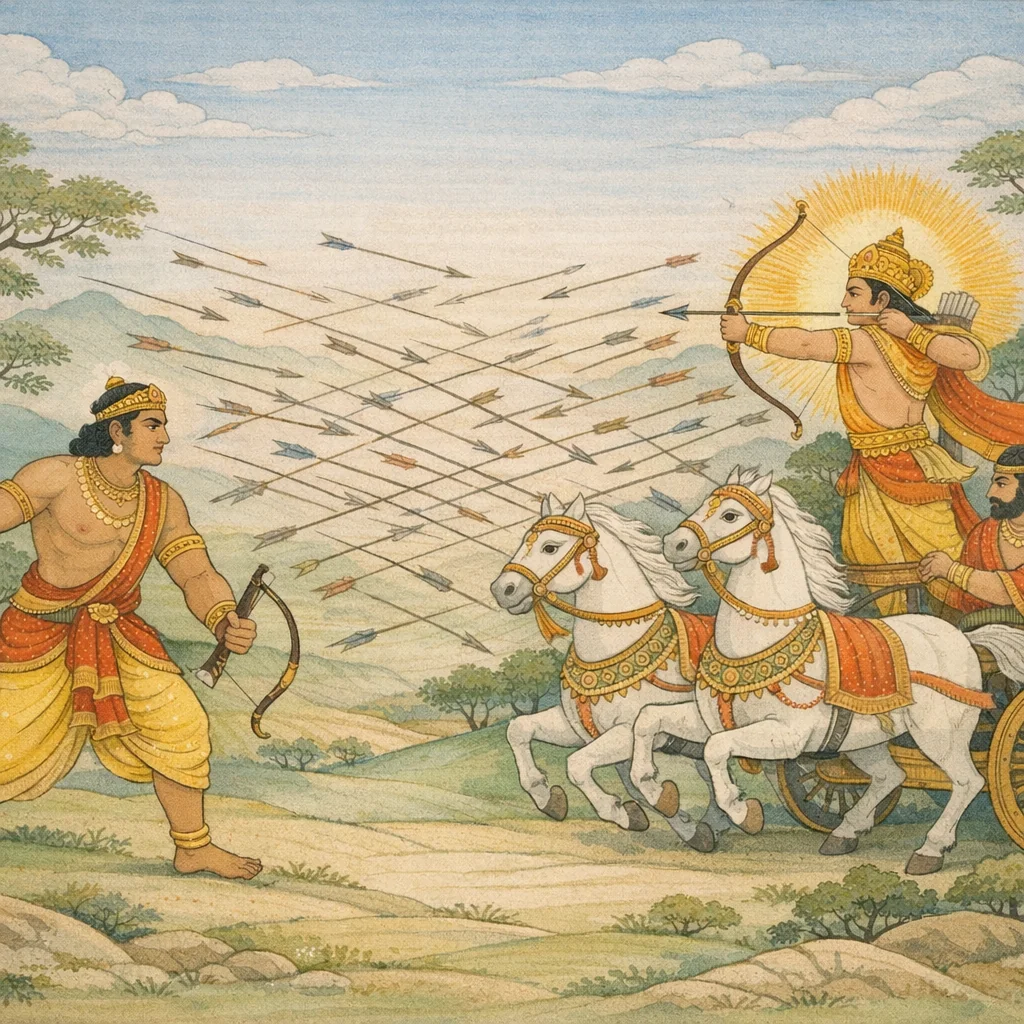
Chapter Arc: रणभूमि में भीमसेन और सूतपुत्र कर्ण आमने-सामने आते हैं—दोनों की प्रतिज्ञाएँ, दोनों का अहं, और दोनों के शस्त्र एक ही क्षण में गरज उठते हैं। → कर्ण के तीक्ष्ण बाण भीम को बार-बार बेधते हैं, पर भीम अचल पर्वत-सा न डिगता; प्रत्युत्तर में भीम भी कर्ण को कान और अंगों में तेल-धौते, पैने शरों से गहरे घायल करता है। दोनों नरसिंहों के शर-संस्पर्श से आकाश मानो जाल बन जाता है; मध्याह्न का सूर्य-सा कर्ण क्रोध में बाण-वर्षा बढ़ाता जाता है। → भीम क्रोध में समुद्र-सी उठती बाण-वर्षा की परवाह किए बिना कर्ण पर धावा बोलता है; घोर निकट-संघर्ष में भीम कर्ण के धनुष को तोड़ देता है और कर्ण अर्जुन के बाणों से भी व्यथित होता जाता है। → भीम के अभिप्राय को समझकर कर्ण, समस्त धनुर्धरों के देखते-देखते, रथ को वेग देकर भीम से अलग हो जाता है—युद्ध का पलड़ा क्षण भर के लिए भीम की ओर झुकता है, पर निर्णायक अंत टल जाता है। → कर्ण पीछे हटता है, किंतु अपमान और क्रोध की आग शेष रहती है—अगली मुठभेड़ में यह वैर किस पर टूटेगा?
Shlokas
Verse 1
नीसममा न (0) आफसऔअन+- एकोनचत्वारिंशर्दाधिकशततमो< ध्याय: भीमसेन और कर्णका भयंकर युद्ध, पहले भीमकी और पीछे कर्णकी विजय, उसके बाद अर्जुनके बाणोंसे व्यथित होकर कर्ण और अभश्रवृत्थामाका पलायन संजय उवाच ततः कर्णो महाराज भीम॑ विद्ध्वा त्रिभि: शरै: । मुमोच शरवर्षाणि विचित्राणि बहूनि च,संजय कहते हैं--महाराज! तदनन्तर कर्णने तीन बाणोंसे भीमसेनको घायल करके उनपर बहुत-से विचित्र बाण बरसाये
Sanjaya said: Then Karna, O King, having struck Bhima with three arrows, unleashed upon him a great and varied rain of shafts. The scene underscores the relentless escalation of force in battle, where prowess and resolve are tested amid the harsh demands of kṣatriya warfare.
Verse 2
वध्यमानो महाबाहु: सूतपुत्रेण पाण्डव: । न विव्यथे भीमसेनो भिद्यमान इवाचल:,सूतपुत्रके द्वारा बेधे जानेपर भी महाबाहु पाण्डुपुत्र भीमसेनको विद्ध होनेवाले पर्वतके समान तनिक भी व्यथा नहीं हुई
Sañjaya said: Though being struck down by the charioteer’s son, the mighty-armed Pāṇḍava Bhīmasena did not waver in pain at all; like a mountain being split, he remained unmoved—an image of steadfast courage amid the brutal ethics of war.
Verse 3
स कर्ण कर्णिना कर्णे पीतेन निशितेन च । विव्याध सुभृशं संख्ये तैलधौतेन मारिष,माननीय नरेश! फिर उन्होंने भी युद्धस्थलमें तेलके धोये हुए पानीदार तीखे “कर्णी' नामक बाणसे कर्णके कानमें गहरी चोट पहुँचायी
Sañjaya said: In the thick of battle, he struck Karṇa fiercely in the ear with a sharp arrow called a karṇī—an arrow polished and cleansed with oil. The scene underscores the ruthless precision of war, where even renowned warriors are targeted at vulnerable points, and victory is pursued through skill and lethal intent rather than restraint.
Verse 4
स कुण्डलं महच्चारु कर्णस्यापातयद् भुवि | तपनीयं महाराज दीप्तं ज्योतिरिवाम्बरात्,महाराज! भीमने कर्णके सोनेके बने हुए विशाल एवं सुन्दर कुण्डलको आकाशसे चमकते हुए तारेके समान पृथ्वीपर काट गिराया
Sañjaya said: O King, he struck down to the earth Karṇa’s large and beautiful earring—made of pure gold—shining like a bright star fallen from the sky. The image underscores how, in war, even the most splendid marks of status and identity can be violently severed in an instant, revealing the fragility of worldly glory amid adharma-driven destruction.
Verse 5
अथापरेण भल्ल्लेन सूतपुत्र॑ स्तनान्तरे । आजयचघान भशं क्रुद्धो हसन्निव वृकोदर:,तदनन्तर भीमसेनने अत्यन्त कुपित हो हँसते हुए-से दूसरे भल्लसे सूतपुत्रकी छातीमें बड़े जोरसे आघात किया
Sañjaya said: Then Vṛkodara (Bhīma), enraged, as though laughing, struck the charioteer’s son (Karna) with another bhalla-arrow, driving it with great force into his chest. The scene underscores the relentless escalation of battle, where wrath and prowess surge together, and the warrior’s intent is fixed on disabling the foe rather than yielding to hesitation.
Verse 6
पुनरस्य त्वरन् भीमो नाराचान् दश भारत । रणे प्रैषीन्महाबाहुर्निर्मुक्ताशीविषोपमान्,भरतनन्दन! फिर महाबाहु भीमने बड़ी उतावलीके साथ केंचुलसे छूटे हुए विषधर सर्पोंके समान दस नाराच उस रणक्षेत्रमें कर्णपर चलाये
Sañjaya said: Then again, Bhīma—hastening in the press of battle—discharged ten nārāca arrows at him on the battlefield, O Bhārata, O delight of the Bharatas, like venomous serpents newly freed from their slough. The verse heightens the moral tension of war: swift, deliberate violence is portrayed with vivid natural imagery, underscoring both the warriors’ resolve and the fearful consequences of martial skill when dharma is contested through arms.
Verse 7
ते ललाटं विनिर्भिद्य सूतपुत्रस्य भारत | विविशुश्वोदितास्तेन वल्मीकमिव पन्नगा:,भारत! उनके चलाये हुए वे नाराच सूतपुत्रका ललाट छेद करके बाँबीमें सर्पोंके समान उसके भीतर घुस गये
Sañjaya said: O Bhārata, the arrows he had loosed pierced the brow of the Sūta’s son and entered into him, like serpents slipping into an anthill. The image underscores the relentless, inescapable force of battle—where skill and fury turn the body into a battlefield, and violence advances with a grim inevitability.
Verse 8
ललाटस्थैस्ततो बाणै: सूतपुत्रो व्यरोचत । नीलोत्पलमयीं मालां धारयन् वै यथा पुरा,ललाटमें स्थित हुए उन बाणोंद्वारा सूतपुत्रकी उसी प्रकार शोभा हुई, जैसे वह पहले मस्तकपर नील कमलकी माला धारण करके सुशोभित होता था
Sañjaya said: Then, with those arrows lodged upon his forehead, the charioteer’s son shone brilliantly—just as he had once shone before, as though wearing a garland made of blue lotuses upon his brow. The verse underscores the grim irony of war: what once was an ornament of beauty is now mirrored by wounds, yet the warrior’s composure and radiance remain unbroken.
Verse 9
सो5तिविद्धो भृशं कर्ण: पाण्डवेन तरस्विना । रथकूबरमालम्ब्य न्यमीलयत लोचने,वेगवान् पाण्डुपुत्र भीमके द्वारा अत्यन्त घायल कर दिये जानेपर कर्णने रथके कूबरका सहारा लेकर आँखें बंद कर लीं
Sañjaya said: Struck with great force and grievously wounded by the mighty Pāṇḍava, Karṇa clutched the chariot’s yoke for support and closed his eyes—an instant that shows how even the most renowned warrior, when overwhelmed by pain and shock in battle, is reduced to sheer endurance amid the relentless ethics of war.
Verse 10
स मुहूर्तात् पुनः संज्ञां लेभे कर्ण: परंतप: । रुधिरोक्षितसर्वाड्र:ः क्रोधभाहारयत् परम्,शत्रुओंको संताप देनेवाले कर्णको पुनः दो ही घड़ीके बाद चेत हो गया। उस समय उसका सारा शरीर रक्तसे भीग गया था। उस दशामें उसे बड़ा क्रोध हुआ
Sañjaya said: After a short while, Karṇa—the scorcher of foes—regained consciousness. His entire body was drenched in blood, and in that condition an intense wrath surged within him, directed toward his enemies. The scene underscores how, amid the brutal ethics of war, injury does not end resolve; it often hardens it into fierce determination and retaliatory anger.
Verse 11
ततः क्रुद्धो रणे कर्ण: पीडितो दृढ्धन्वना । वेग॑ं चक्रे महावेगो भीमसेनरथं प्रति,सुदृढ़ धनुष धारण करनेवाले भीमसेनसे पीड़ित हुए महान् वेगशाली कर्णने रणभूमिमें कुपित हो भीमसेनके रथकी ओर बड़े वेगसे आक्रमण किया
Sañjaya said: Then Karṇa, angered on the battlefield and hard-pressed by the steadfast archer, gathered his tremendous speed and surged in a fierce assault toward Bhīmasena’s chariot. In the moral atmosphere of the war, the verse highlights how wounded pride and pressure in combat can ignite wrath, driving a warrior to escalate violence rather than restrain it.
Verse 12
तस्मै कर्ण: शतं राजन्निषूणां गार्ध्रवाससाम् । अमर्षी बलवान क्रुद्ध: प्रेषयामास भारत,राजन्! भरतनन्दन! अमर्षशील एवं क्रोधमें भरे हुए बलवान् कर्णने भीमसेनपर गीधके पंखवाले सौ बाण चलाये
Sañjaya said: Then, O King, Karṇa—powerful, intolerant of affront, and inflamed with anger—shot at him a hundred arrows, their shafts adorned with vulture-feathers. In the relentless ethic of battlefield rivalry, Karṇa answers perceived provocation not with restraint but with overwhelming force, intensifying the cycle of wrath that drives the combat onward.
Verse 13
ततः प्रासृजदुग्राणि शरवर्षाणि पाण्डव: । समरे तमनादृत्य तस्य वीर्यमचिन्तयन्,तब समरभूमिमें कर्णके पराक्रमको कुछ न समझते हुए उसकी अवहेलना करके पाण्डुनन्दन भीमसेनने उसके ऊपर भयंकर बाणोंकी वर्षा प्रारम्भ कर दी
Sañjaya said: Then the Pāṇḍava (Bhīmasena), disregarding him in the thick of battle and giving no weight to his prowess, unleashed fierce showers of arrows upon him. The scene underscores the ruthless momentum of war, where contempt for an opponent’s strength becomes both a tactic and a moral risk, intensifying the cycle of violence on the battlefield.
Verse 14
कर्णस्ततो महाराज पाण्डवं नवभि: शरै: । आजपघानोरससि क्रुद्धः क्ुद्धरूपं परंतप,शत्रुओंको संताप देनेवाले महाराज! तब कर्णने कुपित हो क्रोधमें भरे हुए पाण्डुपुत्र भीमसेनकी छातीमें नौ बाण मारे
Sañjaya said: Then, O great king, Karṇa—wrathful and terrible in his anger—struck the Pāṇḍava (Bhīmasena) on the chest with nine arrows. In the grim ethic of battle, this is the relentless escalation of force between vowed warriors, where personal fury rides upon the formal code of combat and turns the field into a test of endurance and resolve.
Verse 15
तावुभौ नरशार्टूलौ शार्दूलाविव दंष्टिणौ । जीमूताविव चान्योन्यं प्रववर्षतुराहवे,वे दोनों पुरुषसिंह दाढ़ोंवाले दो सिंहोंके समान परस्पर जूझ रहे थे और आकाशमें दो मेघोंके समान युद्धस्थलमें वे दोनों एक-दूसरेपर बाणोंकी वर्षा कर रहे थे
Sañjaya said: Those two tiger-like heroes, like two fanged lions, grappled with each other in the battle. And like two storm-clouds in the sky, they poured a mutual rain of arrows upon one another on the field—an image of valor locked in relentless, reciprocal violence, where prowess is displayed without yielding and the war’s momentum is sustained by equal fury on both sides.
Verse 16
तलशब्दरवैश्वैव त्रासयेतां परस्परम् । शरजालैश्व विविधैस्त्रासयामासतुर्मुधे
Sañjaya said: With the clamor of their palm-leaf signals and the roar of their cries, the two sides struck fear into one another; and in that battle they kept terrifying each other with diverse nets of arrows. The verse underscores how war amplifies mutual dread—each party becoming both the cause and the victim of the same violence it unleashes.
Verse 17
ततो भीमो महाबाहु: सूतपुत्रस्य भारत
Sañjaya said: Then Bhīma, the mighty-armed one—O Bhārata—(turned his attention) toward the charioteer’s son, Karṇa, as the battle’s fierce momentum continued.
Verse 18
तदपास्य थनुश्छिन्नं सूतपुत्रो महारथ:
Sañjaya said: Casting aside that bow which had been cut, the great chariot-warrior—the son of the charioteer—(prepared to continue the fight). The moment underscores the warrior’s resolve in battle: even when a weapon is disabled, one does not abandon one’s chosen duty in the field, but adapts and presses on according to the harsh ethics of war.
Verse 19
तदप्यथ निमेषार्धाच्चिच्छेदास्थ वृकोदर:,परंतु भीमसेनने आधे निमेषमें ही उसे भी काट दिया। इसी प्रकार तीसरे, चौथे, पाँचवें छठे, सातवें, आठवें, नवें, दसवें, ग्यारहवें, बारहवें, तेरहवें, चौदहवें, पंद्रहवें और सोलहदें धनुषको भी भीमसेनने काट डाला
Sañjaya said: Even that (weapon/bow) too, within half the blink of an eye, Vṛkodara cut down. In the same manner Bhīmasena went on severing the third, fourth, fifth, sixth, seventh, eighth, ninth, tenth, eleventh, twelfth, thirteenth, fourteenth, fifteenth, and sixteenth bows as well—displaying overwhelming speed and force in the press of battle, where prowess and resolve decide the moment’s outcome.
Verse 20
तृतीयं च चतुर्थ च पठ्चमं षष्ठमेव हि । सप्तमं चाष्टमं चैव नवमं दशमं तथा,परंतु भीमसेनने आधे निमेषमें ही उसे भी काट दिया। इसी प्रकार तीसरे, चौथे, पाँचवें छठे, सातवें, आठवें, नवें, दसवें, ग्यारहवें, बारहवें, तेरहवें, चौदहवें, पंद्रहवें और सोलहदें धनुषको भी भीमसेनने काट डाला
Verse 21
एकादश द्वादशं च त्रयोदशमथापि च । चतुर्दशं पडचदशं षोडशं च वृकोदर:,परंतु भीमसेनने आधे निमेषमें ही उसे भी काट दिया। इसी प्रकार तीसरे, चौथे, पाँचवें छठे, सातवें, आठवें, नवें, दसवें, ग्यारहवें, बारहवें, तेरहवें, चौदहवें, पंद्रहवें और सोलहदें धनुषको भी भीमसेनने काट डाला
Verse 22
तथा सप्तदशं वेगादष्टादशमथापि वा । बहूनि भीमश्रिच्छेद कर्णस्यैवं धनूंषि हि,इतना ही नहीं, भीमने सत्रहवें, अठारहवें तथा और भी बहुत-से कर्णके धनुषोंको वेगपूर्वक काट दिया
Sañjaya said: In the same way, with swift force, Bhīma cut down Karṇa’s seventeenth bow, then the eighteenth as well—and indeed many more. The scene underscores the relentless momentum of battle, where skill and resolve repeatedly shatter an opponent’s means of resistance, even as both warriors persist in their chosen duty as kṣatriyas.
Verse 23
निमेषार्धात् ततः कर्णो धनुर्हस्तो व्यतिष्ठत । दृष्टवा स कुरुसौवीरसिन्धुवीरबलक्षयम्
Sañjaya said: Then, in less than half a blink, Karṇa stood firm with his bow in hand. Seeing the destruction of the warriors’ forces—those of the Kurus, the Sauvīras, and the Sindhu heroes—he braced himself to respond, steadying his resolve amid the collapsing ranks and the mounting cost of war.
Verse 24
सवर्मध्वजशस्त्रैश्न पतितै: संवृतां महीम् । हस्त्यश्वरथदेहां श्व गतासून् प्रेक्ष्य सर्वश:
Sañjaya said: Seeing the earth everywhere covered with fallen armor, banners, and weapons—and beholding on all sides the lifeless bodies of elephants, horses, and chariot-warriors—he looked upon the battlefield’s ruin, a stark witness to the moral cost of war and the collapse of human restraint amid slaughter.
Verse 25
सूतपुत्रस्य संरम्भाद् दीप्तं वपुरजायत । इतनेपर भी कर्ण आधे ही निमेषमें दूसरा धनुष हाथमें लेकर खड़ा हो गया। कुरु, सौवीर तथा सिंधुदेशके वीरोंकी सेनाका विनाश, सब ओर गिरे हुए कवच, ध्वज तथा अस्त्र- शस्त्रोंसे आच्छादित हुई भूमि और प्राणशून्य हाथी, घोड़े एवं रथियोंके शरीरोंकोी सब ओर देखकर सूतपुत्र कर्णका शरीर क्रोधसे उद्दीप्त हो उठा ।। स विस्फार्य महच्चापं कार्तस्वरविभूषितम्
Sañjaya said: From the charioteer’s son’s sudden surge of fury, his very body blazed. Seeing on every side the ruin of the Kuru, Sauvīra, and Sindhu warriors—ground strewn with fallen armor, banners, and weapons, and the lifeless bodies of elephants, horses, and chariot-fighters—Karna flared up with wrath. Then he drew back his great bow, adorned with gold, ready to answer slaughter with renewed violence, as the battle’s moral gravity deepened into retaliation and rage.
Verse 26
ततः क्रुद्ध: शरानस्यथन् सूतपुत्रो व्यरोचत
Sañjaya said: Then, enraged, the charioteer’s son (Karna) began to discharge arrows, shining forth in prowess as he pressed the battle with fierce resolve.
Verse 27
मरीचिविकचस्येव राजन् भानुमतो वपु:
Sañjaya said: O King, his body shone like a sunburst in full bloom—radiant, expansive, and unmistakably luminous amid the violence of battle, as if brilliance itself were standing against the surrounding darkness.
Verse 28
कराभ्यामाददानस्य संदधानस्य चाशुगान्
Sañjaya said: (He was seen) taking up (the arrows) with both hands and swiftly fitting those fast-flying shafts (to the bow), intent on immediate discharge—an image of practiced martial discipline amid the relentless ethics of war.
Verse 29
अग्निचक्रोपमं घोरं मण्डलीकृतमायुधम्
Sañjaya said: “A dreadful weapon, made to whirl in a circular formation, resembling a wheel of fire.”
Verse 30
स्वर्णपुड्खा: सुनिशिता: कर्णचापच्युता: शरा:
Sañjaya said: “Arrows, keenly sharpened and fitted with golden feathers, shot forth from Karṇa’s bow.” The line underscores the relentless, highly skilled violence of the battlefield—where martial excellence and costly weaponry intensify the destructive momentum of war, even as the larger struggle over duty and righteousness continues.
Verse 31
ततः कनकपुड्खानां शराणां नतपर्वणाम्
Sañjaya said: Then there followed a volley of arrows—golden-feathered and bent at the joints—signaling the intensification of the battle’s violence and the relentless skill of the warriors engaged.
Verse 32
बाणासनादाधिरथे: प्रभवन्ति सम सायका:
Sañjaya said: From Karṇa, stationed upon his bow-seat in the chariot, there issued forth a steady, unbroken stream of arrows—equal and well-matched shafts—signaling the relentless momentum of battle and the grim resolve driving the warriors onward.
Verse 33
गार्ध्रपत्रानु शिलाधौतान् कार्तस्वरविभूषितान्
Sañjaya said: “(They were) fitted with vulture-feathers, polished smooth upon stone, and adorned with pure gold.”
Verse 34
ते तु चापबलोद्धूता: शातकुम्भविभूषिता:
But those warriors, shaken by the force of the bow, were adorned with ornaments of pure gold—an image that heightens the battlefield’s stark contrast between martial violence and royal splendor, as Sanjaya reports the scene with sober clarity.
Verse 35
ते व्योम्नि रुक्मविकृता व्यकाशन्त सहस्रश:
Sañjaya said: In the sky, they shone forth in their thousands, appearing as if fashioned of gold—an awe-inspiring spectacle amid the turmoil of war, where dazzling signs and omens heighten the sense of fate closing in upon the combatants.
Verse 36
चापादाधिरथेर्बाणा: प्रपतन्तश्नकाशिरे
Sañjaya said: From the bow of Adhiratha’s son (Karna), the arrows kept falling in a steady, measured stream—an image of controlled martial skill amid the relentless violence of the war.
Verse 37
पर्वतं वारिधाराभिश्छादयन्निव तोयद:
Sañjaya said: Like a rain-bearing cloud that seems to veil a mountain with unbroken sheets of falling water, the scene appeared covered over—suggesting how, in the fury of battle, even what is firm and visible can be obscured by overwhelming force.
Verse 38
तत्र भारत भीमस्य बल वीर्य पराक्रमम्
There, O descendant of Bharata, (I shall describe) Bhīma’s strength, manly valor, and heroic prowess—so that his deeds in the battle may be rightly understood in their full force.
Verse 39
तां समुद्रमिवोद्धूतां शरवृष्टिं समुत्थिताम्
Sañjaya said: “That storm of arrows, risen up and driven onward like the heaving ocean, surged forth—an image of war’s blind momentum, where human resolve is tested amid overwhelming force.”
Verse 40
रुक्मपृष्ठं महच्चापं भीमस्यासीद् विशाम्पते,प्रजानाथ! सुवर्णमय पृष्ठवाला भीमसेनका विशाल धनुष प्रत्यंचा खींचनेसे मण्डलाकार हो दूसरे इन्द्र-धनुषके समान प्रतीत हो रहा था। उससे जो बाण प्रकट होते थे, वे मानो आकाशको भर रहे थे
Sañjaya said: O lord of the people, O ruler of men—Bhīma possessed a great bow with a golden back. As Bhīmasena drew its bowstring, it curved into a perfect circle and seemed like a second rainbow. The arrows that sprang forth from it appeared as though they were filling the sky—an image of overwhelming force unleashed in the battle.
Verse 41
आकर्षान्मण्डली भूतं शक्रचापमिवापरम् । तस्माच्छरा: प्रादुरासन् पूरयन्त इवाम्बरम्,प्रजानाथ! सुवर्णमय पृष्ठवाला भीमसेनका विशाल धनुष प्रत्यंचा खींचनेसे मण्डलाकार हो दूसरे इन्द्र-धनुषके समान प्रतीत हो रहा था। उससे जो बाण प्रकट होते थे, वे मानो आकाशको भर रहे थे
Sañjaya said: “O lord of men, as he drew it, Bhīmasena’s great bow—gold-backed—curved into a circle, appearing like another rainbow of Indra. From it arrows sprang forth in such number that they seemed to fill the sky.”
Verse 42
सुवर्णपुड्खैर्भीमेन सायकैर्नतपर्वभि: । गगने रचिता माला काञ्चनीव व्यरोचत,भीमसेनने झुकी हुई गाँठ और सुवर्णमय पंखवाले बाणोंसे आकाशमें सोनेकी माला- सी रच डाली थी, जो बड़ी शोभा पा रही थी
Sanjaya said: With arrows whose feathered ends were of gold and whose joints were bent, Bhima fashioned in the sky a garland that shone like a golden necklace. The image conveys not ornament for its own sake, but the terrifying mastery of a warrior whose skill turns the battlefield itself into a display of power and resolve.
Verse 43
ततो व्योम्नि विषक्तानि शरजालानि भागश: । आहतानि व्यशीर्यन्त भीमसेनस्य पत्रिभि:,उस समय भीमसेनके बाणोंसे आहत होकर आकाशमें फैले हुए बाणोंके जाल टुकड़े- टुकड़े होकर बिखर गये
Then, struck by Bhīmasena’s feathered arrows, the arrow-nets that hung spread across the sky shattered and scattered into fragments. The scene underscores how, amid the fury of battle, even seemingly impenetrable volleys are broken by superior force and resolve.
Verse 44
कर्णस्य शरजालौघैर्भीमसेनस्य चो भयो: । अग्निस्फुलिजड्गसंस्पर्शरञ्जोगतिभिराहवे
Sañjaya said: In that battle, the dense torrents of arrows released by Karṇa and by Bhīmasena—on both sides—moved and struck like showers of fire-sparks, their swift courses flashing as they met and grazed, turning the field into a blazing spectacle of mutual fury and unrelenting resolve.
Verse 45
तैस्तै: कनकपुड्खानां द्यौरासीत् संवृता व्रजै: । कर्ण और भीमसेन दोनोंके बाणसमूह स्पर्श करनेपर आगकी चिनगारियोंके समान प्रतीत होते थे। अनायास ही उनकी युद्धमें सर्वत्र गति थी। सुवर्णमय पंखवाले उन बाणोंके समूहसे सारा आकाश छा गया था ।। न सम सूर्यस्तदा भाति न सम वाति समीरण:
Sañjaya said: With those volleys of arrows—each fitted with golden feathers—the sky became completely covered. The arrow-clusters of Karṇa and Bhīmasena, when they struck, looked like sparks leaping from fire, moving everywhere across the battlefield with effortless speed. In that storm of shafts, the sun no longer shone clearly, and the wind itself seemed not to blow.
Verse 46
स भीम॑ छादयन् बाणै: सूतपुत्र: पृथग्विधै:
Sañjaya said: The son of the charioteer (Karna), showering Bhīma with arrows of many kinds, covered him over in the press of battle—an image of relentless martial prowess where skill and fury momentarily eclipse restraint.
Verse 47
तयोर्विसृजतोस्तत्र शरजालानि मारिष
Sañjaya said: “O venerable one, as those two warriors there kept releasing their missiles, volleys of arrows spread out like nets, thickly filling the battlefield.”
Verse 48
अन्योन्यशरसंस्पर्शात् तयोर्मनुजसिंहयो:
Sañjaya said: As those two lion-like men met each other in the clash and close contact of their arrows, the battle between them tightened into a direct, personal contest—an image of warrior-duty where courage and resolve are tested without retreat.
Verse 49
तथा कर्ण: शितान् बाणान् कर्मारपरिमार्जितान्
Sañjaya said: Then Karṇa (in the heat of battle) let fly sharp arrows, carefully finished and polished by the smith—an image of deliberate, well-prepared violence, where skill and craftsmanship are turned toward the grim necessities of war.
Verse 50
तानन्तरिक्षे विशिखैस्त्रिधैिकैकमशातयत्
Sañjaya said: While they were still in mid-air, he struck the arrow with his own shafts and split that single missile into three. The narration highlights the ruthless precision of martial skill in war—where even a weapon’s flight is intercepted—showing how prowess and alertness can decide life and death in a moment.
Verse 51
विशेषयन् सूतपुत्र॑ भीमस्तिषछ्ेति चाब्रवीत् । परन्तु भीमसेनने अपनेको सूतपुत्रसे विशिष्ट सिद्ध करते हुए बाणोंद्वारा आकाशमें उन बाणोंमेंसे प्रत्येकके तीन-तीन टुकड़े कर डाले और कर्णसे कहा--“अरे! खड़ा रह” ।। ५० ३ || पुनश्चासृजदुग्राणि शरवर्षाणि पाण्डव:
Sanjaya said: Seeking to prove himself superior to the charioteer’s son (Karna), Bhima called out, “Stand your ground!” Then the Pandava again unleashed fierce showers of arrows, intensifying the combat and asserting his resolve amid the moral strain of fratricidal war.
Verse 52
ततश्नट्चटाशब्दो गोधाघातादभूत् तयो:,उस समय उन दोनोंके गोहचर्मके बने हुए दस्तानोंके आधातसे चटाचटकी आवाज होने लगी। साथ ही हथेलीका शब्द और महाभयंकर सिंहनाद भी होने लगा। रथके पहियोंकी घरघराहट और प्रत्यंचाकी भयंकर टंकार भी कानोंमें पड़ने लगी
Sañjaya said: Then, from the blows of their gloves made of go-skin, there arose a sharp clattering sound—“caṭa-caṭa.” Along with it were heard the slap of palms and a most dreadful lion-roar; and the rumbling of chariot-wheels and the terrifying twang of bowstrings also struck the ears. The scene conveys the war’s escalating ferocity, where human resolve and martial skill manifest as an overwhelming soundscape that signals imminent violence and the hardening of hearts in battle.
Verse 53
तलशब्दश्न सुमहान् सिंहनादश्न भैरव: । रथनेमिनिनादक्ष ज्याशब्दश्चैव दारुण:,उस समय उन दोनोंके गोहचर्मके बने हुए दस्तानोंके आधातसे चटाचटकी आवाज होने लगी। साथ ही हथेलीका शब्द और महाभयंकर सिंहनाद भी होने लगा। रथके पहियोंकी घरघराहट और प्रत्यंचाकी भयंकर टंकार भी कानोंमें पड़ने लगी
Sañjaya said: Then there arose a very loud clapping sound, a terrifying lion-roar, the rumbling of the chariot-wheels, and the dreadful twang of the bowstring. The battlefield’s soundscape swelled as the warriors’ readiness and ferocity became audible, signaling an escalation of combat and the hardening of resolve amid the demands of kṣatriya-dharma.
Verse 54
योधा व्युपारमन् युद्धाद् दिदृक्षन्त: पराक्रमम् । कर्णपाण्डवयो राजन् परस्परवधैषिणो:,राजन! परस्पर वधकी इच्छा रखनेवाले कर्ण और भीमसेनके पराक्रमको देखनेकी अभिलाषासे समस्त योद्धा युद्धसे उपरत हो गये
Sañjaya said: O King, the warriors ceased from fighting, eager to witness the prowess of Karṇa and the Pāṇḍava—both intent on each other’s death. The battlefield’s tumult briefly gave way to a tense pause, as all eyes turned to this duel driven by vengeance and the grim ethic of kṣatriya combat.
Verse 55
देवर्षिसिद्धगन्धर्वा: साधु साथ्वित्यपूजयन् । मुमुचु: पुष्पवर्ष च विद्याधरगणास्तथा,देवता, ऋषि, सिद्ध, गन्धर्व और विद्याधरगण 'साधु-साधु” कहकर उन दोनोंकी प्रशंसा और फूलोंकी वर्षा करने लगे
Sanjaya said: The divine seers, Siddhas, and Gandharvas acclaimed them with cries of “Well done! Well done!” and honored them; and the hosts of Vidyadharas likewise released a shower of flowers. In the midst of war, this celestial approval marks the deed as worthy of praise—an affirmation that valor and right conduct, when aligned with dharma, are recognized even by higher beings.
Verse 56
ततो भीमो महाबाहु: संरम्भी दृढविक्रम: । अस्त्रैरस्त्राणि संवार्य शरैरविव्याध सूतजम्,तदनन्तर क्रोधमें भरे हुए सुदृढ़ पराक्रमी महाबाहु भीमसेनने अपने अस्त्रोंद्वारा कर्णके अस्त्रोंका निवारण करके उसे बाणोंसे बींध डाला
Sañjaya said: Then Bhīma, the mighty-armed hero—fired with fierce resolve and steadfast in valor—checked Karṇa’s weapons with his own, and, having countered weapon with weapon, pierced the charioteer’s son with a shower of arrows. The scene underscores the grim ethic of battlefield skill: mastery is shown not only in striking, but in restraining and neutralizing an opponent’s assault before delivering a decisive counterblow.
Verse 57
कर्णोडपि भीमसेनस्य निवार्येषून् महाबल: । प्राहिणोन्नच नाराचानाशीविषसमान् रणे,महाबली कर्णने भी रणक्षेत्रमें भीमसेनके बाणोंका निवारण करके उनके ऊपर विषैले सर्पोके समान नौ नाराच चलाये
Sañjaya said: Mighty Karṇa too, having checked Bhīmasena’s arrows, hurled nine nārāca shafts in the battle—deadly like venomous serpents. The scene underscores the relentless escalation of martial skill and wrath on the battlefield, where prowess is measured by restraint, countering, and the lethal precision of one’s response.
Verse 58
तावद्धिरथ तान् भीमो व्योम्नि चिच्छेद पत्रिभि: । नाराचान् सूतपुत्रस्य तिष्ठ तिछेति चाब्रवीत्
Sañjaya said: Meanwhile, Bhīma, swift in his chariot, cut down in mid-air the arrows of the Sūta’s son with his own sharp shafts. Then, challenging him in the heat of battle, he cried out, “Stand! Stand!”—a fierce call meant to halt the foe and force a direct encounter rather than a distant exchange of missiles.
Verse 59
भीमसेनने उतने ही बाणोंसे आकाशमें सूतपुत्रके सारे नाराच काट डाले और उससे कहा 'खड़ा रह, खड़ा रह” ।। ततो भीमो महाबाहु: शरं क्रुद्धान्तकोपमम् । मुमोचाधिरथेवीरों यमदण्डमिवापरम्,तत्पश्चात् महाबाहु वीर भीमसेनने कर्णके ऊपर ऐसा बाण चलाया, जो क्ुद्ध यमराजके समान तथा दूसरे यमदण्डके सदृश भयंकर था
Sañjaya said: Then mighty-armed Bhīma, like a wrathful Death itself, released a dreadful arrow at the hero Karṇa—like another rod of Yama. The scene underscores the merciless momentum of battle, where valor and rage drive warriors to strike with lethal intent, and where the ethical tension of duty in war (kṣātra-dharma) coexists with escalating ferocity.
Verse 60
तमापततन्तं चिच्छेद राधेय: प्रहसन्निव । त्रिभि: शरै: शरं राजन् पाण्डवस्य प्रतापवान्,राजन्! अपने ऊपर आते हुए भीमसेनके उस बाणको प्रतापी राधानन्दन कर्णने तीन बाणोंद्वारा हँसते हुए-से काट डाला
Sanjaya said: As that arrow came rushing toward him, Radheya (Karna), as if smiling, cut it down. O King, the mighty Karna severed the Pandava’s arrow with three of his own—displaying calm mastery amid the fury of battle.
Verse 61
पुनश्चासृजदुग्राणि शरवर्षाणि पाण्डव: । तस्य तान्याददे कर्ण: सर्वाण्यस्त्राण्यभीतवत्,तब पाण्डुनन्दन भीमने पुनः भयानक बाणोंकी वर्षा प्रारम्भ कर दी; परंतु कर्णने उन सब अस्त्रोंको निर्भयतापूर्वक आत्मसात् कर लिया
Sañjaya said: Then the Pāṇḍava again unleashed a dreadful rain of arrows. Yet Karṇa, undaunted, received and countered all those missiles—meeting violence with steadiness and martial resolve amid the relentless ethics of battlefield duty.
Verse 62
युध्यमानस्य भीमस्य सूतपुत्रो5स्त्रमायया । तस्येषुधी धनुर्ज्या च बाणै: संनतपर्वभि:,क्रोधमें भरे हुए सूतपुत्र कर्णने अपने अस्त्रोंकी मायासे तथा झुकी हुई गाँठवाले बाणोंद्वारा युद्धपरायण भीमसेनके दो तरकसों, धनुषकी प्रत्यंचा, बागडोर तथा घोड़े जोतनेकी रस्सियोंको भी युद्धस्थलमें काट डाला। फिर घोड़ोंको भी मारकर सारथिको पाँच बाणोंसे घायल कर दिया
Sañjaya said: As Bhīma fought on, the charioteer’s son Karṇa, by the deceptive mastery of his weapons, struck with arrows whose joints were bent and well-aimed, cutting down Bhīma’s quivers and even the bowstring. The episode underscores the ruthless precision of battlefield skill—where disabling an opponent’s means of combat becomes a decisive tactic, raising the ethical tension between valor in open contest and victory through calculated disarmament.
Verse 63
रश्मीन् योक्त्राणि चाश्रानां क्रुद्ध: कर्णो5च्छिनन्मृधे । तस्याश्चांश्व पुनर्हत्वा सूतं विव्याध पठचभि:,क्रोधमें भरे हुए सूतपुत्र कर्णने अपने अस्त्रोंकी मायासे तथा झुकी हुई गाँठवाले बाणोंद्वारा युद्धपरायण भीमसेनके दो तरकसों, धनुषकी प्रत्यंचा, बागडोर तथा घोड़े जोतनेकी रस्सियोंको भी युद्धस्थलमें काट डाला। फिर घोड़ोंको भी मारकर सारथिको पाँच बाणोंसे घायल कर दिया
Sañjaya said: Enraged in the midst of battle, Karṇa cut down the reins and the harness-ropes of the horses. Then, after killing those horses, he pierced the charioteer with five arrows. The episode underscores the ruthless logic of war: by disabling the opponent’s mobility and support-system (horses and driver), a warrior seeks decisive advantage, even as such tactics intensify the moral harshness of the battlefield.
Verse 64
सो<पसृत्य द्रुतं सूतो युधामन्यो रथं ययौ । विहसन्निव भीमस्य क्रुद्ध: कालानलद्युति:
Sañjaya said: Withdrawing a little and moving swiftly, the charioteer drove Yudhāmanyu’s chariot forward. Radiant like the fire of Time at the end of an age, he advanced in wrath, as though laughing in scorn at Bhīma—an image of war’s fierce momentum where anger and contempt propel action beyond restraint.
Verse 65
ध्वजं चिच्छेद राधेय: पताकां च व्यपातयत् । सारथि वहाँसे भागकर तुरंत ही युधामन्युके रथपर चढ़ गया। इधर क्रोधमें भरे हुए कालाग्निके समान तेजस्वी राधापुत्र कर्णने भीमसेनका उपहास-सा करते हुए उनकी ध्वजा और पताकाको भी काट गिराया ।। स विधन्वा महाबाहुरथ शक्ति परामृशत्
Sañjaya said: Rādheya (Karna) cut down the banner and struck down the pennant. The charioteer fled from there at once and mounted Yudhāmanyu’s chariot. Meanwhile, Karna—radiant like the fire of dissolution and filled with wrath—mocking Bhīmasena as though in derision, also severed and brought down his standard and pennant. Then that mighty-armed warrior, taking up his bow, grasped a spear.
Verse 66
तामाधिरथिरायस्त: शक्ति काउ्चनभूषणाम्
Sañjaya said: Then Adhirathi’s son (Karna), fully prepared, took up that spear adorned with gold—readying a decisive weapon amid the moral darkness of the battlefield, where prowess and fate press against the demands of dharma.
Verse 67
सापतद् दशधा छिज्ना कर्णस्य निशितै: शरै:
Sañjaya said: Struck by Karṇa’s razor-sharp arrows, it was cut into ten pieces and fell down—an image of the battlefield’s ruthless precision, where prowess and resolve decide outcomes amid the moral weight of fratricidal war.
Verse 68
स चर्मादत्त कौन्तेयो जातरूपपरिष्कृतम्
Sañjaya said: The son of Kuntī then took up a leather shield, finely adorned and embellished with gold—an image of martial readiness and disciplined resolve amid the brutal ethics of battlefield duty.
Verse 69
तदस्य तरसा क्रुद्धों व्यधमच्चर्म सुप्रभम्
Sanjaya said: Then, in a surge of speed and anger, he struck and shattered that brilliantly shining protective hide—an image of how wrath, when yoked to force, seeks to break even what seems secure in the chaos of war.
Verse 70
स विचर्मा महाराज विरथ: क्रोधमूर्च्छित:
Sañjaya said: O great king, that warrior—his armor stripped away and his chariot lost—was overcome by a swoon of wrath, driven by furious rage amid the battle’s chaos.
Verse 71
स धनु: सूतपुत्रस्य सज्यं छित्ता महानसि:
Sañjaya said: “Having cut the bow of the charioteer’s son while it was strung and ready for use, you have shown yourself to be truly great.”
Verse 72
ततः प्रहस्याधिरथिरन्यदादाय कार्मुकम्,सहस्रशो महाराज रुक्मपुड्खान् सुतेजनान् | यह देखकर अधिरथपुत्र कर्ण ठठाकर हँस पड़ा और समरांगणमें कुपित हो उसने शत्रुविनाशकारी सुदृढ़ प्रत्यंचावाला अत्यन्त वेगशाली दूसरा धनुष हाथमें लेकर उसपर कुन्तीपुत्रके वधकी इच्छासे सुवर्णमय पंखवाले सहस्रों अत्यन्त तीखे बाणोंका संधान किया
Sañjaya said: Then Adhiratha’s son Karṇa laughed aloud and, taking up another bow, in anger on the battlefield he fixed—O King—thousands of exceedingly sharp arrows with golden feathers, intent on slaying Kuntī’s son. The scene underscores how pride and wrath can harden into a single-minded resolve for destruction, even among the foremost warriors.
Verse 73
शत्रुघ्नं समरे क्रुद्धों दृढज्यं वेगवत्तरम् । व्यायच्छत् स शरान् कर्ण: कुन्तीपुत्रजिघांसया,सहस्रशो महाराज रुक्मपुड्खान् सुतेजनान् | यह देखकर अधिरथपुत्र कर्ण ठठाकर हँस पड़ा और समरांगणमें कुपित हो उसने शत्रुविनाशकारी सुदृढ़ प्रत्यंचावाला अत्यन्त वेगशाली दूसरा धनुष हाथमें लेकर उसपर कुन्तीपुत्रके वधकी इच्छासे सुवर्णमय पंखवाले सहस्रों अत्यन्त तीखे बाणोंका संधान किया
Sañjaya said: Enraged in the battle, Karṇa—intent on killing Kuntī’s son—strung his firm-bowed, even swifter weapon and fixed upon him thousands of razor-sharp arrows with golden feathers. The scene underscores how wrath and the single-minded desire to slay can drive a warrior’s skill into relentless, escalating violence on the battlefield.
Verse 74
।। स वध्यमानो बलवान् कर्णचापच्युतै: शरै:
Sañjaya said: Though being struck down, the mighty warrior was pierced by arrows released from Karṇa’s bow—an image of relentless martial pressure where strength is tested under sustained assault.
Verse 75
वैहायसं प्राक्रमद् वै कर्णस्य व्यथयन्मन: । कर्णके धनुषसे छूटे हुए बाणोंद्वारा घायल किये जाते हुए बलवान् भीमसेन कर्णके मनमें व्यथा उत्पन्न करते हुए उसे पकड़नेके लिये आकाशमें उछले || ७४ $ ।। स तस्य चरितं दृष्टवा संग्रामे विजयैषिण:
Sañjaya said: Though wounded by the arrows released from Karṇa’s bow, the mighty Bhīmasena sprang up into the sky to seize Karṇa; by this daring leap he stirred anguish and alarm in Karṇa’s mind. Seeing Bhīma’s conduct, the victory-seeking warrior in that battle (then responded accordingly).
Verse 76
तं च दृष्टवा रथोपस्थे निलीन व्यथितेन्द्रियम्
Sañjaya said: Seeing him there—crouched down upon the chariot’s platform, his senses shaken and unsteady—(they understood) that fear and distress had overtaken him amid the moral and physical shock of battle.
Verse 77
तदस्य कुरव: सर्वे चारणाश्ना भ्यपूजयन्
Sañjaya said: Hearing and witnessing this, all the Kurus—together with the bards—honoured him with acclaim and reverent praise, affirming the warrior’s standing and the courtly code of recognition even amid the harshness of war.
Verse 78
स च्छिन्नथन्वा विरथ: स्वधर्ममनुपालयन्
Sañjaya said: Even with his bow cut and deprived of his chariot, he continued to uphold his own dharma—persisting in the duty of a warrior amid the chaos of battle.
Verse 79
तद् विह॒त्यास्य राधेयस्तत एनं समभ्ययात्
Sañjaya said: Having struck him down, Rādheya then advanced straight toward him again—pressing the attack without pause amid the relentless ethics of battlefield duty.
Verse 80
तौ समेतौ महाराज स्पर्धमानौ महाबलौ
Sañjaya said: O King, those two mighty warriors, having come together, were contending with one another in strength—locked in a direct clash amid the battle’s relentless momentum.
Verse 81
तयोरासीत् सम्प्रहार: क्रुद्धयोर्नरसिंहयो:
Sanjaya said: Then a fierce clash arose between the two—both enraged, like man-lions—each meeting the other head-on in the heat of battle.
Verse 82
क्षीणशस्त्रस्तु कौन्तेय: कर्णेन समभिद्रुत:,जब कुन्तीकुमार भीमसेनके सारे अस्त्र-शस्त्र नष्ट हो गये, उनके पास एक भी आयुध शेष नहीं रह गया और कर्णके द्वारा उनपर पूर्ववत् आक्रमण होता रहा, तब वे रथके मार्गको बंद कर देनेके लिये अर्जुनके मारे हुए पर्वताकार हाथियोंको वहाँ गिरा देख उनके भीतर प्रवेश कर गये
Sañjaya said: When Bhīmasena, the son of Kuntī, had his weapons exhausted—so that not a single implement of war remained with him—and Karṇa continued to press his attack as before, Bhīma, seeking to block the course of the chariot, saw the mountain-like elephants slain by Arjuna lying there and entered among them for cover and obstruction. The episode highlights battlefield prudence: when force fails, one preserves life and purpose through strategy rather than futile display.
Verse 83
दृष्टवार्जुनहतान् नागान् पतितान् पर्वतोपमान् | रथमार्गविघातार्थ व्यायुध: प्रविवेश ह,जब कुन्तीकुमार भीमसेनके सारे अस्त्र-शस्त्र नष्ट हो गये, उनके पास एक भी आयुध शेष नहीं रह गया और कर्णके द्वारा उनपर पूर्ववत् आक्रमण होता रहा, तब वे रथके मार्गको बंद कर देनेके लिये अर्जुनके मारे हुए पर्वताकार हाथियोंको वहाँ गिरा देख उनके भीतर प्रवेश कर गये
Sañjaya said: Seeing the mountain-like elephants—slain by Arjuna—lying fallen there, Bhīmasena, now bereft of weapons, entered among them in order to block the path of the chariots. Even as Karṇa continued to press his attack, Bhīma chose a desperate, tactical act of resistance: using the battlefield’s wreckage to obstruct the enemy’s advance and protect the larger cause.
Verse 84
हस्तिनां व्रजमासाद्य रथदुर्ग प्रविश्य च । पाण्डवो जीविताकाड्क्षी राधेयं नाभ्यहारयत्
Sañjaya said: Having reached the herd of elephants and then forcing his way into the chariot-formation like a fortress, the Pāṇḍava—still desiring to preserve his own life—did not strike down Rādheya (Karna). The moment underscores how, amid the fury of battle, self-preservation and tactical restraint can override the impulse to deliver a decisive blow.
Verse 85
हाथियोंके समूहमें पहुँचकर मानो वे रथके आक्रमणसे बचनेके लिये दुर्गके भीतर प्रविष्ट हो गये हों, ऐसा अनुभव करते हुए पाण्डुपुत्र भीम केवल अपने प्राण बचानेकी इच्छा करने लगे, उन्होंने राधापुत्र कर्णपर प्रहार नहीं किया ।। व्यवस्थानमथाकाडुक्षन् धनंजयशरैहतम् । उद्यम्य कुज्जरं पार्थस्तस्थौ परपुरंजय:
Sañjaya said: Seeking to regain a firm position after being struck by Dhanañjaya’s arrows, the son of Pṛthā—conqueror of enemy strongholds—raised up his elephant and stood his ground. The scene suggests a tactical regrouping amid the press of battle, where survival and steadiness momentarily outweigh aggressive pursuit.
Verse 86
तमस्य विशिखेै: कर्णो व्यधमत् कुज्जरं पुन:,कर्णने अपने बाणोंद्वारा उस हाथीके भी टुकड़े-टुकड़े कर दिये। तब पाण्डुनन्दन भीमने हाथीके कटे हुए अंगोंको ही कर्णपर फेंकना शुरू किया। रथोंके पहिये, घोड़ोंकी लाशें तथा और भी जो-जो वस्तुएँ वे धरतीपर पड़ी देखते, उन्हें उठाकर क्रोधपूर्वक कर्णपर फेंकते थे; परंतु वे जो-जो वस्तु फेंकते, उन सबको कर्ण अपने तीखे बाणोंसे काट डालता था
Sañjaya said: With his sharp arrows, Karṇa again struck down that elephant, reducing it to pieces. Then Bhīma, the son of Pāṇḍu, began hurling the severed limbs of the elephant at Karṇa. Whatever else he saw lying on the ground—chariot wheels, the carcasses of horses, and other objects—he seized in wrath and flung at Karṇa; yet each thing that was thrown, Karṇa cut apart with his keen shafts. The scene underscores the ferocity of the duel and the warriors’ relentless resolve within the harsh ethics of battlefield duty.
Verse 87
हस्त्यड्रान्यथ कर्णाय प्राहिणोत् पाण्डुनन्दन: । चक्राण्यश्वांस्तथा चान्यद् यद् यत् पश्यति भूतले,कर्णने अपने बाणोंद्वारा उस हाथीके भी टुकड़े-टुकड़े कर दिये। तब पाण्डुनन्दन भीमने हाथीके कटे हुए अंगोंको ही कर्णपर फेंकना शुरू किया। रथोंके पहिये, घोड़ोंकी लाशें तथा और भी जो-जो वस्तुएँ वे धरतीपर पड़ी देखते, उन्हें उठाकर क्रोधपूर्वक कर्णपर फेंकते थे; परंतु वे जो-जो वस्तु फेंकते, उन सबको कर्ण अपने तीखे बाणोंसे काट डालता था
Sañjaya said: Then the son of Pāṇḍu hurled a great elephant-mass toward Karṇa. He also flung chariot-wheels, dead horses, and whatever else he could see lying on the ground—snatching them up in wrath and casting them at Karṇa. Yet whatever was thrown, Karṇa, with his keen arrows, cut it down. The scene underscores how fury in battle seeks any means at hand, while disciplined martial skill answers with controlled, precise force.
Verse 88
तत् तदादाय चिक्षेप क्रुद्ध: कर्णाय पाण्डव: । तदस्य सर्व चिच्छेद क्षिप्तं क्षिप्तं शितैः शरै:,कर्णने अपने बाणोंद्वारा उस हाथीके भी टुकड़े-टुकड़े कर दिये। तब पाण्डुनन्दन भीमने हाथीके कटे हुए अंगोंको ही कर्णपर फेंकना शुरू किया। रथोंके पहिये, घोड़ोंकी लाशें तथा और भी जो-जो वस्तुएँ वे धरतीपर पड़ी देखते, उन्हें उठाकर क्रोधपूर्वक कर्णपर फेंकते थे; परंतु वे जो-जो वस्तु फेंकते, उन सबको कर्ण अपने तीखे बाणोंसे काट डालता था
Sañjaya said: Enraged, the Pāṇḍava (Bhīma) kept snatching up whatever lay at hand and hurling it at Karṇa. Yet Karṇa, with razor-sharp arrows, cut to pieces each and every object the moment it was thrown. The scene underscores how fury seeks any means to strike, while disciplined martial skill meets force with precise restraint—turning even chaotic violence into a contest of control.
Verse 89
भीमो5पि मुष्टिमुद्यम्य वज्गर्भा सुदारुणाम् । हन्तुमैच्छत् सूतपुत्रं संस्मरन्नर्जुनं क्षणात्,अब भीमसेनने अपने अंगूठेको मुट्टीके भीतर करके वज्रतुल्य अत्यन्त भयंकर घूँसा तानकर सूतपुत्र कर्णको मार डालनेकी इच्छा की। तबतक क्षणभरमें उन्हें अर्जुनकी याद आ गयी। अतः सव्यसाची अर्जुनने पहले जो प्रतिज्ञा की थी, उसकी रक्षा करते हुए पाण्डुनन्दन भीमने समर्थ एवं शक्तिशाली होनेपर भी उस समय कर्णका वध नहीं किया
Sanjaya said: Bhima too, raising his fist—hard as a thunderbolt and exceedingly terrible—wished to strike down Karna, the charioteer’s son. But in that very moment he remembered Arjuna; and so, though fully capable and powerful, Bhima did not kill Karna then, preserving Arjuna’s prior vow and the ethical order of their pledged combat.
Verse 90
शक्तो5पि नावधीत् कर्ण समर्थ: पाडुनन्दन: । रक्षमाण: प्रतिज्ञां तां या कृता सव्यसाचिना,अब भीमसेनने अपने अंगूठेको मुट्टीके भीतर करके वज्रतुल्य अत्यन्त भयंकर घूँसा तानकर सूतपुत्र कर्णको मार डालनेकी इच्छा की। तबतक क्षणभरमें उन्हें अर्जुनकी याद आ गयी। अतः सव्यसाची अर्जुनने पहले जो प्रतिज्ञा की थी, उसकी रक्षा करते हुए पाण्डुनन्दन भीमने समर्थ एवं शक्तिशाली होनेपर भी उस समय कर्णका वध नहीं किया
Sañjaya said: Though fully capable, the Pandu-born hero did not slay Karṇa. Powerful as he was, he restrained himself in order to uphold the vow that had been made earlier by Savyasācin (Arjuna). In the midst of battle, Bhīma’s strength yields to the ethical demand of honoring a pledged word—especially one belonging to his brother and ally—so that victory is not purchased at the cost of breaking a solemn promise.
Verse 91
तमेवं व्याकुलं भीम॑ भूयों भूय: शितै: शरै: । मूर्च्कयाभिपरीताड़मकरोत् सूतनन्दन:,इस प्रकार वहाँ बाणोंके आघातसे व्याकुल हुए भीमसेनको सूतपुत्र कर्णने बारंबार अपने पैने बाणोंकी मारसे मूर्च्छित-सा कर दिया
Sañjaya said: Seeing Bhīma thus shaken and distressed by the blows of arrows, Karṇa—the charioteer’s son—again and again struck him with sharp shafts, battering him so severely that Bhīma seemed to swoon. In the relentless ethics of battlefield duty, Karṇa presses his advantage without pause, turning skill and persistence into overwhelming force.
Verse 92
व्यायुधं नावधीच्चैनं कर्ण: कुन्त्या वच: स्मरन् । धनुषोअग्रेण तं कर्ण: सोभिद्रुत्य परामृशत्,परंतु कुन्तीके वचनका स्मरण करके उसने शस्त्रहीन भीमसेनका वध नहीं किया। कर्णने उनके पास जाकर अपने धनुषकी नोकसे उनका स्पर्श किया
Sañjaya said: Remembering Kuntī’s words, Karṇa did not slay Bhīmasena when he was without weapons. Instead, Karṇa rushed up to him and merely touched him with the tip of his bow—signaling restraint and adherence to a pledged moral boundary even amid the fury of war.
Verse 93
भीमसेनका कर्णके रथपर हाथीकी लाश फेंकना धनुषा स्पृष्टमात्रेण क्रुद्ध: सर्प इव श्वसन् । आच्चछिद्य स धनुस्तस्य कर्ण मूर्धन्यताडयत्,धनुषका स्पर्श होते ही वे क्रोधमें भरे हुए सर्पफे समान फुफकार उठे और उन्होंने कर्णके हाथसे वह धनुष छीनकर उसे उसीके मस्तकपर दे मारा
Verse 94
ताडितो भीमसेनेन क्रोधादारक्तलोचन: । विहसन्निव राधेयो वाक्यमेतदुवाच ह,भीमसेनकी मार खाकर राधापुत्र कर्णकी आँखें लाल हो गयीं। उसने हँसते हुए-से यह बात कही--
Smitten by Bhīmasena, Rādheya (Karna) became red-eyed with anger; yet, as if laughing, he spoke these words—signaling a warrior’s pride and the hardening of resolve amid the moral strain of battle.
Verse 95
पुन: पुनस्तूबरक मूढ औदरिकेति च । अकृतास्त्रक मा योत्सीर्बाल संग्रामकातर,“ओ बिना दाढ़ी-मूछके नपुंसक! ओ मूर्ख! अरे पेटू! तू तो अस्त्र-शस्त्रोंके ज्ञानसे सर्वथा शून्य है। युद्धभीरु कायर! छोकरे! अब फिर कभी युद्ध न करना
Sañjaya said: Again and again he reviled him—“You eunuch without beard or moustache! You fool! You glutton! You are utterly untrained in the science of weapons. O war-shy coward, mere boy—do not fight again!” The speech is not counsel but humiliation: it weaponizes shame and masculinity to break an opponent’s resolve, showing how, amid the fury of battle, ethical restraint in speech can collapse into cruelty.
Verse 96
यत्र भोज्यं बहुविध॑ भक्ष्यं पेयं च पाण्डव । तत्र त्वं दुर्मते योग्यो न युद्धेषु कदाचन,'दुर्बुद्धि पाण्डव! जहाँ अनेक प्रकारकी खाने-पीनेकी वस्तुएँ रखी हों, तू वहीं रहनेके योग्य है! युद्धोंमें तुओ कभी नहीं आना चाहिये
Sañjaya said: “O Pāṇḍava, where there are many kinds of foods to be eaten and things to be drunk, there—O foolish-minded one—you are fit to remain; you should never come to the battles.”
Verse 97
मूलपुष्पफलाहारो व्रतेषु नियमेषु च । उचिततस्त्वं वने भीम न त्वं युद्धविशारद:,“भीम! वनमें रहकर तू फल-मूल और फूल खाकर व्रत एवं नियम आदि पालन करनेके योग्य है। युद्धकौशल तुझमें नाममात्रको भी नहीं है
Sanjaya said: “Bhima, you are fit to live in the forest, sustaining yourself on roots, flowers, and fruits, and observing vows and disciplines. You are not, however, a master of warfare.” In context, the line functions as a cutting taunt meant to shame Bhima by contrasting ascetic restraint with the demanded competence of the battlefield, implying that true worth in this moment is measured by martial capability and resolve rather than by forest-dwelling austerities.
Verse 98
क्व युद्ध॑ क्व मुनित्वं च वनं गच्छ वृकोदर । न त्वं युद्धोचितस्तात वनवासरतिर्भवान्,“वृकोदर! कहाँ युद्ध और कहाँ मुनिवृत्ति। जा, जा, वनमें चला जा। तात! तुझमें युद्धकी योग्यता नहीं है। तू तो वनवासका ही प्रेमी है
Sañjaya said: “What has war to do with you, and what has the life of a sage to do with you? Go—go to the forest, O Vṛkodara. You are not fit for battle, dear one; your heart is set on living in exile.” The remark is a cutting taunt meant to shame Bhīma by portraying him as unmartial and more suited to ascetic withdrawal than to the duties of a warrior in the crisis of Kurukṣetra.
Verse 99
(सूद त्वामहमाजाने मात्स्ये प्रेष्षफकारकम् ।) सूदान् भृत्यजनान् दासांस्त्वं गृहे त्वरयन् भृशम् । योग्यस्ताडयितु क्रोधाद् भोजनार्थ वृकोदर,“मैं तुझे अच्छी तरह जानता हूँ। तू मत्स्यराज विराटका नौकर एक रसोइया रहा है। वृकोदर! तू तो घरमें रसोइयों, भृत्यजनों तथा दासोंको बहुत जल्दी भोजन तैयार करनेके लिये प्रेरणा देते हुए क्रोधसे उन्हें डॉँटने और मारने-पीटनेकी योग्यता रखता है
Sañjaya said: “O charioteer, I know you well—you once served in the Matsya kingdom as a cook in disguise. O Vṛkodara, in a household you are the sort who, in pressing the cooks, servants, and slaves to prepare food quickly, would be fit—out of anger—to scold and even strike them.”
Verse 100
मुनिर्भूत्वाथवा भीम फलान्यादत्स्व दुर्मते । वनाय व्रज कौन्तेय न त्वं युद्धविशारद:,“दुर्मति कुन्तीकुमार भीम! अथवा तू मुनि होकर वनमें चला जा। वहाँ इधर-उधरसे फल ले आ और खा। तू युद्धमें निपुण नहीं है
Sañjaya said: “O Bhīma, you foolish-minded one! If you wish, become a sage and go to the forest—there you may gather fruits from here and there and eat them. You are not skilled in the art of war.”
Verse 101
फलमूलाशने शक्तस्त्वं तथातिथिपूजने । न त्वां शस्त्रसमुद्योगे योग्यं मन्न्ये वृकोदर,“वृकोदर! तू फल-मूल खाने और अतिथिसत्कार करनेमें समर्थ है। मैं तुझे हथियार उठानेके योग्य नहीं मानता'
Sañjaya said: “Vṛkodara, you are capable of living on fruits and roots and of honoring guests; but I do not consider you fit for taking up arms in the enterprise of war.” The remark frames a moral contrast—between the virtues of austere, hospitable domestic life and the harsh competence demanded by armed conflict—cast here as a cutting judgment meant to belittle martial readiness.
Verse 102
कौमारे यानि वृत्तानि विप्रियाणि विशाम्पते । तानि सर्वाणि चाप्येव रूक्षाण्यश्रावयद् भूशम्,प्रजापालक नरेश! कर्णने बाल्यावस्थामें जो अप्रिय वृत्तान्त घटित हुए थे, उन सबका उल्लेख करते हुए बहुत-सी रूखी बातें सुनायीं
Sañjaya said: “O lord of the people, in speaking of Karṇa’s boyhood he recounted all those incidents from his youth that were painful and unwelcome, and, dwelling on them, he made many harsh and cutting remarks—wounding the listener by repeatedly bringing up what ought to have been handled with restraint.”
Verse 103
अथीैनं तत्र संलीनमस्पृशद् धनुषा पुनः । प्रहसंश्व॒ पुनर्वाक्यं भीममाह वृषस्तदा,तत्पश्चात् वहाँ छिपे हुए भीमसेनका कर्णने पुनः धनुषसे स्पर्श किया और उस समय उनका उपहास करते हुए फिर कहा--
Sañjaya said: Then Karṇa again touched Bhīma—who was lying concealed there—with his bow. Mocking him, Vṛṣa (Karṇa) once more addressed Bhīma with taunting words, intensifying the humiliation amid the ruthless ethics of battlefield rivalry.
Verse 104
योद्धव्यं मारिषान्यत्र न योद्धव्यं च मादृशै: । मादृशैर्युध्यमानानामेतच्चान्यच्च विद्यते,“आर्य! तुझे और लोगोंके साथ युद्ध करना चाहिये। मेरे-जैसे वीरोंके साथ नहीं। मेरे- जैसे योद्धाओंसे जूझनेवालोंकी ऐसी ही अथवा इससे भी बुरी दशा होती है
Sanjaya said: “O noble one, here you should fight with other men, not with warriors like me. For those who choose to grapple with fighters of my kind, this—and worse besides—is what awaits.”
Verse 105
गच्छ वा यत्र तौ कृष्णौ तौ त्वां रक्षिष्यतो रणे । गृहं वा गच्छ कौन्तेय कि ते युद्धेन बालक,“अथवा जहाँ श्रीकृष्ण और अर्जुन हैं, वहीं चला जा। वे रणभूमिमें तेरी रक्षा करेंगे अथवा कुन्तीकुमार! तू घर चला जा। बच्चे! तुझे युद्धसे क्या लाभ है?”
Sañjaya said: “Go, if you will, to where those two—Kṛṣṇa and Arjuna—are; in the battle they will protect you. Or else, O son of Kuntī, go back home. Child, what purpose can war serve for you?”
Verse 106
कर्णस्य वचन श्रुत्वा भीमसेनो5तिदारुणम् । उवाच कर्ण प्रहसन् सर्वेषां शुण्वतां वच:,कर्णके ये अत्यन्त कठोर वचन सुनकर भीमसेन ठठाकर हँस पड़े और सबके सुनते हुए उससे इस प्रकार बोले---
Sañjaya said: Hearing Karṇa’s exceedingly harsh words, Bhīmasena burst into laughter and, with everyone listening, addressed Karṇa in reply—setting the tone for a public, morally charged exchange amid the pressures of war.
Verse 107
जितस्त्वमसकृद् दुष्ट कत्थसे कि वृथा55त्मना । जयाजयीौ महेन्द्रस्य लोके दृष्टौ पुरातनै:,“अरे दुष्ट! मैंने तुझे एक बार नहीं, बारंबार हराया है; फिर क्यों व्यर्थ अपने ही मुँहसे अपनी बड़ाई कर रहा है। संसारमें पूर्वपुरुषोंने देवराज इन्द्रकी भी कभी जय और कभी पराजय होती देखी है
Sañjaya said: “You have been defeated again and again, you wicked one—why do you boast in vain, praising yourself? Even Mahendra (Indra), the lord of the gods, has been seen in this world by the ancients to meet with victory at times and defeat at times.”
Verse 108
मल्लयुद्ध॑ मया सार्ध कुरु दुष्कुलसम्भव । महाबलो महाभोगी कीचको निहतो यथा
Sañjaya said: “Come, O Kuru born of a degenerate line—fight a wrestler’s duel with me. I am mighty and a great enjoyer of power; I shall strike you down as Kīcaka was slain.”
Verse 109
भीमस्य मतमाज्ञाय कर्णो बुद्धिमतां वर:
Sañjaya said: Understanding Bhīma’s intention, Karṇa—foremost among the wise—responded with discerning judgment, reading the enemy’s purpose amid the moral strain of battle.
Verse 110
एवं तं॑ विरथं कृत्वा कर्णो राजन् व्यकत्थयत्,प्राहिणोत् सूतपुत्राय केशवेन प्रचोदित: । राजन्! इस प्रकार कर्णने भीमसेनको रथहीन करके जब वृष्णिवंशके सिंह भगवान् श्रीकृष्ण और महामना अर्जुनके सामने ही अपनी इतनी प्रशंसा की, तब श्रीकृष्णकी प्रेरणासे कपिध्वज अर्जुनने शिलापर स्वच्छ किये हुए बहुत-से बाणोंको सूतपुत्र कर्णपर चलाया
Sanjaya said: O King, having thus made him chariotless, Karna boasted openly before Keshava—the lion of the Vrishnis—and the high-souled Arjuna. Then, urged on by Krishna, Arjuna of the monkey-banner discharged many well-whetted arrows upon Karna, the son of a charioteer. The passage highlights how pride and self-praise in battle provoke a swift, duty-bound response, with Krishna guiding Arjuna to act decisively within the warrior code.
Verse 111
प्रमुखे वृष्णिसिंहस्य पार्थस्य च महात्मन: । ततो राजन् शिलाधौतान् शरान् शाखामृगध्वज:
Sañjaya said: “In the very forefront, before the lion among the Vṛṣṇis and the great-souled Pārtha, then, O King, Śākhāmṛgadhvaja discharged arrows that were as if whetted on stone.”
Verse 112
ततः पार्थभुजोत्सृष्टा: शरा: कनकभूषणा:
Sañjaya said: Then the arrows released from Pārtha’s arm—adorned with gold—sped forth, marking the disciplined force of a warrior’s resolve amid the moral gravity of battle.
Verse 113
स भुजड्जैरिवाविष्टेगाण्डीवप्रेषितै:ः शरै:
Sañjaya said: He was enveloped, as if by serpents, by the arrows discharged from the Gāṇḍīva—an image that underscores how Arjuna’s disciplined martial skill, when directed in a righteous cause, can become inescapable and overwhelming on the battlefield.
Verse 114
स च्छिन्नधन्वा भीमेन धनंजयशराहत:
Sañjaya said: With his bow cut down by Bhīma, and struck by the arrows of Dhanañjaya, he was left weaponless and overwhelmed in the press of battle—an image of how, in war, prowess and pride can be undone when righteous resolve and coordinated effort prevail.
Verse 115
भीमो<पि सात्यकेर्वाहं समारुह्म नरर्षभ:
Sañjaya said: Bhīma too, that bull among men, mounted Sātyaki’s chariot—joining him in the thick of battle with resolute purpose and comradeship amid the demands of righteous war.
Verse 116
ततः कर्ण समुद्दिश्य त्वरमाणो धनंजय:
Sañjaya said: Then Dhanañjaya (Arjuna), hastening with resolve, directed his attention toward Karṇa—turning his purpose toward that formidable opponent amid the press of war.
Verse 117
स गरुत्मानिवाकाशे प्रार्थयन् भुजगोत्तमम्
Sañjaya said: Like Garuḍa soaring through the sky, he sought out and pursued the foremost of serpents—pressing the chase with single-minded resolve amid the violence of war.
Verse 118
तमन्तरिक्षे नाराचं द्रौणिश्षिच्छेद पत्रिणा
Sañjaya said: While it was still in mid-air, Droṇa’s son (Aśvatthāman) cut down that iron arrow with a feathered shaft—an image of battlefield mastery where swift perception and disciplined skill decide life and death in an instant.
Verse 119
ततो द्रौणिं चतुःषष्ट्या विव्याध कुपितोर्डर्जुन:
Then Arjuna, inflamed with wrath, pierced Droṇa’s son (Aśvatthāman) with sixty-four arrows—an act that intensifies the ferocity of the battle while highlighting how even the most disciplined warrior can be driven by righteous anger and the demands of war.
Verse 120
स तु मत्तगजाकीर्णमनीकं रथसंकुलम्
Sañjaya said: But that battle-array was choked with maddened elephants and crowded with chariots—an image of war’s intoxication, where uncontrolled force and the press of weapons overwhelm order and restraint.
Verse 121
ततः सुवर्णपृष्ठानां चापानां कूजतां रणे
Sañjaya said: Then, on the battlefield, the bows with golden backs began to resound—an ominous, stirring music of war that signals the warriors’ resolve and the irreversible momentum of violence once arms are drawn.
Verse 122
धनंजयस्तथा यान्तं पृष्ठतो द्रौणिमभ्यगात्
Sañjaya said: Then Dhanañjaya (Arjuna) advanced toward Drauni (Aśvatthāman) from behind as he was moving away—pressing the pursuit in the relentless flow of battle, where duty to restrain a dangerous foe overrides hesitation.
Verse 123
विदार्य देहान् नाराचैर्नरवारणवाजिनाम्
Sañjaya said: With sharp nārāca arrows, he tore open the bodies of men, elephants, and horses—an image of the battle’s ruthless momentum, where martial skill becomes a force that indiscriminately shatters living beings and tests the limits of dharma amid slaughter.
Verse 124
कड्कबर्हिणवासोभिर्बलं व्यधमदर्जुन: । उस समय उन्होंने कंक और मोरकी पाँखोंसे युक्त नाराचोंद्वारा घोड़ों, हाथियों और मनुष्योंके शरीरोंको विदीर्ण करके सारी सेनाको तहस-नहस कर दिया ।। तद् बल॑ भरतश्रेष्ठ सवाजिद्विपमानवम्,भरतश्रेष्ठ] उस समय सावधान हुए इन्द्रकुमार कुन्तीपुत्र अर्जुनने हाथी, घोड़ों और मनुष्योंसे भरी हुई उस सेनाका संहार कर डाला
Sañjaya said: Arjuna shattered that host with arrows fletched with vulture-feathers and peacock-plumes. O best of the Bharatas, he tore through the bodies of horses, elephants, and men, and brought down that army—crowded with steeds, tuskers, and warriors—reducing it to ruin. The passage underscores the grim efficiency of martial skill in war, where prowess serves a larger dharmic cause yet still entails devastating human cost.
Verse 125
पाकशासनिरायत्त: पार्थ: स निजघान ह,भरतश्रेष्ठ] उस समय सावधान हुए इन्द्रकुमार कुन्तीपुत्र अर्जुनने हाथी, घोड़ों और मनुष्योंसे भरी हुई उस सेनाका संहार कर डाला
Sañjaya said: Then Pārtha (Arjuna), acting under the protection and direction of Pākaśāsana (Indra), struck down that host—crowded with elephants, horses, and men—bringing about its destruction in the press of war. The verse underscores the terrible efficiency of divinely-aided martial prowess, while implicitly reminding the listener that even such power is to be exercised within the grim, duty-bound framework of a righteous battle.
Verse 139
इति श्रीमहाभारते द्रोणपर्वणि जयद्रथवधपर्वणि भीमकर्णयुद्धे एकोनचत्वारिंशदिधिकशततमो<ध्याय:
Sañjaya said: “Thus ends, in the Śrī Mahābhārata, within the Droṇa Parva, in the section concerning the slaying of Jayadratha, the chapter describing the battle between Bhīma and Karṇa—being the one-hundred-and-thirty-ninth chapter.” This is a formal colophon marking the close of a chapter, situating the narrative within the larger ethical and martial arc of the war, where vows, duty, and the consequences of violence are tracked with careful textual framing.
Verse 163
अन्योन्यं समरे क़रुद्धो कृतप्रतिकृतेषिणौ । वे अपनी हथेलियोंके शब्दसे एक-दूसरेको डराते हुए युद्धसस््थलमें विविध बाणसमूहोंद्वारा परस्पर त्रास पहुँचा रहे थे। वे दोनों वीर समरमें कुपित हो एक-दूसरेके किये हुए प्रहारका प्रतीकार करनेकी अभिलाषा रखते थे
Verse 176
क्षुरप्रेण धनुश्छित्त्वा ननाद परवीरहा । भरतनन्दन! तब शत्रुवीरोंका संहार करनेवाले महाबाहु भीमसेनने क्षुरप्रके द्वारा सूतपुत्रके धनुषको काटकर बड़े जोरसे गर्जना की
Sañjaya said: Having cut the bow with a razor-headed arrow, the slayer of enemy heroes roared. O joy of the Bharatas, then the mighty-armed Bhīmasena—ever intent on the destruction of hostile champions—severed the charioteer’s son’s bow with a razor-shafted missile and let out a thunderous cry, proclaiming resolve and dominance amid the righteous yet terrible press of war.
Verse 183
अन्यत् कार्मुकमादत्त भारघ्नं वेगवत्तरम् | तब महारथी सूतपुत्र कर्णने उस कटे हुए धनुषको फेंककर भार निवारण करनेमें समर्थ और अत्यन्त वेगशाली दूसरा धनुष हाथमें लिया
Sañjaya said: Casting aside the bow that had been cut, Karṇa—the charioteer’s son and a great chariot-warrior—took up another bow, one capable of bearing the strain and swifter in its force. In the relentless ethics of battlefield duty, he does not yield to setback; he restores his capacity to fight and continues the contest without hesitation.
Verse 253
भीम प्रैक्षत राधेयो घोरं घोरेण चक्षुषा । उस समय राधानन्दन कर्णने कुपित हो अपने सुवर्णभूषित विशाल धनुषकी टंकार करते हुए भयानक भीमसेनको घोर दृष्टिसे देखा
Sañjaya said: Karṇa, the son of Rādhā, burning with anger, fixed his dreadful gaze upon the fearsome Bhīmasena—his great bow, adorned with gold, resounding with a menacing twang. The verse highlights how wrath and martial pride intensify the violence of the battlefield, as perception itself becomes weaponized through a hostile, dehumanizing stare.
Verse 263
मध्यंदिनगतोडर्चिष्मान् शरदीव दिवाकर: । तत्पश्चात् सूतपुत्र कुपित हो बाणोंकी वर्षा करता हुआ शरत्कालके दोपहरके तेजस्वी सूर्यकी भाँति शोभा पाने लगा
Sañjaya said: Like the radiant sun at midday in the autumn season, the charioteer’s son (Karna) then—angered—began to pour down a rain of arrows, and in that fierce display of martial power he shone like the blazing autumn sun at noon. The image underscores how wrath in war can magnify destructive brilliance, turning prowess into a scorching force that tests restraint and righteousness.
Verse 283
कर्षतो मुज्चतो बाणान् नान्तरं ददृशे रणे । उस रणभूमिमें दोनों हाथोंसे बाणोंको लेते, धनुषपर रखते, खींचते और छोड़ते हुए कर्णके इन कार्योंमें कोई अन्तर नहीं दिखायी देता था
Sañjaya said: On the battlefield, as he seized the arrows and released them, no difference at all could be perceived in his action—whether taking them in hand, setting them to the bow, drawing, or letting fly. The scene underscores the terrifying steadiness of a master archer in war, where skill becomes relentless force and the moral weight of combat is carried by unwavering execution of one’s chosen side.
Verse 296
कर्णस्यासीन्महीपाल सव्यदक्षिणमस्यत: । भूपाल! दायें-बायें बाण चलाते हुए कर्णका मण्डलाकार धनुष अग्निचक्रके समान भयंकर प्रतीत होता था
Sanjaya said: O king, as Karna shot arrows with both his left and right hands, his bow—sweeping in a circular arc—appeared terrifying, like a blazing wheel of fire. The scene underscores how martial excellence, when driven by wrath and rivalry, becomes an awe-inspiring yet fearsome instrument of destruction on the battlefield.
Verse 303
प्राच्छादयन्महाराज दिश: सूर्यस्य च प्रभा: । महाराज! कर्णके धनुषसे छूटे हुए सुवर्णमय पंखवाले अत्यन्त तीखे बाणोंने सम्पूर्ण दिशाओं तथा सूर्यकी प्रभाको भी ढक दिया
Sanjaya said: O King, the arrows—exceedingly sharp and adorned with golden wings—released from Karna’s bow spread so densely that they seemed to veil all the directions and even the radiance of the sun. The scene underscores how, in the frenzy of war, human prowess can appear to eclipse the natural order itself, intensifying the moral weight of violence and the urgency of discerning dharma amid overwhelming force.
Verse 316
धनुश्ष्युतानां वियति ददृशे बहुधा व्रज: । तदनन्तर धनुषसे छूटे हुए झुकी हुई गाँठ तथा सुवर्णमय पंखवाले बहुत-से बाणोंके समूह आकाशमें दृष्टिगोचर होने लगे
Sañjaya said: In the sky there appeared, in many directions, a multitude of arrows released from bows. Immediately thereafter, clusters of arrows—loosed from the bow, their notches bent and their wings golden—became visible across the heavens, showing how the warriors’ skill and fury filled the battlefield and how the war’s momentum was driven by relentless, impersonal force rather than restraint.
Verse 326
श्रेणीकृता व्यरोचन्त राजन् क्रौज्चा इवाम्बरे । राजन! अधिरथपुत्रके धनुषसे जो बाण छूटते थे, वे श्रेणीबद्ध होकर आकाशगमें क्रौंच पक्षियोंके समान सुशोभित होते थे
Sañjaya said: O King, the arrows, released in ordered rows, shone in the sky like flights of krauñca birds. The image underscores the disciplined, almost ritual precision of warfare—beauty and order appearing even amid lethal violence, reminding the listener that martial skill, when harnessed by resolve, can turn destruction into a grim spectacle of form and control.
Verse 336
महावेगानू् प्रदीप्ताग्रान् मुमोचाधिरथि: शरान् | सूतपुत्रने गीधके पाँखवाले, शिलापर तेज किये, सुवर्णभूषित, महान् वेगशाली और प्रज्वलित अग्र-भागवाले बहुत-से बाण छोड़े
Sañjaya said: The great chariot-warrior released many arrows—driven with tremendous speed and tipped with blazing points—intensifying the ferocity of the battle and displaying the ruthless efficiency that war demands when dharma has already been pushed into crisis.
Verse 343
अजस्रमपतन् बाणा भीमसेनरयथं प्रति । धनुषके बलसे उठे हुए वे सुवर्णभूषित बाण भीमसेनके रथपर लगातार गिर रहे थे
Sañjaya said: Unceasingly, arrows flew toward Bhīmasena’s chariot. Shot with force from the bow, those gold-adorned shafts kept raining down upon Bhīmasena’s car without pause—an image of relentless martial pressure in the dharmic catastrophe of war, where prowess and endurance are tested amid escalating violence.
Verse 356
शलभानामिव व्राता: शरा: कर्णसमीरिता: । कर्णके चलाये हुए सहस्रों सुवर्गणमय बाण आकाशकमें टिड्डीदलोंके समान प्रकाशित हो रहे थे
Sañjaya said: Stirred and driven by Karṇa, the flights of arrows shone in the sky like swarms of locusts—countless shafts, gleaming as if wrought of gold. The image conveys the overwhelming force of martial skill: in war, prowess can fill the heavens, yet it also signals how violence multiplies beyond measure when wrath and rivalry govern the field.
Verse 366
एको दीर्घ इवात्यर्थमाकाशे संस्थित: शर: । सूतपुत्रके धनुषसे गिरते हुए बाण ऐसी शोभा पा रहे थे, मानो एक ही अत्यन्त विशाल- सा बाण आकाशमें खड़ा हो
Sañjaya said: A single arrow seemed to stand fixed in the sky—so long and so striking did it appear. In the thick of battle, the shafts released from the bow of the charioteer’s son (Karna) fell with such splendor and force that they looked as though one immense arrow had been set upright in the heavens, signaling the terrifying mastery of his archery and the escalating intensity of the war.
Verse 373
कर्ण: प्राच्छादयत् क्रुद्धों भीमं सायकवृष्टिभि: । क्रोधमें भरे हुए कर्णने अपने बाणोंकी वर्षासे भीमसेनको उसी प्रकार आच्छादित कर दिया, जैसे बादल जलकी धाराओंसे पर्वतको ढक देता है
Sañjaya said: Enraged, Karṇa covered Bhīma with a shower of arrows, overwhelming him as a rain-laden cloud veils a mountain with streaming downpours. The scene underscores how wrath in battle turns prowess into a relentless, almost natural force—powerful, yet ethically perilous when driven by anger rather than restraint.
Verse 386
व्यवसायं च पुत्रास्ते ददुशु:ः सहसैनिका: । भारत! वहाँ सैनिकोंसहित आपके पुत्रोंने भीमसेनके बल, वीर्य, पराक्रम और उद्योगको देखा
Sañjaya said: O Bhārata, there your sons too, along with their troops, witnessed Bhīmasena’s resolve—his strength, valor, heroic prowess, and tireless exertion. The scene underscores how, in war, mere numbers are humbled when confronted by steadfast effort and disciplined power.
Verse 453
शरजालावृते व्योम्नि न प्राज्ञायत किंचन । उस समय न तो सूर्यका पता चलता था और न वायु ही चल पाती थी। बाणोंके समूहसे आच्छादित हुए आकाशगमें कुछ भी जान नहीं पड़ता था
Sañjaya said: When the sky was veiled by a net of arrows, nothing could be made out at all. In that moment, the sun could not be discerned, and even the wind seemed unable to move—such was the overwhelming storm of missiles that blotted out the heavens.
Verse 463
उपारोहदनादृत्य तस्य वीर्य महात्मन: । सूतपुत्र कर्ण नाना प्रकारके बाणोंद्वारा भीमसेनको आच्छादित करता हुआ उन महामनस्वी वीरके पराक्रमका तिरस्कार करके उनपर चढ़ आया
Sañjaya said: Disregarding the might of that great-souled warrior, Karṇa—the charioteer’s son—rushed upon him. Showering Bhīmasena with arrows of many kinds, he advanced in contempt of that noble hero’s prowess. The scene underscores how, in the fury of war, pride and rivalry can harden into deliberate disregard for an opponent’s valor, even when that valor is widely acknowledged.
Verse 473
वायुभूतान्यदृश्यन्त संसक्तानीतरेतरम् । माननीय नरेश! उन दोनोंके छोड़े हुए बाणसमूह वहाँ परस्पर सटकर अत्यन्त वेगके कारण वायुस्वरूप दिखायी देते थे
Sañjaya said: “O venerable king, the volleys of arrows released by the two warriors there struck and clung to one another so densely that, driven by their extreme speed, they appeared like the very wind itself.”
Verse 486
आकाशे भरतश्रेष्ठ पावक: समजायत । भरतश्रेष्ठ! उन दोनों पुरुषसिंहोंके बाणोंके परस्पर टकरानेसे आकाशमें आग प्रकट हो जाती थी
Sañjaya said: “O best of the Bharatas, fire seemed to arise in the very sky. Indeed, O Bharata-foremost, as the arrows of those two lion-like warriors struck against one another, flames appeared overhead.” The scene underscores how the warriors’ prowess, when driven by wrath and rivalry, turns the battlefield into a spectacle of destructive power, where even the heavens seem to burn.
Verse 493
सुवर्णविकृतान् क्रुद्ध: प्राहिणोद् वधकाड्क्षया । कर्णने कुपित होकर भीमसेनके वधकी इच्छासे सुनारके माँजे हुए सुवर्णभूषित तीखे बाणोंका प्रहार किया
Sañjaya said: Enraged and intent on killing, Karṇa launched a volley of razor-sharp arrows—gold-adorned and finely finished—aimed at Bhīmasena. The scene underscores how wrath and the thirst for slaughter drive even great warriors to intensify violence, turning skill and craftsmanship into instruments of fatal resolve.
Verse 513
अमर्षी बलवान क्रुद्धो दिधक्षन्निव पावक: । फिर क्रोध एवं अमर्षमें भरे हुए बलवान् भीमसेनने जलानेकी इच्छावाले अग्निदेवके समान भयंकर बाणोंकी वर्षा आरम्भ कर दी
Sañjaya said: Overcome by indignation and blazing with wrath, the mighty warrior—like a fire seeking to consume—began to unleash a terrifying shower of arrows. The verse underscores how anger, when joined with wounded pride, turns martial strength into a consuming force that threatens to burn away restraint and right judgment amid the chaos of war.
Verse 653
तां व्यवासृजदाविध्य क्रुद्धः कर्णरथं प्रति । धनुष कट जानेपर कुपित हुए महाबाहु भीमसेनने शक्ति हाथमें ली और उसे घुमाकर कर्णके रथपर दे मारा
Sañjaya said: Enraged, Bhīmasena took up that spear-like weapon, whirled it with force, and hurled it straight at Karṇa’s chariot. The moment underscores how wrath on the battlefield drives warriors to decisive, violent acts, where prowess and intent collide with the moral weight of escalating vengeance.
Verse 666
आपतत्तीं महोल्काभां चिच्छेद दशभि: शरै: । कर्ण कुछ थक-सा गया था, तो भी उसने बहुत बड़ी उल्काके समान अपनी ओर आती हुई उस सुवर्णभूषित शक्तिको दस बाणोंसे काट दिया
Sañjaya said: As that mighty weapon, blazing like a great meteor, rushed toward him, Karṇa—though visibly wearied—steadied himself and, with ten arrows, cut it down in mid-flight. The moment underscores the grim ethic of the battlefield: even exhaustion cannot excuse a warrior from vigilance, skill, and resolve when lethal force is unleashed.
Verse 676
अस्यतः: सूतपुत्रस्य मित्रार्थे चित्रयोधिन: । मित्रके हितके लिये विचित्र युद्ध करनेवाले तथा बाणप्रहारमें तत्पर सूतपत्र कर्णके तीखे बाणोंसे दस टुकड़ोंमें कटकर वह शक्ति धरतीपर गिर पड़ी
Sanjaya said: As Karna, the charioteer’s son, fought with dazzling prowess for the sake of his friend, he—ever intent on striking with arrows—shattered that spear into ten pieces with his sharp shafts, and it fell to the earth. The moment underscores how loyalty to a friend can become a driving ethic in war, even as it intensifies the cycle of violence on the battlefield.
Verse 683
खडगं चान्यतरप्रेप्सु्मत्योरग्रे जयस्य वा । तब कुन्तीकुमार भीमसेनने युद्धमें सम्मुख मृत्यु अथवा विजय इन दोमेंसे एकका निश्चिररूपसे वरण करनेकी इच्छा रखकर ढाल और सुवर्णभूषित तलवार हाथमें ले ली
Sañjaya said: Then Bhīmasena, the son of Kuntī, resolved to choose one of two certainties in the battle—death faced head-on or victory. With that unwavering intent, he took up his shield and a sword adorned with gold, ready to meet the outcome he had accepted in advance.
Verse 696
शरैर्बहुभिरत्युग्रै: प्रहसन्निव भारत । भारत! उस समय क्रोधमें भरे हुए कर्णने हँसते हुए-से वेगपूर्वक बहुत-से अत्यन्त भयंकर बाण मारकर भीमसेनकी चमकीली ढाल नष्ट कर दी
Sañjaya said: O Bhārata, then Karṇa, his wrath fully aroused, seemed to laugh as he swiftly loosed many exceedingly fierce and terrifying arrows, shattering Bhīmasena’s gleaming shield. The scene underscores how anger and martial pride intensify violence on the battlefield, even as each warrior strives to uphold his chosen duty as a fighter.
Verse 703
असिं प्रासृजदाविध्य त्वरन् कर्णरथं प्रति | महाराज! ढाल और रथसे रहित हुए भीमसेनने क्रोधसे आतुर हो बड़ी उतावलीके साथ कर्णके रथपर तलवार घुमाकर चला दी
Sañjaya said: Hurrying, Bhīmasena whirled his sword and hurled it toward Karṇa’s chariot. O King, though deprived of both shield and chariot, he was driven by wrath and pressed the attack with fierce urgency—showing how, in the heat of war, anger can propel a warrior beyond ordinary safeguards and into reckless valor.
Verse 716
पपात भुवि राजेन्द्र क्रुद्ध: सर्प इवाम्बरात् । राजेन्द्र! वह बड़ी तलवार आकाशसे कुपित सर्पकी भाँति आकर सूतपुत्र कर्णके प्रत्यंचासहित धनुषको काटती हुई पृथ्वीपर गिर पड़ी
Sañjaya said: O king, that weapon fell to the earth—like an enraged serpent dropping from the sky. In the grim ethics of battle, the image signals a sudden, fate-like reversal: a decisive instrument of combat is violently severed and cast down, foreshadowing vulnerability and the swift turning of advantage amid adharma-saturated warfare.
Verse 753
लयमास्थाय राधेयो भीमसेनमवज्चयत् । संग्राममें विजय चाहनेवाले भीमसेनका वह चरित्र देख राधापुत्र कर्णने अपना अंग सिकोड़कर भीमसेनके आक्रमणको विफल कर दिया
Sañjaya said: Assuming a guarded, yielding posture, Radheya (Karna) checked Bhimasena and gained the upper hand. Seeing Bhima’s fierce conduct—driven by the desire for victory in battle—Karna drew in his body with controlled restraint and rendered Bhima’s assault ineffective, showing how disciplined composure can neutralize raw force on the battlefield.
Verse 766
ध्वजमस्य समासाद्य तस्थौ भीमो महीतले । कर्णकी सारी इन्द्रियाँ व्यथित हो गयी थीं। वह रथके पिछले भागमें दुबक गया था। उसे उस अवस्थामें देखकर भीमसेन उसके ध्वजका सहारा लेकर पृथ्वीपर खड़े हो गये
Sanjaya said: Reaching his banner, Bhima stood firm upon the earth. Karna’s charioteer and his senses were shaken; he had crouched down in the rear of the chariot. Seeing him in that condition, Bhimasena, taking support of the banner, remained standing on the ground—an image of relentless pressure in battle, where fear and disarray can seize even the mighty, while resolve seeks any support to continue the fight.
Verse 773
यदियेष रथात् कर्ण हर्तु ताक्ष्य इवोरगम् । जैसे गरुड़ सर्पको दबोच लेते हैं, उसी प्रकार भीमसेनने कर्णको उसके रथसे पकड़ ले जानेकी जो इच्छा की थी, उनके इस कर्मकी समस्त कौरवों तथा चारणोंने भी प्रशंसा की
Sañjaya said: Bhīmasena sought to seize Karṇa and carry him off from his chariot, just as Tākṣya (Garuḍa) snatches up a serpent. This daring intent and deed drew the admiration of all the Kauravas and the bards, highlighting how, in the heat of war, even enemies may praise conspicuous valor and martial prowess when it is displayed without hesitation.
Verse 786
स्वरथं पृष्ठतः कृत्वा युद्धायैव व्यवस्थित: । धनुष कट जाने तथा रथहीन होनेपर भी स्वधर्मका पालन करते हुए भीमसेन अपने रथको पीछे करके युद्धके लिये ही खड़े रहे
Sañjaya said: Having turned his own chariot to the rear, he stood firmly resolved for battle alone—remaining steadfast in the duty of a warrior even when deprived of the support of a chariot, choosing dharma over retreat.
Verse 793
संरम्भात् पाण्डवं संख्ये युद्धाय समुपस्थितम् । उनके रथ आदि साधनोंको नष्ट करके राधानन्दन कर्णने फिर क्रोधपूर्वक रणक्षेत्रमें युद्धके लिये उपस्थित हुए इन पाण्डुपुत्र भीमसेनपर आक्रमण किया
Sañjaya said: Driven by fierce impetuosity, Karṇa—son of Rādhā—first shattered Bhīma’s chariot and other means of combat. Then, inflamed with anger, he again charged at Bhīmasena, the Pāṇḍava, who stood ready on the battlefield for war. The scene underscores how wrath intensifies violence in battle, turning martial prowess into relentless aggression.
Verse 806
जीमूताविव घ॒र्मान्ति गर्जमानौ नरर्षभौ । महाराज! एक-दूसरेसे स्पर्धा रखनेवाले वे दोनों नरश्रेष्ठ महाबली वीर परस्पर भिड़कर वर्षा-ऋतुमें गर्जना करनेवाले दो मेघोंके समान गरज रहे थे
Sanjaya said: O King, those two bull-like heroes—mighty warriors who rivaled one another—closed in and clashed. Like two thunderclouds rumbling at the end of the hot season, they roared against each other, their challenge and pride swelling as the battle’s storm gathered force.
Verse 816
अमृष्यमाणयो: संख्ये देवदानवयोरिव । युद्धस्थलमें अमर्ष और क्रोधसे भरे हुए उन दोनों पुरुषसिंहोंका संग्राम देव-दानव- युद्धके समान भयंकर हो रहा था
Sañjaya said: In that battle, those two lion-like men, unable to endure one another and filled with indignation and wrath on the field of war, fought with a terror comparable to the ancient wars between the gods and the Dānavas—an image that underscores how unchecked anger turns combat into a cosmic-scale calamity.
Verse 853
महौषधिसमायुक्त हनूमानिव पर्वतम् | शत्रुओंकी नगरीपर विजय पानेवाले कुन्तीकुमार भीमसेन यह चाहते थे कि कर्णके बाणोंसे बचनेके लिये कोई व्यवधान (आड़) मिल जाय; इसीलिये वे अर्जुनके बाणोंसे मारे गये एक हाथीकी लाशको उठाकर चुपचाप खड़े हो गये। उस समय वे संजीवन नामक महान् औषधिसे युक्त पर्वत उठाये हुए हनुमानूजीके समान जान पड़ते थे
Sanjaya said: Bhimasena, the son of Kunti—eager to win victory over the enemies’ stronghold—sought some cover to escape Karna’s arrows. Therefore, lifting the carcass of an elephant slain by Arjuna’s shafts, he stood silently, using it as a shield. At that moment he appeared like Hanuman bearing a mountain laden with the great life-restoring herb Sanjivani—mighty in strength, yet acting with tactical restraint amid the harsh ethics of war.
Verse 1083
तथा त्वां घातयिष्यामि पश्यत्सु सर्वराजसु । “नीच कुलमें पैदा हुए कर्ण! आ, मेरे साथ मल्ल-युद्ध कर ले। जैसे मैंने महान् बलशाली महाभोगी कीचकको पीस डाला था, उसी प्रकार इन समस्त राजाओंके देखते-देखते मैं तुझे अभी मौतके हवाले कर दूँगा”
Sañjaya said: “So shall I slay you, while all the kings look on. ‘Karna, born in a low lineage—come, wrestle with me! Just as I crushed the mighty, powerful, pleasure-seeking Kīcaka, so too, before the eyes of all these rulers, I will hand you over to death this very moment.’”
Verse 1096
विरराम रणात् तस्मात् पश्यतां सर्वधन्विनाम् । भीमसेनका यह अभिप्राय जानकर बुद्धिमानोंमें श्रेष्ठ कर्ण समस्त धनुर्धरोंके सामने ही उस युद्धसे हट गया
Sañjaya said: In full view of all the bowmen, he ceased from that combat and withdrew from the battlefield. Perceiving Bhīmasena’s intent, Karṇa—foremost among the wise—stepped back from the fight before the assembled archers, a moment that underscores how even the mightiest warriors sometimes choose restraint and tactical withdrawal amid the pressures of dharma and reputation.
Verse 1116
प्राहिणोत् सूतपुत्राय केशवेन प्रचोदित: । राजन्! इस प्रकार कर्णने भीमसेनको रथहीन करके जब वृष्णिवंशके सिंह भगवान् श्रीकृष्ण और महामना अर्जुनके सामने ही अपनी इतनी प्रशंसा की, तब श्रीकृष्णकी प्रेरणासे कपिध्वज अर्जुनने शिलापर स्वच्छ किये हुए बहुत-से बाणोंको सूतपुत्र कर्णपर चलाया
Sanjaya said: Urged on by Keshava, Arjuna sent a volley of arrows against Karna, the charioteer’s son. O King, when Karna had first deprived Bhimasena of his chariot and then, right before Sri Krishna—the lion of the Vrishni line—and the high-minded Arjuna, praised himself excessively, Krishna’s prompting moved Arjuna, the bearer of the monkey-banner, to launch many well-honed arrows at Karna. The passage frames the response as a measured counter to boastful self-exaltation amid the moral pressure of war.
Verse 1123
गाण्डीवप्रभवा: कर्ण हंसा: क्रौज्चमिवाविशन् | तत्पश्चात् अर्जुनकी भुजाओंसे छोड़े गये तथा गाण्डीव धनुषसे छूटे हुए वे सुवर्णभूषित बाण कर्णके शरीरमें उसी प्रकार घुस गये, जैसे हंस क्रौंच पर्वतकी गुफाओंमें समा जाते हैं
Sañjaya said: Born of the Gāṇḍīva, those arrows entered Karṇa as swans enter the caves of Mount Krauñca. Thereafter, the gold-adorned shafts released by Arjuna’s arms and sped from the bow Gāṇḍīva sank into Karṇa’s body in that very manner—swift, sure, and inescapable—intensifying the grim moral weight of fratricidal war where prowess becomes the instrument of fate.
Verse 1133
भीमसेनादपासेधत् सूतपुत्रं धनंजय: । इस प्रकार धनंजयने गाण्डीव धनुषसे छोड़े गये रोषभरे सर्पोंके समान बाणोंद्वारा सूतपुत्र कर्णको भीमसेनसे दूर हटा दिया
Sanjaya said: Arjuna drove away Karna, the son of a charioteer, from Bhimasena. Thus, with arrows released from the Gandiva—fierce like enraged serpents—Dhananjaya forced Karna back and kept him at a distance from Bhima, upholding the immediate battlefield duty of protecting an ally amid the chaos of war.
Verse 1153
अन्वयाद् भ्रातरं संख्ये पाण्डवं सव्यसाचिनम् | इधर नरश्रेष्ठ भीमसेन भी सात्यकिके रथपर आरूढ़ हो युद्धस्थलमें सव्यसाची पाण्डुपुत्र भाई अर्जुनके पास जा पहुँचे
Sañjaya said: Then, in the thick of battle, Bhīmasena—the best of men—mounted upon Sātyaki’s chariot and went to his brother, the Pāṇḍava Arjuna, famed as Savyasācin, arriving beside him on the battlefield. The moment underscores fraternal duty and solidarity amid the moral strain of war.
Verse 1163
नाराचां क्रोधताम्राक्ष: प्रैषीन्मृत्युमिवान्तक: । तत्पश्चात् क्रोधसे लाल आँखें किये अर्जुनने बड़ी उतावलीके साथ कर्णको लक्ष्य करके एक नाराच चलाया, मानो यमराजने किसीके लिये मौत भेज दी हो
Sañjaya said: With eyes reddened by wrath, Arjuna swiftly launched a nārāca at Karṇa—like Antaka (Death) dispatching mortality itself toward its destined victim. The scene underscores how, in the fury of battle, a warrior’s focused intent can resemble the inexorable certainty of death, even as the larger war tests the boundaries of righteous conduct (dharma) amid vengeance and duty.
Verse 1173
नाराचो< भ्यपतत् कर्ण तूर्ण गाण्डीवचोदित: । गाण्डीव धनुषसे छूटा हुआ वह नाराच आकाशमार्गसे तुरंत ही कर्णकी ओर चला, मानो गरुड़ किसी उत्तम सर्पको पकड़नेके लिये जा रहे हों
Sañjaya said: Urged on by the Gāṇḍīva bow, a nārāca arrow sped swiftly toward Karṇa—like Garuḍa rushing through the sky to seize a mighty serpent. The image underscores the relentless momentum of martial resolve in battle, where skill and intent drive consequences with near-inevitable force.
Verse 1186
धनंजयभयात् कर्णमुज्जिहीर्षन् महारथ: । उस समय अर्जुनके भयसे कर्णका उद्धार करनेकी इच्छा रखकर महारथी अभश्वत्थामाने अपने बाणसे उस नाराचको आकाशमें ही काट दिया
Sañjaya said: Fearing Dhanañjaya (Arjuna), and wishing to rescue Karṇa, the great chariot-warrior Aśvatthāmā—moved by anxiety at Arjuna’s prowess—cut that nārāca arrow in mid-air with his own shaft, preventing it from reaching its mark. The moment underscores how, amid the chaos of battle, loyalty to an ally and the urgent duty to protect one’s side can drive swift, decisive action.
Verse 1196
शिलीमुखैर्महाराज मा गास्तिषछ्ठेति चाब्रवीत् । महाराज! तब क्रोधमें भरे हुए अर्जुनने अश्वत्थामाको चौंसठ बाण मारे और कहा --'खड़े रहो, भागना मत”
Sanjaya said: “O King, with sharp arrows he cried, ‘Do not flee—stand your ground!’ Then Arjuna, filled with wrath, struck Ashvatthama with sixty-four arrows and commanded him, ‘Stand and do not run away.’” The moment underscores the warrior code of facing one’s opponent directly in battle, even as anger intensifies the violence of the encounter.
Verse 1203
तूर्णमभ्याविशद् द्रौणिर्धनंजयशरार्दित: । परंतु अर्जुनके बाणोंसे पीड़ित हो अभश्व॒त्थामा तुरंत ही रथसे व्याप्त एवं मतवाले हाथियोंसे भरे हुए व्यूहके भीतर घुस गया
Sañjaya said: Struck and harried by the arrows of Dhanañjaya (Arjuna), Droṇa’s son Aśvatthāmā swiftly forced his way in. Yet, though pained by Arjuna’s shafts, he at once drove his chariot into the battle-formation—crowded with surging chariots and filled with maddened elephants—seeking cover and tactical advantage amid the chaos of war.
Verse 1213
शब्दं गाण्डीवधोषेण कौन्तेयो5भ्यभवद् बली । तब बलवान कुन्तीकुमार अर्जुनने रणक्षेत्रमें टंकार करते हुए सुवर्णमय पृष्ठभागवाले समस्त धनुषोंके सम्मिलित शब्दोंको अपने गाण्डीव धनुषके गम्भीर घोषसे दबा दिया
Sañjaya said: The mighty son of Kuntī, Arjuna, overpowered the battlefield’s sound with the roar of Gāṇḍīva. Then, as he twanged his bow in the midst of combat, he drowned out the combined clamor of all the bows—gold-backed and resplendent—by the deep, thunderous resonance of his own Gāṇḍīva. In the moral theatre of war, this is not mere noise: it signals resolve, steadiness of purpose, and the psychological turning of the tide without needless speech—power expressed as disciplined action.
Verse 1223
नातिदीर्घमिवाध्वानं शरै: संत्रासयन् बलम् | अर्जुन भागते हुए अभश्वत्थामाके पीछे-पीछे अपने बाणोंद्वारा कौरव-सेनाको संत्रस्त करते हुए कुछ दूरतक गये
Sañjaya said: Not for a very long stretch of the road, Arjuna went on—pursuing Aśvatthāmā as he fled—while with his arrows he kept the Kaurava host in terror. The scene underscores Arjuna’s controlled pursuit: he presses the offender, yet measures the chase rather than letting wrath turn into indiscriminate slaughter.
Verse 2736
आसीदाधिरथेर्घोरं वपु: शरशताचितम् | राजन्! अधिरथपुत्र कर्णका भयंकर शरीर सैकड़ों बाणोंसे व्याप्त था। वह किरणोंसे प्रकाशित होनेवाले सूर्यके समान जान पड़ता था
Sañjaya said: O King, the terrible body of Adhiratha’s son (Karna) was covered all over with hundreds of arrows. Yet, even in that grievous state, he appeared radiant—like the sun shining forth with its rays—revealing the warrior’s steadfast endurance amid the brutal demands of battle.
Verse 3936
अचिन्तयित्वा भीमस्तु क्रुद्ध: कर्णमुपाद्रवत् । क्रोधमें भरे हुए भीमसेनने समुद्रकी भाँति उठी हुई उस बाण-वर्षाकी तनिक भी परवा न करके कर्णपर धावा बोल दिया
Sañjaya said: Without giving it a thought, Bhīma—burning with anger—charged straight at Karṇa. Unmoved by the sea-like storm of arrows rising against him, he pressed forward, driven by wrath and the fierce resolve of battle.
Verse 11463
कर्णो भीमादपायासीद्ू रथेन महता द्रुतम् भीमसेनने कर्णके धनुषको तो पहलेसे ही तोड़ दिया था। इसीलिये वह धनंजयके बाणोंसे घायल हो भीमसेनको छोड़कर अपने विशाल रथके द्वारा तुरंत ही वहाँसे दूर हट गया
Sanjaya said: Karna swiftly withdrew from Bhima, speeding away on his great chariot. Having already had his bow broken by Bhimasena and being wounded by Dhananjaya’s arrows, he chose to disengage rather than persist in a compromised fight—an act reflecting the battlefield ethic of tactical retreat when one’s means of combat are impaired.
Frequently Asked Questions
The chapter presents dharma under battlefield compression: whether rapid escalation (bow-cutting, lethal projectiles, and decisive finishing strikes) is justified when visibility is poor and outcomes hinge on immediate deterrence and survival.
It illustrates how perception, reputation, and morale operate as causal forces: in conditions of uncertainty, disciplined recovery (regaining composure) and calibrated signaling can prevent strategic collapse.
No explicit phalaśruti appears here; the chapter functions as embedded historiographic reportage, emphasizing consequential linkage—how localized duels reshape army-wide belief and subsequent operational movement.