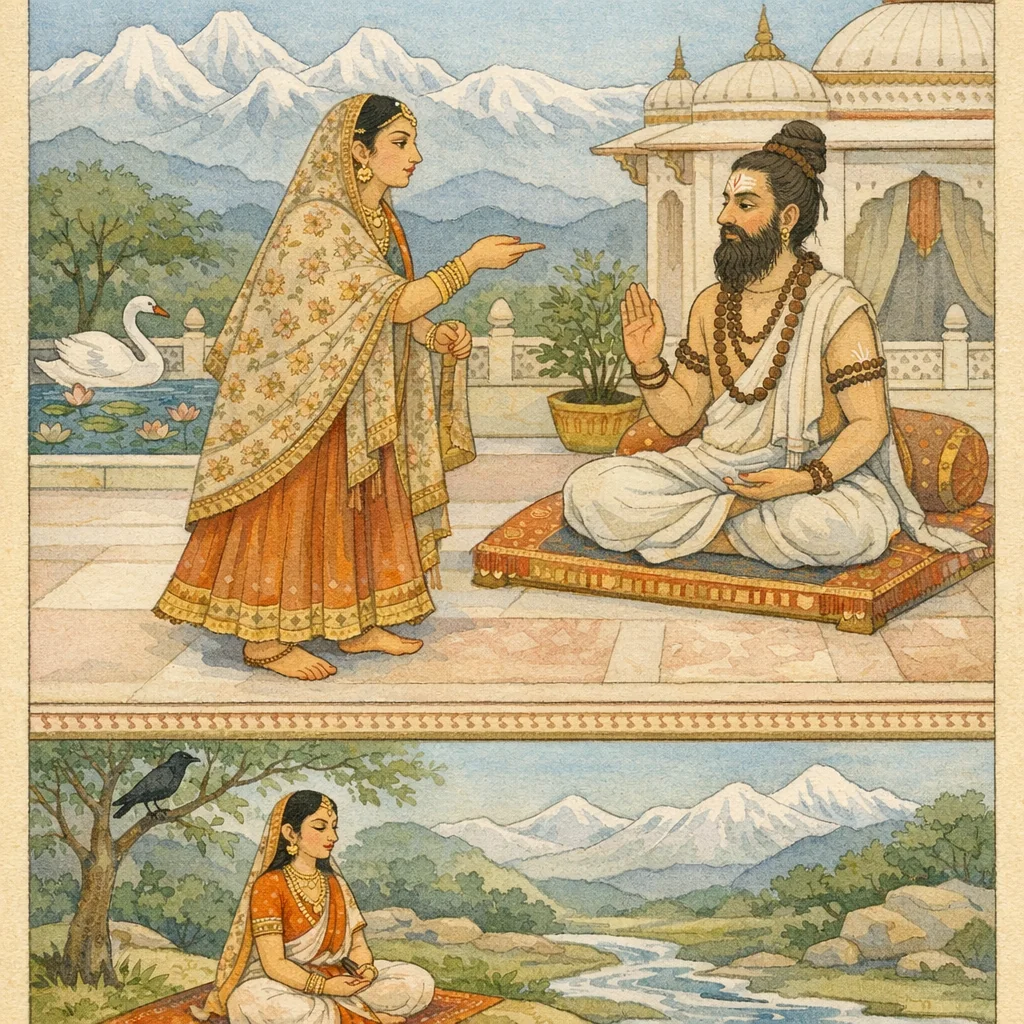
मेनायाः क्रोध-विलापः — Menā’s Lament and Reproach (to the Sage)
Adhyāya 44 begins with Brahmā describing how Menā (Himavat’s wife and Pārvatī’s mother) briefly regains composure, then becomes intensely agitated—lamenting and turning to sharp reproach of the advising sage. She condemns the outcome of earlier assurances about Pārvatī’s destined marriage to Śiva, reading later events as deception or a reversal of what was promised. Menā calls Pārvatī’s severe tapas a painful “fruit” and voices despair: fear for family honor and stability, uncertainty about any refuge, and anger at a perceived betrayal. Her speech rises into bitter metaphors aimed at her daughter—trading gold for glass, leaving sandalwood for mud, and catching a crow after letting a swan fly away—signs of misjudgment, inverted values, and tragic choice. The chapter sets maternal grief and social anxiety against the divine purpose of the Śiva–Pārvatī union, preparing a resolution in which human perspective is corrected by cosmic intent.
Shlokas
Verse 1
ब्रह्मोवाच । संज्ञां लब्धा ततस्सा च मेना शैलप्रिया सती । विललापातिसंक्षुब्धा तिरस्कारमथाकरोत्
Brahmā said: Then Menā, the virtuous lady who loved the mountains, regained consciousness. Greatly shaken, she began to lament and then voiced her reproach.
Verse 2
तत्र तावत्स्वपुत्रांश्च निनिन्द खलिता मुहुः । प्रथमं सा ततः पुत्री कथयामास दुर्वचः
There, overcome by agitation, she repeatedly censured her own sons. Then, first of all, that daughter spoke harsh and improper words.
Verse 3
मेनोवाच । मुने पुरा त्वया प्रोक्तं वरिष्यति शिवा शिवम् । पश्चाद्धिमवतः कृत्यं पूजार्थं विनिवेशितम्
Menā said: “O sage, you had formerly declared that Śivā (Pārvatī) would choose Śiva as her lord. Thereafter, the duty to be undertaken by Himavat—arranging what is required for worship—was duly set in motion.”
Verse 4
ततो दृष्टं फलं सत्यं विपरीतमनर्थकम् । मुनेऽधमाहं दुर्बुद्धे सर्वथा वञ्चिता त्वया
Then I saw the real outcome—truly the reverse and utterly ruinous. O sage! I, a wretched woman, have been completely deceived by you, O evil-minded one.
Verse 5
पुनस्तया तपस्तप्तं दुष्करं मुनिभिश्च यत् । तस्य लब्धं फलं ह्येतत्पश्यतां दुःखदायकम्
Again she undertook that severe tapas, so arduous that even the sages find it hard. Yet the fruit she gained from it became a cause of sorrow for those who witnessed it.
Verse 6
किं करोमि क्व गच्छामि को मे दुःखं व्यपोहताम् । कुलादिकं विनष्टं मे विहितं जीवितं मम
“What shall I do? Where shall I go? Who will take away my sorrow? My family and all that belonged to it are destroyed; even my very life now seems a fate appointed for suffering.”
Verse 7
क्व गता ऋषयो दिव्याः श्मश्रूणि त्रोटयाम्यहम् । तपस्विनी च या पत्नी सा धूर्ता स्वयमागता
“Where have the divine sages gone? In my agitation I will tear out my beard! And that wife who is truly an ascetic—she, the crafty one—has come here of her own accord.”
Verse 8
केषाञ्चैवापराधेन सर्वं नष्टं ममाधुना । इत्युक्त्वा वीक्ष्य च सुतामुवाच वचनं कटु
“By the offense of certain people, everything of mine is now ruined.” Saying this, he looked at his daughter and spoke harsh words.
Verse 9
किं कृतं ते सुते दुष्टे कर्म दुःखकरं मम । हेम दत्त्वा त्वयानीतः काचो वै दुष्टया स्वयम्
“O wicked daughter, what painful deed have you done to me? Having given gold, you have brought back mere glass—indeed, you yourself, being perverse, have done this.”
Verse 10
हित्वा तु चन्दनं भूयो लेपितः कर्दमस्त्वया । हंसमुड्डीय काको वै गृहीतो हस्तपञ्जरे
Abandoning sandal-paste, you have again smeared yourself with mud. Flying up to seize a swan, you have instead caught only a crow within the cage of your hands.
Verse 11
हित्वा ब्रह्मजलं दूरे पीतं कूपोदकं त्वया । सूर्यं हित्वा तु खद्योतो गृहीतो यत्नतस्त्वया
Casting far away the vast ‘ocean-like’ water (of higher truth), you have chosen to drink mere well-water. Abandoning the Sun, you have instead, with great effort, taken hold of a firefly.
Verse 12
तण्डुलांश्च तथा हित्वा कृतं वै तुषभक्षणम् । प्रक्षिप्याज्यं तथा तैलं कारण्डं भुक्तमादरात्
Abandoning even rice-grains, he indeed took to eating husk and bran. Mixing in ghee and oil, he reverently ate that coarse food with care.
Verse 13
सिंहसेवां तथा मुक्त्वा शृगालस्सेवितस्त्वया । ब्रह्मविद्यां तथा मुक्त्वा कुगाथा च श्रुता त्वया
Abandoning service to the lion, you have instead served a jackal; abandoning the sacred Brahmavidyā, the knowledge of Brahman, you have listened to base and worthless tales.
Verse 14
गृहे यज्ञविभूतिं हि दूरीकृत्य सुमंगलाम् । गृहीतश्च चिताभस्म त्वया पुत्रि ह्यमंगलम्
You have pushed away from the house the auspicious sacred ash used in sacrifice, and instead, my daughter, you have taken up the ash from a funeral pyre—this indeed is inauspicious.
Verse 15
सर्वान् देववरांस्त्यक्त्वा विष्ण्वादीन्परमेश्वरान् । कृतं त्वया कुबुद्ध्या वै शिवार्थं तप ईदृशम्
Abandoning all the excellent gods—Vishnu and the other supreme deities—you, with misguided understanding, have undertaken such austerity for Shiva’s sake.
Verse 16
धिक्त्वा च तव बुद्धिश्च धिग्रूपं चरितं तव । धिक् चोपदेशकर्त्तारं धिक्सख्यावपि ते तथा
Shame on you—and shame on your understanding! Shame on your form and on your conduct. Shame also on the one who gave you such counsel, and shame even on your friendship as well.
Verse 17
आवां च धिक्तथा पुत्री यौ ते जन्मप्रवर्तकौ । धिक्ते नारद बुद्धिञ्च सप्तर्षींश्च सुबुद्धिदान्
“Shame upon us—and upon our daughter as well—for we became the instruments that set your birth in motion. And shame upon your counsel too, O Nārada, and upon the Seven Ṛṣis, though they are givers of good understanding.”
Verse 18
धिक्कुलं धिक्क्रियादाक्ष्यं सर्वं धिग्यत्कृतं त्वया । गृहन्तु धुक्षितं त्वेतन्मरणं तु ममैव हि
Shame on this lineage; shame on this ritualistic prowess—shame on everything you have done. Let this kindled fire consume this body; for death, indeed, is mine alone to embrace.
Verse 19
पार्वतानामयं राजा नायातु निकटे मम । सप्तर्षयस्स्वयं नैव दर्शयन्तु मुखम्मम
“Let not that king of the mountains come near me; and let not even the Seven Sages themselves show me their faces.”
Verse 20
साधितं किञ्च सर्वैस्तु मिलित्वा घातितं कुलम् । वन्ध्याहं न कथं जाता गर्भो न गलितः कथम्
“Somehow, all of you united have accomplished your aim and struck down my family. Yet how have I not become barren? And how has the embryo not fallen?”
Verse 21
अथो न वा मृता चाहं पुत्रिका न मृता कथम् । रक्षसाद्य कथं नो वा भक्षिता गगने पुनः
“Or else—am I not dead? Then how is my daughter not dead? Or how have we not been eaten by a rākṣasa and the like—again, up in the sky?”
Verse 22
छेदयामि शिरस्तेऽद्य किं करोमि कलेवरैः । त्यक्त्वा त्वां च कुतो यायां हाहा मे जीवितं हतम्
“I shall cut off your head today. What use have I for this body? And after abandoning you, where could I even go? Alas—my very life is destroyed!”
Verse 23
ब्रह्मोवाच । इत्युक्त्वा पतिता सा च मेना भूमौ विमूर्छिता । व्याकुला शोकरोषाद्यैर्न गता भर्तृसन्निधौ
Brahmā said: Having spoken thus, Menā fell to the ground and fainted. Distressed by grief, anger, and the like, she did not go into her husband’s presence.
Verse 24
हाहाकारो महानासीत्त स्मिन्काले मुनीश्वर । सर्वे समागतास्तत्र क्रमात्तत्सन्निधौ सुराः
O best of sages, at that time a great outcry arose. Then all the gods, one after another, assembled there and came into that presence.
Verse 25
पुरा देवमुने चाहमागतस्तु स्वयं तदा । मां दृष्ट्वा त्वं वचस्ता वै प्रावोच ऋषिसत्तम
Formerly, O divine sage, I myself came there at that time. Seeing me, you indeed addressed me with words, O best of sages.
Verse 26
नारद उवाच । यथार्थं सुंदरं रूपं ना ज्ञातं ते शिवस्य वै । लीलयेदं धृतं रूपं न यथार्थं शिवेन च
Nārada said: “Truly, you have not known the real, supremely beautiful form of Śiva. This form has been assumed here by Śiva as a divine play (līlā); it is not His ultimate reality.”
Verse 27
तस्मात्क्रोधं परित्यज्य स्वस्था भव पतिव्रते । कार्य्यं कुरु हठं त्यक्त्वा शिवां देहि शिवाय च
Therefore, abandon anger and remain composed, O faithful wife. Do what must be done, giving up stubborn insistence; and offer the auspicious “Śivā”—the blessed gift—unto Śiva as well.
Verse 28
ब्रह्मोवाच । तदाकर्ण्य वचस्ते सा मेना त्वां वाक्यमब्रवीत् । उत्तिष्ठेतो गच्छ दूरं दुष्टाधमवरो भवान्
Brahmā said: Hearing your words, Menā spoke to you: “Rise from here and go far away. You are base—wicked and contemptible.”
Verse 29
इत्युक्ते तु तया देव इन्द्राद्याः सकलाः क्रमात् । समागत्य च दिक्पाला वचनं चेदमब्रुवन्
When she had spoken thus, all the gods—Indra and the rest—came in due order; and the Guardians of the Directions assembled and spoke these words.
Verse 30
देवा ऊचुः । हे मेने पितृकन्ये हि शृण्वस्मद्वचनम्मुदा । अयं वै परमः साक्षाच्छिवः परसुखावहः
The Devas said: “O Menā, daughter of the Pitṛs, listen joyfully to our words. This indeed is the Supreme—Shiva Himself, directly manifest—who bestows the highest bliss.”
Verse 31
कृपया च भवत्पुत्र्यास्तपो दृष्ट्वातिदुस्सहम् । दर्शनं दत्तवाञ्छम्भुर्वरं सद्भक्तवत्सलः
Seeing, with compassion, the exceedingly difficult austerity performed by your daughter, Śambhu—ever affectionate to true devotees—granted her His divine vision and bestowed a boon.
Verse 32
ब्रह्मोवाच । अथोवाच सुरान्मेना विलप्याति मुहुर्मुहुः । न देया तु मया कन्या गिरिशायोग्ररूपिणे
Brahmā said: Then Menā, the mother of the gods, spoke again and again while lamenting: “I must not give my daughter to Girīśa in his fierce and awe-inspiring form.”
Verse 33
किमर्थन्तु भवन्तश्च सर्वे देवाः प्रपञ्चिताः । रूपमस्याः परन्नाम व्यर्थीकर्तुं समुद्यतः
For what purpose, indeed, have all of you gods come here in such display and commotion—are you intent on rendering futile the supreme, transcendent beauty and true Name (glory) of this Goddess?
Verse 34
इत्युक्ते च तया तत्र ऋषयस्सप्त एव हि । ऊचुस्ते वच आगत्य वसिष्ठाद्या मुनीश्वर
When she had spoken thus there, the seven sages indeed—those lordly seers beginning with Vasiṣṭha—approached and spoke their words.
Verse 35
सप्तर्षयः ऊचुः । कार्य्यं साधयितुम्प्राप्ताः पितृकन्ये गिरिप्रिये । विरुद्धं चात्र उक्तार्थे कथम्मन्यामहे वयम्
The Seven Sages said: “O beloved daughter of your father, O dear one of the Mountain! We have come here to accomplish our task; yet what you have stated seems contrary to the very aim at hand. How are we to understand this?”
Verse 36
ब्रह्मोवाच । अयं वै परमो लाभो दर्शनं शंकरस्य यत् । दानपात्रं स ते भूत्वागतस्तव च मंदिरम्
Brahmā said: “Indeed, this is the highest gain—that one obtains the darśana of Śaṅkara. Becoming a worthy recipient of your charity, he has now come to your temple as well.”
Verse 37
ब्रह्मोवाच । इत्युक्त्वा तैस्ततो मेना मुनिवाक्यं मृषाकरोत् । प्रत्युवाच च रुष्टा सा तानृषीञ्ज्ञानदुर्बला
Brahmā said: When they had spoken thus, Menā dismissed the sages’ words as false. Then, overcome by anger and weak in true discernment, she replied to those ṛṣis.
Verse 38
मेनोवाच । शस्त्राद्यैर्घातयिष्येहं न हास्ये शंकरायताम् । दूरं गच्छत सर्वे हि नागन्तव्यं मदन्तिके
Mena said: “Here I shall strike (you) down with weapons and the like; I will not allow you to go to Śaṅkara. Go far away—all of you! You must not come near me.”
Verse 39
ब्रह्मोवाच । इत्युक्त्वा विररामाशु सा विलप्यातिविह्वला । हाहाकारो महानासीत्तत्र तद्वृत्ततो मुने
Brahmā said: Having spoken thus, she quickly fell silent; overwhelmed with anguish, she lamented. O sage, because of that event, a great cry of distress arose there.
Verse 40
ततो हिमालयस्तत्राजगामातिसमाकुलः । ताञ्च बोधयितुं प्रीत्या प्राह तत्त्वञ्च दर्शयन्
Then Himālaya came there, greatly agitated. Wishing to awaken her understanding with affection, he spoke to her—at the same time pointing out the true principle (tattva) behind the situation.
Verse 41
हिमालय उवाच । शृणु मेने वचो मेऽद्य विकलाऽसि कथम्प्रिये । के के समागता गेहं कथं चैतान्विनिन्दसि
Himālaya said: “Listen today to my words, O beloved Mena. Why are you so distressed? Who all have come to our house, and why do you speak ill of them?”
Verse 42
शंकरं त्वं च जानासि रूपं दृष्ट्वासि विह्वला । विकटं तस्य शंभोस्तु नानारूपाभिधस्य हि
You indeed know Śaṅkara; yet, on seeing that form, you have become overwhelmed. For that very Śambhu—known by many names and manifesting in many forms—has a wondrous and formidable aspect.
Verse 43
स शंकरो मया ज्ञातस्सर्वेषां प्रतिपालकः । पूज्यानां पूज्य एवासौ कर्तानुग्रहनिग्रहान्
I have come to know that Śaṅkara is the protector of all. He alone is worthy of worship even among the worship-worthy, and He bestows both grace and restraint upon beings.
Verse 44
इति श्रीशिवमहापुराणे द्वितीयायां रुद्रसंहितायां तृतीये पार्वती खण्डे मेनाप्रबोधवर्णनो नाम चतुश्चत्वारिंशोऽध्यायः
Thus ends the forty-fourth chapter, called “The Description of Menā’s Awakening (Instruction),” in the Pārvatī Khaṇḍa, the third section of the second part—the Rudra Saṃhitā—of the revered Śrī Śiva Mahāpurāṇa.
Verse 45
यद्वै द्वारगतश्शंभुः पुरा विकटरूपधृक् । नानालीलाञ्च कृतवाञ्चेतयामि च तामिमाम्
I call to mind that very deed: how, in former times, Śambhu came to the doorway assuming a fearsome form, and performed many divine play-acts—meant to veil and then reveal His grace to the devotee.
Verse 46
तन्माहात्म्यं परं दृष्ट्वा कन्यां दातुं त्वया मया । अंगीकृतं तदा देवि तत्प्रमाणं कुरु प्रिये
Having beheld that supreme greatness, O Goddess, it was then accepted by me—together with you—that the maiden should be given in marriage. O beloved, now make that decision a confirmed and authoritative resolve.
Verse 47
ब्रह्मोवाच । इत्युक्त्वा सोऽद्रिनाथो हि विरराम ततो मुने । तदाकर्ण्य शिवामाता मेनोवाच हिमालयम्
Brahmā said: Having spoken thus, O sage, the Lord of the mountain (Himālaya) fell silent. Hearing those words, Śivā’s mother Menā then spoke to Himālaya.
Verse 48
मेनोवाच । मद्वचः श्रूयतां नाथ तथा कर्तुं त्वमर्हसि । गृहीत्वा तनुजां चैनां बद्ध्वा कण्ठे तु पार्वतीम्
Menā said: “O Lord, please hear my words, and you ought to act accordingly. Take this daughter of mine, and place Pārvatī as a garland upon your neck (accept her in marriage).”
Verse 49
अधः पातय निःशंकं दास्ये तां न हराय हि । तथैनामथवा नाथ गत्वा वै सागरे सुताम्
“Cast her down below without hesitation; for I will not give her to Hara (Śiva). Or else, O lord, go to the ocean and give her away as the daughter of the sea.”
Verse 50
निमज्जय दयां त्यक्त्वा ततोऽद्रीश सुखी भव । यदि दास्यसि पुत्री त्वं रुद्राय विकटात्मने । तर्हि त्यक्ष्याम्यहं स्वामिन्निश्चयेन कलेवरम्
“Casting aside compassion and plunging (me) into misery, O Lord of the mountain, be happy then. If you give your daughter to Rudra—of fearsome nature—then, my lord, I will certainly abandon this body.”
Verse 51
ब्रह्मोवाच । इत्युक्ते च तदा तत्र वचने मेनया हठान् । उवाच वचनं रम्यं पार्वती स्वयमागता
Brahmā said: When Menā had spoken there with stubborn insistence, Pārvatī herself stepped forward and uttered gentle, pleasing words.
Verse 52
पार्वत्युवाच । मातस्ते विपरीता हि बुद्धिर्जाताऽशुभावहा । धर्मावलम्बनात्त्वं हि कथन्धर्मं जहासि वै
Pārvatī said: Mother, your understanding has indeed turned contrary, bringing inauspicious results. Since you have taken refuge in dharma, how can you truly abandon dharma?
Verse 53
अयं रुद्रोऽपरस्साक्षात्सर्वप्रभव ईश्वरः । शम्भुस्सुरूपस्सुखदस्सर्वश्रुतिषु वर्णितः
This Rudra is verily the Transcendent Himself—Īśvara, the Lord who is the source of all. He is Śambhu, of auspicious and perfect form, the bestower of bliss, and is praised throughout all the Śrutis (the Vedas).
Verse 54
महेशश्शंकरश्चायं सर्वदेवप्रभुस्स्वराट् । नानारूपाभिधो मातर्हरिब्रह्मादिसेवितः
O Mother, this Lord is Maheśa—Śaṅkara Himself—the sovereign ruler and master of all the gods. He is known by many forms and many names, and is worshipped even by Hari (Viṣṇu), Brahmā, and the other deities.
Verse 55
अधिष्ठानं च सर्वेषां कर्ता हर्ता च स प्रभुः । निर्विकारी त्रिदेवेशो ह्यविनाशी सनातनः
He is the underlying support of all; that Lord is both the doer and the withdrawer. Unchanging, the Lord of the three gods, He is imperishable and eternal.
Verse 56
यदर्थे देवतास्सर्वा आयाता किंकरीकृताः । द्वारि ते सोत्सवाश्चाद्य किमतोऽन्यत्परं सुखम्
For your sake all the gods have come and have become attendants; today they stand at your very door, rejoicing in festive celebration. What happiness could be higher than this?
Verse 57
उत्तिष्ठातः प्रयत्नेन जीवितं सफलं कुरु । देहि मां त्वं शिवायास्मै स्वाश्रमं कुरु सार्थकम्
Rise up with earnest effort and make your life truly fruitful. Give me to that Lord Śiva, and thereby make your own āśrama—the dharma of the household—meaningful and fulfilled.
Verse 58
देहि मां परमेशाय शंकराय जनन्यहो । स्वीकुरु त्वमिमं मातर्विनयम्मे ब्रवीमि ते
“O Mother! Please give me to Parameśa Śaṅkara. Accept this request, O Mother; I humbly submit my entreaty to you.”
Verse 59
चेन्न दास्यसि तस्मै मां न वृणेऽन्यमहं वरम् । भागं लभेत्कथं सैंहं शृगालः परवंचकः
“If you will not give me to him, then I choose no other boon. How could a deceitful jackal ever obtain a lion’s share?”
Verse 60
मनसा वचसा मातः कर्मणा च हरस्त्वयम् । मया वृतो वृतश्चैव यदिच्छसि तथा कुरु
“O Mother, by mind, by speech, and by action you have indeed won over Hara (Śiva). I have chosen you, and you have chosen me as well—now do as you wish.”
Verse 61
ब्रह्मोवाच । इत्याकर्ण्य शिवावाक्यं मेना शैलेश्वरप्रिया । सुविलप्य महाक्रुद्धा गृहीत्वा तत्कलेवरम्
Brahmā said: Hearing these words of Śiva, Menā—the beloved of the lord of mountains—lamented greatly. Then, becoming exceedingly angry, she took up that body.
Verse 62
मुष्टिभिः कूर्परैश्चैव दन्तान्धर्षयती च सा । ताडयामास तां पुत्रीं विह्वलातिरुषान्विता
Striking with her fists and elbows, and grinding her teeth in fury, she beat that daughter—overwhelmed and seized by intense anger.
Verse 63
ये तत्र ऋषयस्तात त्वदाद्याश्चापरे मुने । तद्धस्तात्ताम्परिच्छिद्य नित्युर्दूरतरं ततः
“Beloved one, the sages who were there—beginning with you and others too, O muni—took her from his hand, placed her under their protection, and then withdrew far away from that place.”
Verse 64
तान्वै तथा विधान्दृष्ट्वा भर्त्सयित्वा पुनः पुनः । उवाच श्रावयन्ती सा दुर्वचो निखिलान्पुनः
Seeing them behave in that improper way, she rebuked them again and again; and, making everyone listen, she once more uttered all those harsh words.
Verse 65
मेनोवाच । किं मेना हि करिष्येऽहं दुष्टां ग्रहवतीं शिवाम् । दास्याम्यस्यै गरन्तीव्रं कूपे क्षेप्स्यामि वा ध्रुवम्
Mena said: “What am I to do with this Śivā, ill-disposed and as though seized by an evil influence? I shall give her a fierce poison, or else I will surely cast her into a well.”
Verse 66
छेत्स्यामि कालीमथवा शस्त्रास्त्रैर्भूरिखण्डशः । निमज्जयिष्ये वा सिन्धौ स्वसुताम्पार्वतीं खलु
“Either I shall cut Kāli into many pieces with weapons, or else I shall indeed drown my own daughter Pārvatī in the ocean.”
Verse 67
अथवा स्वशरीरं हि त्यक्ष्याम्याश्वन्यथा ध्रुवम् । न दास्ये शम्भवे कन्यां दुर्गां विकटरूपिणे
“Otherwise, I shall swiftly abandon this very body—this is certain. I will not give my daughter, the formidable and awe-inspiring Durgā, to Śambhu.”
Verse 68
वरोऽयं कीदृशो भीमोऽनया लब्धश्च दुष्टया । कारितश्चोपहासो मे गिरेश्चापि कुलस्य हि
“What sort of dreadful boon is this that has been obtained by this wicked woman? She has made a mockery of me—and indeed of Girīśa (Śiva) as well, and of the honor of our whole lineage.”
Verse 69
न माता न पिता भ्राता न बन्धुर्गोत्रजोऽपि हि । नो सुरूपं न चातुर्य्यं न गुहं वास्य किंचन
He has neither mother nor father, neither brother nor any kinsman of the lineage. He possesses neither handsome form nor cleverness, and there is no hidden excellence in him whatsoever.
Verse 70
न वस्त्रं नाप्यलङ्कारास्सहायाः केऽपि तस्य न । वाहनं न शुभं ह्यस्य न वयो न धनन्तथा
He had no clothing, nor any ornaments; he had no companions at all. He had no auspicious vehicle; neither youth nor wealth was his.
Verse 71
न पावित्र्यं न विद्या च कीदृशः काय आर्तिदः । किं विलोक्य मया पुत्री देयास्मै स्यात्सुमंगला
“In him there is neither purity nor learning. What kind of body does this tormentor possess? Seeing what good quality should I give my daughter to him, that she may become truly auspicious (sumangala)?”
Verse 72
ब्रह्मोवाच । इत्यादि सुविलप्याथ बहुशो मेनका तदा । रुरोदोच्चैर्मुने सा हि दुःखशोकपरिप्लुता
Brahmā said: After lamenting in this way again and again, Menakā then—overwhelmed by sorrow and grief—cried aloud, O sage.
Verse 73
अथाहन्द्रुतमागत्याकथयम्मेनकां च ताम् । शिवतत्त्वं च परमं कुज्ञानहरमुत्तमम्
Then he said, “Come quickly and tell that Menakā as well—(teach her) the supreme principle of Śiva, the highest truth that removes false and misguided knowledge.”
Verse 74
ब्रह्मोवाच । श्रोतव्यम्प्रीतितो मेने मदीयं वचनं शुभम् । यस्य श्रवणतः प्रीत्या कुबुद्धिस्ते विनश्यति
Brahmā said: “Listen with devotion to my auspicious words. For the one who hears them with loving faith, misguided understanding and faulty judgment are destroyed.”
Verse 75
शङ्करो जगतः कर्ता भर्ता हर्ता तथैव च । न त्वं जानासि तद्रूपं कथन्दुःखं समीहसे
Śaṅkara is indeed the Creator, Sustainer, and Dissolver of the universe. Since you do not truly know His real nature, how can you deliberately seek sorrow?
Verse 76
अनेकरूपनामा च नाना लीलाकरः प्रभुः । सर्वस्वामी स्वतन्त्रश्च मायाधीशोऽविकल्पकः
He is the Lord of many forms and many names, enacting diverse divine līlā. He is the sovereign of all, ever independent, the ruler of Māyā, and the One free from all limiting distinctions and alternatives.
Verse 77
इति विज्ञाय मेने त्वं शिवान्देहि शिवाय वै । कुहठन्त्यज कुज्ञानं सर्वकार्यविनाशनम्
Knowing thus, he resolved: “You are Śivā—truly offer yourself to Śiva. Abandon crooked obstinacy and cast away false knowledge, for it destroys every noble undertaking.”
Verse 78
ब्रह्मोवाच । इत्युक्ता सा मया मेना विलपन्ती मुहुर्मुहुः । लज्जां किंचिच्छनैस्त्यक्त्वा मुने मां वाक्यमब्रवीत्
Brahmā said: Thus addressed by me, Menā kept lamenting again and again. Then, casting off her shyness little by little, O sage, she spoke these words to me.
Verse 79
मेनोवाच । किमर्थन्तु भवान्ब्रह्मन्रूपमस्य महावरम् । व्यर्थीकरोति किमियं हन्यतां न स्वयं शिवा
Menā said: “O Brahman, for what reason do you make futile this great and excellent form (and boon) of his? Why should this one be slain—why does Śivā herself not kill her?”
Verse 80
न वक्तव्यं च भवता शिवाय प्रतिदीयताम् । न दास्येऽहं शिवायैनां स्वसुताम्प्राणवल्लभाम्
“You must not even say, ‘Let her be given to Śiva.’ I will not give this—my own daughter, dear to me as my very life—to Śiva.”
Verse 81
ब्रह्मोवाच । इत्युक्ते तु तदा सिद्धाः सनकाद्या महामुने । समागत्य महाप्रीत्या वचनं हीदमब्रुवन्
Brahmā said: “When this had been spoken, O great sage, the perfected ones—Sanaka and the others—then came forward. Filled with great joy, they spoke these words.”
Verse 82
सिद्धा ऊचुः । अयम्वै परमस्साक्षाच्छिवः परसुखावहः । कृपया च भवत्पुत्र्यै दर्शनन्दत्तवान्प्रभुः
The Siddhās said: “This indeed is the Supreme—Shiva Himself, manifest before us—who bestows the highest bliss. Out of compassion, the Lord has granted His divine vision to your daughter.”
Verse 83
ब्रह्मोवाच । अथोवाच तु तान्मेना विलप्य च मुहुर्मुहुः । न देया तु मया सम्यग्गिरिशायोग्ररूपिणे
Brahmā said: Then Menā, again and again lamenting, spoke to them: “Truly, I should not properly give (my daughter) to Girīśa, who bears a fearsome form.”
Verse 84
किमर्थन्तु भवन्तश्च सर्वे सिद्धाः प्रपञ्चिनः । रूपमस्याः परं नाम व्यर्थीकर्त्तुं समुद्यताः
“For what reason are all of you—though accomplished siddhas and skilled in worldly ways—endeavoring to render futile her supreme form and her highest name?”
Verse 85
इत्युक्ते च तया तत्र मुनेऽहं चकितोऽभवम् । सर्वे विस्मयमापन्ना देवसिद्धर्षिमानवाः
When she spoke thus there, O sage, I was struck with astonishment; and all—gods, Siddhas, seers, and men—fell into wonder.
Verse 86
एतस्मिन्समये तस्या हठं श्रुत्वा दृढं महत् । द्रुतं शिवप्रियो विष्णुस्समागत्याऽब्रवीदिदम्
At that time, hearing of her great and steadfast resolve, Viṣṇu—ever dear to Lord Śiva—quickly arrived and spoke these words.
Verse 87
विष्णुरुवाच । पितॄणां च प्रिया पुत्री मानसी गुणसंयुता । पत्नी हिमवतस्साक्षाद्ब्रह्मणः कुलमुत्तमम्
Viṣṇu said: “She is the beloved daughter of the Pitṛs, mind-born and endowed with virtues; indeed she is the very consort of Himavān. She belongs to Brahmā’s most excellent lineage.”
Verse 88
सहायास्तादृशा लोके धन्या ह्यसि वदामि किम् । धर्मस्याधारभूतासि कथं धर्मं जहासि हि
A helper like you is rare in this world—truly you are blessed; what more can I say? You are the very support of dharma itself—how then can you abandon dharma?
Verse 89
देवैश्च ऋषिभिश्चैव ब्रह्मणा वा मया तथा । विरुद्धं कथ्यते किं नु त्वयैव सुविचार्यताम्
Whether by the gods, by the seers, by Brahmā, or even by me—what, indeed, is being spoken here that is contrary to truth and right order? You yourself should reflect on it carefully.
Verse 90
शिवत्वं न च जानासि निर्गुणस्य गुणस्स हि । विरूपस्स सुरूपो हि सर्वसेव्यस्सतां गतिः
You do not truly understand the state of Śiva-hood. Though He is nirguṇa (beyond all qualities), He is indeed the very ground of all qualities. Though appearing formless or strange to worldly eyes, He is supremely beautiful in essence. He is worshipped by all, and He is the refuge and final goal of the virtuous.
Verse 91
तेनैव निर्मिता देवी मूलप्रकृतिरीश्वरी । तत्पार्श्वे च तदा तेन निर्मितः पुरुषोत्तमः
By Him alone the Goddess—Īśvarī, the primordial Root‑Nature (Mūla‑Prakṛti)—was brought forth; and then, at Her side, by Him was manifested the Supreme Person (Puruṣottama).
Verse 92
ताभ्यां चाहं तथा ब्रह्मा ततश्च गुणरूपतः । अवतीर्य स्वयं रुद्रो लोकानां हितकारकः
From those two primordial principles arose I and Brahmā; and then, taking on a form constituted of the guṇas, Rudra Himself descended—acting for the welfare of the worlds.
Verse 93
ततो वेदास्तथा देवा यत्किंचिद्दृश्यते जगत् । स्थावरं जंगमं चैव तत्सर्वं शकरादभूत्
From Him arose the Vedas and the gods; indeed, whatever world is seen—both the immovable and the moving—everything came forth from Śaṅkara.
Verse 94
तद्रूपम्वर्णितं केन ज्ञायते केन वा पुनः । मया च ब्रह्मणा यस्य ह्यतो लब्धश्च नैव हि
Who can truly describe that Form, and who, again, can fully know it? Even I—Brahmā—have never been able to attain a complete grasp of His reality.
Verse 95
आब्रह्मस्तम्बपर्यंतं यत्किञ्चिद्दृश्यते जगत् । तत्सर्वं च शिवं विद्धि नात्र कार्या विचारणा
From Brahmā down to a blade of grass, whatever is seen as this universe—know all of that to be Śiva alone; here there is no need for further deliberation.
Verse 96
स एवेदृक्सुरूपेणावतीर्णो निजलीलया । शिवातपः प्रभावाद्धि तव द्वारि समागतः
He himself, assuming just such a beautiful form, has descended by his own divine play; indeed, by the power of Śiva-austerity, he has come to your very door.
Verse 97
तस्मात्त्वं हिमवत्पत्नि दुःखं मुञ्च शिवम्भज । भविष्यति महानन्दः क्लेशो यास्यति संक्षयम्
Therefore, O consort of Himavān, abandon sorrow and take refuge in Śiva through devoted worship. Great bliss will surely arise, and your afflictions will go to complete exhaustion.
Verse 98
ब्रह्मोवाच एवम्प्रबोधितायास्तु मेनकाया अभून्मुने । तस्यास्तु कोमलं किंचिन्मनो विष्णुप्रबोधितम्
Brahmā said: Thus instructed, O sage, Menakā became receptive; and her tender heart—softened within—was, in some measure, awakened by Viṣṇu’s counsel.
Verse 99
परं हठं न तत्याज कन्यान्दातुं हराय न । स्वीचकार तदा मेना शिवमायाविमोहि ता
Yet she did not relinquish her stubborn resolve, refusing to give the maiden to Hara (Śiva). Then Menā—bewildered by Śiva’s divine Māyā—gave her consent.
Verse 100
उवाच च हरिं मेना किञ्चिद्बुद्ध्वा गिरिप्रिया । श्रुत्वा विष्णुवचो रम्यं गिरिजाजननी हि सा
Then Menā—beloved of the Mountain (Himālaya) and indeed the mother of Girijā—having understood the matter somewhat, spoke to Hari after hearing the charming words of Viṣṇu.
Verse 101
यदि रम्यतनुस्स स्यात्तदा देया मया सुता । नान्यथा कोटिशो यत्नैर्वच्मि सत्यन्दृढं वचः
“If he truly possesses a beautiful and worthy form, then my daughter shall be given by me in marriage. Not otherwise—though there be efforts made by the tens of millions. I speak this as firm truth, a steadfast vow.”
Verse 102
ब्रह्मोवाच । इत्युक्त्वा वचनं मेना तूष्णीमास दृढव्रता । शिवेच्छाप्रेरिता धन्या तथा याखिलमोहिनी
Brahmā said: Having spoken these words, Menā—the steadfast woman of firm resolve—became silent. Blessed indeed was she, impelled by Śiva’s will, and she remained one who could enchant and bewilder all.
Frequently Asked Questions
Menā’s emotional outburst and reproach after Pārvatī’s austerities and the unfolding marriage-destiny narrative; she challenges earlier assurances about Śiva and interprets events as a disastrous reversal.
The chapter dramatizes the gap between worldly valuation (honor, security, immediate outcomes) and the purāṇic claim that tapas and divine union can appear ‘painful’ before revealing their higher telos—testing attachment and social fear.
Not a theophany-driven chapter in the sample; the ‘manifestations’ are rhetorical and ethical: Śakti’s path (Pārvatī’s tapas) versus household perception (Menā’s grief), expressed through emblematic metaphors of value inversion.