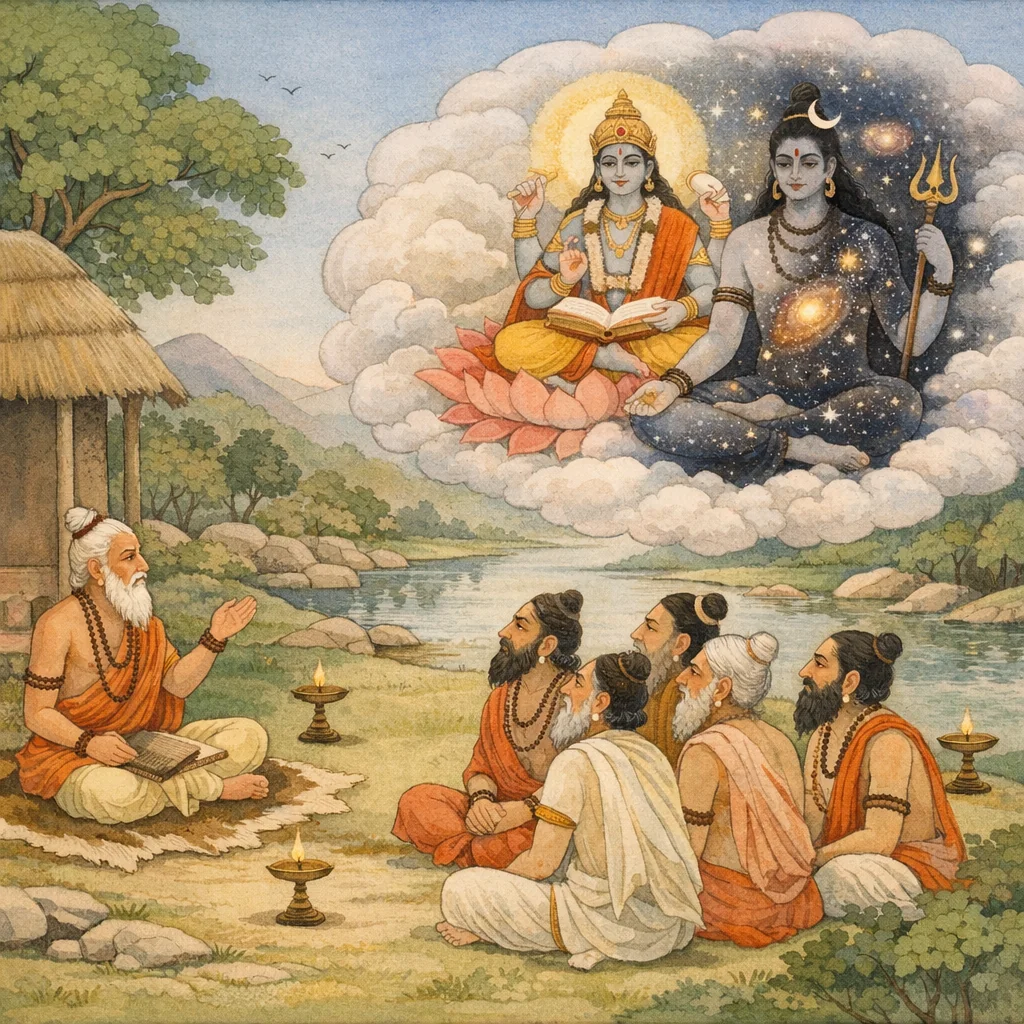
Śiva-nāma-sahasraka-kathana (The Recital/Teaching of the Thousand Names of Śiva)
Adhyāya 35 unfolds as a scene of sacred transmission: Sūta addresses the sages and proclaims a received, merit-bearing teaching—the puṇya “nāma-sahasraka,” the Thousand Names that delighted Parameśvara (Śiva) when requested by Viṣṇu. The chapter then turns, under the heading “Śrīviṣṇur uvāca,” into a litany of Śiva’s epithets, establishing the hymn as divinely authorized and ritually practicable as a recitable sequence. The names encode Śiva’s iconography (Pinākī, Nīlakaṇṭha, Vṛṣavāhana), metaphysical stature (Aparicchedya, Parātpara), yogic knowability in samādhi (Samādhivedya), and cosmic scope (Viśvarūpa, Viśvambhareśvara). Its esoteric import is that the Name functions as condensed ontology: each epithet serves as a meditative handle, leading from form-bound attributes to the limitless principle they signify, while faithful recitation accrues ritual merit.
Shlokas
Verse 1
सूत उवाच । श्रूयतामृषयः श्रेष्ठाः कथयामि यथा श्रुतम् । विष्णुना प्रार्थितो येन संतुष्टः परमेश्वरः । तदाहं कथयाम्यद्य पुण्यं नाम सहस्रकम्
Sūta said: “Listen, O best of sages. I shall relate exactly as I have heard—by which sacred recitation, when prayed to by Viṣṇu, the Supreme Lord Parameśvara Śiva became fully pleased. Therefore, today I will proclaim that meritorious thousandfold of Names.”
Verse 2
श्रीविष्णुरुवाच । शिवो हरो मृडो रुद्रः पुष्करः पुष्पलोचनः । अर्थिगम्यः सदाचारः शर्वः शंभुर्महेश्वरः
Śrī Viṣṇu said: “He is Śiva, the Auspicious; Hara, the Remover of sin and bondage; Mṛḍa, the Gracious; Rudra, the Lord who makes beings weep and dissolves the world. He is Puṣkara, pure and lotus-like; Puṣpalocana, the One with flower-like eyes. He is accessible to those who seek refuge, the very embodiment of right conduct; Śarva, the all-destroying Lord; Śaṃbhu, the Giver of welfare; and Maheśvara, the Supreme Ruler.”
Verse 3
चंद्रापीडश्चंद्रमौलिर्विश्वं विश्वंभरेश्वरः । वेदांतसारसंदोहः कपाली नीललोहितः
He is the one crowned with the Moon, the Moon-crested Lord; He is the universe itself and the Sovereign who sustains the universe. He is the gathered essence of Vedānta, Kapālī the skull-bearing ascetic, and Nīlalohita, the blue-and-reddish, awe-inspiring form of Śiva.
Verse 4
ध्यानाधारोऽपरिच्छेद्यो गौरीभर्त्ता गणेश्वरः । अष्टमूर्तिर्विश्वमूर्तिस्त्रिवर्गस्वर्गसाधनः
He is the unfailing support of meditation, limitless in nature; the Lord of Gaurī (Pārvatī) and the sovereign of the gaṇas. He is Aṣṭamūrti, the Eight-Formed One; Viśvamūrti, whose body is the universe; and the bestower of life’s aims—dharma, artha, and kāma—along with the attainment of heaven.
Verse 5
ज्ञानगम्यो दृढप्रज्ञो देवदेवस्त्रिलोचनः । वामदेवो महादेवः पटुः परिवृढो दृढः
He is attainable through true knowledge; steadfast in wisdom; the God of gods, the Three‑eyed Lord. He is Vāmadeva, Mahādeva—skilled, fully matured in power, and unwaveringly steadfast.
Verse 6
विश्वरूपो विरूपाक्षो वागीशः शुचिसत्तमः । सर्वप्रमाणसंवादी वृषाङ्को वृषवाहनः
He is of the form of the universe, with wondrous all-seeing eyes; the Lord of sacred speech, the purest among the pure. He accords with all true means of knowledge, bears the bull as His emblem, and has the bull as His divine mount.
Verse 7
ईशः पिनाकी खट्वांगी चित्रवेषश्चिरंतनः । तमोहरो महायोगी गोप्ता ब्रह्मा च धूर्जटिः
He is Īśa, the sovereign Lord; bearer of Pināka; wielder of the khaṭvāṅga; of wondrous forms, the Ancient Eternal. He is the dispeller of darkness, the Great Yogi, the Protector; also Brahmā—the creative principle—and Dhūrjaṭi, the Lord with matted locks.
Verse 8
कालकालः कृत्तिवासाः सुभगः प्रणवात्मकः । उन्नध्रः पुरुषो जुष्यो दुर्वासाः पुरशासनः
He is Kālākāla, the Death of death, the Lord who conquers Time; the One clad in hide; the auspicious and gracious Lord, whose very essence is the sacred syllable Oṁ. He is the exalted, unwavering Support; the supreme Puruṣa worthy of refuge; the ever-pleasing and adorable One; the austere Durvāsā; and the chastiser of Tripura—Śiva, sovereign ruler of all.
Verse 9
दिव्यायुधः स्कंदगुरुः परमेष्ठीः परात्परः । अनादिमध्यनिधनो गिरीशो गिरिजाधवः
His weapons are divine; He is the revered teacher of Skanda; Paramēṣṭhī, the Supreme enthroned above all; the Transcendent beyond the transcendent. Beginningless, middleless, and endless; Girīśa, Lord of the mountains; and the beloved consort of Girijā (Pārvatī).
Verse 10
कुबेरबंधुः श्रीकंठो लोकवर्णोत्तमो मृदुः । समाधिवेद्यः कोदंडी नीलकंठः परस्वधीः
He is Kubera’s ally and friend, Śrīkaṇṭha of the auspicious throat, the supreme excellence praised throughout the worlds, gentle in grace. Known through samādhi, he is Kodaṇḍī, bearer of the bow; Nīlakaṇṭha, the Blue-Throated One; and the wielder of the supreme axe—Śiva, liberator of bound souls.
Verse 11
विशालाक्षो मृगव्याधः सुरेशः सूर्यतापनः । धर्मधाम क्षमाक्षेत्रं भगवान्भगनेत्रभित्
He is the Wide-Eyed Lord; the Hunter who subdues the mind’s wildness; the Sovereign of the gods; whose radiance outshines the sun. He is the Abode of Dharma, the sacred Field of forbearance, the blessed Bhagavān who destroyed Bhaga’s eye.
Verse 12
उग्रः पशुपतिस्तार्क्ष्यः प्रियभक्तः परंतपः । दाता दयाकरो दक्षः कर्मंदीः कामशासनः
He is Ugra, the awe-inspiring Lord; Paśupati, the Master of bound souls; swift and mighty like Tārkṣya; the One who holds His devotee most dear; the chastiser of hostile forces. He is the Giver, the embodiment of compassion, perfectly capable and skillful; the One whose intelligence is ever engaged in right action; and the Controller of desire.
Verse 13
श्मशाननिलयः सूक्ष्मः श्मशानस्थो महेश्वरः । लोककर्त्ता मृगपतिर्महाकर्त्ता महौषधिः
He whose abode is the cremation-ground—subtle and beyond all grasp—abides there as Maheśvara. He is the Maker of the worlds, Mṛgapati the Lord of all beings, the Great Doer of every deed, and the supreme healing herb—the remedy for the bondage of saṃsāra.
Verse 14
उत्तरो गोपतिर्गोप्ता ज्ञानगम्यः पुरातनः । नीतिः सुनीतिः शुद्धात्मा सोमः सोमरतः सुखी
He is the Supreme Uplifter—the Lord of all beings and their Protector—knowable through true knowledge, the Ancient One. He is Dharma itself and perfect right conduct, pure in essence. He is Soma, delighting in Soma, ever abiding in bliss.
Verse 15
सोमपोऽमृतपः सौम्यो महातेजा महाद्युतिः । तेजोमयोऽमृतमयोऽन्नमयश्च सुधापतिः
He is the drinker of Soma and the drinker of immortality; gentle, with lunar grace, vast in splendor and great in radiance. He is formed of pure brilliance, formed of nectar-like deathlessness, and also the very substance of food; He is the Lord of ambrosia.
Verse 16
अजातशत्रुरालोकः संभाव्यो हव्यवाहनः । लोककरो वेदकरः सूत्रकारः सनातनः
He is one whose enmity is unborn, the very Light of awareness, ever worthy of reverent contemplation, and the bearer of the sacrificial oblations. He is the maker and sustainer of the worlds, the revealer of the Veda, the author of the sacred sūtras, and the Eternal One.
Verse 17
महर्षिकपिलाचार्यो विश्वदीप्तिस्त्रिलोचनः । पिनाकपाणिर्भूदेवः स्वस्तिदः स्वस्तिकृत्सुधीः
He is the great sage and preceptor Kapila; the Radiance that illumines the universe; the Three‑eyed Lord. With the Pināka bow in His hand, He is the divine Lord of the earth; the giver of auspiciousness and the very maker of well‑being—wise and perfectly discerning.
Verse 18
धातृधामा धामकरः सर्वगः सर्वगोचरः । ब्रह्मसृग्विश्वसृक्सर्गः कर्णिकारः प्रियः कविः
He is the abode of the Sustainer and the very maker of all splendor; all-pervading, and yet accessible to all. He brings forth Brahmā, brings forth the universe and its unfolding creation; He is the radiant Karṇikāra, the Beloved, and the divine Sage-poet.
Verse 19
शाखो विशाखो गोशाखः शिवो भिषगनुत्तमः । गंगाप्लवोदको भव्यः पुष्कलः स्थपतिः स्थिरः
He is Śākha and Viśākha, the branching One and the One of manifold branches; He is Gośākha, the sheltering branch for all beings. He is Śiva, the most excellent of physicians who heals the soul’s bondage. He is the sacred water of the Gaṅgā’s purifying flood; He is auspicious and splendid, abundant in grace—He is the Divine Architect and the ever-steady, immutable Lord.
Verse 20
विजितात्मा विधेयात्मा भूतवाहनसारथिः । सगणो गणकायश्च सुकीर्तिच्छिन्नसंशयः
He is self-conquered and perfectly disciplined; the charioteer of the host of beings who serve as his conveyance. Surrounded by his gaṇas and embodying the very community of gaṇas, he is of spotless renown—one who cuts away all doubt.
Verse 21
कामदेवः कामपालो भस्मोद्धूलितविग्रहः । भस्मप्रियो भस्मशायी कामी कांतः कृतागमः
He is Kāmadeva, the guardian of desire; His very form is dusted with sacred ash. He is fond of bhasma and reclines upon bhasma; He is the enjoyer (who governs desire), the beloved, and the one who has established the āgamas (revealed Shaiva scriptures).
Verse 22
समावर्तोऽनिवृत्तात्मा धर्मपुंजः सदाशिवः । अकल्मषश्च पुण्यात्मा चतुर्बाहुर्दुरासदः
He is perfectly complete and ever-returning to protect and uplift, unwavering in His inner being; He is the very heap of Dharma—Sadāśiva Himself. Stainless and sinless, of supremely pure nature, four-armed, and impossible for hostile forces to overcome.
Verse 23
दुर्लभो दुर्गमो दुर्गः सर्वायुधविशारदः । अध्यात्मयोगनिलयः सुतंतुस्तंतुवर्धनः
He is hard to attain and difficult to approach, yet He Himself is the invincible refuge. He is expertly skilled in all weapons. He abides as the very seat of inward spiritual yoga; He is the subtle thread holding all together and the One who expands and sustains the cosmic web.
Verse 24
शुभांगो लोकसारंगो जगदीशो जनार्दनः । भस्मशुद्धिकरो मेरुरोजस्वी शुद्धविग्रहः
His limbs are auspicious; He is the very essence of the worlds, the Lord of the universe and the refuge of beings. He purifies through sacred ash (bhasma), stands steadfast like Mount Meru, shines with spiritual vigor, and possesses a perfectly pure divine form.
Verse 25
असाध्यः साधुसाध्यश्च भृत्यमर्कटरूपधृक् । हिरण्यरेताः पौराणो रिपुजीवहरो बली
He is the Unattainable—yet attainable through the saintly; He assumes the form of a servant and even of a monkey. He is Hiraṇyaretas, the Ancient One of the Purāṇas, the taker of the enemies’ very life-force, and the Mighty.
Verse 26
महाह्रदो महागर्तस्सिद्धोवृंदारवंदितः । व्याघ्रचर्मांबरो व्याली महाभूतो महानिधिः
He is the vast sacred lake and the great abyss, adored by hosts of Siddhas and by the gods. Clad in a tiger-skin and bearing the serpent, He is the Great Being and the supreme treasure—the refuge of all.
Verse 27
अमृतोऽमृवपुः श्रीमान्पाञ्चजन्यः प्रभंजनः । पंचविंशतितत्त्वस्थः पारिजातः परात्परः
He is Deathless, of undecaying form, and ever-auspicious; the Conch (Pāñcajanya) and the mighty Wind (Prabhañjana). Established beyond the twenty‑five tattvas, he is the wish‑fulfilling Pārijāta, the Supreme beyond the supreme.
Verse 28
सुलभस्सुव्रतश्शूरो वाङ्मयैकनिधिर्निधिः । वर्णाश्रमगुरुर्वर्णी शत्रुजिच्छत्रुतापनः
He is easily accessible, steadfast in righteous vows, and truly heroic. He is the singular treasury of sacred speech and the very embodiment of wealth. He is the preceptor who upholds the disciplines of varṇa and āśrama, and he is the conqueror and chastiser of enemies.
Verse 29
आश्रमः क्षपणः क्षामो ज्ञानवानचलेश्वरः । प्रमाणभूतो दुर्ज्ञेयः सुपर्णो वायुवाहनः
He is the holy refuge (Āśrama), the Destroyer of sins, the austere and self-restrained One; he is the Lord of the Unmoving (Acalas), endowed with perfect knowledge. He is the very ground of true authority and right knowing, difficult to comprehend; he is the noble-winged One and the Rider borne by the wind.
Verse 30
धनुर्धरो धनुर्वेदो गुणः शशिगुणाकरः । सत्यस्सत्यपरोऽदीनो धर्मो गोधर्मशासनः
He is the Bearer of the bow and the very science of archery; he is Virtue itself, and the treasury of moonlike (cool, soothing) qualities. He is Truth, devoted to Truth, never fallen into distress; he is Dharma itself, the governor who upholds the righteous law.
Verse 31
अनंतदृष्टिरानंदो दंडो दमयिता दमः । अभिचार्य्यो महामायो विश्वकर्म विशारदः
He whose vision is limitless; He who is Bliss itself; the Punisher and the Discipliner; self-control itself; the Master of occult forces; the Great Enchanter (Mahāmāyā’s Lord); Viśvakarman—the cosmic artisan—and the supremely skillful One.
Verse 32
वीतरागो विनीतात्मा तपस्वीभूतभावनः । उन्मत्तवेषः प्रच्छन्नो जितकामोऽजितप्रियः
Free from attachment, humble in spirit, and a great ascetic who sanctifies all beings, he moved about in the guise of a madman, remaining concealed. Having conquered desire, he was dear to the Unconquered Lord, Śiva.
Verse 33
कल्याणप्रकृतिः कल्पः सर्वलोकप्रजापतिः । तरस्वी तारको धीमान्प्रधानः प्रभुरव्ययः
He is of auspicious nature; He is the very ordinance of cosmic order. He is the Prajāpati of all worlds. Mighty and full of ardor, He is Tāraka, the Deliverer who ferries beings across; all-wise, the Primordial Principle, the sovereign Lord—imperishable.
Verse 34
लोकपालोंऽतर्हितात्मा कल्पादिः कमलेक्षणः । वेदशास्त्रार्थतत्त्वज्ञोऽनियमो नियताश्रयः
He is the guardian of the worlds (Lokapāla), inwardly hidden in His own essence; the primal one from whom the cycles (kalpa) begin, lotus-eyed. He knows the true purport of the Vedas and the Śāstras; though beyond all imposed rules, He is the sure refuge of right order and discipline.
Verse 35
इति श्रीशिवमहापुराणे चतुर्थ्यां कोटिरुद्रसंहितायां शिवसहस्रनामवर्णनं नाम पञ्चत्रिंशोध्यायः
Thus, in the holy Śiva Mahāpurāṇa, in the Fourth section, the Koṭirudra-saṃhitā, ends the thirty-fifth chapter entitled “The Description of the Thousand Names of Śiva.”
Verse 36
अद्रिरद्र्यालयः कांतः परमात्मा जगद्गुरुः । सर्वकर्मालयस्तुष्टो मंगल्यो मंगलावृतः
He is the Mountain and the Dweller upon the mountains; the beloved Lord, the Supreme Self, and the Guru of the universe. He is the abode of all sacred actions—ever content, auspicious, and encompassed by auspiciousness itself.
Verse 37
महातपा दीर्घतपाः स्थविष्ठ स्थविरो ध्रुवः । अहः संवत्सरो व्याप्तिः प्रमाणं परमं तपः
He is the Great Ascetic, the One of long-enduring austerity—most vast, most ancient, and ever steadfast. He is the Day and the Year; He is all-pervading Presence, the true Measure of all, and the supreme Austerity itself.
Verse 38
संवत्सरकरो मंत्रः प्रत्ययः सर्वतापनः । अजः सर्वेश्वरस्सिद्धो महातेजा महाबलः
He is the mantra that brings the cycle of the year to completion; the sure ground of trust and the One who burns away all afflictions. Unborn, the Lord of all, ever-accomplished—He is of immense splendor and great strength.
Verse 39
योगी योग्यो महारेता सिद्धिः सर्वादिरग्रहः । वसुर्वसुमनाः सत्यः सर्वपापहरो हरः
He is the Yogi and the One to be attained through Yoga; Mahāretā, the great bearer of divine potency. He is Siddhi itself, the primordial source of all, and the Unseizing One. He is Vasu—the indwelling radiance—of benevolent mind and unfailing truth; and as Hara, he removes all sins.
Verse 40
सुकीर्ति शोभनस्स्रग्वी वेदांगो वेदविन्मुनिः । भ्राजिष्णुर्भोजनं भोक्ता लोकनाथो दुराधरः
He is of good renown, adorned with a beautiful garland; the very limbs of the Veda and the sage who knows the Veda. He is radiant; he is the food and also the eater; the Lord of the worlds—yet difficult to be borne or overcome.
Verse 41
अमृतश्शाश्वतश्शांतो बाणहस्तः प्रतापवान् । कमंडलुधरो धन्वी ह्यवाङ्मनसगोचरः
He, Śiva, is deathless, eternal, and perfectly tranquil. With arrows in His hand and radiant in might, He bears the kamaṇḍalu and the bow; indeed, He is beyond the reach of speech and mind.
Verse 42
अतींद्रियो महामायस्सर्ववासश्चतुष्पथः । कालयोगी महानादो महोत्साहो महाबलः
He is beyond the reach of the senses; the Great Māyā who also transcends Māyā; the indwelling Presence in all abodes; the Lord of the fourfold path. He is the Yogin of Time, the Great Sound (Nāda) itself—of mighty vigor and immense strength.
Verse 43
महाबुद्धिर्महावीर्यो भूतचारी पुरं दरः । निशाचरः प्रेतचारी महाशक्तिर्महाद्युतिः
He is of vast intelligence and mighty valor; He moves among beings and is the breaker of fortified strongholds. He roams by night and moves amidst the hosts of spirits (pretas); He is the supremely powerful One, radiant with great splendor.
Verse 44
अनिर्देश्यवपुः श्रीमान्सर्वाचार्यमनोगतिः । बहुश्रुतिर्महामायो नियतात्मा ध्रुवोऽध्रुवः
He is the glorious Lord whose form cannot be defined; He is the inner guiding aim of all teachers and sacred disciplines. He is the very essence of the many Vedic revelations, the wielder of the Great Māyā; self-controlled and perfectly established—yet, in His līlā, both the changeless Reality and the One who appears changeful.
Verse 45
तेजस्तेजो द्युतिधरो जनकः सर्वशासकः । नृत्यप्रियो नृत्यनित्यः प्रकाशात्मा प्रकाशकः
He is the very brilliance of all brilliance, the bearer of divine radiance; the primal source, the ruler of all. He delights in the cosmic dance and is eternally established in dance; He is Light itself and the One who illumines all.
Verse 46
स्पष्टाक्षरो बुधो मंत्रः समानः सारसंप्लवः । युगादिकृद्युगावर्तो गंभीरो वृषवाहनः
He is the One whose syllables are perfectly clear—the Mantra itself, wise and discerning; ever even and impartial, a flood that bears the essence of the Vedas and all teachings. He is the maker of the beginnings of the ages and the turning cycle of the yugas; profound and unfathomable, the Rider of the Bull (Vṛṣavāhana).
Verse 47
इष्टो विशिष्टः शिष्टेष्टः सुलभः सारशो धनः । तीर्थरूपस्तीर्थनामा तीर्थादृश्यस्तु तीर्थदः
He is the beloved Lord, the supremely excellent One, dear to the virtuous and revered by the disciplined. Easily approached, He is the very essence and the true wealth. He is Himself the form of all sacred tīrthas and is known by the names of tīrthas; though unseen by ordinary sight as the inner reality of pilgrimage, He bestows the fruits of all tīrthas.
Verse 48
अपांनिधिरधिष्ठानं विजयो जयकालवित् । प्रतिष्ठितः प्रमाणज्ञो हिरण्यकवचो हरिः
He is the treasure of waters and the abiding foundation; He is Victory itself, knowing the proper time for triumph. Ever firmly established, He knows the true measure and right authority; Hari (the Lord) is clad in golden armor.
Verse 49
विमोचनस्सुरगणो विद्येशो बिंदुसंश्रयः । वातरूपोऽमलोन्मायी विकर्ता गहनो गुहः
He is Vimocana, the Liberator; the very host of the gods and their Lord; Vidyeśa, Master of spiritual knowledge; the One established in the subtle bindu, the seed-point of manifestation. He is of the nature of wind—ungraspable and all-pervading; the stainless One who transcends delusion; the Transformer who reshapes all; the Unfathomable; and the Indweller hidden within the cave of the heart.
Verse 50
करणं कारणं कर्ता सर्वबंधविमोचनः । व्यवसायो व्यवस्थानः स्थानदो जगदादिजः
He is the instrument and the cause, the true Doer; He is the Liberator from all bonds. He is right endeavor and ordained order; He bestows the rightful station, and He is the primal source from whom the world arises.
Verse 51
गुरुदो ललितोऽभेदो भावात्मात्मनि संस्थितः । वीरेश्वरो वीरभद्रो वीरासनविधिर्गुरुः
He is the giver of the Guru (the bestower of true guidance), the graceful and sportive Lord, non-different (from the highest Reality), and the very essence of sacred feeling, abiding within the Self. He is Vīreśvara, he is Vīrabhadra, and he is the Guru who teaches the discipline of the heroic posture (vīrāsana).
Verse 52
वीरचूडामणिर्वेत्ता चिदानंदो नदीधरः । आज्ञाधारस्त्रिशूली च शिपिविष्टः शिवालयः
He is the Knower of the crest-jewel among heroes; He is Consciousness and Bliss itself; the Bearer of rivers. He is the Support of command (sovereign authority); the Wielder of the trident; the All-pervading One; and the very Abode of auspiciousness—Śiva.
Verse 53
बालखिल्यो महावीरस्तिग्मांशुर्बधिरः खगः । अभिरामः सुशरणः सुब्रह्मण्यः सुधापतिः
He is the Bālakhilya—subtle and austere; the Great Hero; the Radiant One with piercing rays; the Silent (beyond ordinary hearing); the Sky-goer. He is the Delightful One, the excellent Refuge, the gracious Protector of the pious and the Brahmanas, and the Lord of the nectar of immortality.
Verse 54
मघवान्कौशिको गोमान्विरामः सर्वसाधनः । ललाटाक्षो विश्वदेहः सारः संसारचक्रभृत्
He is Maghavān, the mighty Lord; Kauśika; the possessor of abundant cattle and prosperity; the very rest that stills all turmoil; the universal means of attainment. He is the One with the eye upon the forehead, whose body is the whole cosmos; the essential Reality, and the bearer and governor of the wheel of saṃsāra, worldly becoming.
Verse 56
रुचिर्बहुरुचिर्वेद्यो वाचस्पतिरहस्पतिः । रविर्विरोचनः स्कंदः शास्ता वैवस्वतो यमः
He is Radiance itself, and the One of manifold splendors; the One to be known through the Vedas and through realization. He is the Lord of sacred speech and the Lord of the day. He is the Sun and the Brilliant One; he is Skanda; he is the Divine Ruler, and he is Yama, son of Vivasvān—the Lord of restraint.
Verse 57
युक्तिरुन्नतकीर्तिश्च सानुरागः पुरंजयः । कैलासाधिपतिः कांतः सविता रविलोचनः
He is Right Discernment itself and of exalted fame; He is tenderly compassionate and the conqueror of cities. He is the Lord of Kailāsa, the Beloved, the Sun in essence, and He whose eyes are like the Sun.
Verse 58
विश्वोत्तमो वीतभयो विश्वभर्त्ताऽनिवारितः । नित्यो नियतकल्याणः पुण्यश्रवणकीर्त्तनः
He is the Supreme of the universe, utterly free from fear; the sustainer of all worlds, unobstructed by anything. Eternal and ever-established in auspiciousness, He is the One whose hearing and praising becomes a source of holy merit.
Verse 59
दूरश्रवो विश्वसहो ध्येयो दुःस्वप्ननाशनः । उत्तारणो दुष्कृतिहा विज्ञेयो दुःसहोऽभवः
He is Far-hearing, the All-enduring; He is to be meditated upon, the destroyer of evil dreams. He is the Deliverer who carries beings across, the slayer of misdeeds; know Him as the Unborn Lord, whom evil cannot endure.
Verse 60
अनादिर्भूर्भुवो लक्ष्मीः किरीटी त्रिदशाधिपः । विश्वगोप्ता विश्वकर्त्ता सुवीरो रुचिरांगदः
He is beginningless; He is the very ground of Bhūḥ and Bhuvaḥ (earth and the mid‑region). He is auspicious prosperity itself. Crowned with sovereignty, He is the Lord of the devas—protector of the universe and maker of the universe—supremely valiant, adorned with radiant armlets.
Verse 61
जननो जनजन्मादिः प्रीतिमान्नीतिमान्ध्रुवः । वशिष्ठः कश्यपो भानुर्भीमो भीमपराक्रमः
He is the Begetter, the primal source of all births; the loving One, the righteous One, the steadfast and unwavering. He is (also) Vasiṣṭha, Kaśyapa, the Radiant Sun; the Terrible One, whose valor is formidable.
Verse 62
प्रणवः सत्पथाचारो महाकोशो महाधनः । जन्माधिपो महा देवः सकलागमपारगः
He is the Praṇava (Oṁ) itself; He is the very conduct of the true path. He is the great treasury and the supreme wealth. He is the Lord over birth and all embodied existence; He is Mahādeva, who has crossed to the far shore of all Āgamas, the revealed scriptures.
Verse 63
तत्त्वं तत्त्वविदेकात्मा विभुर्विष्णुर्विभूषणः । ऋषिर्ब्राह्मण ऐश्वर्यजन्ममृत्युजरातिगः
He is Tattva itself—the very Reality—and the Self known to the knowers of Reality. All-pervading and all-sustaining, He is the true adornment of the worlds. He is the Ṛṣi and the pure Brahmin principle, sovereign in power, transcending prosperity and decline, birth, death, and old age.
Verse 64
पंचयज्ञसमुत्पत्तिर्विश्वेशो विमलोदयः । आत्मयोनिरनाद्यंतो वत्सलो भक्तलोकधृक्
From Him arises the very source of the five sacred yajñas; He is Viśveśa, Lord of the universe, whose manifestation is stainless and pure. Self-born, without beginning or end, He is tenderly affectionate, and He upholds the world of His devotees.
Verse 65
गायत्रीवल्लभः प्रांशुर्विश्वावासः प्रभाकरः । शिशुर्गिरिरतः सम्राट् सुषेणः सुरशत्रुहा
He is the Beloved of Gāyatrī, the Lofty and Exalted One, the Abode of the universe, and the Maker of radiance. Ever-young, delighting in the mountain (Kailāsa), He is the sovereign Emperor, the leader of noble hosts, and the slayer of the enemies of the gods.
Verse 66
अनेमिरिष्टनेमिश्च मुकुन्दो विगतज्वरः । स्वयंज्योतिर्महाज्योतिस्तनुज्योतिरचंचलः
He is without rim or limit, and yet the Lord of flawless, perfect measure. He is Mukunda, the giver of mokṣa, free from every fever of affliction. Self-luminous, He is the Great Light—His very form is Light—unmoving and unwavering.
Verse 67
पिंगलः कपिलश्मश्रुर्भालनेत्रस्त्रयीतनुः । ज्ञानस्कंदो महानीतिर्विश्वोत्पत्तिरुपप्लवः
He is Piṅgala, the tawny-hued One; tawny-bearded; the Bearer of the eye upon the brow; whose very body is the Triple Veda. He is the pillar of sacred knowledge, the Supreme Guide of dharmic order, the source from which the universe arises, and the One who dissolves all upheaval and peril.
Verse 68
भगो विवस्वानादित्यो गतपारो बृहस्पतिः । कल्याणगुणनामा च पापहा पुण्यदर्शनः
He is Bhaga; he is Vivasvān, the Āditya—the Sun. He is the One who has passed beyond all limitation, and he is Bṛhaspati. His very Name is of auspicious virtues; he destroys sin, and his vision is holy and merit-bestowing.
Verse 69
उदारकीर्तिरुद्योगी सद्योगी सदसत्त्रपः । नक्षत्रमाली नाकेशः स्वाधिष्ठानः षडाश्रयः
His glory is expansive; the Lord ever active; the Yogi ever perfectly united. He is revered in both being and non-being; adorned with a garland of stars; the Lord of heaven; the self-established inner ground (Svādhiṣṭhāna); and the refuge of the sixfold supports.
Verse 70
पवित्रः पापहारी च मणिपूरो नभोगतिः । हृत्पुंडरीकमासीनः शक्रः शांतो वृषाकपिः
He is the Pure One and the remover of sin; he is Maṇipūra and the mover through the sky. Seated upon the lotus of the heart, he is Śakra, the mighty Lord; the tranquil One; and Vṛṣākapi—he whose emblem is the bull.
Verse 71
उष्णो गृहपतिः कृष्णः समर्थोऽनर्थनाशनः । अधर्मशत्रुरज्ञेयः पुरुहूतः पुरुश्रुतः
He is the ardent Heat itself; Gṛhapati, Lord of the household and the sacrificial hearth; the Dark-hued One; all-capable and the destroyer of misfortune. He is the enemy of adharma, unknowable to the unillumined mind, widely invoked by many, and widely renowned in countless sacred recitations.
Verse 72
ब्रह्मगर्भो बृहद्गर्भो धर्मधेनुर्धनागमः । जगद्धितैषी सुगतः कुमारः कुशलागमः
He bears within Himself the seed of Brahmā, the vast womb of all existence; the cow of Dharma that yields righteousness, and the source from which true prosperity arises. Ever seeking the welfare of the worlds, He is the auspicious path itself—the divine Youth, Kumāra, the bringer of all that is wholesome and beneficial.
Verse 73
हिरण्यवर्णो ज्योतिष्मान्नानाभूतरतो ध्वनिः । आरोग्यो नमनाध्यक्षो विश्वामित्रो धनेश्वरः
He is golden-hued and radiant; He delights in the manifold hosts of beings and is Sound itself. He is Health itself, the presiding Lord of salutations, the universal Friend, and the Lord of wealth.
Verse 74
ब्रह्मज्योतिर्वसुधामा महाज्योतिरनुत्तमः । मातामहो मातरिश्वा नभस्वान्नागहारधृक्
He is Brahma’s very Light, the radiant support of the earth, the supreme Great Light beyond compare. He is the Grandfather of beings; Mātariśvan, the life-breath moving within; Nabhasvān, the one who pervades the sky; and the bearer of the serpent-garland.
Verse 75
पुलस्त्यः पुलहोऽगस्त्यो जातूकर्ण्यः पराशरः । निरावरणनिर्वारो वैरंच्यो विष्टरश्रवाः
Pulastya, Pulaha, Agastya, Jātūkarṇya, and Parāśara; and also Nirāvaraṇa, Nirvāra, Vairaṃcya, and Viṣṭaraśravas—these revered sages, too, are counted among those celebrated in this sacred account.
Verse 76
आत्मभूरनिरुद्धोऽत्रिर्ज्ञानमूर्तिर्महायशाः । लोकवीराग्रणीर्वीरश्चण्डः सत्यपराक्रमः
Here (in this sacred account) are named Ātmabhū (Brahmā), Aniruddha, and Atri—along with the great-gloried embodiment of spiritual knowledge; and the foremost hero among the world’s champions, the mighty, the fierce (Caṇḍa), whose valour is founded upon truth.
Verse 77
व्यालकल्पो महाकल्पः कल्पवृक्षः कलाधरः । अलंकरिष्णुरचलो रोचिष्णुर्विक्रमोन्नतः
He is the very archetype of awe-inspiring power and the supremely vast Kalpa; He is the wish-fulfilling tree and the bearer of all divine phases and arts. He is the One who adorns all, the immovable Lord; ever-radiant, and exalted through His mighty stride.
Verse 78
आयुः शब्दपतिर्वाग्मी प्लवनश्शिखिसारथिः । असंसृष्टोऽतिथिश्शत्रुः प्रमाथी पादपासनः
He is Life itself; the Lord of sound and sacred speech; the eloquent One; the Savior who ferries beings across; the Charioteer of the fire-born power. Unmixed and untouched, He is the honored Guest and the destroyer of hostility; the mighty Subduer, and the One at whose feet all beings find their seat and refuge.
Verse 79
वसुश्रवा कव्यवाहः प्रतप्तो विश्वभोजनः । जप्यो जरादिशमनो लोहितश्च तनूनपात्
He is Vasuśravā, the famed and opulent One; Kavyavāha, the bearer of oblations to the ancestors; Pratapta, the intensely radiant; and Viśvabhojana, the sustainer who ‘feeds’ the whole universe. He is Japya, to be worshipped through japa; the remover of old age and its afflictions; Lohita, the crimson-hued Lord; and Tanūnapāt, the Self-born Fire abiding within all embodied beings.
Verse 80
पृषदश्वो नभोयोनिः सुप्रतीकस्तमिस्रहा । निदाघस्तपनो मेघभक्षः परपुरंजयः
He is Pṛṣadaśva; the Womb of the sky; the One of auspicious and splendid form; the Destroyer of darkness. He is the scorching heat of summer, the Sun that ripens all things; the Devourer of clouds; and the Conqueror of hostile cities—Śiva, the supreme Lord, who governs the elements and dispels ignorance.
Verse 81
सुखानिलस्सुनिष्पन्नस्सुरभिश्शिशिरात्मकः । वसंतो माधवो ग्रीष्मो नभस्यो बीजवाहनः
He is the pleasant breeze, perfectly manifest; the fragrant One whose nature is coolness. He is Spring and the month of Mādhava; He is Summer and the season of Nabhasya—He who bears and carries the seed of creation.
Verse 82
अंगिरा गुरुरात्रेयो विमलो विश्वपावनः । पावनः पुरजिच्छक्रस्त्रैविद्यो नववारण
He is Aṅgirā; the venerable Guru; Ātreya; the stainless One; the Purifier of the whole universe; the Purifier; the conqueror of the cities; the mighty Lord; the knower of the three Vedas; and the remover of the ninefold obstacles.
Verse 83
मनोबुद्धिरहंकारः क्षेत्रज्ञः क्षेत्रपालकः । जमदग्निर्बलनिधिर्विगालो विश्वगालवः
He is the very Mind, the Intellect, and the sense of “I”. He is the Knower of the field (kṣetrajña) and also the Guardian of the field (kṣetrapālaka), the Lord who governs the body and the world. He is Jamadagni; the treasure-house of strength; He is Vigāla and the all-pervading Viśvagālava.
Verse 84
अघोरोऽनुत्तरो यज्ञः श्रेयो निःश्रेयसप्रदः । शैलो गगनकुंदाभो दानवारिररिंदमः
He is Aghora, the unsurpassed Sacrifice. He is the auspicious good and the bestower of niḥśreyasa, final liberation. He is the mountain-like Lord, radiant as the sky and the jasmine blossom, the subduer of the gods’ enemies, the crusher of the Daityas’ foes.
Verse 85
चामुण्डो जनकश्चारुर्निश्शल्यो लोकशल्यधृक् । चतुर्वेदश्चतुर्भावश्चतुरश्चतुर प्रियः
He is Cāmuṇḍa; Janaka, the Progenitor; Cāru, the Beautiful; Niśśalya, the Woundless; and Loka-śalya-dhṛk, the Bearer of the world’s burdens and afflictions. He is the embodiment of the Four Vedas and the fourfold states of being; Catura, supremely skillful and wise; and the One dear to the four quarters—beloved everywhere.
Verse 86
आम्नायोऽथ समाम्नायस्तीर्थदेवशिवालयः । बहुरूपो महारूपस्सर्वरूपश्चराचरः
He is Āmnāya, the sacred revelation, and Samāmnāya, the well-established tradition. He is the holy tīrtha of pilgrimage, the very Deity, and Śivālaya, the abode of Śiva. He is of many forms, of the supreme Form; and as all forms He pervades everything—moving and unmoving.
Verse 87
न्यायनिर्मायको नेयो न्यायगम्यो निरंजनः । सहस्रमूर्द्धा देवेंद्रस्सर्वशस्त्रप्रभंजनः
He is the very author of dharma and right order; He is to be truly known, and He is realized through the path of justice and truth. Stainless and untouched by impurity, He is the thousand‑headed Lord of the gods, the shatterer of every weapon—invincible in all worlds.
Verse 88
मुंडी विरूपो विकृतो दंडी नादी गुणोत्तमः । पिंगलाक्षो हि बह्वयो नीलग्रीवो निरामयः
He is shaven-headed, of wondrous and awe-inspiring appearance, and assumes manifold transformations. Bearing the staff and abiding as the sacred inner sound (nāda), He is the supreme excellence of all qualities. His eyes are tawny; He is many-formed; blue-throated, and free from all affliction—thus is Lord Śiva praised in His saguṇa manifestations, while remaining the liberating Lord (Pati) beyond all bonds.
Verse 89
सहस्रबाहुस्सर्वेशश्शरण्यस्सर्वलोकधृक् । पद्मासनः परं ज्योतिः पारम्पर्य्यफलप्रदः
He is the Thousand-armed Lord of all, the Refuge of all, and the Sustainer of every world. Seated upon the lotus-seat, He is the Supreme Light, bestowing the fruits that come through the sacred lineage of devotion and right tradition.
Verse 90
पद्मगर्भो महागर्भो विश्वगर्भो विचक्षणः । परावरज्ञो वरदो वरेण्यश्च महास्वनः
He is the Womb of the lotus (the source of Brahmā), the Great Womb, the Womb of the whole universe, and the all-discerning One. He knows the higher and the lower (the transcendent and the immanent); He is the Giver of boons, the most adorable and worthy of choice, and He resounds with a mighty, awe-filling resonance.
Verse 91
देवासुरगुरुर्देवो देवासुरनमस्कृतः । देवासुरमहा मित्रो देवासुरमहेश्वरः
He is the divine Lord, the Guru of both Devas and Asuras—revered by Devas and Asuras alike. He is their great Friend, and the Supreme Lord, Maheśvara, over both Devas and Asuras.
Verse 92
देवासुरेश्वरो दिव्यो देवासुरमहाश्रयाः । देवदेवोऽनयोऽचिंत्यो देवतात्मात्मसंभवः
He is the divine Lord of both the gods and the asuras, the great refuge and support of them all. He is the God of gods—of both sides—an inconceivable reality, self-born from the very Self that is the inner essence of all deities.
Verse 93
सद्यो महासुरव्याधो देवसिंहो दिवाकरः । विबुधामचरः श्रेष्ठः सर्वदेवोत्तमोत्तम
Instantly he became the great slayer of the asuras—lion among the gods, radiant as the sun; the foremost mover among the wise, most excellent, and supreme above all the deities.
Verse 94
शिवज्ञानरतः श्रीमाञ्शिखी श्रीपर्वतप्रियः । वज्रहस्तस्सिद्धखङ्गो नरसिंहनिपातनः
He is absorbed in the knowledge of Śiva, radiant with auspicious splendour; crowned with a sacred topknot and dear to the holy mountain. With the vajra in his hand and a perfected sword, he is the slayer of Narasiṃha, the man-lion.
Verse 95
ब्रह्मचारी लोकचारी धर्मचारी धनाधिपः । नन्दी नंदीश्वरोऽनंतो नग्नव्रतधरश्शुचिः
He is the brahmacārin, the celibate ascetic who roams freely through the worlds; he walks in dharma and is Lord of wealth. He is Nandī, Nandīśvara, the Infinite—pure, and bearer of the vow of nakedness, signifying utter renunciation.
Verse 96
लिंगाध्यक्षः सुराध्यक्षो युगाध्यक्षो युगापहः । स्वधामा स्वगतः स्वर्गी स्वरः स्वरमयः स्वनः
He is the Lord who presides over the Liṅga, the Lord of the gods; the Ruler of the yugas and the One who brings the yugas to their close. He is His own abode, self-contained and self-abiding, the Bestower of heaven. He is the primal tone (svara), the very essence of sound, and the reverberation itself.
Verse 97
बाणाध्यक्षो बीजकर्ता कर्मकृद्धर्मसंभवः । दंभो लोभोऽथ वै शंभुस्सर्व भूतमहेश्वरः
He is the Lord of arrows, the maker of the primal seed, the ordainer of action, and the very source from which dharma arises. Even what beings call “pride” and “greed” lies under His sovereignty; indeed, He is Śambhu—Mahādeva, the Great Lord of all beings.
Verse 98
श्मशाननिलयस्त्र्यक्षस्स तुरप्रतिमाकृतिः । लोकोत्तरस्फुटोलोकः त्र्यंबको नागभूषणः
He who abides in the cremation-ground is the Three-eyed Lord, whose form is incomparable. He shines as a manifest Presence that transcends the worlds. That Tryambaka, adorned with serpents, is the supreme object of contemplation and worship.
Verse 99
अंधकारि मखद्वेषी विष्णुकंधरपातनः । हीनदोषोऽक्षयगुणो दक्षारिः पूषदंतभित्
He is the slayer of Andhaka, the foe of sacrificial arrogance, and the one who made Viṣṇu’s head bow down. Free from all defect and endowed with imperishable virtues, He is the enemy of Dakṣa’s pride and the breaker of Pūṣan’s teeth.
Verse 100
पूर्णः पूरयिता पुण्यः सुकुमारः सुलोचनः । सन्मार्गमप्रियो धूर्त्तः पुण्यकीर्तिरनामयः
He is the Perfect and Complete One, the Fulfiller of all aspirations, the Holy and Purifying Lord; gentle and tender in grace, and beautiful-eyed. Though beyond the grasp of those who cling to worldly ways, He outwits delusion itself; His fame is meritorious, and He is free from all affliction.
Verse 101
मनोजवस्तीर्थकरो जटिलो नियमेश्वरः । जीवितांतकरो नित्यो वसुरेता वसुप्रदः
He is swift as the mind; the establisher of sacred tīrthas; the matted-haired ascetic; the Lord of discipline and holy observance. He ends embodied life (the cutter of mortality), the Eternal; the seed-source of all riches; and the bestower of prosperity.
Verse 102
सद्गतिः सिद्धिदः सिद्धिः सज्जातिः खलकंटकः । कलाधरो महाकालभूतः सत्यपरायणः
He is the True Refuge and the Supreme Goal; the bestower of siddhis and Himself the very Siddhi; the giver of noble birth and the destroyer of the wicked thorn. He bears the lunar kalā, is Mahā-Kāla—Time itself—and the ground of all beings, ever devoted to Truth.
Verse 103
लोकलावण्यकर्ता च लोकोत्तरसुखालयः । चंद्रसंजीवनश्शास्ता लोकग्राहो महाधिपः
He is the maker of the world’s beauty and grace; the abode of joy that transcends the worlds. He revives the Moon, the divine governor and guide, the sustainer who upholds the worlds, and the Great Lord over all.
Verse 104
लोकबंधुर्लोकनाथः कृतज्ञः कृतिभूषितः । अनपायोऽक्षरः कांतः सर्वशस्त्रभृतां वरः
He is the kinsman of the worlds and the Lord of the worlds—grateful and adorned with noble deeds. Unfailing and imperishable, the Beloved, He is the foremost among all who bear weapons.
Verse 105
तेजोमयो श्रुतिधरो लोकमानी घृणार्णवः । शुचिस्मितः प्रसन्नात्मा ह्यजेयो दुरतिक्रमः
He is formed of radiant splendour, the bearer of the Vedas; honoured by the worlds and an ocean of compassion. With a pure, gentle smile and a serene inner being, he is truly unconquerable and impossible to overstep—Lord Śiva, the supreme Pati, who grants protection and liberation to devotees.
Verse 106
ज्योतिर्मयो जगन्नाथो निराकारो जलेश्वरः । तुम्बवीणो महाकायो विशोकश्शोकनाशनः
He is pure Light, the Lord of the universe; formless in His true nature, the sovereign Lord who abides in the waters. Bearing the tumbā-vīṇā, vast in cosmic form, He is sorrowless and the destroyer of the sorrow of beings.
Verse 107
त्रिलोकपस्त्रिलोकेशः सर्वशुद्धिरधोक्षजः । अव्यक्तलक्षणो देवो व्यक्तोऽव्यक्तो विशांपतिः
He is the Protector of the three worlds and the Lord of the three worlds; wholly Pure, the Transcendent beyond the reach of the senses. That God bears the mark of the Unmanifest, and yet is both Manifest and Unmanifest—the sovereign Lord of all beings.
Verse 108
परः शिवो वसुर्नासासारो मानधरो यमः । ब्रह्मा विष्णुः प्रजापालो हंसो हंसगतिर्वयः
He is the Supreme—Shiva Himself: the radiant Vasu, the very essence of the life-breath in the nostrils, the bearer of honor, and Yama, the cosmic regulator. He is also Brahmā and Viṣṇu, protector of creatures; He is the Haṃsa (the supreme Self) and the movement of the Haṃsa—indeed, He is Time/age itself.
Verse 109
वेधा विधाता धाता च स्रष्टा हर्त्ता चतुर्मुखः । कैलासशिखरावासी सर्वावासी सदागति
He is the Ordainer, the Disposer, and the Sustainer; the Creator and the Withdrawer as well—indeed the four-faced Lord. He dwells upon the summit of Kailāsa, yet abides in all beings; He is ever the supreme refuge and the ultimate course and goal of all.
Verse 110
हिरण्यगर्भो द्रुहिणो भूतपालोऽथ भूपतिः । सद्योगी योगविद्योगीवरदो ब्राह्मणप्रिय
He is Hiraṇyagarbha, Druhiṇa (Brahmā), the Protector of beings and the Lord of the earth. Ever established in Yoga, the Knower of Yoga, the bestower of boons to yogins, and the beloved of brāhmaṇas—thus is the Lord praised.
Verse 111
देवप्रियो देवनाथो देवको देवचिंतकः । विषमाक्षो विरूपाक्षो वृषदो वृषवर्धनः
He is beloved of the gods and the Lord of the gods, the Divine One ever intent on the welfare of the devas. He is the unequal-eyed, the wondrous Lord of many eyes; the giver of Dharma and the increaser of Dharma.
Verse 112
निर्ममो निरहंकारो निर्मोहो निरुपद्रवः । दर्पहा दर्पदो दृप्तः सर्वार्थपरिवर्त्तकः
He is free from possessiveness and ego, free from delusion and untouched by disturbance. He destroys pride and bestows true dignity; radiant with power, He turns all aims and outcomes according to His will.
Verse 113
सहस्रार्चिर्भूतिभूषः स्निग्धाकृतिरदक्षिणः । भूतभव्यभवन्नाथो विभवो भूतिनाशनः
He shines with a thousand flames and is adorned with Vibhūti, the sacred ash. His form is serene and lustrous, never inauspicious. He is the Lord of past, future, and present—mighty in splendor, and the destroyer of worldly prosperity that binds the soul.
Verse 114
अर्थोऽनर्थो महाकोश परकायैकपंडित । निष्कंटकः कृतानंदो निर्व्याजो व्याजमर्दनः
He is prosperity and the remover of misfortune, the great treasury. He is the peerless sage who knows all embodied beings. He is without thorns—free of all afflictions—bestowing fulfilled bliss; utterly guileless, and the crusher of hypocrisy and deceit.
Verse 115
सत्त्ववान्सात्त्विकः सत्यः कृतस्नेहः कृतागमः । अकंपितो गुणग्राही नैकात्मानैककर्मकृत्
He is endowed with sattva and a sāttvika nature, truthful, steadfast in well-formed affection, and grounded in the Āgamas, the sacred teachings. Unshaken, He recognizes the right qualities in others; He is not of a divided self, nor one who acts in scattered, many-sided ways.
Verse 116
सुप्रीतः सुखदः सूक्ष्मः सुकरो दक्षिणानिलः । नंदिस्कंदो धरो धुर्यः प्रकटः प्रीतिवर्धनः
He is supremely gracious and bestows happiness; subtle in essence and easy to approach, like the auspicious southern breeze. He is Skanda, Nandi’s son—the supporter and foremost bearer of duties—manifest, ever increasing the devotees’ joy.
Verse 117
अपराजितः सर्वसहो गोविंदः सत्त्ववाहनः । अधृतः स्वधृतः सिद्धः पूतमूर्तिर्यशोधनः
He is the Unconquered, the All-enduring—the Protector of the worlds and bearer of pure sattva. Unsupported, yet Self-supported; ever accomplished, wholly purified in form, and the increaser of sacred renown.
Verse 118
वाराहशृंगधृक् शृंगी बलवानेकनायकः । श्रुतिप्रकाशः श्रुतिमाने कबंधुरनेकधृक्
He bears the boar’s horn—the Horned One; mighty, the single sovereign Lord. He illumines the Vedas, possessor of Śruti, sacred revelation; the mysterious “headless” One, and the bearer of many forms and many supports.
Verse 119
श्रीवत्सलः शिवारंभः शांतभद्रः समो यशः । भूयशो भूषणो भूतिर्भूतिकृद्भूतभावनः
He is beloved of Śrī, the very source from which auspiciousness begins; gentle and supremely auspicious, even-minded, and the embodiment of sacred renown. Ever more glorious, the true ornament of all—prosperity itself—He bestows wellbeing and nurtures all beings to their destined fulfillment.
Verse 120
अकंपो भक्तिकायस्तु कालहानिः कलाविभुः । सत्यव्रती महात्यागी नित्यशांतिपरायणः
He is unshakable; his very being is formed of devotion. He diminishes the tyranny of time and is sovereign over all arts and phases of existence. Firm in truth, a great renunciant, he is ever devoted to abiding peace.
Verse 121
परार्थवृत्तिर्वरदो विरक्तस्तु विशारदः । शुभदः शुभकर्ता च शुभनामा शुभः स्वयम्
He is devoted to the good of others and the bestower of boons; detached, and perfectly discerning. He grants auspiciousness and brings auspicious acts to fruition; His very name is auspicious—indeed, He Himself is auspiciousness.
Verse 122
अनर्थितो गुणग्राही ह्यकर्ता कनकप्रभः । स्वभावभद्रो मध्यस्थ शत्रुघ्नो विघ्ननाशनः
Unsolicited, he yet recognizes virtue; though unbound by doership, he shines with golden splendor. Noble by nature and impartial, he destroys enemies and removes obstacles.
Verse 123
शिखंडी कवची शूली जटी मुंडी च कुंडली । अमृत्युः सर्वदृक् सिंहस्तेजोराशिर्महामणिः
He is the One with crest and plume, the Armoured Lord, the Bearer of the trident; the ascetic with matted jata-locks, the shaven-headed renunciant, and the One adorned with earrings. He is Deathlessness itself, the All-seeing, the Lion-like Lord; a mass of divine radiance, the Great Jewel.
Verse 124
असंख्येयोऽप्रमेयात्मा वीर्यवान् वीर्यकोविदः । वेद्यश्च वै वियोगात्मा सप्तावरमुनीश्वरः
In His very essence He is beyond number and beyond measure; endowed with supreme potency and perfectly knowing that potency. He is indeed the One to be known—yet His nature is ever unattached, apart from all limiting bonds. He is the sovereign Lord of sages, the supreme ruler over all beings, from the immovable to the moving.
Verse 125
अनुत्तमो दुराधर्षो मधुरः प्रियदर्शनः । सुरेश स्मरणः सर्वः शब्दः प्रतपतां वरः
He is unsurpassed and unassailable; sweet in nature and lovely to behold. He is the remembrance of the Lord of the gods; he is all—indeed, the supreme Word for those who strive in tapas and spiritual discipline.
Verse 126
कालपक्षः कालकालः सुकृती कृतवासुकिः । महेष्वासो महीभर्ता निष्कलंको विशृंखल
He is the very phase and measure of Time, and also the Death of Death—the One who transcends Time. He performs auspicious merit and subdues Vāsuki; the great archer, the supporter of the earth; spotless and utterly unbound.
Verse 127
द्युमणिस्तरणिर्धन्यः सिद्धिदः सिद्धिसाधनः । विश्वतस्संवृतस्तु व्यूढोरस्को महाभुजः
He shines like a celestial gem and like the sun, the truly blessed One. He bestows the siddhis and is Himself the very means of attaining them. Encompassing the universe on every side, He stands broad-chested and mighty-armed—Śiva, the gracious Lord who grants liberation by His own power.
Verse 128
सर्वयोनिर्निरातंको नरनारायणप्रियः । निर्लेपो यतिसंगात्मा निर्व्यंगो व्यंगनाशनः
He is the source of all births and the support of every origin; stainless and untainted. Beloved of Nara and Nārāyaṇa, He remains untouched by impurity—ever aligned with the company and inner state of renunciants. Free from defect Himself, He destroys the defects of those who take refuge in Him.
Verse 129
स्तव्यः स्तवप्रियः स्तोता व्यासमूर्तिर्निरंकुलः । निरवद्यमयोपायो विद्याराशिश्च सत्कृतः
He is worthy to be praised; He delights in hymns; and He Himself is the true worshipper and chanter. He is the very form of Vyāsa, ever unconfounded and undisturbed. He is the flawless upāya, the means to attain the good; a treasury of sacred knowledge, rightly honored by the virtuous.
Verse 130
प्रशांतबुद्धिरक्षुण्णः संग्रहो नित्यसुंदरः । वैयाघ्रधुर्यो धात्रीशः संकल्पः शर्वरीपतिः
He whose intellect is perfectly tranquil and unshaken; the One who gathers and sustains all; the ever-beautiful Lord; the foremost among those of tiger-like prowess; the sovereign of the Sustainer (Dhātṛ); the very Power of sacred resolve (saṅkalpa); and the Lord of the Night.
Verse 131
परमार्थगुरुर्दत्तः सूरिराश्रितवत्सलः । सोमो रसज्ञो रसदः सर्वसत्त्वावलंबनः
He is the Guru who bestows the supreme Truth; the radiant Lord, compassionate to those who seek refuge. He is Soma, knower of all essences and giver of spiritual nectar, the support and sustainer of all beings.
Verse 132
एवं नाम्नां सहस्रेण तुष्टाव हि हरं हरिः । प्रार्थयामास शम्भुं वै पूजयामास पंकजः
Thus, with a thousand divine Names, Hari (Viṣṇu) praised Hara (Śiva). Then the Lotus-born (Brahmā) truly petitioned Śambhu and offered Him worship.
Verse 133
ततः स कौतुकी शम्भुश्चकार चरितं द्विजाः । महाद्भुतं सुखकरं तदेव शृणुतादरात्
Then Śambhu, stirred by divine playfulness, enacted a sacred episode, O twice-born sages—most wondrous and joy-bestowing. Listen to that very account with reverent attention.
Frequently Asked Questions
The chapter’s framing claim is theological authorization: Viṣṇu petitions and praises Śiva, and the resulting satisfaction of Parameśvara validates the nāma-sahasraka as a potent, meritorious recitation. The argument is that divine names are not ornamental; they are sanctioned vehicles of access to Śiva.
Iconic epithets function as meditative code: Nīlakaṇṭha signals the metabolization of poison into compassion and stability; Vṛṣavāhana/Vṛṣāṅka encodes dharma-support and steadfastness; Samādhivedya marks Śiva as known through contemplative absorption; Aparicchedya/Parātpara indicates the limit-transcending absolute behind all forms.
The litany foregrounds Śiva as Maheśvara/Parameśvara (supreme lord), as yogic lord (Mahāyogī), as the bearer of distinctive iconography (Pinākī, Kṛttivāsā, Kapālī, Dhūrjaṭi, Nīlakaṇṭha), and as relationally situated (Gaurī-bhartṛ; Gaṇeśvara; Skanda-guru), integrating family-theology with transcendence.