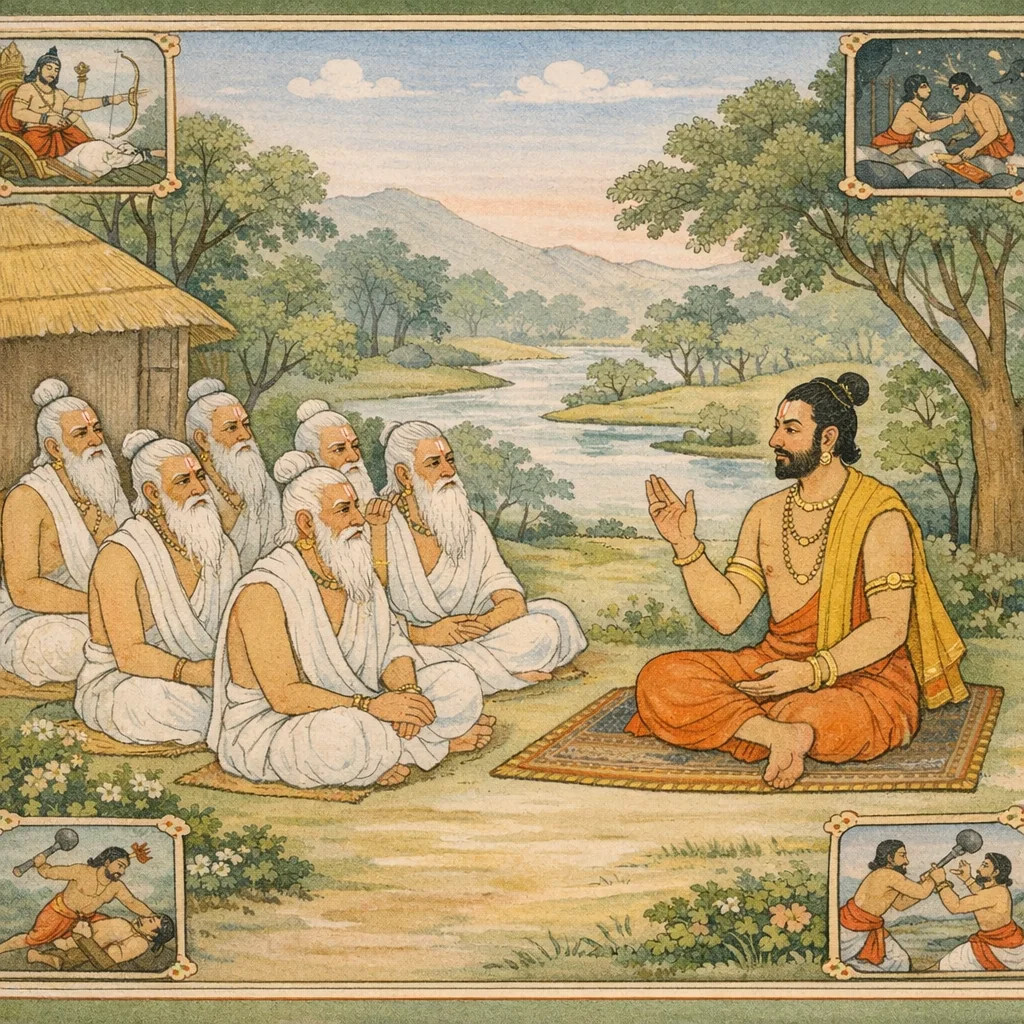
Adhyaya 2
समन्तपञ्चक-आख्यानम् तथा अक्षौहिणी-प्रमाणनिर्णयः (Samantapañcaka Narrative and the Measure of an Akṣauhiṇī)
Upa-parva: Parva-saṅgraha & Samantapañcaka–Akṣauhiṇī Nirūpaṇa (Catalogue and Definitions)
This chapter operates as a technical and etiological briefing within the Naimiṣāraṇya frame. The ṛṣis request a systematic account of Samantapañcaka. The narrator explains its origin through Paraśurāma’s repeated elimination of the kṣatriya class, the creation of five blood-filled reservoirs at Samantapañcaka, and the subsequent pacification by ancestral figures urging cessation; the land near these reservoirs becomes renowned as sacred and is named according to its distinguishing marker (liṅga), illustrating a principle of toponymy. The discourse then situates the later Kuru–Pāṇḍava conflict at this same locale during the Dvāpara–Kali transition and introduces the standardized force measure: akṣauhiṇī. A hierarchical enumeration is provided—patti, senāmukha, gulma, gaṇa, vāhinī, pṛtanā, camū, anīkinī, culminating in akṣauhiṇī—followed by explicit counts of chariots, elephants, infantry, and horses. The chapter also supplies a compressed war-duration ledger by commander-days (Bhīṣma, Droṇa, Karṇa, Śalya) and transitions into a parva-saṅgraha, listing major books and notable episodes, thereby functioning as an internal navigational index and a meta-commentary on the epic’s comprehensiveness.
Chapter Arc: उग्रश्रवा सौति नैमिषारण्य में ऋषियों से कहते हैं—“शृणुध्वं… कथा: शुभा:” और श्रोताओं को समन्तपञ्चक तथा ‘जय’ नामक इतिहास की महिमा की ओर खींच लेते हैं। → कथा स्वयं युद्ध नहीं, पर युद्ध-बीजों की सूची बनकर उभरती है: परशुराम द्वारा क्षत्रियों का संहार, विविध उपपर्वों/पर्वों का क्रम, तीर्थ-यात्राएँ, वंशावलियाँ, और आगे आने वाले भीषण संग्रामों की झलक—मानो एक विराट ग्रन्थ का द्वार धीरे-धीरे खुल रहा हो। → ‘जय’ शब्द का अर्थ महाभारत-इतिहास ही है—यह उद्घोष अध्याय का शिखर बनता है; साथ ही पर्व-सूची में द्रोणपर्व, सौप्तिक, गदायुद्ध, आश्रमवासिक आदि का संकेत देकर कथा की व्यापकता और अनिवार्य त्रासदी का पूर्वाभास चरम पर पहुँचता है। → सौति क्रमबद्ध अनुक्रमणिका के रूप में आगे-आगे आने वाले प्रसंगों (निवातकवचयुद्ध, आजगर, मार्कण्डेयसमास्या, सारस्वत, तीर्थ-वंश-वर्णन, आदि) का संकेत देकर श्रोताओं को आश्वस्त करते हैं कि यह इतिहास सुव्यवस्थित रूप से कहा जाएगा। → पर्वों की यह झलक श्रोताओं को अगले अध्याय/आगे के आख्यान के लिए उत्कंठित छोड़ती है—कौन-सा कारण इन सबको एक ही ‘जय’ में बाँधता है, और यह ‘विजय’ किसकी, किस मूल्य पर?
Shlokas
Verse 1
[दाक्षिणात्य अधिक पाठके ७ श्लोक मिलाकर कुल २८२ श्लोक हैं] ।। अनुक्रमणिकापर्व सम्पूर्ण ।। ३. जय शब्दका अर्थ महाभारत नामक इतिहास ही है। आगे चलकर कहा है--“जयो नामेतिहासो5यम्' इत्यादि। अथवा अठारहों पुराण, वाल्मीकिरामायण आदि सभी आर्ष-ग्रन्थोंकी संज्ञा जय” है। २. मंगलाचरणका श्लोक देखनेपर ऐसा जान पड़ता है कि यहाँ नारायण शब्दका अर्थ है भगवान् श्रीकृष्ण और नरोत्तम नरका अर्थ है नररत्न अर्जुन। महाभारतमें प्राय: सर्वत्र इन्हीं दोनोंका नर-नारायणके अवतारके रूपमें उल्लेख हुआ है। इससे मंगलाचरणमें ग्रन्थके इन दोनों प्रधान पात्र तथा भगवानके मूर्ति- युगलको प्रणाम करना मंगलाचरणको नमस्कारात्मक होनेके साथ ही वस्तुनिर्देशात्मक भी बना देता है। इसलिये अनुवादमें श्रीकृष्ण और अर्जुनका ही उल्लेख किया गया है। 3. नैमिषारण्य नामकी व्याख्या वाराहपुराणमें इस प्रकार मिलती है-- एवं कृत्वा ततो देवो मुनिं गौरमुखं तदा। उवाच निमिषेणेदं निहतं दानवं बलम् ।। अरुण्येडस्मिंस्ततस्त्वेतत्नैमिषारण्यसंज्ञितम् । ऐसा करके भगवानने उस समय गौरमुख मुनिसे कहा--“मैंने निमिषमात्रमें इस अरण्य (वन)-के भीतर इस दानव-सेनाका संहार किया है; अत: यह वन नैमिषारण्यके नामसे प्रसिद्ध होगा।” ४. जो दिद्वान् ब्राह्ण अकेला ही दस सहसख्र जिज्ञासु व्यक्तियोंका अन्न-दानादिके द्वारा भरण-पोषण करता है, उसे कुलपति कहते हैं। ५. जो कार्य अनेक व्यक्तियोंके सहयोगसे किया गया हो और जिसमें बहुतोंको ज्ञान, सदाचार आदिकी शिक्षा तथा अन्न-वस्त्रादि वस्तुएँ दी जाती हों, जो बहुतोंके लिये तृप्तिकारक एवं उपयोगी हो, उसे “सत्र” कहते हैं। $. “तत् सृष्टवा तदेवानु प्राविशत” (तैत्तिरीय उपनिषद्)। ब्रह्मने अण्ड एवं पिण्डकी रचना करके मानो स्वयं ही उसमें प्रवेश किया है। २. ऋषय: सप्त पूर्वे ये मनवश्च चतुर्दश । एते प्रजानां पतय एभि: कल्प: समाप्यते ।। (नीलकपण्ठीमें ब्रह्माण्डपुराणका वचन) > यह और इसके बादका श्लोक महाभारतके तात्पर्यके सूचक हैं। दुर्योधन क्रोध है। यहाँ क्रोध शब्दसे द्वेष-असूया आदि दुर्गुण भी समझ लेने चाहिये। कर्ण, शकुनि, दःशासन आदि उससे एकताको प्राप्त हैं, उसीके स्वरूप हैं। इन सबका मूल है राजा धृतराष्ट्र। यह अज्ञानी अपने मनको वशमें करनेमें असमर्थ है। इसीने पुत्रोंकी आसक्तिसे अंधे होकर दुर्योधनको अवसर दिया, जिससे उसकी जड़ मजबूत हो गयी। यदि यह दुर्योधनको वशमें कर लेता अथवा बचपनमें ही विदुर आदिकी बात मानकर इसका त्याग कर देता तो विष-दान, लाक्षागृहदाह, द्रौपदी-केशाकर्षण आदि दुष्कर्मोंका अवसर ही नहीं आता और कुलक्षय न होता। इस प्रसंगसे यह भाव सूचित किया गया है कि यह जो मन्यु (दुर्योधन)-रूप वृक्ष है, इसका दृढ़ अज्ञान ही मूल है, क्रोध-लोभादि स्कन्ध हैं, हिंसा-चोरी आदि शाखाएँ हैं और बन्धन-नरकादि इसके फल- पुष्प हैं। पुरुषार्थकामी पुरुषको मूलाज्ञानका उच्छेद करके पहले ही इस (क्रोधरूप) वृक्षको नष्ट कर देना चाहिये। - युधिष्ठिर धर्म हैं। इसका अभिप्राय यह है कि वे शम, दम, सत्य, अहिंसा आदि रूप धर्मकी मूर्ति हैं। अर्जुन-भीम आदिको धर्मकी शाखा बतलानेका अभिप्राय यह है कि वे सब युधिष्ठिरके ही स्वरूप हैं, उनसे अभिन्न हैं। शुद्धसत्त्वमय ज्ञानविग्रह श्रीकृष्णरूप परमात्मा ही उसके मूल हैं। उनके दृढ़ ज्ञानसे ही धर्मकी नींव मजबूत होती है। श्रुति भगवतीने कहा है कि “हे गार्गी! इस अविनाशी परमात्माको जाने बिना इस लोकमें जो हजारों वर्षपर्यन्त यज्ञ करता है, दान देता है, तपस्या करता है, उन सबका फल नाशवान् ही होता है।' ज्ञानका मूल है ब्रह्म अर्थात् वेद। वेदसे ही परमधर्म योग और अपरधर्म यज्ञ-यागादिका ज्ञान होता है। यह निश्चित सिद्धान्त है कि धर्मका मूल केवल शब्दप्रमाण ही है। वेदके भी मूल ब्राह्मण हैं; क्योंकि वे ही वेद-सम्प्रदायके प्रवर्तक हैं। इस प्रकार उपदेशकके रूपमें ब्राह्मण, प्रमाणके रूपमें वेद और अनुग्राहकके रूपमें परमात्मा धर्मका मूल है। इससे यह बात सिद्ध हुई है कि वेद और ब्राह्मणका भक्त अधिकारी पुरुष भगवदाराधनके बलसे योगादिरूप धर्ममय वृक्षका सम्पादन करे। उस वृक्षके अहिंसा-सत्य आदि तने हैं। धारण-ध्यान आदि शाखाएँ हैं और तत्त्व-साक्षात्कार ही उसका फल है। इस धर्ममय वृक्षके समाश्रयसे ही पुरुषार्थकी सिद्धि होती है, अन्यथा नहीं। > शास्त्रोक्त आचारका परित्याग न करना, सदाचारी सत्पुरुषोंका संग करना और सदाचारमें दृढ़तासे स्थित रहना--इसको “शौच” कहते हैं। अपनी इच्छाके अनुकूल और प्रतिकूल पदार्थोंकी प्राप्ति होनेपर चित्तमें विकार न होना ही 'धृति" है। सबसे बढ़कर सामर्थ्यका होना ही “विक्रम” है। सद्वृत्तकी अनुवृत्ति ही 'शुश्रूषा” है। (सदाचारपरायण गुरुजनोंका अनुसरण गुरुशुश्रूषा है।) किसीके द्वारा अपराध बन जानेपर भी उसके प्रति अपने चित्तमें क्रोध आदि विकारोंका न होना ही 'क्षमाशीलता' है। जितेन्द्रियता अथवा अनुद्धत रहना ही “विनय” है। बलवान् शत्रुको भी पराजित कर देनेका अध्यवसाय “शौर्य” है। इनके संग्राहक श्लोक इस प्रकार हैं-- आचारापरिहारश्न संसर्गश्चाप्यनिन्दितै: | आचारे च व्यवस्थानं शौचमित्यभिधीयते ।। इष्टानिष्टार्थसम्पत्तौ चित्तस्याविकृतिर्धृतिः | सर्वातिशयसामर्थ्य॑ विक्रमं परिचक्षते ।। वृत्तानुवृत्ति: शुश्रूषा क्षान्तिरागस्यविक्रिया । जितेन्द्रियत्वं विनयो5थवानुद्धतशीलता ।। शौर्यमध्यवसायः स्याद् बलिनो5पि पराभवे ।। > आचार्य, ब्रह्मा, ऋत्विकू, सदस्य, यजमान, यजमानपत्नी, धन-सम्पत्ति, श्रद्धा-उत्साह, विधि- विधानका सम्यक् पालन एवं सदबुद्धि आदि यज्ञकी उत्तम गुणसामग्रीके अन्तर्गत हैं। (पर्वसंग्रहपर्व) द्वितीयो<्ध्याय: समन्तपंचकक्षेत्रका वर्णन, अक्षौहिणी सेनाका प्रमाण, महाभारतमें वर्णित पर्वों और उनके संक्षिप्त विषयोंका संग्रह तथा महाभारतके श्रवण एवं पठनका फल ऋषय ऊचु: समन्तपञ्चकमिति यदुक्त सूतनन्दन । एतत् सर्व यथातत्त्वं श्रोतुमिच्छामहे वयम्,ऋषि बोले--सूतनन्दन! आपने अपने प्रवचनके प्रारम्भमें जो समनन््तपंचक (कुरुक्षेत्र)- की चर्चा की थी, अब हम उस देश (तथा वहाँ हुए युद्ध)-के सम्बन्धमें पूर्णरूपसे सब कुछ यथावत् सुनना चाहते हैं
The sages said: “O delight of the Sūtas, you earlier mentioned the place called Samantapañcaka. Now we wish to hear, in full and exactly as it truly is, everything about that land—and about the great conflict that took place there.”
Verse 2
सौतिर्वाच शृणुध्वं मम भो विद्रा ब्रुवतश्न॒ कथा: शुभा: । समन्तपञ्चकाख्यं च श्रोतुर्महथ सत्तमा:,उग्रश्रवाजीने कहा--साधुशिरोमणि विप्रगण! अब मैं कल्याणदायिनी शुभ कथाएँ कह रहा हूँ; उसे आपलोग सावधान चित्तसे सुनिये और इसी प्रसंगमें समन्तपंचकक्षेत्रका वर्णन भी सुन लीजिये इति श्रीमहा भारते आदिपर्वणि पर्वसंग्रहपर्वणि द्वितीयो$ध्याय:
Sauti said: “O venerable Brahmins, listen to me as I speak these auspicious narratives. And, O best among the good, you should also hear about the place called Samantapañcaka.”
Verse 3
त्रेताद्वापरयो: सन्धौ राम: शस्त्रभृतां वर: । असकृत् पार्थिवं क्षत्रं जघानामर्षचोदित:,त्रेता और द्वापरकी सन्धिके समय शस्त्रधारियोंमें श्रेष्ठ परशुरामजीने क्षत्रियोंके प्रति क्रोधसे प्रेरित होकर अनेकों बार क्षत्रिय राजाओंका संहार किया
At the junction of the Tretā and Dvāpara ages, Rāma (Paraśurāma), foremost among weapon-bearers, driven by intolerant wrath, repeatedly slew the royal Kṣatriya order—kings who had abused power—thus becoming a fearsome instrument of retribution against unrighteous rule.
Verse 4
स सर्व क्षत्रमुत्साद्य स्ववीर्येणानलद्युति: । समनतपजञ्चके पञ्च चकार रौधिरान् हृदान्,अग्निके समान तेजस्वी परशुरामजीने अपने पराक्रमसे सम्पूर्ण क्षत्रियवंशका संहार करके समन्तपंचवक्षेत्रमें रक्तके पाँच सरोवर बना दिये
Sañjaya said: Having exterminated the entire warrior nobility (the Kṣatriya class) by his own prowess, Paraśurāma—radiant like fire—created at Samantapañcaka five lakes filled with blood.
Verse 5
स तेषु रुधिराम्भ:सु हदेषु क्रोधमूर्च्छित: । पितृन् संतर्पयामास रुधिरेणेति नः श्रुतम्,क्रोधसे आविष्ट होकर परशुरामजीने उन रक्तरूप जलसे भरे हुए सरोवरोंमें रक्ताउ्जलिके द्वारा अपने पितरोंका तर्पण किया, यह बात हमने सुनी है
Sañjaya said: “We have heard that, overcome by a frenzy of wrath, he (Paraśurāma) went to those lakes whose waters were blood, and there he offered libations (tṛpaṇa) of blood to satisfy his ancestors.”
Verse 6
अथर्चीकादयो<भ्येत्य पितरो राममन्रुवन् । राम राम महाभाग प्रीता: सम तव भार्गव,तदनन्तर, ऋचीक आदि पितृगण परशुरामजीके पास आकर बोले--“महाभाग राम! सामर्थ्यशाली भृगुवंशभूषण परशुराम!!! तुम्हारी इस पितृभक्ति और पराक्रमसे हम बहुत ही प्रसन्न हैं। महाप्रतापी परशुराम! तुम्हारा कल्याण हो। तुम्हें जिस वरकी इच्छा हो हमसे माँग लो'
Then the forefathers beginning with Ṛcīka approached Rāma (Paraśurāma) and addressed him: “Rāma, Rāma—O greatly fortunate one, O Bhārgava! We are pleased with you.”
Verse 7
अनया पितृभक्त्या च विक्रमेण तव प्रभो । वरं वृणीष्व भद्रं ते यमिच्छसि महाद्युते,तदनन्तर, ऋचीक आदि पितृगण परशुरामजीके पास आकर बोले--“महाभाग राम! सामर्थ्यशाली भृगुवंशभूषण परशुराम!!! तुम्हारी इस पितृभक्ति और पराक्रमसे हम बहुत ही प्रसन्न हैं। महाप्रतापी परशुराम! तुम्हारा कल्याण हो। तुम्हें जिस वरकी इच्छा हो हमसे माँग लो'
“Pleased by your devotion to your forefathers and by your valor, O lord, choose a boon. May auspiciousness attend you, O greatly radiant one—ask for whatever you desire.”
Verse 8
राम उवाच यदि मे पितर: प्रीता यद्यनुग्राह्मता मयि । यच्च रोषाभिभूतेन क्षत्रमुत्सादितं मया,परशुरामजीने कहा--यदि आप सब हमारे पितर मुझपर प्रसन्न हैं और मुझे अपने अनुग्रहका पात्र समझते हैं तो मैंने जो क्रोधवश क्षत्रियवंशका विध्वंस किया है, इस कुकर्मके पापसे मैं मुक्त हो जाऊँ और ये मेरे बनाये हुए सरोवर पृथ्वीमें प्रसिद्ध तीर्थ हो जायँ। यही वर मैं आपलोगोंसे चाहता हूँ
Rama said: “If my forefathers are pleased with me, and if I am deemed worthy of their favor, then may I be released from the sin of the grievous deed I committed—when, overcome by wrath, I brought ruin upon the Kshatriya line.”
Verse 9
अतश्न पापान्मुच्ये5हमेष मे प्रार्थितो वर: । हृदाश्न तीर्थभूता मे भवेयुर्भुवि विश्रुता:,परशुरामजीने कहा--यदि आप सब हमारे पितर मुझपर प्रसन्न हैं और मुझे अपने अनुग्रहका पात्र समझते हैं तो मैंने जो क्रोधवश क्षत्रियवंशका विध्वंस किया है, इस कुकर्मके पापसे मैं मुक्त हो जाऊँ और ये मेरे बनाये हुए सरोवर पृथ्वीमें प्रसिद्ध तीर्थ हो जायँ। यही वर मैं आपलोगोंसे चाहता हूँ
“Therefore may I be released from sin—this is the boon I ask. And may these lakes I have made become sacred pilgrimage-fords, renowned upon the earth.”
Verse 10
एवं भविष्यतीत्येवं पितरस्तमथाब्रुवन् । तं क्षमस्वेति निषिषिधुस्ततः स विरराम ह,तदनन्तर 'ऐसा ही होगा” यह कहकर पितरोंने वरदान दिया। साथ ही “अब बचे-खुचे क्षत्रियवंशको क्षमा कर दो'--ऐसा कहकर उन्हें क्षत्रियोंक संहारसे भी रोक दिया। इसके पश्चात् परशुरामजी शान्त हो गये
Then the forefathers said to him, “So shall it be,” and granted the boon. They also enjoined him, “Forgive what remains of the Kshatriya line,” and restrained him from further slaughter of the Kshatriyas. Thereafter Paraśurāma grew calm.
Verse 11
तेषां समीपे यो देशो हृदानां रुधिराम्भसाम् | समनन््तपजञ्चकमिति पुण्यं तत् परिकीर्तितम्,उन रक्तसे भरे सरोवरोंके पास जो प्रदेश है उसे ही समन्तपंचक कहते हैं। यह क्षेत्र बहुत ही पुण्यप्रद है
Near those lakes filled with blood there lies a tract of land renowned as Samantapañcaka. That region is celebrated as exceptionally sacred.
Verse 12
येन लिड्लरेन यो देशो युक्त: समुपलक्ष्यते । तेनैव नाम्ना तं देशं वाच्यमाहुर्मनीषिण:,जिस चिह्नसे जो देश युक्त होता है और जिससे जिसकी पहचान होती है, विद्वानोंका कहना है कि उस देशका वही नाम रखना चाहिये
The wise declare that a region should be called by the very name that arises from the distinguishing mark by which it is recognized. In other words, a land’s name ought to reflect the characteristic sign through which its identity is understood.
Verse 13
अन्तरे चैव सम्प्राप्ते कलिद्वापरयोरभूत् । समन्तपज्चके युद्ध कुरुपाण्डवसेनयो:,जब कलियुग और द्वापरकी सन्धिका समय आया, तब उसी समन्तपंचवक्षेत्रमें कौरवों और पाण्डवोंकी सेनाओंका परस्पर भीषण युद्ध हुआ
When the transitional juncture between the Dvāpara and Kali ages arrived, a fierce mutual battle took place at Samantapañcaka between the armies of the Kurus and the Pāṇḍavas—an event that marks the moral turning-point of the age, where the decline of dharma becomes visible through fratricidal war.
Verse 14
तस्मिन् परमधर्मिष्ठे देशे भूदोषवर्जिते | अष्टादश समाजम्मुरक्षौहिण्यो युयुत्सया,भूमिसम्बन्धी दोषोंसेः रहित उस परम धार्मिक प्रदेशमें युद्ध करनेकी इच्छासे अठारह अक्षौहिणी सेनाएँ इकट्टी हुई थीं
In that region renowned for the highest righteousness and free from defects of the land, eighteen great armies (akṣauhiṇīs) assembled, driven by the desire to fight—signaling how even a place praised for dharma can become the stage for war when human resolve turns toward conflict.
Verse 15
समेत्य त॑ द्विजास्ताश्न तत्रैव निधनं गता: । एततन्नामाभिनिर्वत्तं तस्य देशस्य वै द्विजा:,ब्राह्मणो! वे सब सेनाएँ वहाँ इकट्टी हुईं और वहीं नष्ट हो गयीं। द्विजवरो! इसीसे उस देशका नाम समन्तपंचकः) पड़ गया
All those armies, O Brahmins, assembled there and met their end on that very spot. O best of the twice-born, it is from this event that the name of that region came to be established—“Samantapañcaka”—a place remembered for the gathering and destruction that occurred there.
Verse 16
पुण्यश्ष रमणीयश्व स देशो व: प्रकीर्तित: । तदेतत् कथित सर्व मया ब्राह्मणसत्तमा: । यथा देश: स विख्यातस्त्रिषु लोकेषु सुव्रता:,वह देश अत्यन्त पुण्यमय एवं रमणीय कहा गया है। उत्तम व्रतका पालन करनेवाले श्रेष्ठ ब्राह्मणो! तीनों लोकोंमें जिस प्रकार उस देशकी प्रसिद्धि हुई थी, वह सब मैंने आपलोगोंसे कह दिया
That land has been proclaimed to you as both supremely meritorious and delightful. O best of Brahmins, I have now told you everything—how that region came to be renowned in the three worlds, O you who are steadfast in noble vows.
Verse 17
ऋषय ऊचु: अक्षौहिण्य इति प्रोक्तं यत्त्या सूतनन्दन । एतदिच्छामहे श्रोतुं सर्वमेव यथातथम्,ऋषियोंने पूछा--सूतनन्दन! अभी-अभी आपने जो अक्षौहिणी शब्दका उच्चारण किया है, इसके सम्बन्धमें हमलोग सारी बातें यथार्थरूपसे सुनना चाहते हैं
The ṛṣis asked: “O son of the Sūta, you have just uttered the term ‘akṣauhiṇī’. We wish to hear everything about it, in full and exactly as it is.”
Verse 18
अक्षौहिण्या: परीमाणं नराश्वरथदन्तिनाम् । यथावच्चैव नो ब्रहि सर्व हि विदितं तव,अक्षौहिणी सेनामें कितने पैदल, घोड़े, रथ और हाथी होते हैं? इसका हमें यथार्थ वर्णन सुनाइये; क्योंकि आपको सब कुछ ज्ञात है
Rāma said: “Tell us precisely the full measure of an akṣauhiṇī—how many foot-soldiers, horses, chariots, and elephants it contains. Explain it to us exactly as it is, for all this is known to you.”
Verse 19
सौतिरुवाच एको रथो गजकश्लनैको नरा: पञठच पदातय: । त्रयश्न तुरगास्तज्ज्ञैः पत्तिरित्यभिधीयते,उग्रश्रवाजीने कहा--एक रथ, एक हाथी, पाँच पैदल सैनिक और तीन घोड़े--बस, इन्हींको सेनाके मर्मज्ञ विद्वानोंने 'पत्ति' कहा है
Sauti said: “One chariot, one elephant, five foot-soldiers, and three horses—this unit, according to those who understand the science of armies, is called a ‘patti’.”
Verse 20
पत्तिं तु त्रिगुणामेतामाहु: सेनामुखं बुधा: । त्रीणि सेनामुखान्येको गुल्म इत्यभिधीयते,इसी पत्तिकी तिगुनी संख्याको विद्वान् पुरुष 'सेनामुख” कहते हैं। तीन 'सेनामुखों” को एक “गुल्म” कहा जाता है
The wise describe this unit called a patti, when taken in triple measure, as a ‘senāmukha’—a battle-front or vanguard. And three such senāmukhas together are designated as a single ‘gulma’.
Verse 21
त्रयो गुल्मा गणो नाम वाहिनी तु गणास्त्रय: । स्मृतास्तिस्रस्तु वाहिन्य: पृतनेति विचक्षणै:,तीन गुल्मका एक “गण” होता है, तीन गणकी एक “वाहिनी' होती है और तीन वाहिनियोंको सेनाका रहस्य जाननेवाले विद्वानोंने 'पृतना” कहा है
“Three gulmas constitute what is called a gaṇa; three gaṇas make a vāhinī; and three vāhinīs, according to those discerning in the science of armies, are termed a pṛtanā (a full fighting force).”
Verse 22
चमूस्तु पृतनास्तिस्नस्तिस्रश्नम्बस्त्वनीकिनी । अनीकिनीं दशगुणां प्राहुरक्षौहिणीं बुधा:,तीन पृतनाकी एक “चमू”, तीन चमूकी एक “अनीकिनी” और दस अनीकिनीकी एक 'अक्षौहिणी' होती है। यह विद्वानोंका कथन है
Rāma said: “Three pṛtanās make one camū; three camūs make one anīkinī; and ten anīkinīs constitute an akṣauhiṇī. Thus do the learned define the graded measures of an army.”
Verse 23
अक्षौहिण्या: प्रसंख्याता रथानां द्विजसत्तमा: । संख्या गणिततत्त्वज्जै: सहस्राण्येकविंशति:,श्रेष्ठ ब्राह्यणो! गणितके तत्त्वज्ञ विद्वानोंने एक अक्षौहिणी सेनामें रथोंकी संख्या इक्कीस हजार आठ सौ सत्तर (२१,८७०) बतलायी है। हाथियोंकी संख्या भी इतनी ही कहनी चाहिये
O best of Brahmins! Those learned in the principles of reckoning have computed the number of chariots in a single akṣauhiṇī to be twenty-one thousand eight hundred and seventy (21,870). The number of elephants, too, should be declared to be exactly the same.
Verse 24
शतान्युपरि चैवाष्टौ तथा भूयश्व सप्तति: । गजानां च परीमाणमेतदेव विनिर्दिशेत्,श्रेष्ठ ब्राह्यणो! गणितके तत्त्वज्ञ विद्वानोंने एक अक्षौहिणी सेनामें रथोंकी संख्या इक्कीस हजार आठ सौ सत्तर (२१,८७०) बतलायी है। हाथियोंकी संख्या भी इतनी ही कहनी चाहिये
“Eight more hundreds, and again seventy besides—this is the stated measure. And the number of elephants too should be declared to be exactly the same.” In defining an akṣauhiṇī (a standard battle-formation), the verse fixes the precise count and insists on consistency in reporting the elephant contingent, reflecting the epic’s concern for orderly classification and disciplined military organization.
Verse 25
ज्ञेय शतसहस््रं तु सहस्नाणि नवैव तु । नराणामपि पजञ्चाशच्छतानि त्रीणि चानघा:,निष्पाप ब्राह्मणो! एक अक्षौहिणीमें पैदल मनुष्योंकी संख्या एक लाख नौ हजार तीन सौ पचास (१,०९,३५०) जाननी चाहिये
“Know this: the number of foot-soldiers is one hundred thousand, plus nine thousand more, and a further three hundred and fifty men, O sinless one.” In this context the speaker is defining the standard count of infantry within an akṣauhiṇī, establishing an orderly measure for armies so that warfare, if undertaken, is conceived in regulated and accountable terms rather than as unbounded violence.
Verse 26
पज्चषष्टिसहस्राणि तथाश्वानां शतानि च । दशोत्तराणि षट् प्राहुर्यथावदिह संख्यया,एक अक्षौहिणी सेनामें, घोड़ोंकी ठीक-ठीक संख्या पैंसठ हजार छः: सौ दस (६५,६१०) कही गयी है
They declare, according to the correct reckoning given here, that the number of horses in a single akṣauhiṇī army is sixty-five thousand and six hundred and ten (65,610). The passage underscores the importance of precise enumeration and orderly organization in matters of war, where discipline and clarity are treated as a form of duty.
Verse 27
एतामक्षौहिणीं प्राहु: संख्यातत्त्वविदो जना: । यां व: कथितवानस्मि विस्तरेण तपोधना:,तपोधनो! संख्याका तत्त्व जाननेवाले विद्वानोंने इसीको अक्षौहिणी कहा है, जिसे मैंने आपलोगोंको विस्तारपूर्वक बताया है
Those who truly understand numerical reckoning and its principles declare this formation to be an “akṣauhiṇī”. O rich in austerity, this is the very measure I have explained to you in detail—so that the scale of armies may be known precisely and spoken of without confusion.
Verse 28
एतया संख्यया हासन् कुरुपाण्डवसेनयो: । अक्षौहिण्यो द्विजश्रेष्ठा: पिण्डिताष्टादशैव तु,श्रेष्ठ ब्राह्मणो! इसी गणनाके अनुसार कौरव-पाण्डव दोनों सेनाओंकी संख्या अठारह अक्षौहिणी थी
By this reckoning, O best of the twice-born, the armies of the Kurus and the Pāṇḍavas together amounted to eighteen akṣauhiṇīs. The line casts the coming war not as a mere quarrel of kings, but as a vast, ordered mobilization whose very scale foretells the grave moral cost of battle.
Verse 29
समेतास्तत्र वै देशे तत्रैव निधनं गता: । कौरवान् कारण कृत्वा कालेनाद्भधुतकर्मणा,अदभुत कर्म करनेवाले कालकी प्रेरणासे समन्तपंचकक्षेत्रमें कौरवोंको निमित्त बनाकर इतनी सेनाएँ इकट्टी हुईं और वहीं नाशको प्राप्त हो गयीं
In that very region they assembled, and in that very place they met their destruction. Making the Kauravas the immediate occasion, Kāla—Time, whose workings are wondrous and irresistible—brought it about that such vast armies gathered at Samantapañcaka and perished there. The verse frames the catastrophe as the convergence of human agency and the larger moral-cosmic force of Kāla.
Verse 30
अहानि युयुधे भीष्मो दशैव परमास्त्रवित् । अहानि पज्च द्रोणस्तु ररक्ष कुरुवाहिनीम्,अस्त्र-शस्त्रोंके सर्वोपरि मर्मज्ञ भीष्मपितामहने दस दिनोंतक युद्ध किया, आचार्य द्रोणने पाँच दिनोंतक कौरव-सेनाकी रक्षा की
Bhīṣma, the supreme master of celestial weapons, fought for ten days. Then Droṇa protected the Kuru host for five days—marking the measured succession of commanders in the war and underscoring how the fate of armies turns on the prowess and strategy of a few foremost guardians.
Verse 31
अहनी युयुधे द्वे तु कर्ण: परबलार्दन: । शल्यो<र्धदिवसं चैव गदायुद्धमत: परम्,शत्रुसेनाको पीड़ित करनेवाले वीरवर कर्णने दो दिन युद्ध किया और शल्यने आधे दिनतक। इसके पश्चात् (दुर्योधन और भीमसेनका परस्पर) गदायुद्ध आधे दिनतक होता रहा
The mighty Karṇa, a crusher of the enemy’s strength, fought for two full days; Śalya fought for half a day. Thereafter, the supreme contest of clubs took place—Duryodhana and Bhīmasena engaging one another—continuing for half a day. The passage underscores the relentless escalation of warfare and the grim endurance of warriors, where prowess and persistence dominate even as the moral weight of violence accumulates.
Verse 32
तस्यैव दिवसस्यान्ते द्रौणिहार्दिक्यगौतमा: । प्रसुप्तं निशि विश्वस्तं जघ्नुर्याधिष्ठिरे बलम्,अठारहवाँ दिन बीत जानेपर रात्रिके समय अभश्व॒त्थामा, कृतवर्मा और कृपाचार्यने नि:शंक सोते हुए युधिष्ठिरके सैनिकोंको मार डाला
At the close of that very day, Drauṇi (Aśvatthāmā), Hārdikya (Kṛtavarmā), and Gautama (Kṛpa) slew, in the night, the forces aligned with Yudhiṣṭhira—men who lay asleep and unsuspecting. The episode underscores the moral collapse that can follow prolonged war: victory sought through fear and vengeance turns into a breach of kṣatriya restraint, where the helpless are struck instead of met in open combat.
Verse 33
यत्तु शौनक सत्रे ते भारताख्यानमुत्तमम् | जनमेजयस्य तत् सत्रे व्यासशिष्येण धीमता,शौनकजी! आपके इस सत्संग-सत्रमें मैं यह जो उत्तम इतिहास महाभारत सुना रहा हूँ, यही जनमेजयके सर्पयज्ञमें व्यासजीके बुद्धिमान् शिष्य वैशम्पायनजीके द्वारा भी वर्णन किया गया था। उन्होंने बड़े-बड़े नरपतियोंके यश और पराक्रमका विस्तारपूर्वक वर्णन करनेके लिये प्रारम्भमें पौष्य, पौलोम और आस्तीक--इन तीन पर्वोका स्मरण किया है
O Śaunaka, this excellent narrative called the Bhārata which I am recounting here in your sacrificial session—this very same account was also narrated at King Janamejaya’s sacrificial rite by the wise disciple of Vyāsa. The verse underscores the careful transmission of sacred history through trusted lineages of teachers and reciters, grounding the epic’s authority in an ethical culture of faithful listening, accurate remembrance, and responsible retelling.
Verse 34
कथितं विस्तरार्थ च यशो वीर्य महीक्षिताम् । पौष्यं तत्र च पौलोममास्तीकं चादित: स्मृतम्,शौनकजी! आपके इस सत्संग-सत्रमें मैं यह जो उत्तम इतिहास महाभारत सुना रहा हूँ, यही जनमेजयके सर्पयज्ञमें व्यासजीके बुद्धिमान् शिष्य वैशम्पायनजीके द्वारा भी वर्णन किया गया था। उन्होंने बड़े-बड़े नरपतियोंके यश और पराक्रमका विस्तारपूर्वक वर्णन करनेके लिये प्रारम्भमें पौष्य, पौलोम और आस्तीक--इन तीन पर्वोका स्मरण किया है
This sacred narrative has been told in full detail, setting forth the fame and valor of great kings. In that telling, at the very outset, the sections known as Pauṣya, Pauloma, and Āstīka are recalled—so that the account may proceed in an ordered way and the deeds of rulers be understood in their proper scope and moral frame.
Verse 35
विचित्रार्थपदाख्यानमनेकसमयान्वितम् । प्रतिपन्नं नरै: प्राजैरवैराग्यमिव मोक्षिभि:,जैसे मोक्ष चाहनेवाले पुरुष पर-वैराग्यकी शरण ग्रहण करते हैं, वैसे ही प्रज्ञावान् मनुष्य अलौकिक अर्थ, विचित्र पद, अदभुत आख्यान और भाँति-भाँतिकी परस्पर विलक्षण मर्यादाओंसे युक्त इस महाभारतका आश्रय ग्रहण करते हैं
This Mahābhārata—rich in wondrous meanings, striking expressions, and extraordinary narratives, and woven with many diverse conventions and occasions—is taken up and relied upon by discerning people, just as seekers of liberation take refuge in dispassion as their support on the path to mokṣa.
Verse 36
आत्मेव वेदितव्येषु प्रियेष्विव हि जीवितम् । इतिहास: प्रधानार्थ: श्रेष्ठ: सर्वागमेष्वयम्,जैसे जाननेयोग्य पदार्थो्में आत्मा, प्रिय पदार्थोमें अपना जीवन सर्वश्रेष्ठ है, वैसे ही सम्पूर्ण शास्त्रोंमें परब्रह्म परमात्माकी प्राप्तिरूप प्रयोजनको पूर्ण करनेवाला यह इतिहास श्रेष्ठ है
Just as the Self is foremost among all things that ought to be known, and one’s own life is dearest among beloved things, so too this Itihāsa—whose central purpose is paramount—is the most excellent among all sacred teachings, for it leads to the fulfillment of the highest aim: realization of the Supreme Brahman, the Paramātman.
Verse 37
अनश्रित्येदमाख्यानं कथा भुवि न विद्यते । आहारमनपगश्रिित्य शरीरस्येव धारणम्,जैसे भोजन किये बिना शरीर-निर्वाह सम्भव नहीं है, वैसे ही इस इतिहासका आश्रय लिये बिना पृथ्वीपर कोई कथा नहीं है
Without taking refuge in this sacred narrative, no story truly exists upon the earth. Just as the body cannot be sustained without relying on food, so too all worldly narration is sustained only by leaning upon this Itihāsa.
Verse 38
तदेतद् भारतं नाम कविभिस्तूपजीव्यते । उदयप्रेप्सुभिर्भुत्यैरैभिजात इवेश्वर:,जैसे अपनी उन्नति चाहनेवाले महत्त्वाकांक्षी सेवक अपने कुलीन और सद्धावसम्पन्न स्वामीकी सेवा करते हैं, इसी प्रकार संसारके श्रेष्ठ कवि इस महाभारतकी सेवा करके ही अपने काव्यकी रचना करते हैं
This epic called the Bhārata is the very livelihood of poets. As ambitious servants who seek their own rise attend upon a noble lord—high-born and rich in faith—so do the finest poets of the world serve this Mahābhārata, and only then fashion their poetry.
Verse 39
इतिहासोत्तमे यस्मिन्नर्पिता बुद्धिरुत्तमा । स्वरव्यज्जनयो: कृत्स्ना लोकवेदाश्रयेव वाक्,जैसे लौकिक और वैदिक सब प्रकारके ज्ञानको प्रकाशित करनेवाली सम्पूर्ण वाणी स्वरों एवं व्यंजनोंमें समायी रहती है, वैसे ही (लोक, परलोक एवं परमार्थसम्बन्धी) सम्पूर्ण उत्तम विद्या-बुद्धि इस श्रेष्ठ इतिहासमें भरी हुई है
In this supreme Itihāsa, the highest wisdom has been fully enshrined. Just as all speech—grounded in both worldly and Vedic usage—resides entirely within vowels and consonants, so too the complete range of excellent knowledge and discernment concerning this world, the next, and the highest good is contained within this great narrative.
Verse 40
तस्य प्रज्ञाभिपन्नस्य विचित्रपदपर्वण: । सूक्ष्मार्थन्याययुक्तस्य वेदार्थभ्भूषितस्य च,यह महाभारत इतिहास ज्ञानका भण्डार है। इसमें सूक्ष्म-से-सूक्ष्म पदार्थ और उनका अनुभव करानेवाली युक्तियाँ भरी हुई हैं। इसका एक-एक पद और पर्व आश्चर्यजनक है तथा यह वेदोंके धर्ममय अर्थसे अलंकृत है। अब इसके पर्वोकी संग्रह-सूची सुनिये। पहले अध्यायमें पर्वानुक्रमणी है और दूसरेमें पर्वसंग्रह
This Mahābhārata—grasped by a discerning intellect—is wondrous in every word and section. It is furnished with subtle meanings and sound reasoning, and it is adorned with the dharma-suffused purport of the Vedas. Now listen to the concise catalogue of its parvans: in the first chapter there is the index of parvans (Parvānukramaṇī), and in the second, a summary-compendium of the parvans (Parvasaṅgraha).
Verse 41
भारतस्येतिहासस्य श्रूयतां पर्वसंग्रह: । पर्वनुक्रमणी पूर्व द्वितीय: पर्वसंग्रह:,यह महाभारत इतिहास ज्ञानका भण्डार है। इसमें सूक्ष्म-से-सूक्ष्म पदार्थ और उनका अनुभव करानेवाली युक्तियाँ भरी हुई हैं। इसका एक-एक पद और पर्व आश्चर्यजनक है तथा यह वेदोंके धर्ममय अर्थसे अलंकृत है। अब इसके पर्वोकी संग्रह-सूची सुनिये। पहले अध्यायमें पर्वानुक्रमणी है और दूसरेमें पर्वसंग्रह
Hear now the compendium of the sections (parvans) of the Bhārata epic. First comes the “Table of Contents of the Parvans” (Parvānukramaṇī), and second is the “Summary of the Parvans” (Parvasaṅgraha).
Verse 42
पौष्यं पौलोममास्तीकमादिरंशावतारणम् | ततः सम्भवपर्वोक्तमद्भुतं रोमहर्षणम्,इसके पश्चात् पौष्य, पौलोम, आस्तीक और आदिअंशावतरण पर्व हैं। तदनन्तर सम्भवपर्वका वर्णन है, जो अत्यन्त अद्भुत और रोमांचकारी है
Thereafter come the Pauṣya, Pauloma, Āstīka, and the Ādi-aṃśāvatāraṇa (account of partial incarnations). Then is narrated the Sambhava-parvan—marvellous beyond measure, and hair-raising in its wonder.
Verse 43
दाहो जतुगृहस्यात्र हैडिम्बं पर्व चोच्यते । ततो बकवध: पर्व पर्व चैत्ररथं तत:,इसके पश्चात् जतुगृह (लाक्षाभवन) दाहपर्व है। तदनन्तर हिडिम्बवधपर्व है, फिर बकवध और उसके बाद चैत्ररथपर्व है
Here is described the burning of the lac-house (Jatugṛha). After that comes the episode called the Haiḍimba Parva; then the slaying of Baka; and thereafter the Caitraratha Parva.
Verse 44
ततः स्वयंवरो देव्या: पाज्चाल्या: पर्व चोच्यते । क्षात्रधर्मेण निर्जित्य ततो वैवाहिकं स्मृतम्,उसके बाद पांचालराजकुमारी देवी द्रौपदीके स्वयंवरपर्वका तथा क्षत्रियधर्मसे सब राजाओंपर विजय-प्राप्तिपूर्वक वैवाहिकपर्वका वर्णन है
Thereafter is narrated the episode of the princess Pāñcālī’s svayaṃvara; and, having overcome the assembled kings in accordance with the kṣatriya code, the account proceeds to the marriage rites and the wedding episode.
Verse 45
विदुरागमनं पर्व राज्यलम्भस्तथैव च । अर्जुनस्य वने वास: सुभद्राहरणं तत:,विदुरागमन, राज्यलम्भपर्व, तत्पश्चात् अर्जुन-वनवासपर्व और फिर सुभद्राहरणपर्व है
“The section on Vidura’s arrival, and likewise the section on the gaining of the kingdom; then the section on Arjuna’s dwelling in the forest; and after that, the section on the abduction (carrying away) of Subhadrā.”
Verse 46
सुभद्राहरणादूर्ध्व ज्ेया हरणहारिका । तत: खाण्डवदाहाख्यं तत्रैव मयदर्शनम्,सुभद्राहरणके बाद हरणाहरणपर्व है, पुनः खाण्डवदाह-पर्व है, उसीमें मयदानवके दर्शनकी कथा है
After the episode of Subhadrā’s abduction, one should understand the subsequent section called the Haraṇa-hārikā. Thereafter comes the episode known as the Burning of the Khāṇḍava Forest; within that very narrative occurs the account of encountering Maya (the Dānava).
Verse 47
सभापर्व ततः प्रोक्त मन्त्रपर्व ततः परम् । जरासन्धवध: पर्व पर्व दिग्विजयं तथा,इसके बाद क्रमश: सभापर्व, मन्त्रपर्व, जरासन्ध-वधपर्व और दिग्विजयपर्वका प्रवचन है
Thereafter the Sabhā Parva is recounted; next comes the Mantra Parva. Then follow the section on the slaying of Jarāsandha, and likewise the Digvijaya Parva—thus the narrative proceeds in orderly sequence.
Verse 48
पर्व दिग्विजयादूर्ध्व राजसूयिकमुच्यते । ततश्चार्धाभिहरणं शिशुपालवधस्तत:,तदनन्तर राजसूय, अर्घाभिहरण और शिशुपाल-वधपर्व कहे गये हैं
After the section describing the conquest of the quarters (digvijaya), the narrative proceeds to what is called the Rājasūya-sacrifice section. Thereafter come the episode of offering the arghya (honorary oblation) and then the slaying of Śiśupāla. The sequence highlights how royal ambition is ritually framed, how rightful honor is publicly discerned, and how arrogance and hostility toward dharma culminate in decisive retribution.
Verse 49
द्यूतपर्व ततः प्रोक्तमनुद्यूतमत: परम् । तत आरण्यकं पर्व किर्मीरवध एव च,इसके बाद क्रमशः द्यूत एवं अनुद्यूतपर्व हैं। तत्पश्चात् वनयात्रापर्व तथा किर्मीरवधपर्व है
He then enumerated the sequence of sections: after that comes the Dyūta-parvan (the episode of gambling), followed next by the Anudyūta-parvan (the subsequent gambling). Thereafter is the Āraṇyaka-parvan (the forest sojourn), and also the Kirmīra-vadha-parvan (the slaying of Kirmīra). The verse functions as a roadmap of the epic’s unfolding moral crisis—how a lapse into vice (gambling) precipitates exile and violent encounters, testing steadfastness in dharma under adversity.
Verse 50
अर्जुनस्याभिगमनं पर्व ज्ञेयमत: परम् | ईश्वरार्जुनयोर्युद्धे पर्व कैरातसंज्ञितम्,इसके बाद अर्जुनाभिगमनपर्व जानना चाहिये और फिर कैरातपर्व आता है, जिसमें सर्वेश्वर भगवान् शिव तथा अर्जुनके युद्धका वर्णन है
After this, one should understand the section called the “Arjuna’s Approach” episode; and thereafter comes the chapter known as the “Kirāta” episode, in which the combat between the Supreme Lord Śiva and Arjuna is described. The sequence highlights how a seeker’s deliberate approach and disciplined striving are tested, and how divine encounter may come in the form of challenge before grace is granted.
Verse 51
इन्द्रलोकाभिगमन पर्व ज्ञेयमत: परम् । नलोपाख्यानमपि च धार्मिक करुणोदयम्,तत्पश्चात् इन्द्रलोकाभिगमनपर्व है, फिर धार्मिक तथा करुणोत्पादक नलोपाख्यानपर्व है
Next, one should understand the section called the ‘Indraloka-visit’ episode. After that comes the Nala narrative as well—an account that is rooted in dharma and that awakens compassion—presented as the subsequent parva.
Verse 52
तीर्थयात्रा ततः पर्व कुरुराजस्य धीमतः । जटासुरवध: पर्व यक्षयुद्धमत: परम्,तदनन्तर बुद्धिमान् कुरुराजका तीर्थयात्रापर्व, जटासुरवधपर्व और उसके बाद यक्षयुद्धपर्व है
Next comes the section describing the pilgrimage of the wise king of the Kurus; after that is the section on the slaying of Jaṭāsura; and thereafter follows the section on the battle with the Yakṣas. The sequence highlights how righteous kingship is tested not only in war but also through sacred travel, protection of companions, and encounters with beings beyond the human realm.
Verse 53
निवातकवचैरय्युद्ध पर्व चाजगरं ततः । मार्कण्डेयसमास्या च पर्वानन्तरमुच्यते,इसके पश्चात् निवातकवचयुद्ध, आजगर और मार्कण्डेयसमास्यापर्व क्रमश: कहे गये हैं
Thereafter, in due sequence, are recounted the sections called “The Battle with the Nivātakavacas,” the “Ajagara (Python) episode,” and then the “Mārkaṇḍeya Samāsyā”—thus marking the ordered transmission of the epic’s narratives and the moral exempla they bear.
Verse 54
संवादश्न तत: पर्व द्रौोपदीसत्यभामयो: । घोषयात्रा ततः पर्व मृगस्वप्नोद्भवं तत:,इसके बाद आता है द्रौपदी और सत्यभामाके संवादका पर्व, इसके अनन्तर घोषयात्रापर्व है, उसीमें मृगस्वप्नोद्भव और व्रीहिद्रौीणिक उपाख्यान है। तदनन्तर इन्द्रद्यम्नका आख्यान और उसके बाद द्रौपदीहरणपर्व है। उसीमें जयद्रथविमोक्षणपर्व है
Then comes the section recounting the dialogue between Draupadī and Satyabhāmā. After that follows the Ghoṣayātrā (the cattle-expedition) section, within which the episode arising from the “deer-dream” is narrated. The passage serves as a table-of-contents transition, directing the listener to successive tales that probe marital duty, restraint in adversity, and the ethical tensions that surface in exile and conflict.
Verse 55
व्रीहिद्रोणिकमाख्यानमैन्द्रद्युम्नं तथैव च । द्रौपदीहरणं पर्व जयद्रथविमोक्षणम्,इसके बाद आता है द्रौपदी और सत्यभामाके संवादका पर्व, इसके अनन्तर घोषयात्रापर्व है, उसीमें मृगस्वप्नोद्भव और व्रीहिद्रौीणिक उपाख्यान है। तदनन्तर इन्द्रद्यम्नका आख्यान और उसके बाद द्रौपदीहरणपर्व है। उसीमें जयद्रथविमोक्षणपर्व है
The speaker enumerates notable episodes to be narrated: the tale called “Vrīhidroṇika,” the account of King Indradyumna, the section on Draupadī’s abduction, and the episode describing Jayadratha’s release. Ethically, the list points forward to narratives that repeatedly test dharma—especially the protection of the vulnerable, the consequences of desire and aggression, and the restoration of justice through rightful action.
Verse 56
पतिव्रताया माहात्म्यं सावित्रयाश्वैवमद्भुतम् । रामोपाख्यानमत्रैव पर्व ज्ञेयमत: परम्,इसके बाद पतित्रता सावित्रीके पातिव्रत्यका अदभुत माहात्म्य है। फिर इसी स्थानपर रामोपाख्यानपर्व जानना चाहिये
Here, one should next understand the wondrous greatness of Savitrī’s steadfast fidelity to her husband. After that, in this very place, the section known as the Rāmopākhyāna is to be known—presented as a further exemplary narrative.
Verse 57
कुण्डलाहरणं पर्व ततः परमिहोच्यते । आरणेयं ततः पर्व वैराटं तदनन्तरम् | पाण्डवानां प्रवेशश्व॒ समयस्य च पालनम्,इसके बाद क्रमश: कुण्डलाहरण और आरणेय-पर्व कहे गये हैं। तदनन्तर विराटपर्वका आरम्भ होता है, जिसमें पाण्डवोंके नगरप्रवेश और समयपालन-सम्बन्धीपर्व हैं
Next, the section called “The Taking of the Earrings” is described; after that comes the “Āraṇeya” section, and then the “Vairāṭa” section. In the Vairāṭa narrative are told the Pāṇḍavas’ entry into the city/kingdom and their careful observance of the stipulated time—highlighting disciplined self-restraint and fidelity to pledged conditions as essential supports of dharma amid adversity.
Verse 58
कीचकानां वध: पर्व पर्व गोग्रहणं तत: । अभिमन्योश्र वैराट्या: पर्व वैवाहिकं स्मृतम्,इसके बाद कीचकवधपर्व, गोग्रहण (गोहरण)-पर्व तथा अभिमन्यु और उत्तराके विवाहका पर्व है
Next is recounted the parva on the slaying of Kīcaka, then the parva on the seizure of the cattle; and thereafter is remembered the wedding parva concerning Abhimanyu and the princess of Virāṭa. The sequence shows how the Pāṇḍavas, even while concealed, uphold honor and protect the vulnerable, and how rightful alliances and social order are restored once oppression is checked.
Verse 59
उद्योगपर्व विज्ञेयमत ऊर्ध्व॑ महाद्भुतम् । ततः संजययानाख्यं पर्व ज्ञेयमत: परम्,इसके पश्चात् परम अदभुत उद्योगपर्व समझना चाहिये। इसीमें संजययानपर्व कहा गया है। तदनन्तर चिन्ताके कारण धृतराष्ट्रके रातभर जागनेसे सम्बन्ध रखनेवाला प्रजागरपर्व समझना चाहिये। तत्पश्चात् वह प्रसिद्ध सनत्सुजातपर्व है, जिसमें अत्यन्त गोपनीय अध्यात्मदर्शनका समावेश हुआ है
From this point onward, one should understand the Udyoga Parva, wondrous in its scope. After that comes the section known as the Saṁjayāyana Parva. (Thereafter follow further celebrated sections—such as the Prājāgara, connected with Dhṛtarāṣṭra’s sleepless night of anxious reflection, and the renowned Sanatsujāta Parva, which contains profoundly confidential spiritual teaching.)
Verse 60
प्रजागरं तथा पर्व धृतराष्ट्रस्य चिन्तया । पर्व सानत्सुजातं वै गुह्मध्यात्मदर्शनम्,इसके पश्चात् परम अदभुत उद्योगपर्व समझना चाहिये। इसीमें संजययानपर्व कहा गया है। तदनन्तर चिन्ताके कारण धृतराष्ट्रके रातभर जागनेसे सम्बन्ध रखनेवाला प्रजागरपर्व समझना चाहिये। तत्पश्चात् वह प्रसिद्ध सनत्सुजातपर्व है, जिसमें अत्यन्त गोपनीय अध्यात्मदर्शनका समावेश हुआ है
Next is the Prajāgara Parva, connected with Dhṛtarāṣṭra’s anxious brooding that keeps him awake through the night. After that comes the renowned Sānatsujāta Parva, which contains a profoundly secret teaching on the vision of the Self (spiritual wisdom).
Verse 61
यानसन्धिस्तत: पर्व भगवद्यानमेव च । मातलीयमुपाख्यानं चरितं गालवस्य च,इसके पश्चात् यानसन्धि तथा भगवदयानपर्व है, इसीमें मातलिका उपाख्यान, गालव- चरित, सावित्र, वामदेव तथा वैन्य-उपाख्यान, जामदग्न्य और षोडशराजिक-उपाख्यान आते हैं
Then comes the section called Yānasaṃdhi, followed by the parvan known as Bhagavad-yāna. Within these are included the episode concerning Mātali and the account of Gālava’s deeds—along with other celebrated sub-narratives that elaborate dharma through exemplary lives and instructive precedents.
Verse 62
सावित्रं वामदेव्यं च वैन्योपाख्यानमेव च । जामदग्न्यमुपाख्यानं पर्व षघोडशराजिकम्,इसके पश्चात् यानसन्धि तथा भगवदयानपर्व है, इसीमें मातलिका उपाख्यान, गालव- चरित, सावित्र, वामदेव तथा वैन्य-उपाख्यान, जामदग्न्य और षोडशराजिक-उपाख्यान आते हैं
“(There follow) the Sāvitra episode, the Vāmadevya episode, and also the narrative of Vainya; likewise the Jāmadagnya episode, and the section called ‘Ṣoḍaśarājika’ (the account of the sixteen kings).”
Verse 63
सभाप्रवेश: कृष्णस्य विदुलापुत्रशासनम् | उद्योग: सैन्यनिर्याणं विश्वोपाख्यानमेव च,फिर श्रीकृष्णका सभाप्रवेश, विदुलाका अपने पुत्रके प्रति उपदेश, युद्धका उद्योग, सैन्यनिर्याण तथा विश्वोपाख्यान--इनका क्रमश: उल्लेख हुआ है
The narration proceeds by listing, in order, these topics: Kṛṣṇa’s entry into the royal assembly; Vidulā’s counsel to her son, urging steadfastness and right resolve; the preparations for war; the marching forth of the armies; and the account known as the Viśvopākhyāna. The verse serves as a thematic index, setting counsel (ethical instruction) beside action (mobilization for conflict) as the epic unfolds.
Verse 64
ज्ञेयं विवादपर्वात्र कर्णस्यापि महात्मन: । निर्याणं च तत: पर्व कुरुपाण्डवसेनयो:,इसी प्रसंगमें महात्मा कर्णका विवादपर्व है। तदनन्तर कौरव एवं पाण्डव-सेनाका निर्याणपर्व है
Here one should understand the section called the “Dispute Parvan,” which concerns the great-souled Karṇa. After that comes the Parvan describing the setting forth (marching out) of the Kuru and Pāṇḍava armies. The narrative marks a shift from contention and rivalry to organized movement toward war, showing how unresolved disputes harden into collective conflict.
Verse 65
रथातिरथसंख्या च पर्वोक्ते तदनन्तरम् | उलूकदूतागमन पर्वामर्षविवर्धनम्,तत्पश्चात् रथातिरथसंख्यापर्व और उसके बाद क्रोधकी आग प्रज्वलित करनेवाला उलूकदूतागमनपर्व है
After the section that enumerates the rathas and atirathas has been mentioned, the next comes the Ulūka’s-messenger-visit section—one that intensifies resentment and inflames anger, further sharpening the hostility that drives the conflict forward.
Verse 66
अम्बोपाख्यानमन्रैव पर्व ज्ञेगमत: परम् | भीष्माभिषेचन पर्व ततश्वाद्भुतमुच्यते,इसके बाद ही अम्बोपाख्यानपर्व है। तत्पश्चात् अदभुत भीष्माभिषेचनपर्व कहा गया है
Next comes the section known as the “Ambā Episode.” After that, the “Bhīṣma’s Consecration” section is spoken of as a wondrous account.
Verse 67
जम्बूखण्डविनिर्माणं पर्वोक्ते तदनन्तरम् | भूमिपर्व ततः प्रोक्ते द्वीपविस्तारकीर्तनम्,इसके आगे जम्बूखण्ड विनिर्माणपर्व है। तदनन्तर भूमिपर्व कहा गया है, जिसमें द्वीपोंके विस्तारका कीर्तन किया गया है
Next, the section called the “Jambū-khaṇḍa Construction” is said to be narrated. After that is declared the “Bhūmi-parvan,” in which the expanse and detailed description of the islands (continents) is recounted—signaling a shift from genealogical narrative to a cosmographical mapping of the world that frames human action within a larger ordered universe.
Verse 68
पर्वोक्ते भगवद्वीता पर्व भीष्मवधस्तत: । द्रोणाभिषेचनं पर्व संशप्तकवधस्तत:,इसके बाद क्रमश: भगवदगीता, भीष्मवध, द्रोणाभिषेक तथा संशप्तकवधपर्व हैं
Having described the preceding section, the narrative next enumerates the subsequent Parvas in sequence: first the Bhagavadgītā Parva, then the Parva concerning Bhīṣma’s slaying, thereafter the Parva of Droṇa’s consecration as commander, and then the Parva describing the destruction of the Saṃśaptakas.
Verse 69
अभिमन्युवध: पर्व प्रतिज्ञापर्व चोच्यते । जयद्रथवध: पर्व घटोत्कचवधस्तत:,इसके बाद अभिमन्युवधपर्व, प्रतिज्ञापर्व, जयद्रथवधपर्व और घटोत्कचवधपर्व हैं
Next come the Parva of Abhimanyu’s slaying—also called the Parva of the Vow—followed by the Parva of Jayadratha’s slaying, and thereafter the Parva of Ghaṭotkaca’s slaying.
Verse 70
ततो द्रोणवध: पर्व विज्ञेयं लोमहर्षणम् । मोक्षो नारायणास्त्रस्य पर्वानन्तरमुच्यते,फिर रोंगटे खड़े कर देनेवाला द्रोणवधपर्व जानना चाहिये। तदनन्तर नारायणास्त्रमोक्षपर्व कहा गया है
Then one should understand the section called the “Slaying of Droṇa” as a hair-raising episode. After that, the next section is said to be the “Release of the Nārāyaṇa-weapon.”
Verse 71
कर्णपर्व ततो ज्ञेयं शल्यपर्व ततः परम् । ह्नदप्रवेशनं पर्व गदायुद्धमत: परम्,फिर कर्णपर्व और उसके बाद शल्यपर्व है। इसी पर्वमें हृदप्रवेश और गदायुद्धपर्व भी हैं
Next, one should understand the Karṇa Parva; after that comes the Śalya Parva. Thereafter are the sections known as ‘Entering the Lake’ and ‘The Club-Fight.’
Verse 72
सारस्वतं ततः पर्व तीर्थवंशानुकीर्तनम् । अत ऊर्ध्व॑ सुबीभत्सं पर्व सौप्तिकमुच्यते,तदनन्तर सारस्वतपर्व है, जिसमें तीर्थों और वंशोंका वर्णन किया गया है। इसके बाद है अत्यन्त बीभत्स सौप्तिकपर्व
Thereafter comes the Sārasvata section, which recounts the sacred fords (tīrthas) and the lineages (vaṃśas). Following that is the Sauptika section, exceedingly dreadful in nature, for it narrates the horrors that occur in the night after the war.
Verse 73
ऐषीकं पर्व चोद्दिष्टमत ऊर्ध्व सुदारुणम् जलप्रदानिकं पर्व स्त्रीविलापस्तत: परम्,इसके बाद अत्यन्त दारुण ऐषीकपर्वकी कथा है। फिर जलप्रदानिक और स्त्रीविलापपर्व आते हैं
Next is indicated the Aiṣīka Parva, exceedingly grim in its events. After that come the Jalapradānika Parva, concerning the offering of water-oblations, and then the Strīvilāpa Parva, marked by the lamentations of women—signaling the moral and emotional aftermath of devastation.
Verse 74
भ्राद्धपर्व ततो ज्ञेयं कुरूणामौर्ध्वदेहिकम् । चार्वाकनिग्रह: पर्व रक्षसो ब्रह्म॒रूपिण:,तत्पश्चात् श्राद्धपर्व है, जिसमें मृत कौरवोंकी अन्त्येष्टिक्रियाका वर्णन है। उसके बाद ब्राह्मण-वेषधारी राक्षस चार्वाकके निग्रहका पर्व है
Next is to be understood the Śrāddha Parva, describing the post-funeral rites (aurdhva-dehika) performed for the Kurus who have died. After that comes the Parva concerning the suppression of Cārvāka—the rākṣasa who had assumed the guise of a brāhmaṇa—highlighting the need to protect sacred order from deceit that masquerades as holiness.
Verse 75
आभिषेचनिकं पर्व धर्मराजस्य धीमत: । प्रविभागो गृहाणां च पर्वोक्ते तदनन्तरम्,तदनन्तर धर्मबुद्धिसम्पन्न धर्मराज युधिष्ठिरके अभिषेकका पर्व है तथा इसके पश्चात् गृहप्रविभागपर्व है
The next section described is the Ābhiṣecanika Parvan, recounting the consecration (royal anointing) of the wise Dharmarāja. Immediately after that, the narrative proceeds to the division and allotment of households. The sequence highlights kingship grounded in dharma—legitimate authority is affirmed through consecration, and social order is maintained through orderly distribution and governance.
Verse 76
शान्तिपर्व ततो यत्र राजधर्मानुशासनम् | आपद्धर्मश्न पर्वोक्त मोक्षधर्मस्ततः परम्,इसके बाद शान्तिपर्व प्रारम्भ होता है; जिसमें राजधर्मानुशासन, आपद्धर्म और मोक्षधर्मपर्व हैं
Thereafter comes the Śānti Parva, wherein the instruction on the king’s duties and governance is set forth; it also contains the teaching on conduct in times of calamity (āpaddharma), and beyond these is the discourse on liberation (mokṣadharma).
Verse 77
शुकप्रश्नाभिगमन ब्रह्म॒प्रश्नानुशासनम् । प्रादुर्भावश्व दुर्वास: संवादश्वैव मायया,फिर शुकप्रश्नाभिगमन, ब्रह्मप्रश्नानुशासन, दुर्वासाका प्रादुर्भाव और मायासंवादपर्व हैं
Rāma said: “These are the sections: the approach connected with Śuka’s questions; the instruction on Brahmā-related questions; the manifestation (appearance) of the sage Durvāsā; and the dialogue involving Māyā.”
Verse 78
ततः पर्व परिज्ञेयमानुशासनिकं परम् | स्वर्गारोहणिकं चैव ततो भीष्मस्य धीमत:,इसके बाद धर्माधर्मका अनुशासन करनेवाला आनुशासनिकपर्व है, तदनन्तर बुद्धिमान् भीष्मजीका स्वर्गारोहणपर्व है
Thereafter is to be understood the Ānuśāsanika Parva, the supreme section that lays down instruction on dharma and adharma. Following that comes the Svargārohaṇika Parva, describing the ascent to heaven of the wise Bhīṣma.
Verse 79
ततो<5श्वमेधिकं पर्व सर्वपापप्रणाशनम् । अनुगीता ततः पर्व ज्ञेयमध्यात्मवाचकम्,अब आता है आश्वमेधिकपर्व, जो सम्पूर्ण पापोंका नाशक है। उसीमें अनुगीतापर्व है, जिसमें अध्यात्मज्ञानका सुन्दर निरूपण हुआ है
Thereafter comes the Aśvamedhika Parva, said to destroy all sins. Within it is to be known the Anugītā Parva, which expounds the teaching of the Self and spiritual wisdom.
Verse 80
पर्व चाश्रमवासाख्य॑ पुत्रदर्शनमेव च । नारदागमनं पर्व ततः: परमिहोच्यते,इसके बाद आश्रमवासिक, पुत्रदर्शन और तदनन्तर नारदागमनपर्व कहे गये हैं
He said: “Next is the section called ‘Āśramavāsa’, then the ‘Vision of the Son’; after that, the ‘Coming of Nārada’ is declared here as the subsequent episode.”
Verse 81
इसके बाद है अत्यन्त भयानक एवं दारुण मौसलपर्व। तत्पश्चात् महाप्रस्थानपर्व और स्वर्गारोहण-पर्व आते हैं
Thereafter comes the Mausala Parva, exceedingly terrifying and grim, recounting the catastrophic end brought about by internecine destruction. Following that arrive the Mahāprasthāna Parva, describing the great final journey of the Pāṇḍavas, and the Svargārohaṇa Parva, narrating their ascent to heaven.
Verse 82
हरिवंशस्तत: पर्व पुराणं खिलसंज्ञितम् विष्णुपर्व शिशोश्षचर्या विष्णो: कंसवधस्तथा,इसके बाद हरिवंशपर्व है, जिसे खिल (परिशिष्ट) पुराण भी कहते हैं, इसमें विष्णुपर्व, श्रीकृष्णकी बाललीला एवं कंसवधका वर्णन है
Thereafter comes the Harivaṁśa section, a Purāṇa regarded as a ‘khila’ (supplement/appendix). In it are contained the Viṣṇu-parvan, the childhood deeds of Viṣṇu (Kṛṣṇa), and likewise the slaying of Kaṁsa—thereby extending the epic’s lineage narrative into a devotional and moral account of divine protection and the downfall of tyranny.
Verse 83
मौसल पर्व चोद्िष्टं ततो घोरं सुदारुणम् । महाप्रस्थानिकं पर्व स्वर्गारोहणिकं तत:,भविष्यपर्व चाप्युक्तं खिलेष्वेवाद्भुतं महत् । एतत् पर्वशतं पूर्ण व्यासेनोक्ते महात्मना इस खिलपर्वमें भविष्यपर्व भी कहा गया है, जो महान् अदभुत है। महात्मा श्रीव्यासजीने इस प्रकार पूरे सौ पर्वोकी रचना की है
He said: “Next has been indicated the Mausala Parva—grim and most dreadful. After that come the Mahāprasthānika Parva and then the Svargārohaṇika Parva. In the supplementary sections (khilas) there is also mentioned the Bhaviṣya Parva, a great and wondrous addition. Thus the venerable Vyāsa has set forth this complete collection of a hundred parvas.”
Verse 84
यथावत् सूरपुत्रेण लौमहर्षणिना ततः । उक्तानि नैमिषारण्ये पर्वाण्यष्टादशैव तु,सूतवंशशिरोमणि लोमहर्षणके पुत्र उग्रश्रवाजीने व्यासजीकी रचना पूर्ण हो जानेपर नैमिषारप्यक्षेत्रमें इन्हीं सौ पर्वोको अठारह पर्वोके रूपमें सुव्यवस्थित करके ऋषियोंके सामने कहा
Thereafter, in due and proper order, the son of Sūta—Lomaharṣaṇa—recounted in the Naimiṣa forest the eighteen Parvans (books) of the Mahābhārata. The sense is that once Vyāsa’s composition was complete, it was arranged into eighteen divisions and then transmitted in a disciplined, faithful manner before the assembled sages—emphasizing the ethical responsibility of accurate preservation and teaching of sacred history.
Verse 85
समासो भारतस्यायमत्रोक्त: पर्वसंग्रह: । पौष्यं पौलोममास्तीकमादिरंशावतारणम्,मयस्य दर्शनं चैव आदिपर्वणि कथ्यते । इस प्रकार यहाँ संक्षेपसे महाभारतके पर्वोका संग्रह बताया गया है। पौष्य, पौलोम, आस्तीक, आदिअंशावतरण, सम्भव, लाक्षागृह, हिडिम्बवध, बकवध, चैत्ररथ, देवी द्रौपदीका स्वयंवर, क्षत्रियधर्मसे राजाओंपर विजयप्राप्तिपूर्वक वैवाहिक विधि, विदुरागमन, राज्यलम्भ, अर्जुनका वनवास, सुभद्राका हरण, हरणाहरण, खाण्डवदाह तथा मयदानवसे मिलनेका प्रसंग--यहाँतककी कथा आदिपर्वमें कही गयी है
Here is stated a concise synopsis of the Mahābhārata—an index of its sections. In the Ādi Parva are narrated the episodes of Pauṣya, Pauloma, and Āstīka; the account of the primordial descent of portions (aṃśas) of divine beings; and also the encounter with Maya. Thus the opening book frames the epic’s moral universe by mapping its origins, lineages, and the causes that will later mature into conflict and the testing of dharma.
Verse 86
सम्भवो जतुवेश्माख्यं हिडिम्बबकयोर्वध: । तथा चैत्रर॒थं देव्या: पाज्चाल्याश्व॒ स्वयंवर:
Rama said: “(There are accounts of) the birth (of the heroes), the episode known as the House of Lac, the slaying of Hiḍimba and Baka, and likewise the Caitraratha episode, and the princess Pāñcālī’s svayaṃvara.”
Verse 87
क्षात्रधर्मेण निर्जित्य ततो वैवाहिकं स्मृतम् । विदुरागमनं चैव राज्यलम्भस्तथैव च
Having first prevailed by the warrior’s code (kṣātra-dharma), what follows is remembered as the marriage rite; and then, likewise, the coming of Vidura and the gaining of the kingdom as well.
Verse 88
वनवासोडर्जुनस्यापि सुभद्राहरणं तत: । हरणाहरणं चैव दहनं खाण्डवस्य च
He also recounts Arjuna’s exile in the forest; then the carrying off of Subhadrā; the taking and counter-taking (the abduction and the retrieval); and the burning of the Khāṇḍava forest.
Verse 89
पौष्ये पर्वणि माहात्म्यमुत्तड़कस्योपवर्णितम्,पौष्यपर्वमें उत्तंकके माहात्म्यका वर्णन है। पौलोमपर्वमें भूगुवंशके विस्तारका वर्णन है। आस्तीकपर्वमें सब नागों तथा गरुड़की उत्पत्तिकी कथा है
In the Pauṣya section, the greatness of Uttaṅka is described. In the Pauṣya-parvan, Uttaṅka’s exemplary stature is narrated; in the Pauloma-parvan, the expansion of the Bhṛgu lineage is set forth; and in the Āstīka-parvan, the origin-stories of the serpents and of Garuḍa are recounted.
Verse 90
पौलोमे भृगुवंशस्य विस्तार: परिकीर्तित: । आस्तीके सर्वनागानां गरुडस्य च सम्भव:,पौष्यपर्वमें उत्तंकके माहात्म्यका वर्णन है। पौलोमपर्वमें भूगुवंशके विस्तारका वर्णन है। आस्तीकपर्वमें सब नागों तथा गरुड़की उत्पत्तिकी कथा है
In the Pauloma section, the expansion and lineage-history of the Bhṛgu clan is recounted. In the Āstīka section, the origin-story of all the Nāgas (serpents) and also of Garuḍa is narrated—thus indicating what each subsequent episode will chiefly describe.
Verse 91
क्षीरोदमथनं चैव जन्मोच्चै:अ्रवसस्तथा । यजत: सर्पसत्रेण राज्ञ: पारीक्षितस्थ च,इसी पर्वमें क्षीरसागरके मन्थन और उच्चै:श्रवा घोड़ेके जन्मकी भी कथा है। परीक्षित्नन्दन राजा जनमेजयके सर्पयज्ञमें इन भरतवंशी महात्मा राजाओंकी कथा कही गयी है। सम्भवपर्वमें राजाओंके भिन्न-भिन्न प्रकारके जन्मसम्बन्धी वृत्तान्तोंका वर्णन है। इसीमें दूसरे शूरवीरों तथा महर्षि द्वैपषायनके जन्मकी कथा भी है। यहीं देवताओंके अंशावतरणकी कथा कही गयी है
Here are also recounted the churning of the Milk Ocean and the birth of the celestial horse Uccaiḥśravas. Likewise, in the serpent-sacrifice performed by King Janamejaya, son of Parīkṣit, the histories of these great kings of the Bharata line are narrated.
Verse 92
कथेयमभिनिर्वत्ता भरतानां महात्मनाम् | विविधा: सम्भवा राज्ञामुक्ता: सम्भवपर्वणि,इसी पर्वमें क्षीरसागरके मन्थन और उच्चै:श्रवा घोड़ेके जन्मकी भी कथा है। परीक्षित्नन्दन राजा जनमेजयके सर्पयज्ञमें इन भरतवंशी महात्मा राजाओंकी कथा कही गयी है। सम्भवपर्वमें राजाओंके भिन्न-भिन्न प्रकारके जन्मसम्बन्धी वृत्तान्तोंका वर्णन है। इसीमें दूसरे शूरवीरों तथा महर्षि द्वैपषायनके जन्मकी कथा भी है। यहीं देवताओंके अंशावतरणकी कथा कही गयी है
This account has arisen concerning the great-souled kings of the Bharata line. In the Sambhava-parvan, the many and varied origins and birth-stories of kings are narrated.
Verse 93
अन््येषां चैव शूराणामृषेद्वैपायनस्य च । अंशावतरणं चात्र देवानां परिकीर्तितम्,इसी पर्वमें क्षीरसागरके मन्थन और उच्चै:श्रवा घोड़ेके जन्मकी भी कथा है। परीक्षित्नन्दन राजा जनमेजयके सर्पयज्ञमें इन भरतवंशी महात्मा राजाओंकी कथा कही गयी है। सम्भवपर्वमें राजाओंके भिन्न-भिन्न प्रकारके जन्मसम्बन्धी वृत्तान्तोंका वर्णन है। इसीमें दूसरे शूरवीरों तथा महर्षि द्वैपषायनके जन्मकी कथा भी है। यहीं देवताओंके अंशावतरणकी कथा कही गयी है
Here, the births and lineages of other heroic figures are also recounted, along with the birth of the sage Dvaipāyana (Vyāsa). In this same context, the narrative further proclaims the doctrine of divine “partial descents”—that certain beings appear in the world as manifestations of the gods’ portions—thereby framing later events as both human history and a morally charged, divinely patterned unfolding.
Verse 94
दैत्यानां दानवानां च यक्षाणां च महौजसाम् । नागानामथ सर्पाणां गन्धर्वाणां पतत्त्रिणाम्,इसी पर्वमें अत्यन्त प्रभावशाली दैत्य, दानव, यक्ष, नाग, सर्प, गन्धर्व और पक्षियों तथा अन्य विविध प्रकारके प्राणियोंकी उत्पत्तिका वर्णन है। परम तपस्वी महर्षि कण्वके आश्रममें दुष्यन्तके द्वारा शकुन्तलाके गर्भसे भरतके जन्मकी कथा भी इसीमें है। उन्हीं महात्मा भरतके नामसे यह भरतवंश संसारमें प्रसिद्ध हुआ है
Here is described the origin of many kinds of powerful beings—Daityas and Dānavas, mighty Yakṣas, Nāgas and serpents, Gandharvas, and birds. In this same section is also narrated the birth of Bharata, born to Śakuntalā through King Duṣyanta in the hermitage of the great ascetic Maharṣi Kaṇva. From that illustrious Bharata, the lineage came to be celebrated in the world as the Bhārata dynasty.
Verse 95
अन््येषां चैव भूतानां विविधानां समुद्धव: । महर्षेराश्रमपदे कण्वस्य च तपस्विन:,इसी पर्वमें अत्यन्त प्रभावशाली दैत्य, दानव, यक्ष, नाग, सर्प, गन्धर्व और पक्षियों तथा अन्य विविध प्रकारके प्राणियोंकी उत्पत्तिका वर्णन है। परम तपस्वी महर्षि कण्वके आश्रममें दुष्यन्तके द्वारा शकुन्तलाके गर्भसे भरतके जन्मकी कथा भी इसीमें है। उन्हीं महात्मा भरतके नामसे यह भरतवंश संसारमें प्रसिद्ध हुआ है
It also recounts the manifold origins of other kinds of beings. In the hermitage-settlement of the great sage Kaṇva—an ascetic of supreme austerity—it further narrates how Duṣyanta, through Śakuntalā’s womb, became the father of Bharata. From that illustrious Bharata the lineage came to be renowned in the world as the Bhārata dynasty—linking cosmic origins with the ethical ideal of kingship grounded in ascetic sanctity and legitimate succession.
Verse 96
शकुन्तलायां दुष्यन्ताद् भरतश्नापि जज्ञिवान् यस्य लोकेषु नाम्नेदं प्रथितं भारतं कुलम्,इसी पर्वमें अत्यन्त प्रभावशाली दैत्य, दानव, यक्ष, नाग, सर्प, गन्धर्व और पक्षियों तथा अन्य विविध प्रकारके प्राणियोंकी उत्पत्तिका वर्णन है। परम तपस्वी महर्षि कण्वके आश्रममें दुष्यन्तके द्वारा शकुन्तलाके गर्भसे भरतके जन्मकी कथा भी इसीमें है। उन्हीं महात्मा भरतके नामसे यह भरतवंश संसारमें प्रसिद्ध हुआ है
From Śakuntalā, by King Duṣyanta, Bharata too was born—he whose very name became renowned throughout the worlds, so that this lineage came to be celebrated as the Bhārata dynasty. In this section, the epic also recounts the origins of many powerful beings—Daityas, Dānavas, Yakṣas, Nāgas, serpents, Gandharvas, birds, and other diverse creatures—and it narrates Bharata’s birth in the hermitage of the great ascetic Kaṇva, grounding the fame of the dynasty in righteous kingship and sacred lineage.
Verse 97
वसूनां पुनरुत्पत्तिर्भागीरथ्यां महात्मनाम् | शान्तनोर्वेश्मनि पुनस्तेषां चारोहणं दिवि,इसके बाद महाराज शान्तनुके गृहमें भागीरथी गंगाके गर्भसे महात्मा वसुओंकी उत्पत्ति एवं फिरसे उनके स्वर्गमें जानेका वर्णन किया गया है
The account then describes how the great-souled Vasus were born again through Bhāgīrathī (Gaṅgā) in King Śāntanu’s household, and how, after fulfilling the destined course of their birth, they once more ascended to heaven. The narrative underscores the working of fate and the moral order: even celestial beings must undergo the consequences of a curse, yet righteous completion of one’s allotted duty leads back to the higher realm.
Verse 98
तेजों5शानां च सम्पातो भीष्मस्याप्यत्र सम्भव: | राज्यान्निवर्तनं तस्य ब्रह्मचर्यव्रते स्थिति:,इसी पर्वमें वसुओंके तेजके अंशभूत भीष्मके जन्मकी कथा भी है। उनकी राज्यभोगसे निवृत्ति, आजीवन ब्रह्मचर्यव्रतमें स्थित रहनेकी प्रतिज्ञा, प्रतिज्ञापालन, चित्रांगदकी रक्षा और चित्रांगदकी मृत्यु हो जानेपर छोटे भाई विचित्रवीर्यकी रक्षा, उन्हें राज्य-समर्पण, अणीमाण्डव्यके शापसे भगवान् धर्मकी विदुरके रूपमें मनुष्योंमें उत्पत्ति, श्रीकृष्णद्वैपायनके वरदानके कारण धृतराष्ट्र एवं पाण्डुका जन्म और इसी प्रसंगमें पाण्डवोंकी उत्पत्ति-कथा भी है
Here too is recounted the descent of the Vasus’ splendor in the birth of Bhīṣma. It tells of his turning away from kingship and worldly enjoyment, and of his steadfast resolve to remain established in the vow of lifelong celibacy—an ethical portrait of renunciation and unwavering fidelity to a chosen dharma.
Verse 99
प्रतिज्ञापालनं चैव रक्षा चित्राड्भदस्य च | हते चित्राड्दे चैव रक्षा भ्रातुर्यवीयस:,इसी पर्वमें वसुओंके तेजके अंशभूत भीष्मके जन्मकी कथा भी है। उनकी राज्यभोगसे निवृत्ति, आजीवन ब्रह्मचर्यव्रतमें स्थित रहनेकी प्रतिज्ञा, प्रतिज्ञापालन, चित्रांगदकी रक्षा और चित्रांगदकी मृत्यु हो जानेपर छोटे भाई विचित्रवीर्यकी रक्षा, उन्हें राज्य-समर्पण, अणीमाण्डव्यके शापसे भगवान् धर्मकी विदुरके रूपमें मनुष्योंमें उत्पत्ति, श्रीकृष्णद्वैपायनके वरदानके कारण धृतराष्ट्र एवं पाण्डुका जन्म और इसी प्रसंगमें पाण्डवोंकी उत्पत्ति-कथा भी है
“And the keeping of one’s vow; the protection of Citrāṅgada; and, when Citrāṅgada has been slain, the protection of the younger brother as well.” (This points to the ethical ideal of steadfast fidelity to a pledge and the kṣatriya-duty of guardianship—first toward Citrāṅgada, and after his death toward the younger Vicitravīrya.)
Verse 100
विचित्रवीर्यस्य तथा राज्ये सम्प्रतिपादनम् । धर्मस्य नृषु सम्भूतिरणीमाण्डव्यशापजा,इसी पर्वमें वसुओंके तेजके अंशभूत भीष्मके जन्मकी कथा भी है। उनकी राज्यभोगसे निवृत्ति, आजीवन ब्रह्मचर्यव्रतमें स्थित रहनेकी प्रतिज्ञा, प्रतिज्ञापालन, चित्रांगदकी रक्षा और चित्रांगदकी मृत्यु हो जानेपर छोटे भाई विचित्रवीर्यकी रक्षा, उन्हें राज्य-समर्पण, अणीमाण्डव्यके शापसे भगवान् धर्मकी विदुरके रूपमें मनुष्योंमें उत्पत्ति, श्रीकृष्णद्वैपायनके वरदानके कारण धृतराष्ट्र एवं पाण्डुका जन्म और इसी प्रसंगमें पाण्डवोंकी उत्पत्ति-कथा भी है
And also the account of how Vicitravīrya was duly installed in the kingship; and how Dharma, because of the curse of Aṇīmāṇḍavya, was born among human beings (as Vidura). In this same section are narrated: the birth of Bhīṣma, who was a portion of the Vasus’ splendor; his withdrawal from royal enjoyment; his vow to remain established in lifelong celibacy; his steadfast keeping of that vow; his protection of Citrāṅgada and, after Citrāṅgada’s death, his guardianship of the younger brother Vicitravīrya and the handing over of the kingdom to him; the births of Dhṛtarāṣṭra and Pāṇḍu through the boon of Śrī Kṛṣṇa Dvaipāyana (Vyāsa); and, in that very context, the narrative of the origin of the Pāṇḍavas.
Verse 101
कृष्णद्वैपायनाच्चैव प्रसूतिर्वरदानजा । धृतराष्ट्रस्य पाण्डोश्व॒ पाण्डवानां च सम्भव:,इसी पर्वमें वसुओंके तेजके अंशभूत भीष्मके जन्मकी कथा भी है। उनकी राज्यभोगसे निवृत्ति, आजीवन ब्रह्मचर्यव्रतमें स्थित रहनेकी प्रतिज्ञा, प्रतिज्ञापालन, चित्रांगदकी रक्षा और चित्रांगदकी मृत्यु हो जानेपर छोटे भाई विचित्रवीर्यकी रक्षा, उन्हें राज्य-समर्पण, अणीमाण्डव्यके शापसे भगवान् धर्मकी विदुरके रूपमें मनुष्योंमें उत्पत्ति, श्रीकृष्णद्वैपायनके वरदानके कारण धृतराष्ट्र एवं पाण्डुका जन्म और इसी प्रसंगमें पाण्डवोंकी उत्पत्ति-कथा भी है
And from Kṛṣṇa-Dvaipāyana (Vyāsa) as well, through a boon-granted birth, came the origins of Dhṛtarāṣṭra and Pāṇḍu, and thereafter the birth-story of the Pāṇḍavas. The passage points to the providential, dharma-governed unfolding of the Kuru lineage—where extraordinary births arise not from mere desire, but from vows, curses, and divine ordinances shaping responsibility and succession.
Verse 102
वारणावततयात्रायां मन्त्रो दुर्योधनस्य च । कूटस्य धार्तराष्ट्रेण प्रेषणं पाण्डवान् प्रति,लाक्षागृहदाहपर्वमें पाण्डवोंकी वारणावत-यात्राके प्रसंगमें दुर्योधनके गुप्त षड़्यन्त्रका वर्णन है। उसका पाण्डवोंके पास कूटनीतिज्ञ पुरोचनको भेजनेका भी प्रसंग है। मार्गमें विदुरजीने बुद्धिमान् युधिष्ठिरके हितके लिये म्लेच्छभाषामें जो हितोपदेश किया, उसका भी वर्णन है
In connection with the Pāṇḍavas’ journey to Vāraṇāvata, the narrative describes Duryodhana’s secret counsel and the deceitful plan devised by Dhṛtarāṣṭra’s side—namely, the dispatch of a crafty agent against the Pāṇḍavas. It sets the ethical contrast between covert, adharma-driven intrigue and the vigilant protection of righteousness that will soon be urged for the Pāṇḍavas’ safety.
Verse 103
हितोपदेशश्न पथि धर्मराजस्य धीमत: । विदुरेण कृतो यत्र हितार्थ म्लेच्छभाषया,लाक्षागृहदाहपर्वमें पाण्डवोंकी वारणावत-यात्राके प्रसंगमें दुर्योधनके गुप्त षड़्यन्त्रका वर्णन है। उसका पाण्डवोंके पास कूटनीतिज्ञ पुरोचनको भेजनेका भी प्रसंग है। मार्गमें विदुरजीने बुद्धिमान् युधिष्ठिरके हितके लिये म्लेच्छभाषामें जो हितोपदेश किया, उसका भी वर्णन है
On the journey, Vidura—seeking the welfare of the wise Dharmarāja (Yudhiṣṭhira)—delivered a beneficial counsel in a coded ‘mleccha’ speech. This occurs in the context of the Lac House episode, where Duryodhana’s secret plot at Vāraṇāvata is set in motion and the crafty agent Purocana is dispatched; Vidura’s veiled advice serves as an ethical and practical warning to protect the Pāṇḍavas from treachery.
Verse 104
विदुरस्य च वाक्येन सुरज्रोपक्रमक्रिया । निषाद्या: पज्चपुत्राया: सुप्ताया जतुवेश्मनि,फिर विदुरकी बात मानकर सुरंग खुदवानेका कार्य आरम्भ किया गया। उसी लाक्षागृहमें अपने पाँच पुत्रोंके साथ सोती हुई एक भीलनी और पुरोचन भी जल मरे--यह सब कथा कही गयी है। हिडिम्बवधपर्वमें घोर वनके मार्गसे यात्रा करते समय पाण्डवोंको हिडिम्बाके दर्शन, महाबली भीमसेनके द्वारा हिडिम्बासुरके वध तथा घटोत्कचके जन्मकी कथा कही गयी है
Acting on Vidura’s counsel, the work of beginning a secret tunnel was set in motion. In the house of lac, a Niṣāda (forest-woman) with her five sons—lying asleep there—was burned along with Purocana; thus the account is narrated. The passage underscores how prudence and timely warning can preserve the righteous, yet also how deceit and political violence lead to collateral suffering, leaving an ethical shadow even over a successful escape.
Verse 105
पुरोचनस्य चात्रैव दहनं सम्प्रकीर्तितम् । पाण्डवानां वने घोरे हिडिम्बायाश्व दर्शनम्,फिर विदुरकी बात मानकर सुरंग खुदवानेका कार्य आरम्भ किया गया। उसी लाक्षागृहमें अपने पाँच पुत्रोंके साथ सोती हुई एक भीलनी और पुरोचन भी जल मरे--यह सब कथा कही गयी है। हिडिम्बवधपर्वमें घोर वनके मार्गसे यात्रा करते समय पाण्डवोंको हिडिम्बाके दर्शन, महाबली भीमसेनके द्वारा हिडिम्बासुरके वध तथा घटोत्कचके जन्मकी कथा कही गयी है
Here it is also recounted how Purocana was burned in that very place, and how the Pāṇḍavas, while passing through a dreadful forest, came into contact with Hiḍimbā. The narrative underscores the peril created by deceit (the lac-house plot) and the moral necessity of prudent counsel (Vidura’s guidance), followed by the transition from political danger to wilderness trials where courage and protection of the vulnerable become central.
Verse 106
तत्रैव च हिडिम्बस्य वधो भीमान्महाबलात् । घटोत्कचस्य चोत्पत्तिरत्रैव परिकीर्तिता,फिर विदुरकी बात मानकर सुरंग खुदवानेका कार्य आरम्भ किया गया। उसी लाक्षागृहमें अपने पाँच पुत्रोंके साथ सोती हुई एक भीलनी और पुरोचन भी जल मरे--यह सब कथा कही गयी है। हिडिम्बवधपर्वमें घोर वनके मार्गसे यात्रा करते समय पाण्डवोंको हिडिम्बाके दर्शन, महाबली भीमसेनके द्वारा हिडिम्बासुरके वध तथा घटोत्कचके जन्मकी कथा कही गयी है
Here itself is also recounted the slaying of Hiḍimba by Bhīma of great might, and likewise the birth of Ghaṭotkaca. The narrative highlights how extraordinary strength is to be exercised in protection of the vulnerable and in removing violent threats encountered during exile and forest-wandering, while also marking the emergence of a future ally born from that encounter.
Verse 107
महर्षेर्दर्शन॑ं चैव व्यासस्यामिततेजस: । तदाज्ञयैकचक्रायां ब्राह्मणस्य निवेशने,अमिततेजस्वी महर्षि व्यासका पाण्डवोंसे मिलना और उनकी आज्ञासे एकचक्रा नगरीमें ब्राह्मणके घर पाण्डवोंके गुप्त निवासका वर्णन है। वहीं रहते समय उन्होंने बकासुरका वध किया, जिससे नागरिकोंको बड़ा भारी आश्चर्य हुआ
It describes the auspicious meeting with the great seer Vyāsa of immeasurable splendor, and—acting on his instruction—the Pāṇḍavas’ concealed residence in the house of a brāhmaṇa in the city of Ekacakrā. While living there in secrecy, they slew the man-eating Baka, an act that astonished the townspeople and restored safety—showing how protection of the afflicted and restraint in adversity can align with dharma even amid exile.
Verse 108
अज्ञातचर्यया वासो यत्र तेषां प्रकीर्तित: । बकस्य निधन चैव नागराणां च विस्मय:,अमिततेजस्वी महर्षि व्यासका पाण्डवोंसे मिलना और उनकी आज्ञासे एकचक्रा नगरीमें ब्राह्मणके घर पाण्डवोंके गुप्त निवासका वर्णन है। वहीं रहते समय उन्होंने बकासुरका वध किया, जिससे नागरिकोंको बड़ा भारी आश्चर्य हुआ
Here is recounted the place where they lived in concealment, practicing an unknown (incognito) mode of life; and also the slaying of Baka, which became a cause of great astonishment among the townspeople. In narrative context, the passage points to the Pandavas’ dharmic restraint in hiding when required, and their protective courage in removing a violent threat to society, thereby restoring safety for ordinary citizens.
Verse 109
सम्भवश्वैव कृष्णाया धृष्टद्युम्नस्य चैव ह । ब्राह्मणात् समुपश्रुत्य व्यासवाक्यप्रचोदिता:,इसके अनन्तर कृष्णा (द्रौपदी) और उसके भाई धृष्टद्युम्नकी उत्पत्तिका वर्णन है। जब पाण्डवोंको ब्राह्मणके मुखसे यह संवाद मिला, तब वे महर्षि व्यासकी आज्ञासे द्रौपदीकी प्राप्तिकि लिये कौतूहलपूर्ण चित्तसे स्वयंवर देखने पांचालदेशकी ओर चल पड़े
Then follows the account of the birth of Kṛṣṇā (Draupadī) and her brother Dhṛṣṭadyumna. Having heard this report from the mouth of a brāhmaṇa, and being urged onward by the words (and direction) of the sage Vyāsa, the Pāṇḍavas—minds stirred with eager curiosity—set out toward the land of Pañcāla to witness the svayaṃvara and seek Draupadī’s hand. The passage frames their journey as guided by trustworthy testimony and a seer’s counsel, suggesting that decisive action should be grounded in reliable hearing and righteous guidance rather than impulse alone.
Verse 110
द्रौपदी प्रार्थयन्तस्ते स्वयंवरदिदृक्षया । पज्चालानभितो जममुर्यत्र कौतूहलान्विता:,इसके अनन्तर कृष्णा (द्रौपदी) और उसके भाई धृष्टद्युम्नकी उत्पत्तिका वर्णन है। जब पाण्डवोंको ब्राह्मणके मुखसे यह संवाद मिला, तब वे महर्षि व्यासकी आज्ञासे द्रौपदीकी प्राप्तिकि लिये कौतूहलपूर्ण चित्तसे स्वयंवर देखने पांचालदेशकी ओर चल पड़े
Longing to win Draupadī and eager to witness her svayaṃvara, they set out toward the land of the Pāñcālas, their minds filled with curiosity and anticipation. In the surrounding narrative, the birth of Kṛṣṇā (Draupadī) and her brother Dhṛṣṭadyumna is described; upon hearing this account from a brāhmaṇa, the Pāṇḍavas—acting under the guidance of Maharṣi Vyāsa—proceed toward Pāñcāla to seek Draupadī’s hand, framing their journey as one undertaken with purpose, restraint, and adherence to counsel.
Verse 111
अड्भारपर्ण निर्जित्य गड़्ाकूले<र्जुनस्तदा । सख्यं कृत्वा ततस्तेन तस्मादेव च शुश्रुवे,चैत्ररथपर्वमें गंगाके तटपर अर्जुनने अंगारपर्ण गन्धर्वको जीतकर उससे मित्रता कर ली और उसीके मुखसे तपती, वसिष्ठ और और्वके उत्तम आख्यान सुने। फिर अर्जुनने वहाँसे अपने सभी भाइयोंके साथ पांचालकी ओर यात्रा की। तदनन्तर अर्जुनने पांचालनगरके बड़े-बड़े राजाओंसे भरी सभामें लक्ष्यवेध करके द्रौपदीको प्राप्त किया--यह कथा भी इसी पर्वमें है। वहीं भीमसेन और अर्जुनने रणांगणमें युद्धके लिये संनद्ध क्रोधान्ध राजाओंको तथा शल्य और कर्णको भी अपने पराक्रमसे पराजित कर दिया
After defeating the Gandharva Aṅgāraparṇa on the bank of the Gaṅgā, Arjuna then formed a friendship with him. From that very Gandharva he heard noble accounts—those concerning Tapati, Vasiṣṭha, and Aurva—thus turning a moment of conflict into an occasion for learning and refinement of conduct.
Verse 112
तापत्यमथ वासिष्ठमौर्व चाख्यानमुत्तमम् । भ्रातृभि: सहित: सर्वे: पजड्चालानभितो ययौ,चैत्ररथपर्वमें गंगाके तटपर अर्जुनने अंगारपर्ण गन्धर्वको जीतकर उससे मित्रता कर ली और उसीके मुखसे तपती, वसिष्ठ और और्वके उत्तम आख्यान सुने। फिर अर्जुनने वहाँसे अपने सभी भाइयोंके साथ पांचालकी ओर यात्रा की। तदनन्तर अर्जुनने पांचालनगरके बड़े-बड़े राजाओंसे भरी सभामें लक्ष्यवेध करके द्रौपदीको प्राप्त किया--यह कथा भी इसी पर्वमें है। वहीं भीमसेन और अर्जुनने रणांगणमें युद्धके लिये संनद्ध क्रोधान्ध राजाओंको तथा शल्य और कर्णको भी अपने पराक्रमसे पराजित कर दिया
Then Arjuna heard the excellent accounts concerning Tapatī, Vasiṣṭha, and Aurva. Afterward, accompanied by all his brothers, he set out toward the land of the Pāñcālas. In the wider narrative context of this section, Arjuna’s victory over the Gandharva Aṅgāraparṇa leads not to enmity but to friendship and learning; the episode underscores that prowess is ethically completed by restraint, alliance, and the pursuit of instructive tradition (ākhyāna), before the brothers proceed toward the Pāñcāla court where the events leading to Draupadī’s marriage unfold.
Verse 113
पाञ्चालनगरे चापि लक्ष्यं भित्त्ता धनंजय: । द्रौपदी लब्धवानत्र मध्ये सर्वमहीक्षिताम्,चैत्ररथपर्वमें गंगाके तटपर अर्जुनने अंगारपर्ण गन्धर्वको जीतकर उससे मित्रता कर ली और उसीके मुखसे तपती, वसिष्ठ और और्वके उत्तम आख्यान सुने। फिर अर्जुनने वहाँसे अपने सभी भाइयोंके साथ पांचालकी ओर यात्रा की। तदनन्तर अर्जुनने पांचालनगरके बड़े-बड़े राजाओंसे भरी सभामें लक्ष्यवेध करके द्रौपदीको प्राप्त किया--यह कथा भी इसी पर्वमें है। वहीं भीमसेन और अर्जुनने रणांगणमें युद्धके लिये संनद्ध क्रोधान्ध राजाओंको तथा शल्य और कर्णको भी अपने पराक्रमसे पराजित कर दिया
In the city of the Pāñcālas, Dhanaṃjaya (Arjuna) pierced the target as well, and there—amidst an assembly filled with kings from across the earth—he won Draupadī. The episode shows how public trials of skill and self-mastery become decisive instruments of royal alliance, and how prowess, when aligned with rightful purpose, reshapes political and moral order.
Verse 114
भीमसेनार्जुनौ यत्र संरब्धान् पृथिवीपतीन् । शल्यकर्णो च तरसा जितवन्तौ महामृथे,चैत्ररथपर्वमें गंगाके तटपर अर्जुनने अंगारपर्ण गन्धर्वको जीतकर उससे मित्रता कर ली और उसीके मुखसे तपती, वसिष्ठ और और्वके उत्तम आख्यान सुने। फिर अर्जुनने वहाँसे अपने सभी भाइयोंके साथ पांचालकी ओर यात्रा की। तदनन्तर अर्जुनने पांचालनगरके बड़े-बड़े राजाओंसे भरी सभामें लक्ष्यवेध करके द्रौपदीको प्राप्त किया--यह कथा भी इसी पर्वमें है। वहीं भीमसेन और अर्जुनने रणांगणमें युद्धके लिये संनद्ध क्रोधान्ध राजाओंको तथा शल्य और कर्णको भी अपने पराक्रमसे पराजित कर दिया
In this episode it is recalled how Bhīmasena and Arjuna, in the midst of a great battle, swiftly overcame the enraged kings who had taken up arms, and also defeated Śalya and Karṇa by their prowess. The narrative underscores that uncontrolled wrath and pride in royal assemblies lead to conflict, while disciplined strength and resolve can restore order and uphold rightful conduct in the face of aggression.
Verse 115
दृष्टवा तयोश्व तद्वीर्यमप्रमेयममानुषम् । शड्कमानीौ पाण्डवांस्तान् रामकृष्णौ महामती,महामति बलराम एवं भगवान् श्रीकृष्णने जब भीमसेन एवं अर्जुनके अपरिमित और अतिमानुष बल-वीर्यको देखा, तब उन्हें यह शंका हुई कि कहीं ये पाण्डव तो नहीं हैं। फिर वे दोनों उनसे मिलनेके लिये कुम्हारके घर आये। इसके पश्चात् ट्रपदने 'पाँचों पाण्डवोंकी एक ही पत्नी कैसे हो सकती है'--इस सम्बन्धमें विचार-विमर्श किया
Seeing that extraordinary prowess—immeasurable and beyond ordinary human capacity—Rāma (Balarāma) and Kṛṣṇa, both clear-sighted in judgment, grew suspicious that these might indeed be the Pāṇḍavas. Moved by that doubt, they came to meet them at the potter’s house. Thereafter, Drupada deliberated on the difficult question of how one woman could become the wife of all five Pāṇḍavas, initiating discussion on propriety and dharma in an unprecedented situation.
Verse 116
जग्मतुस्तै: समागन्तुं शालां भार्गववेश्मनि । पञज्चानामेकपत्नीत्वे विमर्शो द्रपदस्य च,महामति बलराम एवं भगवान् श्रीकृष्णने जब भीमसेन एवं अर्जुनके अपरिमित और अतिमानुष बल-वीर्यको देखा, तब उन्हें यह शंका हुई कि कहीं ये पाण्डव तो नहीं हैं। फिर वे दोनों उनसे मिलनेके लिये कुम्हारके घर आये। इसके पश्चात् ट्रपदने 'पाँचों पाण्डवोंकी एक ही पत्नी कैसे हो सकती है'--इस सम्बन्धमें विचार-विमर्श किया
Then those two set out to meet them, going to the hall at the dwelling of the Bhārgava. Thereafter, King Drupada also entered into deliberation on the question of how the five brothers could have a single wife—an issue that calls for careful reflection on propriety and dharma in extraordinary circumstances.
Verse 117
पज्चेन्द्राणामुपाख्यानमत्रैवाद्धुतमुच्यते । द्रौपद्या देवविहितो विवाहश्नाप्यमानुष:,इसी वैवाहिकपर्वमें पाँच इन्द्रोंका अदभुत उपाख्यान और द्रौपदीके देवविहित तथा मनुष्य-परम्पराके विपरीत विवाहका वर्णन हुआ है
Here itself is narrated the wondrous tale of the five Indras, and also Draupadī’s marriage—ordained by the gods and yet extraordinary, standing outside the usual human convention. In this wedding-episode, the text frames an event that challenges social norms while asserting a higher, divinely sanctioned order, inviting reflection on how dharma may sometimes be upheld through exceptional, providential arrangements.
Verse 118
क्षत्तुश्न धृतराष्ट्रेण प्रेषणं पाण्डवान् प्रति । विदुरस्य च सम्प्राप्तिर्दर्शन॑ केशवस्य च,इसके बाद धृतराष्ट्रने पाण्डवोंके पास विदुरजीको भेजा है, विदुरजी पाण्डवोंसे मिले हैं तथा उन्हें श्रीकृष्णका दर्शन हुआ है
Dhṛtarāṣṭra dispatched Vidura, the royal chamberlain, to the Pāṇḍavas. Vidura arrived and met them, and they were also granted an audience with Keśava (Śrī Kṛṣṇa). The episode shows how counsel and diplomacy are wielded in times of strain, and how a righteous envoy bears grave moral weight while seeking reconciliation and dharmic clarity.
Verse 119
खाण्डवप्रस्थवासश्न तथा राज्यार्धथसर्जनम् । नारदस्याज्ञया चैव द्रौपद्या: समयक्रिया,इसके पश्चात् धृतराष्ट्रका पाण्डवोंको आधा राज्य देना, इन्द्रप्रस्थमें पाण्डवोंका निवास करना एवं नारदजीकी आज्ञासे द्रौपदीके पास आने-जानेके सम्बन्धमें समय-निर्धारण आदि विषयोंका वर्णन है
It then recounts the Pāṇḍavas’ residence at Khāṇḍavaprastha (Indraprastha), Dhṛtarāṣṭra’s grant of half the kingdom, and—at Nārada’s direction—the setting of an agreed rule of times governing Draupadī’s access and the brothers’ visits. The passage shows how political settlement and household order rest on clear agreements and obedience to wise counsel, preserving harmony and dharma in home and realm.
Verse 120
सुन्दोपसुन्दयोस्तद्वदाख्यानं परिकीर्तितम् । अनन्तरं च द्रौपद्या सहासीनं युधिछ्िरम्,इसी प्रसंगमें सुन्दर और उपसुन्दके उपाख्यानका भी वर्णन है। तदनन्तर एक दिन धर्मराज युधिष्ठिर द्रौपदीके साथ बैठे हुए थे। अर्जुनने ब्राह्मणके लिये नियम तोड़कर वहाँ प्रवेश किया और अपने आयुध लेकर ब्राह्मणकी वस्तु उसे प्राप्त करा दी और दृढ़ निश्चय करके वीरताके साथ मर्यादापालनके लिये वनमें चले गये। इसी प्रसंगमें यह कथा भी कही गयी है कि वनवासके अवसरपर मार्गमें ही अर्जुन और उलूपीका मेल-मिलाप हो गया
The tale of Sunda and Upasunda is also recounted here. Thereafter, King Yudhiṣṭhira—the Dharmarāja—sat together with Draupadī, setting the scene for the episode to follow, where questions of propriety, restraint, and the safeguarding of dharma come to the fore.
Verse 121
अनुप्रविश्य विप्रार्थे फाल्गुनो गृह्य चायुधम् । मोक्षयित्वा गृहं गत्वा विप्रार्थ कृतनिश्चय:,इसी प्रसंगमें सुन्दर और उपसुन्दके उपाख्यानका भी वर्णन है। तदनन्तर एक दिन धर्मराज युधिष्ठिर द्रौपदीके साथ बैठे हुए थे। अर्जुनने ब्राह्मणके लिये नियम तोड़कर वहाँ प्रवेश किया और अपने आयुध लेकर ब्राह्मणकी वस्तु उसे प्राप्त करा दी और दृढ़ निश्चय करके वीरताके साथ मर्यादापालनके लिये वनमें चले गये। इसी प्रसंगमें यह कथा भी कही गयी है कि वनवासके अवसरपर मार्गमें ही अर्जुन और उलूपीका मेल-मिलाप हो गया
For a brahmin’s sake, Phālguna (Arjuna) entered the forbidden place and took up his weapons; and, having secured the brahmin’s cause, he returned home, his resolve made firm. Here Arjuna breaks a rule to uphold a higher duty: he restores what is rightfully the brahmin’s, and then—so the agreed boundary and his own integrity remain untainted—he accepts the stipulated consequence and departs for the forest with steadfast courage.
Verse 122
समयं पालयन् वीरो वन यत्र जगाम ह । पार्थस्य वनवासे च उलूप्या पथि संगम:,इसी प्रसंगमें सुन्दर और उपसुन्दके उपाख्यानका भी वर्णन है। तदनन्तर एक दिन धर्मराज युधिष्ठिर द्रौपदीके साथ बैठे हुए थे। अर्जुनने ब्राह्मणके लिये नियम तोड़कर वहाँ प्रवेश किया और अपने आयुध लेकर ब्राह्मणकी वस्तु उसे प्राप्त करा दी और दृढ़ निश्चय करके वीरताके साथ मर्यादापालनके लिये वनमें चले गये। इसी प्रसंगमें यह कथा भी कही गयी है कि वनवासके अवसरपर मार्गमें ही अर्जुन और उलूपीका मेल-मिलाप हो गया
Keeping the rule he had pledged, the heroic Pārtha set out for the forest. Thus, during Arjuna’s exile, he encountered Ulūpī on the way. The episode underscores a central ethic of the Mahābhārata: even when a rule is broken for a righteous purpose—here, to aid a brāhmaṇa—one must still accept the stipulated consequence and uphold one’s word without evasion.
Verse 123
पुण्यतीर्थानुसंयानं बश्रुवाहनजन्म च । तत्रैव मोक्षयामास पठ्च सो5प्सरस: शुभा:,इसके बाद अर्जुनने पवित्र तीर्थोकी यात्रा की है। इसी समय चित्रांगदाके गर्भसे बभ्रुवाहनका जन्म हुआ है और इसी यात्रामें उन्होंने पाँच शुभ अप्सराओंको मुक्तिदान किया, जो एक तपस्वी ब्राह्मणके शापसे ग्राह हो गयी थीं। फिर प्रभासतीर्थमें श्रीकृष्ण और अर्जुनके मिलनका वर्णन है
It is related that Arjuna undertook a pilgrimage to sacred tīrthas. During that same period, Babhruvāhana was born from Citrāṅgadā. And on that very journey Arjuna granted release to five auspicious apsarases, who had been trapped in the form of crocodiles by the curse of an ascetic brāhmaṇa—showing how contact with dharma and compassionate action can undo the consequences of wrongdoing and restore beings to their proper state.
Verse 124
शापाद् ग्राहत्वमापन्ना ब्राह्मणस्य तपस्विन: । प्रभासतीर्थे पार्थेन कृष्णस्य च समागम:,इसके बाद अर्जुनने पवित्र तीर्थोकी यात्रा की है। इसी समय चित्रांगदाके गर्भसे बभ्रुवाहनका जन्म हुआ है और इसी यात्रामें उन्होंने पाँच शुभ अप्सराओंको मुक्तिदान किया, जो एक तपस्वी ब्राह्मणके शापसे ग्राह हो गयी थीं। फिर प्रभासतीर्थमें श्रीकृष्ण और अर्जुनके मिलनका वर्णन है
Cursed by an austere brāhmaṇa, they had fallen into the condition of crocodiles. Thereafter, at the sacred ford of Prabhāsa, there is the account of the meeting of Kṛṣṇa with Pārtha (Arjuna). The passage serves as a narrative bridge: it recalls the moral force of ascetic speech—a curse that binds—and highlights the countervailing power of righteous encounter and pilgrimage, through which burdens are lifted and alliances reaffirmed.
Verse 125
द्वारकायां सुभद्रा च कामयानेन कामिनी । वासुदेवस्यानुमते प्राप्ता चैव किरीटिना,तत्पश्चात् यह बताया गया है कि द्वारकामें सुभद्रा और अर्जुन परस्पर एक-दूसरेपर आसक्त हो गये, उसके बाद श्रीकृष्णकी अनुमतिसे अर्जुनने सुभद्राको हर लिया
In Dvārakā, Subhadrā—herself a woman of desire—became enamored under love’s impulse; and with Vāsudeva’s consent she was obtained by the diadem-wearing hero (Arjuna). The narrative frames the union not as mere seizure but as an elopement/abduction sanctioned by the guardian’s approval, aligning personal attraction with social legitimacy and dharmic propriety.
Verse 126
गृहीत्वा हरणं प्राप्ते कृष्णे देवकिनन्दने । अभिमन्यो: सुभद्रायां जन्म चोत्तमतेजस:,तदनन्तर देवकीनन्दन भगवान् श्रीकृष्णके दहेज लेकर पाण्डवोंके पास पहुँचनेकी और सुभद्राके गर्भसे परम तेजस्वी वीर बालक अभिमन्युके जन्मकी कथा है
After taking the bridal wealth (dowry) and arriving among the Pāṇḍavas, Kṛṣṇa—the blessed son of Devakī—becomes the occasion for the next event: from Subhadrā’s womb is born the supremely radiant hero Abhimanyu. The narrative highlights the continuity of family duty and alliance-building, where rightful marriage and kinship bonds become the ground from which future protectors of dharma arise.
Verse 127
द्रौपद्यास्तनयानां च सम्भवो«नुप्रकीर्तित: । विहारार्थ च गतयो: कृष्णयोर्यमुनामनु,इसके पश्चात् द्रौपदीके पुत्रोंकी उत्पत्तिकी कथा है। तदनन्तर जब श्रीकृष्ण और अर्जुन यमुनाजीके तटपर विहार करनेके लिये गये हुए थे, तब उन्हें जिस प्रकार चक्र और धनुषकी प्राप्ति हुई, उसका वर्णन है। साथ ही खाण्डववनके दाह, मयदानवके छुटकारे और अग्निकाण्डसे सर्पके सर्वथा बच जानेका वर्णन हुआ है
The account then proceeds to recount the birth of Draupadī’s sons. Thereafter, when Kṛṣṇa and Arjuna went to the bank of the Yamunā for recreation, it describes how they obtained the discus and the bow. It also narrates the burning of the Khāṇḍava forest, the rescue of the Dānava Maya, and how a serpent escaped the conflagration entirely.
Verse 128
सम्प्राप्तिश्नक्रधनुषो: खाण्डवस्य च दाहनम् | मयस्य मोक्षो ज्वलनाद् भुजड़स्य च मोक्षणम्,इसके पश्चात् द्रौपदीके पुत्रोंकी उत्पत्तिकी कथा है। तदनन्तर जब श्रीकृष्ण और अर्जुन यमुनाजीके तटपर विहार करनेके लिये गये हुए थे, तब उन्हें जिस प्रकार चक्र और धनुषकी प्राप्ति हुई, उसका वर्णन है। साथ ही खाण्डववनके दाह, मयदानवके छुटकारे और अग्निकाण्डसे सर्पके सर्वथा बच जानेका वर्णन हुआ है
Here is recounted how Arjuna came to obtain Indra’s bow, and how the Khāṇḍava forest was set ablaze; how Maya (the Dānava) was rescued from the fire; and how a serpent escaped completely from the conflagration. The passage serves as a narrative bridge, pointing to the consequences of divine weapons and human alliance—power used within a larger cosmic design, yet accompanied by protection and rescue amid destruction.
Verse 129
महर्षेमन्दपालस्य शार्ड्र्या तनयसम्भव: । इत्येतदादिपर्वोक्त प्रथमं बहुविस्तरम्,इसके बाद महर्षि मन्दपालका शार्ड्ी पक्षीके गर्भसे पुत्र उत्पन्न करनेकी कथा है। इस प्रकार इस अत्यन्त विस्तृत आदिपर्वका सबसे प्रथम निरूपण हुआ है
“This is the first, very expansive account related in the Ādi Parva: the story of how the great sage Mandapāla had sons born from Śārḍrī (the bird).” The verse serves as a narrative marker, signaling the transition to the episode of Mandapāla and the birth of his offspring, and underscoring the breadth of the Ādi Parva’s opening exposition.
Verse 130
अध्यायानां शते द्वे तु संख्याते परमर्षिणा । सप्तविंशतिरथ्याया व्यासेनोत्तमतेजसा,परमर्षि एवं परम तेजस्वी महर्षि व्यासने इस पर्वमें दो सौ सत्ताईस (२२७) अध्यायोंकी रचना की है
The supreme sage has counted them as two hundred chapters; and the most radiant sage Vyāsa has composed twenty-seven additional chapters. Thus, this section is presented as having a total of two hundred and twenty-seven chapters—an affirmation of the text’s carefully preserved structure and authoritative transmission.
Verse 131
अष्टौ श्लोकसहस्राणि अष्टौ श्लोकशतानि च । श्लोकाश्न चतुराशीतिर्मुनिनोक्ता महात्मना,महात्मा व्यास मुनिने इन दो सौ सत्ताईस (२२७) अध्यायोंमें आठ हजार आठ सौ चौरासी (८,८८४) श्लोक कहे हैं
Rāma said: “The great sage has declared that this work contains eight thousand verses, plus eight hundred more, and a further eighty-four verses.” In context, the statement functions as a traditional colophon-like enumeration, emphasizing the vastness and authoritative transmission of the Mahābhārata as preserved by the sage Vyāsa.
Verse 132
द्वितीयं तु सभापर्व बहुवृत्तान्तमुच्यते । सभाक्रिया पाण्डवानां किड्कराणां च दर्शनम्,दूसरा सभापर्व है। इसमें बहुत-से वृत्तान्तोंका वर्णन है। पाण्डवोंका सभानिर्माण, किंकर नामक राक्षसोंका दीखना, देवर्षि नारदद्वारा लोकपालोंकी सभाका वर्णन, राजसूययज्ञका आरम्भ एवं जरासन्धवध, गिरिव्रजमें बंदी राजाओंका श्रीकृष्णके द्वारा छुड़ाया जाना और पाण्डवोंकी दिग्विजयका भी इसी सभापर्वमें वर्णन किया गया है
Next is the second book, the Sabhāparvan, said to contain many detailed episodes. It recounts the Pāṇḍavas’ activities connected with the royal assembly—its establishment and proceedings—and also the appearance/encounter of the beings called Kiṅkaras. In narrative terms, this section frames how royal power is organized and displayed, and ethically it highlights how sovereignty, public order, and the conduct of rulers are tested through events that arise in and around the court.
Verse 133
लोकपालसभाख्यानं नारदाद् देवदर्शिन: । राजसूयस्य चारम्भो जरासन्धवधस्तथा,दूसरा सभापर्व है। इसमें बहुत-से वृत्तान्तोंका वर्णन है। पाण्डवोंका सभानिर्माण, किंकर नामक राक्षसोंका दीखना, देवर्षि नारदद्वारा लोकपालोंकी सभाका वर्णन, राजसूययज्ञका आरम्भ एवं जरासन्धवध, गिरिव्रजमें बंदी राजाओंका श्रीकृष्णके द्वारा छुड़ाया जाना और पाण्डवोंकी दिग्विजयका भी इसी सभापर्वमें वर्णन किया गया है
“The account of the assemblies of the world-guardians, as heard from Nārada the seer of the gods; likewise the commencement of the Rājasūya sacrifice and the slaying of Jarāsandha.” In context, it points to the Sabhāparvan’s ethical-political arc: righteous sovereignty established through ritual legitimacy, power ordered through counsel and diplomacy, and oppressive rule removed through Jarāsandha’s fall and the freeing of captive kings.
Verse 134
गिरिव्रजे निरुद्धानां राज्ञां कृष्णेन मोक्षणम् । तथा दिग्विजयोअ्चत्रैव पाण्डवानां प्रकीर्तित:,दूसरा सभापर्व है। इसमें बहुत-से वृत्तान्तोंका वर्णन है। पाण्डवोंका सभानिर्माण, किंकर नामक राक्षसोंका दीखना, देवर्षि नारदद्वारा लोकपालोंकी सभाका वर्णन, राजसूययज्ञका आरम्भ एवं जरासन्धवध, गिरिव्रजमें बंदी राजाओंका श्रीकृष्णके द्वारा छुड़ाया जाना और पाण्डवोंकी दिग्विजयका भी इसी सभापर्वमें वर्णन किया गया है
“At Girivraja, the kings who had been imprisoned were liberated by Kṛṣṇa; and in this very context the Pāṇḍavas’ conquest in all directions is also described.” These events frame the rise of their royal authority and their ethical claim to restore wronged rulers to freedom.
Verse 135
राज्ञामागमनं चैव सार्हणानां महाक्रतौ । राजसूये<र्घसंवादे शिशुपालवधस्तथा,राजसूय महायज्ञमें उपहार ले-लेकर राजाओंके आगमन तथा पहले किसकी पूजा हो इस विषयको लेकर छिड़े हुए विवादमें शिशुपालके वधका प्रसंग भी इसी सभापर्वमें आया है
It recounts the arrival of kings bearing tribute at the great sacrifice, and—during the Rājasūya—a dispute over who should receive the foremost honor, culminating in the slaying of Śiśupāla. It shows how precedence and ritual honor, when driven by pride and hostility, can swell into grave ethical and political consequences.
Verse 136
यज्ञे विभूतिं तां दृष्टवा दुःखामर्षान्वितस्य च | दुर्योधनस्यावहासो भीमेन च सभातले,यज्ञमें पाण्डवोंका यह वैभव देखकर दुर्योधन दुःख और ईरष्यासे मन-ही-मनमें जलने लगा। इसी प्रसंगमें सभाभवनके सामने समतल भूमिपर भीमसेनने उसका उपहास किया
Seeing the Pandavas’ splendid prosperity displayed at the sacrifice, Duryodhana was inwardly consumed by grief and jealous resentment. In that very context, on the level ground before the assembly-hall, Bhimasena mocked him—an incident that deepened hostility and foreshadowed an ethical collapse driven by envy and wounded pride.
Verse 137
यत्रास्य मन्युरुदभूतो येन द्यूतमकारयत् । यत्र धर्मसुतं द्यूते शकुनि: कितवो5जयत्,उसी उपहासके कारण दुर्योधनके हृदयमें क्रोधाग्नि जल उठी। जिसके कारण उसने जूएके खेलका षड़्यन्त्र रचा। इसी जूएमें कपटी शकुनिने धर्मपुत्र युधिष्ठिरको जीत लिया
From that very point his anger flared up—the anger that drove him to engineer the gambling match. And in that same game, the deceitful gambler Śakuni defeated Dharmasuta Yudhiṣṭhira. The verse shows how ridicule and wounded pride can ignite wrath, and how wrath, turned into intrigue, becomes a cause of adharma and future ruin.
Verse 138
यत्र द्यूतार्णवे मग्नां द्रौपदी नौरिवार्णवात् । धृतराष्ट्रो महाप्राज्ञ: स्नुषां परमदु:खिताम्,जैसे समुद्रमें डूबी हुई नौकाको कोई फिरसे निकाल ले, वैसे ही द्यूतके समुद्रमें डूबी हुई परमदु:खिनी पुत्रवधू द्रौपदीको परम बुद्धिमान् धृतराष्ट्रने निकाल लिया। जब राजा दुर्योधनको जूएकी विपत्तिसे पाण्डवोंके बच जानेका समाचार मिला, तब उसने पुनः उन्हें (पितासे आग्रह करके) जूएके लिये बुलवाया
Just as a boat sunk in the ocean is hauled back up, so the wise Dhṛtarāṣṭra drew out his daughter-in-law Draupadī—utterly afflicted—from the ocean-like calamity of the dice-game. The image underscores a king’s duty to protect the vulnerable and to restrain adharma when it overwhelms the royal house.
Verse 139
तारयामास तांस््तीर्णान ज्ञात्वा दुर्योधनो नृपः । पुनरेव ततो द्यूते समाह्दयत पाण्डवान्,जैसे समुद्रमें डूबी हुई नौकाको कोई फिरसे निकाल ले, वैसे ही द्यूतके समुद्रमें डूबी हुई परमदु:खिनी पुत्रवधू द्रौपदीको परम बुद्धिमान् धृतराष्ट्रने निकाल लिया। जब राजा दुर्योधनको जूएकी विपत्तिसे पाण्डवोंके बच जानेका समाचार मिला, तब उसने पुनः उन्हें (पितासे आग्रह करके) जूएके लिये बुलवाया
Having learned that the Pāṇḍavas had been brought safely through that calamity, King Duryodhana—intent on renewing the same ruinous course—again summoned them to the gambling match. The episode underscores how rescue from a moral and social disaster can be undone when greed and hostility refuse to relent, and how repeated indulgence in adharma turns misfortune into a deliberate policy.
Verse 140
जित्वा स वनवासाय प्रेषयामास तांस्तत: । एतत् सर्व सभापर्व समाख्यातं महात्मना,दुर्योधनने उन्हें जूएमें जीतकर वनवासके लिये भेज दिया। महर्षि व्यासने सभापर्वमें यही सब कथा कही है
Having defeated them in the game of dice, he then sent them away into exile in the forest. All of this, in its entirety, was later recounted by the great-souled sage in the Sabhāparvan—showing how victory gained through deceit and adharma leads not to rightful sovereignty but to the suffering of the righteous and the eventual ruin of the wrongdoer.
Verse 141
अध्याया: सप्ततिरज्ञैयास्तथा चाष्टौ प्रसंख्यया । श्लोकानां द्वे सहस्ने तु पजच शलोकशतानि च,श्रेष्ठ ब्राह्मणो! इस पर्वमें अध्यायोंकी संख्या अठहत्तर (७८) है और श्लोकोंकी संख्या दो हजार पाँच सौ ग्यारह (२,५११) बतायी गयी है। इसके पश्चात् महत्त्वपूर्ण वनपर्वका आरम्भ होता है
Rāma said: “In this parvan, the chapters are counted as seventy plus eight—seventy-eight in all. The verses are stated to be two thousand and five hundred. After this, the great Forest Book (Vana-parvan) begins.”
Verse 142
श्लोकाश्नैकादश ज्ञेया: पर्वण्यस्मिन् द्विजोत्तमा: । अतः पर तृतीयं तु ज्ञेयमारण्यकं महत्,श्रेष्ठ ब्राह्मणो! इस पर्वमें अध्यायोंकी संख्या अठहत्तर (७८) है और श्लोकोंकी संख्या दो हजार पाँच सौ ग्यारह (२,५११) बतायी गयी है। इसके पश्चात् महत्त्वपूर्ण वनपर्वका आरम्भ होता है
“O best of twice-born ones, know that in this Parva there are eleven sections (or units) of verses. After this, the great third (major division) is to be understood as the Āraṇyaka—i.e., the great Forest narrative.”
Verse 143
वनवासं प्रयातेषु पाण्डवेषु महात्मसु । पौरानुगमन चैव धर्मपुत्रस्य धीमत:,जिस समय महात्मा पाण्डव वनवासके लिये यात्रा कर रहे थे, उस समय बहुत-से पुरवासी लोग बुद्धिमान् धर्मराज युधिष्ठिरके पीछे-पीछे चलने लगे
As the great-souled Pāṇḍavas set out for their forest exile, many citizens of the city followed behind the wise Dharmaputra (Yudhiṣṭhira). The scene reveals the people’s loyalty to righteous rule and the moral pull of dharma even amid unjust suffering.
Verse 144
अन्नौषधीनां च कृते पाण्डवेन महात्मना । द्विजानां भरणार्थ च कृतमाराधनं रवे:,महात्मा युधिष्ठिरने पहले अनुयायी ब्राह्मणोंक भरण-पोषणके लिये अन्न और ओषधियाँ प्राप्त करनेके उद्देश्यसे सूर्यभभगवान्की आराधना की
To obtain food and medicinal herbs, the great-souled Pāṇḍava worshiped the Sun. He did so to sustain and support the twice-born (Brahmins) who depended on him—showing kingship as service, where devotion is directed toward fulfilling dharmic duties of care and hospitality.
Verse 145
धौम्योपदेशात् तिग्मांशुप्रसादादन्नसम्भव: । हित॑ च ब्रुवत: क्षत्तु: परित्यागोडम्बिकासुतात्,महर्षि धौम्यके उपदेशसे उन्हें सूर्यभगवान्की कृपा प्राप्त हुई और अक्षय अन्नका पात्र मिला। उधर विदुरजी धृतराष्ट्रको हितकारी उपदेश कर रहे थे, परंतु धृतराष्ट्रने उनका परित्याग कर दिया। धुृतराष्ट्रके परित्यागपर विदुरजी पाण्डवोंके पास चले गये और फिर धृतराष्ट्रका आदेश प्राप्त होनेपर उनके पास लौट आये। धुृतराष्ट्रनन्दन दुर्मति दुर्योधनने कर्णके प्रोत्साहनसे वनवासी पाण्डवोंको मार डालनेका विचार किया
By the counsel of the sage Dhaumya and by the gracious favor of the Sun, the fierce-rayed one, a source of food arose—an inexhaustible vessel of provisions. Meanwhile Vidura, the royal counselor, spoke salutary and righteous words to Dhṛtarāṣṭra; yet Dhṛtarāṣṭra cast him off. Thus rejected, Vidura went to the sons of Pāṇḍu, and later—summoned by Dhṛtarāṣṭra’s command—returned. Thereafter the ill-minded Duryodhana, Dhṛtarāṣṭra’s son, urged on by Karṇa, conceived a plan to kill the Pāṇḍavas dwelling in the forest.
Verse 146
त्यक्तस्य पाण्डुपुत्राणां समीपगमनं तथा । पुनरागमनं चैव धृतराष्ट्रस्य शासनात्,महर्षि धौम्यके उपदेशसे उन्हें सूर्यभगवान्की कृपा प्राप्त हुई और अक्षय अन्नका पात्र मिला। उधर विदुरजी धृतराष्ट्रको हितकारी उपदेश कर रहे थे, परंतु धृतराष्ट्रने उनका परित्याग कर दिया। धुृतराष्ट्रके परित्यागपर विदुरजी पाण्डवोंके पास चले गये और फिर धृतराष्ट्रका आदेश प्राप्त होनेपर उनके पास लौट आये। धुृतराष्ट्रनन्दन दुर्मति दुर्योधनने कर्णके प्रोत्साहनसे वनवासी पाण्डवोंको मार डालनेका विचार किया
It tells how Vidura, cast off by Dhṛtarāṣṭra despite offering salutary counsel, went to be near the sons of Pāṇḍu, and then—upon Dhṛtarāṣṭra’s command—returned again. The episode highlights the strain between righteous advice and a ruler’s attachment, and how political authority can recall even a well-wisher once rejected.
Verse 147
कर्णप्रोत्साहनाच्चैव धार्तराष्ट्रस्य दुर्मते: । वनस्थान् पाण्डवान् हन्तुं मन्त्रों दुर्योधनस्य च,महर्षि धौम्यके उपदेशसे उन्हें सूर्यभगवान्की कृपा प्राप्त हुई और अक्षय अन्नका पात्र मिला। उधर विदुरजी धृतराष्ट्रको हितकारी उपदेश कर रहे थे, परंतु धृतराष्ट्रने उनका परित्याग कर दिया। धुृतराष्ट्रके परित्यागपर विदुरजी पाण्डवोंके पास चले गये और फिर धृतराष्ट्रका आदेश प्राप्त होनेपर उनके पास लौट आये। धुृतराष्ट्रनन्दन दुर्मति दुर्योधनने कर्णके प्रोत्साहनसे वनवासी पाण्डवोंको मार डालनेका विचार किया
Spurred on by Karṇa, Duryodhana—the ill-minded son of Dhṛtarāṣṭra—formed a secret plan to kill the Pāṇḍavas while they were living in the forest. The passage shows how bad counsel and envy can harden into criminal intent, setting adharma in motion against those already suffering exile.
Verse 148
त॑ दुष्टभावं॑ विज्ञाय व्यासस्यागमन द्रुतम् । निर्याणप्रतिषेधश्व सुरभ्याख्यानमेव च,दुर्योधनके इस दूषित भावको जानकर महर्षि व्यास झटपट वहाँ आ पहुँचे और उन्होंने दुर्योधनकी यात्राका निषेध कर दिया। इसी प्रसंगमें सुरभिका आख्यान भी है
Perceiving Duryodhana’s corrupt intention, the sage Vyāsa hastened to that place. He forbade Duryodhana from setting out on his journey; and in this very context the episode (ākhyāna) of Surabhī is also related—underscoring how wise counsel seeks to restrain harmful resolve before it ripens into wrongdoing.
Verse 149
मैत्रेयागमन चात्र राज्ञश्नैवानुशासनम् । शापोत्सर्गश्न तेनैव राज्ञो दुर्योधनस्य च,मैत्रेय ऋषिने आकर राजा धृतराष्ट्रको उपदेश किया और उन्होंने ही राजा दुर्योधनको शाप दे दिया
Here is also recounted the coming of the sage Maitreya and his counsel to King Dhṛtarāṣṭra; and further, how that very sage pronounced a curse upon King Duryodhana. The episode frames a moral warning: when power is joined with arrogance and refusal to heed wise instruction, it invites inevitable downfall.
Verse 150
किर्मीरस्य वधश्चात्र भीमसेनेन संयुगे | वृष्णीनामागमश्चात्र पज्चालानां च सर्वश:,इसी पर्वमें यह कथा है कि युद्धमें भीमसेनने किर्मीरको मार डाला। पाण्डवोंके पास वृष्णिवंशी और पांचाल आये। पाण्डवोंने उन सबके साथ वार्तालाप किया
Here it is recounted that, in battle, Bhīmasena slew Kirmīra. It is also told that the Vṛṣṇis and the Pāñcālas came in full to the Pāṇḍavas, and that the Pāṇḍavas conversed with them all—signaling the gathering of allies and the strengthening of righteous support in the face of conflict.
Verse 151
श्रुत्वा शकुनिना द्ूते निकृत्या निर्जितांश्व॒ तान् । क्रुद्धस्यानुप्रशमनं हरेश्नैव किरीटिना,जब श्रीकृष्णने यह सुना कि शकुनिने जूएमें पाण्डवोंको कपटसे हरा दिया है, तब वे अत्यन्त क्रोधित हुए; परंतु अर्जुनने हाथ जोड़कर उन्हें शान्त किया
Hearing that Śakuni, through deceit in the game of dice, had defeated them, Hari (Śrī Kṛṣṇa) became intensely enraged. Yet Arjuna, the diademed hero, restrained and pacified him—showing that even righteous anger must be governed by self-control and timely counsel.
Verse 152
परिदेवनं च पाज्चाल्या वासुदेवस्य संनिधौ | आश्चासनं च कृष्णेन दु:खार्ताया: प्रकीर्तितम्,द्रौपदी श्रीकृष्णके पास बहुत रोयी-कलपी। श्रीकृष्णने दुःखार्त द्रौपदीको आश्वासन दिया। यह सब कथा वनपर्वमें है
It is recounted how Pāñcālī (Draupadī), in the presence of Vāsudeva, poured out her grief in lamentation, and how Kṛṣṇa consoled her when she was afflicted by sorrow. The passage highlights compassionate reassurance offered to the distressed and the ethical duty to uphold hope and dharma amid suffering.
Verse 153
तथा सौभवधाख्यानमत्रैवोक्तं महर्षिणा । सुभद्राया: सपुत्राया: कृष्णेन द्वारकां पुरीम्,इसी पर्वमें महर्षि व्यासने सौभवधकी कथा कही है। श्रीकृष्ण सुभद्राको पुत्रसहित द्वारकामें ले गये। धृष्टद्युम्न द्रौपदीके पुत्रोंकी अपने साथ लिवा ले गये। तदनन्तर पाण्डवोंने परम रमणीय द्वैतवनमें प्रवेश किया
Likewise, the great sage narrated here itself the account of the slaying of Saubha. And Kṛṣṇa took Subhadrā, together with her son, to the city of Dvārakā.
Verse 154
नयन द्रौपदेयानां धृष्टद्युम्नेन चैव ह । प्रवेश: पाण्डवेयानां रम्ये द्वैतववने तत:,इसी पर्वमें महर्षि व्यासने सौभवधकी कथा कही है। श्रीकृष्ण सुभद्राको पुत्रसहित द्वारकामें ले गये। धृष्टद्युम्न द्रौपदीके पुत्रोंकी अपने साथ लिवा ले गये। तदनन्तर पाण्डवोंने परम रमणीय द्वैतवनमें प्रवेश किया
Then Dhṛṣṭadyumna took Draupadī’s sons with him. After this, the Pāṇḍavas entered the exceedingly beautiful Dvaitavana forest.
Verse 155
धर्मराजस्य चात्रैव संवाद: कृष्णया सह । संवादश्न तथा राज्ञा भीमस्यापि प्रकीर्तित:,इसी पर्वमें युधिष्ठिर एवं द्रौपदीका संवाद तथा युधिष्ठिर और भीमसेनके संवादका भलीभाँति वर्णन किया गया है
Here itself, the dialogue of Dharmarāja (Yudhiṣṭhira) with Kṛṣṇā (Draupadī) is related; and likewise the dialogue of the king with Bhīma is also recounted.
Verse 156
समीपं पाण्डुपुत्राणां व्यासस्यागमनं तथा । प्रतिस्मृत्याथ विद्याया दान राज्ञो महर्षिणा,महर्षि व्यास पाण्डवोंके पास आये और उन्होंने राजा युधिष्ठिरको प्रतिस्मृति नामक मन्त्रविद्याका उपदेश दिया
Remembering the arrival of the sage Vyāsa near the sons of Pāṇḍu, the narrative recalls how that great seer instructed King Yudhiṣṭhira in a mantra-knowledge called Pratismṛti.
Verse 157
गमन॑ काम्यके चापि व्यासे प्रतिगते ततः । अस्त्रहेतोर्विवासक्ष पार्थस्यामिततेजस:,व्यासजीके चले जानेपर पाण्डवोंने काम्यकवनकी यात्रा की। इसके बाद अमिततेजस्वी अर्जुन अस्त्र प्राप्त करनेके लिये अपने भाइयोंसे अलग चले गये
After Vyāsa had departed, the Pāṇḍavas set out for the Kāmyaka forest. Then the mighty Pārtha (Arjuna), seeking to obtain celestial weapons, separated from his brothers and went into solitary exile.
Verse 158
महादेवेन युद्ध च किरातवपुषा सह । दर्शन॑ं लोकपालानामग्त्रप्राप्तिस्तथैव च,वहीं किरातवेशधारी महादेवजीके साथ अर्जुनका युद्ध हुआ, लोकपालोंके दर्शन हुए और अस्त्रकी प्राप्ति हुई
There was also a battle with Mahādeva, who had assumed the form of a Kirāta, a mountain hunter. Thereafter came the vision of the Lokapālas, the guardians of the directions, and likewise the gaining of divine weapons.
Verse 159
महेन्द्रलोकगमनमस्त्रार्थे च किरीटिन: । यत्र चिन्ता समुत्पन्ना धृतराष्ट्रस्य भूयसी,इसके बाद अर्जुन अस्त्रके लिये इन्द्रलोकमें गये यह सुनकर धृतराष्ट्रको बड़ी चिन्ता हुई
After this, the diademed Arjuna went to Mahendra’s world—Indra’s heaven—to obtain celestial weapons. Hearing it, Dhṛtarāṣṭra was seized by a great and growing anxiety.
Verse 160
दर्शन बृहदश्वस्य महर्षेर्भावितात्मन: । युधिष्ठिरस्य चार्तस्य व्यसन परिदेवनम्,इसके बाद धर्मराज युधिष्ठिरको शुद्धहृदय महर्षि बृहदश्वका दर्शन हुआ। युधिष्छिरने आर्त होकर उन्हें अपनी दुःखगाथा सुनायी और विलाप किया
Then Yudhiṣṭhira, the king of Dharma, stricken by calamity, gained an audience with the great seer Bṛhadaśva, a sage of purified and disciplined mind. In anguish he recounted his misfortunes and lamented before him.
Verse 161
नलोपाख्यानमत्रैव धर्मिष्ठं करूणोदयम् । दमयन्त्या: स्थितिर्यत्र नलस्य चरितं तथा,इसी प्रसंगमें नलोपाख्यान आता है, जिसमें धर्मनिष्ठाका अनुपम आदर्श है और जिसे पढ़-सुनकर हृदयमें करुणाकी धारा बहने लगती है। दमयन्तीका दृढ़ धैर्य और नलका चरित्र यहीं पढ़नेको मिलते हैं
In this very connection comes the tale of Nala, the Nālôpākhyāna—an unsurpassed exemplar of steadfastness in dharma, which, when read or heard, makes compassion well up in the heart. Here are found Damayantī’s unshaken endurance and the life and conduct of Nala.
Verse 162
तथाक्षह्गदयप्राप्तिस्तस्मादेव महर्षित: । लोमशस्यागमस्तत्र स्वर्गात् पाण्डुसुतान् प्रति,उन्हीं महर्षिसे पाण्डवोंको अक्षहृदय (जूएके रहस्य)-की प्राप्ति हुई। यहीं स्वर्गसे महर्षि लोमश पाण्डवोंके पास पधारे। लोमशने ही वनवासी महात्मा पाण्डवोंको यह बात बतलायी कि अर्जुन स्वर्गमें किस प्रकार अस्त्र-विद्या सीख रहे हैं
Thus, from that very great sage the Pāṇḍavas obtained the Akṣahṛdaya—the secret lore of dice. In that same place the sage Lomaśa arrived from heaven to visit the sons of Pāṇḍu, and he told the forest-dwelling Pāṇḍavas how Arjuna was learning the science of divine weapons in heaven.
Verse 163
वनवासगतानां च पाण्डवानां महात्मनाम् | स्वर्गे प्रवृत्तिराख्याता लोमशेनार्जुनस्य वै,उन्हीं महर्षिसे पाण्डवोंको अक्षहृदय (जूएके रहस्य)-की प्राप्ति हुई। यहीं स्वर्गसे महर्षि लोमश पाण्डवोंके पास पधारे। लोमशने ही वनवासी महात्मा पाण्डवोंको यह बात बतलायी कि अर्जुन स्वर्गमें किस प्रकार अस्त्र-विद्या सीख रहे हैं
The sage Lomaśa told the great-souled Pāṇḍavas, then dwelling in forest exile, the account of Arjuna’s doings in heaven—how he was advancing there and learning the divine science of weapons. Within the tale’s frame, this report upholds the exiles’ resolve: even amid hardship, righteous striving continues, and heavenly aid comes to those steadfast in dharma.
Verse 164
संदेशादर्जुनस्यात्र तीर्थाभिगमनक्रिया । तीर्थानां च फलप्राप्ति: पुण्यत्वं चापि कीर्तितम्,इसी पर्वमें अर्जुनका संदेश पाकर पाण्डवोंने तीर्थयात्रा की। उन्हें तीर्थयात्राका फल प्राप्त हुआ और कौन तीर्थ कितने पुण्यप्रद होते हैं--इस बातका वर्णन हुआ है
Here it is recounted that, upon receiving Arjuna’s message, the Pāṇḍavas undertook the prescribed practice of visiting sacred fords (tīrthas). They gained the spiritual fruits of pilgrimage, and the account also declares which tīrthas are especially meritorious and to what degree—showing that righteous action, done in the proper spirit, yields purifying results.
Verse 165
पुलस्त्यतीर्थयात्रा च नारदेन महर्षिणा । तीर्थयात्रा च तत्रैव पाण्डवानां महात्मनाम्,इसके बाद महर्षि नारदने पुलस्त्यतीर्थकी यात्रा करनेकी प्रेरणा दी और महात्मा पाण्डवोंने वहाँकी यात्रा की। यहीं इन्द्रके द्वारा कर्णको कुण्डलोंसे वंचित करनेका तथा राजा गयके यज्ञवैभवका वर्णन किया गया है
Here is described the pilgrimage to Pulastya’s sacred ford, prompted by the great sage Nārada; and, in that same context, the pilgrimage undertaken there by the high-souled Pāṇḍavas. The narrative frame also gestures to related episodes in that section—such as Indra’s stratagem by which Karṇa was deprived of his earrings, and the splendor of King Gaya’s sacrificial rites—showing how holy travel, sage counsel, and the moral testing of heroes intertwine.
Verse 166
कर्णस्य परिमोक्षो5त्र कुण्डलाभ्यां पुरन्दरात् तथा यज्ञविभूतिश्न गयस्यात्र प्रकीर्तिता,इसके बाद महर्षि नारदने पुलस्त्यतीर्थकी यात्रा करनेकी प्रेरणा दी और महात्मा पाण्डवोंने वहाँकी यात्रा की। यहीं इन्द्रके द्वारा कर्णको कुण्डलोंसे वंचित करनेका तथा राजा गयके यज्ञवैभवका वर्णन किया गया है
Here is recounted how Karṇa was deprived of his earrings by Purandara (Indra), and also the splendid grandeur of King Gaya’s sacrificial rite. The passage frames these episodes as noteworthy exemplars within the sacred travel-and-tradition narrative, showing how divine strategy and ritual merit shape human destiny and renown.
Verse 167
आगस््त्यमपि चाख्यानं यत्र वातापिभक्षणम् | लोपामुद्राभिगमनमपत्यार्थमृषेस्तथा,इसके बाद अगस्त्य-चरित्र है, जिसमें उनके वातापिभक्षण तथा संतानके लिये लोपामुद्राके साथ समागमका वर्णन है
Here too is told the tale of Agastya—how he consumed Vātāpi, and how the sage approached Lopāmudrā in order to beget offspring. The passage points to a narrative where extraordinary ascetic power is joined with household duty, presenting procreation not as indulgence but as a purposeful act aligned with dharma.
Verse 168
ऋष्यशृज्गस्य चरितं कौमारब्रह्मचारिण: । जामदग्न्यस्य रामस्य चरित॑ं भूरितेजस:,इसके पश्चात् कौमार ब्रह्मचारी ऋष्यशृंगका चरित्र है। फिर परम तेजस्वी जमदग्निनन्दन परशुरामका चरित्र है
(Next comes) the account of Ṛṣyaśṛṅga, who lived as a celibate from boyhood; and then the account of Rāma Jāmadagnya (Paraśurāma), a man of immense splendor.
Verse 169
कार्तवीर्यवधो यत्र हैहयानां च वर्ण्यते | प्रभासतीर्थे पाण्डूनां वृष्णिभिश्व॒ समागम:,इसी चरित्रमें कार्तवीर्य अर्जुन तथा हैहयवंशी राजाओंके वधका वर्णन किया गया है। प्रभासतीर्थमें पाण्डवों एवं यादवोंके मिलनेकी कथा भी इसीमें है
In this account is narrated the slaying of Kārtavīrya Arjuna and the destruction of the Haihaya kings. It also tells of the meeting of the sons of Pāṇḍu with the Vṛṣṇis at the sacred ford of Prabhāsa.
Verse 170
सीकन्यमपि चाख्यानं च्यवनो यत्र भार्गव: । शर्यातियज्ञे नासत्यौ कृतवान् सोमपीतिनौ,इसके बाद सुकन्याका उपाख्यान है। इसीमें यह कथा है कि भृगुनन्दन च्यवनने शर्यातिके यज्ञमें अश्विनीकुमारोंकोी सोमपानका अधिकारी बना दिया
And there is also the episode concerning Sukanyā—where the Bhārgava sage Cyavana appears. In King Śaryāti’s sacrifice, Cyavana caused the Aśvin twins (Nāsatya and Dasra) to be granted the right to drink Soma.
Verse 171
ताभ्यां च यत्र स मुनिर्यावनं प्रतिपादित: । मान्धातुश्चाप्युपाख्यानं राज्ञोड्त्रैव प्रकीर्तितम्,उन्हीं दोनोंने च्यवन मुनिको बूढ़ेसे जवान बना दिया। राजा मान्धाताकी कथा भी इसी पर्वमें कही गयी है
There, by those two, the sage Cyavana was restored from old age to youth. In this very section, the celebrated account of King Māndhātṛ is also narrated.
Verse 172
जन्तूपाख्यानमत्रैव यत्र पुत्रेण सोमक: । पुत्रार्थभयजद् राजा लेभे पुत्रशतं च सः,यहीं जन्तूपाख्यान है। इसमें राजा सोमकने बहुत-से पुत्र प्राप्त करनेके लिये एक पुत्रसे यजन किया और उसके फलस्वरूप सौ पुत्र प्राप्त किये
Here itself is recounted the tale called the Jantūpākhyāna, wherein King Somaka, driven by anxious desire for sons, performed a sacrifice offering one son in order to obtain offspring; and as a result he came to have a hundred sons.
Verse 173
ततः श्येनकपोतीयमुपाख्यानमनुत्तमम् | इन्द्राग्नी यत्र धर्मस्य जिज्ञासार्थ शिबिं नृूपम्,इसके बाद श्येन (बाज) और कपोत (कबूतर)-का सर्वोत्तम उपाख्यान है। इसमें इन्द्र और अग्नि राजा शिबिके धर्मकी परीक्षा लेनेके लिये आये हैं
Thereafter comes the unsurpassed tale of the hawk and the dove, in which Indra and Agni approach King Śibi to test and ascertain the true nature of his dharma—his steadfast commitment to righteous protection and moral duty under pressure.
Verse 174
अष्टावक्रीयमत्रैव विवादो यत्र बन्दिना । अष्टावक्रस्य विप्रर्षेर्जनकस्याध्वरेडभवत्,इसी पर्वमें अष्टावक्रका चरित्र भी है। जिसमें बन्दीके साथ जनकके यज्ञमें ब्रह्मर्षि अष्टावक्रके शास्त्रार्थका वर्णन है। वह बन्दी वरुणका पुत्र था और नैयायिकोंमें प्रधान था। उसे महात्मा अष्टावक्रने वाद-विवादमें पराजित कर दिया। महर्षि अष्टावक्रने बन्दीको हराकर समुद्रमें डाले हुए अपने पिताको प्राप्त कर लिया। इसके बाद यवक्रीत और महात्मा रैभ्यका उपाख्यान है। तदनन्तर पाण्डवोंकी गन्धमादनयात्रा और नारायणाश्रममें निवासका वर्णन है
Here too is the episode of Aṣṭāvakra: the debate in which the brahmarṣi Aṣṭāvakra engaged Bandin at King Janaka’s sacrificial rite. Bandin—said to be Varuṇa’s son and foremost among logicians—was defeated by the great sage in disputation. By overcoming Bandin, Aṣṭāvakra recovered his father, who had been cast into the sea. Thereafter follow the tales of Yavakrīta and the venerable Raibhya, and then the account of the Pāṇḍavas’ journey to Gandhamādana and their residence at Nārāyaṇa’s hermitage.
Verse 175
नैयायिकानां मुख्येन वरुणस्यात्मजेन च । पराजितो यत्र बन्दी विवादेन महात्मना,इसी पर्वमें अष्टावक्रका चरित्र भी है। जिसमें बन्दीके साथ जनकके यज्ञमें ब्रह्मर्षि अष्टावक्रके शास्त्रार्थका वर्णन है। वह बन्दी वरुणका पुत्र था और नैयायिकोंमें प्रधान था। उसे महात्मा अष्टावक्रने वाद-विवादमें पराजित कर दिया। महर्षि अष्टावक्रने बन्दीको हराकर समुद्रमें डाले हुए अपने पिताको प्राप्त कर लिया। इसके बाद यवक्रीत और महात्मा रैभ्यका उपाख्यान है। तदनन्तर पाण्डवोंकी गन्धमादनयात्रा और नारायणाश्रममें निवासका वर्णन है
Here it is recounted that Bandī—chief among the Naiyāyikas and the son of Varuṇa—was defeated in formal debate by a great-souled sage. The passage points to the episode of Aṣṭāvakra’s disputation at King Janaka’s sacrifice, where learning is tested not for vanity but to restore justice: by overcoming Bandī, Aṣṭāvakra rescues his father who had been cast into the sea, showing that true wisdom serves dharma and the protection of the innocent.
Verse 176
विजित्य सागर प्राप्तं पितरं लब्धवानृषि: । यवक्रीतस्य चाख्यानं रैभ्यस्य च महात्मन: । गन्धमादनयात्रा च वासो नारायणाश्रमे,इसी पर्वमें अष्टावक्रका चरित्र भी है। जिसमें बन्दीके साथ जनकके यज्ञमें ब्रह्मर्षि अष्टावक्रके शास्त्रार्थका वर्णन है। वह बन्दी वरुणका पुत्र था और नैयायिकोंमें प्रधान था। उसे महात्मा अष्टावक्रने वाद-विवादमें पराजित कर दिया। महर्षि अष्टावक्रने बन्दीको हराकर समुद्रमें डाले हुए अपने पिताको प्राप्त कर लिया। इसके बाद यवक्रीत और महात्मा रैभ्यका उपाख्यान है। तदनन्तर पाण्डवोंकी गन्धमादनयात्रा और नारायणाश्रममें निवासका वर्णन है
Rama said: “Having conquered (his opponent), the sage recovered his father who had been taken to the ocean. Then comes the account of Yavakrīta and the great-souled Raibhya; and thereafter the journey to Gandhamādana and the residence in Nārāyaṇa’s hermitage. In this very section is also the story of Aṣṭāvakra: at King Janaka’s sacrifice he engages in a formal debate with Bandī—Varuṇa’s son and foremost among logicians—and defeats him. By overcoming Bandī, Aṣṭāvakra regains his father who had been cast into the sea. The passage thus highlights the ethical force of true learning: knowledge is not for pride, but for restoring justice, rescuing the afflicted, and re-establishing dharma through disciplined speech and right conduct.”
Verse 177
नियुक्तो भीमसेन श्व द्रौपद्या गन्धमादने । व्रजन् पथि महाबाहुर्दृष्टटान् पवनात्मजम्,द्रौपदीने सौगन्धिक कमल लानेके लिये भीमसेनको गन्धमादन पर्वतपर भेजा। यात्रा करते समय महाबाहु भीमसेनने मार्गमें कदलीवनमें महाबली पवननन्दन श्रीहनुमानजीका दर्शन किया। यहीं सौगन्धिक कमलके लिये भीमसेनने सरोवरमें घुसकर उसे मथ डाला
At Draupadī’s request, Bhīmasena was dispatched for the next day to Mount Gandhamādana to obtain the fragrant saugandhika lotuses. As the mighty-armed hero set out on the way, he beheld Hanumān, the son of the Wind-god. The episode frames Bhīma’s strength within restraint and reverence: even a powerful warrior is reminded to temper force with humility, and to honor elders and divine kin before pursuing desire or prideful conquest.
Verse 178
कदलीखण्डमध्यस्थं हनूमन्तं महाबलम् । यत्र सौगन्धिकार्थेड्सौ नलिनीं तामधर्षयत्,द्रौपदीने सौगन्धिक कमल लानेके लिये भीमसेनको गन्धमादन पर्वतपर भेजा। यात्रा करते समय महाबाहु भीमसेनने मार्गमें कदलीवनमें महाबली पवननन्दन श्रीहनुमानजीका दर्शन किया। यहीं सौगन्धिक कमलके लिये भीमसेनने सरोवरमें घुसकर उसे मथ डाला
Rāma said: “There, in the midst of a grove of plantain trees, stood the mighty Hanūmān. It was in that very place that, in pursuit of the fragrant saugandhika lotuses, he forcefully disturbed the lotus-lake.” The episode shows how desire—even when born of service to one beloved—can overstep its bounds, and how meeting a greater exemplar (Hanūmān) becomes a corrective lesson in restraint, humility, and right conduct.
Verse 179
यत्रास्य युद्धमभवत् सुमहद् राक्षसै: सह । यक्षैश्षैव महावीर्यर्मणिमत्प्रमुखैस्तथा,वहीं भीमसेनका राक्षसों एवं महाशक्तिशाली मणिमान् आदि यक्षोंके साथ घमासान युद्ध हुआ
There, a very great battle took place for him—fought against the Rākṣasas, and also against the Yakṣas, mighty in prowess, led by Maṇimān. The scene underscores how extraordinary strength and resolve are tested when one confronts fierce, non-human adversaries, and how valor is measured by steadfastness amid overwhelming opposition.
Verse 180
जटासुरस्य च वधो राक्षसस्य वृकोदरात् । वृषपर्वणश्न राजर्षेस्ततो 5भिगमनं स्मृतम्,तत्पश्चात् भीमसेनके द्वारा जटासुर राक्षसका वध हुआ। फिर पाण्डव क्रमशः राजर्षि वृषपर्वा और आर्श्षिणके आश्रमपर गये और वहीं रहने लगे। यहीं द्रौपदी महात्मा भीमसेनको प्रोत्साहित करती रही। भीमसेन कैलासपर्वतपर चढ़ गये। यहीं अपनी शक्तिके नशेमें चूर मणिमान् आदि यक्षोंके साथ उनका अत्यन्त घोर युद्ध हुआ
It is remembered that the man-eating rākṣasa Jaṭāsura was slain by Vṛkodara (Bhīma). Thereafter, the Pāṇḍavas proceeded to the hermitage associated with the royal sage Vṛṣaparvan and took up residence there. The episode underscores the protection of the vulnerable and the restoration of order: when predatory violence threatens dharma, righteous strength—guided by restraint and purpose—becomes a necessary instrument of safeguarding society.
Verse 181
आर्डिषेणाश्रमे चैषां गमनं वास एव च । प्रोत्साहनं च पाउचाल्या भीमस्यात्र महात्मन:,तत्पश्चात् भीमसेनके द्वारा जटासुर राक्षसका वध हुआ। फिर पाण्डव क्रमशः राजर्षि वृषपर्वा और आर्श्षिणके आश्रमपर गये और वहीं रहने लगे। यहीं द्रौपदी महात्मा भीमसेनको प्रोत्साहित करती रही। भीमसेन कैलासपर्वतपर चढ़ गये। यहीं अपनी शक्तिके नशेमें चूर मणिमान् आदि यक्षोंके साथ उनका अत्यन्त घोर युद्ध हुआ
Here is described their going to the hermitage of Ārḍiṣeṇa and their dwelling there, as well as how Pāñcālī (Draupadī) encouraged the great-souled Bhīma. In the surrounding narrative, Bhīmasena slays the rākṣasa Jaṭāsura; thereafter the Pāṇḍavas proceed in due course to the hermitages associated with royal sages (including Vṛṣaparvan) and remain there. Draupadī continues to rouse Bhīma’s resolve, leading into his ascent toward Kailāsa and a fierce conflict with yakṣas such as Maṇimān—episodes that highlight steadfast courage, protection of the vulnerable, and disciplined strength rather than prideful violence.
Verse 182
कैलासारोहणं प्रोक्तं यत्र यक्षेर्बलोत्कटै: । युद्धमासीन्महाघोरं मणिमत्प्रमुखै: सह,तत्पश्चात् भीमसेनके द्वारा जटासुर राक्षसका वध हुआ। फिर पाण्डव क्रमशः राजर्षि वृषपर्वा और आर्श्षिणके आश्रमपर गये और वहीं रहने लगे। यहीं द्रौपदी महात्मा भीमसेनको प्रोत्साहित करती रही। भीमसेन कैलासपर्वतपर चढ़ गये। यहीं अपनी शक्तिके नशेमें चूर मणिमान् आदि यक्षोंके साथ उनका अत्यन्त घोर युद्ध हुआ
It is recounted how Bhīmasena undertook the ascent of Mount Kailāsa, where a most dreadful battle erupted with the Yakṣas—fierce in strength—led by Maṇimān. The episode frames valor as a tested virtue: power intoxicates the guardians, yet courage and steadfastness are measured against restraint and rightful purpose amid violence.
Verse 183
समागमश्न पाण्डूनां यत्र वैश्रवणेन च । समागमश्नार्जुनस्य तत्रैव भ्रातृभि: सह,यहीं पाण्डवोंका कुबेरके साथ समागम हुआ। इसी स्थानपर अर्जुन आकर अपने भाइयोंसे मिले
At that very place where the Pāṇḍavas once met Vaiśravaṇa (Kubera), Arjuna too arrived and there was reunited with his brothers.
Verse 184
अवाप्य दिव्यान्यस्त्राणि गुर्वर्थ सव्यसाचिना । निवातकवचैर्युद्ध हिरण्यपुरवासिभि:,इधर सव्यसाची अर्जुनने अपने बड़े भाईके लिये दिव्य अस्त्र प्राप्त कर लिये और हिरण्यपुरवासी निवातकवच दानवोंके साथ उनका घोर युद्ध हुआ
Having obtained celestial weapons for the sake of his revered elder, the ambidextrous archer (Arjuna) then fought a fierce battle with the Nivātakavaca demons who dwelt in Hiraṇyapura.
Verse 185
निवातकवचैघररिर्दानवै: सुरशत्रुभि: । पौलोमै: कालकेयैश्व यत्र युद्ध किरीटिन:,वहाँ देवताओंके शत्रु भयंकर दानव निवातकवच, पौलोम और कालकेयोंके साथ अर्जुनने जैसा युद्ध किया और जिस प्रकार उन सबका वध हुआ था, वह सब बुद्धिमान् अर्जुनने स्वयं राजा युधिष्ठिरको सुनाया। इसके बाद अर्जुनने धर्मराज युधिष्ठिरके पास अपने अस्त्र-शस्त्रोंका प्रदर्शन करना चाहा
Rāma said: “There, the Diademed one (Arjuna) fought a fierce battle against the dreadful Dānavas—enemies of the gods—namely the Nivātakavacas, the Paulomas, and the Kālakeyas.”
Verse 186
वधश्नैषां समाख्यातों राज्ञस्तेनेव धीमता । अस्त्रसंदर्शनारम्भो धर्मराजस्य संनिधौ,वहाँ देवताओंके शत्रु भयंकर दानव निवातकवच, पौलोम और कालकेयोंके साथ अर्जुनने जैसा युद्ध किया और जिस प्रकार उन सबका वध हुआ था, वह सब बुद्धिमान् अर्जुनने स्वयं राजा युधिष्ठिरको सुनाया। इसके बाद अर्जुनने धर्मराज युधिष्ठिरके पास अपने अस्त्र-शस्त्रोंका प्रदर्शन करना चाहा
The wise one himself recounted to the king in full detail the slaying of those foes. Thereafter, in the very presence of Dharmarāja, he began a demonstration of his weapons.
Verse 187
पार्थस्य प्रतिषेधश्व॒ नारदेन सुर््िणा । अवरोहणं पुनश्चैव पाण्डूनां गन्धमादनात्,इसी समय देवर्षि नारदने आकर अर्जुनको अस्त्र-प्रदर्शनसे रोक दिया। अब पाण्डव गन्धमादन पर्वतसे नीचे उतरने लगे
At that time the divine seer Nārada came and restrained Pārtha (Arjuna) from displaying his weapons. Thereafter, the Pāṇḍavas began their descent from Mount Gandhamādana.
Verse 188
भीमस्य ग्रहणं चात्र पर्वताभोगवर्ष्मणा । भुजगेन्द्रेण बलिना तस्मिन् सुगहने वने,फिर एक बीहड़ वनमें पर्वतके समान विशाल शरीरधारी बलवान् अजगरने भीमसेनको पकड़ लिया
There, in that dense and difficult forest, a mighty lord of serpents—huge-bodied like a mountain—seized Bhīma. The episode shows how even great strength may be suddenly checked by unforeseen forces, calling for steadiness, discernment, and reliance on right counsel rather than mere physical power.
Verse 189
अमोक्षयद् यत्र चैन॑ प्रश्नानुक्त्वा युधिष्ठिर: । काम्यकागमन चैव पुनस्तेषां महात्मनाम्,धर्मराज युधिष्ठिरने अजगर-वेशधारी नहुषके प्रश्नोंका उत्तर देकर भीमसेनको छुड़ा लिया। इसके बाद महानुभाव पाण्डव पुन: काम्यकवनमें आये
There, Yudhiṣṭhira, having answered the questions, secured the release (of his brother). Thereafter those great-souled men returned again to the Kāmyaka forest. The episode underscores that steadfast adherence to dharma—expressed through truthful, discerning speech and self-control—becomes the means of protection and deliverance even in peril.
Verse 190
तत्रस्थांश्व पुनर्द्रष्ट पाण्डवान् पुरुषर्षभान् । वासुदेवस्यागमनमत्रैव परिकीर्तितम्,जब नरपुंगव पाण्डव काम्यकवनमें निवास करने लगे, तब उनसे मिलनेके लिये वसुदेवनन्दन श्रीकृष्ण उनके पास आये--यह कथा इसी प्रसंगमें कही गयी है
Here it is again recounted that, while the Pāṇḍavas—the foremost among men—were residing there, Vāsudeva (Śrī Kṛṣṇa) came to see them. The narrative highlights the sustaining power of righteous companionship: in a time of exile and trial, the virtuous are strengthened by timely counsel and the presence of the wise and devoted.
Verse 191
मार्कण्डेयसमास्यायामुपाख्यानानि सर्वश: । पृथोर्वैन्यस्य यत्रोक्तमाख्यानं परमर्षिणा,पाण्डवोंका महामुनि मार्कण्डेयके साथ समागम हुआ। वहाँ महर्षिने बहुत-से उपाख्यान सुनाये। उनमें वेनपुत्र पृुथुका भी उपाख्यान है
In the course of the dialogue with Mārkaṇḍeya, many subsidiary narratives were recounted in full. Among them, the supreme seer related the celebrated story of Pṛthu, the son of Vena—an episode presented as an instructive example of righteous kingship and the restoration of order.
Verse 192
संवादश्न सरस्वत्यास्ताक्ष्यरषें: सुमहात्मन: । मत्स्योपाख्यानमत्रैव प्रोच्यते तदनन्तरम्,इसी प्रसंगमें प्रसिद्ध महात्मा महर्षि ताक्ष्य और सरस्वतीका संवाद है। तदनन्तर मत्स्योपाख्यान भी कहा गया है
Here, in this very context, the celebrated dialogue between the river-goddess Sarasvatī and the great-souled sage Tākṣya is related; and immediately after that, the narrative known as the Matsya-upākhyāna (the ‘Fish Episode’) is also recounted. The passage functions as a transition, signaling that exemplary conversations and illustrative tales will be used to convey ethical and dharmic instruction through narrative.
Verse 193
मार्कण्डेयसमास्या च पुराणं परिकीर्त्यते । ऐन्द्रद्युम्नमुपाख्यानं धौन्धुमारं तथैव च,इसी मार्कण्डेय-समागममें पुराणोंकी अनेक कथाएँ, राजा इन्द्रद्युम्नका उपाख्यान तथा धुन्धुमारकी कथा भी है
In the account of the meeting with Mārkaṇḍeya, a Purāṇic narration is also recited; likewise, the episode of King Indradyumna and the tale of Dhundhumāra are told there as well.
Verse 194
पतिव्रतायाश्नाख्यानं तथैवाज्धिरसं स्मृतम् । द्रौपद्या: कीर्तितश्चात्र संवाद: सत्यभामया,पतिव्रताका और आंगिरसका उपाख्यान भी इसी प्रसंगमें है। द्रौपदीका सत्यभामाके साथ संवाद भी इसीमें है
Here, the traditional account of a devoted wife (pativratā) is also recalled, along with the well-known episode connected with Aṅgiras. In this same context, the dialogue of Draupadī with Satyabhāmā is likewise narrated—highlighting ideals of marital fidelity, self-restraint, and dharma as lived within household life.
Verse 195
पुनर्द्धतवनं चैव पाण्डवा: समुपागता: । घोषयात्रा च गन्धर्वर्यत्र बद्ध: सुयोधन:,तदनन्तर धर्मात्मा पाण्डव पुन: द्वैतवनमें आये। कौरवोंने घोषयात्रा की और गन्धर्वोने दुर्योधनको बन्दी बना लिया
Thereafter the Pāṇḍavas again came to the Dvaitavana forest. It was there that the Kauravas undertook their cattle-review expedition (ghoṣayātrā), and there that Suyodhana (Duryodhana) was seized and held captive by the Gandharvas.
Verse 196
ह्वियमाणस्तु मन्दात्मा मोक्षितो5सौ किरीटिना | धर्मराजस्य चात्रैव मृगस्वप्ननिदर्शनम्,वे मन्दमति दुर्योधनको कैद करके लिये जा रहे थे कि अर्जुनने युद्ध करके उसे छुड़ा लिया। इसके बाद धर्मराज युधिष्ठिरको स्वप्नमें हरिणके दर्शन हुए
As the dull-witted and mean-spirited one was being carried off as a captive, he was freed by Kirīṭin (Arjuna). And here itself, for Dharmarāja (Yudhiṣṭhira), there occurred the portent of a ‘deer-in-a-dream’—an omen-like vision that frames the episode in terms of moral consequence and forewarning amid conflict.
Verse 197
काम्यके काननश्रेष्ठे पुनर्गमनमुच्यते । व्रीहिद्रोणिकमाख्यानमत्रैव बहुविस्तरम्,इसके पश्चात् पाण्डवगण काम्यक नामक श्रेष्ठ वनमें फिरसे गये। इसी प्रसंगमें अत्यन्त विस्तारके साथ व्रीहिद्रौणिक उपाख्यान भी कहा गया है
Here it is related how they returned again to the excellent forest of Kāmyaka; and in this very context the extensive episode known as the Vrīhidroṇika narrative is also recounted in detail.
Verse 198
दुर्वाससो<प्युपाख्यानमत्रैव परिकीर्तितम् | जयद्रथेनापहारो द्रौपद्याश्चाश्रमान्तरात्,इसीमें दुर्वासाजीका उपाख्यान और जयद्रथके द्वारा आश्रमसे द्रौपदीके हरणकी कथा भी कही गयी है
Here itself is also recounted the episode concerning Durvāsā; and likewise the account of Draupadī’s abduction by Jayadratha from the hermitage precincts.
Verse 199
यत्रैनमन्वयाद् भीमो वायुवेगसमो जवे । चक्रे चैनं पजचशिखं यत्र भीमो महाबल:,उस समय महाबली भयंकर भीमसेनने वायुवेगसे दौड़कर उसका पीछा किया था तथा जयद्रथके सिरके सारे बाल मूँड़कर उसमें पाँच चोटियाँ रख दी थीं
There, mighty Bhīma—swift as the wind in his speed—ran after him. And there the great-armed Bhīma made him ‘five-tufted’: shaving off all the hair of Jayadratha’s head and leaving five locks, a humiliating mark of punishment.
Verse 200
रामायणमुपाख्यानमत्रैव बहुविस्तरम् । यत्र रामेण विक्रम्य निहतो रावणो युधि,वनपर्वमें बड़े ही विस्तारके साथ रामायणका उपाख्यान है, जिसमें भगवान् श्रीरामचन्द्रजीने युद्धभूमिमें अपने पराक्रमसे रावणका वध किया है
Here itself is found the extensive subsidiary narrative of the Rāmāyaṇa—where Rāma, displaying heroic prowess, slew Rāvaṇa in battle.
Frequently Asked Questions
The Paraśurāma episode foregrounds the ethical instability of retaliatory violence: martial zeal escalates into repeated extermination, then is restrained by ancestral authority, implying that even ostensibly justified anger requires limits under dharma.
Understanding requires structured context: sacred place is explained through cause and sign (liṅga), historical time is located at yuga transition, and collective action is rendered intelligible through standardized measures (akṣauhiṇī), encouraging disciplined interpretation over impressionistic reading.
Yes, the chapter shifts into explicit meta-commentary by asserting the Mahābhārata’s primacy as Itihāsa and by presenting the parva-saṅgraha (book catalogue), framing comprehension of the epic’s structure as integral to engaging its ethical and philosophical content.