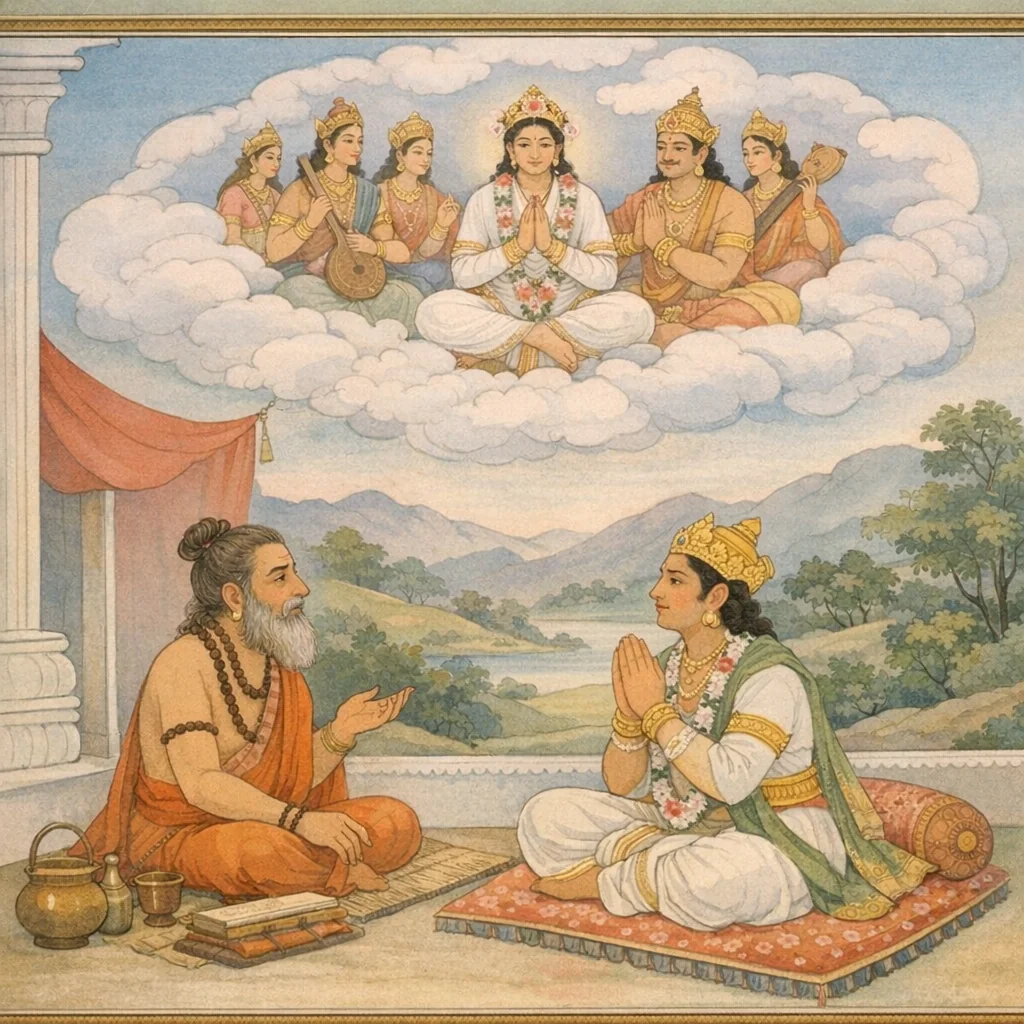
Adhyaya 6
Chapter Arc: जनमेजय का जिज्ञासु प्रश्न उठता है—हे भगवन्, महाभारत-श्रवण का विधि-विधान क्या है, और पर्व-पर्व पर कौन-सा दान-धर्म अपेक्षित है? → वैशम्पायन उत्तर देते हुए श्रवण-पारायण की क्रमबद्ध मर्यादा, प्रत्येक पर्व की समाप्ति पर दान, ब्राह्मण-भोजन, हविष्य, गन्ध-माल्य-चन्दन, गौ-दान और सुवर्ण-निष्क सहित दान की सूक्ष्म विधि बताते हैं; कथा अब युद्ध-वीरता से हटकर ‘श्रवण’ को यज्ञ-तुल्य कर्म सिद्ध करने की ओर बढ़ती है। → श्रवण-पारायण के फल का उत्कर्ष घोषित होता है—पर्व-समाप्ति पर विधिपूर्वक आचरण करने वाला श्रोता दिव्य माल्य-अम्बर धारण कर देवताओं के साथ स्वर्ग में ‘दूसरे देव’ की भाँति आनंदित होता है; अश्वमेध, अतिरात्र आदि यज्ञ-फलों के तुल्य फल ‘भारत-श्रवण’ से प्राप्त होता है। → अध्याय श्रोता को परम कल्याण के लिए सतत प्रयत्न का उपदेश देता है—मन का संयम, भीतर-बाहर की शुद्धि, इतिहास का यथावत श्रवण, और पर्वानुसार महादान/रत्न-दान/ब्राह्मण-तर्पण द्वारा श्रवण को पूर्ण करना।
Shlokas
Verse 1
/ न्न् व निज: ।। स्वर्गारोहणपर्व सम्पूर्णम् ।। नी (0) आप आन+- अनुष्टुप् ( अन्य बड़े छन्द ) बड़े छन्दोंको ३२ अक्षरोंके कुल योग अनुष्टप् घानकर गिननेपर उत्तर भारतीय पाठसे लिये गये २१४॥ (३) ४> २१८ ॥० दक्षिण भारतीय पाठसे लिये गये स्वर्गारोहणपर्वकी कुल एलोकसंख्या -- २१८ ।।> श्रीमहाभारतं सम्पूर्णम् - श्रीकृष्णद्वैपायन व्यासके द्वारा प्रकट होनेके कारण “कृष्णादागतः कार्ष्ण:” इस व्युत्पत्तिके अनुसार यह उपाख्यान 'कार्ष्णवेद' के नामसे प्रसिद्ध है। महाभारतश्रवणविधि: माहात्म्य, कथा सुननेकी विधि और उसका फल जनमेजय उवाच भगवन् केन विधिना श्रोतव्यं भारतं बुध: । फलं किं के च देवाश्न पूज्या वै पारणेष्विह,जनमेजयने पूछा--भगवन्! विद्वानोंको किस विधिसे महाभारतका श्रवण करना चाहिये? इसके सुननेसे क्या फल होता है? इसकी पारणाके समय किन-किन देवताओंका पूजन करना चाहिये? भगवन! प्रत्येक पर्वकी समाप्तिपर क्या दान देना चाहिये? और इस कथाका वाचक कैसा होना चाहिये? यह सब मुझे बतानेकी कृपा कीजिये
Janamejaya said: “Revered sir, by what method should a wise person listen to the Mahābhārata? What fruit arises from hearing it? And at the time of concluding recitations (pāraṇa), which deities should be worshipped here?”
Verse 2
देयं समाप्ते भगवन् किं च पर्वणि पर्वणि । वाचक: कीदृशश्षात्र एष्टव्यस्तद् वदस्व मे,जनमेजयने पूछा--भगवन्! विद्वानोंको किस विधिसे महाभारतका श्रवण करना चाहिये? इसके सुननेसे क्या फल होता है? इसकी पारणाके समय किन-किन देवताओंका पूजन करना चाहिये? भगवन! प्रत्येक पर्वकी समाप्तिपर क्या दान देना चाहिये? और इस कथाका वाचक कैसा होना चाहिये? यह सब मुझे बतानेकी कृपा कीजिये
Janamejaya said: “O revered one, what gift should be given at the completion (of the recitation), and what should be given at the end of each individual book-section (parvan)? And what kind of narrator is to be chosen for this sacred account? Please tell me.”
Verse 3
वैशम्पायन उवाच शृणु राजन् विधिमिमं फलं यच्चापि भारतात् | श्रुताद् भवति राजेन्द्र यत् त्वं मामनुपृच्छसि,वैशम्पायनजीने कहा--राजेन्द्र! महाभारत सुननेकी जो विधि है और उसके श्रवणसे जो फल होता है, जिसके विषयमें तुमने मुझसे जिज्ञासा प्रकट की है, वह सब बता रहा हूँ; सुनो
Vaiśampāyana said: “Listen, O King. I shall explain the proper procedure for hearing the Mahābhārata and also the fruit that arises from such listening—precisely what you, O best of kings, have asked me about.”
Verse 4
दिवि देवा महीपाल क्रीडार्थमवनिं गता: । कृत्वा कार्यमिदं चैव ततश्न दिवमागता:,भूपाल! स्वर्गके देवता भगवान्की लीलामें सहायता करनेके लिये पृथ्वीपर आये थे और इस कार्यको पूरा करके वे पुनः स्वर्गमें जा पहुँचे
Vaiśaṃpāyana said: “O king, the gods from heaven descended to the earth for the sake of the Lord’s sport. Having accomplished this very task, they then returned again to heaven.”
Verse 5
हन्त यत् ते प्रवक्ष्यामि तच्छुणुष्व समाहित: । ऋषीणां देवतानां च सम्भवं वसुधातले,अब मैं इस भूतलपर ऋषियों और देवताओंके प्रादुर्भावके विषयमें प्रसन्नतापूर्वक तुम्हें जो कुछ बताता हूँ, उसे एकाग्रचित्त होकर सुनो
Vaiśampāyana said: “Come then—listen with a collected mind to what I shall tell you. I will relate, with clarity and goodwill, the manifestation and origins of the seers and the gods upon the surface of the earth.”
Verse 6
अतन्र रुद्रास्तथा साध्या विश्वेदेवाश्ष शाश्वता: | आदित्यश्षाश्विनौ देवौ लोकपाला महर्षय:,भरतश्रेष्ठ।! यहाँ महाभारतमें रुद्र, साध्य, सनातन विश्वेदेव, सूर्य, अश्विनीकुमार, लोकपाल, महर्षि, गुह्मक, गन्धर्व, नाग, विद्याधर, सिद्ध, धर्म, स्वयम्भू ब्रह्मा, श्रेष्ठ मुनि कात्यायन, पर्वत, समुद्र, नदियाँ, अप्सराओंके समुदाय, ग्रह, संवत्सर, अयन, ऋतु, सम्पूर्ण चराचर जगत्, देवता और असुर--ये सब-के-सब एकत्र हुए देखे जाते हैं
Vaiśampāyana said: “O best of the Bharatas, there were seen assembled—without fatigue—the Rudras, the Sādhyas, the eternal Viśvedevas, the Ādityas, the two Aśvin gods, the guardians of the worlds, and the great seers.” In this climactic vision of Svargārohaṇa, the epic gathers the entire cosmic order—divine, semi-divine, and natural powers—around the final passage of the Pāṇḍavas, underscoring that dharma is ultimately witnessed and ratified by the whole universe.
Verse 7
गुहाुका श्व सगन्धर्वा नागा विद्याधरास्तथा | सिद्धा धर्म: स्वयम्भूश्न मुनि: कात्यायनो वर:,भरतश्रेष्ठ।! यहाँ महाभारतमें रुद्र, साध्य, सनातन विश्वेदेव, सूर्य, अश्विनीकुमार, लोकपाल, महर्षि, गुह्मक, गन्धर्व, नाग, विद्याधर, सिद्ध, धर्म, स्वयम्भू ब्रह्मा, श्रेष्ठ मुनि कात्यायन, पर्वत, समुद्र, नदियाँ, अप्सराओंके समुदाय, ग्रह, संवत्सर, अयन, ऋतु, सम्पूर्ण चराचर जगत्, देवता और असुर--ये सब-के-सब एकत्र हुए देखे जाते हैं
Vaiśampāyana said: O best of the Bharatas, there were seen assembled together the hosts of celestial and semi-celestial beings—Guhyakas, Gandharvas, Nāgas, Vidyādharas, and Siddhas—along with Dharma himself, Svayambhū (Brahmā), and the eminent sage Kātyāyana. Indeed, in this great narrative were beheld as gathered: Rudras, Sādhyas, the eternal Viśvedevas, Sūrya, the Aśvin twins, the guardians of the worlds, great seers, mountains, oceans, rivers, companies of Apsarases, the planets, the year with its solstices and seasons, and the entire moving and unmoving universe—gods and asuras alike. The scene underscores that the final outcome of a life devoted to dharma is witnessed by the whole cosmic order, as if the universe itself stands as moral testimony.
Verse 8
गिरय: सागरा नद्यस्तथैवाप्सरसां गणा: । ग्रहा: संवत्सराश्वैव अयनान्यूतवस्तथा,भरतश्रेष्ठ।! यहाँ महाभारतमें रुद्र, साध्य, सनातन विश्वेदेव, सूर्य, अश्विनीकुमार, लोकपाल, महर्षि, गुह्मक, गन्धर्व, नाग, विद्याधर, सिद्ध, धर्म, स्वयम्भू ब्रह्मा, श्रेष्ठ मुनि कात्यायन, पर्वत, समुद्र, नदियाँ, अप्सराओंके समुदाय, ग्रह, संवत्सर, अयन, ऋतु, सम्पूर्ण चराचर जगत्, देवता और असुर--ये सब-के-सब एकत्र हुए देखे जाते हैं
Vaiśaṃpāyana said: “O best of the Bharatas, mountains, oceans, and rivers—likewise the hosts of Apsarases—together with the planets, the years, the solstitial courses (ayanas), and the seasons: all these were seen gathered there.” In the closing movement of the epic, the narration widens from human actors to the whole cosmic order, suggesting that the final reckoning of dharma is witnessed and upheld by the entire universe.
Verse 9
स्थावरं जड़म॑ चैव जगत् सर्व सुरासुरम् । भारते भरतश्रेष्ठ एकस्थमिह दृश्यते,भरतश्रेष्ठ।! यहाँ महाभारतमें रुद्र, साध्य, सनातन विश्वेदेव, सूर्य, अश्विनीकुमार, लोकपाल, महर्षि, गुह्मक, गन्धर्व, नाग, विद्याधर, सिद्ध, धर्म, स्वयम्भू ब्रह्मा, श्रेष्ठ मुनि कात्यायन, पर्वत, समुद्र, नदियाँ, अप्सराओंके समुदाय, ग्रह, संवत्सर, अयन, ऋतु, सम्पूर्ण चराचर जगत्, देवता और असुर--ये सब-के-सब एकत्र हुए देखे जाते हैं
Vaiśampāyana said: O best of the Bharatas, here in this Mahābhārata one sees the entire universe—both the gods and the asuras—gathered together in a single place: the immovable and the inert, and indeed all that exists. In this culminating vision, the epic presents a moral panorama in which every order of being stands assembled, as if to witness the final reckoning of dharma and the destiny of the Pāṇḍavas.
Verse 10
तेषां श्रुत्वा प्रतिष्ठानं नामकर्मानुकीर्तनात् । कृत्वापि पातकं घोरं सद्यो मुच्येत मानव:,मनुष्य घोर पातक करनेपर भी उन सबकी प्रतिष्ठा सुनकर तथा प्रतिदिन उनके नाम और कर्मोका कीर्तन करता हुआ उससे तत्काल मुक्त हो जाता है
Vaiśampāyana said: By hearing of their exalted standing, and by regularly recounting their names and deeds, a person—even if he has committed a dreadful sin—may be freed from it at once. The verse underscores the purifying power of remembrance and praise of the righteous, presenting moral renewal as accessible through sincere hearing and recitation.
Verse 11
इतिहासमिमं श्रुत्वा यथावदनुपूर्वश: । संयतात्मा शुचिर्भूत्वा पारं गत्वा च भारते,महादानानि देयानि रत्नानि विविधानि च । मनुष्य अपने मनको संयममें रखते हुए बाहर-भीतरसे शुद्ध हो महाभारतमें वर्णित इस इतिहासको क्रमश: यथावत् रूपसे सुनकर इसे समाप्त करनेके पश्चात् इनमें मारे गये प्रमुख वीरोंके लिये श्राद्ध करे। भारत! भरतभूषण! महाभारत सुनकर श्रोता अपनी शक्तिके अनुसार ब्राह्मणोंको भक्तिभावसे नाना प्रकारके रत्न आदि बड़े-बड़े दान दे
Vaiśaṃpāyana said: “Having heard this history in due order and exactly as it is, with the mind restrained and having become pure within and without, and having carried it through to its completion, O Bhārata—one should then offer great gifts, including various kinds of jewels. After completing the Mahābhārata, the listener should, according to his capacity, perform śrāddha for the foremost heroes who fell, and with devotion give generous donations to Brāhmaṇas.”
Verse 12
तेषां श्राद्धानि देयानि श्रुत्वा भारत भारतम् । ब्राह्मणेभ्यो यथाशक्त्या भक्त्या च भरतर्षभ
Vaiśaṃpāyana said: “Having heard this account of the Bhāratas, O descendant of Bharata, one should offer the śrāddha rites for them—giving, according to one’s capacity, to Brāhmaṇas with sincere devotion, O best of the Bharatas.”
Verse 13
गाव: कांस्योपदोहाश्न कन्याश्वैव स्वलंकृता:
Vaiśampāyana said: “There were cows with milking-vessels of bronze, and maidens too, richly adorned.” The verse evokes the scene of auspicious gifts and ceremonial offerings, suggesting a social-ethical ideal in which wealth is directed toward generosity, hospitality, and merit-making rather than hoarding.
Verse 14
सर्वकामगुणोपेता यानानि विविधानि च । भवनानि विचित्राणि भूमिर्वासांसि काउ्चनम्
Vaiśaṃpāyana said: “There were conveyances of many kinds, endowed with every desirable comfort and excellence; there were wondrous, variegated mansions; and there were lands and garments—golden in splendor.”
Verse 15
वाहनानि च देयानि हया मत्ताश्ष वारणा: । शयनं शिबिकाश्रैव स्यन्दनाश्च स्वलंकृता:
Vaiśaṃpāyana said: “Vehicles are to be given in charity—spirited horses and rutting elephants; also beds and palanquins, and well-adorned chariots.” The verse underscores the ethic of generous gifting of valuable conveyances and comforts, presenting dāna as a concrete expression of dharma at life’s culmination.
Verse 16
यद् यद् गृहे वरं किंचिद् यद् यदस्ति महद् वसु । तत् तद् देयं द्विजातिभ्य आत्मा दाराश्न सूनव:
Vaiśampāyana said: “Whatever excellent thing there is in the household, and whatever great wealth is present—each and every such possession should be given away to the twice-born. Indeed, even one’s own self, one’s wife, and one’s sons are to be offered up (in the spirit of complete renunciation and charity).”
Verse 17
गौएँ, काँसीके दुग्धपात्र, वस्त्राभूषणोंसे विभूषित और सम्पूर्ण मनोवाञ्छित गुणोंसे युक्त कन्याएँ, नाना प्रकारके यान, विचित्र भवन, भूमि, वस्त्र, सुवर्ण, वाहन, घोड़े, मतवाले हाथी, शय्या, शिबिकाएँ, सजे-सजाये रथ तथा घरमें जो कोई भी श्रेष्ठ वस्तु और महान् धन हो, वह सब ब्राह्मणोंको देने चाहिये। स्त्री-पुत्रोंसहित अपने शरीरको भी उनकी सेवामें लगा देना चाहिये ।। श्रद्धया परया युक्त क्रमशस्तस्य पारग: । शक्तित: सुमना हृष्ट: शुश्रुषुरविकल्पक:
Vaiśaṃpāyana said: Endowed with supreme faith, he should proceed step by step to the far shore (of his undertaking), acting according to his capacity—cheerful in mind, gladdened at heart, intent on service, and free from hesitation. In this context, the teaching underscores wholehearted generosity and devoted service to brāhmaṇas: one should give cows, vessels for milk from Kāśī, garments and ornaments, well-qualified maidens, various conveyances, splendid houses, land, clothing, gold, vehicles, horses, rutting elephants, beds, palanquins, well-adorned chariots, and whatever excellent goods and great wealth are found at home—offering even one’s own body, together with wife and sons, in their service.
Verse 18
पूर्ण श्रद्धाकें साथ क्रमश: कथा सुनते हुए उसे अन्ततक पूर्णरूपसे श्रवण करना चाहिये। यथाशक्ति श्रवणके लिये उद्यत रहकर मनको प्रसन्न रखे। हृदयमें हर्षसे उललसित हो मनमें संशय या तर्क-वितर्क न करे ।। सत्यार्जवरतो दान्त: शुचि: शौचसमन्वित: । श्रद्धधानो जितक्रोधो यथा सिध्यति तच्छृूणु,सत्य और सरलताके सेवनमें संलग्न रहे। इन्ट्रियोंका दमन करे, शुद्ध एवं शौचाचारसे सम्पन्न रहे। श्रद्धालु बना रहे और क्रोधको काबूमें रखे। ऐसे श्रोताको जिस प्रकार सिद्धि प्राप्त होती है, वह बताता हूँ; सुनो
Vaiśampāyana said: One should listen to the account step by step with complete faith, hearing it in full up to the very end. As far as one is able, one should remain intent on listening and keep the mind cheerful. With the heart uplifted by joy, one should not indulge in doubt or argumentative disputation. A listener who is vowed to truth and straightforwardness, self-controlled, pure and observant of cleanliness, faithful, and master of anger—how such a hearer attains spiritual success, that I shall tell you; listen.
Verse 19
शुचि: शीलान्विताचार: शुक्लवासा जितेन्द्रिय: । संस्कृत: सर्वशास्त्रज्ञ: श्रद्दधानोइनसूयक:,जो बाहर-भीतरसे पवित्र, शीलवानू, सदाचारी, शुद्ध वस्त्र धारण करनेवाला, जितेन्द्रिय, संस्कारसम्पन्न, सम्पूर्ण शास्त्रोंका तत्त्वज्ञ, श्रद्धालू, दोषदृष्टिसे रहित, रूपवान्, सौभाग्यशाली, मनको वशगमें रखनेवाला, सत्यवादी और जितेन्द्रिय हो, ऐसे विद्वान् पुरुषको दान और मानसे अनुगृहीत करके वाचक बनाना चाहिये
Vaiśaṃpāyana said: “One should appoint as a reciter a learned man who is pure within and without, endowed with good character and right conduct, clad in clean white garments, self-controlled, well-cultured, and versed in the essence of all śāstras—faithful and free from fault-finding. Such a scholar, honored and supported through gifts and respect, becomes fit to transmit the sacred narrative in a manner that upholds dharma.”
Verse 20
रूपवान् सुभगो दान्त: सत्यवादी जितेन्द्रिय: । दानमानगृहीतश्न कार्यो भवति वाचक:,जो बाहर-भीतरसे पवित्र, शीलवानू, सदाचारी, शुद्ध वस्त्र धारण करनेवाला, जितेन्द्रिय, संस्कारसम्पन्न, सम्पूर्ण शास्त्रोंका तत्त्वज्ञ, श्रद्धालू, दोषदृष्टिसे रहित, रूपवान्, सौभाग्यशाली, मनको वशगमें रखनेवाला, सत्यवादी और जितेन्द्रिय हो, ऐसे विद्वान् पुरुषको दान और मानसे अनुगृहीत करके वाचक बनाना चाहिये
Vaiśampāyana said: “One who is handsome and fortunate, self-restrained, truthful, and master of the senses—such a learned man, honored and supported with gifts and respect, should be appointed as the reciter (vācaka).”
Verse 21
अविलम्बमनायस्तमद्रुतं धीरमूर्जितम् । असंसक्ताक्षरपदं स्वरभावसमन्वितम्,कथावाचकको न तो बहुत रुक-रुककर कथा बाँचनी चाहिये और न बहुत जल्दी ही। आरामके साथ धीरगतिसे अक्षरों और पदोंका स्पष्ट उच्चारण करते हुए उच्चस्वरसे कथा बाँचनी चाहिये। मीठे स्वरसे भावार्थ समझाकर कथा कहनी चाहिये
Vaiśampāyana said: “The recitation should be neither delayed nor strained, and it should not be rushed. It should proceed with steady composure and vigour, with syllables and words clearly articulated and not run together, and with voice and feeling properly aligned. In this way the storyteller conveys the meaning sweetly and makes the narrative intelligible and effective.”
Verse 22
त्रिषष्टिवर्णसंयुक्तमष्टस्थानसमीरितम् । वाचयेद् वाचक: स्वस्थ: स्वासीन: सुसमाहित:,तिरसठ अक्षरोंका उनके आठों स्थानोंसे ठीक-ठीक उच्चारण करे। कथा सुनाते समय वाचकके लिये स्वस्थ और एकाग्रचित्त होना आवश्यक है। उसके लिये आसन ऐसा होना चाहिये जिसपर वह सुखपूर्वक बैठ सके
Vaiśaṃpāyana said: “Let the reciter deliver the text—composed of the sixty-three phonetic units—articulated correctly from the eight places of pronunciation. While narrating, the reader should be healthy, seated comfortably, and deeply composed in concentration.”
Verse 23
नारायणं नमस्कृत्य नरं चैव नरोत्तमम् | देवीं सरस्वतीं व्यासं ततो जयमुदीरयेत्,अन्तर्यामी नारायणस्वरूप भगवान् श्रीकृष्ण, (उनके नित्य सखा) नरस्वरूप नरश्रेष्ठ अर्जुन, (उनकी लीला प्रकट करनेवाली) भगवती सरस्वती और (उन लीलाओंका संकलन करनेवाले) महर्षि वेदव्यासको नमस्कार करके जय (महाभारत)-का पाठ करना चाहिये
Having bowed in reverence to Nārāyaṇa, and also to Nara—the best of men—along with the goddess Sarasvatī and Vyāsa, one should then recite ‘Jaya’ (the Mahābhārata). Ethically, the verse frames the epic as sacred instruction: the telling of human struggle and dharma is to be approached with humility, gratitude to its divine source, and respect for the powers of speech and transmission that preserve truth.
Verse 24
ईदृशाद् वाचकादू राजन श्रुत्वा भारत भारतम् | नियमस्थ: शुचि: श्रोता शृण्वन् स फलमश्षुते,राजन! भरतनन्दन! नियमपरायण पवित्र श्रोता ऐसे वाचकसे महाभारतकी कथा सुनकर श्रवणका पूरा-पूरा फल पाता है
Vaiśampāyana said: O King—O scion of Bharata—when the Mahābhārata is heard from a reciter of such a kind, a listener who is disciplined and pure, listening with observant restraint, attains the full fruit of that hearing. The emphasis is that the ethical quality of both the teacher (reciter) and the listener (disciplined, purified) completes the spiritual and moral benefit of the epic’s narration.
Verse 25
पारणं प्रथम प्राप्प द्विजान् कामैश्न तर्पयन् । अग्निष्टोमस्य यज्ञस्य फलं वै लभते नर:,जो मनुष्य प्रथम पारणके समय ब्राह्मणोंको अभीष्ट वस्तुएँ देकर तृप्त करता है वह अग्निष्टोम यज्ञका फल पाता है। उसे अप्सराओंसे भरा हुआ विमान प्राप्त होता है और वह प्रसन्नतापूर्वक एकाग्रचित्त हो देवताओंके साथ स्वर्गलोकमें जाता है
Vaiśampāyana said: Having reached the first occasion of breaking the fast (pāraṇa), the man who satisfies the twice-born (brāhmaṇas) by giving them the desired gifts indeed attains the merit of the Agniṣṭoma sacrifice. The passage underscores that timely generosity and honoring worthy recipients at sacred moments yields great spiritual reward and an auspicious heavenly destiny.
Verse 26
अप्सरोगणसंकीर्ण विमानं लभते महत् | प्रहृष्ट: स तु देवैश्व दिवं याति समाहित:,जो मनुष्य प्रथम पारणके समय ब्राह्मणोंको अभीष्ट वस्तुएँ देकर तृप्त करता है वह अग्निष्टोम यज्ञका फल पाता है। उसे अप्सराओंसे भरा हुआ विमान प्राप्त होता है और वह प्रसन्नतापूर्वक एकाग्रचित्त हो देवताओंके साथ स्वर्गलोकमें जाता है
Vaiśampāyana said: He obtains a great celestial chariot filled with hosts of apsarās. Rejoicing, and with a collected mind, he goes to heaven together with the gods. The ethical sense is that sincere, timely generosity—especially the act of satisfying brāhmaṇas with desired gifts at the proper occasion—bears merit comparable to major Vedic sacrifice and leads to exalted heavenly reward.
Verse 27
द्वितीयं पारणं प्राप्प सो$तिरात्रफलं लभेत् । सर्वरत्नमयं दिव्यं विमानमधिरोहति,जो मनुष्य दूसरा पारण पूरा करता है उसे अतिरात्र यज्ञका फल मिलता है। वह सर्वरत्नमय दिव्य विमानपर आरूढ़ होता है
Vaiśampāyana said: Having completed the second observance of pāraṇa, a person gains the merit of the Atirātra sacrifice. He then ascends a divine aerial chariot, resplendent and fashioned as though of all precious gems—an image of reward proportionate to disciplined fulfillment of vowed duty.
Verse 28
दिव्यमाल्याम्बरधरो दिव्यगन्धविभूषित: । दिव्याड्भदधरो नित्यं देवलोके महीयते,वह दिव्य माला और दिव्य वस्त्र धारण करता, दिव्य चन्दनसे चर्चित एवं दिव्य सुगन्धसे वासित होता और दिव्य अंगद धारण करके सदा देवलोकमें सम्मानित होता है
Vaiśaṃpāyana said: Adorned with celestial garlands and garments, anointed and perfumed with divine fragrances, and wearing radiant armlets, he is ever honored in the world of the gods. The verse underscores the ethical idea that righteous conduct culminates in exalted recognition beyond mortal life.
Verse 29
तृतीयं पारणं प्राप्प द्वादशाहफलं लभेत् । वसत्यमरसंकाशो वर्षाण्ययुतशो दिवि,तीसरा पारण पूरा करनेपर मनुष्य द्वादशाहयज्ञका फल पाता है और देवताओंके तुल्य तेजस्वी होकर हजारों वर्षोतक स्वर्गलोकमें निवास करता है
Vaiśampāyana said: “Having completed the third observance (pāraṇa), a person gains the merit equal to that of a twelve-day sacrificial rite. Radiant like the immortals, he dwells in heaven for tens of thousands of years.”
Verse 30
चतुर्थे वाजपेयस्य पठ्चमे द्विगुणं फलम् । उदितादित्यसंकाशं ज्वलन्तमनलोपमम्
Vaiśampāyana said: “In the fourth stage of the Vājapeya sacrifice, and in the fifth, the reward becomes doubled—appearing like the newly risen sun, blazing, comparable to fire.”
Verse 31
विमान विबुधै: सार्धमारुह् दिवि गच्छति । वर्षायुतानि भवने शक्रस्य दिवि मोदते
Vaiśampāyana said: Ascending the celestial chariot together with the gods, he goes to heaven. For tens of thousands of years he rejoices in the heavenly realm, in Indra’s abode—signifying the fruition of righteous conduct and the honoring of dharma after the trials of mortal life.
Verse 32
चौथे पारणमें वाजपेय-यज्ञका और पाँचवेंमें उससे दूना फल प्राप्त होता है। वह पुरुष उदयकालके सूर्य तथा प्रज्वलित अग्निके समान तेजस्वी विमानपर आरूढ़ हो देवताओंके साथ स्वर्गलोकमें जाता है और वहाँ इन्द्रभवनमें दस हजार वर्षोतक आनन्द भोगता है ।। षष्ठे द्विगुणमस्तीति सप्तमे त्रिगुणं फलम् । कैलासशिखराकार वैदूर्यमणिवेदिकम्
Vaiśampāyana said: “In the sixth observance the merit is said to be doubled, and in the seventh it becomes threefold. (The reward is described as) a radiant celestial abode—like the peak of Mount Kailāsa—set upon a platform inlaid with vaidūrya gems.” The passage emphasizes that disciplined, repeated acts of religious restraint and offering yield progressively greater spiritual fruit, culminating in exalted heavenly enjoyment.
Verse 33
परिक्षिप्तं च बहुधा मणिविद्रुम भूषितम् । विमान समधिष्ठाय कामगं साप्सरोगणम्
Vaiśaṃpāyana said: Adorned in many ways and lavishly embellished with jewels and coral, they mounted a celestial chariot—able to go wherever one wills—accompanied by a retinue of Apsarases. The scene underscores the Mahābhārata’s closing vision: the fruits of a life’s deeds are revealed not as human praise, but as the otherworldly consequences of dharma and merit.
Verse 34
सर्वाल्लोकान् विचरते द्वितीय इव भास्कर: । छठे पारणमें इससे दूना और सातवेंमें तिगुना फल मिलता है। वह मनुष्य अप्सराओंसे भरे हुए और इच्छानुसार चलनेवाले, कैलासशिखरकी भाँति उज्ज्वल, वैदूर्यमणिकी वेदियोंसे विभूषित, नाना प्रकारसे सुसज्जित तथा मणियों और मूँगोंसे अलंकृत विमानपर बैठकर दूसरे सूर्यकी भाँति सम्पूर्ण लोकोंमें विचरता है || ३२-३३ ई ।। अष्टमे राजसूयस्य पारणे लभते फलम्,आठवें पारणमें मनुष्य राजसूय यज्ञका फल पाता है। वह मनके समान वेगशाली और चन्द्रमाकी किरणोंके समान रंगवाले श्वेत घोड़ोंसे जुते हुए चन्द्रोदयतुल्य रमणीय विमानपर आरूढ़ होता है
Vaiśampāyana said: He moves through all the worlds like a second sun. The passage describes the exalted posthumous reward gained by progressively greater observances: with the sixth completion the merit is doubled, with the seventh it is tripled; the person then rides a radiant, wish-moving aerial car—bright like the peak of Kailāsa, adorned with platforms of vaidūrya-gems, richly decorated with jewels and coral, and surrounded by apsarases—traversing the cosmos with solar splendor. With the eighth completion, one attains the fruit of the Rājasūya sacrifice, ascending a moonrise-like, delightful vimāna yoked to swift white horses, pale as moonbeams. The ethical frame is that disciplined religious observance and self-restraint are portrayed as generating cosmic merit and elevated states of being.
Verse 35
चन्द्रोदयनिभं रम्यं विमानमधिरोहति । चन्द्ररश्मिप्रतीकाशैह्यैर्युक्ते मनोजवै:,आठवें पारणमें मनुष्य राजसूय यज्ञका फल पाता है। वह मनके समान वेगशाली और चन्द्रमाकी किरणोंके समान रंगवाले श्वेत घोड़ोंसे जुते हुए चन्द्रोदयतुल्य रमणीय विमानपर आरूढ़ होता है
Verse 36
सेव्यमानो वरस्त्रीणां चन्द्रात् कान्ततरैर्मुखै: । मेखलानां निनादेन नूपुराणां च निः:स्वनै:
Vaiśaṃpāyana said: He was being attended and honored by excellent women whose faces were more radiant than the moon, while the scene resounded with the jingling of their girdles and the clear chiming of their anklets—an image of celestial splendor that contrasts with the hard-won, morally weighty end of the earthly journey.
Verse 37
नवमे क्रतुराजस्य वाजिमेधस्य भारत,भारत! नवाँ पारण पूर्ण होनेपर श्रोताको यज्ञोंके राजा अश्वमेधका फल प्राप्त होता है। वह सोनेके खंभों और छज्जोंसे सुशोभित, वैदूर्यमणिकी बनी हुई वेदियोंसे विभूषित, चारों ओरसे जाम्बूनदमय दिव्य वातायनोंसे अलंकृत, स्वर्गवासी गन्धर्वों एवं अप्सराओंसे सेवित दिव्य विमानपर आरूढ़ हो अपनी उत्कृष्ट शोभासे प्रकाशित होता हुआ स्वर्गमें दूसरे देवताकी भाँति देवताओंके साथ आनन्द भोगता है। उसके अंगोंमें दिव्य माला एवं दिव्य वस्त्र शोभा पाते हैं तथा वह दिव्य चन्दनसे चर्चित होता है
Vaiśampāyana said: O Bhārata, when the ninth observance is completed, the listener attains the merit of the Aśvamedha, the king of sacrifices. Mounted upon a celestial chariot—adorned with golden pillars and canopies, embellished with altars fashioned of vaidūrya gems, and encircled by divine windows of Jāmbūnada gold—attended by heavenly Gandharvas and Apsarases, he shines by his own surpassing splendor. In heaven he enjoys bliss in the company of the gods, like a second deity. Divine garlands and garments grace his limbs, and he is anointed with celestial sandalwood.
Verse 38
काञ्चनस्तम्भनिर्यूहवैदूर्यकृतवेदिकम् । जाम्बूनदमर्यैर्दिव्यैर्गवाक्षै: सर्वतो वृतम्,भारत! नवाँ पारण पूर्ण होनेपर श्रोताको यज्ञोंके राजा अश्वमेधका फल प्राप्त होता है। वह सोनेके खंभों और छज्जोंसे सुशोभित, वैदूर्यमणिकी बनी हुई वेदियोंसे विभूषित, चारों ओरसे जाम्बूनदमय दिव्य वातायनोंसे अलंकृत, स्वर्गवासी गन्धर्वों एवं अप्सराओंसे सेवित दिव्य विमानपर आरूढ़ हो अपनी उत्कृष्ट शोभासे प्रकाशित होता हुआ स्वर्गमें दूसरे देवताकी भाँति देवताओंके साथ आनन्द भोगता है। उसके अंगोंमें दिव्य माला एवं दिव्य वस्त्र शोभा पाते हैं तथा वह दिव्य चन्दनसे चर्चित होता है
Vaiśampāyana said: “O Bhārata, it was surrounded on every side by divine lattice-windows made of Jāmbūnada gold; it was adorned with golden pillars and projecting cornices, and furnished with platforms (altars) fashioned of vaidūrya (cat’s-eye gemstone).” In context, the passage describes the splendor of the heavenly conveyance and rewards promised for completing a sacred vow, emphasizing the Mahābhārata’s ethic that disciplined observance and meritorious acts are believed to yield exalted posthumous attainments.
Verse 39
सेवितं चाप्सर: सड्घैर्गन्धर्वैर्देविचारिभि: । विमानं समधिष्ठाय श्रिया परमया ज्वलन्,भारत! नवाँ पारण पूर्ण होनेपर श्रोताको यज्ञोंके राजा अश्वमेधका फल प्राप्त होता है। वह सोनेके खंभों और छज्जोंसे सुशोभित, वैदूर्यमणिकी बनी हुई वेदियोंसे विभूषित, चारों ओरसे जाम्बूनदमय दिव्य वातायनोंसे अलंकृत, स्वर्गवासी गन्धर्वों एवं अप्सराओंसे सेवित दिव्य विमानपर आरूढ़ हो अपनी उत्कृष्ट शोभासे प्रकाशित होता हुआ स्वर्गमें दूसरे देवताकी भाँति देवताओंके साथ आनन्द भोगता है। उसके अंगोंमें दिव्य माला एवं दिव्य वस्त्र शोभा पाते हैं तथा वह दिव्य चन्दनसे चर्चित होता है
Vaiśampāyana said: Served by companies of Apsarases and by Gandharvas who move in the heavens, he ascends and takes his seat upon a celestial aerial car; blazing with supreme splendor, O Bhārata, he shines forth. The passage evokes the ethical idea that meritorious conduct and sacred observances culminate in exalted, luminous states of being, portrayed here through the imagery of heavenly attendants and a radiant vimāna.
Verse 40
दिव्यमाल्याम्बरधरो दिव्यचन्दनरूषित: । मोदते दैवतै: सार्थ दिवि देव इवापर:,भारत! नवाँ पारण पूर्ण होनेपर श्रोताको यज्ञोंके राजा अश्वमेधका फल प्राप्त होता है। वह सोनेके खंभों और छज्जोंसे सुशोभित, वैदूर्यमणिकी बनी हुई वेदियोंसे विभूषित, चारों ओरसे जाम्बूनदमय दिव्य वातायनोंसे अलंकृत, स्वर्गवासी गन्धर्वों एवं अप्सराओंसे सेवित दिव्य विमानपर आरूढ़ हो अपनी उत्कृष्ट शोभासे प्रकाशित होता हुआ स्वर्गमें दूसरे देवताकी भाँति देवताओंके साथ आनन्द भोगता है। उसके अंगोंमें दिव्य माला एवं दिव्य वस्त्र शोभा पाते हैं तथा वह दिव्य चन्दनसे चर्चित होता है
Vaiśaṃpāyana said: Adorned with celestial garlands and garments, anointed with divine sandal-paste, he rejoices in heaven together with the gods, shining like another god. The verse underscores the Mahābhārata’s ethical logic of karmic fruition: disciplined, meritorious religious observance culminates in exalted posthumous reward and honored companionship among the divine.
Verse 41
दशमं पारणं प्राप्य द्विजातीनभिवन्द्य च । किंकिणीजालनिर्घोषं पताकाध्वजशोभितम्
Vaiśaṃpāyana said: Having reached the tenth stage of crossing, and having paid reverent homage to the twice-born, they came upon a place resonant with the ringing of clustered bells, adorned with banners and standards—an auspicious, ceremonially ordered scene that signals honor, hierarchy, and the sanctity accorded to the learned.
Verse 42
रत्नवेदिकसम्बाधं वैदूर्यममणितोरणम् । हेमजालपरिक्षिप्तं प्रवालवलभीमुखम्
Vaiśampāyana said: (They beheld a celestial structure) densely adorned with jeweled platforms, its gateways and festoons set with vaidūrya gems; it was encircled by a net-like lattice of gold, and its front and roofline shone with coral-hued brilliance. The description heightens the sense of a realm beyond human striving—where the fruits of a life’s conduct are mirrored in radiant, orderly splendor.
Verse 43
गन्धर्वैर्गीतकुशलैरप्सरोभिश्व शोभितम् । विमान॑ सुकृतावासं सुखेनैवोपपद्यते
Vaiśampāyana said: Adorned by Gandharvas skilled in song and by Apsarases, that celestial chariot—an abode granted by meritorious deeds—comes to him with ease. The narrative underscores that the fruits of righteous conduct and accumulated merit manifest naturally, without struggle, as fitting recompense in the otherworld.
Verse 44
दसवाँ पारण पूरा होनेपर ब्राह्मणोंको प्रणाम करनेके पश्चात् श्रोताको पुण्यनिकेतन विमान अनायास ही प्राप्त हो जाता है। उसमें छोटी-छोटी घंटियोंसे युक्त झालरें लगी होती हैं और उनसे मधुर ध्वनि फैलती रहती है। बहुत-सी ध्वजा-पताकाएँ उस विमानकी शोभा बढ़ाती हैं। उनमें जगह-जगह रत्नमय चबूतरे बने होते हैं। वैदूर्य-यमणिका बना हुआ फाटक लगा होता है। सब ओरसे सोनेकी जालीद्वारा वह विमान घिरा होता है। उसके छज्जोंके नीचे मूँगे जड़े होते हैं। संगीतकुशल गण्धर्वों और अप्सराओंसे उस विमानकी शोभा और बढ़ जाती है ।। मुकुटेनाग्निवर्णेन जाम्बूनदविभूषिणा । दिव्यचन्दनदिग्धाड़ो दिव्यमाल्यविभूषित:,उसपर बैठा हुआ पुण्यात्मा पुरुष अग्नितुल्य तेजस्वी मुकुटसे अलंकृत तथा जाम्बूनदके आभूषणोंसे विभूषित होता है। उसका शरीर दिव्य चन्दनसे चर्चित तथा दिव्य मालाओंसे विभूषित होता है। दिव्य भोगोंसे सम्पन्न हो वह दिव्य लोकोंमें विचरता है और देवताओंकी कृपासे उत्कृष्ट शोभा-सम्पत्ति प्राप्त कर लेता है
Vaiśampāyana said: The meritorious man, seated in that celestial conveyance, is adorned with a crown blazing like fire and embellished with ornaments of pure Jāmbūnada gold. His limbs are anointed with divine sandalwood and decorated with heavenly garlands. Endowed with celestial enjoyments, he moves through the divine worlds, and by the gods’ favor attains an exalted splendor and prosperity—presented as the fruit of pious observance and reverent conduct.
Verse 45
दिव्यॉल्लोकान् विचरति दिव्यैर्भोगै: समन्वित: । विबुधानां प्रसादेन श्रिया परमया युत:,उसपर बैठा हुआ पुण्यात्मा पुरुष अग्नितुल्य तेजस्वी मुकुटसे अलंकृत तथा जाम्बूनदके आभूषणोंसे विभूषित होता है। उसका शरीर दिव्य चन्दनसे चर्चित तथा दिव्य मालाओंसे विभूषित होता है। दिव्य भोगोंसे सम्पन्न हो वह दिव्य लोकोंमें विचरता है और देवताओंकी कृपासे उत्कृष्ट शोभा-सम्पत्ति प्राप्त कर लेता है
Vaiśampāyana said: Endowed with celestial enjoyments, he moves freely through the divine worlds; and by the favor of the gods he becomes possessed of the highest splendor and prosperity. The verse underscores the Mahābhārata’s ethical vision that meritorious conduct bears fruit beyond death, culminating in radiant honor granted through divine grace.
Verse 46
अथ वर्षगणानेवं स्वर्गलोके महीयते । ततो गन्धर्वसहित: सहस्राण्येकविंशतिम्
Thus, in the world of heaven, he is honored in this manner by the hosts of celestial beings. Thereafter, accompanied by the Gandharvas, he proceeds onward—through a vast measure of time and number—twenty-one thousand (in count).
Verse 47
दिव्ययानविमानेषु लोकेषु विविधेषु च
Vaiśampāyana said: (They were seen) in celestial vehicles and in various worlds—an evocation of the posthumous order in which beings, according to their deeds, attain different divine realms and modes of passage.
Verse 48
ततः सूर्यस्य भवने चन्द्रस्य भवने तथा
Then they came to the abode of the Sun, and likewise to the abode of the Moon—moving onward through the celestial realms in due order, as the fruits of righteous conduct lead beings to higher stations.
Verse 49
एवमेतन्महाराज नात्र कार्या विचारणा
Vaiśampāyana said: “So it is, O great king; there is no need for further deliberation here.”
Verse 50
श्रद्धधानेन वै भाव्यमेवमाह गुरुर्मम । महाराज! ठीक ऐसी ही बात है। इस विषयमें कोई अन्यथा विचार नहीं करना चाहिये। मेरे गुरुका कथन है कि महाभारतकी इस महिमा और फलपर श्रद्धा रखनी चाहिये ।। ४९६ || वाचकस्य तु दातव्यं मनसा यद् यदिच्छति,हस्त्यश्वरथयानानि वाहनानि विशेषत: । वाचकको उसके मनमें जिस-जिस वस्तुकी इच्छा हो वह सब देनी चाहिये। हाथी, घोड़े, रथ, पालकी तथा दूसरे-दूसरे वाहन विशेषरूपसे देने चाहिये
Vaiśampāyana said: “One must approach this with faith—so my teacher has declared. O great king, it is exactly so; on this matter no contrary notion should be entertained. My teacher’s instruction is that one should place trust in the greatness of the Mahābhārata and in the spiritual fruit it bestows. Moreover, whatever the reciter desires in his mind should be given to him—especially conveyances such as elephants, horses, chariots, palanquins, and other vehicles.”
Verse 51
कटके कुण्डले चैव ब्रह्मुसूत्रं तथा परम्,कड़े, कुण्डल, यज्ञोपवीत, विचित्र वस्त्र और विशेषत: गनन््ध अर्पित करके वाचककी देवताके समान पूजा करनी चाहिये। ऐसा करनेवाला श्रोता भगवान् विष्णुके लोकमें जाता है
Vaiśampāyana said: “Offering armlets and earrings, and also the sacred thread, along with ornaments, the yajñopavīta, fine and variegated garments, and especially fragrant substances, one should honor the reciter as one would worship a deity. A listener who acts in this way attains the world of Lord Viṣṇu.”
Verse 52
वस्त्र चैव विचित्र च गन्धं चैव विशेषत: । देववत् पूजयेत् तं तु विष्णुलोकमवाप्नुयात्,कड़े, कुण्डल, यज्ञोपवीत, विचित्र वस्त्र और विशेषत: गनन््ध अर्पित करके वाचककी देवताके समान पूजा करनी चाहिये। ऐसा करनेवाला श्रोता भगवान् विष्णुके लोकमें जाता है
He should offer fine and variegated garments, and especially fragrant substances, and worship that reciter as one would worship a deity. A listener who does so attains the world of Viṣṇu—showing that reverence toward sacred teaching and its transmitter is itself a meritorious dharma leading to auspicious destiny.
Verse 53
अतः: पर प्रवक्ष्यामि यानि देयानि भारते । वाच्यमाने तु विप्रेभ्यो राजन् पर्वणि पर्वणि,राजन! भरतश्रेष्ठ) महाभारतकी कथा प्रारम्भ हो जानेपर प्रत्येक पर्वमें क्षत्रियोंकी जाति, देश, सत्यता, माहात्म्य, धर्म और वृत्तिको जानकर ब्राह्मणोंको जो-जो वस्तुएँ अर्पित करनी चाहिये, अब उनका वर्णन करूँगा
Vaishampayana said: “Now, further, I shall describe what gifts are to be given in the Bharata (Mahābhārata). O King, as the narrative is being recited to the Brahmins, at each and every parvan, one should offer the appropriate donations.”
Verse 54
जातिं देशं च सत्यं च माहात्म्यं भरतर्षभ | धर्म वृत्ति च विज्ञाय क्षत्रियाणां नराधिप,राजन! भरतश्रेष्ठ) महाभारतकी कथा प्रारम्भ हो जानेपर प्रत्येक पर्वमें क्षत्रियोंकी जाति, देश, सत्यता, माहात्म्य, धर्म और वृत्तिको जानकर ब्राह्मणोंको जो-जो वस्तुएँ अर्पित करनी चाहिये, अब उनका वर्णन करूँगा
Vaiśampāyana said: “O bull among the Bharatas, O king—best of the Bharata line—having ascertained the lineage and homeland, the truthfulness and greatness, and also the dharma and customary conduct of kṣatriyas, I shall now describe what offerings should be presented to the brāhmaṇas in each parvan once the Mahābhārata narrative has begun.”
Verse 55
स्वस्ति वाच्य द्विजानादौ ततः कार्ये प्रवर्तिते । समाप्ते पर्वणि ततः स्वशकक््त्या पूजयेद् द्विजान्,पहले ब्राह्मणोंसे स्वस्तिवाचन कराकर कथावाचनका कार्य प्रारम्भ कराये। फिर पर्व समाप्त होनेपर अपनी शक्तिके अनुसार उन ब्राह्मणोंकी पूजा करे
Vaiśampāyana said: “First, have the Brahmins pronounce auspicious blessings, and then begin the intended recitation/ritual undertaking. When the parvan (section) is completed, one should, according to one’s means, honor and worship those Brahmins.”
Verse 56
आदी तु वाचकं चैव वस्त्रगन्धसमन्वितम् | विधिवद् भोजयेद् राजन् मधु पायसमुनत्तमम्,राजन्! आदिपर्वकी कथाके समय वाचकको नूतन वस्त्र पहनाकर चन्दन आदिसे उसकी पूजा करे और विधिपूर्वक उसे मीठी एवं उत्तम खीर भोजन कराये
Vaiśampāyana said: “At the outset, O king, the reciter should be duly honoured—adorned with fresh garments and fragrant unguents—and then, according to proper rite, he should be fed with sweet honey and excellent rice-pudding. Thus the narration is begun with reverence, gratitude, and disciplined hospitality.”
Verse 57
ततो मूलफलप्रायं पायसं मधुसर्पिषा । आस्तीके भोजयेदू राजन् दद्याच्चैव गुडौदनम्,राजन! तत्पश्चात् आस्तीकपर्वकी कथाके समय ब्राह्मणोंको मधु और घीसे युक्त खीर भोजन कराये। उस भोजनमें फल-मूलकी अधिकता होनी चाहिये। फिर गुड़ और भात दान करे
Then, O King, at the time of the Āstīka-related rite/recitation, one should feed the brāhmaṇas with rice-pudding enriched with honey and ghee, in which fruits and roots predominate; thereafter, one should also give as a gift sweetened rice (rice with jaggery). The passage underscores the ethic of honoring sacred occasions through pure, sattvic offerings and generous dāna to the learned.
Verse 58
अपूपैश्नैव पूपैश्न मोदकैश्व समन्वितम् । सभापर्वणि राजेन्द्र हविष्यं भोजयेद् द्विजान्
Vaiśampāyana said: “O king, on the occasion of the Sabhā-parvan, one should feed the twice-born with offerings (haviṣya), accompanied by apūpas, pūpas, and modakas.” The verse frames ritual hospitality as a dharmic act: honoring learned guests through pure food-offerings, especially on a sacred commemorative occasion.
Verse 59
राजेन्द्र! सभापर्व आरम्भ होनेपर ब्राह्मणोंको पूओं, कचौड़ियों और मिठाइयोंके साथ खीर भोजन कराये ।। आरण्यके मूलफलैस्तर्पयेत्तु द्विजोत्तमान् । अरणीपर्व चासाद्य जलकुम्भान् प्रदापयेत्,वनपर्वमें श्रेष्ठ ब्राह्मणोंको फल-मूलोंद्वारा तृप्त करे। अरणीपर्वमें पहुँचकर जलसे भरे हुए घडोंका दान करे
Vaiśampāyana said: “O best of kings, when the Sabhā-parvan begins, one should feed the Brahmins with rice-pudding along with fried breads, stuffed pastries, and sweets. In the Āraṇyaka section, one should satisfy the foremost twice-born with forest roots and fruits. And upon reaching the Araṇī section, one should give away water-pots filled with water. Thus, at each stage, the gifts and hospitality are to be suited to place and circumstance, honoring the learned and sustaining life.”
Verse 60
तर्पणानि च मुख्यानि वन्यमूलफलानि च । सर्वकामगुणोपेतं विप्रेभ्यो$न्नं प्रदापयेत्,इतना ही नहीं, जिनको खानेसे तृप्ति हो सके, ऐसे उत्तम-उत्तम जंगली मूल-फल और सभी अभीष्ट गुणोंसे सम्पन्न अन्न ब्राह्मणोंको दान करे
Vaiśampāyana said: One should offer the principal libations and, moreover, provide excellent forest roots and fruits that truly satisfy hunger, along with food endowed with every desired quality, as a gift to the brāhmaṇas. The teaching emphasizes dharmic generosity—making one’s offerings complete not merely in form, but in real nourishment and respectful care for worthy recipients.
Verse 61
विराटपर्वणि तथा वासांसि विविधानि च । उद्योगे भरतश्रेष्ठ सर्वकामगुणान्वितम्
And in the Virāṭa episode as well, there were garments of many kinds; and in the Udyoga (the preparations for war), O best of the Bharatas, there was every desirable excellence—endowed with all qualities that fulfill one’s aims.
Verse 62
भोजनं भोजयेद् विप्रान् गन्धमाल्यैरलंकृतान् । भरतश्रेष्ठ! विराटपर्वमें भाँति-भाँतिके वस्त्र दान करे तथा उद्योगपर्वमें ब्राह्मणोंकी चन्दन और फूलोंकी मालासे अलंकृत करके उन्हें सर्वगुणसम्पन्न अन्न भोजन कराये ॥। ६१ *॥] भीष्मपर्वणि राजेन्द्र दत्त्वा यानमनुत्तमम्
Vaiśampāyana said: “O best of the Bharatas, one should feed Brahmins, adorning them with perfumes and garlands. In the Virāṭa Parva one should give gifts of many kinds of garments; and in the Udyoga Parva, having honored Brahmins with sandalwood and flower-garlands, one should serve them food endowed with every excellence. In the Bhīṣma Parva, O lord of kings, having given an unsurpassed conveyance…”
Verse 63
द्रोणपर्वणि विप्रेभ्यो भोजनं परमार्चितम्
Vaiśampāyana said: “In the Droṇa Parva, a meal—honoured in the highest manner—was offered to the brāhmaṇas.” The line highlights the epic’s ethical insistence that even amid the violence and upheaval of war, reverence toward learned and sacred guests (vipras) and the duty of hospitality (atithi-satkara) must be upheld.
Verse 64
शराक्ष देया राजेन्द्र चापान्यसिवरास्तथा । राजेन्द्र! द्रोणपर्वमें ब्राह्मणोंको परम उत्तम भोजन कराये और उन्हें धनुष, बाण तथा उत्तम खड्ग प्रदान करे ।। ६३ $ ।। कर्णपर्वण्यपि तथा भोजन सार्वकामिकम्
Vaiśaṃpāyana said: “O best of kings, let protective gear be given, and likewise bows and excellent swords. O king, in the Droṇa Parvan, have the brāhmaṇas fed with the finest food, and present them with bows, arrows, and superior blades. In the Karṇa Parvan as well, arrange food that satisfies every need.” The passage frames royal duty as sustained generosity—especially toward brāhmaṇas—linking the king’s ethical standing to timely gifts and hospitality even amid the shadow of war.
Verse 65
विप्रेभ्य: संस्कृतं सम्यग् दद्यात् संयतमानस: । कर्णपर्वमें भी ब्राह्मणोंको अच्छे ढंगसे तैयार किया हुआ सबकी रुचिके अनुकूल उत्तम भोजन दे और अपने मनको वशमें रखे ।। ६४ $ ।। शल्यपर्वणि राजेन्द्र मोदकै: सगुडौदनै:
Vaiśampāyana said: With a disciplined mind, one should properly offer well-prepared food to the brāhmaṇas. O best of kings, in the Śalya-parvan as well, he should delight them with sweet cakes and rice cooked with jaggery—gifts given with self-control and due care, in keeping with their taste. The ethical emphasis is on restraint, respectful giving, and honoring the learned through fitting hospitality.
Verse 66
गदापर्वण्यपि तथा मुद्गमिश्र॑ प्रदापयेत्
Vaiśampāyana said: “Likewise, even on the day of Gadāparvan, one should have a preparation mixed with mudga (green gram) given (as a charitable offering).”
Verse 67
स्त्रीपर्वणि तथा र्नैस्तर्पयेत्तु द्विजोत्तमान् । गदापर्वमें भी मूँग मिलाये हुए चावलका दान करे। स्त्रीपर्वमें रत्नोंद्वारा श्रेष्ठ ब्राह्मणोंको तृप्त करे ।। घृतौदनं पुरस्ताच्च ऐषीके दापयेत् पुन:
Vaiśampāyana said: In the Strī-parvan, a twice-born man should satisfy the best of Brahmins; and in the Gadā-parvan he should give as a gift rice mixed with mung beans. Again, in the Strī-parvan he should gratify excellent Brahmins by offering jewels. Earlier as well, in the Aiṣīka section, he should once more cause ghee-cooked rice to be given. The passage frames post-war remembrance as an ethical discipline: honoring the learned through appropriate gifts and nourishment, and sustaining dharma through generosity and ritual care.
Verse 68
शान्तिपर्वण्यपि तथा हविष्यं भोजयेद् द्विजान्
Vaiśampāyana said: “Likewise, even in the Śānti-parvan context, one should feed the twice-born with the sacred oblation (haviṣya).” The line underscores the ethical ideal that ritual purity and respectful hospitality to learned Brahmins remain a continuing duty, especially in rites connected with peace, expiation, and the restoration of order.
Verse 69
आश्चमेधिकमासाद्य भोजन सार्वकामिकम् | शान्तिपर्वमें भी ब्राह्मणोंको हविष्य भोजन कराये। आश्वमेधिकपर्वमें पहुँचनेपर सबकी रुचिके अनुकूल उत्तम भोजन दे ।। ६८ ह ।। तथा<<श्रमनिवासे तु हविष्यं भोजयेद् द्विजान्
Vaiśampāyana said: Having reached the section concerning the Aśvamedha, one should provide food that satisfies every legitimate desire. In the Śānti-parvan, Brahmins are to be fed with haviṣya—pure, sacrificial fare. And upon arriving at the Aśvamedha-parvan, one should give excellent भोजन suited to each person’s taste. Likewise, at a place of rest for the weary, one should feed the twice-born with haviṣya. The ethical emphasis is on disciplined generosity: honoring Brahmins and guests with pure offerings, and practicing hospitality that is both righteous and considerate of others’ needs.
Verse 70
महाप्रास्थानिके तद्वत् सर्वकामगुणान्वितम्
Vaiśampāyana said: “In the Mahāprāsthānika episode as well, it was likewise described as endowed with every desirable quality and excellence.”
Verse 71
हरिवंशसमाप्तौ तु सहस्नं भोजयेद् द्विजान्
Vaiśampāyana said: At the conclusion of the Harivaṁśa, one should feed a thousand twice-born (brāhmaṇas). The verse frames completion of sacred narrative as an occasion for generous giving, turning listening and recitation into an ethical act of gratitude and merit through hospitality.
Verse 72
तदर्धेनापि दातव्या दरिद्रेणापि पार्थिव,पृथ्वीनाथ! यदि श्रोता दरिद्र हो तो उसे भी आधी दक्षिणाके साथ गोदान अवश्य करना चाहिये। प्रत्येक पर्वकी समाप्तिपर विद्वान् पुरुष सुवर्णसहित पुस्तक वाचकको समर्पित करे
Vaiśaṃpāyana said: “O king, O lord of the earth, even a poor man should make the gift—if only with half the customary fee. If the listener is poor, one should still certainly perform the gift of a cow, accompanied by a reduced honorarium. At the conclusion of each section, a learned person should present the recited book to the reader, together with gold.”
Verse 73
प्रतिपर्वसमाप्तौ तु पुस्तकं वै विचक्षण: । सुवर्णेन च संयुक्त वाचकाय निवेदयेत्,पृथ्वीनाथ! यदि श्रोता दरिद्र हो तो उसे भी आधी दक्षिणाके साथ गोदान अवश्य करना चाहिये। प्रत्येक पर्वकी समाप्तिपर विद्वान् पुरुष सुवर्णसहित पुस्तक वाचकको समर्पित करे
Vaiśaṃpāyana said: “At the conclusion of each section (parvan), a discerning person should present the book—together with gold—to the reciter. O lord of the earth, even if the listener is poor, one should still certainly perform the gift of a cow, along with half the customary honorarium. Thus, at the end of every parvan, the learned should formally hand over the book, accompanied by gold, to the one who reads it aloud.”
Verse 74
हरिवंशे पर्वणि च पायसं तत्र भोजयेत् । पारणे पारणे राजन् यथावद् भरतर्षभ
Vaiśampāyana said: “And on the occasion of the Harivaṁśa recitation as well, one should there offer sweet milk-rice as food. At each and every concluding rite (pāraṇa), O King—done in the proper manner, O bull among the Bharatas—this is to be duly performed.”
Verse 75
राजन! भरतश्रेष्ठ! हरिवंशपर्वमें भी प्रत्येक पारणके समय ब्राह्मणोंको यथावत् रूपसे खीर भोजन कराये ।। समाप्य सर्वा:ः प्रयत: संहिता: शास्त्रकोविद: । शुभे देशे निवेश्याथ क्षौमवस्त्राभिसंवृता:,इस प्रकार एकाग्रचित्त हो सब पर्वोकी संहिताओंको समाप्त करके शास्त्रवेत्ता पुरुषको चाहिये कि वह उन्हें रेशमी वस्त्रोंमें लपेटकर किसी उत्तम स्थानमें रखे और स्वयं स्नान आदिसे पवित्र हो श्वेत वस्त्र, फ़ूलकी माला तथा आभूषण धारण करके चन्दन-माला आदि उपचारोंसे उन संहिता-पुस्तककी पृथक्-पृथक् विधिवत् पूजा करे। पूजाके समय चित्तको एकाग्र एवं शुद्ध रखे। भाँति-भाँतिके उत्तम भक्ष्य, भोजन, पेय, माल्य तथा अन्य कमनीय वस्तुएँ भेंटके रूपमें चढ़ाये
Vaiśampāyana said: “O King, best of the Bharatas! In the Harivaṁśa-parvan too, at the completion of each recitation one should duly feed the Brāhmaṇas with milk-rice. Having carefully completed all the collected recensions, the knower of the scriptures should place them in an auspicious spot, wrapped in fine linen/silk cloth. Then, having purified himself by bathing and the like, wearing white garments, garlands, and ornaments, he should worship those manuscript-collections properly and separately with sandal, garlands, and other offerings—keeping the mind focused and pure—presenting excellent foods, drinks, wreaths, and other pleasing gifts.”
Verse 76
शुक्लाम्बरधर: स्रग्वी शुचिर्भूत्वा स््वलंकृतः । अर्चयेत यथान्यायं गन्धमाल्यै: पृथक् पृथक्,इस प्रकार एकाग्रचित्त हो सब पर्वोकी संहिताओंको समाप्त करके शास्त्रवेत्ता पुरुषको चाहिये कि वह उन्हें रेशमी वस्त्रोंमें लपेटकर किसी उत्तम स्थानमें रखे और स्वयं स्नान आदिसे पवित्र हो श्वेत वस्त्र, फ़ूलकी माला तथा आभूषण धारण करके चन्दन-माला आदि उपचारोंसे उन संहिता-पुस्तककी पृथक्-पृथक् विधिवत् पूजा करे। पूजाके समय चित्तको एकाग्र एवं शुद्ध रखे। भाँति-भाँतिके उत्तम भक्ष्य, भोजन, पेय, माल्य तथा अन्य कमनीय वस्तुएँ भेंटके रूपमें चढ़ाये
Vaiśampāyana said: Having purified himself, clad in white garments, wearing a garland, and properly adorned, one should worship (the sacred compilations) in the prescribed manner—offering fragrances and flower-garlands to each of them separately. With a focused and pure mind, he should present fine foods, meals, drinks, garlands, and other pleasing items as offerings. The passage emphasizes reverent care for scripture and the discipline of purity, attention, and devotion in religious practice.
Verse 77
संहितापुस्तकान् राजन् प्रयतः सुसमाहित:ः । भक्ष्यैमल्यैश्न पेयैश्व कामैश्न विविधै: शुभ:,इस प्रकार एकाग्रचित्त हो सब पर्वोकी संहिताओंको समाप्त करके शास्त्रवेत्ता पुरुषको चाहिये कि वह उन्हें रेशमी वस्त्रोंमें लपेटकर किसी उत्तम स्थानमें रखे और स्वयं स्नान आदिसे पवित्र हो श्वेत वस्त्र, फ़ूलकी माला तथा आभूषण धारण करके चन्दन-माला आदि उपचारोंसे उन संहिता-पुस्तककी पृथक्-पृथक् विधिवत् पूजा करे। पूजाके समय चित्तको एकाग्र एवं शुद्ध रखे। भाँति-भाँतिके उत्तम भक्ष्य, भोजन, पेय, माल्य तथा अन्य कमनीय वस्तुएँ भेंटके रूपमें चढ़ाये
Vaiśampāyana said: “O King, with self-restraint and a well-collected mind, one should duly honor the compiled books of the sacred recensions. Offering fine foods, garlands, drinks, and other auspicious and desirable gifts, one should worship them with focused and purified attention.”
Verse 78
हिरण्यं च सुवर्ण च दक्षिणामथ दापयेत् | सर्वत्र त्रिपलं स्वर्ण दातव्यं प्रयतात्मना,इसके बाद हिरण्य एवं सुवर्णकी दक्षिणा दे। मनको वशमें रखकर सभी पुस्तकोंपर तीन-तीन पल सोना चढ़ाना चाहिये
Vaiśampāyana said: “Then one should have gifts of gold and fine gold given as the priestly fee. With the mind disciplined and intent on propriety, one should have three palas of gold offered everywhere (i.e., in each prescribed instance), as the due donation.”
Verse 79
तदर्थ पादशेषं वा वित्तशाव्यविवर्जितम् । यद् यदेवात्मनो<भीष्टं तत् तद् देयं द्विजातये,इतना न हो सके तो सबपर डेढ़-डेढ़ पल सोना चढ़ाये और यह भी सम्भव न हो तो पौन-पौन पल चढ़ाये; परंतु धन रहते हुए कंजूसी नहीं करनी चाहिये। जो-जो वस्तु अपनेको प्रिय लगती हो वही-वही ब्राह्मणको दानमें देनी चाहिये
Vaiśaṃpāyana said: “If one cannot manage the full measure, let him offer even the remaining fraction—without any taint of miserliness when wealth is available. Whatever things one personally holds dear, those very things should be given in gift to a twice-born (a Brāhmaṇa).”
Verse 80
सर्वथा तोषयेद् भक्त्या वाचकं गुरुमात्मन: । देवता: कीर्तयेत् सर्वा नरनारायणौ तथा,कथावाचक अपना गुरु होता है, अतः उसके प्रति भक्तिभाव रखते हुए उसे सर्वथा संतुष्ट करना चाहिये। उस समय सम्पूर्ण देवताओं तथा भगवान् नर-नारायणका कीर्तन करना चाहिये
Vaiśampāyana said: One should, in every way, please the reciter who is one’s own teacher, with a spirit of devotion. At that time one should also chant the praises of all the gods, and likewise of Nara and Nārāyaṇa. The ethical emphasis is on reverence to the transmitting teacher and on sanctifying the act of listening/recitation through devotional remembrance of the divine.
Verse 81
ततो गन्धैश्न माल्यैश्न स्वलंकृत्य द्विजोत्तमान् | तर्पयेद् विविधै: कामैदनिश्वलोच्चावचैस्तथा,तदनन्तर श्रेष्ठ ब्राह्मणोंको चन्द्र और माला आदिसे विभूषित करके उन्हें नाना प्रकारकी मनोवाञ्छित वस्तुएँ और भाँति-भाँतिके छोटे-बड़े आवश्यक पदार्थ देकर संतुष्ट करे
Then, having adorned the foremost of the twice-born with fragrances and garlands, he should gratify them with various desired enjoyments—providing, in due measure, necessities of many kinds, both small and great. The ethical emphasis is on honoring worthy Brahmins through respectful hospitality and generous, appropriate giving.
Verse 82
अतितात्रस्य यज्ञस्थ फल प्राप्रोति मानव: । प्राप्तुयाच्च क्रतुफलं तथा पर्वणि पर्वणि,ऐसा करनेसे मनुष्यको अतिरात्र यज्ञका फल मिलता है तथा प्रत्येक पर्वकी समाप्तिपर ब्राह्मणकी पूजा करनेसे श्रौत यज्ञका फल प्राप्त होता है
Vaiśampāyana said: By performing this, a person attains the merit of the Atirātra sacrifice; and likewise, by honoring Brahmins at the completion of each observance (parvan), one gains the fruit of a Vedic sacrificial rite. The teaching emphasizes that reverence, charity, and proper honoring of the learned can confer spiritual merit comparable to elaborate ritual performance.
Verse 83
वाचको भरतमश्रेष्ठ व्यक्ताक्षरपदस्वर: | भविष्यं श्रावयेद् विद्वान् भारतं भरतर्षभ,भरतश्रेष्ठ) कथावाचकको विद्दवान् होना चाहिये और प्रत्येक अक्षर, पद तथा स्वरका सुस्पष्ट उच्चारण करते हुए उसे महाभारत या हरिवंशके भविष्यपर्वकी कथा सुनानी चाहिये
Vaiśampāyana said: “O best of the Bharatas, a reciter should be a learned man, articulating each syllable, word, and accent with clarity. In this manner he should cause the Bhārata to be heard—O bull among the Bharatas—and he should also recite the Bhaviṣya section (as in the Harivaṃśa tradition).”
Verse 84
भुक्तवत्सु द्विजेन्द्रेष यथावत् सम्प्रदापयेत् । वाचकं भरतश्रेष्ठ भोजयित्वा स्वलंकृतम्,भरतभूषण! सम्पूर्ण कथाकी समाप्ति होनेके बाद श्रेष्ठ ब्राह्मणोंक भोजन कर लेनेपर उन्हें यथोचित दान देना चाहिये। फिर वाचकको भी वस्त्राभूषणोंसे अलंकृत करके उत्तम अन्न भोजन कराना चाहिये। इसके बाद उसे दान-मानसे संतुष्ट करना उचित है
Vaiśampāyana said: “When the foremost Brahmins have finished their meal, one should bestow appropriate gifts upon them in due manner. Then, O best of the Bharatas, having honored the reciter—adorned with garments and ornaments—one should feed him with excellent food; thereafter it is fitting to gratify him with gifts and respectful honors.”
Verse 85
वाचके परितुष्टे तु शुभा प्रीतिरनुत्तमा । ब्राह्मणेषु तु तुष्टेषु प्रसन्ना: सर्वदेवता:,कथावाचकके संतुष्ट होनेपर ही परम उत्तम एवं मंगलमयी प्रीति प्राप्त होती है। ब्राह्मणोंके संतुष्ट होनेपर श्रोताके ऊपर समस्त देवता प्रसन्न होते हैं
Vaiśampāyana said: When the reciter of the sacred narrative is satisfied, an unsurpassed, auspicious joy and affection arises. And when the brāhmaṇas are pleased, all the gods become gracious toward the listener. The verse underscores the ethical ideal that honoring those who preserve and transmit dharma—through respectful listening, hospitality, and reverence—brings spiritual merit and divine favor.
Verse 86
ततो हि वरणं कार्य द्विजानां भरतर्षभ | सर्वकामैर्यथान्यायं साधुभिश् पृथग्विधै:,इसलिये भरतश्रेष्ठ) साधुस्वभावके श्रोताओंको चाहिये कि वे न्यायपूर्वक ब्राह्मणोंका वरण करें तथा उनकी विभिन्न प्रकारकी समस्त इच्छाएँ पूर्ण करते हुए उनका यथोचित पूजन करें
Therefore, O bull among the Bharatas, it is indeed proper to choose and honor the twice-born (brāhmaṇas). People of virtuous disposition should, in accordance with justice and established propriety, worship them fittingly—fulfilling their various wishes and needs in every appropriate way.
Verse 87
इत्येष विधिरुद्दिष्टो मया ते द्विपदां वर । श्रद्दधानेन वै भाव्यं यन्मां त्वं परिपृच्छसि,मनुष्योंमें श्रेष्ठ नरेश्वर! तुम मुझसे जो कुछ पूछ रहे थे, उसके अनुसार यह मैंने महाभारतके सुनने तथा उसका पारायण करनेकी विधि बतलायी है। तुम्हें इसपर श्रद्धा करनी चाहिये
Verse 88
भारतश्रवणे राजन् पारणे च नृपोत्तम । सदा यत्नवता भाव्यं श्रेयस्तु परमिच्छता
Vaiśampāyana said: “O king, O best of rulers—one who seeks the highest good should always act with sustained effort in listening to the Bhārata and in duly completing its recitation. For such disciplined engagement leads toward supreme welfare.”
Verse 89
राजन! नृपश्रेष्ठ अपने परम कल्याणकी इच्छा रखनेवाले श्रोताको महाभारतको सुनने तथा इसका पारायण करनेके लिये सदा प्रयत्नशील रहना चाहिये ।। भारतं शृणुयान्नित्यं भारतं परिकीर्तयेत् । भारतं भवने यस्य तस्य हस्तगतो जय:,प्रतिदिन महाभारत सुने। नित्यप्रति महाभारतका पाठ करे। जिसके घरमें महाभारत ग्रन्थ मौजूद है, विजय उसके हाथमें है
Vaiśampāyana said: “O King, best among rulers: a listener who seeks his highest good should always strive to hear the Mahābhārata and to recite it. One should listen to the Bhārata daily and also proclaim it. In whose home the Bhārata is present, victory is held in his very hand.”
Verse 90
भारतं परम पुण्यं भारते विविधा: कथा: । भारतं सेव्यते देवैर्भारतं परमं पदम्,महाभारत परम पवित्र ग्रन्थ है। इसमें नाना प्रकारकी कथाएँ हैं। देवता भी महाभारतका सेवन करते हैं। महाभारत परमपदस्वरूप है
Vaiśampāyana said: “The Bhārata is supremely meritorious. Within the Bhārata are manifold narratives. Even the gods partake of and cherish the Bhārata. The Bhārata itself is the highest goal—an embodiment of the supreme state.”
Verse 91
भारतं सर्वशास्त्राणामुत्तमं भरतर्षभ | भारतात् प्राप्यते मोक्षस्तत्त्वमेतद् ब्रवीमि तत्,भरतश्रेष्ठ) महाभारत सम्पूर्ण शास्त्रोंमें उत्तम है। महाभारतसे मोक्ष प्राप्त होता है। यह मैं तुमसे सच्ची बात बता रहा हूँ
Vaiśaṃpāyana said: “O bull among the Bharatas, the Mahābhārata is the finest among all treatises. From the Bhārata one attains liberation; this truth I declare to you.”
Verse 92
महाभारतमाख्यान क्षितिं गां च सरस्वतीम् । ब्राह्मणान् केशवं चैव कीर्तयन् नावसीदति,महाभारत नामक इतिहास, पृथ्वी, गौ, सरस्वती, ब्राह्मण और भगवान् श्रीकृष्णका कीर्तन करनेवाला मनुष्य कभी विपत्तिमें नहीं पड़ता
Vaiśampāyana said: One who continually recites and praises the Mahābhārata—the sacred narrative—along with reverence for the earth, the cow, the river Sarasvatī, the brāhmaṇas, and Keśava (Śrī Kṛṣṇa), does not sink into calamity. The verse frames remembrance and honoring of these supports of dharma as a protective ethical discipline that steadies a person against misfortune.
Verse 93
वेदे रामायणे पुण्ये भारते भरतर्षभ । आदी चान्ते च मध्ये च हरि: सर्वत्र गीयते,भरतश्रेष्ठ! वेद, रामायण तथा पवित्र महाभारतके आदि, मध्य एवं अन्तमें सर्वत्र भगवान् श्रीहरिका ही गान किया जाता है
Vaiśampāyana said: “O bull among the Bharatas, in the Vedas, in the sacred Rāmāyaṇa, and in the Mahābhārata, Hari is praised everywhere—at the beginning, in the middle, and at the end.” The statement underscores that the highest ethical and spiritual aim of these revered texts is ultimately oriented toward the remembrance and glorification of the Divine, framing dharma as inseparable from devotion.
Verse 94
यत्र विष्णुकथा दिव्या: श्रुतयश्चन सनातना: । तत् श्रोतव्यं मनुष्येण परं पदमिहेच्छता,जहाँ भगवान् विष्णुकी दिव्य कथाओं तथा सनातन श्रुतियोंका समावेश है उस महाभारतका इस जगत्में परमपदकी इच्छा रखनेवाले मनुष्यको अवश्य श्रवण करना चाहिये
Where the divine narratives of Lord Viṣṇu are found together with the eternal Vedic revelations, that Mahābhārata should certainly be listened to by a person who, in this very world, seeks the highest state. The verse frames hearing the epic not merely as entertainment but as a disciplined act of devotion and ethical formation aimed at liberation.
Verse 95
एतत् पवित्र परममेतद् धर्मनिदर्शनम् । एतत् सर्वगुणोपेतं श्रोतव्यं भूतिमिच्छता,यह महाभारत परम पवित्र है। यह धर्मके स्वरूपका साक्षात्कार करानेवाला है तथा यह समस्त उत्तम गुणोंसे सम्पन्न है। अपना कल्याण चाहनेवाले पुरुषको इसका श्रवण अवश्य करना चाहिये
Verse 96
कायिकं वाचिकं चैव मनसा समुपार्जितम् । तत् सर्व नाशमायाति तमः सूर्योदये यथा,महाभारतके श्रवणसे शरीर, वाणी और मनके द्वारा सज्चित किये हुए सारे पाप वैसे ही नष्ट हो जाते हैं जैसे सूर्योदय होनेपर अन्धकार
Vaiśampāyana said: Whatever sin has been accumulated through the body, through speech, and through the mind— all of it is destroyed, just as darkness vanishes at the rising of the sun. In the ethical frame of the Svargārohaṇa narrative, the verse underscores inner purification: when true illumination arises, the entire stock of wrongdoing—physical, verbal, and mental—loses its power.
Verse 97
अष्टादशपुराणानां श्रवणाद् यत् फलं भवेत् | तत् फलं समवाप्रोति वैष्णवो नात्र संशय:,अठारह पुराणोंके सुननेसे जो फल होता है वह सारा फल वैष्णव पुरुषको अकेले महाभारतके श्रवणसे मिल जाता है, इसमें संशय नहीं है
Vaiśampāyana said: Whatever merit arises from hearing the eighteen Purāṇas— that very merit a devotee of Viṣṇu attains in full simply by hearing the Mahābhārata alone; of this there is no doubt.
Verse 98
स्त्रियश्न पुरुषाश्वैव वैष्णवं पदमाप्तुयु: । स्त्रीभिश्व पुत्रकामाभि: श्रोतव्यं वैष्णवं यश:,स्त्रियाँ हों या पुरुष, सभी इसके श्रवणसे भगवान् विष्णुके धामको चले जाते हैं। पुत्रकी कामना रखनेवाली स्त्रियोंको भगवान् विष्णुके यशस्वरूप इस महाभारतका श्रवण अवश्य करना चाहिये
Vaiśampāyana said: Whether women or men, all attain the supreme abode of Viṣṇu through this hearing. Therefore women who long for children should certainly listen to this Mahābhārata, the glory of Viṣṇu—an act of devotion believed to confer both spiritual ascent and desired blessings.
Verse 99
दक्षिणा चात्र देया वै निष्कपञ्चसुवर्णकम् | वाचकाय यथाशकक्त्या यथोक्तं फलमिच्छता,शास्त्रोक्त फलकी इच्छा रखनेवाले पुरुषको चाहिये कि वह महाभारत-श्रवणके पश्चात् वाचकको यथाशक्ति सोनेके पाँच सिक्के दक्षिणाके रूपमें दान करे
Vaiśampāyana said: Here, too, a gratuity should certainly be given—five gold niṣkas—as a sacrificial fee. One who desires the stated (scriptural) fruit should, according to his means, give this to the reciter after hearing the Mahābhārata, honoring the transmission of sacred teaching through proper giving.
Verse 100
स्वर्णशुद्धीं च कपिलां सवत्सां वस्त्रसंवृताम् | वाचकाय च दद्याद्धि आत्मन: श्रेय इच्छता,अपना कल्याण चाहनेवाले पुरुषको उचित है कि वह कपिला गौके सींगोंमें सोना मढ़ाकर उसे वस्त्रसे आच्छादित करके बछड़ेसहित वाचकको दान दे
Vaiśampāyana said: One who seeks his own spiritual welfare should indeed give to the reciter a tawny cow—together with her calf—having her horns overlaid with purified gold and her body covered with cloth. The verse frames charity as a deliberate dharmic act: offering a well-prepared, auspicious gift to a worthy recipient in order to cultivate merit and inner good.
Verse 101
अलड्कार प्रदद्याच्च पाण्योर्वे भरतर्षभ । कर्णस्याभरणं दद्याद् धनं चैव विशेषत:,भरतश्रेष्ठ! इसके सिवा कथावाचकके लिये दोनों हाथोंके कड़े, कानोंके कुण्डल और विशेषत: धन प्रदान करे
Vaiśampāyana said: “O bull among the Bharatas, one should also bestow ornaments for the hands—bracelets or armlets. One should give an ear-ornament as well, and above all, give wealth.” The verse frames generosity toward a reciter/storyteller as a dharmic act: honoring sacred narration not only with praise but with tangible gifts, with special emphasis on monetary support.
Verse 102
भूमिदानं समादद्याद् वाचकाय नराधिप । भूमिदानसमं दान॑ न भूतं न भविष्यति,नरेश्वर! वाचकके लिये भूमिदान तो अवश्य ही करना चाहिये; क्योंकि भूमिदानके समान दूसरा कोई दान न हुआ है, न होगा
Vaiśampāyana said: “O king, one should certainly undertake the gift of land for the reciter. For, O lord of men, no gift equal to the gift of land has existed in the past, nor will it exist in the future.”
Verse 103
शृणोति श्रावयेद् वापि सततं चैव यो नर: । सर्वपापविनिर्मुक्तो वैष्णवं पदमाप्तनुयात्,जो मनुष्य सदा महाभारतको सुनता अथवा सुनाता रहता है वह सब पापोंसे मुक्त होकर भगवान् विष्णुके धामको जाता है
Vaiśampāyana said: Whoever continually listens to the Mahābhārata, or causes it to be recited for others, becomes freed from all sins and attains the supreme abode of Viṣṇu. The verse frames sustained engagement with sacred narrative as an ethical discipline: hearing and transmitting dharma-bearing tradition purifies conduct and directs one toward devotion and liberation.
Verse 104
पितृनुद्धरते सवानिकादशसमुद्धवान् | आत्मानं ससुतं चैव स्त्रियं च भरतर्षभ,भरतश्रेष्ठ) वह पुरुष अपनी ग्यारह पीढ़ीमें समस्त पितरोंका, अपना तथा अपनी स्त्री और पुत्रका भी उद्धार कर देता है
Vaiśaṃpāyana said: “O bull among the Bharatas, such a man becomes a savior to his lineage—he delivers all his forefathers across eleven generations, and also secures the spiritual uplift of himself, his wife, and his son.”
Verse 105
दशांशश्रैव होमो5पि कर्तव्यो5त्र नराधिप । इदं मया तवाग्रे च प्रोक्त सर्व नरर्षभ,नरेश्वरर महाभारत सुननेके बाद उसके लिये दशांश होम भी करना आवश्यक है। नरश्रेष्ठ इस प्रकार मैंने तुम्हारे समक्ष इन सब बातोंका विस्तारके साथ वर्णन कर दिया
Vaiśampāyana said: “O king, in this matter a ‘tenth-part’ offering (daśāṁśa-homa) should also be performed. O best of men, I have thus set forth before you, in full, all that is to be done.”
Verse 366
अड्के परमनारीणां सुखसुप्तो विबुध्यते । चन्द्रमासे भी अधिक कमनीय मुखोंद्वारा सुशोभित होनेवाली सुन्दरी दिव्याड्रनाएँ उसकी सेवामें रहती हैं तथा सुरसुन्दरियोंके अंकमें सुखसे सोया हुआ वह पुरुष उन्हींकी मेखलाओंके खन-खन शब्दों और नूपुरोंकी मधुर झनकारोंसे जगाया जाता है
Vaiśampāyana said: Resting in the embrace of supremely beautiful women, he sleeps in delight and then awakens. Adorned by faces lovelier than the moon, celestial apsarases attend upon him; and as he lies happily in the laps of those heavenly maidens, he is roused by the tinkling of their girdles and the sweet chiming of their anklets. The passage depicts the sensory rewards promised in heaven, contrasting worldly striving with the allure of pleasure as a fruit of merit.
Verse 466
पुरन्दरपुरे रम्ये शक्रेण सह मोदते । इस प्रकार बहुत वर्षोतक वह स्वर्गलोकमें सम्मानपूर्वक रहता है। तदनन्तर इक््कीस हजार वर्षोतक गन्धर्वोंके साथ इन्द्रकी रमणीय नगरीमें रहकर देवेन्द्रके साथ ही वहाँका सुख भोगता है
Vaiśampāyana said: In the delightful city of Purandara (Indra), he rejoices together with Śakra. Thus, for many years he dwells in the heavenly world with honor; thereafter, for twenty-one thousand years he remains in Indra’s charming city in the company of the Gandharvas, enjoying celestial happiness alongside the lord of the gods—an image of the posthumous reward that follows meritorious conduct and righteous striving.
Verse 473
दिव्यनारीगणाकीर्णो निवसत्यमरो यथा । दिव्य रथों और विमानोंपर आरूढ़ हो नाना प्रकारके लोकोंमें विचरता और दिव्य नारियोंसे घिरा हुआ देवताकी भाँति वहाँ निवास करता है
Vaiśaṃpāyana said: Surrounded by hosts of celestial women, he dwells there like an immortal—moving through various heavenly realms mounted on divine chariots and aerial cars, enjoying the splendor that follows the fruition of merit.
Verse 483
शिवस्य भवने राजन् विष्णोर्याति सलोकताम् | राजन्! इसके बाद वह सूर्य, चन्द्रमा, शिव तथा भगवान् विष्णुके लोकमें जाता है
Vaiśaṃpāyana said: “O King, in Śiva’s divine abode he attains the same world as Viṣṇu.” (The passage conveys the fruit of spiritual attainment: through sanctified conduct and devotion, one is led to exalted realms and proximity to the highest divine presence.)
Verse 623
ततः सर्वगुणोपेतमन्नं दद्यात् सुसंस्कृतम् । राजेन्द्र! भीष्मपर्वमें उत्तम सवारी देकर अच्छी तरह छौंक-बघारकर तैयार किया हुआ सभी उत्तम गुणोंसे युक्त भोजन दान करे
Vaiśaṃpāyana said: “Thereafter, one should give in charity well-prepared food—properly cooked and refined—endowed with every good quality.” The ethical emphasis is that giving is not merely an act of transfer, but a conscientious offering: wholesome, carefully prepared, and worthy of the recipient.
Verse 656
अपूपैस्तर्पणैश्वैव सर्वमन्नें प्रदापयेत् । राजेन्द्र! शल्यपर्वमें मिठाई, गुड़, भात, पूआ तथा तृप्तिकारक फल आदिके साथ सब प्रकारके उत्तम अन्न दान करे
Vaiśampāyana said: “O best of kings, one should have all kinds of food distributed—especially sweet cakes (apūpa) and satisfying refreshments (tarpaṇa).” In ethical context, the verse commends generous hospitality and food-giving as a dharmic act that nourishes others and accrues merit, particularly in the solemn setting of the Svargārohaṇa narrative where the fruits of conduct are being underscored.
Verse 673
ततः सर्वगुणोपेतमन्नं दद्यात् सुसंस्कृतम् । ऐषीकपर्वमें पहले घी मिलाया हुआ भात जिमाये। फिर अच्छी तरह संस्कार किये हुए सर्वगुणसम्पन्न अन्नका दान करे
Then one should offer well-prepared food, endowed with all good qualities. In ethical terms, the teaching emphasizes that charity is not merely the act of giving, but giving that is properly prepared, wholesome, and fit to honor the recipient—thereby making the gift dharmically complete.
Verse 703
स्वर्गपर्वण्यपि तथा हविष्यं भोजयेद् द्विजान् | इसी प्रकार महाप्रस्थानिकपर्वमें भी समस्त वाउ्छनीय गुणोंसे युक्त अन्न आदिका दान करे। स्वर्गारोहणपर्वमें भी ब्राह्मणोंको हविष्य खिलाये
Vaiśampāyana said: “Likewise, in the Svargārohaṇa section too, one should feed the twice-born (brāhmaṇas) with haviṣya—pure, consecrated food. Even at the end of the journey, the ethical emphasis remains on meritorious giving and respectful nourishment of worthy recipients.”
Verse 716
गामेकां निष्कसंयुक्तां ब्राह्मणाय निवेदयेत् । हरिवंशकी समाप्ति होनेपर एक हजार ब्राह्मणोंको भोजन कराये तथा स्वर्णमुद्रासहित एक गौ ब्राह्मणको दान दे
Vaiśampāyana said: One should present to a Brāhmaṇa a single cow accompanied by a niṣka (a gold coin/ornament). The passage frames this as a meritorious act of dāna—honouring sacred learning and sustaining the priestly community through generous gifts at the completion of a revered recitation.
Verse 1263
महादानानि देयानि रत्नानि विविधानि च । मनुष्य अपने मनको संयममें रखते हुए बाहर-भीतरसे शुद्ध हो महाभारतमें वर्णित इस इतिहासको क्रमश: यथावत् रूपसे सुनकर इसे समाप्त करनेके पश्चात् इनमें मारे गये प्रमुख वीरोंके लिये श्राद्ध करे। भारत! भरतभूषण! महाभारत सुनकर श्रोता अपनी शक्तिके अनुसार ब्राह्मणोंको भक्तिभावसे नाना प्रकारके रत्न आदि बड़े-बड़े दान दे
Vaiśampāyana said: “One should make great gifts—various kinds of jewels and the like. A person, keeping the mind under restraint and remaining pure both outwardly and inwardly, should listen in due order to this history as it is set forth in the Mahābhārata; and after completing it, he should perform śrāddha rites for the foremost heroes who were slain therein. O Bhārata, ornament of the Bharata line, having heard the Mahābhārata, the listener should, according to his capacity, give to brāhmaṇas with devotion many great gifts such as jewels.”
Verse 6963
मौसले सार्वगुणिकं गन्धमाल्यानुलेपनम् । आश्रमवासिकपर्वमें ब्राह्मणोंको हविष्प भोजन कराये। मौसलपर्वमें सर्वगुणसम्पन्न अन्न, चन्दन, माला और अनुलेपनका दान करे
Vaiśampāyana said: In the Mausala section, one should offer gifts that are complete in every good quality—fragrant substances, garlands, and unguents. In the Āśramavāsika section, one should arrange for Brahmins to be fed with food prepared from sacrificial offerings. Thus, in the Mausala Parva, one should donate excellent food, sandalwood, garlands, and anointing pastes—acts that uphold dharma through reverence, purity, and generosity.