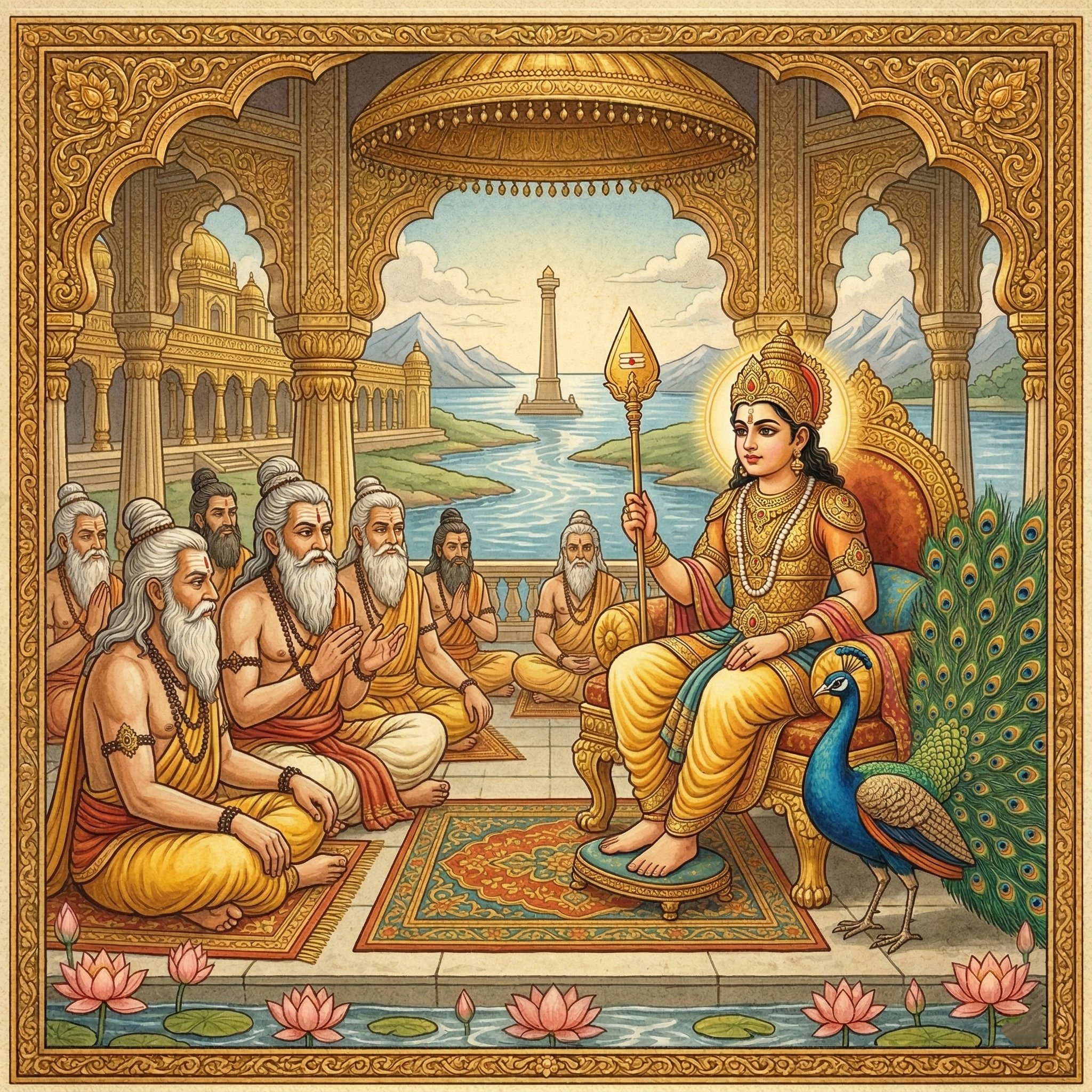
Kaumarika Khanda
Kaumarika Khanda
This section is framed around southern coastal sacred geography (dakṣiṇa-sāgara / southern ocean littoral) and a cluster of five tīrthas presented as potent yet perilous due to aquatic guardians (grāha). The narrative treats the shoreline as a liminal ritual zone where pilgrimage merit, danger, and release (śāpa-mokṣa) converge, and where Kaumāra/Kumāreśa associations mark the region as a site of Skanda-linked sanctity.
Adhyayas in Kaumarika Khanda
66 chapters to explore.
Adhyaya 1
Pañca-Tīrtha Prabhāva and the Grāha-Śāpa Liberation (पञ्चतीर्थप्रभावः ग्राहशापमोचनं च)
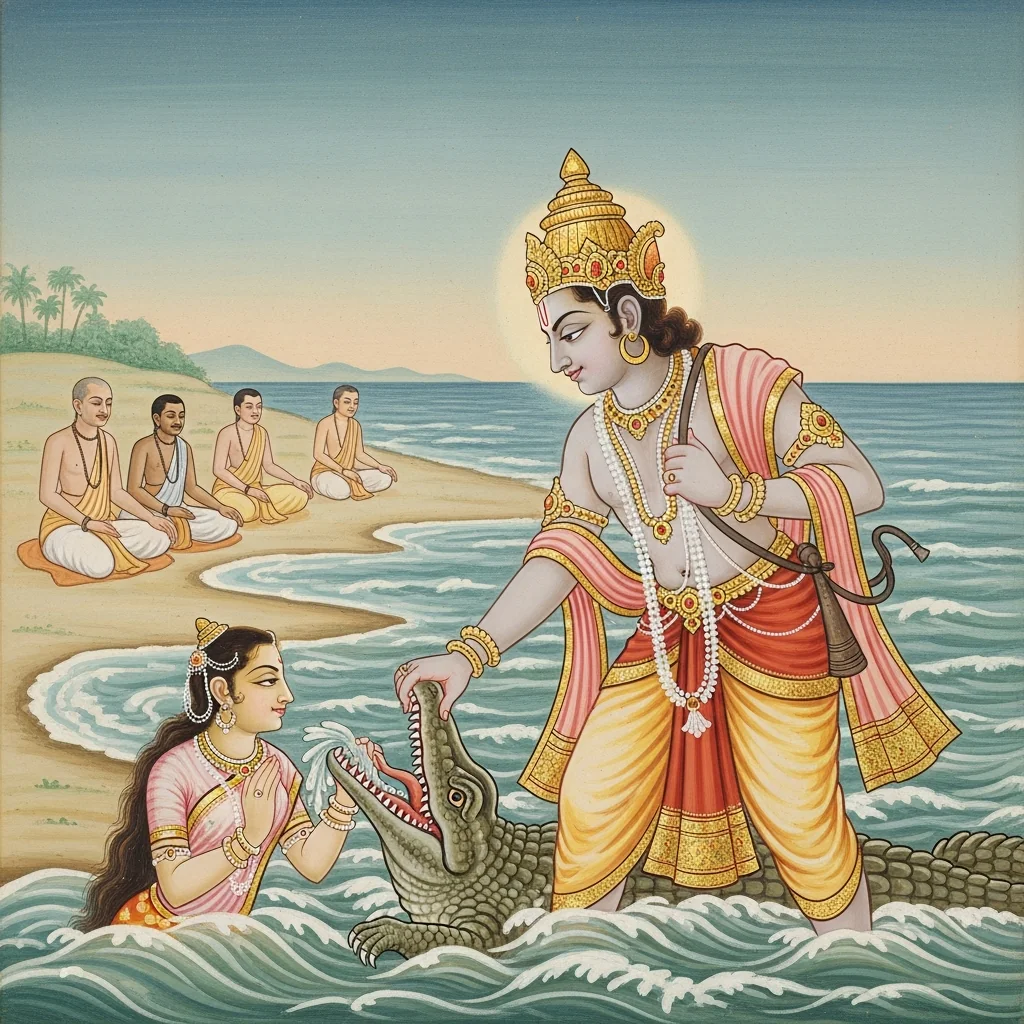
The chapter begins with sages asking about five sacred tīrthas on the southern ocean-shore and the complete merit said to arise from pilgrimage to them. Ugraśravas introduces a holy account centered on Kumāra (Skanda/Kārttikeya), portraying these tīrthas as exceptionally powerful. The royal hero Arjuna/Phālguna reaches the five sites and learns from ascetics that people avoid bathing there because grāhas seize bathers; he insists that the pursuit of dharma must not be blocked by fear. Entering the waters—especially at the Saubhadra tīrtha—he is seized, yet he drags the grāha up by force, whereupon it transforms into an ornamented divine woman, an apsaras. She explains that she and her companions once tried to disturb a brahmin ascetic’s tapas and were cursed to become aquatic grāhas for a fixed term, to be released only when drawn from the water by a great man. The brahmin’s ensuing discourse lays down ethical guidance on desire, household order, and disciplined speech and conduct, contrasting higher and lower ways through vivid moral imagery. Nārada then appears as an authoritative guide, directing the cursed beings to the southern pañca-tīrthas, where Arjuna’s successive baths restore them. The episode ends with Arjuna’s reflective questions about why such obstructions were permitted and why mighty protectors did not prevent them, leading into further explanation.
Adhyaya 2
Nārada–Arjuna संवादः: तीर्थयात्रा-नीतिः, स्थाणु-भक्ति, दानधर्मस्य प्रशंसा
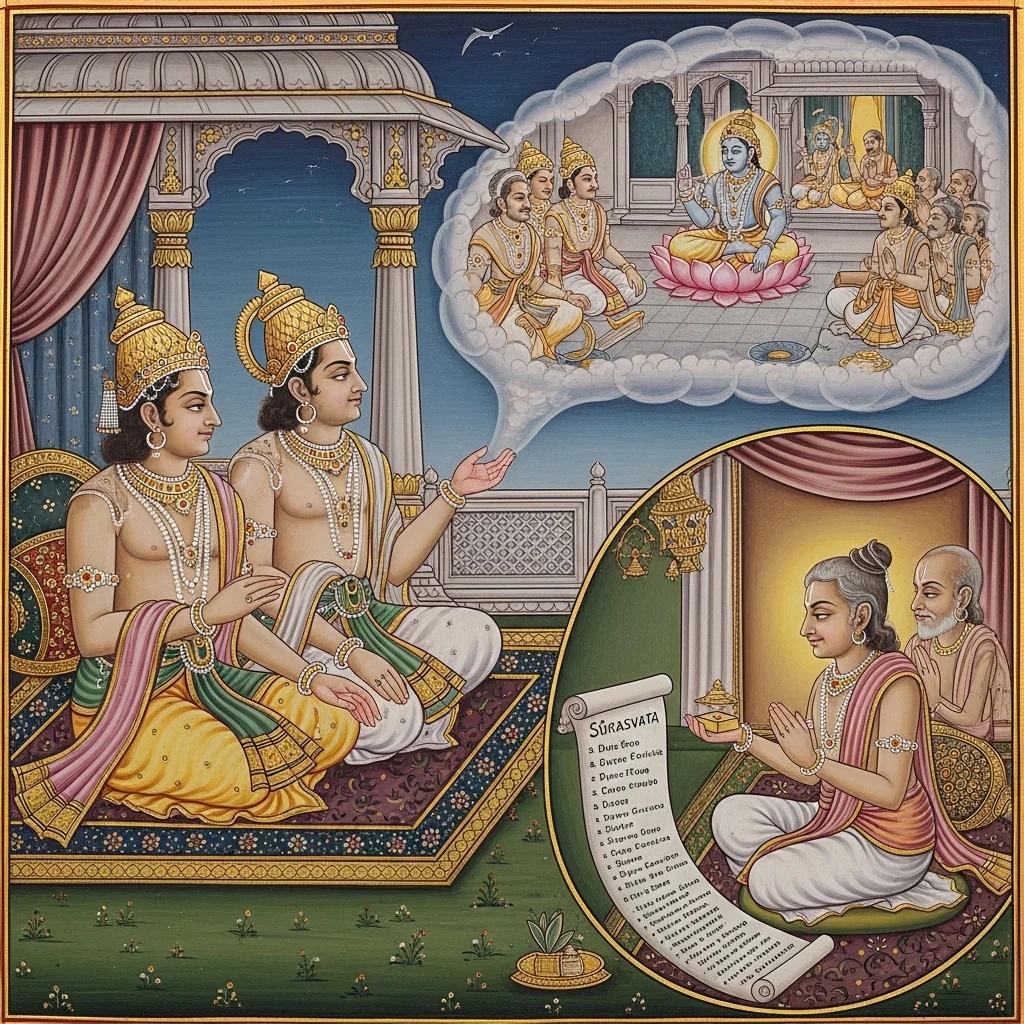
Chapter 2 presents a layered theological dialogue on the ethics of pilgrimage (tīrtha-yātrā) and the discipline of giving (dāna). Sūta recounts Arjuna’s approach to the deva-honored sage Nārada, who praises Arjuna’s dharma-guided intellect and asks whether twelve years of pilgrimage have produced weariness or irritation—thereby stating the central thesis that tīrtha-fruit depends on disciplined use of hands, feet, and mind, not on travel alone. Arjuna affirms the superiority of direct contact with a sacred place and requests the qualities (guṇa) of the present holy setting. Nārada replies by weaving in a cosmographic report: in Brahmaloka, Brahmā questions messengers about wondrous events that bestow merit even by being heard. Suśravas relates Kātyāyana’s inquiry on the bank of the Sarasvatī, where Sārasvata teaches a realistic view of worldly instability and prescribes refuge in “Sthāṇu” (Śiva) through devotion, and especially through dāna. A sustained argument follows: giving is the hardest and most socially verifiable discipline because it requires relinquishing hard-earned wealth; it brings increase rather than loss, serves as a “boat” across saṃsāra, and must be regulated by place, time, the recipient’s worthiness, and purity of mind. Examples of renowned donors reinforce the norm, and the chapter closes with Nārada’s reflection on his own poverty and the practical difficulty of performing dāna, underscoring that ethical intention and discernment are the heart of the practice.
Adhyaya 3
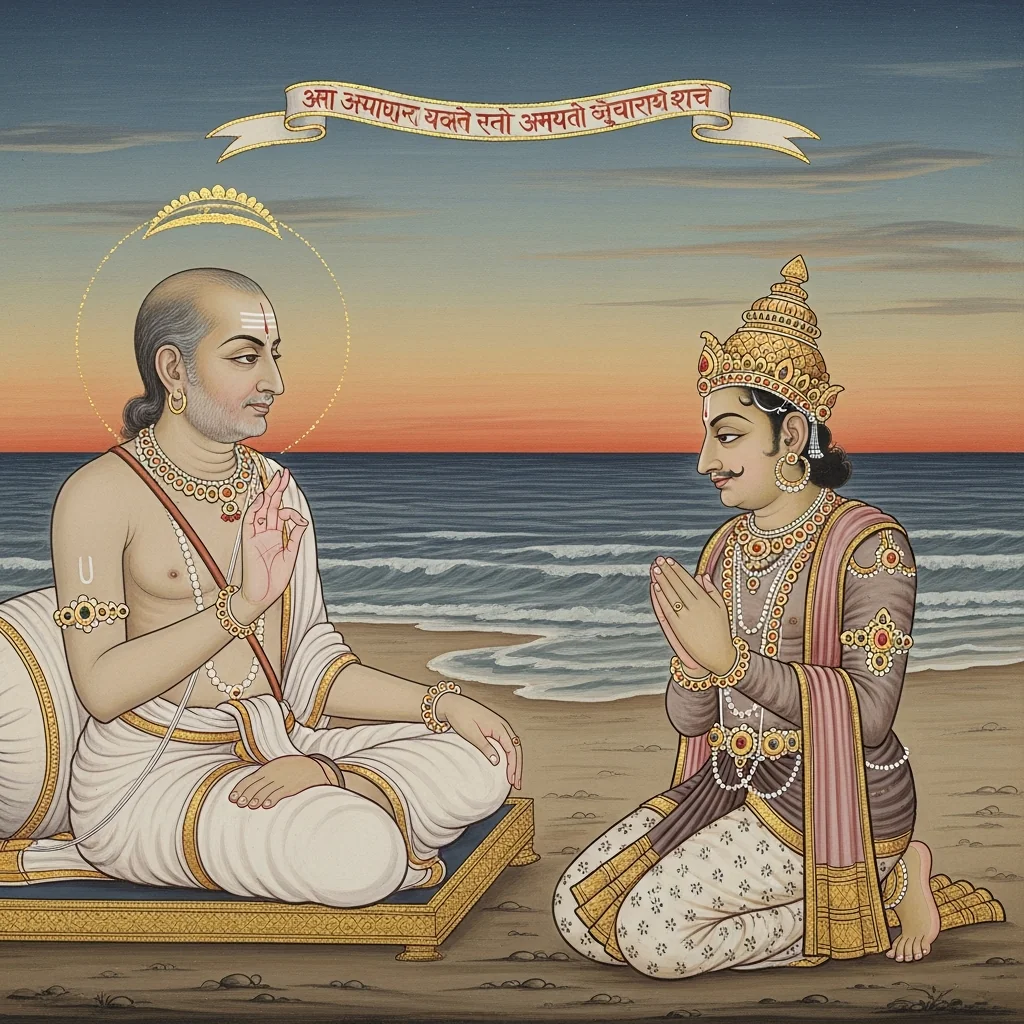
Reva-Śuklatīrtha and Stambha-tīrtha: Pilgrimage Purification and Ancestral Rites (Revā–Mahī–Sāgara Saṅgama Narrative)
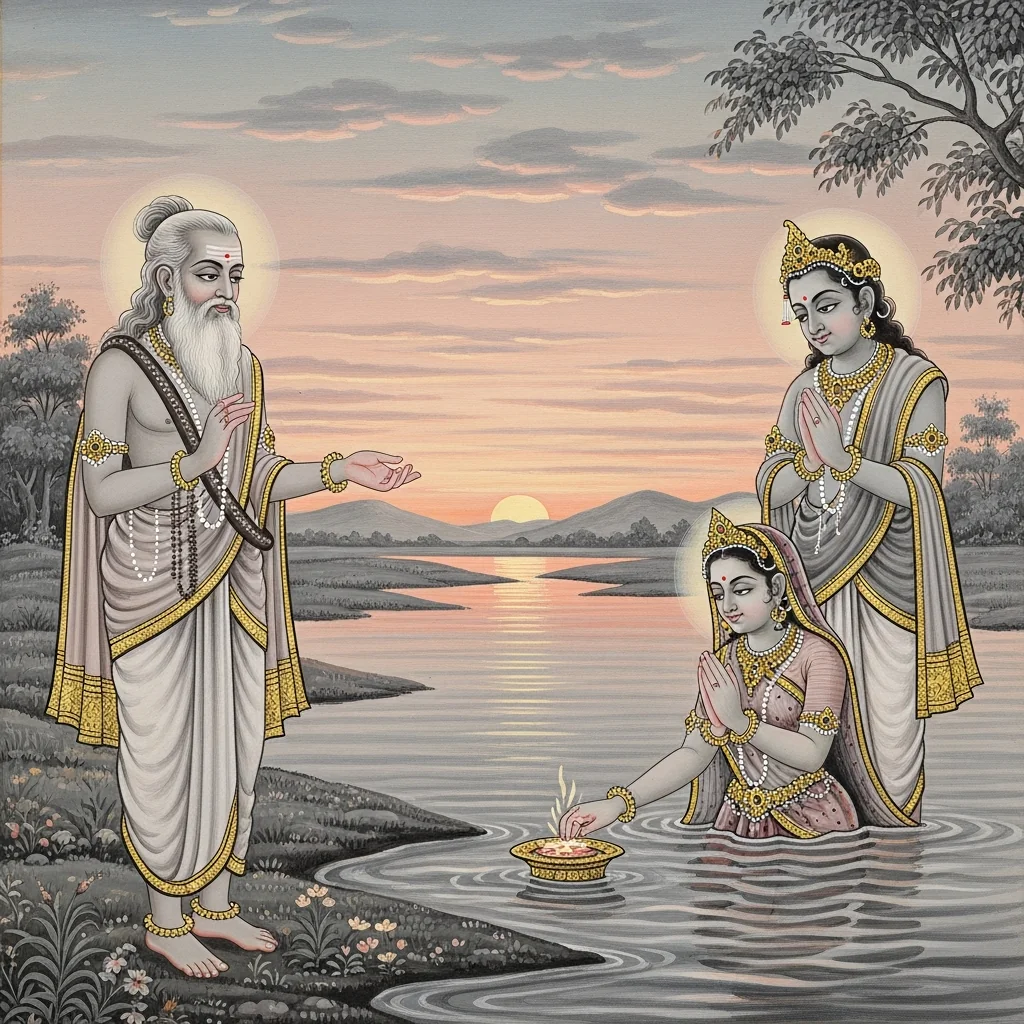
This adhyāya unfolds as Nārada journeys among sacred places and arrives at Bhṛgu’s āśrama beside the Revā, praised as supremely purifying, “embodying all tīrthas,” and powerful through praise—above all through mere sight and ritual bathing. Śuklatīrtha on the Revā is identified as a sin-destroying ford where bathing is said to remove even severe impurity. Bhṛgu then recounts a related tīrtha tradition focused on the Mahī–Sāgara confluence and the renowned Stambha-tīrtha, declaring that wise bathers there are freed from wrongdoing and escape Yama’s realm. An episode follows: Devśarmā, a restrained sage devoted to ancestral offerings at Gaṅgā–Sāgara, learns that Subhadra’s tarpaṇa at the Mahī–Sāgara confluence benefits ancestors more fully; he laments his misfortune and household strife when his wife refuses to travel. Subhadra offers a remedy by performing the śrāddha/tarpaṇa on Devśarmā’s behalf at the confluence, and Devśarmā promises a share of his accumulated ascetic merit. The chapter closes with Bhṛgu’s affirmation of the confluence’s extraordinary sanctity and Nārada’s renewed resolve to witness it and establish its sacred significance.
Adhyaya 4
दानतत्त्व-व्याख्या (Doctrine of Dāna: Intent, Means, and Outcomes) / “Nārada Explains the Taxonomy of Giving”
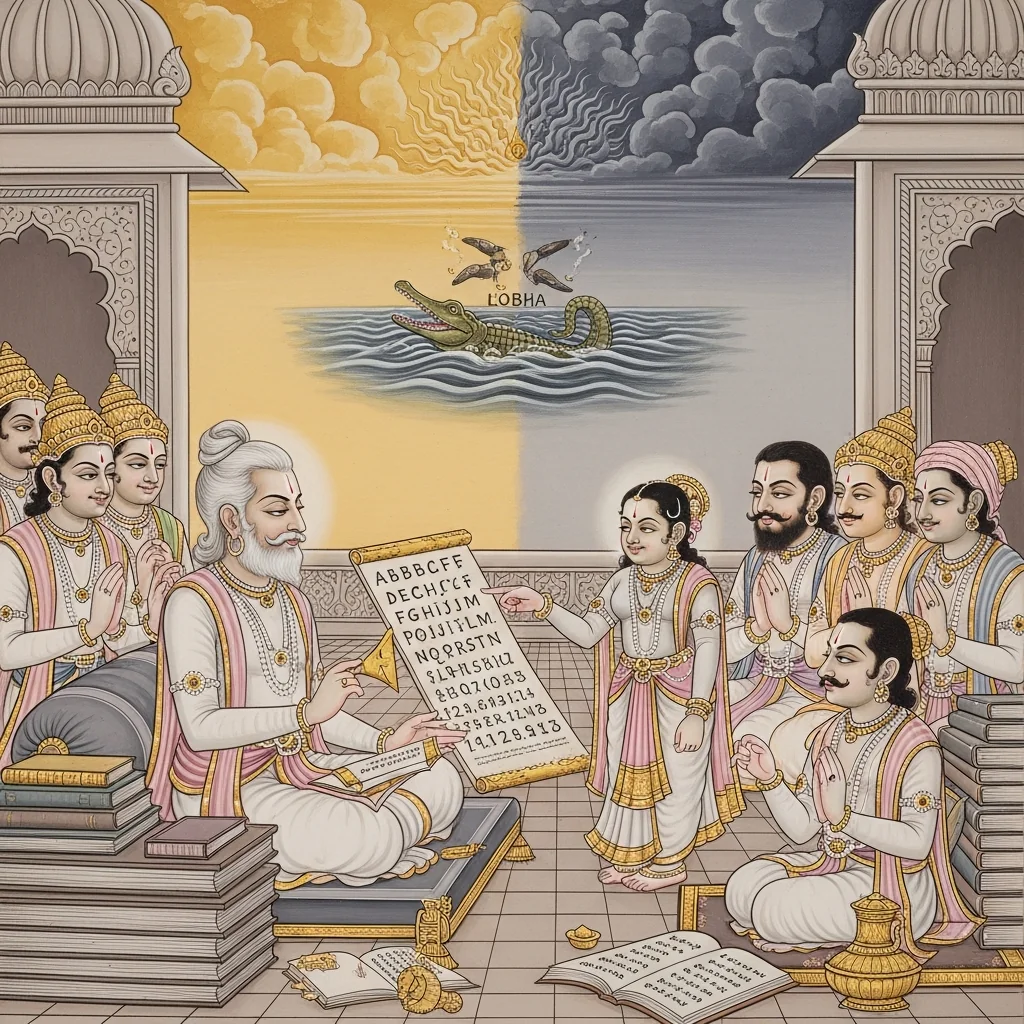
This chapter unfolds as a theological and ethical teaching prompted by Nārada’s practical concern: how to obtain a secure dwelling or estate without falling into morally tainted acceptance (pratigraha). It begins by classifying wealth by moral quality—śukla (pure), śabala (mixed), and kṛṣṇa (dark)—and explains the karmic results of using each for dharma: leading to divine status, human birth, or animal existence. Nārada then recounts a public episode in Saurāṣṭra. King Dharmavarma receives an enigmatic verse on dāna, listing two causes, six bases, six limbs, two “ripenings,” four types, a threefold ranking, and three destroyers of giving, and he offers great rewards for its correct explanation. Disguised as an aged brāhmaṇa, Nārada explains: the two causes are śraddhā (faith) and śakti (capacity); the six bases are dharma, artha, kāma, vrīḍā (modesty), harṣa (joy), and bhaya (fear); and the six limbs include donor, recipient, purity, the gift-object, dharma-intent, and proper place and time. The two “ripenings” distinguish otherworldly and this-worldly fruition according to the recipient’s worth; the four types are dhruva, trika, kāmya, and naimittika; gifts are graded as superior, middling, or minor; and giving is ruined by regret after giving, giving without faith, and giving with insult. The chapter ends with the king’s gratitude, Nārada’s self-revelation, and Dharmavarma’s readiness to grant land and wealth for Nārada’s stated sacred purpose.
Adhyaya 5
Adhyāya 5: Nārada’s Search for Worthy Recipients and Sutanu’s Doctrinal Replies (Mātṛkā–Gṛha–Lobha–Brāhmaṇa-bheda–Kāla)
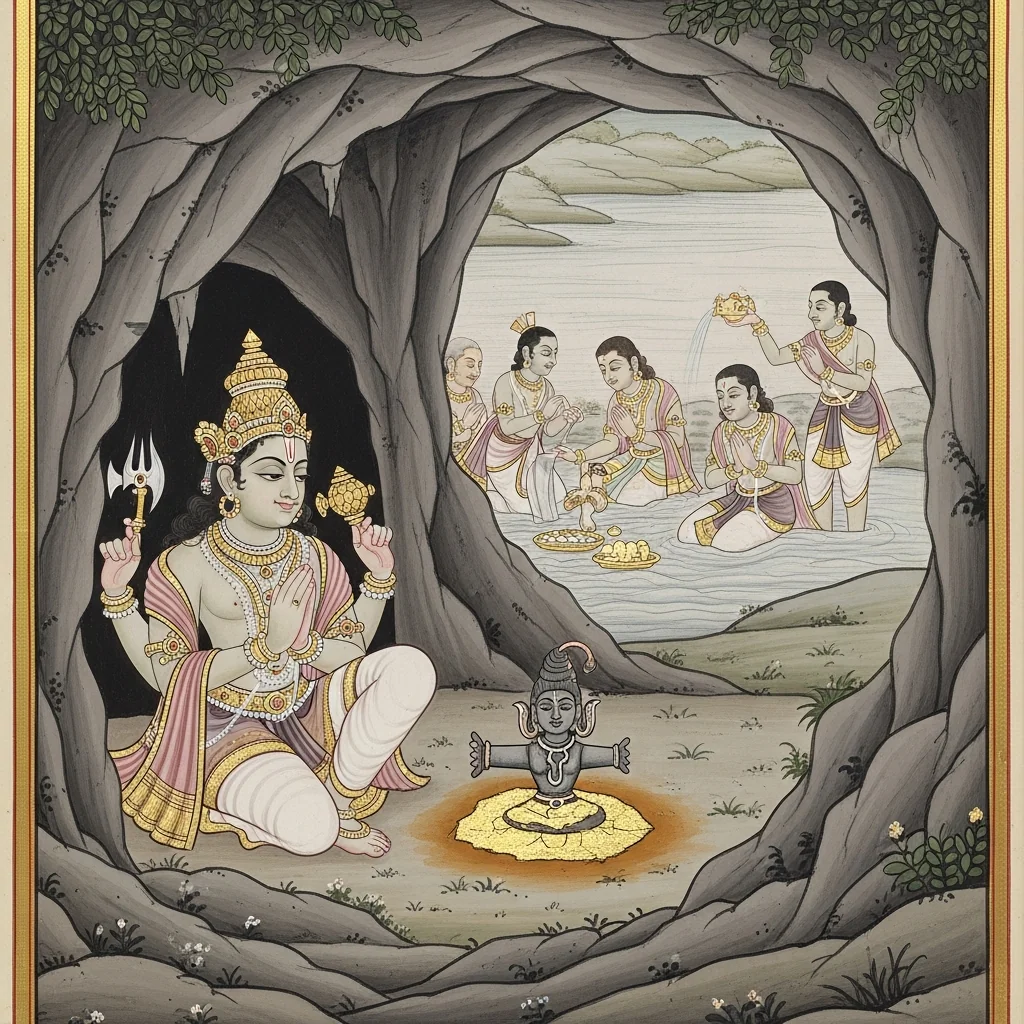
The chapter begins with Nārada setting out toward Mount Raivata, resolved to act “for the sake of brāhmaṇas,” and thus frames an ethical inquiry into dāna (giving) and the fitness of recipients (pātratā). Didactic verses condemn gifts made to the unworthy and warn that an undisciplined or unlearned brāhmaṇa cannot “carry others across,” like a rudderless boat. Proper giving is then defined by right place, time, means, substance, and faith, with pātratā grounded in learning joined to conduct. Nārada poses twelve testing questions and travels to Kalāpagrāma, a great settlement filled with āśramas and śruti-trained brāhmaṇas engaged in debate. Though they deem the questions easy, a child named Sutanu answers them systematically. Sutanu lists the mātṛkā (phonemic set) including oṃkāra, interprets oṃ as A–U–M with the transcendent half-mātrā as Sadāśiva, explains the “five-times-five wondrous house” as a tattva-schema culminating in Sadāśiva, identifies the “many-formed woman” as buddhi, and the “great sea-creature” as lobha (greed) with its moral consequences. He further sets out an eightfold hierarchy of brāhmaṇas by learning and discipline and names calendrical junctures (yugādis, manvantarādis) linked to imperishable merit. The chapter closes by urging life-planning through reflective action, recalling the two paths (arcis and dhūma) from Vedānta, and rejecting ways that deny devas and dharma against śruti-smṛti norms.
Adhyaya 6
Brahmaṇa-parīkṣā, ‘Caurāḥ’ as Inner Vices, and Cira-kārī Upākhyāna (Testing of Brahmins; inner ‘thieves’; the parable of deliberate action)
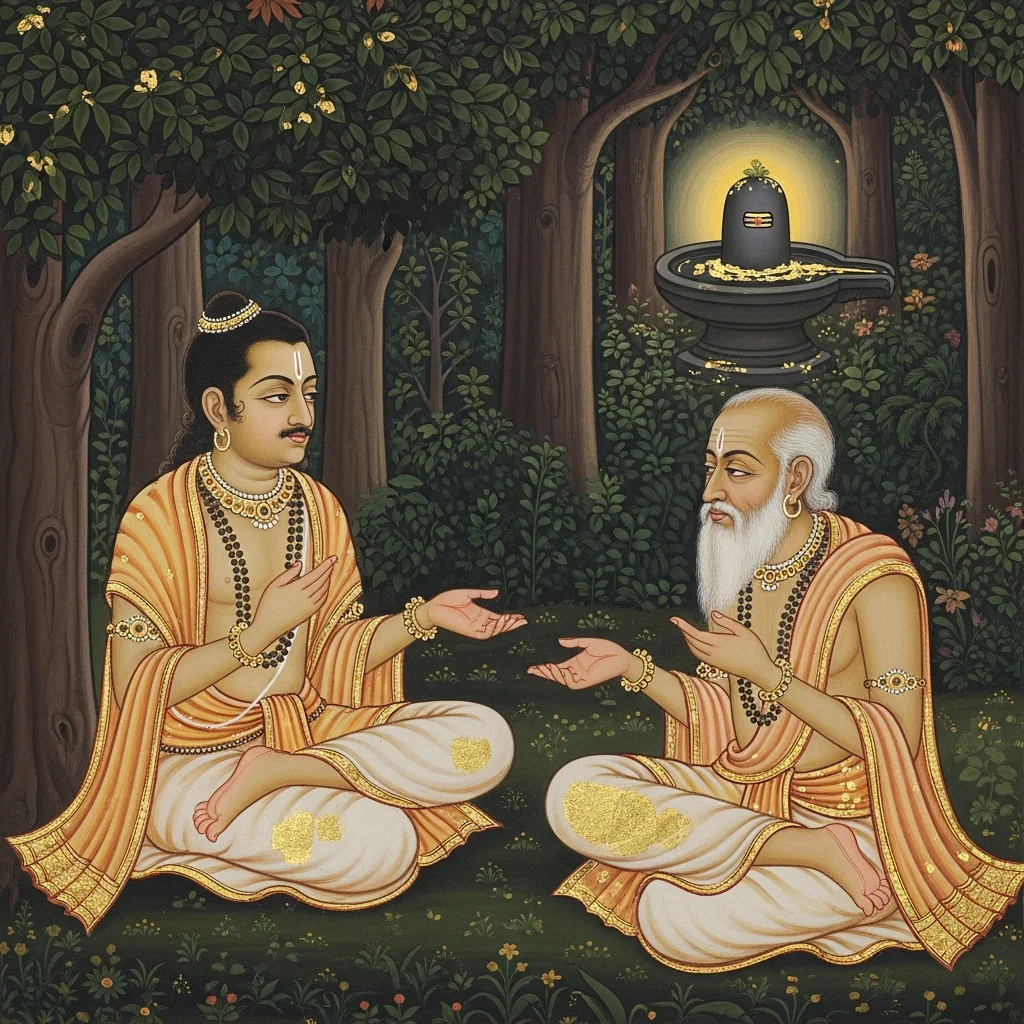
This chapter unfolds as a reverent dialogue: Nārada meets Brahmins led by Śātātapa and others. After mutual honor and inquiry, Nārada states his aim—to found an auspicious Brahmin seat near a mahātīrtha at the earth–ocean confluence and to test the Brahmins’ fitness. When “thieves” at the site are feared, the teaching redefines them as inner foes—kāma, krodha, and the like—who can steal the “wealth” of tapas through negligence. A technical travel-and-practice section follows, giving routes from Kedāra toward Kalāpa/Kalāpaka and a method for passing through a cave (bila). Worship of Guha/Skanda, a dream-command motif, and ritual use of sacred earth and water as ocular unguent and bodily application enable perception of the passage and its traversal. The narrative returns to the confluence with collective bathing, tarpaṇa rites, japa, and contemplation, and a divine assembly is described. An episode of hospitality then appears: Kapila requests Brahmins to arrange a land-gift, underscoring atithi-dharma and the consequences of neglect. From dispute and reflection on anger and haste, the Cira-kārī exemplum is introduced: a son delays carrying out a rash paternal command and thereby averts grave sin, praising deliberation in difficult actions. The chapter closes with warnings about the potency of curses in Kali-yuga, consecratory acts, and divine ratification of the newly established sacred place(s).
Adhyaya 7
Indradyumna-Kīrti-Punaruddhāraḥ (Recovery of Indradyumna’s Fame) and Nāḍījaṅgha’s Account of Ghṛtakambala-Śiva Worship
Arjuna questions Nārada after hearing earlier praise, asking for a fuller account of a crisis afflicting the earth and the deeper origin it suggests. Nārada introduces the model king Indradyumna, renowned for generosity, knowledge of dharma, and vast public works and gifts. Though his merit is immense, Brahmā commands him to return to earth: merit alone cannot uphold one’s heavenly standing without an unblemished, widely diffused fame across the three worlds (niṣkalmaṣā kīrti), for time (kāla) erodes remembrance. Indradyumna descends to find his name forgotten, seeks a long-lived witness, and is directed to Mārkaṇḍeya at Naimiṣāraṇya. Mārkaṇḍeya too cannot recall him, but points to his ancient friend Nāḍījaṅgha. Nāḍījaṅgha likewise does not remember Indradyumna, and explains his extraordinary longevity through a layered account: childhood wrongdoing involving a Śiva-liṅga set in a ghee vessel; later repentance and renewed worship by covering liṅgas with ghṛta, gaining Śiva’s favor and gaṇa-status; then a fall through pride and desire, an attempted abduction of the ascetic Gālava’s wife, a curse to become a crane (baka), and a mitigation—he will help restore a hidden reputation and thus share in Indradyumna’s eventual liberation. The chapter weaves kingship ethics, the metaphysics of time and fame, and the teaching that devotion must be joined to moral restraint.
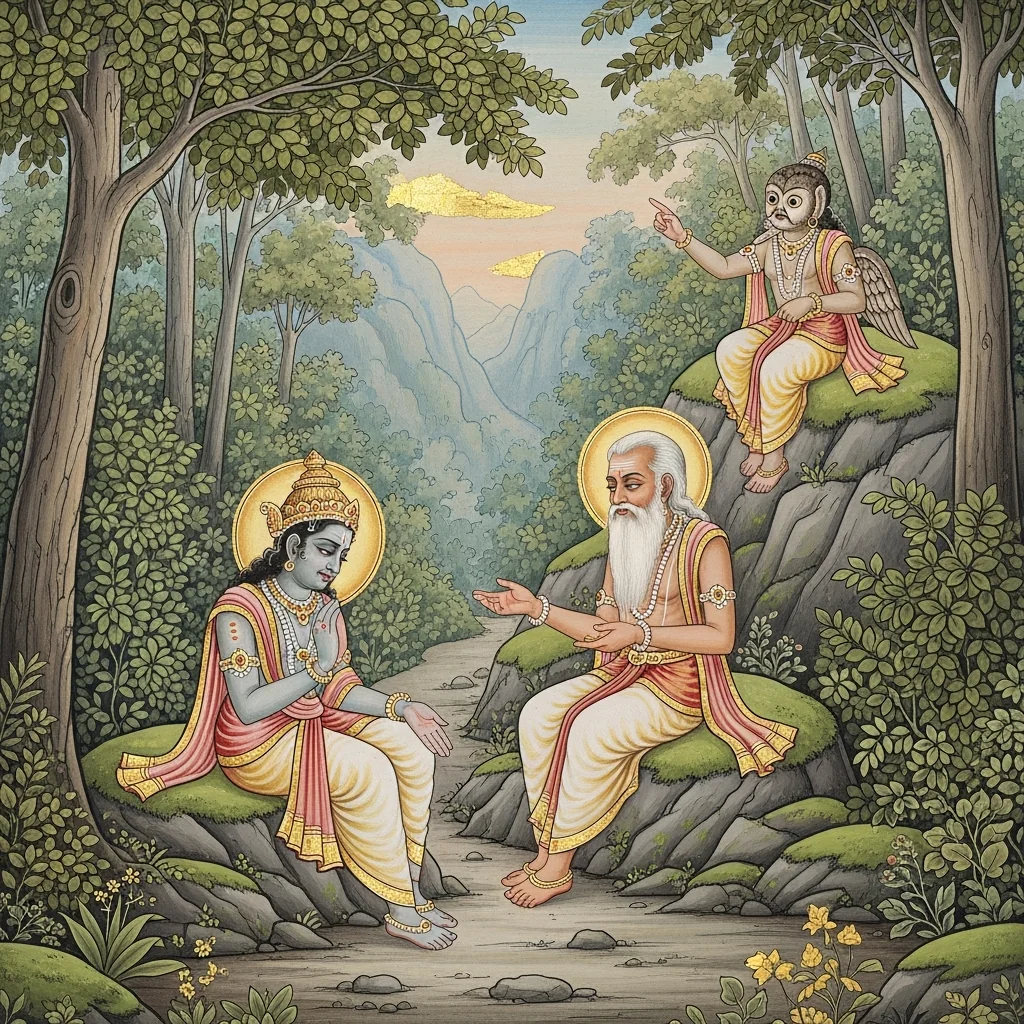
Adhyaya 8
अखण्डबिल्वपत्रार्चन-दीर्घायुः शापकथा च (Unbroken Bilva-Leaf Worship, Longevity, and the Curse Narrative)
Chapter 8 unfolds a multi-voiced theological discussion on moral duty and the power of devotion. Nārada describes a king (with Indradyumna as the reference point) shaken after hearing a harsh pronouncement attributed to Mārkaṇḍeya. The dialogue elevates satya (truthfulness) and mītra-dharma (the ethics of friendship): once a vow or promise is given, it is morally binding even at personal cost, and exemplars of truth-commitment sharpen the ethical stakes. Turning away from self-immolation, the group chooses a practical pilgrimage toward Śiva’s realm, traveling to Kailāsa and consulting an owl named Prākārakarṇa. The owl—formerly a brāhmaṇa called Ghaṇṭa—explains that his extraordinary longevity arose from worship of Śiva through unbroken offerings of bilva leaves and tri-kāla (three-times) devotion. Śiva then appears and grants a boon. The narrative pivots to a social-ethical rupture: a forced gandharva-style marriage results in a curse that transforms him into an owl, with the label “night-roamer” newly interpreted. The curse carries a condition for restoration—helping to identify Indradyumna becomes the trigger to regain his original form. Thus the chapter braids ritual instruction (bilva-leaf liṅga-pūjā), karmic causality (boon and curse), and normative ethics (promise-keeping, marriage norms, and accountability).
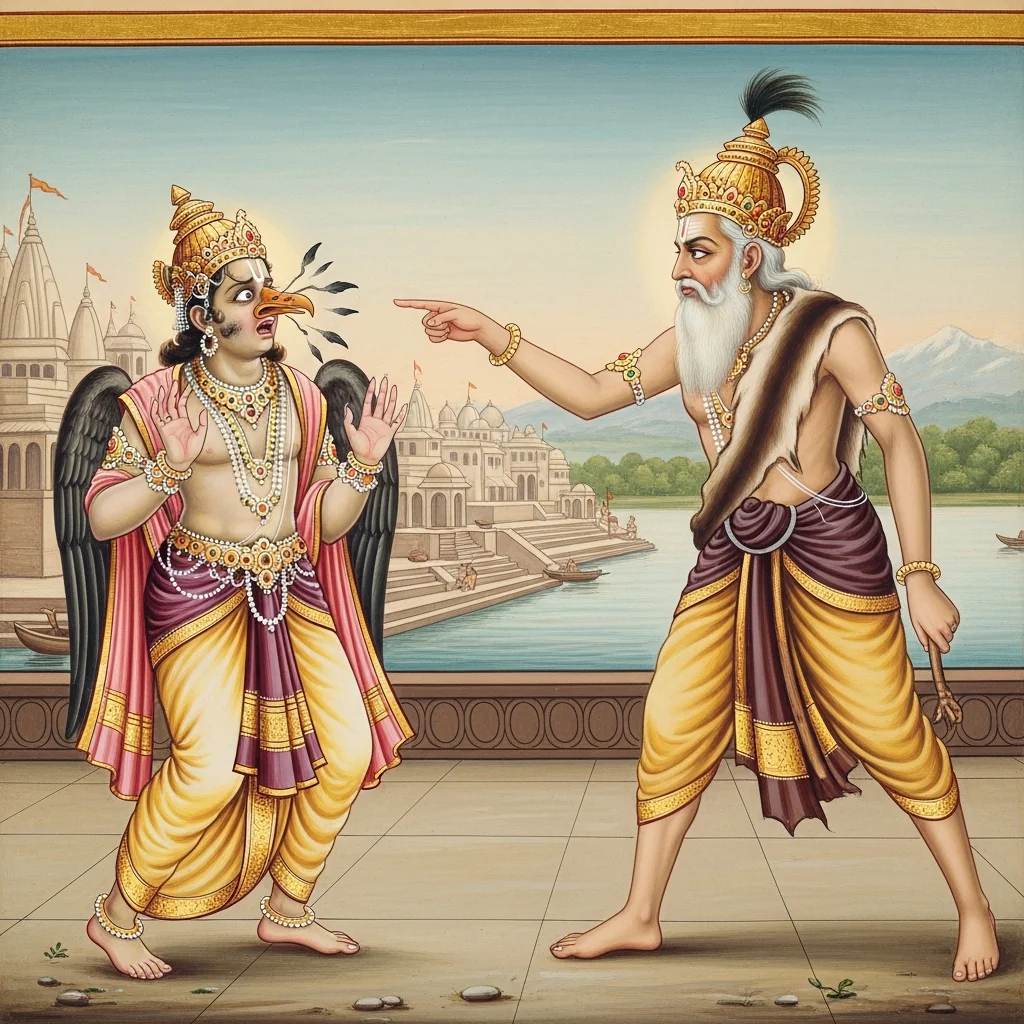
Adhyaya 9
इंद्रद्युम्नपरिज्ञानोपाख्यानम् (The Inquiry into King Indradyumna: Friendship, Vow, and the Gṛdhra’s Past)
Chapter 9 unfolds as a dialogue-centered episode, framed as an ethical and theological case. After the causes rooted in former births (pūrvajanma-samudbhava) have been explained, Nāḍījaṅgha grieves that the party’s aim—recognizing or finding King Indradyumna—remains unfulfilled, and he proposes an extreme act: entering the fire together with his companions, claiming it as loyalty to a friend and the completion of a vowed duty. Ulūka restrains him and points to another course: on Mount Gandhamādana lives a long-lived vulture (gṛdhra), a beloved companion, who may know the sought identity. The group approaches the vulture, but it admits that through many kalpas it has neither seen nor heard of Indradyumna, deepening their sorrow and prompting further inquiry. The vulture then recounts its own former-life story: once a restless monkey, it inadvertently took part in Śiva’s dāmanaka festival, involving a golden swing and a liṅga; beaten by devotees, it died at the shrine and was reborn as Kuśadhvaja, son of the lord of Kāśī, later devoted to Śiva through dīkṣā and yogic discipline. Later, inflamed by desire, it abducted Agniveśya’s daughter and was cursed into becoming a gṛdhra, with release promised only when it helps in the recognition of King Indradyumna. Thus the chapter weaves together friendship ethics, the logic of vows, ritual-festival merit, and the conditional workings of curse and liberation.
Adhyaya 10
Indradyumna–Mantharaka-saṃvādaḥ (Dialogue of Indradyumna and the Tortoise Mantharaka)
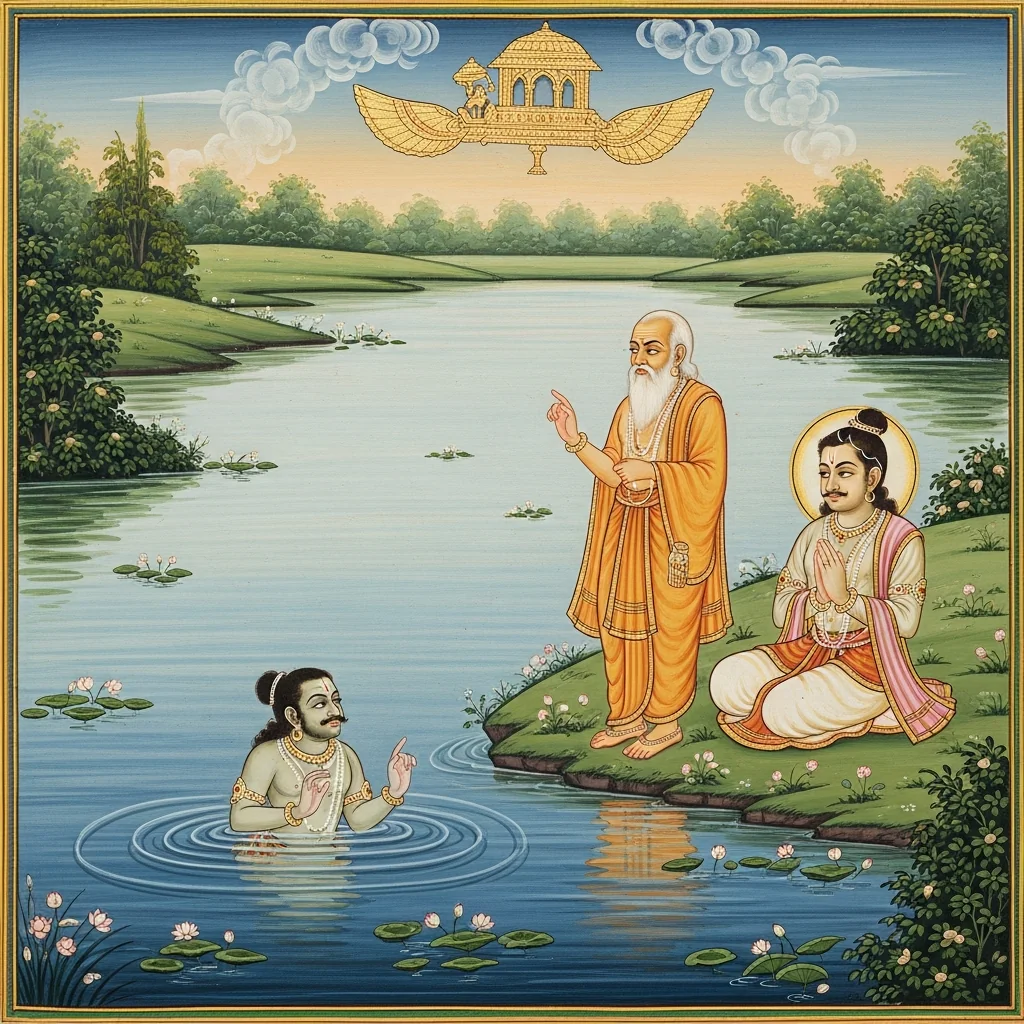
Led by Nārada’s narration, King Indradyumna—grieved and astonished—questions a vulture’s words and seeks the cause of his impending death. The party goes to the famed mānasa-saras to consult the tortoise Mantharaka, renowned for knowing hidden matters. Seeing them approach, Mantharaka withdraws into the water; the sage Kauśika rebukes this as a breach of ātithya-dharma, affirming the sacred duty of honoring guests and condemning guest-aversion as sin. Mantharaka replies that he understands hospitality, yet fears Indradyumna: at an earlier sacrifice in Raucaka-pura his back was burned by the sacrificial fire, and the wound still remains, so he dreads being burned again. As he speaks, flowers rain from the sky and divine music resounds, openly attesting that the king’s kīrti has been restored. A celestial chariot appears, and a devadūta invites Indradyumna to Brahmaloka, teaching that one abides in heaven only so long as one’s fame endures on earth, and linking merit to pūrta works such as tanks, wells, and gardens. Valuing loyalty and friendship, Indradyumna asks that his companions accompany him; the envoy explains they are fallen Śiva-gaṇas awaiting the end of a curse and desire no heaven apart from Mahādeva. The king refuses a heaven shadowed by fear of falling again, choosing instead alignment with Śiva’s retinue. He then asks the tortoise the secret of his long life; Mantharaka introduces a “divine, sin-destroying” Śiva-mahātmya and its phalaśruti, declaring that faithful listening purifies, and that his own longevity and tortoise-form arise from the grace of Śambhu.
Adhyaya 11
Kūrma’s Past-Life Account: Śiva-Temple Merit, Ethical Lapse, and the Curse into Tortoisehood
The chapter is framed as a retrospective theological and ethical account spoken by Kūrma to King Indradyumna. It opens with a childhood memory: as the brāhmaṇa Śāṇḍilya, the speaker builds a rain-season Śiva shrine of sand and clay in a pañcāyatana arrangement, and worships the liṅga with flowers, song, and dance in heartfelt devotion. The narrative then moves across successive births, praising steadfast Śiva-bhakti, initiation (dīkṣā), and temple-building as supreme merits, reinforced by phala-statements on the rewards of constructing Śiva’s abodes in various materials. A decisive reversal follows: after receiving the extraordinary boon of agelessness, the devotee-turned-king Jayadatta becomes ethically careless and violates dharma by pursuing others’ spouses, which the text names as the chief cause for the collapse of lifespan, austerity, fame, and prosperity. Yama appeals to Śiva over this disruption of dharma, and Śiva responds with a curse that makes the offender a tortoise (kūrma), while also appointing release in a future kalpa. The chapter weaves in cosmological memory—yajña-related burn marks on the tortoise’s back—along with tīrtha-like purifying references, and ends with Indradyumna’s resolve toward discernment and renunciation as he seeks instruction from the long-lived sage Lomaśa, affirming satsanga as superior even to tīrtha.
Adhyaya 12
कूर्माख्यानम् (Kūrmākhyāna) — The Discourse on Kūrma and the Teaching of Lomaśa
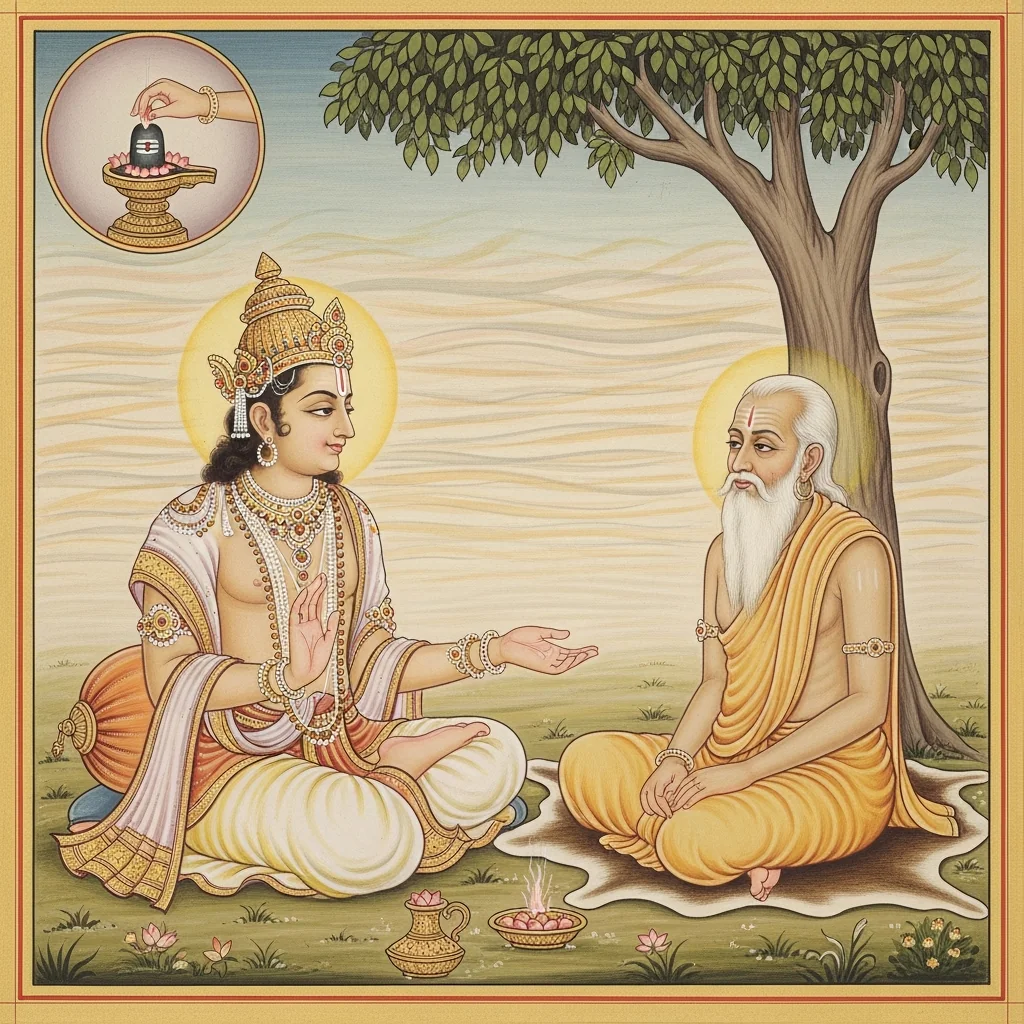
This chapter unfolds as a multi-voiced theological dialogue framed by Nārada’s narration. A party including King Indradyumna meets a great ascetic aligned with the “Maitra” path—non-violence and disciplined speech—whose sanctity commands reverence even from animals. Kūrma introduces Indradyumna as a ruler seeking restored renown and spiritual benefit, not heaven, and asks Lomaśa to guide him as a disciple. Lomaśa replies with an extended meditation on mortality, criticizing worldly building and attachment—house, comfort, youth, wealth—since impermanence makes such pursuits unstable. Indradyumna then asks about Lomaśa’s extraordinary longevity, and Lomaśa recounts a former-life cause: once poor, he performed a single sincere act of bathing the Śiva-liṅga and worshiping with lotuses, leading to rebirth with memory and a life of ascetic devotion. Śiva granted him not absolute immortality but a lifespan extended within cosmic cycles, signaled by periodic loss of body-hair as time draws near. The chapter concludes by affirming the accessibility and purifying power of Śiva worship—lotus pūjā, japa of the praṇava (Om), and bhakti—able to cleanse even grave sins. It also lists “rarities” such as human birth in Bhārata and devotion to Śiva to sharpen ethical urgency. The closing rahasya declares Śiva-pūjā the chief practical teaching and the safest refuge in a transient world.
Adhyaya 13
Mahī–Sāgara-saṅgama Māhātmya and the Indradyumneśvara Liṅga (महीसागर-संगम-माहात्म्य एवं इन्द्रद्युम्नेश्वर-लिङ्ग)
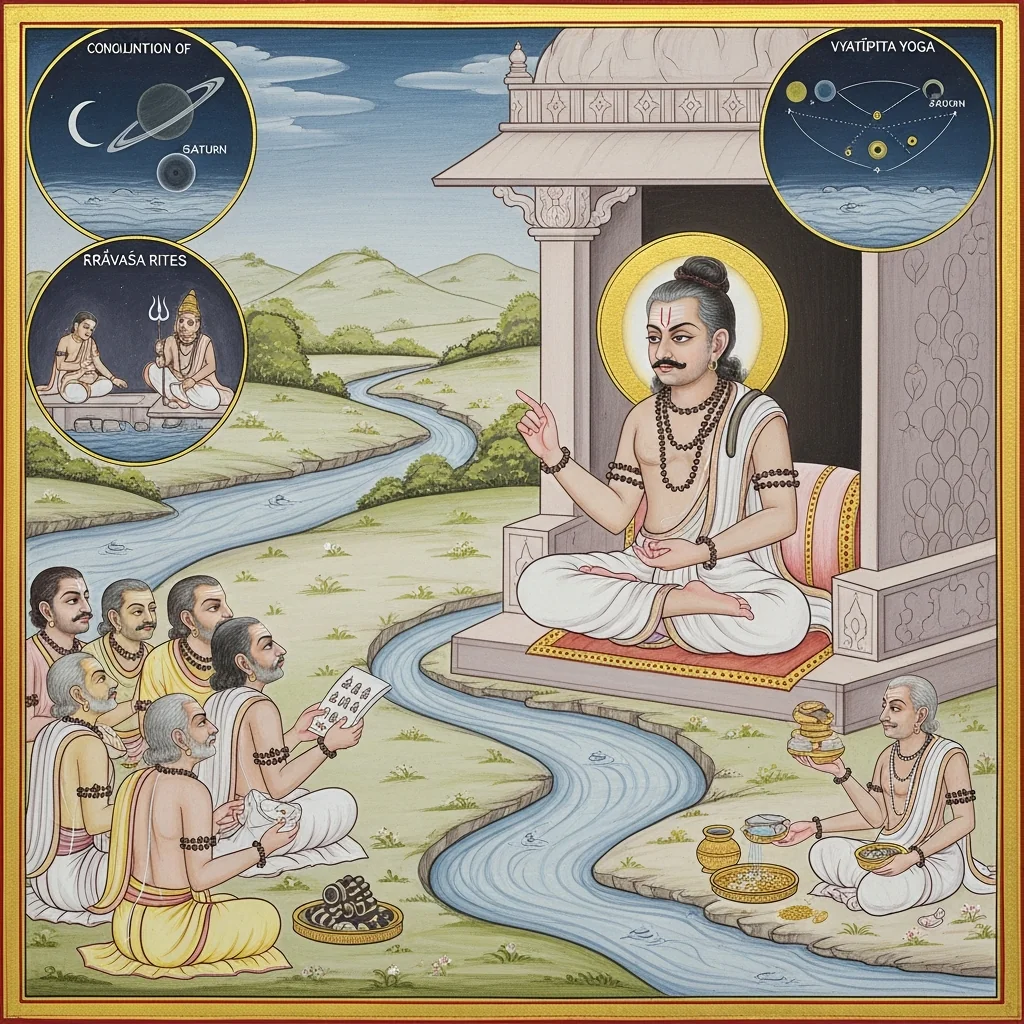
This adhyāya unfolds as a multi-voiced theological discourse, moving from personal devotion to the sanctification of place and the laying down of ritual observances. It opens with a king’s resolve to remain near the sage Loṃaśa and to receive Śiva-dīkṣā for liṅga-worship, while sat-saṅga (holy company) is praised as greater even than tīrtha. A group of beings—especially in bird/animal forms—seek release from a curse and ask for a site that grants the fruit of all tīrthas. Nārada directs them to consult the yogin Saṃvarta in Vārāṇasī, giving a distinctive sign by which he may be recognized on the road at night. Saṃvarta proclaims the supremacy of Mahī–Sāgara-saṅgama, extols the sanctity of the Mahī river, and declares that bathing and allied rites there equal or surpass the merits of famed places such as Prayāga and Gayā. The chapter also supplies calendrical and ritual-technical details: amāvāsyā occurring with Śani, special yogas like vyatīpāta; offerings to Śani and Sūrya; arghya-mantras; and a juridical-style truth-test rite involving raising the right hand from water. Through the extended Yājñavalkya–Nakula exchange, harsh speech is censured and ethical discipline is upheld, teaching that learning without restraint is inadequate. The narrative culminates in the installation and naming of the liṅga as Indradyumneśvara (also linked with Mahākāla), with Śiva’s direct boon promising sāyujya/sārūpya-like attainments to devotees and affirming the confluence’s exceptional salvific power.
Adhyaya 14
कुमारेश्वर-माहात्म्यप्रश्नः तथा वज्राङ्गोपाख्यान-प्रस्तावः (Inquiry into the Glory of Kumāreśvara and Prelude to the Vajrāṅga Narrative)
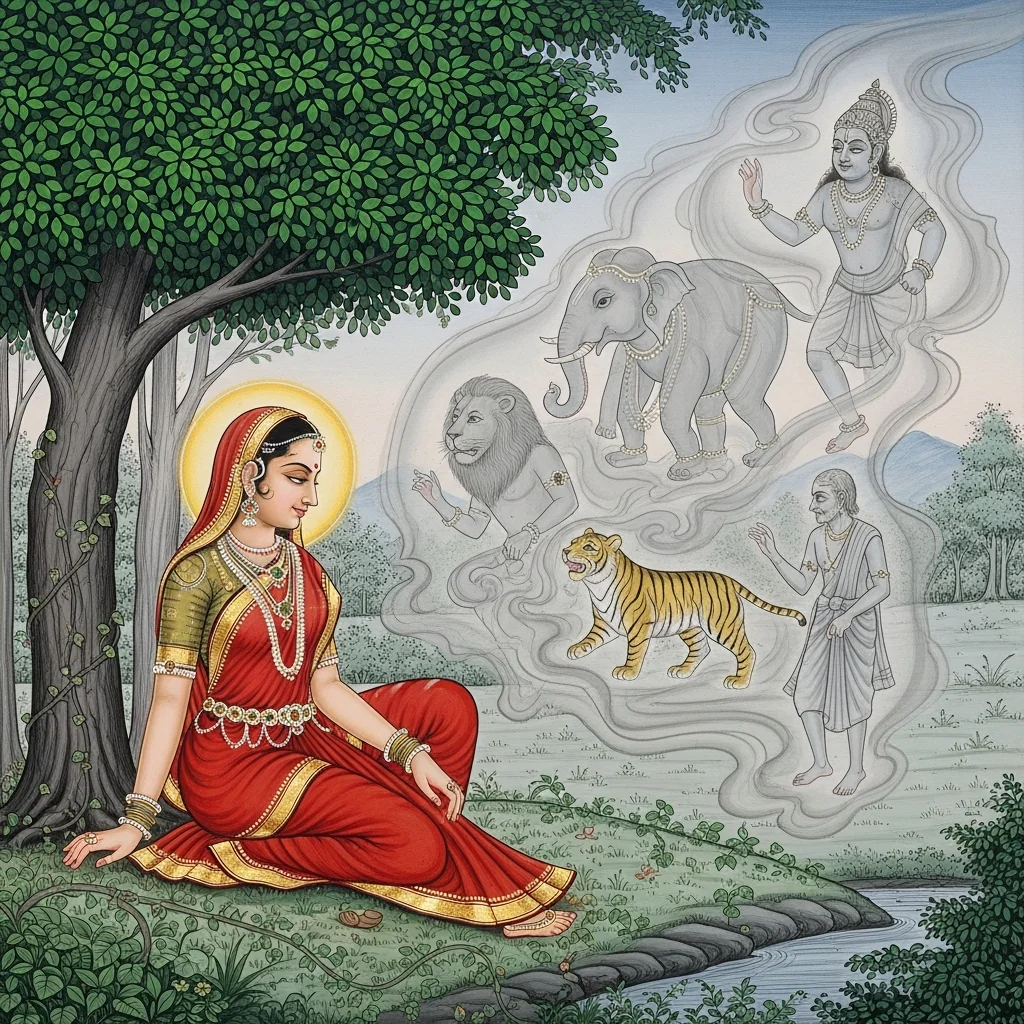
Chapter 14 begins with Arjuna’s well-ordered inquiry, requesting a fuller and more accurate account of the māhātmya (sacred glory) of Kumāranātha/Kumāreśvara and the origins of the figures connected with Him. Nārada replies first by affirming the purifying power of approaching Kumāreśvara through darśana (holy sight), śravaṇa (hearing), dhyāna (meditation), pūjā (worship), and Vedic-style reverence, so the chapter serves as both theological teaching and ritual-ethical guidance. The narration then widens into genealogy and cosmology: Dakṣa’s daughters, their bestowal upon Dharma, Kaśyapa, Soma, and others, and the divine and semi-divine lineages that arise. This framework supports the asura line: Diti’s loss of sons, her tapas (austerity), Indra’s intervention that brings forth the Maruts, and Diti’s renewed plea for a formidable son. Kaśyapa grants the boon, and Vajrāṅga is born with a vajra-like, indestructible body. Vajrāṅga’s conflict with Indra culminates in an ethic of restraint: Brahmā counsels that true heroism lies in releasing an enemy who comes as a supplicant, turning Vajrāṅga from sovereignty toward tapas. Brahmā also provides him a spouse, Varāṅgī, and the chapter describes prolonged ascetic practice and her steadfast endurance amid Indra’s attempts to break her vow—highlighting kṣamā (forbearance), firmness, and tapas as the highest “wealth.” The chapter closes with Vajrāṅga consoling his distressed wife, affirming household ethics alongside ascetic ideals, while keeping the larger trajectory aimed toward Kumāreśvara-related outcomes promised by Arjuna’s opening questions.
Adhyaya 15
Tārakotpattiḥ, Tapasā Vara-prāptiś ca (Birth of Tāraka and the Boon Earned through Austerity)
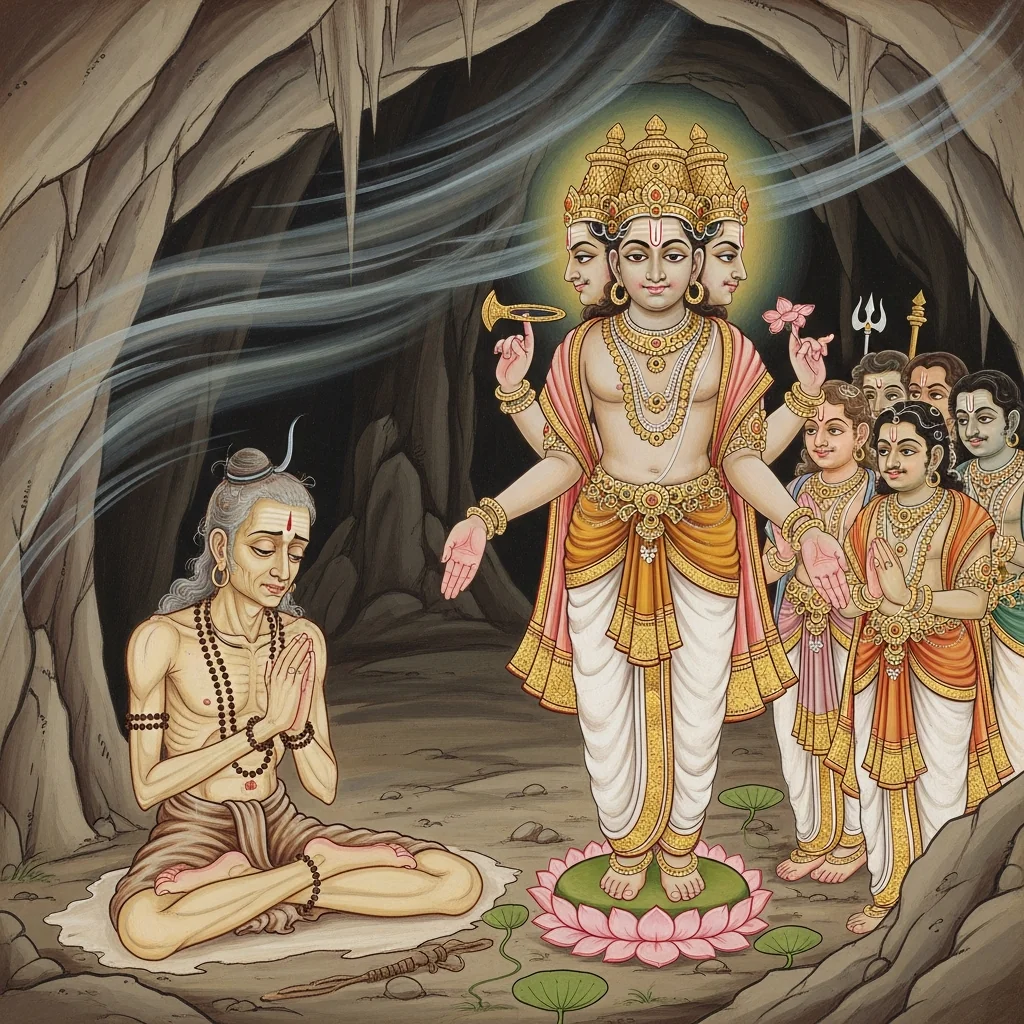
Chapter 15 unfolds a key causal chain in the Kaumāra myth-cycle: suffering gives rise to supplication, supplication awakens dharmic moral reflection, and reflection drives tapas (austerity) that reshapes cosmic power. Varāṅgī laments abandonment and torment, praying for a son who will end her fear and humiliation. The Daitya leader, though cast as asuric, voices a normative defense of marital duty: the wife is honored through dharma-marked roles—jāyā, bhāryā, gṛhiṇī, kalatra—and neglect of an afflicted spouse is declared morally perilous. Brahmā intervenes to temper extreme ascetic resolve and grants assurance of a mighty son named Tāraka. Varāṅgī bears the embryo for a thousand years; Tāraka’s birth is accompanied by cosmic disturbances, signaling world-level consequence. Installed as asura sovereign, Tāraka adopts a strategy: first harsher tapas, then conquest of the devas. At Pāriyātra he receives Pāśupata dīkṣā, repeats five mantras, performs prolonged austerities including self-mutilating oblations, and terrifies the gods by the radiance of his ascetic power. Though pleased, Brahmā—bound by the doctrine of mortality—refuses absolute invulnerability. Tāraka negotiates a conditional boon: he may be slain only by a child older than seven days, a tightly defined vulnerability that foreshadows the Kaumāra resolution. The chapter closes with imagery of Tāraka’s prosperous, courtly rule and the consolidation of his dominion.
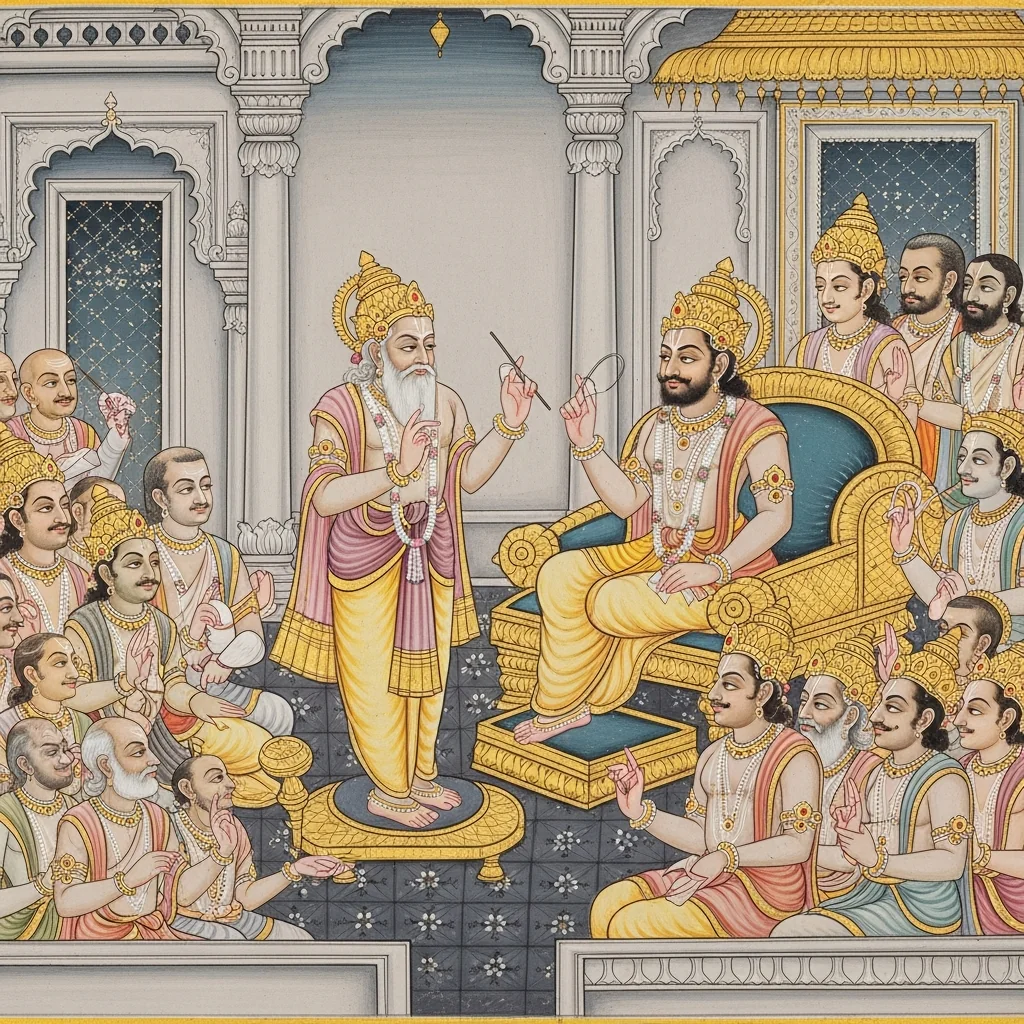
Adhyaya 16
Tāraka’s Mobilization and Bṛhaspati’s Nīti: The Deva–Asura War Preparations (तारक-सेनासंयोजनं बृहस्पति-नीतिविचारश्च)
This adhyāya portrays a two-sided escalation before the great deva–asura clash. Tāraka first laments human moral decline, calling sovereignty bubble-like and impermanent, and warning that intoxication with pleasures—women, dice, and drink—destroys “pauruṣa,” the steadfast power to act. He then commands swift war preparations to seize the gods’ tri-worldly prosperity, specifying a grand chariot and ornate insignia. Nārada reports the asura response: the commander Grāsana musters the host, gathering chariots, mounts, and many leaders, each distinguished by fearsome banners (ketu/dhvaja) bearing animal, rākṣasa, and piśāca motifs. The text lingers over numbers, formations, vehicles, and heraldry, presenting a catalog of martial splendor meant to intimidate. The narrative turns to the devas when Vāyu brings Indra news of the asura force. Indra consults Bṛhaspati, who teaches classical nīti through four means—sāma, dāna, bheda, and daṇḍa—and insists that with morally incorrigible foes, conciliation fails and daṇḍa, coercive force, becomes the effective remedy. Indra accepts, orders mobilization, honors the weapons, appoints Yama as senāpati, and a vast muster of devas and allied beings (gandharvas, yakṣas, rākṣasas, piśācas, kinnaras) is described with their banners and vehicles. The chapter closes with Indra’s majestic appearance upon Airāvata, framing the coming war as the dharmic defense of cosmic order guided by ethical strategy.
Adhyaya 17
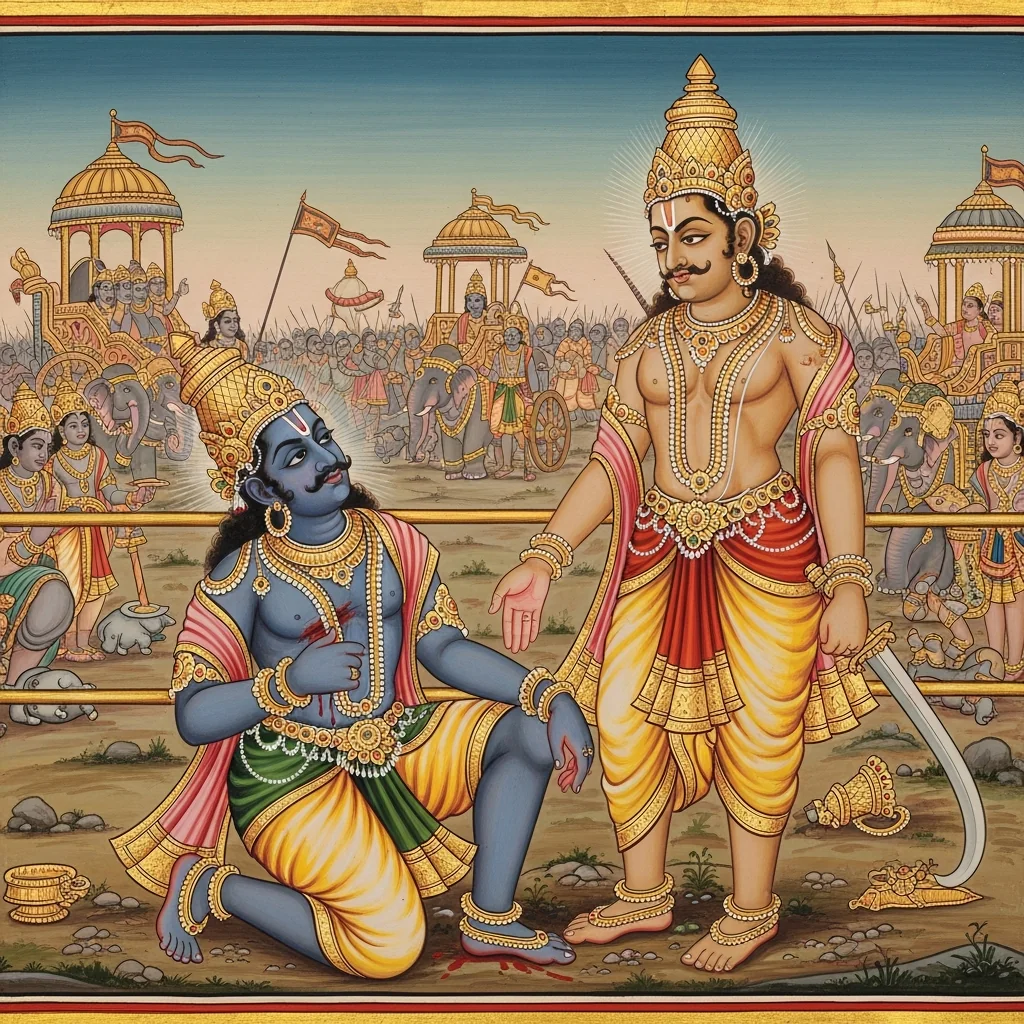
Grasana–Yama Saṅgrāmaḥ (The Battle of Grasana and Yama) / ग्रसन–यमसंग्रामः
Narrated by Nārada, this chapter unfolds a vast, end-of-age battle between the deva and asura hosts. Their armies collide like a last-time ocean in upheaval, with conches, drums, elephants, horses, and chariots roaring together. A crushing exchange of missiles follows—spears, maces, axes, śaktis, tomaras, hooks, and arrows—so dense that the directions are obscured as if by darkness, and fighters strike in confusion without seeing their foes. The battlefield is strewn with shattered chariots, fallen elephants, and rivers of blood, drawing flesh-eaters and delighting certain liminal beings. The narrative then narrows to a duel: the asura leader Grasana confronts Yama (Kṛtānta), trading storms of arrows, blows of mace and the punitive staff daṇḍa, and grappling at close quarters. Grasana’s fury overwhelms Yama’s kiṅkaras, and Yama is beaten down and taken for lifeless; Grasana roars in triumph and regroups. Through the images of kāla and daṇḍa, the chapter intimates its lesson: martial “pauruṣa” proves fragile when tested against cosmic governance. The devas are shaken, and the very field of battle seems to tremble.
Adhyaya 18
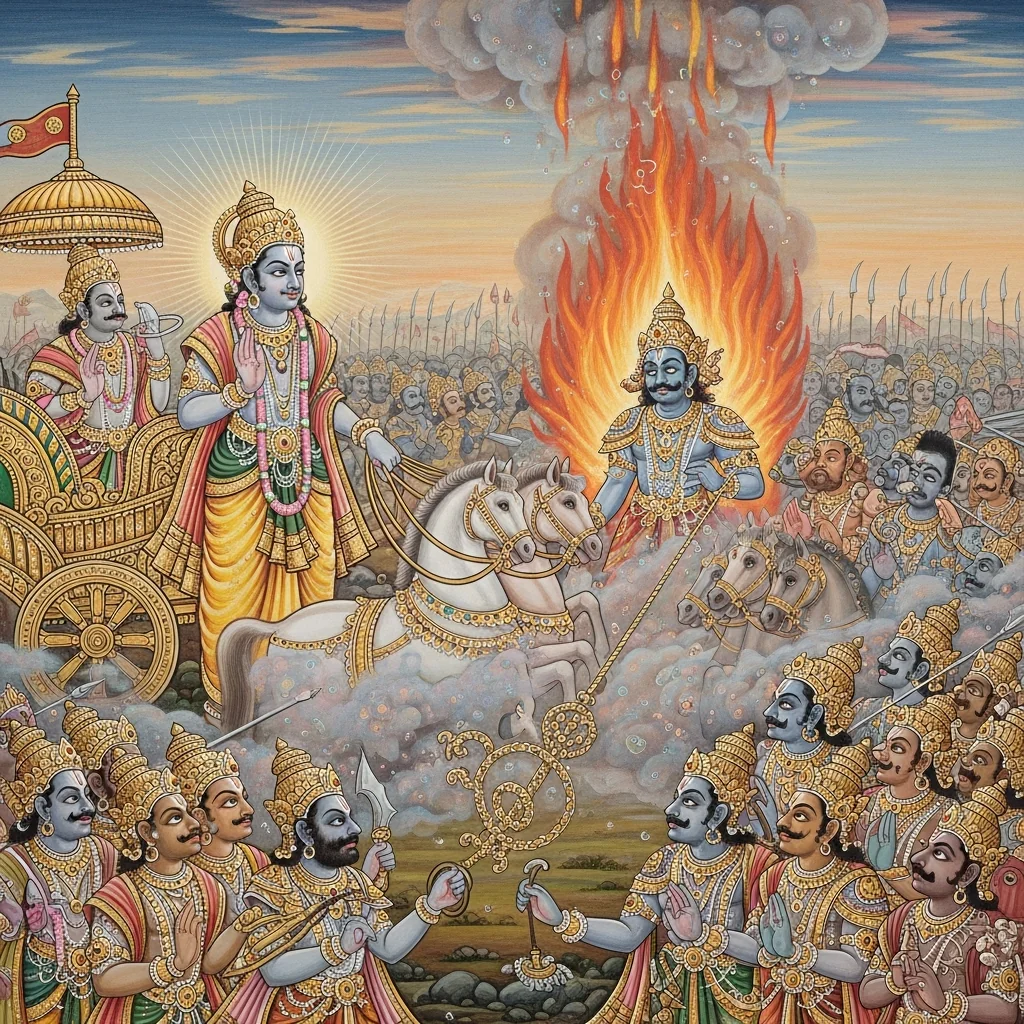
Kubera–Daitya Saṅgrāma: Kujambha, Nirṛti, Varuṇa, Candra, and Divākara in Cosmic Conflict
Nārada recounts a prolonged battle in which Kubera (Dhanādhipa/Dhaneśa) confronts daitya hosts led first by Jambha and then by Kujambha. Kubera’s famed gadā crushes Jambha despite a thick volley of weapons, but Kujambha escalates with arrow-nets and heavy arms, briefly overpowering Kubera and seizing wealth, treasures, and vehicles. As the conflict spreads, Nirṛti enters and routs the daitya troops. The daityas answer with a tāmāsī māyā that immobilizes all in darkness, until a Sāvitra astra dispels the gloom. Varuṇa binds Kujambha with a pāśa and strikes him, yet Mahīṣa threatens Varuṇa and Nirṛti, driving them to retreat toward Indra’s protection. Candra unleashes a severe cold-astra that paralyzes and demoralizes the daitya host; Kālanemi rebukes them and counters with a human-formed māyā and fire-like proliferation to reverse the cold. Finally Divākara (the Sun) intervenes, commands Aruṇa to drive against Kālanemi, and releases illusion-laden, weaponized assaults (with Śambara and Indrajāla effects), causing misrecognition—daityas mistaking devas—and renewed slaughter. The chapter teaches that power severed from discernment turns volatile, while astras, māyā, and divine guardianship serve to restore cosmic balance in the purāṇic vision.
Adhyaya 19
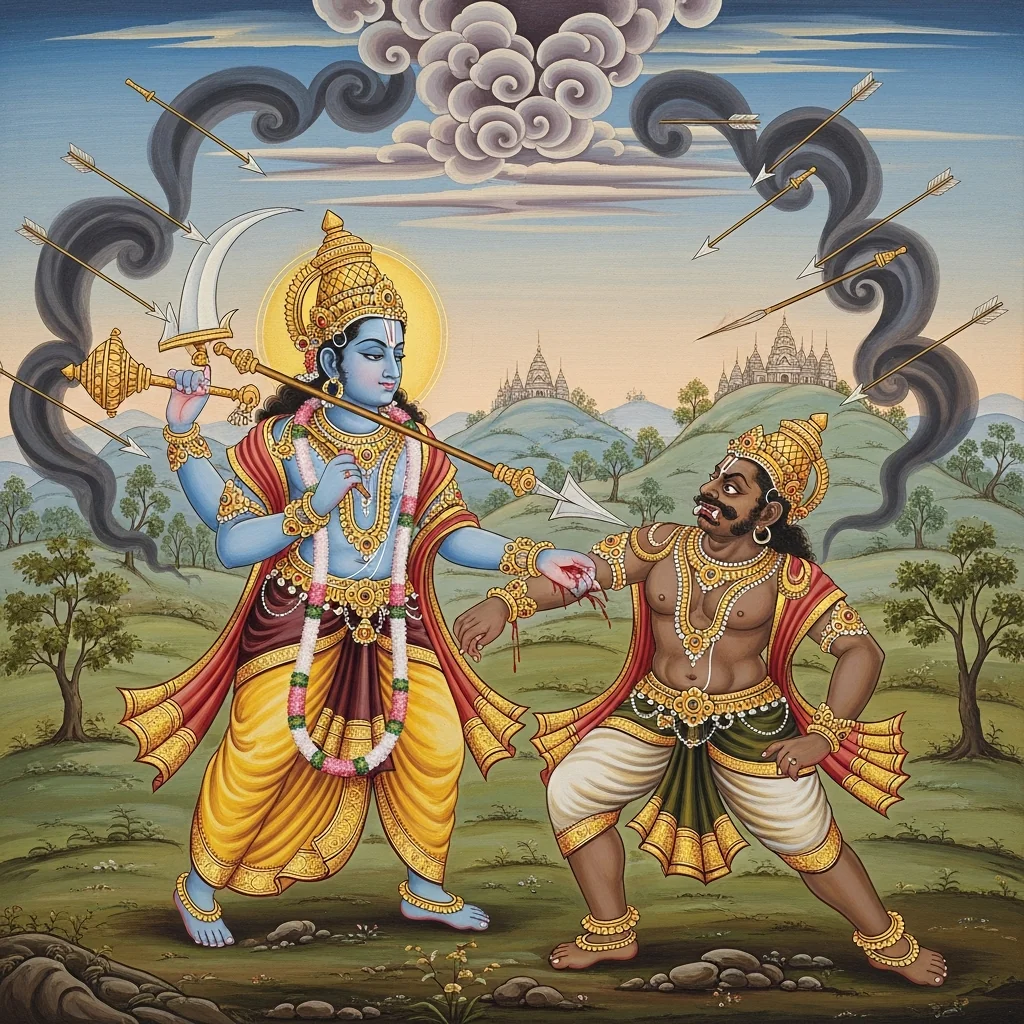
कालनेमिवधप्रसङ्गः — The Episode of Kālanemi’s Defeat and the Devas’ Appeal to Viṣṇu
This adhyāya recounts a fierce cosmological battle. Kālanemi, inflamed by anger and mistaken recognition, misreads Nimi’s form and escalates the conflict. At Nimi’s prompting he releases the Brahmāstra, throwing the deva hosts into panic, until a countermeasure renders the weapon powerless. Then Bhāskara (Sūrya) manifests a dreadful, heat-emitting form that devastates the asura ranks, bringing chaos, thirst, and catastrophic losses. Kālanemi next assumes a cloud-like form, reverses the conditions with cold rain to revive asuric morale, and unleashes a storm of weapons that crushes devas and their allies in vast numbers. The twin Aśvins attempt a tactical strike with concentrated arrows and vajra-astra-like force, damaging Kālanemi’s war apparatus; he retaliates with weapons such as a wheel and a mace, and the narrative signals a Nārāyaṇāstra episode. As Indra’s position grows perilous and cosmic omens intensify, the devas formally praise Vāsudeva and seek refuge. Viṣṇu awakens from yoganidrā, arrives upon Garuḍa, absorbs the asuric assault, and engages Kālanemi directly. After exchanges of missiles and close combat, the Lord wounds and subdues Kālanemi with a decisive blow, yet grants a temporary reprieve, foretelling a later final end. Terrified before the Lord of the worlds, Kālanemi’s charioteer withdraws him in haste.
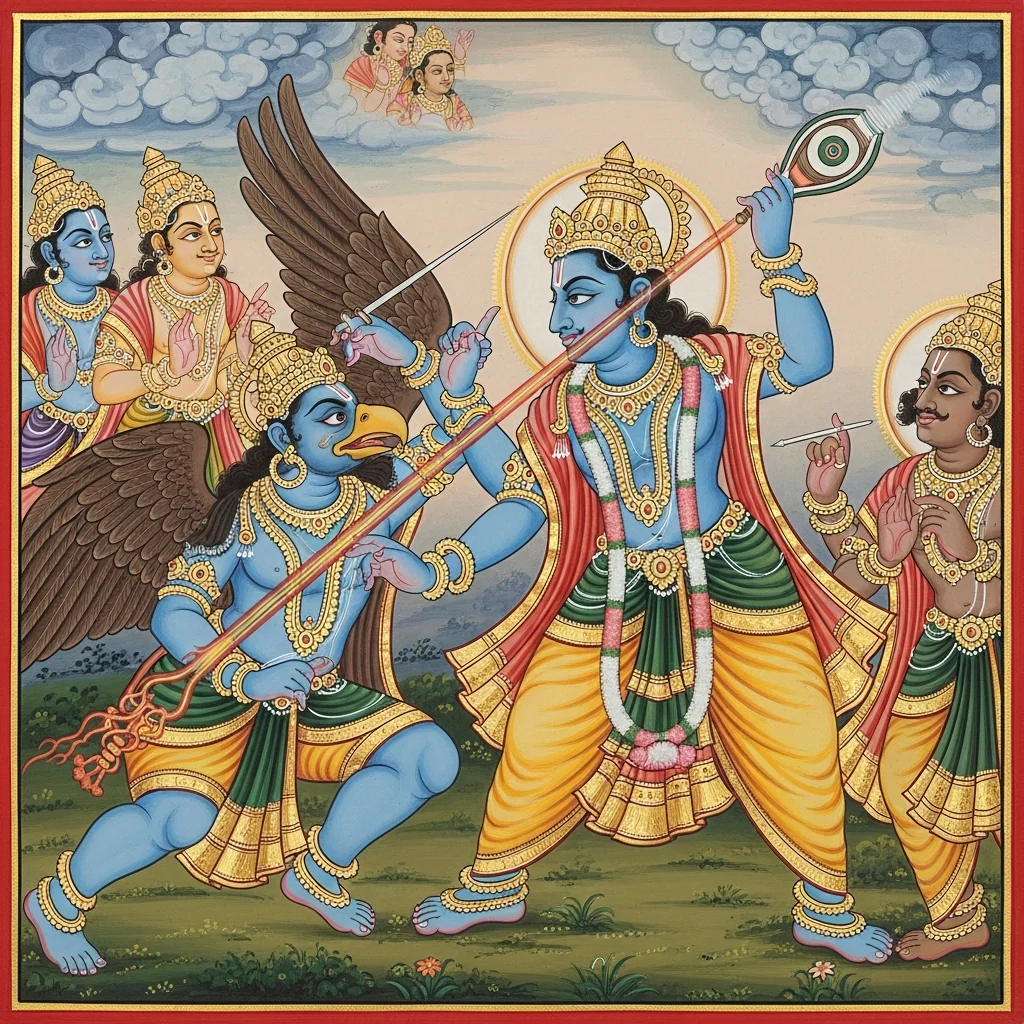
Adhyaya 20
Viṣṇu–Dānava Saṅgrāma: Astrayuddha and the Fall of Grasana
Nārada recounts a vast battle in which many dānavas, riding fearsome beasts and vehicles, converge upon Nārāyaṇa (Viṣṇu). Named fighters include Nimi, Mathana, Śumbha, Jambha, Grasana (as commander), and Mahiṣa. The conflict rises from volleys of piercing missiles to the release of mighty divine weapons (astras); Viṣṇu withstands sustained assaults, shifts from bow to mace, and meets layered astras head-on. Grasana nullifies a discharged Raudrāstra by deploying a Brahmāstra. Viṣṇu then unleashes the dread Kāladaṇḍāstra, which ravages the dānava host until counter-astras restrain it. Viṣṇu next uses his discus to slay Grasana decisively. Close-quarters fighting follows, with some asuras clinging to Garuḍa and even to Viṣṇu, whom the Lord shakes off before resuming armed combat. Mathana is killed by Viṣṇu’s mace after a brief exchange of heavy weapons. Mahiṣa attacks fiercely but is spared because destiny binds him to be slain by a woman, as earlier declared by lotus-born Brahmā; Viṣṇu therefore releases him from immediate death. Śumbha retreats after admonition, while Jambha boasts, strikes so massively that Garuḍa and Viṣṇu are briefly incapacitated, and then flees when Viṣṇu regains composure and advances. The chapter highlights cosmic order through the hierarchy of astras, the ethics of honoring destiny’s constraints, and the restoration of balance after the commander’s fall.
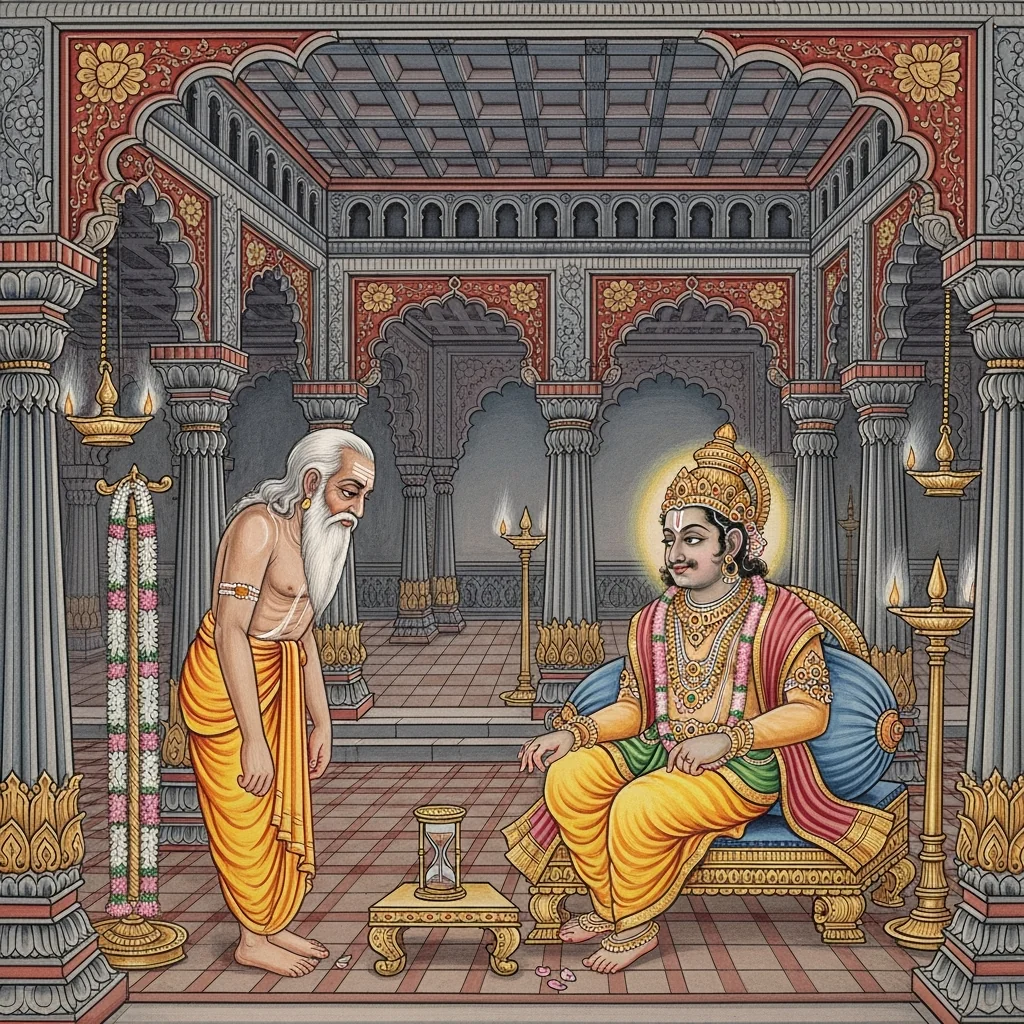
Adhyaya 21
Jambha–Tāraka Saṅgrāma, Nārāyaṇāstra, and Kāla-Upadeśa (जंभतारकसंग्रामः कालोपदेशश्च)
The chapter begins with Nārada noticing Indra’s hesitation as the daityas regroup. Indra seeks Viṣṇu’s aid; Viṣṇu affirms His power to destroy the foes, yet explains the restraints created by earlier boons and conditions, and directs Indra to the proper target—Jambha—and the right means. Viṣṇu then arranges a divine battle-formation, appointing eleven Rudra-emanations as the अग्रसर (vanguard). Their intervention features the slaying of the elephant-formed enemy (Gajāsura) and a skin-transformation motif. The war intensifies into a sustained exchange of astras: deva and asuric weapons—mauśala, śaila, vajra, āgneya, vāruṇa, vāyavya, nārasiṁha, gāruḍa, and finally the alignment with the pāśupata through the aghora-mantra—are deployed and countered, displaying a technical theology of astras and their governance. Jambha is ultimately brought down by a sequence of empowered arrows, and the daityas flee to Tāraka, who overwhelms the devas until Viṣṇu adopts a deceptive “monkey” guise to enter Tāraka’s court. In the courtly dialogue, Viṣṇu delivers an extended upadeśa on kāla (time) and karma—sovereignty’s impermanence, the delusion of personal agency, and the necessity of dharma. Tāraka acknowledges the teaching, grants safety and administrative roles to the devas for a term, and the chapter closes with a redistribution of cosmic offices, a political theology of delegated power under Time.
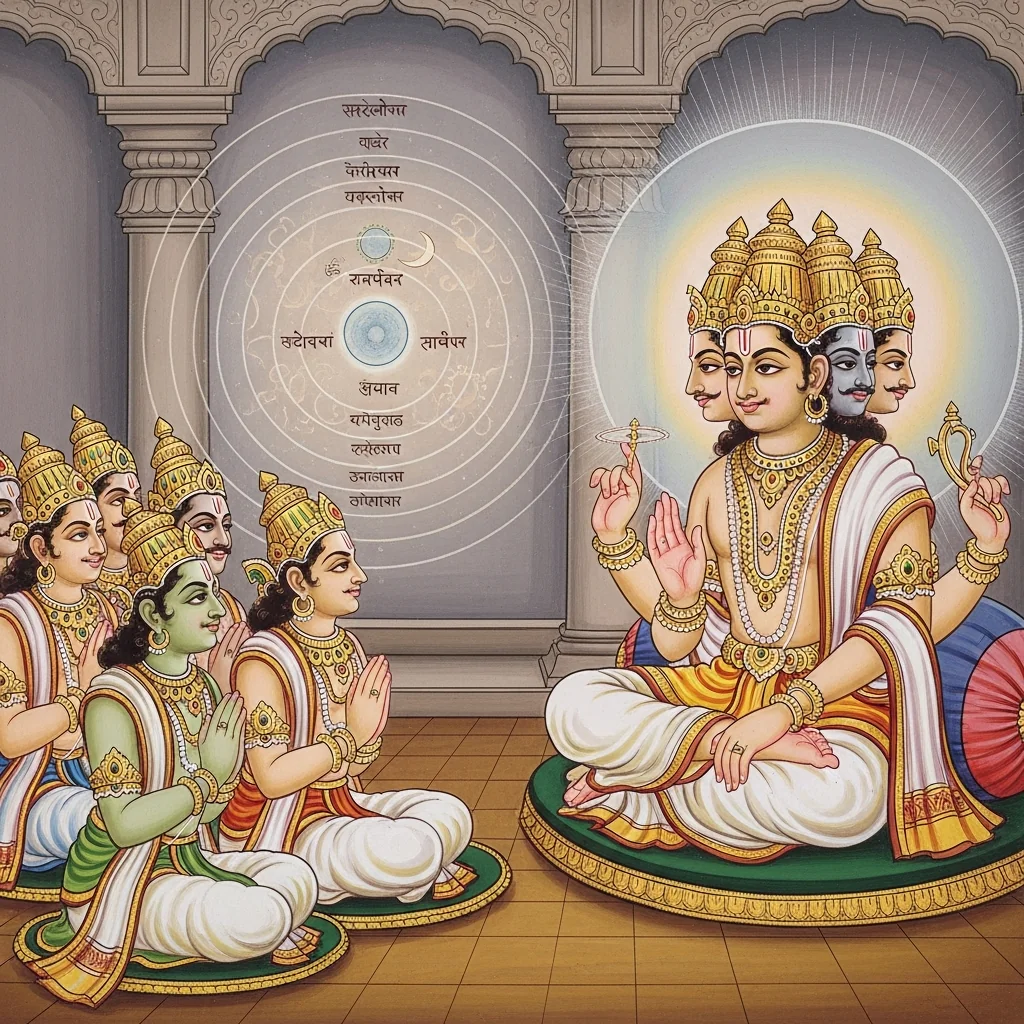
Adhyaya 22
Virāṭ-stuti, Tāraka-vadha-upāya, and Rātri’s Commission for the Goddess’s Rebirth (विराट्स्तुति–तारकवधोपाय–रात्र्यादेशः)
Chapter 22 presents a theological movement from crisis to remedy. Nārada relates that the Devas, oppressed by Tāraka’s ascendancy, approach Svayambhū (Brahmā) while concealed in a transformed guise. Brahmā reassures them and receives their hymn, which delineates the Virāṭ (cosmic) form: netherworlds and heavens are mapped onto divine limbs, and the sun, moon, directions, and vital apertures are gathered into a single cosmological anatomy. The Devas then report Tāraka’s outrages—his devastation of a sacred shore/tīrtha, his seizure of divine powers, and the overturning of cosmic allegiance. Brahmā explains the binding force of boons that render Tāraka nearly invulnerable, and he sets forth a lawful dharmic solution: a seven-day-old divine child will be his slayer; the Goddess (once Satī) will be reborn as Himācala’s daughter to reunite with Śaṅkara; and tapas is affirmed as the indispensable means to siddhi. Brahmā commissions Rātri (Vibhāvarī) to enter Menā’s womb and darken the Goddess’s complexion, foreshadowing Kālī/Cāmuṇḍā forms and future demon-slaying. The chapter concludes with an auspicious birth: cosmic harmony is restored, dispositions turn again toward dharma, nature becomes abundant, and gods, sages, mountains, rivers, and oceans join in celebration.
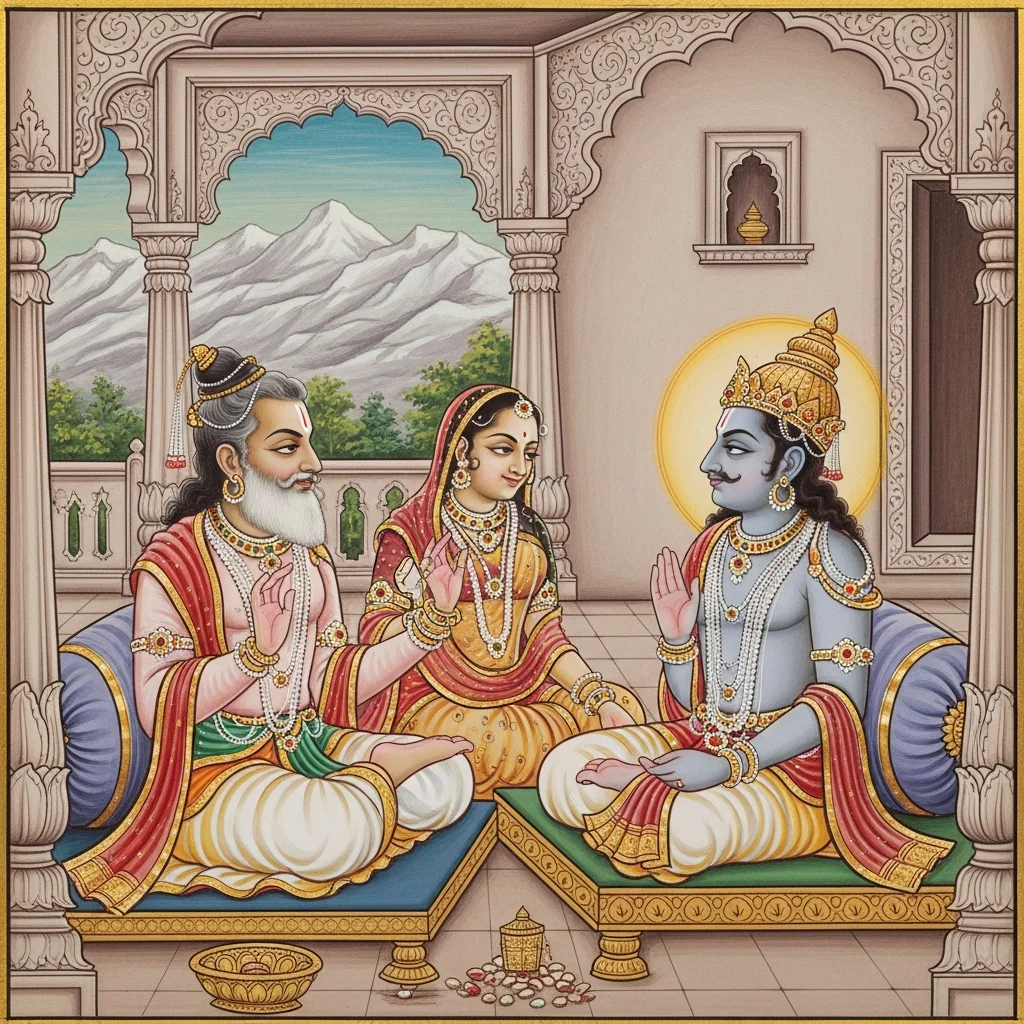
Adhyaya 23
Nārada–Himavat-saṃvāda: Pārvatyāḥ Pati-nirdeśa (Narada’s Dialogue with Himavat on Pārvatī’s Destined Spouse)
This chapter is framed as a dialogue that joins sacred geography with the dharma of household life. Nārada describes Śailajā Devī (Pārvatī) playfully moving among divine and semi-divine maidens, then recounts how Indra (Śakra) remembers him and summons him to Meru. Indra asks Nārada to promote the union of Śailajā with Hara (Śiva), declaring it the only truly fitting match. Nārada travels to the Himālaya, is honored by Himavat, and praises the mountain as a sustainer of beings through shelter, waters, and resources for ascetic practice—linking place to dharma. Menā arrives with modest devotion, and Pārvatī is introduced as a shy young girl. Nārada blesses Menā with auspicious household virtues and heroic offspring. When Menā asks about Pārvatī’s future husband, Nārada first describes him through paradox—unborn, “naked,” poor, fierce—distressing Himavat and prompting reflection on the rarity of human birth and the difficulty of living dharma in the household state. Nārada then resolves the paradox: Pārvatī is the cosmic Mother, and her destined spouse is the eternal Śaṅkara—unborn yet ever-present, “poor” yet the giver of all—concluding with a theological clarification of Śiva’s transcendence and immanence.
Adhyaya 24
Kāma’s Mission, Śiva’s Yoga, and the Burning of Manmatha (कामदहनप्रसङ्गः)
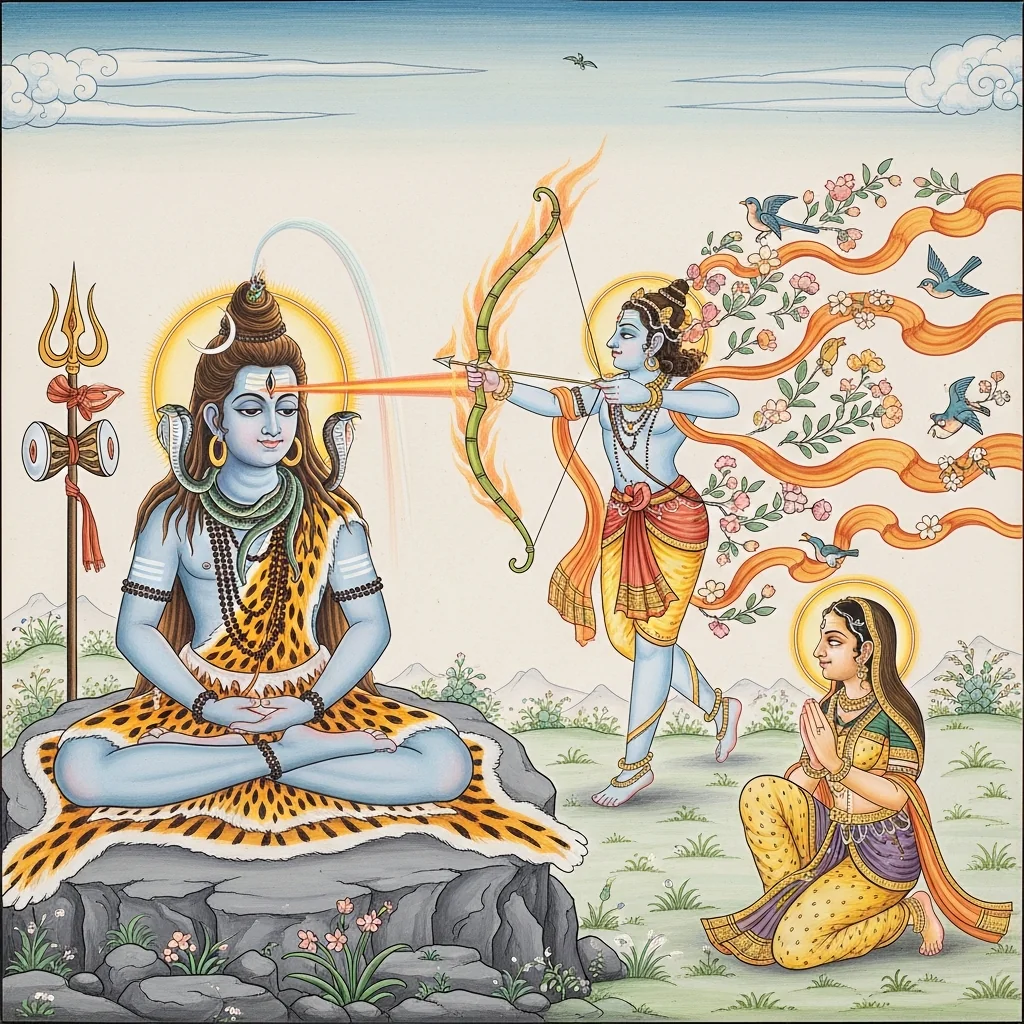
This chapter is framed by Nārada’s report of an earlier exchange with Himālaya: the future goddess’s raised (uttāna) right hand is understood as the abiding gesture of «abhaya», granting fearlessness and protection to all beings. Nārada adds that a great divine work still remains—Śiva must be reunited with the Himalayan-born Devī, Pārvatī, for the sake of cosmic purpose. At Nārada’s prompting, Indra summons Kāma (Manmatha). Kāma raises ethical objections drawn from ascetic critique: in Vedānta and renunciant teaching, desire is often condemned as a veil over knowledge and a persistent foe of the wise. Indra replies with a functional theology of desire, distinguishing Kāma’s three modes (tāmasa, rājasa, sāttvika) and arguing that intention-as-desire (kāmanā) underlies worldly accomplishment, while regulated desire can serve higher ends. Kāma proceeds with Vasanta and Rati to Śiva’s āśrama, beholds Śiva absorbed in deep samādhi, and attempts entry through a subtle disturbance (the pretext of a bee’s hum). Śiva becomes aware, turns, and releases the fire of the third eye, burning Kāma to ashes. The excess flame threatens cosmic conflagration until Śiva apportions it into various loci—moon, flowers, music, bees, cuckoos, and pleasures—explaining the enduring “fire” of longing within beings. Rati laments; Śiva consoles her, affirming Kāma’s continued efficacy in embodied life and foretelling a future restoration: when Viṣṇu is born as Vāsudeva’s son, Kāma will arise as his offspring (the Pradyumna motif), and Rati’s conjugal status will be regained.
Adhyaya 25
पार्वतीतपः–ब्रह्मचारिवेषधरीश्वरीक्षण–स्वयंवरप्रसंगः | Pārvatī’s Austerity, Śiva’s Brahmacārin Test, and the Svayaṃvara Episode
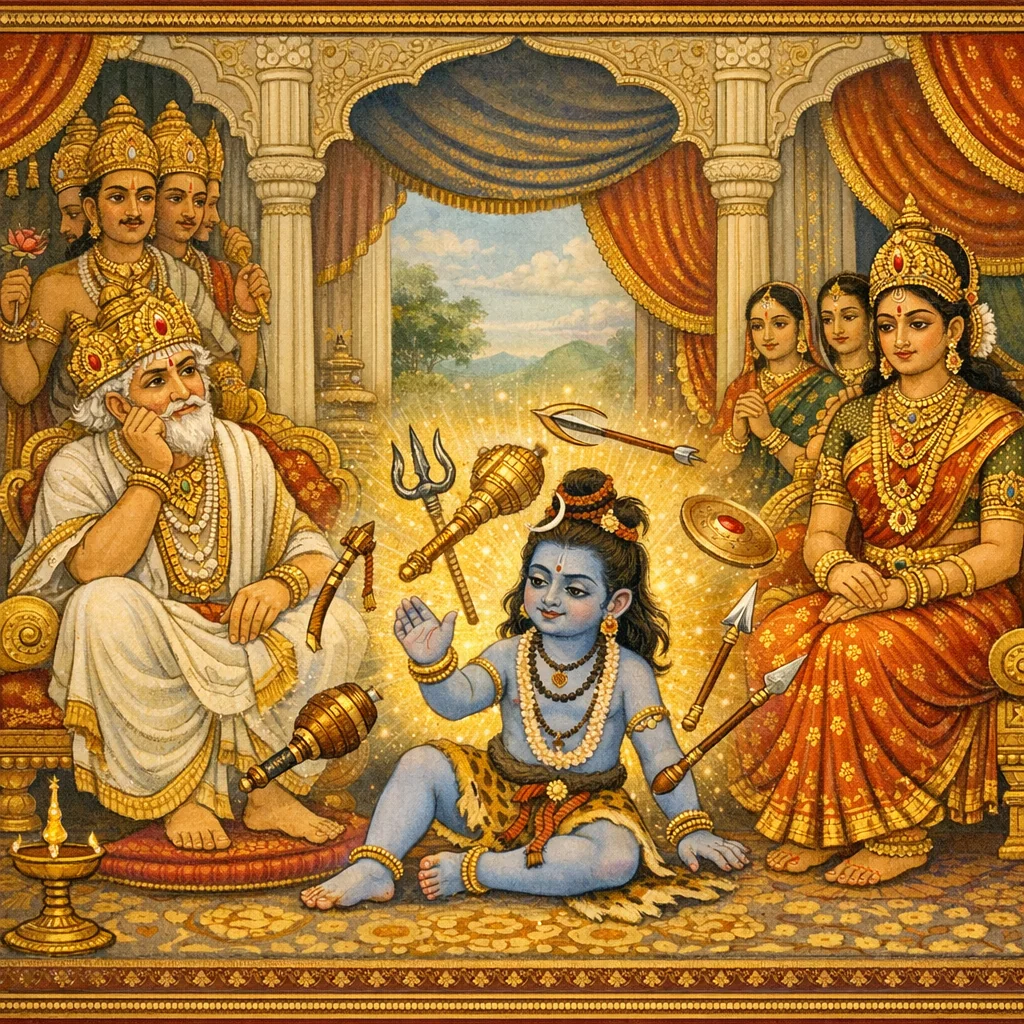
The chapter begins with Arjuna asking Nārada to restate the “nectar-like” account of Śiva’s intentions after his separation from Satī and the burning of Smara (Kāma). Nārada teaches that tapas (disciplined austerity) is the root of great attainments: without it there is no purity, no fitness for union, and no success in lofty undertakings. The narrative turns to Pārvatī’s sorrow and resolve. Rejecting mere fatalism, she declares that results arise from destiny joined with effort and inner disposition, and that tapas is a proven means of attainment. With her parents’ reluctant consent, she performs graded austerities on Himavat—progressively reducing food, then living by breath, and finally near-total fasting—while practicing the pranava (Om) and fixing her mind on Īśvara. Śiva arrives disguised as a brahmacārin and conducts a moral-theological test (including a contrived drowning episode), drawing out Pārvatī’s dharma-first commitment and unwavering vow. He then verbally criticizes Śiva’s ascetic marks to probe her discernment; Pārvatī answers with a doctrinal defense, reading the cremation-ground, serpents, trident, and bull as symbols of cosmic principles. Revealing his true form, Śiva accepts her and directs Himavat to arrange a svayaṃvara. At the svayaṃvara, devas and many beings assemble; Śiva playfully appears as an infant, immobilizes the gods’ weapons, and displays supreme sovereignty. Brahmā recognizes the divine līlā, leads the hymns of praise, and the gods receive a higher “vision” to perceive Śiva. Pārvatī places the garland upon Śiva, the assembly proclaims victory, and the episode closes as an affirmation of tapas, discernment, and divine grace.
Adhyaya 26
शिवपार्वतीविवाहः (Śiva–Pārvatī Vivāha: The Cosmic Wedding and Ritual Protocol)
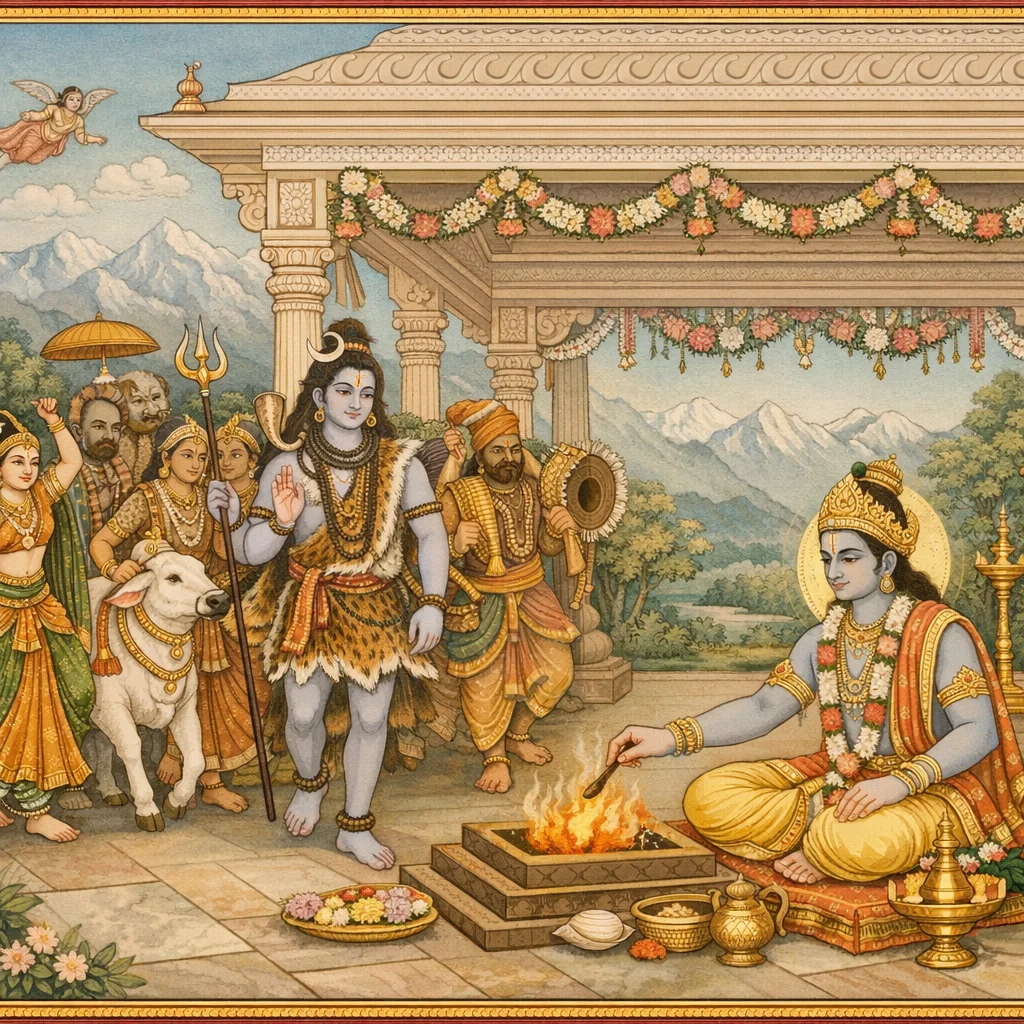
Chapter 26 recounts the formal solemnization of Śiva’s marriage to Pārvatī through a meticulously ordered Vedic rite and a cosmological wedding procession. Brahmā petitions Mahādeva to begin; a vast jeweled ceremonial city and the wedding mandapa are prepared. The whole universe is invited—excluding hostile daityas—so the occasion becomes a cosmic liturgy. Many deities contribute ornaments and insignia to Śiva: the moon-crest, the kaparda hair arrangement, the skull-garland, garments, and weapons. Gaṇas and celestial musicians gather in immense numbers, and the procession advances amid drums, songs, apsaras, and Vedic officiation. At Himālaya’s court, a procedural issue arises: the bride’s brother is absent for the lājāhoma rite, and the groom’s kula/gotra is questioned. Viṣṇu resolves both by assuming the role of Umā’s brother and explaining kinship logic that preserves ritual correctness. Brahmā serves as hotṛ; offerings and dakṣiṇā are distributed to Brahmā, Agni, and the sages. The chapter ends with a phalaśruti declaring that hearing or reciting this sacred wedding account brings enduring increase of auspiciousness (maṅgala-vṛddhi).
Adhyaya 27
विघ्नपतिप्रादुर्भावः, गणेशमर्यादा-प्रतिपादनं, तथा उमा-शंकरनर्मसंवादः (Manifestation of Vighnapati, Norms of Merit, and the Uma–Śaṅkara Dialogue)
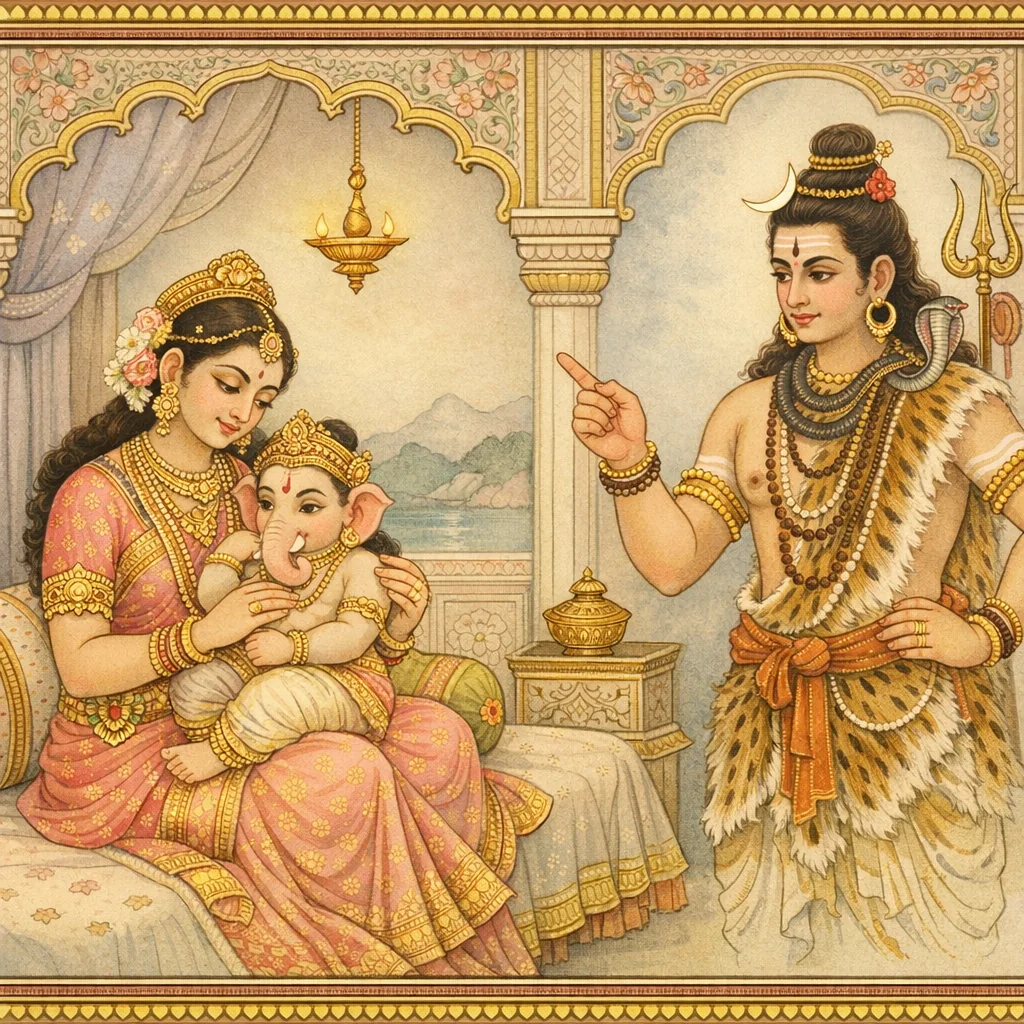
The chapter unfolds in three linked movements. (1) Nārada describes a divine household at Mandara where Śiva and Devī dwell; the devas, oppressed by Tāraka, approach Śiva with hymns. Near this praise, Devī’s bodily unguent (udvartana-mala) becomes the basis for the manifestation of Gajānana—Vighnapati—whom Devī acknowledges as her “son,” and whom Śiva praises as equal in valor and compassion. A teaching on obstacles follows: those who reject Veda-dharma, deny Śiva/Viṣṇu, or invert social and ritual order meet persistent impediments and domestic discord, while those who uphold śruti-dharma, honor the guru, and practice restraint have obstacles removed. (2) Devī establishes a public-ethical “maryādā” through a calculus of merit: building wells, ponds, and reservoirs is meritorious, yet planting and maintaining a tree is declared superior; restoration of what is old and ruined (jīrṇoddhāra) yields doubled fruit. (3) A catalogue then portrays Śiva’s gaṇas in diverse forms, habitats, and behaviors; Devī takes special interest in an attendant, Vīraka, and adopts him as a son through an affectionate, ritualized gesture. The chapter closes with a tense, stylized narmic exchange between Umā and Śiva—wordplay, complexion imagery, and mutual reproach—serving as a moral-psychological vignette on interpretation, offense, and relational ethics.
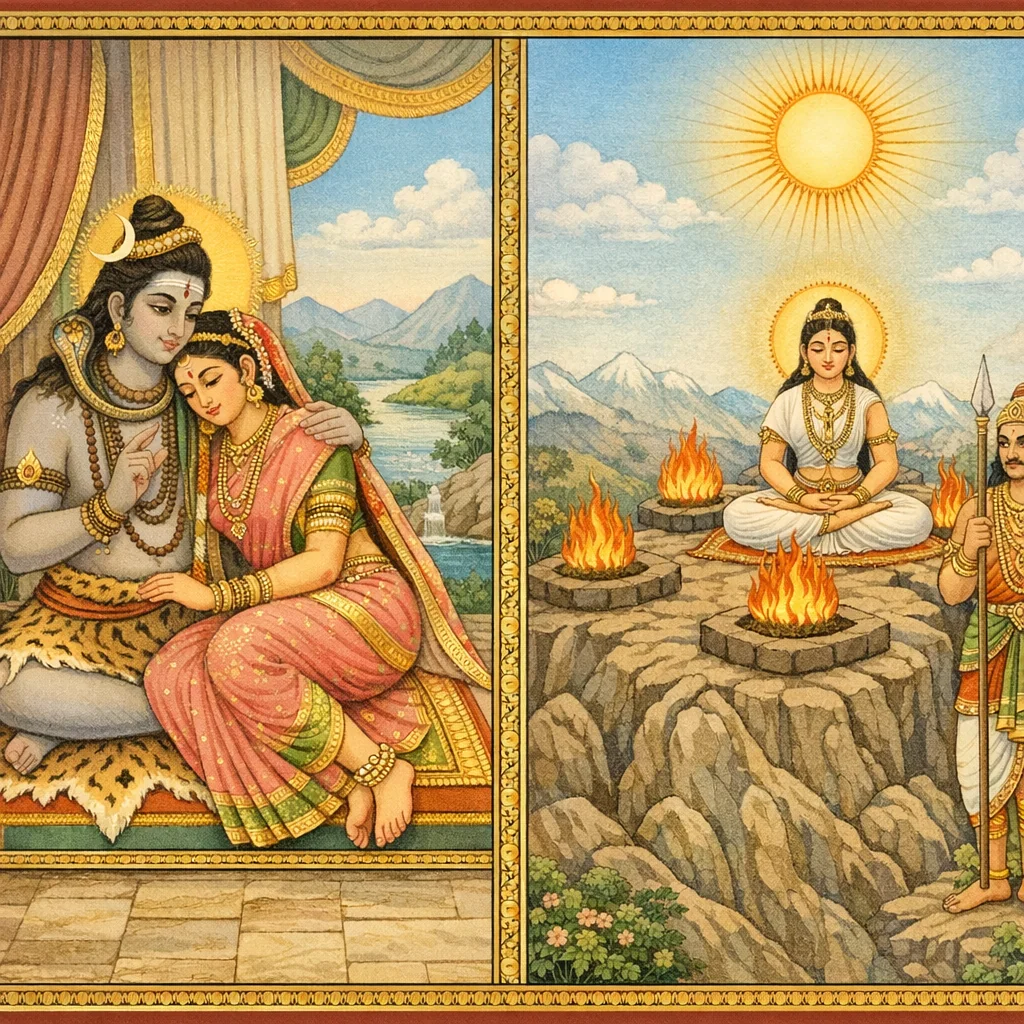
Adhyaya 28
गिरिजातपः-नियमनम् — Pārvatī’s Austerity and Protective Boundary near Śiva
The chapter begins with Nārada’s narration: as Girijā (Pārvatī) departs, she meets the radiant mountain-deity Kusumāmodinī, devoted to the Lord of the peak. The goddess affectionately asks why Pārvatī is leaving and learns the cause—a conflict arising in connection with Śaṅkara (Śiva). Pārvatī acknowledges the deity’s constant, motherly care and gives an immediate ethical-practical instruction: if any other woman approaches Pinākin (Śiva), her attendant/son must report it, and proper correction will follow. Pārvatī then goes to a beautiful high summit, lays aside her ornaments, dons bark garments, and undertakes tapas—enduring the “five fires” in summer and water-discipline in the rains—protected by her attendant/son Vīraka. The guardian is charged to enforce a protective boundary near Śiva’s vicinity; he agrees, then approaches (addressed as Gajavaktra) with an emotional plea to be taken along as well, citing shared destiny and the dharmic need to overcome deceitful adversaries. The episode teaches ascetic discipline, relational duty, and regulated access to sacred proximity.
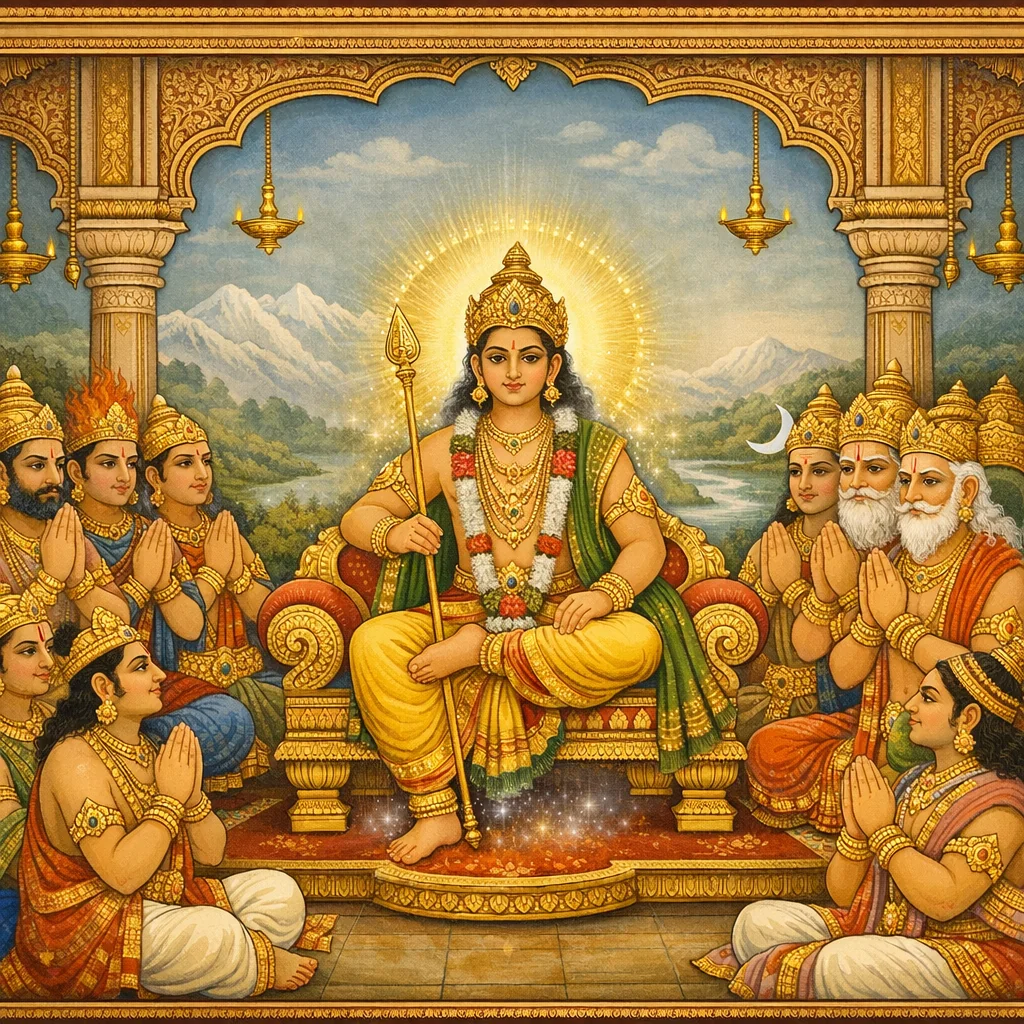
Adhyaya 29
आर्बुदाख्यानम् (Arbuda-ākhyāna) and Kaumāra Narrative Cycle: Pārvatī’s Tapas, Māyā-Discernment, and Skanda’s Investiture
Chapter 29, narrated by Nārada, unfolds as a multi-episode theological account. Girijā (Pārvatī) meets the mountain’s presiding goddess, Kusumāmodinī, and undertakes tapas on a lofty peak, performing seasonal austerities that display her ascetic power. In parallel, the asura Āḍi (connected to Andhaka’s line) gains a conditional boon from Brahmā—death only upon a change of form—and, using māyā, infiltrates Śiva’s vicinity by taking an Umā-like guise to do harm. Śiva detects the imposture through bodily marks and neutralizes it, exemplifying viveka, discerning wisdom against illusion. Misled, Girijā angrily curses her son-like gatekeeper Vīraka; yet the narrative reframes the curse as providential: Vīraka is destined to be born human from stone (śilā) and to serve in time. The chapter explicitly praises Arbuda/Arbudāraṇya and the Acalēśvara-liṅga for their salvific potency. Brahmā grants Girijā a transformation from which Kauśikī, a distinct goddess-form, emerges—appointed as a protector, given a lion as vāhana, and empowered to conquer demonic forces. The account then turns to a Kaumāra cosmogony: Agni’s episode with Svāhā (who assumes the forms of six sages’ wives, excluding Arundhatī) explains the transmission and deposition of Rudra-tejas and the birth and maturation of Skanda/Guha. Viśvāmitra presents a stotra of 108+ names, stressing protective and purifying fruits. Skanda’s early martial display unsettles the devas; Indra’s vajra produces emanations (Śākha, Naigameya) and maternal gaṇa figures, culminating in Skanda’s acceptance of the office of senāpati while reaffirming Indra’s kingship. The chapter closes with celebration on Śveta-parvata and the parents’ reunion with their son, integrating ethics (the cost of anger), ritual theology (stotra, yajña shares), and sacred geography (Arbuda) into a coherent guide for devotion.
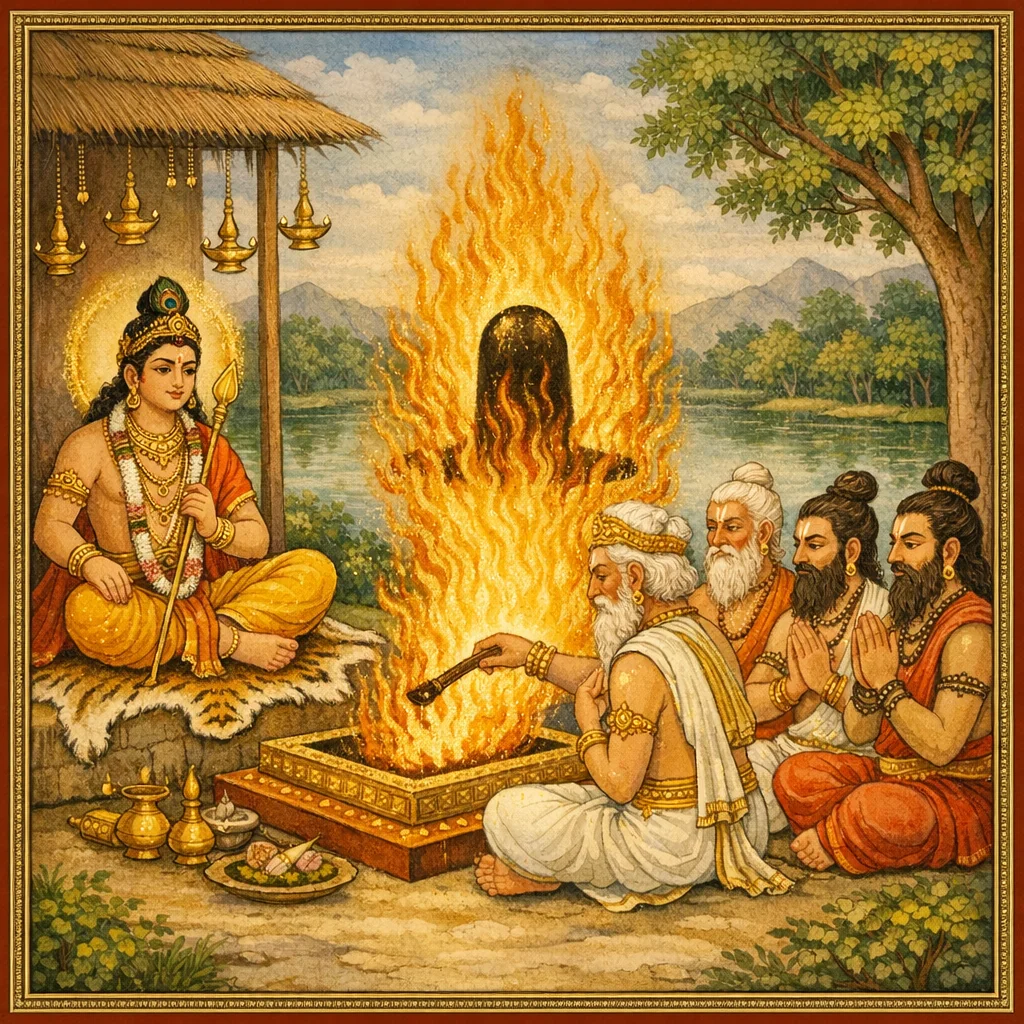
Adhyaya 30
Skanda’s Senāpati-Abhiṣeka at the Mahī–Ocean Confluence (महीसमुद्रसंगमे स्कन्दाभिषेकः)
Adhyāya 30 begins with Nārada watching Skanda advance south from Śvetaparvata to confront Tāraka. A catalog of troubling forces—grahas and upagrahas, vetālas, śākinīs, unmādas, apasmāras, and piśācas—frames an instruction on protection gained through disciplined conduct, self-restraint, and steadfast devotion. The scene shifts to the bank of the Mahī, where the devas praise the Mahī-māhātmya and especially the Mahī–ocean confluence as a ritual concentration of all tīrthas. Bathing there and offering ancestral tarpaṇa are declared universally efficacious, even though the water is saline, its sanctifying power explained through analogies of transformative potency. Gods and sages then perform Skanda’s formal abhiṣeka as senāpati, assembling consecration materials and conducting a mantra-purified homa led by principal ṛtviks (including Brahmā and Kapila, as stated). A striking theological moment follows when Mahādeva reveals a liṅga-form within the fire-pit, a theophany taken as verification of the rite. The chapter culminates in a grand roll call of participating deities, cosmic classes, and beings, followed by the bestowal of gifts, weapons, attendants (parṣadas), and extensive mātr̥gaṇa lists. Skanda’s command is thus shown as cosmic and ritually authorized; he offers reverent salutations, and the devas stand ready to grant boons, sealing the themes of sacred geography, consecration liturgy, protective ethics, and divine legitimation of leadership.
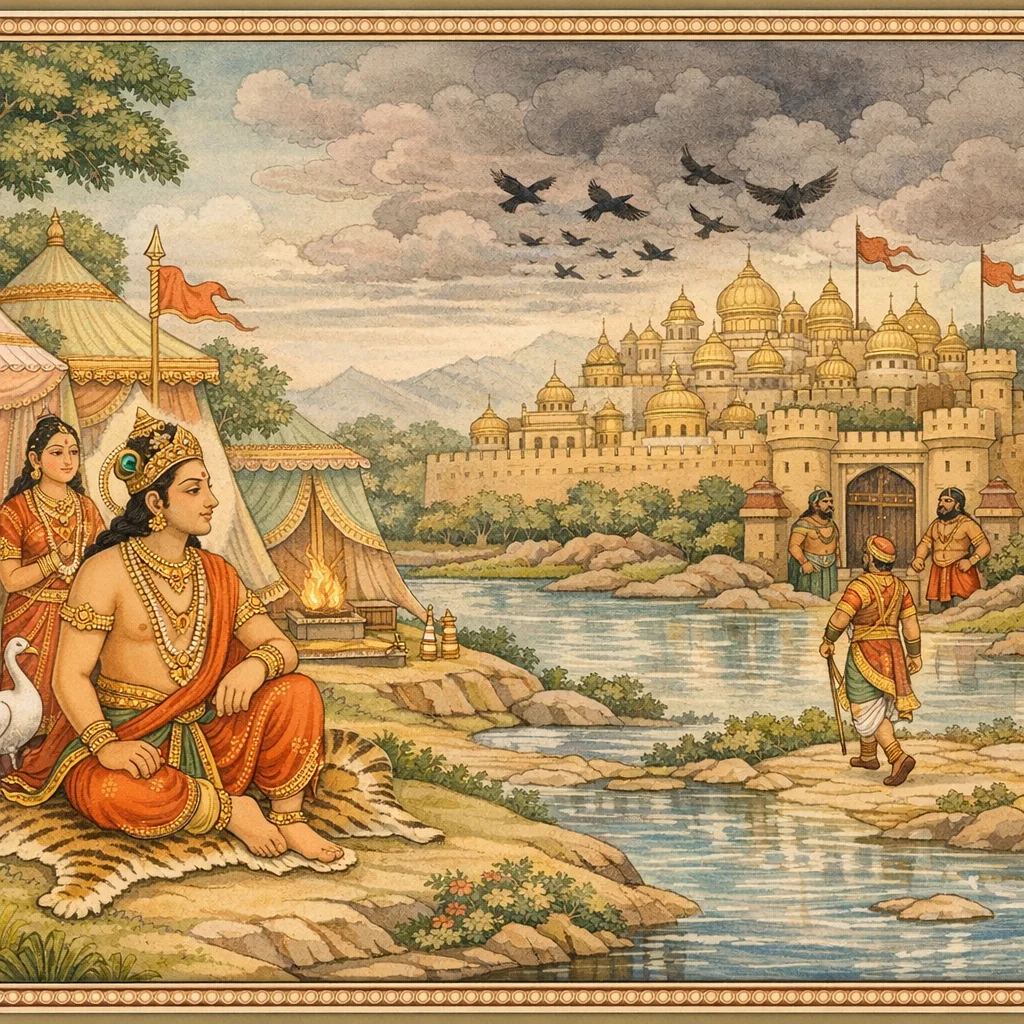
Adhyaya 31
Guha’s March to Tārakapura and the Deva-Host: Oath, Mobilization, and Stuti (गुहस्य तारकपुराभियानम्)
The chapter begins with Nārada recounting how the devas seek a boon from Guha/Skanda: the slaying of the sinful Tāraka. Guha agrees, mounts his peacock, and marches forth in martial readiness, yet declares a sharp ethical vow—he will not spare those who dishonor cows and brāhmaṇas—thus casting the coming war as the protection of dharma rather than mere conquest. A magnificent mobilization follows: Śiva, with Pārvatī, advances in a radiant chariot drawn by lions, with Brahmā holding the reins. Kubera, Indra, the Maruts, Vasus, Rudras, Yama, Varuṇa, and even personified weapons and implements accompany them, forming a cosmic procession, while Viṣṇu appears from behind to guard the entire formation. Reaching a northern bank, the host halts near a copper-hued rampart as Skanda surveys Tāraka’s prosperous city. The narrative turns to diplomacy: at Indra’s suggestion a messenger is sent, and a dūta delivers a stern ultimatum, threatening the city’s destruction if Tāraka does not come forth. Troubled by ominous signs, Tāraka beholds the overwhelming deva army and hears loud acclamations and hymns praising Skanda as Mahāsena, culminating in a formal stuti beseeching him to destroy the enemies of the gods.
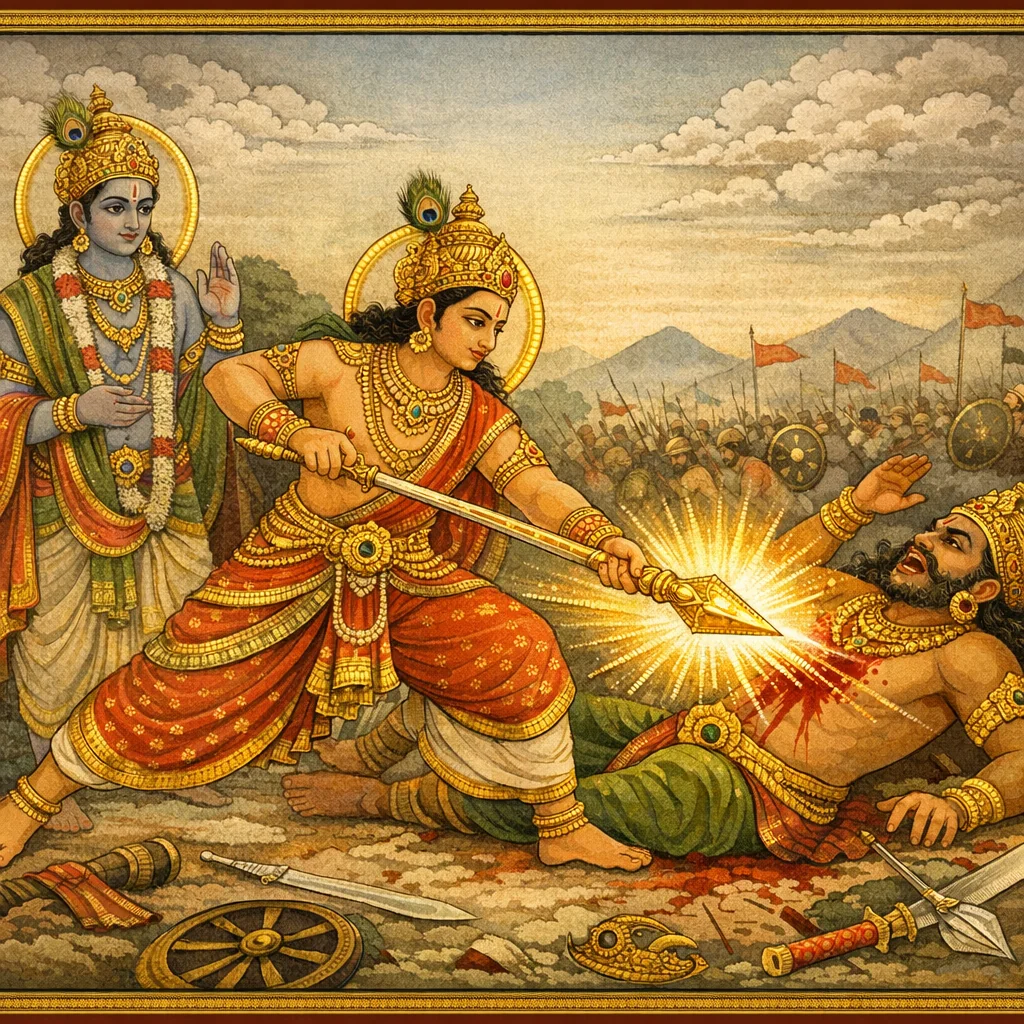
Adhyaya 32
Tārakāsura–Vadhasya Prastāvaḥ (Prelude to the Slaying of Tāraka) / The Battle with Tāraka and the Release of Śakti
Adhyāya 32 presents a dense martial and theological account. Spurred by Nārada’s report, the asura king Tāraka convenes his ministers, sounds the war-drum, mobilizes vast forces, and marches against the devas. A sweeping battle follows with shifting fortunes: the devas are temporarily routed, and Indra is struck down by Kālanemi, as alliances form and Indra, Śaṅkara (Śiva), Viṣṇu, and other deities engage various asura leaders. The narrative then turns to doctrine and ethics. Skanda hesitates to strike Tāraka because he is called a “Rudra-bhakta,” but Viṣṇu argues that one who harms beings and opposes dharma cannot be a true devotee. Tāraka escalates by attacking Rudra’s chariot; Śiva withdraws strategically, prompting a broader divine counterattack and a momentary cosmic destabilization. Viṣṇu’s wrath is restrained by counsel, and Skanda is reminded of his sacred purpose: to protect the virtuous and remove the harmful. At the climax, a personified Śakti emerges from Tāraka’s head, declaring she was gained through his tapas yet departs when his merit reaches its limit. Immediately Skanda releases the Śakti-weapon, which pierces Tāraka’s heart and restores cosmic order. The chapter closes with auspicious signs—gentle winds, calm directions, divine praise—and a directive to confront Bāṇa at Kraunca mountain, linking this victory to the continuing Kaumāra campaign.
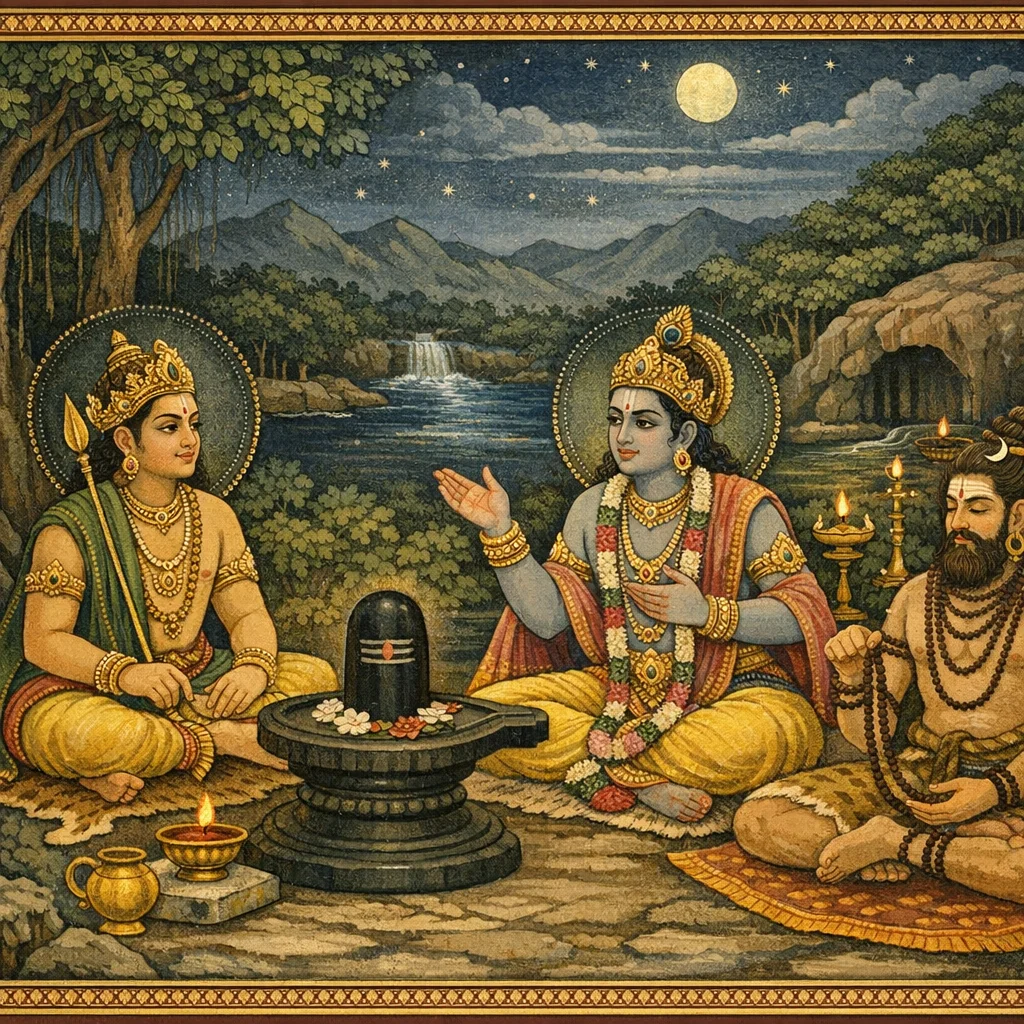
Adhyaya 33
Tārakavadhānantara-śoka, Dharmopadeśa, and Tri-liṅga-pratiṣṭhā (प्रतिज्ञेश्वर–कपालेश्वर-स्थापनम्)
Chapter 33 begins with Nārada describing Tāraka’s fallen body and the devas’ astonishment. Skanda (Guha), though victorious, is morally troubled; he restrains festive praise, voices remorse, and seeks instruction on prāyaścitta, especially since the slain foe is said to be connected with Rudra-bhakti. Vāsudeva replies on śāstric authority—śruti, smṛti, itihāsa, and purāṇa—that there is no culpability in killing a harmful wrongdoer, for social order depends on curbing the violent. He then teaches a higher expiatory and liberating path: Rudra-ārādhana, above all liṅga worship, surpasses other penances, and Śiva’s supremacy is praised through exempla such as halāhala, Gaṅgā upon his head, the Tripura battle, and Dakṣa’s sacrifice as a warning. Ritual details follow: bathing the liṅga with water and pañcāmṛta, offering flowers and naivedya, and the extraordinary merit of establishing a liṅga—uplifting one’s lineage and attaining Rudraloka. Śiva affirms non-difference (abheda) between himself and Hari, grounding sectarian harmony in doctrine. Skanda vows to install three liṅgas tied to distinct narrative moments; Viśvakarmā fashions them, and their installation is described with names (notably Pratijñeśvara and Kapāleśvara), observances on aṣṭamī and kṛṣṇa-caturdaśī, adjacent Śakti worship, a ‘śakticchidra’ site, and a uniquely praised tīrtha whose snāna and japa grant purification and posthumous ascent.
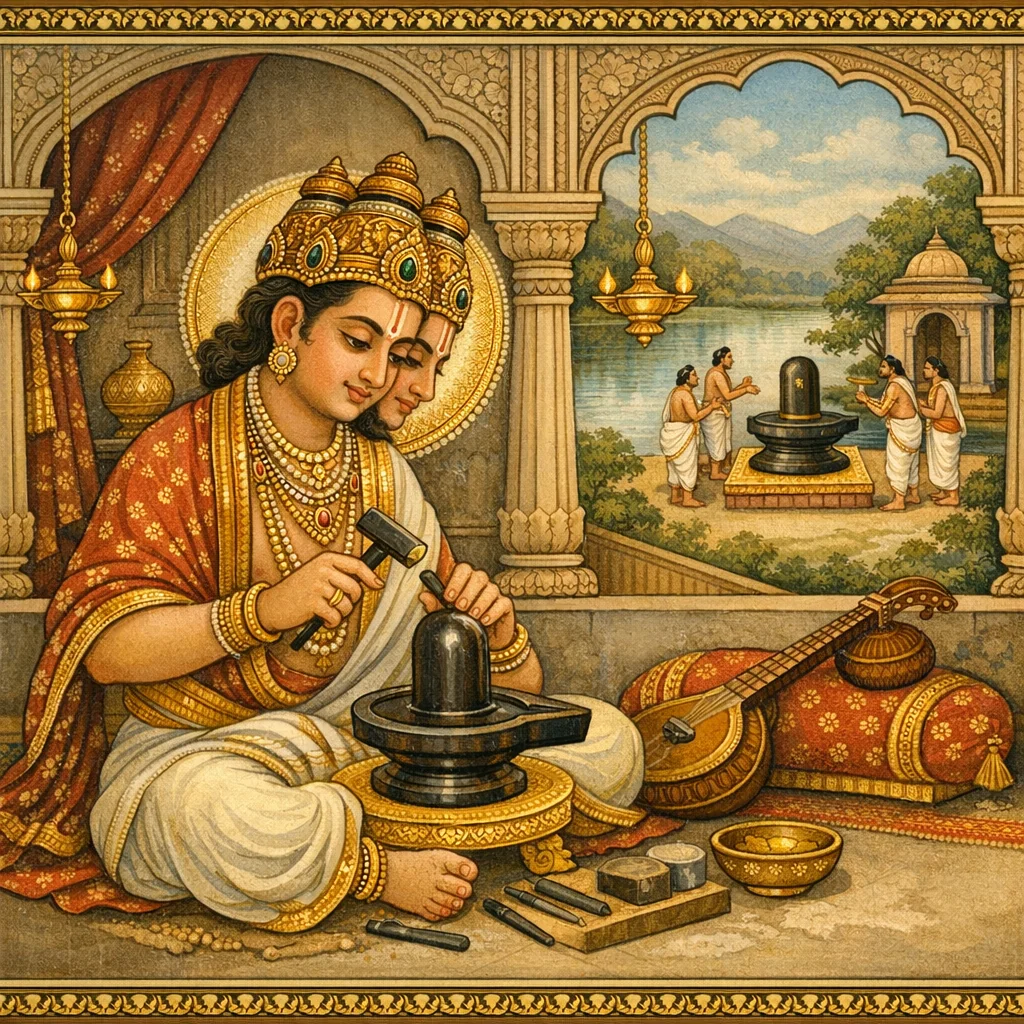
Adhyaya 34
कुमारेश्वर-लिङ्गप्रतिष्ठा, तीर्थमाहात्म्य, स्तव-फलश्रुति (Kumarēśvara Liṅga Installation, Tīrtha-Greatness, and Hymn’s Fruits)
The chapter begins with Nārada describing Brahmā’s resolve to establish a third liṅga, shaping it into an even more exemplary form—pleasing to the eye, calming to the mind, and fruitful in result. The gods create a wondrous lake and gather the waters of the great tīrthas, such as the Gaṅgā and others, into that basin for Skanda’s delight. On an auspicious day in Vaiśākha, Brahmā and the priests perform the installation with Rudra-mantras and offerings amid celestial music. Skanda bathes, performs liṅga-abhiṣeka with “the waters of all tīrthas,” and worships with five mantras; Śiva is said to receive the worship from within the liṅga. Skanda then asks the fruits of particular offerings, and Śiva replies with a detailed ritual-and-ethical catalogue: establishing liṅgas and building shrines grants long residence in Śiva’s realm, while gifts—flags, perfumes, lamps, incense, food offerings, flowers, bilva leaves, canopies, music, bells, and more—yield distinct results such as health, prosperity, fame, knowledge, and the removal of sin. Śiva’s abiding presence at Kumarēśvara is affirmed as a “hidden kṣetra,” likened to Viśvanātha at Vārāṇasī. Skanda recites an extended Śaiva stotra, and Śiva promises benefits to those who chant it morning and evening. The discourse expands to tīrtha observances: bathing and worship at Mahīsāgara-saṅgama on key lunar and solar occasions brings great merit. A drought-remedy rite is prescribed—multi-night abhiṣeka with scented water, offerings, feeding Brahmins, homa, donations, and Rudra-japa—promising rainfall and social well-being. Further boons include jāti-smṛti (memory of past births) through regular worship, Rudraloka for those who die at the tīrtha, and obstacle-removal assured by Kapardin (Gaṇeśa). The chapter closes with exemplary devotees such as Jāmadagnya/Paraśurāma and the injunction that reciting or hearing this māhātmya grants desired fruits, benefits ancestors when read at śrāddha, and bestows auspicious offspring when read to a pregnant woman.
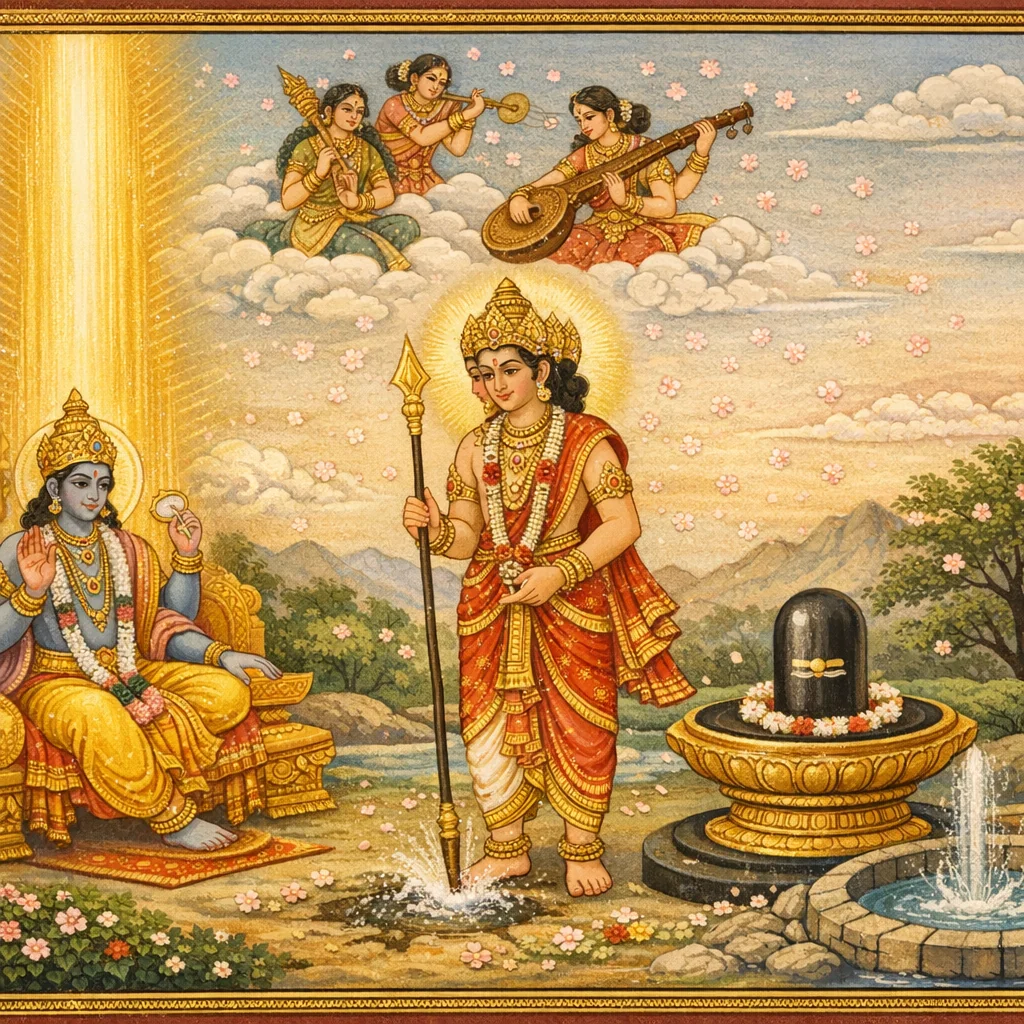
Adhyaya 35
जयस्तम्भ-स्थापनम् तथा स्तम्भेश्वर-लिङ्गप्रतिष्ठा (Installation of the Victory Pillar and the Stambheśvara Liṅga)
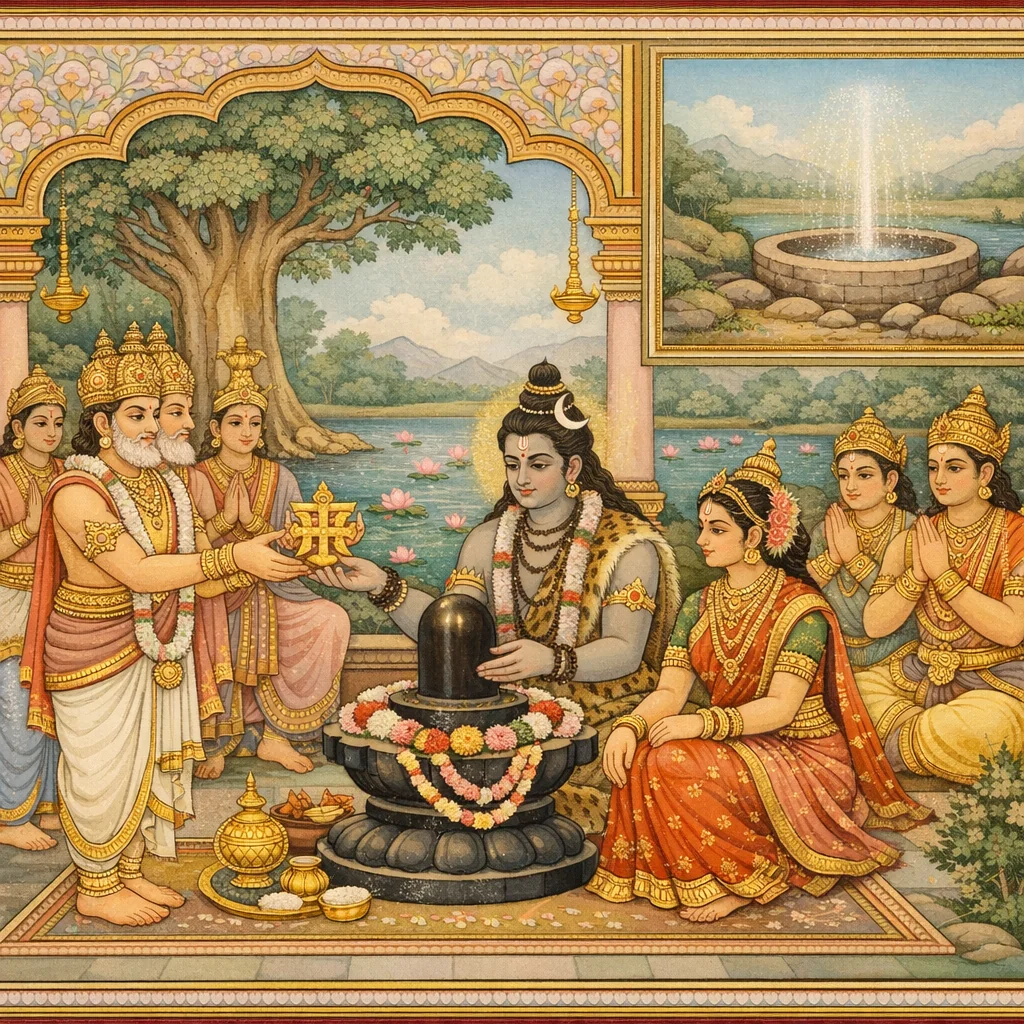
This chapter unfolds a ritual-theological episode framed by Nārada’s inquiry. The gods approach Skanda (Guhā) with folded hands and petition him, citing the victors’ custom that one who conquers enemies in battle should erect a victory-marked pillar (stambha-cihna). To commemorate Skanda’s triumph they propose an excellent pillar, fashioned by Viśvakarman and linked with an eminent liṅga tradition. Skanda agrees, and the devas led by Śakra/Indra install on the battlefield a radiant, jāmbūnada-gold-like pillar; the ritual ground is adorned like a jewel-filled precinct. Apsarases and divine hosts rejoice with song and dance; Viṣṇu is portrayed as providing musical accompaniment, and flowers rain from the sky as a sign of divine approval. The narrative then turns from monument to deity: Skanda, son of the Three-Eyed Lord, establishes Stambheśvara, a liṅga-form of Śiva. Nearby he creates a well (kūpa), from whose depths Gaṅgā is said to arise, joining the sanctity of water with the sanctity of the liṅga. The chapter prescribes ancestral rites: on the fourteenth day of the dark fortnight of Māgha, one who bathes in the well and offers pitṛ-tarpaṇa gains merit equal to Gayā-śrāddha. The phalaśruti adds that worship of Stambheśvara with fragrance and flowers yields lofty merit likened to the Vājapeya, and that śrāddha on new-moon/full-moon days—especially in the imagery of earth meeting ocean—together with Stambheśvara worship satisfies the ancestors, destroys sins, and leads to exaltation in Rudra’s realm. The chapter closes by attributing the teaching to Rudra for Skanda’s delight and affirming that the establishment was successful and praised by all the gods.
Adhyaya 36
सिद्धेश्वरलिङ्ग-स्थापनम् तथा सिद्धकूप-माहात्म्यम् (Establishment of Siddheśvara Liṅga and the Glory of Siddhakūpa)
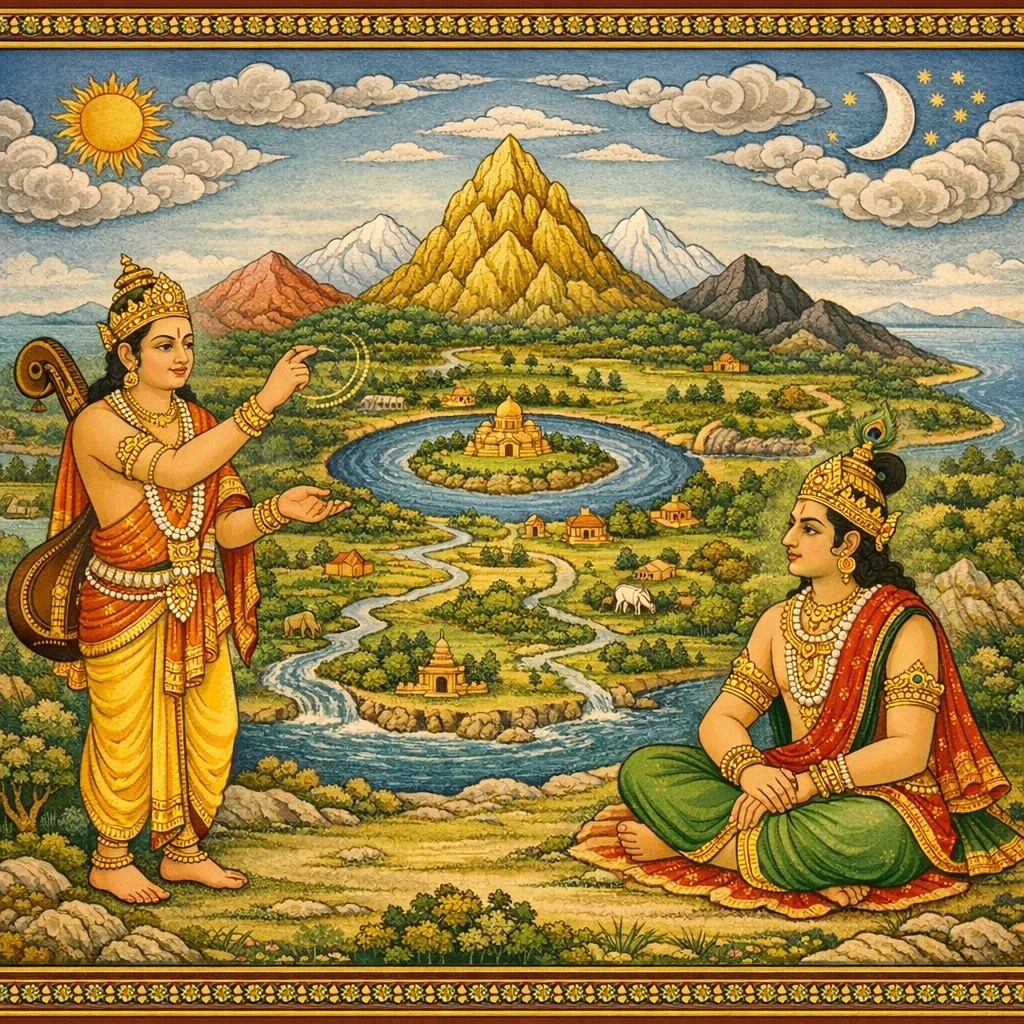
This adhyāya unfolds a connected series of kṣetra-formation themes. Seeing the many liṅgas earlier established by Skanda at the meeting of land and sea, the assembled devas—led by Brahmā, Viṣṇu, and Indra—reflect on the difficulty of scattered worship and resolve to found one auspicious liṅga for collective devotion and the stability of the region. With Maheśvara’s consent they install a liṅga made by Brahmā; Guha names it Siddheśvara, and a sacred pond is dug and filled with tīrtha waters. The narrative then turns to a crisis in Pātāla: the nāgas report the demon Pralamba’s ravages after fleeing the Tāraka war. Skanda sends his śakti to the netherworld; she pierces the earth, slays Pralamba, and the resulting fissure fills with the purifying waters of the Pātāla-Gaṅgā. Skanda names the place Siddhakūpa and prescribes observances—especially on kṛṣṇāṣṭamī and caturdaśī—bathing, worship of Siddheśvara, and śrāddha, promising the removal of sins and enduring ritual fruit. The chapter further establishes the kṣetra by installing Siddāmbikā, appointing kṣetrapālas (including a set of sixty-four Mahēśvaras), and founding Siddhivināyaka to ensure success in all beginnings. A concluding phalāśruti praises recitation or hearing as bestowing prosperity, protection, and ultimately nearness to Ṣaṇmukha’s realm.
Adhyaya 37
बर्बरीतीर्थमाहात्म्य-प्रस्तावना तथा सृष्टि-भूगोलवर्णनम् (Barbarī Tīrtha Prologue and Cosmography of Creation)
The chapter begins with Nārada’s vow to tell Arjuna the māhātmya of the Barbarī/Barbaree tīrtha, introducing Barbarikā—also called Kumārī—and declaring the Kaumārikākhaṇḍa to bestow the four aims of life. Arjuna asks for Kumārī’s story in full, and also for an explanation of how the cosmos arises, how beings become differentiated through karma, and how Bhārata-khaṇḍa is formed. Nārada replies with a technical cosmogony: from the unmanifest (avyakta) and the paired principles pradhāna and puruṣa emerge mahat, then ahaṅkāra in three guṇic modes, followed by tanmātras, bhūtas, the eleven indriyas including manas, and the complete set of twenty-four tattvas. The teaching then turns to cosmography: the brahmāṇḍa as a bubble-like cosmic egg, a three-tiered habitation—devas above, humans in the middle, nāgas/daityas below—and the seven dvīpas with surrounding oceans of differing substances. It details Meru’s measurements, its directional mountains, forests and lakes, boundary ranges, and the varṣa divisions of Jambūdvīpa, explaining Bhārata’s name from Bharata (descended from Ṛṣabha, son of Nābhi). Other dvīpas—Śāka, Kuśa, Krauñca, Śālmali, Gomeda, Puṣkara—are outlined with their rulers, regions, and characteristic devotions (japa/stuti) to Vāyu, Jātavedas/Agni, Āpaḥ, Soma, Sūrya, and Brahman-contemplation, concluding by leading toward the arrangement of the higher worlds.
Adhyaya 38
रथ-मण्डल-लोकविन्यासः (Cosmography of Chariots, Spheres, and Lokas)
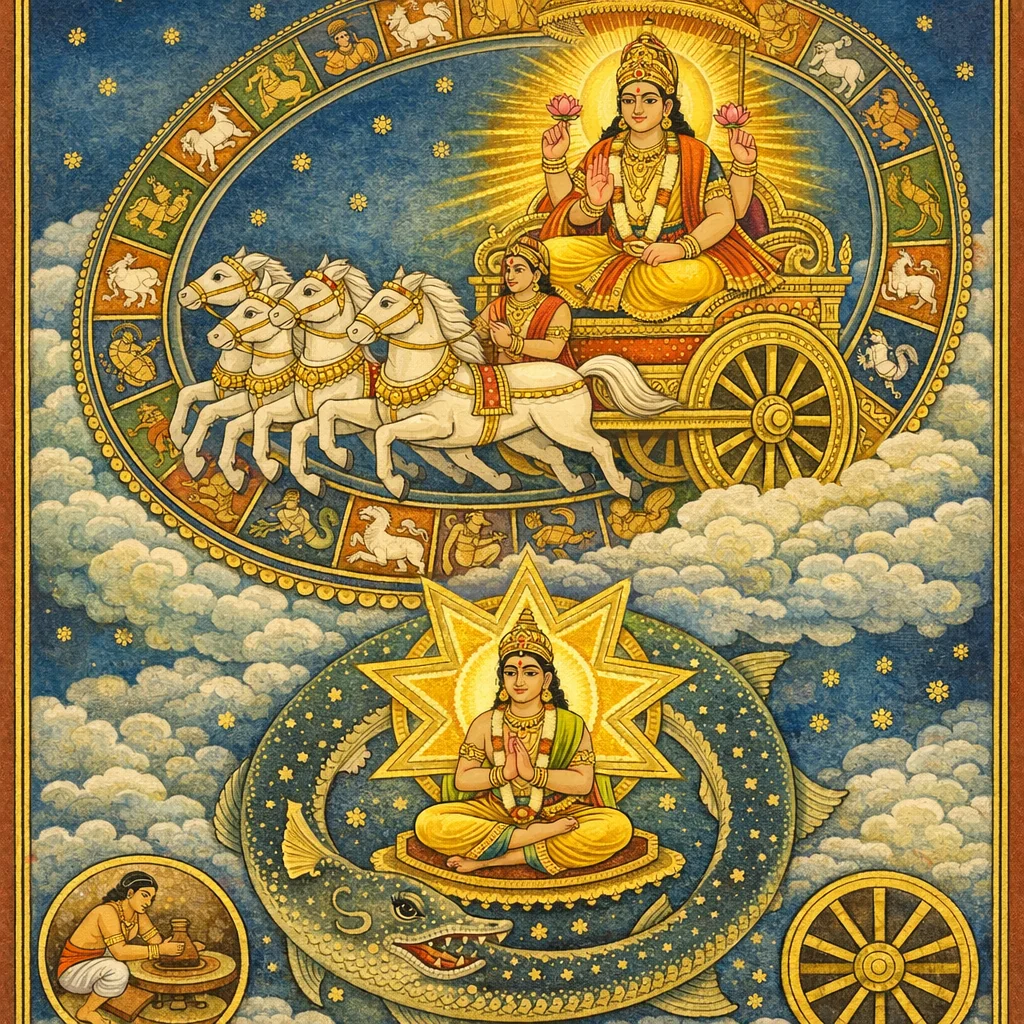
This chapter, framed as Nārada’s exposition, presents a technical cosmography of the heavens. It describes the Sun’s sphere and the construction of the solar chariot—axles, wheels, and measures—and links the Sun’s seven horses with the Vedic metres: Gāyatrī, Bṛhatī, Uṣṇik, Jagatī, Triṣṭubh, Anuṣṭubh, and Paṅkti. “Sunrise” and “sunset” are explained as appearance and disappearance to perception, not the Sun’s absolute cessation. It then outlines the Sun’s northern and southern courses (uttarāyaṇa/dakṣiṇāyana) through the rāśis, explaining differing apparent speeds by the analogy of a potter’s wheel. Twilight (sandhyā) conflicts are introduced, in which beings seek to harm the Sun, and the sandhyā observance—especially water offerings purified by the Gāyatrī—is taught as an ethical and protective rite. The chapter maps the Moon’s sphere, the nakṣatra-maṇḍala, and the planets with their placements and chariots, rising to the Saptarṣi-maṇḍala and to Dhruva as the axle and pivot of the jyotiṣ-cakra. It enumerates the seven lokas (bhūḥ, bhuvaḥ, svaḥ, mahaḥ, janaḥ, tapaḥ, satyaḥ) with relative distances and ontological notes (kṛtaka/akṛtaka). It concludes by situating the Gaṅgā in the cosmic order and describing the seven vāyu-skandhas that bind and rotate the celestial systems, leading into a transition toward the pātālas.
Adhyaya 39
Pātāla–Naraka Cosmography and the Barkareśvara–Stambhatīrtha Māhātmya (कालमान-वर्णन सहित)
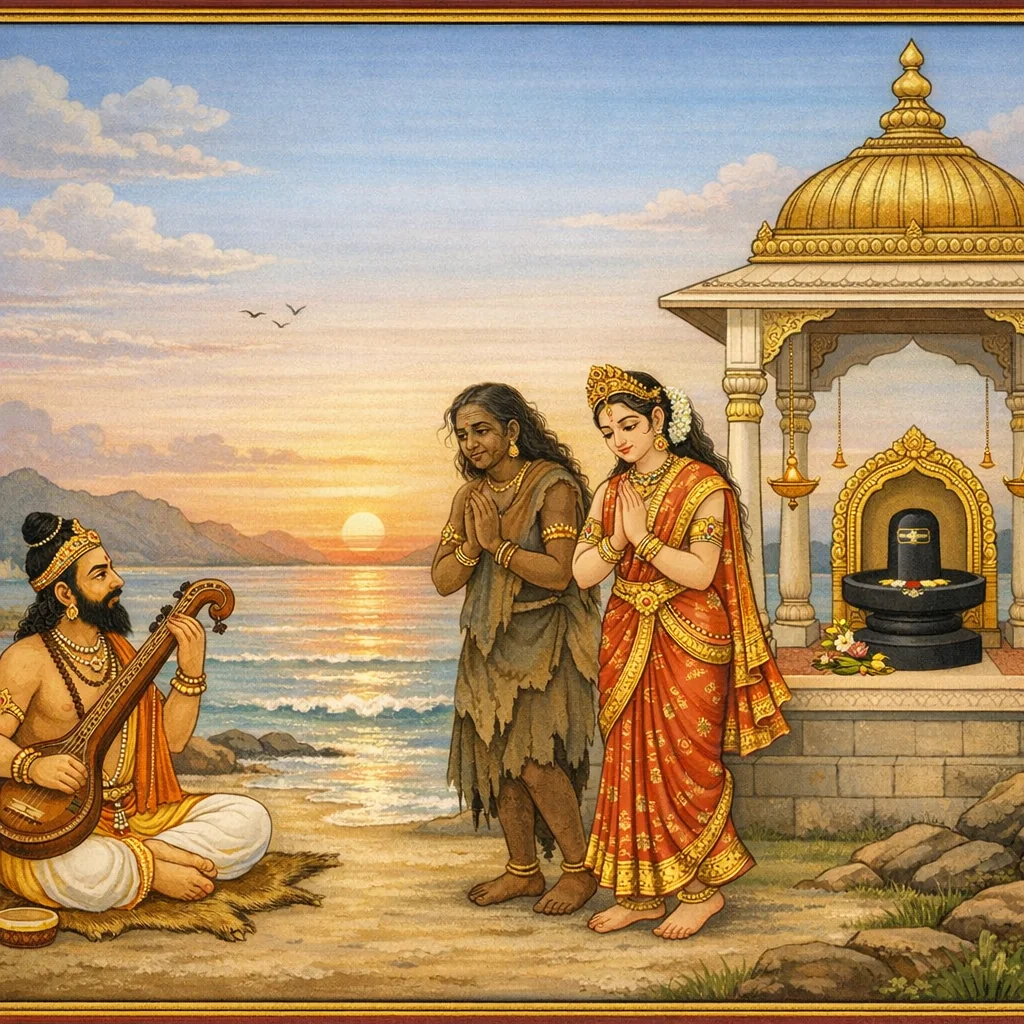
Adhyāya 39 presents a layered teaching on cosmography and the sanctity of tīrthas. Nārada describes the seven Pātālas—Atala through Pātāla—as radiant, beautiful realms inhabited by Dānavas, Daityas, and Nāgas, and introduces a colossal liṅga, Śrīhāṭakeśvara, installed by Brahmā. Beneath these, many Narakas are named, each linked to specific wrongs—false testimony, violence, misuse of intoxicants, breaches of duty toward guru and guest, and other anti-dharma acts—so that karmic consequence becomes moral instruction. The discourse then turns to cosmic structure and time: Kālāgni, Ananta, the directional elephants, and the enclosing kaṭāha (cosmic shell), followed by a technical scale of time from nimeṣa to yuga, manvantara, and kalpa, including named kalpas. It next recounts a local legend at Stambhatīrtha: a dog-headed maiden, Kumārīkā, recalls a past-life cause at the sea–land confluence; through tīrtha rites and tapas she is restored, establishes Barkareśvara, and creates the Svāstika-kūpa well, while the enduring merits of cremation and bone-immersion are explicitly praised. The chapter concludes with a broad mapping of Bhāratakhaṇḍa—its division among descendants, major mountains and river sources, and extensive regional lists with village and port counts—forming a Purāṇic gazetteer woven into sacred geography.
Adhyaya 40
Mahākāla-prādurbhāva and the Discourse on Tarpaṇa, Śrāddha, and Yuga-Dharma (महाकालप्रादुर्भावः)
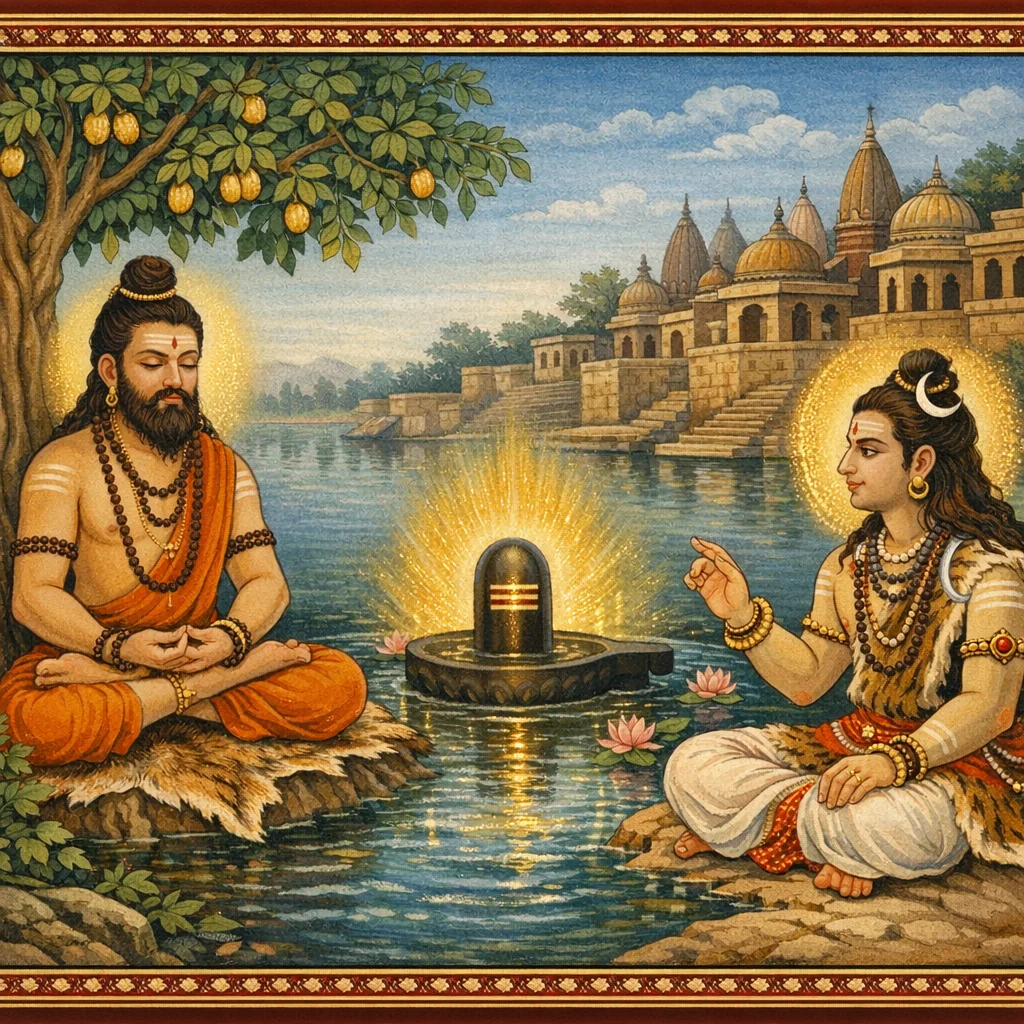
Arjuna asks Nārada who Mahākāla is and how He may be attained at a certain tīrtha. Nārada recounts the origin: in Vārāṇasī the ascetic Māṇḍi performs prolonged Rudra-japa to obtain a son, and Śiva grants a mighty child. The child remains in the womb for years, fearing the “kāla-mārga” (the karmic course) as opposed to the “arcis” path linked with liberation; by Śiva’s grace and the personified vibhūtis (virtues/powers), he is born and named Kālabhīti. As an accomplished Pāśupata devotee, Kālabhīti undertakes tīrtha-yātrā and intense mantra-japa beneath a bilva tree, entering profound bliss and discerning the site’s exceptional purity. During a century-long vow, a mysterious man offers him water; they debate purity, knowledge of lineage, and the ethics of accepting gifts, until a miracle proves the point—a pit fills and becomes a lake. The man vanishes, a colossal liṅga self-manifests amid celestial celebration, and Kālabhīti offers a many-faced Śiva-stotra. Śiva appears, praises his dharma, and grants boons: perpetual presence at the svayaṃbhū liṅga, imperishable fruit for worship and gifts there, and the merit of all tīrthas for bathing and ancestral tarpaṇa in the adjacent well, with special calendrical observances. Later King Karaṅdhama asks how water-offerings reach the ancestors and how śrāddha works. Mahākāla explains subtle reception through tattva and sensory essences, the necessity of mantra-mediated offering, the protective purpose of darbha/tila/akṣata against disruptive forces, and the four yugas with their dominant dharmas—Satya: dhyāna, Tretā: yajña, Dvāpara: observance/vrata, Kali: dāna—along with a sketch of Kali-yuga conditions and future restoration themes.
Adhyaya 41
Adhyāya 41 — Deva-tāratamya-vicāra, Pāpa-vibhāga, Śiva-pūjā-vidhi, and Ācāra-saṅgraha (Mahākāla’s Instruction)
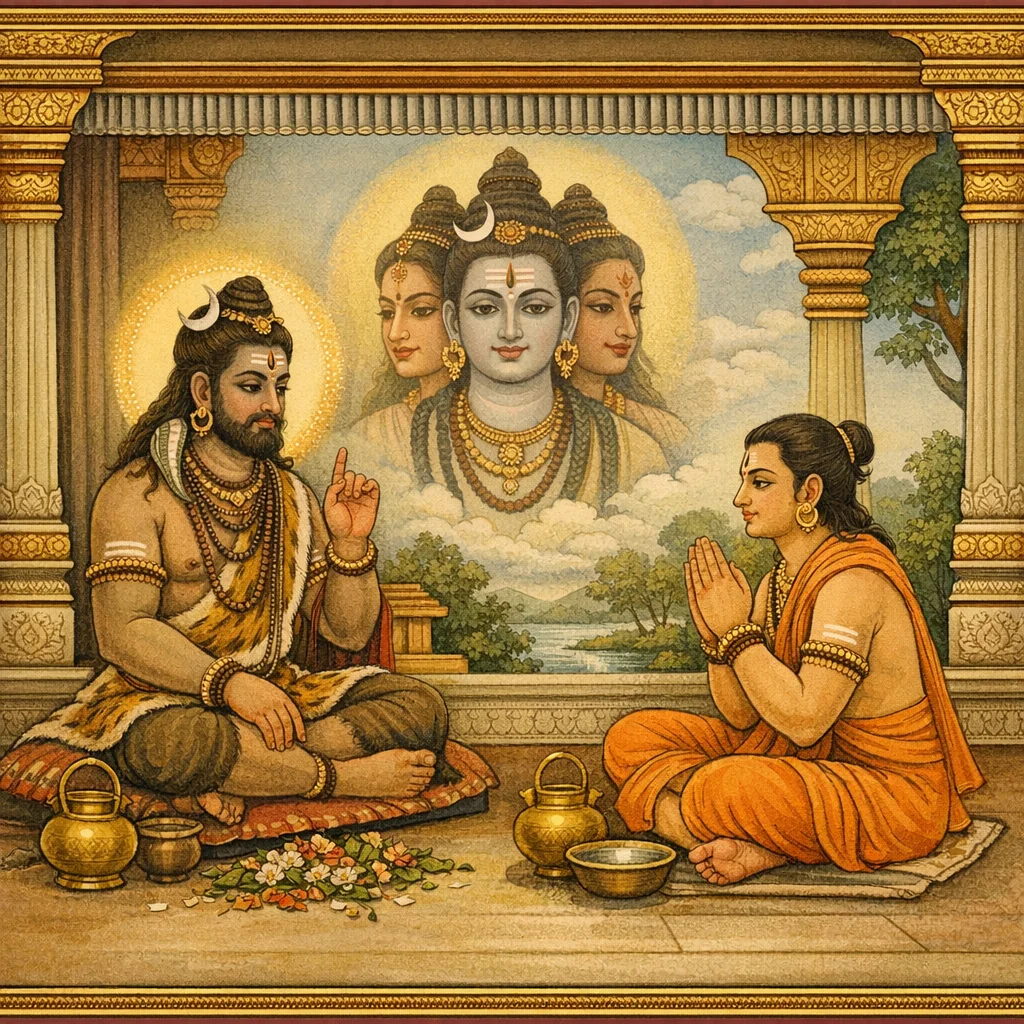
The chapter presents a structured theological and ethical instruction spoken by Mahākāla in reply to Karaṇḍhama. It first addresses debates about the “superiority” of deities—some extol Śiva, others Viṣṇu, others Brahmā as the means to mokṣa—and warns against simplistic hierarchy, recalling an earlier Naimiṣāraṇya episode where sages sought a verdict and received affirmations honoring multiple divine forms. It then lays out a detailed classification of sin: misdeeds of mind, speech, and body, with hostility toward Śiva marked as especially grave. Degrees of wrongdoing are traced from major sins (mahāpātaka) to secondary offenses (upapātaka) and broader social-ethical violations such as deceit, cruelty, exploitation, and slander. The teaching turns to ritual prescription with an abridged yet technical Śiva-pūjā: proper times, purification (including bhasma), entering and cleansing the shrine, water-vessels (gaḍuka), offerings, dhyāna, mantra practice (including a stated mūlamantra), arghya, dhūpa-dīpa-naivedya, nīrājana, and concluding hymns with requests for forgiveness. Finally, an extensive ācāra compendium sets out daily discipline for the householder-devotee—sandhyā observance, restraint in speech, bodily purity, reverence toward elders and sacred beings, and practical rules to safeguard dharma and spiritual progress. The chapter ends with a divine assembly honoring Mahākāla, affirming the renown of the liṅga and its associated tīrtha, and declaring benefits for those who hear, recite, or worship in accordance with these teachings.
Adhyaya 42
Aitareya-Māhātmya and Ekādaśī-Jāgara: Vāsudeva Installation, Bhāva-Śuddhi, and Liberation Theology
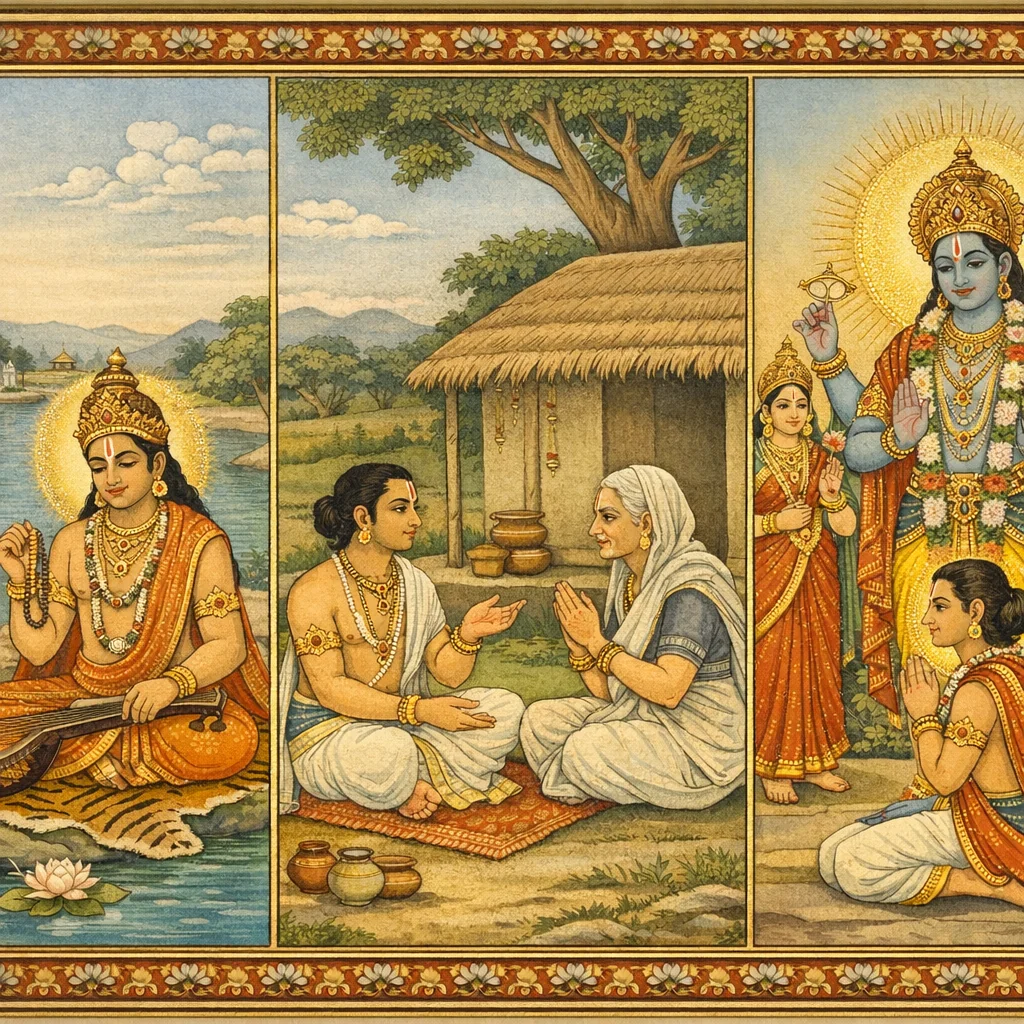
Chapter 42 unfolds in three linked movements. (1) Nārada teaches a tīrtha-theology: a sacred place is incomplete without Vāsudeva. After prolonged yogic worship with aṣṭākṣara-japa, he asks that a “kalā” of Viṣṇu be established there for the welfare of all; Viṣṇu agrees and is installed, giving the site a local epithet and ritual authority. (2) The chapter then prescribes an Ekādaśī observance (Kārttika, śukla pakṣa): bathing in designated waters, pañcopacāra worship, fasting, night vigil with music/recitation, avoidance of anger and pride, and dāna. It lists ideal devotional and ethical qualities, culminating in the claim that one who perfects the vigil “is not born again” (punar na jāyate). (3) A didactic exemplum follows: Arjuna asks about Aitareya; Nārada recounts his lineage, his seeming muteness from continuous mantra-japa, and household tensions. Aitareya teaches the pervasive duḥkha of embodied life, the inadequacy of outer purification without inner purity (bhāva-śuddhi), and the progression nirveda → vairāgya → jñāna → Viṣṇu-realization → mokṣa. Viṣṇu manifests, receives his stotra, grants boons, names its power “aghā-nāśana,” and directs him to Koṭitīrtha and a Harimedhas ritual context; Aitareya later fulfills his duties and attains liberation through constant remembrance of Vāsudeva.
Adhyaya 43
Bhattāditya-pratiṣṭhā, Sūrya-stuti (aṣṭottara-śata-nāma), and Arghya-vidhi at Kāmarūpa
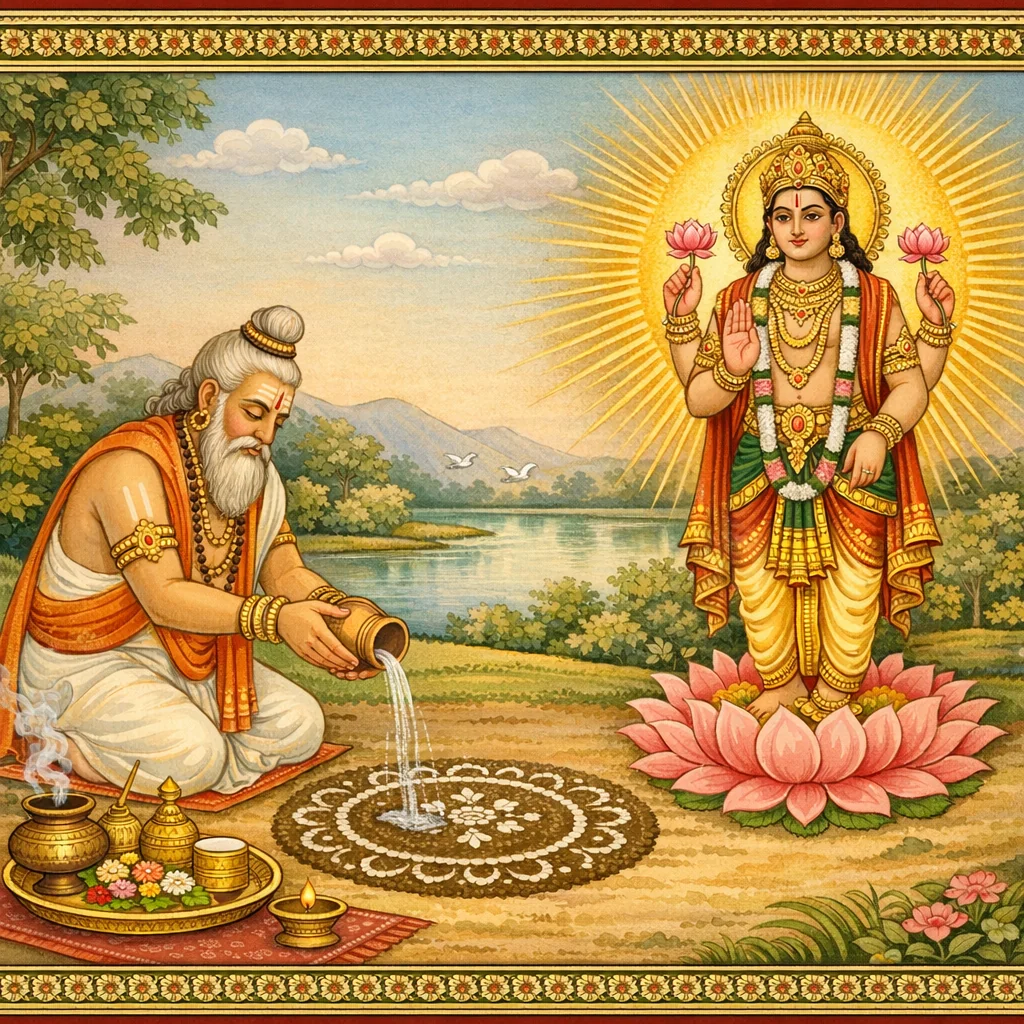
Framed as a dialogue, the chapter has Nārada recount to Arjuna a course of Sūrya-bhakti undertaken at Kāmarūpa for the welfare of the people. It opens by praising the Sun as the universal sustainer and by affirming that remembrance, hymn, and daily worship bestow worldly benefits and protective power. After a long ascetic discipline, Sūrya manifests directly and grants a boon: the deity’s “kāmarūpa-kalā” will remain present in that region. Nārada then installs the deity as Bhattāditya and offers an extended aṣṭottara-śata style hymn of 108 name-epithets, portraying Sūrya as cosmic ruler, healer, upholder of dharma, and remover of affliction. The teaching then turns to ritual detail: at Arjuna’s request, Nārada explains the morning arghya rite—purification, mandala preparation, the arghya vessel and its contents, meditation on Sūrya in twelve forms, invocation formulas, and a sequence of offerings (pādya, snāna, vastra, yajñopavīta, ornaments, unguents, flowers, incense, naivedya), ending with apologies and visarjana. Finally, the sacred geography is set forth: a forest kuṇḍa linked to the kāmarūpa-kalā, auspicious bathing on Māgha-śukla-saptamī, ratha worship and rathayātrā, and fruits equal to great tīrthas—closing with the assurance that Bhattāditya abides there continually, swiftly removing sin and strengthening dharma.
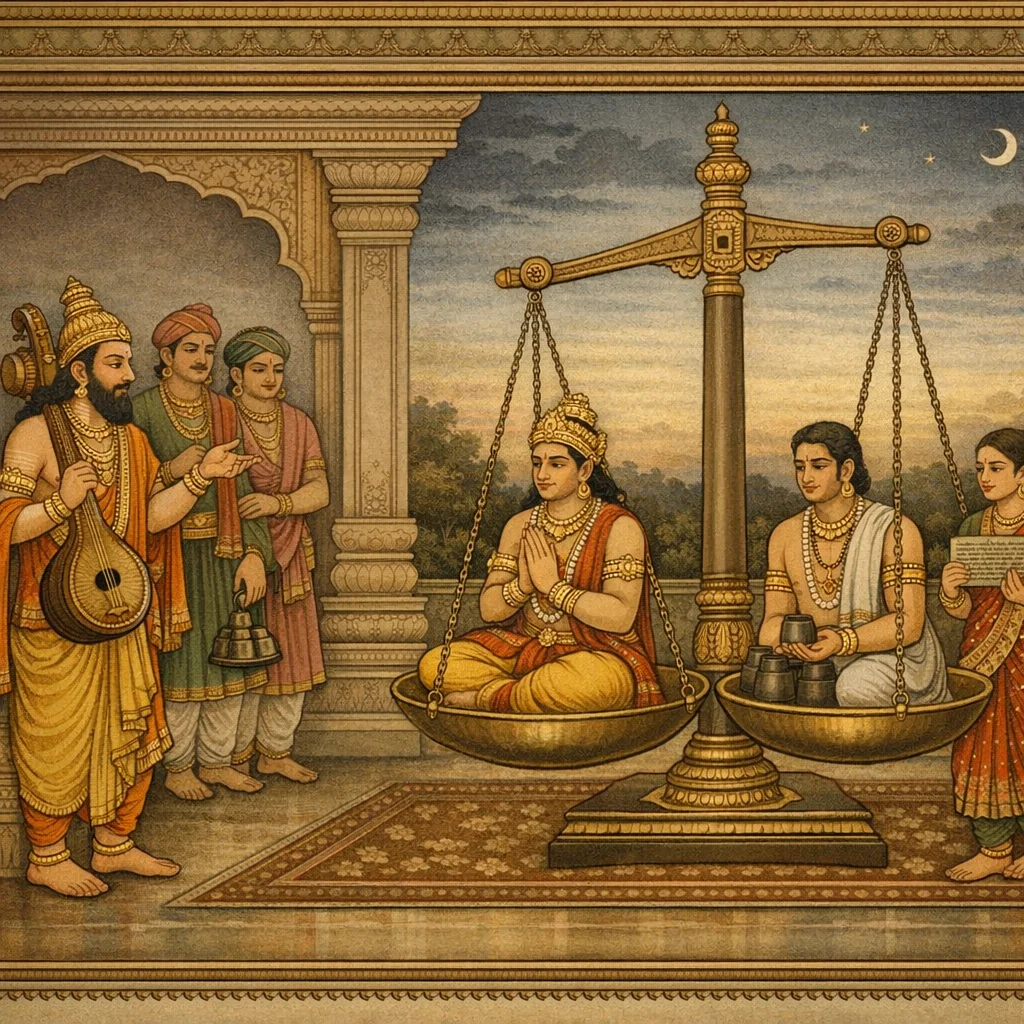
Adhyaya 44
दिव्य-शपथ-प्रकरणम् (Divya Ordeals and Oath-Procedure Discourse)
Arjuna asks for a clear account of “divya” procedures—ritual truth-tests used when evidence is lacking and disputes continue. Nārada lists the recognized ordeals (divyāni) and places them within ethical governance: oaths are to establish truth in contested matters such as quarrels, accusations, and grave offenses. The chapter repeatedly warns that false oaths cannot be hidden from divine witnesses—sun, moon, wind, fire, earth, waters, the heart/conscience, Yama, day and night, twilight, and Dharma—and that careless or deceitful swearing brings ruin. It then gives stepwise, technical descriptions of several ordeals: the scale/balance test (tulā/ghaṭa, with materials, measures, officiants, and pass–fail rules), poison, fire (heated iron with ritual preparation and burn-observation), hot bean/gold (taptamāṣa), ploughshare/tongue examination (phalā/jihvā), rice (tandula, used in theft cases), and water (submersion time). Overall, these rites are presented as regulated instruments for rulers and officials, requiring competent, impartial administration and safeguards against manipulation.
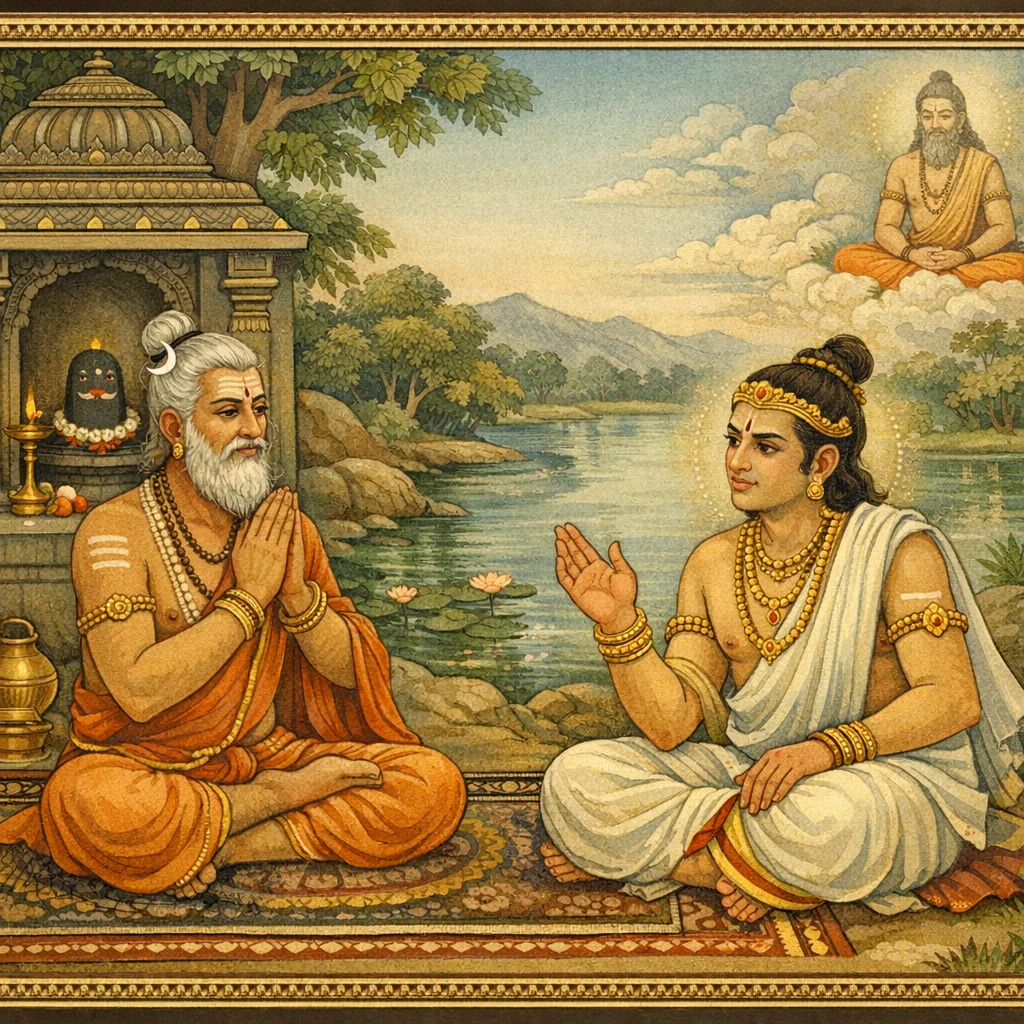
Adhyaya 45
बहूदकतīर्थे नन्दभद्र-सत्यव्रतसंवादः (Nandabhadra–Satyavrata Dialogue at Bahūdaka Tīrtha)
Chapter 45 begins with Nārada situating the discourse at Bahūdaka in Kāmarūpa and explaining the name and sanctity of the tīrtha, recalling Kapila’s austerities and the स्थापना of the Kapileśvara liṅga. The narrative then presents Nandabhadra as a model of righteousness—disciplined in thought, speech, and deed, devoted to Śiva’s worship, and committed to an honest livelihood, even in trade with small profit and no fraud. Nandabhadra rejects easy praise of yajña, saṃnyāsa, agriculture, worldly power, and even pilgrimage when these are severed from purity and ahiṃsā. He redefines true sacrifice as sincere bhakti that pleases the deities, and teaches that the self is purified by ceasing from sin. Conflict arises when the skeptical neighbor Satyavrata searches for faults in Nandabhadra and reads his misfortunes—loss of son and wife—as evidence against dharma and liṅga worship. Satyavrata offers a technical discussion of the qualities and faults of speech and advances a naturalistic ‘svabhāva’ view denying divine causation. Nandabhadra replies that suffering is also seen among the unethical, defends liṅga worship with exempla of gods and heroes who established liṅgas, and warns against ornate yet inconsistent rhetoric. The chapter ends with his departure toward the holy Bahūdaka-kunda, reaffirming dharma’s authority when grounded in reliable pramāṇas—Veda, Smṛti, and dharmically coherent reasoning.
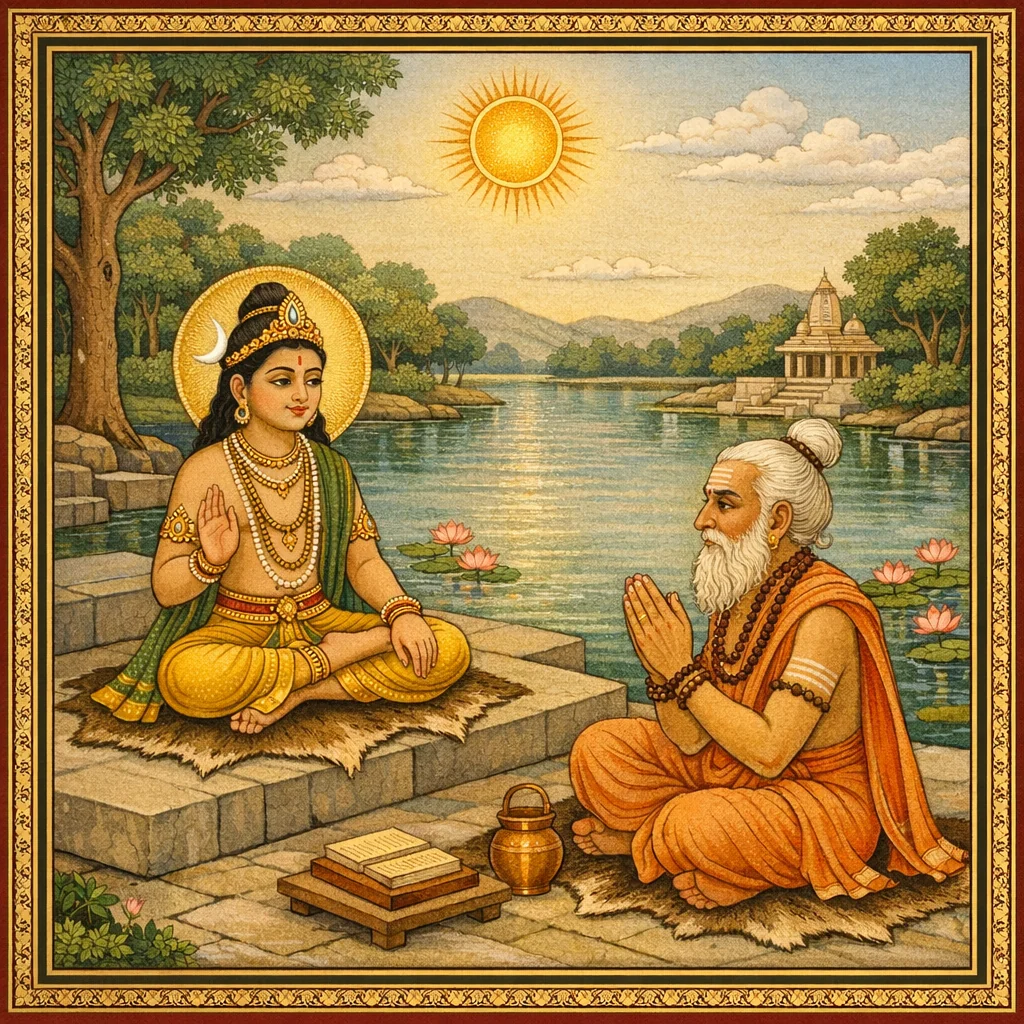
Adhyaya 46
Bahūdaka-kuṇḍa Māhātmya and the Instruction on Guṇas, Karma, and Detachment (बाहूदककुण्डमाहात्म्यं तथा गुणकर्मवैराग्योपदेशः)
This chapter praises the sanctity of Bahūdaka-kuṇḍa and, within a tīrtha narrative, teaches about the guṇas, karma, and vairāgya (detachment). After worshipping the Kapileśvara-liṅga on the bank of Bahūdaka-kuṇḍa, Nandabhadra raises a deep protest against the seeming injustice of saṃsāra: why would the pure, unattached Lord create a world of suffering, separation, and unequal destinies (svarga/naraka)? A diseased seven-year-old child arrives and reframes the issue through ethical psychology: bodily and mental pains have discernible causes, and the root of mental anguish is sneha (attachment), which gives rise to rāga, desire (kāma), anger (krodha), and craving (tṛṣṇā). Asked how one can abandon ego, desire, and anger while still pursuing dharma, the child explains a sāṃkhya-leaning cosmology—prakṛti and puruṣa, the emergence of guṇas, ahaṃkāra, tanmātras and indriyas—and urges the refinement of rajas and tamas through sattva. On why devotees still suffer, the child speaks of purity and impurity in worship, the inevitability of karma’s fruition, and divine grace as enabling the concentrated enjoyment or exhaustion of results across births. He then reveals his prior-life story (a hypocritical preacher punished in naraka, reborn through many yoni-s, aided by Vyāsa through the Sārasvata mantra) and prescribes rites: a week-long fast with solar japa, cremation at a named tīrtha, immersion of bones, and installation of a Bhāskara icon at Bahūdaka. The phala section lists the merits of bathing, offerings, ritual acts, feeding and hospitality, yoga practice, and attentive hearing, culminating in a liberation-oriented promise.
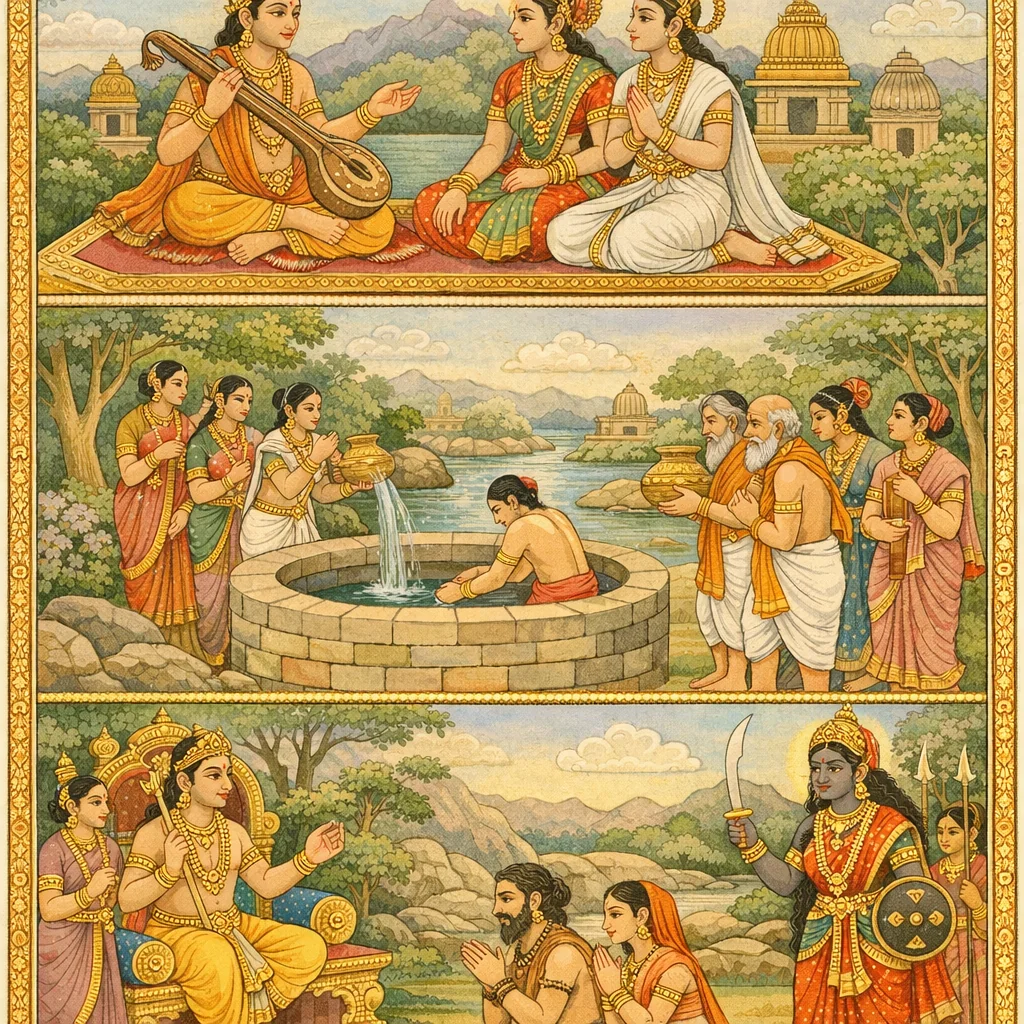
Adhyaya 47
Śakti-vyāpti, Digdevī-sthāpana, Navadurgā-pratiṣṭhā, and Tīrtha-phalapradāna (Chapter 47)
Chapter 47 sets forth a structured theological teaching on Śakti as the eternal, all-pervading Prakṛti, comparable to the Supreme Lord’s own pervasion. Śakti becomes a cause of bondage or a means of liberation according to one’s inner orientation and worship; those who disregard her are said to decline spiritually, illustrated by an exemplum from Vārāṇasī of fallen yogins. The chapter then lays out a directional ritual geography, installing four Mahāśaktis in the quarters: Siddhāmbikā in the east; Tārā in the south, linked with the Kūrma episode and the safeguarding of Vedic order; Bhāskarā in the west, energizing the sun and the stellar bodies; and Yoganandinī in the north, associated with yogic purity and the Sanakas. It further establishes nine Durgās at the tīrtha—Tripurā; Kolambā (with a Rudrāṇī-related well, bathing especially on Māgha Aṣṭamī, and praised as surpassing major tīrthas); Kapāleśī; Suvarṇākṣī; Mahādurgā known as Carcitā (bestower of valor, with a future exemplum of freeing a bound hero); Trailokyavijayā (from Soma-loka); Ekavīrā (power of cosmic dissolution); Harasiddhi (born from Rudra’s body, protecting from ḍākinī disturbances); and Caṇḍikā/Navamī in the Īśāna corner with battle motifs involving Caṇḍa-Muṇḍa, Andhaka, and Raktabīja. Navarātra worship is prescribed with offerings—bali, pūpa, naivedya, dhūpa, gandha—promising protective results in public spaces such as streets and crossroads. Bhūtamātā/Guhāśakti is also described as enforcing boundaries over disruptive beings and granting boons to those who worship on the Vaiśākha darśa day with specified offerings. The conclusion presents the tīrtha as a multi-station abode of many goddesses, emphasizing ritual engagement as the means to uphold ethical order, receive protection, and attain desired goals.
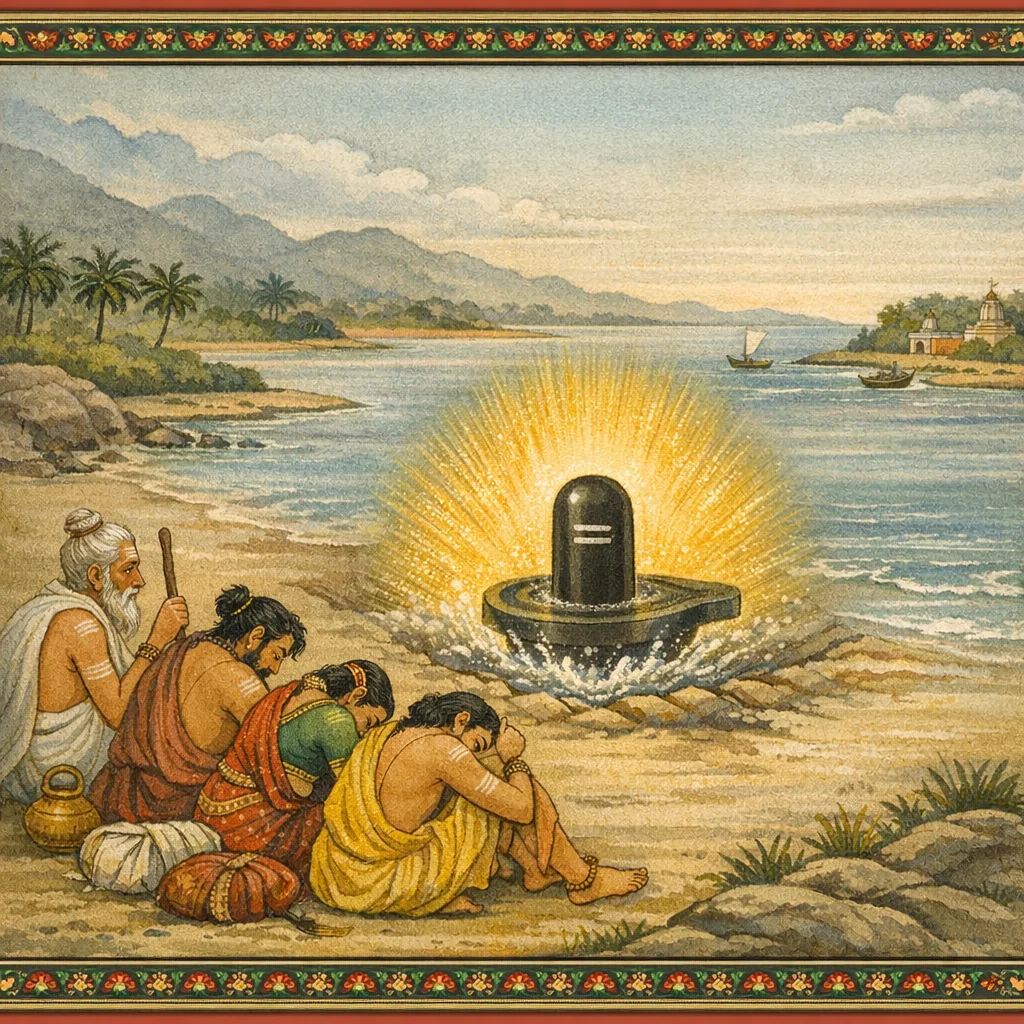
Adhyaya 48
स्तम्भतीर्थमाहात्म्ये सोमनाथवृत्तान्तवर्णनम् (Somanātha Account within the Glory of Stambha-tīrtha)
The chapter begins with Nārada’s vow to set forth clearly the māhātmya of Somanātha, declaring that hearing and reciting it become means to pāpa-mokṣa. Two radiant Brahmins, Ūrjayanta and Prāleya, encounter a verse praising Prabhāsa and its tīrthas, and are stirred to undertake pilgrimage for ritual bathing. They travel through forests and across rivers, including the Narmadā, reaching a sacred tract envisioned as the meeting of land and sea. Weariness, hunger, and thirst test their pilgrim discipline; they collapse near a Siddhaliṅga and bow to Siddhanātha. In that liminal moment a liṅga is said to arise, with a heavenly voice and a rain of flowers, granting Prāleya a fruit equal to Somanātha and pointing to a liṅga established on the seashore. The narrative then turns back to Prabhāsa and presents a dual Somanātha motif—two manifestations linked to the two travelers. Hāṭakeśvara is introduced: Brahmā is described as establishing a liṅga, followed by a structured hymn enumerating Śiva’s cosmic forms in aṣṭamūrti imagery (sun/fire, earth, wind, sky/sound, and more). The phalaśruti concludes that reciting or hearing Brahmā’s hymn and remembering Hāṭakeśvara brings sāyujya with the eightfold Śiva, and affirms the abundance of puṇya-places at the land–ocean confluence.
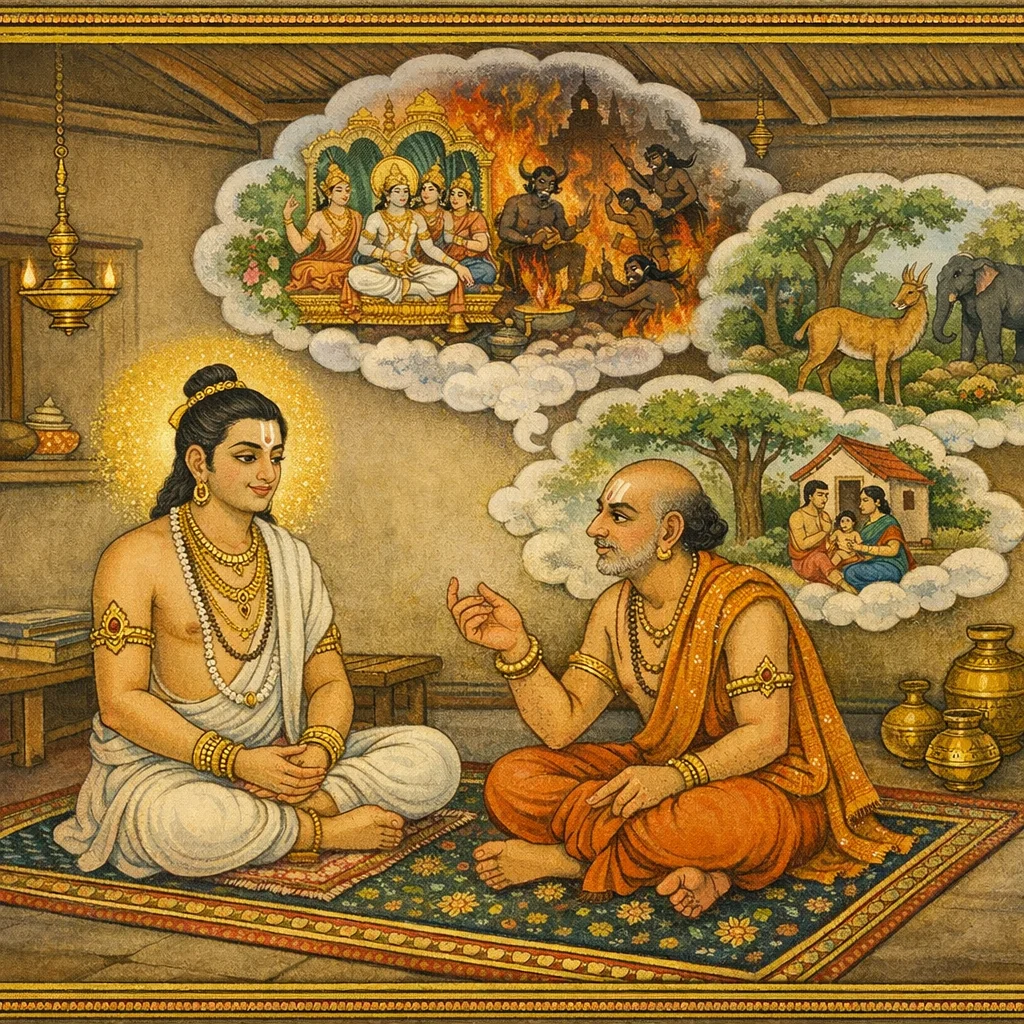
Adhyaya 49
Jayāditya-Māhātmya and the Discourse on Karma, Rebirth, and the ‘Twofold Food’
Arjuna asks to hear of the chief tīrthas established at Mahīnagaraka. Nārada introduces the sacred region and extols Jayāditya, a solar manifestation, declaring that remembrance of the Name brings relief from disease and fulfills heartfelt aims, and that even the mere sight of Him is auspicious. Nārada then recounts an earlier episode: he once journeyed to the solar realm, where Bhāskara questioned him about the Brahmins dwelling in the place Nārada had founded. Nārada refuses to praise or blame them, warning that both carry ethical and rhetorical peril, and urges the deity to ascertain the truth directly. Bhāskara assumes the guise of an aged Brahmin and arrives at the riverside near the settlement, where the local Brahmins led by Hārīta receive him as an atithi (honored guest). The guest asks for “parama-bhojana” (supreme food). Hārīta’s son Kamaṭha explains the “twofold food”: ordinary food that satisfies the body, and the supreme food of dharma-instruction—hearing and teaching—which nourishes the ātman/kṣetrajña (the knower of the field). The guest then asks how beings are born and dissolved, and where they go after becoming ash; Kamaṭha answers by classifying karma as sāttvika, tāmasa, or mixed, and by tracing rebirth to heavenly, infernal, animal, and human states. The chapter continues with detailed embryology and the sufferings of the womb, and concludes with a stark, poetic anatomy of the body as a “house” inhabited by the field-knower, where liberation, heaven, and hell are pursued through action and understanding.
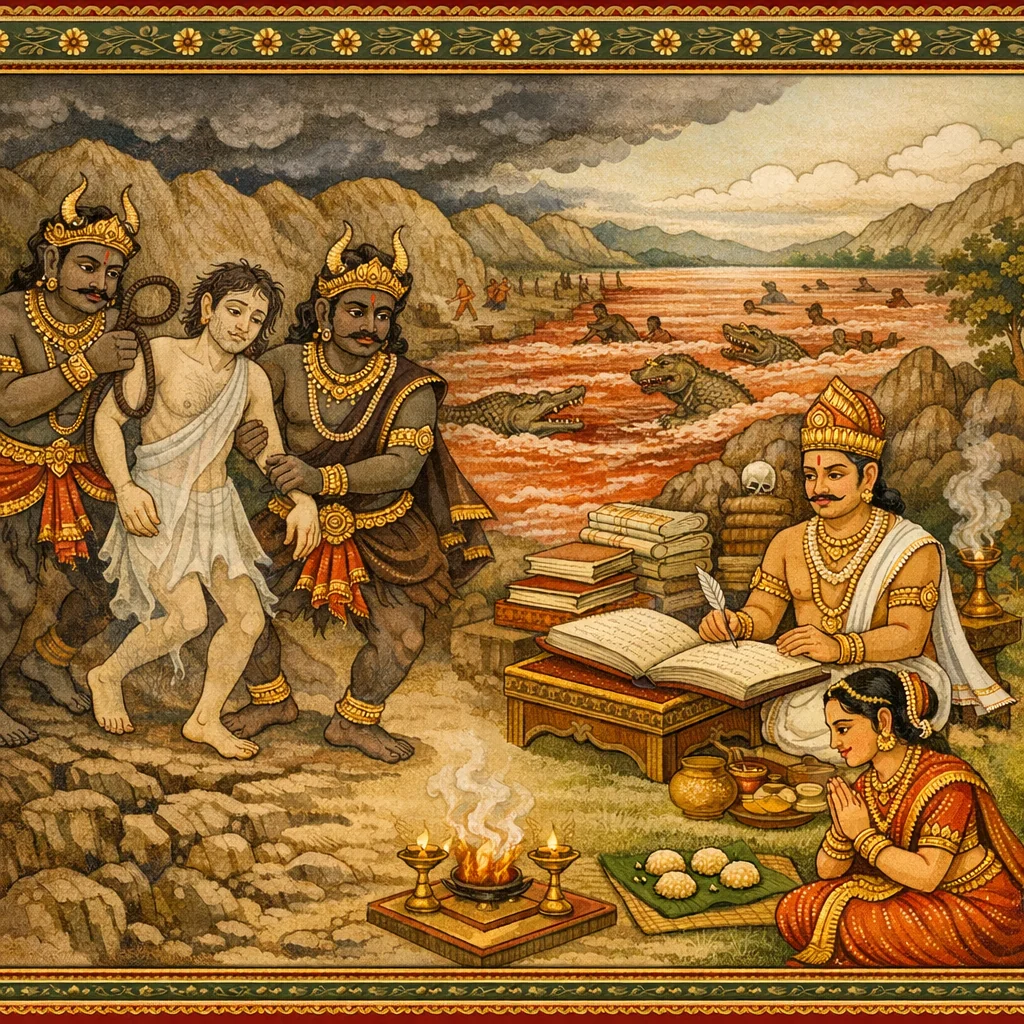
Adhyaya 50
Śarīra–Brahmāṇḍa-sāmya, Dhātu–Nāḍī-vyavasthā, and Karma–Preta-yātrā (Body–Cosmos Correspondence and Post-mortem Ethics)
This chapter unfolds as a technical theological dialogue. Atithi asks about bodily characteristics, and Kamaṭha teaches the microcosm–macrocosm doctrine: the human body corresponds to the cosmic tiers from Pātāla up to Satyaloka, so anatomy is presented as a map of the universe. It then lists bodily constituents and measures—seven dhātus (skin, blood, flesh, fat, bone, marrow, semen), counts of bones and nāḍīs, and the chief limbs and internal organs. The discourse proceeds to functional physiology: the principal nāḍīs (suṣumnā, iḍā, piṅgalā), the five vāyus (prāṇa, apāna, samāna, udāna, vyāna) and their karmic roles, the five forms of digestive fire (pācaka, rañjaka, sādhaka, ālocaka, bhrājaka), and soma/kapha aspects (e.g., kledaka, bodhaka, tarpaṇa, śleṣmaka, ālambaka). Digestion is traced as food becomes rasa, then blood and successive tissues, while wastes exit through twelve mala-āśrayas. The chapter then turns to ethics and the after-death passage: the body must be maintained as an instrument for puṇya, and actions ripen according to time, place, and capacity. At death the jīva departs through apertures according to karma, assumes an intermediate (ativāhika) form, is led to Yama’s realm, confronts the Vaitaraṇī river motif and preta-loka conditions. Offerings and śrāddha— including annual completion and sapinḍīkaraṇa—are emphasized as relieving preta status, and the teaching concludes that mixed karma yields mixed destinations (svarga/naraka) in proportion to one’s deeds.
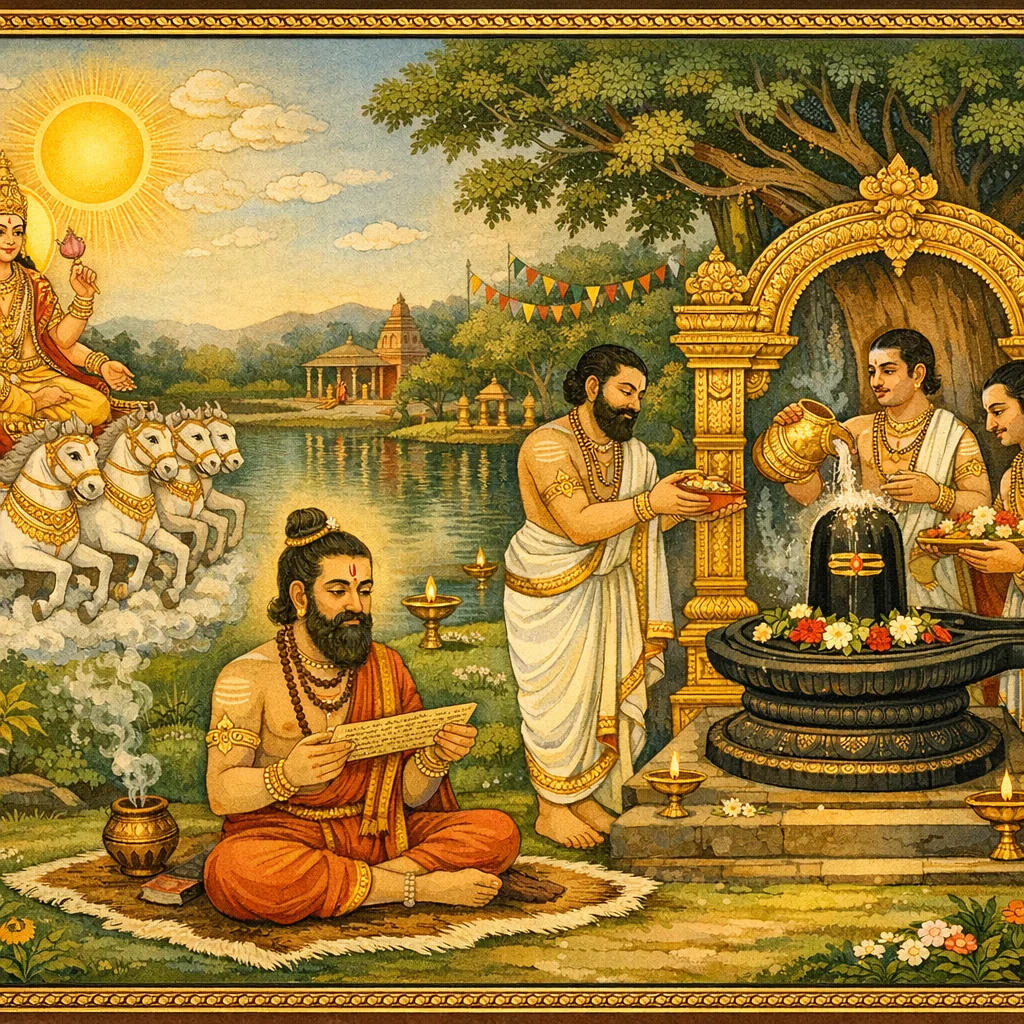
Adhyaya 51
Jayāditya-pratiṣṭhā, Karma-phala Lakṣaṇa, and Sūrya-stuti (जयादित्यप्रतिष्ठा—कर्मफललक्षण—सूर्यस्तुति)
The chapter moves in three closely linked parts. (1) To answer doubts about the afterlife, Kamatha systematizes the “marks of karma’s fruit” (karma-phala lakṣaṇas) as an instructive catalogue: visible embodied conditions—disease, disability, and social marginality—are correlated with specific transgressions such as violence, theft, deceit, sexual misconduct, disrespect toward teachers, and harm done to cows or sacred persons. (2) A dharma-centered didactic close follows: happiness in both worlds arises from dharma, while adharma yields suffering; even a short life with “white” (pure) action is preferable to a long life opposed to the good of both worlds. (3) The narrative then turns to sacred establishment. Nārada and the brāhmaṇas praise Kamatha’s discourse; Sūrya appears, approves, and offers a boon. Asked to remain permanently, Sūrya agrees and becomes known as Jayāditya, promising relief from poverty and disease to worshippers. After Kamatha recites a formal hymn (Jayādityāṣṭaka-style), Sūrya prescribes ritual times (especially Sundays and the month of Āśvina), offerings, bathing at Koṭitīrtha, and the resulting purification and attainment of Sūryaloka; the chapter ends by equating this practice’s merit with that of renowned tīrthas.
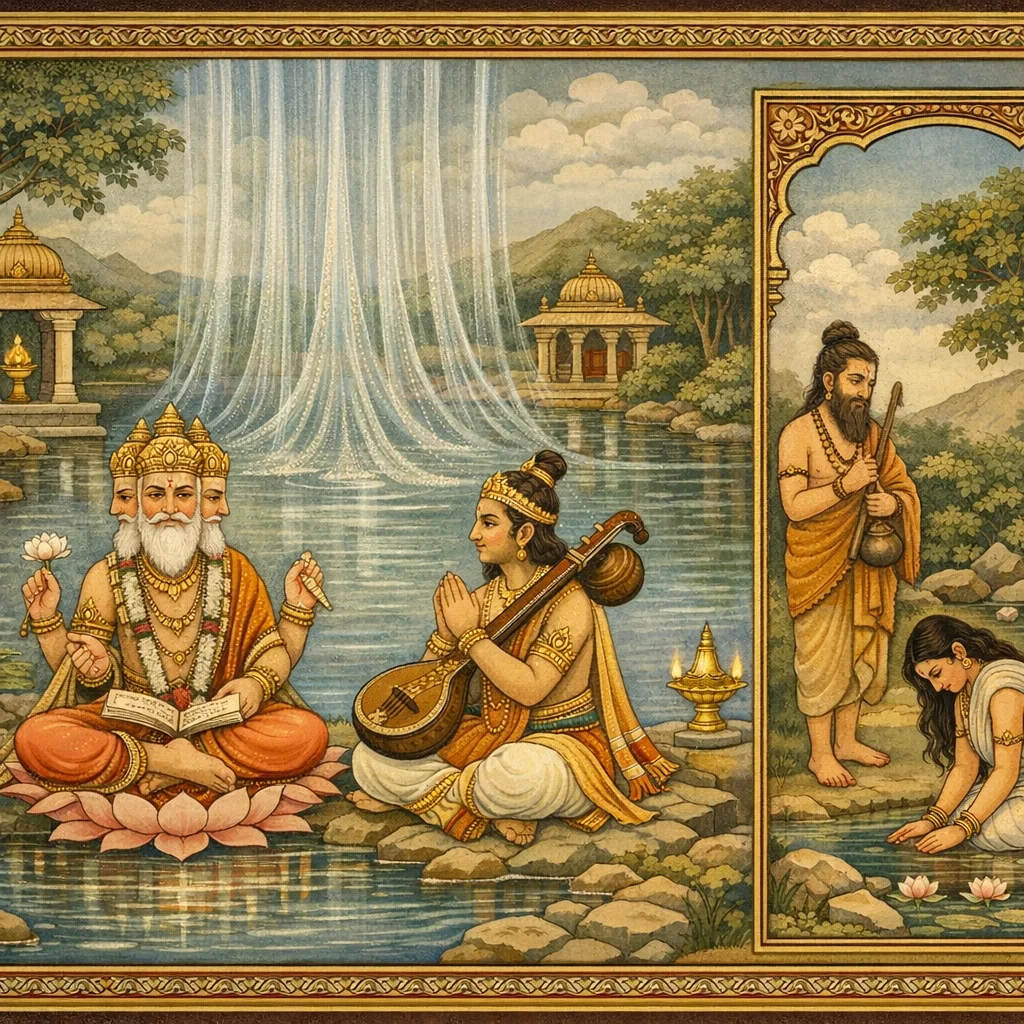
Adhyaya 52
कोटितीर्थमाहात्म्यवर्णनम् (Koti-tīrtha Māhātmya: The Glory and Ritual Efficacy of Koti Tirtha)
This chapter unfolds as a dialogue: Arjuna asks Nārada how Koṭitīrtha came into being, who constructed it, and why its promised fruits are so widely proclaimed. Nārada relates a cosmo-ritual origin: Brahmā is brought from Brahma-loka; as he recollects innumerable tīrthas, they manifest by that very remembrance from Svarga, Earth, and Pātāla, each with its corresponding liṅga. After bathing and worship, Brahmā mentally fashions a sacred lake (sarovara) and decrees that all tīrthas shall abide within it, and that worship of a single liṅga there is equivalent to worship of all liṅgas. The phalaśruti then declares the rewards: bathing (snāna) at Koṭitīrtha yields the fruit of all tīrthas and rivers, including the Gaṅgā; śrāddha and piṇḍadāna grant inexhaustible satisfaction to the ancestors; worship of Koṭīśvara bestows the merit of worshipping a koṭi of liṅgas. The sanctity is further localized through ṛṣi exemplars: Atri establishes Atrīśvara to the south and creates a reservoir; Bharadvāja installs Bharadvājeśvara and performs tapas and yajñas; Gautama undertakes fierce tapas seeking union with Ahalyā, after which Ahalyā creates Ahalyā-saras—bathing and rites there, with worship of Gautameśvara, lead to Brahma-loka. Ethical instruction on dāna is explicit: feeding even one brāhmaṇa with faith is said to satisfy a “crore,” and gifts given at this site multiply merit; but promising a donation and failing to give is severely condemned with grave consequences. The chapter also marks times of heightened efficacy—Māgha, the Sun’s entry into Makara, Kanyā-saṅkrānti, and Kārtika—asserting intensified ritual yield, even koṭi-yajña equivalence. It closes by exalting death, cremation, and bone-immersion connected with the place as beyond full verbal appraisal, affirming Koṭitīrtha’s exceptional glory.
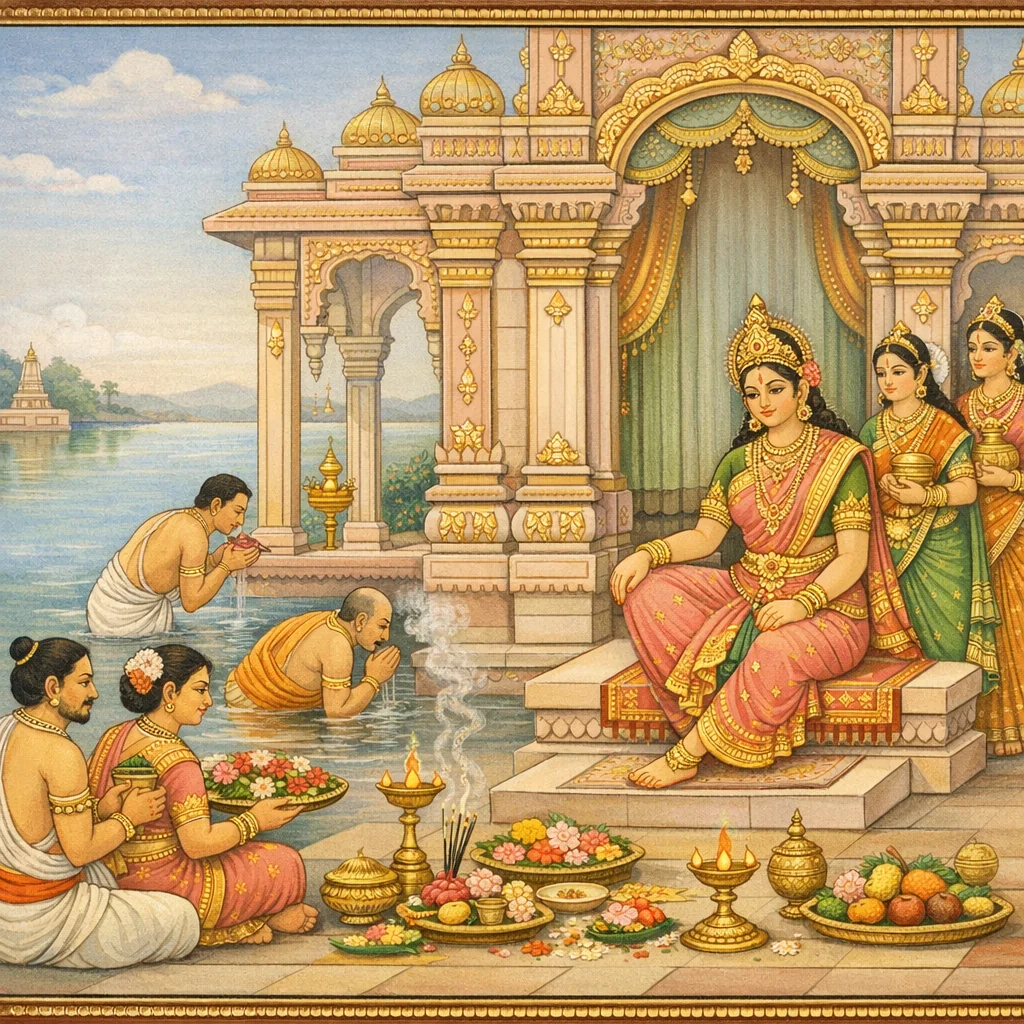
Adhyaya 53
त्रिपुरुषशालामाहात्म्य–नारदीयसरोमाहात्म्य–द्वारदेवीपूजाफलवर्णनम् (Chapter 53: Glory of the Trīpuruṣa Śālā, Nārādīya Pond, and Gate-Goddess Worship Results)
Chapter 53 is a composite account of tīrthas and rites spoken through Nārada. Concerned that a sacred site might vanish, Nārada worships the divine triad—Brahmā, Viṣṇu, and Maheśvara—and seeks a boon that the place will not disappear and will gain lasting renown; the triad grants protection through their partial presence (aṃśa). The chapter then lays out a ritual-legal safeguard: learned brāhmaṇas recite Vedic portions at fixed times—Ṛg in the forenoon, Yajus at midday, Sāman in the third watch—and when threatened, they utter a curse-formula before the śālā, declaring that an enemy will become ashes within specified time limits, as enforcement of the earlier vow of protection. Next it praises the Nārādīya-saras: Nārada excavates a pond and fills it with superior waters gathered from all tīrthas. Bathing and performing śrāddha/dāna there—especially in Āśvina on a Sunday—satisfies ancestors for immense durations, and the offerings are said to be akṣaya, imperishable in fruit. It also recounts nāga austerities to escape Kadru’s curse, culminating in the स्थापना of a Nāgeśvara-liṅga; worship there yields vast merit and lessens serpent-related fear. Finally, gate-associated goddesses (including “Apara-dvārakā” and a dvāravāsinī at a city gate) are described: bathing in a kuṇḍa and worship on prescribed dates (notably a Caitra kṛṣṇa-navamī and Āśvina navarātra) removes obstacles, fulfills aims, and grants prosperity and offspring, as the phalaśruti declares.
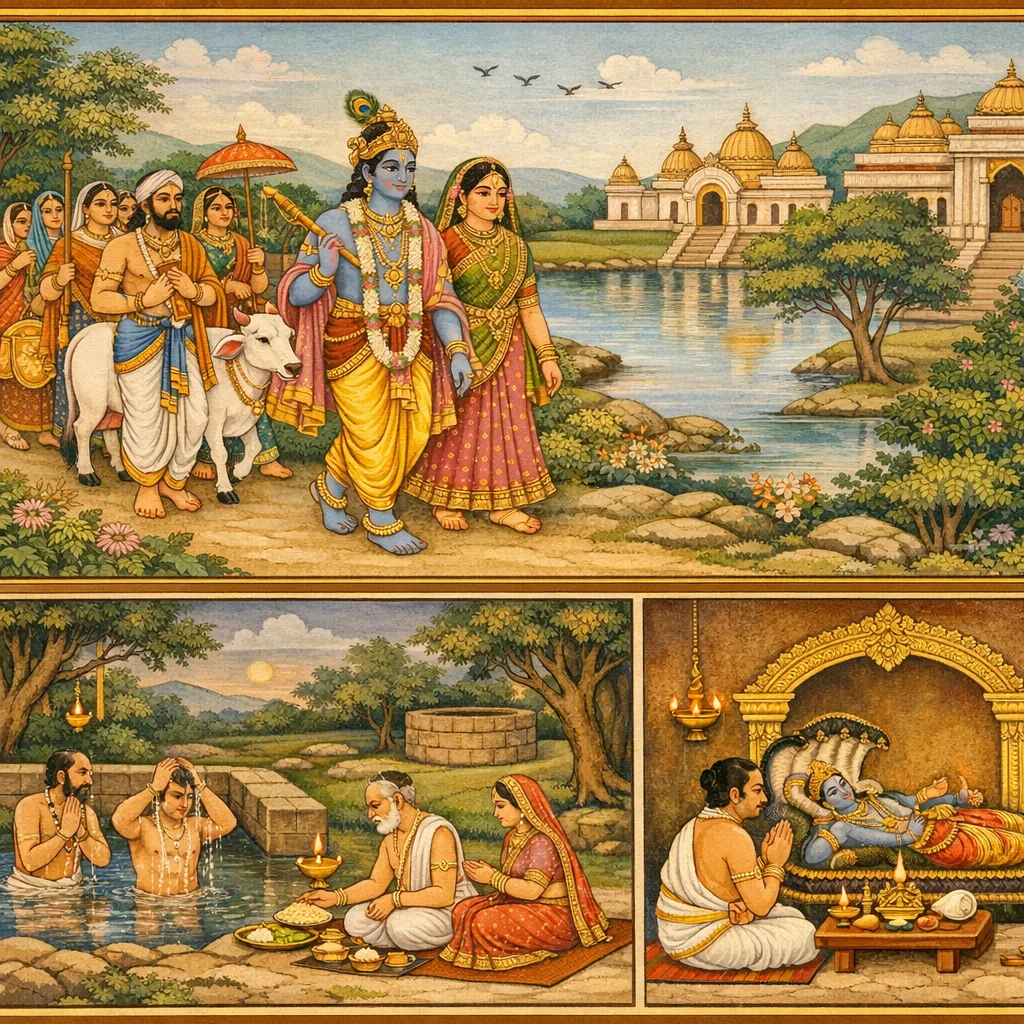
Adhyaya 54
Nārada’s Wandering, Dakṣa’s Curse, and the Kārttika Prabodhinī Rite at Nārada-kūpa (नारदचापल्य-शापकथा तथा प्रबोधिनी-विधिः)
This chapter unfolds through layered dialogue and purāṇic relay narration. Nārada first speaks of his own worship on the Kārttika bright-fortnight Prabodhinī observance, declaring that devotion brings release from the defects born of Kali. Arjuna raises a long-standing doubt: how can Nārada—praised as equanimous, disciplined, and liberation-minded—seem restless, moving “like the wind,” in a world harmed by Kali? Sūta then reports the exchange and introduces Bābhravya, a brāhmaṇa of the Hārīta lineage, who explains the matter as he heard it from Kṛṣṇa. In the embedded account, Kṛṣṇa goes on pilgrimage to a sea-confluence region, performs piṇḍa-dāna and generous gifts, worships various liṅgas with care (including Guheśvara), bathes at Koṭitīrtha, and honors Nārada. When Ugrasena asks why Nārada roams without cease, Kṛṣṇa explains that Dakṣa cursed him for obstructing the paths of creation, condemning him to perpetual wandering and a reputation for stirring others; yet Nārada remains untainted through truthfulness, single-mindedness, and bhakti. Kṛṣṇa recites a long stotra listing Nārada’s virtues—self-control, non-duplicity, steadiness, learning, and non-malice—and promises Nārada’s favor to regular reciters. The chapter then prescribes a calendrical rite: on Kārttika Śukla Dvādaśī (Prabodhinī), one should bathe at the well established by Nārada, carefully perform śrāddha, and undertake tapas, dāna, and japa, said to be akṣaya at this site. One is to “awaken” Viṣṇu with the mantra “idaṁ viṣṇu,” then similarly rouse and worship Nārada, offering auspicious items and giving gifts to brāhmaṇas according to capacity—such as an umbrella (chatra), cloth (dhotra), and kamaṇḍalu. The phala concludes that this observance frees one from sin, prevents Kali’s afflictions from arising, and eases worldly distress.
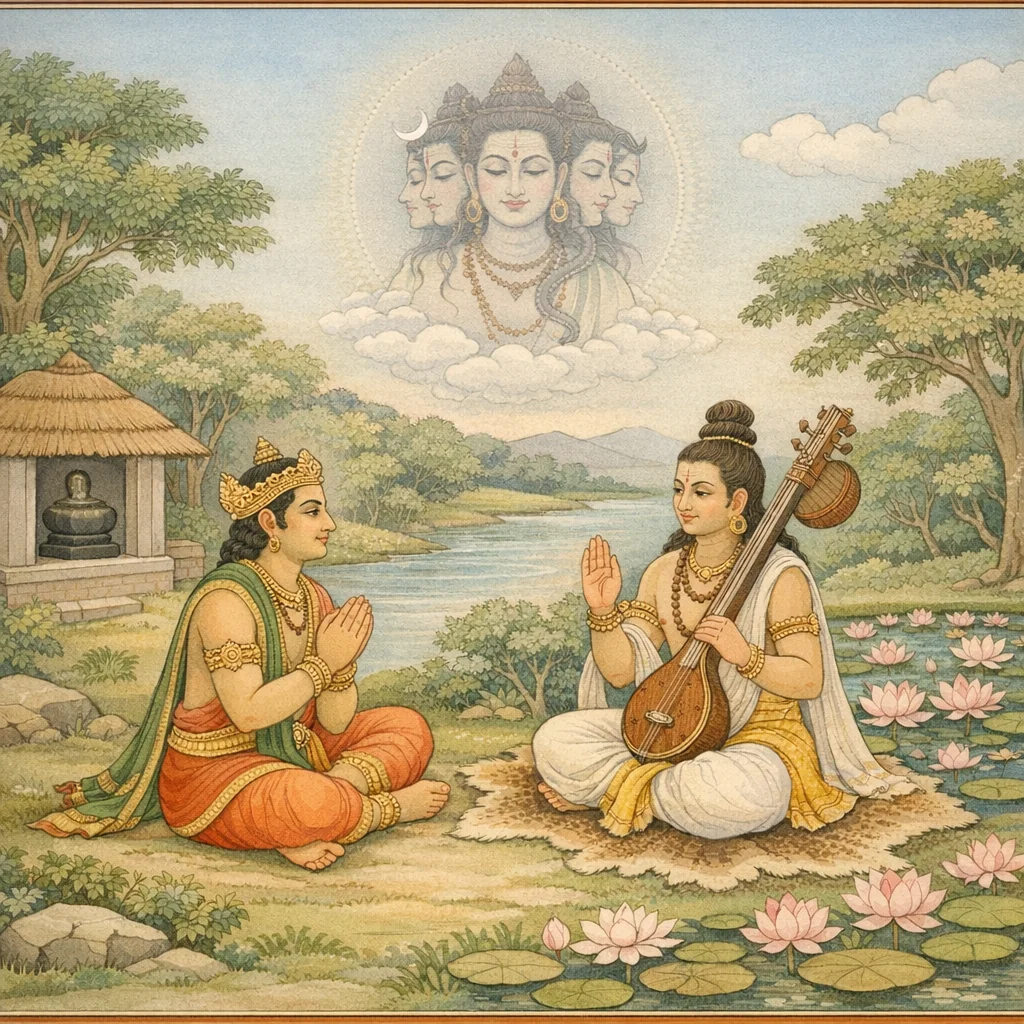
Adhyaya 55
गौतमेश्वरलिङ्गमाहात्म्यं तथा अष्टाङ्गयोगोपदेशः (Gautameśvara Liṅga Māhātmya and Instruction on Aṣṭāṅga Yoga)
The chapter unfolds as a layered dialogue. After hearing praise of the secret sacred field (gupta-kṣetra), the inquirer asks Nārada for fuller detail. Nārada first recounts the origin and power of the Gautameśvara Liṅga: the sage Gautama (Akṣapāda), connected with the Godāvarī and Ahalyā, performs intense tapas, attains yogic success, and establishes the liṅga. Ritual worship—bathing the great liṅga, anointing it with sandal, offering flowers, and fumigating with guggulu—is taught as a purifier that leads to exalted post-mortem states such as Rudra-loka. Arjuna then requests a technical teaching on yoga. Nārada defines yoga as citta-vṛtti-nirodha, the stilling of the mind’s modifications, and expounds aṣṭāṅga practice: yama and niyama with precise meanings (ahiṃsā, satya, asteya, brahmacarya, aparigraha; and śauca, tuṣṭi, tapas, japa/svādhyāya, guru-bhakti). He proceeds through prāṇāyāma (types, measures, effects, and cautions), pratyāhāra, dhāraṇā (inner movement and fixation of prāṇa), Śiva-centered dhyāna, and samādhi marked by sensory withdrawal and steadiness. The chapter also lists obstacles and “upasargas,” sāttvika dietary guidance, omens of death in dreams and bodily signs as yogic diagnosis, and a broad taxonomy of siddhis culminating in the eight great siddhis (aṇimā, laghimā, etc.). It ends by warning against attachment to powers, reaffirming liberation as the self’s assimilation to the Supreme, and restating the fruit of hearing and worship—especially on Kṛṣṇa Caturdaśī in Āśvina, with bathing at Ahalyā-saras and liṅga worship—bringing purification and an “imperishable” state.
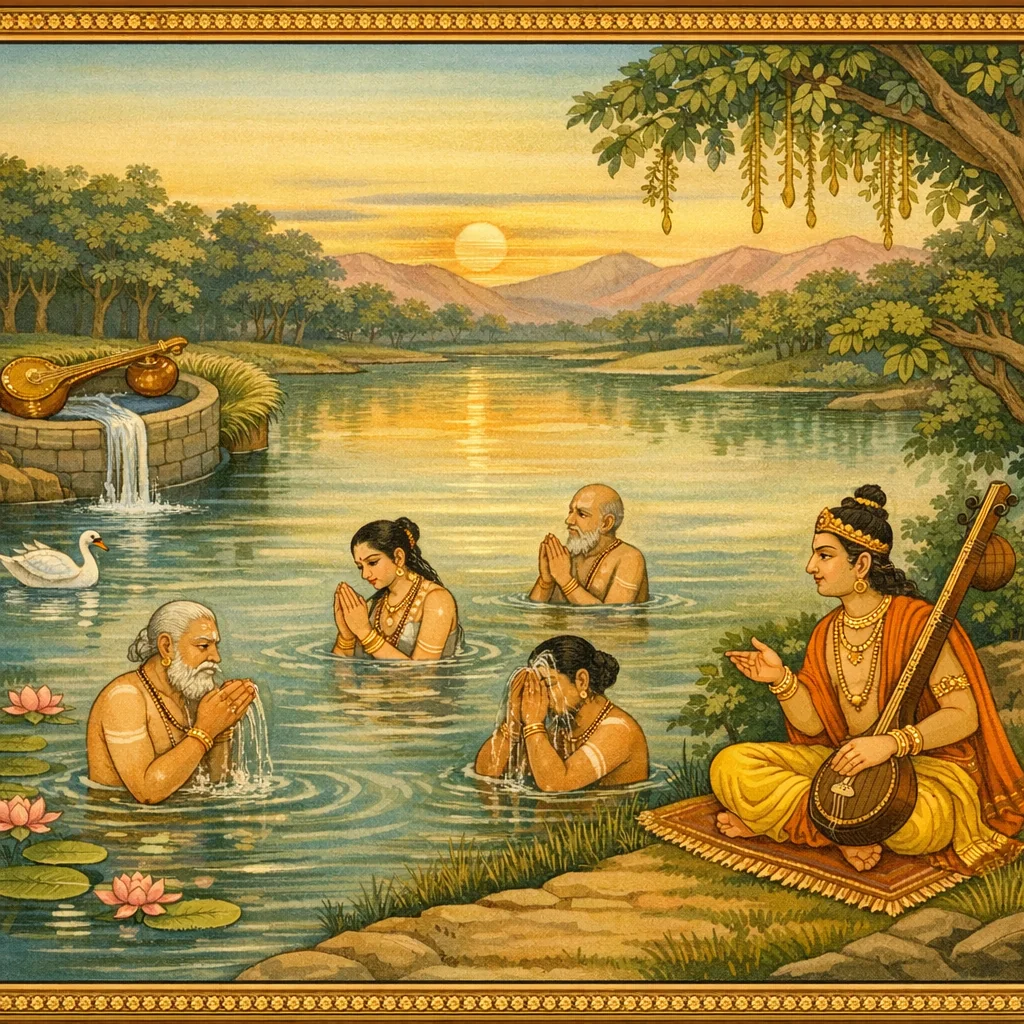
Adhyaya 56
ब्रह्मेश्वर–मोक्षेश्वर–गर्भेश्वरमाहात्म्यवर्णनम् (Brahmeśvara, Mokṣeśvara, and Garbheśvara: A Māhātmya of Sacred Liṅgas and Tīrthas)
This adhyāya unfolds as a theological dialogue in which Nārada recounts successive foundations of sacred sites and their ritual import. Brahmā, stirred by the urge to create, performs intense tapas for a thousand years; Śaṅkara, pleased, grants a boon. Brahmā then recognizes the holiness of the place, excavates the auspicious Brahmasaras east of a city—said to remove even great sins—and installs a Mahāliṅga on its bank, where Śaṅkara is declared to be directly present. The chapter prescribes pilgrimage discipline: bathing, piṇḍadāna for ancestors, charity according to one’s means, and devotional worship, especially in the month of Kārttika, affirming merits comparable to renowned tīrthas such as Puṣkara, Kurukṣetra, and Gaṅgā-associated holy places. Next it introduces the Mokṣaliṅga, the superior liṅga named Mokṣeśvara, established after propitiation, beside a well dug with a darbha tip. Brahmā brings Sarasvatī through his kamaṇḍalu into this well for the liberation-oriented welfare of beings. On Kārttika śukla caturdaśī, bathing in the well and offering sesame piṇḍas to the departed yields the fruit of a “mokṣatīrtha,” and such rites are said to prevent recurring preta-status within the family line. Finally, the related tīrtha Jayādityakūpa is linked with venerating Garbheśvara, with the stated effect of avoiding repeated descent into womb-existence (repeated births). The adhyāya closes with a phala statement praising attentive hearing as purifying.
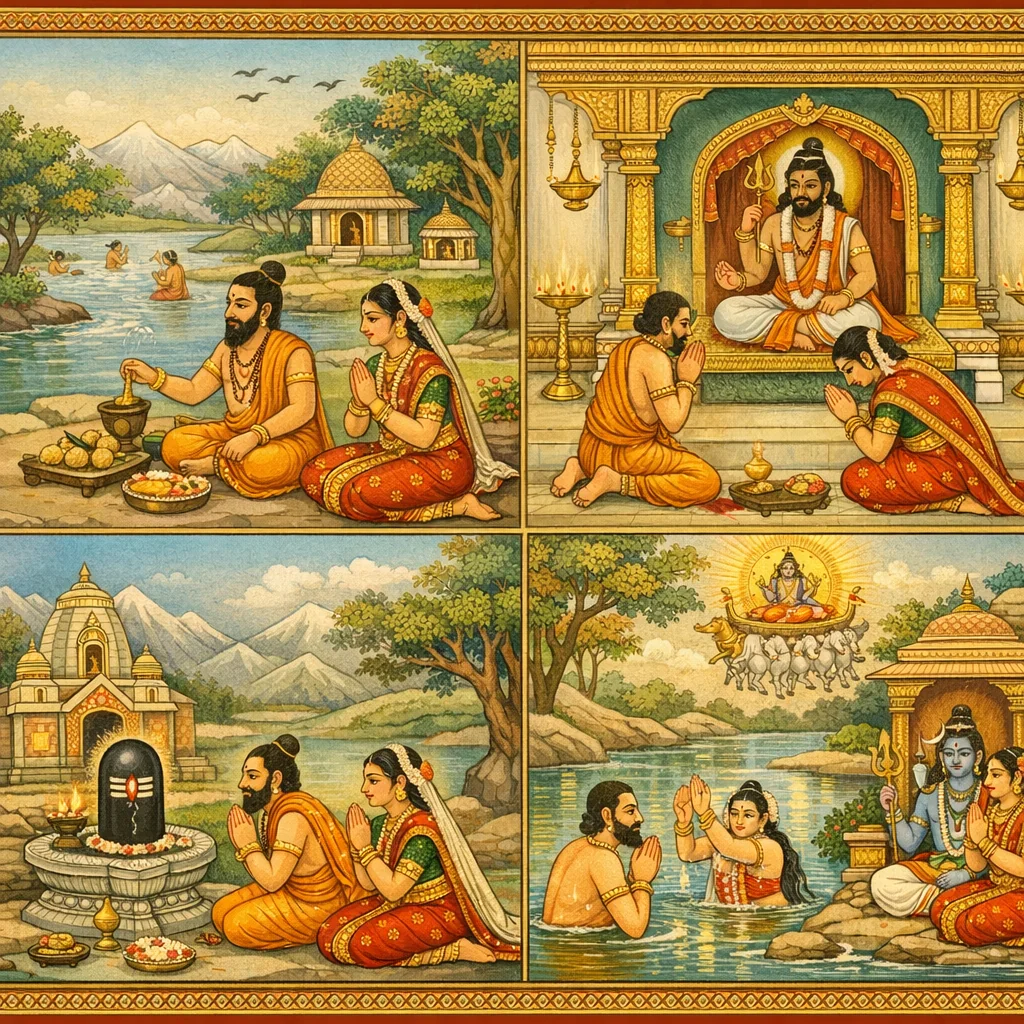
Adhyaya 57
नीलकण्ठमाहात्म्यवर्णनम् | Nīlakaṇṭha Māhātmya (Glorification of Nīlakaṇṭha)
The chapter is cast as a dialogue opening with Nārada’s words. It tells how Nārada and the brāhmaṇas, having propitiated Maheśvara (Śiva), establish Śaṅkara at the holy Mahīnagaraka for the welfare of the worlds, and point out an excellent Kedāra-liṅga north of Atrīśa, praised as a destroyer of great sins. A ritual order is taught: bathe at Atrikuṇḍa, perform śrāddha according to rule, salute Atrīśa, and then take darśana of Kedāra; one who does so is said to become a “share-holder in liberation” (mukti-bhāg). The narrative then connects Nārada with Rudra’s presence as Nīlakaṇṭha, adding place-specific observances: bathe at Koṭitīrtha and behold Nīlakaṇṭha, then salute Jayāditya, which leads to Rudraloka. Jayāditya is also worshiped by eminent people after bathing in a well, with a protective assurance that through his grace their lineage will not be destroyed. The chapter ends with a phalaśruti: hearing the full account of Mahīnagaraka frees one from all sins.
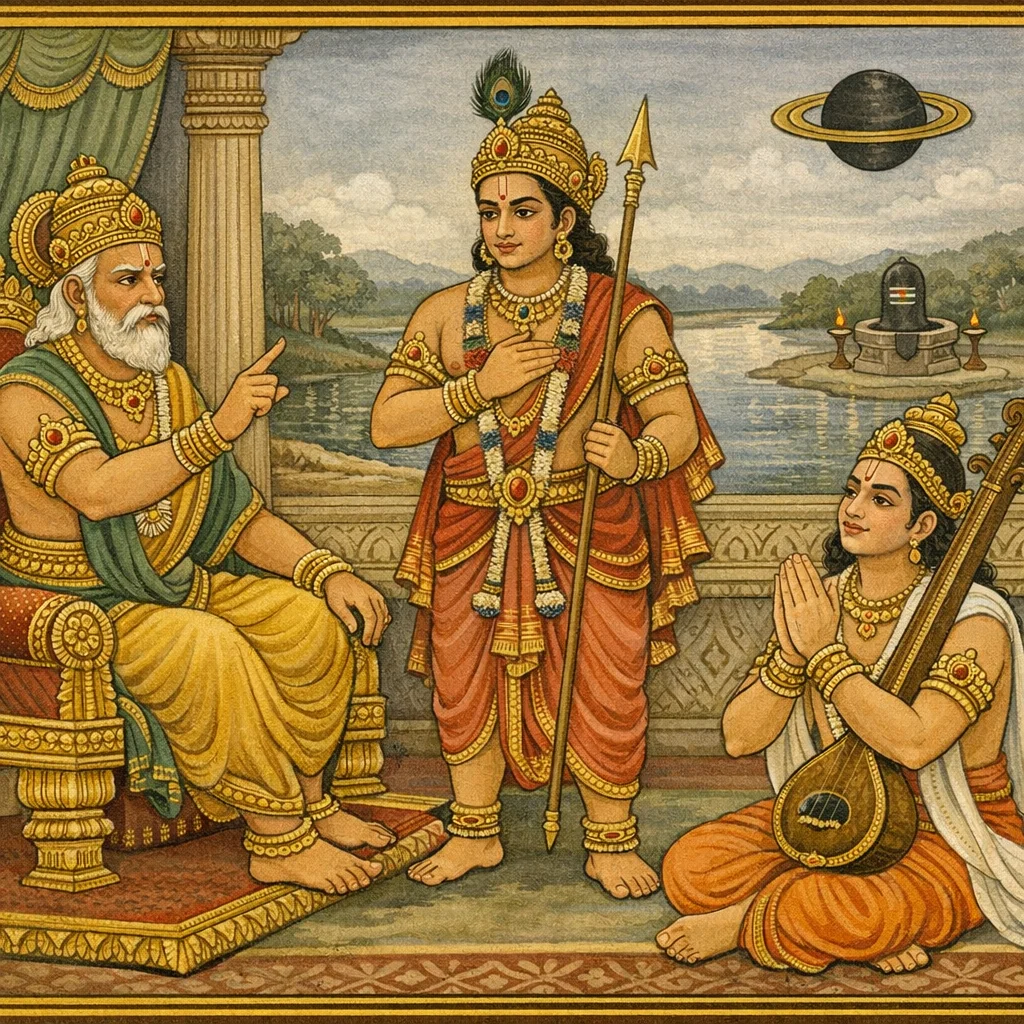
Adhyaya 58
स्तम्भतीर्थ-गुप्तक्षेत्र-कारणकथनम् (The Origin of the Hidden Sacred Field and the Rise of Stambha-tīrtha)
Chapter 58 opens with Arjuna asking Nārada why a supremely powerful holy region is nevertheless called a “hidden sacred field” (guptakṣetra). Nārada recounts an ancient episode: countless tīrtha-deities assemble in Brahmā’s court, seeking a decision on spiritual precedence. Brahmā wishes to offer a single arghya to the foremost tīrtha, yet neither he nor the tīrthas can readily judge who is supreme. The tīrtha known as Mahī-sāgara-saṅgama—the meeting of land and ocean, presented as a composite tīrtha—claims primacy with three reasons, including its connection with a liṅga installed by Guhā/Skanda and its recognition by Nārada. Dharma rebukes this self-praise, teaching that the virtuous should not proclaim their own merits even when true, and declares that the place will become “unfamed,” giving rise to the name Stambha-tīrtha (stambha: pride/obstinacy). Guhā challenges the severity while accepting the moral principle: the site may remain hidden for a time, but will later be renowned as Stambha-tīrtha and bestow the complete fruits of all tīrthas. A detailed comparison of merits follows, especially regarding Saturday new-moon observances (Śani-vāra amāvāsyā), said to equal multiple major pilgrimages. The chapter ends with Brahmā granting arghya and acknowledging the tīrtha’s status, and Nārada stating that hearing this account purifies one from sins.
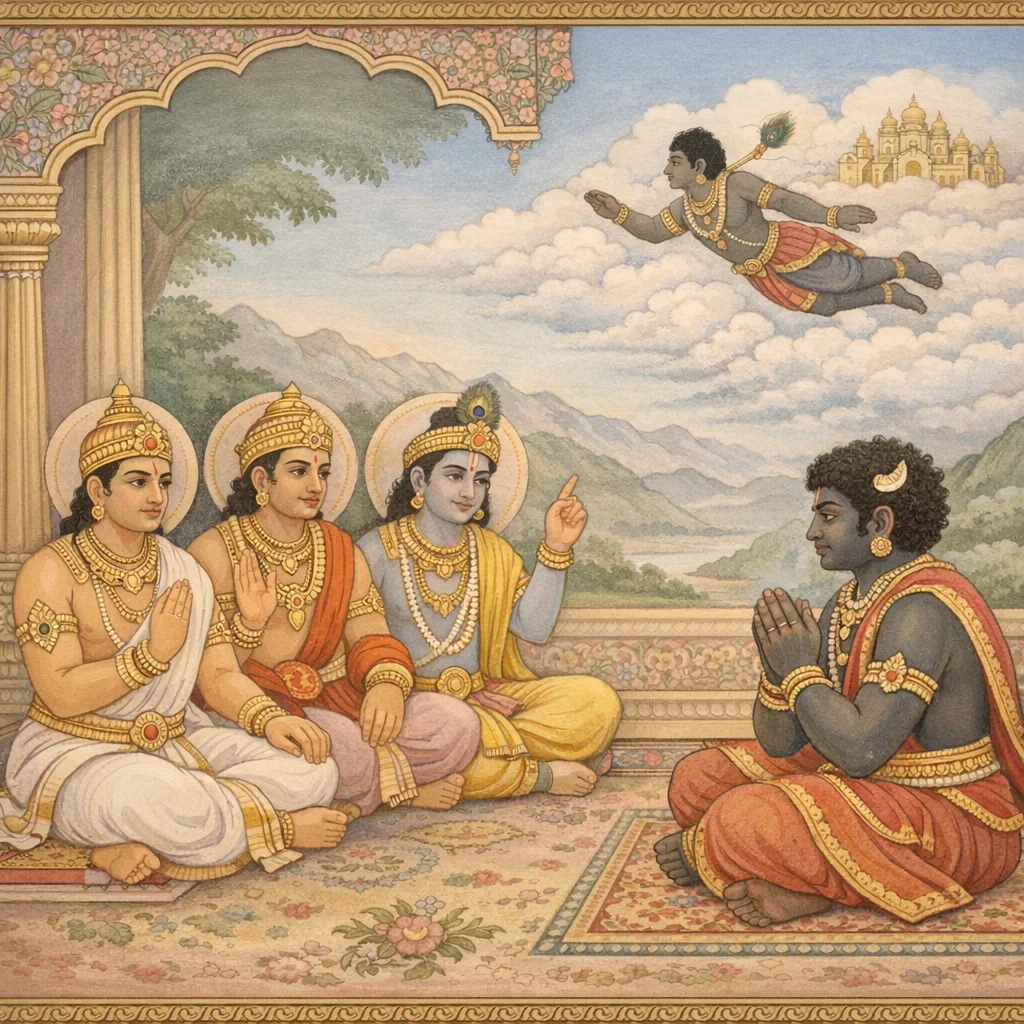
Adhyaya 59
Ghaṭotkaca’s Mission and the Kāmākhya-Ordained Marriage Alliance (घटोत्कचप्रेषणम्—कामाख्यावाक्येन मौर्वीविवाहनिश्चयः)
The chapter begins with the sage Śaunaka questioning Sūta about a previously mentioned miraculous sanctity and about the persons and attainments connected with the “Siddhaliṅga,” seeking to know how success is gained through grace. Sūta (Ugraśravas) replies that he will recount a tradition heard from Dvaipāyana (Vyāsa). The narrative then turns epic: after the Pāṇḍavas settle in Indraprastha, they are conversing in assembly when Ghaṭotkaca arrives. The brothers and Vāsudeva welcome him; Yudhiṣṭhira asks after his welfare, his rule, and his mother’s condition. Ghaṭotkaca reports that he maintains order and follows his mother’s command to practice devotion to the Pitṛs (ancestors), upholding the honor of the family. Yudhiṣṭhira consults Kṛṣṇa about a fitting marriage for Ghaṭotkaca. Kṛṣṇa speaks of a formidable bride in Prāgjyotiṣapura—the daughter of the daitya Mura (linked with Naraka)—and recalls an earlier conflict in which the goddess Kāmakhyā intervened, forbade her killing, granted her martial boons, and revealed a destined alliance: she is to become Ghaṭotkaca’s wife. The bride’s condition is that she will marry whoever defeats her in challenge, and many suitors have died attempting it. Yudhiṣṭhira worries over the danger, Bhīma upholds kṣatriya valor and the need for hard deeds, Arjuna supports the divine prophecy, and Kṛṣṇa urges swift action. Ghaṭotkaca humbly accepts the mission, resolved to preserve ancestral and familial honor; blessed with Kṛṣṇa’s strategic support, he departs by the sky-path toward Prāgjyotiṣa.
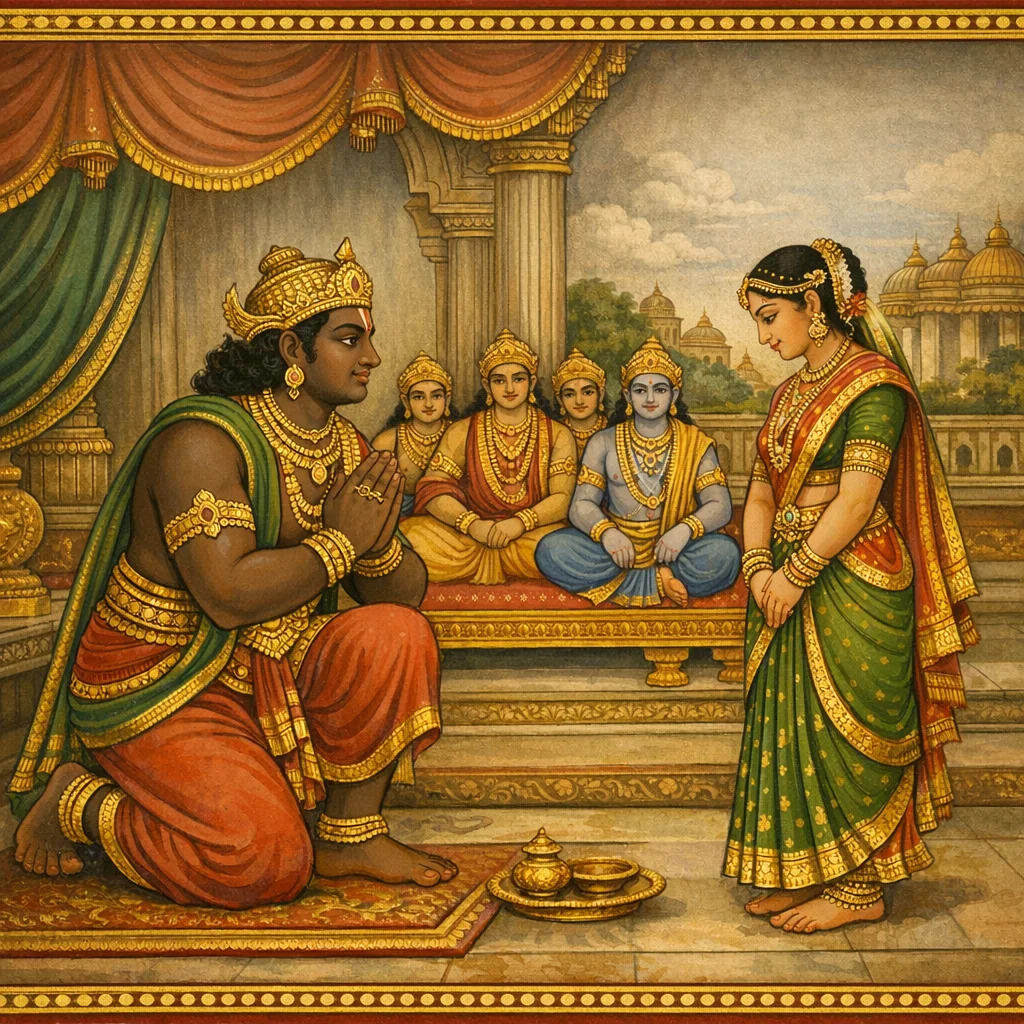
Adhyaya 60
घटोत्कच–मौर्वी संवादः (Ghaṭotkaca and Maurvī: Contest of Power, Question, and Marriage Settlement)
Narrated by Sūta, this chapter unfolds a courtly heroic episode. Ghaṭotkaca arrives outside Prāgjyotiṣa and beholds a radiant, multi-storied golden mansion filled with music and attendants. At the gate the doorkeeper Karṇaprāvaraṇā warns that many suitors have perished seeking Maurvī, Murā’s daughter, and even offers him pleasures and service; he rejects this as contrary to his purpose and insists on being announced as an atithi (honoured guest) for formal reception. Maurvī admits him but challenges him with a sharp genealogical riddle about whether one is “granddaughter or daughter,” born of an ethically disordered household. When it is not answered, she unleashes terrifying hordes; Ghaṭotkaca effortlessly counters them, subdues her, and is about to punish her severely, whereupon she yields, acknowledges his superiority, and offers service. The exchange then turns to social legitimacy: Ghaṭotkaca declares that a concealed or irregular union is improper, seeks formal permission from her kin (Bhagadatta), and escorts Maurvī to Śakraprastha. There, with Vāsudeva and the Pāṇḍavas’ approval, their marriage is solemnized according to prescribed norms; celebrations follow and the couple return to their realm. The chapter closes with the birth and rapid maturation of their son, named Barbarīka, and an intention to approach Vāsudeva at Dvārakā—linking lineage, dharma, and future narrative paths.
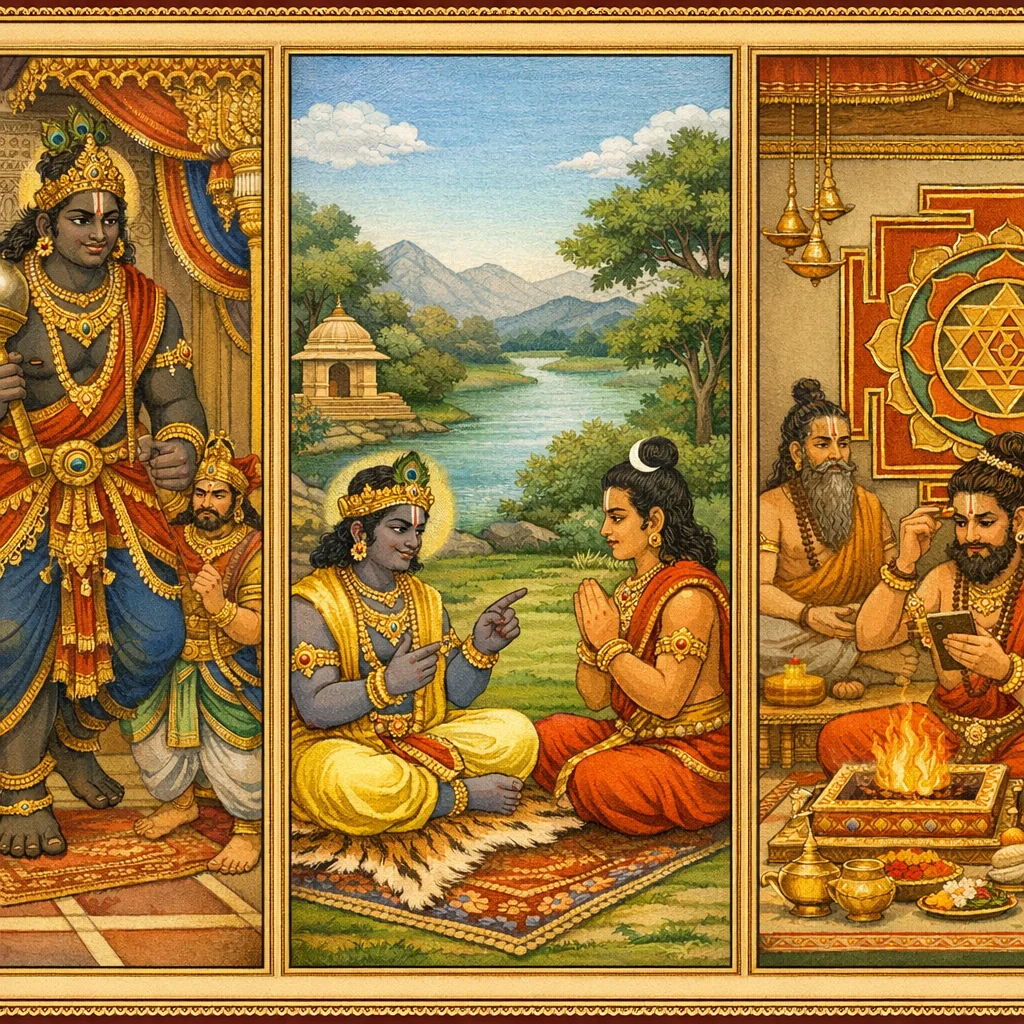
Adhyaya 61
महाविद्यासाधने गाणेश्वरकल्पवर्णनम् | Mahāvidyā-Sādhana and the Gaṇeśvara Ritual Protocol
Adhyāya 61 opens with a courtly, theological episode in Dvārakā and then turns to practical ritual instruction. Ghaṭotkaca arrives with his son Barbarīka and is first mistaken for a hostile rākṣasa, but is recognized as a devotee seeking audience. In the assembly Barbarīka asks Śrī Kṛṣṇa what true “śreyas” is amid rival claims—dharma, austerity, wealth, renunciation, enjoyment, and liberation. Kṛṣṇa answers with a varṇa-based ethic: brāhmaṇas for study, restraint, and tapas; kṣatriyas for trained strength, chastising the wicked and protecting the good; vaiśyas for pastoral/agricultural and commercial knowledge; śūdras for service and crafts that support the twice-born, along with basic devotional duties. Since Barbarīka is kṣatriya-born, Kṛṣṇa directs him first to gain unsurpassed bala through Devī-ārādhana at Guptakṣetra, worshipping many goddesses (digdēvīs and Durgā forms) with offerings and hymns. Their satisfaction is said to bestow strength, prosperity, fame, family welfare, heaven, and even mokṣa. Kṛṣṇa names him “Suhṛdaya” and sends him there; after sustained tri-kāla worship the goddesses appear, empower him, and advise continued residence for victorious association. A brāhmaṇa named Vijaya then comes seeking vidyā-siddhi; by dream-oracle the goddesses instruct him to enlist Suhṛdaya’s help. The chapter concludes with a detailed night-ritual sequence—fasting, shrine worship, mandala construction, protective stakes, weapon consecration, and an extensive Gaṇapati mantra with tilaka/pujā/homa procedures to remove obstacles and accomplish intended aims—ending with the chapter colophon.
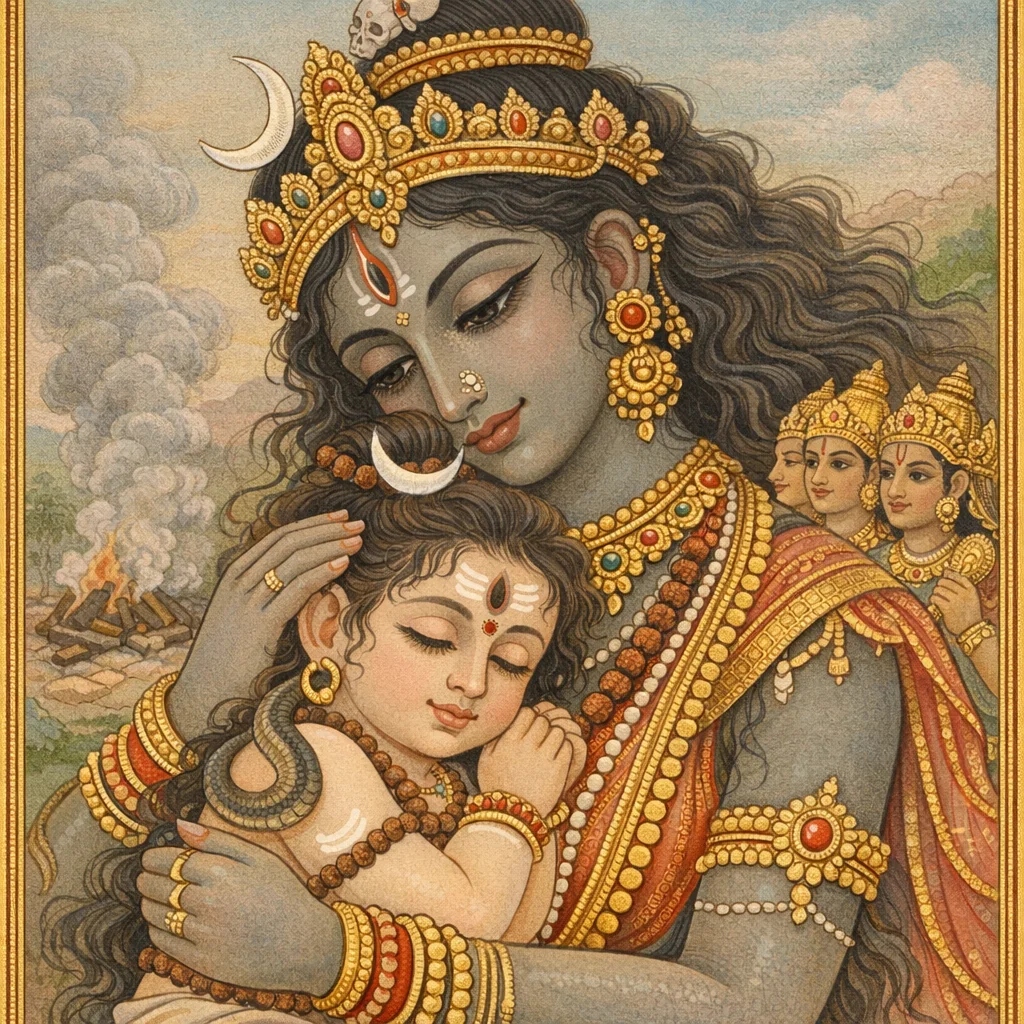
Adhyaya 62
Kṣetrapāla-sṛṣṭi, Kālīkā-prasāda, Vaṭayakṣiṇī-pūjā, and Aparājitā Mahāvidyā
Śaunaka asks Sūta about the origin of Gaṇapa as a kṣetrapāla (guardian and “lord” of a sacred field) and how the “lord of the kṣetra” comes to be. Sūta recounts a crisis: the devas, oppressed by the mighty Dāruka, appeal to Śiva and Devī, declaring that Dāruka cannot be conquered by other gods without the Ardhanārīśvara principle. Pārvatī draws forth the “darkness” from Hara’s throat as a sign of concentrated śakti, manifests Kālīkā, names her, and commands swift destruction. Kālīkā’s dreadful roar slays Dāruka and his host, shaking the cosmos. To restore calm, Rudra appears as a crying child in the cremation-ground; Kālīkā nurses him, and the child as it were “drinks” the embodied wrath, making Kālīkā gentle. When the devas remain uneasy, Maheśvara in child-form reassures them and emanates sixty-four child-like kṣetrapālas from his mouth, assigning their jurisdictions across svarga, pātāla, and the fourteen-world bhū-loka system. The chapter specifies ritual obligations—offerings, especially black gram mixed with rice—and warns that neglect renders ritual fruit void, to be consumed by hostile beings. It then provides a concise worship guide: a nine-syllable kṣetrapāla mantra, offerings, lamps, and a long stuti listing guardian names and their placements (forests, waters, caves, crossroads, mountains, and more). A secondary account introduces Vaṭayakṣiṇī, who manifests through the austerities and daily worship of the widow Sunandā; Śiva decrees that worship of him while neglecting her yields fruitlessness, and a simple mantra-prayer promises fulfillment for women and men. Finally, Vijaya venerates Aparājitā Mahāvidyā, the “parama-vaiṣṇavī,” teaching an extended protective mantra with assurances of safety from many fears (elements, thieves, animals, hostile rites), and declaring that daily recitation removes obstacles even without elaborate ritual.
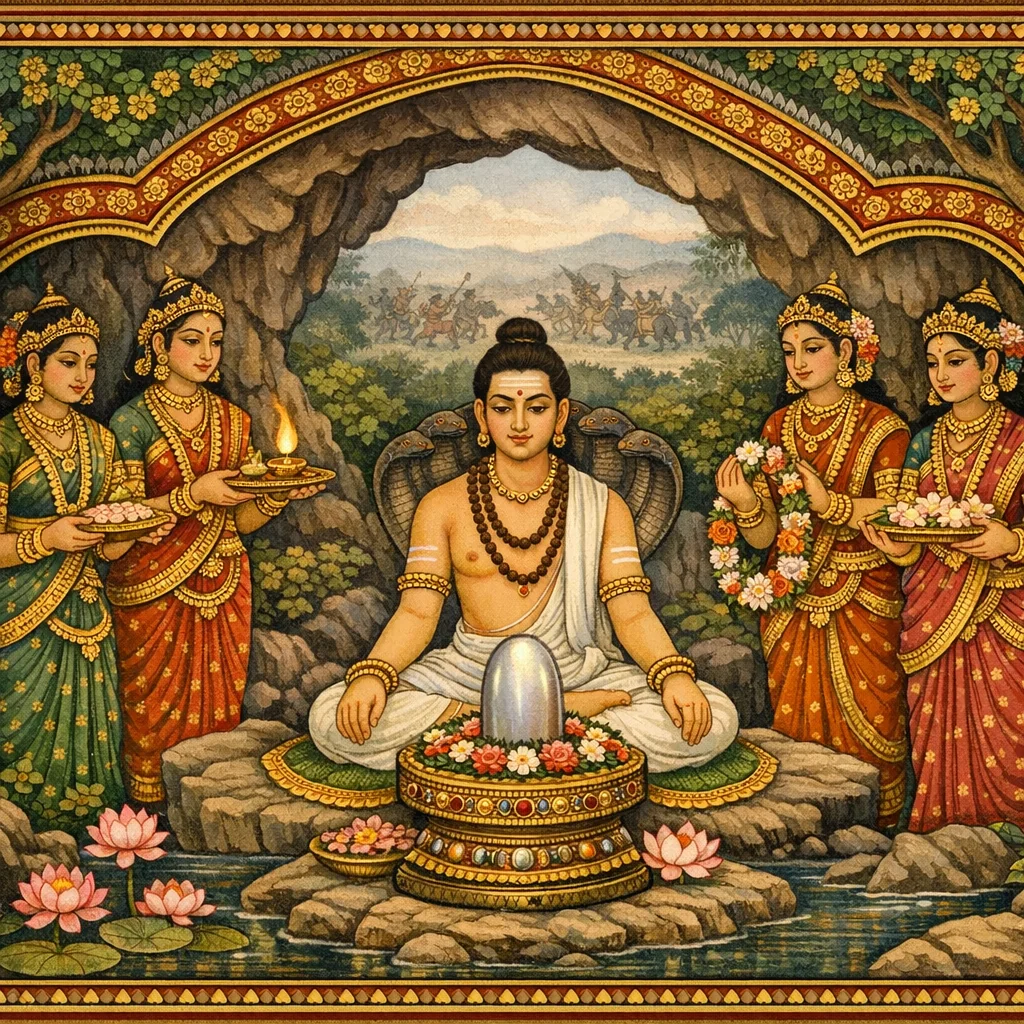
Adhyaya 63
Barbarīka’s Night Vigil, Defeat of Obstacle-Makers, and the Nāga-Established Mahāliṅga (Routes to Major Kṣetras)
Sūta recounts a night ritual in which Vijaya performs a fire offering with potent mantras (bala/atibala). Through successive night-watches, disruptors arise: the fearsome rākṣasī Mahājihvā seeks release in return for vows of non-harm and future beneficence; a mountain-like foe, Repalendra/Repala, is checked by Barbarīka’s overwhelming counterforce; and the śākinī leader Duhadruhā is subdued and slain. An ascetic then condemns the fire rite as subtly life-harming, but Barbarīka refutes the charge as false within a sanctioned sacrificial order and drives him off, revealing a daitya form. The pursuit reaches Bahuprabhā city, where vast daitya forces are defeated. Nāgas led by Vāsuki thank Barbarīka for ending their oppression and grant a boon: that Vijaya’s work be completed without obstacles. The narrative turns to a jewel-like liṅga beneath a wish-fulfilling tree, worshipped by nāga maidens, who say it was installed by Śeṣa through tapas and who describe four routes from it: east to Śrīparvata, south to Śūrpāraka, west to Prabhāsa, and north to a hidden kṣetra with a siddhaliṅga. Vijaya offers Barbarīka a war-ash talisman; he declines from non-attachment, but divine counsel warns of future harm if the ash reaches the Kauravas, so he accepts. The gods honor Vijaya as “Siddhasena,” and the chapter closes with vows fulfilled and order stabilized through disciplined power and rightful worship.
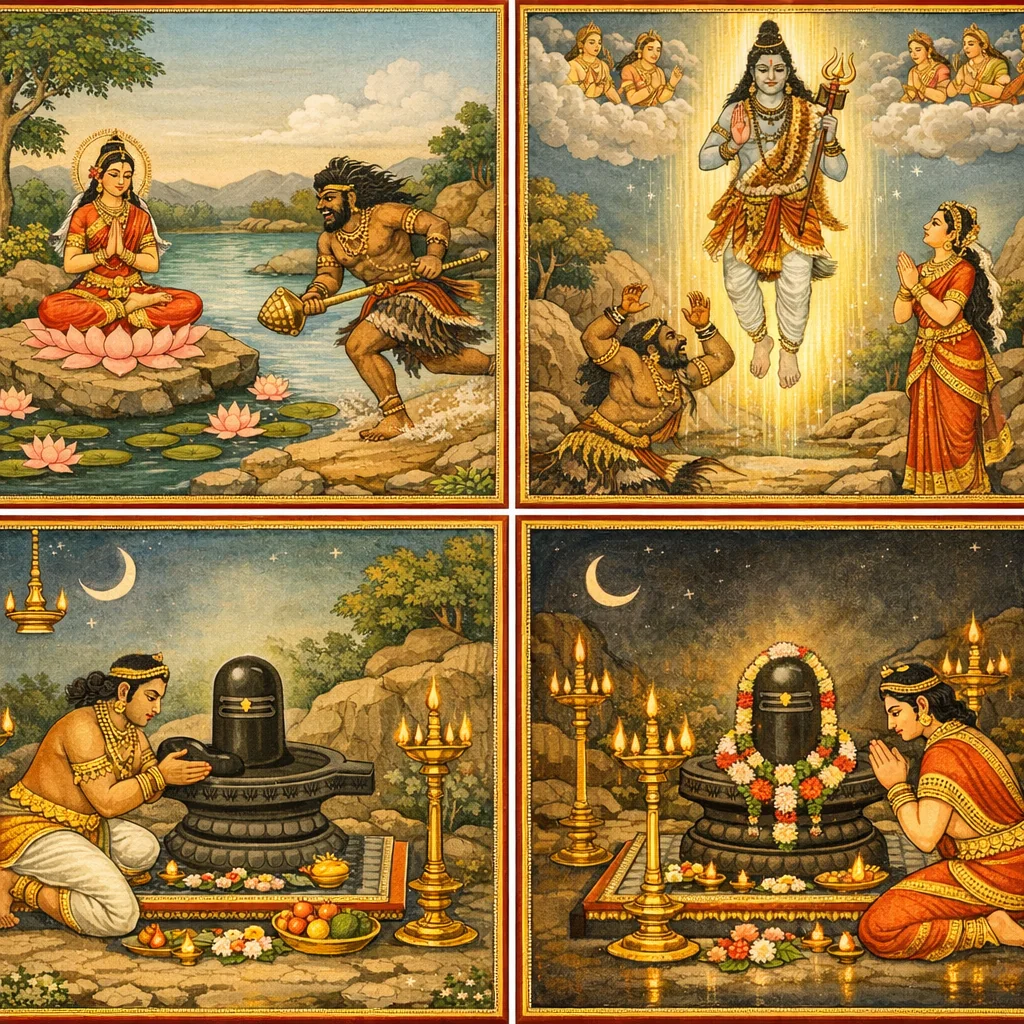
Adhyaya 64
भीमेश्वरलिङ्गप्रतिष्ठा तथा तीर्थाचारोपदेशः (Bhimeshvara Liṅga स्थापना and Instruction on Tīrtha Conduct)
Chapter 64 recounts an ethical and ritual dispute at the consecrated Devī-kuṇḍa during the Pāṇḍavas’ pilgrimage in exile after the dice game. Arriving weary with Draupadī at Caṇḍikā’s sacred place, Bhīma—overcome by thirst—steps into the kuṇḍa to drink and wash, despite Yudhiṣṭhira’s warning about proper conduct. A guardian figure named Suhṛdaya rebukes him, declaring the water reserved for divine bathing; one should wash the feet outside and never defile consecrated waters, for carelessness at a tīrtha bears grave moral consequence according to śāstra. Bhīma answers with a practical defense grounded in bodily need and the general injunction to bathe at holy places. The quarrel turns to combat; Bhīma is subdued by the extraordinarily strong Bārbarīka, who tries to hurl him into the sea. Divine oversight intervenes: Rudra commands Bārbarīka to release Bhīma, reveals a kinship/patriarchal bond, and frames the clash as an error born of ignorance. Stricken with remorse, Bārbarīka seeks self-destruction, but Devī-associated goddesses restrain him, cite śāstric principles about unintended fault, and foretell his eventual death at Kṛṣṇa’s hands as a higher, divinely sanctioned end. The episode closes with reconciliation, renewed tīrtha bathing by the Pāṇḍavas, and Bhīma’s स्थापना of the Bhīmeśvara liṅga. A vrata on Kṛṣṇapakṣa Caturdaśī in Jyeṣṭha is indicated, promising purification from birth-linked faults; the liṅga is praised as equal in fruit to other eminent liṅgas and as a remover of sins.
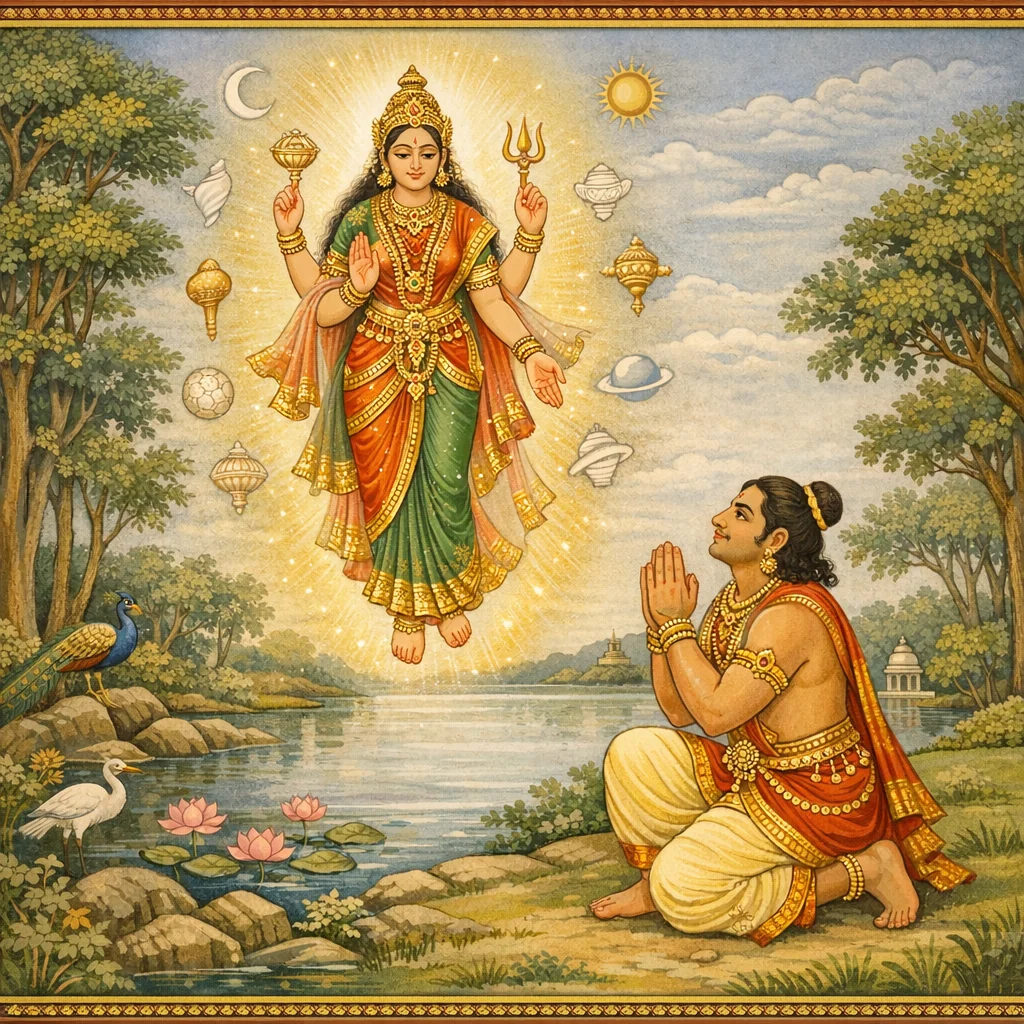
Adhyaya 65
Devī-stuti, Bhīmasena’s Reversal, and the Prophetic Mapping of Kali-yuga Devī-Sthānas (Ekānaṃśā / Keleśvarī / Durgā / Vatseśvarī)
Sūta relates that Yudhiṣṭhira, after staying seven nights at the tīrtha, prepares to depart: he performs morning purification, worships the Devīs and the liṅgas, circumambulates the kṣetra, and recites a hymn for the moment of leaving. He then offers a Devī-centered śaraṇāgati, hailing her as Mahāśakti and as Ekānaṃśā, Kṛṣṇa’s beloved sister, affirming her all-pervading cosmic form and seeking her protection. Bhīma (Vāyuputra) answers with a polemical warning against misplaced refuge and “idle speech,” arguing that the learned should not take shelter in “prakṛti” (portrayed as deluding) but should praise Mahādeva, Vāsudeva, Arjuna, and even Bhīma himself; he condemns futile talk as spiritually harmful. Yudhiṣṭhira rebuts him, defending Devī as the Mother of beings, worshipped by Brahmā, Viṣṇu, and Śiva, and admonishing Bhīma not to show contempt. At once Bhīma loses his sight, taken as Devī’s displeasure; he fully surrenders and recites an extended stotra listing her identities (Brāhmī, Vaiṣṇavī, Śāmbhavī; the śaktis of the directions; planetary links; her pervasion of cosmos and underworld), pleading for the restoration of his eyes and vision. Devī appears in radiant epiphany, consoles Bhīma, instructs him to cease disparaging worshippers, and reveals her saving role as Viṣṇu’s helper in restoring dharma. She then proclaims a prophetic charter of Kali-yuga tīrthas and Devī-shrines: future places (Lohāṇā and Lohāṇā-pura; Dharmāraṇya near Mahīsāgara; Aṭṭālaja; Gaya-trāḍa), future devotees (Kelo, Vailāka, Vatsa-rāja), calendrical observances (such as Śukla Saptamī and Śukla Navamī), and promised fruits (wish-fulfillment, progeny, heaven, liberation, removal of obstacles, and healing—including sight). The chapter ends with the Pāṇḍavas’ astonishment and their continued pilgrimage, including installing Barbarīka and proceeding to other tīrthas.
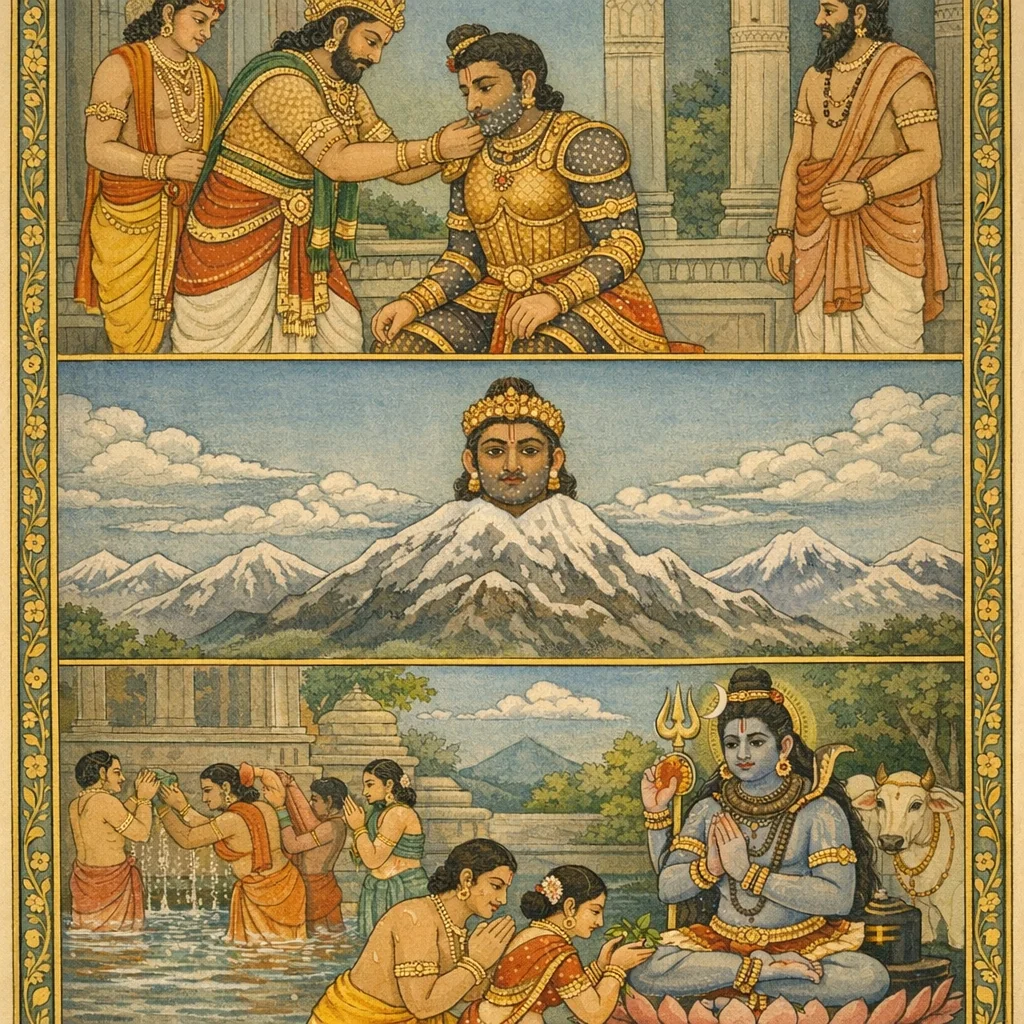
Adhyaya 66
बर्बरीक-शिरःपूजा, गुप्तक्षेत्र-माहात्म्य, कोटितीर्थ-फलश्रुति (Barbarīka’s Severed Head, Guptakṣetra Māhātmya, and Koṭitīrtha Phalaśruti)
Chapter 66, narrated by Sūta, unfolds as a discourse in the war-camp. After thirteen years the Pāṇḍavas and Kauravas assemble at Kurukṣetra; heroes are counted and claims about how soon victory will come are debated. Arjuna challenges the elders’ pledges about the war’s duration and asserts his decisive power. Barbarīka—Bhīma’s grandson, also known as Sūryavarcāḥ—then steps forward, declaring he can finish the conflict within a muhūrta. He demonstrates a technique: with a special arrow he marks the vulnerable vital points (marmas) of both armies, leaving ash/blood-like signs on critical places while sparing only a chosen few. Kṛṣṇa, however, beheads Barbarīka with the Sudarśana discus, creating an ethical and theological turning point. Devī and attendant goddesses appear to explain that an earlier cosmic plan to lighten the earth’s burden required Kṛṣṇa to preserve the ordained course of the war, and that Brahmā’s prior curse made Barbarīka’s death inevitable. Barbarīka’s head is revived and granted perpetual veneration; it is stationed on a mountain peak to witness the war, and devotees are promised long-lasting worship and healing blessings. The chapter then turns to tīrtha-mahātmya, praising Guptakṣetra, Koṭitīrtha, and Mahīnagaraka. Sacred bathing (snāna), śrāddha, dāna, and hearing/reciting the account are taught as means to purification, prosperity, and liberation, with motifs of Rudraloka and Vishṇuloka. A long stotra to Barbarīka follows, and the phalaśruti concludes by codifying the merits of listening to this chapter.
FAQs about Kaumarika Khanda
The section emphasizes a southern coastal tīrtha-cluster whose sanctity is described as exceptionally merit-yielding, yet pedagogically guarded by danger, highlighting that spiritual benefit is coupled with ethical resolve and right intention.
Merit is associated with bathing and disciplined conduct at the five tīrthas, with narratives implying purification, restoration from curse-conditions, and alignment with higher lokas through devotional and ethical steadiness.
Key legends include the account of Arjuna (Phālguna) approaching the five tīrthas, the grāha episode leading to an apsaras’ restoration, and Nārada’s role in directing afflicted beings toward the pilgrim-hero for release.