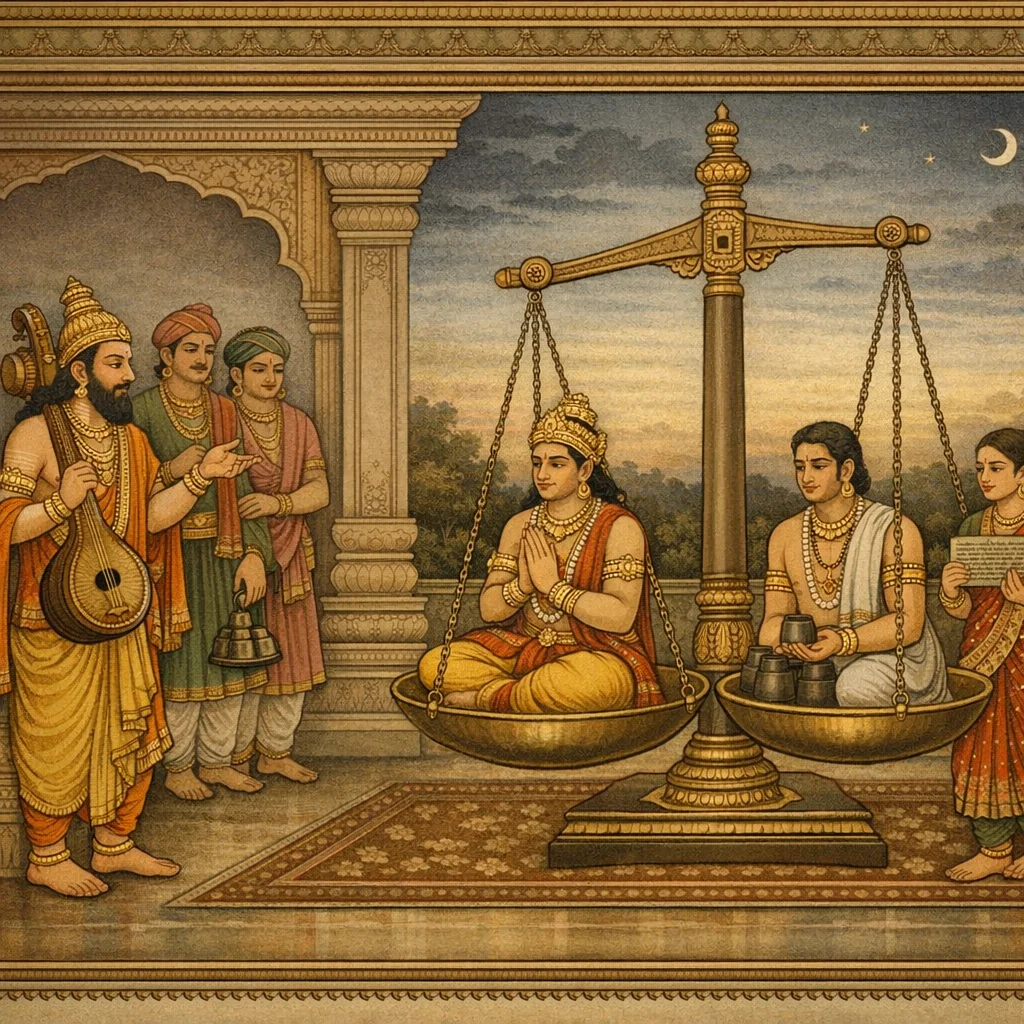
Adhyaya 44
Arjuna asks for a clear account of “divya” procedures—ritual truth-tests used when evidence is lacking and disputes continue. Nārada lists the recognized ordeals (divyāni) and places them within ethical governance: oaths are to establish truth in contested matters such as quarrels, accusations, and grave offenses. The chapter repeatedly warns that false oaths cannot be hidden from divine witnesses—sun, moon, wind, fire, earth, waters, the heart/conscience, Yama, day and night, twilight, and Dharma—and that careless or deceitful swearing brings ruin. It then gives stepwise, technical descriptions of several ordeals: the scale/balance test (tulā/ghaṭa, with materials, measures, officiants, and pass–fail rules), poison, fire (heated iron with ritual preparation and burn-observation), hot bean/gold (taptamāṣa), ploughshare/tongue examination (phalā/jihvā), rice (tandula, used in theft cases), and water (submersion time). Overall, these rites are presented as regulated instruments for rulers and officials, requiring competent, impartial administration and safeguards against manipulation.
Shlokas
Verse 1
अर्जुन उवाच । दिव्यप्राकारमिच्छामि श्रोतुं चाहं मुनीश्वर । कथं कार्याणि कानीह स्फुटं यैः पुण्यपापकम्
Arjuna said: O lord among sages, I wish to hear the procedure of the divine ordeal. What acts are to be done here—clearly—by which merit and sin become evident?
Verse 2
नारद उवाच । शपषाः पोशघटकौ विषाग्न तप्तमाषकौ । फलं च तंदुलं चैव दिव्यान्यष्टौ विदुर्बुधाः
Nārada said: Śapaṣā, Pośa, and the (ordeal of) the ghaṭaka; poison and fire; the heated māṣaka; and also fruit and rice—these are the eight divya ordeals, as the wise know.
Verse 3
असाक्षिकेषु चार्थेषु मिथो विवदमानयोः । राजद्रोहाभिशापेषु साहसेषु तथैव च
In matters where there are no witnesses, when two parties dispute with each other; in accusations of treason against the king; in cases involving curses and denunciations; and likewise in acts of violence—(in such situations the divine ordeals are employed).
Verse 4
अविदस्तत्त्वतः सत्यं शपथेनाभिलंघयेत् । महर्षिभिश्च देवैश्च सत्यार्थाः शपथाः कृताः
One who does not truly know the facts may overstep the truth by resorting to an oath. Therefore, great seers and the gods established oaths only for the sake of upholding truth.
Verse 5
जवनो नृपतिः क्षीणो मिथ्याशपथमाचरेत् । वसिष्ठाग्रे वर्षमध्ये सान्वयः किल भारत
O Bhārata, it is said that King Javana, fallen into ruin, practiced a false oath—even before Vasiṣṭha, in the midst of the year—together with his lineage.
Verse 6
अंधः शत्रुगृहं गच्छेद्यो मिथ्याशपथांश्चरेत् । रौरवस्य स्वयं द्वारमुद्धाटयति दुर्मतिः
Whoever utters false oaths is like a blind man walking into an enemy’s house; that evil-minded person opens, by his own hand, the very gate of Raurava (hell).
Verse 7
मन्यंते वै पापकृतो न कश्चितपश्यतीति नः । तांश्च देवाः प्रपश्यंति स्वस्यैवांतरपौरुषाः
Evildoers imagine, “No one sees us.” Yet the gods do see them—as witnesses to one’s own inner acts and secret exertions.
Verse 8
आदित्यचंद्रावनिलोऽनलश्च द्यौर्भूमिरापो हृदयं यमश्च । अहश्च रात्रिश्च उभे च संध्ये धर्मो हि जानाति नरस्य वृत्तम्
The Sun and Moon, Wind and Fire, Heaven and Earth, the Waters, the heart within, and Yama; day and night, and both twilights—Dharma indeed knows a man’s conduct.
Verse 9
एवं तस्मादभिज्ञाय सत्यर्थशपथांश्चरेत् । वृथा हि शपथान्कुर्वन्प्रेत्य चेह विनश्यति
Therefore, knowing this, one should take oaths only for the sake of truth. For one who makes oaths in vain perishes both here and after death.
Verse 10
इदं सत्यं वदामीति ब्रुवन्साक्षी भवान्यतः । शुभाशुभफलं देहि शुचिः पादौ रवेः स्वृशेत्
Saying, “This truth I speak,” one should stand as a witness, with the Divine as witness. Being pure, let him touch the feet of Āditya, the Sun, and pray: “Grant me the fruit—good or ill—according to the truth of my words.”
Verse 11
अथ शास्त्रस्य विप्रोऽपि शस्त्रस्यापि च क्षत्रियः । मां संस्पृशंस्तथा वैश्यः शुद्रः स्वगुरुमेव च
Then, in matters of śāstra, even a brāhmaṇa may take the oath; in matters of weapons, a kṣatriya. Likewise, a vaiśya should do so by touching me, and a śūdra by touching his own guru.
Verse 12
मातरं पितरं पूज्यं स्पृशेत्साधारणं त्विदम् । कोशस्य रूपं पूर्वं ते व्याख्यातं पांडुनंदन
One may touch one’s mother, father, or a venerable person—this is the general rule. O son of Pāṇḍu, the form of the “kośa” (the ritual receptacle/means in this procedure) has already been explained to you earlier.
Verse 13
विप्रवर्ज्यं तथा केशं वर्णिनां दापयेन्नृपः । यो यो यद्देवताभक्तः पाययेत्तस्य तं नरम्
The king should have hair (for the other varṇas) given as the oath-touch, excluding brāhmaṇas. And whatever deity a man is devoted to, he should be made to drink water in that deity’s name as part of the oath.
Verse 14
समभक्तं च देवानामादित्यस्यैव पाययेत् । सर्वेषां चोग्रदेवानां स्नापयेदायुधास्त्रकम्
One should offer an equal share of the consecrated food to the gods and, in particular, present a libation to Āditya, the Sun. And for all the fierce deities, one should perform ritual bathing (ablution) of their weapons and their astras, the missile-implements.
Verse 15
स्नानोदकं वा संकल्पं गृहीत्वा पाययेन्नवम् । त्रिसप्तरात्रमध्ये च फलं कोशस्य निर्दिशेत्
Taking either the bath-water as consecrated water, or accepting the saṅkalpa as a solemn vow, one should offer a fresh libation. And within the span of three times seven nights, the fruit connected with the kośa, the treasury, is to be declared.
Verse 16
अतः परं महादिव्यविधानं श्रृणु यद्भवेत् । संशयच्छेदि सर्वेषां धार्ष्ट्यत्तद्दिव्यमेव च
Now hear further the great and wondrous ordinance as it truly is. It cuts away the doubts of all; and by its bold certainty, it is indeed ‘divine’.
Verse 17
सशिरस्कंप्रदातव्यमिति ब्रह्मा पुराब्रवीत् । महोग्राणां च दातव्यमशिरस्कमपि स्फुटम्
“It should be given together with the head (that is, complete),” Brahmā declared in former times. Yet for the very fierce (mahogra) deities, it should be given even without the head—this is stated plainly.
Verse 18
साधूनां वर्णिनां राजा न शिरस्कं प्रदापयेत् । न प्रवातेधटं देयं नोष्णकाले हुताशनम्
For the virtuous and the initiated students (varṇins), a king should not cause “the head” to be given. One should not make a dhaṭa offering in a windy place, nor perform the fire-offering (homa) at a time of excessive heat.
Verse 19
वर्णिनां च तथा कालं तंदुलं मुखरोगिणाम्
Likewise, for the initiated students (varṇins) one should give kāla (the prescribed item or measure), and for those afflicted with diseases of the mouth one should give rice-grains (taṇḍula).
Verse 20
कुष्ठपित्तार्दितानां च ब्राह्मणानां च नो विषम् । तप्तमाषकमर्हंति सर्वे धर्म्यं निरत्ययम्
For those afflicted with leprosy and disorders of bile, and likewise for brāhmaṇas, poison should not be given or employed. All are fit to receive the heated māṣaka, righteous in dharma and free from danger.
Verse 21
न व्याधिमरके देशे शपथान्कोशमेव च । दिव्यान्यासुरकैर्मंत्रैः स्तंभयंतीह केचन
In a land stricken by disease and death, one should not employ oaths or treasury-ordeals. For here some people, by demonic (asuric) mantras, immobilize and obstruct the divine tests.
Verse 22
प्रतिघातविदस्तेषां योजयेद्धर्मवत्सलान् । दिव्यानां स्तभकाञ्ज्ञात्वा पापान्नित्यं महीपतिः
The king should appoint dharma-loving experts who know the counter-measures against them. Having identified the sinful persons who obstruct the divine ordeals, the lord of the land should act against them continually.
Verse 23
विवासयेत्स्वकाद्राष्ट्रात्ते हि लोकस्य कंटकाः । तेषामन्वेषणे यत्नं राजा नित्यं समाचरेत्
He should banish them from his own kingdom, for they are thorns to the people. In seeking them out, the king should constantly exert effort.
Verse 24
ते हि पापसमाचारास्तस्करेभ्योऽपि तस्कराः । प्राग्दृष्टदोषान्स्वल्पेषु दिव्येषु विनियोजयेत्
For such men, whose conduct is sinful, are thieves even beyond thieves. A king should assign those already known for wrongdoing to minor divine ordeals, in keeping with the faults previously observed.
Verse 25
महत्स्वपि न चार्थेषु धर्मज्ञान्धर्मवत्सलान् । न मिथ्यावचनं येषां जन्मप्रभृति विद्यते
Even in matters of great wealth, those who know dharma and cherish dharma do not stray from it. False speech is not found in them from birth onward.
Verse 26
श्रद्दध्यात्पार्थिवस्तेषां वचना देव भारत । ज्ञात्वा धर्मिष्ठतां राजा पुरुषस्य विचक्षणः
O noble Bhārata, the king should place faith in the words of such men. Having recognized a person’s steadfast righteousness, the discerning ruler should rely upon him.
Verse 27
क्रोधाल्लोभात्कारयंश्च स्वयमेव प्रदुष्यति । तस्मात्पापिषु दिव्यं स्यात्तत्रादौ प्रोच्यते धटे
Acting out of anger and greed, one becomes tainted by one’s own deed. Therefore, in the case of sinners, a divine ordeal should be employed; and here, first, the ‘dhaṭa’ (balance-ordeal) is described.
Verse 28
सुसमायां पृथिव्यां च दिग्भागे पूर्वदक्षिणे । यज्ञियस्य तु वृक्षस्य स्थाप्यं स्यान्मुंडकद्वयम्
On level ground, in the southeastern quarter, two ‘muṇḍakas’ (posts/stumps) should be set up, made from a tree fit for sacrificial use.
Verse 29
स्तंभकस्य प्रमाणं च सप्तहस्तं प्रकीर्तितम् । द्वौ हस्तौ निखनेत्काष्ठं दृश्यं स्याद्धस्तपंचकम्
The measure of the pillar is declared to be seven hands. Two hands’ length of the wood should be sunk into the ground, so that five hands’ length remains visible.
Verse 30
अंतरं तु तयोः कार्यं तथा हस्तचतुष्टयम् । मुंडकोपरि काष्ठं च दृढं कुर्याद्विचक्षणः
The space between the two should be made four hands in measure. And the discerning man should firmly fix a wooden beam upon the muṇḍakas (posts).
Verse 31
चतुर्हस्तं तुलाकाष्ठमव्रणं कारयेत्स्थिरम् । खदिरार्जुनवृक्षाणां शिंशपाशालजं त्वथ
He should have a firm, unblemished balance-beam made, four hands in length—of khadira or arjuna wood, or else of śiṃśapā or śāla.
Verse 32
तुलाकाष्ठे तु कर्तव्यं तथा वै शिक्यकद्वयम् । प्राङ्मुखो निश्चलः कार्यः शुचौ देशे धटस्तथा
On the balance-beam, two śikyaka (slings/baskets) should likewise be made. The ‘dhaṭa’ (ritual operator) should be steady and facing east, and the rite should be conducted in a clean place.
Verse 33
पाषाणस्यापि जायेत् स्तंभेषु च धटस्तथा । वणिक्सुवर्णकारो वा कुशलः कांस्यकारकः
The posts may even be made of stone; and in that case too, the ‘dhaṭa’ arrangement should be set upon the pillars. A skilled merchant, a goldsmith, or a capable worker in bronze may be employed for the making and setting.
Verse 34
तुलाधारधरः कार्यो रिपौ मित्रे च यः समः । श्रावयेत्प्राड्विवाकोऽपि तुलाधारं विचक्षणः
One should appoint as the holder of the balance a person who is impartial—equal toward enemy and friend. Even the learned judge (prāḍvivāka), if discerning, should have the balance-holder instructed and made to follow the proper procedure.
Verse 35
ब्रह्मघ्ने ये स्मृता लोका ये च स्त्रीबालघातके । तुलाधारस्य ते लोकास्तुलां धारयतो मृषा
The worlds (hellish destinies) declared for the slayer of a brāhmaṇa, and for one who kills women and children—those very worlds befall the balance-holder who bears the scale falsely, cheating in the weighing.
Verse 36
एकस्मिंस्तोलयेच्छिक्ये ज्ञातं सूपोषितं नरम् । द्वितीये मृत्तिकां शुभ्रां गौरां तु तुलयेद्बुधः
In one pan of the balance, one should weigh the well-known, well-nourished man; in the second, the wise person should weigh clean, bright, pale whitish clay.
Verse 37
इष्टिकाभस्मपाषाणकपालास्थीनि वर्जयेत् । तोलयित्वा ततः पूर्वं तस्मात्तमवतारयेत्
One should avoid using brick, ash, stone, potsherds, and bones as the counterweight. Having first weighed as prescribed, then one should make him step down from the balance.
Verse 38
मूर्ध्नि पत्रं ततो न्यस्य न्यस्तपत्रं निवेशयेत् । पत्रे मंत्रस्त्वयं लेख्यो यः पुरोक्तः श्वयंभुवा
Then, placing a leaf upon his head, one should secure that placed leaf in position. Upon the leaf, this mantra should be written—the one formerly spoken by Svayambhū (Brahmā).
Verse 39
ब्रह्मणस्त्वं सुता देवी तुलानाम्नेति कथ्यते । तुकारो गौरवे नित्यं लकारो लघुनि स्मृतः
“O Goddess, you are Brahmā’s daughter; you are called by the name Tulā (Balance). The syllable ‘tu’ is ever associated with heaviness (weight), and the syllable ‘lā’ is remembered as lightness.”
Verse 40
गुरुलाघवसंयोगात्तुला तेन निगद्यसे । संशयान्मोचयस्वैनमभिशस्तं नरं शुभे
Because you unite heaviness and lightness, you are therefore called Tulā, the Balance. O auspicious one, free this accused man from doubt.
Verse 41
भूय आरोपयेत्तं तु नरं तस्मिन्सपत्रकम् । तुलितो यदि वर्धेत शुद्धो भवति धर्मतः
Then one should again place that man upon the balance, together with the leaf. If, when weighed, he becomes heavier, then by dharma he is deemed purified (innocent).
Verse 42
हीयमानो न शुद्धः स्यादिति धर्मविदो विदुः । शिक्यच्छेदे तुलाभंगे पुनरारोपयेन्नरम्
The knowers of dharma understand: if he becomes lighter, he should not be considered purified. If the pan’s sling is cut or the balance breaks, one should place the man upon it again and repeat the test.
Verse 43
एवं निःसंशयं ज्ञानं यच्चान्यायं न लोपयेत् । एतत्सर्वं रवौ वारे कार्यं संपूज्य भास्करम्
Thus one attains knowledge free from doubt and does not allow injustice to prevail. All of this should be performed on Sunday, after duly worshipping Bhāskara, the Sun.
Verse 44
अथातः संप्रवक्ष्यामि विषदिव्यं श्रृणुष्व मे
Now I shall fully explain the viṣa-divya, the poison-ordeal; listen carefully to me.
Verse 45
द्विप्रकारं च तत्प्रोक्तं घटसर्पविषं तथा । शृंगिणो वत्सनाभस्य हिमशैलभवस्य वा
That poison-ordeal is declared to be of two kinds: the “pot-snake poison” and the poison of the horned one—either from vatsanābha (aconite) or that produced in the Himalayan ranges.
Verse 46
यवाः सप्त प्रदातव्या अथवा षड्घृतप्लुताः । मूर्ध्नि विन्यस्तपत्रस्य पत्रे चैवं निवेशयेत्
Seven barley-grains should be given—alternatively, six grains moistened with ghee. For the one with a leaf placed upon the head, those grains should be set in that very leaf in this manner.
Verse 47
त्वं विष ब्रह्मणः पुत्र सत्यधर्मे व्यवस्थितः । त्रायस्वैनं नरं पापात्सत्येनास्य भवामृतम्
O Poison, son of Brahmā, established in the dharma of truth—save this man from sin; by truth, become for him nectar (amṛta) rather than death.
Verse 48
येन वेगैर्विना जीर्णं छर्दिमूर्च्छाविवर्जितम् । तं तु शुद्धं विजानीयादिति धर्मविदो विदुः
If it is digested without violent reactions—free from vomiting and fainting—then the learned in dharma know that person to be pure (vindicated).
Verse 49
क्षुधितं क्षुधितः सर्पं घटस्थं प्रोच्य पूर्ववत् । संस्पृशेत्तालिकाः सप्त न दशेच्छुध्यतीति सः
When the snake is hungry, the participant, being hungry as well, should address the snake kept in a pot as previously instructed. Touching it seven times, it will not bite—thus he becomes purified (vindicated).
Verse 50
अग्निदिव्यं यथा प्राह विरंचिस्तच्छृणुष्व मे । सप्तमंडलकान्कुर्याद्देवस्याग्रे रवेस्तथा
Listen to me as I recount the fire-ordeal (agni-divya) as Virāñci (Brahmā) taught it. One should draw seven circular maṇḍalas before the deity, and likewise before the Sun.
Verse 51
मंडलान्मंडलं कार्यं पूर्वेणेति विनिश्चयः । षोडशांतुलकं कार्यं मंडलात्तावदं तरम्
A circle should be made after a circle, each following the previous—this is the settled rule. The gap from one circle to the next should be sixteen aṅgulas (finger-breadths).
Verse 52
आर्द्रवाससमाहूय तथा चैवाप्युपोपितम् । कारयेत्सर्वदिव्यानि देवब्राह्मणसंनिधौ
Having summoned one clothed in damp garments, and likewise one kept under fasting observance, one should conduct all ordeals (divya) in the presence of the deity and of brāhmaṇas.
Verse 53
प्रत्यक्षं कारयेद्दिव्यं राज्ञो वाधिकृतस्य वा । ब्राह्मणानां श्रुतवतां प्रकृतीनां तथैव च
The ordeal should be carried out openly—either before the king or before his appointed officer—and likewise in the presence of brāhmaṇas learned in śruti and of the people as witnesses.
Verse 54
पश्चिमे दिनकाले हि प्राङ्मुखः प्राञ्जलिः शुचिः । चतुरस्रे मंडलेऽन्ये कृत्वा चैव समौ करौ
At the close of the day (towards the western time), let him, purified, face east with hands folded in añjali. Then, having made a separate square maṇḍala, let him set both hands evenly, in proper alignment.
Verse 55
लक्षयेयुः कृतादीनि हस्तयोस्तस्य हारिणः । सप्ताश्वत्थस्य पत्राणि भध्नीयुः करयोस्ततः
They should first observe the marks and lines upon that person’s hands; then they should bind seven leaves of the sacred aśvattha (holy fig) upon his hands.
Verse 56
नवेन कृतसूत्रेण कार्पासेन दृढं यथा । ततस्तु सुसमं कृत्वा अष्टांगुलमथायसम्
With a newly made cotton thread they should tie it firmly; then, having made it even and well-balanced, they should prepare an iron piece measuring eight aṅgulas.
Verse 57
पिंडं हुताशसंतप्तं पंचाशत्पलिकं दृढम् । आदौ पूजां रवेः कृत्वा हुताशस्याथ कारयेत्
Let a firm lump of iron, weighing fifty palas, be heated in the fire; first worshipping Sūrya, let the rite of the sacred Agni then be performed.
Verse 58
रक्तचंदनधूपाभ्यां रक्तपुष्पैस्तथैव च । अभिशस्तस्य पत्रं च बध्नीयाच्चैव मूर्धनि
With red sandalwood and incense, and likewise with red flowers, one should also bind a leaf upon the head of the accused or afflicted person (abhiśasta).
Verse 59
मंत्रेणानेन संयुक्तं ब्राह्मणाभिहितेन च । त्वमग्ने वेदाश्चत्वारस्त्वं च यज्ञेषु हूयसे
Joined with this mantra, as uttered by the brāhmaṇas: “O Agni, you are the four Vedas, and you are the one invoked in the sacrifices (yajñas).”
Verse 60
पापं पुनासि वै यस्मात्तस्मात्पावक उच्यसे । त्वं मुखं सर्वदेवानां त्वं मुखं ब्रह्मवादिनाम्
Because you truly purify sin, therefore you are called “Pāvaka,” the Purifier. You are the mouth of all the gods, and you are the mouth of those who proclaim Brahman—the Vedic sages.
Verse 61
जठरस्थोऽसि भूतानां ततो वेत्सि शुभाशुभम् । पापेषु दर्शयात्मानमर्चिष्मान्भव पावक
You abide in the bellies of beings; therefore you know what is auspicious and inauspicious. In the presence of sins, reveal yourself—shine forth, O Pāvaka.
Verse 62
अथवा शुद्धभावेषु शीतो भवमहाबल । ततोऽभिशस्तः शनकैर्मंडलानि परिक्रमेत्
Or else, for those of pure disposition, become cool, O mighty one. Then the accused person (abhiśasta) should slowly circumambulate the maṇḍalas.
Verse 63
परिक्रम्य शनैर्जह्याल्लोहपिंडं ततः क्षितौ । विपत्रहस्तं तं पश्चात्कारयेद्व्रीहिमर्दनम्
Having circumambulated slowly, he should then cast the iron lump onto the ground. After that, with his hands freed of the leaves, he should be made to crush (or rub) rice-grains.
Verse 64
निर्विकारौ करौ दृष्ट्वा शुद्धो भवति धर्मतः । भयाद्वा पातयेद्यस्तु तदधो वा विभाव्यते
If, upon inspection, both hands are seen to be free from any change or injury, he is deemed purified according to dharma. But if, out of fear, he drops it, then by that very act he is regarded as fallen (guilty).
Verse 65
पुनस्त्वाहारयेल्लोहं विधिरेष प्रकीर्तितः । अथातः संप्रऐवक्ष्यामि तप्तमाषविधिं श्रृणु
Then he should again take up the iron—this procedure has been declared. Now listen, as I set forth in full the rite of the heated bean (taptamāṣa).
Verse 66
कारयेदायसं पात्रं ताम्रं वा षोडशांगुलम् । चतुरंगुलखातं तु मृन्मयं वापि कारयेत्
One should have a vessel made of iron—or of copper—measuring sixteen aṅgulas, with a hollow of four aṅgulas; or it may also be made of clay.
Verse 67
पूरयेद्घृततैलाभ्यां पलैर्विशतिभिस्ततः । सुतप्ते निक्षिपेत्तत्र सुवर्णस्य तु माषकम्
Then one should fill it with ghee and oil, measuring twenty palas; when it is well heated, one should place there a māṣaka-weight of gold.
Verse 68
वह्न्युक्तं विन्यसेन्मंत्रमभिशस्तस्य मूर्धनि । अंगुष्ठांगुलियोगेन तप्तमाषं समुद्धरेत्
One should place upon the head of the accused the mantra prescribed with reference to Fire; then, using the thumb and finger together, he should lift out the heated bean.
Verse 69
शुद्धं ज्ञेयमसंदिग्धं विस्फोटादिविवर्जितम् । फालशुद्धिं प्रवक्ष्यामि तां श्रृणु त्वं धनंजय
It should be known as pure—beyond doubt—free from blisters and the like. Now I shall explain the purification by the ploughshare; listen, O Dhanañjaya.
Verse 70
आयसं द्वादशपलं घटितं फालमुच्यते । अष्टांगुलमदीर्घं च चतुरंगुलविस्तृतम्
The ploughshare (phāla) is said to be wrought of iron, weighing twelve palas—eight aṅgulas in length and four aṅgulas in breadth.
Verse 71
वह्न्युक्तं विन्यसेन्मंत्रमभिशस्तस्य मूर्धनि । त्रिःपरावर्तयेज्जिह्वा लिहन्नस्मात्षडंगुलम्
One should place upon the head of the accused the mantra prescribed with reference to Fire (Agni); then he should turn the tongue back three times, licking from this heated implement a length of six aṅgulas.
Verse 72
गवां क्षीरं प्रदातव्यं जिह्वाशोधनमुत्तमम् । जिह्वापरीक्षणं कुर्याद्दग्धा चेन्न तु विमोच्यते
Cow’s milk should be given—an excellent means of cleansing the tongue. One should examine the tongue; if it is burnt, then he is not to be released.
Verse 73
तं विशुद्धं विजानीयाद्विशुद्धा चेत्तु जायते । तंदुलस्याथ वक्ष्यामि विधिधर्मं सनातनम्
He should be known as completely purified, if purity indeed results. Now I shall speak of the ancient rule of procedure concerning rice-grains (taṇḍula).
Verse 74
चौर्ये तु तंदुला देया न चान्यत्र कथंचन । तंदुलानुदके सिक्त्वा रात्रौ तत्रैव स्थापयेत्
In a case of theft, one should employ rice-grains (taṇḍula), and no other substance whatsoever. Having sprinkled the rice with water, one should leave them there through the night.
Verse 75
प्रभाते कारिणे देया भक्षणाय न संशयः । त्रिःकॉत्वः प्राङ्मुखश्चैव पत्रे निष्ठीवयेत्ततः
At dawn, they should be given to the doer (the concerned person) to eat—without doubt. Then, facing east, he should spit three times onto a leaf.
Verse 76
पिप्पलस्याथ भूर्जस्य न त्वन्यस्य कथंचन । तांस्तु वै कारयेच्छुद्धांस्तंदुलाञ्छालिसंभवान्
Use leaves of the sacred fig (pippala) or of birch (bhūrja)—and of no other kind whatsoever. And one should have those rice-grains, born of śāli-rice, made clean.
Verse 77
मृन्मये भाजने कृत्वा सवितुः पुरतः स्थितः । तन्दुलान्मंत्रयेच्छुद्धान्मन्त्रेणानेन धर्मतः
Placing them in an earthen vessel, and standing before Savitṛ (the Sun), one should duly consecrate the purified rice-grains with this mantra, according to dharma.
Verse 78
दीयसे धर्मतत्त्वज्ञैर्मानुषाणां विशोधनम् । स्तुतस्तन्दुल सत्येन धर्मतस्त्रातुमर्हसि
You are administered by knowers of dharma’s truth for the purification of human beings. O Rice-grain, praised by truth—by dharma you are fit to protect (and vindicate).
Verse 79
निष्ठीवने कृते तेषां सवितुः पुरतः स्थिते । शोणितं दृश्यते यस्य तमशुद्धं विनिर्दिशेत्
When the spitting rite has been performed, while standing before Savitṛ (the Sun), if blood is seen in someone’s spittle, that person should be declared impure (i.e., not cleared).
Verse 80
एवमष्टविधं दिव्यं पापसंशयच्छेदनम् । भट्टादित्यस्य पुरतो जायते कुरुनंदन
Thus, this eightfold divine ordeal—cutting off doubts of sin—proves effective in the presence of Bhaṭṭāditya, O joy of the Kurus.
Verse 81
जलदिव्यं तथा प्राहुर्द्विप्रकारं पुराविदः । जलहस्तं स्मृतं चैकं मज्जनं चापरं विदुः
Likewise, the ancients describe the ‘water-ordeal’ as of two kinds: one is known as the ‘water-hand’ test, and the other as submersion.
Verse 82
बाणक्षेपस्तथादानं यावद्वीर्यवता कृतम् । तावत्तं मज्जयेज्जीवेत्तथा तच्छुद्धिमादिशेत्
For as long as a strong man can shoot an arrow and return (with it), for that duration one should keep him submerged; if he remains alive, one should declare his purity accordingly.
Verse 83
एवंविधमिदं स्थानं भट्टादित्यस्य भारत । ममैव कृपया भानोर्जातमेतन्महीतले
Such is this sacred place of Bhaṭṭāditya, O Bhārata. By my very grace, this manifestation of Bhānu (the Sun) came into being upon the earth.