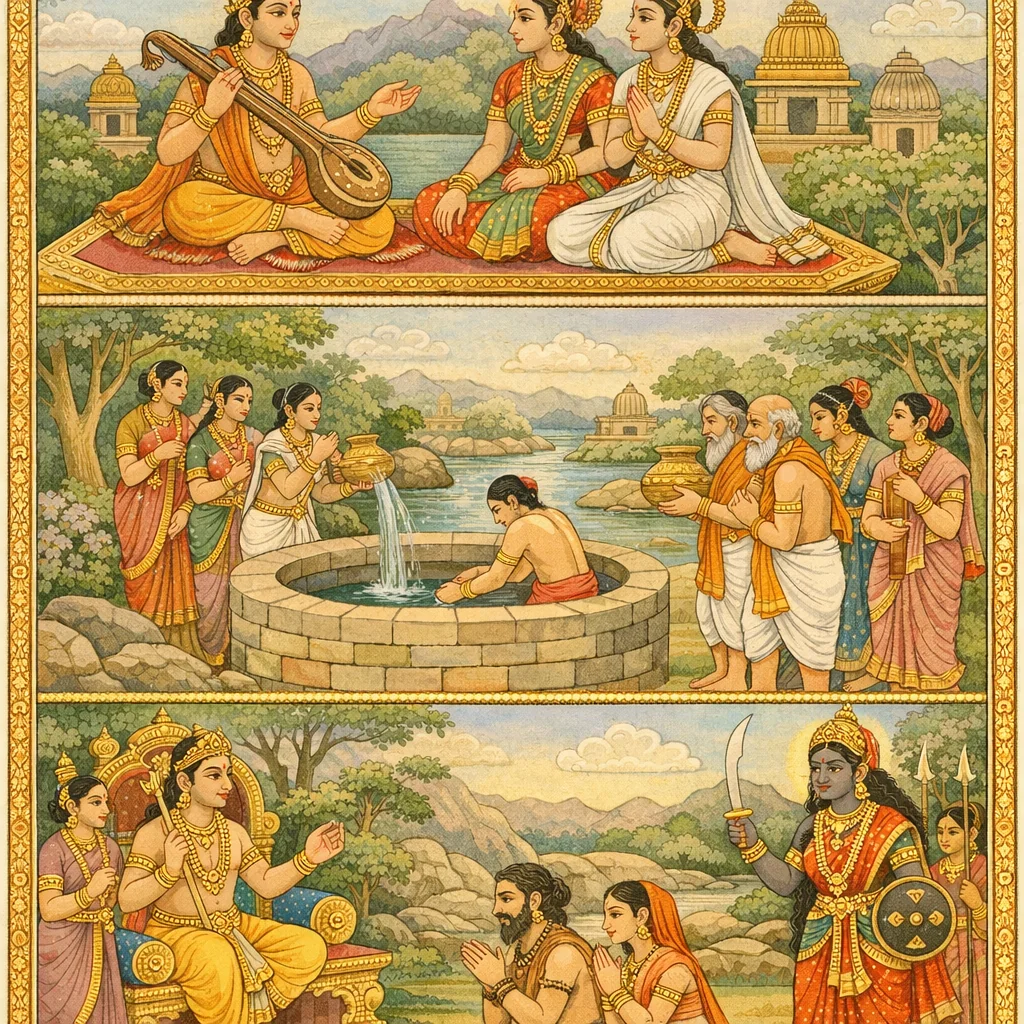
Adhyaya 47
Chapter 47 sets forth a structured theological teaching on Śakti as the eternal, all-pervading Prakṛti, comparable to the Supreme Lord’s own pervasion. Śakti becomes a cause of bondage or a means of liberation according to one’s inner orientation and worship; those who disregard her are said to decline spiritually, illustrated by an exemplum from Vārāṇasī of fallen yogins. The chapter then lays out a directional ritual geography, installing four Mahāśaktis in the quarters: Siddhāmbikā in the east; Tārā in the south, linked with the Kūrma episode and the safeguarding of Vedic order; Bhāskarā in the west, energizing the sun and the stellar bodies; and Yoganandinī in the north, associated with yogic purity and the Sanakas. It further establishes nine Durgās at the tīrtha—Tripurā; Kolambā (with a Rudrāṇī-related well, bathing especially on Māgha Aṣṭamī, and praised as surpassing major tīrthas); Kapāleśī; Suvarṇākṣī; Mahādurgā known as Carcitā (bestower of valor, with a future exemplum of freeing a bound hero); Trailokyavijayā (from Soma-loka); Ekavīrā (power of cosmic dissolution); Harasiddhi (born from Rudra’s body, protecting from ḍākinī disturbances); and Caṇḍikā/Navamī in the Īśāna corner with battle motifs involving Caṇḍa-Muṇḍa, Andhaka, and Raktabīja. Navarātra worship is prescribed with offerings—bali, pūpa, naivedya, dhūpa, gandha—promising protective results in public spaces such as streets and crossroads. Bhūtamātā/Guhāśakti is also described as enforcing boundaries over disruptive beings and granting boons to those who worship on the Vaiśākha darśa day with specified offerings. The conclusion presents the tīrtha as a multi-station abode of many goddesses, emphasizing ritual engagement as the means to uphold ethical order, receive protection, and attain desired goals.
Shlokas
Verse 1
नारद उवाच । ततो मयास्य तीर्थस्य रक्षणाय पुनर्जय । समाराध्य यथा देव्यः स्थापितास्तच्छृणुष्व भोः
Nārada said: Then, to safeguard this sacred tīrtha, O victorious one, I duly worshipped the Goddess. Listen, O sir, to how the Divine Goddesses were established here.
Verse 2
यथात्मा सर्वभूतेषु व्यापकः परमेश्वरः । तथैव प्रकृतिर्नित्या व्यापका परमेश्वरी
Just as the Supreme Lord, the Self, pervades all beings, so too the eternal Prakṛti—the Supreme Goddess—pervades everything.
Verse 3
शक्ति प्रसादादाप्नोति वीर्यं सर्वाश्च संपदः । ईश्वरी सर्वभूतेषु सा चैवं पार्थ संस्थिता
By the grace of Śakti one attains vigor and every prosperity. The Sovereign Goddess abides within all beings—thus, O Pārtha, she is established everywhere.
Verse 4
बुद्धिह्रीपुष्टिलज्जेति तुष्टिः शांतिः क्षमा स्पृहा । श्रद्धा च चेतना शक्तिर्मंत्रोत्साहप्रभूद्भवा
As intellect, modesty, nourishment, and bashfulness; as contentment, peace, forbearance, and aspiration; as faith and consciousness—Śakti manifests, arising powerfully through mantra and spiritual fervor.
Verse 5
इयमेव च बंधाय मोक्षायेयं च सर्वदा । एनामाराध्य चैश्वर्यमिन्द्राद्याः समवाप्नुयुः
She alone becomes the cause of bondage, and she alone—always—becomes the cause of liberation. By worshipping her, even Indra and the other gods attain sovereign powers.
Verse 6
ये च शक्तिं न मन्यंते तिरस्कुर्वंति चाधमाः । योगीन्द्रा अपि ते व्यक्तं भ्रश्यंते काशिजा यथा
Those base people who neither acknowledge Śakti nor honor her, but instead disparage her—even if they are called “lords of yogins”—surely fall, just as certain ones in Kāśī once fell.
Verse 7
वाराणस्यां किल पुरा सिद्धयोगीश्वराः पुनः । अवमन्य च ते शक्तिं पुनर्भ्रंशमुपागताः
Indeed, long ago in Vārāṇasī, certain perfected masters of yoga, after slighting Śakti, once again came to downfall.
Verse 8
तस्मात्सदा देहिनेयं शक्तिः पूज्यैव नित्यदा । तुष्टा ददाति सा कामान्रुष्टा संहरते क्षणात्
Therefore, this Śakti should always be worshipped by embodied beings. When pleased, she grants desires; when angered, she withdraws all in an instant.
Verse 9
परमा प्रकृतिः सा च बहुभेदैर्व्यवस्थिता । तासां मध्ये महादेव्यो ह्यत्र संस्थापिताः शृणु
She is the Supreme Prakṛti, arranged in many distinct forms. Among those forms, the Great Goddesses have been established here—listen as I explain.
Verse 10
चतस्रस्तु महाशक्त्यश्चतुर्दिक्षु व्यवस्थिताः । सिद्धांबिका तु पूर्वस्यां स्थापिता सा गुहेन च
Four great divine Powers were stationed in the four directions. Among them, Siddhāmbikā was established in the eastern quarter—set there by Guha (Skanda) himself.
Verse 11
जगदादौ मूलूप्रकृतेरुत्पन्ना सा प्रकीर्त्यते । आराधिता यतः सिद्धैस्तस्मात्सिद्धांबिका च सा
She is proclaimed to have arisen, at the very dawn of the cosmos, from the primordial Root-Nature (Mūlaprakṛti). And because the Siddhas worshipped her, she is therefore known as Siddhāmbikā.
Verse 12
दक्षिणस्यां तथा तारा संस्थिता स्थापिता मया । तारणार्थाय देवानां यस्मात्कूर्मं समाश्रिता
Likewise, in the southern quarter, Tārā was installed—set there by me—because, for the deliverance of the gods, she took refuge in (and empowered) Kūrma.
Verse 13
ययाविष्टः समुज्जह्रे वेदान्कूर्मो जगद्गुरुः । अनयाविष्टदेहश्च बुधो बौद्धान्हनिष्यति
Possessed by that Power, Kūrma—the teacher of the world—lifted up and restored the Vedas. And with his body entered by this very Power, Buddha will, in time, subdue the Bauddhas.
Verse 14
कोटिशो वेदमार्गस्य ध्वंसकान्पापकर्मिणः । इयं मया समाराध्य समानीता गिरेः सुता
In countless multitudes, sinners arise who would destroy the path of the Vedas. Therefore, having duly worshipped, I brought here this Daughter of the Mountain (Girisutā) as protection.
Verse 15
कोटिसंख्याभिरत्युग्रदेवीभिः संवृता च सा । दक्षिणां दिशमाश्रित्य संस्थिता मम गौरवात्
Surrounded by crores of exceedingly fierce goddesses, she remains established, taking refuge in the southern direction—by the majesty of my authority.
Verse 16
पश्चिमायां तथा देवी संस्थिता भास्करा शुभा । ययाविष्टानि भासंते भास्करप्रमुखानि च
Likewise, in the western quarter stands the auspicious Goddess Bhāskarā. Entered by her power, the luminaries—headed by the Sun—shine forth.
Verse 17
बिंबानि सर्वताराणां गच्छन्त्यायांति च द्रुतम् । सैषा महाबला शक्तिर्भास्वरा कुरुनन्दन
The discs (images) of all the stars swiftly move—coming and going. Such is that radiant, immensely powerful Śakti, O joy of the Kurus.
Verse 18
मयाराध्य समानीता कटाहादत्र संस्थिता । कोटिकोटिवृता नित्यं त्रायते पश्चिमां दिशम्
Having worshipped, I brought her from Kaṭāha, and here she stands established. Encircled by countless crores, she ever protects the western direction.
Verse 19
उत्तरस्यां तथा देवी संस्थिता योगनंदिनी । परमप्रकृतेर्देहात्पूर्वं निःसृतया यया
Likewise, in the northern quarter the Goddess Yoganandinī stands established—by that Power which, earlier, emerged forth from the very body of the Supreme Prakṛti.
Verse 20
दृष्ट्या दृष्टा निर्मलया योगमापुश्चतुःसनाः । योगीश्वरी च सा देवी सनकाद्यैः सुतोषिता
Beholding her with a pure and stainless gaze, the four Kumāras attained yogic absorption. That Goddess—sovereign of yogins—was greatly pleased with Sanaka and the others.
Verse 21
सैव चांडकटाहान्मे समाराध्यात्र प्रापिता । योगिनीभिः परिवृता संस्थिता चोत्तरां दिशम्
That very Goddess, duly worshipped, I brought here from Cāṇḍakaṭāha. Surrounded by yoginīs, she abides established, facing the northern quarter.
Verse 22
एवमेता महाशक्त्यश्चतस्रः संस्थिताः सदा । पूजिताः कामदा नित्यं रुष्टाः संहरणक्षमाः
Thus these four Great Powers remain ever established. When worshipped, they continually bestow the boons one desires; when angered, they are able to bring about destruction.
Verse 23
ततश्च नव मे दुर्गाः समानीताः शृणुध्व ताः
Thereafter, my nine Durgās were brought here; listen to them as I describe them.
Verse 24
त्रिपुरानाम परमा देवी स्थाणुर्यया पुरा । आविष्टस्त्रिपुरं निन्ये भस्मत्वं जगदीश्वरः
There is the supreme Goddess named Tripurā; in ancient times, through her, Sthāṇu (Śiva) was filled with divine power, and the Lord of the world reduced Tripura to ashes.
Verse 25
त्रिपुरेति ततस्तां तु प्रोक्तवान्भगवान्हरः । तुष्टाव च स्वयं तस्मात्पूज्या सा जगतामपि
Therefore Bhagavān Hara called her “Tripurā” and praised her himself. Hence she is worthy of worship, even by all the worlds.
Verse 26
सा चाराध्य समानीता मयामरेश्वरपर्वतात् । भक्तानां कामदा सास्ति भट्टादित्यसमीपतः
Having worshipped her, I brought her from Mareśvara Mountain. She stands near Bhaṭṭāditya, granting devotees the boons they desire.
Verse 27
अपरा चापि कोलंबा महाशक्तिः सनातनी । कोलरूपी ययाविष्टः केशवश्चोज्जहार गाम्
Another, too, is Kolambā, the eternal Great Power. Empowered by her, Keśava assumed the form of a boar and lifted up the Earth.
Verse 28
तस्मात्सा विष्णुना चोक्ता कोलंबेति स्तुतार्चिता । सा च देवी मया पार्थ भक्तियोगेन तोषिता
Therefore Viṣṇu called her ‘Kolambā’ and praised and worshipped her. And that Goddess, O Pārtha, was pleased by me through the yoga of devotion.
Verse 29
वाराहगिरिसंस्था मां समानीता च साब्रवीत् । यत्राहं नारद सदा तिष्ठामि कृपयार्थिनाम्
Established on Varāha Mountain, she was brought by me, and she said: ‘Where I ever dwell, O Nārada, it is for those who seek compassion.’
Verse 30
तत्र कूपेन संस्थेयं रुद्राणीसंस्थितेन वै । तं हि कूपं विना मह्यं न रतिर्जायते क्वचित्
“There I must indeed abide—by that well in which Rudrāṇī is established. For without that well, no delight ever arises for me anywhere.”
Verse 31
तस्माद्भवान्कूपवरं स्वयमत्र खन द्विज । एवमुक्ते पार्थ देव्या दर्भमूलेन मे तदा
“Therefore, O brāhmaṇa, dig here with your own hands this most excellent well.” When the Goddess spoke thus, I then set to work at that time, using the root of kuśa-grass.
Verse 32
कूपोऽखनि यत्र साक्षाद्रुद्राणी कूप आबभौ । ततो मया तत्र देवाः स्नात्वा जप्त्वा च तर्पिताः
The well was dug there, and in that very well Rudrāṇī manifested directly. Then, in that place, I bathed, performed japa, and offered tarpana—libations of water—thus satisfying the Devas.
Verse 33
पूजिता च ततो दैवी कोलंबा जगदीश्वरी । परितुष्टा तदा देवी प्रणतं मा ततोऽब्रवीत्
Then the divine Kolaṃbā, the Sovereign Lady of the world, was worshipped. Pleased, the Goddess spoke to me as I bowed in reverence.
Verse 34
सदात्र चाहं स्थास्यामि प्रसादं प्रापिता त्वया । ये च कूपेत्र संस्नात्वा माघाष्टम्यां विशेषतः
“I shall dwell here always, for you have brought about my gracious favor (prasāda). And those who bathe here at this well—especially on the Aṣṭamī, the eighth day of the month of Māgha—”
Verse 35
पूजयिष्यंति मां मर्त्यास्तेषां छेत्स्यामि दुष्कृतम् । सर्वतीर्थमयी यश्च सर्वर्तुकवनेस्थितः
“Mortals who worship me—I shall cut away their evil deeds. And this place, abiding in Sarvartuka-vana, is filled with the power of all tīrthas.”
Verse 36
मेरोः समीपे रुद्राण्याः कूप एष स एव च
This very well of Rudrāṇī is indeed situated near Mount Meru.
Verse 37
प्रयागादपि गंगाया गयायाश्च विशेषतः । कूपेस्मिन्नधिकं स्नानं मया नारद कीर्तितम्
“Even beyond Prayāga, the Gaṅgā, and especially Gayā—bathing in this well is superior. Thus have I declared it to you, O Nārada.”
Verse 38
तदहं तव वाक्येन संस्थितात्र तपोधन । गुहेनाथ सरः पुण्यं पालयिष्याम्यतंद्रिता
“Therefore, by your word, O treasury of austerity, I shall remain here. With Guha as my lord, I will diligently protect this holy lake.”
Verse 39
कुमारेशं पूजयित्वा पूजयिष्यंति ये च माम् । देवीभिः षष्टिकोटीभिर्युता तेषामभीष्टदा
“Those who, after worshipping Kumāreśa, also worship me—accompanied by sixty crores of goddesses, I shall grant them their desired boons.”
Verse 40
नारद उवाच । इत्युक्तोऽहं पार्थ देव्या तदानीं प्रीयमाणया । प्रत्यब्रवं प्रमुदितः कोलंबां विश्वमातरम्
Nārada said: O Pārtha, thus addressed at that time by the Goddess, who was pleased, I replied with joy to Kolambā—the Mother of the universe.
Verse 41
अत्रास्य माता त्वं देवि गुप्तक्षेत्रस्यकारणम् । तीर्थयात्रा वृथा तेषां नार्च्चयंतीह त्वां च ये
Here, O Goddess, you are the very Mother of this place and the cause of this hidden sacred field. For those who do not worship you here, pilgrimages to holy places become fruitless.
Verse 42
इदं च यत्सरः पुण्यं त्वन्नाम्ना ख्यातिमेष्यति । ईश्वरी सरसोऽस्य त्वं तीर्थस्यास्य तथेश्वरी
And this sacred lake will become renowned by your very name. You are the Sovereign Lady of this lake, and likewise the Sovereign Lady of this tīrtha.
Verse 43
एवं दीर्घं तपस्तत्वा स्थापिता मयका शुभा । महादुर्गा नरैस्तस्मात्पूज्येयं सततं बुधैः
Having thus performed long austerities, I established this auspicious Goddess-form. Therefore, as Mahādurgā, she should always be worshipped by people—especially by the wise.
Verse 44
तृतीया च दिशि तस्यां स्थिता संस्थापिता मया । गुहेन च कपालेश्याः प्रभावोस्याः पुरेरितः
And a third Goddess-form was placed there in that direction, installed by me. And by Guha (Skanda), the glory of this Kapāleśī was proclaimed in the city.
Verse 45
धन्यास्ते ये प्रपश्यंति नित्यमेनां नरोत्तमाः । कपालेश्वरमभ्यर्च्य विश्वशक्तिरियं यतः
Blessed indeed are those best of men who behold her daily. For, having worshipped Kapāleśvara, this Goddess is present here as the Power (Śakti) of the universe.
Verse 46
एवमेतास्तिस्रो दुर्गाः पूर्वस्यां दिशि संस्थिताः । पश्चिमायां प्रवक्ष्यामि तिस्रो दुर्गा महोत्तमा
Thus, these three Durgās are established in the eastern quarter. Now I shall describe three supremely excellent Durgās in the western quarter.
Verse 47
सुवर्णाक्षी तु या देवी ब्रह्मांडपरिपालिनी । सा मयात्र समाराध्य तीर्थे देवी निवेशिता
That Goddess named Suvarṇākṣī, protectress of the entire cosmos, was worshipped by me here and installed as the Goddess of this tīrtha.
Verse 48
ये चैनां प्रणमिष्यंति पूजयिष्यंति भक्तितः । त्रयस्त्रिंशद्भिः कोटीभिर्देवीभिः पूजिता च तैः
Those who bow to her and worship her with devotion—by them she is, as it were, worshipped by thirty-three crores of goddesses.
Verse 49
अपरा च महादुर्गा चर्चिता चेति संस्थिता । रसातलतलात्तत्र मयानीता सुभक्तितः
Another Mahādurgā is established there, renowned as ‘Carcitā’. From the level of Rasātala, she was brought there by me through deep devotion.
Verse 50
इयमर्च्या च चिंत्या च वीरत्वं समभीप्सुभिः । बहुभिर्देवदैतेयैर्ददौ तेभ्यश्च वीरताम्
This Goddess should be worshipped and meditated upon by those who seek heroic valor. Many Devas and Daityas, having revered her, received from her that very bravery and prowess.
Verse 51
इयमेव महादुर्गा शूद्रकं वीरसत्तमम् । चौरैर्बद्धं कलौ चाग्रे मोक्षयिष्यति विक्रमात्
This very Mahādurgā, by her mighty prowess, will in the coming age of Kali free Śūdraka—the foremost of heroes—when he has been bound by thieves.
Verse 52
ततस्त्वेतां स चाराध्य वीरेंद्रत्वमवाप्स्यति । निहनिष्यति चाक्रम्य कालसेनमुखान्रिपून्
Thereafter, having duly worshiped her, he will attain the state of a lord among heroes; and advancing forth, he will strike down enemies—kings headed by Kālasena.
Verse 53
तस्मादियं समाराध्या वीर्यकामैर्नरैः सदा । चर्चिता या महादुर्गा पश्चिमायां दिशि स्थिता
Therefore this Goddess should always be duly propitiated by men who desire strength and valor—she who is renowned as Mahādurgā and is established in the western direction.
Verse 54
तथा त्रैलोक्यविजया तृतीयस्यां दिशि स्थिता । यामाराध्य जयं प्राप्तस्त्रिलोक्यां रोहिणीपतिः । सोमलोकान्मयानीता पूजिता जयदा सदा
Likewise, Trailokyavijayā is established in the third direction. Having worshiped her, Rohiṇī’s lord attained victory throughout the three worlds. Brought by me from Soma’s realm, she is ever worshiped and always bestows triumph.
Verse 55
एवमेताः पश्चिमायामुत्तरस्यामतः शृणु । तिस्रो देव्यश्चोत्तरस्यामेकवीरामुखाः स्थिताः
Thus are these in the west; now hear about the north. In the northern direction stand three Goddesses, headed by Ekavīrā.
Verse 56
एकवीरेति या देवी साक्षात्सा शिवपूजिता । ययाविष्टो जगत्सर्वं संहरत्येष भूतराट्
The Goddess called Ekavīrā is worshiped directly by Śiva himself. Possessed by her power, this Lord of beings brings the entire universe to dissolution.
Verse 57
वीर्येणाद्येकवीरायाः कृत्वा लोकांश्च भस्मसात् । युगैकादशपूर्णत्वे विलक्षोऽभूत्स भस्मनि
By the primal might of Ekavīrā, the worlds were reduced to ashes; and when eleven yugas had been completed, he became marked and distinct—remaining as ash.
Verse 58
एवंविधा त्वेकवीरा शक्तिरेषा सनातनी । पूजिताराधिता चैव सर्वाभीप्सितदा नृणाम्
Such indeed is Ekavīrā—this eternal Śakti. When worshiped and duly propitiated, she grants to people all that they desire.
Verse 59
ब्रह्मलोकात्समानीता मयाराध्यात्र भारत । नामकीर्तनमप्यस्या दुष्टानां घातनं विदुः
O Bhārata, she was brought from Brahmaloka and is worshiped by me here. They know that even the chanting of her name becomes the destruction of the wicked.
Verse 60
द्वितीया हरसिद्ध्याख्या देवी दुर्गा महाबला । शीकोत्तरात्समाराध्य मयानीतात्र पांडव
The second goddess is the greatly powerful Devī Durgā, renowned as Harasiddhi. Having duly worshipped her at Śīkottara, I brought her here, O Pāṇḍava.
Verse 61
यदा शीकोत्तरस्थेन पार्वत्या प्रार्थितेन च । रुद्रेण डाकिनीमंत्रः प्रोक्तो देव्याः कृपालुना
When, at Śīkottara, Pārvatī entreated him, Rudra—compassionate toward the Goddess—taught Devī the Ḍākinī-mantra.
Verse 62
तदा मंत्रप्रभावेण मोहिता गिरिजा सती । तमेवाक्रम्य मांसं च शोणितं च भवं पपौ
Then, deluded by the mantra’s power, the virtuous Girijā overpowered Bhava himself and drank (his) flesh and blood.
Verse 63
ततो रुद्रशरीरात्तु विनिष्क्रांतार्तिनाशिनी । हरसिद्धिर्महादुर्गा महामंत्रविशारदा
Thereupon, from Rudra’s body emerged Harasiddhi—Mahādurgā, the destroyer of affliction, fully adept in the great mantras.
Verse 64
सा सहस्रभुजा देवी समाक्रम्याभिपीड्य च । मोक्षयामास गिरिशमशापयत तां तथा
That thousand-armed Goddess, having seized and pressed (him), released Giriśa; and in the same manner she also freed her (the other one) from the curse.
Verse 65
ततः प्रभृति सा लोके हरसिद्धिः प्रकीर्त्यते । देवीनां षष्टिकोटीभिरावृता पूज्यते सुरैः
From that time onward she is celebrated in the world as Harasiddhi. Surrounded by sixty crores of goddesses, she is worshipped by the gods.
Verse 66
एतामाराध्य सुग्रीवप्रमुखा दोषनाशिनीम् । अभूवन्त्सुमहावीर्या डाकिनीसंघनाशनाः
Having propitiated her—the destroyer of faults—Sugrīva and the others became exceedingly valiant, becoming destroyers of hosts of ḍākinīs.
Verse 67
तस्मादेतां पूजयेत्तु मनोवाक्कायकर्मभिः । डाकिन्याद्या न सर्पंति हरसिद्धेरनंतरम्
Therefore one should worship her with mind, speech, body, and deeds; then ḍākinīs and the like do not approach, in the presence of Harasiddhi.
Verse 68
तृतीयेशानकोणस्था चंडिका नवमी स्थिता । वागीशोऽपि लभेत्पारं नैव यस्याः प्रवर्णने
The third goddess, Caṇḍikā, abides in the Īśāna corner and is established as the Ninth (Navamī). Even the lord of speech cannot reach the end of describing her.
Verse 69
या पुरा पार्वतीदेहाद्विनिःसृत्य महासुरौ । चंडमुंडौ निहत्यैव भक्षयामास क्रोधतः
She who once emerged from Pārvatī’s body and, in wrath, slew the great demons Caṇḍa and Muṇḍa and then devoured them.
Verse 70
अक्षौहिणीशतं त्वेकं चंडमुंडौ च तावुभौ । नापूर्यतैकग्रासोऽस्याः किंलक्ष्या यात्वियं हि सा
Even a hundred akṣauhiṇīs of armies, and those two—Caṇḍa and Muṇḍa—were not enough to fill even a single mouthful of hers. What extraordinary mark or measure can be assigned to her? Truly, she is beyond reckoning.
Verse 71
इयमेवांधकानां च तृषिता शोणितं पुनः । पपौ ततो निजग्राह चांधकं भगवान्भवः
She herself, thirsting, drank once more the blood of the Andhakas; then Bhagavān Bhava (Śiva) seized Andhaka.
Verse 72
इयं च रक्तबीजानां कृत्वा पानं च रक्तजम् । अर्पयामास तं देव्याश्चामुण्डापीतशोणितम्
And she, having drunk the blood born of the Raktabījas, offered to the Goddess that blood which Cāmuṇḍā had consumed.
Verse 73
एषा तृप्यति भक्तानां प्रणामेनापि भारत । अर्बुदानां च कोटीभिर्दैत्यानां पापकर्मिणाम्
O Bhārata, she is satisfied even by a devotee’s single reverent prostration—whereas crores upon crores of sinful Daityas, in myriads, do not satisfy her.
Verse 74
कुण्डं चास्या मया देव्याः पुण्यं निष्पादितं शुभम् । यत्र वै स्पर्शमात्रेण सर्वतीर्थफलं लभेत्
And for this Goddess I have established a sacred, auspicious, meritorious pond (kuṇḍa), where merely by touching its waters one gains the fruit of all holy places.
Verse 75
हरसिद्धिर्देवसिद्धिर्धर्मसिद्धिश्च भारत । विविधा प्राप्यते सिद्धिस्तीर्थेऽस्मिंश्चंडिकारतैः
O Bhārata, in this tīrtha, those devoted to Caṇḍikā attain many kinds of accomplishment—success in Hara’s (Śiva’s) grace, success in the divine sphere, and success in dharma.
Verse 76
यश्च पूजयते देवीं स्वल्पेन बहुनापि वा । कात्यायनी कोटिशतैर्वृता तस्य विभूतिदा
Whoever worships the Goddess—whether with little or with much—Kātyāyanī, surrounded by hundreds of crores of attendants, bestows prosperity and divine glory upon that person.
Verse 77
एवमेता महादुर्गा नवतीर्थेऽत्र संस्थिताः । चतस्रश्चापि दिग्देव्यो नित्यमर्च्याः शुभेप्सुभिः
Thus these forms of Mahādurgā are established here in the nine tīrthas; and the four goddesses who guard the directions, too, should be worshipped daily by those who desire auspiciousness.
Verse 78
आश्विनस्य च मासस्य नवरात्रे विशेषतः । उपोष्य चैकभक्तैर्वा देवीस्त्वेताः प्रपूजयेत्
Especially during the Navarātras of the month of Āśvina, one should worship these goddesses with special devotion—either fasting, or observing the one-meal discipline (eka-bhakta).
Verse 79
बलिपूपकनैवेद्यैस्तर्पणैर्धूपगंधिभिः । तस्य रक्षां चरंत्येता रथ्यासु त्रिकचत्वरे
With offerings of bali, cakes, and naivedya, with libations (tarpaṇa), and with incense and fragrances, these goddesses move about granting protection to that devotee—along the streets, at junctions, and at the three- and four-way crossings.
Verse 80
भूतप्रेतपिशाचाद्या नोपकुर्युः प्रपीडनम् । आपदो विद्रवंत्याशु योगिन्यो नंदयंति तम्
Bhūtas, pretas, piśācas and the like cannot trouble him with oppression. Calamities quickly flee away, and the Yoginīs become pleased with him.
Verse 81
पुत्रार्थी लभते पुत्रान्धनार्थी धनमाप्नुयात् । रोगार्तो मुच्यते रोगाद्बद्धो मुच्येत बन्धनात्
One who longs for a son obtains sons; one who seeks wealth attains wealth. The sick is freed from disease, and the bound is released from bondage.
Verse 82
आसां यः कुरुते भक्तिं नरो नारी च श्रद्धया । सर्वान्कामानवाप्नोति यांश्चिंतयति चेतसि
Any man or woman who, with faith, offers devotion to these (goddesses/powers) attains all the desires that he or she contemplates in the heart.
Verse 83
कामगव्य इमा देव्यश्चिन्तामणिनिभास्तथा । कल्पवल्ल्योऽथ भक्तानां प्रतिच्छन्दोऽत्र नव हि
These goddesses are like wish-fulfilling cows, and likewise like wish-granting jewels. For devotees they are as wish-yielding creepers; indeed, here there are nine such manifestations.
Verse 84
तथात्र भूतमातास्ति हरसिद्धेस्तु दक्षिणे । तस्या माहात्म्यमतुलं संक्षेपात्प्रब्रवीमि ते
Likewise, here there is Bhūtamātā, to the south of Harasiddhi. Her incomparable greatness I shall now tell you in brief.
Verse 85
पूर्वं किल गुहो विद्वान्पुण्ये सारस्वते तटे । भूतप्रेतपिशाचानामाधिराज्येऽभ्यषिच्यत
Formerly, indeed, the wise Guha, on the holy bank of the Sarasvatī, was consecrated to the overlordship of bhūtas, pretas, and piśācas.
Verse 86
स च सर्वाणि भूतानि मर्यादायामधारयत् । एतदन्नं प्रदायैव कृपया भगवान्गुहः
And he restrained all beings within their proper bounds. Out of compassion, the blessed Lord Guha bestowed this food upon them.
Verse 88
ततस्त्वनेन भोगेन तानि नंदंति कृत्स्नशः । ततः केनापि कालेन श्रद्धयाऽश्रद्धया कृतम्
Then, by enjoying this offering, they all became wholly satisfied. Afterward, at some time, it was performed—whether with faith or without faith.
Verse 89
पुण्यं तान्येव भूतानि ग्रसंत्याक्रम्य देवताः । ततो देवाः क्षुधार्त्तास्ते गुहायैतन्न्यवेदयन्
Those very beings, overpowering the gods, began to consume their merit. Then the gods, tormented by hunger, reported this matter to Guha.
Verse 90
स वै तदाकर्ण्य क्रुद्धो गुहः काल इवाभवत् । तस्य क्रुद्धस्य भ्रूपद्ममध्यात्काचिद्विनिर्गता
Hearing that, Guha became wrathful, like Time (Death) itself. From the midst of the lotus of his brows, as he blazed in anger, a certain power emerged.
Verse 91
ज्वालामाला सुदुर्दर्शा नारी द्वादशलोचना । सा च प्रणम्य तं प्राह तव शक्तिरहं प्रभो । शीघ्रमादिश मां कृत्ये किं करोमि तवेप्सितम्
A fearsome woman appeared, wreathed in a garland of flames, hard to behold, with twelve eyes. Bowing to him, she said: “O Lord, I am your Śakti, your Power. Command me swiftly in this task—what shall I do according to your desire?”
Verse 92
स्कन्द उवाच । एतैर्भूतगणैः पापैरुल्लंघ्य मम शासनम्
Skanda said: "By these sinful hosts of spirits, my command has been transgressed."
Verse 93
मनुष्यदत्तं सकलं भुज्यते स्वेच्छयाधमैः । शीघ्रमेतानि त्वं तस्मान्मर्यादायामुपानय
"All that is offered by human beings is being consumed at will by these vile ones. Therefore, quickly bring them back within proper bounds."
Verse 94
एतास्त्वानुव्रजिष्यंति देव्यः कोटिशतं शुभे । ततस्तथेति सा चोक्ता देवीभिः संवृता तदा
"A hundred million goddesses will follow you, O auspicious one." Thus addressed, she replied, "So be it," and at that time she was surrounded by the goddesses.
Verse 95
मयूरं समुपास्थाय गुहशक्तिः समागता । सरोजवनमासाद्य भूतसंघानपश्यत
Having mounted the peacock, Guhashakti set forth; reaching a lotus-grove, she beheld the assembled hosts of spirits.
Verse 96
जघान च समासाद्य देवी नानाविधायुधैः । ततः प्रेतपिशाचाद्या हन्यमाना महारणे
Closing in, the Goddess struck them down with many kinds of weapons. Then, in that great battle, pretas, piśācas, and others were being slain.
Verse 97
प्रसादयंति तां देवीं नानावेषैः सुदीनवत् । केचिद्ब्राह्मणवेषैश्च तापसानां तथो क्तिभिः
In utter distress, they sought to appease the Goddess by many disguises—some in the guise of brāhmaṇas, others with the speech and conduct of ascetics.
Verse 98
नृत्यंति देवि पद्माक्षि प्रसीदेति पुनःपुनः । ततः प्रसन्ना सा देवी व्रियतां स्वेच्छयाऽह तान्
They danced again and again, crying, “O Goddess, lotus-eyed one, be gracious!” Then the Goddess, pleased, said to them: “Choose a boon as you wish.”
Verse 99
तां ते प्रोचुस्त्राहि नस्त्वं भूतमाता भवेश्वरि । मर्यादां नैव त्यक्ष्यामो वयं स्कन्दविनिर्मिताम्
They said to her: “Save us, O Mother of the bhūtas, O Sovereign Lady! We will never abandon the boundary-rule established by Skanda.”
Verse 100
ये चैवं त्वां तोषयन्ति तेषां देहि वरान्सदा
“And to those who thus please you—grant them boons always.”
Verse 101
श्रीदेव्युवाच । वैशाखे दर्शदिवसे ये चैवं तोषयंति माम् । अरिष्टाभरणैः पुष्पैर्दधिभक्तैश्च पूजनैः । तेषां सर्वोपसर्गा वै यास्यंति विलयं स्फुटम्
The Blessed Goddess said: “On the new-moon day in the month of Vaiśākha, those who thus delight Me with worship—offering protective amulets or auspicious ornaments, flowers, and offerings of curd and rice—will have all afflictions and calamities clearly brought to complete dissolution.”
Verse 102
एवं दत्त्वा वरं देवी मुमुदे भूतसंवृता । एवंप्रभावा सा देवी मयानीतात्र भारत
Thus, having granted the boon, the Goddess rejoiced, surrounded by her attendant beings. Such is the power of that Goddess—so have I related it here to you, O Bhārata.
Verse 103
य एनां प्रणमेन्मर्त्यः सर्वारिष्टैर्विमुच्यते
Any mortal who bows to Her in reverent homage is freed from all misfortunes and ominous afflictions.
Verse 104
एवं प्रभावाः परिकीर्तिता मया समासतस्तीर्थवरेऽत्र देव्यः । चतुर्दशैवार्जुन पूजिता याश्चतुर्दशस्थानवरैर्नृमुख्यैः
Thus, in brief, I have proclaimed the powers of the Goddesses here at this most excellent sacred ford. O Arjuna, those Goddesses—fourteen in number—were worshipped and are associated with fourteen superb stations revered by the foremost of men.