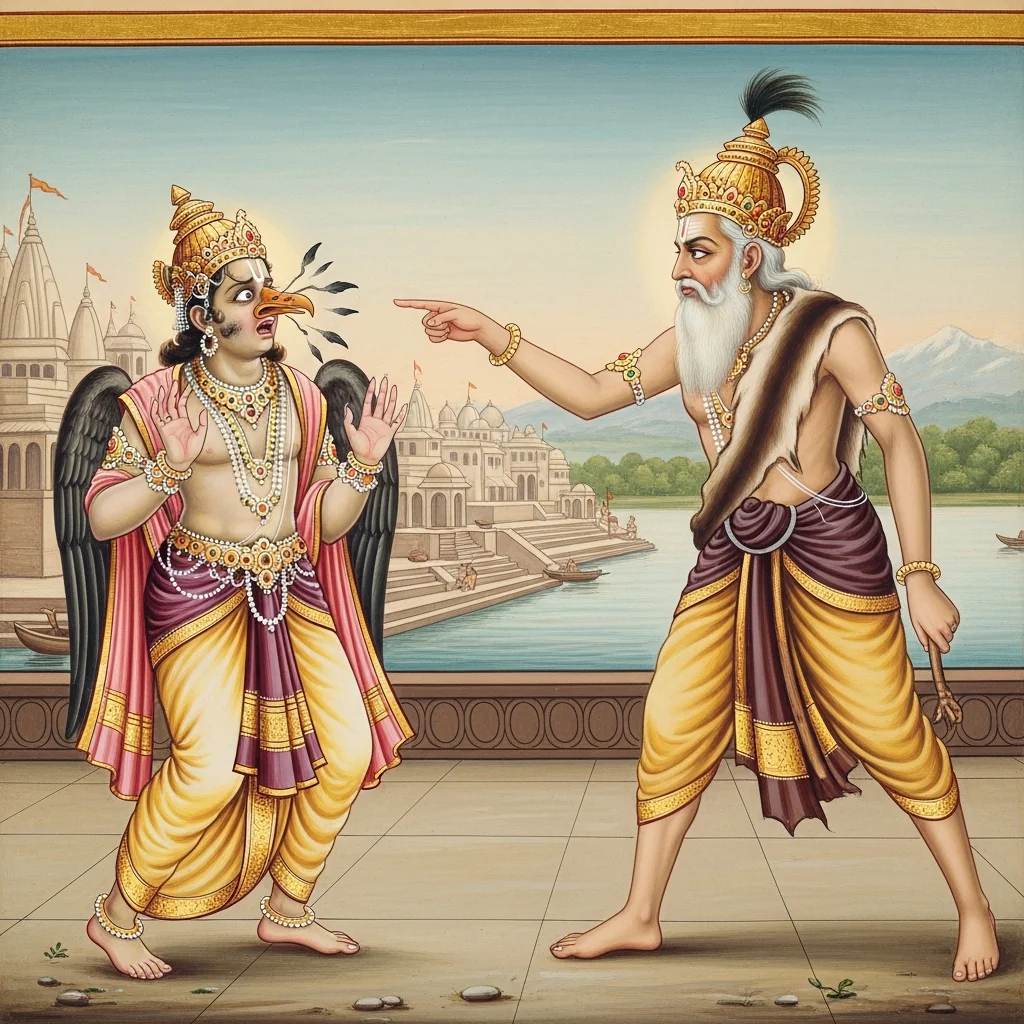
Adhyaya 9
Chapter 9 unfolds as a dialogue-centered episode, framed as an ethical and theological case. After the causes rooted in former births (pūrvajanma-samudbhava) have been explained, Nāḍījaṅgha grieves that the party’s aim—recognizing or finding King Indradyumna—remains unfulfilled, and he proposes an extreme act: entering the fire together with his companions, claiming it as loyalty to a friend and the completion of a vowed duty. Ulūka restrains him and points to another course: on Mount Gandhamādana lives a long-lived vulture (gṛdhra), a beloved companion, who may know the sought identity. The group approaches the vulture, but it admits that through many kalpas it has neither seen nor heard of Indradyumna, deepening their sorrow and prompting further inquiry. The vulture then recounts its own former-life story: once a restless monkey, it inadvertently took part in Śiva’s dāmanaka festival, involving a golden swing and a liṅga; beaten by devotees, it died at the shrine and was reborn as Kuśadhvaja, son of the lord of Kāśī, later devoted to Śiva through dīkṣā and yogic discipline. Later, inflamed by desire, it abducted Agniveśya’s daughter and was cursed into becoming a gṛdhra, with release promised only when it helps in the recognition of King Indradyumna. Thus the chapter weaves together friendship ethics, the logic of vows, ritual-festival merit, and the conditional workings of curse and liberation.
Shlokas
Verse 1
उलूक उवाच । इतिदमुक्तमखिलं पूर्वजन्मसमुद्भवम् । स्वरूपमायुषो हेतुः कौशिकत्वस्य चेति मे
Ulūka said: “Thus I have told in full what arose from my former birth—my true identity, the cause of my lifespan, and also the reason I became ‘Kauśika’.”
Verse 2
इत्युक्त्वा विरते तस्मिन्पुरूहूतसनामनि । नाडीजंघो बको मित्रमाह तं दुःखितो वचः
When he—named Purūhūta—had spoken thus and then fell silent, his friend Nāḍījaṅgha, the crane (Baka), sorrowfully addressed him in words.
Verse 3
नाडीजंघ उवाच । यदर्थं वयमायातास्तन्न सिद्धं महामते । कार्यं तन्मरणं नूनं त्रयाणामप्युपागतम्
Nāḍījaṅgha said: “The purpose for which we came has not been fulfilled, O great-minded sage. Now that very ‘task’ has surely turned into death that has come upon all three of us.”
Verse 4
इंद्रद्युम्नापरिज्ञाने भद्रकोऽयं मुमूर्षति । तस्यानु मित्रं मार्कंडस्तं चान्वहमपि स्फुटम्
Because Indradyumna has not been recognized, Bhadraka seeks death. His friend Markanda follows him, and I too shall surely follow.
Verse 5
मित्रकार्ये विनिर्वृत्ते म्रियमाणं निरीक्षते । यो मित्रं जीवितं तस्य धिगस्निग्धं दुरात्मनः
Shame on the life of that heartless, evil-minded soul who, having been served by a friend, merely watches that friend die!
Verse 6
तदेतावनुयास्यामि म्रियमाणावहं द्विज । आपृच्छे त्वां नमस्कार आश्लेषश्चाथपश्चिमः
Therefore, O Brahmin, I shall follow these two who are dying. I bid you farewell; accept my salutation and final embrace.
Verse 7
प्रतिज्ञातमनिष्पाद्य मित्रस्याभ्यागतस्य च । कथंकारं न लज्जंते हताशा जीवितेप्सवः
How do those wretched souls who desire life not feel shame, having failed to fulfill a promise to a friend who came for help?
Verse 8
तस्माद्वह्निं प्रवेक्ष्यामि सार्धमाभ्यामसंशयम् । आपृष्टोऽस्यधुना स्नेहान्मम देहि जलांजलिम्
Therefore, without doubt, I shall enter the fire with these two. Having asked your leave out of affection, grant me a handful of water.
Verse 9
इत्युक्तवत्युलूकोऽसौ नाडीजंघे सगद्गदम् । साश्रुनेत्रं स्थिरीभूय प्राह वाचं सुधासमुचम्
When this was said, that owl—his legs trembling, his voice choked—steadied himself, tears in his eyes, and spoke words sweet as nectar.
Verse 10
उलूक उवाच । मयि जीवति मित्रे मे भवान्मरणमेति च । अद्यप्रभृति कस्तर्हि हृदा मम लभिष्यति
Ulūka said: “While I—your friend—still live, you are going to meet death! From today onward, who then will my heart ever find as a true companion?”
Verse 11
अस्त्युपायो महानत्र गन्धमादनपर्वते । मत्तश्चिरायुर्मित्रोस्ति गृध्रः प्राणसमः सुहृत्
“There is a great remedy here—on Mount Gandhamādana. I have a long-lived friend there, a vulture, a well-wisher dear to me as life itself.”
Verse 12
स विज्ञास्यति वोऽभीष्टमिंद्रद्युम्नं महीपतिम् । इत्युक्त्वा पुरतस्तस्थावुलूकः स च भूपतिः
“He will find out for you what you desire—concerning Indradyumna, the lord of the earth.” Having said this, Ulūka stood in front, and the king as well prepared to follow.
Verse 13
मार्कंडेयो बकश्चैव प्रययुर्गंधमादनम् । तमायांतमथालोक्य वयस्यं पुरतः स्थितम्
Mārkaṇḍeya and Baka also set out for Gandhamādana. As they approached, they saw their companion standing in front, and they drew near.
Verse 14
स्वकुलायात्प्रहृष्टोऽसौ गृध्रः संमुखमाययौ । कृतसंविदसौ पूर्वं स्वागतासनभोजनैः
Rejoicing, that vulture came forth from his own abode to meet them face to face. Since they were previously acquainted, they exchanged courtesies—welcome, seats, and food.
Verse 15
उलूकं गृध्रराजश्च कार्यं पप्रच्छ तं तथा । म चाचख्यावयं मित्रं बको मेऽस्य मुनिः किल
The king of vultures questioned Ulūka about the purpose of their visit. Then Ulūka explained: “This is our friend; and this Baka here—so it is said—is a muni, a sage.”
Verse 16
मुनेरपि तृतीयोऽयं मित्रं चार्थोयमुद्यतः । इंद्रद्युम्नपरिज्ञाने स्वयं जीवति नान्यथा
“He is a third friend as well, a friend even of the muni; and this is the purpose set before us: in the matter of recognizing Indradyumna, he lives by that—otherwise he does not live.”
Verse 17
वह्निं प्रवेक्ष्यते व्यक्तमयं तदनु वै वयम् । मया निषिद्धोऽयं ज्ञात्वा त्वां चिरंतनमात्मना
“Clearly, he is about to enter the fire—and after him, we too would follow. Knowing you to be an ancient one, true of heart, I have restrained him.”
Verse 18
तच्चेज्जानासि तं ब्रूहि चतुर्णां देहि जीवितम् । सरं क्ष्याप्नुहि सत्कीर्तिं क्षयं चाखिलपाप्मनः
“If you truly know him, then tell us. Grant life to the four of us; and you shall attain a lake of merit, noble fame, and the complete destruction of all sins.”
Verse 19
गृध्र उवाच । षट्पंचाशद्व्यतीता मे कल्पा जातस्य कौशिक । न दृष्टो न श्रुतोऽस्माभिरिंद्रद्युम्नो महीपतिः
The Vulture said: “O Kauśika, fifty-six kalpas have passed since my birth. Yet King Indradyumna, lord of the earth, has neither been seen by us nor even heard of.”
Verse 20
तच्छ्रुत्वा विस्मयाविष्ट इंद्रद्युम्नोऽपि दुःखितः । पप्रचछ जीविते हेतुमतिमात्रे विहंगमम्
Hearing this, Indradyumna—struck with astonishment and also distressed—questioned the bird, exceedingly wise, about the cause of its long life.
Verse 21
गृध्र उवाच । श्रृणु भद्रै पुरा जातो मर्कटोऽहं च चापलः । आसं कदाचिदभवद्वसंतोऽथ ऋतुः क्रमात्
The Vulture said: “Listen, O blessed one. Long ago I was born as a monkey, restless by nature. Once, in the due course of seasons, spring arrived.”
Verse 22
तत्राग्रे देवदेवस्य वनमध्ये शिवालये । भवोद्भवस्य पुरतो जगद्योगेश्वराभिधे
There, in the forest—within a shrine of Śiva, the God of gods—before Bhavodbhava, in the place known as Jagadyogeśvara,
Verse 23
चतुर्दशीदिने हस्तनक्षत्रे हर्षणाभिधे । योगे चैत्रे सिते पक्ष आसीद्दमनकोत्सवः
On the fourteenth lunar day, under the Hasta constellation, in the yoga called Harṣaṇa—during the bright fortnight of Caitra—there was the festival of Damanaka.
Verse 24
अत्र सौवर्ण्यदोलायां लिंग आरोपिते जनैः । निशायामधिरूह्याऽहं दोलां तां च व्यचालयम्
Here, when the people had set the Liṅga upon a golden swing, I climbed onto that swing at night and set it swaying.
Verse 25
निसर्गाज्जतिचापल्याच्चिरकालं पुनःपुनः । अथ प्रभात आयाता जनाः पूजाकृते कपिम्
Because of my inborn, restless monkey-nature, I kept doing it again and again for a long time. Then, at dawn, people came for worship and saw the monkey.
Verse 26
दोलाधिरूढमालोक्य लकुटैर्मां व्यताडयन् । दोलासंस्थित एवाहं प्रमीतः शिवमंदिरे
Seeing me seated upon the swing, they struck me with sticks. Still upon the swing itself, I died there in Śiva’s temple.
Verse 27
तेषां प्रहारैः सुदृढैर्बहुभिर्वज्रदुःसहैः । शिवांदोलनमाहात्म्याज्जातोऽहं नृपमंदिरे
Through their many blows—hard and unbearable like thunderbolts—yet by the greatness of Śiva’s swing-rite (āndolana), I was reborn in a royal palace.
Verse 28
काशीश्वरस्य तनयः प्रतीतोऽस्मि कुशध्वजः । जाति स्मरस्ततो राज्ये क्रमात्प्राप्याहमैश्वरम्
I am renowned as Kuśadhvaja, the son of the lord of Kāśī. Remembering former births, I gradually attained sovereign lordship in the kingdom.
Verse 29
कारयामि धरापृष्ठे चैत्रे दमनकोत्सवम् । यता यथा दोलयति शिवं दोलास्थितं नरः
Upon the face of the earth, in the month of Caitra, I cause the Damanaka festival to be performed. In whatever manner a man swings Śiva seated upon the swing,
Verse 30
तथा तथाऽशुभं याति पुण्यमायाति भद्रक । शिवदीक्षामुपागम्याखिलसंस्कारसंस्कृतः
In that very measure, inauspiciousness departs and merit arrives, O Bhadraka—when one approaches Śiva’s dīkṣā, refined by all sacred rites.
Verse 31
शिवाचार्यैर्विमुक्तोऽहं पशुपाशैस्तदागमात् । निर्वाहदीक्षापर्यंतान्संस्कारान्प्राप्य सर्वतः
By Śaiva preceptors I was freed from the bonds of the paśu, according to that sacred Āgama tradition; and I obtained, in every respect, the consecratory rites up to the nirvāha-dīkṣā.
Verse 32
आराधयामि देवेशं प्रत्यक्चित्तमुमापतिम् । समस्तक्लेशविच्छेदकारणं जगतां गुरुम्
I worship the Lord of gods—Umāpati—realized within the inward-turned mind; the cause of severing all afflictions, the Guru of the worlds.
Verse 33
चित्तवृत्तिनिरोधेन वैराग्याभ्यासयोगतः । जपन्नुद्गीतमस्यार्थं भावयन्नष्टमं रसम्
By restraining the mind’s fluctuations, through the yoga of dispassion and steady practice, I chanted the sacred udgīta, contemplating its meaning and cultivating the ‘eighth rasa’—the transcendent spiritual savor.
Verse 34
ततो मां प्रणिधानेनाभ्यासेन दृढभूमिना । अन्तरायानुपहतं ज्ञात्वा तुष्टोऽब्रवीद्धरः
Then, knowing me to be unshaken by obstacles through steadfast practice and firm dedication, Hara, pleased, spoke.
Verse 35
ईश्वर उवाच । कुशध्वजाहं तुष्टोद्य वरं वरय वांछितम् । न हीदृशमनुष्ठानं कस्याप्यस्ति महीतले
Īśvara said: “O Kuśadhvaja, today I am pleased. Choose the boon you desire, for on the face of the earth no one has such a discipline and worship as this.”
Verse 36
श्रुत्वेत्युक्तो मया शम्भुर्भूयासं ते गंणो ह्यहम् । अनेनैव शरीरेण तथेत्येवाह गां प्रभुः
Hearing this, I said to Śambhu: “May I indeed become one of Your gaṇas.” The Lord replied: “So be it—by this very body.”
Verse 37
ततः कैलासमानीय विमानं मम चादिशत् । सर्वरत्नमयं दिव्यं दिव्याश्चर्यसमावृतम्
Then, bringing me to Kailāsa, He assigned to me a celestial chariot—divine, made of every jewel, and surrounded by wondrous splendors.
Verse 38
विचरामि प्रतीतोऽहं तदारूढो यदृच्छया । अथ काले कियन्मात्रे व्यतीतेऽत्रैवं पर्वते
Thus, having mounted it as if by chance, I roamed about with a satisfied mind. After a short while had passed here on this very mountain, the following occurred.
Verse 39
गवाक्षाधिष्ठितोऽपश्यं वसंते मुनिकन्यकाम् । प्रवाति दक्षिणे वायौ मदनाग्निप्रदीपितः
Standing at a window-opening in the spring season, I beheld a sage’s daughter. When the southern breeze began to blow, the fire of Kāma (desire) was kindled within me.
Verse 40
अग्निवेश्यसुतां भद्र विवस्त्रां जलमध्यगाम् । उद्भिन्नयौवनां श्यामां मध्यक्षामां मृगेक्षणाम्
O noble one, she was Agniveśya’s daughter—without garments, standing in the midst of the water—her youth newly blossoming, dark-hued, slender-waisted, and doe-eyed.
Verse 41
विस्तीर्णजघनाभोगां रंभोरुं संहतस्तनीम् । तामंकुरितलावण्यां जलसेका दिवाग्रतः
Her hips were full and broad, her thighs like Rambhā’s, and her breasts firm and close-set. Her beauty seemed newly sprouted as she bathed, pouring water over herself in the open of day.
Verse 42
प्रोन्निद्रपंकजमुखीं वर्णनीयतमाकृतिम् । यथाप्रज्ञानयाथात्म्याद्विद्विद्भिरपि वर्णिनीम्
Her face was like a fully opened lotus, her form supremely worthy of praise; yet even the learned could scarcely describe her as she truly was, for her reality exceeded ordinary understanding.
Verse 43
प्रोद्यत्कटाक्षविक्षेपैः शरव्रातैरिव स्मरः । स्वयं तदंगमास्थाय ताडयामास मां दृढम्
With the flinging of her glances—like volleys of arrows—Kāma struck me hard, as though he himself had taken his stand upon her very limbs and smitten me.
Verse 44
वयस्यासंवृचामेवं खेलमानां यदृच्छया । अवतीर्याहमहरं विमानान्मदनातुरः
While her companions were sporting thus, by chance I descended from the aerial car and, tormented by desire, seized the opportunity.
Verse 45
सा गृहीता मया दीर्घं प्रकुर्वाणा महास्वनम् । तातेति च विमानस्था रुरोदातीव भद्रक
I held her fast for a long time; she raised a great cry. ‘Father!’ she wailed, and there in the aerial car she wept, as if helpless—O good one.
Verse 46
ततो वयस्यास्ता दीना मुनिमाहुः प्रधाविताः । वैमानिकेन केनापि ह्रियते तव पुत्रिका
Then her distressed companions ran to the sage and cried: ‘By some aerial being, your daughter is being carried off!’
Verse 47
रुदन्तीं भगवन्नेतां त्राह्युत्तिष्ठेति सर्वतः । तासां तदाकर्ण्य वचो मुनिर्भद्रतपोनिधिः
‘Bhagavan, save her—she is crying! Rise up at once!’ they pleaded from every side. Hearing their words, the sage—an auspicious treasury of austerity—prepared to act.
Verse 48
अग्निवेश्योऽभ्यगात्तस्या व्योमन्युपपदं त्वरन् । तिष्ठतिष्ठेति मामुक्त्वा संस्तभ्य तपसा गतिम्
Then Agniveśya hurried through the sky and caught up with her. Saying to me, “Stop, stop!”, he checked my movement by the power of his austerity.
Verse 49
ततः प्रकुपितः प्राह मुनिमामति दुःसहम् । अग्निवेश्य उवाच । यस्मान्मदीया तनया मांसपेशीव ते हृता
Then, inflamed with anger, he spoke words hard to endure. Agniveśya said: “Since you have carried off my own daughter as though she were but a lump of flesh…”
Verse 50
गृध्रेणेवाऽधुना व्योम्नि तस्माद्गध्रो भव द्रुतम् । अनिच्छंती मदीयेयं सुता बाला तपस्विनी
“As a vulture now bears her through the sky, so become a vulture at once! This daughter of mine—unwilling, young, and devoted to austerity—has been taken away.”
Verse 51
त्वया हृताधुनास्यैतत्फलमाप्नुहि दुर्मते । इत्याकर्ण्य भयाविष्टो लज्जयाधोमुखो मुनेः
“Since you have taken her away, receive the fruit of this deed, O wicked-minded one!” Hearing this, he was seized with fear and, in shame, lowered his face before the sage.
Verse 52
पादौ प्रगृह्य न्यपतं रुदन्नतितरां तदा । न मयेयं परिज्ञाय हृता नाद्यापि धर्षिता
Then, grasping his feet, I fell down, weeping bitterly: “Without knowing who she was, I took her away; and even now she has not been violated.”
Verse 53
प्रसादं कुरु ते शापं व्यावर्तय तपोनिधे । प्रणतेषु क्षमावन्तो निसर्गेण तपोधनाः
“Show me grace, O treasure-house of austerity; turn back your curse. For those rich in tapas are, by their very nature, forgiving toward the bowed and surrendered.”
Verse 54
भवंति संतस्तद्गृध्रो मा भवेयं प्रसीद मे । इति प्रपन्नेन मया प्रणतोऽसौ महामुनिः
“The virtuous are indeed compassionate—may I not become a vulture; be gracious to me.” Thus, having sought refuge, I bowed down to that great sage.
Verse 55
प्रसन्नः प्राह नो मिथ्या मम वाक्यं भवेत्क्वचित् । किं त्विंद्रद्युम्नभूपालपरिज्ञाने सहायताम्
Pleased, he said: “My word will never be false at any time. Yet, in the matter of recognizing King Indradyumna, you shall render assistance.”
Verse 56
यदा यास्यसि शापस्य तदा मुक्तिमवाप्स्यसि
“When you have undergone the curse, then you will attain release.”
Verse 57
इत्युक्त्वा स मुनिः प्रायाद्गृहीत्वा निजकन्यकाम् । अखण्डशीलां स्वावासमहं गृध्रोऽभवं तदा
Having said this, that sage departed, taking his own daughter—whose chastity was unbroken—back to his abode. And at that very moment, I became a vulture.
Verse 58
एवं तदा दमनकोत्सव ईश्वरस्य आंदोलनेन नृपवेश्मनि मेऽवतारः । शम्भोर्गणत्वमभवच्च तथाग्निवेश्यशापेन गृध्र इह भद्र तवेदमुक्तम्
Thus, at that time—during the Lord’s Damanaka festival and the ceremonial swinging (āndolana) of Īśvara—my descent took place in the king’s palace. I also attained the status of a gaṇa of Śambhu; and here, O good one, by the curse of Agniveśya I became a vulture. This is what has been told to you.