Adhyaya 34
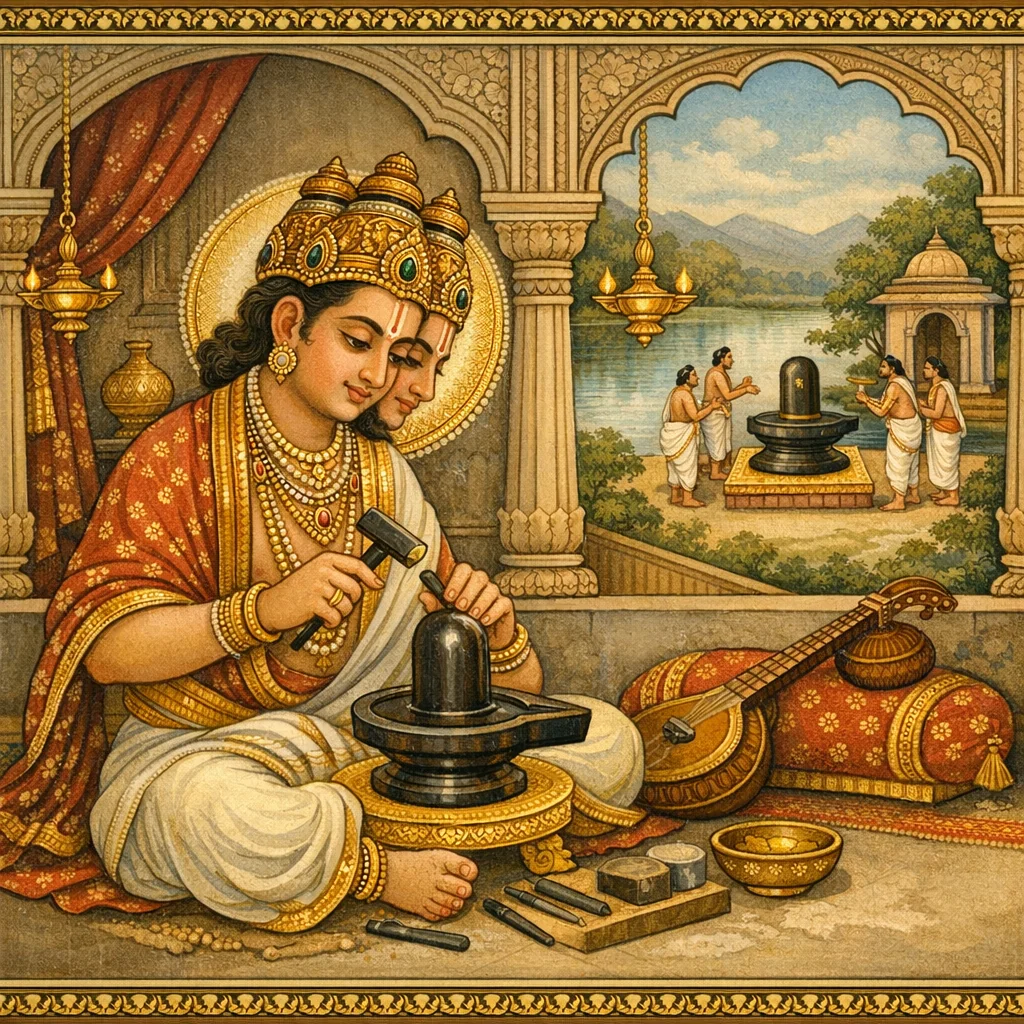
The chapter begins with Nārada describing Brahmā’s resolve to establish a third liṅga, shaping it into an even more exemplary form—pleasing to the eye, calming to the mind, and fruitful in result. The gods create a wondrous lake and gather the waters of the great tīrthas, such as the Gaṅgā and others, into that basin for Skanda’s delight. On an auspicious day in Vaiśākha, Brahmā and the priests perform the installation with Rudra-mantras and offerings amid celestial music. Skanda bathes, performs liṅga-abhiṣeka with “the waters of all tīrthas,” and worships with five mantras; Śiva is said to receive the worship from within the liṅga. Skanda then asks the fruits of particular offerings, and Śiva replies with a detailed ritual-and-ethical catalogue: establishing liṅgas and building shrines grants long residence in Śiva’s realm, while gifts—flags, perfumes, lamps, incense, food offerings, flowers, bilva leaves, canopies, music, bells, and more—yield distinct results such as health, prosperity, fame, knowledge, and the removal of sin. Śiva’s abiding presence at Kumarēśvara is affirmed as a “hidden kṣetra,” likened to Viśvanātha at Vārāṇasī. Skanda recites an extended Śaiva stotra, and Śiva promises benefits to those who chant it morning and evening. The discourse expands to tīrtha observances: bathing and worship at Mahīsāgara-saṅgama on key lunar and solar occasions brings great merit. A drought-remedy rite is prescribed—multi-night abhiṣeka with scented water, offerings, feeding Brahmins, homa, donations, and Rudra-japa—promising rainfall and social well-being. Further boons include jāti-smṛti (memory of past births) through regular worship, Rudraloka for those who die at the tīrtha, and obstacle-removal assured by Kapardin (Gaṇeśa). The chapter closes with exemplary devotees such as Jāmadagnya/Paraśurāma and the injunction that reciting or hearing this māhātmya grants desired fruits, benefits ancestors when read at śrāddha, and bestows auspicious offspring when read to a pregnant woman.
Shlokas
Verse 1
नारद उवाच । ततस्तृतीयलिंगस्य चिकीर्षु स्थापनं गुहम् । ब्रह्मा प्राहास्य प्रीत्यर्थं स्वयमन्यं प्रकुर्महे
Nārada said: Then, when Guha desired to establish a third liṅga, Brahmā spoke, saying, “For his satisfaction, let us ourselves set up another (liṅga).”
Verse 2
यद्यप्येतच्छुभं लिंगं सर्वदोषविवर्जितम् । तथाप्यन्यत्करिष्येऽहं सर्वश्रेष्ठतमं हि यत्
(Brahmā said:) “Although this auspicious liṅga is free from every defect, still I shall make another—one that is truly the most excellent of all.”
Verse 3
ततो ब्रह्मा सर्वदोषविमुक्तं निर्ममे स्वयम् । दृष्टिकांतं मनःकांतं फलकांतं सुलिंगकम्
Then Brahmā himself fashioned an auspicious Śiva-liṅga—free from every defect—pleasing to behold, delightful to the mind, and beautiful in its promised fruits (spiritual results).
Verse 4
तत्र स्कंदस्य प्रीत्यर्थं सर्वदेवैर्निनिर्मितम् । सरः सुरम्यं तीर्थानि तत्र ते निदधुस्तथा
There, to delight Skanda, all the gods fashioned a most beautiful lake; and in that very place they also established tīrthas—sacred bathing-fords.
Verse 5
गंगादिकानि तीर्थानि यानि प्रोचुर्दिवौकसः । इदं यावत्सरस्तावत्सर्वैरत्र समुष्यताम्
“Let the holy tīrthas, beginning with the Gaṅgā—of which the gods speak—remain gathered here for as long as this lake endures.”
Verse 6
एवमस्त्विति तान्यूचुः प्रीत्यर्थं शरजन्मनः । ततो ब्रह्मा स्वयं तत्र रौद्रैर्मंत्रैर्हुताशनम् । गाधिपुत्रादिभिर्विप्रैस्तर्पयामास संयुतः
“So be it,” they said, seeking to please the Lord born amid reeds (Skanda). Then Brahmā himself, on that very spot, satisfied the sacred Fire (Agni) with Rudra-mantras, together with brāhmaṇas such as the son of Gādhi and others.
Verse 7
ततो वैशाखमासस्य चतुर्द्दश्यां शुभे दिने । प्रतिष्ठां चक्रिरे लिंगे चिरं विप्रमुका द्विजाः
Then, on the auspicious fourteenth day of the month of Vaiśākha, the twice-born (dvija), led by brāhmaṇas, solemnly performed the pratiṣṭhā—the consecration of the liṅga.
Verse 8
जगुर्गंधर्वपतयो ननृतुश्चाप्सरोगणाः । ततः स्कंदः प्रीतियुक्तः स्नात्वा सरसि शोभने
The lords of the Gandharvas sang, and the hosts of Apsarases danced. Then Skanda, filled with joy, bathed in that splendid lake.
Verse 9
सर्वतीर्थोदकैः स्नाप्य तल्लिंगं भक्तिसंयुतः । विविधैः पूजयामास पुष्पैर्मंत्रैश्च पंचभिः
With devotion, he bathed that liṅga with the waters of all the tīrthas, and worshipped it in many ways—offering diverse flowers and reciting five mantras.
Verse 10
पूजाकाले स्वयं तत्र लिंगमध्येस्थितो हरः । जंगमा जंगमैः सार्धं स्वयं जग्राह पूजनम्
At the time of worship, Hara himself was present there within the very heart of the liṅga; together with the moving beings—the living devotees—he personally received the worship.
Verse 11
ततस्तं पूजयन्प्राह स्कंदो भक्तिपरिप्लुतः । केन केनोपहारेण त्वयि दत्तेन किं फलम्
Then Skanda, overwhelmed with devotion as he worshipped him, asked: “By which offering given to you, what fruit is obtained?”
Verse 12
श्रीमहादेव उवाच । मम यः स्थापयेल्लिंगं शुभं सद्म च कारयेत् । मल्लोके वसतेऽसौ च वावच्चंद्रदिवाकरौ
Śrī Mahādeva said: “Whoever establishes my liṅga and also causes an auspicious shrine to be built—he dwells in my realm for as long as the moon and the sun endure.”
Verse 13
मम सद्म सुधाशुभ्रं यावत्संख्यं करोति यः । तावंत्येव च जन्मानि यशसासौ विराजते
Whoever makes (or causes to be made) my abode—white and radiant like nectar—in whatever measure, for that same number of births he shines forth adorned with fame.
Verse 14
ध्वजभूतो ध्वजं दत्त्वा विपापः स्यात्पताकया । विधाय चित्रविन्यास गंधर्वैः सह मोदते
By offering a banner (dhvaja), one becomes as it were a banner of honor; by giving a flag (patākā), one is freed from sin. And having arranged ornate designs, one rejoices in the company of the Gandharvas.
Verse 15
रजःसंशोधनं कृत्वा नरो रोगैः प्रमुच्यते । प्राप्नोति देहं हार्दं च सुरसद्मानुलेपनात्
Having cleansed away dust and impurity, a man is freed from diseases. And by plastering or anointing the divine abode (the temple), he attains a pleasing and beloved body as well.
Verse 16
पुष्पक्षीरादि भिर्दत्तैस्तिलाभोऽक्षतदर्भकैः । शंभोः शिरसि दत्त्वार्घ्य दिवि वर्षायुतं वसेत्
With offerings such as flowers and milk—together with sesame, unbroken rice (akṣata), and darbha grass—having placed an arghya (honor-offering) upon Śambhu’s head, one dwells in heaven for ten thousand years.
Verse 17
घृतेन हतपापः स्यान्मधुना सुभगो भवेत् । विरोगो दधिदुग्धाभ्यां लिंगं संस्नाप्य जायते
By bathing the Liṅga with ghee one becomes freed from sins; with honey one becomes fortunate and attractive; and by bathing the Liṅga with curd and milk one becomes free from disease.
Verse 18
पानीयदधिदुग्धाद्यैः क्रमाद्दशगुणं फलम् । मासं संस्नाप्य वै भक्त्या पिष्टाद्यैश्च विरूक्षयेत्
With water, curd, milk, and the like—successively—the fruit becomes tenfold. Having bathed (the Liṅga) for a month with devotion, one should also sprinkle or dust it with flour and similar substances.
Verse 19
कपिलापंचगव्येन सुरसिंधुजलेन वा । मां च संस्नाप्य चाभ्यच्च मल्लोकमधिगच्छति
He who bathes me (the Liṅga) with the five products of a tawny cow, or with water from the divine river, and worships me, attains my world.
Verse 20
कुशोदकाद्गंधजलं तस्मात्तीर्थोदकं वरम् । तीर्थेभ्यश्च जलं दर्शे महीसागरसंभवम्
Better than kuśa-water is scented water; superior to that is water from a tīrtha, a sacred ford. Superior even to ordinary tīrtha-waters is the water that appears on the new-moon day, born of earth and ocean.
Verse 21
कपिलां दत्त्वा यदाप्नोति तत्फलं कलशे पृथक् । मृत्ताम्ररौप्यसौवर्णैः क्रमाच्छतगुणं फलम्
Whatever fruit is gained by gifting a tawny cow, that same fruit is gained separately by offering a kalaśa, a water-pot. With pots of clay, copper, silver, and gold respectively, the result becomes a hundredfold in ascending order.
Verse 22
श्रीखंडागरुकाश्मीरशशिनः क्रमशोऽधिकाः । मां च तैश्च समालभ्य स्याच्छ्रीमान्सुभगः सुखी
Sandalwood (śrīkhaṇḍa), agaru, Kāśmīra saffron, and camphor are each progressively superior. By anointing me with these as well, one becomes prosperous, fortunate, and happy.
Verse 23
प्रशस्तो गुग्लुलो धूपस्तस्माच्चंद्रोऽगरुर्वरः । धूपानेतान्नरो दत्त्वा सुखं स्वर्गमवाप्नुयात्
Commended is the incense of guggulu; and superior still are fragrant offerings like candana and the excellent agaru. One who offers such incenses attains heavenly happiness with ease.
Verse 24
दीपदः कीर्तिमाप्नोति चक्षुरुत्तममेव च । नैवेद्यस्य प्रदानेन नरो मृष्टाशनो भवेत्
One who offers a lamp attains fame and also excellent eyesight. By offering naivedya (a food-offering), a person becomes one who enjoys refined, pure, and wholesome nourishment.
Verse 25
पुष्पेण हेमकर्णस्य प्रबद्धेन द्विसंगुणम् । फलमाप्नोति पुरुषः सत्यसंधश्च जायते
By offering a well-arranged flower to Hemakarṇa, a man gains a fruit doubled in measure, and he becomes steadfast in truth.
Verse 26
अखंडैर्बिल्वपत्रैश्च पुष्पैर्वा विविधैरपि । लिंगं प्रपूरणं कृत्वा लक्ष्मेकं वसेद्दिवि
By fully adorning the Liṅga with unbroken bilva leaves, or even with various kinds of flowers, one dwells in heaven endowed with abundant prosperity.
Verse 27
यस्तु पुष्पगृहं कुर्यान्नरः शुद्धाशयो भवेत् । पुष्पकेण विमानेन दिवि संक्रीडते चिरम्
But the person who builds a flower-house (a floral pavilion for worship) becomes pure in intention; and in heaven, he sports for a long time in a celestial ‘Puṣpaka’ aerial car.
Verse 28
भूषणांबरदानेन नरो भवति भोगभाक् । सच्चामरप्रदानेन जायते पार्थिवो नरः
By gifting ornaments and garments, a person becomes an enjoyer of comforts and prosperity. By offering a fine cāmara (yak-tail fan), a man is born as a ruler upon the earth.
Verse 29
रम्यं वितानं यो दद्याच्छत्रुभिर्नाभूयते । गीतं वाद्यं प्रनृत्यं च कृत्वा शुद्धो व्रजेत्स माम्
Whoever donates a beautiful sacred canopy is not overcome by enemies. And having offered song, instrumental music, and dance in worship, he is purified and attains Me.
Verse 30
शंखघंटाप्रदानेन विद्वान्भवति शब्दवान् । विधाय रथयात्रां च चिरं शोकैः प्रमुच्यते
By donating a conch and a bell, one becomes learned and endowed with a powerful voice. And by organizing a chariot procession (ratha-yātrā), one is freed from sorrows for a long time.
Verse 31
नमस्कारं प्रणामं च कृत्वा जायेन्महाकुले । वाचयंश्चाग्रतः शास्त्रं मम ज्ञानी प्रजायते
By offering reverent salutations and full prostrations, one is born into a great family. And by reciting the scriptures aloud in My presence, one becomes a knower of Me—a wise devotee.
Verse 32
विमुच्यते मनोमोहैर्भक्त्या स्तुत्वा च मां नरः । गोदानफलमाप्नोति निर्माल्यस्फेटनान्मम
A person who praises Me with devotion is released from the delusions of the mind. And by removing My nirmālya (used garlands and offerings), he attains the same merit as the gift of a cow.
Verse 33
आरार्तिकं भ्रामयित्वा अर्तिहीनः प्रजायते । कृत्वा शीतलिकां तापैर्मुच्यते दोष संभवैः
By waving the ārārtika (lamp-offering), a person becomes free from afflictions. By performing the Śītalikā rite, one is released from burning torments and from faults that give rise to suffering.
Verse 34
नत्वा दत्त्वाथ शक्त्या च दानं लिंगस्य संनिधौ । फलं शतगुणं प्राप्य इह चामुत्र मोदते
Having bowed down, and then giving charity according to one’s capacity in the presence of the Liṅga, one obtains a hundredfold fruit and rejoices both in this world and in the next.
Verse 35
प्रणामात्पंचदश च स्नानाद्विंशतिं पूजया । शतं यथाप्रोक्तविधेरपराधानहं क्षमे
For fifteen (offences) through prostration, for twenty through bathing, and for a hundred through worship—I forgive transgressions when the rite is performed as prescribed.
Verse 36
एतत्सर्वं यथोद्दिष्टं कुमारात्र भविष्यति । ये मां प्रपूजयिष्यंति कुमारेश्वर संस्थितम्
All this shall indeed occur here in this Kumāra (sacred region), just as declared—for those who will worship Me, abiding here as Kumāreśvara.
Verse 37
वाराणस्यां यथा वत्स विश्वनाथोऽस्मि संस्थितः
Just as, dear child, I am established in Vārāṇasī as Viśvanātha,
Verse 38
गुप्तक्षेत्रे तथा स्थास्ये कुमारेश्वरमध्यतः
So too, in the Guptakṣetra, I shall abide in the very midst of Kumāreśvara.
Verse 39
श्रुत्वेति वचनं रुद्राद्देवानां श्रृण्वतां गुहः । विस्मितः प्रणिपत्यैनं तुष्टाव गिरिजापतिम्
Hearing these words from Rudra as the gods listened, Guha—filled with wonder—bowed down before Him and praised the Lord of Girijā (Pārvatī).
Verse 40
नमः शिवायास्तु निरामयाय नमः शिवायास्तु मनोमयाय । नमः शिवायास्तु सुरार्चिताय तुभ्यं सदा भक्तकृपापराय
Salutation to Śiva, the remover of disease; salutation to Śiva, who pervades the mind. Salutation to Śiva, worshipped by the gods—to You, ever intent on compassion for devotees.
Verse 41
नमो भवायास्तु भवोद्भवाय नमोस्तु ते ध्वस्तमनोभवाय । नमोऽस्तु ते गूढमहाव्रताय नमोऽस्तु मायगहनाश्रयाय
Salutation to Bhava, the source of all becoming; salutation to You who have destroyed the god of desire. Salutation to You whose great vow is hidden; salutation to You, the support of Māyā’s deep mystery.
Verse 42
नमोस्तु शर्वाय नमः शिवाय नमोस्तु सिद्धाय पुरातनाय । नमोस्तु कालाय नमः कलाय नमोऽस्तु ते कालकलातिगाय
Salutation to Śarva; salutation to Śiva; salutation to the Perfect One, the Ancient. Salutation to Time; salutation to the Divine Power, Kalā; salutation to You who transcend both Time and its divisions.
Verse 43
नमो निसर्गात्मकभूतिकाय नमोऽस्त्वमेयोक्षमहर्द्धिकाय । नमः शरण्याय नमोऽगुणाय नमोऽस्तु ते भीमगुणानुगाय
Salutations to You whose very body is the manifested order of nature and existence. Salutations to the immeasurable One, the mighty Lord of great majesty whose banner is the Bull. Salutations to the Refuge of all; salutations to the attributeless Absolute. Salutations to You, who yet moves in accord with awe-inspiring divine powers.
Verse 44
नमोऽस्तु नानाभुवनाधिकर्त्रे नमोऽस्तु भक्ताभिमतप्रदात्रे । नमोऽस्तु कर्मप्रसावाय धात्रे नमः सदा ते भगवन्सुकर्त्रे
Salutations to You, the sovereign maker of the many worlds. Salutations to You, the giver of what devotees long for. Salutations to You, the Sustainer who brings forth the fruits of karma. Ever salutations to You, O Blessed Lord, the perfect doer of all deeds.
Verse 45
अनंतरूपाय सदैव तुभ्यमसह्यकोपाय सदैव तुभ्यम् । अमेयमानाय नमोस्तु तुभ्यं वृषेंद्रयानाय नमोऽस्तु तुभ्यम्
Ever to You—of endless forms—salutations. Ever to You—whose wrath is unbearable (to evil)—salutations. Salutations to You, immeasurable in greatness; salutations to You who rides the lordly Bull.
Verse 46
नमः प्रसिद्धाय महौषधाय नमोऽस्तु ते व्याधिगणापहाय । चराचरायाथ विचारदाय कुमारनाथाय नमः शिवाय
Salutations to You, famed as the Great Medicine. Salutations to You, the remover of hosts of diseases. Salutations to You, the Lord of all moving and unmoving beings, who grants discernment. Salutations to Śiva, the Lord of Kumāra.
Verse 47
ममेश भूतेश महेश्वरोसि कामेश वागीश बलेश धीश । क्रोधेश मोहेश परापरेश नमोस्तु मोक्षेश गुहशयेश
You are my Lord—the Lord of beings, the Great God. Lord over desire, Lord of speech, Lord of strength, Lord of understanding. Lord over anger and delusion, Lord of both the higher and the lower realities—salutations to You, Lord of liberation, the Indweller in the cave of the heart.
Verse 48
इति संस्तूय वरदं शूलपाणिमुमापतिम् । प्रणिपत्य उमापुत्रो नमोनम उवाच ह
Having thus praised the boon-giving Lord—Śūlapāṇi, the consort of Umā—Umā’s son bowed down and again and again said, “Salutations, salutations.”
Verse 49
एवं भक्तिपराक्रांतमात्मयोग्यं स्तवं शिवः । अभिनन्द्य चिरं कालमिदं वचनमब्रवीत्
Thus Śiva—long pleased—commended that hymn, mighty with devotion and worthy of Him, and spoke these words.
Verse 50
त्वया दुःखं न संचिंत्यं मम भक्तवधात्मकम् । कर्मणानेन श्लाघ्योऽसि मुनीनामपि पुत्रक
You should not brood in sorrow over this act of Mine that involved the slaying of a devotee. By this deed, dear child, you are worthy of praise—even among sages.
Verse 51
ये च सायं तथा प्रातस्त्वत्कृतेन स्तवेन माम् । स्तोष्यंति परया भक्त्या श्रुणु तेषां च यत्फलम्
And those who, in the evening and again at dawn, praise Me with this hymn composed by you, with supreme devotion—listen to the fruit that comes to them.
Verse 52
न व्याधिर्न च दारिद्र्यं न चैवेष्टवियोजनम् । भुक्त्वा भोगान्दुर्लभांश्च मम यास्यंति सद्म ते
For them there will be no disease, no poverty, and no separation from what is dear. Having enjoyed even rare delights, they will go to My abode.
Verse 53
तथान्यानपि दास्यामि वरान्परमदुर्लभान् । भक्त्या तवातितुष्टोऽहं प्रीत्यर्थं तव पुत्रक
Moreover, I shall grant you other boons too—boons exceedingly difficult to obtain. I am deeply pleased by your devotion, my son, and I bestow them for your joy.
Verse 54
महीसा गरकूले तु ये मां स्तोष्यंति पूजया । तेषां दतक्षयं सर्वं वैशाख्यां दानपूजनम्
Those who, on the bank of the Mahī at Garakūla, gladden me through worship—every act of charity (dāna) and every rite of worship they perform in the month of Vaiśākha becomes imperishable, never wasted.
Verse 55
सरस्यत्र च ये स्नानं प्रकरिष्यंति मानवाः । सर्वतीर्थफला वाप्तिर्वैशाख्यां प्रभविष्यति
And those people who bathe in the lake here will, in the month of Vaiśākha, obtain the fruit of bathing at all sacred fords (tīrthas).
Verse 56
कुमारेशं तु मां भक्त्या महीसागरसंगमे । स्नात्वा संपूजयेन्नित्यं तस्य जातिस्मृतिर्भवेत्
But whoever, with devotion, bathes at the confluence of the Mahī and the ocean and then worships me daily as Kumāreśvara—he gains jātismṛti, the remembrance of previous births.
Verse 57
जातिस्मृतिरियं पुत्र यस्यां जातौ प्रजायते । स्मरतेऽस्याः प्रकर्तव्यं श्रेयोरूपं सुदुर्लभम्
This jātismṛti, my son—when it arises in a being in whatever birth—once one remembers, one should undertake what leads to the highest good, which is exceedingly hard to attain.
Verse 58
यस्मिन्काले ह्यनावृष्टिर्जायते कृत्तिकासुत । स्नापयेद्विधिवन्मां च कलशैर्विविधैः शुभैः
O son of the Kṛttikās, whenever drought occurs, one should, according to rule, bathe my sacred image with many auspicious water-pots (kalaśas) of various kinds.
Verse 59
एकरात्रं त्रिरात्रं वा पञ्चरात्रं च सप्त वा । स्नापयेद्गंधतोयेन कुंकुमेन विलेपयेत्
For one night, or three nights, or five, or even seven, one should bathe the Deity with fragrant water and anoint Him with saffron.
Verse 60
करवीरै रक्तपुष्पैर्जपापुष्पैस्तथैव च । अर्चयेत्पुष्पमालाभिः परिधायारुणवाससी
One should worship with oleander blossoms, with red flowers, and likewise with hibiscus flowers; and worship with garlands of flowers, wearing crimson garments.
Verse 61
भोजयेद्ब्रह्णांश्चैव तापसाञ्छंसिवव्रतान् । लक्षहोमं प्रकुर्वीत शिवहोमं ग्रहादिकम्
One should feed Brahmins and ascetics who are steadfast in their vows. One should perform the lakṣa-homa—one hundred thousand oblations—and also Śiva-homa and rites to pacify planetary afflictions and the like.
Verse 62
भूमिदानं ततः कुर्यात्तत्तो दद्याद्गवाह्निकम् । आघोषयेच्छिवां शांतिं रुद्रजाप्यं हि कारयेत्
Thereafter one should give the gift of land; then one should give cows (as a daily gift or rite). One should proclaim Śiva’s auspicious peace and have Rudra-japa performed.
Verse 63
अनेनैव विधानेन कृतेन तु द्विजोत्तमैः । आगर्भितास्तदा मेघा वर्षते नात्र संशयः
When this very rite is duly performed by the foremost of brāhmaṇas, the clouds then become laden with rain and it surely rains—of this there is no doubt.
Verse 64
विविधैः पूर्यते धान्यः शाद्वलैश्च वसुन्धरा । आरोग्यं हि भवेच्चैव जने गोपकुले तथा
Grain becomes abundant in many kinds, and the earth is covered with fresh green grasses; truly, health arises among the people, and likewise among the communities of herdsmen.
Verse 65
धर्मयुक्तो भवेद्राजा परचक्रैर्न पीड्यते । गृतेन स्नापयेन्मां च अर्कक्रांतौ नरोऽत्र यः
A king becomes established in dharma and is not afflicted by hostile armies. And the man who here, at the Sun’s transition, bathes the Deity with ghee attains these results.
Verse 66
कन्यादान फलं तस्य नात्र कार्या विचारणा । क्षीरेण स्नापयेद्देवं तथा पंचामृतेन यः
He gains the fruit of gifting a maiden in marriage—no deliberation is needed about this. Whoever bathes the Lord with milk, and likewise with pañcāmṛta, attains that merit.
Verse 67
अग्निष्टोमस्य यज्ञस्य फलं तस्योपजायते । कुमारेश्वरतीर्थेयः प्राणत्यागं करोति हि
He obtains the fruit of the Agniṣṭoma sacrifice—namely, the one who truly gives up his life at the sacred tīrtha of Kumāreśvara.
Verse 68
रुद्रलोके वसेत्तावद्यावदाभूतसंप्लवम् । अयने विषुवे चैव ग्रहणे चंद्रसूर्ययोः
He dwells in Rudra’s world until the cosmic dissolution. This is especially so at the solstices, at the equinox, and at the eclipses of the Moon and the Sun.
Verse 69
पौर्णमास्याममावास्यां संक्रांतौ वैधृते तथा । कुमारेशं नरः स्नात्वा महीसागरसंगमे
On the full-moon day, on the new-moon day, at the Sun’s transit (saṅkrānti), and likewise in the Vaidhṛti yoga—whoever bathes at Kumāreśa, at the meeting of land and ocean—attains great merit.
Verse 70
भक्त्या योभ्यर्चयेन्मां च तस्य पुण्यफलं श्रृणु । यन्महीतलतीर्थेषु स्नाने स्यात्तु महत्फलम्
Hear the meritorious fruit of one who worships Me with devotion: it is the same great fruit that would arise from bathing at the tīrthas throughout the earth.
Verse 71
यच्चर्चितेषु लिंगेषु सर्वेषु स्यात्फलं च तत् । आरोग्यं पुत्रलाभं च धनलाभं सुखंसुतम्
That very fruit which comes from worship of all revered liṅgas is obtained here: health, the gaining of sons, the gaining of wealth, and happiness, O son.
Verse 72
निश्चितं लभते मर्त्यः कुमारेश्वरसेवया । ब्रह्मचारी शुचिर्भूत्वा यस्तिष्ठेदत्र तापसः
A mortal surely obtains (that supreme result) through service to Kumāreśvara. The ascetic who dwells here as a celibate, having become pure, attains it without fail.
Verse 73
परं पाशुपतं योगं प्राप्य याति लयं मयि । पापात्मनां च मर्त्यानां सद्योऽस्मि फलदर्शकः
Having attained the supreme Pāśupata Yoga, one dissolves into Me. And for mortal beings of sinful nature, I am the one who makes the fruit visible immediately.
Verse 74
दिव्येनाष्टविधेनात्र कोशः साधारणोऽत्र च । अघोराद्यैः पंचमंत्रैः स्नाप्य लिंगं महोज्जवलम्
Here, the consecrated vessel (kośa) is prepared with the divine eightfold materials, as is customary. Then, having bathed the greatly radiant Liṅga with the five mantras beginning with Aghora, the rite is fulfilled.
Verse 75
अघोरेणैव तत्तोयं दद्याद्दिव्यस्य कारणे । पिबेदेतदुदीर्या प्रसृतित्रयमेव च
Using the Aghora mantra alone, one should offer that water for the sake of the divine rite. Reciting it, one should also drink of it—exactly three handful-measures.
Verse 76
यदि धर्मस्तथा सत्यमीश्वरोऽत्र जगत्त्रये । कोशपानात्फलं सद्यो द्रक्ष्याम्यस्मि शुभा शुभम्
If Dharma and Truth indeed prevail, and if the Lord rules here in the three worlds—then from drinking the water of the consecrated vessel, I shall see the result immediately, whether auspicious or inauspicious.
Verse 77
यास्ये चेति कुलं हन्याद्गमने च कुटुम्बकम् । दर्शने च शुभं पाने हन्याद्देहं च मिथ्यया
“I will go”—by such a false claim one destroys one’s lineage; “I will go”—by such deceit one harms one’s household. “I have seen”—one ruins one’s good fortune; and by falsehood in drinking (the consecrated water), one destroys even one’s own body.
Verse 78
त्रिभिर्दिनैस्त्रिभिः पक्षैस्त्रिभिर्मासैस्त्रिभिः समैः । अत्युग्रपुण्यपापानां मानेन फलमश्नुते
Within three days, three fortnights, three months, or three years—according to the measure of exceedingly intense merit or sin—one partakes of the result.
Verse 79
एते वरामया लिंगे दत्तात्रं स्थापिते त्वया । तव प्रीत्यभिवृद्ध्यर्थं ब्रूहि भूयोऽप्युमात्मज
These boons have I granted here, in the place where you have established the Liṅga. Now speak once more, O son of Umā, that your joy and satisfaction may increase still further.
Verse 80
स्कन्द उवाच । कृतकृत्यो वरैर्दत्तैस्त्वया चैतैर्महेश्वर । नमोनमो नमस्तेस्तु नात्र त्याज्यं त्वया विभो
Skanda said: By these boons granted by you, O Maheśvara, my purpose is fulfilled. Homage to you again and again—O Lord, do not depart from here, O All-pervading One.
Verse 81
एवं प्रणम्य देवं स मातरं प्रणतोऽब्रवीत् । त्वयापि मातर्नैवात्र त्याज्यं मम प्रियेप्सया
Having thus bowed to the God, he respectfully spoke to his mother: “You too, Mother, should not leave this place—out of love for me.”
Verse 82
त्वामप्यत्र स्थापयिष्ये वरदा भव पर्वति
You too I shall establish here; become a bestower of boons, O Pārvatī.
Verse 83
श्रीदेव्युवाच । यत्र शर्वः स्वभावेन तत्र तिष्ठाम्यहं सुत
The Goddess said: “O son, wherever Śarva (Śiva) abides by his own nature, there I too remain present.”
Verse 84
तव भक्त्या विशेषेण स्थास्ये स्त्रीणां वरप्रदा । युद्धेषु तवकर्माणि रुद्रभक्तेषु ते कृपाम्
By your devotion, most especially, I shall abide as a bestower of boons upon women. In battles your deeds shall be upheld, and my compassion shall rest upon the devotees of Rudra (Śiva).
Verse 85
पश्यंति पुत्रिणां मुख्या प्रीणिता च भृशं त्वया । गर्भक्लेशः स्त्रियो मन्ये साफल्यं भजते तदा
Then the foremost of mothers shall behold the faces of their children, greatly delighted by you; and the hardships of pregnancy, I deem, find their fulfillment when such fruit is obtained.
Verse 86
सुतो यदा रुद्रभक्तः सानंदं सद्भिरीर्यते । भव तस्मात्प्रियार्थाय तिष्ठाम्यत्र षडानन
When a son is a devotee of Rudra and is joyfully praised by the good, then—so that what is dear may be fulfilled—know that I remain here, O Six-faced One (Ṣaḍānana).
Verse 87
स्त्रीभिराराधिता दास्ये सौभाग्यं सुपतिं सुतान् । चैत्रे चापि तृतीयायां स्नात्वा शीतेन वारिणा
When worshipped by women, I shall grant good fortune—an excellent husband and sons. And on the third day (tṛtīyā) in the month of Caitra, after bathing with cool water…
Verse 88
अर्चयिष्यंति मां याश्च पुष्पैर्धूपैर्विलेपनैः । दास्यामि चाष्टसौभाग्यं या नारी भक्तितत्परा
Those women who worship me with flowers, incense, and unguents—any woman devoted in faith—I shall grant her the eightfold blessings of auspicious fortune (aṣṭa-saubhāgya).
Verse 89
पितरौ श्वशुरौ पुत्रान्पतिं सौभाग्यसंपदः । कुंकुमं पुष्पश्रीखंडं तांबूलांजनमिक्षवः
(She will obtain) parents and parents-in-law, sons, a husband, and the wealth of auspicious fortune—along with blessings such as vermilion (kumkuma), flowers, fragrant sandal-paste, betel, collyrium, and sugarcane.
Verse 90
सप्तमं लवणं प्रोक्तमष्टमं च सुजीरकम् । तोलयेत्तुलया वापि सांघ्रिश्च तुलिता भवेत्
The seventh item is said to be salt, and the eighth is fine cumin. One should weigh them on a balance; thus the pair is duly measured.
Verse 91
सुवर्मेनाथ सौगन्ध्यद्रव्यैः शुभफलैरपि । भुंक्ते वा लवणं पश्चान्नासौ वै विधवा भवेत्
With gold, fragrant substances, and auspicious fruits as well—if she then partakes of salt afterward, she will indeed not become a widow.
Verse 92
माघे वा कार्तिके वापि चैत्रे स्नात्वार्चयेत् माम् । दौर्भाग्यदुःखदारिद्र्यैर्न सा संयोगमाप्नुयात्
Whether in Māgha, or in Kārttika, or in Caitra—having bathed, one should worship me. She will not come into association with misfortune, sorrow, or poverty.
Verse 93
श्रुत्वेति गिरिजावाचं सानंदः पार्वतीसुतः । स्थापयित्वा गिरिसुतां कपर्दिनमथाब्रवीत्
Hearing these words spoken by Girijā (Pārvatī), the son of Pārvatī rejoiced. Having duly established the daughter of the Mountain as the sacred presence, he then addressed Kapardin (Śiva).
Verse 94
पुष्पैर्धूपैर्मोदकैश्च पूर्वमभ्यर्च्य त्वां प्रभो । पुजयंति कुमारेशं तेषां विघ्नहरो भव
O Lord, having first worshipped You with flowers, incense, and sweet offerings (modaka), they then worship Kumāreśa. For them, become the remover of obstacles.
Verse 95
कपर्द्युवाच । भ्रातस्त्वया स्थापितेऽस्मिंल्लिंगे भक्ताश्च ये नराः । न तेषां मम विघ्नानि मम वागनुगामिनी
Kapardin (Śiva) said: O brother, those devoted men who worship this liṅga established by you—no obstacles of mine shall befall them; my word shall surely be fulfilled.
Verse 96
एवमुक्ते विघ्नराज्ञा प्रतीतेऽस्थापयच्च तम् । तस्मादसौ सदाभ्यर्च्यश्चतुर्थ्यां च विशेषतः
When Vighnarāja had thus spoken and consented, he established that deity. Therefore it should always be worshipped—especially on Caturthī, the fourth lunar day.
Verse 97
एवं स्थाप्य कुमारेशं लब्ध्वा चैतान्वराञ्छिवात् । मनसा कृतकृत्यं चात्मानं मेने षडाननः
Thus, having established Kumāreśa and received these boons from Śiva, the six-faced Lord (Ṣaḍānana) felt in his heart that his purpose was fulfilled.
Verse 98
तस्थावंशेन तत्रैव कुमारेश्वरसंनिधौ । अत्र स्थितं कुमारं ये पश्यन्ति स्वामियात्रिमः
He remained there indeed, near the sacred presence of Kumāreśvara. Those pilgrims of the Svāmiyātrā who behold Kumāra abiding here—
Verse 99
सफला स्वामियात्रा च तेषां भवति भारत । कार्तिक्यां च विशेषेण कार्तिकेयं समर्चयेत्
O Bhārata, their Svāmiyātrā becomes fruitful. And especially in the month of Kārtika, one should worship Kārtikeya with special devotion.
Verse 100
यत्फलं स्वामियात्रायां तत्फलं समावाप्नुयात् । एवंविधमिदं पार्थ महीसागरसंगमम्
Whatever fruit is gained in the Svāmiyātrā, that very fruit one obtains here in full. Such, O Pārtha, is this confluence of land and ocean.
Verse 101
निमित्तीकृत्य चात्मानं साध्वर्थे लिंगमर्चितम् । रोगाभिभूतो रोगैर्वा नाम्नामष्टोत्तरं शतम्
Taking oneself as the occasion and intending a holy purpose, one should worship the liṅga. One afflicted by disease—by illnesses of any kind—should recite the hundred-and-eight names.
Verse 102
जप्त्वा शुचिर्ब्रह्मचारी मासं मुच्येत पातकात् । एतदाराध्य संजाता रजिरामादयः पुरा
Having performed the japa, being pure and observing brahmacarya, within a month one is freed from sin. By worshipping this, in former times there arose exemplars such as Rajirāma and others.
Verse 103
शतसंख्याबलं राज्यं रुद्रलोक च भेजिरे । जामदग्न्यस्त्विदं लिंगमाराध्य च समायुतम्
They attained a kingdom strengthened a hundredfold, and also reached Rudra’s world. But Jāmadagnya (Paraśurāma), having worshipped this liṅga, became endowed with complete power and prosperity.
Verse 104
लेभे कुठारमुज्जह्ने येनार्जुनभुजान्युधि । अग्रतो देवदेवस्य ज्ञात्वा तीर्थे महागुणान्
He obtained the axe by which he cut down Arjuna’s arms in battle—having first come before the God of gods and understood the great excellences of that sacred tīrtha.
Verse 105
रामेश्वरमिति ख्यातं स्थापितं लिंगमुत्तमम् । तच्च योऽभ्यर्चयेद्भक्त्या रुद्रलोकं स गच्छति
That supreme liṅga was established and became renowned as “Rāmeśvara.” Whoever worships it with devotion goes to Rudra’s world.
Verse 106
प्रीतः स्यात्तस्य रामश्च कुमारेशश्च फाल्गुन । इति संक्षेपतः प्रोक्तं कुमारेशस्य वर्णनम्
Rāma and Kumāreśa too become pleased with that person, O Phālguna. Thus, in brief, the account of Kumāreśa has been described.
Verse 107
कुमारेशस्य माहात्म्यं कीर्तयेद्यस्तदग्रतः । ये च श्रृण्वंत्यनुदिनं रुद्रलोके वसंति ते
Whoever proclaims the greatness of Kumāreśa in his very presence—and those who listen to it daily—indeed dwell in Rudra’s world.
Verse 108
अस्य लिंगस्य माहात्म्यं श्राद्धकाले तु यः पठेत् । पितॄणामक्षयं जायते नात्र संशयः
Whoever recites the greatness of this liṅga at the time of śrāddha brings about imperishable benefit for the ancestors—of this there is no doubt.
Verse 109
अस्य लिंगस्य माहात्म्यं गुर्विणीं श्रावयेद्यदि । गुणवाञ्जायते पुत्रः कन्या चापि पतिव्रता
If a pregnant woman is made to hear the greatness of this liṅga, a virtuous son is born—and a daughter too becomes devoted to her husband, steadfast in marital dharma.
Verse 110
एतत्पुण्यं पापहरं धर्म्यं चाह्लादकारकम् । पठतां चापि सर्वाभीष्टफल प्रदम्
This is meritorious, sin-destroying, in accord with dharma, and a giver of joy. For those who recite it, it bestows the fulfillment of all desired fruits.