Adhyaya 50
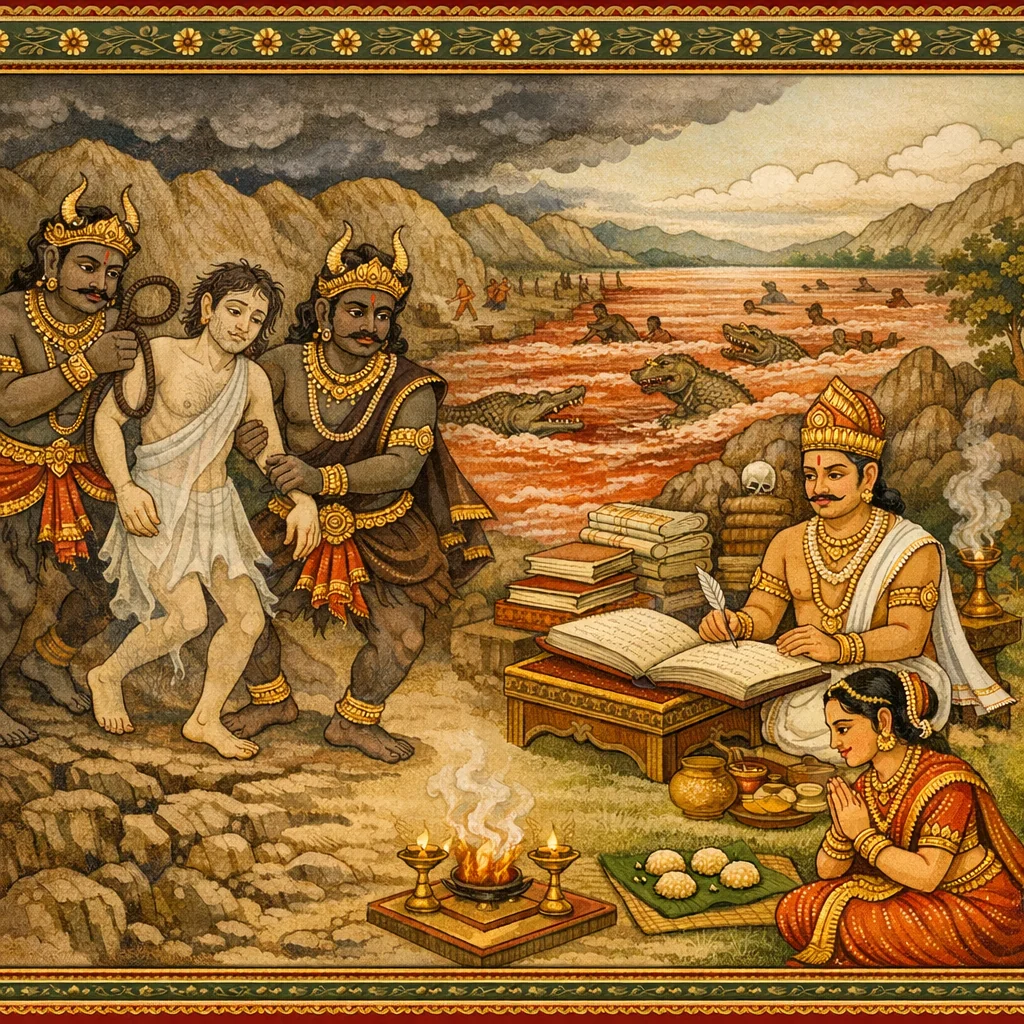
This chapter unfolds as a technical theological dialogue. Atithi asks about bodily characteristics, and Kamaṭha teaches the microcosm–macrocosm doctrine: the human body corresponds to the cosmic tiers from Pātāla up to Satyaloka, so anatomy is presented as a map of the universe. It then lists bodily constituents and measures—seven dhātus (skin, blood, flesh, fat, bone, marrow, semen), counts of bones and nāḍīs, and the chief limbs and internal organs. The discourse proceeds to functional physiology: the principal nāḍīs (suṣumnā, iḍā, piṅgalā), the five vāyus (prāṇa, apāna, samāna, udāna, vyāna) and their karmic roles, the five forms of digestive fire (pācaka, rañjaka, sādhaka, ālocaka, bhrājaka), and soma/kapha aspects (e.g., kledaka, bodhaka, tarpaṇa, śleṣmaka, ālambaka). Digestion is traced as food becomes rasa, then blood and successive tissues, while wastes exit through twelve mala-āśrayas. The chapter then turns to ethics and the after-death passage: the body must be maintained as an instrument for puṇya, and actions ripen according to time, place, and capacity. At death the jīva departs through apertures according to karma, assumes an intermediate (ativāhika) form, is led to Yama’s realm, confronts the Vaitaraṇī river motif and preta-loka conditions. Offerings and śrāddha— including annual completion and sapinḍīkaraṇa—are emphasized as relieving preta status, and the teaching concludes that mixed karma yields mixed destinations (svarga/naraka) in proportion to one’s deeds.
Shlokas
Verse 1
अतिथिरुवाच । साध्वबालमते बाल कमठैतत्त्वयोच्यते । शरीरलक्षणं श्रोतुं पुनरिच्छामि तद्वद
Atithi said: O child Kamaṭha, your teaching on the principles (tattva) is well-suited to a simple mind. I wish again to hear the characteristics of the body; tell me that.
Verse 2
कमठ उवाच । यथैतद्वेद ब्रह्मांडं शरीरं च तथा शृणु । पादमूलं च पातालं प्रपदं च रसातलम्
Kamaṭha said: Hear how this body corresponds to the brahmāṇḍa, the cosmic egg. The soles of the feet are Pātāla, and the forepart of the foot is Rasātala.
Verse 3
तलातलं तथा गुल्फौ जंघे चास्य महातलम् । जानुनी सुतलं चोरू वितलं चातलं कटिम्
Talātala is likewise the ankles; his shanks are Mahātala. The knees are Sutala; the thighs are Vitala; and the hips are Atala.
Verse 4
नाभिं महीतलं प्राहुर्भुवर्लोकमथोदरम् । उरःस्थलं च स्वर्लोकं महर्ग्रीवा मुखं जनम्
They call the navel the Earth-plane; the belly is Bhuvarloka. The chest-region is Svargaloka; the neck is Maharloka; and the face is Janaloka.
Verse 5
नेत्रे तपः सत्यलोकं शीर्षदेशं वदंति च । तद्यथा सप्त द्वीपानि पृथिव्यां संस्थितानि च
They say the eyes are Tapoloka, and the crown of the head is Satyaloka. And just as there are seven continents established upon the earth—
Verse 6
तथात्र धातवः सप्त नामतस्तान्निबोध मे । त्वगसृङ्मांस मेदोऽस्थिमज्जाशुक्राणि धातवः
So too, here are the seven bodily constituents—learn them by name from me: skin, blood, flesh, fat, bone, marrow, and semen are the dhātus.
Verse 7
अस्थ्नामत्र शतानि स्युस्त्रीणि षष्ट्यधिकानि च । त्रिंशच्छतसहस्राणि नाडीनां कथितानि च
Here, the bones are said to be three hundred and sixty in number; and the nāḍīs are described as three hundred thousand.
Verse 8
षट्पंचाशत्सहस्राणि तथान्यानि नवैव तु । ता वहंति रसं देहे जलं नद्यो यथा भुवि
There are fifty-six thousand (channels), and additionally nine more. They carry the body’s vital essence (rasa) within, just as rivers on earth carry water.
Verse 9
सार्धाभिस्तिसृभिश्छन्नं समंताद्रोमकोटिभिः । शरीरं स्थूलसूक्ष्माभिर्दृश्यादृश्या हि ताः स्मृताः
The body is covered on every side by three and a half crores of hairs. These are remembered as two kinds—gross and subtle, visible and invisible.
Verse 10
षडंगानि प्रधानानि कथ्यमानानि मे शृणु । द्वौ बाहू सक्थिनी द्वे च मूर्धा जठरमेव च
Hear from me the six principal limbs as they are described: the two arms, the two thighs, the head, and the belly.
Verse 11
अंत्राण्यत्र तथा त्रीणि सार्धव्यामत्रयाणि च । त्रिव्यामानि तथा स्त्रीणामाहुर्वेदविदो द्विजाः
Here too the intestines are three, measuring three and a half vyāmas; and for women they are said to be three vyāmas—so declare the twice-born who know the Veda.
Verse 12
ऊर्ध्वनालमधोवक्त्रं हृदि पद्मं प्रकीर्त्यते । हृत्पद्मवामतः प्लीहो दक्षिणे स्यात्तथा यकृत्
In the heart there is said to be a lotus—its stalk upward and its mouth turned downward. To the left of the heart-lotus lies the spleen, and on the right likewise the liver.
Verse 13
मज्जातो मेदसश्चैव वसायाश्च तथा द्विज । मूत्रस्य चैव पित्तस्य श्लेष्मणः शकृतस्तथा
O twice-born, (the bodily substances include) marrow, fat, and adipose tissue; and also urine, bile, phlegm, and likewise feces.
Verse 14
रक्तस्य चरमस्यात्र गर्ता द्व्यंजलयः स्मृताः । गेयः प्रवर्तमानास्ते देहं संधारयंत्युत
Here, the cavities that store the final blood are said to measure two añjalis (two handfuls). Flowing onward, they indeed sustain the body.
Verse 15
सीवन्यश्च तथा सप्त पंच मूर्धानमास्थिताः । एका मेढ्रं गता चैका तथा जिह्वां गता द्विज
There are seven sīvanyas (sutural junctions); five are situated in the head. One goes to the penis, and one likewise goes to the tongue, O twice-born.
Verse 16
नाड्यः सर्वाः प्रवर्तंते नाभिपद्मात्तथात्र च । यासां श्रेष्ठा शिरो याता सुषुम्नेडाऽथ पिंगला
All the nāḍīs arise and proceed here from the navel-lotus. Among them, the most excellent that reach the head are Suṣumnā, Iḍā, and Piṅgalā.
Verse 17
नासिकाद्वारमासाद्य संस्थिते देहवर्धने । वायुरग्निश्चंद्रमाश्च पंचधा पंचधात्र च
Reaching the gateway of the nostrils, they remain established for the body’s growth and sustenance. There, too, the vital wind, fire, and the lunar principle each operate in fivefold ways.
Verse 18
प्राणापानसमानाश्च उदानो व्यान एव च । पंच भेदाः स्मृता वायोः कर्मार्ण्येषां वदंति च
Prāṇa, Apāna, Samāna, Udāna, and Vyāna—these are remembered as the five divisions of vāyu, the vital wind; and the functions of each are also taught.
Verse 19
उच्छ्वासश्चैव निःश्वासो ह्यन्नपानप्रवेशनम् । आकंठाच्छीर्षसंस्थास्य प्राणकर्म प्रकीर्तितम्
Exhalation and inhalation, and the intake of food and drink—these are proclaimed as the functions of Prāṇa, whose seat extends from the throat up to the head.
Verse 20
त्यागो विण्मूत्रशुक्राणां गर्भविस्रवणं तथा । अपानकर्म निर्दिष्टं स्थानमस्य गुदोपरि
The expulsion of feces, urine, and semen, and likewise the discharge connected with pregnancy—this is specified as the function of Apāna; its seat is above the anus.
Verse 21
समानो धारयत्यन्नं विवेचयति चाप्यथ । रसयंश्चैव चरति सर्वश्रोणिष्ववारितः
Samāna holds the food within, and then separates and distributes its essence; moving unobstructed through all the channels of the body, it circulates the nutritive sap (rasa).
Verse 22
वाक्प्रवृत्तिप्रदोद्गारे प्रयत्ने सर्वकर्मणाम् । आकंठसुरसंस्थानमुदानस्य प्रकीर्त्यते
Udāna is said to govern the outward activity of speech, belching, and exertion in all actions; its seat is described as reaching up to the throat and the higher, divine region.
Verse 23
व्यानो हृदि स्थितो नित्यं तथा देहचरोपि च । धातुवृद्धिप्रदः स्वेदलालोन्मेषनिमेषकृत्
Vyāna abides ever in the heart and yet moves throughout the body. It promotes the growth of the bodily constituents (dhātu) and produces sweating, salivation, and the opening and closing of the eyes.
Verse 24
पाचको रजकश्चैव साधकालोचकौ तथा । भ्राजकश्च तथा देहे पञ्चधा पावकः स्थितः
Within the body, the inner “fire” (pāvaka) abides in fivefold form: Pācaka, Rañjaka, Sādhaka, Ālocaka, and Bhrājaka.
Verse 25
पाचकस्तु पचत्यन्नं नित्यं पक्वाशये स्थित । आमाशयस्थोऽपि रसं रंजकः कुरुते त्वसृक्
Pācaka, stationed in the intestines, ever digests the food. And Rañjaka, though dwelling in the stomach-region, transforms the nutritive essence (rasa) into blood.
Verse 26
साधको हृदिसंस्थश्च बुद्ध्याद्युत्साहकारकः । आलोचकश्च दृक्संस्थो रूपदर्शनशक्ति कृत
Sādhaka, established in the heart, kindles zeal for intellect and the like. Ālocaka, established in the eye, bestows the power to behold forms.
Verse 27
त्वक्संस्थो भ्राजको देहं भ्राजयेन्निर्मलीकृतः । क्लेदको बोधकश्चैव तर्पणः श्लेष्मणस्तथा
Bhrājaka, seated in the skin, makes the body radiant, purified. Likewise, Kledaka, Bodhaka, and Tarpaṇa are taught as forms of Kapha (śleṣman) as well.
Verse 28
आलंबकस्तथा देहे पंचधा सोम उच्यते । क्लेदकः क्लेदयत्यन्नं नित्यं पक्वाशये स्थितः
In the body, Soma is said to operate in five ways. Kledaka, the moistening principle, ever abiding in the large intestine, continually moistens and softens the food.
Verse 29
बोधको रसनास्थश्च रसानामवबोधकः । शिरःस्थश्चक्षुरादीनां तर्पणात्तर्पणः स्मृतः
The “Bodhaka,” abiding upon the tongue, makes the flavors truly known. And the “Tarpaṇa,” seated in the head, is remembered as that which nourishes the eyes and the other senses through sustaining satisfaction.
Verse 30
सर्वसंधिगतश्चैव श्लेष्मणः श्लेष्मकृत्तथा । उरःस्थः सर्वगात्राणि स वै ह्यालंबकः स्थितः
Pervading all the joints and producing the binding mucus (śleṣman) as well, the “Ālambaka” abides in the chest, supporting and steadying all the limbs of the body.
Verse 31
एवं वाय्वग्निसोमैश्च देहः संधारितस्त्वसौ । आकाशजानि स्रोतांसि तथा कोष्ठविविक्तता
Thus is this body held together by Vāyu, Agni, and Soma. From Ākāśa arise the bodily channels (srotas), and from it too comes the inner spacing and distinctness of the visceral cavities.
Verse 32
पार्थिवानीह जानीहि घ्राणकेशनखानि च । अस्थीनि धैर्यं गुरुता त्वङ्मांस हृदयं गुदम्
Know here the “earthy” constituents: the nose, hair, and nails; the bones, firmness, and heaviness; the skin and flesh; and also the heart and the anus.
Verse 33
नाभिर्मेदो यकृन्मज्जा अंत्रमामाशयः शिरा । स्नायुः पक्वाशयश्चैव प्राहुर्वेदविदो द्विजाः
The navel, fat, liver, marrow, intestines, stomach, and the vessels; the sinews and the large intestine as well—so declare the twice-born knowers of the Veda.
Verse 34
नेत्रयोर्मडलं शुक्लं कफाद्भवति पैतृकम् । कृष्णं च मण्डलं वातात्तथा भवति मातृकम्
In the eyes, the white circle arises from Kapha and is declared to be of paternal origin; the dark circle arises from Vāta and is likewise declared to be of maternal origin.
Verse 35
पक्ष्ममण्डलमेकं तु द्वितीयं चर्ममण्डलम् । शुक्लं तृतीयं कथित चतुर्थं कृष्णमण्डलम्
The first is the circle of the eyelashes; the second is the circle of the skin. The third is spoken of as the white circle, and the fourth as the dark circle.
Verse 36
दृङ्मण्डलं पंचमं तु नेत्रं स्यात्पंचमण्डलम् । अपरे नेत्रभागे द्वे उपांगोऽपांग एव च
The ‘disc of seeing’ (dṛṅ-maṇḍala) is the fifth; thus the eye is said to possess five circles. Others, however, speak of two additional parts of the eye: the upāṅga and the apāṅga.
Verse 37
उपांगो नेत्रपर्यंतो नासा मूलमपांगकः । वृषणौ च तथा प्रोक्तौ मेदोसृक्कफमांसकौ
The upāṅga extends to the edge of the eye; the apāṅga is at the root of the nose. And the two testicles, too, are said to be composed of fat, blood, Kapha, and flesh.
Verse 38
असृङ्मांसमयी जिह्वा सर्वेषामेव देहिनाम् । हस्तयोरोष्ठयोर्मेढ्रे ग्रीवायां षट् च कूर्चकाः
In all embodied beings, the tongue is formed of blood and flesh. And there are six ‘kūrcaka’—clustered, tendinous nodes—situated in the two hands, the lips, the organ of generation, and the neck.
Verse 39
एवमत्र स्थिते जीवो देहेऽस्मिन्सप्तसप्तके । पंचविंशतिको व्याप्य देहं वासोऽस्य मूर्धनि
Thus, in this state, the jīva—the individual soul—abides in this body composed of two sets of seven. Though of the twenty-fivefold principle and pervading the whole body, its seat is in the head.
Verse 40
त्वगसृग्मांसमित्याहुस्त्रिकं मातृसमुद्भवम् । मेदोमज्जास्थिकं प्रोक्तं पितृजं षट्च कौशिकम्
Skin, blood, and flesh—this triad is said to arise from the mother. Fat, marrow, and bone are declared to be from the father; and likewise the sixfold grouping called “kauśika” is spoken of.
Verse 41
एवं भूतमयं देहं पंचभूतसमुद्भवैः । अन्नैर्यथा वृद्धिमेति तदहं वर्णयामि ते
Thus this body, made of the elements, grows by foods that arise from the five great elements. I shall tell you how that increase comes to be.
Verse 42
तदन्नं पिण्डकवलैर्ग्रासैर्भुक्तं च देहिभिः । पूर्वं स्थूलाशये वायुः प्राणः प्रकुरुते द्विधा
That food, eaten by embodied beings in lumps and mouthfuls, first reaches the gross stomach. There the vital air, Prāṇa, acts upon it in a twofold manner.
Verse 43
संप्रविश्यान्नमध्ये तु पृथगन्नपृथग्जलम् । अग्नेरूर्ध्वं जलं स्थाप्य तदन्नं तज्जलोपरि
Entering the mass of food, it separates food from water. Placing the water above the digestive fire, it sets the food above that water.
Verse 44
जलस्याधः स्वयं प्राणः स्थित्वाग्निं धमते शनैः । वायुना धम्यमानोग्निरत्युष्णं कुरुते जलम्
Beneath the water, Prāṇa himself abides and gently fans the digestive fire (Agni). Fanned by the wind, that fire makes the water intensely hot.
Verse 45
तदन्नमुष्णतोयेन समंतात्पच्यते पुनः । द्विधा भवति तत्पक्वं पृथक्किट्टं पृथग्रसम्
That food is then cooked on all sides by the hot water. Once digested, it becomes twofold: separately the waste (kiṭṭa) and separately the nutritive essence (rasa).
Verse 46
मलैर्द्वादशभिः किट्टं भिन्नं देहाद्बहिर्व्रजेत् । कर्णाक्षिनासिकाजिह्वादताः शिश्नं गुदं नखाः
The waste portion, divided into twelve impurities, goes out from the body. These are: the ears, eyes, nose, tongue, teeth, the penis, the anus, and the nails.
Verse 47
रोमकूपाणि चैव स्युर्द्वादशैते मलाश्रयाः । हृत्पद्मप्रतिबद्धाश्च सर्वा नाड्यः समंततः
And the hair-pores too are among these—these twelve are the abodes of impurities. All the nāḍīs (channels), bound to the lotus of the heart, spread throughout on every side.
Verse 48
तासां मुखेषु तं सूक्ष्मं व्यानः स्थापयते रसम् । रसेन तेन ता नाडीः समानः पूरयेत्पुनः
There, within the mouths (openings) of those channels, Vyāna establishes the subtle nutritive essence (rasa). Then, by that rasa, Samāna again fills the nāḍīs, sustaining the body’s inner circulation.
Verse 49
ततः प्रयांति संपूर्णास्ताश्च देहं समंततः । ततः स नाडिमध्यस्थो रञ्जकेनोष्मणा रसः
Thereafter, those channels, fully filled, spread throughout the body on all sides. Then the rasa, situated within the nāḍīs, is acted upon by the coloring heat.
Verse 50
पच्यते पच्यमानस्तु रुधिरत्वं भजेत्पुनः । ततस्त्वग्लोमकेशाश्च मांसं स्नायु शिरास्थि च
As it is cooked (transformed), it again attains the state of blood. From that arise the skin, body-hair and head-hair, and also flesh, sinews, veins, and bones.
Verse 51
नखा मज्जा खवैमल्यं शुक्रवृद्धिः क्रमाद्भवेत् । एवं द्वादशधान्नस्य परिणामः प्रकीर्त्यते
In due order arise nails, marrow, the cleansing of the bodily cavities, and the increase of semen. Thus is proclaimed the twelvefold transformation of food.
Verse 52
एवमेतद्विनिष्पन्नं शरीरं पुण्यहेतवे । यथैव स्यंदनः शुभ्रो भारसंवाहनाय च
Thus this body, once fully formed, is meant to be a cause of merit. Just as a clean, excellent chariot exists for carrying a burden, so too is the body meant for purposeful endeavor.
Verse 53
तैलाभ्यंगादिभिर्यत्नैर्बहुभिः पाल्यते न चेत् । किं कृत्यं साध्यते तेन यदि भारं वहेन्न हि
If a chariot is not maintained with many efforts—such as oiling and the like—what task can be accomplished by it, if it cannot even bear the load?
Verse 54
एवमेतेन देहेन किं कृत्यं भोजनोत्तमैः । वर्धितेन न चेत्पुण्यं कुरुते पशुवच्च तत्
So too, what is the use of nourishing this body with the finest foods, if—even when thus increased—it performs no merit (puṇya) and lives like an animal?
Verse 55
भवंति चात्र श्लोकाः । यस्मिन्काले च देशे च वयसा यादृशेन च । कृतं शुभाशुभं कर्म तत्तथा तेन भुज्यते
And here are verses that sum up the teaching: At whatever time and place, and at whatever age, one performs a good or evil deed—one experiences its fruit in a corresponding way.
Verse 56
तस्मात्सदा शुभं कार्यमविच्छिन्नसुखार्थिभिः । विच्छिद्यंतेऽन्यथा भोगा ग्रीष्मे कुसरितो यथा
Therefore, those who seek unbroken happiness should always do what is good. Otherwise, enjoyments are cut off—like little streams that dry up in summer.
Verse 57
यस्मात्पापेन दुःखानि तीव्राणि सुबहून्यपि । तस्मात्पापं न कर्तव्यमात्मपीडाकरं हि तत्
Because sin brings intense sufferings—many and severe—therefore one should not commit sin; for it is truly self-tormenting.
Verse 58
एवं ते वर्णितः साधो प्रश्नोऽयं शक्तितो मया । यथा संजायते प्राणी यथा शृणु प्रलीयते
Thus, O good one, I have explained this question to you to the best of my ability—how a living being is born; now hear also how it meets dissolution (death).
Verse 59
आयुष्ये कर्मणि क्षीणे संप्राप्ते मरणे नृणाम् । स्वकर्मवशगो देही कृष्यते यमकिंकरैः
When the allotted lifespan and the sustaining karma are exhausted and death arrives, the embodied soul—overpowered by its own deeds—is dragged away by Yama’s servants.
Verse 60
पंचतन्मात्रसहितः समनोबुद्ध्यहंकृतिः । पुण्यपापमयैः पाशैर्बद्धो जीवस्त्यजे द्वपुः
Accompanied by the five subtle elements, together with mind, intellect, and ego-sense, the jīva—bound by the nooses made of merit and sin—abandons the body.
Verse 61
शीर्ष्णश्च सप्तभिश्छिद्रैर्निर्गच्छेत्पुण्यकर्मणाम् । अधश्च पापिनां यांति योगिनां ब्रह्मरंध्रतः
Those of meritorious deeds depart through the seven openings in the head; sinners go downward; but yogins depart through the Brahma-opening (brahmarandhra).
Verse 62
तत्क्षणात्सोऽथ गृह्णाति शारीरं चातिवाहिकम् । अंगुष्ठपर्वमात्रं तु स्वप्राणैरेव निर्मितम्
At that very moment, it then assumes an ‘ativāhika’ (carrying) body—only the size of a thumb-joint—formed solely from its own vital forces.
Verse 63
ततस्तस्मिन्स्थितं जीवं देहे यमभटास्तदा । बद्ध्वा नयंति मार्गेण याम्येनाति यथाबलम्
Then Yama’s guards, finding the jīva established in that body, bind it and lead it along Yama’s path, with force as needed.
Verse 64
तप्तांबरीषतुल्येन अयोगुडनिभेन च । प्रतप्तसिकतेनापि ताम्रपात्रनिभेन च
Along that way he is tormented—like one pressed by a blazing mass of iron, like a lump of heated iron, like scorching sand, and like a copper vessel made red-hot.
Verse 65
षडशीतिसहस्राणि योजनानां महीतलात् । कृष्यमाणो यमपुरीं नीयते पापकृद्भटैः
Dragged from the surface of the earth for eighty-six thousand yojanas, the doer of sin is taken by Yama’s guards to the city of Yama.
Verse 66
क्वचिच्छीतं महादुर्गमन्धकारं क्वचिन्महत् । अग्निसंस्पर्शवदनैः काककाकोलजंबुकैः
In some places it is icy; in some, a vast and impassable darkness—while crows, ravens, and jackals, their mouths like the touch of fire, assail him.
Verse 68
क्वचिच्च भक्ष्यते घोरै राक्षसैः कृष्यतेऽस्यते । दह्यमानोतिघोरेण सैकतेन च नीयते
In some places he is eaten by dreadful rākṣasas; he is dragged and struck; burning upon terrible, scorching sands, he is driven onward.
Verse 69
मुहूतैर्दशभिर्याति तं मार्गमतिदुस्तरम् । तं कालं सुमहद्वेत्ति पुरुषो वर्षसंमितम्
In just ten muhūrtas he is made to traverse that exceedingly difficult road; yet the embodied person experiences that span of time as immensely long, as though it were measured in years.
Verse 70
तार्यते च नदीं घोरां पूयशोणितवाहिनीम् । नदीं वैतरणीं नाम केशशैवलशाद्वलाम्
And he is made to cross a dreadful river that bears pus and blood—the river named Vaitaraṇī—whose banks are tangled with hair and coated with slimy weed and grass.
Verse 71
ततो यमस्य पुरतः स्थाप्यते यमकिंकरैः । पापी महाभयं पश्येत्कालांतकमुखैर्वृतम्
Then Yama’s attendants set him before Yama; the sinner beholds a great terror, surrounded by faces like Time-and-Death itself.
Verse 72
पुण्यकर्मा सौम्यरूपं धर्मराजं तदा किल । मनुष्या एव गच्छंति यमलोकेन चापरे
But the doer of merit, at that time, truly approaches Dharmarāja in his gentle form; and some other beings too pass along the path of Yama’s world—indeed, as human souls.
Verse 73
मरणानंतरं तेषां जंतूनां योनिपूरणम् । तथाहि प्रेता मनुजाः श्रूयंते नान्यजंतवः
After death, for those beings there is the taking of a new womb (rebirth); for it is heard that ‘pretas’ are human beings—other creatures are not spoken of in that way.
Verse 74
धार्मिकः पूज्यते तत्र पापः पाशगलो भवेत् । धार्मिकश्च यथा याति तं मार्गं शृणु वच्मि ते
There the righteous one is honored, while the sinful becomes bound in the noose (pāśa). Now hear from me how the dhārmika travels upon that path.
Verse 75
आरामद्रुमदातारः फलपुष्पवता पथा । छायया च सुखं यांति तथा ये च्छत्रदा नराः
Those who bestow groves and trees proceed upon a path abundant with fruits and flowers, and they journey in ease beneath cooling shade; so too do those who have given umbrellas.
Verse 76
उपानहप्रदा यानैर्वितृषाः पूर्तधर्मिणः । विमानैर्यानदा यांति तथा शय्यासनप्रदाः
Those who give footwear—doers of public merit—travel by conveyances and remain untouched by thirst. Those who give vehicles go by vimānas, celestial cars; likewise do those who give beds and seats.
Verse 77
भक्ष्यभोज्यैस्तथा तृप्ता यांति भोजनदायिन । दीपप्रदाः प्रकाशेन गोप्रदास्तां नदीं सुखम्
Those who give food proceed satisfied, with edibles and meals in abundance. Givers of lamps go with light as their companion; givers of cows cross that river with ease and comfort.
Verse 78
श्रीसूर्यं श्रीमहादेवं भक्ता ये पुरुषोत्तमम् । जन्मप्रभृति ते यांति पूज्यमाना यमानुगैः
Those devotees who are devoted to the glorious Sun, to Śrī Mahādeva, and to the Supreme Person, Puruṣottama—from their very birth they proceed onward, honored even by Yama’s attendants.
Verse 79
महीं गां कांचनं लोहं तिलान्कार्पासमेव च । लवणं सप्तधान्यं च दत्त्वा याति सुखं नरः
A man who gives in charity land, a cow, gold, iron, sesame, cotton, salt, and the seven kinds of grain attains a happy state hereafter.
Verse 80
तेषां तत्र गतानां च पापिनां पुण्यकर्मिणाम् । चित्रगुप्तः प्रेतपाय निरूपयति वै ततः
For those who have gone there—both sinners and doers of merit—Citragupta then indeed determines their course in the realm of the departed.
Verse 81
प्रेतलोके स वसति ततः संवत्सरं नरः । वत्सरेण च तेनास्य शरीरमभिजायते
There the person dwells in the preta-world for a year; and by the completion of that year, a body is formed for him.
Verse 82
सोदकुम्भमथान्नाद्यं बांधवैर्यत्प्रदीयते । दिनेदिने स तद्भुक्त्वा तेन वृद्धिं प्रयाति च
And the water-pot and the food offerings that are given by his relatives—eating them day by day, he grows thereby.
Verse 83
पूर्वदत्तमथान्नाद्यं प्राप्नोति स्वयमेव च । स्वयं येन न दत्तं च तथा दाता न विद्यते
He also receives, of itself, the food and the like that had been given earlier; but for one by whom nothing was given during life, no giver is found.
Verse 84
न चाप्युदकदातासौ क्षुत्तृड्भ्यामतिपीड्यते । बांधवैस्तूदकं दत्तं नदीभूत्वोपतिष्ठति
And one who has been a giver of water is not severely tormented by hunger and thirst; moreover, the water offered by relatives comes to him, becoming as it were a river.
Verse 85
मासिमासि च यच्छ्राद्धं षोडशश्राद्धपूर्वकम् । अत्र न क्रियते यस्य प्रेतत्वात्स न मुच्यते
If, here, the monthly śrāddha—beginning with the sixteen śrāddhas—is not performed for someone, he is not freed from the condition of being a preta.
Verse 86
मानुषेण दिनेनैव प्रेतलोके दिनं स्मृतम् । तस्माद्दिनेदिने देयं प्रेतायान्नं च वत्सरम्
A single human day is reckoned as a day in the preta-world; therefore, day after day, food should be offered to the preta for the span of a year.
Verse 87
तं च स्माशानिकानाम गणा याम्या भयावहाः । शीतवातातपोपेतं तत्र रक्षंति पापिनम्
And there, fearful Yama-like attendants known as the “smāśānikas” keep watch over the sinner, beset by cold, wind, and scorching heat.
Verse 88
यथेह बन्धने कश्चिद्रक्ष्यते विषमैर्नरैः । प्रेतपिंडा न दीयंते षोडशश्राद्धपूर्वकाः
Just as, in this world, one in confinement is kept under guard by harsh men, so too the preta-offerings (piṇḍas)—to be offered beginning with the sixteen śrāddhas—are not given.
Verse 89
यस्य तस्य न मोक्षोऽस्ति प्रेतत्वाद्वै युगैरपि । ततः सपिण्डीकरणे बांधवैः सुकृते नरः
So long as one remains in the state of a preta, there is no liberation for him—even across vast ages. Thereafter, when the kinsmen perform the sapiṇḍīkaraṇa rite with due merit, the departed one is duly benefited.
Verse 90
पूर्णे संवत्सरे देहं संपूर्णं प्रतिपद्यते । पापात्मा घोररूपं तु धार्मिको दिव्यमुत्तमम्
When a full year is completed, the being attains a fully formed body. The sinful-souled assumes a dreadful form, while the righteous, established in Dharma, attains a radiant and excellent one.
Verse 91
ततः स नरकं याति स्वर्गं वा स्वेन कर्मणा । रौरवाद्याश्च नरकाः पातालतलसंस्थिताः
Thereafter, by his own deeds, he goes either to hell or to heaven. The hells beginning with Raurava are situated in the regions of Pātāla.
Verse 92
सुराद्याः सत्यपर्यंताः स्वर्लोकस्योर्ध्वमाश्रिताः । इतिहासपुराणेषु वेदस्मृतिषु यच्छुतम्
The realms beginning with that of the gods and extending up to Satya are situated above Svarga. This is what is heard in the Itihāsas and Purāṇas, and in the Vedas and Smṛtis.
Verse 93
पुण्यं तेन भवेत्स्वर्गो नरकस्तद्विपर्ययात् । तत्रापि कालवसति कर्मणामनुरूपतः
Through merit, heaven results; through the opposite, hell. Even there, one dwells for a duration proportionate to one’s actions.
Verse 94
अर्वाक्सपिंडीकरणं यस्य वर्षाच्च वा कृतम् । प्रेतत्वमपि तस्यापि प्रोक्तं संवत्सरं धुवम्
Even if one’s sapiṇḍīkaraṇa is performed earlier—before the year has passed—still, for him too the state of preta is declared to last certainly for a full year.
Verse 95
यैरिष्टं च त्रिभिर्मेधैरर्चितं वा सुरत्रयम् । प्रेतलोकं न ते यांति तथा ये समरे हताः
Those who have performed three sacrifices, or who have worshipped the triad of gods, do not go to the realm of pretas; nor do those who are slain in battle.
Verse 96
शुद्धेन पुण्येन दिवं च शुद्धां पापेन शुद्धेन तथा तमोंधम् । मिश्रेण स्वर्गं नरकं च याति देहस्तथैवास्य भवेच्च तादृक्
By pure merit one reaches a pure heaven; by pure sin one reaches blinding darkness. By mixed deeds one goes to both heaven and hell, and his embodied condition too becomes correspondingly mixed.
Verse 97
प्रश्नत्रयं चेति तव प्रणीतमुत्पत्तिमृत्यू परलोकवासः । यथा गुरुर्मे समुदाजहार किं भूय इच्छत्युत तद्वदामि
You have thus set forth the three questions—birth, death, and dwelling in the next world. Just as my teacher explained it to me, so I shall tell it; what more do you wish to hear?
Verse 617
मक्षिकादंशमशकैर्भक्ष्यते सर्पवृश्चिकैः । भक्ष्यमाणोऽपि तैर्जंतुः क्रंदते म्रियते न हि
He is eaten by flies, gadflies, and mosquitoes, and by snakes and scorpions. Though being devoured by them, the creature wails, yet does not die.