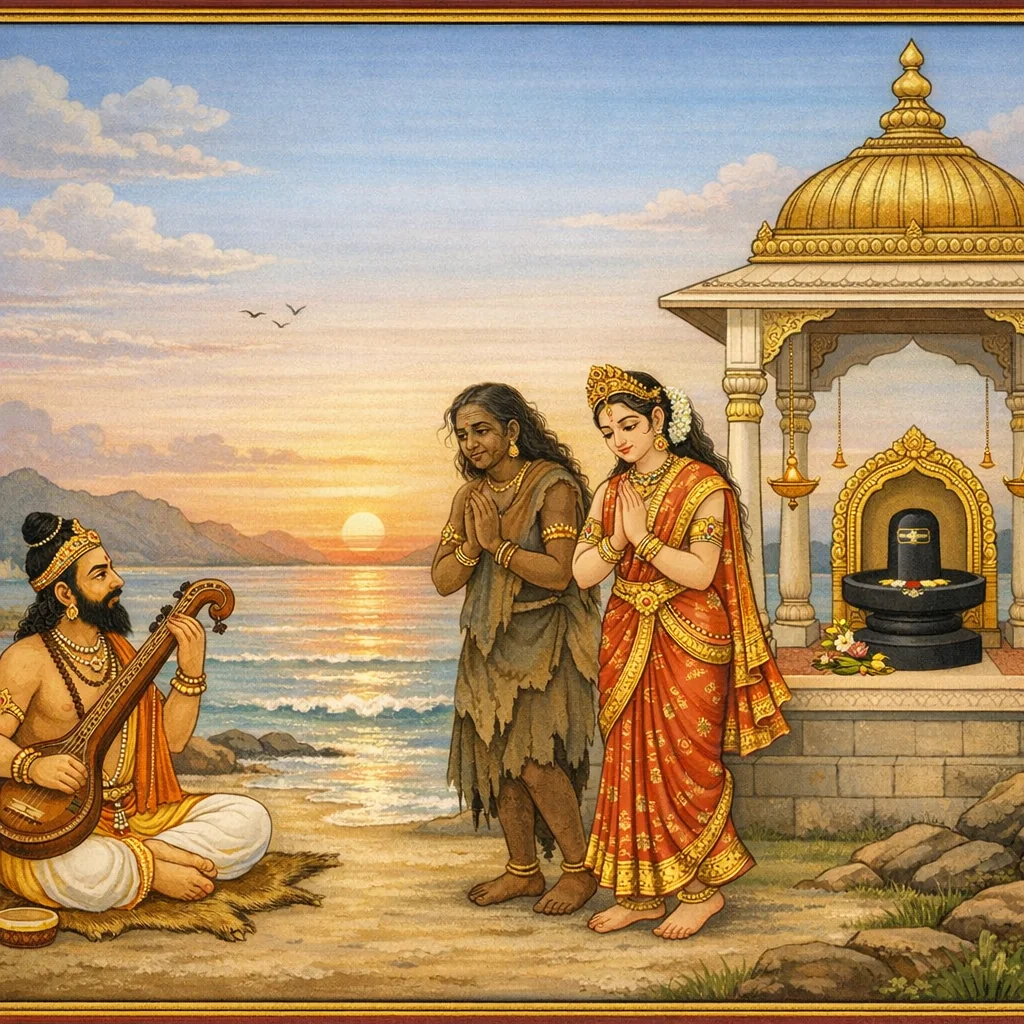
Adhyaya 39
Adhyāya 39 presents a layered teaching on cosmography and the sanctity of tīrthas. Nārada describes the seven Pātālas—Atala through Pātāla—as radiant, beautiful realms inhabited by Dānavas, Daityas, and Nāgas, and introduces a colossal liṅga, Śrīhāṭakeśvara, installed by Brahmā. Beneath these, many Narakas are named, each linked to specific wrongs—false testimony, violence, misuse of intoxicants, breaches of duty toward guru and guest, and other anti-dharma acts—so that karmic consequence becomes moral instruction. The discourse then turns to cosmic structure and time: Kālāgni, Ananta, the directional elephants, and the enclosing kaṭāha (cosmic shell), followed by a technical scale of time from nimeṣa to yuga, manvantara, and kalpa, including named kalpas. It next recounts a local legend at Stambhatīrtha: a dog-headed maiden, Kumārīkā, recalls a past-life cause at the sea–land confluence; through tīrtha rites and tapas she is restored, establishes Barkareśvara, and creates the Svāstika-kūpa well, while the enduring merits of cremation and bone-immersion are explicitly praised. The chapter concludes with a broad mapping of Bhāratakhaṇḍa—its division among descendants, major mountains and river sources, and extensive regional lists with village and port counts—forming a Purāṇic gazetteer woven into sacred geography.
Shlokas
Verse 1
। नारद उवाच । सहस्रसप्तत्युच्छ्राये पातालानि परस्परम् । अतलं वितलं चैव नितलं च रसातलम्
Nārada said: “The Pātālas lie one below another, each at a depth of a thousand and seventy yojanas. They are Atala, Vitala, Nitala, and Rasātala.”
Verse 2
तलातलं च सुतलं पातालं चापि सप्तमम् । कृष्णशुक्लारुणाः पीताः शर्कराशैलकांचनाः
“Further, there are Talātala and Sutala, and Pātāla as the seventh. They are described as dark, white, ruddy, and yellow—resplendent like gravel, mountains, and gold.”
Verse 3
भूमयो यत्र कौरव्य वरप्रासादशोभिताः । तेषु दानवदैतेयनागाश्चैव सहस्रसः
O scion of the Kurus, there are realms there adorned with splendid and excellent palaces; in those regions dwell thousands upon thousands of Dānavas, Daityas, and Nāgas.
Verse 4
स्वर्लोकादपि रम्याणि दृष्टानि बहुशो मया । आह्लादकारिणो नानामण्यो यत्र पन्नगः
Many times have I beheld places more delightful even than Svarga; there the nāgas are adorned with many kinds of jewels, bringing joy and wonder.
Verse 5
दैत्यदानवकन्याभिर्महारूपाभिरन्विते । पाताले कस्य न प्रीतिर्विमुक्तस्यापि जायते
In Pātāla—filled with the magnificently beautiful maidens of the Daityas and Dānavas—whose heart would not feel delight, even if he were otherwise detached from the world?
Verse 6
यत्र नोष्णं न वा शीतं न वर्षं दुःखमेव च । भक्ष्यभोज्यमहाभोगकालो यत्रापि जायते
There is neither heat nor cold, nor rain, nor any suffering; and there arises there as well a time of great enjoyments—foods to be eaten and feasts to be savored.
Verse 7
पाताले सप्तमे चास्ति लिंगं श्रीहाटकेश्वरम् । ब्रह्मणा स्थापितं पार्थ सहस्रयोजनोच्छ्रितम्
And in the seventh Pātāla there is the liṅga called Śrīhāṭakeśvara. O Pārtha, it was established by Brahmā and rises to a height of a thousand yojanas.
Verse 8
हाटकस्य तु लिंगस्य प्रासादो योजनायुतः । सर्वरत्नमयो दिव्यो नानाश्चयविभूषितः
For that Hāṭaka-liṅga there is a temple-palace extending a yojana; it is divine, made of every kind of jewel, and adorned with abundant treasures.
Verse 9
तच्चार्यंति तल्लिंगं नानानागेन्द्रसत्तमाः । तदधस्ताज्जलं भूरि तस्याधो नरकाः स्मृताः
The foremost lords among the Nāgas worship and attend upon that liṅga. Beneath it lies a vast expanse of water; below that, the hells are said to be situated.
Verse 10
पापिनो येषु पात्यंते ताञ्छृणुष्व महामते । कोटयः पंचपंचाशद्राजानश्चैकविंशति
Hear from me, O great-minded one, about those hells into which sinners are cast down—there are fifty-five crores, and twenty-one as the chief divisions among them.
Verse 11
रौरवः शूकरो रोधस्तालो विशसनस्तथा । महाज्वालस्तप्तकुम्भो लवणोथ विमोहकः
Raurava, Śūkara, Rodha, Tāla, and Viśasana; Mahājvāla, Taptakumbha, Lavaṇa, and then Vimohaka—these are among the hells that are named.
Verse 12
रुधिरांधो वैतरणी कृमिशः कृमिभोजनः । असिपत्रवनं कृष्णो लालाभक्ष्यश्च दारुमः
Rudhirāndha, Vaitaraṇī, Kṛmiśa, Kṛmibhojana; Asipatravana, Kṛṣṇa, Lālābhakṣya, and Dāruma—these too are counted among the hells.
Verse 13
तथा पूयवहः पापो वह्निज्वालोऽप्यधःशिराः । संदंशः कृष्णसूत्रश्च तमश्चावीचिरेवच
Likewise, there are the hells called Pūyavaha, Pāpa, Vahnijvāla, and Adhaḥśiras; also Saṃdaṃśa, Kṛṣṇasūtra, Tamaḥ, and Avīci.
Verse 14
श्वभोजनो विसूचिश्चाप्यवीचिश्च तथाऽपरः । कूटसाक्षी रौरवं च रोधं गोविप्ररोधकः
There are also the hells called Śvabhojana, Visūci, and another Avīci. The false witness goes to Raurava; and one who obstructs cows and brāhmaṇas goes to Rodha.
Verse 15
सुरापः सूकरं याति तालं मिथ्याम नुष्यहा । गुरुतल्पी तप्तकुम्भं तप्तलोहं च भक्तहा
A drinker of liquor becomes a pig; a slayer of a human being falls into Tāla; one who violates the teacher’s bed goes to Taptakumbha; and one who kills a devotee goes to Taptaloha.
Verse 16
गुरूणामवमंता यचो महाज्वाले निपात्यते । लवणं शास्त्रहंता च निर्मर्यादो विमोहके
One who dishonours the gurus is cast into Mahājvāla. The destroyer of scripture goes to Lavaṇa; and the boundary-less, lawless person falls into Vimohaka.
Verse 17
कृमिभक्ष्ये देवद्वेष्टा कृमिशे तु दुरिष्टकृत् । पितृदेवात्पूर्वमश्रल्लांलाभक्ष्ये प्रयाति च
A hater of the gods goes to Kṛmibhakṣya; an evil sacrificer goes to Kṛmiśa. And one who eats before the Pitṛs and the Devas are duly offered goes to Lāṃlābhakṣya.
Verse 18
मिथ्याजीवविरोधी विशसने कूटशस्त्रकृत् । अधोमुखे ह्यसद्ग्राही एकाशी पूयवाहके
One who opposes a rightful livelihood goes to Viśasana; the maker of deceitful weapons goes there as well. The follower of falsehood goes to Adhomukha; and one who eats alone goes to Pūyavāhaka.
Verse 19
मार्ज्जारकुक्कुटश्वानपक्षिपोष्टा प्रयाति च । बधिरांधगृहक्षेत्रतृणधान्यादिज्वालकः
One who keeps and fattens cats, cocks, dogs, and birds goes to that very fate. And one who sets fire to the homes or fields of the deaf and the blind—burning grass, grain, and the like—meets dire consequences.
Verse 20
नक्षत्ररंगजीवी च याति वैतरणीं नरः । धनयौवनमत्तो यो धनहा कृष्णमेति सः
A man who lives by astrological shows and spectacles goes to Vaitaraṇī. And one intoxicated with wealth and youth, who destroys wealth, goes to Kṛṣṇa—the dark hell-state.
Verse 21
असिपत्रवनं याति वृक्षच्छेदी वृथैव यत् । कुहकाजीविनः सर्वे वह्निज्वाले पतंति ते
One who cuts down trees without cause goes to Asipatravana. All who live by deceit fall into Vahnijvāla, the blaze of fire.
Verse 22
परस्त्रीं च परान्नं च गच्छन्संदंशमेति च । दिवास्वप्नपरा ये व्रतलोपपराश्च ये
One who pursues another’s wife and another’s food goes to Saṃdaṃśa. Those addicted to sleeping by day, and those devoted to breaking sacred vows (vrata), likewise incur such downfall.
Verse 23
शरीरमदमत्ताश्च यांति चैते श्वभोजनम् । शिवं हरिं न मन्यंते यांत्यवीचिनमेव च
Those intoxicated with pride in the body go to the state called Śvabhojana, ‘dog-eating’. And those who do not acknowledge Śiva and Hari go indeed to Avīci, the abyssal hell.
Verse 24
इत्येवमादिभिः पापैरशास्त्रौघस्य सेवनैः । पतंत्येव महाघोरनरकेषु सहस्रशः
By such sins and the like—by resorting to a flood of practices contrary to the Śāstra—people surely fall, by the thousands, into exceedingly dreadful hells.
Verse 25
तस्माद्य इच्छेदेतेभ्यो विमोक्षं बुद्धिमान्नरः । श्रुतिमार्गेण तेनार्च्यौ देवौ हरिहरावुभौ
Therefore, the wise person who seeks liberation from these (hellish fates) should worship both deities—Hari and Hara—according to the path taught by the Śruti.
Verse 26
नरकाणामधोभागे स्थितः कालाग्निसंज्ञकः । तदधो हट्टकश्चैव अनंतस्तदधः स्मृतः
In the lower region beneath the hells lies a realm known as Kālāgni. Below that is Haṭṭaka, and beneath that is remembered Ananta.
Verse 27
यस्यैतत्सकलं विश्वं मूर्धाग्रे सर्षपायते । इत्यनंतप्रभावात्स ह्यनंत इति कीर्त्यते
For whom this entire universe appears like a mustard-seed upon the tip of his head—because of such boundless power, he is celebrated as ‘Ananta’.
Verse 28
दिशां गजास्तत्र पद्मकुमुदांजनवामनाः । तदधोंऽडकटाहश्च एकवीरास्ति तत्र च
There are the elephants of the directions there—Padma, Kumuda, Añjana, and Vāmana. Below that is the realm called Oṃḍakaṭāha, and there too is (one named) Ekavīra.
Verse 29
चतुर्लक्षसहस्राणि नवतिश्च शतानि च । एतनैव प्रमाणेन उदकं च ततः स्मृतम्
Four hundred thousand, and ninety hundreds as well—by this very measure, the extent of the water there is also declared.
Verse 30
तदधो नरकाः कोट्यो द्विकोट्योऽग्निस्ततो महान् । चत्वारिंशत्सहस्रैश्च तदधस्तम उच्यते
Below that are crores of hells; below them is a great fire of two crores. And below that, by forty thousand more, is what is called ‘Tamas’—darkness.
Verse 31
चत्वारिंश्च्चकोट्यस्तु चतस्रश्च ततः पराः । एकोननवतिर्लक्षाः सहस्राशीतिरेव च
Forty crores indeed, and four more beyond that; then eighty-nine lakhs, and eighty thousand as well.
Verse 32
तदधोंऽडकटाहोथ कोटिमात्रस्तथापरः । देवी युक्ता कपालीशा दंडहस्तेन चापि सा
Below that is Oṃḍakaṭāha, measured as a crore, and another layer beyond. There abides a Goddess—Kapālīśā—also holding a staff in her hand.
Verse 33
देवीनां कोटिकोटीभिः संवृता तत्र पालिनी । संकर्षणस्य निःश्वासप्रेरितो दाहकोऽनलः
There the protecting Goddess stands, surrounded by crores upon crores of goddesses. And the burning fire—impelled by the exhalation of Saṅkarṣaṇa—moves forth as the consuming flame.
Verse 34
कालाग्निं प्रेरयत्येव कल्पांते दह्यते जगत् । एवंविधमधःसूत्रं निर्मितं चात्र भारत
Indeed, he sets the Fire of Time in motion; at the end of a kalpa the world is burned. Thus, O Bhārata, such is the lower “cord” (supporting structure) that has been fashioned here.
Verse 35
मध्यसूत्रे कटाहे च पालकांस्ताञ्छृणुष्व मे । वसुधामा स्थितः पूर्वे शंखपालश्च दक्षिणे
Hear from me about the guardians stationed at the central cord and at the cosmic cauldron: Vasudhāmā is placed in the East, and Śaṅkhapāla in the South.
Verse 36
तक्षकेशः स्थितः पश्चादुत्तरे केतुमानिति । हरसिद्धिः सुपर्णाक्षी भास्करा योगनंदिनी
Takṣakeśa is stationed in the West, and Ketumān in the North. Likewise are present Harasiddhi, Suparṇākṣī, Bhāskarā, and Yoganandinī.
Verse 37
कोटिकोटी युता देवी देवीनां पालयत्यदः । एवमेतन्महाश्चर्यं ब्रह्मांडं स्थापितं च यैः
A Goddess attended by crores upon crores of goddesses protects this realm below. Thus, by those divine powers, this wondrous cosmic egg has been established.
Verse 38
नमामि तानहं नित्यं ब्रह्मविष्णुमहेश्वरान् । विष्णुलोको रुद्रलोको बहिश्चास्मात्प्रकीर्त्यते
I ever bow to them—Brahmā, Viṣṇu, and Maheśvara. Beyond this cosmic enclosure, the realms called Viṣṇuloka and Rudraloka are spoken of.
Verse 39
तं च वर्णयितुं ब्रह्मा शक्तो नैवास्मदादयः । विमुक्ता यत्र संयांति नित्यं हरिहरव्रताः
Even Brahmā is not able to describe that realm—nor are beings such as ourselves. There, the liberated ever attain, those who are perpetually vowed to Hari and Hara.
Verse 40
ब्रह्मांडं संवृतं ह्येतत्कटाहेन समंततः । कपित्थस्य यथा बीजं कटाहेन सुसंवृतम्
This cosmic egg is indeed enclosed on all sides by the cauldron-like shell—just as the seed of the wood-apple (kapittha) is tightly enclosed by its hard covering.
Verse 41
दशोत्तरेण पयसा वृतं तच्चापि तेजसा । तेजश्च वायुना वायुर्नभ साहंतया च तत्
That enclosure is covered by water tenfold beyond it, and that again by fire (tejas). Fire is enveloped by wind, and wind by space—each exceeding the former by a tenfold measure.
Verse 42
अहंकारश्च महता तं चापि प्रकृतिः परा । दशोत्तराणि सर्वाणि षडाहुः सप्तमं च तत्
Ego (ahaṃkāra) is enveloped by the Great Principle (mahat), and that again by the supreme Prakṛti. These are all tenfold in measure; they say there are six such coverings, and that Prakṛti is the seventh.
Verse 43
प्राकृतं चरणं पार्थ तदनंतं प्रकीर्तितम् । अंडानां तु सहस्राणां सहस्राण्ययुतानि च
O Pārtha, that ‘natural quarter’ is proclaimed to be endless—comprising thousands upon thousands, and tens of thousands, of cosmic eggs (universes).
Verse 44
ईदृशानां तथा चात्र कोटिकोटिशतानि च । सर्वाण्येवंविधान्येव यादृशं कीर्तितंत्विदम्
And here there are hundreds of crores upon hundreds of crores of such world-systems; all are of this very kind, just as this one has been described.
Verse 45
यस्यैवं वैभवं पार्थ तं नमामी सदाशिवम् । अहो मंदः स पापात्मा को वा तस्मादचेतनः
O Pārtha, I bow to Sadāśiva whose majesty is such. Alas—dull and sinful is the one who does not awaken to Him; who could be more insentient than that?
Verse 46
य एवंविधसंमोहतारकं न शिवं भजेत् । अथ ते कीर्थयिष्यामि कालमानं निबोध तत्
Who would not worship Śiva, the deliverer from delusion of this kind? Now I shall declare to you the measure of time—understand it well.
Verse 47
काष्ठा निमेषा दश पंच चाहुस्त्रिंशच्च काष्ठा गणयेत्कला हि । त्रिंशत्कलाश्चापि भवेन्मुहुर्त्तं तत्त्रिंशता रात्र्यहनी उभे च
They say fifteen nimeṣas make one kāṣṭhā; and thirty kāṣṭhās are counted as one kalā. Thirty kalās make a muhūrta; and by thirty muhūrtas are constituted both day and night.
Verse 48
दिवसे पंच कालाः स्युस्त्रिमुहूर्ताः श्रृणुष्व तान् । प्रातस्ततः संगवश्च मध्याह्नश्चापराह्णकः
In a day there are five periods, each of three muhūrtas—listen to them: morning, then saṃgava (forenoon), midday, and aparāhṇa (afternoon).
Verse 49
सायाह्नः पंचमश्चापि मुहूर्ता दश पंच च । अहोरात्राः पंचदश पक्ष इत्यभिधीयते
The fifth period is sāyāhna, the sacred evening; and a day is made of fifteen muhūrtas. Fifteen day-nights are called a pakṣa, a fortnight.
Verse 50
मासः पक्षद्वयेनोक्तो द्वौ मासौ चार्कजावृतुः । ऋतुत्रयं चाप्ययनं द्वेयने वर्षमुच्यते
A month is said to be made of two pakṣas; two months form a season (ṛtu). Three seasons make an ayana, a half-year; and two ayanas are called a year.
Verse 51
चतुर्भेदं मासमाहुः पंचभेदं च वत्सरम् । संवत्सरस्तु प्रथमो द्वितीयः परिवत्सरः
They declare the month to have four divisions, and the year to have five. The first is called Saṃvatsara; the second, Parivatsara.
Verse 52
इद्वत्सरस्तृतीयोऽसौ चतुर्थश्चानुवत्सरः । पंचमश्च युगोनाम गणनानिश्चयो हि सः
The third is Idvatsara; the fourth is Anuvatsara. The fifth is called Yuga—this is the settled rule for sacred reckoning.
Verse 53
मासेन च मनुष्याणामहोरात्रं च पैतृकम् । कृष्णपक्षस्त्वहः प्रोक्तः शुक्लपक्षश्च शर्वरी
For humans, a month is a single day-and-night (ahorātra) for the Pitṛs, the ancestral beings: the kṛṣṇa-pakṣa, the dark fortnight, is said to be their day, and the śukla-pakṣa, the bright fortnight, their night.
Verse 54
मानुषेण च वर्षेण दैविको दिवसः स्मृतः । अहस्तत्रो दगयनं रात्रिः स्याद्दक्षिणायनम्
A human year is remembered as a single day of the gods. In that divine day, uttarāyaṇa (the northern course) is their daytime, and dakṣiṇāyana (the southern course) is their night.
Verse 55
वर्षेण चैव देवानां मतः सप्तर्षिवासरः । सप्तर्षीणां च वर्षेण ध्रौवश्च दिवसः स्मृतः
By the measure of a year, the ‘day’ of the gods is understood as the day of the Seven Sages (Saptarṣis). And by the measure of a year of the Saptarṣis, the day of Dhruva is remembered.
Verse 56
मनुष्याणां च वर्षाणि लक्षासप्तदशैव तु । अष्टाविंशतिसहस्राणि कृतं त्रेतायुगं ततः
In human years, seventeen lakhs and twenty-eight thousand make up the Kṛta (Satya) age; after that comes the Tretā-yuga.
Verse 57
लक्षद्वादशसाहस्रषण्नवत्यधिकाः पराः । अष्टौ लक्षाश्चतुःषष्टिसहस्राणि च द्वापरः
The Tretā age is said to be twelve lakhs, ninety-six thousand, and an additional thousand years; and the Dvāpara age is eight lakhs and sixty-four thousand years (in human measure).
Verse 58
चतुर्लक्षं तु द्वात्रिंशत्सहस्राणि कलिः स्मृतः । चतुर्भिरेतैर्देवानां युगामित्यभिधीयते
Kali is remembered as four lakhs and thirty-two thousand human years. By these four ages taken together, the ‘yuga’ of the gods is thus spoken of.
Verse 59
आयुर्मनोर्युगानां च साधिका ह्येकसप्ततिः । चतुर्दशमनूनां च कालेन ब्रह्मणो दिनम्
The span of the yugas in Manu’s age is seventy-one (with an additional portion). And by the measure of fourteen Manus, the “day of Brahmā” is reckoned.
Verse 60
युगानां च सहस्रेण स च कल्पः श्रृणुष्व तान् । भवोद्भवस्तपभव्य ऋतुर्वह्निर्वराहकः
A thousand sets of yugas make a kalpa—listen to their names: Bhavodbhava, Tapobhavya, Ṛtu, Vahni, and Varāhaka.
Verse 61
सावित्र आसिकश्चापि गांधारः कुशिकस्तथा । ऋषभश्च तथा खड्गो गांधारीयश्च मध्यमः
Also named are: Sāvitra, Āsika, Gāndhāra, Kuśika; likewise Ṛṣabha, Khaḍga, Gāndhārīya, and Madhyama.
Verse 62
वैराजश्च निषादश्च मेघवाहनपंचमौ । चित्रको ज्ञान आकूतिर्मोनो दंशश्च बृंहकः
Vairāja and Niṣāda are also named, with Meghavāhana as the fifth; then come Citraka, Jñāna, Ākūti, Mono, Daṃśa, and Bṛṃhaka.
Verse 63
श्वेतो लोहितरक्तौ च पीतवासाः शिवः प्रभुः । सर्वरूपश्च मासोऽयमेवं वर्षशतावधिः
Lord Śiva, the sovereign Master, manifests as white, as ruddy-red, and as one clad in yellow garments. This month is of every form; thus it extends through a hundred years (by divine measure).
Verse 64
पूर्वार्धमपरार्धं च ब्रह्ममानमिदं स्मृतम् । विष्णोश्च शंकरस्यापि नाहं शक्तश्च वर्णने
The earlier half and the latter half—this is remembered as the measure of Brahmā (brahma-māna). Even of Viṣṇu and of Śaṅkara, I am not able to describe fully their measure and glory.
Verse 65
क्वाहमल्पमतिः पार्थ क्वापरौ हरित्र्यंबकौ । देविकेनैव मानेन पातालेष्वपि गण्यते
Where am I—of little understanding, O Pārtha—and where are those two, Hari and Tryambaka? Only by the Goddess’s own measure is it reckoned, even in the nether realms of Pātāla.
Verse 66
इति ते सूचितं बुद्ध्या श्रृणु तत्प्राकृतं पुनः
Thus it has been indicated to you with understanding; now hear again what is ordinary—the more common account.
Verse 67
इति वैधात्रव्यवस्थितिः । श्रीनारद उवाच । ऋषभोनाम यन्नाम्ना नानापाषंड कल्पनाः । कलौ पार्थ भविष्यंति लोकानां मोहनात्मिकाः
Thus stands the ordinance established by the Creator (Vaidhātṛ). Śrī Nārada said: “O Pārtha, in Kali-yuga there will arise—under the name ‘Ṛṣabha’—many fabricated heretical systems, delusive in nature, that bewilder the people.”
Verse 68
तस्य पुत्रस्तु भरतः शतश्रृंगस्तु तत्सुतः । तस्य पुत्राष्टकं जातं तथैकाच कुमारिका
His son was Bharata, and Bharata’s son was Śataśṛṅga. To him were born eight sons, and likewise one daughter.
Verse 69
इंद्रद्वीपः कसेरुश्च ताम्रद्वीपो गभस्तिमान् । नागः सौम्यश्च गांधर्वो वरुणश्च कुमारिका
They were Indradvīpa, Kaseru, Tāmradvīpa, Gabhastimān, Nāga, Saumya, Gāndharva, and Varuṇa—and also the maiden (their sister).
Verse 70
वदनं चापि कन्यायाः पार्थ बर्करिकाकृति । श्रृणु तत्कारणं सर्वं महाश्चर्यसमन्वितम्
And the maiden’s face too, O Pārtha, was shaped like a barkarī. Hear the entire cause of that, filled with great wonder.
Verse 71
महीसागरपर्यंतं वृक्षराजिविराजिते । जालीगुल्मलताकीर्णे स्तंभतीर्थस्य संनिधौ
Stretching from the land to the sea, resplendent with rows of trees, thick with jālī plants, shrubs, and creepers—near the sacred ford called Staṃbha-tīrtha.
Verse 72
अजासमजतो मध्यात्काचिदेका च बर्करी । भ्रांता सती समायाता प्रदेशे तत्र दुश्चरे
From the midst of a herd of goats there came a certain lone barkarī; wandering astray, she arrived in that difficult region.
Verse 73
इतस्ततो भ्रमंति सा जालिमध्ये समंततः । निर्गंतुं नैव शक्नोति क्षुत्पिपासार्दिता शुभा
Wandering here and there on every side within the snare, that auspicious woman could not find any way out, tormented by hunger and thirst.
Verse 74
विलग्ना जालिमध्ये तु ततः पंचत्वमागता । कालेन कियता तस्य त्रुटित्वा शिरसो ह्यधः
Entangled in the snare, she then met her end. After some time, her head broke off and fell downward.
Verse 75
पपात शनिदर्शे च महीसागरसंगमे । सर्वतीर्थमये तत्र सर्वपापप्रमोचने
It fell at Śanidarśa, at the confluence of the Mahī River and the ocean—there, a place that embodies all tīrthas and releases one from every sin.
Verse 76
शिरस्तु तदवस्थं हि समग्रं तत्र संस्थितम् । जालिगुल्मावलग्नं च तस्या नैवापतज्जले
But her head, in that same condition and intact, remained there. Caught in a thicket of nets and shrubs, it did not fall into the water.
Verse 77
शेषकायप्रपातेन महीसागरसंगमे । तत्तीर्थस्य प्रभावेन बर्करीसा कुरूद्वह
When the rest of her body fell at the Mahī–ocean confluence, by the power of that tīrtha, O best of Kurus, she became Barkarīsā.
Verse 78
शकश्रृंगस्य वै राज्ञः सिंहलेष्वभवत्सुता । मुखं बर्करिकातुल्यं व्यक्तं तस्या व्यजायत
In Siṃhala, to King Śakaśṛṅga, a daughter was born; and her face clearly appeared like that of a barkarī (a she-goat).
Verse 79
दिव्यनारी शुभाकारा शेषकाये बभौ शुभा । पूर्वं तस्याप्यपुत्रस्य राज्ञः पुत्रशतोपमा
Her remaining body became a radiant, auspicious celestial woman. Formerly, for that king who had been without a son, she was in worth like a hundred sons.
Verse 80
पुत्री जाता प्रमोदेन स्वजनानंदवर्धिनी । ततस्तस्या विलोक्याथ मुखं वर्करिकाकृति
A daughter was born in gladness, increasing the joy of her kin and the people. Yet when they looked upon her, they saw her face bore the form of a she-goat.
Verse 81
विस्मयं समनुप्राप्ताः सर्वे ते राजपूरुषाः । विषादं परमापन्नो राजा सांतःपुरस्तदा
All the king’s men were struck with astonishment. The king, together with his inner household, then fell into deep sorrow.
Verse 82
खिन्नाः प्रकृतयः सर्वास्तादृग्रूपविलोकनात् । तत्किमित्येतदाश्चर्यमूचुः पौराः सुविस्मिताः
All the subjects were dismayed on seeing such a form. Greatly astonished, the townspeople said, “What is this wonder—and why has it happened?”
Verse 83
ततः सा यौवनं प्राप्ता साक्षाद्देवसुतोपमा । स्वमुखं दर्पणे वीक्ष्यस्मृतः पूर्वो भवस्तया
Then she attained youth, resembling a divine maiden. Seeing her own face in a mirror, she remembered her former existence.
Verse 84
तत्तीर्थस्य प्रभावेण मातृपित्रोर्निवेदितम् । विषादो नैव कर्तव्यो मदर्थे तात निश्चितम्
By the power of that sacred ford, she informed her mother and father: “Father, surely no grief should be indulged on my account.”
Verse 85
मा शोकं कुरु मे मातः पूर्वजन्मार्जितं फलम् । ततः पूर्वं स्ववृत्तांतमुक्त्वा सा च कुमारिका
“Mother, do not grieve; this is the fruit earned in a former birth.” Then the maiden related the earlier account of her own story.
Verse 86
पूर्वजन्मोद्भवः कायस्यस्या यत्रापतत्तथा । गमनाय तमुद्देशं विज्ञप्तौ पितरौ तया
She informed her parents of the very place where her body, arising from her former birth, had fallen—and requested to go to that region.
Verse 87
अहं तात गमिष्यामि महीसागरसंगमम् । भवामि तत्र संप्राप्ता यथा कुरु तथा नृप
“Father, I shall go to the confluence of the land and the ocean. When I reach there, O king, do as you think proper.”
Verse 88
ततः पित्रा प्रतिज्ञातं शतश्रृंगेण तत्तथा । तस्याः संवाहनं चक्रे राजा पोतैः सरत्नकैः
Then her father pledged to do so, in the manner promised by Śataśṛṅga. The king arranged her transport in boats adorned with treasures.
Verse 89
स्तंभतीर्थं ततः साऽपि प्राप्य पोतार्यसंयुता । भूरिदानं ततश्चक्रे दानं सर्वस्वलक्षणम्
Thereafter she too reached Staṃbha-tīrtha, accompanied by the boatmen. Then she performed abundant charity—giving in a manner that bore the mark of offering one’s all.
Verse 90
जालिगुल्मांतरेऽन्विष्य ततो दृष्टं निजं शिरः । अस्थिचर्मावशेषं च तदादाय प्रयत्नतः
Searching amid thickets and shrubs, she then saw her own head, and the remaining bones and skin; taking them up carefully, with effort,
Verse 91
दग्ध्वा संगमसांनिध्ये क्षिप्तान्यस्थीनि संगमे । ततस्तीर्थप्रभावेण मुखं जातं शशिप्रभम्
Having cremated them near the confluence and cast the bones into the saṅgama, then—by the power of that tīrtha—her face became radiant like the moon.
Verse 92
न तादृग्देवकन्यानां न तादृङनागयोषिताम् । न तादृङमर्त्यनारीणां तस्या यादृङमुखं मुखम्
Such a face was not found among celestial maidens, nor among nāga-women, nor among mortal women—like hers, such was her face.
Verse 93
सुरासुरनराः सर्वे तस्या रूपेण मोहिताः । बहुधा प्रार्थयंत्येनां न सा वरमभीप्सति
Gods, demons, and men alike were enchanted by her beauty. Many times they pleaded with her, yet she did not desire any boon from them.
Verse 94
कष्टं तया मुदा तत्र प्रारब्धं दुश्चरं तपः । ततः संवत्सरे पूर्णे देवदेवो महेश्वरः
There, with joy, she began a severe and arduous austerity. When a full year was completed, Maheśvara—the God of gods—appeared.
Verse 95
प्रत्यक्षतां गतस्तस्यै वरदोऽस्मीति चाब्रवीत् । ततस्तं पूजयित्वा च कुमारी वाक्यमब्रवीत्
He became manifest before her and said, “I am the giver of boons.” Then Kumārī, having worshipped him, spoke these words.
Verse 96
यदि तुष्टोऽसि देवेश यदि देयो वरो मम । सांनिध्यं क्रियतामत्र सर्वकालं हि शंकर
“If you are pleased, O Lord of gods, and if a boon is to be granted to me—then, O Śaṅkara, establish your abiding presence here for all time.”
Verse 97
एवमस्त्विति शर्वेण प्रोक्ते हृष्टा कुमारिका । यत्र दग्धं शिरस्तस्या बर्कर्याः कुरुसत्तम
When Śarva said, “So be it,” Kumārī rejoiced. O best of the Kurus, this took place where the head of that Barkarī was burned.
Verse 98
बर्करेशः शिवस्तत्र तया संस्थापितस्तदा । मन्मुखान्महादाश्चर्यं श्रुत्वेदं च तलातलात्
There, at that time, she स्थापित Śiva as Barkareśa. And this great wonder, heard from my own mouth, became known even down to Talātala, the nether regions.
Verse 99
स्वस्तिकोनाम नागेंद्रः कुमारीं द्रष्टुमागतः । शिरसा गच्छता तेन यत्रोत्क्षिप्ता च भूरभूत्
A serpent-king named Svastika came to behold Kumārī. As he moved, bearing his head, the earth rose up at the very spot where it was lifted.
Verse 100
ईशाने बर्करेशस्य कूपोऽभूत्स्वस्तिकाभिधः । पूरितो गंगया पार्थसर्वतीर्थफलप्रदः
To the northeast of Barkareśa there arose a well called Svastikā. Filled with the waters of the Gaṅgā, O Pārtha, it bestows the fruits of all sacred bathing-places.
Verse 101
दृष्ट्वा च स्थापितं लिंगं शिवस्तुष्टो वरं ददौ । येषां मृतशरीराणामत्र दाहः प्रजायते
Seeing the liṅga duly established, Śiva, well pleased, granted a boon: for those whose mortal remains are cremated here, a special spiritual fruit is attained.
Verse 102
क्षिप्यंतेब्धौ तथा स्थीनि तेषां स्यादक्षया गतिः । ते स्वर्गे सुचिरं कालं वसित्वात्र समागताः
And when their bones are cast into the sea, their onward course becomes imperishable. Having dwelt in heaven for a very long time, they return again and come to auspicious states.
Verse 103
राजानः सर्वसंपूर्णाः सप्रतापा भवंति ते । बर्करेशं च यो भक्त्या संपूजयति मानवः
Those kings become wholly prosperous and radiant with might. Likewise, any person who worships Barkareśa with devotion attains such fullness and splendor.
Verse 104
स्नात्वार्णवमहीतोये तस्य स्यान्मनसेप्सितम् । कार्तिके च चतुर्द्देश्यां कृष्णायां श्रद्धयान्वितः
After bathing in the ocean’s waters and in the earth’s sacred waters, the heart’s desired aim is fulfilled—especially in the month of Kārttika, on the fourteenth day of the dark fortnight, when one acts endowed with faith.
Verse 105
कूपे स्नानं नरः कृत्वा संतर्प्य च पितॄन्निजान् । पूजयेद्बर्करेशं यः सर्पपापैः स मुच्यते
Having bathed in the well and satisfied his own Pitṛs, the ancestors, with offerings, the man who worships Barkareśa is released from sins connected with serpents.
Verse 106
एवं लब्ध्वा वरान्सर्वान्सा पुनः सिंहलं ययौ । शतश्रृङ्गाय पित्रे च वृत्तांतं स्वं न्यवेदयत्
Thus, having obtained all the boons, she returned again to Siṃhala and reported her entire account to her father Śataśṛṅga.
Verse 107
तच्छ्रुत्वा विस्मितो राजा लोकाः सर्वे च फाल्गुन । प्रशशंसुर्महीतीर्थमाजग्मुश्च कृतादराः
Hearing that, the king was astonished, and all the people as well, O Phālguna; they praised the Mahītīrtha and, with reverence, came there.
Verse 108
स्नात्वा दत्त्वा च दानानि विविधानि च ते ततः । सिंहलं च ययुर्भूयस्तीर्थमाहात्म्यहर्षिताः
After bathing and giving many kinds of gifts, they then returned again to Siṃhala, delighted by the greatness of the tīrtha.
Verse 109
अनिच्छंत्यां कुमार्यां च वरं द्रव्यं च पार्थिवः । तथान्यदपि प्रीत्यासौ यद्ददौ नृपतिः श्रृणु
Though the maiden did not desire it, the king granted her a boon and wealth; and, out of affection, he bestowed other gifts as well—hear what that ruler gave.
Verse 110
इदं भारतखंडं च नवधैव विभज्य सः । ददावष्टौ स्वपुत्राणां कुमार्यै नवमं तथा
Dividing this Bhārata-khaṇḍa into nine parts, he gave eight to his own sons, and likewise the ninth to the maiden.
Verse 111
तेषां विभेदान्वक्ष्यामि पर्वतैरुपशोभितान् । पुत्रनामानि वर्षाणि पर्वतांश्च श्रृणुष्व मे
I shall describe their divisions, adorned with mountains; listen to me as I tell the names of the sons, the regions (varṣas), and the mountains.
Verse 112
महेन्द्रो मलयः सह्यः शुक्तिमानृक्षपर्वतः । विंध्यश्च पारियात्रश्च सप्तात्र कुलपर्वताः
Mahendra, Malaya, Sahya, Śuktimān, Ṛkṣaparvata, Vindhya, and Pāriyātra—these are the seven clan-mountains (kulaparvatas).
Verse 113
महेन्द्रपरतश्चैव इन्द्रद्वीपो निगद्यते । पारियात्रस्य चैवार्वाक्खण्डं कौमारिकं स्मृतम्
To the west of the Mahendra mountain lies what is known as Indradvīpa. And the tract lying to the north of the Pāriyātra range is remembered as the Kaumārikā Khaṇḍa.
Verse 114
सहस्रमेकमेकं च सर्वखण्डान्यमूनि च । नदीनां संभवं चापि संक्षेपाच्छृणु फाल्गुन
Hear briefly, O Phālguna, of all these regions in their entirety—one thousand and one—and also of the origins of the rivers.
Verse 115
वेदस्मृतिमुखा नद्यः पारियात्रोद्भवा मताः । नर्मदासरसाद्याश्च नद्यो विंध्याद्विनिर्गताः
The rivers Vedasmṛti and Mukhā are held to arise from the Pāriyātra range. And rivers such as the Narmadā and the Sarasā are said to flow forth from the Vindhya.
Verse 116
शतद्रूचन्द्रभागाद्या ऋक्षपर्वतसंभवाः । ऋषिकुल्याकुमार्याद्याः शुक्तिमत्पादसंभवाः
Rivers such as the Śatadrū and the Candrabhāgā arise from the Ṛkṣa mountain. And rivers such as Ṛṣikulyā and Kumārī arise from the foothills of Śuktimat.
Verse 117
तापी पयोष्णी निर्विध्या कावेरी च महीनदी । कृष्णा वेणी भीमरथी सह्यपादोद्भवाः स्मृताः
The Tāpī, Payoṣṇī, Nirvindhyā, Kāverī, and the Mahī river—as well as the Kṛṣṇā, Veṇī, and Bhīmarathī—are remembered as arising from the foothills of the Sahya mountains.
Verse 118
कृतमालाताम्रपर्णीप्रमुखा मलयोद्भवाः । त्रिसामऋष्यकुल्याद्या महेन्द्रप्रभवाः स्मृताः
Rivers headed by the Kṛtamālā and the Tāmraparṇī arise from the Malaya mountains. And rivers such as the Trisāmā and Ṛṣyakulyā are remembered as originating from Mahendra.
Verse 119
एवं विभज्य पुत्रेभ्यः कुमार्यै च महीपतिः । शतशृंगो गिरं गत्वा उदीच्यां तप्तवांस्तपः
Thus, having apportioned the realms to his sons and also to Kumārī, the lord of the earth—King Śataśṛṅga—went to a mountain in the northern quarter and performed austerity.
Verse 120
तत्र तप्त्वा तपो घोरं ब्रह्मलोकं जगाम सः । शतश्रृंगो नृपश्रेष्ठः शतश्रृंगे नगोत्तमे
There, having performed fierce austerity, he attained Brahmaloka. That foremost of kings, Śataśṛṅga, did so upon Śataśṛṅga—an excellent mountain.
Verse 121
यत्र जातोऽसि कौतेय पांडोस्त्वं सोदरैः सह । कुमारी च महाभागा स्तंभतीर्थस्थिता सती
O son of Kuntī, where you were born—along with your brothers, as the son of Pāṇḍu—there also the most fortunate Kumārī, the virtuous one, abides at Stambhatīrtha.
Verse 122
खंडोद्भवेन द्रव्येण तेपे दानानि यच्छती । ततः केनापि कालेन भ्रातृभ्योऽष्टभ्य एव च
Using wealth produced from her allotted portion, she cultivated merit by bestowing gifts. Then, at some later time, she gave to her eight brothers as well.
Verse 123
महावीर्यबलोत्साहा जाता नव नवात्मजाः । ते समेत्य समागम्य कुमारीं प्रोचिरे ततः
Mighty in valor, strength, and zeal, new sons were born again and again. Gathering together and assembling, they then addressed the Goddess Kumārī.
Verse 124
कुलदेवी त्वमस्माकं प्रसादं कुरु नः शुभे । अष्टौ खण्डानि चास्माकं विभज्य स्वयमेव च । देही द्वासप्ततीनां नो विभेदः स्याद्यथा न नः
You are our clan-goddess; O auspicious one, show us your grace. Divide our realm yourself into eight divisions, and grant it so that among our seventy-two there may be no dissension, no splitting into hostile factions.
Verse 125
इत्युक्ता सर्वधर्मज्ञा विज्ञाने ब्रह्मणा समा । द्वासप्ततिविभेदैः सा नव खंडान्यचीकरत्
Thus addressed, she—knower of all dharmas, and in wisdom equal to Brahmā—set in order the seventy-two classifications and fashioned nine territorial divisions.
Verse 126
तेषां नामानि ग्रामांश्च पत्तनानि च फाल्गुन । वेलाकूलानि संख्यां च वक्ष्यामि तव तत्त्वतः
O Phālguna, I shall tell you truly the names of those divisions, their villages and towns, their sea-coasts, and their numbers—accurately and in detail.
Verse 127
कोटिश्चतस्रो ग्रामाणां नीवृदासीच्च मंडले । सार्धकोटिद्वयग्रामैर्देशो बालाक जच्यते
In that maṇḍala, the Nīvṛt region had four koṭis of villages; and the Bālāka country is said to contain two and a half koṭis of villages.
Verse 128
सपादकोटिर्ग्रामाणां पुरसाहणके विदुः । लक्षाश्चत्वार एवापि ग्रामाणामंधके स्मृताः
In Purasāhaṇaka, they know there to be one and a quarter koṭi of villages. In Aṃdhaka, four lakṣas of villages are remembered.
Verse 129
एको लक्षश्च नेपाले ग्रामाणां परिकीर्तितः । षट्त्रींशल्लक्षमानं तु कान्यकुब्जे प्रकीर्तितम्
In Nepāla, one lakṣa of villages is proclaimed; in Kānyakubja, however, the measure is declared to be thirty-six lakṣas of villages.
Verse 130
द्वासप्ततिस्तथा लक्षा ग्रामा गाजणके स्मृताः । अष्टादश तथा लक्षा ग्रामाणां गौडदेशके
In Gājaṇaka, seventy-two lakṣas of villages are remembered; and in the land of Gauḍa, eighteen lakṣas of villages are likewise stated.
Verse 131
कामरूपे च ग्रामाणां नवलक्षाः प्रकीर्तिताः । डाहले वेदसंज्ञे तु ग्रामाणां नवलक्षकम्
In Kāmarūpa, nine lakṣas of villages are proclaimed; and in Ḍāhala—also known by the name “Veda”—nine lakṣas of villages are said to be as well.
Verse 132
नवैव लक्षा ग्रामाणां कांतिपुरे प्रकीर्तिताः । नवलक्षास्तथा चैव माचिपुरे प्रकीर्तिताः
In Kāṃtipura, exactly nine lakṣas of villages are proclaimed; and likewise, in Mācipura too, nine lakṣas are declared.
Verse 133
ओड्डियाणे तथा देशे नवलक्षाः प्रकीर्तिताः । जालंधरे तथा देशे नवलक्षाः प्रकीर्तिताः
In the land of Oḍḍiyāṇa, nine lakṣas of villages/settlements are renowned; and likewise, in the land of Jālaṃdhara, nine lakṣas are celebrated.
Verse 134
लोहपूरे तथा देशे लक्षाः प्रोक्ता नवैव च । ग्रामाणां सप्तलक्षं च पांबीपुरे प्रकीर्तितम्
In the land of Lohapūra, nine lakhs are spoken of; and in Pāṃbīpura, seven lakhs of villages are proclaimed renowned.
Verse 135
ग्रामाणां सप्तलक्षं च रटराजे प्रकीर्तितम् । हरीआले च ग्रामाणां लक्षपंचकसंमितम्
In Raṭarāja, seven lakhs of villages are renowned; and in Harīāla, the villages are said to number five lakhs.
Verse 136
सार्धलक्षत्रयं प्रोक्तं द्रडस्य विषये तथा । सार्धलक्षत्रयं प्रोक्तं तथावंभणवाहके
In the territory of Draḍa, three and a half lakhs are stated; and likewise, in Avaṃbhaṇavāhaka, three and a half lakhs are stated.
Verse 137
एकविंशतिसाहस्रं ग्रामणां नीलपूरके । तथामलविषये पार्थ ग्राममाणामेकलक्षकम्
In Nīlapūraka, it is said there are twenty-one thousand villages. And, O Pārtha, in the territory of Mala, the villages are said to amount to one lakh.
Verse 138
नरेंदुनामदेशे तु लक्षमेकं सपादकम् । अतिलांगलदेशे च लक्षः प्रोक्तः सपादकः
In the land called Narendu, one lakh and a quarter are stated; and in the land of Atilāṃgala too, a lakh and a quarter are stated.
Verse 139
लक्षाष्टादशसाहस्रं नवती द्वे च मालवे । सयंभरे तथा देशे लक्षः प्रोक्तः सपादकः
In Mālava, the number is declared as one lakh, eighteen thousand, and ninety-two. Likewise, in the land of Sayaṃbhara, it is said to be a lakh and a quarter.
Verse 140
मेवाडे च तथा प्रोक्तो लक्षश्चैकःसपादकः । अशीतिश्च सहस्राणि वागुरिः परिकीर्तितः
In Mevāḍa too, one lakh and a quarter are stated. And Vāguri is celebrated as having eighty thousand (villages/settlements).
Verse 141
ग्रामसप्ततिसाहस्रो गुर्जरात्रः प्रकीर्तितः । तथा सप्ततिसाहस्रः पांडर्विषय एव च
Gurjarātra is renowned as having seventy thousand villages; and likewise, the Pāṃḍar territory too is said to have seventy thousand.
Verse 142
जहाहुतिसहस्राणि द्वाचत्वारिंशदेव च । अष्टषाष्टसहस्राणि प्रोक्तं काश्मीरमंडलम्
Jahāhuti is said to have forty-two thousand (villages/settlements). The Kāśmīra realm is stated to have sixty-eight thousand.
Verse 143
षष्टित्रिंशत्सहस्राणि ग्रामाणां कौंकणे विदुः । चतुर्दशशतं द्वे च विंशतीलघुकौंकणम्
They know that in the Koṅkaṇa there are thirty-six thousand villages; and in the region called “Laghukoṅkaṇa” there are one thousand four hundred and twenty.
Verse 144
सिंधुः सहस्रदशके ग्रामाणां परिकीर्तितः
Sindhu is proclaimed to possess ten thousand villages.
Verse 145
चतुर्दशशते द्वे च विंशतिः कच्छमंडलम् । पंचपंचाशत्सहस्रं ग्रामाः सौराष्ट्रमुच्यते
Kacchamaṇḍala is said to have one thousand four hundred and twenty villages; and Saurāṣṭra is called the land of fifty-five thousand villages.
Verse 146
एकविंशतिसहस्रो लाडदेशः प्रकीर्तितः । अतिसिंधुश्च ग्रामाणां दशसहस्र उच्यते । तथा चाश्वमुखं पार्थ दशसाहस्रमुच्यते
Lāḍadeśa is proclaimed as having twenty-one thousand villages. Ati-Sindhu is said to have ten thousand villages. Likewise, O Pārtha, Aśvamukha is said to have ten thousand.
Verse 147
सहस्रदशकं चापि एकपादः प्रकीर्तितः
And Ekapāda too is proclaimed as having ten thousand villages.
Verse 148
तथैव दशसाहस्रो देशः सूर्यमुखः स्मृतः । एकबाहुस्तथा देशो दशसाहस्रमुच्यते
Likewise, the land called Sūryamukha is remembered as having ten thousand villages. So too, the land Ekabāhu is said to have ten thousand.
Verse 149
सहस्रदशकं चैव संजायुरिति देशकः । शिवनामा तथा देशः सहस्रदशकः स्मृतः । सहस्राणि दश ख्यातं तथा कालहयंजयः
The region called Saṃjāyu is likewise reckoned as ten thousand (villages). The land named Śivanāmā too is remembered as ten thousand. And Kālahayaṃjaya is also renowned as ten thousand (villages).
Verse 150
लिंगोद्भवस्तथा देशः सहस्राणि दशैव च । भद्रश्च देवभद्रश्च प्रत्येकं दशकौ स्मृतौ
Likewise, the land called Liṅgodbhava is indeed ten thousand (villages). And Bhadra and Devabhadra—each of them—is remembered as ten thousand.
Verse 151
षट्त्रिंशच्च सहस्राणि स्मृतौ चटविराटकौ । षट्त्रिंशच्च सहस्राणि यमकोटिः प्रकीर्तिता
Caṭa and Virāṭaka are remembered as (lands of) thirty-six thousand (villages). Yamakoṭi too is proclaimed as thirty-six thousand.
Verse 152
अष्टादश तथा कोट्यो रामको देश उच्यते । तोमरश्चापि कर्णाटो युगलश्च त्रयस्त्विमे
And Rāmaka is called a land of eighteen koṭis. Tomara, Karṇāṭa, and Yugala—these three as well—are mentioned here.
Verse 153
सपादलक्षग्रामाणां प्रत्येकं परिकीर्तितः । पंचलक्षाश्च ग्रामाणां स्त्रीराज्यं परिकीर्तितम्
Each of those regions is declared to contain one and a quarter lakhs of villages; and the land known as Strīrājya is proclaimed to contain five lakhs of villages.
Verse 154
पुलस्त्यविषयश्चापि दशलक्षक उच्यते । प्रत्येकं लक्षदशकौ देशौ कांबोजकोशलौ
Pulastya’s territory, too, is said to comprise ten lakhs of villages. And the lands of Kāṃboja and Kośala are each declared to have ten lakhs of villages.
Verse 155
ग्रामाणां च चतुर्लक्षो बाल्हिकः परिकीर्त्यते । षट्त्रिंशच्च सहस्राणि लंकादेशः प्रकीर्तितः
Bālhika is proclaimed to have four lakhs of villages. The land of Laṅkā is declared to have thirty-six thousand villages.
Verse 156
चतुःषष्टिसहस्राणि कुरुदेशः प्रकीर्तितः । सार्धलक्षस्तथा प्रोक्तः किरातविजयो जयः
The country of Kuru is declared to have sixty-four thousand villages. And Kirātavijaya—also called Jaya—is likewise said to have one and a half lakhs of villages.
Verse 157
पंच प्राहुस्तथा लक्षान्विदर्भायां च ग्रामकान् । चतुर्दशसहस्राणि वर्धमानं प्रकीर्तितम्
Likewise, they state that Vidarbhā contains five lakhs of villages. Vardhamāna is declared to have fourteen thousand villages.
Verse 158
सहस्रदशकं चापि सिंहलद्वीपमुच्यते । षट्त्रिंशच्च सहस्राणि ग्रामाणां पांडुदेशकः
Siṃhala-dvīpa, too, is said to have ten thousand villages. And Pāṇḍu-deśa is declared to have thirty-six thousand villages.
Verse 159
लक्षैकं च तथा प्रोक्तं ग्रामाणां तु भयाणकम् । षट्षष्टिं च सहस्राणि देशो मागध उच्यते
Bhayānaka, too, is said to have one lakh of villages. The land of Māgadha is declared to have sixty-six thousand villages.
Verse 160
षष्टिसहस्राणि तथा ग्रामाणां पांगुदेशकः । त्रिंशत्साहस्र उक्तश्च ग्रामाणां च वरेंदुकः
Likewise, Pāṃgu-deśa is said to have sixty thousand villages, and Vareṃduka is said to have thirty thousand villages.
Verse 161
पंचविंशतिसाहस्रं मूलस्थानं प्रकीर्तितम् । चत्वारिंशत्सहस्राणि ग्रामाणां यावनः स्मृतः
Mūlasthāna is declared to have twenty-five thousand villages. Yāvana is remembered as having forty thousand villages.
Verse 162
चत्वार्येव सहस्राणि पक्षबाहुरुदीर्यते । द्वासप्ततिरमी देशाः ग्रामसंख्याः प्रकीर्तिताः
Pakṣabāhu is stated to have four thousand villages. Thus, these seventy-two countries, together with their village-counts, have been proclaimed.
Verse 163
एवं भरतखंडेऽस्मिन्षण्णवत्येव कोटयः । द्वासप्ततिस्तथा लक्षाः पत्तनानां प्रकीर्तिताः
Thus, within this Bhārata-khaṇḍa there are said to be ninety-six koṭis (ninety-six crores) of sacred divisions or settlements, and likewise seventy-two lakhs of towns—so it is proclaimed in the tradition.
Verse 164
षट्त्रिंशच्च सहस्राणि वेलाकूलानि भारत । एवं विभज्य खंडानि भ्रातृव्याणां ददौ नव
O Bhārata, there are thirty-six thousand stretches of seacoast. Thus dividing the regions into portions, she granted nine shares to the kinsmen of her brothers.
Verse 165
आत्मीयमपि सा देवी अनिच्छुष्वपि तेषु च । यतो मान्येति भगिनी प्रति क्रुध्यंति भ्रातरः
That Goddess, even with what was her own, did not wish to keep it from them. For the brothers grow angry toward their sister, thinking, “She should be honored first.”
Verse 166
भ्रातॄन्प्रति भगिनी च विचार्यैव ददौ शुभा । तत्कृत्वा सानुमान्यैतान्स्तंभतीर्थमुपागता
Reflecting upon her brothers and her place as their sister, that auspicious lady indeed granted those portions. Having done so, and duly honoring them, she went to Stambha-tīrtha.
Verse 167
तदा तेषु च देशेषु चतुर्वर्गस्य साधनम् । सर्वेषां प्रवरं प्रोक्तं कुमारीश्वरमेव च
Then, among those regions, the means to attain the four aims of life—dharma, artha, kāma, and mokṣa—was declared; yet the foremost of all was proclaimed to be Kumārīśvara alone.
Verse 168
तत्रापि गुप्तक्षेत्रं च वेदैतत्सा कुमारिका । गुप्तक्षेत्रे कुमारेशं पूजयंति महाव्रता
There too is a “hidden kṣetra,” known to that Kumārikā. In that concealed sacred field, the great vow-observers worship Kumāreśa.
Verse 169
तस्थौ स्नायंती षट्सु चैवापि संगमे । ततः कालप्रकर्षाच् प्रासादे स्कंदनिर्मिते
She stayed there, bathing at the confluences—especially at six sacred meeting-places. Then, as time went on, she dwelt in the temple-palace built by Skanda.
Verse 170
जीर्णे नव्यं स्वर्णमयं प्रासादं साप्यकारयत् । ततस्तुष्टो महादेवस्तस्या भक्त्यातितोषितः
When the old shrine had fallen into decay, she had a new golden temple built. Thereupon Mahādeva, exceedingly pleased by her devotion, became satisfied.
Verse 171
कुमारलिंगादुत्थाय प्रत्यक्षस्तामवोचत । भद्रे तवाहं भक्त्या च विज्ञानेन च तोषितः
Rising from the Kumāra-liṅga and appearing before her in person, Śiva spoke: “O blessed one, I am pleased with you—by your devotion and by your understanding.”
Verse 172
जीर्णः पुनरुद्धृतोऽयं प्रासादस्तेन तोषितः । तव नाम्ना च विख्यातो भविष्यामि कुमारिके
“This decayed temple has been raised up anew; by that I am satisfied. And, O Kumārikā, I shall become renowned by your very name.”
Verse 173
कर्ता चापि तथोद्धर्ता द्वौ वै समफलौ स्मृतौ । कुमारेशः कुमारीश इति वक्ष्यंति मां ततः
The Creator and the Deliverer—these two are remembered as bestowing equal fruit. Therefore people will thereafter speak of me as both “Kumāreśa” and “Kumārīśa.”
Verse 174
बर्करेशे च ये दत्त वरा दत्ताः सदैव ते । तवापि प्राप्तः कालश्च समीपे वरवर्णिनि
The boons bestowed at Barkareśa are ever truly fulfilled. For you too, O fair one, the destined hour has come and now stands close at hand.
Verse 175
अभर्तृकाया नार्याश्च न स्वर्गो मोक्ष एव च । यथैव वृद्धकन्यायाः सरस्वत्यास्तटे शुभे
For a woman without a husband, neither heaven nor even liberation is spoken of—just as with that aged maiden upon the auspicious bank of the Sarasvatī.
Verse 176
तस्मात्त्वमत्र तीर्थे च महाकालमिति स्मृतम् । सिद्धिं गतं वृणु भद्रे पतित्वे वरवर्णिनि
Therefore, here at this tīrtha known as Mahākāla, choose—O blessed, fair one—Mahākāla, who has attained siddhi and perfection, as your husband.
Verse 177
ततः सा रुद्रवाक्येन वरयामास तं पतिम् । रुद्रलोकं ययौ चापि महाकालसन्विता
Then, heeding Rudra’s word, she chose him as her husband; and accompanied by Mahākāla, she went to Rudra’s world.
Verse 178
तत्र तां पार्वती प्राह समालिंग्य प्रहर्षिता । यस्मात्त्वया चित्रवच्च लिखिता पृथिवी शुभे
There, Pārvatī—delighted—embraced her and spoke: “Because you, O auspicious one, have portrayed the earth as though it were a painting.”
Verse 179
चित्रलेखेतिनाम्ना त्वं तस्माद्भव सखी मम । ततः सखी समभवच्चित्रलेखेति सा शुभा
“Therefore, under the name Citralekhā, become my companion.” From that time, that auspicious one indeed became a friend known as Citralekhā.
Verse 180
ययानिरुद्धः कथित उषायाः पतिरुत्तमः । योगिनीनां वरिष्ठा या महाकालस्य वल्लभा
She was the one who pointed out Aniruddha—the excellent husband of Uṣā; she is the foremost among the Yoginīs; she is beloved of Mahākāla.
Verse 181
अप्सुसा वार्षिकं बिंदुं पूर्णे वर्षशते पपौ । तपश्चरंती तस्मात्सा प्रोच्यते चाप्सरा दिवि
Practising austerity, she drank but a single yearly drop for a full hundred years. Therefore, in heaven she is spoken of as an Apsarā.
Verse 182
एवंविधा कुमारी सा लिंगमेतद्धि फाल्गुन । स्थापयामास शिवदं बर्करेश्वरसंज्ञितम्
Such was that maiden; and indeed, O Phālguna, she established this very liṅga—bestower of Śiva’s grace—renowned by the name Barkareśvara.
Verse 183
तस्मादत्र नृणां दाहश्चास्थिक्षेपश्च भारत । प्रयागादधिकौ प्रोक्तौ महेशस्य वचो यथा
Therefore, O Bhārata, in this place the cremation of people and the consigning of their bones are declared—according to the very word of Maheśa—to bestow merit even greater than that of Prayāga.