Adhyaya 38
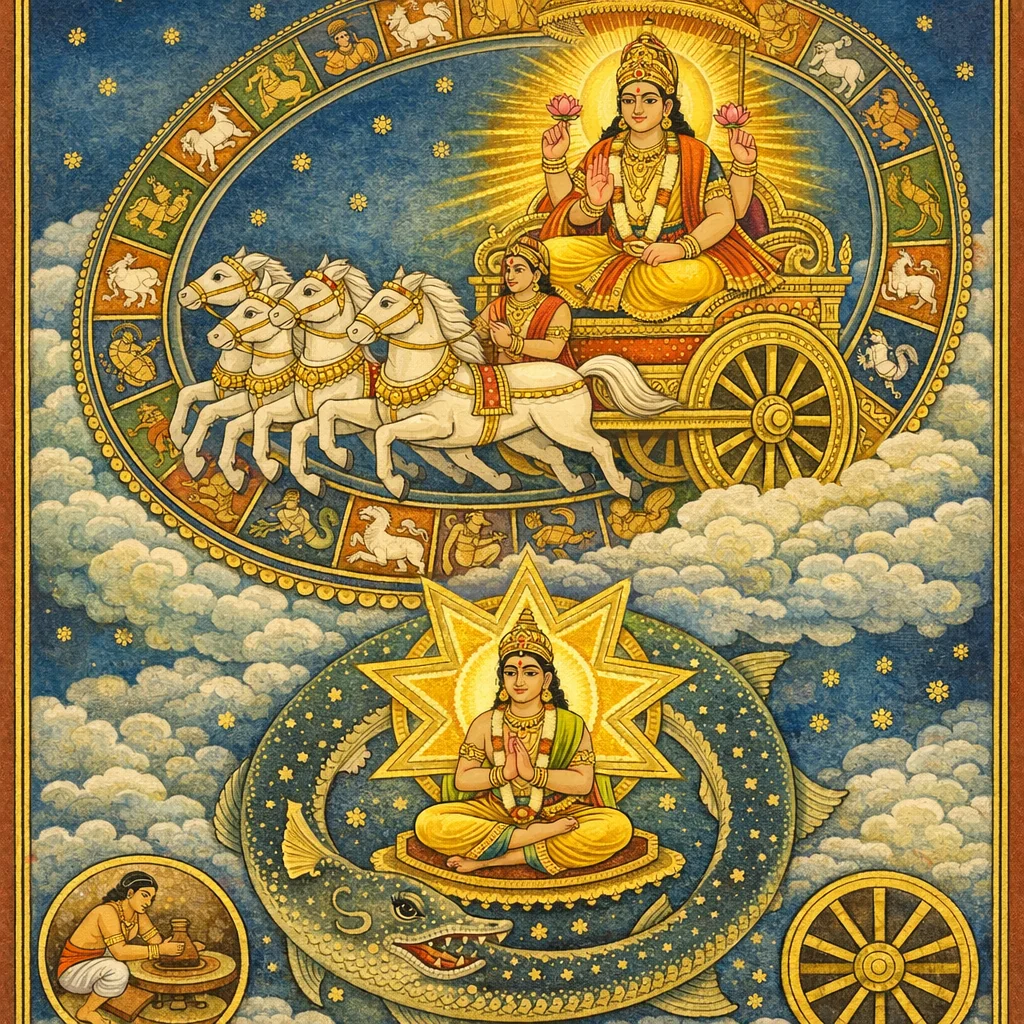
This chapter, framed as Nārada’s exposition, presents a technical cosmography of the heavens. It describes the Sun’s sphere and the construction of the solar chariot—axles, wheels, and measures—and links the Sun’s seven horses with the Vedic metres: Gāyatrī, Bṛhatī, Uṣṇik, Jagatī, Triṣṭubh, Anuṣṭubh, and Paṅkti. “Sunrise” and “sunset” are explained as appearance and disappearance to perception, not the Sun’s absolute cessation. It then outlines the Sun’s northern and southern courses (uttarāyaṇa/dakṣiṇāyana) through the rāśis, explaining differing apparent speeds by the analogy of a potter’s wheel. Twilight (sandhyā) conflicts are introduced, in which beings seek to harm the Sun, and the sandhyā observance—especially water offerings purified by the Gāyatrī—is taught as an ethical and protective rite. The chapter maps the Moon’s sphere, the nakṣatra-maṇḍala, and the planets with their placements and chariots, rising to the Saptarṣi-maṇḍala and to Dhruva as the axle and pivot of the jyotiṣ-cakra. It enumerates the seven lokas (bhūḥ, bhuvaḥ, svaḥ, mahaḥ, janaḥ, tapaḥ, satyaḥ) with relative distances and ontological notes (kṛtaka/akṛtaka). It concludes by situating the Gaṅgā in the cosmic order and describing the seven vāyu-skandhas that bind and rotate the celestial systems, leading into a transition toward the pātālas.
Shlokas
Verse 1
नारद उवाच । भूमेर्योजनलक्षे च कौरव्य रविमंडलम् । योजनानां सहस्राणि भास्करस्य रथो नव
Nārada said: O descendant of Kuru, the solar orb is at a distance of one lakh yojanas from the earth. The chariot of the Sun measures nine thousand yojanas.
Verse 2
ईषादंडस्ततैवास्य द्विगुणः परिकीर्तितः । सार्धकोटिस्तथा सप्त नियुतानि विवस्वतः
The pole-shaft of that chariot is declared to be twice as long. And of Vivasvān (the Sun) there are said to be seven and a half koṭis and also seven niyutas (in measure/number).
Verse 3
योजनानां तु तस्याक्षस्तत्र चक्रं प्रतिष्ठितम् । त्रिनाभि तच्च पंचारं षण्नेमि परिकीर्तितम्
Its axle extends for so many yojanas, and upon that axle the wheel is established. That wheel is proclaimed to have three hubs, five spokes, and six rims.
Verse 4
चत्वारिंशत्सहस्राणि द्वितीयोऽक्षोऽपि विस्तृतः । पंच चान्यानि सार्द्धानि स्यन्दनस्य तु पांडव
The second axle too is extended to forty thousand (yojanas). And, O Pāṇḍava, the chariot (syandana) has five and a half more in measure besides this.
Verse 5
अक्षप्रमाणमुभयोः प्रमाणं तद्युगार्द्धयोः । ह्रस्वोऽक्षस्तद्युगार्द्धं च ध्रुवाधारं रथस्य वै
The measure of both axles is likewise the measure of their half-yokes. The shorter axle and that half-yoke are indeed the chariot’s fixed support (dhruvādhāra).
Verse 6
द्वितीयोऽक्षस्तथा सव्ये चक्रं तन्मानसे स्थितम् । हयाश्च सप्त च्छांदांसि तेषां नामानि मे श्रृणु
The second axle, likewise, is on the left; upon that side the wheel is set. And there are seven horses—named for the Vedic metres. Hear from me their names.
Verse 7
गायत्री च बृहत्युष्णिग्जगती त्रिष्टुवेव च । अनुष्टुप्पंक्तिरित्युक्ताश्छंदांसि हरयो रवेः
Gāyatrī, Bṛhatī, Uṣṇik, Jagatī, Triṣṭubh; and also Anuṣṭubh and Paṅkti—these are declared to be the Vedic metres that serve as the Sun’s “steeds,” bearing his radiance through the ordered rhythm of sacred speech.
Verse 8
नैवास्तमनमर्कस्य नोदयः सर्वदा सतः । उदयास्तमनाक्यं हि दर्शनादर्शनं रवेः
For the Sun, who ever truly exists, there is neither “setting” nor “rising.” What people call sunrise and sunset is only Ravi’s appearing and disappearing to our sight.
Verse 9
शक्रदीनां पुरे तिष्ठन्स्पृशत्येष पुरत्रयम् । विकीर्णोऽतो विकर्णस्थस्त्रिकोणार्धपुरे तथा
Standing in the cities of Indra and the other gods, he (the Sun) touches the three celestial “cities” in his course. Thus he is spoken of as “diffused”—set in the directions—moving also through the triangular and half-city divisions of the cosmic sphere.
Verse 10
अयनस्योत्तरस्यादौ मकरं याति भास्करः । ततः कुम्भं च मीनं च राशे राश्यंतरं तथा
At the beginning of the northern course (uttarāyaṇa), Bhāskara enters Makara (Capricorn). Then he proceeds to Kumbha (Aquarius) and Mīna (Pisces), moving from sign to sign in due order.
Verse 11
त्रिष्वेतेष्वथ भुक्तेषु ततो वैषुवतीं गतिम् । प्रयाति सविता कुर्वन्नहोरात्रं च तत्समम्
When these three signs have been traversed, Savitṛ then attains the equinoctial movement (vaiṣuvatī), and he makes day and night equal in measure.
Verse 12
ततो रात्रिः क्षयं याति वर्धते तु दिनं दिनम् । ततश्च मिथुनस्यांते परां काष्ठामुपागतः
Thereafter, the night diminishes, while the day increases day by day. Then, at the end of Mithuna (Gemini), he reaches the highest limit—the utmost point of that northern advance.
Verse 13
राशिं कर्कटकं प्राप्य कुरुते दक्षिणायांनम् । कुलालचक्रपर्यंतो यथा शीघ्रं निवर्तते
Having reached the sign of Karkaṭaka (Cancer), he begins the southern course (dakṣiṇāyana). Like the rim of a potter’s wheel, he then turns back swiftly.
Verse 14
दक्षिणायक्रमे सूर्यस्तथा शीघ्रं निवर्तते । अतिवेगितया कालं वायुमार्गबलाच्चरन्
In the course of dakṣiṇāyana, the Sun likewise turns back swiftly, moving through time with great speed, propelled by the force of the wind-paths.
Verse 15
तस्मात्प्रकृष्टां भूमिं स कालेनाल्पेन गच्छति । कुलालचक्रमध्यस्थो यता मंदं प्रसर्पति
Therefore he covers a greater stretch of ground in a shorter time. Just as one at the outer part of a potter’s wheel moves swiftly, so in that phase he advances rapidly.
Verse 16
तथोदगयने सूर्यः सर्पते मंदविक्रमः । तस्माद्दीर्घेण कालेन भूमिमल्पं निगच्छति
So too, in the northern course (udagayana), the Sun moves with gentler pace; therefore, over a longer time he covers a smaller stretch of ground.
Verse 17
संध्याकाले च मंदेहाः सूर्यमिच्छंति खादितुम् । प्रजापतिकृतः शापस्तेषां फाल्गुन रक्षसाम्
At the time of twilight, the Māndehā demons desire to devour the Sun. This, O Phālguna, is the curse pronounced upon those rākṣasas by Prajāpati.
Verse 18
अक्षयत्वं शरीराणां मरणं च दिनेदिने । ततः सूर्यस्य तैर्युद्धं भवत्यत्यंतदारुणम्
Their bodies seem unperishing, yet they die again and again each day; therefore their battle with the Sun becomes exceedingly dreadful.
Verse 19
ततो गायत्रिपूतं यद्द्विजास्तोयं क्षिपंति च । तेन दह्यंति ते पापाः संध्योपासनतः सदा
Then the water cast forth by the twice-born—purified by the Gāyatrī—burns those sinful beings; thus, through constant twilight worship they are ever scorched.
Verse 20
ये संध्यां नाप्युपासंते कृतघ्ना यांति रौरवम् । प्रतिमासं पृथक्सूर्य ऋषिगन्धर्वराक्षसैः
Those who do not worship even the twilight rites—being ungrateful—go to the Raurava hell. And the Sun, distinct in each month, is attended in his course by sages, gandharvas, and rākṣasas.
Verse 21
अप्सरोग्रामणीसर्पैरथो याति च सप्तभिः । धातार्यमा मित्रवरुणौ विवस्वानिन्द्र एव च
Moreover, he proceeds with seven companions—apsarases, leaders, and serpents—and with Dhātā, Aryamā, Mitra and Varuṇa, Vivasvān, and Indra as well.
Verse 22
पूषा च सविता सोऽथ भगस्त्वष्टा च कीर्तितः । विष्णुश्चैत्रादिमासेषु आदित्या द्वादश स्मृताः
Pūṣan and Savitṛ, then Bhaga and Tvāṣṭṛ are also proclaimed; and Viṣṇu—thus, beginning with the month of Caitra, the twelve Ādityas are remembered as presiding powers.
Verse 23
ततो दिवाकरस्थानान्मंडलं शशिनः स्तितम् । लक्षमात्रेण तस्यापि त्रिचक्रोरथ उच्यते
Then, beyond the Sun’s station lies the Moon’s orbit; it is said to be about one lakh yojanas away. Even for him, the chariot is described as three-wheeled.
Verse 24
कुंदाभा दश चैवाश्वा वामदक्षिणतो युताः । पूर्णे शतसहस्रे च योजनानां निशाकरात्
Ten jasmine-white horses, yoked on the left and right, draw that chariot. And at a full hundred thousand yojanas beyond the Moon…
Verse 25
नक्षत्रमण्डलं कृत्स्नमुपरिष्टात्प्रकाशते । चतुर्दश चार्बुदान्यप्यशीतिः सरितांपतिः
Above that shines the entire sphere of the constellations. (Its measure) is given as fourteen arbuda and eighty; thus is described the lord of rivers.
Verse 26
विंशतिश्च तथा कोट्यो नक्षत्राणां प्रकीर्तिताः । द्वे लक्षे चोत्तरे तस्माद्बुधो नक्षत्रमण्डलात्
And twenty crores of stars are declared. Two lakh yojanas beyond that starry sphere lies Budha (Mercury), beyond the constellation-orbit.
Verse 27
वाय्वग्निद्रव्यसंभूतो रथश्चंद्रसुतस्य च । पिशंगैस्तुरसोष्टाभिर्वायवेगिभिः
The chariot of the Moon’s son, Budha, is fashioned from substances born of wind and fire; it is drawn by eight tawny, swift horses, moving with the speed of the wind.
Verse 28
द्विलक्षश्चोत्तरे तस्माद्बुधाच्चाप्युशना स्मृतः । शुक्रस्यापि रथोष्टाभिर्युक्तोऽभूत्संभवैर्हयैः
Two lakṣas above that, and above Budha (Mercury), Uśanā (Śukrācārya/Venus) is remembered to abide. Śukra’s chariot too is yoked with eight horses born of that celestial origin.
Verse 29
लक्षद्वयेन भौमस्य स्मृतो देवपुरोहितः । अष्टाभिः पांडुरैरश्वैर्युक्तोऽस्य कांचनोरथः
At a distance of two lakṣas from Bhāuma (Mars) is said to be the Devas’ priest, Bṛhaspati (Jupiter). His golden chariot is yoked with eight pale-white horses.
Verse 30
सौरिर्बृहस्पतेश्चोर्ध्वं द्विलक्षे समुपस्थितः । आकाशसंभवैरश्वैरष्टाभिः शबलै रथः
Sauri (Śani/Saturn) is situated two lakṣas above Bṛhaspati (Jupiter). His chariot is drawn by eight dappled horses born of the sky, ākāśa.
Verse 31
स्वर्भानोस्तुरगाश्चाष्टौ भृंगाभा धूसरारथम् । वहंति च सकृद्युक्ता आदित्याधःस्थितास्तथा
Svarbhānu’s eight horses, dark as bees, bear his grey chariot. Yoked but once, they move on their course, stationed beneath the Sun.
Verse 32
सौरेर्लक्षं स्मृतं चोर्ध्वं ततः सप्तर्षिमण्डलम् । ऋषिभ्यश्चापि लक्षेण ध्रुवश्चोर्ध्वं व्यवस्थितः
One lakṣa above Sauri (Saturn), a region is said to be; beyond it lies the circle of the Seven Ṛṣis (Saptarṣi-maṇḍala). And one lakṣa above the Ṛṣis, Dhruva (the Pole Star) stands firmly established.
Verse 33
मेढीभूतः समस्तस्य ज्योतिश्चक्रस्य वै ध्रुवः । ध्रुवोऽपि शिंशुमारस्य पुच्छाधारे व्यवस्थितः
Dhruva has indeed become the pivot of the entire wheel of lights (the celestial sphere). Dhruva, moreover, is stationed at the support of the tail of the Śiṃśumāra (the cosmic dolphin-form).
Verse 34
यमाहुर्वासुदेवस्य रूपमात्मानमव्ययम् । वायुपाशैर्ध्रुवे बद्धं सर्वमेतच्च फाल्गुन
That which they call the imperishable Self—the very form of Vāsudeva—is what holds all this bound to Dhruva by bonds of wind, O Phālguna (Arjuna).
Verse 35
नवयोजनसाहस्रं मण्डलं सवितुः स्मृतम् । द्विगुणं सूर्यविस्तारान्मण्डलं शशिनः स्मृतम्
The solar disc (maṇḍala) is said to measure nine thousand yojanas. The lunar disc is said to be twice the Sun’s diameter/extent.
Verse 36
तुल्यस्तयोस्तु स्वर्भानुर्भूत्वाधस्तात्प्रसर्पति । उद्धृत्य पृथिवीच्छायां निर्मलां मण्डलाकृतिः
Svarbhānu (Rāhu), equal to them in form, moves creeping below. Having drawn up the Earth’s shadow, he appears as a clear, circular disc.
Verse 37
चन्द्रस्य षोडशो भागो भार्गवश्च विधीयते । भार्गवात्पादहीनस्तु विज्ञेयोऽथ बृहस्पतिः
One-sixteenth part of the Moon’s measure is assigned to Bhārgava (Venus). And Bṛhaspati (Jupiter) should be understood as one quarter less than Bhārgava.
Verse 38
बृहस्पतेः पादहीनौ वक्रसौरी बुधस्तथा । शतानि पंच चत्वारित्रीणि द्वे चैकयोजनम्
Vakrasaurī (Saturn, moving in a crooked course) and Budha (Mercury) are each a quarter less than Bṛhaspati. Their measure is stated in hundreds—five, four, three, two—and at last, one yojana.
Verse 39
योजनार्धप्रमाणानि भानि ह्रस्वं न विद्यते । भूमिलोकश्च भूर्लोकः पादगम्यः प्रकीर्तितः
The luminaries are measured as half a yojana; no smaller measure is acknowledged. The earthly realm—Bhūloka, the ground-world—is proclaimed to be traversable on foot.
Verse 40
भूमिसूर्यांतरं तच्च भुवर्लोकः प्रकीर्तितः । ध्रुवसूर्यांतरं तच्च नियुतानि चतुर्दश
The interval between the Earth and the Sun is declared to be Bhuvarloka. And the interval between Dhruva and the Sun is said to be fourteen niyutas.
Verse 41
स्वर्लोकः सोऽपि गदितो लोकसंस्थानचिंतकैः । ध्रुवादूर्ध्वं तथा कोटचिर्महर्लोकः प्रकीर्तितः
Svarloka too is described by those who contemplate the arrangement of the worlds. Above Dhruva, Maharloka is proclaimed, extending in a vast span measured in koṭis.
Verse 42
द्वे कोट्यौ च जनो यत्र निवसंति चतुःसनाः । चतुर्भिश्चापि कोटीभिस्तपोलोकस्ततः स्मॉतः
That region is called Janoloka, where the Four Kumāras dwell; and beyond it, Tapoloka is remembered as extending by four koṭis.
Verse 43
वैराजा यत्र ते देवाः स्थिता दाहविवर्जिताः । षड्गुणेन तपोलोकात्सत्यलोको विराजते
Where the Vairāja deities abide, free from torment and burning—beyond Tapoloka, Satyaloka shines forth, sixfold in measure.
Verse 44
अपुनर्मरका यत्र ब्रह्मलोको हि स स्मृतः । अष्टादस तथा कोट्यो लक्षाण्यशीतिपंच च
Where there is no return to death, that is remembered as Brahmaloka. Its measure is said to be eighteen koṭis and eighty-five lakṣas.
Verse 45
शुभं निरुपमं स्थानं तदूर्ध्वं संप्रकाशते । भूर्भूवःस्वरिति प्रोक्तं त्रैलोक्यं कृतकं त्विदम्
Above that, an auspicious and incomparable station shines forth. ‘Bhūr, Bhuvaḥ, Svaḥ’—thus is spoken the triad of worlds; and this threefold realm is called the ‘constructed’ (kṛtaka) one.
Verse 46
जनस्तपस्तथा सत्यमिति चाकृतकं त्रयम् । कृतकाकृतयोर्मध्ये मर्हर्लोक इति स्मृतः
‘Jana, Tapa, and Satya’—this triad is also called the ‘unconstructed’ (akṛtaka) realm. Between the constructed and the unconstructed is remembered Maharloka.
Verse 47
शून्यो भवति कल्पांते योत्यंतं न विनश्यति । एते सप्त समाख्याता लोकाः पुण्यैरुपार्जिताः
At the end of a kalpa, when everything becomes void, that supreme state does not perish in the least. These are declared to be the seven worlds, attained and ‘earned’ through merit (puṇya).
Verse 48
यज्ञैर्दानैर्जपैर्होमैस्तीर्थैर्व्रतसमुच्चयैः । वेदादिप्रोक्तैरन्यैश्च साध्यांल्लोकानिमान्विदुः
By yajñas (sacrifices), dāna (gifts), japa (recitation), homa (fire-offerings), pilgrimages to sacred tīrthas, and the gathered practice of vows (vrata)—together with other disciplines taught in the Vedas and allied teachings—these worlds are known to be attainable.
Verse 49
ततश्चांडस्य शिरसो धारा नीरमयी शिवा । सर्वलोकान्समाप्लाव्य गंगा मेरावुपागता
Then, from the crown of the cosmic Egg, a blessed, Śiva-hallowed stream of water arose; flooding all the worlds, that Gaṅgā reached Mount Meru.
Verse 50
ततो महीतलं सर्वं पातालं प्रविवेश सा । अंडमूर्ध्नि स्थिता देवी सततं द्वारवासिनी
Thereafter she entered the whole expanse of the earth and even Pātāla, the nether realm. The Goddess, stationed upon the crown of the cosmic Egg, abides perpetually as the guardian at the gate.
Verse 51
देवीनां कोटिकोटीभिः संवृता पिंगलेन च । तत्र स्थिता सदा रक्षां कुरुतेऽण्डस्य सा शुभा
Surrounded by crores upon crores of goddesses, and also by Piṅgala, that auspicious Goddess remains stationed there and continually protects the cosmic Egg.
Verse 52
निहंति दुष्टसंघातान्महाबलपराक्रमा । वायुस्कंधानि सप्तापिश्रृणुयद्वत्स्थितान्यपि
Mighty in strength and valor, she destroys the multitudes of the wicked. Now hear also of the seven ‘supports’ of wind—how they are stationed.
Verse 53
पृथिवीं समभिक्रम्य संस्थितो मेघमंडले । प्रवहोनाम यो मेघान्प्रवहत्यतिशक्तिमान्
Having encompassed the earth, the first wind-support abides in the sphere of clouds. He is called Pravaha, exceedingly mighty, who drives the clouds onward.
Verse 54
धूमजाश्वोष्मजा मेघाः सामुद्रैयन पूरिताः । तोयैर्भवंति नीलांगा वर्षिष्ठाश्चैव भारत
O Bhārata, clouds born of smoke and of heat, filled with moisture drawn from the ocean, become dark-bodied with waters and are indeed the most abundant bearers of rain.
Verse 55
द्वितीयश्चावहो नाम निबद्धः सूर्यमंडले । तेन बद्धं ध्रुवेणेदं भ्राम्यते सूर्यमंडलम्
The second is named Āvaha, bound to the orb of the Sun. Fastened by him to Dhruva, this solar sphere revolves.
Verse 56
तृतीयश्चोद्वहो नाम चंद्रस्कंधे प्रतिष्ठितः । बद्धं ध्रुवेण येनेदं भ्राम्यते चंद्रमंडलम्
The third is named Udvaha, established in the support of the Moon. Bound by him to Dhruva, this lunar sphere revolves.
Verse 57
चतुर्थः संवहो नाम स्थितो नक्षत्रमण्डले । वातरश्मिभिराबद्धं ध्रुवेण सह भ्राम्यते
The fourth wind, known as Saṃvaha, abides in the sphere of the lunar mansions. Bound by cords of wind-rays, it causes that stellar sphere to revolve together with Dhruva, the Pole Star.
Verse 58
ग्रहेषु पंचमः सोऽपि विवहो नाम मारुतः । ग्रहचक्रमिदं येन भ्राम्यते ध्रुवसंधितम्
Among the planets, the fifth wind too is the Marut called Vivaha. By it this planetary wheel—joined to Dhruva—is set into revolution.
Verse 59
षष्ठः परिवहो नाम स्थितः सप्तर्षिमंडले । भ्रमंति ध्रुवसंबद्धा येन सप्तर्षयो दिवि
The sixth, named Parivaha, is stationed in the sphere of the Seven Ṛṣis. Bound to Dhruva, the Seven Sages in the sky revolve by its power.
Verse 60
सप्तमश्च ध्रुवे बद्धो वायुर्नाम्ना परावहः । येन संस्थापितं ध्रौव्यं चक्रं चान्यानि भारत
And the seventh—bound to Dhruva—is the wind called Parāvaha. By it the Dhruva-centered wheel, and other circles as well, are held firmly in their appointed order, O Bhārata.
Verse 61
यं समासाद्य वेगेन दिशामंतं प्रपेदिरे । दक्षस्य दश पुत्राणां सहस्राणि प्रजापतेः
Reaching it with great speed, they arrived at the very limits of the directions—those thousands belonging to the ten sons of Dakṣa, the Prajāpati.
Verse 62
एवमेते दितेः पुत्राः सप्तसप्त व्यवस्थिताः । अनारमंतः संवांति सर्वगाः सर्वधारिणः
Thus are these sons of Diti arranged in groups of seven and seven. Unceasingly they blow forth—moving everywhere, upholding all.
Verse 63
ध्रुवादूर्ध्वमसूर्यं चाप्यनक्षत्रमतारकम् । स्वतेजसा स्वशक्त्या चाधिष्ठितास्ते हि नित्यदा
Above Dhruva there is neither sun, nor constellation, nor any star. Yet those regions are forever sustained and governed by their own radiance and inherent power.
Verse 64
इत्यूर्ध्वं ते समाख्यांतं पातालान्यथ मे श्रृणु
Thus have I explained to you what lies above; now hear from me about the Pātālas, the nether regions.