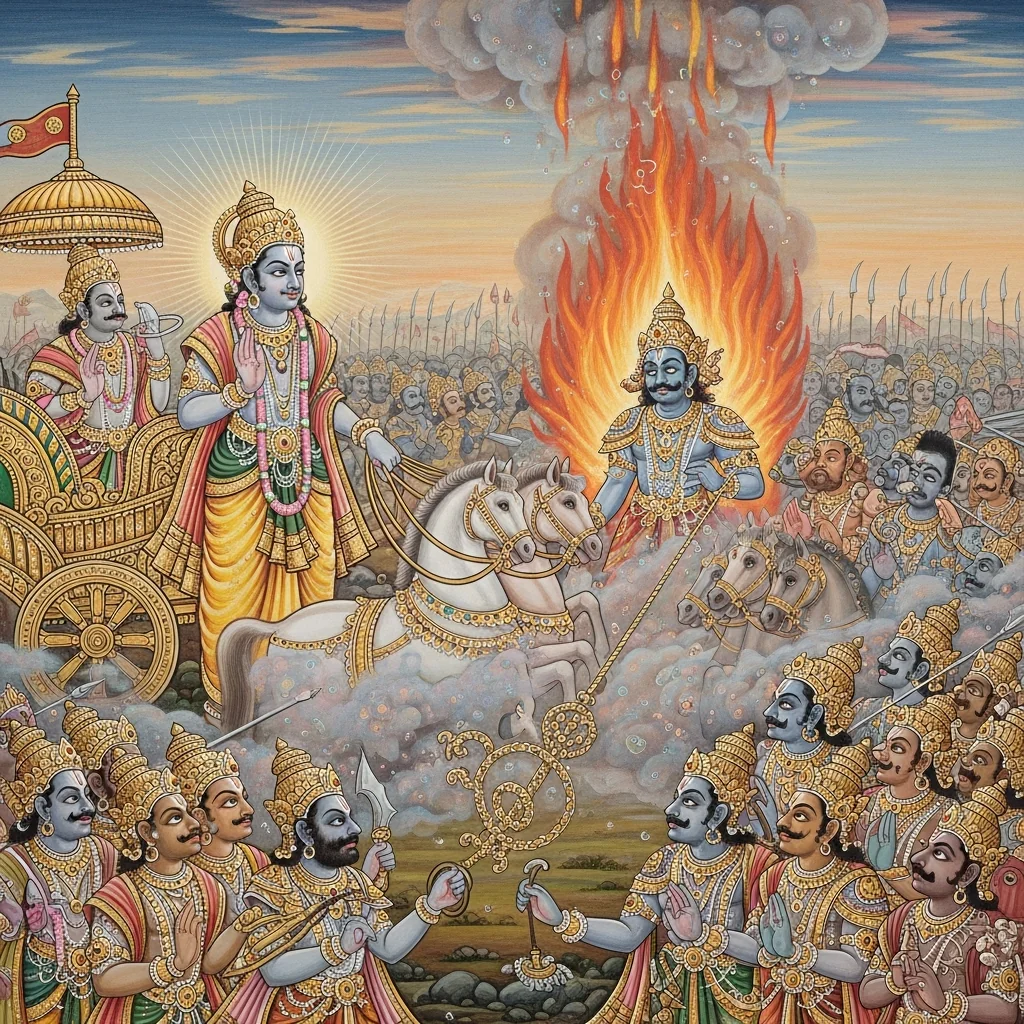
Adhyaya 18
Nārada recounts a prolonged battle in which Kubera (Dhanādhipa/Dhaneśa) confronts daitya hosts led first by Jambha and then by Kujambha. Kubera’s famed gadā crushes Jambha despite a thick volley of weapons, but Kujambha escalates with arrow-nets and heavy arms, briefly overpowering Kubera and seizing wealth, treasures, and vehicles. As the conflict spreads, Nirṛti enters and routs the daitya troops. The daityas answer with a tāmāsī māyā that immobilizes all in darkness, until a Sāvitra astra dispels the gloom. Varuṇa binds Kujambha with a pāśa and strikes him, yet Mahīṣa threatens Varuṇa and Nirṛti, driving them to retreat toward Indra’s protection. Candra unleashes a severe cold-astra that paralyzes and demoralizes the daitya host; Kālanemi rebukes them and counters with a human-formed māyā and fire-like proliferation to reverse the cold. Finally Divākara (the Sun) intervenes, commands Aruṇa to drive against Kālanemi, and releases illusion-laden, weaponized assaults (with Śambara and Indrajāla effects), causing misrecognition—daityas mistaking devas—and renewed slaughter. The chapter teaches that power severed from discernment turns volatile, while astras, māyā, and divine guardianship serve to restore cosmic balance in the purāṇic vision.
Shlokas
Verse 1
नारद उवाच । धनाधिपस्य जंभेन सायकैर्मर्मभेदिभिः । दिशोपरुद्धाः क्रुद्धेन सैन्यं चाभ्यर्दितं भृशम्
Nārada said: With Jambha’s arrows that pierced the vital points, the very directions were blocked; and in his wrath he sorely harassed the army of Dhanādhipa (Kubera).
Verse 2
तद्दृष्ट्वा कर्म दैत्यस्य धनाध्यक्षः प्रतापवान् । आकर्णाकृष्टचापस्तु जंभमाजौ महाबलम्
Seeing that deed of the daitya, the mighty and radiant Dhanādhyakṣa drew his bow back to the ear and confronted the powerful Jambha in battle.
Verse 3
हृदि विव्याध बाणानां सहस्रेणाग्निवर्चसाम् । स प्रहस्य ततो वीरो बाणानामयुतत्रयम्
He pierced him in the heart with a thousand arrows blazing like fire. Then that warrior, laughing, released thirty thousand arrows.
Verse 4
नियुतं च तथा कोटिमर्बुदं चाक्षिपत्क्षणात् । तस्य तल्लाघ्रवं दृषट्वा क्रुद्धो गृह्य महागदाम्
In a mere instant he hurled forces counted by the niyuta, the koṭi, and even the arbuda. Seeing that astounding swiftness, he grew enraged and seized his great mace.
Verse 5
धनाध्यक्षः प्रचिक्षेप स्वर्गेप्सुः स्वधनं यथा । मुक्तायां वै नादोऽभूत्प्रलये यथा
The Lord of Wealth cast it forth, as one longing for heaven gives away his own riches. When it was released, a roar arose—like the sound at the time of cosmic dissolution.
Verse 6
भूतानां बहुधा रावा जज्ञिरे खे महाभयाः । वायुश्च सुमहाञ्जज्ञे खमायान्मेघसंकुलम्
In the sky arose many terrifying cries from the hosts of beings. A mighty wind was born, and the heavens became overcast, crowded with clouds.
Verse 7
सा हि वैश्रवणस्यास्ते त्रैलोक्याभ्यर्चिता गदा । आयांतीं तां समालोक्य तडित्संघातदुर्द्दशाम्
For that mace belonged to Vaiśravaṇa, honored throughout the three worlds. Seeing it rushing forward—dreadful like a mass of lightning—(the foe braced himself).
Verse 8
दैत्यो गदाविघातार्थं शस्त्रवृष्टिं मुमोच ह । चक्राणि कुणपान्प्रासाञ्छतघ्नीः पट्टिशांस्तथा
To ward off the blow of the mace, the Daitya unleashed a rain of weapons—discus-blades, heavy maces, spears, śataghnīs, and axes as well.
Verse 9
परिघान्मुशलान्वृक्षान्गिरींश्चातुलविक्रमः । कदर्थीकृत्य शस्त्राणि तानि सर्वाणि सा गदा
That mace of incomparable might shattered and rendered useless all those weapons—iron bars, pestles, trees, and even mountains.
Verse 10
कल्पांतभास्करो यद्वन्न्यपतद्दैत्यवक्षसि । स तया गाढभिन्नः सन्सफेनरुधिरं वमन्
Like the sun at the end of an aeon, it crashed upon the demon’s chest. Split open by it, he vomited blood mixed with foam.
Verse 11
निःपपात रथाज्जंभो वसुधां गतचेतनः । जंभं निपतितं दृष्ट्वा कुजंभो घोरनिश्चयः
Jaṃbha fell from his chariot onto the earth, senseless. Seeing Jaṃbha collapsed, Kujaṃbha—of grim resolve—rose to act.
Verse 12
धनाधिपस्य संक्रुद्धो नादेनापूरयन्दिशः । चक्रे बाणमयं जालं शकुंतस्येव पंजरम्
Enraged at the Lord of Wealth, he filled the quarters with his roar and formed a net made of arrows—like a cage for a bird.
Verse 13
विच्छिद्य बाणजालं च मायाजालमिवोत्कटम् । मुमोच बाणानपरांस्तस्य यक्षाधिपो बली
Shattering that arrow-net—like a fierce web of illusion—the mighty lord of the Yakṣas released another volley of arrows against him.
Verse 14
चिच्छेद लीलया तांश्च दैत्यः क्रोधीव सद्वचः । निष्फलांस्तांस्ततो दृष्ट्वा बाणान्क्रुद्धो धनाधिपः
The Daitya cut those arrows to pieces with ease—like an angry man slicing through good counsel with harshness. Seeing his shafts made fruitless, the Lord of Wealth (Kubera) grew enraged.
Verse 15
शक्तिं जग्राह दुर्धर्षां शतघंटामहास्वनाम् । प्रेषिता सा तदा शक्तिर्दारयामास तं हृति
He seized a dreadful, irresistible spear, resounding like a hundred bells. When hurled, that spear pierced him through the heart.
Verse 16
यथाल्पबोधं पुरुषं दुःखं संसारसंभवम् । तथास्य हृदयं भित्त्वा जगाम धरणीतलम्
As worldly sorrow born of saṃsāra overwhelms a man of little understanding, so, his heart split asunder, he fell upon the face of the earth.
Verse 17
निमेषात्सोभिसंस्तम्भ्य दानवो दारुणाकृतिः । जग्राह पट्टिशं दैत्यो गिरीणामपि भेदनम्
In a mere moment, the dreadful-looking Dānava steadied himself and seized a paṭṭiśa (battle-axe), a weapon able to cleave even mountains.
Verse 18
स तेन पट्टिसेनाजौ धनदस्य स्तनांतरम् । वाक्येन तीक्ष्णरूपेण मर्माक्षरविसर्पिणा
In battle, with that paṭṭiśa he struck Kubera, Lord of Wealth, between the breasts—like a keen-edged utterance whose syllables creep into one’s vital points.
Verse 19
निर्बिभेदाभिजातस्य हृदयं दुर्जनो यथा । तेन पट्टिश घातेन धनेशः ।परिमूर्छितः
By that blow of the paṭṭiśa, Dhanesha, Lord of Wealth, fell into a swoon—just as a wicked man pierces the heart of the noble.
Verse 20
निषसाद रथोपस्थे दुर्वाचा सुजनो यथा । तथागतं तु तं दृष्ट्वा धनेशं वै मृतं यथा
He sank upon the chariot-seat, like a good man brought low by cruel speech. Seeing him thus, they truly thought Dhanesha, Lord of Wealth, to be as if dead.
Verse 21
राक्षसो निरृतिर्देवो निशाचरबलानुगः । अभिदुद्राव वेगेन कुजंभं भीमविक्रमम्
Nirṛti—lord among the Rākṣasas—followed by the forces of the night-roamers, charged swiftly toward Kujaṃbha of dreadful prowess.
Verse 22
अथ दृष्ट्वातिदुर्धर्षं कुजंभो राक्षसेश्वरम् । नोदयामास दैत्यान्स राक्षसेशरथं प्रति
Then, seeing the exceedingly formidable lord of the Rākṣasas, Kujaṃbha urged the Daityas onward against the chariot of that Rākṣasa-king.
Verse 23
स दृष्ट्वा नोदितां सेनां प्रबलास्त्रां सुभीषणाम् । रथादाप्लुत्य वेगेन निरृती राक्षसेश्वरम्
Seeing that impelled army—mighty in weapons and most terrifying—Nirṛti, the Rākṣasa-lord, leapt down from his chariot with speed.
Verse 24
खड्गेन तीक्ष्णधारेण चर्मपाणिरधावत । प्रविश्य दानवानीकं गजः पद्मसरो यथा
Bearing a sharp-edged sword and a shield in hand, Carmapāṇi charged forth; plunging into the Dānava host like an elephant entering a lotus-lake.
Verse 25
लोडयामास बहुधा विनिष्कृत्य सहस्रशः । चिच्छेद कांश्चिच्छतशो बिभेदान्यान्वरासिना
He hurled them about in many ways, dragging forth thousands; some he cut down by the hundreds, and others he pierced through with his excellent sword.
Verse 26
संदष्टौष्ठमुखैः पृथ्वीं दैत्यानां सोऽभ्यपूरयत् । ततो निःशेषितप्रायां विलोक्य स्वां चमूं तदा
With the Daityas biting their lips and faces in fury, he filled the earth with them; then, seeing his own army nearly wiped out, at that moment he looked on.
Verse 27
मुक्त्वा धनपतिं दैत्यः कुजंभो निरृतिं ययौ । लब्धसंज्ञस्तु जंभोऽपि धनाध्यक्षपदानुगान्
Releasing Dhanapati (Kubera), the Daitya Kujambha went to Nirṛti’s quarter. And Jambha too, regaining consciousness, turned his attention toward the attendants who followed the Lord of Wealth’s command.
Verse 28
जीवग्राहं स जग्राह बद्धा पाशैः सहस्रधा । मूर्तिमंति च रत्ननि पद्मादींश्च निधींस्तथा
He seized the jīvagrāha—life-seizing captives—bound in a thousand ways with nooses; and he also took embodied jewels, as well as the treasure-hoards (nidhis) such as Padma and the rest.
Verse 29
वाहनानि च दिव्यानि विमानानि च सर्वशः । धनेशो लब्धसंज्ञस्तु तामवस्थां विलोक्य सः
Divine mounts and aerial chariots (vimānas) of every kind were taken as well. Then Dhaneśa (Kubera), having regained consciousness, looked upon that state of affairs.
Verse 30
निःश्वसन्दीर्घमुष्णं च रोषात्ताम्रविलोचनः । ध्यात्वास्त्रं गारुडं दिव्यं बाणं संधाय कार्मुके
Breathing out long and hot, his eyes reddened with wrath, he meditated on the divine Gāruḍa weapon and set an arrow upon his bow.
Verse 31
मुमोच दानवानीके तं बाणं शत्रुदारणम् । प्रथमं कार्मुकं तस्य वह्निज्वालमदृश्यत
He released into the demon host that enemy-rending arrow. First, from his bow there appeared a blaze of fire.
Verse 32
निश्चेरुर्विस्फुलिंगानां कोटयो धनुषस्तथा । ततो ज्वालाकुलं व्योम चक्रे चास्त्रं समंततः
From the bow there burst forth crores of sparks; then the weapon made the sky, on every side, a mass of flames.
Verse 33
तदस्त्रं सहसा दृष्ट्वा जंभो भीमपराक्रमः । संवर्तं मुमुचे तेन प्रशांतं गारुडं तदा
Seeing that weapon suddenly, Jambha of dreadful prowess released the Saṃvarta counter-weapon; by it, the Gāruḍa weapon was then quelled.
Verse 34
ततस्तं दानवो दृष्ट्वा कुबेरं रोषविह्वलः । अभिदुद्राव वेगेन पदातिर्धनदं नदन्
Then, seeing Kubera, the Dānava—overwhelmed with rage—rushed at the Lord of Wealth with great speed on foot, roaring aloud.
Verse 35
अथाभिमुखमायांतं दैत्यं दृष्ट्वा धनाधिपः । बभूव संभ्रमाविष्टः पलायनपरायणः
Seeing the Daitya advancing straight toward him, Kubera, Lord of wealth, was seized by panic and turned wholly toward flight.
Verse 36
ततः पलायतस्तस्य मुकुटो रत्नमंडितः । पपात भूतले दीप्तो रविबिंबमिवांबरात्
As he fled, his jewel-studded crown fell to the ground, shining like the disc of the sun dropping from the sky.
Verse 37
यक्षणामभिजातानां भग्नं प्रववृते रणात् । मर्तुं संग्राम शिरसि युक्तं नो भूषणाय तत्
“For Yakṣas of noble birth, to break and withdraw from battle is not fitting. It is proper to die at the forefront of war—this, not ornament, is our true honor.”
Verse 38
इति व्यवस्य दुर्धर्षा नानाशस्त्रास्त्रपाणयः । युयुत्सवस्तथा यक्षा मुकुटं परिवार्य ते
Having thus resolved, those unassailable Yakṣas—bearing many kinds of weapons and missiles—eager for battle, surrounded the fallen crown.
Verse 39
अभिमान धना वीरा धनस्य पदानुगाः । तानमर्षाच्च संप्रेक्ष्य दानवश्चंडपौरुषः
Those heroes, rich in pride, were attendants who followed in Kubera’s footsteps. Seeing them, the Dānava—fierce in valor—burned with intolerant wrath.
Verse 40
भुशुण्डीं भीषणाकारां गृहीत्वा शैलगौरवाम् । रक्षिणो मुकुटस्याथ निष्पिपेष निशाचरान्
Grasping a terrifying bhuśuṇḍī, heavy as a mountain, he then crushed the night-roaming guards who were protecting the crown.
Verse 41
तान्प्रमथ्याथ नियुतं मुकुटं तं स्वके रथे । समारोप्यामररिपुर्जित्वा धनदमाहवे
Having crushed them, the enemy of the gods placed that priceless crown upon his own chariot and, in battle, overcame Kubera.
Verse 42
धनानि च निधीन्गृह्य स्वसैन्येन समावृतः । नादेन महता देवान्द्रावयामास सर्वशः
Seizing wealth and treasures, surrounded by his own army, he drove the gods away in all directions with a tremendous roar.
Verse 43
धनदोऽपि धनं सर्वं गृहीतो मुक्तमूर्धजः । पदातिरेकः सन्त्रस्तः प्राप्यैवं दीनवत्स्थितः
Even Kubera, the giver of wealth, was stripped of all his riches; his hair loosened, left alone on foot and terrified, he stood in a pitiable state.
Verse 44
कुजंभेनाथ संसक्तो रजनीचरनंदनः । मायाममोघामाश्रित्य तामसीं राक्षसेश्वरः
Entangled in combat with Kujaṃbha, the lord of the Rākṣasas—son of the night-roaming race—resorted to an unfailing, darkness-born illusion.
Verse 45
मोहयामास दैत्येन्द्रो जगत्कृत्वा तमोमयम् । ततो विफलनेत्राणि दानवानां बलानि च
The lord of the Daityas bewildered all, making the world as though wrought of darkness; then the hosts of the Dānavas were left with sight rendered useless.
Verse 46
न शेकुश्चलितुं तत्र पदादपि पदं तदा । ततो नानास्त्रवर्षेण दानवानां महाचमूः
At that time they could not move there even a single step; then, beneath a rain of many kinds of weapons, the great host of the Dānavas was overwhelmed and struck down.
Verse 47
जघान निरृतिर्देवस्तमसा संवृता भृशम् । हन्यमानेषु दैत्येषु कुजंभे मूढचेतसि
Nirṛti, the divine power, struck fiercely while all was heavily veiled in darkness; as the Daityas were being slain, Kujaṃbha’s mind remained confounded.
Verse 48
महिषो दानवेन्द्रस्तु कल्पांतां भोदसन्निभः । अस्त्रं चकार सावित्रमुल्कासंघातमंडितम्
But Mahiṣa, the lord of the Dānavas—terrible like the fire at the end of an aeon—fashioned a Sāvitra weapon, adorned with a mass of meteoric flames.
Verse 49
विजृंभत्यथ सावित्रे परमास्त्रे प्रातपिनि । प्रणासमगमत्तीव्रं तमो घोरमनंतरम्
When that supreme Sāvitra weapon blazed forth, the fierce and dreadful darkness immediately rushed toward destruction.
Verse 50
ततोऽस्त्रविस्फुलिंगांकं तमः शुक्लं व्यजायत । प्रोत्फुल्लारुणपद्मौघं शरदीवामलं सरः
Then the darkness—marked by the weapon’s sparks—turned white, like a spotless autumn lake filled with fully blossomed red lotuses.
Verse 51
ततस्तमसि संशांते दैत्येन्द्राः प्राप्तचक्षुषः । चक्रुः क्रुरेण तमसा देवानीकं महाद्भुतम्
When that darkness had subsided, the Daitya lords regained their sight; and with a cruel darkness they conjured a wondrous, bewildering spectacle before the army of the gods.
Verse 52
अथादाय धनुर्घोरमिषुं चाशीविषोपमम् । कुजंभोऽधावत क्षिप्रं रक्षोदेवबलं प्रति
Then, taking up a dreadful bow and an arrow like a venomous serpent, Kujaṃbha swiftly charged toward the combined forces of the Rākṣasas and the gods.
Verse 53
राक्षसेन्द्रस्तथायांतं दृषट्वा तं स पदानुगः । विव्याध निशितैर्बाणैः कालाशनिसमस्वनैः
Seeing him advance thus, the Rākṣasa king, close upon his steps, pierced him with sharp arrows that resounded like the thunderbolt of Kāla, Time.
Verse 54
नादानं न च सन्धानं न मोक्षो वास्य लक्ष्यते । चिच्छेदोग्रैः शरव्रातैस्ताञ्छरानतिलाघवात्
In him no drawing back, no re-stringing, and no pause for release could be seen; with terrifying volleys of arrows, by sheer swiftness, he cut down those missiles.
Verse 55
ध्वजं शरेण तीक्ष्णेन निचकर्तामरद्विषः । सारथिं चास्य भल्लेन रथनीडादपाहरत्
With a sharp arrow he cut down the banner of the foe of the gods, and with a crescent-headed shaft he struck away his charioteer from the chariot-seat.
Verse 56
कालकल्पेन बाणेन तं च वक्षस्याताडयत् । स तु तेन प्रहारेण चकम्पे पीडितो भृशम्
With an arrow like the very ordinance of Time, he struck him in the chest; tormented by that blow, he trembled violently.
Verse 57
दैत्येंद्रो राक्षसेन्द्रेण क्षितिकंपेनगो यथा । स सुहूर्तात्समाश्वास्य मत्वा तं दुर्जयं रणे
The lord of the Daityas, shaken by the lord of the Rākṣasas like a mountain struck by an earthquake, regained his breath after a moment, judging him hard to conquer in battle.
Verse 58
पदातिरासाद्य रथं रक्षो वामकरेण च । केशेषु निरृतिं गृह्य जानुनाक्रम्य च स्थितः
Then the Rākṣasa, coming up on foot to the chariot, seized Nirṛti by the hair with his left hand and, pressing him down with his knee, stood over him.
Verse 59
ततः खड्गेन च शिरश्छेत्तुमैच्छदमर्षणः । ततः कलकलो जज्ञे देवानां सुमहांस्तदा । कुजंभस्य वशं प्राप्तं दृष्ट्वा निरृतिमाहवे
Then the wrathful one wished to sever his head with a sword. At that moment a great outcry arose among the gods, seeing Nirṛti on the battlefield fallen under the control of Kujaṃbha.
Verse 60
एतस्मिन्नन्तरे देवो वरुणः पाशभृद्धृतः । पाशेन दानवेंद्रस्य बबन्धाशु भुजद्वयम्
Just then the god Varuṇa, bearer of the sacred noose (pāśa), stepped in and swiftly bound the two arms of the lord of the Dānavas with his pāśa.
Verse 61
ततो बद्धभुजं दैत्यं विफलीकृतपौरुषम् । ताडयामास गदया दयामुत्सृज्य पाशभृत्
Then the noose-bearer, casting aside compassion, struck the Daitya—his arms bound and his might made futile—with a mace (gadā).
Verse 62
स तु तेन प्रहारेण स्रोतोभिः क्षतजं स्रवन् । दधार कालमेघस्य रूपं विद्युल्लताभृतम्
Struck by that blow, he poured forth blood in streams, taking on the appearance of a dark storm-cloud—like Kāla’s own cloud—streaked with lightning.
Verse 63
तदवस्थागतं दृष्ट्वा कुजंभं महिषासुरः । व्यावृत्तवदनारावो भोक्तुमैच्छत्सुरावुभौ
Seeing Kujaṃbha brought to that condition, Mahiṣāsura—turning his face and roaring—desired to devour both of those gods.
Verse 64
निरृति वरुणं चैव तीक्ष्णदंष्ट्रोत्कटाननः । तावभिप्रायमा लोक्य तस्य दैत्यस्य दूषितम्
The fierce one—terrible-faced, with sharp fangs—looked toward both Nirṛti and Varuṇa, grasped their intention, and discerned the demon’s tainted, wicked design.
Verse 65
त्यक्त्वा रथावुभौ भीतौ पदाती प्रद्रुतौ द्रुतम् । जग्मतुर्महिषाद्भीतौ शरणं पाकशासनम्
Abandoning their chariots, the two—terrified—ran swiftly on foot; frightened of Mahiṣa, they went for refuge to Pākaśāsana (Indra).
Verse 66
क्रुद्धोऽथ महिषो दैत्यो वरुणं समुपाद्रवत् । तमंतकमुखासन्नमालोक्य हिमदीधितिः
Then the enraged demon Mahiṣa charged at Varuṇa. Seeing him come close, like Death before one’s face, Himadīdhiti (the Moon, of cool radiance) took note.
Verse 67
चक्रे शस्त्रं विसृष्टं हि हिमसंघातमुल्बणम् । वायव्यं चास्त्र मतुलं चंद्रश्चक्रे द्वितीयकम्
He unleashed a weapon indeed—an overwhelming mass of ice. And the Moon prepared a second, incomparable missile: the Vāyavya (wind) weapon.
Verse 68
वायुना तेन चंडंन संशुष्केण हिमेन च । महाहिमनिपातेन शस्त्रैश्चंद्रप्रणोदितैः
By that fierce wind, by the drying frost, by the great fall of ice, and by weapons driven forth by the Moon—
Verse 69
गात्राण्यसुरसैन्यानामदह्यंत समंततः । व्यथिता दानवाः सर्वे सीतच्छादितपौरुषाः
The limbs of the armies of asuras were scorched on every side. All the dānavas were tormented— their valor smothered beneath the freezing cold.
Verse 70
न शेकुश्चलिंतुं तत्र नास्त्राण्यादातुमेव च । महिषो निष्प्रयत्नश्च शीतेनाकंपिताननः
There they could neither move nor even take up their weapons. Mahiṣa too became powerless, his face trembling from the cold.
Verse 71
अंसमालिंग्य पाणिभ्यामुपविष्टो ह्यधोमुखः । सर्वे ते निष्प्रतीकारा दैत्याश्चंद्रमसा जिताः
Clasping his shoulders with both hands, he sat down with his face cast downward. All those demons, left without any countermeasure, were conquered by the Moon.
Verse 72
रणेच्छां दूरतस्त्यक्त्वा तस्थुस्ते जीवितार्थिनः । तत्राब्रवीत्कालनेमिर्दैत्यान्क्रोधविदीपितः
Casting far away their desire to fight, they stood seeking only their lives. Then Kālanemi—inflamed with anger—addressed the demons.
Verse 73
भोभोः श्रृंगारिणः क्रूराः सर्वशस्त्रास्त्रपारगाः । एकैकोऽपि जगत्कृस्नं शक्तस्तुलयितुं भुजैः
“Ho! Ho! You proud and cruel ones—masters of every weapon and missile—each one of you is strong enough to weigh the whole world with your arms!”
Verse 74
एकैकोऽपि क्षमो ग्रस्तुं जगत्सर्वं चराचरम् । एकैकस्यापि पर्याप्ता न सर्वेऽपि दिवौकसः
Each one of them is capable of swallowing the entire moving and unmoving universe. Even a single one is more than a match—indeed, all the gods together are not sufficient to face even one.
Verse 75
किं त्रस्तनयनाश्चैव समरे परिनिर्जिताः । न युक्तमेतच्छूराणां विशेषाद्दैत्यजन्मनाम्
Why do you flee with frightened eyes, defeated on the battlefield? This is not fitting for heroes—least of all for those born as Daityas.
Verse 76
राज्ञश्च तारकस्यापि दर्शयिष्यथ किं मुखम् । विरतानां रणाच्चासौ क्रुद्धः प्राणान्हरिष्यति
And what face will you show to King Tāraka? If you withdraw from the battlefield, he—angered—will take away your very lives.
Verse 77
इति ते प्रोच्यमानापि नोचुः किंचिन्महासुराः । शीतेन नष्टश्रुतयो भ्रष्टवाक्याश्च ते तथा
Though addressed in this way, the great Asuras spoke nothing at all. Overcome by the cold, their hearing failed, and their speech likewise broke down.
Verse 78
मूकास्तथाभवन्दैत्या मृतकल्पा महारणे । तान्दृष्ट्वा नष्टचेतस्कान्दैत्याञ्छीतेन पीडितान्
Thus the Daityas became mute, like the dead in that great battle. Seeing those Daityas—bereft of sense and tormented by the cold—(he acted).
Verse 79
मत्वा कालक्षमं कार्यं कालनेमिर्महासुरः । आश्रित्य मानवीं मायां वितत्य च महावपुः
Judging it to be the right moment for action, the great Asura Kālanemi resorted to a human-like māyā and expanded into a gigantic form.
Verse 80
पूरयामास गगनं विदिश एव च । निर्ममे दानवेन्द्रोऽसौ शरीरेभास्करायुतम्
He filled the sky and the intermediate directions as well. That lord of the Dānavas fashioned for himself a body blazing with the radiance of ten thousand suns.
Verse 81
दिशश्च विदिशश्चैव पूरयामास पावकैः । ततो ज्वालाकुलं सर्वं त्रैलोक्यमभवत्क्षणात्
He filled the quarters and the intermediate quarters with fires; and then, in an instant, the entire three worlds became crowded with flames.
Verse 82
तेन ज्वालासमूहेन हिमां शुरगमद्द्रुतम् । ततः क्रमेण विभ्रष्टं शीतदुर्दिनमाबभौ
By that mass of flames, the icy cold quickly departed. Then, gradually, the bleak cold spell was dispelled and came to an end.
Verse 83
तद्बलं दानवेंद्राणां मायया कालनेमिनः । तद्दृष्ट्वा दानवानीकं लब्धसंज्ञं दिवाकरः । उवाचारुणमत्यर्थं कोपरक्तांतलोचनः
Such was the force of the Dānava lords, produced by Kālanemi’s illusion. Seeing that Dānava host regain its senses, the Sun (Divākara), his eyes red at the corners with anger, spoke with a deeply ruddy, blazing intensity.
Verse 84
दिवाकर उवाच । नयारुण रथं शीघ्रं कालनेमिरथो यतः
Divākara said: “Drive, O Aruṇa, the chariot swiftly—toward where Kālanemi’s chariot is.”
Verse 85
विमर्दे तत्र विषमे भविता भूतसंक्षयः । जित एषशशांकोऽथ वयं यद्बलमाश्रिताः
In that dreadful clash there will be a great destruction of beings. Yet this “Moon-bannered” one will be conquered, for we have taken refuge in that power of the Lord.
Verse 86
इत्युक्तश्चोदयामास रथं गरुडपूर्वजः । रथे स्थितोऽपि तैरश्वैः सितचामरधारिभिः
So addressed, Garuḍa’s elder brother urged on the chariot; and though stationed upon the car, he was attended by those horses and by bearers of white chowries.
Verse 87
जगद्दीपोऽथ भगवाञ्जग्राह विततं धनुः । शरौघो वै पांडुपुत्र क्षिप्रमासीद्विषद्युतिः
Then the Blessed Lord, the Lamp of the worlds, took up his fully strung bow. And, O son of Pāṇḍu, a mass of arrows swiftly appeared, blazing with deadly splendor.
Verse 88
शंबरास्त्रेण संधाय बाणमेकं ससर्ज ह । द्वितीयं चेन्द्रजालेनायोजितं प्रमुमोच ह
Fixing one arrow with the Śambara-weapon, he released it; and a second, empowered by Indra’s net of illusion, he then let fly.
Verse 89
शंबरास्त्रं क्षणाच्चक्रे तेषांरूपविपर्ययम् । देवानां दानवं रूपं दानवानां च दैविकम्
In an instant the Śambara-weapon caused their forms to be reversed: the gods appeared in demonic guise, and the demons in divine form.
Verse 90
मत्वा सुरान्स्वकानेव जघ्ने घोरास्त्रलाघवात् । कालनेमी रुषाविष्टः कृतांत इव संक्षये
Mistaking the gods for his own side, he struck them down by the swift use of dreadful weapons. Kālanemi, seized by wrath, raged like Death itself at the hour of destruction.
Verse 91
कांश्चित्खड्गेन तीक्ष्णेन कांश्चिन्नाराचवृष्टिभिः । कांश्चिद्गदाभिर्घोराभिः कांश्चिद्धोरैः परश्वधैः
Some he struck with a keen sword; some with showers of iron arrows; some with dreadful maces; and some with fearsome battle-axes.
Verse 92
शिरांसि केषाचिदपातयद्रथाद्भुजांस्तथा सारथींस्चोग्रवेगान् । कांश्चित्पिपेषाथरथस्य वेगात्कांश्चित्तथात्यद्भुतमुष्टिपातैः
He made the heads of some fall from their chariots, and likewise the arms of others, even the swift charioteers. Some he crushed beneath the rush of his chariot, and some by astonishing blows of his fists.