Adhyaya 28
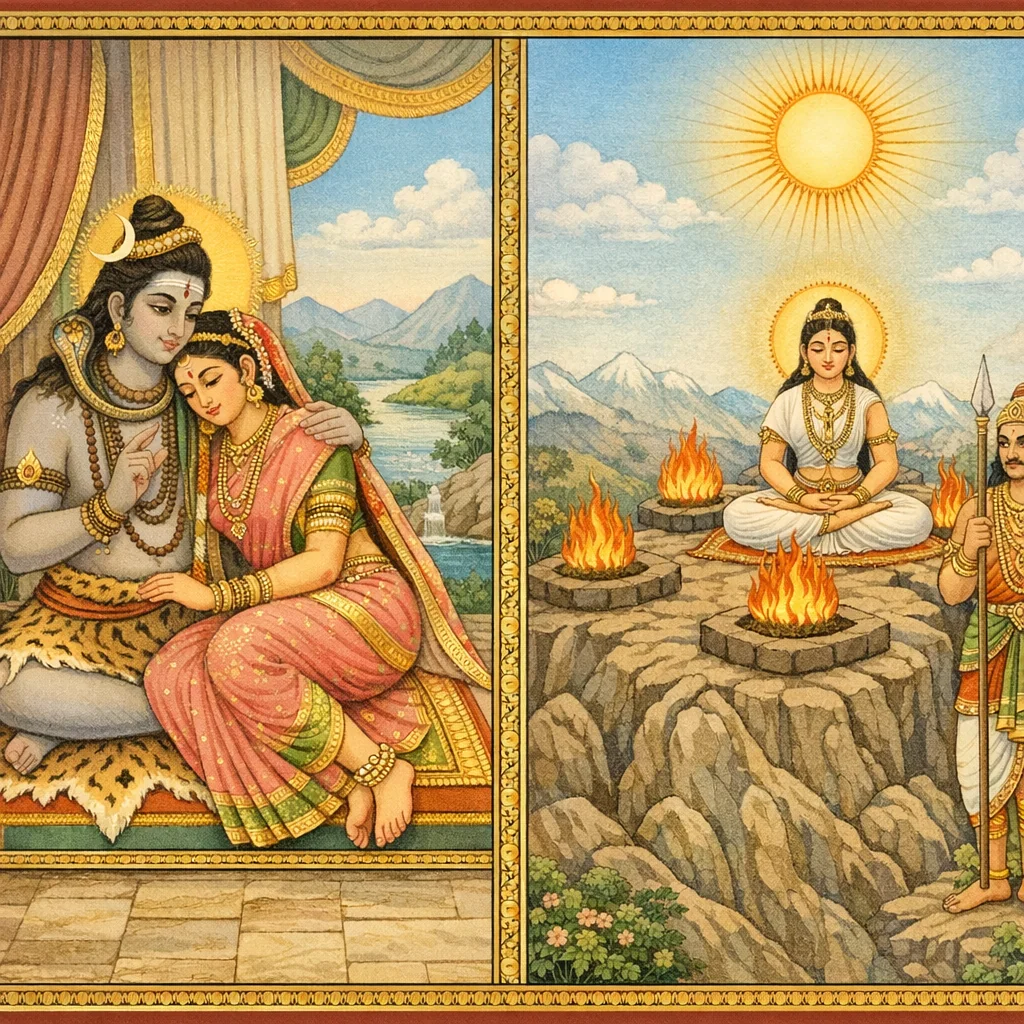
The chapter begins with Nārada’s narration: as Girijā (Pārvatī) departs, she meets the radiant mountain-deity Kusumāmodinī, devoted to the Lord of the peak. The goddess affectionately asks why Pārvatī is leaving and learns the cause—a conflict arising in connection with Śaṅkara (Śiva). Pārvatī acknowledges the deity’s constant, motherly care and gives an immediate ethical-practical instruction: if any other woman approaches Pinākin (Śiva), her attendant/son must report it, and proper correction will follow. Pārvatī then goes to a beautiful high summit, lays aside her ornaments, dons bark garments, and undertakes tapas—enduring the “five fires” in summer and water-discipline in the rains—protected by her attendant/son Vīraka. The guardian is charged to enforce a protective boundary near Śiva’s vicinity; he agrees, then approaches (addressed as Gajavaktra) with an emotional plea to be taken along as well, citing shared destiny and the dharmic need to overcome deceitful adversaries. The episode teaches ascetic discipline, relational duty, and regulated access to sacred proximity.
Shlokas
Verse 1
। नारद उवाच । व्रजंती गिरिजाऽपश्यत्सखीं मातुर्महाप्रभाम् । कुसुमामोदिनींनाम तस्य शैलस्य देवताम्
Nārada said: As Girijā was going, she saw her mother’s radiant friend—the deity of that mountain—named Kusumāmodinī.
Verse 2
सापि दृष्ट्वा गिरिसुतां स्नेहविक्लवमानसा । क्वपुनर्गच्छसीत्युच्चैरालिंग्योवाच देवता
Seeing the Mountain’s daughter, the Goddess—her heart shaken with tender love—embraced her and asked aloud, “Where are you going again?”
Verse 3
सा चास्यै सर्वमाचख्यौ शंकरात्कोपकारणम् । पुनश्चोवाच गिरिजा देवतां मातृसंमताम्
She told her everything—the cause of her anger arising from Śaṅkara; and again Girijā spoke to the Goddess, approved and trusted by her mother.
Verse 4
नित्यं शैलाधिराजस्य देवता त्वमनिंदिते । सर्वं च सन्निधानं च मयि चातीव वत्सला
“Blameless one, you are ever the deity of the Lord of mountains; you know all, are ever present—and are exceedingly affectionate toward me.”
Verse 5
तदहं संप्रवक्ष्यामि यद्विधेयं तवाधुना । अथान्य स्त्रीप्रवेशे तु समीपे तु पिनाकिनः
“Therefore I shall tell you what should be done by you now. But as for another woman entering into the proximity of Pinākin (Śiva)…”
Verse 6
त्वयाख्येयं मम शुबे युक्तं पश्चात्करोम्यहम् । तथेत्युक्ते तया देव्या ययौ देवी गिरिं प्रति
“O auspicious one, tell me what is to be conveyed; thereafter I shall do what is proper.” When the Goddess spoke thus, Devī (Pārvatī) set out toward the mountain.
Verse 7
रम्ये तत्र महाशृंगे नानाश्चर्योपशोभिते । विभूषणादि सन्यस्य वृक्षवल्कलधारिणी
There, upon a lovely lofty peak adorned with many marvels, she set aside ornaments and the like; and, clad in garments of tree-bark, she embraced the sacred life of austerity (tapasya).
Verse 8
तपस्तेपे गिरिसुता पुत्रेण परिपालिता । ग्रीष्मे पंचाग्निसंतप्ता वर्षासु च जलोषिता
The Daughter of the Mountain performed austerities, protected and attended by her son. In summer she endured the heat of the five fires, and in the rainy season she remained immersed in water.
Verse 9
यथा न काचित्प्रविशेद्योषिदत्र हरांतिके । दृष्ट्वा परां स्त्रियं चात्र वदेथा मम पुत्रक
“See that no woman at all enters here, near Hara. And if you should notice any other woman here, tell me at once, my son.”
Verse 10
शीघ्रमेव करिष्यामि ततो युक्तमनंतरम् । एवमस्त्विति तां देवीं वीरकः प्राह सांप्रतम्
“I shall do it at once; thereafter, what is fitting will follow without delay.” Saying, “So be it,” Vīraka then addressed the Goddess.
Verse 11
मातुराज्ञा सुतो ह्लाद प्लावितांगो गतज्वरः । जगाम त्र्यक्षं संद्रष्टुं प्रणिपत्य च मातरम्
By his mother’s command, the son—his body thrilled with joy and his fever gone—bowed to his mother and went to behold the Three-Eyed Lord.
Verse 12
गजवक्त्रं ततः प्राह प्रणम्य समवस्थितम् । साश्रुकंठं प्रयाचंतं नय मामपि पार्वति
Then he spoke to Gajavaktra, the Elephant-Faced One, who stood there after bowing—his throat choked with tears as he pleaded: “O Pārvatī, take me also with you.”
Verse 13
गजवक्त्रं हि त्वां बाल मामिवोपहसिष्यति । तदागच्छ मया सार्धं या गतिर्मे तवापि सा
“Child, Gajavaktra will surely mock you, just as he mocks me. Therefore come with me; whatever course is mine, that shall be yours as well.”
Verse 14
पराभवाद्धि धूर्तानां मरणं साधु पुत्रक । एवमुक्त्वा समादाय हिमाद्रिं प्रति सा ययौ
“Indeed, for the deceitful, death comes from humiliation; it is well, my son.” Having said this, she took him along and went toward Himādri, the Himalaya.