Adhyaya 48
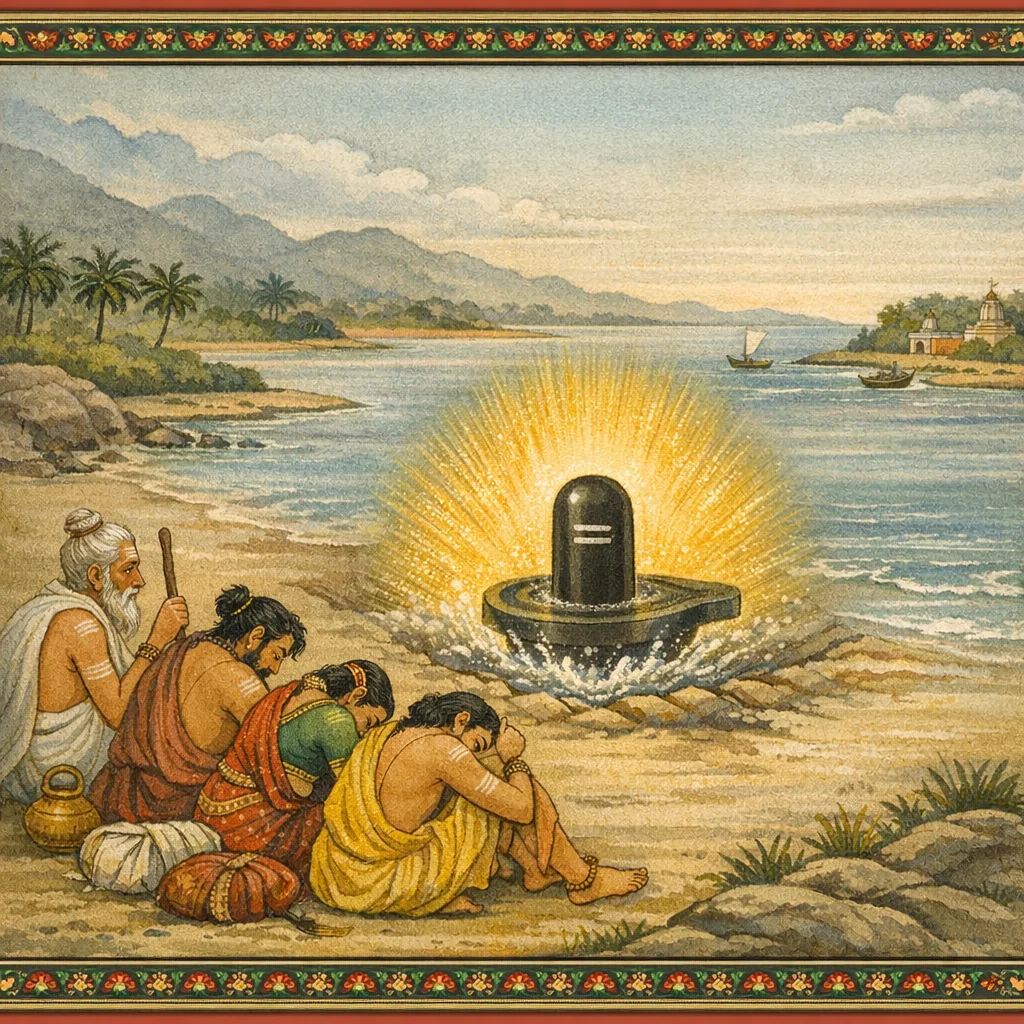
The chapter begins with Nārada’s vow to set forth clearly the māhātmya of Somanātha, declaring that hearing and reciting it become means to pāpa-mokṣa. Two radiant Brahmins, Ūrjayanta and Prāleya, encounter a verse praising Prabhāsa and its tīrthas, and are stirred to undertake pilgrimage for ritual bathing. They travel through forests and across rivers, including the Narmadā, reaching a sacred tract envisioned as the meeting of land and sea. Weariness, hunger, and thirst test their pilgrim discipline; they collapse near a Siddhaliṅga and bow to Siddhanātha. In that liminal moment a liṅga is said to arise, with a heavenly voice and a rain of flowers, granting Prāleya a fruit equal to Somanātha and pointing to a liṅga established on the seashore. The narrative then turns back to Prabhāsa and presents a dual Somanātha motif—two manifestations linked to the two travelers. Hāṭakeśvara is introduced: Brahmā is described as establishing a liṅga, followed by a structured hymn enumerating Śiva’s cosmic forms in aṣṭamūrti imagery (sun/fire, earth, wind, sky/sound, and more). The phalaśruti concludes that reciting or hearing Brahmā’s hymn and remembering Hāṭakeśvara brings sāyujya with the eightfold Śiva, and affirms the abundance of puṇya-places at the land–ocean confluence.
Shlokas
Verse 1
नारद उवाच । अथातः संप्रवक्ष्यामि सोमनाथमहिं स्फुटम् । शृण्वन्यां कीर्त यिष्यामि पापमोक्षमवाप्नुयात्
Nārada said: “Now I shall clearly expound the greatness of Somanātha. I will proclaim it; whoever listens attains liberation from sin.”
Verse 2
पुरा त्रेतायुगे पार्थ चौडदेशसमुद्भवौ । ऊर्जयंतश्च प्रालेयो विप्रावास्तां महाद्युती
Formerly, in the Tretā age, O Pārtha, there were two radiant brāhmaṇas born in the land of Cauḍa—Ūrjayanta and Prāleya.
Verse 3
तावेकदा पुराणार्थे श्लोकमेकमपश्यताम् । तं दृष्ट्वा सर्वशास्त्रज्ञावास्तां कंटकितत्वचौ
Once, while examining the meaning of the Purāṇas, the two beheld a certain śloka. On seeing it, those knowers of all śāstras were thrilled with sacred rapture—gooseflesh rose upon their skin.
Verse 4
प्रभासाद्यानि तीर्थानि पुलस्त्यायाह पद्मभूः । न यैस्तत्राप्लुतं चैव किं तैस्तीर्थमुपासितम्
Padmabhū (Brahmā) declared to Pulastya concerning the sacred tīrthas beginning with Prabhāsa: “Those who have not bathed there—what have they truly gained by resorting to other tīrthas?”
Verse 5
इति श्लोकं पठित्वा तौ पुनःपुनरभिष्टुतम् । तर्ह्येव च प्रभासाय निःसृतौ स्नातुमुत्तमौ
Having read that śloka, the two praised it again and again. Then and there, those excellent men set out for Prabhāsa in order to bathe.
Verse 6
तौ वनानि नदीश्चैव व्यतिक्रम्य शनैःशनैः । महर्षिगणसंकीर्णामुत्तीणौ नर्मदां शिवाम्
Passing gradually through forests and rivers, the two crossed the auspicious Narmadā, thronged with hosts of great ṛṣis.
Verse 7
गुप्तक्षेत्रस्य माहात्म्यं महीसागरसंगमम् । तत्र स्नात्वा प्रभासाय तन्मध्येन प्रतस्थतुः
They heard of the greatness of Guptakṣetra and of the confluence where the land meets the ocean. Having bathed there, they set out for Prabhāsa, proceeding by that very route.
Verse 8
ततो मार्गस्य शून्यत्वात्तृट्क्षुधापीडितौ भृशम् । आस्तां विचेतनौ विप्रौ सिद्धलिंगसमीपतः
Then, because the road was desolate, the two brāhmaṇas were sorely afflicted by thirst and hunger. Near the Siddhaliṅga they lay senseless, faint and undone.
Verse 9
सिद्धनाथं नमस्कृत्य संप्रयातौ सुधैर्यतः । क्षुधावेगेन तीव्रेण तृषा मध्यार्कतापितौ
Having bowed to Siddhanātha, they went on with steady courage; yet the midday sun scorched them, and fierce hunger and thirst drove them hard.
Verse 10
सहसा पतितौ भूमौ स्थूणपादौ विमूर्छितौ । ततो मुहूर्तात्प्रालेय ऊर्जयंतमभाषत
All at once they fell upon the ground, their feet rigid like pillars, and swooned. After a short while, Prāleya spoke to Ūrjayanta.
Verse 11
किंचिद्विश्वस्य धैर्याच्च सखे किं न श्रुतं त्वया । यथा यथा विवर्णांगो जायते तीर्थयात्रया
Friend, have you not heard—even a little—of the steadfast endurance required in this world? For when one sets out on pilgrimage to the sacred tīrthas, the body may again and again grow pale and worn.
Verse 12
तथातथा भवेद्दानैर्दीनः सोमेश्वरो हरः । तथाऽस्तां लुंठमानौ तावेवमुक्ते श्रुतेऽपि च
“So too, through gifts and charity, Hara—Someshvara—becomes gracious to the afflicted.” Yet even after these words were spoken and heard, the two still lay there, rolling about in helpless weakness.
Verse 13
लुंठमानो जगामैव प्रालेयः किंचिदंतरे । उत्थितं सहसा लिंगं भूमिं भित्त्वा सुदुर्दृशम्
Still writhing, Prāleya moved on a little distance. Then, all at once, a liṅga arose—splitting the earth—terrible and awe-inspiring to behold.
Verse 14
खे वाणी चाभवत्तत्र पुष्पवर्षपुरःसरा । प्रालेय तव हेतोस्तु सोमनाथसमं फलम् । उत्थितं सागरतटे लिंगं तिष्ठात्र सुव्रत
Then a voice resounded in the sky, preceded by a shower of flowers: ‘Prāleya, because of you, the fruit here shall be equal to that of Somanātha. This liṅga has arisen on the ocean-shore—let it remain here, O noble-vowed one.’
Verse 15
प्रालेय उवाच । यद्येवं सत्यमेतच्च तथाप्यात्मा प्रकल्पितः
Prāleya said: ‘If this indeed is true—then even so, my resolve is already fixed.’
Verse 16
प्रभासाय प्रयातव्यं यदाऽमृत्योर्मया स्फुटम् । ततश्चैवोर्ज्जयंतोऽपि मूर्छाभावाल्लुठन्पुरः
‘I must go on to Prabhāsa—this I have clearly resolved, even at the cost of my life.’ Then Ūrjayanta too, overcome by faintness, continued ahead while crawling and rolling along.
Verse 17
अपश्यदुत्थितं लिंगं स चैवं प्रत्यपद्यत । ततः प्रत्यक्षतां प्राप्तो भवश्चक्रे तयोर्दृढे
He beheld the Liṅga rising up, and thus he understood the truth of it. Thereupon Bhava (Śiva) became directly manifest and made their resolve firm and unshakable.
Verse 18
दृष्ट्या तनू ततो यातौ प्रभासं शिवसद्म च । तावेतौ सोमनाथौ द्वौ सिद्धेश्वरसमीपतः
Then, by mere vision, their bodies were borne to Prabhāsa and to Śiva’s sacred abode. Those two became the twin Somanāthas, abiding near Siddheśvara.
Verse 19
ऊर्जयंतः प्रतीच्यां च प्रालेयस्येश्वरोऽपरः । सोमकुडांभसि शनैः स्नात्वार्णवमहीजले
And in the western quarter is another Lord—Prāleyeśvara—who bestows strength. One should bathe gently in the waters of Soma-kuḍa, where ocean-water mingles with the waters of the earth.
Verse 20
सोमनाथद्वयं पश्येज्जन्मपापात्प्रमुच्यते । ब्रह्मात्र स्थापयित्वा तु हाटकेश्वर संज्ञितम्
Whoever beholds the pair of Somanāthas is freed from the sins accumulated from birth. Here Brahmā established a liṅga known by the name Hāṭakeśvara.
Verse 21
महीनगरके लिंगं पातालात्सुमनोहरम् । तुष्टाव देवं प्रयतः स्तुतिं तां शृणु पांडव
In Mahī-nagara there is a supremely beautiful Liṅga that arose from Pātāla. Then, with focused devotion, he praised the Lord. Listen to that hymn, O Pāṇḍava.
Verse 22
नमस्ते भगवन्रुद्र भास्करामिततेजसे । नमो भवाय रुद्राय रसायांबुमयाय ते
Salutations to You, O blessed Rudra, whose splendor is immeasurable like the sun. Salutations to Bhava-Rudra, to You who are formed of the earth’s essence and of water.
Verse 23
शर्वाय क्षितिरूपाय सदा सुरभिणे नमः । ईशाय वायवे तुभ्यं संस्पर्शाय नमोनमः
Homage to Śarva, whose form is the earth, ever fragrant and life-bearing. Homage again and again to you, O Īśa, who are the wind and the very principle of touch.
Verse 24
पशूनां पतये चापि पावकायातितेजसे । भीमाय व्योमरूपाय शब्दमात्राय ते नमः
Homage to Paśupati, Lord of all creatures, and to you as Fire of surpassing brilliance. Homage to Bhīma, whose form is the sky, and who is the very subtle essence of sound.
Verse 25
महादेवाय सोमाय अमृताय नमोऽस्तु ते । उग्राय यजमानाय नमस्ते कर्मयोगिने
Homage be to you, Mahādeva—Soma—immortal nectar itself. Salutations to you, the Terrible One, the Sacrificer, the Lord united with the path of sacred action.
Verse 26
इत्येवं नामभिर्दिव्यैः स्तव एष उदीरितः । यः पठेच्छृणुयाद्वापि पितामहकृतं स्तवम्
Thus this hymn has been proclaimed through divine names. Whoever recites it—or even hears it—this hymn composed by the Grandsire (Brahmā)…
Verse 27
हाटकेश्वरलिंगस्य नित्यं च प्रयतो नरः । अष्टमूर्तेः स सायुज्यं लभते नात्र संशयः
A disciplined man who, with purity of conduct, worships Hāṭakeśvara-liṅga daily attains sāyujya—intimate union—with the Eight-Formed Lord (Śiva as Aṣṭamūrti). Of this there is no doubt.
Verse 28
हाटकेश्वरलिंगं च प्रयतो यः स्मरेदपि । तस्य स्याद्वरदो ब्रह्मा तेनेदं स्थापितं जय
Even one who, with self-restraint, merely remembers the Hāṭakeśvara-liṅga finds Brahmā gracious and boon-giving to him; for it was by Brahmā that this (liṅga) was established, O Jaya.
Verse 29
एवंविधानि तीर्थानि महीसागरसंगमे । बहूनि संति पुण्यानि संक्षेपाद्वर्णितानि मे
At the confluence of land and ocean there are many such sacred tīrthas—numerous and merit-bestowing. I have described them only in brief.
Verse 48
इति श्रीस्कांदे महापुराण एकाशीतिसाहस्र्यां संहितायां प्रथमे माहेश्वरखण्डे कौमारिकाखण्डे स्तम्भतीर्थमाहात्म्ये सोमनाथवृत्तांतवर्णनंनामाष्टचत्वारिंशोऽध्यायः
Thus ends the forty-eighth chapter, called “The Narration of the Account of Somanātha,” in the Stambhatīrtha-māhātmya, within the Kaumārikākhaṇḍa of the first Māheśvarakhaṇḍa of the Śrī Skanda Mahāpurāṇa (the collection of eighty-one thousand verses).