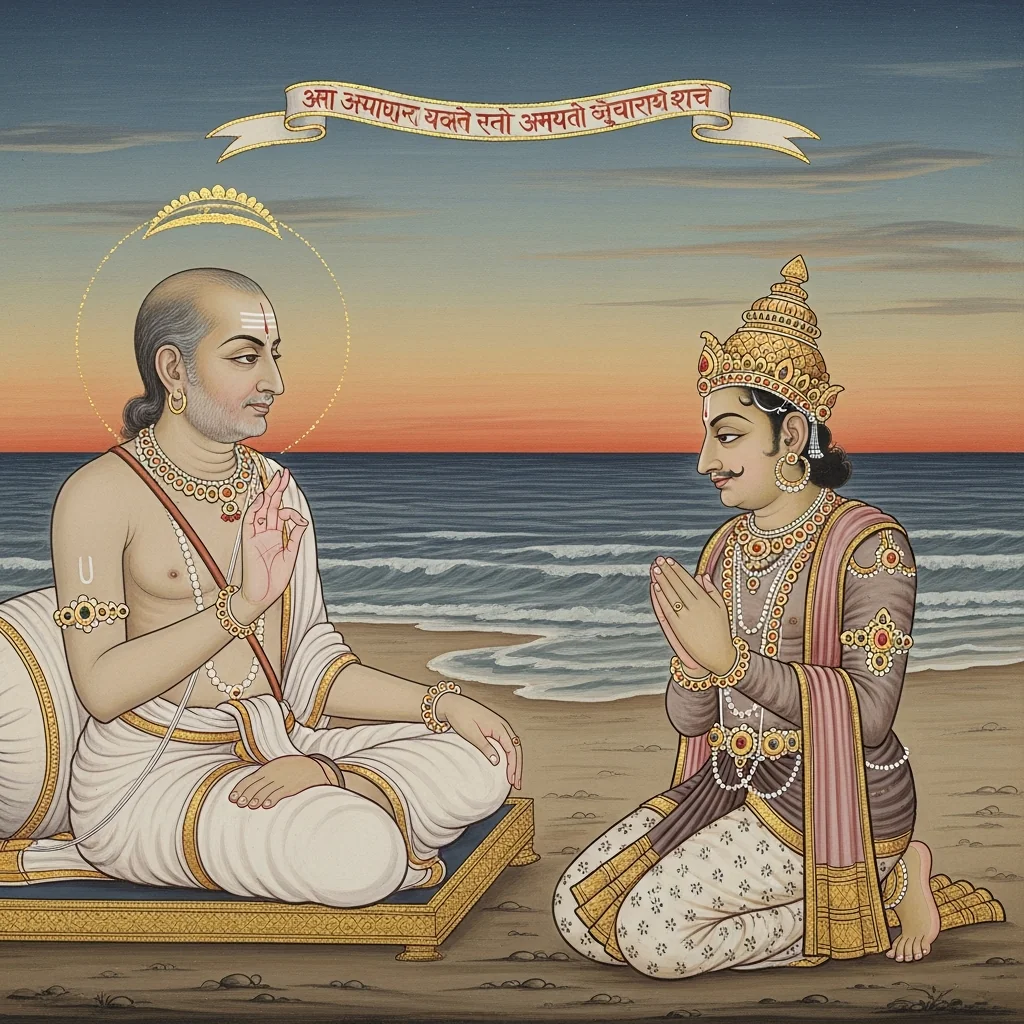
Adhyaya 4
This chapter unfolds as a theological and ethical teaching prompted by Nārada’s practical concern: how to obtain a secure dwelling or estate without falling into morally tainted acceptance (pratigraha). It begins by classifying wealth by moral quality—śukla (pure), śabala (mixed), and kṛṣṇa (dark)—and explains the karmic results of using each for dharma: leading to divine status, human birth, or animal existence. Nārada then recounts a public episode in Saurāṣṭra. King Dharmavarma receives an enigmatic verse on dāna, listing two causes, six bases, six limbs, two “ripenings,” four types, a threefold ranking, and three destroyers of giving, and he offers great rewards for its correct explanation. Disguised as an aged brāhmaṇa, Nārada explains: the two causes are śraddhā (faith) and śakti (capacity); the six bases are dharma, artha, kāma, vrīḍā (modesty), harṣa (joy), and bhaya (fear); and the six limbs include donor, recipient, purity, the gift-object, dharma-intent, and proper place and time. The two “ripenings” distinguish otherworldly and this-worldly fruition according to the recipient’s worth; the four types are dhruva, trika, kāmya, and naimittika; gifts are graded as superior, middling, or minor; and giving is ruined by regret after giving, giving without faith, and giving with insult. The chapter ends with the king’s gratitude, Nārada’s self-revelation, and Dharmavarma’s readiness to grant land and wealth for Nārada’s stated sacred purpose.
Shlokas
Verse 1
नारद उवाच । ततस्त्वहं चिंतयामि कथं स्थानमिदं भवेत् । ममायत्तं यतो राज्ञां भूमिरेषा सदा वशे
Nārada said: Then I considered, “How can this become a sacred establishment? For this land is under my control, and kings are ever held in check (by my influence).”
Verse 2
यत्त्वहं धर्मवर्णाणं गत्वा याचे ह मेदिनीम् । अर्पयत्येव स च मे याचितो न पुनः परः
If I go to that righteous lord (of the realm) and request the land, he will indeed grant it to me when asked—he will not refuse thereafter.
Verse 3
तथा हि मुनिभिः प्रोक्तं द्रव्यं त्रिविधमुत्तमम् । शुक्लं मध्यं च शबलमधमं गृष्णमुच्यते
For thus have the sages taught: wealth (or gifts) are of three superior kinds—white (pure), middling, and mixed; but the lowest is said to be ‘black’ (tainted).
Verse 4
श्रुतेः संपादनाच्छिष्यात्प्राप्तं शुक्लं च क्न्ययया । तथा कुसीदवाणिज्यकृषियाचितमेव च
Wealth gained by preserving and transmitting Śruti (sacred learning), received from disciples, and obtained through a maiden (as a lawful gift or dowry) is called ‘white’ (pure). So too are gains from interest, trade, agriculture, and even what is acquired by begging.
Verse 5
शबलं प्रोच्यते सद्भिर्द्यूतचौर्येण साहसैः । व्याजेनोपार्जितं यच्च तत्कृष्णं समुदाहृतम्
The righteous call ‘mixed’ (śabala) that wealth which is gained through gambling, theft, and violent or reckless deeds. But whatever is earned by deceitful pretexts and fraud is declared ‘black’ (impure).
Verse 6
शुक्लवित्तेन यो धर्मं प्रकुर्याच्छ्रद्धयान्वितः । तीर्थं पात्रं समासाद्य देवत्वे तत्समश्नुते
One who performs dharma with pure wealth, endowed with faith, and who offers it at a sacred tīrtha to a worthy recipient—he attains divine status as its fruit.
Verse 7
राजसेन च भावेन वित्तेन शबलेन च । प्रदद्याद्दानमर्थिभ्यो मानुष्यत्वे तदश्नुते
But one who gives charity with a rājasa (passionate) disposition and with mixed (tainted) wealth, giving to those who ask—he gains the fruit of continued human birth.
Verse 8
तमोवृतस्तु यो दद्यात्कृष्णवित्तेन मानवः । तिर्यक्त्वे तत्फलं प्रेत्य समश्राति नराधमः
A man shrouded in tamas (darkness) who gives using ‘black’ (impure) wealth—after death, that vile person reaps the fruit as an animal birth.
Verse 9
तत्तु याचितद्रव्यं मे राजसं हि स्फुटं भवेत् । अथ ब्राह्मणभावेन नृपं याचे प्रतिग्रहम्
Yet the wealth I obtain by begging is clearly of a rājasa character. And if, adopting the stance of a brāhmaṇa, I ask a king for a gift, that is ‘pratigraha’—the acceptance of a donation.
Verse 10
तदप्यहो चातिकष्ट हेतुना तेन मे मतम् । अयं प्रतिग्रहो घोरो मध्वास्वादो विषोपमः
Yet even that, alas, seems a path of grave hardship—such is my judgment. This acceptance of gifts is dreadful: sweet to the taste like honey, yet poison-like in its consequence.
Verse 11
प्रतीग्रहेण संयुक्तं ह्यमीवमाविशोद्द्विजम् । तस्मादहं निवृत्तश्च पापादस्मात्प्रतिग्रहात्
For a sickness, bound up with the acceptance of gifts, entered the twice-born. Therefore I have withdrawn from this sin—this practice of accepting gifts.
Verse 12
ततः केनाप्युपायेन द्वयोरन्यतरेण तु । स्वायत्तं स्थानक कुर्म एतत्सञ्चिंतये मुहुः
Therefore, by some means—by one of the two ways—I must establish a settled livelihood under my own control; upon this I reflect again and again.
Verse 13
यथा कुभार्यः पुरुषश्चिन्तांतं न प्रपद्यते । तथैव विमृशंश्चाहं चिंतांतं न लभाम्यणु
Just as a man with a wicked wife does not reach the end of his anxieties, so too—even though I deliberate—I do not find even the slightest end to my worries.
Verse 14
एतस्मिन्नन्तरे पार्थ स्नातुं तत्र समागताः । बहवो मुनयः पुण्ये महीसागरसंगमे
Just then, O Pārtha, many sages arrived there to bathe at that holy confluence where the land meets the ocean.
Verse 15
अहं तानब्रवं सर्वान्कुतो यूयं समागताः । ते मामूचुः प्रणम्याथ सौराष्ट्रविषये मुने
I asked them all, “From where have you come?” They bowed to me and replied, “O sage, from the region of Saurāṣṭra.”
Verse 16
धर्मवर्मेति नृपतिर्योऽस्य देशस्य भूपतिः । स तु दानस्य तत्त्वार्थी तेपे वर्षगणान्बहून्
“The king named Dharmavarman, ruler of this land—seeking the true principle of dāna (charitable giving)—performed austerities for many years.”
Verse 17
ततस्तं प्राह खे वाणी श्लोकमेकं नृप श्रृणु । द्विहेतु षडधिष्ठानं षडंगं च द्विपाकयुक्
Then a voice in the sky addressed him: “O king, listen to this single verse: dāna has two causes, six foundations, six limbs, and is connected with a twofold fruition.”
Verse 18
चतुःप्रकारं त्रिविधं त्रिनाशं दानमुच्यते । इत्येकं श्लोकमाभाष्य खे वाणी विरराम ह
“Dāna is said to be of four kinds, threefold, and marked by three ‘failures’ that destroy its merit.” Having spoken this one verse, the celestial voice fell silent.
Verse 19
श्लोकस्यार्थं नावभाषे पृच्छमानापि नारद । ततो राजा धर्मवर्मा पटहेनान्वघोषयत्
O Nārada, even when questioned, the meaning of that verse was not explained. Then King Dharmavarman had a proclamation made by drumbeat.
Verse 20
यस्तु श्लोकस्य चैवास्य लब्धस्य तपसा मया । करोति सम्यगव्याख्यानं तस्य चैतद्ददाम्यहम्
Whoever gives a correct explanation of this śloka—obtained by me through tapas (austerity)—to him I shall grant this reward.
Verse 21
गवां च सप्त नियुतं सुवर्णं तावदेव तु । सप्तग्रामान्प्रयच्छामि श्लोकव्याख्यां करोति यः
To the one who explains the śloka, I will give seven niyutas of cows, an equal amount of gold, and seven villages.
Verse 22
पटहेनेति नृपतेः श्रुत्वा राज्ञो वचो महत् । आजग्मुर्बहुदेशीया ब्राह्मणाः कोटिशो मुने
Hearing the king’s great announcement proclaimed by drumbeat, brāhmaṇas from many lands came in crores, O sage.
Verse 23
पुनर्दुर्बोधविन्यासः श्लोकस्तैर्विप्रपुंगवैः । आख्यातुं शक्यते नैव गुडो मूकैर्यथा मुने
Yet that śloka, arranged in a hard-to-grasp manner, could not be explained even by those foremost among brāhmaṇas—just as the taste of guḍa (jaggery) cannot be conveyed by the mute, O sage.
Verse 24
वयं च तत्र याताः स्मो धनलोभेन नारद । दुर्बोधत्वान्नमस्कृत्य श्लोकं चात्र समागताः
O Nārada, driven by greed for wealth we went there; and, since the śloka was hard to understand, we bowed in reverence and gathered here, bringing that very śloka with us.
Verse 25
दुर्व्याख्येयस्त्वयं श्लोको धनं लभ्यं न चैव नः । तीर्थयात्रां कथं यामीत्येवाचिंत्यात्र चागताः
This śloka is truly hard to expound, and we have gained no wealth at all. Thinking, “How then shall we set out on pilgrimage to the tīrthas?”, we have come here, anxious and deep in reflection.
Verse 26
एवं फाल्गुन तेषां तु वचः श्रुत्वा महात्मनाम् । अतीव संप्रहृष्टोऽहं तान्विसृज्येत्यचिंतयम्
Thus, O Phālguna, having heard the words of those great-souled men, I was exceedingly delighted and thought, “I shall help them and then send them onward.”
Verse 27
अहो प्राप्त उपायो मे स्थानप्राप्तौ न संशयः । श्लोकं व्याख्याय नृपतेर्लप्स्ये स्थानं धनं तथा
Ah! A means has come to me—there is no doubt I shall obtain a position. By explaining this śloka to the king, I will gain both office and wealth.
Verse 28
विद्यामूल्येन नैवं च याचितः स्यात्प्रतिग्रहः । सत्यमाह पुराणार्षिर्वासुदेवो जगद्गुरुः
A gift received as the “price of learning” should not be solicited in this manner. Truly spoke the Purāṇic seer—Vāsudeva, the Guru of the world.
Verse 29
धर्मस्य यस्य श्रद्धा स्यान्न च सा नैव पूर्यते । पापस्य यस्य श्रद्धास्यान्न च सापि न पूर्यते
He whose faith is set on dharma, yet that faith does not come to fulfillment; and he whose faith is set on sin, yet even that does not come to fulfillment—such a person remains frustrated on both sides.
Verse 30
एवं विचिंत्य विद्वांसः प्रकुर्वंति यथारुचि । सत्यमेतद्विभोर्वाक्यं दुर्लभोऽपि यथा हि मे
Thus reflecting, the learned act according to their own inclination. This utterance of the Lord is true, though for me it has indeed been hard to attain.
Verse 31
मनोरथोऽयं सफलः संभूतोंकुरितः स्फुटम् । एनं च दुर्विदं श्लोकमहं जानामि सुस्फुटम्
This desire of mine has borne fruit—truly it has arisen and sprouted forth in clarity. And this śloka, hard to fathom, I now understand with perfect lucidity.
Verse 32
अमूर्तैः पितृभिः पूर्वमेव ख्यातो हि मे पुरा । एवं हर्षान्वितः पार्थ संचिंत्याऽहं ततो मुहुः
Formerly indeed, the formless Pitṛs had already made it known to me. Thus, O Pārtha, filled with joy, I reflected upon it again and again.
Verse 33
प्रणम्य तीर्थं चलितो महीसागरसंगमम् । वृद्धब्राह्मणरूपेण ततोहं यातवान्नृपम्
Having bowed in reverence to the tīrtha, I set out for the meeting-place of land and ocean. Then, assuming the form of an aged brāhmaṇa, I went to the king.
Verse 34
इदं भणितवानस्मि श्लोकव्याख्यां नृप श्रृणु । यत्ते पटहविख्यातं दानं च प्रगुणीकुरु
Thus have I spoken; now, O king, listen to the clear exposition of this verse. And duly prepare your dāna—proclaimed publicly by the beat of the drum—making it properly ready.
Verse 35
एवमुक्ते नृपः प्राह प्रोचुरेवं हि कोटिशः । द्विजोत्तमाः पुनर्नस्यं प्रोक्तुमर्थो हि शक्यते
When this was said, the king replied: “Truly, this has been spoken in the same manner millions of times. O best of the twice-born, how can this matter be stated again in a fresh and meaningful way?”
Verse 36
के द्विहेतू षडाख्यातान्यधिष्ठानानि कानि च । कानि चैव षडंगानि कौ द्वौ पाकौ तथा स्मृतौ
“What are the two causes (of dāna), and what are the six foundations that are declared? What indeed are the six limbs, and which two ‘ripenings/results’ are remembered in the tradition?”
Verse 37
के च प्रकाराश्चत्वारः किंस्वित्तत्त्रिविधं द्विज । पयो नाशाश्च के प्रोक्ता दानस्यैतत्स्फुटं वद
“What are the four modes (of dāna), and what is that which is said to be threefold, O twice-born? And what ‘losses’ are taught regarding dāna? Speak all this clearly.”
Verse 38
स्फुटान्प्रश्नानिमान्सप्त यदि वक्ष्यसि ब्राह्मण । ततो गवां सप्तनियुतं सुवर्णं तावदेव तु
“If you will answer these seven clear questions, O brāhmaṇa, then I shall give seven thousand cows—and an equal measure of gold as well.”
Verse 39
सप्त ग्रामांश्च दास्यामि नो चेद्यास्यसि स्वं गृहम् । इत्युक्त्वा वचनं पार्थ सौराष्ट्रस्वामिनं नृपम्
“And I shall also give seven villages; otherwise you will not be allowed to go to your own home.” Having spoken these words, O Pārtha, to the king who was lord of Saurāṣṭra…
Verse 40
धर्मवर्माणमस्त्वेवं प्रावोचमवधारय । श्लोकव्याख्यां स्फुटां वक्ष्ये दानहेतू च तौ श्रृणु
So be it, O Dharmavarman—grasp well what I now proclaim. I shall plainly set forth the explanation of this śloka; and listen also to the two causes of sacred giving (dāna).
Verse 41
अल्पत्वं वा बहुत्वं वा दानस्याभ्युदयावहम् । श्रद्धा शक्तिश्च दानानां वृद्ध्यक्षयकरेहि ते
Whether the gift be small or great, dāna can bring an auspicious rise. For śraddhā—reverent faith—and one’s capacity are what make the fruit of giving increase, or else diminish.
Verse 42
तत्र श्रद्धाविषये श्लोका भवन्ति । कायक्लेशैश्च बहुभिर्न चैवारथस्य राशिभिः
On that matter—śraddhā—there are verses: not by many bodily hardships, nor indeed by heaps of wealth alone (is dharma attained).
Verse 43
धर्मः संप्राप्यते सूक्ष्मः श्रद्धा धर्मोऽद्भुतं तपः । श्रद्धा स्वर्गश्च मोक्षश्च श्रद्धा सर्वमिदं जगत्
The subtle essence of dharma is attained through śraddhā. Śraddhā itself is dharma; it is wondrous tapas. Śraddhā is heaven and liberation (mokṣa); śraddhā is this entire world.
Verse 44
सर्वस्वं जीवितं चापि दद्यादश्रद्धया यदि । नाप्नुयात्स फलं किंचिच्छ्रद्दधानस्ततो भवेत्
Even if one were to give away everything, even one’s very life, if it is done without śraddhā, no fruit at all is gained. Therefore, one should become a giver endowed with śraddhā—reverent faith.
Verse 45
श्रद्धया साध्यते धर्मो महद्भिर्नार्थराशिभिः । अकिंचना हि मुनयः श्रद्धावंतो दिवं गताः
Dharma is fulfilled through śraddhā—reverent faith—not by great heaps of wealth. Sages who owned nothing, yet were filled with faith, have attained heaven.
Verse 46
त्रिविधा भवति श्रद्धा देहिनां सा स्वभावजा । सात्त्विकी राजसी चैव तामसी चेति तां श्रृणु
The śraddhā of embodied beings is threefold, born of their own nature: sāttvika, rājasika, and tāmasika. Hear of it.
Verse 47
यजंते सात्त्विका देवान्यक्षरक्षांसि राजसाः । प्रेतान्भूतपिशाचांश्च यजंते तामसा जनाः
Those of sāttvika disposition worship the devas; those of rājasika disposition worship yakṣas and rākṣasas; and tāmasika people worship pretas, bhūtas, and piśācas.
Verse 48
तस्माच्छ्रद्धावता पात्रे दत्तं न्यायार्जितं हि यत् । तेनैव भगवान्रुद्रः स्वल्पकेनापि तुष्यति
Therefore, whatever is given with śraddhā to a worthy recipient, and earned by righteous means—by that alone Bhagavān Rudra is pleased, even if the gift is small.
Verse 49
शक्तिविषये च श्लोका भवंति । कुटुंबभुक्तवसनाद्देयं यदतिरिच्यते । मध्वास्वादो विषं पश्चाद्दातुर्धर्मोऽन्यथा भवेत्
On the measure of one’s capacity, these verses are taught: after one’s family has been fed and clothed, whatever remains should be given. Sweet at first like honey but poison afterward is the ‘charity’ of a giver when dharma is done in a way that harms rightful duties.
Verse 50
शक्ते परजने दाता स्वजने दुःखजीविनि । मध्वापानविषादः स धर्माणां प्रतिरूपकः
To give to outsiders though one has the power to help, yet to let one’s own people live in misery, is like drinking honey and then suffering poison—only a counterfeit likeness of dharma.
Verse 51
भृत्यानामुपरोधेन यत्करोत्यौर्ध्वदैहिकम् । तद्भवत्यसुखोदकं जीवतोऽस्य मृतस्य च
Whatever post-death rite one performs by obstructing and oppressing servants becomes “water of sorrow,” bringing unhappiness to him both while living and after death.
Verse 52
सामान्यं याचितं न्यासमाधिर्दाराश्च दर्शनम् । अन्वाहितं च निक्षेपः सर्वस्वं चान्वये सति
Common property; what is obtained by solicitation; deposits and pledges; one’s wife; and whatever is held in trust or kept as a deposit—indeed, even one’s entire estate when heirs exist—these are not to be given away as dāna.
Verse 53
आपत्स्वपि न देयानि नववस्तूनि पंडितैः । यो ददाति स मूढात्मा प्रायाश्चित्तीयते नरः
Even in times of distress, the wise should not give away “new goods” (newly acquired or needed for stability). Whoever gives them is of deluded mind; such a person becomes one who must perform expiation (prāyaścitta).
Verse 54
इति ते गदितौ राजन्द्वौ हेतू श्रूयतामतः । अधिष्ठानानि वक्ष्यामि षडेव श्रृणु तान्यपि
Thus, O King, the two motives have been explained to you. Now listen further: I shall declare the six bases that drive charitable giving—hear those as well.
Verse 55
धर्ममर्थं च कामं च व्रीडाहर्षभयानि च । अधिष्ठानानि दानानां षडेतानि प्रचक्षते
Dharma, artha (gain), kāma (desire), and also shame, joy, and fear—these six are proclaimed as the bases that impel the act of giving (dāna).
Verse 56
पात्रेभ्यो दीयते नित्यमनपेक्ष्य प्रयोजनम् । केवलं धर्मबुद्ध्या यद्धर्मदानं तदुच्यते
That gift which is regularly given to worthy recipients, without regard for any personal end, and solely with a mind devoted to dharma—this is called ‘dharma-dāna’.
Verse 57
धनिनं धनलोभेन लोभयित्वार्थमाहरेत् । तदर्थदानमित्याहुः कामदानमतः श्रृणु
When one entices a wealthy man by appealing to his greed for wealth and thereby obtains resources, that is called ‘artha-dāna’ (giving rooted in gain). Now hear of ‘kāma-dāna’.
Verse 58
प्रयोजनमपेक्ष्यैव प्रसंगाद्यत्प्रदीयते । अनर्हेषु सरागेण कामदानं तदुच्यते
That which is given only with a personal end in view—out of attachment and casual impulse, even to the unworthy—is called ‘kāma-dāna’.
Verse 59
संसदि व्रीडयाऽश्रुत्य आर्थिभ्यः प्रददाति च । प्रतिदीयते च यद्दानं व्रीडादानमिति श्रुतम्
A gift given to petitioners in an assembly out of embarrassment—fearing ill repute—and then repaid in return is known as ‘vrīḍā-dāna’, giving born of shame.
Verse 60
दृष्ट्वा प्रियाणि श्रुत्वा वा हर्षवद्यत्प्रदीयते । हर्षदानमिति प्रोक्तं दानं तद्धर्मचिंतकैः
A gift offered with gladness after seeing or hearing something pleasing is called “joy-giving” (harṣa-dāna) by those who reflect on dharma.
Verse 61
आक्रोशानर्थहिंसानां प्रतीकाराय यद्भवेत् । दीयतेऽनुपकर्तृभ्यो भयदानं तदुच्यते
That which is given as a countermeasure against abuse, misfortune, or harm—given even to those who have rendered no help—is called “fear-giving” (bhaya-dāna).
Verse 62
प्रोक्तानि षडधिष्ठानान्यंगान्यपि च षट्च्छ्रुणु । दाता प्रतिग्रहीता च शुद्धिर्देयं च धर्मयुक्
The six bases have been stated; now hear also the six limbs of giving: the giver, the receiver, purity, the gift itself, and that which is aligned with dharma—
Verse 63
देशकालौ च दानानामंगान्येतानि षड्विदुः । अपरोगी च धर्मात्मा दित्सुरव्यसनः शुचिः
Place and time are also counted among the limbs of charity—these are known as six. A proper giver is free from illness, devoted to dharma, intent on giving, untroubled by vice, and pure.
Verse 64
अनिंद्याजीवकर्मा च षड्भिर्दाता प्रशस्यते । अनृजुश्चाश्रद्दधानोऽशांतात्मा धृष्टभीरुकः
A giver is praised when endowed with six qualities—among them, earning one’s livelihood by blameless means. But one who is crooked, faithless, inwardly unquiet, and at once impudent and fearful is not so commended.
Verse 65
असत्यसंधो निद्रालुर्दातायं तामसोऽधमः । त्रिशुक्लः कृशवृत्तिश्च घृणालुः सकलेंद्रियः
A donor bound to falsehood, drowsy with sleep and sunk in tamas is counted as base. Such a person—though outwardly ‘pure’ in three ways—lives meanly, is cruel, and is driven by the senses.
Verse 66
विमुक्तो योनिदोषेभ्यो ब्राह्मः पात्रमुच्यते । सौमुख्यादभिसंप्रीतिरर्थिनां दर्शने सदा । सत्कृतिश्चानसूया च तदा शुद्धिरिति स्मृता
One who is free from defects of birth and conduct is called a ‘brāhma’—a worthy vessel for gifts. With a gracious face he feels heartfelt joy on seeing those who seek help; he honors them and is without envy—this is remembered as purity.
Verse 67
अपराबाधमक्लेशं स्वयत्नेनार्जितं धनम् । स्वल्पं वा विपुलं वापि देयमित्यभिधीयते
Wealth earned by one’s own effort, without harming others and without oppressive strain—whether little or abundant—is declared fit to be given.
Verse 68
तेनापि किल धर्मेण उद्दिश्य किल किंचन । देयं तद्धर्मयुगिति शून्ये शून्यं फलं मतम्
Even with such righteous means, one should give something with a proper dedication and dharmic intention; for when the intention is void, the fruit is held to be void.
Verse 69
न्यायेन दुर्लभं द्रव्यं देशे कालेपि वा पुनः । दानार्हौ देशकालौ तौ स्यातां श्रेष्ठौ न चान्यथा
Wealth that is hard to obtain by lawful means—whether because of place or time—when given, makes that very place and that very time truly most excellent for charity, and not otherwise.
Verse 70
षंडगानीति चोक्तानि द्वौ च पाकावतः श्रृणु । द्वौ पाकौ दानजौ प्राहुः परत्राथ त्विहोच्यते
Thus the “six limbs” have been declared; now hear of the two “ripenings” (fruits). The sages proclaim that charity bears two ripenings—one in the world beyond, and one here in this very world.
Verse 71
सद्भ्यो यद्दीयते किंचित्तत्परत्रोपतिष्ठति । असत्सु दीयते किंचित्तद्दानमिह भुज्यते
Whatever is given to the good abides as merit in the hereafter. But whatever is given to the unworthy is spent here itself—its reward is only worldly.
Verse 72
द्वौ पाकाविति निर्दिष्टौ प्रकारांश्चतुरः श्रृणु । ध्रुवमाहुस्त्रिकं काम्यं नैमित्तिकमिति क्रमात्
Thus the two “ripenings” have been indicated; now hear the four modes. In order they are taught as: the fixed (dhruva), the threefold, the desire-motivated (kāmya), and the occasion-based (naimittika).
Verse 73
वैदिको दानमार्गोऽयं चतुर्धा वर्ण्यते द्विजैः । प्रपारामतडागादिसर्वकामफलं ध्रुवम्
This Vedic path of charity is described by the twice-born in four divisions. Among them, the “fixed” (dhruva) gifts—such as building water-sheds, rest-houses, and tanks—bestow a steady fruit, fulfilling all worthy desires.
Verse 74
तदाहुस्त्रिकामित्याहुर्दीयते यद्दिनेदिने । अपत्यविजयैश्वर्यस्त्रीबालार्थं प्रदीयते
That gift which is offered day after day is called “trikāma”—for it is given seeking three desires: offspring, victory, and prosperity; and it is also given for the welfare of women and children.
Verse 75
इच्छासंस्थं च यद्दानं काम्यमित्यभिधीयते । कालापेक्षं क्रियापेक्षं गुणापेक्षमिति स्मृतौ
A gift grounded in personal desire is called “kāmya” (desire-motivated giving). The Smṛti declares that it depends on the proper time, on the correct performance of rites, and on the qualities of the recipient.
Verse 76
त्रिधा नौमित्तिकं प्रोक्तं सदा होमविवर्जितम् । इति प्रोक्ताः प्रकारास्ते त्रैविध्यमभिधीयते
Naimittika giving (occasion-based, prompted by a cause) is declared to be threefold, and is said to be performed without making homa (fire-offering) a constant requirement. Thus these stated modes are spoken of as a threefold classification.
Verse 77
अष्टोत्तमानि चत्वारि मध्यमानि विधानतः । कानीयसानि शेषाणि त्रिविधत्वमिदं विदुः
By rule, eight are prescribed as “excellent” and four as “middling”; the rest are “lesser”. Thus the wise understand this threefold grading.
Verse 78
गृहप्रासादविद्याभूगोकूपप्राणहाटकम् । एतान्युत्तमदानानि उत्तमद्रव्यदानतः
Gifts such as a house, a mansion, education, land, cows, wells, the saving of life, and gold—these are “excellent gifts”, for they are donations of superior supports and substances that sustain life.
Verse 79
अन्नारामं च वासांसि हयप्रभृतिवाहनम् । दानानि मध्यमानीति मध्यमद्रव्यदानतः
Food and gardens, garments, and conveyances beginning with horses—these gifts are called “middling”, for they are donations of middling resources.
Verse 80
उपानच्छत्रपात्रादिदधिमध्वासनानि च
Also counted among the lower gifts are footwear, umbrellas, vessels and the like, as well as curd, honey, and seats.
Verse 81
दीपकाष्ठोपलादीनि चरमं बहुवार्षिकम् । इति कानीयसान्याहुर्दाननाशत्रयं श्रृणु
Lamp-offerings, firewood, stones and the like are the lowest, and their merit is short-lived even across many years. Thus they are called ‘lesser’. Now hear the three ways by which a gift is ruined and made fruitless.
Verse 82
यद्दत्त्वा तप्यते पश्चादासुरं तद्धृथा मतम् । अश्रद्धया यद्ददाति राक्षसं स्याद्वृथैव तत्
A gift after giving which one later burns with regret is deemed ‘āsura’ and is considered wasted. And a gift that one gives without faith is ‘rākṣasa’—that too becomes fruitless.
Verse 83
यच्चाक्रुश्य ददात्यंग दत्त्वा वाक्रोशति द्विजम् । पैशाचं तद्वृथा दानंदाननाशास्त्रयस्त्वमी
And, dear one, the gift that a person gives while abusing the recipient, or after giving, reviles the brāhmaṇa—this is ‘paiśāca’ and is wasted. These, indeed, are the three ways by which a gift is ruined.
Verse 84
इति सप्तपदैर्बद्धं दानमाहात्म्य मुत्तमम् । शक्त्या ते कीर्तितं राजन्साधु वाऽसाधु वा वद
“Thus, in seven steps (verses), the supreme greatness of charity has been set forth. O King, according to my ability I have proclaimed it to you—now tell me: is it well said, or ill said?”
Verse 85
धर्मवर्मोवाच । अद्य मे सफलं जन्म अद्य मे सफलं तपः । अद्य ते कृतकृत्योऽस्मि कृतः कृतिमतां वर
Dharmavarman said: “Today my birth has borne fruit; today my austerity has borne fruit. Today, O best among the accomplished, through you I have become one whose purpose is fulfilled.”
Verse 86
पठित्वा सकलं जन्म ब्रह्मचारि यथा वृथा । बहुक्लेशात्प्राप्तभार्यः सावृथाऽप्रियवादिनी
“Having spent one’s whole life merely ‘studying’, one may remain like a brahmacārin in vain. And even a wife obtained after much hardship can prove ‘in vain’—if she is harsh and speaks what is unpleasing.”
Verse 87
क्लेशेन कृत्वा कूपं वा स च क्षारोदको वृथा । बहुक्लेशैर्जन्म नीतं विना धर्मं तथा वृथा
“Or, having dug a well with great exertion, if its water turns out brackish, that effort is wasted. Likewise, a life carried on through many hardships is wasted if it is lived without dharma.”
Verse 88
एवं मे यद्वृथा नाम जातं तत्सफलं त्वया । कृतं तस्मान्नमस्तुभ्यं द्विजेभ्यश्च नमोनमः
“Thus, whatever in my life had become ‘in vain’ has been made fruitful by you. Therefore, salutations to you—and salutations again and again to the twice-born (brāhmaṇas).”
Verse 89
सत्यमाह पुरा विष्णुः कुमारान्विष्णुसद्भनि
“Truly, long ago Viṣṇu spoke these words to the Kumāras in Viṣṇu’s own assembly.”
Verse 90
नाहं तथाद्भि यजमानहविर्वितानश्चयोतद्घृतप्लुतमदन्हुतभुङ्मुखेन । यद्ब्राह्मणस्य मुखतश्चरतोनुघासं तुष्टस्य मय्यवहितैर्निजकर्मपाकैः
I am not pleased in that same way by the sacrificer’s elaborate offerings—by oblations and ghee poured into the fire and consumed by the mouth of the rite—as I am pleased by even a mere morsel that comes from the mouth of a contented brāhmaṇa, offered with attentive devotion as the ripened fruit of one’s own deeds.
Verse 91
तन्मयाऽशर्मणा वापि यद्विप्रेष्वप्रियं कृतम् । सर्वस्य प्रभवो विप्रास्तत्क्षमतां प्रसादये
Whatever unpleasing act has been done by me toward brāhmaṇas—whether through negligence or lack of discernment—may the brāhmaṇas, the source of all, forgive that; I seek their gracious pardon.
Verse 92
त्वं च कोसि न सामान्यः प्रणम्याहं प्रसादये । आत्मानं ख्यापय मुने प्रोक्तश्चेत्यब्रवं तदा
And who are you—surely no ordinary person? Bowing down, I seek your favor. ‘Reveal yourself, O sage,’ I said then, when this was spoken.
Verse 93
नारद उवाच । नारदोऽस्मि नृपश्रेष्ठ स्थानकार्थी समागतः । प्रोक्तं च देहि मे द्रव्यं भूमिं च स्थानहेतवे
Nārada said: “I am Nārada, O best of kings. I have come seeking a place (a proper site). And so I ask: give me wealth and also land, for the sake of establishing that place.”
Verse 94
यद्यपीयं देवतानां भूमिर्द्रव्यं च पार्थिव । तथापि यस्मिन्यः काले राजा प्रार्थ्यः स निश्चितम्
O king, although this land and its wealth truly belong to the gods, still there is a certain proper time and circumstance in which the king must indeed be petitioned—this is firmly established.
Verse 95
सहीश्वरस्यावतारो भर्त्ता दाताऽभयस्य सः । तथैव त्वामहं याचे द्रव्यशुद्धिप्सया । पूर्व ममालयं देहि देयार्थे प्रार्थनापरः
He, the king, is truly an embodiment of the Lord—protector and bestower of fearlessness. In that same spirit I beseech you, longing for the purity of the wealth meant for sacred giving. First, grant me a dwelling-place, for I am intent on asking it so that a proper gift may be made.
Verse 96
राजोवाच । यदि त्वं नारदो विप्र राज्यमस्त्वखिलं तव । अहं हि ब्राह्मणानां ते दास्यं कर्ता न संशयः
The king said: “O brāhmaṇa Nārada, if it is indeed you, then let the entire kingdom be yours. As for me, I shall serve you and the brāhmaṇas—of this there is no doubt.”
Verse 97
नारद उवाच । यद्यस्माकं भवान्भक्तस्तत्ते कार्यं च नो वचः
Nārada said: “If you are truly devoted to us, then carry out our instruction; let our word be your duty.”
Verse 98
सर्वं यत्तद्देहि मे द्रव्यमुक्तं भुवं च मे सप्तगव्यूतिमात्राम् । भूयात्त्वत्तोप्यस्य रक्षेति सोऽपि मेने त्वहं चिंतये चार्थशेषम्
“Give me all that wealth which has been spoken of, and grant me also land measuring seven gavyūtis.” He too consented, thinking, “May its protection come from you.” Yet I reflected further upon what still remained to be done.