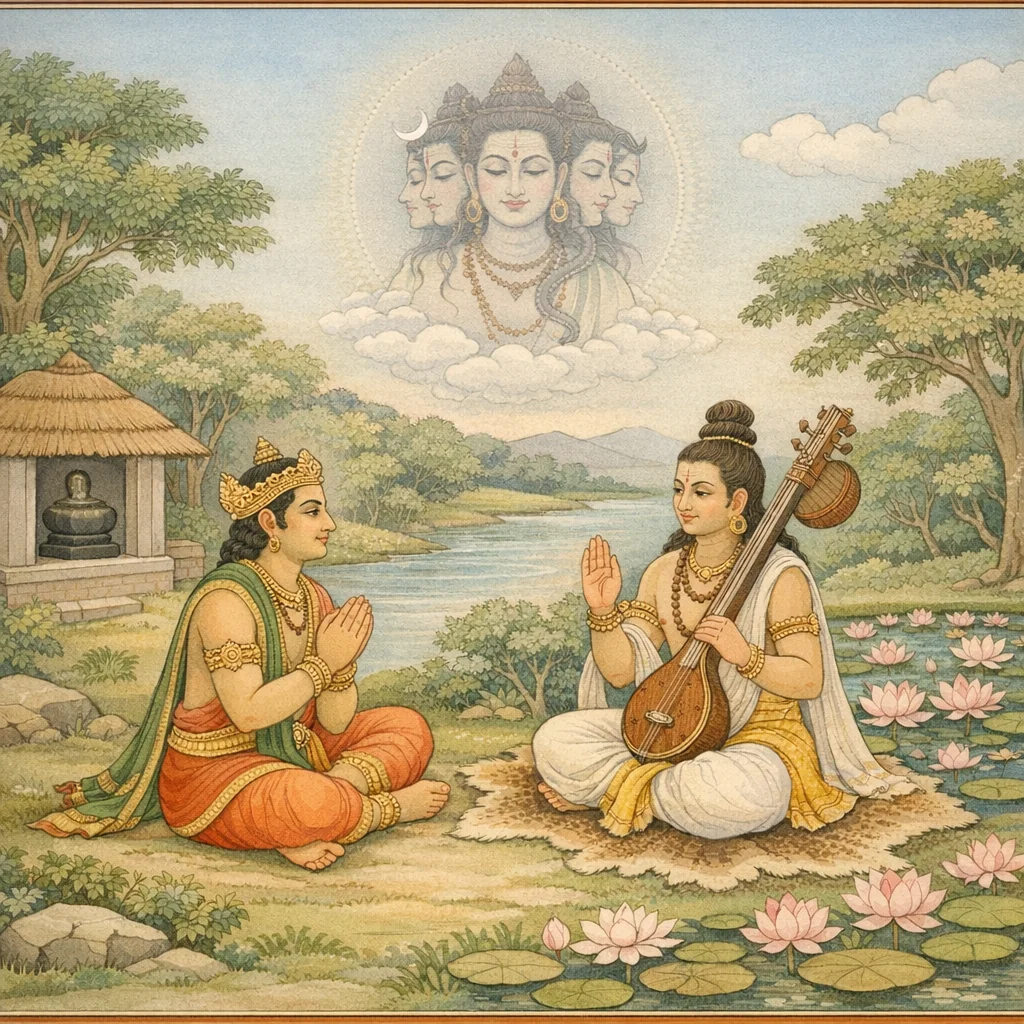
Adhyaya 55
The chapter unfolds as a layered dialogue. After hearing praise of the secret sacred field (gupta-kṣetra), the inquirer asks Nārada for fuller detail. Nārada first recounts the origin and power of the Gautameśvara Liṅga: the sage Gautama (Akṣapāda), connected with the Godāvarī and Ahalyā, performs intense tapas, attains yogic success, and establishes the liṅga. Ritual worship—bathing the great liṅga, anointing it with sandal, offering flowers, and fumigating with guggulu—is taught as a purifier that leads to exalted post-mortem states such as Rudra-loka. Arjuna then requests a technical teaching on yoga. Nārada defines yoga as citta-vṛtti-nirodha, the stilling of the mind’s modifications, and expounds aṣṭāṅga practice: yama and niyama with precise meanings (ahiṃsā, satya, asteya, brahmacarya, aparigraha; and śauca, tuṣṭi, tapas, japa/svādhyāya, guru-bhakti). He proceeds through prāṇāyāma (types, measures, effects, and cautions), pratyāhāra, dhāraṇā (inner movement and fixation of prāṇa), Śiva-centered dhyāna, and samādhi marked by sensory withdrawal and steadiness. The chapter also lists obstacles and “upasargas,” sāttvika dietary guidance, omens of death in dreams and bodily signs as yogic diagnosis, and a broad taxonomy of siddhis culminating in the eight great siddhis (aṇimā, laghimā, etc.). It ends by warning against attachment to powers, reaffirming liberation as the self’s assimilation to the Supreme, and restating the fruit of hearing and worship—especially on Kṛṣṇa Caturdaśī in Āśvina, with bathing at Ahalyā-saras and liṅga worship—bringing purification and an “imperishable” state.
Shlokas
Verse 1
सूत उवाच । इति बाभ्रव्यवचनमाकर्ण्य कुरुनन्दनः । प्राणमन्नारदं भक्त्या विस्मितः पुलकान्वितः
Sūta said: Hearing these words of Bābhravya, the delight of the Kurus bowed to Nārada with devotion—astonished, his body thrilled with rapture.
Verse 2
प्रशस्य च चिरं कालं पुनर्नारदमब्रवीत्
And after praising him for a long while, he again spoke to Nārada.
Verse 3
गुप्तक्षेत्रस्य माहात्म्यं शृण्वानस्त्वन्मुखान्मुने । तृप्तिं नैवाधिगच्छामि भूयस्तद्वक्तुमर्हसि
O sage, though I hear from your own lips the greatness of Guptakṣetra, I do not attain satisfaction; therefore, you should speak of it again, in fuller measure.
Verse 4
नारद उवाच । महालिंगस्य वक्ष्यामि महिमानं कुरूद्वह । गौतमेश्वर लिंगस्य सावधानः शृणुष्व तत्
Nārada said: O foremost of the Kurus, I shall declare the greatness of the Great Liṅga—of the Gautameśvara Liṅga. Listen to it with full attention.
Verse 5
अक्षपादो महायोगी गौतमाख्योऽभवन्मुनिः । गोदावरीसमानेता अहल्यायाः पतिः प्रभुः
There was a great yogin named Akṣapāda, known as the sage Gautama—an exalted lord, the husband of Ahalyā, and the one who manifested the river Godāvarī.
Verse 6
गुप्त क्षेत्रस्य माहात्म्यं स च ज्ञात्वा महोत्तमम् । योगसंसाधनं कुर्वन्नत्र तेपे तपो महत्
Having come to know the supremely excellent greatness of Guptakṣetra, he undertook yogic discipline and performed great austerity here.
Verse 7
योगसिद्धिं ततः प्राप्य गौतमेन महात्मना । अत्र संस्थापितं लिंगं गौतमेश्वरसंज्ञया
Then, having attained yogic perfection, the great-souled Gautama established a Liṅga at this very place, giving it the name “Gautameśvara.”
Verse 8
संस्नाप्यैतन्महालिंगं चन्दनेन विलिप्य च । संपूज्य पुष्पैर्विविधैर्गुग्गुलं दाहयेत्पुरः । सर्वपापविनिर्मुक्तो रुद्रलोके महीयते
Having bathed this great Liṅga, anointing it with sandalpaste, worshipping it with various flowers, and burning guggulu incense before it, one is freed from all sins and is honored in Rudra’s world.
Verse 9
अर्जुन उवाच । योगस्वरूपमिच्छामि श्रोतुं नारद तत्त्वतः । योगं सर्वे प्रशंसंति यतः सर्वोत्तमोत्तमम्
Arjuna said: “O Nārada, I wish to hear, in truth, the real nature of Yoga; for all people praise Yoga as the highest of the highest.”
Verse 10
नारद उवाच । समासात्तव वक्ष्यामि योगतत्त्वं कुरूद्वह । श्रवणादपि नैर्मल्यं यस्य स्यात्सेवनात्किमु
Nārada said: “O best of the Kurus, I shall tell you succinctly the truth of Yoga. If even hearing it brings purity, what then need be said of practicing it?”
Verse 11
चित्तवृत्तिनिरोधाख्यं योगतत्त्वं प्रकीर्त्यते । तदष्टांगप्रकारेण साधयंतीह योगिनः
The truth of Yoga is proclaimed as “the restraint of the mind’s modifications”; and yogins accomplish it here by the eightfold method.
Verse 12
यमश्च नियमश्चैव प्राणायामस्तृतीयकः । प्रत्याहारो धारणा च ध्येयं ध्यानं च सप्तमम्
Yama and Niyama come first; Prāṇāyāma is the third. Then come Pratyāhāra and Dhāraṇā; Dhyeya (the chosen object of contemplation) and Dhyāna are the seventh.
Verse 13
समाधिरिति चाष्टांगो योगः संपरिकीर्तितः । प्रत्येकं लक्षणं तेषामष्टानां शृणु पांडव
Samādhi is declared to be the eighth limb of Yoga. Hear, O Pāṇḍava, the distinct characteristics of each of these eight.
Verse 14
अनुक्रमान्नरो येषां साधनाद्योगमश्नुते । अहिंसा सत्यमस्तेयं ब्रह्मचर्यापरिग्रहौ
By practicing them in due order, a person attains Yoga: non-violence, truthfulness, non-stealing, chastity, and non-possessiveness.
Verse 15
एते पंच यमाः प्रोक्ताः शृण्वेषामपि लक्षणम् । आत्मवत्सर्वभूतेषु यो हिताय प्रवर्तते
These five are declared to be the Yamas; now hear their defining marks as well. He who acts for the welfare of all beings, regarding them as himself—
Verse 16
अहिंसैषा समाख्याता वेदसंविहिता च या । दृष्टं श्रुतं चानुमितं स्वानुभूतं यथार्थतः
This is called non-violence, and it is also enjoined by the Vedas: to speak in accord with reality of what is seen, heard, inferred, and personally experienced.
Verse 17
कथनं सत्यमित्युक्तं परपीडाविवर्जितम् । अनादानं परस्वानामापद्यपि कथंचन
Truthfulness is declared to be speech that is true and free from harming others; and non-stealing is never taking what belongs to another—even in times of calamity.
Verse 18
मनसा कर्मणा वाचा तदस्तेयं प्रकीर्तितम् । अमैथुनं यतीनां च मनोवाक्कायकर्मभिः
Non-stealing (asteya) is thus proclaimed as restraint of mind, deed, and speech; and for ascetics (yatis), celibacy—brahmacarya (amaithuna)—is likewise to be maintained by mind, word, and bodily action.
Verse 19
ऋतौ स्वदारगमनं गेहिनां ब्रह्मचर्यता । यतीनां सर्वसंन्यासो मनोवाक्कायकर्मणा
For householders, approaching one’s own lawful spouse in the proper season is regarded as continence (brahmacarya); but for ascetics (yatis), total renunciation is to be upheld through mind, speech, and bodily acts.
Verse 20
गृहस्थानां च मनसा स्मृत एषोऽपरिग्रहः । एते यमास्तव प्रोक्ताः पंचैव नियमाञ्छृणु
And for householders, non-possessiveness (aparigraha) is understood as detachment within the mind. These yamas have been taught to you; now hear the five niyamas.
Verse 21
शौचं तुष्टिस्तपश्चैव जपो भक्तिर्गुरोस्तथा । एतेषामपि पंचानां पृथक्संशृणु लक्षणम्
Purity (śauca), contentment (tuṣṭi), austerity (tapas), japa (sacred repetition), and devotion to the Guru (bhakti)—these are the five niyamas; hear their distinct characteristics one by one.
Verse 22
बाह्यमाभ्यतरं चैव द्विविधं शौचमुच्यते । बाह्यं तु मृज्जलैः प्रोक्तमांतरं शुद्धमानसम्
Purity (śauca) is said to be of two kinds—external and internal. External purity is taught as cleansing with earth and water; internal purity is the mind made clean.
Verse 23
न्यायेनागतया वृत्त्या भिक्षया वार्तयापि च । संतोषो यस्य सततं सा तुष्टिरिति चोच्यते
Contentment is said to be this: one who is ever satisfied with livelihood obtained righteously—whether by alms or by one’s honest means of living.
Verse 24
चांद्रायणादीनि पुनस्तपांसि विहितानि च । आहारलाघवपरः कुर्यात्तत्तप उच्यते
Austerities such as the Cāndrāyaṇa and others are indeed enjoined; and whoever undertakes practices aimed at lightness of diet—this is called tapas.
Verse 25
स्वाध्यायस्तु जपः प्रोक्तः प्रणवाभ्यसनादिकः । शिवे ज्ञाने गुरौ भक्तिर्गुरुभक्तिरिति स्मृता
Svādhyāya is declared to be japa—such as repeated practice of the Praṇava (Oṁ) and the like. Devotion directed to Śiva, to sacred knowledge, and to the Guru is remembered as ‘guru-devotion’.
Verse 26
एवं संसाध्य नियमान्संयमांश्च विचक्षणः । प्राणायामाय संदध्यान्नान्यथा योगसाधकः
Thus, having properly accomplished the niyamas and restraints, the discerning seeker should apply himself to prāṇāyāma—there is no other way for one who would accomplish yoga.
Verse 27
यतोऽशुचिशरीरस्य वायुकोपो महान्भवेत् । वायुकोपात्कुष्ठता च जडत्वादीनुपाश्नुते
For, in one whose body is impure, a great aggravation of vāyu (the wind-humour) arises; and from the disturbance of vāyu, one comes to afflictions such as leprosy and torpor (dullness), and the like.
Verse 28
तस्माद्विचक्षणः शुद्धं कृत्वा देहं यतेत्परम् । प्राणायामस्य वक्ष्यामि लक्षणं शृणु पांडव
Therefore, the discerning one should strive earnestly, having first purified the body. I shall describe the defining marks of prāṇāyāma—listen, O Pāṇḍava.
Verse 29
प्राणापाननिरोधश्च प्राणायामः प्रकीर्तितः । लघुमध्योत्तरीयाख्यः स च धीरैस्त्रिधोदितः
Prāṇāyāma is declared to be the restraint of prāṇa and apāna. The steady-minded describe it as threefold—named light, medium, and superior.
Verse 30
लघुर्द्वादशमात्रस्तु मात्रा निमिष उन्मिषः । द्विगुणो मध्यमश्चोक्तस्त्रिगुणश्चोत्तमः स्मृतः
The ‘light’ (prāṇāyāma) is of twelve mātrās; a mātrā is measured as a blink and the reopening of the eyes. The ‘medium’ is said to be double that, and the ‘superior’ is remembered as triple.
Verse 31
प्रथमेन जयेत्स्वेदं मध्यमेन तु वेपथुम् । विषादं च तृतीयेन जयेद्दोषाननुक्रमात्
By the first grade one conquers sweating; by the medium, trembling; and by the third, despondency—thus, in due order, one overcomes the faults.
Verse 32
पद्माख्यमासनं कृत्वा रेचकं पूरकं तथा । कुंभकं च सुखासीनः प्राणायामं त्रिधाऽभ्यसेत्
Having assumed the posture called Padma (lotus), seated at ease, one should practise prāṇāyāma in three ways: exhalation (recaka), inhalation (pūraka), and retention (kumbhaka).
Verse 33
प्राणानामुपसंरोधात्प्राणायाम इति स्मृतः । यथा पर्वतधातूनां ध्मातानां दह्यते मलः
Because it is the close restraint of the vital breaths, it is remembered as prāṇāyāma. Just as the impurities of mountain ores are burnt away when they are smelted and blown in the furnace,
Verse 34
तथेंद्रियवृतो दोषः प्राणायामेन दह्यते । गोशतं कापिलं दत्त्वा यत्फलं तत्फलं भवेत्
So too, the fault that is wrapped up with the senses is burnt away by prāṇāyāma. Whatever fruit arises from gifting a hundred tawny cows—such is the fruit that comes from it.
Verse 35
प्राणायामेन योगज्ञस्तस्मात्प्राणं सदा यमेत् । प्राणायामेन सिद्ध्यन्ति दिव्याः शान्त्यादयः क्रमात्
By prāṇāyāma the knower of yoga—therefore—should always restrain the vital breath. Through prāṇāyāma, divine attainments beginning with peace are accomplished, in due sequence.
Verse 36
शांतिः प्रशान्तिर्दीप्तिश्च प्रसादश्च यथाक्रमम् स । हजागंतुकामानां पापानां च प्रवर्तताम्
Peace, deep tranquillity, radiance, and clarity of grace arise in due order; and thereby the sins already present, and those that arise anew, are checked.
Verse 37
वासनाशांतिरित्याख्यः प्रथमो जायते गुणः । लोभमोहात्मकान्दोषान्निराकृत्यैव कृत्स्नशः
When the faults that take the form of greed and delusion are wholly cast out, the first virtue arises—known as the pacification of latent impressions (vāsanās).
Verse 38
तपसां च यदा प्राप्तिः सा शांतिरिति चोच्यते । सर्वेन्द्रियप्रसादश्च बुद्धेर्वै मरुतामपि
And when the attainments born of austerity (tapas) are gained, that too is called “peace.” Then arise the clarity and grace of all the senses, and the serenity of the intellect—indeed, through mastery of the vital winds (vāyu) as well.
Verse 39
प्रसाद इति स प्रोक्तः प्राप्यमेवं चतुष्टयम् । एवंफलं सदा योगी प्राणायामं समभ्यसेत्
This is declared to be “prasāda” (lucid grace). Thus a fourfold attainment is gained; therefore, knowing such fruits, the yogin should constantly practice prāṇāyāma.
Verse 40
मृदुत्वं सेव्यमानास्तु सिंहशार्दूलकुंजराः । यथा यान्ति तथा प्राणो वश्यो भवति साधितः
Just as lions, tigers, and elephants become gentle when trained and tended, so too prāṇa becomes controllable when it is properly disciplined.
Verse 41
प्राणायामस्त्वयं प्रोक्तः प्रत्याहारं ततः शृणु । विषयेषु प्रवृत्तस्य चेतसो विनिवर्तनम्
Thus prāṇāyāma has been explained; now listen to pratyāhāra. It is the drawing back of the mind that has run outward toward sense-objects.
Verse 42
प्रत्याहारं विनिर्दिष्टतस्य संयमनं हि यत् । प्रत्याहारस्त्वयं प्रोक्तो धारणालक्षणं शृणु
And that restraint (saṃyama) which has been specified is indeed pratyāhāra. Thus pratyāhāra has been taught; now listen to the defining mark of dhāraṇā (concentration).
Verse 43
यथा तोयार्थिनस्तोयं पत्रनालादिभिः शनैः । आपिबेयुस्तथा वायुं योगी नयति साधितम्
As those who seek water sip it slowly through leaf-tubes and the like, so the yogin, having mastered the method, gently guides and imbibes the vital air (prāṇa/vāyu).
Verse 44
प्राग्नाभ्यां हृदये वायुरथ तालौ भ्रुवोंऽतरे । चतुर्दले षड्दशे च द्वादशे षोडशद्विके
First, the yogin places the vital air from the region of the navel into the heart; then he leads it to the palate and between the eyebrows—into the lotus-centres of four petals, of sixteen, of twelve, and of twice sixteen.
Verse 45
आकुंचनेनैव मूर्द्धमुन्नीय पवनं शनैः । मूर्धनि ब्रह्मरंध्रे तं प्राणं संधारयेत्कृती
By contraction (ākuñcana) alone, raising the breath gently to the head, the adept should hold that prāṇa at the crown—in the Brahma-aperture (brahmarandhra).
Verse 46
प्राणायामा दश द्वौ च धारणैषा प्रकीर्त्यते । दशैता धारणाः स्थाप्य प्राप्नोत्यक्षरसाम्यताम्
This dhāraṇā is said to consist of twelve prāṇāyāmas. Having established these ten dhāraṇās, one attains equality with the Imperishable (Akṣara).
Verse 47
धारणास्थस्य यद्ध्येयं तस्य त्वं शृणु लक्षणम् । ध्येयं बहुविधं पार्थ यस्यांतो नोपलभ्यते
Hear from me the defining mark of the object of meditation for one established in dhāraṇā. The object to be contemplated is of many kinds, O Pārtha, and its limit cannot be fully grasped.
Verse 48
केचिच्छिवं हरिं केचित्केचित्सूर्यं विधिं परे । केचिद्देवीं महद्भूतामुत ध्यायन्ति केचन
Some meditate on Śiva; some on Hari; others on the Sun, and others on the Creator (Brahmā). Some contemplate the Goddess, the great primordial Power—thus do different people meditate in different ways.
Verse 49
तत्र यो यच्च ध्यायेत स च तत्र प्रलीयते । तस्मात्सदा शिवं देवं पंचवक्त्रं हरं स्मरेत्
Whatever a person contemplates, into that very reality he dissolves. Therefore one should always remember Śiva—the divine Hara with five faces.
Verse 50
पद्मासनस्थं तं गौरं बीजपूरकरं स्थितम् । दशहस्तं सुप्रसन्नवदनं ध्यानमास्थितम्
Meditate on Him as seated in lotus posture, fair in radiance, holding a citron (bījapūra) in His hand—ten-armed, with a supremely serene face, established in deep contemplation.
Verse 51
ध्येयमेतत्तव प्रोक्तं तस्माद्ध्यानं समाचरेत् । ध्यानस्य लक्षणं चैतन्निमेषार्धमपि स्फुटम्
This object of meditation has been told to you; therefore practice dhyāna. This is indeed the clear hallmark of meditation—even for half the blink of an eye.
Verse 52
न पृथग्जायते ध्येयाद्धारणां यः समास्थितः । एवमेतां दुरारोहां भूमिमास्थाय योगवित्
For one firmly established in dhāraṇā, no separation arises from the object of meditation. Thus, having mounted this hard-to-attain stage, the knower of yoga…
Verse 53
न किंचिच्चिंतयेत्पश्चात्समाधिरिति कीर्त्यते । समाधेर्लक्षणं सम्यग्ब्रुवतो मे निशामय
Thereafter, when one thinks of nothing whatsoever, it is called samādhi. Hear from me, as I speak rightly, the true characteristic of samādhi.
Verse 54
शब्दस्पर्शरसैर्हीनं गंधरूपविवर्जितम् । परं पुरुषं संप्राप्तः समाधिस्थः प्रकीर्तितः
Devoid of sound, touch, and taste—free from smell and form—one who has reached the Supreme Person is proclaimed to be established in samādhi.
Verse 55
तां तु प्राप्य नरो विघ्नैर्नाभिभूयेत कर्हिचित् । समाधिस्थश्च दुःखेन गुरुणापि न चाल्यते
Having attained that state, a person is never overcome by obstacles. Established in samādhi, he is not shaken even by heavy suffering.
Verse 56
शंखाद्याः शतशस्तस्य वाद्यन्ते यदि कर्णयोः । भेर्यश्च यदि हन्यंते शब्दं बाह्यं न विंदति
Even if hundreds of conches and other instruments are sounded at his ears, even if kettledrums are beaten, he does not perceive external sound.
Verse 57
कशाप्रहाराभिहतो वह्निदग्धतनुस्तथा । शीताढ्येव स्थितो घोरे स्पर्शं बाह्यं न विन्दति
Even if struck by blows of a whip, even if the body is scorched by fire, or even if one stands amid dreadful cold, he does not perceive any external touch—so absorbed is he in inner stillness.
Verse 58
रूपे गंधे रसे बाह्ये तादृशस्य तु का कथा । दृष्ट्वा य आत्मनात्मानं समाधिं लभते पुनः
If even external touch leaves him thus untouched, what need be said of outward form, fragrance, and taste? Having beheld the Self by the Self, he again attains samādhi.
Verse 59
तृष्णा वाथ बुभुक्षा वा बाधेते तं न कर्हिचित्
Neither thirst nor hunger ever troubles him.
Verse 60
न स्वर्गे न च पाताले मानुष्ये क्व च तत्सुखम् । समाधिं निश्चलं प्राप्य यत्सुखं विंदते नरः
That happiness is found neither in heaven nor in Pātāla, nor anywhere in the human realm—for such is the joy a man discovers after attaining unwavering samādhi.
Verse 61
एवमारूढयोगस्य तस्यापि कुरुनदन । पंचोपसर्गाः कटुकाः प्रवर्तंते यथा शृणु
O son of the Kurus, even for one who has thus mounted the path of yoga, five bitter obstacles arise. Hear how they proceed.
Verse 62
प्रातिभः श्रावणो दैवो भ्रमावर्तोऽथ भीषणः । प्रतिभा सर्वशास्त्राणां प्रातिभोऽयं च सात्त्विकः
The five obstacles are: Prātibha, Śrāvaṇa, Daiva, the whirlpool of delusion (Bhramāvarta), and the dreadful (Bhīṣaṇa). ‘Prātibha’ is a sāttvic, subtle power—an intuition concerning all the śāstras.
Verse 63
तेन यो मदमादद्याद्योगी शीघ्रं च चेतसः । योजनानां सहस्रेभ्यः श्रवणं श्रावणस्तु सः
By that Prātibha, if a yogin quickly becomes intoxicated with pride, the mind is disturbed. Hearing from thousands of yojanas away—this is called Śrāvaṇa, an obstacle.
Verse 64
द्वितीयः सात्विकश्चायमस्मान्मत्तो विनश्यति । अष्टौ पश्यति योनीश्च देवानां दैव इत्यसौ
This second too is sāttvic, yet it perishes when it turns into intoxication with pride. One who beholds the eight divine yonis of the gods—this is called Daiva, an obstacle.
Verse 65
अयं च सात्त्विको दोषो मदादस्माद्विनश्यति । आवर्त इव तोयस्य जनावर्ते यदाकुलः
This too is a sāttvic fault, and it is ruined by the pride that arises from it—like a whirlpool in water, turbulent in the eddy of the currents.
Verse 66
आवर्ताख्यस्त्वयं दोषो राजसः स महाभयः । भ्राम्यते यन्निरालम्बं मनो दोषैश्च योगिनः
This defect called “Āvarta” is rājasic and a great terror: by these faults the yogin’s mind, unsupported, begins to whirl and wander.
Verse 67
समस्ताधारविभ्रंशाद्भ्रमाख्यस्तामसो गुणः । एतैर्नाशितयोगाश्च सकला देवयोनयः
When the foundations of all supports are thrown into disorder, the tamasic quality called “bhrama” (delusion) arises. By these disturbances, yoga is ruined—even for beings born in divine orders.
Verse 68
उपसर्गैर्महाघोरैरावर्त्यंते पुनः पुनः । प्रावृत्य कंबलं शुक्लं योगी तस्मान्मनोमयम्
Again and again, by exceedingly dreadful obstacles, the mind is made to whirl about. Therefore the yogin, wrapping himself in a white blanket, should resort to the discipline fashioned by the mind—namely, inward contemplation.
Verse 69
चिंतयेत्परमं ब्रह्म कृत्वा तत्प्रवणं मनः । आहाराः सात्त्विकाश्चैव संसेव्याः सिद्धिमिच्छता
Let one contemplate the Supreme Brahman, making the mind incline wholly toward That. And one who seeks attainment should also partake only of sāttvic, pure foods.
Verse 70
राजसैस्तामसैश्चैव योगी सिद्धयेन्न कर्हिचित् । श्रद्दधानेषु दांतेषु श्रोत्रियेषु महात्मसु
By rājasika and tāmasika ways, a yogin never attains perfection. Rather, he should rely upon and keep company with the faithful, self-controlled, Veda-learned, great-souled ones.
Verse 71
स्वधर्मादनपेतेषु भिक्षा याच्या च योगिना । भैक्षं यवान्नं तक्रं वा पयो यावकमेव वा
A yogin should beg alms only from those who have not fallen away from their own dharma. The alms may be barley-food (yava), or buttermilk (takra), or milk, or yāvaka-gruel alone.
Verse 72
फलमूलं विपक्वं वा कणपिण्याकसक्तवः । श्रुता इत्येत आहारा योगिनां सिद्धिकारकाः
Ripe fruits and roots, or grains and preparations of bran and bran-flour—these, as taught in tradition, are foods that bring about yogins’ attainment.
Verse 73
मृत्युकालं विदित्वा च निमित्तैर्योगसाधकः । योगं युञ्जीत कालस्य वंचनार्थं समाहितः
Having discerned the time of death through omens, the yogic practitioner—mind collected—should apply himself to yoga, in order to outwit Time (Death).
Verse 74
निमित्तानि च वक्ष्यामि मृत्युं यो वेत्ति योगवित् । रक्तकृष्णांबरधरा गायंतीह सती च यम्
I shall declare the signs by which the knower of yoga understands death: for instance, a virtuous woman, clad in red and black garments, singing here (in one’s vision).
Verse 75
दक्षिणाशां नयेन्नारी स्वप्ने सोऽपि न जीवति । नग्नं क्षपणकं स्वप्ने हसमानं प्रदृश्य च
If, in a dream, a woman leads one toward the southern quarter, he too will not live. And if one sees in a dream a naked ascetic (kṣapaṇaka) laughing, that also is a sign.
Verse 76
एनं च वीक्ष्य वल्गन्तं तं विद्यान्मृत्युमागतम् । ऋक्षवानरयुग्यस्थो गायन्यो दक्षिणां दिशम्
Seeing him leaping about, one should know that death has arrived. Likewise, one mounted on a team of bears and monkeys, singing and going toward the southern direction, is an omen.
Verse 77
याति मज्जेदधौ पंके गोमये वा न जीवति । केशांगारैस्तथा भस्मभुजंगैर्निजलां नदीम्
If, in a dream, a person goes and sinks into curd, into mire, or into cow-dung, he does not survive. Likewise, if he beholds a river whose water is not truly water—filled with hair, embers, and serpents made of ash—this too is a sign of death.
Verse 78
एषामन्यतमैः पूर्णां दृष्ट्वा स्वप्ने न जीवति । करालैर्विकटै रूक्षैः पुरुषैरुद्यतायुधैः
If, in a dream, one sees the space ahead filled with any of these—terrifying, monstrous, harsh men with weapons raised—he does not survive.
Verse 79
पाषाणैस्ताडितः स्वप्ने सद्यो मृत्युं भजेन्नरः । सूर्योदये यस्य शिवा क्रोशंती याति सम्मुखम्
If, in a dream, a man is struck with stones, he meets death at once. And at sunrise, if a jackal (sivā) comes straight toward someone while crying out, that too is an omen of death.
Verse 80
विपरीतं परीतं वा स सद्यो मृत्युमृच्छति । दीपाधिगंधं नो वेत्ति वमत्यग्निं तथा निशि
If one sees things reversed or perverted as an evil sign, he quickly meets death. If he cannot perceive the scent of the lamp, and if at night he vomits fire, these too are portents of death.
Verse 81
नात्मानं परनेत्रस्थं वीक्षते न स जीवति । शक्रायुधं चार्धरात्रे दिवा वा ग्रहणं तथा
If one cannot see his own reflection in another’s eye, he does not live. Likewise, seeing Indra’s weapon (the vajra) at midnight, or an eclipse appearing by day, is an omen of death.
Verse 82
दृष्ट्वा मन्येत स क्षीणमात्मजीवितमाप्तवान् । नासिका वक्रतामेति कर्णयोर्न्नमनोन्नती
Seeing these signs, he should understand that his own life has diminished. When the nose turns crooked, and the ears show irregular drooping and rising, these are marks of life’s decline.
Verse 83
नेत्रं च वामं स्रवति यस्य तस्यायुरुद्गतम् । आरक्ततामेति मुखं जिह्वा चाप्यसिता यदा
If a person’s left eye waters, his span of life has already withdrawn. When the face turns red and the tongue too grows dark, these are signs that death is near.
Verse 84
तदा प्राज्ञो विजानीयादासन्नं मृत्युमात्मनः । उष्ट्ररासभयानेन स्वप्ने यो याति दक्षिणाम्
Then the wise should know that his own death is near. If, in a dream, he journeys south riding a camel or a donkey, that too is such an omen.
Verse 85
दिशं कर्णौ पिधायापि निर्घोषं शृणुयान्न च । न स जीवेत्तथा स्वप्ने पति तस्य पिधीयते
Even if he covers his ears, if he still hears no sound, he does not live. Likewise, if in a dream his lord or husband is shut away or cut off, that too is a death-omen.
Verse 86
द्वारं न चोत्तिष्ठति च शुभ्रा दृष्टिश्च लोहिता । स्वप्नेऽग्निं प्रविशेद्यश्च न च निष्क्रमते पुनः
If a door does not stand open or appear properly, and one’s vision turns pale and then red, these are ominous signs. And whoever, in a dream, enters fire and does not come out again—he does not survive.
Verse 87
जलप्रवेशादपि वा तदंतं तस्य जीवितम् । यश्चाभिहन्यते दुष्टैर्भूतै रात्रावथो दिवा
Whether by entering water or by some other means, his life comes to its end; and one who is struck down by wicked spirits—by night or by day—meets that destined termination.
Verse 88
प्रकृतैर्विकृतैर्वापि तस्यासन्नौ यमांतकौ । देवतानां गुरूणां च पित्रोर्ज्ञानविदां तथा
By ordinary (natural) signs or by distorted (unnatural) omens, the two bringers of death—Yama and Antaka—draw near to him; likewise, adverse portents arise concerning the gods, the teachers, the parents, and the knowers of sacred wisdom.
Verse 89
निन्दामवज्ञां कुरुते भक्तो भूत्वा न जीवति । एवं दृष्ट्वा निमित्तानि विपरीतानि योगवित्
If, after becoming a devotee, one falls into slander and contempt, one does not live long. Seeing such contrary portents, the knower of yoga acts with care.
Verse 90
धारणां सम्यगास्थाय समाधावचलो भवेत् । यदि नेच्छति ते मृत्युं ततो नासौ प्रपद्यते
Having properly established dhāraṇā (concentration), one should become unwavering in samādhi. If, then, death does not “desire” you, it does not overtake you.
Verse 91
विमुक्तिमथवा वांछेद्विसृजेद्ब्रह्ममूर्धनि । संति देहे विमुक्ते च उपसर्गाश्च ये पुनः
Seeking liberation, one should cast forth the prāṇa/awareness through the Brahma-aperture at the crown of the head. Yet obstacles also arise—both while still embodied and even at the moment of release.
Verse 92
योगिनं समुपायांति शृणु तानपि पांडव । ऐशान्ये राक्षसपुरे यक्षो गन्धर्व एव च
They approach the yogin—hear of them too, O Pāṇḍava. In the northeastern quarter, in the city of the rākṣasas, there are yakṣas and gandharvas as well, who become part of such encounters and obstacles.
Verse 93
ऐन्द्रे सौम्ये प्रजापत्ये ब्राह्मे चाष्टसु सिद्धयः । भवंति चाष्टौ शृणु ताः पार्थिवी या च तैजसी
In the Aindra, Saumya, Prājāpatya, and Brāhma realms, the siddhis arise in sets of eight. They become eightfold—listen to them: the ‘earthly’ and the ‘fiery’ types as well.
Verse 94
वायवी व्योमात्मिका चैव मानसाहम्भवा मतिः । प्रत्येकमष्टधा भिन्ना द्विगुणा द्विगुणा क्रमात
Likewise there are siddhis of the airy kind, of the etheric kind, and those born of mind and ego. Each is divided eightfold, and they increase twofold, then twofold again, in due order.
Verse 95
पूर्वे चाष्टौ चतुःषष्टिरन्ते शृणुष्व तद्यथा । स्थूलता ह्रस्वता बाल्यं वार्धक्यं योवनं तथा
First there are eight, and at the end there are sixty-four—listen to them as they are: such as largeness, smallness, childhood, old age, and likewise youth.
Verse 96
नानाजाति स्वरूपं च चतुर्भिर्देहधारणम् । पार्थिवांशं विना नित्यमष्टौ पार्थिवसिद्धयः
Assuming forms of many kinds of birth and species, and sustaining bodies by means of the four elements—yet without the ‘earthly portion’ there are always eight specifically earthly siddhis.
Verse 97
विजिते पृथिवीतत्त्वे यदैशान्ये भवन्ति च । भूमाविव जले वासो नातुरोऽर्णवमापिबेत्
When the principle of earth is mastered, and one attains an Īśāna-like state of sovereignty, dwelling in water becomes as natural as living on land; even the ocean cannot overwhelm or harm such a one.
Verse 98
सर्वत्र जलप्राप्तिश्च अपि शुष्कं द्रवं फलम् । त्रिभिर्देहस्य धरणं नदीर्वा स्थापयेत्करे
Water becomes obtainable everywhere; even dry fruits yield liquid. By three such powers the body is sustained, and one may even restrain—or set in place—rivers with the hand.
Verse 99
अव्रणत्वं शरीरस्य कांतिश्चाथाष्टकं स्मृतम् । अष्टौ पूर्वा इमाश्चाष्टौ राक्षसानां पुरे स्मृताः
Freedom from wounds in the body and radiant splendor—these are remembered as an eightfold set. Those earlier eight and these eight are said to be the recognized attainments in the city of the Rākṣasas.
Verse 100
देहादग्निविनिर्माणं तत्तापभयवर्जनम् । शक्तिदत्वं च लोकानां जलमध्येग्निज्वालनम्
From one’s own body, fire can be produced; its heat brings no fear or pain. One can bestow power upon beings, and even kindle fire in the midst of water.
Verse 101
अग्निग्रहश्च हस्तेन स्मृतिमात्रेण पावनम् । भस्मीभूतस्य निर्माणं द्वाभ्यां देहस्य धारणम्
Fire may be grasped with the hand, and purification occurs by mere remembrance. One can reconstitute what has been reduced to ash; and by two such powers the body can be sustained.
Verse 102
पूर्वाः षोडश चाप्यष्टौ तेजसो यक्षसद्मनि । मनोगतित्वं भूतानामन्तर्निवेशनं तथा
Those earlier sixteen, and also these eight, are said to belong to the realm of Tejas in the abode of the Yakṣas. There too are: beings moving at the speed of thought, and entering within (others).
Verse 103
पर्वतादिमहाभारवहनं लीलयैव च । लघुत्वं गौरवत्वं च पाणिभ्यां वायुवारणम्
Bearing immense burdens—mountains and the like—becomes mere play. One may assume lightness or heaviness at will, and with the hands even restrain the wind.
Verse 104
अंगुल्यग्रनिपातेन भूमेः सर्वत्र कम्पनम् । एकेन देहनिष्पत्तिर्गांधर्वे वांति सिद्धयः
By the mere drop of a fingertip, the earth can be made to tremble everywhere. By a single power one may manifest a body at will—such siddhis are said to prevail in the Gandharva realm.
Verse 105
चतुर्विंशतिः पूर्वाश्चाप्यष्टावेताश्च सिद्धयः । गन्धर्वलोके द्वात्रिंशदत ऊर्ध्वं निशामय
The earlier twenty-four, together with these eight siddhis—thus there are thirty-two in the Gandharva world. Now listen further to what is above that.
Verse 106
छायाविहीननिष्पत्तिरिंद्रियाणामदर्शनम् । आकाशगमनं नित्यमिंद्रियादिशमः स्वयम्
One may exist without casting a shadow, and the senses become unseen (undetectable). One can move constantly through the sky, and of oneself attains the calming and mastery of the senses and the rest.
Verse 107
दूरे च शब्दग्रहणं सर्वशब्दावगाहनम् । तन्मात्रलिंगग्रहणं सर्वप्राणिनिदर्शनम्
Hearing sounds even from afar; comprehending every kind of sound; perceiving the subtle signs of the tanmātras; and beholding all living beings—these are among the extraordinary yogic attainments described.
Verse 108
अष्टौ वातात्मिकाश्चैन्द्रे द्वात्रिंशदपि पूर्वकाः । यथाकामोपलब्धिश्च यथाकामविनिर्गमः
In Indra’s world are spoken of eight powers of wind-nature, and likewise the earlier thirty-two. There too are: gaining things at will, and departing—or projecting oneself—at will.
Verse 109
सर्वत्राभिभवश्चैव सर्वगुह्यनिदर्शनम् । संसारदर्शनं चापि मानस्योऽष्टौ च सिद्धयः
Mastery everywhere; the vision of all secrets; and even direct perception of the course of saṃsāra—these too are eight ‘mental’ siddhis.
Verse 110
चत्वारिंशच्च पूर्वाश्च सोमलोके स्मृतास्त्विमाः । छेदनं तापनं बन्धः संसारपरिवर्तनम्
In the Moon-world (Somaloka) these are remembered as forty, together with the earlier ones: cutting down obstacles, burning to afflict, binding, and turning the course of another’s worldly condition.
Verse 111
सर्वभूत प्रसादत्वं मृत्युकालजयस्तथा । अहंकारोद्भवश्चाष्टौ प्राजापत्ये च पूर्विकाः
Winning the favor of all beings, and likewise conquering the appointed time of death; and another eight arising from ahaṃkāra (ego)—these, together with the earlier ones, are spoken of in the Prajāpati-world.
Verse 112
आकारेण जगत्सष्टिस्तथानुग्रह एव च । प्रलयस्याधिकारं च लोकचित्रप्रवर्तनम्
Creating the universe by mere form—or intention—granting grace as well; holding authority even over pralaya (dissolution); and setting in motion wondrous displays within worlds—these are the enumerated powers.
Verse 113
असादृश्यमिदं व्यक्तं निर्वाणं च पृथक्पृथक् । शुभेतरस्य कर्तृत्वमष्टौ बुद्धिभवास्त्वमी
A manifest uniqueness beyond all comparison; nirvāṇa experienced distinctly, each in its own mode; and agency over both the auspicious and the inauspicious—these are said to be eight attainments born of buddhi (intellect).
Verse 114
षट्पंचाशत्तथा पूर्वाश्चतुःषष्टिरिमे गुणाः । ब्राह्मये पदे प्रवर्तंते गुह्यमेतत्तवेरितम्
Fifty-six, and likewise the earlier ones—these sixty-four qualities operate in the Brahmā-state (Brahmā-pada). This is a secret teaching, declared by you.
Verse 115
जीवतो देहभेदे वा सिद्ध्यश्चैतास्तु योगिनाम् । संगो नैव विधातव्यो भयात्पतनसंभवात्
These siddhis belong to yogins—whether while living or upon separation from the body. Yet one must never become attached to them, for attachment may cause a fall.
Verse 116
एतान्गुणान्निराकृत्य युञ्जतो योगिनस्तदा । सिद्धयोऽष्टौ प्रवर्तंते योगसंसिद्धिकारकाः
When the yogin practices after setting aside these (lower) qualities, then the eight siddhis arise—those that bring yoga to full perfection.
Verse 117
अणिमा लघिमा चैव महिमा प्राप्तिरेव च । प्राकाम्यं च तथेशित्वं वशित्वं च तथापरे
Aṇimā (minuteness), Laghimā (lightness), Mahimā (greatness), and Prāpti (attainment) are mentioned; likewise Prākāmya (unhindered fulfillment of desire), Īśitva (lordship), and Vaśitva (mastery)—and other siddhis as well.
Verse 118
यत्र कामावसायित्वं माहेश्वरपदस्थिताः । सूक्ष्मात्सूक्ष्मत्वमणिमा शीघ्रत्वाल्लघिमा स्मृता
For those established in the Māheśvara state (the station of Śiva), there is kāmāvasāyitva—perfect accomplishment of intention. Becoming subtler than the subtlest is called aṇimā; and through swiftness is laghimā understood.
Verse 119
महिमा शेषपूज्यत्वात्प्राप्तिर्नाप्राप्यमस्य यत् । प्राकाम्यमस्य व्यापित्वादीशित्वं चेश्वरो यतः
Mahimā is so called because one becomes worthy of reverence by all others; prāpti is that state in which nothing remains unattainable. Prākāmya belongs to one who pervades all; and īśitva is his, because he is truly the Lord.
Verse 120
वशित्वाद्वशिता नाम सप्तमी सिद्धिरुत्तमा । यत्रेच्छा तत्र च स्थानं तत्र कामावसायिता
From vaśitva arises the siddhi called Vaśitā, the seventh and excellent power. Wherever the will is, there is the very location—and there, intention is perfectly accomplished.
Verse 121
ऐश्वरं पदमाप्तस्य भवंत्येताश्च सिद्धयः । ततो न जायते नैव वर्धते न विनश्यति
For one who has attained the sovereign station (aiśvara-pada), these siddhis indeed arise. Thereafter, he is not born again; he neither grows nor perishes.
Verse 122
एष मुक्त इति प्रोक्तो य एवं मुक्तिमाप्नुयात् । यथा जलं जलेनैक्यं निक्षिप्तमुपगच्छति
Such a one is declared ‘liberated’—who attains liberation in this manner. Just as water, when poured into water, comes to oneness with it,
Verse 123
तथैवं सात्म्यमभ्येति योगिनामात्मा परात्मना । एवं ज्ञात्वा फलं योगी सदा योगं समभ्यसेत्
So too, the yogin’s self attains complete harmony and union with the Supreme Self. Knowing this fruit, the yogin should always practice yoga.
Verse 124
अत्रोपमां व्याहरंति योगार्थं योगिनोऽ मलाः । शशांकरश्मिसंयोगादर्ककांतो हुताशनम्
Here, to explain yoga, stainless yogins utter an analogy: by the conjunction of moonbeams, the arka-kānta gem kindles fire.
Verse 125
समुत्सृजति नैकः सन्नुपमा सास्ति योगिनः । कपिंजलाखुनकुला वसंति स्वामिव द्गृहे
Not just one example is set forth—for the yogin has many analogies. Like francolins, mice, and mongooses dwelling in a house as if it were their master’s home,
Verse 126
ध्वस्ते यांत्यन्यतो दुःखं न तेषां सोपमा यतेः । मृद्देहकल्पदेहोऽपि मुखाग्रेण कनीयसा
When it is destroyed, they go elsewhere in suffering—such is not the yogin’s comparison. Even if the body is like clay, or like a ‘wish-fulfilling’ body, it is still inferior when weighed against what is foremost, the higher realization.
Verse 127
करोति मृद्भागचयमुपदेशः स योगिनः । पशुपक्षिमनुष्याद्यैः पत्रपुष्पफलान्वितम्
By the yogin’s instruction, a heap of earthen portions is formed—endowed with leaves, flowers, and fruits—and it becomes an offering meant for beings such as animals, birds, and humans.
Verse 128
वृक्षं विलुप्यमानं च लब्ध्वा सिध्यंति योगिनः । रुरुगात्रविषाणाग्रमालक्ष्य तिलकाकृतिम्
Having obtained a tree that is being stripped away, yogins attain siddhi; and, observing the tip of a deer’s horn, they perceive a mark shaped like a tilaka.
Verse 129
सह तेन विवर्धेत योगी सिद्धिमुपाश्नुते । द्रव्यं पूर्णमुपादाय पात्रमारोहते भुवः
Growing together with that sign or practice, the yogin attains accomplishment. Taking up a vessel filled with substance, he rises from the earth as though ascending beyond ordinary limits.
Verse 130
तुंगमार्गं विलोक्यैवं विज्ञातं कि न योगिनाम् । तद्गेहं यत्र वसति तद्भोज्यं येन जीवति
Having thus beheld the lofty path, what is there that is not known to yogins? They know the house where one dwells, and the very food by which one lives.
Verse 131
येन निष्पाद्यते चार्थः स्वयं स्याद्योगसिद्धये । तथा ज्ञानमुपासीत योगी यत्कार्यसाधकम्
That by which one’s purpose is truly accomplished and yoga-siddhi arises of itself—such knowledge the yogin should cultivate, the knowledge that genuinely brings the work to fulfillment.
Verse 132
ज्ञानानां बहुता येयं योगविघ्नकरी हि सा । इदं ज्ञेयमिदं ज्ञेयमिति यस्तृषितश्चरेत्
This excessive multiplicity of ‘knowledges’ indeed becomes an obstacle to yoga. One who wanders thirsting—‘this must be known, this must be known’—is thereby hindered.
Verse 133
अपि कल्पसहस्रायुर्नैव ज्ञेयमवाप्नुयात् । त्यक्तसंगो जितक्रोधो लब्धाहारो जितेंद्रियः
Even if one were to live for a thousand kalpas, one would not attain the ‘knowable’ by mere accumulation. Let one be free from attachment, conquer anger, partake only of the food that comes by rightful obtaining, and restrain the senses.
Verse 134
पिधाय बुद्ध्या द्वाराणि मनो ध्याने निवेशयेत् । आहारं सात्त्विकं सेवेन्न तं येन विचेतनः
Closing the ‘doors’ (of the senses) with discernment, one should place the mind in meditation. One should partake of sāttvika food—never that by which one becomes dull and senseless.
Verse 135
स्यादयं तं च भुंजानो रौरवस्य प्रियातिथिः । वाग्दण्डः कर्मदण्डश्च मनोदंडश्च ते त्रयः
One who eats that (unwholesome food) becomes a welcome guest of Raurava (hell). These three are the ‘staffs’ of discipline: restraint of speech, restraint of action, and restraint of mind.
Verse 136
यस्यैते नियता दंडाः स त्रिदंडी यतिः स्मृतः । अनुरागं जनो याति परोक्षे गुणकीर्तनम्
He for whom these staffs are firmly regulated is remembered as a tridaṇḍī yati. People grow devoted to such a one, and even in his absence they praise his virtues.
Verse 137
न बिभ्यति च सत्त्वानि सिद्धेर्लक्षणमुच्यते
That living beings no longer fear him—this is declared to be a mark of siddhi, spiritual attainment.
Verse 138
अलौल्यमारोग्यमनिष्ठुरत्वं गंधः शुभो मूत्रपुरीषयोश्च । कांतिः प्रसादः स्वरसौम्यता च योगप्रवृत्तेः प्रथमं हि चिह्नम्
Freedom from restlessness, sound health, gentleness, a pleasant fragrance even in urine and stool, radiance, clarity of speech, and sweetness of voice—these indeed are the first signs of the awakening of yoga-practice.
Verse 139
समाहितो ब्रह्मपरोऽप्रमादी शुचिस्तथैकांतरतिर्जितेन्द्रियः । समाप्नुयाद्योगमिमं महामना विमुक्तिमाप्नोति ततश्च योगतः
Collected in mind, devoted to Brahman, vigilant, pure, delighting in solitude, and self-controlled—such a great-souled one attains this yoga; and through that yoga he reaches liberation.
Verse 140
कुलं पवित्रं जननी कृतार्था वसुन्धरा भाग्यवती च तेन । अवाह्यमार्गे सुखसिन्धुमग्नं लग्नं परे ब्रह्मणि यस्य चेतः
His lineage becomes sanctified, his mother’s life fulfilled, and the very earth becomes fortunate because of him—whose mind, immersed in the ocean of bliss, is firmly fixed on the Supreme Brahman, beyond all worldly paths.
Verse 141
विशुद्धबुद्धिः समलोष्टकांचनः समस्तभूतेषु वसन्समो हि यः । स्थानं परं शाश्वतमव्ययं च यतिर्हि गत्वा न पुनः प्रजायते
He whose intellect is purified, who views a clod of earth and gold alike, and who dwells among all beings with equal regard—such an ascetic, having reached the supreme, eternal, undecaying state, is not born again.
Verse 142
इदं मया योगरहस्यमुक्तमेवंविधं गौतमः प्राप योगम् । तेनैतच्च स्थापितं पार्थ लिंगं संदर्शनादर्चनात्कल्मषघ्नम्
Thus have I declared the secret of yoga. In this very manner Gautama attained yoga; therefore, O Pārtha, he established this Liṅga—sin-destroying by mere sight and by worship.
Verse 143
यश्चाश्विने कृष्णचतुर्दशीदिने रात्रौ समभ्यर्चति लिंगमेतन् । स्नात्वा अहल्यासरसि प्रधाने श्रद्धाय सर्वं प्रविधाय भक्तितः
And whoever, on the night of the fourteenth lunar day (Caturdaśī) of the dark fortnight in the month of Āśvina, worships this Liṅga—having bathed in the foremost Ahalyā Lake and performed all rites with faith and devotion—
Verse 144
महोपकारेण विमुक्तपापः स याति यत्रास्ति स गौतमो मुनिः
Freed from sins by this great benefaction, he goes to where the sage Gautama dwells.
Verse 145
इदं मया पार्थ तव प्रणीतं गुप्तस्य क्षेत्रस्य समासयोगात् । माहात्म्यमेतत्सकलं शृणोति यः स स्याद्विशुद्धः किमु वच्मि भूयः
O Pārtha, I have conveyed to you in brief the account of a hidden sacred field. Whoever listens to this entire māhātmya becomes purified—what more need be said?
Verse 146
य इदं शृणुयाद्भक्त्या गौतमाख्यानमुत्तमम् । पुत्रपौत्रप्रियं प्राप्य स याति पदमव्ययम्
Whoever hears with devotion this excellent account of Gautama—gaining what is dear in sons and grandsons—goes to the imperishable state.