Adhyaya 63
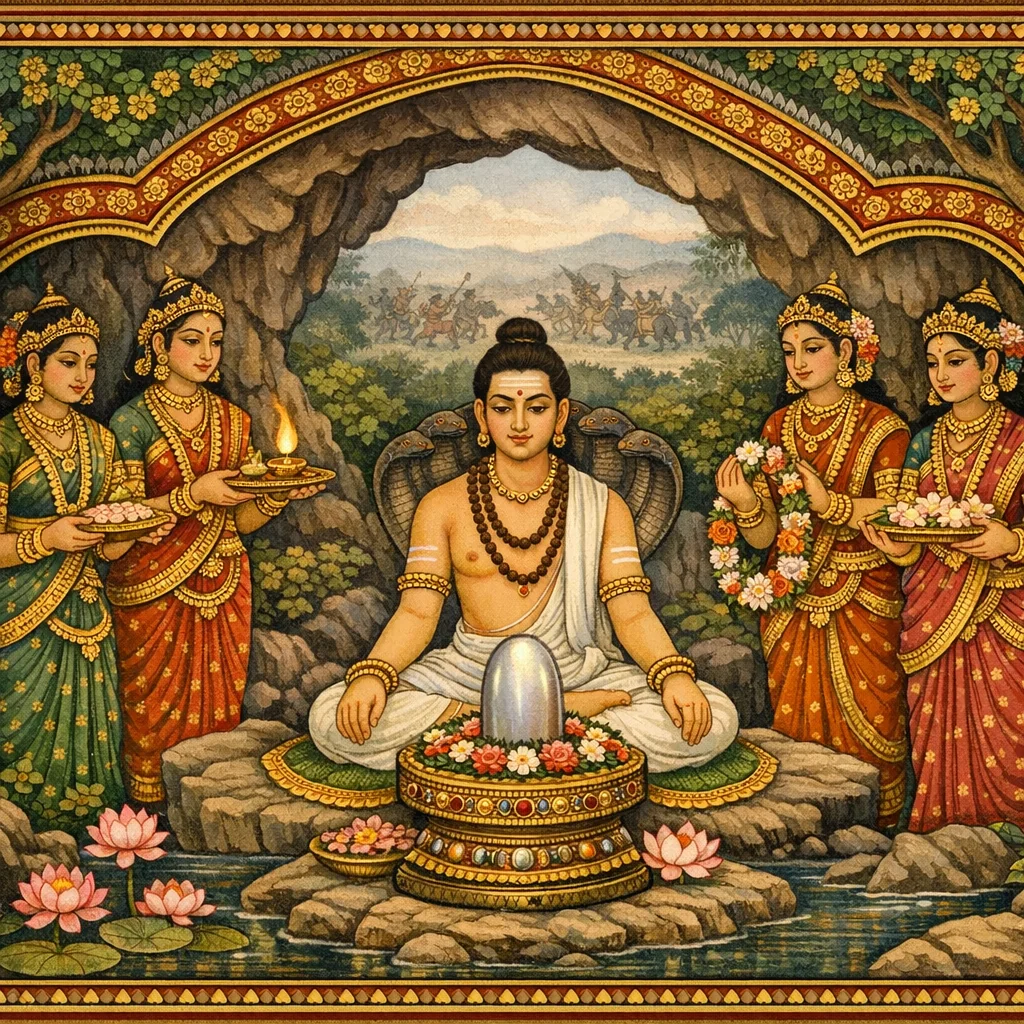
Sūta recounts a night ritual in which Vijaya performs a fire offering with potent mantras (bala/atibala). Through successive night-watches, disruptors arise: the fearsome rākṣasī Mahājihvā seeks release in return for vows of non-harm and future beneficence; a mountain-like foe, Repalendra/Repala, is checked by Barbarīka’s overwhelming counterforce; and the śākinī leader Duhadruhā is subdued and slain. An ascetic then condemns the fire rite as subtly life-harming, but Barbarīka refutes the charge as false within a sanctioned sacrificial order and drives him off, revealing a daitya form. The pursuit reaches Bahuprabhā city, where vast daitya forces are defeated. Nāgas led by Vāsuki thank Barbarīka for ending their oppression and grant a boon: that Vijaya’s work be completed without obstacles. The narrative turns to a jewel-like liṅga beneath a wish-fulfilling tree, worshipped by nāga maidens, who say it was installed by Śeṣa through tapas and who describe four routes from it: east to Śrīparvata, south to Śūrpāraka, west to Prabhāsa, and north to a hidden kṣetra with a siddhaliṅga. Vijaya offers Barbarīka a war-ash talisman; he declines from non-attachment, but divine counsel warns of future harm if the ash reaches the Kauravas, so he accepts. The gods honor Vijaya as “Siddhasena,” and the chapter closes with vows fulfilled and order stabilized through disciplined power and rightful worship.
Shlokas
Verse 1
सूत उवाच । अश्वत्थलाक्षावह्नौ च सर्षपान्केसरप्लुतान् । जुह्वतो मंत्रमुख्यैश्च बलातिबलसंज्ञकैः
Sūta said: As they were offering oblations into the fire fed with aśvattha-wood and lac, casting mustard-seeds moistened with saffron, and invoking the foremost mantras known as Balā and Atibalā,
Verse 2
यामे तु प्रथमे याते काचिन्नारी समाययौ । शोणिताक्तैकवसना महोच्चोर्ध्वशिरोरुहा
When the first watch of the night had passed, a certain woman arrived—clad in a single garment smeared with blood, her hair standing high and bristling upward.
Verse 3
दारुणाक्षी शुक्लदन्ती भयस्यापि भयंकरी । सा रुरोद महारावं प्राप्य तां होमभूमिकाम्
With dreadful eyes and white teeth—terrifying even to fear itself—she, upon reaching the ground of the homa fire-rite, let out a great, thunderous wail.
Verse 4
तां दृष्ट्वा चुक्षुभे सद्यो विजयो भीतिमानिव । बर्बरीकश्च निर्भीतिस्तस्याः संमुखमाययौ
Seeing her, Vijaya at once grew agitated, as though seized by fear; but Barbarīka, fearless, went straight to face her.
Verse 5
ततः कण्ठं समाश्लिष्य तस्या मतिमतां वरः । रुरोद द्विगुणं वीरो मेघवन्नादयन्बहु
Then that hero—best among the intelligent—seized her by the throat and cried out twice as loudly, roaring again and again like a cloud.
Verse 6
तं दृष्ट्वा विस्मिता सा च यावन्मुंचति कर्तिकाम् । तावन्निष्पीडिते कंठे मोक्तुं तस्मिन्न चाशकत्
Seeing him, she was astonished; and as long as he did not release her, with her throat tightly gripped she was unable to free herself from him.
Verse 7
पीड्यमाने च बलिना कंठे तस्या मुहुर्मुहुः । मुमुोच विविधाञ्छब्दान्वज्राहत इवाचलः
And as the strong one repeatedly pressed her throat, she again and again emitted various sounds—like a mountain struck by a thunderbolt.
Verse 8
क्षणं रावांस्ततो मुक्त्वा त्राहि मुञ्चेति वक्त्यणु । ततः कृपालुना मुक्ता पादयोः पतिताऽब्रवीत्
After letting out a cry for a moment, she pleaded in a faint voice, “Save me—release me!” Then, being freed by the compassionate one, she fell at his feet and spoke.
Verse 9
शरणं ते प्रपन्नास्मि दासी कर्मकरी तव । महाजिह्वेति मां विद्धि राक्षसीं कामरूपिणीम्
I have sought refuge in you. I am your handmaid, your worker. Know me as Mahājihvā—a rākṣasī who can assume forms at will.
Verse 10
काशीश्मशाननिलयां देवदानवदर्पहाम् । ददासि यदि मे वीर दुर्लभां प्राणदक्षिणाम्
O hero, if you grant me the rare gift of life—(I shall dwell in) Kāśī, whose abode is the cremation-ground, the humbler of the pride of gods and demons.
Verse 11
ततस्तपश्चरिष्यामि सर्वभूताभयप्रदा । अस्मिन्नर्थे स्वदेवस्य शपथा मे तथात्मनः
Then I shall practice austerity (tapas), becoming a giver of fearlessness to all beings. In this matter, I swear by my own chosen deity—and by my very self.
Verse 12
यद्येतद्व्यत्ययं कुर्यां भस्मीभूयां ततः क्षणम् । एवं ब्रुवाणां तां वीरो निगृह्य शपथैर्दृढम्
If I should violate this, may I be reduced to ashes that very instant. As she spoke thus, the hero restrained her firmly, binding her with solemn oaths.
Verse 13
मुमोच सापि संहृष्टा कृच्छ्रान्मुक्ता ययौ वनम् । सोऽपि वीरः खङ्गधारी तत्रैवावस्थितोऽभवत्
He released her; and she too, delighted—freed from distress—went to the forest. That hero, bearing a sword, remained stationed there.
Verse 14
ततो मध्यमरात्रौ च गर्जितं श्रूयते महत् । अन्धकारं च संजज्ञे तमोंऽधनरकप्रभम्
Then, at midnight, a mighty roar was heard, and darkness arose—gloomy like the radiance of a blind hell.
Verse 15
ददृशे च ततः शैलः शतशृंगोऽतिविस्तरः । नानाशिलाः प्रमुमुचे नानावृक्षांश्च सोच्छ्रयान्
Then a mountain appeared—vast, with a hundred peaks. It hurled forth many kinds of rocks, and many trees as well, towering aloft.
Verse 16
नानानिर्झर संघोषं ववृषे शोणितं वहु । तं तथा नगमालोक्य निर्भीतो भैमिनंदनः
With a tumult like many waterfalls, much blood rained down. Seeing the mountain in that state, the son of Bhīmā remained unafraid.
Verse 17
पर्वतो द्विगुणो भूत्वा पर्वतं सहसाप्लुतः । तदाभिजघ्ने संहृत्य पर्वतं स्वेन भूभृता
Becoming twice as large, the mountain suddenly leapt upon the other mountain. Then it struck it down, seizing and crushing it with its own mass.
Verse 18
तदा विशीर्णः सोऽभूच्च पर्वतो भूमिमंडले । ततो योजनदेहात्मा शतशीर्षः शतोदरः
Then, upon the circle of the earth, that mountain-like form collapsed and lay shattered. From it arose a being of a body measuring a yojana—having a hundred heads and a hundred bellies.
Verse 19
वक्त्रैर्मुंचन्महाज्वालां रेपलेन्द्रोऽभ्यधावत । तं धावमानं दृष्ट्वैव बर्बरीको महाबलः
Repalendra charged forward, spewing mighty flames from his many mouths. Seeing him rush in, the great and powerful Barbarīka also advanced to meet him.
Verse 20
विधाय तादृशं रूपं नर्दन्तं चाप्यधावत । ततो मध्यमरात्रौ ती लघु चित्रं च सुष्ठु च
Assuming such a form and roaring aloud, he too ran forward. Then, in the middle of the night, there occurred something swift, wondrous, and most striking.
Verse 21
युयुधाते बाणजालैर्यथा प्रावृषि तोयदौ । छिन्नचापौ च खङ्गाभ्यां छिन्नखड्गौ च मुष्टिभिः
They fought with nets of arrows like rain-clouds in the monsoon. Their bows were cut by swords, and their swords were smashed away by fists.
Verse 22
पर्वताविव सत्पक्षौ चिरं युयुधतुः स्थिरम् । ततः कक्षे समुत्पाट्य भ्रामयित्वा मुहूर्तकम्
Like two mountains with mighty wings, they fought steadfastly for a long time. Then, seizing the foe at the waist, he tore him up and whirled him around for a moment.
Verse 23
भूमौ प्रधर्षयामास प्रसृतं च मुमोच ह । चिक्षेप चाग्निकोणे तं महीसागररोधसि
He dashed him down upon the ground and, as he lay sprawled, released his hold. Then he hurled him toward the south-east, to the boundary where land meets the ocean.
Verse 24
तद्दूरे रेपलेन्द्राख्यं ग्राममद्यापि वर्तते । एवं स रेपलोनाम वृत्रतुल्यपराक्रमः
Not far from that place, a village called Repalendra exists even today. Thus was that Repala, whose prowess was like Vṛtra’s.
Verse 25
नाथः श्मशानस्यावन्त्या विघ्नकृन्निहतोऽभवत् । तं निहत्य पुनर्वीरो बर्बरीकः स्थितोऽभवत्
The lord of the cremation-ground of Avanti—one who caused obstacles—was slain. Having killed him, the hero Barbarīka stood again, firm and unshaken.
Verse 26
ततस्तृतीययामे च प्रतीच्या दिश आययौ । पर्वताभा महानादा पादैः कम्पयतीव भूः
Then, in the third watch of the night, from the western direction there came one mountain-like in form, roaring loudly, as though shaking the earth with her feet.
Verse 27
दुहद्रुहाख्याश्वतरी मेघभ्रष्टा तडिद्यथा । तामायांतीं तथा दृष्ट्वा सूर्यवैश्वानरप्रभाम्
A she-mule named Duhadruhā appeared, like lightning fallen from a cloud. Seeing her coming, radiant with the splendor of the sun and of Vaiśvānara-fire, (he reacted).
Verse 28
उपसृत्य जवाद्भैमी रुरोह प्रहसन्निव । वेगात्ततः प्रद्रवतीं तुण्डे प्राहत्य मुष्टिभिः
Rushing up with great speed, Bhairavī mounted upon him as if laughing. Then, as she darted forward with force, he struck her in the face with his fists.
Verse 29
स्थापयामास तत्रैव तस्थौ सा चातिपीडिता । ततः क्रुद्धा महारावं कृत्वाप्लुत्य दुहद्रुहा
He forced her down right there and she stood, sorely crushed. Then, enraged, Duhadruhā leapt up, uttering a tremendous roar.
Verse 30
जगत्यामाशु चिक्षेप बर्बरीकं तथेच्छकम् । ततो नदित्वा चातीव पादघातममुंचत
She swiftly hurled Barbarīka down onto the ground, as she wished. Then, roaring fiercely, she delivered a violent kick.
Verse 31
पादौ च वीरः संगृह्य चिक्षेप भुवि लीलया । ततः पुनः समुत्थाय धावंतीं तां निगृह्य सः
The hero seized her feet and, as if in sport, flung her to the ground. Then, rising again, he caught and checked her as she charged forward.
Verse 32
मुष्टिना पातयित्वैव दंतान्कंठमपीडयत् । क्लिन्नं वास इवापीड्य प्राणानत्याजयद्द्रुतम्
Knocking her down with his fist, he crushed her teeth and throttled her throat. Squeezing her like a soaked cloth, he quickly made her give up her life-breath.
Verse 33
एवं सीकोत्तरस्थाने स्मशानैकपदो द्भवा । शाकिनीनामधीशा सा बर्बरीकेण सूदिता
Thus, in the region to the north of Sīka—at the cremation-ground called Eka-pada—she, the overlord of the Śākinīs, was slain by Barbarīka.
Verse 34
हत्वा तां चापि चिक्षेप प्रतीच्यामेव लीलया । दुहद्रुहाख्यमद्यापि तत्र ग्रामं स्म वर्तते
After killing her, he cast her westward as though in sport. Even to this day, it is said that a village named Duhadruhā stands there.
Verse 35
ततस्तथैव संतस्थौ बर्बरीकोऽभिरक्षणे । ततश्चतुर्थे यामे च प्राप्तः क्षपणकोऽद्भुतः
Then Barbarīka remained stationed there, keeping watch as before. And in the fourth watch of the night, a wondrous ascetic, a kṣapaṇaka, arrived.
Verse 36
मुंडी नग्नो मयूराणां पिच्छधारी महाव्रतः । प्रोवाच चेदं वचनं हाहा कष्टमतीव भोः
Bald-headed, naked, clad in peacock feathers, and observing a great vow, he spoke these words: “Alas, alas—this is exceedingly grievous, sir!”
Verse 37
अहिंसा परमो धर्मस्तदग्निर्ज्वाल्यते कुतः । हूयमाने यतो वह्नौ सूक्ष्मजीववधो महान्
“Non-violence is the highest dharma—so how can this fire be kindled? For when offerings are poured into the flame, there is great slaughter of subtle living beings.”
Verse 38
श्रुत्वेदं वचनं तस्य बर्बरीकोऽब्रवीत्स्मयन् । वदने सर्वदेवानां हूयमाने स्म पावके
Hearing his words, Barbarīka spoke with a smile, while the sacrificial fire was being kindled and oblations were being offered—invoking the presence of all the gods.
Verse 39
अनृतं भाषसे पाप शिक्षायोग्योऽसि दुर्मते । इत्युक्त्वा सहसोत्पत्य कक्षामध्ये स्थिरोऽस्य च
“You speak falsehood, sinner—your wicked mind deserves correction!” Saying this, he sprang up at once and stood firmly at his foe’s waist, within his grasp.
Verse 40
दन्तान्मुष्टिप्रहारैश्च समाहत्याभ्यपातयत् । रुधिराविलवक्त्रं तं मुमोच पतितं भुवि
Striking him with fist-blows upon the teeth, he smashed him down. His face smeared with blood, the foe was released and fell upon the ground.
Verse 41
स क्षणाच्चेतनां प्राप्य घोरदैत्यवपुर्धरः । भयाद्भैमेः प्रदुद्राव गुहाविवरमाविशत्
In a moment he regained consciousness—dreadful, wearing a daitya’s form. Fearing Bhīma’s descendant, he fled and entered a cleft in a cave.
Verse 42
बहुप्रभेति नगरी षष्टियोजनमायता । तस्यां विवेश सहसा तं चानु बर्बरीककः
There was a city called Bahuprabhā, radiant, stretching sixty yojanas. Into it he entered suddenly, and Barbarīka followed close behind him.
Verse 43
बर्बरीकं ततो दृष्ट्वा नादोऽभूच्च पलाशिनाम् । धावध्वं हन्यतामेष छिद्यतां भिद्यतामिति
Seeing Barbarīka, a great outcry arose among the Palāśins: “Run! Kill him! Cut him down! Pierce and shatter him!”
Verse 44
तच्छ्रुत्वा दैत्यवीराणां कोटयो नव भीषणाः । नानायुधधरा वीरं बर्बरीकमुपाद्रवन्
Hearing that cry, nine crores of fearsome Daitya warriors—bearing weapons of every kind—rushed upon the hero Barbarīka.
Verse 45
दृष्ट्वा तान्कोटिशो दैत्यान्क्रुद्धो भीमात्मजात्मजः । निमील्य सहसा नेत्रे तेषां मध्यमधावत
Seeing those Daityas in crores, Bhīma’s grandson blazed with anger. Closing his eyes for an instant, he suddenly charged into the midst of them.
Verse 46
पादघातैस्ततः कांश्चिद्भुजाघातैस्तथापरान् । हृदयस्याभिघातैश्च क्षणान्निन्ये यमक्षयम्
Then he struck some down with kicks, others with blows of his arms; and with crushing blows to the heart he sent them, in an instant, to the abode of Yama.
Verse 47
यथा नलवनं क्र्रुद्धः कुर्याद्भूमिसमं करी । नवकोटीस्तथा जघ्ने सह तेन पलाशिना
As an enraged elephant levels a thicket of reeds to the ground, so did he slaughter nine crores—together with that Palāśin.
Verse 48
ततो नागाः समागम्य वासुकिप्रमुखास्तदा । तुष्टुबुर्विविधैर्वाक्यैरूचुः सुहृदयं च ते
Then the Nāgas, led by Vāsuki, assembled there. Delighted, they praised Suhṛdaya with many words and addressed him with heartfelt goodwill.
Verse 49
नागानां परमं कृत्यं कृतं ते भैमिनंदन । पलाशीनाम दैत्योयं नीतो यत्सानुगो यमम्
O son of Bhīma, you have rendered the highest service to the Nāgas: this Daitya named Palāśī, together with his followers, has been sent to Yama.
Verse 50
अनेन हि वयं वीर सानुगेन दुरात्मना । पीडिता विविधोपायैः पातालादप्यधः कृताः
For by that wicked one, together with his followers, we were tormented, O hero, by many cruel means, and were driven down even below Pātāla.
Verse 51
वरं वृणीष्व त्वं तस्मान्नागेभ्योऽभिमतं परम् । वरदाः सर्व एव स्म वयं तुभ्यं सुतोषिताः
Therefore choose a boon—whatever supreme gift you desire—from the Nāgas. We are all granters of boons, for we are exceedingly pleased with you.
Verse 52
सुहृदय उवाच । यदि देयो वरो मह्यं तदेनं प्रवृणोम्यहम् । सर्वविघ्नविनिर्मुक्तो विजयः सिद्धिमाप्नुयात्
Suhṛdaya said: “If a boon is to be granted to me, then I choose this: may Vijaya, freed from all obstacles, attain complete success.”
Verse 53
ततस्तथेति तं प्रोचुः प्रहृष्टा वायुभोजनाः । स च तेभ्यः पुरीं दत्त्वा निवृत्तो नागपूजितः
Then the wind-fed Nāgas, rejoicing, replied to him, “So be it.” And he, granting them a city, returned—honored and worshipped by the Nāgas.
Verse 54
विवरस्य च मध्येन समागच्छन्महाप्रभम् । सर्वरत्नमयं लिंगं स्थितं कल्पतरोरधः
Passing through the middle of a cleft, he came upon a great radiance: a liṅga made of all jewels, standing beneath the wish-fulfilling Kalpataru tree.
Verse 55
अर्च्यमानं सुवह्नीभिर्नागकन्याभिरैक्षत । ततोऽसौ विस्मयाविष्टो नागकन्या ह्यपृच्छत
He saw it being worshipped by radiant Nāga maidens. Then, filled with wonder, he questioned the Nāga maiden.
Verse 56
केनेदं स्थापितं लिंगं सूर्यवैश्वानरप्रभम् । लिंगादपि चतुर्दिक्षु मार्गाश्चेमे तु कीदृशाः
“By whom was this liṅga established—radiant like the Sun and the sacred fire? And from the liṅga, these paths extending to the four directions—what are they?”
Verse 57
इति वीरवचः श्रुत्वा बृहत्कटिपयोधरा । सव्रीडं सस्मितापांगनिर्मोक्षमिदमब्रवीत्
Hearing the hero’s words, the maiden—broad-hipped and full-breasted—spoke thus, with modesty and a smile, her sidelong glance gently released.
Verse 58
सर्वपन्नगराजेन शेषेण सुमहात्मना । तप स्तप्त्वा महालिंगमिदमत्र प्रतिष्ठितम्
By the great-souled Śeṣa, king of all serpent-lords, severe austerity was performed, and this mighty Śiva-liṅga was established here.
Verse 59
दर्शनात्स्पर्शनाद्ध्यानादर्चनात्सर्वसिद्धिदम् । लिंगात्पूर्वेण मार्गोयं याति श्रीपर्वतं भुवि
By beholding, touching, meditating upon, and worshipping it, this liṅga bestows every attainment. From the liṅga, this eastern path on earth leads to Śrīparvata.
Verse 60
एलापत्रेण विहितो नागानां तत्र प्राप्तये । दक्षिणेन च मार्गोऽयं याति शूर्पारकं भुवि
This route was laid out by Elāpatra so that the Nāgas might reach that place. And this southern path on earth leads to Śūrpāraka.
Verse 61
कर्कोटकेन नागेन कृतोऽयं तत्र प्राप्तये । पश्चिमेन च मार्गोऽयं प्रभासं याति सुप्रभम्
This route was made by the Nāga Karkoṭaka for reaching that place. And this western path leads to the splendid Prabhāsa.
Verse 62
ऐरावतेन विहितो नागानां गमनाय च । उत्तरेण च मार्गोयं येन यातुं भवान्स्थितः
Arranged by Airāvata for the Nāgas’ passage, this is the northern route—by which you are now prepared to proceed.
Verse 63
गुप्तक्षेत्रे सिद्धलिंगं याति शक्तिगुहाऽकृतः । विहितस्तक्षकेणासौ यातुं तत्र महात्मना
In the hidden sacred region, the path goes to Siddhaliṅga—made by Śaktiguhā. That very path was laid out by the great-souled Takṣaka for going there.
Verse 64
इतीदं वर्णितं वीर विज्ञप्तिः श्रूयतां मम । को भवानधुनैवेतो दैत्यपृष्ठ गतोऽभवत् । अधुनैव तथैकाकी समायातोऽत्र नो वद
Thus, O hero, I have described this; now hear my request. Who are you, who have just arrived riding upon a demon’s back? And how have you come here now, all alone? Tell us.
Verse 65
वयं च सर्वास्ते दास्यस्त्वां पतिं प्रवृणीमहे । अस्माभिः सहितः क्रीड विविधास्वत्र भूमिषु
And we—all of us your maidservants—choose you as our lord. Along with us, sport and wander in many delightful places here.
Verse 66
बर्बरीक उवाच । अहं कुरुकुलोत्पन्नः पांडुपुत्रस्य पौत्रकः । बर्बरीक इति ख्यातस्तं दैत्यं हंतुमागतः
Barbarīka said: “I am born in the Kuru lineage, the grandson of Pāṇḍu’s son. Known as Barbarīka, I have come to slay that demon.”
Verse 67
स च दैत्यो हतः पापः पुनर्यास्ये महीतलम् । भवतीभिश्च मे नास्ति कृत्यं भोभोः कथंचन
“And that sinful demon has been slain. Now I shall return to the earth. And with you, ladies, I have no further business at all.”
Verse 68
ब्रह्मचारिव्रतं यस्मादहं सततमास्थितः । इत्युक्त्वाभ्यर्च्य तल्लिंगं प्रणिपत्य च दण्डवत्
Saying, “Because I have ever remained established in the vow of brahmacarya,” he worshipped that liṅga, and then bowed down in full prostration like a staff.
Verse 69
ऊर्ध्वमाचक्रमे वीरः कातरं ताभिरीक्षितः । ततो बहिः समागत्य सप्रकाशं मुखं तदा
Then the hero rose upward; as those women looked on with anxious concern, he came forth, and at that moment his face shone with radiant clarity.
Verse 70
प्रहर्षेणैव पूर्वस्या विजयं ददृशे दिशः । तस्मिन्काले च विजयः कर्म सर्वं समाप्तवान्
With great delight he beheld victory coming from the eastern direction; and at that very time, Vijaya completed the entire undertaking.
Verse 71
कांत्या सूर्यसमाभास ऊर्ध्वमाचक्रमे क्षणात् । ततो वियद्गतं देवैः पुष्पवर्षमभून्महत्
Shining with a splendor like the sun, he rose upward in an instant. Then, from the heavens, the gods sent down a great rain of flowers.
Verse 72
जगुर्गंधर्वमुख्याश्च ननृतुश्चाप्सरोगणाः । विजयो बर्बरीकं च ततो वचनमब्रवीत्
The foremost Gandharvas sang, and the hosts of Apsarases danced. Then Vijaya addressed Barbarīka with these words.
Verse 73
तव प्रसादाद्वीरेश सिद्धिः प्राप्ता मयातुला । चिरं जीव चिरं नंद चिरं वस चिरं जय
“O lord of heroes, by your grace I have attained incomparable success. Live long, rejoice long, dwell long, and triumph long!”
Verse 74
अत एव हि साधृनां संगमिच्छंति साधवः । औषधं सर्वदोषाणां भवेत्सत्यं गमो यतः
Therefore the virtuous seek the company of the virtuous; for from such fellowship arises a truthful way of life, which becomes a medicine for all faults.
Verse 75
त्वं च होमस्थितं भस्म सिंदूरसदृशप्रभम् । निःशल्यं सविवरकं पूर्यमाणं गृहाण च
And you, take this ash from the fire-offering (homa), radiant like red vermilion—unwounded, yet with an opening, and able to be filled; receive it.
Verse 76
अक्षय्यमेतत्संग्रामे प्रथमं ते प्रमुंचतः । शत्रूणां स्थानकं मृत्योर्देहं ध्वस्तं करिष्यति
This is inexhaustible in battle. When you release it first, it will shatter the enemies’ stronghold and break even Death’s very body.
Verse 77
एवं सुखेन विजयः शत्रूणां ते भविष्यति
Thus, with ease, victory over your enemies will be yours.
Verse 78
बर्बरीक उवाच । उपकुर्यान्निराकांक्षो यः स साधुरितीर्यते । साकांक्षमुपकुर्याद्यः साधुत्वे तस्य को गुणः
Barbarīka said: “He alone is called a true good man who helps without any expectation. If someone helps while desiring a return, what virtue is there in calling him ‘good’?”
Verse 79
तद्देहि भस्म चान्यस्मै केनाप्यर्थो न मेऽण्वपि । प्रसादसुमुखां दृष्टिं विना नान्यद्वृणोमि ते
Give that ash to someone else—for I seek not even the slightest worldly gain from anyone. Save for your gracious, kindly glance of favor, I ask you for nothing else.
Verse 80
देवा ऊचुः । कुरूणां पांडवानां च भविष्यति महान्रणः । ततो भूमिस्थितं भस्म प्राप्स्यंति यदि कौरवाः
The gods said: “A great war will arise between the Kurus and the Pāṇḍavas. If, after that, the Kauravas obtain the ash lying upon the ground…”
Verse 81
महाननर्थो भविता पांडवानां ततः स्फुटम् । तस्माद्गृहाण त्वं भस्म सोपि चक्रे तथो वचः
“Then, clearly, a great calamity would befall the Pāṇḍavas. Therefore, you should take this ash.” And he, too, acted in accordance with those words.
Verse 82
देवीभिः सहिता देवाः संमान्य विजयं च ते । सिद्धैश्वर्यं ददुस्तस्मै सिद्धसेनेति नाम च
The gods, accompanied by the goddesses, honored Vijaya. They bestowed upon him perfected powers and prosperity, and also gave him the name “Siddhasena.”
Verse 83
एवं स विजयो विप्रः सिद्धिं लेभे सुदुर्लभाम् । बर्बरीकश्च कृत्वैतद्देवीभक्तिरतोऽवसत्
Thus that brāhmaṇa Vijaya attained a very rare perfection. And Barbarīka, having done this, lived on devotedly engaged in worship of the Goddess.