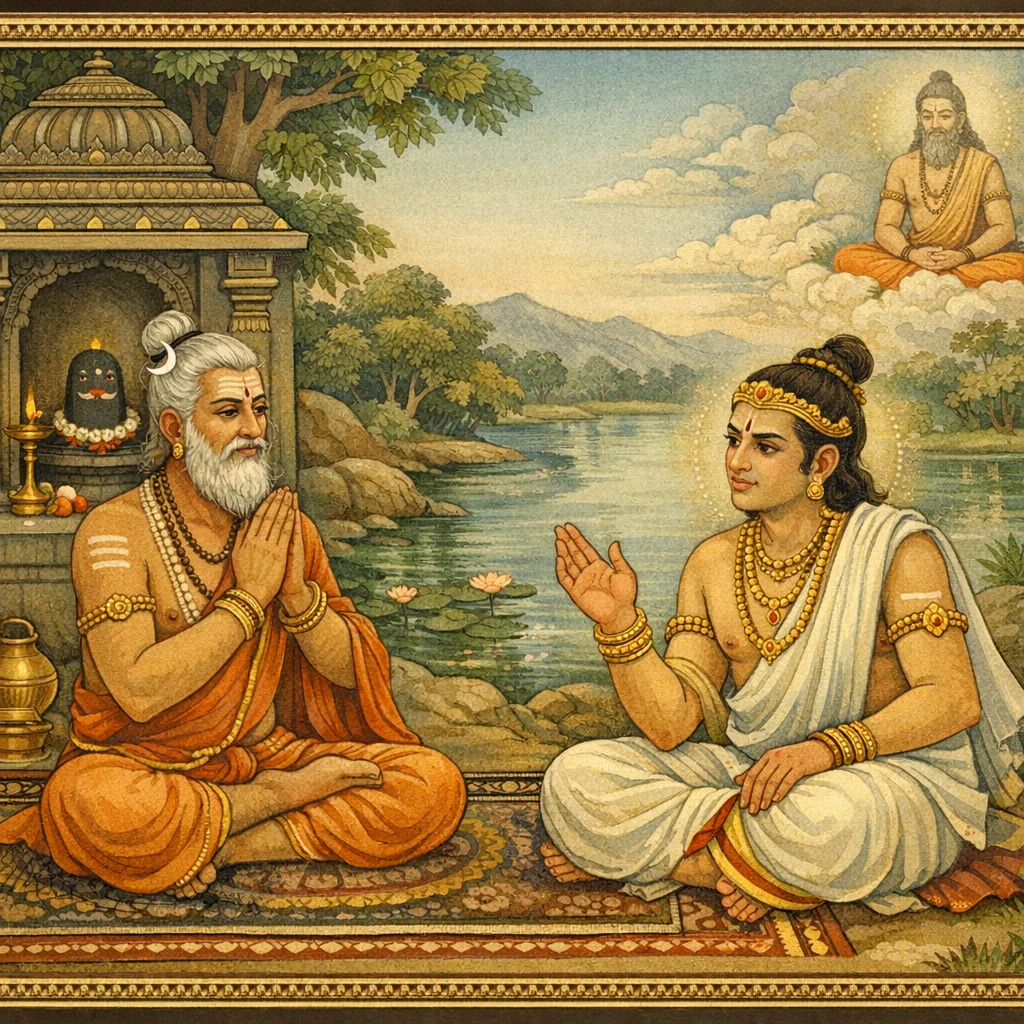
Adhyaya 45
Chapter 45 begins with Nārada situating the discourse at Bahūdaka in Kāmarūpa and explaining the name and sanctity of the tīrtha, recalling Kapila’s austerities and the स्थापना of the Kapileśvara liṅga. The narrative then presents Nandabhadra as a model of righteousness—disciplined in thought, speech, and deed, devoted to Śiva’s worship, and committed to an honest livelihood, even in trade with small profit and no fraud. Nandabhadra rejects easy praise of yajña, saṃnyāsa, agriculture, worldly power, and even pilgrimage when these are severed from purity and ahiṃsā. He redefines true sacrifice as sincere bhakti that pleases the deities, and teaches that the self is purified by ceasing from sin. Conflict arises when the skeptical neighbor Satyavrata searches for faults in Nandabhadra and reads his misfortunes—loss of son and wife—as evidence against dharma and liṅga worship. Satyavrata offers a technical discussion of the qualities and faults of speech and advances a naturalistic ‘svabhāva’ view denying divine causation. Nandabhadra replies that suffering is also seen among the unethical, defends liṅga worship with exempla of gods and heroes who established liṅgas, and warns against ornate yet inconsistent rhetoric. The chapter ends with his departure toward the holy Bahūdaka-kunda, reaffirming dharma’s authority when grounded in reliable pramāṇas—Veda, Smṛti, and dharmically coherent reasoning.
Shlokas
Verse 1
। नारद उवाच । तथा बहूदकस्थाने कथामाकर्णयाद्भुताम् । यस्माद्बहूदकं कामरूपे यदस्ति च
Nārada said: “Thus, at the sacred place called Bahūdaka, hear a wondrous account—for in Kāmarūpa there exists a tīrtha known as Bahūdaka.”
Verse 2
तदस्ति चात्र संक्रांतं तस्मात्प्रोक्तं बहूदकम् । कपिलेनात्र तप्त्वा च वर्षाणि सुबहून्यपि
Here too there is a sacred saṅkrānti, a holy convergence and transition; therefore it is called Bahūdaka. And here Kapila also performed austerities for very many years.
Verse 3
स्थापितं शोभनं लिंगं कपिलश्वरसंज्ञितम् । तच्च लिगं सदा पार्थ नन्दभद्र इति समृतः
There a splendid liṅga was established, known as Kapileśvara. And that liṅga, O Pārtha, is ever remembered by the name Nandabhadra.
Verse 4
वाणिक्संपूजयामास त्रिकालं च कृतादरः । सर्वधर्प्रविशेवज्ञः साक्षाद्धर्म इवापरः
A merchant worshipped that liṅga with reverence three times a day. He was skilled in entering into every duty—like Dharma himself in another form.
Verse 5
नाज्ञातं तस्य किंचिच्च यद्धर्मेषु प्रकीर्त्यते । सर्वेषां च सुहृन्नित्यं सर्वेषां च हिते रतः
Nothing taught concerning dharma was unknown to him. He was ever a friend to all, and devoted to the welfare of all.
Verse 6
कर्मणा मनसा वाचा धर्ममेनमुपाश्रितः । न भूतो न भविष्यश्च न स धर्मोऽस्ति किंचन
By deed, by mind, and by speech, he took refuge in dharma. There was no duty—neither in the past nor in the future—that he did not embody in some way.
Verse 7
विदोषो यो हि सर्वत्र निश्चित्यैवं व्यवस्थितः । अस्य धर्मसमुद्रस्य संप्रवृद्धस्य सर्वतः
Indeed, having discerned what is faultless in every circumstance, he remained firmly established thus. Behold this ocean of dharma, grown vast on every side.
Verse 8
निर्मथ्य नन्दभद्रेण आहृतं तन्निशामय । वाणिज्यं मन्यते श्रेष्ठं जीवनाय तदा स्थितः
Now hear what Nandabhadra brought forth through strenuous effort, as though by churning. At that time he deemed trade the finest means of sustaining life, and he remained engaged in it.
Verse 9
परिच्छिन्नैः काष्ठतृणैः शरणं तेन कारितम् । मद्यवर्जं भेदवर्जं कूटवर्जं समं तथा
With gathered pieces of wood and grass, he made a simple shelter. He kept free from liquor, free from divisiveness, free from deceit, and remained even-minded as well.
Verse 10
सर्वभूतेषु वाणिज्यमल्पलाभेन सोऽचरत् । अमायया परेभ्योऽसौ गृहीत्वैव क्रयाणकम्
He carried on trade with all beings, taking only a small profit. Without trickery, he accepted from others only the proper price of purchase.
Verse 11
अमाययैव भूतेभ्यो विक्रीणात्यस्य सद्व्रतम् । केचिद्यज्ञं प्रशंसंति नन्दभद्रो न मन्यते
With guilelessness he “purchases” (wins over) beings through compassion—this is his true and noble vow. Some praise yajña, the sacrificial rite, but Nandabhadra does not accept that as the highest.
Verse 12
दोषमेनं विनिश्चत्य श्रृमु तं पांडुनन्दन । लुब्धोऽनृती दांभीकश्च स्वप्रशंसापरायणः
Having discerned this fault, hear it, O son of Pāṇḍu: he is greedy, untruthful, hypocritical, and devoted to praising himself.
Verse 13
यजन्यज्ञैर्जगद्धं ति स्वं चांधतमसं नयेत् । अग्नौ प्रास्ताहुतिः सम्यगादित्यमुपतिष्ठते
By performing sacrifices, one upholds the world and does not fall into blind darkness. Oblations properly cast into the fire duly reach the Sun (Āditya).
Verse 14
आदित्याज्जायते वृष्टिर्वष्टेरन्नं ततः प्रजाः । यद्यदा यजमानस्य ऋत्विजो द्रव्यमेव च
From the Sun arises rain; from rain comes food; and from that, living beings thrive. And whenever the sacrificer, the priests, and the sacrificial materials (are involved)…
Verse 15
चौरप्रायस्य कलुषाज्जन्म जायेज्जनस्य हि । अदक्षिणे वृथा यज्ञे कृते चाप्यविधानतः
Indeed, from the impurity of a sacrifice that is almost like theft, a person’s rebirth arises in a fallen way. When a yajña is performed without fees (dakṣiṇā), in vain, and contrary to proper rule, it becomes tainted.
Verse 16
पशवो लकुटैर्हन्युर्यजमानं मृतं हताः । तस्माच्छुद्धैर्यवद्रव्यैर्यजमानः शुभः स्मृतः
The sacrificial animals—struck down with clubs—would, as it were, strike the sacrificer after death. Therefore the sacrificer is considered auspicious when the offerings and materials (such as barley) are pure.
Verse 17
यज्ञ एवं विचार्यासौ यज्ञसारं समास्थितः । श्रद्धया देवपूजा या नमस्कारः स्तुतिः शुभा
Thus reflecting on yajña, he abides in the very essence of sacrifice: worship of the gods with faith, reverent salutations, and auspicious praise.
Verse 18
नैवेद्यं हविषश्चैव यज्ञोऽयं हि विकल्मषः । स एव यज्ञः प्रोक्तो वै येन तुष्यन्ति देवताः
Naivedya (food-offerings) and havis (oblations) as well—this yajña is indeed free from impurity. That alone is called ‘sacrifice’ by which the deities are truly satisfied.
Verse 19
केचिच्छंसन्ति संन्यासं नन्दभद्रो न मन्यते । यो हि संन्यस्य विषयान्मनसा गृह्यते पुनः
Some extol renunciation, but Nandabhadra does not accept it as genuine when—having renounced sense-objects—one again seizes them in the mind.
Verse 20
उभयभ्रष्ट एवासौ भिन्ना भूमिर्विनश्यति । संन्यासस्य तु यत्सारं तत्तेनावृतमुत्तमम्
Such a person is fallen from both paths; like split ground, he comes to ruin. But whatever is the true essence of renunciation—that supreme essence is veiled for him.
Verse 21
कस्यचिन्नैव कर्माणि शपते वा प्रशंसति । नानामार्गस्थितांल्लोकांश्चन्द्रवल्लीयते क्षितौ
He neither condemns nor praises the actions of anyone. Moving among people who follow many different paths, he remains on earth like the moon—aloof, cool, and untainted.
Verse 22
न द्वेष्टि नो कामयते न विरुद्धोऽनुरुध्यते । समाश्मकांचनो धीरस्तुल्यनिंदात्मसंस्तुतिः
He neither hates nor craves; even when opposed, he does not fawn for approval. Steady and discerning, the wise one sees stone and gold alike, and remains the same in blame and in self-praise.
Verse 23
अभयः सर्वभूतेभ्यो यथांधबधिराकृतिः । न कर्मणां फलाकांक्षा शिवस्याराधनं हि तत्
He grants fearlessness to all beings, as though blind and deaf to provocations. He does not yearn for the fruits of actions—this itself is truly the worship of Śiva.
Verse 24
कारणाद्धर्ममन्विच्छन्न लोभं च ततश्चरन्
Seeking Dharma in its true cause and purpose, and then proceeding without greed—such is his way of conduct.
Verse 25
विविच्य नंदभद्रस्तत्सारं मोक्षेषु जगृहे । कृषिं केचित्प्रशंसंति नंदभद्रो न मन्यते
Having rightly discerned, Nandabhadra accepted the essence as mokṣa, liberation. Though some praise agriculture, Nandabhadra does not regard it as the highest good.
Verse 26
यस्यां छिंदंति वृषाणां चैव नासिकाम् । कर्षयंति महाभारान्बध्नंति दमयंति च
In that occupation, they even cut the noses of bulls; they make them drag heavy loads, bind them, and break them into obedience.
Verse 27
बहुदंशमयान्देशान्नयंति बहुकर्दमान् । वाहसंपीडिता धुर्याः सीदंत्यविधिना परे
They drive them through lands swarming with biting pests and through deep mud. Crushed beneath the load, the draught-animals collapse—while others do this without due rule or compassion.
Verse 28
मन्यंते भ्रूणहत्यापि विशिष्टा नास्य कर्मणः । अघ्न्या इति गवां नाम श्रुतौ ताः पीडयेत्कथम्
They deem even embryo-killing less grievous than this deed. For the Veda calls cows “aghnyā”—“not to be harmed”; how then could one torment them?
Verse 29
भूमिं भूमिशयांश्चैव हंति काष्ठमयोमुखम् । पंचेंद्रियेषु जीवेषु सर्वं वसति दैवतम्
With a wooden-faced plough it strikes the earth and the creatures that lie within the earth. In all beings endowed with the five senses, the Divine dwells entirely.
Verse 30
आदित्यश्चंद्रमा वायुः प्रभूत्यैव च तांस्तु यः । विक्रीणाति सुमूढस्य तस्य का नु विचारणा
The Sun, the Moon, the Wind, and other mighty powers sustain life; yet one who “sells” them as his own commodity is utterly deluded—what discernment could such a person possibly have?
Verse 31
अजोऽग्निर्वरुणो मेषः सूर्यश्च पृथिवी विराट् । धेनुर्वत्सश्च सोमो वै विक्रीयैतान्न सिध्यति
The goat, Fire, Varuṇa, the ram, the Sun, the Earth, the Cosmic Being (Virāṭ), the cow and calf, and Soma—by selling such sacred beings and principles, one never attains true success.
Verse 32
एवंविधसहस्रैश्च युता दोषैः कृषिः सदा । अष्टगवं स्याद्धि हलं त्रिंशद्भागं त्यजेत्कृषेः
Agriculture is ever entangled with thousands of faults of this kind. Truly, the plough is as though drawn by eight oxen; therefore one should relinquish a thirtieth part of the farm’s produce as a dharmic renunciation.
Verse 33
धर्मे दद्यात्पशून्वृद्धान्पुष्यादेषा कृषिः कुतः । सारमेतत्कृषेस्तेन नंदभद्रेण चादृतम्
For the sake of dharma, one should give away aged cattle; then how could agriculture truly flourish without bearing moral burden? This is the very essence concerning farming, and Nandabhadra revered and upheld it.
Verse 34
विसाधितव्यान्यन्नानि स्वशक्त्या देवपितृषु । मनुष्य द्विजभूतेषु नियुज्याश्नीत सर्वदा
Food should be prepared according to one’s capacity and duly offered to the gods and the ancestors. Then it should be distributed among humans, twice-born guests, and all living beings; only thereafter should one eat, always.
Verse 35
केचिच्छंसंति चैश्वर्यं नंदभद्रो न मन्यते । मानुषा मानुषानेव दासभावेन भुंजते
Some praise lordly power and dominion, but Nandabhadra does not approve. For humans, making other humans into slaves for “enjoyment” is an enjoyment rooted in bondage.
Verse 36
वधबंधनिरोधेन पीडयंति दिवानिशम् । देहं किमेतद्धातुः स्वं मातुर्वा जनकस्य वा
By killing, binding, and confinement they torment others day and night. But whose is this body—does it belong to oneself, to the mother, or to the father?
Verse 37
मातुः पितुर्वा बलिनः क्रेतुरग्नेः शुनोऽपि वा । इति संचिंत्य व्यहरन्नमरा इव ईश्वराः
Thinking, “(This body belongs) to the mother, or the father, or the strong man, or the buyer, or to Fire, or even to a dog,” and reasoning thus, such “lords” behave like immortals, as though beyond accountability.
Verse 38
ऐश्वर्यमदपापिष्ठा महामद्यमदादयः । ऐश्वर्यमदमत्तो हि ना पतित्वा हि माद्यति
The intoxication of power is the most sinful; even great intoxications—drunkenness and the like—are lesser. For one maddened by sovereignty does not sober up even after falling into ruin.
Verse 39
आत्मवत्सर्वभृत्येषु श्रिया नैव च माद्यति
He who regards all dependents and servants as his own self does not become intoxicated by prosperity.
Verse 40
आत्मप्रत्ययवान्देही क्वेश्वरश्चेदृशोऽस्ति हि । ऐश्वर्यस्यापि सारं स जग्राहैतन्निशामय
Where indeed is such a ruler—embodied, yet steadfast in self-trust (inner clarity)? He has grasped even the essence of sovereignty; listen to this well.
Verse 41
स्वशक्त्या सर्व भूतेषु यदसौ न पराङ्मुखः । तीर्थायेके प्रशंसंति नंदभद्रो न मन्यते
Because, by his own inner strength, he does not turn away from any living being, some praise him as a “tīrtha” (a holy place of pilgrimage). Yet Nandabhadra himself does not accept such acclaim.
Verse 42
श्रमेण संकरात्तापशीतवातक्षुधा तृषा । क्रोधेन धर्मगेहस्य नापि नाशमवाप्नुयात्
Through toil and hardship, through heat and cold, wind, hunger, and thirst—nor even through anger—does the “house of dharma” come to ruin.
Verse 43
सौख्येन वा धनस्यापि श्रद्धया स्वल्पगोर्थवान् । समर्थो हि महत्पुण्यं शक्त आप्तुं क्व वास्ति सः
Even with comfort and wealth, even with faith—who is there that, though possessing only a little, is truly capable of attaining great merit?
Verse 44
सदा शुचिर्देवयाजी तीर्थसारं गृहेगृह । नापः पुनंति पापानि न शैला न महाश्रमाः
Always pure and devoted to the worship of the gods, he becomes the very essence of tīrthas in every home. It is not mere waters that cleanse sins—nor mountains, nor great hermitages.
Verse 45
आत्मा पुनाति पापानि यदि पापान्निवर्तते । एवमेव समाचारं प्रादुर्भूतं ततस्ततः
The Self purifies sins when one turns back from sinful acts. In this very way, right conduct has manifested again and again, in place after place.
Verse 46
एकीकृत्य सदा धीमान्नंदभद्रः समास्थितः । तस्यैवं वर्ततः साधोः स्पृहयंत्यपि देवताः
Thus, ever collected and wise, Nandabhadra remained steadfast. Seeing such conduct in that saintly man, even the gods themselves yearned for it.
Verse 47
वासवप्रमुखाः सर्वे विस्मयं च परं ययुः । अत्रैव स्थानके चापि शूद्रोऽभूत्प्रतिवेश्मकः
All the gods, led by Vāsava (Indra), were seized with great wonder. Right there in that very place, a Śūdra also lived as a neighbor.
Verse 48
स नंदभद्रं धर्मिष्ठं पुनः पुनरसूयत । नास्तिकः स दुराचारः सत्यव्रत इति श्रुतः
Again and again he envied Nandabhadra, the most righteous in dharma. That man was an unbeliever and of evil conduct, though he was reputed to be “Satyavrata,” one vowed to truth.
Verse 49
स सदा नंदभद्रस्य विलोकयति चांतरम् । छिद्रं चेदस्य पश्यामि ततो धर्मान्निवर्तये
He constantly watched for a flaw in Nandabhadra. “If I find even a single gap in him, then I will make him turn away from dharma,” he thought.
Verse 50
स्वभाव एव क्रूराणां नास्तिकानां दुरात्मनाम् । आत्मानं पातयंत्येव पातयंत्यपरं च यत्
This is simply the nature of the cruel—of unbelievers with wicked hearts—that they bring about their own downfall and drag down others as well.
Verse 51
ततस्त्वेवं वर्ततोऽस्य नंदभद्रस्य धीमतः । एकोऽभूत्तयः कष्टाद्वार्धिके सोऽप्यनश्यत
Then, as the wise Nandabhadra continued living in this manner, a single son was born to him; but through misfortune, that child too perished in infancy.
Verse 52
तच्च दैवकृतं मत्वा न शुशोच महामतिः । देवो वा मानवो वापि को हि दवाद्विमुच्यते
Knowing it to be wrought by destiny (daiva), the great-minded man did not grieve. For whether god or human—who can escape what fate has ordained?
Verse 53
ततोऽस्य सुप्रिया भार्या सर्वैः साध्वीगुणैर्युता । गृहधर्मस्य मूर्तिर्या साक्षादिव अरुंधती
Thereafter, his beloved wife—endowed with every virtue of a chaste and noble woman—was as though the very embodiment of household dharma (gṛha-dharma), like Arundhatī herself made manifest.
Verse 54
विनाशमागता पार्थ कनकानाम नामतः । ततो यतेंद्रियोऽप्येष गृहधर्मविनाशतः
O Pārtha, she—named Kanakānāmā—met with destruction. Thereafter, even this man of restrained senses was shaken, for the very order of household dharma (gṛha-dharma) had been undone.
Verse 55
शुशोच हा कष्टमिति पापोहमिति चासकृत् । तत्तस्य चांतरं दृष्ट्वाऽहृष्यत्यव्रतश्चिरात्
He lamented again and again, crying, “Alas, what misery! I am sinful!” Seeing that breach in his heart, the undisciplined one—after long waiting—rejoiced.
Verse 56
उपाव्रज्य च हा कष्टं ब्रुवंस्तं नंदभद्रकम् । दधिकर्ण इवासाद्य नंदभद्रमुवाच सः
Approaching him as he cried, “Alas, what sorrow!”, that man—like Dadhikarṇa—came up to Nandabhadra and addressed him.
Verse 57
हा नंदभद्र यद्येवं तवाप्येवंविधं फलम् । एतेन मन्ये मनसि धर्मोप्येष वृथैव यत्
“Alas, Nandabhadra! If even you receive such a result, then by this I conclude in my heart that dharma itself is futile.”
Verse 58
इत्यादि बहुधा प्रोच्य तत्तद्वाक्यं ततस्ततः । सत्यव्रतस्ततः प्राह नंदभद्रं कृपान्वितः
Speaking in many such ways, repeating those arguments again and again, Satyavrata then—moved by compassion—spoke to Nandabhadra.
Verse 59
नंदभद्र सदा तुभ्यं वक्तुकामोस्मि किंचन । प्रस्तावस्याप्यभावाच्च नोदितं च मया क्वचित्
“Nandabhadra, I have always wished to tell you something. Yet, for lack of a proper occasion, I have never spoken of it to you at any time.”
Verse 60
अप्रस्तावं ब्रुवन्वाक्यं बृहस्पतिरपिध्रुवम् । लभते बुद्ध्यवज्ञानमवमानं च हीनवत्
“Indeed, even Bṛhaspati, if he speaks words out of season, surely meets with disregard for his wisdom and with contempt—like an inferior man.”
Verse 61
नन्दभद्र उवाच । ब्रूहिब्रूहि न मे किंचित्साधु गोप्यं प्रियं परम् । वचोभिः शुद्धसत्त्वानां न मोक्षोऽप्युपमीयते
Nandabhadra said: “Speak, speak—do not keep back anything good from me, O beloved and supreme one. For the words of those whose being is purified cannot be compared even with liberation (mokṣa).”
Verse 62
सत्यव्रत उवाच । नवभिर्नवभिश्चैव विमुक्तं वाग्विदूषणैः । नवभिर्बुद्धिदोषैश्च वाक्यं वक्ष्याम्यदोषवत्
Satyavrata said: I shall utter a faultless statement—freed from the nine impurities of speech and also from the nine defects of the intellect.
Verse 63
सौक्ष्म्यं संख्याक्रमश्चापि निर्णयः सप्रयोजनः । पंचैतान्यर्थजातानि यत्र तद्वाक्यमुच्यते
Subtlety, proper enumeration, orderly sequence, clear determination, and a stated purpose—where these five meanings are present, that is called a well-formed statement.
Verse 64
धर्ममर्थं च कामं च मोक्षं चोद्दिश्य चोच्यते । प्रयोजनमिति प्रोक्तं प्रथमं वाक्यलक्षणम्
When something is spoken with dharma, artha, kāma, or mokṣa in view, that is called its “purpose”—the first defining mark of a statement.
Verse 65
धर्मार्थकाममोक्षेषु प्रतिज्ञाय विशेषतः । इदं तदिति वाक्यांते प्रोच्यते स विनिर्णयः
After making a specific proposition regarding dharma, artha, kāma, or mokṣa, when at the end of the statement one declares, “This is that,” that is called determination (vinirṇaya).
Verse 66
इदं पूर्वमिदं पश्चाद्वक्तव्यं यत्क्रमेण हि । क्रमयोगं तमप्याहुर्वाक्यतत्तविदो बुधाः
That which should be stated first and that which should be stated afterward—when expressed in proper order—this too the wise who know the truth of discourse call “sequence” (kramayoga).
Verse 67
दोषाणां च गुणानां च प्रमाणं प्रविभागतः । उभयार्थमपि प्रेक्ष्य सा संख्येत्युपधार्यताम्
The measure of faults and virtues, set forth by proper division—beholding both sides—should be understood as “saṃkhyā,” the sacred act of enumeration.
Verse 68
वाक्यज्ञेयेषु भिन्नेषु यत्राभेदः प्रदृश्यते । तत्रातिशयहेतुत्वं तत्सौक्ष्म्यमिति निर्दिशेत्
When the meanings to be grasped from a statement are diverse, yet an underlying unity is perceived, that power which discloses the excellence-causing connection is taught as “saukṣmya,” subtlety.
Verse 69
इति वाक्यगुणानां च वाग्दोषान्द्विनव श्रृणु । अपेतार्थमभिन्नार्थमपवृत्तं तथाधिकम्
Thus the virtues of a statement have been declared; now hear the eighteen faults of speech: “devoid of meaning,” “without distinct meaning,” “straying from the topic,” and “excessive,” and the rest.
Verse 70
अश्लक्ष्णं चापि संदिग्धं पदांते गुरु चाक्षरम् । पराङ्मुखमुखं यच्च अनृतं चाप्यसंस्कृतम्
Faulty too are words that are harsh, doubtful, or weighted with heavy syllables at the ends of terms; those that begin with an inauspicious or awkward opening; those that are untrue, and those unrefined in language.
Verse 71
विरुद्धं यत्त्रिवर्गेण न्यूनं कष्टातिशब्दकम् । व्युत्क्रमाभिहृतं यच् सशेषं चाप्यहेतुकम्
Speech is faulty when it opposes the three aims of life—dharma, artha, and kāma—when it is deficient, when it is harsh or overstated, when it is uttered in disordered sequence, when it is incomplete, and when it is spoken without proper cause.
Verse 72
निष्कारणं च वाग्दोषान्बुद्धिजाञ्छृणु त्वं च यान् । कामात्क्रोधाद्भयाच्चैव लोभाद्दैन्यादनार्यकात्
Now hear the faults of speech that arise from the mind and are uttered without due cause—born of desire, anger, fear, greed, wretchedness, and ignoble conduct.
Verse 73
हीनानुक्रोशतो मानान्न च वक्ष्यामि किंचन । वक्ता श्रोता च वाक्यं च यदा त्वविकलं भवेत्
Out of compassion for the inferior—and out of regard for the worthy—I will not say anything at random. Only when the speaker, the listener, and the statement are all unimpaired does speech become fit to be uttered.
Verse 74
सममेति विवक्षायां तदा सोऽर्थः प्रकाशते । वक्तव्ये तु यदा वक्ता श्रोतारमवमन्यते
When intention and expression are in harmony, the meaning shines forth. But when something ought to be said and the speaker instead belittles the listener,
Verse 75
श्रोता चाप्यथ वक्तारं तदा वाक्यं न रोहति । अथ यः स्वप्रियं ब्रूयाच्छ्रोतुर्वोत्सृज्ययदृतम्
And if the listener, in turn, disrespects the speaker, the words do not take root. Likewise, one who speaks what is pleasing to himself, abandoning what is truly beneficial for the listener,
Verse 76
विशंका जायते तस्मिन्वाक्यं तदपि दोषवत् । तस्माद्यः स्वप्रियं त्यक्त्वा श्रोतुश्चाप्यथ यत्प्रियम्
Suspicion arises about such a statement, and even that speech becomes tainted. Therefore, one should abandon what is merely pleasing to oneself and also consider what is pleasing to the listener—
Verse 77
सत्यमेव प्रभाषेत स वक्ता नेतरो भुवि । मिथ्यावादाञ्छास्त्रजालसंभवान्यद्विहाय च
Only one who speaks truth is truly a speaker in this world—none other. Cast aside falsehoods, even those fashioned through a web of sophistical arguments parading as “scripture.”
Verse 78
सत्यमेव व्रतं यस्मात्तस्मात्सत्यव्रतस्त्वहम् । सत्यं ते संप्रवक्ष्यामि मंतुमर्हसि तत्तथा
Since truth alone is the sacred vow (vrata), therefore I am one vowed to truth. I shall declare the truth to you; receive it and understand it just as it truly is.
Verse 79
यदाप्रभृति भद्र त्वं पाषाणस्यार्चने रतः । तदाप्रभृति किंचिच्च न हि पश्यामि शोभनम्
O good man, from the time you became devoted to worshipping a mere stone, from that very moment onward I see nothing auspicious unfolding for you.
Verse 80
एकः सोऽपि सुतो नष्टो भार्या चार्याऽप्यनश्यत । कूटानां कर्मणां साधो फलमेवंविधं भवेत्
Your only son has been lost, and your wife and possessions have also been ruined. O worthy one, such is the fruit that arises from deceitful deeds.
Verse 81
क्व देवाः संति मिथ्यैतद्दृश्यंते चेद्भवंत्यपि । सर्वा च कूटविप्राणां द्रव्यायैषा विकल्पना
“Where, indeed, are the gods? This is false. Even if it is said they are ‘seen’ and thus exist, it is all merely an invented scheme—devised by fraudulent brahmins for the sake of wealth.”
Verse 82
पितॄनुद्दिश्य यच्छंति मम हासः प्रजायते । अन्नस्योपद्रवं यच्च मृतो हि किमशिष्यत
When people give gifts “addressed to the ancestors,” laughter arises in me; and food is spoiled as well—for what, indeed, can a dead person consume or enjoy?
Verse 83
यत्त्विदं बहुधा मूढा वर्णयंति द्विजाधमाः । विश्वनिर्माणमखिलं तथापि श्रृणु सत्यतः
As for this—what deluded men, the lowest among the twice-born, describe in many ways, namely the entire making of the universe—nevertheless, hear it in truth.
Verse 84
उत्पत्तिश्चापि भंगश्च विश्वस्यैतद्द्वयं मृषा । एवमेव हि सर्वं च सदिदं वर्तते जगत्
Both “origination” and “destruction” of the universe—this pair is false. Thus indeed everything exists; this world abides as real being.
Verse 85
स्वभावतो विश्वमिदं हि वर्तते स्वभावतः सूर्यमुखा भ्रमंत्यमी । स्वभावतो वायवो वांति नित्यं स्वभावतो वर्षति चांबुदोऽयम्
By its own nature this universe proceeds; by their own nature these heavenly bodies revolve with the sun at their head. By their own nature the winds blow continually, and by its own nature this cloud rains.
Verse 86
स्वभावतो रोहति धान्यजातं स्वभावतो वर्षशीतातपत्वम् । स्वभावतः संस्थिता मेदिनी च स्वभावतः सरितः संस्रवंति
By its own nature the crops grow; by their own nature come rain, cold, and heat. By its own nature the earth stands firm, and by their own nature the rivers flow onward.
Verse 87
स्वभावतः पर्वता भांति नित्यं स्वभावतो वारिधिरेष संस्थितः । स्वभावतो गर्भिणी संप्रसूते स्वभावतोऽमी बहवश्च जीवाः
By their own nature the mountains ever appear and stand as they are; by its own nature this ocean remains established in its place. By her own nature a pregnant woman gives birth; by their own nature these many beings live.
Verse 88
यथा स्वभावेन भवंति वक्रा ऋतुस्वबावाद्बदरीषु कण्टकाः । तथा स्वभावेन हि सर्वमेतत्प्रकाशते कोऽपि कर्ता न दृश्यः
Just as, by nature—by the nature of the seasons—thorns arise upon the badarī (jujube) trees, so too by nature all this is made manifest; no doer whatsoever is seen.
Verse 89
तदेवं संस्थिते लोके मूढो मुह्यति मत्तवत् । मानुष्यमपि यद्धूर्ता वदंत्यग्र्यं श्रृणुष्वतत्
Thus, though the world stands as it does, the deluded one is confounded like a man intoxicated. And as for what rogues proclaim as ‘the highest’—even ‘human life’—listen to that.
Verse 90
मानुष्यान्न परं कष्टं वैरिणां नो भवेद्धि तत् । शोकस्थानसहस्राणि मनुष्यस्य क्षणेक्षणे
There is no suffering greater than being human—indeed, even enemies would not wish that upon one. For a human being has thousands of occasions for grief, moment after moment.
Verse 91
मानुष्यं हि स्मृताकारं सभाग्योऽस्माद्विमुच्यते । पशवः पक्षिणः कीटाः कृमयश्च यथासुखम्
For the human state, endowed with memory and discernment, the fortunate one is released from this bondage. But animals, birds, insects, and worms live on—each according to its own ease.
Verse 92
अबद्धा विहरंत्येते योनिरेषां सुदुर्लभा । निश्चिंताः स्थावरा ह्येते सौख्यमेषां महद्भुवि
Unbound, they wander freely; for them such a manner of birth is exceedingly hard to obtain. Free from anxiety, as though fixed in place, great indeed is their ease upon the earth.
Verse 93
बहुना किं मनुष्येभ्यः सर्वो धन्योऽन्ययोनिजः । स्वभावमेव जानीहि पुण्यापुण्यादिकल्पना
Why speak at length of humans? One born from another womb is, in every way, the fortunate one. Know it as mere nature itself—this notion of ‘merit and demerit’ and the like is only a construct.
Verse 94
यदेके स्थावराः कीटाः पतंगा मानुषादिकाः । तस्मान्मित्या परित्यज्य नंदभद्र यथासुखम् । पिब क्रीडनकैः सार्धं भोगान्सत्यमिदं भुवि
Since some are immobile beings, some are insects, some are birds, and some are humans and the rest—therefore, O Nandabhadra, abandon these ‘false notions’ and, as you please, drink and enjoy pleasures together with your playmates. This alone is the truth on earth.
Verse 95
नारद उवाच । इत्येतैरमुखैर्वाक्यैरयुक्तैरसमंजसैः
Nārada said: Thus, by such baseless statements—ill-reasoned and incoherent—
Verse 96
सत्यव्रतस्य नाकम्पन्नंदभद्रो महामनाः । प्रहसन्निव तं प्राह स्वक्षोभ्यः सागरो यथा
Nandabhadra, great-souled, did not tremble at Satyavrata’s words. Smiling as though in amusement, he spoke to him—like the ocean, unshaken by its own agitation.
Verse 97
यद्भवानाह धर्मिष्ठाः सदा दुःखस्य भागिनः । तन्मिथ्या दुःखजालानि पश्यामः पापिनामपि
What you say—that the most righteous are always heirs to sorrow—is untrue. For we behold nets of suffering even among sinners as well.
Verse 98
वधबंधपरिक्लेशाः पुत्रदारादि पंचता । पापिनामपि दृश्यंते तस्माद्धर्मो गुरुर्मतः
Killing, imprisonment, and afflictions—and the “fivefold” calamities connected with sons, wife, and the rest—are seen even among sinners. Therefore dharma is regarded as the true teacher and guide.
Verse 99
अयं साधुरहो कष्टं कष्टमस्य महाजनाः । साधोर्वदंत्येतदपि पापिनां दुर्लभं त्विदम्
“Ah, this good man suffers—how hard it is!”—so say the great people about a virtuous man. Yet even this (a reputation for goodness) is rare indeed among sinners.
Verse 100
दारादिद्रव्यलोभार्यं विशतः पापिनो गृहे । भवानपि बिभेत्यस्माद्द्वेष्टि कुप्यति तद्वृथा
When one enters a sinner’s house, it is filled with craving for wife, wealth, and the like. Even you fear this, hate it, and grow angry—therefore (to claim such things are meaningless) is futile.
Verse 101
यथास्य जगतो ब्रूषे नास्ति हेतुर्महेश्वरः । तद्बालभाषितं तुभ्यं किं राजानं विना प्रजाः
As you claim that this world has no cause—no Maheśvara—such talk is childish. Tell me: can there be subjects without a king?
Verse 102
यच्च ब्रवीषि पाषाणं मिथ्या लिंगं समर्चसि । तद्भवांल्लिंगमाहात्म्यं वेत्ति नांधो यथा रविम्
When you say, “You worship only a stone—an illusory liṅga,” you reveal that you do not know the liṅga’s greatness, like a blind man who cannot behold the sun.
Verse 103
ब्रह्मादायः सुरा सर्वे राजानश्च महर्द्धिकाः । मानवा मुनयश्चैव सर्वे लिंगं यजंति च
Brahmā and all the gods, mighty kings, human beings, and sages as well—indeed all—worship the Śiva-liṅga.
Verse 104
स्वनामकानि चिह्नानि तेषां लिंगानि संति च । एते किं त्वभवत्मूर्खास्त्वं तु सत्यव्रतः सुधीः
Their liṅgas too exist as name-bearing marks of their own. Were all those beings fools—and you alone a wise man devoted to truth?
Verse 105
प्रतिष्ठाप्य पुरा ब्रह्मा पुष्करे नीललोहितम् । प्राप्तवान्परमां सिद्धिं ससर्जेमाः प्रजाः प्रभुः
Long ago, after Brahmā established Nīlalohita at Puṣkara, he attained supreme accomplishment; then that Lord brought forth these beings.
Verse 106
विष्णुनापि निहत्याजौ रावणं पयसांनिधेः । तीरे रामेश्वरं लिंगं स्थापितं चास्ति किं मुधा
Even Viṣṇu—after slaying Rāvaṇa in battle—established the Rāmeśvara liṅga on the shore of the ocean. Was that done in vain?
Verse 107
वृत्रं हत्वा पुरा शक्रो महेंद्रे स्थाप्य शंकरम् । लिंगं विमुक्तपापोऽथ त्रिदिवेद्यापि मोदते
Long ago, after slaying Vṛtra, Śakra established Śaṅkara as a liṅga upon Mahendra; freed from sin, he rejoices even today in heaven.
Verse 108
स्थापयित्वा शिवं सूर्यो गंगासागरसंगमे । निरामयोऽभूत्सोमश्च प्रभासे पश्चिमोदधौ
Sūrya established Śiva at the confluence of the Gaṅgā and the ocean; and Soma became free of disease at Prabhāsa by the western sea.
Verse 109
काश्यां यमश्च धनदः सह्ये गरुडकश्यपौ । नैमिषे वायुवरुणौ स्थाप्य लिंगं प्रमोदिताः
In Kāśī, Yama and Dhanada (Kubera); in the Sahya range, Garuḍa and Kaśyapa; in Naimiṣa, Vāyu and Varuṇa—having established the liṅga, all became joyful and fulfilled.
Verse 110
अस्मिन्नेव स्तंभतीर्थे कुमारेणं गुहो विभुः । लिंगं संस्थापयामास सर्वपापहरं न किम्
Here itself, at Stambha-tīrtha, the mighty Guha (Skanda) established the Kumāreśa liṅga, remover of all sins. Is it not so?
Verse 111
एवमन्यैः सुरैर्यानि पार्थिवैर्मुनिभिस्तथा । संस्तापितानि लिंगानि तन्न संख्यातुमुत्सहे
Likewise, the liṅgas established by other gods, by kings upon the earth, and by sages as well—I do not have the ability to count them.
Verse 112
पृथिवीवासिनः सर्वे ये च स्वर्गनिवासिनः । पातालवासिनस्तृप्ता जायंते लिंगपूजया
All who dwell on earth, those who dwell in heaven, and the residents of the netherworlds as well—through worship of the liṅga they become satisfied and fulfilled.
Verse 113
यच्च ब्रवीषि गीर्वाणा न संति सन्ति चेत्कुतः । कुत्रापि नैव दृश्यंते तेन मे विस्मयो महान्
And what you say, O speaker among the gods—“they do not exist”; but if they do exist, then from where? They are not seen anywhere at all; therefore my wonder is great.
Verse 114
रंकवत्किं स्म ते देवा याचंतां त्वां कुलत्थवत् । यमिच्छिसि महाप्राज्ञ साधको हि गुरुस्तव
Why should those gods beg you like paupers—like asking for mere kulattha (horse-gram)? O greatly wise one, the true accomplisher of what you seek is your guru.
Verse 115
स्वबावान्नैव सर्वार्थाः संसिद्धा यदि ते मते । भोजनादि कथं सिध्येद्वद कर्तारमंतरा
If, in your view, all results are not accomplished merely by nature, then tell me: how would eating and the like succeed without an agent (a doer)?
Verse 116
बदरीमंतरेणापि दृश्यंते कण्टका न हि । तस्मात्कस्यास्ति निर्माणं यस्य यावत्तथैव तत्
Even without the badarī (jujube) tree, thorns are still seen. Therefore, whose ‘creation’ is that which remains just as it is, to whatever extent it exists?
Verse 117
यच्च ब्रवीषि पश्वाद्याः सुखिनो धन्यकास्त्वमी । त्वदृते नेदमुक्तं च केनापि श्रुतमेव वा
And what you say—that animals and the like are happy and blessed—apart from you, no one has ever uttered this, nor has it even been heard from any authority.
Verse 118
तामसा विकला ये च कष्टं तेषां च श्लाघ्यताम् । सर्वेंद्रिययुताः श्रेष्ठाः कुतो धन्या न मानुषाः
Those who are tamasic and deficient—how could they be praised as “fortunate”? Humans, endowed with all the senses and superior in capacity—how could they not be the blessed ones?
Verse 119
सत्यं तव व्रतं मन्ये नरकाय त्वयाऽदृतम् । अत्यनर्थे न भीः कार्या कामोयं भविताचिरात्
I take it your vow is truly undertaken for hell itself. In such extreme ruin, fear should not be entertained—this desire of yours will soon come to fruition.
Verse 120
आदावाडंबरेणैव ध्रुवतोऽज्ञानमेव मे । इत्थं निःसारता व्यक्तमादावाडंबारात्तु यत्
From the very beginning, the mere show has only confirmed my ignorance. Thus the hollowness becomes clear—when, from the start, there is nothing but ostentation.
Verse 121
मायाविनां हि ब्रुवतां वाक्यं चांडबरावृतम् । कुनाणकमिवोद्दीप्तं परीक्षेयं सदा सताम्
For the speech of the deceitful is wrapped in glittering show; like a counterfeit coin that shines, it should always be tested by the good.
Verse 122
आदौ मध्ये तथा चांते येषां वाक्यमदोषवत् । कषदाहैः स्वर्णमिव च्छेदेऽपि स्याच्छुभं शुभम्
Those whose words are faultless at the beginning, in the middle, and at the end—like gold tested by touchstone and fire—remain auspicious even when cut and examined.
Verse 123
त्वयान्यथा प्रतिज्ञातमुक्तं चैवान्यथा पुनः । त्वद्दोषो नायमस्माकं तद्वचः श्रृणुमो हि ये
You promised one way, yet you spoke differently again; this fault is yours, not ours—for we are only those who listened to your words.
Verse 125
आपो वस्त्रं तिलास्तैलं गंधो वा स यथा तथा । पुष्पाणामधिवासेन तथा संसर्गजा गुणाः
As water, cloth, sesame, oil, or fragrance become so-and-so according to what they are infused with, so too qualities arise from the company one keeps.
Verse 126
मोहजालस्य यो योनिर्मूढैरिह समागमः । अहन्यहनि धर्मस्य योनिः साधुसमागमः
Association with the deluded is the very womb of the net of confusion; day after day, association with the holy is the womb of dharma.
Verse 127
तस्मात्प्राज्ञैश्च वृद्धैश्च शुद्धभावैस्तपस्विभिः । सद्भिश्च सह संसर्गः कार्यः शमपरायणैः
Therefore, those devoted to inner calm should cultivate association with the wise and the elders—pure-hearted ascetics and truly good people.
Verse 128
न नीचैर्नाप्यविद्वद्भिर्नानात्मज्ञैर्विशेषतः । येषां त्रीण्यवदातानि योनिर्विद्या च कर्म च
Do not associate with the base or the unlearned—least of all with those devoid of self-knowledge. Seek those in whom three things are pure: lineage, learning, and conduct.
Verse 129
तांश्च सेवेद्विशेषेण शास्त्रं येषां हि विद्यते । असतां दर्शनस्पर्शसंजल्पासनभोजनैः
Serve such people with special care—those who truly possess the śāstras. For by seeing, touching, conversing with, sitting with, and eating with the wicked, one becomes tainted.
Verse 130
धर्माचारात्प्रहीयंते न च सिध्यंति मानवाः । बुद्धिश्च हीयते पुंसां नीचैः सह समागमात्
People fall away from dharmic conduct and do not attain success; and a person’s intellect diminishes through association with the base.
Verse 131
मध्यैश्च मध्यतां याति श्रेष्ठतां याति चोत्तमैः । इति धर्मं स्मरन्नाहं संगमार्थी पुनस्तव । यन्निन्दसि द्विजानेव यैरपेयोऽर्णवः कृतः
With the mediocre one becomes mediocre; with the excellent one rises to excellence. Remembering this dharma, I again seek your companionship—yet you revile the twice-born (dvija), by whom even the ocean was made undrinkable.
Verse 132
वेदाः प्रमाणं स्मृतयः प्रमाणं धर्मार्थयुक्तं वचनं प्रमाणम् । नैतत्त्रयं यस्य भवेत्प्रमाणं कस्तस्य कुर्याद्वचनं प्रमाणम्
The Vedas are an authority; the Smṛtis are an authority; and speech aligned with dharma and right purpose is also an authority. But for one to whom these three are not authoritative—who would ever treat that person’s words as authoritative?
Verse 133
इतिरयित्वा वचनं महात्मा स नंदभद्रः सहसा तदैव । गृहाद्विनिःसृत्य जगाम पुण्यं बहूदकं भट्टरवेस्तु कुंडम्
Having thus spoken, the great-souled Nandabhadra at once hurried out of his house and went to sacred Bahūdaka—the holy pond (kuṇḍa) of Bhaṭṭaravī, renowned for its merit.
Verse 45124
नास्तिकानां च सर्पाणां विषस्य च गुणस्त्वयम् । मोहयंति परं यच्च दोषो नैषपरस्य तु
This is the so-called ‘virtue’ of atheists, of serpents, and of poison: they delude others. Yet that fault truly belongs to them—not to the one who is deluded.