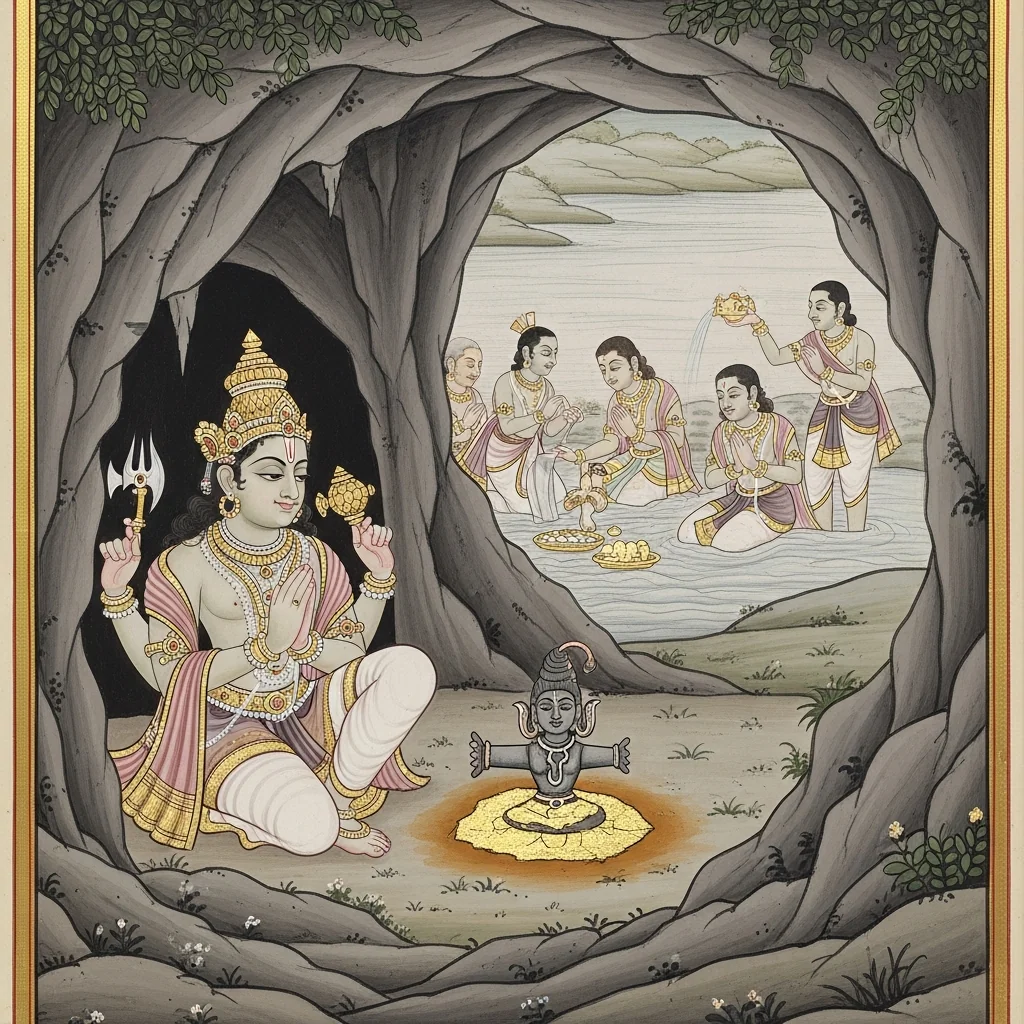
Adhyaya 6
This chapter unfolds as a reverent dialogue: Nārada meets Brahmins led by Śātātapa and others. After mutual honor and inquiry, Nārada states his aim—to found an auspicious Brahmin seat near a mahātīrtha at the earth–ocean confluence and to test the Brahmins’ fitness. When “thieves” at the site are feared, the teaching redefines them as inner foes—kāma, krodha, and the like—who can steal the “wealth” of tapas through negligence. A technical travel-and-practice section follows, giving routes from Kedāra toward Kalāpa/Kalāpaka and a method for passing through a cave (bila). Worship of Guha/Skanda, a dream-command motif, and ritual use of sacred earth and water as ocular unguent and bodily application enable perception of the passage and its traversal. The narrative returns to the confluence with collective bathing, tarpaṇa rites, japa, and contemplation, and a divine assembly is described. An episode of hospitality then appears: Kapila requests Brahmins to arrange a land-gift, underscoring atithi-dharma and the consequences of neglect. From dispute and reflection on anger and haste, the Cira-kārī exemplum is introduced: a son delays carrying out a rash paternal command and thereby averts grave sin, praising deliberation in difficult actions. The chapter closes with warnings about the potency of curses in Kali-yuga, consecratory acts, and divine ratification of the newly established sacred place(s).
Shlokas
Verse 1
श्रीनारद उवाच । इति श्रुत्वा फाल्गुनाहं रोमांचपुलकीकृतः । स्वरूपं प्रकटीकृत्य ब्राह्मणानिदमब्रवम्
Śrī Nārada said: Hearing this, I—Phālguna—was thrilled, my hair standing on end. Then, revealing my true form, I spoke these words to the brāhmaṇas.
Verse 2
अहो धन्यः पितास्माकं यस्य सृष्टस्य पालकाः । युष्मद्विधा ब्राह्मणेंद्राः सत्यमाह पुरा हरिः
Ah! Blessed is our Father, whose creation is protected by brāhmaṇa-lords like you. Long ago, Hari indeed spoke this truth.
Verse 3
मत्तोऽप्यनंतात्परतः परस्मात्समस्तभूताधिपतेर्न किंचित् । तेषां किमुस्यादितरेण येषां द्विजेश्वराणां मम मार्गवादिनाम्
Beyond me—even beyond the Infinite—beyond the Supreme Lord, the ruler of all beings, there is nothing whatsoever. For those brāhmaṇa-lords who proclaim my path, what need could there be of anything else?
Verse 4
तत्सर्वथाद्या धन्योऽस्मि संप्राप्तं जन्मनः फलम् । यद्भवन्तो मया दृष्टाः पापोपद्रववर्जिताः
Therefore, in every way I am blessed today; the fruit of my birth has been attained—because I have beheld you, who are free from sin and affliction.
Verse 5
ततस्ते सहसोत्थाय शातातपपुरोगमाः । अर्घ्यपाद्यादिसत्कारैः पूजयामासुर्मां द्विजाः
Then those twice-born, led by Śātātapa, rose up at once and honored me with respectful offerings—arghya, pādya, and other courtesies.
Verse 6
प्रोक्तवन्तश्च मां पार्थ वचः साधुजनो चितम् । धन्या वयं हि देवर्षे त्वमस्मान्यदिहागतः
And they spoke to me words pleasing to the good-hearted, O Pārtha: “Blessed indeed are we, O divine sage, since you have come here to us.”
Verse 7
कुतो वाऽगमनं तुभ्यं गन्तव्यं वा क्व सांप्रतम् । अत्राप्यागमने कार्यमुच्यतां मुनिसत्तम
From where have you come, and where are you to go now? And what purpose is served even by your coming here—please tell us, O best of sages.
Verse 8
श्रुत्वा प्रीतिकरं वाक्यं द्विजानामिति पांडव । प्रत्यवोचं मुनीन्द्रांस्ताञ्छ्रूयतां द्विजसत्तमाः
O Pāṇḍava, having heard the pleasing words of the brāhmaṇas, I replied to those foremost of sages: “Let it be heard, O best of the twice-born.”
Verse 9
अहं हि ब्रह्मणो वाक्याद्विप्राणां स्थानकं शुभम् । दातुकामो महातीर्थे महीसागरसंगमे
By Brahmā’s command, I desire to bestow upon the brāhmaṇas an auspicious dwelling at the great tīrtha, at the confluence of Mahī (earth/river) and the Ocean.
Verse 10
परीक्षन्ब्राह्मणानत्र प्राप्तो यूयं परीक्षिताः । अहं वः स्थायिष्यामि चानुजानीत तद्द्विजाः
You came here to test the brāhmaṇas, and now you yourselves have been tested. I shall remain here for your sake—grant your consent, O twice-born (dvijas).
Verse 11
एवमुक्तो विलोक्यैव द्विजाञ्छातातपोऽब्रवीत् । देवानामपि दुष्प्राप्यं सत्यं नारद भारतम्
Thus addressed, Śātātapa looked upon the brāhmaṇas and said: “Truthfulness (satya) is hard to attain even for the gods, O Nārada; indeed it is so, O Bhārata.”
Verse 12
किं पुनश्चापि तत्रैव मही सागरसंगमः । यत्र स्नातो महातीर्थफलं सर्वमुपाश्नुते
How much more, then, is that very confluence of Mahī and the Ocean! Whoever bathes there partakes of the entire fruit of all great tīrthas.
Verse 13
पुनरेको महान्दोषो बिभीमो नितरां यतः । तत्र चौराः सुबहवो निर्घृणाः प्रियसाहसाः
Yet there is one great, truly frightening drawback: in that place there are many thieves—merciless and fond of reckless daring.
Verse 14
स्वर्शेषु षोडशं चैकविंशंगृह्णंति नो धनम् । धनेन तेन हीनानां कीदृशं जन्म नो भवेत्
In our very homes they seize sixteen—or even twenty-one—shares of our wealth. When that wealth is taken away, what kind of life, what kind of rebirth, could remain for us?
Verse 15
वरं बुभुक्षया वासो मा चौरकरगा वयम् । अर्जुन उवाच । अद्भुतं वर्ण्यते विप्र के हि चौराः प्रकीर्तिताः
“Better to dwell in hunger than to fall into the hands of thieves!” Arjuna said: “O brāhmaṇa, this is wondrous—who indeed are these ‘thieves’ you speak of?”
Verse 16
किं धनं च हरंत्येते येभ्यो बिभ्यति ब्राह्मणाः । नारद उवाच । कामक्रोधादयश्चौरास्तप एव धनं तथा
“What wealth do they steal, that even brāhmaṇas fear them?” Nārada replied: “Desire, anger, and the rest are the thieves; and the wealth they steal is one’s very tapas—one’s spiritual austerity.”
Verse 17
तस्यापहाभीतास्ते मामूचुरिति ब्राह्मणाः । तानहं प्राब्रवं पश्चाद्वि जानीत द्विजोत्तमाः
Fearing the loss of that spiritual wealth, those brāhmaṇas spoke to me in this way. Then I addressed them afterward: “Understand this, O dvija-uttamas, best among the twice-born.”
Verse 18
जाग्रतां तु मनुष्याणां चौराः कुर्वंति किं खलाः । भयभीतश्चालसश्च तथा चाशुचिरेव यः
Even when people are awake, what may not wicked thieves do? And one who is fearful, lazy, and impure—how can such a person attain steadfastness upon this path?
Verse 19
तेन किं नाम संसाध्यं भूमिस्तं ग्रसते नरम्
What, indeed, is accomplished by such a way of living? In the end, the earth swallows that man.
Verse 20
शातातप उवाच । वयं चौरभयाद्भीतास्ते हरंति धनं महत् । कर्तुं तदा कथं शक्यमंगजागरणं तथा
Śātātapa said: “We are terrified of thieves; they carry off great wealth. In such a situation, how can we possibly perform vigilant wakefulness and disciplined observance?”
Verse 21
खलाश्चौरा गताः क्वापि ततो नत्वाऽगता वयम् । तस्मासर्वं संत्यजामो भयभीता वयं मुने
“Those wicked thieves have gone somewhere; and we have returned after bowing (and seeking counsel). Therefore we abandon everything—for we are afraid, O sage.”
Verse 22
प्रतिग्रहश्च वै घोरः षष्ठांऽशफलदस्तथा । एवं ब्रुवति तस्मिंश्च हारीतोनाम चाब्रवीत्
“Accepting gifts indiscriminately is indeed dreadful, and yields only a sixth part of the fruit.” While he was speaking thus, one named Hārīta replied.
Verse 23
मूढबुद्ध्या हि को नाम महीसागरसंगमम् । त्यजेच्च यत्र मोक्षश्च स्वर्गश्च करगोऽथ वा
Who, unless utterly deluded, would abandon the confluence of land and ocean—where liberation and heaven are, as it were, held in one’s hand?
Verse 24
कलापादिषु ग्रामेषु को वसेत विचक्षणः । यदि वासः स्तम्भतीर्थे क्षणार्धमपि लभ्यते
What discerning person would dwell in ordinary villages such as Kalāpā, if even half a moment’s residence at the sacred Stambhatīrtha can be obtained?
Verse 25
भयं च चौरजं सर्वं किं करिष्यति तत्र न । कुमारनाथं मनसि पालकं कुर्वतां दृढम्
And what can any fear born of thieves do there? Nothing—for those who firmly make Kumāranātha the protector within their hearts.
Verse 26
साहसं च विना भूतिर्न कथंचन प्राप्यते । तस्मान्नारद तत्राहमा यास्ये तव वाक्यतः
Without courage, prosperity and success are never attained. Therefore, O Nārada, I shall indeed go there, following your word.
Verse 27
षड्विंशतिसहस्राणि ब्राह्मणा मे परिग्रहे । षट्कर्मनिरताः शुद्धा लोभदम्भविवर्जिताः
“I have twenty-six thousand Brāhmaṇas under my care—engaged in the six duties, pure, and free from greed and hypocrisy.”
Verse 28
तैः सार्धमागमिष्यामि ममेदं मतमुत्तमम् । इत्युक्ते वचने तांश्च कृत्वाहं दंडमूर्धनि
“I shall go together with them—this is my most excellent decision.” Having spoken thus, he reverently placed those words upon his head.
Verse 29
निवृत्तः सहसा पार्थ खेचरोऽतिमुदान्वितः । शतयोजनमात्रं तु हिममार्गमतीत्य च
O Pārtha, the sky-traveller turned back at once, filled with great joy; and having crossed a snow-bound route extending a hundred yojanas…
Verse 30
केदारं समुपायातो युक्तस्तैर्द्विजसत्तमैः । आकाशेन सुशक्यश्च बिलेनाथ स देशकः
He reached Kedāra, accompanied by those foremost of the twice-born (brāhmaṇas). That region is accessible by the sky, and also—so it is said—by a cave-passage.
Verse 31
अतिक्रांतुं नान्यथा च तथा स्कंदप्रसादतः
And it cannot be crossed in any other way—only so, by the grace of Skanda.
Verse 32
अर्जुन उवाच । क्व कलापं च द्ग्रामं कथं शक्यं बिलेन च । कथं स्कंदप्रसादः स्यादेतन्मे ब्रूहि नारद
Arjuna said: “Where is that Kalāpa village, and how can it be reached by a cave? And how does one obtain Skanda’s grace? Tell me this, O Nārada.”
Verse 33
नारद उवाच । केदाराद्धिमसंयुक्तं योजनानां शतं स्मृतम् । तदंते योजनशतं विस्तृतं तत्कलापकम्
Nārada said: “From Kedāra, a snow-filled stretch of a hundred yojanas is spoken of. Beyond that lies Kalāpaka, spread across another hundred yojanas.”
Verse 34
तदंते योजनशतं वासुकार्णव मुच्यते । शतयोजनमात्रः स भूमिस्वर्गस्ततः स्मृतः
Beyond that, another hundred yojanas is known as the “Ocean of Vāsuki.” From there, a tract of a hundred yojanas is remembered as “Heaven-on-earth.”
Verse 35
बिलेन च यथा शक्यं गंतुं तत्र श्रृणुष्व तत् । निरन्नं वै निरुदकं देवमाराधयेद्गुहम्
Hear now how one may reach that place by way of a cave. One should worship the divine Guha, fasting from food and abstaining from water.
Verse 36
दक्षिणायां दिशि ततो निष्पापं मन्यते यदा । तदा गुहोऽस्य स्वप्ने गच्छेति भारत
Then, when he deems himself purified of sin, Guha appears to him in a dream in the southern direction and says, “Go,” O Bhārata.
Verse 37
ततो गुहात्पश्चिमतो बिलमस्ति बृहत्तरम् । तत्र प्रविश्य गंतव्यं क्रमाणां शतसप्तकम्
Then, to the west of Guha, there is a larger cave. Entering it, one must proceed seven hundred steps.
Verse 38
तत्र मारकतं लिंगमस्ति सूर्यसमप्रभम् । तदग्रे मृत्तिका चास्ति स्वर्णवर्णा सुनिर्मला
There stands a liṅga of emerald hue, radiant like the sun. In front of it lies clay, golden in color and exceedingly pure.
Verse 39
नमस्कृत्य च तल्लिंगं गृहीत्वा मृत्तिकां च ताम् । आगंतव्यं स्तंभतीर्थे समाराध्य कुमारकम्
Having bowed to that liṅga and taken that sacred clay, one should proceed to Stambha-tīrtha and worship Kumāraka (Skanda) with due devotion.
Verse 40
कोलं वा कूपतो ग्राह्यं भूतायां निशि तज्जलम् । तेनोदकेन मृत्तिकया कृत्वा नेत्रद्वयाञ्जनम्
At midnight, one should draw water from a pond or a well. With that water and the sacred clay, one should prepare an eye-ointment (añjana) for both eyes.
Verse 41
उद्वर्तनं च देहस्य कदाचित्षष्टिमे पदे । नेत्रांजनप्रभावाच्च बिलं पश्यति शोभनम्
By rubbing the body with it, at some point—on the sixtieth step—through the power of that eye-ointment, one beholds a splendid opening, the mouth of a cave.
Verse 42
तन्मध्येन ततो याति गात्रोद्वर्त्तप्रभावतः । कारीषैर्नाम चात्युग्रैर्भक्ष्यते नैव कीटकैः
Passing through its midst, he proceeds onward by the potency of the body-anointing. And though there are fierce beings called Kārīṣas, he is not at all devoured by insects.
Verse 43
बिलमध्ये च संपश्यन्सिद्धान्भास्करसन्निभान् । यात्येवं यात्यसौ पार्थ कलापं ग्राममुत्तमम्
Within the cave he beholds Siddhas, resplendent like the sun. Thus he goes on—indeed, O Pārtha—he reaches the excellent village called Kalāpa.
Verse 44
तत्र वर्षसहस्राणि चत्वार्यायुःप्रकीर्तितम् । फलानां भोजनं च स्यात्पुनः पुण्यं च नार्ज्जयेत्
There, a lifespan of four thousand years is proclaimed. One lives on fruits as food, and one does not again accrue merit as in the mortal world.
Verse 45
इत्येतत्कथितं तुभ्यमतश्चाभूच्छृणुष्व तत् । तपः सामर्थ्यतः सूक्ष्मान्दण्डस्याग्रे निधाय तान्
Thus this has been told to you; now hear what further occurred. By the power of austerity, placing those subtle ones upon the tip of his staff…
Verse 46
द्विजानहं समायातो महीसागरसंगमम्
I came, together with brāhmaṇas, to the confluence of land and ocean.
Verse 47
तदोत्तार्य मया मुक्तास्तीरे पुण्यजलाशये । ततो मया कृतं स्नानं सह तैर्द्विजसत्तमैः
After bringing them across, I released them on the bank by that holy water-reservoir. Then, together with those best of brāhmaṇas, I performed the sacred bath.
Verse 48
निःशेषदोषदावाग्नौ महीसागरसंगमे । पितॄणां देवतानां च कृत्वा तर्पणसत्क्रियाः
At the confluence of earth and ocean—like a forest-fire that burns away every remaining fault—they performed the proper tarpaṇa rites and reverent offerings for the Pitṛs and for the gods.
Verse 49
जपमानाः परं जप्यं निविष्टाः संगमे वयम् । भास्करं समवेक्षंतश्चिंतयंतो हरिं हृदि
Seated at the sacred confluence, we chanted the supreme mantra; gazing upon the Sun, we contemplated Hari within the heart.
Verse 50
तस्मिंश्चैवांतरे पार्थ देवाः शक्रपुरोगमाः । आदित्याद्या ग्रहाः सर्वे लोकपालाश्च संगताः
Just then, O Pārtha, the gods led by Śakra assembled; all the planets beginning with Āditya, and the guardians of the directions too, gathered together.
Verse 51
देवानां योनयो ह्यष्टौ गंधर्वाप्सरसां गणाः । महोत्सवे ततस्तस्मिन्गीतवादित्र उत्तमे
There were the eight divine classes, and hosts of Gandharvas and Apsarases; and in that great festival, excellent singing and instrumental music resounded.
Verse 52
पादप्रक्षालनं कर्तुं विप्राणामुद्यतस्त्वहम् । तस्मिन्काले चाश्रृणवमहमातिथ्यवाक्यताम्
I prepared myself to wash the feet of the brāhmaṇas; and at that moment I heard words spoken in the manner of honoring a guest.
Verse 53
सामध्वनिसमायुक्तां तृतीयस्वरनादिताम् । अतीव मनसो रम्यां शिव भक्तिमिवोत्तमाम्
It was filled with the sound of Sāman-chants, resonant with the third note; exceedingly delightful to the mind—like supreme devotion to Śiva itself.
Verse 54
विप्रैरुत्थाय संपृष्टः कस्त्वं विप्र क्व चागतः । किं वा प्रार्थयसे ब्रूहि यत्ते मनसि रोचते
The brāhmaṇas rose and questioned him: “Who are you, O brāhmaṇa, and from where have you come? Tell us—what do you seek, what is it that delights your mind?”
Verse 55
विप्र उवाच । मुनिः कपिलनामाहं नारदाय निवेद्यताम् । आगतः प्रार्थनायैव तच्छ्रुत्वाहमथाब्रवम्
The brāhmaṇa said: “I am the sage named Kapila; let this be conveyed to Nārada. I have come solely to make a request.” Hearing this, I then replied.
Verse 56
धन्योहं यदिहायातः कपिल त्वं महामुने । नास्त्यदेयं तवास्माभिः पात्रं नास्ति तवाधिकम्
“Blessed am I that you have come here, O Kapila, great sage. For you there is nothing we cannot bestow; no recipient is greater than you.”
Verse 57
कपिला उवाच । ब्रह्मपुत्र त्वया देयं यदि मे त्वं श्रृणुष्व तत् । अष्टौ विप्रसहस्रामि मम देहीति नारद
Kapila said: “O son of Brahmā, if you would give to me, then listen: grant me eight thousand brāhmaṇas, O Nārada.”
Verse 58
भूमिदानं करिष्यामि कलापग्रामवासिनाम् । ब्राह्मणानामहं चैषां तदिदं क्रियतां विभो
“I shall perform the gift of land for these brāhmaṇas who dwell in Kalāpa-grāma. Therefore, O Lord, let this be carried out.”
Verse 59
ततो मया प्रतिज्ञातमेव मस्तु महामुने । त्वयापि क्रियतां स्थानं कापिलं कपिलोत्तमम्
“Then let what I have vowed truly come to pass, O great sage. And you too, establish a sacred place—Kāpila, most excellent, O Kapila.”
Verse 60
श्राद्धे वा प्राप्तकाले वा ह्यतिथिर्विमुखीभवेत् । यस्याश्रममुपायातस्यस्य सर्वं हि निष्फलम्
“If, at the time of a Śrāddha or at the proper moment, a guest turns away (unhonoured) from the hermitage he has approached, then for that host everything indeed becomes fruitless.”
Verse 61
स गच्छेद्रौरवांल्लोकान्योऽतिथिं नाभिपूजयेत् । अतिथिः पूजितो येन स देवैरपि पूज्यते
“He who does not honour a guest goes to the Raurava worlds. But he by whom the guest is honoured—he is honoured even by the gods.”
Verse 62
दानैर्यज्ञैस्त तस्तस्मिन्भोजितः कपिलो मुनिः । ततो महामुनिः श्रीमान्हारीतो ह्वयितस्तदा
“Then, with gifts and sacrifices, the sage Kapila was feasted there. After that, the illustrious great sage Hārīta was then invited.”
Verse 63
पादप्रक्षालनार्थाय सिद्धदेवसमागमे । हारीतश्च पुरस्कृत्य वामपादं तदा स्थितः
“For the washing of the feet, amid the assembly of Siddhas and gods, Hārīta—being placed in front—then stood with the left foot forward.”
Verse 64
ततो हासो महाञ्जज्ञे सिद्धाप्सरः सुपर्वणाम् । विचिंत्य बहुधा पृथ्वीं साधु साधुकृता द्विजाः
Then great laughter arose among the Siddhas and Apsarases of noble festivals. Reflecting on the earth in many ways, the twice-born exclaimed, “Well done, well done!”
Verse 65
ततो ममापि मनसि शोकवेगो महानभूत् । सत्यां चैव तथा मेने गाथां पूर्वबुधेरिताम्
Then in my own mind a great surge of sorrow arose; and I understood as true the ancient verse spoken by the wise of old.
Verse 66
सर्वेष्वपि च कार्येषु हेतिशब्दो विगर्हितः । कुर्वतामतिकार्याणि शिलापातो ध्रुवं भवेत्
In all undertakings, the word “heti” (a harsh, weapon-like retort) is censured. For those who commit overstepping acts, a “fall of stones” (certain ruin) surely comes.
Verse 67
ततोहमब्रंवं विप्रान्यूयं मूर्खा भविष्यथ । धनधान्याल्पसंयुक्ता दारिद्र्यकलिलावृताः
Then I spoke to the Brāhmaṇas: “You will become foolish—endowed with little wealth and grain, and enveloped in the mire of poverty.”
Verse 68
एवमुक्ते प्रहस्यैव हारीतः प्राब्रवीदिदम् । तवैवेयं मुने हानिर्यदस्माञ्छपते भवान्
When this was said, Hārīta laughed and replied: “O sage, this loss is yours alone—since you are the one who is cursing us.”
Verse 69
कः शापो दीयते तुभ्यं शापोयमयमेव ते । ततो विमृश्य भूयोऽहब्रवं किमहंद्विज
“What ‘curse’ is being given to you? This very thing is your own curse. Then, reflecting again, I said: ‘What have I done, O twice-born?’”
Verse 70
तथाविधस्य भवतो वामपादप्रदानतः
“Because you—being of such a nature—offered the left foot (in contempt/inauspiciousness) …”
Verse 71
हारीत उवाच । श्रृणु तत्कारणं धीमञ्छून्यता मे यतो भवेत्
Hārīta said: “Listen, O wise one, to the reason why emptiness (inner blankness) arises in me.”
Verse 72
इति चिंतयतश्चित्ते हा दुःखोऽयं प्रतिग्रहः । प्रतिग्रहेण विप्राणां ब्राहयं तेजो हि शाम्यति
As I pondered in my heart—‘Alas, grievous is this acceptance of gifts!’—for by accepting gifts the brāhmaṇic radiance (tejas) of brāhmaṇas indeed becomes diminished.
Verse 73
महादानं हि गृह्णानो ब्राह्मणः स्वं शुभं हि यत् । ददाति दातुर्दाता च अशुभं यच्छति स्वकम्
For when a brāhmaṇa accepts a great gift, he gives away his own merit and auspiciousness; and the giver, in turn, transfers his own inauspiciousness to the recipient.
Verse 74
दाता प्रतिग्रहीता च वचनं हि परस्परम् । मन्यतेऽधःकरो यस्य सोऽल्पबुद्धिः प्रहीयते
The giver and the receiver speak to one another in mutual dependence; but he who regards the other as “inferior” is small-minded and falls away from right understanding.
Verse 75
इति चिंतयतो मह्यं शून्यताभूद्धि नारद । निद्रार्तश्च भयार्तश्च कामार्तः शोकपीडितः
While I was thinking thus, O Nārada, emptiness came over me. One afflicted by sleep, by fear, by desire, or tormented by grief—
Verse 76
हृतस्वश्चान्यचित्तश्च शून्याह्येते भवंति च । तदेषु मतिमान्कोपं न कुर्वीत यदि त्वया
—and likewise one whose wealth is stolen, or whose mind is fixed elsewhere: such people indeed become “empty”. Therefore, if you are wise, you should not direct anger toward them.
Verse 77
कृतः कोपस्ततस्तुभ्यमेवं हानिरियं मुने । ततस्तापान्वितश्चाहं तान्वि प्रानब्रवं पुनः
“Since anger was aroused in you, O sage, this is how the loss came about. Then, filled with remorse, I spoke again to those brāhmaṇas.”
Verse 78
धिङ्मामस्तु च दुर्बुद्धिमविमृश्यार्थकारिणम् । कुर्वतामविमृश्यैव तत्किमस्ति न यद्भवेत्
Shame upon me—foolish as I am—who act without reflection. For those who do things without deliberation, what harm is there that may not arise?
Verse 79
सहसा न क्रियां कुर्यात्पदमेतन्महापदाम् । विमृश्यकारिणं धीरं वृणते सर्वसंपदः
One should not act in haste; haste is a step toward great calamities. All prosperities choose the steadfast person who acts only after due deliberation.
Verse 80
सत्यमाह महाबुद्धिश्चिरकारी पुरा हि सः । पुरा हि ब्राह्मणः कश्चित्प्रख्यातों गिरसां कुले
“Indeed, it is true,” said the great-minded one. For in ancient times there was Cirakārī; and long ago there was a certain brāhmaṇa, renowned in the lineage of the Girasa-s.
Verse 81
चिरकारि महाप्राज्ञो गौतमस्याभवत्सुतः । चिरेण सर्वकार्याणि यो विमृश्य प्रपद्यते
Cirakārī, greatly wise, was the son of Gautama—he who undertakes every action only after long reflection.
Verse 82
चिरकार्याभिसंपतेश्चिरकारी तथोच्यते । अलसग्रहणं प्राप्तो दुर्मेधावी तथोच्यते
Because he attains to actions only after a long while, he is called “Cirakārī” (the slow-doer). But one who merely falls into laziness is called “dull-witted.”
Verse 83
बुद्धिलाघवयुक्तेन जनेनादीर्घदर्शिना । व्यभिचारेण कस्मिन्स व्यतिकम्या परान्सुतान्
With a mind both agile and farsighted, by what transgression could he ever go astray, overstep dharma, and harm others’ children?
Verse 84
पित्रोक्तः कुपितेनाथ जहीमां जननीमिति । स तथेति चिरेणोक्तः स्वभावाच्चिरकारकः
Then, commanded by his enraged father—‘Kill your mother!’—he replied, ‘So be it,’ but only after a long while, for by nature he was one who acts slowly (after reflection).
Verse 85
विमृश्य चिरकारित्वाच्चिं तयामास वै चिरम् । पितुराज्ञां कथं कुर्यां न हन्यां मातरं कथम्
Because he was deliberative, he reflected for a long time: ‘How can I carry out my father’s command? And how can I not kill my mother?’
Verse 86
कथं धर्मच्छलेनास्मिन्निमज्जेयमसाधुवत् । पितुराज्ञा परो धर्मो ह्यधर्मो मातृरक्षणम्
How could I sink into wrongdoing here, under the pretext of ‘dharma’? Obedience to one’s father is said to be the higher duty; yet (if so interpreted) the protection of one’s mother would become ‘adharma’.
Verse 87
अस्वतंत्रं च पुत्रत्वं किं तु मां नात्र पीडयेत् । स्त्रियं हत्वा मातरं च को हि जातु सुखी भवेत्
Sonship is not fully independent—yet let it not torment me in this matter. For who could ever be happy after killing a woman, and one’s own mother as well?
Verse 88
पितरं चाप्यवज्ञाय कः प्रतिष्ठामवाप्नुयात् । अनवज्ञा पितुर्युक्ता युक्तं मातुश्च रक्षणम्
Disregarding one’s father, who could ever attain true honor and standing in the world? Non-contempt toward the father is proper, and so too is the protection and care of the mother.
Verse 89
क्षमायोग्यावुभावेतौ नातिवर्तेत वै कथम् । पिता ह्यात्मानमाधत्ते जायायां जज्ञिवानिति
Mother and father alike are worthy of forbearance—how could one ever transgress them? For the father, having begotten the child in his wife, as it were places his very self within her.
Verse 90
शीलचारित्रगोत्रस्य धारणार्थं कुलस्य च । सोऽहमात्मा स्वयं पित्रा पुत्रत्वे परिकल्पितः
For the preservation of good conduct, character, and lineage—and for the continuance of the family—“that very self” is, by the father himself, appointed to the state of sonship.
Verse 91
जातकर्मणि यत्प्राह पिता यच्चोपकर्मणि । पर्याप्तः स दृढीकारः पितुर्गौरवलिप्सया
Whatever the father declares at the birth-rite (jātakarman) and whatever he instructs at the rite of initiation (upakarman)—that is sufficient as a firm injunction for one who seeks the reverent honor of the father.
Verse 92
शरीरादीनि देयानि पिता त्वेकः प्रयच्चति । तस्मात्पितुर्वचः कार्यं न विचार्यं कथंचन
Even the body and all that follows are gifts received, yet the father alone bestows them. Therefore the father’s word should be carried out, without debating it in any way.
Verse 93
पातकान्यपि चूर्यंते पितुर्वचनकारिणः । पिता स्वर्गः पिता धर्मः पिता परमकं तपः
Even sins are crushed for the one who carries out the father’s word. The father is heaven; the father is dharma; the father is the highest austerity (tapas).
Verse 94
पितरि प्रीतिमापन्ने सर्वाः प्रीणंति देवताः । आशिषस्ता भजंत्येनं पुरुषं प्राह याः पिता
When the father is pleased, all the deities are pleased. The blessings spoken by the father come forth to attend and favor that person.
Verse 95
निष्कृतिः सर्वपापानां पिता यदभिनंदति । मुच्यते बंधनात्पुष्पं फलं वृंतात्प्रमुच्यते
When the father approves, it becomes atonement for all sins. As a flower is freed from its binding and a fruit is released from its stalk, so one is released from bondage.
Verse 96
क्लिश्यन्नपि सुतः स्नेहं पिता स्नेहं न मुंचति । एतद्विचिंत्यतं तावत्पुत्रस्य पितृगौरवम्
Even if a son causes distress, a father does not abandon affection. Reflect on this, then—on the son’s duty to honor the father.
Verse 97
पिता नाल्पतरं स्थानं चिंतयिष्यामि मातरम् । यो ह्ययं मयि संघातो मर्त्यत्वे पांचभौतिकः
I shall regard the mother as holding a station no less than the father. For this embodied aggregate within me, in mortal life, is composed of the five elements.
Verse 98
अस्य मे जननी हेतुः पावकस्य यथारणिः । माता देहारणिः पुंसः सर्वस्यार्थस्य निर्वृतिः
For me, my mother is the very cause of my coming forth, just as fire is born from the araṇi (fire-stick). The mother is the body’s araṇi for a man—the source from which all aims of life find fulfilment and peace.
Verse 99
मातृलाभे सनाथत्वमनाथत्वं विपर्यये । न स शोचति नाप्येनं स्थावर्यमपि कर्षति
When one has the mother, one has a protector; when she is absent, one becomes truly helpless. With a mother, a person does not grieve, and even adversity cannot easily drag him down.
Verse 100
श्रिया हीनोऽपि यो गेहे अंबेति प्रतिपद्यते । पुत्रपौत्रसमापन्नो जननीं यः समाश्रितः
Even if bereft of wealth, one who at home can still cry “Mother!” and turn to her—whoever takes shelter in his mother—becomes blessed with the continuity of the family line, with sons and grandsons.
Verse 101
अपि वर्षशतस्यांते स द्विहायनवच्चरेत् । समर्थं वाऽसमर्थं वा कृशं वाप्यकृशं तथा
Even at the end of a hundred years, she treats him as though he were a two-year-old. Whether the son is capable or incapable, thin or well-built, the mother’s regard remains the same.
Verse 102
रक्षयेच्च सुतं माता नान्यः पोष्यविधानतः । तदा स वृद्धो भवति तदा भवति दुःखितः
It is the mother who protects the son—by the very ordinance of nurturing none other does so. When she is gone, then he truly becomes “old”; then sorrow afflicts him.
Verse 103
तदा शुन्यं जगत्तस्य यदा मात्रा वियुज्यते । नास्ति मातृसमा च्छाया नास्ति मातृसमा गतिः
Then the world becomes empty for him when he is separated from his mother. There is no shade like a mother; there is no refuge and course of life like a mother.
Verse 104
नास्ति मातृसमं त्राणं नास्ति मातृसमा प्रपा । कुक्षिसंधारणाद्धात्री जननाज्जननी तथा
There is no protection equal to a mother; there is no resting-shelter like a mother. Because she bears one in her womb she is called Dhātrī (the Sustainer), and because she gives birth she is called Jananī (the Mother).
Verse 105
अंगानां वर्धनादंबा वीरसूत्वे च वीरसूः । शिशोः शुश्रूषणाच्छ्वश्रूर्माता स्यान्माननात्तथा
She is called Ambā because she nurtures and increases the limbs of the child; and Vīrasū because she gives birth to the brave. By serving and tending the child, even a mother-in-law becomes ‘mother’; likewise, by honoring a woman, she becomes mother in dignity.
Verse 106
देवतानां समावापमेकत्वं पितरं विदुः । मर्त्यानां देवतानां च पूगो नात्येति मातरम्
The wise know the father as a unifying “common field” for the deities, a shared source. Yet among mortals and even among the gods, no multitude surpasses the mother in greatness.
Verse 107
पतिता गुरवस्त्याज्या माता च न कथंचन । गर्भधारणपोषाभ्यां तेन माता गरीयसी
Even if teachers have fallen from right conduct, they may be abandoned; but a mother is never to be abandoned in any circumstance. By bearing the womb and by nourishing, the mother is therefore the weightier, the more venerable.
Verse 108
एवं स कौशिकीतीरे बलिं राजानमीक्षतीम् । स्त्रीवृत्तिं चिरकालत्वाद्धन्तुं दिष्टः स्वमातरम्
Thus, on the bank of the Kauśikī, he beheld King Bali. And, having long suspected his mother’s conduct as unbecoming, he was driven by a grim resolve to slay his own mother.
Verse 109
विमृश्य चिरकालं हि चिंतांतं नाभ्यपद्यत । एतस्मिन्नंतरे शक्रो रूपमास्थितः
After reflecting for a long time, he still did not arrive at any settled conclusion. Meanwhile, Śakra (Indra) assumed a particular form and intervened.
Verse 110
गायन्गाखामुपायातः पितुस्तस्याश्रमांतिके । अनृना हि स्त्रियः सर्वाः सूत्रकारो यदब्रवीत्
Singing a verse, he came near his father’s hermitage. He recited: “All women are indeed free from debt,” as the author of the sūtras has declared.
Verse 111
अतस्ताभ्यः फलं ग्राह्यं न स्याद्दोषेक्षणः सुधीः । इति श्रुत्वा तमानर्च मेधातिथिरुदारधीः
Therefore, one should accept the fruit of their acts, and a wise man should not become a fault-finder. Hearing this, the noble-minded Medhātithi honored him.
Verse 112
दुःखितश्चिंतयन्प्राप्तो भृशमश्रूणि वर्तयन् । अहोऽहमीर्ष्ययाक्षिप्तो मग्नोऽहं दुःखसागरे
Afflicted and brooding, he arrived, shedding copious tears. “Alas! Struck down by jealousy, I have sunk into an ocean of sorrow.”
Verse 113
हत्वा नारीं च साध्वीं च को नु मां तारयिष्यति । सत्वरेण मयाज्ञप्तश्चिरकारी ह्युदारधीः
“If I were to kill a woman—indeed, a virtuous woman—who would then save me? In haste I commanded Cirakārī, though he is noble-minded.”
Verse 114
यद्ययं चिरकारी स्यात्स मां त्रायेत पातकात् । चिरकारिक भद्रं ते भद्रं ते चिरकारिक
“If this one truly acts as Cirakārī, the one who acts after delay, he may yet save me from sin. O Cirakārika, blessings to you—blessings to you, O Cirakārika!”
Verse 115
यदद्य चिरकारी त्वं ततोऽसि चिरकारिकः । त्राहि मां मातरं चैव तपो यच्चार्जितं मया
“If today you have truly been Cirakārī, then you are indeed Cirakārika. Save me—and save my mother as well—and preserve the austerity (tapas) that has been acquired by me.”
Verse 116
आत्मानं पातके विष्टं शुभाह्व चिरकारिक । एवं स दुःखितः प्राप्तो गौतमोऽचिंतयत्तदा
“I see myself sunk in sin, O Cirakārika of auspicious name!” Thus, having come in sorrow, Gautama reflected then.
Verse 117
चिरकारिकं ददर्शाथ पुत्रं मातुरुपांतिके । चिरकारी तु पितरं दृष्ट्वा परमदुःखितः
Then he saw his son Cirakārika near his mother. But Cirakārī, seeing his father, became exceedingly distressed.
Verse 118
शस्त्रं त्यक्त्वा स्थितो मूर्ध्ना प्रसादायोपचक्रमे । मेधातिथिः सुतं दृष्ट्वा शिरसा पतितं भुवि
Casting aside his weapon, he stood with bowed head, beginning to seek forgiveness. Seeing his son fallen to the ground with his head lowered, Medhātithi recognized the son’s humble submission.
Verse 119
पत्नीं चैव तु जीवंतीं परामभ्यगमन्मुदम् । हन्यादिति न सा वेद शस्त्रपाणौ स्थिते सुते
Seeing his wife still alive, he was filled with great joy. She did not know of his intent—“I will kill”—while her son stood there with a weapon in his hand.
Verse 120
बुद्धिरासीत्सुतं दृष्ट्वा पितुश्चरणयोर्नतम् । शस्त्रग्रहणचापल्यं संवृणोति भयादिति
Seeing her son bowed at his father’s feet, she understood: “Out of fear he is concealing the rashness of having taken up a weapon.”
Verse 121
ततः पित्रा चिरं स्मृत्वा चिरं चाघ्राय मूर्धनि । चिरं दोर्भ्यां परिष्वज्य चिरंजीवेत्यु दाहृतः
Then the father, remembering him for long and smelling his head for long, embraced him for long with both arms and uttered, “May you live long!”
Verse 122
चिरं मुदान्वितः पुत्रं मेधातिथिरथाब्रवीत् । चिरकारिक भद्रं ते चिरकारी भवेच्चिरम्
Then Medhātithi, long filled with joy, said to his son: “O Cirakārika, blessings to you. May you long remain one who acts after due deliberation.”
Verse 123
चिराय यत्कृतं सौम्य चिरमस्मिन् दुःखितः । गाथाश्चाप्यब्रवीद्विद्वान्गौतमो मुनिसत्तमः
“Dear one, because the deed was delayed, I have long remained in sorrow.” Thus the wise Gautama, best of sages, also uttered verses (gāthās).
Verse 124
चिरेण मंत्रं संधीयाच्चिरेम च कृतं त्यजेत् । चिरेण विहतं मित्रं चिरं धारणमर्हति
A mantra is perfected only in due time; a deed done after long delay should be abandoned. A friend of long companionship who has been harmed deserves long forbearance and steady support.
Verse 125
रोगे दर्पे च माने च द्रोहे पापे च कर्मणि । अप्रिये चैव कर्तव्ये चिरकारी प्रशस्यते
In illness, in arrogance, in wounded pride, in betrayal, in sinful action, and in duties that are unpleasant—one who proceeds with deliberation is praised.
Verse 126
बंधूनां सुहृदां चैव भृत्यानां स्त्रीजनस्य च । अव्यक्तेष्वपराधेषु चिरकारी प्रशस्यते
With relatives, friends, servants, and womenfolk—when offenses are unclear or not yet fully manifest—one who acts with deliberation is praised.
Verse 127
चिरं धर्मान्निषेवेत कुर्याच्चान्वेषणं चिरम् । चिरमन्वास्य विदुषश्चिरमिष्टानुपास्य च
One should practice dharma steadily for a long time, and one should inquire and investigate for a long time; one should attend upon the learned for long, and likewise worship the chosen deities for long.
Verse 128
चिरं विनीय चात्मानं चिरं यात्यनवज्ञताम् । ब्रुवतश्च परस्यापि वाक्यं धर्मोपसंहितम्
By long disciplining oneself, one attains enduring freedom from contempt and disrespect. One should also heed another’s words when those words are joined to dharma.
Verse 129
चिरं पृच्छेच्च श्रृणुयाच्चिरं न परिभूयते । धर्मे शत्रौ शस्त्रहस्ते पात्रे च निकटस्थिते
Let one inquire at length and listen at length—then one is not easily overpowered. But in matters of dharma, before an enemy, when a weapon is in hand, and when a worthy recipient stands nearby, delay is not to be indulged.
Verse 130
भये च साधुपूजायां चिरकारी न शस्यते । एवमुक्त्वा पुत्रभार्यासहितः प्राप्य चाश्रमम्
In times of danger, and in the worship of holy ones, one who delays is not praised. Having spoken thus, he then reached the hermitage together with his son and wife.
Verse 131
ततश्चिरमुपास्याथ दिवं यातिश्चिरं मुनिः । वयं त्वेवं ब्रुवन्तोऽपि मोहेनैवं प्रतारिताः
Thereafter, having worshipped for a long time, the sage goes to heaven for a long while. Yet we—even while speaking thus—have been deceived in this way by delusion.
Verse 132
कलौ च भवतां विप्रा मच्छापो निपतिष्यति । केचित्सदा भविष्यंति विप्राः सर्वगुणैर्युताः
And in the age of Kali, O brāhmaṇas, my curse will fall upon you. Yet some brāhmaṇas will always remain—endowed with every virtue.
Verse 133
पादप्रक्षालनं कृत्वा ततोऽहं धर्मवर्मणः । समीपे साक्षिणो देवान्कृत्वा संकल्पमाचरम्
After washing the feet (in reverence), I then—near Dharmavarman—made the gods my witnesses and performed the solemn resolve (saṅkalpa).
Verse 134
कांचनैरर्नोप्रदानैश्च गृहदानैर्धनादिभिः । भार्याभूषणवस्त्रैश्च कृतार्था ब्राह्मणाः कृताः
With gifts of gold, with manifold offerings, with the gift of houses and wealth and the like, and with ornaments and garments for their wives, the brāhmaṇas were made fully satisfied and fulfilled.
Verse 135
ततः करं समुद्यम्य प्राहेन्द्रो देवसंगमे । हरांगरुद्धवामार्द्ध यावद्देवी गिरेः सुता
Then, raising his hand, Indra spoke in the assembly of the gods, addressing the Goddess—the Mountain’s daughter—whose left half was embraced by Hara’s body.
Verse 136
गणाधीशो वयं यावद्यावत्त्रिभुवनं त्विदम् । तावन्नन्द्यादिदे स्थानं नारदस्थापितं सुराः
So long as we remain the lords of Śiva’s gaṇas—so long as this threefold world endures—so long shall this abode, beginning with Nandī, established by Nārada, stand firm, O gods.
Verse 137
ब्रह्मशापो रुद्रशापो विष्णुशापस्तथैव च । द्विजशापस्तथा भूयादिदं स्थानं विलुंपतः
May the curse of Brahmā, the curse of Rudra, and likewise the curse of Viṣṇu—and also the curse of the twice-born—fall upon anyone who would despoil this sacred place.
Verse 138
ततस्तथेति तैः सर्वैर्हृष्टैस्तत्र तथोदितम् । एवं मया स्थापिते स्थानकेऽस्मिन्संस्थापयामास च कापिलं मुनिः । स्थाने उभे देवकृते प्रसन्नास्ततो ययुर्देवता देवसद्म
Then all of them, delighted, assented there, saying, “So be it.” When I had thus established this sacred spot, the sage also duly installed Kapila there. Pleased with both the divine foundations that had been made, the deities then departed to their heavenly abode.