Adhyaya 20
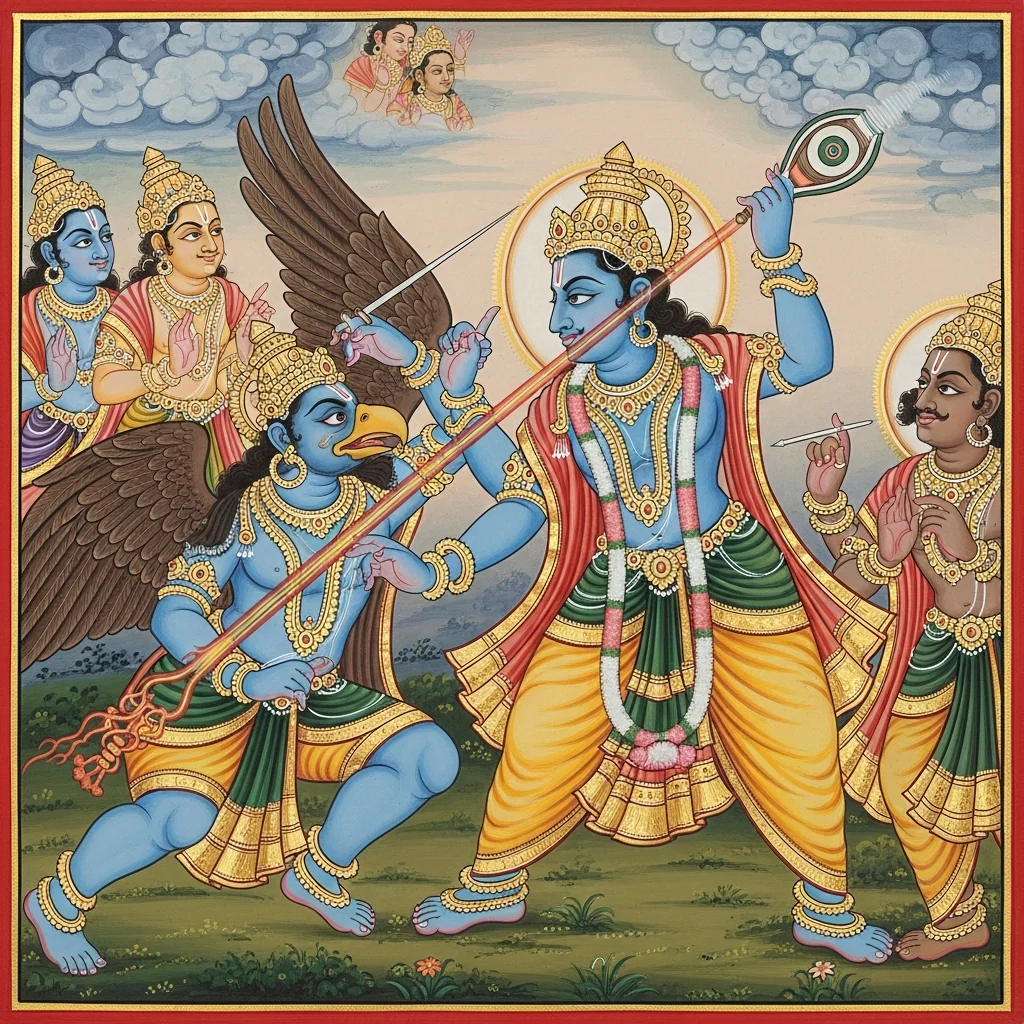
Nārada recounts a vast battle in which many dānavas, riding fearsome beasts and vehicles, converge upon Nārāyaṇa (Viṣṇu). Named fighters include Nimi, Mathana, Śumbha, Jambha, Grasana (as commander), and Mahiṣa. The conflict rises from volleys of piercing missiles to the release of mighty divine weapons (astras); Viṣṇu withstands sustained assaults, shifts from bow to mace, and meets layered astras head-on. Grasana nullifies a discharged Raudrāstra by deploying a Brahmāstra. Viṣṇu then unleashes the dread Kāladaṇḍāstra, which ravages the dānava host until counter-astras restrain it. Viṣṇu next uses his discus to slay Grasana decisively. Close-quarters fighting follows, with some asuras clinging to Garuḍa and even to Viṣṇu, whom the Lord shakes off before resuming armed combat. Mathana is killed by Viṣṇu’s mace after a brief exchange of heavy weapons. Mahiṣa attacks fiercely but is spared because destiny binds him to be slain by a woman, as earlier declared by lotus-born Brahmā; Viṣṇu therefore releases him from immediate death. Śumbha retreats after admonition, while Jambha boasts, strikes so massively that Garuḍa and Viṣṇu are briefly incapacitated, and then flees when Viṣṇu regains composure and advances. The chapter highlights cosmic order through the hierarchy of astras, the ethics of honoring destiny’s constraints, and the restoration of balance after the commander’s fall.
Shlokas
Verse 1
नारद उवाच । तं दृष्ट्वा दानवाः सर्वे क्रुद्धाः स्वैःस्वैर्बलैर्वृताः । सरघा इव माक्षिकं रुरुधुः सर्वतस्ततः
Nārada said: Seeing him, all the Dānavas, enraged and ringed by their own forces, hemmed him in on every side—like swarms of bees enclosing a fly.
Verse 2
पर्वताभे गजे भीमे मदस्राविणि दुर्दमे । सितचित्रपताके तु प्रभिन्नकरटामुखे
Upon a gigantic elephant like a mountain—terrifying, oozing rut-fluid and hard to subdue—bearing a white, patterned banner, with temples split and streaming, he advanced.
Verse 3
स्वर्णवर्णांचिते यद्वन्नगे दावाग्निसंवृते । आरुह्यजौ निमिर्दैत्यो हरिं प्रत्युद्ययौ बली
Like a forest-clad mountain glowing with golden hues and encircled by a wildfire, the mighty Daitya Nimi mounted his beast and charged forth against Hari.
Verse 4
तस्यासन्दानवा रौद्रा गजस्य परिरक्षिणः । सप्तविंशतिकोट्यश्च किरीटकवचोज्जवलाः
There were his fierce Dānava attendants—guards of that elephant—twenty-seven crores in number, resplendent with helmets and armor.
Verse 5
अश्वमारुह्य शैलाभं हरिमाद्रवत् । पंचयोजनप्रग्रीवमुष्ट्रमास्थाय जंभकः
Mounting a horse huge as a mountain, one rushed at Hari; and Jaṃbhaka, riding a camel whose neck stretched five yojanas, also advanced.
Verse 6
शुम्भो मेषं समारुह्याव्रजद्द्वादशयोजनम् । अपरे दानवेन्द्राश्च यत्ता नानास्त्रापाणयः
Śumbha mounted a ram and strode forth, spanning twelve yojanas; and the other lords of the Dānavas also came out, poised, with many kinds of weapons in their hands.
Verse 7
आजग्मुः समरे क्रुद्धा विष्णुमक्लिष्टकारिणम् । परघेण निमिर्दैत्यो मथनो मुद्गरेण च
Enraged in battle, they rushed upon Viṣṇu, the unwearied doer of deeds. The Daitya Nimi struck with an iron bludgeon, and Mathana with a heavy mace.
Verse 8
शुम्भः शूलेन तीक्ष्णेन प्रासेन ग्रसनस्तथा । चक्रेण क्रथनः क्रुद्धो जंभः शक्त्या महारणे
Śumbha struck with a keen śūla; Grasana likewise with a prāsa. Krathana, enraged, assailed with a cakra; and Jaṃbha, in the great battle, with a śakti-javelin.
Verse 9
जघ्नुर्नारायणं शेषा विशिखैर्मर्मभेदिभिः । तान्यस्त्राणि प्रयुक्तानि विविशुः पुरुषोत्तमम्
The rest struck Nārāyaṇa with arrows that pierced the vital points. Those weapons, once released, entered into Puruṣottama, the Supreme Person.
Verse 10
उपदेशा गुरोर्यद्वत्सच्छिष्यं बहुधेरिताः । ततः क्रुद्धो हरिर्गृह्य धनुर्बाणांश्च पुष्कलान्
As a true disciple receives the guru’s instruction again and again, so were many admonitions hurled forth; then Hari, enraged, seized his bow and took up an ample store of arrows.
Verse 11
ममर्द दैत्यसेनां तद्धर्ममर्थवचो यथा । निमिं विव्याध विंशत्या वाणैरनलवर्चसैः
He crushed the host of Asuras, as words of true meaning, aligned with dharma, subdue unrighteousness; and he pierced Nimi with twenty arrows blazing like fire.
Verse 12
मथनं दशभिश्चैव शुम्भं पंचभिरेव च । शतेन महिषं क्रुद्धो विव्याधोरसि माधवः
Mādhava, furious, struck Mathana with ten arrows, Śumbha with five, and pierced Mahiṣa in the chest with a hundred.
Verse 13
जंभं द्वादशभिस्तीक्ष्णैः सर्वांश्चैकैक शोऽष्टभिः । तस्य तल्लाघवं दृष्ट्वा दानवाः क्रोधमूर्छिताः
He struck Jambha with twelve sharp arrows, and each of the others with eight; seeing his swiftness and skill, the Dānavas were stunned into fury.
Verse 14
चक्रुर्गाढतरं यत्नमावृण्वाना हरिं शरैः । चिच्छेदाथ धनुर्ज्यां च निमिर्भल्लेन दानवः
They made an even more intense effort, covering Hari with volleys of arrows; then the Dānava Nimi cut the bowstring with a broad-headed shaft.
Verse 15
हस्ताच्चापं च संरंभाच्चिच्छेद महिषासुरः । षीडयामासा गरुडं जंभो बाणायुतैस्त्रिभिः
In a surge of rage, Mahiṣāsura cut the bow from (Hari’s) hand; and Jambha tormented Garuḍa with three tens of thousands of arrows.
Verse 16
भुजावस्य च विव्याध शंभो बाणायुतेन वै । ततो विस्मितचित्तस्तु गदां जग्राह माधवः
Śambha pierced his arms with a full ten thousand arrows; then Mādhava, astonished at heart, took up his mace.
Verse 17
तां प्राहिणोत्स वेगेन मथनाय महाहवे । तामाप्राप्तां निमिर्बाणैर्मुशलाभैः सहस्रशः
He hurled it with force at Mathana in that great battle; as it came on, Nimi met it with thousands of arrows like iron clubs.
Verse 18
आहत्य पातयामास विनदन्कालमेघवत् । ततोंऽतरिक्षे हाहेति भूतानां जज्ञिरे कथाः
Striking it down, he made it fall, roaring like a dark storm-cloud; then in the sky there arose the cries of “Alas! Alas!” among the hosts of beings.
Verse 19
नैतदस्ति बलं व्यक्तं यत्राशीर्यत सा गदा । तां हरिः पतितां दृष्ट्वा अस्थाने प्रार्थनामिव
“No manifest strength can be found where that mace is shattered.” Seeing it fallen, Hari regarded it as though it were a prayer offered in an unfit place.
Verse 20
जग्राह मुद्गरं घोरं दिव्यरत्नपरिष्कृतम् । तं मुमोचातिवेगेन निमिमुद्दिश्य दानवम्
He seized a dreadful mace, adorned with celestial jewels, and hurled it with tremendous speed, aiming it at the demon Nimi.
Verse 21
तमायांतं वियत्येव त्रयो दैत्या ह्यवारयन् । गदया दंभदैत्यस्तु ग्रसनः पट्टिशेन तु
As he advanced through the sky, three daityas barred his way—Dambha wielding a mace, and Grasana bearing a paṭṭiśa, an axe-like weapon.
Verse 22
शक्त्या च महिषो दैत्यो विनदंतो महाररवम् । निराकृतं तमालोक्य दुर्जनैः सुजनं यथा
And the daitya Mahiṣa, roaring with a mighty cry, assailed him with a śakti (spear); seeing him repulsed, it was as though the wicked were rejecting a virtuous man.
Verse 23
जग्राह शक्तिमुग्रोग्रां शतघंटामहास्वनाम् । जंभाय तां समुद्दिश्य प्राहिणोद्भीषणेरणे
He seized a fiercely dreadful śakti, resounding with the great clang of a hundred bells, and, aiming it at Jambha, hurled it forth in that terrifying battle.
Verse 24
तामायान्तीमथालोक्य जंभोऽन्यस्य रथात्त्वरात् । आप्लुत्य लीलया गृह्णन्कामिनीं कामुको यथा
Seeing it coming, Jambha swiftly leapt from another chariot and caught it playfully—like a lover seizing his beloved.
Verse 25
तयैव गरुडं मूर्ध्नि जघ्ने स प्रहसन्बली । ततो भूयो रथं प्राप्य घनुर्गृह्यभ्ययोजयत्
With that very weapon, the powerful one struck Garuḍa on the head, laughing; then, returning to his chariot, he took up his bow and made ready to shoot.
Verse 26
विचेताश्चाभवद्युद्धे गरुडः शक्तिपीडितः । ततः प्रहस्य तं विष्णुः साधुसाध्विति भारत
In that battle Garuḍa, tormented by the spear, became senseless. Then Viṣṇu laughed and said to him, “Well done, well done,” O Bhārata.
Verse 27
करस्पर्शेन कृतवान्विमोहं विनतात्मजम् । समाश्वास्य च तं वाग्भिः शक्तिं दृष्ट्वा च निष्फलाम्
By the touch of his hand he dispelled the delusion of Vinatā’s son; and after comforting him with words, he saw that the spear had become futile.
Verse 28
कुभार्यस्य यथा पुंसः सर्वंस्याच्चिंतितं वृथा । दृठसारमहामौर्वीमन्यां संयोजयत्ततः
Just as, for a man with a wicked wife, all his plans become vain, so too, seeing his effort fail, he then fastened another mighty bowstring, firm and strong.
Verse 29
कृत्वा च तलनिर्घोषं रौद्रमस्त्रं मुमोच सः । ततोऽस्त्रतेजसा सर्वमाकाशं नैव दृश्यते
And making a thunderous clap-like roar, he released the fierce Raudra missile; then, by the weapon’s blaze, the entire sky could no longer be seen.
Verse 30
भूमिर्दिशश्च विदिशो बामजालमया बुभुः । दृष्ट्वा तदस्त्रमाहात्म्यं सेनानीर्ग्रसनोऽसुरः
The earth, the quarters, and the intermediate directions became filled with a leftward, net-like snare. Seeing the might of that missile, the demon commander Grasana was struck with awe and alarm.
Verse 31
ब्राह्ममस्त्रं चकाराशु सर्वास्त्रविनिवारणम् । तेन तत्प्रशमं यातं रौद्रास्त्रं लोकभीषणम्
He swiftly employed the Brāhma-weapon, the countermeasure that restrains all missiles; by it the dreadful Raudra-weapon—terrifying to the worlds—was brought to calm.
Verse 32
अस्त्रे प्रतिहते तस्मिन्विष्णुर्दानवसूदनः । कालदंडास्त्रमकरोत्सर्वलोकभयंकरम्
When that missile was checked, Viṣṇu—the slayer of the Dānavas—then unleashed the Kāladaṇḍa-weapon, a terror to all the worlds.
Verse 33
संधीयमानेस्त्रे तस्मिन्मारुतः परुषो ववौ । चकंपे च मही देवी भिन्नाश्चांबुधयोऽभवन्
As that weapon was being set in motion, a harsh wind blew; the goddess Earth trembled, and even the oceans were split apart.
Verse 34
तदस्त्रमुग्रं दृष्ट्वा तु दानवा युद्धदुर्मदाः । चक्रुरस्त्राणि दिव्यानि नानारूपाणि संयुगे
Seeing that fierce weapon, the Dānavas—maddened by war—fashioned and launched divine missiles of many forms in the battle.
Verse 35
नारायणांस्त्रं ग्रसनस्तु चक्रे त्वाष्ट्रं निमिश्चास्त्रवरं मुमोच । ऐषीकमस्त्रं च चकार जंभो युद्धस्य दण्डास्त्र निवारणाय
Grasana employed the Nārāyaṇa-weapon; Nimi released the excellent Tvāṣṭra missile; and Jambha prepared the Aiṣīka weapon—seeking to ward off the Rod-of-Time weapon in the war.
Verse 36
यावच्च संधानवशं प्रयांति नारायणादीनि निवारणाय । तावत्क्षणेनैव जघान कोटींदैत्येश्वराणां किल कालदंडः
While the Nārāyaṇa weapon and the others were being brought under control and set forth as countermeasures, in that very instant the Kāladaṇḍa, it is said, struck down a crore of Daitya lords.
Verse 37
अनंतरं शांतभयं तदस्त्रं दैत्यास्त्रयोगेन च कालदण्डम् । शांतं तदालोक्य हरिः स्वमस्त्रं कोपेन कालानलतुल्यमूर्तिः
Soon after, that weapon—its terror stilled—and even the Kāladaṇḍa were pacified by the deployment of Daitya missiles. Seeing it thus calmed, Hari, whose wrathful form was like the fire at the end of time, took up his own weapon.
Verse 38
जग्राह चक्रं तपना युतप्रभमुग्रारमात्मानमिव द्वितीयम् । चिक्षेप सेनापतये ज्वलंतं चतुर्भूजः संयति संप्रगृह्य
The four-armed Lord grasped his discus, radiant with the splendor of the sun—like a second self, fierce and irresistible—and, holding it firmly in battle, hurled the blazing wheel at the commander.
Verse 39
तदाव्रजच्चक्रमथो विलोक्य सर्वात्मना दैत्यवराः स्ववीर्यात् । नाशक्नुन्वारयितुं प्रचंडं दैवं यथा पूर्वमिवोपपन्नम्
When that discus came rushing on, the foremost Daityas, relying wholly on their own valor, looked on—yet they could not restrain the fierce force of destiny, just as before.
Verse 40
तदप्रतर्क्यं नवहेतितुल्यं चक्रं पपात ग्रसनस्य कण्ठे । तद्रक्तधारा रुणघोरनाभि जगाम भूयोपि करं मुरारेः
That unfathomable discus—like a newly whetted weapon—fell upon Grasana’s throat. And the terrible-naved Sudarśana, streaming with his blood, returned once again to the hand of Murāri (Viṣṇu).
Verse 41
चक्राहतः संयति दानवश्च पपात भूमौ प्रममार चापि । दैत्याश्च शेषा भृशशौकमापुः क्रोधं च केचित्पिपिषुर्भुजांश्च
Struck by the discus in battle, the dānava fell to the earth and died. The remaining daityas were seized by grievous sorrow—while some, in wrath, bit their own arms.
Verse 42
ततो विनिहते दैत्ये ग्रसने बलनायके । निर्मर्यादमयुध्यंत हरिणा सह दानवाः
Then, when the daitya Grasana—their leader in strength—had been slain, the dānavas fought against Hari without bounds or restraint.
Verse 43
पट्टिशैर्मुशलैः प्रासैग्नि दाभिः कणपैरपि । तीक्ष्णाननैश्च नाराचैश्चक्रैः शक्तिभिरेव च
With axes, clubs, spears, fire-brand weapons, and barbed missiles; with sharp-pointed arrows, with discs, and with śakti-spears—thus they assailed him with every kind of weapon.
Verse 44
तदस्त्रजालं तैर्मुक्तं लब्धलक्षो जनार्दनः । एकैकं शतधा चक्रे बाणैरग्नि शिखोपमैः
That net of weapons they released—Janārdana, with flawless aim, shattered each and every one into a hundred pieces with arrows like tongues of fire.
Verse 45
जघान तेषां संक्रुद्धः कोटिकोटिं जनार्दनः । ततस्ते सहसा भूत्वा न्यपतन्केशवोपरि
Enraged, Janārdana struck down crores upon crores of them. Then, gathering themselves suddenly, they leapt and fell upon Keśava.
Verse 46
गरुडं जगृहुः केचित्पादयोः शतशोऽसुराः । ललंबिरे च पक्षाभ्यां मुखे चान्ये ललंबिरे
Some asuras—by the hundreds—seized Garuḍa by his feet. Others hung from his wings, and still others clung, dangling, from his beak.
Verse 47
केशवस्यापि धनुषि भुजयोः शीर्ष एव च । ललंबिरे महादैत्या निनदंतो मुहुर्मुहुः
Great daityas clung even to Keśava’s bow, to his arms, and to his very head—roaring again and again.
Verse 48
तदद्भुतं महद्दृष्ट्वा सिद्धचारणवार्तिकाः । हाहेति मुमुचुर्नादसंबरे चास्तुवन्हरिम्
Beholding that great marvel, the Siddhas, Cāraṇas, and celestial heralds cried out, “Hā! Hā!” and, amid the tumult of sound, they praised Hari.
Verse 49
ततो हरिर्विनिर्धूय पातयामास तान्भुवि । यथा प्रबुद्धः पुरुषो दोषान्संसारसंभवान्
Then Hari, shaking them off, cast them down upon the earth—just as an awakened person casts away the faults born of worldly existence (saṃsāra).
Verse 50
विकोशं च ततः नंदकं खड्गमुत्तमम् । चर्म चाप्यमलं विष्णुः पदातिस्तानधावत
Then Viṣṇu unsheathed His supreme sword Nandaka, and taking up His spotless shield as well, He rushed forward on foot against those infantry warriors.
Verse 51
ततो मुहूर्तमात्रेण पद्मानि दश केशवः । चकर्त्त मार्गे बहुभिर्विचरन्दैत्यसत्तमान्
Then, in but a moment, Keśava cut down ten ‘Padma’ divisions along the battlefield route, moving through and striking many of the foremost daityas.
Verse 52
ततो निमिप्रभृतयो विनद्यासुरसत्तमाः । अधावंत महेष्वासाः केशवं पादचारिणम्
Then Nimi and the others—roaring aloud, the foremost asuras, mighty archers—charged at Keśava as He fought on foot.
Verse 53
गरुत्मांश्चाभ्ययात्तूर्णमारुरोह च तं हरिः । उवाच च गरुत्मंतं तस्मिंश्च तुमुले रणे
Garutmān came swiftly, and Hari mounted him. In that tumultuous battle, He spoke to Garuḍa.
Verse 54
अश्रांतो यदि तार्क्ष्यासि मथनं प्रति तद्व्रज । श्रांतश्चेच्च मुहूर्तं त्वं रणादपसृतो भव
“If you are not weary, O Tārkṣya, then go straight toward Mathana. But if you are tired, withdraw from the battle for a moment.”
Verse 55
तार्क्ष्य उवाच । न मे श्रमोऽस्ति लोकेश किंचित्संस्मरतश्च मे । यन्मे सुतान्वाहनत्वे कल्पयामास तारकः
Tārkṣya said: “I have no fatigue, O Lord of the worlds, especially when I remember how Tāraka once forced my sons into the state of being mounts, beasts of burden.”
Verse 56
इति ब्रवन्रणे दैत्यं मथनं प्रति सोऽगमत् । दैत्यस्तवभिमुखं दृष्ट्वा शंखचक्रगदाधरम्
Saying so in the midst of battle, he went toward the daitya Mathana. The daitya, seeing you facing him—bearing conch, discus, and mace—
Verse 57
जघान भिंडिपालेन शितधारेण वक्षसि । तं प्रहारमचिंत्यैव विष्णुस्तस्मिन्महाहवे
He struck him on the chest with a sharp-edged bhiṇḍipāla. Yet in that great battle, Viṣṇu, inconceivable in might, bore that blow as nothing.
Verse 58
जघान पंचभिर्बाणैर्गिरींद्रस्यापि भेदकैः । आकर्णकृष्टैर्दशभिः पुनर्विद्धः स्तनांतरे
He struck him with five arrows capable of cleaving even a lordly mountain; and again he was pierced in the space between the breasts with ten arrows drawn back to the ear.
Verse 59
विचेतनो मुहूर्तात्स संस्तभ्य मथनः पुनः । गृहीत्वा परिघं मूर्ध्नि जनार्दनमताडयत्
Mathana, rendered unconscious for a moment, recovered himself again; then seizing an iron club (parigha), he struck Janārdana on the head.
Verse 60
विष्णुस्तेन प्रहारेण किंचिदाघूर्णितोऽभवत् । ततः कोपविवृत्ताक्षो गदां जग्राह माधवः
By that blow, Viṣṇu was shaken and momentarily reeled. Then Mādhava, his eyes widened with wrath, seized his mace.
Verse 61
तया संताडयामास मथनं हृदये दृढम् । स पपात तथा भूमौ चूर्णितांगो ममार च
With that mace he struck Mathana hard upon the heart. He fell to the ground; his limbs crushed, he died.
Verse 62
तस्मिन्निपतिते भूमौ मथने मथिते भृशम् । अवसादं युयुर्दैत्याः सर्वे ते युद्धमण्डले
When Mathana had fallen to the earth, crushed utterly, all those Daityas on the field of battle sank into despair.
Verse 63
ततस्तेषु विषण्णेषु दानवेष्वतिमानिषु । चुकोप रक्तनयनो महिषो दानवेश्वरः
Then, as those over-proud Dānavas became downcast, Mahiṣa—the lord of the Dānavas—grew enraged, his eyes reddening.
Verse 64
प्रत्युद्ययौ हरिं रौद्रः स्वबाहुबलमाश्रितः । रीक्ष्णधारेण शूलेन महिषो हरिमर्दयन्
Fierce and relying on the strength of his own arms, Mahiṣa charged at Hari, striking at him with a sharp-edged trident.
Verse 65
शक्त्या च गरुडं वीरो हृदयेऽभ्यहनद्दृढम् । ततो विवृत्य वदनं महामलगुहानिभम्
And with a śakti (spear) the hero struck Garuḍa firmly in the heart. Then, opening his mouth—like a vast, foul cavern—
Verse 66
ग्रस्तुमैच्छद्रणे दैत्यः सगरुत्मंतमच्युतम् । अथाच्युतोऽपि विज्ञाय दानवस्य चिकीर्षितम्
In the battle, the Daitya longed to swallow Acyuta together with Garuḍa. But Acyuta, discerning the Dānava’s intent,
Verse 67
वदनं पूरयामास दिव्यैस्त्रैर्महाबलः । स तैर्बाणैरभिहतो महिषोऽचलसंनिभः
The mighty one filled his mouth with three divine arrows. Struck by those shafts, Mahiṣa—like a mountain—was wounded.
Verse 68
परिवर्तितकायार्धः पपाताथ ममार च । महिषं पतितं दृष्ट्वा जीवयित्वा पुनर्हरिः
With half his body overturned, he fell and died. Seeing Mahiṣa fallen, Hari revived him again.
Verse 69
महिषं प्राह मत्तस्त्वं वधं नार्हसि दानव । योषिद्वध्यः पुरोक्तस्त्वं साक्षात्कमलयोनिना
To Mahiṣa Hari said: “O Dānava, you do not deserve death at my hands. Long ago the lotus-born Brahmā himself declared that you would be slain by a woman.”
Verse 70
उत्तिष्ठ गच्छ मन्मुक्तो द्रुतमस्मान्महारणात् । इत्युक्तो हरिणा तस्माद्देशादपगतोऽसुरः
“Rise and depart—released by me—quickly leave this great battlefield.” Thus addressed by Hari (Viṣṇu), the asura withdrew from that place.
Verse 71
तस्मिन्पराङ्मुखे दैत्ये महिषे शुंभदानवः । संदष्टौष्ठपुटाटोपो भृकुटीकुटिलाननः
When that daitya—Mahiṣa—turned away, the dānava Śuṃbha bit his lips in fury; his face, twisted by a knotted frown, bristled with wrath.
Verse 72
निर्मध्य पाणिना पाणिं धनुरादाय भैरवम् । सज्जीकृत्य महाघोरान्मुमोच शतशः शरान्
Gripping hand with hand, he seized the dreadful bow Bhairava; stringing it and making it ready, he loosed hundreds of exceedingly terrible arrows.
Verse 73
स चित्रयोधी दृढमुष्टिपातस्ततश्व विष्णुं च दैत्यः । बाणैर्ज्वलद्वह्निशिखानिकाशैः क्षिप्तैरसंख्यैः प्रतिघाहीनैः
That daitya, a wondrous fighter with crushing blows of the fist, then assailed Viṣṇu as well—hurling countless arrows, blazing like tongues of fire, relentless in their impact.
Verse 74
विष्णुश्च दैत्येंद्रशरार्दितो भृशं भुशुंडिमादाय कृतांततुल्याम् । तया मुखं चास्य पिपेष संख्ये शुंभस्य जत्रुं च धराधराभम्
Viṣṇu, grievously struck by the demon-king’s arrows, seized a bhuśuṇḍī mace, like Death itself; with it in the melee he crushed his face, and shattered Śuṃbha’s mountain-like collarbones.
Verse 75
ततस्त्रिभिः शंभुभुजं द्विषष्ट्या सूतस्य शीर्षं दशक्षिश्च केतुम् । विष्णुर्विकृष्टैः श्रवणावसानं दैत्यस्य बाणैर्ज्वलनार्कवर्णैः
Then Viṣṇu, drawing back, struck with arrows bright as fire and the sun: with three he cut down Śaṃbhu’s arm, with sixty-two the charioteer’s head, and with ten the standard (banner).
Verse 76
स तैश्च विद्धो व्यथितो बभूव दैत्येश्वरो विस्रुतशोणिताक्तः । ततोऽस्य किंचिच्चलितस्य धैर्यादुवाच शंखांबुजसार्ङ्गपाणिः
Pierced by those blows, the lord of the Daityas suffered pain, smeared with streaming blood. Then, as his courage wavered slightly, the Bearer of the conch, lotus, and Sārṅga bow spoke to him.
Verse 77
योषित्सुवध्योऽसि रणं विभुंच शुंभाऽशुभ स्वल्पतरैरहोभिः । मत्तोर्हसि त्वं न वृथैव मूढ ततोऽपयातः स च शंभदानवः
“O inauspicious Shumbha, you are destined to be slain by a woman; your prowess in battle will end in but a few days. You are no match for me—do not strive in vain, O fool.” Saying this, the Danava Shumbha withdrew.
Verse 78
जम्भोऽथ तद्विष्णुमुखान्निशम्य जगर्ज चोच्चैः कृतसिंहनादः । प्रोवाच वाक्यं च सलीलमाजौ महाट्टहासेन जगद्विकंप्य
Then Jambha, hearing those words from Vishnu’s mouth, roared loudly like a lion; and in the battle he spoke playfully, shaking the worlds with a great peal of laughter.
Verse 79
किमेभिस्ते जलावास दैत्यैर्हीनपराक्रमैः । मामासादय युद्धेऽस्मिन्यदि ते पौरुषं क्वचित्
“What use to you, O Water-dweller, are these Daityas of feeble valor? Come face me in this battle, if you have any manliness at all.”
Verse 80
यत्ते पूर्वं हता दैत्या हिरण्याक्षमुखाः किल । जंभस्तदाभवन्नैव पश्य मामद्य संस्थितम्
“Those Danavas you once slew—Hiranyaksha and the rest—were not Jambha. Look at me now, standing before you!”
Verse 81
पश्य तालप्रती काशौ भुजावेतौ हरे मम । वक्षो वा वज्रकठिनं मयि प्रहर तत्सुखम्
Behold, O Hari, these two arms of mine, like mighty palm-trees; and this chest, hard as the vajra. Strike me—do so to your satisfaction!
Verse 82
इत्युक्तः केशवस्तेन सृक्किणी संलिहन्रुषा । मुमोच परिघंघोरं विरीणामपि दारणम्
Thus addressed, Keśava—licking the corners of his mouth in wrath—hurled a dreadful iron club, able to split even the mightiest warriors.
Verse 83
ततस्तस्याप्यनुपदं कालायसमयं दृढम् । मुमोच मुद्गरं विष्णुर्द्वितीयं पर्वतं यथा
Then, immediately after that, Viṣṇu hurled a second weapon—a solid mace of black iron—like a second mountain crashing down.
Verse 84
तदायुधद्वयं दृष्ट्वा जंभो न्यस्य रथे धनुः । आप्लुत्य परिघं गृह्य गरुडं तेन जघ्निवान्
Seeing those two weapons, Jambha set his bow down in the chariot, leapt forward, seized the iron club, and struck Garuḍa with it.
Verse 85
द्वितीयं मुद्गरं चानु गृहीत्वा विनदन्रणे । सर्वप्राणेन गोविंदं तेन मूर्ध्नि जघान सः
Then, taking up the second mace as well and roaring on the battlefield, he struck Govinda on the head with all his might.
Verse 86
ताभ्यां चातिप्रहाराभ्यामुभौ गरुडकेशवौ । मोहाविष्टौ विचेतस्कौ मृतकल्पाविवासताम्
By those two crushing blows, both Garuḍa and Keśava were seized by delusion, senseless, lying as though dead.
Verse 87
तदद्भुतं महद्दृष्ट्वा जगर्जुर्दैत्यसत्तमाः । नैतान्हर्षमदोद्धूतानिदं सेहे जगत्तदा
Seeing that great marvel, the foremost Daityas roared aloud; intoxicated with joy and pride, they could scarcely restrain themselves—indeed, at that moment the world could hardly bear their exultation.
Verse 88
सिंहनादैस्तलोन्नाहैर्धनुर्नादैश्च बाणजैः । जंभं ते हर्षयामासुर्वासांस्यादुधुवुश्च ते
With lion-roars, loud shouts, the twang of bows, and the whir of arrows, they delighted Jambha; and in jubilation they shook their garments.
Verse 89
शंखांश्च पूरयामासुश्चिक्षिपुर्देवता भृशम्
And the Devas loudly blew their conches and hurled their missiles with great force.
Verse 90
संज्ञामवाप्याथ महारणे हरिः सवैनतेयः परिरभ्य जंभम् । पराङ्मुखः संयुगादप्रधृष्यात्पलायनं वेगपरश्चकार
Then, regaining consciousness on that great battlefield, Hari (Viṣṇu), together with Vainateya (Garuḍa), seized Jambha and—turning away from the fight, being unable to be overcome there—made a swift retreat.