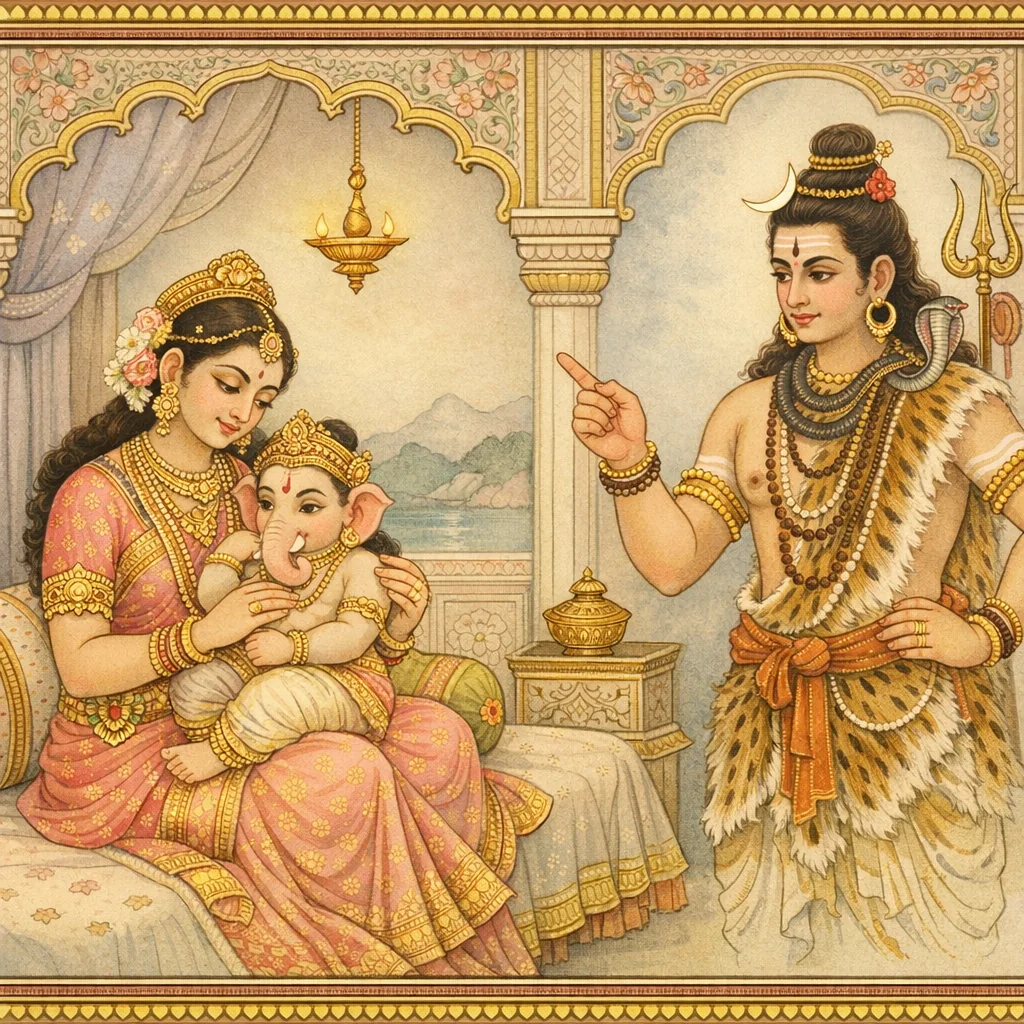
Adhyaya 27
The chapter unfolds in three linked movements. (1) Nārada describes a divine household at Mandara where Śiva and Devī dwell; the devas, oppressed by Tāraka, approach Śiva with hymns. Near this praise, Devī’s bodily unguent (udvartana-mala) becomes the basis for the manifestation of Gajānana—Vighnapati—whom Devī acknowledges as her “son,” and whom Śiva praises as equal in valor and compassion. A teaching on obstacles follows: those who reject Veda-dharma, deny Śiva/Viṣṇu, or invert social and ritual order meet persistent impediments and domestic discord, while those who uphold śruti-dharma, honor the guru, and practice restraint have obstacles removed. (2) Devī establishes a public-ethical “maryādā” through a calculus of merit: building wells, ponds, and reservoirs is meritorious, yet planting and maintaining a tree is declared superior; restoration of what is old and ruined (jīrṇoddhāra) yields doubled fruit. (3) A catalogue then portrays Śiva’s gaṇas in diverse forms, habitats, and behaviors; Devī takes special interest in an attendant, Vīraka, and adopts him as a son through an affectionate, ritualized gesture. The chapter closes with a tense, stylized narmic exchange between Umā and Śiva—wordplay, complexion imagery, and mutual reproach—serving as a moral-psychological vignette on interpretation, offense, and relational ethics.
Shlokas
Verse 1
। नारद उवाच । ततो निरुपमं दिव्यं सर्वरत्नमयं शुभम् । ईशाननिर्मितं साक्षात्सह देव्याविशद्गृहम्
Nārada said: Then, together with the Goddess, he entered a truly incomparable, divine, auspicious mansion, made of every kind of jewel—manifestly fashioned by Īśāna (Śiva) himself.
Verse 2
तत्रासौ मंदरगिरौ सह देव्या भगाक्षहा । प्रासादे तत्र चोद्याने रेमे संहृष्टमानसः
There, on Maṇḍara Mountain, the slayer of Bhaga’s eye (Śiva), along with the Goddess, delighted—his mind joyful—in the palace and in the garden there.
Verse 3
एतस्मिन्नंतरे देवास्तारकेणातिपीडिताः । प्रोत्साहितेन चात्यर्थं मया कलिचिकीर्षुणा
Meanwhile, the gods—greatly tormented by Tāraka—were strongly urged on by me, who intended to set events in motion toward conflict.
Verse 4
आसाद्य ते भवं देवं तुष्टुबुर्बहुधा स्तवैः । एतस्मिन्नंतरे देवी प्रोद्वर्तयत गात्रकम्
Reaching Bhava, the Lord, they praised him in many hymns. In that very interval, the Goddess began to rub and anoint her body (with unguent).
Verse 5
उद्वर्तनमलेनाथ नरं चक्रे गजाननम् । देवानां संस्तवैः पुण्यैः कृपयाभिपरिप्लुता
With the paste from her anointing, the Goddess fashioned a man—Gajānana. Flooded with compassion, and moved by the devas’ meritorious praises, she did so.
Verse 6
पुत्रेत्युवाच तं देवी ततः संहृष्टमानसा । एतस्मिन्नंतरे शर्वस्तत्रागत्य वचोऽब्रवीत्
Then the Goddess, her heart rejoicing, addressed him, saying, “My son.” At that very moment Śarva (Śiva) arrived there and spoke these words.
Verse 7
पुत्रस्तवायं गिरिजे श्रृणु यादृग्भविष्यति । विक्रमेण च वीर्येण कृपया सदृशो मया
“O Girijā, this is your son—hear what he shall be like: in valor, in power, and in compassion he will be like me.”
Verse 8
यथाहं तादृशश्चासौ पुत्रस्ते भविता गुणैः । ये च पापा दुराचारा वेदान्धर्मं द्विषंति च
“As I am, so too will your son be in his qualities. And those who are sinful and of wicked conduct—who hate the Vedas and dharma—”
Verse 9
तेषामामरणांतानि विघ्नान्येष करिष्यति । ये च मां नैव मन्यंते विष्णुं वापि जगद्गुरुम्
“For them he will create obstacles that endure until death—especially for those who do not honor me, nor Viṣṇu, the Guru of the world.”
Verse 10
विघ्निता विघ्नराजेन ते यास्यंति महत्तमः । तेषां गृहेषु कलहः सदा नैवोपसाम्यति
O most eminent one, those who are obstructed by Vighnarāja (the Lord of Obstacles) will come to ruin; and in their homes, quarrel never truly subsides, but remains constant.
Verse 11
पुत्रस्य तव विघ्नेन समूलं तस्य नश्यति । येषां न पूज्याः पूज्यंते क्रोधासत्यपराश्च ये
By the obstacle set in place by your son Vighneśa, they are destroyed from the very root—those who worship the unworthy as worthy, and those devoted to anger and falsehood.
Verse 12
रौद्रसाहसिका ये च तेषां विघ्नं करिष्यति । श्रुतिधर्माञ्ज्ञातिधर्मान्पालयंति गुरूंश्च ये
Those who are fierce and recklessly violent—upon them he will impose obstacles. But those who uphold the dharmas taught in the śruti, the duties owed to kinsmen, and who honor their gurus—
Verse 13
कृपालवो गतक्रोधास्तेषां विघ्नं हरिष्यति । सर्वे धर्माश्च कर्माणि तथा नानाविधानि च
For the compassionate, who have abandoned anger, he will remove obstacles. And all their dharmas and rites—indeed, their many kinds of actions—
Verse 14
सविघ्नानि भिवष्यंति पूजयास्य विना शुभे । एवं श्रुत्वा उमा प्राह एवमस्त्विति शंकरम्
“Without worship of him, O auspicious one, everything will be beset with obstacles.” Hearing this, Umā said to Śaṅkara, “So be it.”
Verse 15
ततो बृहत्तनुः सोऽभूत्तेजसा द्योतयन्दिशः । ततो गणैः समं शर्वः सुराणां प्रददौ च तम् । यावत्तार कहंता वो भवेत्तावदयं प्रभुः
Then he became vast-bodied, illuminating the directions with his tejas. Then Śarva, together with his gaṇas, entrusted him to the gods, saying: “So long as your slayer of Tāraka has not yet come to be, so long shall this lord be your protector.”
Verse 16
ततो विघ्नपतिर्देवैः संस्तुतः प्रमतार्तिहा । चकार तेषां कृत्यानि विघ्नानि दितिजन्मनाम्
Then Vighnapati, praised by the gods, the remover of the distress of Śiva’s Pramathas, carried out his appointed tasks, raising obstacles for those born of Diti’s line (the asuras).
Verse 17
पार्वती च पुनर्देवी पुत्रत्वे परिकल्प्य च । अशोकस्यांकुरं वार्भिरवर्द्धयत स्वादृतैः
And Pārvatī, the Goddess, once more resolving to have a son, nurtured the sprout of an aśoka tree with water carefully tended and offered.
Verse 18
सप्तर्षीनथ चाहूय संस्कारमंगलं तरोः । कारयामास तन्वंगी ततस्तां मुनयोऽब्रुवन्
Then the slender-limbed Goddess summoned the Seven Ṛṣis and had the tree’s auspicious consecratory rites performed; thereafter the sages addressed her.
Verse 19
त्वयैव दर्शिते मार्गे मर्यादां कर्तुमर्हसि । किं फलं भविता देवि कल्पितैस्तरुपुत्रकैः
The sages said: “Since the path has been shown by you yourself, O Goddess, you should establish the proper rule and boundary. What fruit will come, O Devī, from these imagined ‘sons born of a tree’?”
Verse 20
देव्युवाच । यो वै निरुदके ग्रामे कूपं कारयते बुधः । यावत्तोयं भवेत्कूपे तावत्स्वर्गे स मोदते
The Goddess said: “A wise person who has a well built in a waterless village rejoices in heaven for as long as water continues to remain in that well.”
Verse 21
दशकूपसमावापी दशवापी समं सरः । दशसरःसमा कन्या दशकन्यासमः क्रतुः
One step-well equals ten wells; one lake equals ten step-wells; the sacred gift of a maiden in marriage equals ten lakes; and one sacrifice (yajña) equals ten such maiden-gifts.
Verse 22
दशक्रतुसमः पुत्रो दशपुत्रसमो द्रुमः
One son equals ten sacrifices; and one tree equals ten sons.
Verse 23
एषैव मम मर्यादा नियता लोकभाविनी । जीर्णोद्धारे कृते वापि फलं तद्द्विगुणं मतम्
“This indeed is my established ordinance, fixed for the welfare of the world. And if one restores what has grown old and fallen into ruin, the fruit of that deed is held to be double.”
Verse 24
इति गणेशोत्पत्तिः । ततः कदाचिद्भगवानुमया सह मंदरे । मंदिरे हर्षजनने कलधौतमये शुभे
Thus ends the account of Gaṇeśa’s manifestation. Then, at one time, the Blessed Lord—together with Umā—was on Mandara, in a delightful, auspicious mansion made of refined gold.
Verse 25
प्रकीर्णकुसुमामोदमहालिकुलकूजिते । किंनरोद्गीतसंगीत प्रतिशब्दितमध्यके
It was filled with the fragrance of scattered blossoms and the humming of great swarms of bees; and within it, music sung by the Kiṃnaras resounded in echo.
Verse 26
क्रीडामयूरैर्हसैश्च श्रुतैश्चैवाभिनादिते । मौक्तिकैर्विविध रत्नैर्विनिर्मितगवाक्षके
It resounded with the cries of playful peacocks, swans, and other birds; and its windows were fashioned of pearls and many kinds of jewels.
Verse 27
तत्र पुण्यकथाभिश्च क्रीडतो रुभयोस्तयोः । प्रादुरभून्महाञ्छब्दः पूरितांबरगोचरः
There, as the two of them sported and spoke sacred tales, a great sound suddenly arose—filling the sky and spreading through the whole expanse of the heavens.
Verse 28
तं श्रुत्वा कौतुकाद्देवी किमेतदिति शंकरम् । पर्यपृच्छच्छुभतनूर्हरं विस्मयपूर्वकम्
Hearing it, the Goddess—moved by curiosity—asked Śaṅkara, “What is this?” The auspicious-limbed Devī questioned Hara in wonder.
Verse 29
तामाह देवीं गिरिशो दृष्टपूर्वास्तु ते त्वया । एते गणा मे क्रीडंति शैलेऽस्मिंस्त्वत्प्रियाः शुभे
Giriśa said to the Goddess: “These are beings you have seen before. These my Gaṇas are playing upon this mountain, O auspicious one—for they are dear to you.”
Verse 30
तपसा ब्रह्मचर्येण क्लेशेन क्षेत्रसाधनैः । यैरहं तोषितः पृथ्व्यां त एते मनुजोत्तमाः
By austerity, by the discipline of brahmacarya, by hardship, and by the practices of sacred places—those by whom I have been pleased upon the earth: these indeed are the best among men.
Verse 31
मत्समीपमनुप्राप्ता मम लोकं वरानने । चराचरस्य जगतः सृष्टिसंहारणक्षमाः
O fair-faced one, having come into my presence and attained my world, they are able to bring about the creation and dissolution of the entire universe, both moving and unmoving.
Verse 32
विनैतान्नैव मे प्रीतिर्नैभिर्विरहितो रमे । एते अहमहं चैते तानेतान्पस्य पार्वति
Without them I have no delight; apart from them I do not rejoice. They are as I am, and I am as they are—behold them, O Pārvatī.
Verse 33
इत्युक्ता विस्मिता देवी ददृशे तान्गवाक्षके । स्थिता पद्मपलाशाक्षी महादेवेन भाषिता
Thus addressed, the Goddess—astonished—saw them in the window-opening. The lotus-petal-eyed one stood there, having been spoken to by Mahādeva.
Verse 34
केचित्कृशा ह्रस्वदीर्घाः केचित्स्थूलमहोदराः । व्याघ्रेभमेषाजमुखा नानाप्राणिमहामुखाः
Some were lean, some short or tall; some were stout with huge bellies. Some had faces like tigers, elephants, rams, or goats—great-faced beings of many kinds of creatures.
Verse 35
व्याघ्रचर्मपरीधाना नग्ना ज्वालामुखाः परे । गोकर्णा गजकर्णाश्च बहुपादमुखेक्षणाः
Some wore tiger-skins; others were naked, with flaming mouths. Some had ears like cows, some had ears like elephants; some had many feet, faces, and eyes.
Verse 36
विचित्रवाहनाश्चैव नानायुधधरास्तथा । गीतवादित्रतत्त्वज्ञाः सत्त्वगीतरसप्रियाः
They had wondrous mounts and bore weapons of many kinds. They knew the true principles of song and instruments, and they delighted in the savor of pure, harmonious music.
Verse 37
तान्दृष्ट्वा पार्वती प्राह कतिसंख्याभिधास्त्वमी
Seeing them, Pārvatī said: “What is their number, and by what names are they called?”
Verse 38
श्रीशंकर उवाच । असंख्ये यास्त्वमी देवी असंख्येयाभिधास्तथा । जगदापूरितं सर्वमेतैर्भीमैर्महाबलैः
Śrī Śaṅkara said: “They are numberless, O Goddess, and their names too are beyond counting. The whole world is filled by these terrible ones of mighty strength.”
Verse 39
सिद्धक्षेत्रेषु रथ्यासु जीर्णोद्यानेषु वेश्मसु । दानवानां शरीरेषु बालेषून्मत्तकेषु च
In the sacred precincts of the siddhas, in the streets, in ruined gardens and houses; in the bodies of the dānavas, and also in children and in the mad—(there they are found abiding).
Verse 40
एते विशति मुदिता नानाहारविहारिणः । ऊष्मपाः फेनपाश्चैव धूम्रपा मधुपायिनः । मदाहाराः सर्वभक्ष्यास्तथान्ये चाप्यभोजनाः
These twenty gaṇas, joyful and exuberant, roam about with diverse foods and pleasures. Some drink heat (vapour), some drink foam, some drink smoke, some drink honey; some feed on intoxicants; some eat everything—while others live even without eating at all.
Verse 41
गीतनृत्योपहाराश्च नानावाद्यरवप्रियाः । अनंतत्वादमीषां च वक्तुं शक्या न वै गुणाः
They delight in song, dance, and offerings, and they love the sounds of many kinds of instruments. And because their nature is endless, their qualities truly cannot be fully described in words.
Verse 42
श्रीदेव्युवाच । मनःशिलेन कल्केन य एष च्छुरिताननः । तेजसा भास्कराकारो रूपेण सदृशस्तव
Śrī Devī said: “This one whose face is smeared with red manaḥśilā paste—his radiance is like the sun; and in form he resembles you.”
Verse 43
आकर्ण्याकर्ण्य ते देव गणैर्गीतान्महागुणान् । मुहुर्नृत्यति हास्यं च विदधाति मुहुर्मुहुः
O Deva, hearing again and again the great excellences sung by the gaṇas, he repeatedly dances—and again and again he breaks into laughter.
Verse 44
सदाशिवशिवेत्येवं विह्वलो वक्ति यो मुहुः । धन्योऽमीदृशी यस्य भक्तिस्त्वयि महेश्वरे
Overwhelmed, he keeps saying again and again, “Sadāśiva! Śiva!” Blessed indeed is the one who has such devotion toward you, O Maheśvara.
Verse 45
एनं विज्ञातुमिच्छामि किंनामासौ गणस्तव । श्रीशंकर उवाच । स एष वीरक देवी सदा मेद्रिसुते प्रियः
“I wish to know him—what is the name of this gaṇa of yours?” Śrī Śaṅkara said: “Goddess, this is Vīraka, ever dear to me, O daughter of the Mountain.”
Verse 46
नानाश्चर्यगुणाधारः प्रतीहारो मतोंऽबिके । देव्युवाच । ईदृशस्य सुतस्यापि ममोऽकंठा पुरांतक
“O Ambikā, he is regarded as a gatekeeper, a support of many wondrous virtues.” Devī said: “O Destroyer of Tripura, even with such a son, my longing is unrestrained.”
Verse 47
कदाहमीदृशं पुत्रं लप्स्याम्यानंददायकम् । शर्व उवाच । एष एव सुतस्तेस्तु यावदीदृक्परो भवेत्
“When shall I obtain such a son, a giver of joy?” Śarva said: “Let this very one be your son, so long as he remains devoted in such a manner.”
Verse 48
इत्युक्ता विजयां प्राह शीघ्रमानय वीरकम् । विजया च ततो गत्वा वीरकं वाक्यमब्रवीत्
Having spoken thus, (Śiva) told Vijayā, “Quickly bring Vīraka.” Then Vijayā went and spoke words to Vīraka.
Verse 49
एहि वीरक ते देवी गिरिजा तोषिता शुभा । त्वममाह्वयति सा देवी भवस्यानुमते स्वयम्
“Come, Vīraka. The auspicious Goddess Girijā is pleased. That Goddess herself summons you, with Bhava’s (Śiva’s) permission.”
Verse 50
इत्युक्तः संभ्रमयुतो मुखं संमार्ज्य पाणिना । देव्याः समीपमागच्छज्जययाऽनुगतः शनैः
Thus addressed, he—filled with nervous eagerness—wiped his face with his hand and slowly approached the Goddess, with Jaya following behind him.
Verse 51
तं दृष्ट्वा गिरिजा प्राह गिरामधुरवर्णया । एह्येहि पुत्र दत्तस्त्वं भवेन मम पुत्रकः
Seeing him, Girijā spoke in a voice sweet in tone: “Come, come, my child. You have been given to me by Bhava (Śiva); you are my beloved son.”
Verse 52
इत्युक्तो दंडवद्देवीं प्रणम्यावस्थितः पुरः । माता ततस्तमालिंग्य कृत्वोत्संगे च वीरकम्
Thus addressed, he bowed to the Goddess in full prostration like a staff and stood before her. Then the Mother embraced him and placed Vīraka upon her lap.
Verse 53
चुचुंब च कपोले तं गात्राणि च प्रमार्जयत् । भूषयामास दिव्यैस्तं स्वयं नानाविभूषणैः
She kissed him on the cheek and gently wiped his limbs. Then she herself adorned him with various divine ornaments.
Verse 54
एवं संकल्प्य तं पुत्रं लालयित्वा उमाचिरम् । उवाच पुत्र क्रीडेति गच्छ सार्धं गणैरिति
Having thus accepted him as her son and fondled him for a long while, Umā said: “My child, go and play—go together with the Gaṇas.”
Verse 55
ततश्चिक्रीड मध्ये स गणानां पार्वतीसुतः । मुहुर्मुहुः स्वमनसि स्तुवन्भक्तिं स शांकरीम्
Then Pārvatī’s son played among the Gaṇas; and again and again, within his own mind, he praised Śaṅkarī-bhakti—devotion to the Divine Mother.
Verse 56
प्रणम्य सर्वभूतानि प्रार्थयाम्यस्मि दुष्करम् । भक्त्या भजध्वमीशानं यस्या भक्तेरिदं फलम्
Having bowed to all beings, I ask something difficult: Worship Īśāna with devotion—for this very outcome is the fruit of such bhakti.
Verse 57
क्रीडितुं वीरके याते ततो देवी च पार्वती । नानाकथाभिस्चिक्रीड पुनरेव जटाभृता
When Vīraka went off to play, the Goddess Pārvatī sported again with the matted-haired Lord (Śiva), delighting in many kinds of tales.
Verse 58
ततो गिरिसुताकण्ठे क्षिप्तबाहुर्महेश्वरः । तपसस्तु विशेषार्थं नर्म देवीं किलाब्रवीत्
Then Maheśvara, placing his arm around the neck of the mountain-born Goddess, spoke to Devī in a playful manner—yet with the aim of indicating the special purpose of tapas, austerity.
Verse 59
स हि गौरतनुः शर्वो विशेषाच्छशिशोभितः । रंजिता च विभावर्या देवी नीलोत्पलच्छविः
For Śarva was fair-bodied, and especially adorned by the moon’s radiance; and the Goddess—dark-hued like a blue lotus—was beautified by the splendor of the night.
Verse 60
शर्व उवाच । शरीरे मम तन्वंगी सिते भास्यसितद्युतिः । भुजंगीवासिता शुभ्रे संश्लिष्टा चन्दने तरौ
Śarva said: “O slender-limbed one! Upon my body, O fair one, your radiance appears as though bright whiteness were mingled with a dark hue—like a shining serpent clinging to a pale sandalwood tree.”
Verse 61
चंद्रज्योत्स्नाभिसंपृक्ता तामसी रजनी यथा । रजनी वा सिते पक्षे दृष्टिदोषं ददासि मे
You are like a dark night mingled with moonlight, or like a night within the bright fortnight. O fair one, you cast a blemish upon my sight.
Verse 62
इत्युक्ता गिरिजा तेन कण्ठं शर्वाद्विमुच्य सा । उवाच कोपरक्ताक्षी भृकुटीविकृतानना
Thus addressed by him, Girijā released Śarva’s neck and spoke—her eyes reddened with anger, her face distorted by a furrowed brow.
Verse 63
स्वकृतेन जनः सर्वो जनेन परिभूयते । अवश्यमर्थी प्राप्नोति खण्डनां शशिखंडभृत्
By one’s own deeds, every person is brought to humiliation by others. O bearer of the moon-crested mark, one who seeks another’s favor inevitably meets with disparagement.
Verse 64
तपोभिर्दीप्तचरितैर्यत्त्वां प्रार्थितवत्यहम् । तस्य मे नियमस्यैवमवमानः पदेपदे
When, through austere practices and radiant vows, I sought you, this is how my discipline is being dishonored at every step.
Verse 65
नैवाहं कुटिला शर्व विषमा न च धूर्जटे । स्वदोषैस्त्वं गतः क्षांतिं तथा दोषाकरश्रियः
I am not crooked, O Śarva; nor am I unfair, O matted-haired one. You, adorned as the very mine of faults, have come to forbearance only because of your own defects.
Verse 66
नाहं मुष्णामि नयने नेत्रहंता भवान्भव । भगस्तत्ते विजानाति तथैवेदं जगत्त्रयमा
“I do not steal your eyes; you yourself, O Bhava, are the slayer of eyes. Bhaga knows that of you—and so does this entire threefold world.”
Verse 67
मूर्ध्नि शूलं जनयसे स्वैर्दोषैर्मामदिक्षिपन् । यत्त्वं मामाह कृष्णेति महाकालोऽसि विश्रुतः
“You create a spike of pain in my head by your own faults, while casting blame on me. Since you call me ‘dark’, you are famed indeed as Mahākāla!”
Verse 68
यास्याम्यहं परित्यक्तुमात्मानं तपसा गिरिम् । जीवंत्या नास्ति मे कृत्यं धूर्तेन परिभूतया
“I shall go to the mountain and abandon my body through austerity. Living on, I have no purpose—having been insulted by a deceiver.”
Verse 69
निशम्य तस्या वचनं कोपतीक्ष्णाक्षरं भवः । उवाचाथ च संभ्रांतो दुर्ज्ञेयचरितो हरः
Hearing her words—sharp with anger—Bhava (Śiva) then spoke, agitated; for Hara’s ways are difficult to fathom.
Verse 70
न तत्त्वज्ञासि गिरिजे नाहं निंदापरस्तव । चाटूक्तिबुद्ध्या कृतवांस्त वाहं नर्मकीर्तनम्
O Girijā, you do not grasp the truth—and I am not one who delights in censuring you. It was only with a mind set on playful flattery that I uttered those teasing words.
Verse 71
विकल्पः स्वच्छचित्तेति गिरिजैषा मम प्रिया । प्रायेण भूतिलिप्तानामन्यथा चिंतिता हृदि
O Girijā, this is my cherished view: “doubt and wavering can arise even in a mind that seems clear.” For those smeared with the ash of worldliness, the heart commonly imagines things otherwise.
Verse 72
अस्मादृशानां कृष्णांगि प्रवर्तंतेऽन्यथा गिरः । यद्येवं कुपिता भीरु न ते वक्ष्याम्यहं पुनः
O dark-limbed one, among people like us words sometimes come out in a different sense. If you are thus angered, O timid one, then I shall not speak to you again.
Verse 73
नर्मवादी भविष्यामि जहि कोपं सुचिस्मिते । शिरसा प्रणतस्तेऽहं रचितस्ते मयाञ्जलिः
I shall speak only gently and in jest—cast off your anger, O fair-smiling one. I bow to you with my head; I have joined my palms (añjali) before you in reverence.
Verse 74
दीनेनाप्यपमानेन निंदिता नमि विक्रियाम् । वरमस्मि विनम्रोऽपि न त्वं देवि गुणान्विता
Though demeaned—even by a lowly insult—I do not change my stance. Better that I remain humble; but you, O Goddess, are not acting in keeping with virtue.
Verse 75
इत्यनेकैश्चाटुवाक्यैः सूक्तैर्देवेन बोधिता । कोपं तीव्रं न तत्याज सती मर्मणि घट्टिता
Thus, though instructed by the God with many flattering and well-spoken words, Satī still did not abandon her fierce anger—her tender point had been struck.
Verse 76
अवष्टब्धावथ क्षिप्त्वा पादौ शंकरपाणिना । विपर्यस्तालका वेगाद्गन्तुमैच्छत शैलजा
Then, bracing herself, she cast off Śaṅkara’s hand from her feet; her locks dishevelled by haste, the Mountain-born Lady wished to depart at once.
Verse 77
तस्यां व्रजन्त्यां कोपेन पुनराह पुरांतकः । सत्यं सर्वैरवयवैः सुतेति सदृशी पितुः
As she was departing in anger, the Destroyer of the Cities spoke again, also in wrath: “Truly, O daughter, in all your limbs you are exceedingly like your father.”
Verse 78
हिमाचलस्य श्रृंगैस्तैर्मेघमालाकुलैर्मनः । तथा दुरवागाह्योऽसौ हृदयेभ्यस्तवाशयः
Like the peaks of Himācala wreathed in garlands of clouds, so too is your intention hard to fathom—even for hearts that try to enter it.
Verse 79
काठिन्यं कष्टमस्मिंस्ते वनेभ्यो बहुधा गतम् । कुटिलत्वं नदीभ्यस्ते दुःसेव्यत्वं हिमादपि
Your harsh hardness seems to have been gathered many times over from forests; your crookedness from rivers; and your difficult-to-approach nature even from snow and ice.
Verse 80
संक्रांतं सर्वमेवैतत्तव देवी हिमाचलात् । इत्युक्ता सा पुनः प्राह गिरिशं सैलजा तदा
When it was said, “All this has passed into you, O Goddess, from the Devī born of Himācala,” the Mountain-born Lady then spoke again to Girīśa.
Verse 81
कोपकंपितधूम्रास्या प्रस्फुरद्दशनच्छदा । मा शर्वात्मोपमानेन निंद त्वं गुणिनो जनान्
Her face darkened and trembling with wrath, her lips quivering over her teeth, she said: “Do not, by measuring yourself as Śarva—the very Self of all—disparage virtuous people.”
Verse 82
तवापि दुष्टसंपर्कात्संक्रांतं सर्वमेवहि । व्यालेभ्योऽनेकजिह्वत्वं भस्मनः स्नेहवन्ध्यता
“Even in you, indeed, everything has been ‘transferred’ through contact with what is impure: from serpents—many-tonguedness; from ash—barrenness of affection.”
Verse 83
हृत्कालुष्यं शशांकात्ते दुर्बोधत्वं वृषादपि । अथवा बहुनोक्तेन अलं वाचा श्रमेण मे
“From the moon you have taken the heart’s stain; from the Bull you have taken dull comprehension. But enough—why exhaust myself with many words?”
Verse 84
श्मशानवास आसीस्त्वं नग्नत्वान्न तव त्रपा । निर्घृणत्वं कपालित्वादेवं कः शक्नुयात्तवं
“You dwelt in cremation-grounds; because of nakedness you have no shame. From skull-bearing comes mercilessness—so who could ever restrain you?”