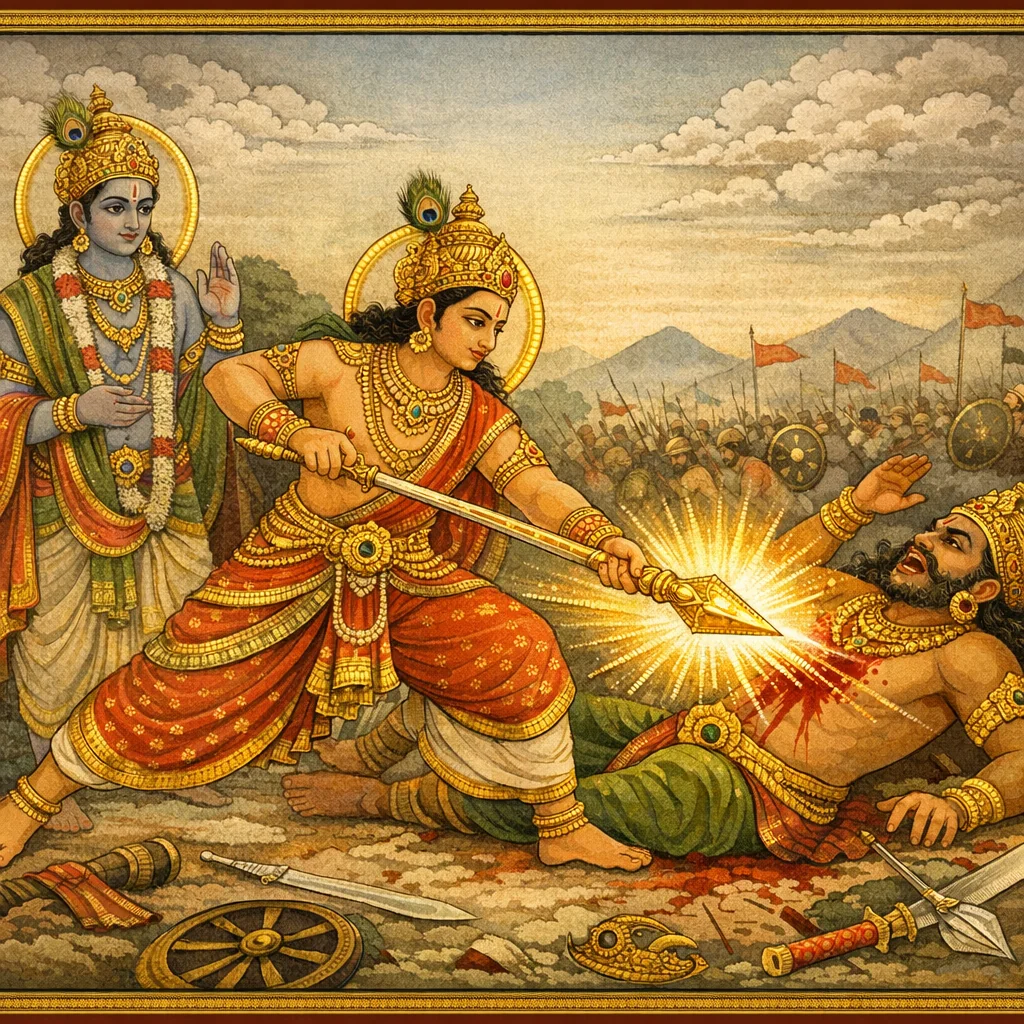
Adhyaya 32
Adhyāya 32 presents a dense martial and theological account. Spurred by Nārada’s report, the asura king Tāraka convenes his ministers, sounds the war-drum, mobilizes vast forces, and marches against the devas. A sweeping battle follows with shifting fortunes: the devas are temporarily routed, and Indra is struck down by Kālanemi, as alliances form and Indra, Śaṅkara (Śiva), Viṣṇu, and other deities engage various asura leaders. The narrative then turns to doctrine and ethics. Skanda hesitates to strike Tāraka because he is called a “Rudra-bhakta,” but Viṣṇu argues that one who harms beings and opposes dharma cannot be a true devotee. Tāraka escalates by attacking Rudra’s chariot; Śiva withdraws strategically, prompting a broader divine counterattack and a momentary cosmic destabilization. Viṣṇu’s wrath is restrained by counsel, and Skanda is reminded of his sacred purpose: to protect the virtuous and remove the harmful. At the climax, a personified Śakti emerges from Tāraka’s head, declaring she was gained through his tapas yet departs when his merit reaches its limit. Immediately Skanda releases the Śakti-weapon, which pierces Tāraka’s heart and restores cosmic order. The chapter closes with auspicious signs—gentle winds, calm directions, divine praise—and a directive to confront Bāṇa at Kraunca mountain, linking this victory to the continuing Kaumāra campaign.
Shlokas
Verse 1
नारद उवाच । श्रुत्वैतं संस्तवं दैत्यः संघुष्टं देवबंदिभिः । सस्मार ब्रह्मणो वाक्यं वधं बालादुपस्थितम्
Nārada said: Hearing this hymn loudly proclaimed by the bards of the gods, the Daitya remembered Brahmā’s words—that his death at the hands of the divine Child had now drawn near.
Verse 2
श्रुत्वा स क्लिन्नसर्वांगो द्वाःस्थं राजा वचोऽब्रवीत् । अमात्यान्द्रष्टुमिच्छामि शीघ्रमानय मा चिरम्
Hearing this, the king—his whole body drenched with agitation—spoke to the doorkeeper: “I wish to see my ministers. Bring them quickly; do not delay.”
Verse 3
ततस्ते राजवचनात्कालनेमि मुखागताः । प्राह तांस्तारको दैत्यः किमिदं वो विचेष्टितम्
Then, at the king’s command, they came before Kālanemi. Daitya Tāraka said to them: “What is this conduct of yours?”
Verse 4
यैः शत्रुसंभवा वार्ता कापि न श्रीवितस्त्वहम् । मदिराकाममत्तानां मंत्रित्वं वो न युज्यते । हितं मन्त्रयते राज्ञस्तेन मंत्री निगद्यते
“Because of you, I have not been informed at all of any news arising from the enemy. Counselorship does not befit those intoxicated with liquor and lust. He alone is called a minister who advises the king for his welfare.”
Verse 5
अमात्या ऊचुः । को जानाति सुरान्दीनान्दैत्यानामिति नो मतिः
The ministers said: “Who can know that the gods are weak and the daityas strong? Such is our understanding.”
Verse 6
मा विषीद महाराज वयं जेष्यामहे सुरान् । बालादपि भयं किं वा लज्जायै चिंतितं त्विदम्
“Do not despair, great king; we shall conquer the gods. Why fear even a mere child? Is this worry only for the sake of honor?”
Verse 7
सर्वमेतत्सुसाध्यं च भेरी संताड्यतां दृढम् । ततो दैत्येन्द्रवचनात्संनाहजननी तदा
“All this is easily accomplished—let the war-drum be struck hard!” Then, at the lord of the daityas’ command, the muster for armament began at once.
Verse 8
भृशं संताडिता भेरी कंपयामास सा जगत् । स्मरणाद्दैत्यराजस्य पर्वतेभ्यो महासुराः
Struck with fierce force, that war-drum made the whole world tremble. At the mere remembrance—the summons—of the Daitya-king, mighty Asuras came forth from the mountains.
Verse 9
निम्नगाभ्यः समुद्रेभ्यः पातालेभ्योंऽबरादपि । सहसा समनुप्राप्ता युगांतानलसप्रभाः
From rivers, from oceans, from the nether realms of Pātāla, and even from the sky, they arrived all at once—radiant like the fire at the end of an age.
Verse 10
कोटिकोटिसहस्रैस्तु परार्धैर्दशभिः शतैः । सेनापतिः कालनेमिः शीघ्रं देवानुपाययौ
With hosts numbering in crores upon crores, in thousands and in countless multitudes, the commander Kālanemi swiftly advanced toward the gods.
Verse 11
चतुर्योजनविस्तीर्णे नानाश्चर्यसमन्विते । रथे स्थितो मनाग्दीनस्तारकः समदृश्यत
Mounted upon a chariot four yojanas wide, adorned with many marvels, Tāraka was seen—yet a slight dejection rested upon him.
Verse 12
एतस्मिन्नंतरे पार्थ क्रुद्धैः स्कन्दस्य पार्षदैः । प्राकारः पातितः सर्वो भग्नान्युपवनानि च
Meanwhile, O Pārtha, Skanda’s enraged attendants tore down the entire rampart, and the pleasure-groves too were smashed apart.
Verse 13
ततश्चचाल वसुधा देवी सवनकानना । जज्वाल खं सनक्षत्रं प्रमूढं भुवनं भृशम्
Then the Goddess Earth shook with her forests and groves; the sky, even with its stars, seemed to blaze, and the worlds were cast into grievous bewilderment.
Verse 14
तमोभूतं जगच्चसीद्गृध्रैर्व्याप्तं नभोऽभवत् । ततो नानाप्रहरणं प्रलयांबुदसन्निभम्
The world turned to darkness, and the sky was filled with vultures. Then arose a tumult of many weapons, like the clouds of pralaya at the end of time.
Verse 15
कालनेमिमुखं पार्थ अदृश्यत महद्बलम् । तद्धि घोरमसंख्येयं जगर्ज विविधा गिरः
O Pārtha, a mighty host led by Kālanemi came into view—terrifying and countless—and it roared with many kinds of cries.
Verse 16
अभ्यद्रवद्रणे देवान्भगवंतं च शंकरम् । विनदद्भिस्ततो दैत्यैन्देवानीकं महायुधैः
Then, in the battle, the roaring Dāityas, bearing great weapons, charged the gods and even the Blessed Śaṅkara, assailing the host of the Devas.
Verse 17
पर्वतैश्च शतघ्नीभिरायसैः परिधैरपि । क्षणेन द्रावितं सर्वं विमुखं चाप्यदृश्यत
With mountains, with śataghnīs, and with iron clubs as well, everything was routed in an instant, and was seen turning away in retreat.
Verse 18
असुरैर्वध्यमाने तु पावकैरिव काननम् । अपतद्दावभूमिष्ठ महाद्रुमवनं यथा
As they were being slain by the Asuras, they fell—like a forest consumed by fire—like a great woodland of mighty trees collapsing to the ground in a wildfire.
Verse 19
ते भिन्नास्थिशि रोदेहाः प्राद्रवंत दिवौकसः । न नाथमध्यगच्छंत वध्यमाना महासुरैः
With bones, heads, and bodies shattered, the dwellers of heaven fled. Slain by the great Asuras, they could not find a protector.
Verse 20
अथ तद्विद्रुतं सैन्यं दृष्ट्वाः पुरंदरः । आश्वासयन्नुवाचेदं बलवद्दानवार्दितम्
Seeing that army in flight, Purandara (Indra) encouraged them and spoke these words to the force hard-pressed by the mighty Dānavas.
Verse 22
एष कालानलप्रख्यो मयूरं समुपस्थितः । रक्षिता वो महासेनः कथं भीतिस्तथापि वः
Here stands Mahāsena, radiant like the fire of Time, mounted upon the peacock. He is your protector—how, even so, can fear remain among you?
Verse 23
शक्रस्य वचनं श्रुत्वा समाश्वस्ता दिवोकसः । दानवान्प्रत्ययुध्यंत शक्रं कृत्वा व्यपाश्रयम्
Hearing Śakra’s words, the gods of heaven were reassured. Taking refuge in Śakra as their support, they turned back and fought the Dānavas.
Verse 24
कालनेमिर्महेन्द्रेण संयुगे समयुज्यत । सहस्राक्षौहिणीयुक्तो जंभकः शंकरेण च
In the battle, Kālanemi engaged Mahendra (Indra) in combat; and Jambhaka, attended by a thousand armies, confronted Śaṅkara (Śiva) as well.
Verse 25
कुजंभो विष्णुना चैव तावत्य क्षौहिणीवृतः । अन्ये च त्रिदशाः सव मरुतश्च महाबलाः
Kujambha, likewise surrounded by such armies, faced Viṣṇu. And all the other gods too—together with the mighty Maruts—joined the fray.
Verse 26
प्रत्ययुध्यंतं दैत्येंद्रेः साध्याश्च वसुभिः सह । ततो बहुविधं युद्धं कालनेमिर्विधायच
The Sādhyas, together with the Vasus, fought back against the lord of the Daityas. Then Kālanemi too set in motion a battle of many kinds and stratagems.
Verse 27
उत्सृज्य सहसा पार्थ ऐरावणशिरःस्थितः । स तु पादप्रहारेण मुष्टिना चैव तं गजम्
Then, suddenly leaping forth, the warrior—mounted upon Airāvata’s head—struck that elephant with a kick and with his fist.
Verse 28
शक्रं च चघ्ने विनदन्पेततुस्तावुभौ भुवि । ततः शक्रं समादाय कालनेमिर्विचेतसम्
Roaring aloud, he struck Śakra as well, and the two of them fell upon the earth. Then Kālanemi seized Śakra, who had become senseless.
Verse 29
रथमाश्रित्य भूयोपि तारकाभिमुखो ययौ । अथ क्रुद्धं तदा देवैः सहसा चांतकादिभिः
Mounting his chariot once more, he advanced again toward Tāraka. Then the gods, together with Antaka and the others, suddenly flared in wrath and moved to respond.
Verse 30
ह्रियते ह्रियते राजा त्राता कोऽपि न विद्यते । एतस्मिन्नंतरे शर्वं पिनाकधनुषश्च्युतैः
“The king is being carried off—carried off! There is no rescuer at all!” In that very moment, Śarva (Śiva), with arrows released from the bow Pināka, …
Verse 31
भयं त्यजत भद्रं वः शुराः शस्त्राणि गृह्णत । कुरुध्वं विक्रमे बुद्धि मा च काचिद्व्यथास्तु वः
“Cast away fear—may good be upon you! O heroes, take up your weapons. Fix your minds on valor, and let no distress remain in you.”
Verse 32
किमेतेन महेन्द्रेण मया युध्यस्व दानव । वीरंमन्य सुदुर्बुद्धे ततो ज्ञास्यसि वीरताम्
“What need is there of Mahendra (Indra)? Fight with me, O Dānava! You who think yourself a hero—foolish one—then you shall learn what true heroism is.”
Verse 33
कानेमिरुवाच । नग्नेन सह को युध्येद्धतेनापि च येन वा । शंसत्सु दैत्यवीराणामुपहासः प्रजायते
Kānemiru said: “Who would fight with a naked man—or with one whom he has already struck down? If we do so while the Daitya heroes look on and boast, ridicule will surely arise against us.”}]}
Verse 34
आत्मनस्तु समं किंचिद्विलोक्य सुदुर्मते । तदाकर्ण्य च सावज्ञं वचः शर्वो विसिष्मिये
But Śarva (Śiva), seeing something comparable to Himself—O utterly misguided one—on hearing those contemptuous words, was filled with astonishment.
Verse 35
ततः कुमारः सहसा मयूरस्थोऽभ्यधावत । कुजंभं सानुगं हत्वा वासुदेवोप्यधावत
Then Kumāra (Skanda), mounted upon his peacock, rushed forth at once. After slaying Kujambha together with his followers, Vāsudeva (Viṣṇu) also charged forward.
Verse 36
ततो हरिः स्कंदमाह किमेतेन तव प्रभो । दैत्याधमेन पापेन मुहूर्तं पश्य मे बलम्
Then Hari (Viṣṇu) said to Skanda: “Lord, what need have you of this sinful, lowest of demons? For a moment, behold my strength.”
Verse 37
एवमुक्त्वा निवार्यैनं केशवो गरुडस्थितः । शार्ङ्गकोदंडनिर्मुक्तैर्बाणैर्दैत्यमवाकिरत्
Having spoken thus, Keśava, seated upon Garuḍa, restrained him (Skanda) and showered the demon with arrows released from the Śārṅga bow.
Verse 38
स तैर्बाणैस्ताड्यमानो वज्रैरिव महासुरः । विमुच्य वासवं क्रुद्धो बाणांस्तान्व्यधमच्छरैः
Struck by those arrows as though by thunderbolts, the great Asura—furious—let loose a weapon like Indra’s (Vāsava) and smashed those arrows with his own shafts.
Verse 39
यान्यान्बाणान्हरिर्दिव्यानस्त्राणि च मुमोच ह । निवारयति दैत्यस्तान्प्रहसंल्लीलयैव च
Whatever divine arrows and heavenly weapons Hari released, the demon checked them all—laughing, as though it were mere play.
Verse 40
ततः कौमोदकीं गृह्य क्षिप्रकारी जनार्दनः । मुमोच सैन्यनाथाय सारथिं च व्यचूर्णयत्
Then swift-acting Janārdana seized the Kaumodakī mace and hurled it at the commander of the host, crushing the charioteer as well.
Verse 41
ततो रथादवप्लुत्य विवृत्य वदनं महत् । गरुडं चंचुनादाय स विष्णुं क्षिप्तवान्मुखे
Then, leaping down from the chariot and opening his huge mouth wide, he seized Garuḍa by the beak and flung him into Viṣṇu’s mouth/face.
Verse 42
ततोऽभूत्सर्वदेवानां विमोहो जगतामपि । चचाल वसुधा चेलुः पर्वताः सप्त चार्णवाः
Then bewilderment seized all the gods—and the worlds as well. The earth trembled; the mountains shook; and the seven oceans were thrown into turmoil.
Verse 43
कालनेमिर्नश्चैव प्रानृत्यत महारणे । असंमूढस्ततो विष्णुस्त्वराकाल उपस्थिते
In that great battle, Kālanemi too was destroyed, writhing and staggering as he fell. Then Viṣṇu, unbewildered and fully composed, acted at once as the decisive moment arrived.
Verse 44
कुक्षिं विदार्य चक्रेण भास्करोऽभादिवोदितः । बहिर्भूतो हरिश्चैनं महोयित्वा स्वनिन्दया
Splitting open the belly with his discus, Hari blazed forth like the newly risen Sun. Emerging outward, he overwhelmed him through his own disgrace.
Verse 45
पातालस्य तलं निन्ये तत्र शिश्ये स काष्ठवत् । ततश्चक्रेण दैत्यानां निहता दशकोट्यः
He was hurled to the floor of Pātāla, lying there motionless like a log. Then, by the discus, ten crores of Dānavas were slain.
Verse 46
प्रमोदितास्तथा देवा विमोहास्तत्क्षणाद्बभुः । ततःशर्वस्तमालिंग्य साधुसाधु जनार्दन
The gods rejoiced, yet were instantly struck with astonishment. Then Śarva embraced him and cried, "Well done, well done, O Janārdana!"
Verse 47
त्वया यद्विहितं कर्म तत्कर्तान्यो न विद्यते । महिषाद्याः सुदुर्जेया देव्या ये विनिपतिताः
No one else exists who could perform the deed you have done. Even the mighty foes like Mahiṣa, felled by the Goddess, are hard to conquer.
Verse 48
तेषामतिबलो ह्येष त्वया विष्णो विनिर्जितः । तारकामयसंग्रामे वध्यस्तेसौ जनार्दन
This one, exceedingly strong among them, has been conquered by you, O Viṣṇu. In the war against Tārakāmaya, he is destined to be slain by you, O Janārdana.
Verse 49
कंसरूपः पुनस्तेऽयं हंतव्योऽष्टमजन्मनि । एवं प्रशंसमानास्ते वासुदेवं जगद्गुरुम्
Again, taking the form of Kaṃsa, this one is to be slain by you in an eighth birth. Thus they praised Vāsudeva, the Guru of the world.
Verse 50
शस्त्रजालैर्लब्धसंज्ञान्दैत्यसैन्याननाशयत् । तानि दैत्यशरीराणि जर्जराणि महायुधैः
Regaining awareness amid a rain of weapons, he destroyed the armies of the demons. Those demon-bodies were shattered and broken by great weapons.
Verse 51
अपतन्भूतले पार्थ च्छिन्नाभ्राणीव सर्वशः । ततस्तद्दानवं सैन्यं हतनाथमभूत्तदा
They fell upon the earth, O Pārtha, everywhere—like clouds torn apart. Then that Dānava host became leaderless, its commander slain.
Verse 52
देवैः स्कंदानुगैश्चैव कृतं शस्त्रैः पराङ्मुखम् । अथो क्रुष्टं तदा हृष्टैः सर्वैर्देवैर्मुदायुतैः
By the gods and by Skanda’s followers, they were turned back, driven to retreat by weapons. Then all the gods, thrilled and filled with joy, raised a triumphant cry.
Verse 53
संहतानि च सर्वाणि तदा तूर्याण्यवादयन् । अथ भग्नं बलं प्रेक्ष्य हतवीरं महारणे
Then, with all their forces gathered together, they sounded the war-instruments. But when they saw the army shattered and its heroes slain in that great battle, the situation turned grave.
Verse 54
देवानां च महामोदं तारकः प्राह सारथिम् । सारथे पश्य सैन्यानि द्राव्यमाणानि मे सुरैः
Seeing the gods’ great rejoicing, Tāraka said to his charioteer: “Charioteer, look—my forces are being driven back by the gods!”
Verse 55
येस्माभिस्तृणवद्दृष्टाः पश्य कालस्य चित्रताम् । तन्मे वाहय शीघ्रं त्वं रथमेनं सुरान्प्रति
“Those whom we once regarded as mere straw—see the strange reversal wrought by Time! Therefore, drive this chariot swiftly for me, straight toward the gods.”
Verse 56
पश्यंतु मे बलं बाह्वोर्द्रवंतु च सुराधमाः । ब्रुवन्नेवं सारथिं स विधुन्वन्सुमहद्धनुः
“Let them witness the strength of my arms—and let those wretched gods flee!” Saying so to his charioteer, he brandished his exceedingly great bow.
Verse 57
क्रोध रक्तेक्षणो राजा देवसैन्यं समाविशत् । आगच्छमानं तं दृष्ट्वा हरिः स्कंदमथाब्रवीत्
The king, his eyes reddened with wrath, charged into the army of the gods. Seeing him advancing, Hari (Viṣṇu) then spoke to Skanda.
Verse 58
कुमार पश्य दैत्येंद्रं कालं यद्वद्युगात्यये । अयं स येन तपसा घोरेणाराधितः शिवः
Hari said: “O Kumāra, behold this lord of the Daityas—like Time itself at the end of an age. This is the very one who, by dreadful austerities, propitiated Śiva.”
Verse 59
अयं स येन शक्राद्याः कृता मर्काः समार्बुदम् । अयं स सर्वशस्त्रैगैर्योऽस्माभिर्न जितो रणे
This is the one by whom Indra and the other gods were made wretched for countless years. This is the very one who, though assailed by us with every kind of weapon, was not defeated in battle.
Verse 60
नावज्ञया प्रद्रष्टव्यस्तारकोऽयं महासुरः । सप्तमं हि दिनं तेऽद्य मध्याह्नोऽयं च वर्तते
This great Asura Tāraka must not be regarded with contempt. Today is your seventh day—and it is now midday as well.
Verse 61
अर्वागस्तमनादेनं जहि वध्योऽन्यथा नहि । एवमुक्त्वा स शक्रादींस्त्वरितः केशवोऽब्रवीत्
Slay him before sunset—he is killable; otherwise, not. Having said this, Keśava urgently spoke to Indra and the other gods.
Verse 62
आयासयत दैत्येंद्रं सुखवध्यो यथा भवेत् । ततस्ते विष्णुवचनाद्विनदन्तो दिवौकसः
Wear down the lord of the Daityas, so that he may be slain with ease. Then, at Viṣṇu’s command, the dwellers of heaven roared aloud.
Verse 63
तमासाद्य शरव्रातैर्मुदिताः समवाकिरन् । प्रहसन्निव देवांस्तान्द्रावयामास तारकः
Reaching him, the gods—delighted—showered him with volleys of arrows. Yet Tāraka, as though laughing, routed those very gods and drove them away.
Verse 64
यथा नास्तिकदुर्वृत्तो नानाशास्त्रोपदेशकान् । सोढुं शक्ता न ते वीरं महति स्यंदने स्थितम्
Just as a corrupt atheist cannot endure teachers who instruct from many scriptures, so they too could not withstand that hero, standing upon his mighty chariot.
Verse 65
महापस्मारसंक्रांतं यथैवाप्रियवादिनम् । विधूय सकलान्देवान्क्षणमात्रेण तारकः
As one afflicted by a great seizure shakes off an unwelcome speaker, so Tāraka, in a mere moment, shook off and scattered all the gods.
Verse 66
आजगाम कुमाराय विधुवन्स महाधनुः । आगच्छमानं तं दृष्ट्वा स्कंदः प्रत्युद्ययौ ततः
Then that wielder of the great bow came toward Kumāra, scattering the hosts. Seeing him approach, Skanda at once advanced to meet him.
Verse 67
तस्यारक्षद्भवः पार्श्वं दक्षिणं चैव तं हरिः । पृष्ठे च पार्षदास्तस्य कोटिशोऽर्बदशस्तथा
Bhava guarded his flank, and Hari guarded his right side; and behind him stood his attendants—by crores and tens of crores.
Verse 68
ततस्तौ सुमहायुद्धे संसक्तौ देवदैत्ययौः । धर्माधर्माविवोदग्रौ जगदाश्चर्यकारकौ
Then, in that tremendous battle, the god and the demon engaged closely—like Dharma and Adharma locked in combat—creating wonder for the whole world.
Verse 69
ततः कुमारमासाद्य लीलया तारकोऽब्रवीत् । अहो बालातिबालस्त्वं यत्त्वं गीर्वाणवाक्यतः
Then Tāraka, approaching Kumāra (Skanda) in a playful manner, spoke: “Ah! You are but a mere child, since you have come at the urging of the gods’ words.”
Verse 70
आसादयसि मां युद्धे पतंग इव पावकम् । वधेन तव को लाभो मम मुक्तोऽसि बालक
“You challenge me in battle like a moth rushing into fire. What profit is there for you in killing me? Child, you will be released (from your burden).”
Verse 71
पिष क्षीरं गृहाणेमं कंदुकं क्रीड लीलया । एवमुक्तः प्रहस्याह तारकं योगिनां गुरुः
“Grind the milk; take this ball and play with it for sport.” Thus addressed, Skanda, the Guru of yogins, laughed and replied to Tāraka.
Verse 72
शिशुत्वं मावमंस्था मे शिशुः कष्टो भुजंगमः । दुष्प्रेक्ष्यो भास्करो बालो दुःस्पर्शोऽल्पोऽपि पावकः
“Do not despise my childhood. Even a young serpent is dangerous; the sun, though ‘young’ at dawn, is hard to gaze upon; and even a small fire is painful to touch.”
Verse 73
अल्पाक्षरो न मंत्रः किं सस्फुरो दैत्य दृश्यते । एवमुक्त्वा दैत्यमुक्तं गृहीत्वा कंदुकं च तम्
“Is this a mantra with so few syllables? Why does the demon appear to tremble?” Saying this, he seized the missile discharged by the demon, as though it were a mere ball.
Verse 74
तस्मिञ्छक्त्यस्त्रमादाय दैत्याय प्रमुमोच ह । तस्य तेन प्रहारेम रथश्चूर्णिकृतोऽभवत्
Then, taking up the Śakti-weapon, he hurled it at the demon; by that blow the demon’s chariot was shattered into dust.
Verse 75
चतुर्योजनमात्रो यो नानाश्चर्यसमन्वितः । गरुडस्य सुता ये च शीर्यमाणे रथोत्तमे
That excellent chariot—measuring four yojanas and filled with many marvels—and those sons of Garuḍa as well, when the supreme chariot was breaking apart…
Verse 76
मुक्ताः कथंचिदुत्पत्य सागरांतरमाविशन् । ततः क्रुद्धस्तारकश्च मुद्गरं क्षिप्तवान्गुहे
Escaping with difficulty, they leapt up and entered the midst of the ocean. Then Tāraka, enraged, hurled a mace at Guha (Skanda).
Verse 77
विंध्याद्रिमिव तं स्कंदो गृहीत्वा तं व्यताडयत् । स्थिरे तस्योरसि व्यूढे मुद्गरः शतधाऽगमत्
Skanda seized it like the Vindhya mountain and struck it down. When the mace landed upon his firm, broad chest, it broke into a hundred pieces.
Verse 78
मेने च दुर्जयं दैत्यस्तदा षड्वदनं रणे । चिंतयामास बुद्ध्या च प्राप्तं तद्ब्रह्मणो वचः
Then the demon deemed the six-faced one (Skanda) unconquerable in battle, and he pondered with his mind the words of Brahmā that had come to pass.
Verse 79
तं भीतमिव चालक्ष्य दैत्यवीराश्च कोटिशः । नदंतोऽतिमहासेनं नानाशस्त्रैरवाकिरन्
Seeing him as though afraid, millions of Daitya warriors, roaring, showered that vast army with weapons of many kinds.
Verse 80
क्रुद्धस्तेषु ततः स्कंदः शक्तिं घोरामथाददे । अभ्यस्यमाने शक्त्यस्त्रे स्कंदनामिततेजसा
Enraged at them, Skanda then took up a dreadful Śakti-spear. As the Śakti-weapon was being set in motion by Skanda of immeasurable splendor…
Verse 81
उल्काजालं महाघोरं पपात वसुधातले । चाल्यमाना तथा शक्तिः सुघोरा भवसूनुना
A most dreadful shower of meteors fell upon the earth. Thus was that exceedingly fearsome Śakti set into motion by Bhava’s son (Skanda).
Verse 82
ततः कोट्यो विनिष्पेतुः शक्तीनां भर्तर्षभ । स शक्त्यस्त्रेण बलवान्करस्थेनाहनत्प्रभुः
Then crores of spears burst forth, O bull among lords; and that mighty Lord struck with the Śakti-weapon held in his hand.
Verse 83
अष्टौ पद्मानि दैत्वानां दशकोटिशतानि च । तथा नियुतसाहस्रं वाहनं कोटिरेव च
The Daityas numbered eight padmas; and there were also a daśa-koṭi-śata, a thousand millions. Their mounts too were in countless multitudes—amounting to a koṭi and more.
Verse 84
ह्रंदोदरं च दैत्येंद्रं निखर्वैर्दशभिर्वृतम् । तत्राकुर्वन्सुतुमुलं नादं वध्येषु शत्रुषु
And Hraṃdodara, the lord of the Daityas, surrounded by ten nikharvas, raised there a most dreadful roar against the enemies destined to be slain.
Verse 85
कुमारानुचराः पार्थ पूरयंतो दिशो दश । शक्त्यस्त्रस्यार्चिः संभूतशक्तिभिः केऽपि सूदिताः
O Pārtha, the followers of Kumāra filled the ten directions; and some were struck down by the flaming energies of the Śakti-weapon—powers born from that very missile.
Verse 86
पताकयावधूताश्च हताः केचित्सहस्रशः । केचिद्धंटारवत्रस्ताश्छिन्नभिन्नहृदोऽपतन्
Some, scattered and swept away like banners, were slain by the thousands; others, terrified by the clangor of bells, fell down with hearts split and shattered.
Verse 87
केचिन्मयूरपक्षाभ्यां चरणाभ्यां च सूदिताः । कोटिशस्ताम्रचूडेन विदार्यैव च भक्षिताः
Some were crushed by the peacock’s wings and feet; and in crores, others were torn apart and devoured by Tāmra-cūḍa.
Verse 88
पार्षदैर्मातृभिः सार्धं पद्मशो निहताः परे । एवं निहन्यमानेषु दानवेषु गुहादिभिः
Others were slain in padma-like multitudes by the Pārṣadas together with the Mātṛs; thus, as the Dānavas were being cut down by Guha and his hosts...
Verse 89
अभाग्यैरिव लोकेषु तारकः स्कंदमाययौ । जग्राह च गदां दिव्यां लक्षघंटादुरासदाम्
Like ill-fortune descending upon the worlds, Tāraka advanced toward Skanda by māyā; and he seized a divine mace, formidable with the peal of a hundred thousand bells.
Verse 90
तया मयूरमाजघ्ने मयूरो विमुखोऽभवत् । दृष्ट्वा पराङ्मुखं लोकेषु वासुदेवोऽब्रवीत्त्वरन्
With that mace he struck the peacock, and the peacock turned away. Seeing it face turned aside before the worlds, Vāsudeva spoke quickly.
Verse 91
देवसेनापते शीघ्रं शक्तिं मुंच महासुरे । प्रतिज्ञामात्मनः पाहि लंबते रविमंडलम्
O commander of the gods’ host, swiftly hurl your Śakti at the great Asura. Protect your own vow—the disk of the sun is sinking low.
Verse 92
स्कंद उवाच । त्वयैव रुद्रभक्तोऽयं जनार्दन ममेरितम् । वधार्थं रुद्रभक्तस्य बाहुः शक्तिं मुंचति
Skanda said: O Janārdana, it is by you that this devotee of Rudra has been urged, as I commanded. For the slaying of this Rudra-devotee, my arm releases the Śakti.
Verse 93
नारुद्रः पूजयेद्रुद्रं भक्तरूपस्य यो हरः । रुद्ररूपममुं हत्वा कीदृशं जन्मनो भवेत्
How could one who is not Rudra worship Rudra, when Hara Himself has taken the form of a devotee? Having slain this one who bears the form of Rudra, what kind of rebirth could possibly await?
Verse 94
तिरस्कृता विप्रलब्धाः शप्ताः क्षिप्ताः प्रपीडिताः । रुद्रभक्ताः कुलं सर्वं निर्दहंति हताः किमु
When Rudra’s devotees are insulted, deceived, cursed, struck down, or oppressed, they can burn up an entire lineage—how much more so if they are slain?
Verse 95
एष चेद्धंति तद्भद्रं हन्यतामेष मां रणे । रुद्रभक्ते पुनर्विष्णो नाहं शस्त्रमुपाददे
If he indeed strikes—so be it; let him strike me in battle. But, O Viṣṇu, against a devotee of Rudra I will not take up a weapon again.
Verse 96
श्रीभगवानुवाच । नैतत्तवोचितं स्कंद रुद्रभक्तो यथा श्रृणु । द्वे तनू गिरिजाभर्तुर्वेदज्ञा मुनयो विदुः
The Blessed Lord said: This is not fitting for you, O Skanda. Hear what a ‘devotee of Rudra’ truly is. The seers who know the Veda declare that the Consort of Girijā has two forms.
Verse 97
एका जीवात्मिका तत्र प्रत्यक्षा च तथापरा । द्रोग्धा भूतेषु भक्तश्च रुद्रभक्तो न स स्मृतः
Of those two, one is the form present within living beings, and the other is the manifest form. But one who is treacherous toward creatures—even if he claims devotion—is not remembered as a devotee of Rudra.
Verse 98
भक्तो रुद्रो कृपावांश्च जंतुष्वेव हरव्रतः । तदेनं भूतमर्त्येषु द्रोग्धारं त्वं पिनाकिनः
A devotee of Rudra is compassionate and steadfast in Hara’s vow, especially toward living beings. Therefore, you—O bearer of the Pināka—may strike this treacherous one among beings and mortals.
Verse 99
जहि नैवात्र पश्यामि दोषं कंचन ते प्रभो । श्रुत्वेति वाचं गोविंदात्सत्यार्थामपि भारत
‘Slay him; I see no fault in you here, O Lord.’ Hearing these words from Govinda—true in meaning—O Bhārata...
Verse 100
हंतुं न कुरुते बुद्धिं रुद्रभक्त इति स्मरन् । तारकस्तु ततः क्रुद्धो ययौ वेगेन केशवम्
Remembering, ‘He is a devotee of Rudra,’ he did not form the resolve to kill. But then Tāraka, enraged, rushed swiftly at Keśava.
Verse 101
प्राह चैवं सुदुर्बुद्धे हन्मि त्वां पश्य मे बलम् । देवानां चापि धर्माणां मूलं मतिमतां तथा । हत्वा त्वामद्य सर्वांस्तांश्छेत्स्ये पश्याद्य मे बलम्
And he spoke thus: ‘O wicked-minded one, I shall kill you—behold my strength! You are the very root of the gods and of dharma, and likewise of the wise. Having slain you today, I will cut down them all—behold my power today!’
Verse 102
विष्णुरुवाच । दैत्येंद्र तव चास्माभिः किमहो श्रृणु सत्यताम्
Viṣṇu said: ‘O lord of the Dānavas, what is this between you and us? Listen now to the truth.’
Verse 103
रथे य एष शर्वोऽयं हतेऽस्मिन्सकलं हतम् । श्रुत्वेति तारकः क्रुद्धस्तूर्णं रुद्ररथं ययौ
Hearing, “This Śarva is upon the chariot—if this one is slain, everything is slain,” Tāraka became enraged and swiftly rushed toward Rudra’s chariot.
Verse 104
अभिसृत्य स जग्राह रुद्रस्य रथकूबरम् । यदा स कूबरं क्रुद्धस्तारकः सहसाऽग्रहीत्
Rushing forward, he seized Rudra’s chariot-pole (kūbara). When the enraged Tāraka suddenly grasped that pole—
Verse 105
रेसतू रोदसी तूर्णं मुमुहुश्च महर्षयः । व्यनदंश्च महाकाया दैत्या जलधरोपमाः
At once the two worlds—heaven and earth—shook and cried out; the great sages were bewildered. And the huge-bodied Daityas, like masses of storm-clouds, roared aloud.
Verse 106
आसीच्च निश्चितं तेषां जितमस्माभिरित्युत । तार कस्याप्यभिप्रायं भगवान्वीक्ष्य शंकरः
And it became their firm conviction, “We have surely won.” But Bhagavān Śaṅkara, discerning even Tāraka’s intention—
Verse 107
उमया सह संत्यक्त्वा रथं वृषभमावहत् । ओमित्यथ जपन्ब्रह्मा आकाशं सहसाश्रितः
Together with Umā, leaving the chariot behind, he mounted the Bull (Vṛṣabha). Then Brahmā—murmuring “Oṃ”—at once took refuge in the sky.
Verse 108
ततस्तं शतसिंहं च रथं रुद्रेण निर्मितम् । उत्क्षिप्य पृथ्व्यामास्फोट्य चूर्णयामास तारकः
Then Tāraka lifted up that chariot—made by Rudra and famed as ‘hundred-lioned’—and dashed it upon the earth, crushing it to powder.
Verse 109
शूलपाशुपतादीनि सहसोपस्थितानि च । वारयामास गिरिशो भवः साध्य इति ब्रुवन्
The trident, the Pāśupata weapon, and the rest appeared all at once; yet Girīśa—Bhava—held them back, saying, “He must be dealt with according to destiny.”
Verse 110
ततः स्ववंचितं ज्ञात्वा रुद्रेणात्मानमीर्ष्यया । विनदन्सहसाऽधावद्वृषभस्थं महेश्वरम्
Then, realizing that Rudra had outwitted him, Tāraka—filled with jealous rage—roared and suddenly charged at Maheśvara seated upon the Bull.
Verse 111
ततो जनार्दनोऽधावच्चक्रमुद्यम्य वेगतः । वज्रमिंद्रस्तथोद्यम्य दंडं चापि यमो नदन्
Then Janārdana rushed forward at speed, raising his discus. Indra too advanced, lifting the thunderbolt; and Yama, roaring, raised his staff.
Verse 112
गदां धनेश्वरः क्रुद्धः पाशं च वरुणो नदन् । वायुर्महांकुशं घोरं शक्तिं वह्निर्महाप्रभाम्
The enraged Lord of Wealth, Dhaneśvara, took up his mace; Varuṇa, roaring, seized his noose. Vāyu raised a dreadful great goad, and Agni bore a radiant spear of immense splendor.
Verse 113
निरृतिर्निशितं खड्गं रुद्राः शूलानि कोपिताः । धनूंषि साध्या देवाश्च परिघान्वसवस्तथा
Nirṛti took up a sharpened sword; the Rudras, enraged, seized their tridents. The Sādhyas and other gods grasped their bows, and the Vasus likewise lifted their iron clubs—each deity arming himself for the onrush of battle.
Verse 114
विश्वेदेवाश्च मुसलं चंद्रार्कौ स्वप्रभामपि । ओषधीश्चाश्विनौ देवौ नागाश्च ज्वलितं विषम्
The Viśvedevas seized their mallets; the Moon and the Sun offered even their own radiance. Healing herbs were gathered, the twin Aśvins joined in, and the Nāgas brought forth their blazing venom—each giving its innate power to the divine cause.
Verse 115
हिमाद्रि प्रमुखाश्चापि समुद्यम्य महीधरान् । भृशमुन्नदतो देवान्धावतो वीक्ष्य तारकः
Seeing the gods rush forward with thunderous roars—while Himādri and other mountains were lifted up as weapons—Tāraka beheld their charge and braced himself to meet it.
Verse 116
निवृत्तः सहसा पार्थ महागज इवोन्नदन् । स वज्रमुष्टि नाहत्य भुजे शक्रमपातयत्
Then Tāraka suddenly turned back, roaring like a mighty elephant. With a fist hard as a thunderbolt, he struck Indra’s arm and made Śakra fall.
Verse 117
दंडं यमादुपादाय मूर्ध्न्याहत्य न्यपातयत् । उरसाहत्य सगदं धनदं भुव्यपातयत्
Seizing Yama’s staff, he struck him on the head and felled him. Then, smashing the mace-bearing Dhanada (Kubera) upon the chest, he hurled him down to the ground.
Verse 118
वरुणात्पाशमादाय तेन बद्धा न्यपातयत् । महांकुशेन वायुं च चिरं मूर्ध्नि जघान सः
Taking Varuṇa’s noose, he bound him with it and cast him down. And with a great goad he struck Vāyu upon the head again and again for a long while.
Verse 119
फूल्कारैरुद्धतं वह्निं शमयामास तारकः । निरृतिंखड्गमादाय हत्वा तेन न्यपातयत्
With fierce blasts of his breath, Tāraka quenched the raging Fire. Then, taking up the sword, he struck down Nirṛti with it and cast her to the ground.
Verse 120
शूलैरेव तथा रुद्राः साध्याश्च धनुषार्दिताः । परिघैरेव वसवो मुशलैरेव विश्वकाः
The Rudras were struck down by those very tridents; the Sādhyas were afflicted by their own bows; the Vasus by their own clubs; and the Viśvedevas by their own mallets—each turned back by the weapons they had raised.
Verse 121
रेणुनाच्छाद्य चंद्रार्कौ वल्मीकस्थाविवेक्षितौ । महोग्राश्चौषधीस्तालैरश्विभ्यां सोऽभ्यवर्तयत्
Covering the Moon and Sun with dust, he made them appear as though sunk within an anthill. And those exceedingly potent healing herbs he beat back from the Aśvins with palm-staves, driving them away.
Verse 122
सविषाश्च कृता नागा निर्विषाः पादकुट्टनैः । पर्वताः पर्वतैरेव निरुच्छ्वासा भृशं कृताः
The Nāgas were rendered venomous—or stripped of venom—by trampling blows of the feet; and the mountains themselves were battered by mountains, left severely stunned and breathless, as it were, in the crush of combat.
Verse 123
एवं तद्देवसैन्यं च हाहाभूतमचेतनम् । कृत्वा मुहूर्तादाधावच्चक्रपाणिं तमुन्नदन्
Thus, having in a moment thrown that army of the gods into a senseless panic—crying ‘hā hā!’—he rushed at the discus-bearing Lord (Viṣṇu), roaring aloud.
Verse 124
ततश्चांतर्दधे सद्यः प्रहसन्निव केशवः । कुयोगिन इव स्वामी सदा बुद्धिमतां वरः
Then Keśava at once vanished from sight, as though smiling—like a true master who slips beyond the wrongly practicing yogin, ever the foremost among the wise.
Verse 125
अपश्यंस्तारको विष्णुं पुनर्वृषभवा हनम् । आधावत्कुपितो दैत्यो मुष्टिमुद्यम्य वेगतः
Not seeing Viṣṇu, Tāraka again charged at the Bull-bannered One (Śiva), the enraged demon rushing swiftly with his fist raised.
Verse 126
अचिरांशुरिवालक्ष्यो लक्ष्योथ भगवान्हरिः । आबभाषे ततो देवान्बाहुमुद्यम्यचोच्चकैः
Then the Blessed Lord Hari—momentarily unseen like a swift ray of light, and then visible again—addressed the gods, raising his arm and speaking aloud.
Verse 127
पलायध्वमहो देवाः शक्तिश्चेद्वः पलायितुम् । विमूढा हि वयं सर्वे ये बालवचसागताः
“Flee, O gods—if you even have the power to flee! Truly we are all deluded, we who came here heeding the words of a mere child.”
Verse 128
किं न श्रुतः पुरा गीतः श्लोकः स्वायंभुवेन यः । यथा बालेषु निक्षिप्ताः स्त्रीषु षंडितकेषु च । अपस्मारीषु चैवापि सर्वे ते संशयं गताः
“Have you not heard the verse formerly sung by Svāyambhuva (Manu)? ‘When matters are entrusted to children, to women, to eunuchs, and even to the epileptic, all of them fall into doubt and confusion.’”
Verse 129
प्रत्यक्षं तदिदं सर्वमाधुना चात्र दृस्यते
And now, here, all of that is seen directly before our eyes.
Verse 130
अज्ञासिष्म पुरैवैतद्रुद्रभक्तं न हंत्यसौ । यत्प्रतिज्ञां नाकरिष्यन्न स्यान्नः कदनं महत्
We already knew this: he does not slay a devotee of Rudra. Had he not made that vow, there would not have been this great devastation for us.
Verse 131
अथैष यदि दैत्येंद्रं न निहंति कुबुद्धिमान् । मा भयं वो महाभागा निहनिष्यामि वो रिपून्
Now, if this foolish one does not strike down the lord of demons, do not fear, O fortunate gods—I shall destroy your enemies.
Verse 132
अद्य मे विपुलं बाह्वोर्बलं पश्यत दैत्याधमं नाशयामि मुष्टिनैकेन पश्यत
Today behold the vast strength of my arms! Watch—I shall destroy that vilest of demons with a single fist; watch!
Verse 133
मया हि दक्षिणो बाहुर्दत्तश्च भवतां सदा । रिपून्वा निहनिष्यामि सत्यं तत्परिपालये
Indeed, I have ever given you my right arm as a pledge. I shall surely strike down the enemies—this is truth; I will uphold that vow.
Verse 134
येंऽबरे ये च पाताले भुवि ये च महासुराः । क्षणात्तान्नासयिष्यामि महावातो घनानिव
Whether those great Asuras are in the sky, in Pātāla, or upon the earth, in a moment I shall destroy them—like a mighty wind scattering clouds.
Verse 135
एवमुक्ता जगन्नाथो मुष्टिमुद्यम्य दक्षिणम् । निरायुधस्तार्क्ष्यपृष्ठादवप्लुत्याभ्यधावत
Thus spoken, the Lord of the universe raised his right fist; weaponless, he leapt down from Garuḍa’s back and rushed forward.
Verse 136
तस्मिन्धावति गोविंदे चचाल भुवनत्रयम् । विमूर्छितमभूद्विश्वं देवा भीतिं परां ययुः
As Govinda charged forward, the three worlds trembled; the universe seemed to swoon, and the gods fell into extreme fear.
Verse 137
धावतश्चापि कल्पांतं रुद्रकल्पस्य तस्य याः । मुखात्समुद्यजुर्ज्वालास्ताबिः खर्वशतं हतम्
As he rushed on with end-of-aeon fury—like that of Rudra at the close of a cycle—flames surged from his mouth; by those flames, hundreds of kharvas were destroyed.
Verse 138
ततोंऽतरिक्षे वाचश्च प्रोचुः सिद्धाः स्वयं तदा । जहि कोपं वासुदेव त्वयि क्रुद्धे क्व वै जगत्
Then, voices in the sky spoke—the Siddhas themselves said: “Abandon your wrath, Vāsudeva; if you are enraged, where indeed can the world remain?”
Verse 139
अनादृत्येव तद्वाक्यं ब्रुवन्नान्यत्करोम्यहम् । आह्वयंश्च महादैत्यं क्रुद्धो हरिरधावत
Disregarding those words, he declared, “I do nothing else.” And, calling out the great Daitya, the enraged Hari rushed onward.
Verse 140
उवाच वाचं साधूंश्च यत्नात्पालयतां फलम् । दुष्टान्विनिघ्नतां चैव तत्फलं मम जायताम्
He said: “Let the reward belong to those who carefully protect the good; and to those who strike down the wicked—let that very fruit come to me.”
Verse 141
अथापश्यन्महासेनो रुद्रं यांतं च तारकम् । तारकं चान्वधावन्तं पुरामपुरुषं हरिम्
Then Mahāsena saw Rudra advancing, and Tāraka as well; and he saw Hari—the primeval Person—pursuing Tāraka.
Verse 142
जगच्च क्षुब्धमत्यर्थं स्वां प्रतिज्ञां पुरा कृताम् । पश्चिमां प्रतिलंबंतं भास्करं चापि लोहितम्
And the world was exceedingly shaken; (he beheld) that earlier vow he had made, and the Sun too, reddened, hanging low in the western direction.
Verse 143
आकाशवाणीं श्रृण्वंश्च किं स्कन्द त्वं विषीदसी । पश्चात्तापो यदि भवेत्कृत्वा ब्रह्मवधं त्वयि
“Even after hearing the divine voice from the sky, why do you grieve, O Skanda? If remorse has arisen in you after committing the sin of brahmin-slaying, (then turn that repentance into atonement).”
Verse 144
स्थापयेर्लिगमीशस्य मोक्षो हत्याशतैरपि । आविवेश महाक्रोधं दिधक्षुरिव मेदिनीम्
Establish the Lord Īśa’s liṅga—then even with hundreds of acts of killing, liberation (mokṣa) may be attained. Yet a great wrath entered him, as though he wished to burn the very earth.
Verse 145
अथोत्प्लुत्य मयूरात्स प्रहसन्निव केशवम् । बाहुभ्यामप्युपादाय प्रोवाच भवनंदनः
Then, leaping down from his peacock, he smiled as if in play toward Keśava; lifting Keśava with both arms, the son of Bhava (Śiva) spoke.
Verse 146
जानामि त्वामहं विष्णो महाबुद्धिपराक्रमम् । भूतभव्यविष्यांश्च दैत्यान्हंस्यपि हूंकृतैः
I know you, O Viṣṇu—of vast intellect and mighty valor. Even the Daityas of past, future, and all times you can destroy, merely by your commanding roar.
Verse 147
त्वमेव हंता दैत्यानां देवानां परिपालकः । धर्मसंस्थापकश्च त्वमेव ते रचितोंऽजलिः
You alone are the slayer of the Daityas; you are the protector of the gods. You alone establish dharma—therefore this reverent salutation with joined palms (añjali) is offered to you.
Verse 148
क्षणार्धं पश्य मे वीर्यं भास्करो लोहितायते । एवं प्रणम्य स्कन्देन वासुदेवः प्रसादितः
“For half a moment, behold my power—the sun turns crimson!” Thus, having bowed in reverence, Skanda pleased Vāsudeva.
Verse 149
विरोषोऽभूत्तमालिंग्य वचनं केशवोऽब्रवीत् । सनाथस्त्वद्य धर्मोऽयं सुराश्चैव त्वया गुह
Then, embracing him, Keśava spoke with joy: “Today this Dharma has found its guardian through you, O Guha—and the gods as well are secured by you.”
Verse 150
स्मरात्मानं यदर्थं त्वमुत्पन्नोऽसि महेश्वरात् । साधूनां पालनार्थाय दुष्टसंहरणाय च । सुरविप्रकृते जन्म जीवितं च महात्मनाम्
Remember your own purpose—why you were born from Maheśvara: to protect the virtuous and to destroy the wicked. For the welfare of gods and brāhmaṇas, the birth and even the life of great souls are undertaken.
Verse 151
रुद्रस्य देव्या गंगायाः कृत्तिकानां च तेजसा । स्वाहावह्नेश्च जातस्त्वं तत्तेजः सफलीकुरु । साधूनां च कृते यस्य धनं वीर्यं च संपदः
Born through the splendor of Rudra, the divine Gaṅgā, the Kṛttikās, and of Svāhā and Agni—make that radiance fruitful. For the sake of the virtuous, let wealth, valor, and prosperity find their true purpose.
Verse 152
सफलं तस्य तत्सर्वं नान्यथा रुद्रनंदन
All that becomes truly fruitful for him—never otherwise, O Rudra’s son.
Verse 153
अद्य धर्मश्च देवाश्च गावः साध्याश्च ब्राह्मणाः । नंदंतु तव वीर्येण प्रदर्शय निजं बलम्
Today, let Dharma, the gods, the cows, the Sādhyas, and the brāhmaṇas rejoice through your heroism. Reveal your own power.
Verse 154
स्कन्द उवाच । या गतिः शिवत्यागेन त्वत्त्यागेन च केशव । तां गतिं प्राप्नुयां क्षिप्रं हन्मि चेन्न हि तारकम्
Skanda said: O Keśava, if I do not truly slay Tāraka, may I swiftly meet that very fate that comes from forsaking Śiva and from forsaking you.
Verse 155
या गतिः श्रुतित्यागेन साध्वी भार्यातिपीडनात् । साधूनां च परित्यागाद्वृथा जीवितसाधनात् । निष्ठुरस्य गतिर्या च तां गतिं यामि केशव
O Keśava, if I fail in my task, may I go to that same fate that comes from forsaking the Śruti, from grievously oppressing a virtuous wife, from abandoning holy persons, from pursuing life’s means in vain, and whatever fate belongs to the cruel.
Verse 156
इत्युक्ते सुमहान्नादः संप्रजज्ञे दिवौकसाम् । प्रशशंसुर्गुहं केचित्केचिन्नारायणं प्रभुम्
When this was spoken, a mighty roar arose among the dwellers of heaven. Some praised Guha, while others praised Lord Nārāyaṇa.
Verse 157
ततस्तार्क्षअयं समारुद्य हरिस्तस्मिन्महारणे । ताम्रचूडं महासेन स्तारकं चाप्यधावताम्
Then, in that great battle, Hari mounted Tārkṣya (Garuḍa). Mahāsena charged at Tāmracūḍa and also at Tāraka.
Verse 158
लोहितांबरसंवीतो लोहितस्रग्विभूषणः । लोहिताक्षो महाबाहुर्हिरण्यकवचः प्रभुः
Clad in red garments, adorned with a red garland, red-eyed, mighty-armed, and wearing a golden cuirass, the lordly warrior stood forth in splendor.
Verse 159
भुजेन तोलयञ्छक्तिं सर्वभूतानि कम्पयन् । प्राप्य तं तारकं प्राह महासेनो हसन्निव
Balancing his spear upon his arm and making all beings tremble, Mahāsena reached Tāraka and spoke, as if smiling.
Verse 160
तिष्ठतिष्ठ सुदुर्बुद्धे जीवितं ते मयि स्थितम् । सुहृष्टः क्रियतां लोको दुर्लभः सर्वसिद्धिदः
“Stand, stand, you of wicked understanding—your life rests in my hands. Make your mind glad; let this world be set aright, rare though it is, and the giver of all attainments.”
Verse 161
यत्ते सुनिष्ठुरत्वं च धर्मे देवेषु गोषु च । तस्य ते प्रहराम्यद्य स्मर शस्त्रं सुशिक्षितम्
“For that extreme cruelty of yours toward Dharma, toward the gods, and toward the cows—I shall strike you today. Recall your weaponry, well trained as it may be.”
Verse 162
एवमुक्ते गुहेनाथ निवृत्तस्यास्य भारत । तारकस्य शिरोदेशात्कापि नारी विनिर्ययौ
O Bhārata, when Guha had spoken thus and he (Tāraka) had drawn back, from the region of Tāraka’s head there emerged a certain woman.
Verse 163
तेजसा भासयंती तमध ऊर्ध्वं दिशो दश । दृष्ट्वा नारीं गुहः प्राह कासि कस्माच्च निर्गता
Illuminating the ten directions above and below with her radiance, that woman appeared. Seeing her, Guha (Kumāra) said: “Who are you, and from where have you come forth?”
Verse 164
नार्युवाच । अहं शक्तिर्गुहाख्याता भूतलेषु सदा स्थिता । अनेन दैत्यराजेन महता तपसार्ज्जिता
The woman said: “I am Śakti, known as ‘Guha’s Power’, ever abiding upon the earth. By this great austerity, I have been obtained by this king of Daityas.”
Verse 165
सुरेषु सर्वेषु वसामि चाहं विप्रेषु शास्त्रार्थरतेषु चाहम् । साध्वीषु नारीषु तथा वसामि विना गुणान्नास्मि वसामि कुत्रचित्
“I dwell in all the Devas; I dwell also in Brahmins devoted to the meanings of the śāstras. Likewise I dwell in virtuous women. But without virtues, I do not dwell anywhere at all.”
Verse 166
तदस्य पुण्यसंघस्य संप्राप्तोद्यावधिर्गुह । तदेनं त्यज्य यास्यामि जह्येनं विश्वहेतवे
“O Guha, the limit of the amassed merit that supported him has now been reached. Therefore, abandoning him, I shall depart. Slay him—for the welfare of the world.”
Verse 167
तस्यां ततो निर्गतायां दैत्यशीर्षं व्यकम्पयत् । कंपितं चास्य तद्देहं गतवीर्योऽभवत्क्षणात्
"When she departed from him, the Daitya’s head began to tremble; his body too shook, and in an instant his valor and strength were drained away."
Verse 168
एतस्मिन्नंतरे शक्तिं सोऽक्षिपद्गिरिजात्मजः । उल्काज्वाला विमुञ्चंतीमतिसूर्याग्निसप्रभाम्
"In that very moment, the son of Girijā (Kumāra) hurled his Śakti (spear), blazing like a meteor-flame, radiant as if surpassing the sun and fire."
Verse 169
कल्पांभोधिसमुन्नादां दिधक्षंतीं जगद्यथा । तारकस्यांतकालाय अभाग्यस्य दशामिव
Roaring like the ocean at the end of a kalpa, as if to burn the whole world—she arrived as the very doom ordained for Tāraka, like misfortune’s final state itself.
Verse 170
दारणीं पर्वतानां च सर्वसत्त्वबलाधिकाम् । उत्क्षिप्य तां विनद्योच्चैरमुञ्चत्कुपितो गुहः
That spear, able to split even mountains and surpassing the strength of all beings—Guha, enraged, lifted it and hurled it forth with a mighty roar.
Verse 171
धर्मश्चेद्बलवांल्लोके धर्मो जयति चेत्सदा । तेन सत्येन दैत्योयं प्रलयं यात्वितीरयन्
“If dharma is truly mighty in the world, if dharma indeed always triumphs—then by that truth, may this Daitya go to destruction,” thus he proclaimed.
Verse 172
सा कुमारभुजोत्सृष्टा दुर्निवार्या दुरासदा । विभेद हृदयं चास्य भित्त्वा च धरणिं गता
Released from Kumāra’s arm, that irresistible, unapproachable power split open his heart; and after piercing through, it entered the earth.
Verse 173
निःसृत्य जलकल्लोलपूर्विका स्कंदमाययौ । स च संताडितः शक्त्या विभिन्नहृदयोसुरः । नादयन्वसुधां सर्वां पपातायोमुखो मृतः
Surging forth like a heaving wave, Ayomukha rushed toward Skanda. But struck by the divine Spear (Śakti), the asura’s heart was split; roaring so that the whole earth resounded, Ayomukha fell down, iron-faced, and died.
Verse 174
एवं प्रताप्य त्रैलोक्यं निर्जित्य बहुशः सुरान् । महारणे कुमारेण निहतः पार्थ तारकः
Thus, after scorching the three worlds and repeatedly conquering the gods, Tāraka was slain by Kumāra in the great battle, O Pārtha.
Verse 175
एतस्मिन्निहते दैत्ये प्रहर्षं विश्वमाययौ
When that daitya was slain, the entire world was filled with joy.
Verse 176
ववुर्वातास्तथा पुण्याः सुप्रभोभूद्दिवाकरः । जज्वलुश्चाग्नयः शांताः शांता दिग्जनितस्वनाः
Auspicious winds began to blow, and the sun shone with splendid radiance. The fires burned steadily yet peacefully, and the directions grew calm, their tumult hushed.
Verse 177
ततः पुनः स्कंदमाह प्रहृष्टः केशवोऽरिहा । स्कंदस्कंद महाबाहो बाणोनाम बलात्मजः
Then Keśava, the slayer of foes, delighted, spoke again to Skanda: “Skanda, Skanda, O mighty-armed one—there is a demon named Bāṇa, the son of Bala.”
Verse 178
क्रौंचपर्वतमादाय देवसंघान्प्रबाधते । सोऽधुना ते भयाद्वीर पलायित्वा नगं गतः । जहि तं पापसंकल्पं क्रौंचस्थं शक्तिवेगतः
Taking refuge in Mount Krauñca, he torments the hosts of gods. Now, O hero, fleeing out of fear of you, he has gone to that mountain. Slay that evil-intentioned one who dwells in Krauñca—swiftly, with the force of your Spear.
Verse 179
ततः क्रौंचं महातेजा नानाव्यालविनादितम् । शक्त्या बिभेद बहुभिर्वृक्षैर्जीवैश्च संकुलम्
Then Skanda, radiant with mighty splendor, split Mount Krauñca with his Śakti, the divine Spear—(that mountain) echoing with the cries of many kinds of wild creatures, thronged with countless trees and living beings.
Verse 180
तत्र व्यालसहस्राणि दैत्यकोट्ययुतं तथा । ददाह बाणां च गिरं भित्त्वा शक्तिर्महारवा
There the Spear, roaring mightily, having pierced the mountain, burned up thousands of fierce beasts and tens of millions of daityas; it also consumed Bāṇa and his stronghold upon the mountain.
Verse 181
अद्यापि छिद्रं तत्पार्थ क्रौंचस्य परिवर्तते
Even today, O Pārtha, that cleft remains upon Mount Krauñca.
Verse 182
येन हंसाश्च क्रौंचाश्च मानसाय प्रयांति च । हत्वा बाणं महाशक्तिः पुनः स्कंदं समागता । प्रत्यायाति मनः साधोराहृतं प्रहितं तथा
Through that very passage, swans and krauñca-birds go to Mānasā (Lake Mānasarovar). Having slain Bāṇa, the great Śakti returned again to Skanda—just as the mind of a holy man, once sent forth and having obtained its aim, returns back.
Verse 183
ततो हरींद्रप्रमुखाः प्रतुष्टुवुर्ननृतुश्च रंभाप्रमुखा वरांगनाः । वाद्यानि सर्वाणि च वादयंतस्तं साधुसाध्वित्यमरा जगुर्भुशम्
Then Hari (Viṣṇu), Indra, and the other gods praised him; the celestial maidens led by Rambhā danced. As every kind of musical instrument was played, the immortals loudly sang, “Well done! Well done!”