Adhyaya 56
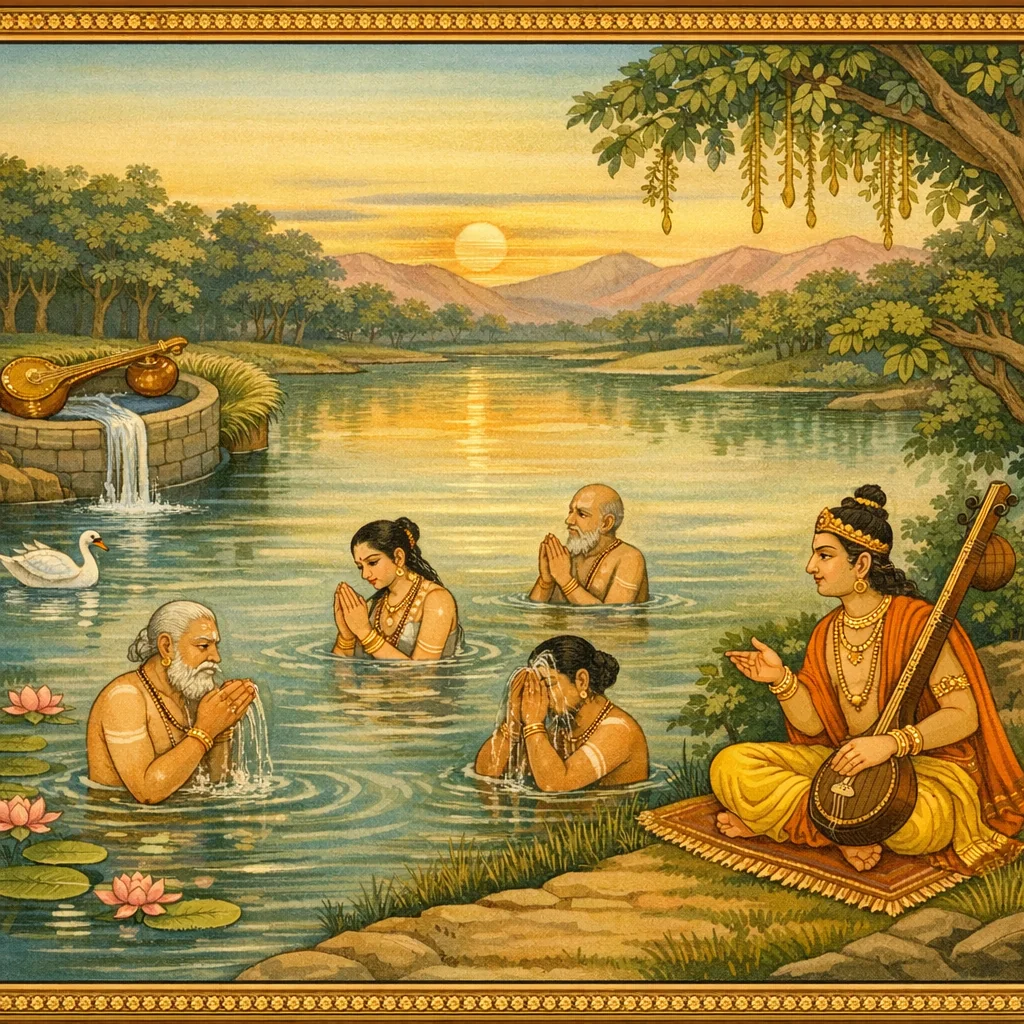
This adhyāya unfolds as a theological dialogue in which Nārada recounts successive foundations of sacred sites and their ritual import. Brahmā, stirred by the urge to create, performs intense tapas for a thousand years; Śaṅkara, pleased, grants a boon. Brahmā then recognizes the holiness of the place, excavates the auspicious Brahmasaras east of a city—said to remove even great sins—and installs a Mahāliṅga on its bank, where Śaṅkara is declared to be directly present. The chapter prescribes pilgrimage discipline: bathing, piṇḍadāna for ancestors, charity according to one’s means, and devotional worship, especially in the month of Kārttika, affirming merits comparable to renowned tīrthas such as Puṣkara, Kurukṣetra, and Gaṅgā-associated holy places. Next it introduces the Mokṣaliṅga, the superior liṅga named Mokṣeśvara, established after propitiation, beside a well dug with a darbha tip. Brahmā brings Sarasvatī through his kamaṇḍalu into this well for the liberation-oriented welfare of beings. On Kārttika śukla caturdaśī, bathing in the well and offering sesame piṇḍas to the departed yields the fruit of a “mokṣatīrtha,” and such rites are said to prevent recurring preta-status within the family line. Finally, the related tīrtha Jayādityakūpa is linked with venerating Garbheśvara, with the stated effect of avoiding repeated descent into womb-existence (repeated births). The adhyāya closes with a phala statement praising attentive hearing as purifying.
Shlokas
Verse 1
नारद उवाच । अतः परं प्रवक्ष्यामि ब्रह्मेशं लिंगमुत्तमम् । यस्य स्मरणमात्रेण वाजपेयफलं भवेत्
Nārada said: “Now I shall declare the supreme liṅga known as Brahmeśa. By the mere remembrance of it, one attains the fruit of the Vājapeya sacrifice.”
Verse 2
एकदा तु पुरा पार्थ सृष्टि कामेन ब्रह्मणा । तपः सुचरितं घोरं सार्धवर्षसहस्रकम्
Once in ancient times, O Pārtha, Brahmā—desiring to bring forth creation—performed a severe and well-observed austerity for a thousand years and more.
Verse 3
तपसा तेन सन्तुष्टः पार्वतीपतिशंकरः । वरमस्मै ततः प्रादाल्लोककर्त्रे स्ववांछितम्
Pleased by that austerity, Śaṅkara—the Lord of Pārvatī—then granted to him, the creator of the worlds, the boon he desired.
Verse 4
ततो हृष्टः प्रमुदितः कृतकृत्यः पितामहः । ज्ञात्वा क्षेत्रस्य माहात्म्यं स्वयं लिंगं चकार ह
Thereupon Pitāmaha (Brahmā), delighted and fulfilled, recognized the greatness of that sacred region and himself fashioned a liṅga.
Verse 5
चखान च सरः पुण्यं नाम्ना ब्रह्मसरः शुभम । महीनगरकात्पूर्वे महापातकनाशनम्
He also dug a sacred and auspicious lake named Brahmasaras, to the east of Mahīnagaraka—a destroyer of great sins.
Verse 6
अस्य तीरे महालिंगं स्थापयामास वै विभुः । तत्र देवः स्वयं साक्षाद्विद्यते किल शंकरः
On its bank the mighty one installed a great liṅga. There, indeed, Śaṅkara himself is present—manifest directly as the Deity.
Verse 7
पुष्करादधिकं तीर्थं ब्रह्मेशंनाम फाल्गुन । तत्र स्नात्वा नरो भक्त्या पिण्डदानं समाचरेत्
O Phālguna, the tīrtha called Brahmeśa is even superior to Puṣkara. Having bathed there with devotion, a man should duly perform piṇḍa-offerings for the ancestors.
Verse 8
दानं चैव यथाशक्त्या कार्तिक्यां च विशेषतः । देवं प्रपूजयेद्भक्त्या ब्रह्मेशं हृष्टमानसः
And one should give charity according to one’s capacity—especially in the month of Kārtika—and with a joyful heart worship the god Brahmeśa with devotion.
Verse 9
पितरस्तस्य तुष्यंति यावदाभूतसंप्लवम् । पुष्करेषु च यत्पुण्यं कुरुक्षेत्रे रविग्रहे
His ancestors are satisfied until the end of the cosmic dissolution. Whatever merit there is at Puṣkara, and at Kurukṣetra during a solar eclipse—
Verse 10
गंगादिपुण्यतीर्थेषु यत्फलं प्राप्यते नरैः । तत्फलं समवाप्नोति तीर्थस्यास्यावगाहनात्
Whatever reward people obtain at the holy tīrthas beginning with the Gaṅgā, that very reward one gains by bathing in this tīrtha.
Verse 11
मोक्षलिंगस्य माहात्म्यं शृणु पार्थ महाद्भुतम् । मया स्थानहितार्थं च समाराध्य महेश्वरम्
O Pārtha, listen to the wondrous greatness of the Mokṣa-liṅga. Seeking the welfare of this sacred place, I worshipped Maheśvara with devotion.
Verse 12
स्थापितं प्रवरं लिंगं नाम्ना मोक्षेश्वरं हरम् । दर्भाग्रेण ततः पार्थ कूपं खनितवानहम्
I installed an excellent liṅga of Hara, named Mokṣeśvara. Then, O Pārtha, with the tip of a darbha grass-blade, I dug a well.
Verse 13
प्रसाद्य लोककर्तारं ब्रह्माणं परमेष्ठिनम् । कमण्डलोर्ब्रह्मणश्च समानीता सरस्वती
Having pleased Brahmā—the creator of the worlds, the Supreme Lord (Parameṣṭhin)—Sarasvatī was brought forth from Brahmā’s water-pot (kamaṇḍalu).
Verse 14
कूपेऽस्मिन्मोक्षनाथस्य लोकानां प्रेतमुक्तये । कार्तिकस्य तु मासस्य शुक्लपक्षे चतुर्दशी
In this well of Mokṣanātha, for the deliverance of people from the state of ‘preta’ (restless departed), the fourteenth lunar day of the bright fortnight in the month of Kārtika is especially significant.
Verse 15
कूपे स्नात्वा नरस्तस्यां तिलपिण्डं समाचरेत् । प्रेतानुद्दिश्य नियतं मोक्षतीर्थफलं भवेत्
After bathing in that well, a man should duly offer sesame piṇḍas, dedicating them to the departed. Surely, the fruit of the Mokṣa-tīrtha arises from this.
Verse 16
कुले न जायते तस्य प्रेतः पार्थ न संशयः । प्रेता मोक्षं प्रगच्छन्ति तीर्थस्यास्य प्रभावतः
O Pārtha, without doubt no ‘preta’ arises in his lineage. By the power of this tīrtha, the departed attain liberation.
Verse 17
जयादित्यकूपवरे नरः स्नात्वा प्रयत्नतः । गर्भेश्वरं नमस्कृत्य न स गर्भेषु मज्जति
Having bathed with due effort in the excellent Jayāditya well, and having bowed in reverence to Garbheśvara, that person does not sink again into wombs (that is, into repeated rebirth).
Verse 18
इदं मया पार्थ तव प्रणीतं गुप्तस्य क्षेत्रस्य समासयोगात् । माहात्म्यमेतत्सकलं शृणोति यः स्याद्विशुद्धः किमु वच्मि भूयः
O Pārtha, I have conveyed this to you by gathering together the account of this hidden sacred region. Whoever listens to this entire māhātmya becomes purified—what more need I say?
Verse 56
इति श्रीस्कांदे महापुराण एकाशीतिसाहस्र्यां संहितायां प्रथमे माहेश्वरखंडे कौमारिकाखंडे ब्रह्मेश्वरमोक्षेश्वर गर्भश्वरमाहात्म्यवर्णनंनाम षट्पंचाशत्तमोऽध्यायः
Thus ends the fifty-sixth chapter, called “The Description of the Māhātmya of Brahmeśvara, Mokṣeśvara, and Garbheśvara,” in the Kaumārikākhaṇḍa of the first Māheśvarakhaṇḍa of the Śrī Skanda Mahāpurāṇa, in the eighty-one-thousand-verse Saṃhitā.