Adhyaya 65
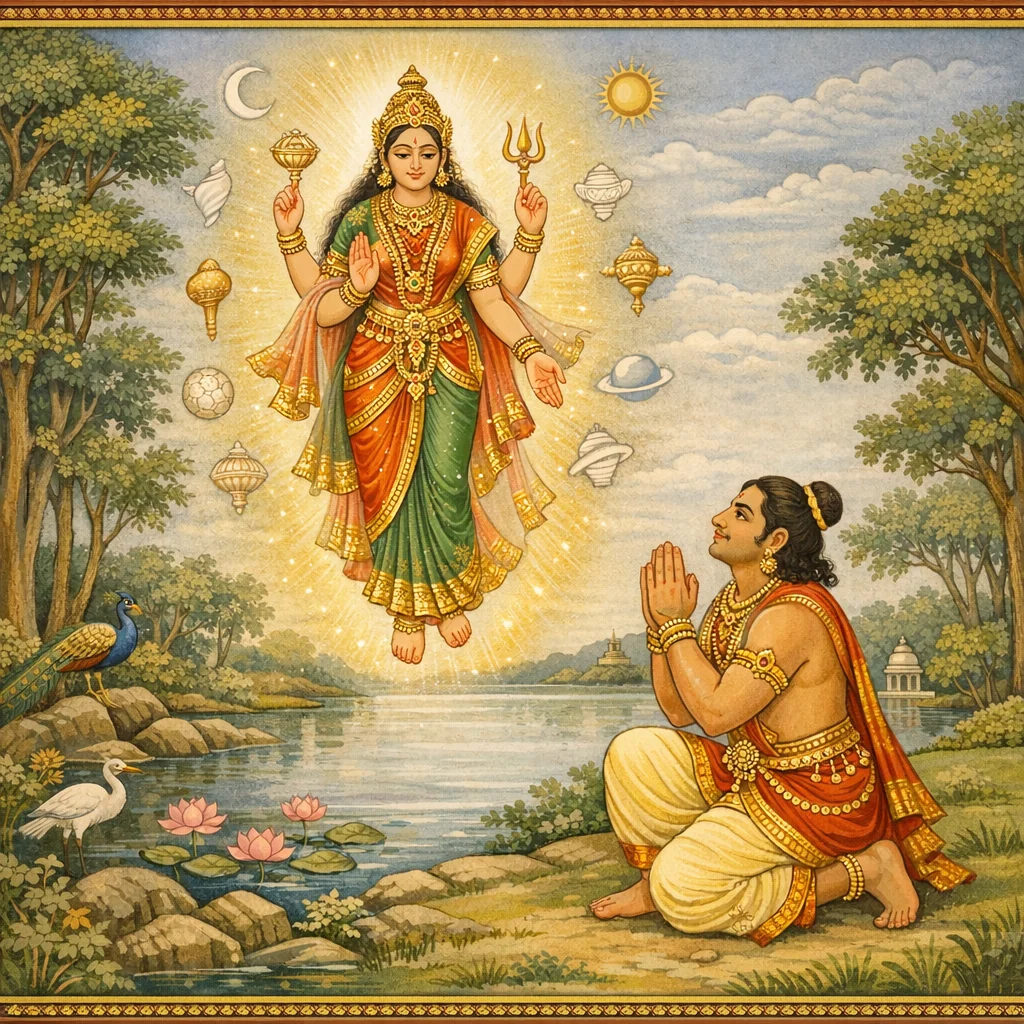
Sūta relates that Yudhiṣṭhira, after staying seven nights at the tīrtha, prepares to depart: he performs morning purification, worships the Devīs and the liṅgas, circumambulates the kṣetra, and recites a hymn for the moment of leaving. He then offers a Devī-centered śaraṇāgati, hailing her as Mahāśakti and as Ekānaṃśā, Kṛṣṇa’s beloved sister, affirming her all-pervading cosmic form and seeking her protection. Bhīma (Vāyuputra) answers with a polemical warning against misplaced refuge and “idle speech,” arguing that the learned should not take shelter in “prakṛti” (portrayed as deluding) but should praise Mahādeva, Vāsudeva, Arjuna, and even Bhīma himself; he condemns futile talk as spiritually harmful. Yudhiṣṭhira rebuts him, defending Devī as the Mother of beings, worshipped by Brahmā, Viṣṇu, and Śiva, and admonishing Bhīma not to show contempt. At once Bhīma loses his sight, taken as Devī’s displeasure; he fully surrenders and recites an extended stotra listing her identities (Brāhmī, Vaiṣṇavī, Śāmbhavī; the śaktis of the directions; planetary links; her pervasion of cosmos and underworld), pleading for the restoration of his eyes and vision. Devī appears in radiant epiphany, consoles Bhīma, instructs him to cease disparaging worshippers, and reveals her saving role as Viṣṇu’s helper in restoring dharma. She then proclaims a prophetic charter of Kali-yuga tīrthas and Devī-shrines: future places (Lohāṇā and Lohāṇā-pura; Dharmāraṇya near Mahīsāgara; Aṭṭālaja; Gaya-trāḍa), future devotees (Kelo, Vailāka, Vatsa-rāja), calendrical observances (such as Śukla Saptamī and Śukla Navamī), and promised fruits (wish-fulfillment, progeny, heaven, liberation, removal of obstacles, and healing—including sight). The chapter ends with the Pāṇḍavas’ astonishment and their continued pilgrimage, including installing Barbarīka and proceeding to other tīrthas.
Shlokas
Verse 1
सूत उवाच । उषित्वा सप्तरात्राणि तीर्थेस्मिन्भ्रातृभिः सह । युधिष्ठिरो महातेजा गमनायोपचक्रमे
Sūta said: After staying for seven nights at this sacred tīrtha together with his brothers, the radiant Yudhiṣṭhira began preparations to depart.
Verse 2
प्रभाते विमले स्नात्वा देवीर्लिंगान्यथार्च्य च । कृत्वा प्रदक्षिणं क्षेत्रं देवीस्तोत्रं जजाप सः । प्रयाणकालेषु सदा जप्यं कृष्णेन कीर्तितम्
In the pure morning, having bathed and duly worshipped the goddesses and the liṅgas, and having circumambulated the sacred precinct, he recited a hymn to the Goddess—one that Kṛṣṇa declared should always be repeated at times of departure.
Verse 3
युधिष्ठिर उवाच । देवि पूज्ये महाशक्ते कृष्णस्य भगिनि प्रिये । नत्वा त्वां शरणं यामि मनोवाक्कायकर्मभिः
Yudhiṣṭhira said: O Goddess worthy of worship, O Great Power, beloved sister of Kṛṣṇa—having bowed to you, I take refuge in you with mind, speech, body, and deeds.
Verse 4
संकर्षणाभयदाने कृष्णच्छविसमप्रभे । एकानंशे महादेवि पुत्रवत्त्राहि मां शिव
O giver of fearlessness to Saṃkarṣaṇa, O radiant one whose splendor matches Kṛṣṇa’s hue, O Ekānaṃśā, Great Goddess—O auspicious Śivā, protect me like a son.
Verse 5
त्वया ततमिदं विश्वं जगदव्यक्तरूपया । इति मत्वा त्वां गतोऽस्मि शरणं त्राहि मां शुभे
This entire universe is pervaded by you, for you are the unmanifest form of the world. Knowing this, I have come to you for refuge—protect me, O auspicious one.
Verse 6
कार्यारम्भेषु सर्वेषु सानुगेन मया तव । स्व आत्मा कल्पितो भद्रे ज्ञात्वैतदनुकंप्यताम
At the commencement of every undertaking, I—together with my followers—have invoked you as my very own self. Knowing this, O gracious one, please show compassion.
Verse 7
सूत उवाच । इति ब्रुवाणं राजानं शिरोबद्धाजलिं तदा । वायुपुत्रः प्रहस्यैव सासूयमिदमब्रवीत्
Sūta said: As the king spoke thus, with hands joined above his head, the son of Vāyu laughed and, with a hint of irony, said this.
Verse 8
ये त्वां राजन्वदंत्येवं सर्वज्ञोऽयं युधिष्ठिरः । वृथैव वचनं तेषां यतस्त्वं वेत्सि नाण्वपि
O King, those who speak of you in this way—‘This Yudhiṣṭhira is all-knowing’—their words are indeed pointless, for you do not know even a little.
Verse 9
को हि प्रज्ञावतां मुख्यः सर्वशास्त्रविदांवरः । स्त्रीणां शरणमापद्येदृजुर्बुद्धिर्यथा भवान्
Who indeed—being the foremost among the wise and the best among knowers of all śāstras—would take refuge in women, as you have done, though you are famed for straightforward understanding?
Verse 10
यतस्त्वमेव वेत्सीदं सर्वशास्त्रेषु कीर्त्यते । जडेयं प्रकृतिर्मूढा यया संमोह्यते जगत्
For you yourself know what is proclaimed in all the śāstras: this Prakṛti is inert and deluding, and by her the whole world is bewildered.
Verse 11
सचेतनं च पुरुषं प्रकृतिं च विचेतनाम् । प्राहुर्बुधा नराध्यक्ष पुंसश्चप्रकृतिः प्रिया
The wise declare the Puruṣa to be conscious and Prakṛti to be unconscious. O ruler among men, they also say that Prakṛti is dear to embodied beings.
Verse 12
तत्स्वयं पुरुषो भूत्वा युधिष्ठिर वृथामते । प्रकृतिं नौषि नत्वा तां हासो मेऽतीव जायते
Therefore, though you are yourself the Puruṣa, O Yudhiṣṭhira of misguided resolve, you bow to Prakṛti and seek refuge—this makes me laugh exceedingly.
Verse 13
आरोहयेच्छिरो नैव क्वचिद्धित्वा उपानहौ । यथा स मूढो भवति देवीभक्तिरतस्तथा
Just as one would never put shoes upon one’s head, casting aside what is proper—so too, in that very way, devotion directed only to the Goddess (as Prakṛti) becomes folly.
Verse 14
यदि ते बन्दिवत्पार्थ तिष्ठेद्वाण्यनिवारिता । तत्किमर्थं महादेवं न स्तौषि त्रिपुरान्तकम्
If your speech, O Pārtha, stands ready like a herald, unhindered—then why do you not praise Mahādeva, the destroyer of Tripura?
Verse 15
अलक्ष्यमिति वा मत्वा महेशानं महामते । ततः किमर्थ दाशार्हं न स्तौषि पुरुषोत्तमम्
If you deem Maheśāna beyond all perception, O great-minded one—then why do you not praise Dāśārha, Puruṣottama, the Supreme Person?
Verse 16
यस्य प्रसादादस्माभिः प्राप्ता द्रुपदनंदिनी । इन्द्रप्रस्थे तथा राज्यं राजसूयस्त्वया कृतः
By his grace we obtained Drupada’s daughter; and in Indraprastha you gained kingship, and you yourself performed the Rājasūya sacrifice.
Verse 17
विजयेन धनुर्लब्धं जरासन्धो मया हतः । प्रत्याहर्तुं तथेच्छामः कौरवेभ्यः स्वकां श्रियम्
Through victory the bow was obtained; Jarāsandha was slain by me. Therefore we now wish to reclaim from the Kauravas our own rightful prosperity and splendor.
Verse 18
यस्य प्रसादात्तं मुक्त्वा कृष्णं हा स्तौषि यज्जयी । अथ स्वयं कौरवाणामुत्पन्नं कुलसत्तमे
By his grace you are victorious—yet, abandoning him, you praise Kṛṣṇa! Thus indeed, O best of lineages, this very trouble arising from the Kauravas has come to pass.
Verse 19
जानन्नात्मानमल्पत्वाद्बुद्धेर्न स्तौषि यादवम् । तत्किमर्थं महावीर्यं न स्तौष्यर्जुनमुत्तमम्
Knowing yourself to be limited by scant understanding, you do not praise the Yādava (Kṛṣṇa). Then for what reason do you also not praise the supremely excellent Arjuna, of great heroic power?
Verse 20
येन विद्धं पुरा लक्ष्यं येन कर्णादयो जिताः । येन तत्खांडवं दग्धं यज्ञे येन नृपा जिताः
By him the target was once pierced; by him Karṇa and others were conquered; by him that Khāṇḍava forest was burned; and by him kings were defeated in the sacrificial contest—
Verse 21
श्रूयते येन विक्रम्य महेशानोऽपि निर्जितः । स्वर्लोकसंस्थितस्यास्य शरणं याहि स्तौषि च
It is heard that by his mighty stride even Maheśāna (Śiva) was overcome. Therefore go to this one who abides in Svarga—take refuge in him and praise him as well.
Verse 22
अथवा तेन शक्रेण राज्यं मे नार्पितं कुतः । इति मत्वा वृथैव त्वं न स्तौषि भ्रातरं मम
Or is it because Śakra (Indra) did not bestow the kingdom upon me? Thinking so, you refrain in vain from praising my brother.
Verse 23
ततो मां वा कथं वीरं न स्तौषि त्वं युधिष्ठिर । येन त्वं रक्षितः पूर्वं लाक्षागेहाग्निमध्यतः
Then how is it, O hero Yudhiṣṭhira, that you do not praise even me—the warrior by whom you were formerly saved from the midst of the fire in the house of lac?
Verse 24
वृक्षेणाहत्य मद्रेशो नदीं शुष्कां प्रसारितः । राजराजस्तथा येन जरासंधो निपातितः
By striking with a tree, the lord of Madra was felled; a dried-up river was made to flow forth; and likewise Jarāsandha—king over kings—was brought down by him.
Verse 25
पूर्वा दिङ्निर्जिता येन येन पूर्वं बको हतः । हिडम्बश्च महावीरः किर्मीरश्चाधुना वने
By whom the eastern quarter was conquered; by whom earlier Baka was slain; and in the forest, the mighty Hiḍamba—and now Kirmīra as well—
Verse 26
कालेकाले च रक्षामि त्वामेवाहं सदानुगः । न तां पश्यामि रक्षंतीं नत्वा यां स्तौषि भारत
At every time I protect you—I who ever follow at your side. Yet I do not see her protecting you, though you bow to her and praise her, O Bhārata.
Verse 27
अथ क्षुधाबलं ज्ञात्वा मामौदरिकसत्तमम् । क्रूरं साहसिकं चैव न स्तौषि क्षमिणां वरः
Or, knowing my strength to be driven by hunger—me, foremost among the voracious—thinking me cruel and rash, you still do not praise me, O best among the patient.
Verse 28
ततः सुसंयतो भूत्वा प्रणवं समुदीरयन् । कथं न यासि मार्गे त्वं वृथालापो हि दोषभाक्
Therefore, becoming well-restrained and uttering the Praṇava (Oṃ), why do you not proceed upon the proper path? For idle talk indeed becomes a bearer of fault.
Verse 29
प्रेताः पिशाचा रक्षांसि वृथालापरतं नरम् । आविशंति तदाविष्टो वक्ताबद्धं पुनः पुनः
Ghosts, goblins, and rākṣasas enter a man who is addicted to idle and senseless talk; once possessed by them, he repeatedly speaks incoherently and without restraint.
Verse 30
वृथालापी यदश्नाति यत्करोति शुभं क्वचित् । प्रेतादितृप्तये सर्वमिति शास्त्रविनिश्चयः
Whatever an idle-talker eats, and whatever good he may do on occasion—scripture concludes that all of it goes only to the satisfaction of pretas and the like.
Verse 31
नायं तस्यास्ति वै लोकः कुत एव परो भवेत् । तस्माद्विजानता यत्नात्त्याज्यमेव वृथा वचः
For such a person there is not even welfare in this world—how then could there be a higher world? Therefore, one who understands should strive and abandon useless speech altogether.
Verse 32
एवं संस्मारितोऽपि त्वं यदि भूयः प्रवर्तसे । भूताविष्टश्चिकित्स्यो नो विविधैरौषधैर्भवान्
Even after being warned in this way, if you persist again, then you should be treated by us as one possessed by spirits—with various remedies.
Verse 33
सूत उवाच । इति प्रवर्णितां श्रुत्वा भीमसेनेन भारतीम् । पटीमिव प्रविततां विहस्याह युधिष्ठिरः
Sūta said: Hearing these words thus elaborated by Bhīmasena—spread out like a cloth—Yudhiṣṭhira spoke with a smile.
Verse 34
नूनं त्वमल्पविज्ञानो वेदाधीतास्त्वया वृथा । मातरं सर्वभूतानामंबिकां यन्न मन्यसे
Surely your understanding is small; your study of the Vedas has been in vain—since you do not acknowledge Ambikā, the Mother of all beings.
Verse 35
स्त्रीपक्ष इति मत्वा तामवजानासि भोः कथम् । स्त्री सती न प्रणम्या किं त्वया कुन्ती वृकोदर
Thinking, “She is on the side of women,” how can you disdain her? Is a virtuous woman not to be bowed to by you—O Vṛkodara—what then of Kuntī?
Verse 36
यदि न स्यान्महामाया ब्रह्मविष्णुशिवार्चिता । तव देहोद्भवः पार्थ कथं स्यात्तत्त्वतो वद
If Mahāmāyā—worshipped by Brahmā, Viṣṇu, and Śiva—did not exist, then how could your very bodily birth be possible, O Pārtha? Speak the truth of it.
Verse 37
ईश्वरः परमात्मा तां त्यक्तुं शक्तः कथं न हि । पुनर्भेजे यतो देवीं तेन मन्ये महोर्जिताम्
How indeed could the Lord, the Supreme Self, be unable to abandon her? Yet since he again chose the Goddess, therefore I consider her supremely mighty.
Verse 38
वासुदेवोऽपि नित्यं तां स्तौति शक्तिं परात्पराम् । अहं यदि चिकित्स्यः स्यां चिकित्स्यः सोऽपि किं भवान्
Even Vāsudeva continually praises her—the Power beyond the highest. If I am to be ‘treated’ (as if afflicted), then should he too be ‘treated’—what then of you?
Verse 39
नैवं भूयः प्रवक्तव्यं मौर्ख्यात्प्रति महेश्वरीम् । भूमौ निपत्य शरणं याहि चेत्सुखमिच्छसि
Do not speak like this again—out of foolishness—against Maheśvarī. If you desire well-being, fall to the ground in humility and seek refuge in Her.
Verse 40
भीम उवाच । सर्वोपायैर्बोधयंति चाटा हस्तगतं नरम् । इदमेवौषधं तत्र तैः सार्धं जल्पनं न हि
Bhīma said: Flatterers, by every means, seek to “advise” a man already in their grasp. In such a case, this alone is the remedy—do not engage in talk with them.
Verse 41
मुण्डे मुण्डे मतिर्भिन्ना सत्यमेतन्नृप स्फुटम् । स्वाभीष्टं कुरुते सर्वः कुर्मोऽभीष्टं वयं तथा
Each head has its own differing opinion—this is plainly true, O King. Everyone does what pleases them; we too will do what we desire.
Verse 42
नागायुतसमप्राणो वायुपुत्रो वृकोदरः । न स्त्रियं शरणं गच्छेद्वाङ्मात्रेण कथंचन
Vṛkodara—son of Vāyu, whose might equals that of ten thousand elephants—should never, even in mere words, go to a woman for refuge.
Verse 43
इत्युक्त्वा वचनं भीमो ह्यनुवव्राज तं नृपम् । राजापि सानुगो यातो न साध्विति मुहुर्ब्रुवन्
Having spoken these words, Bhīma followed that king. The king too went along with his attendants, repeatedly saying, “This is not proper.”
Verse 44
ततः क्षणेन विकलस्त्वितश्चेतश्च प्रस्खलत् । उवाच वचनं भीमः सुसंभ्रांतो नृपं प्रति
Then, in a moment, he became distressed, and his mind began to falter. Greatly alarmed, Bhīma spoke to the king.
Verse 45
धर्मराज महाबुद्धे पश्य मां नृपसत्तम । चक्षुर्भ्यां नैव पश्यामि वैकल्यं किमिदं मम
O Dharmarāja, O great-minded best of kings—look upon me! I cannot see at all with my eyes. What is this affliction that has come upon me?
Verse 46
राजोवाच । भीमभीम ध्रुवं देवी कुपिता ते महेश्वरी । तेन नष्टे चक्षुषी ते महासाहसवल्लभ
The king said: O Bhīma, dread Bhīma, truly the Goddess Maheśvarī is angered with you. Therefore your two eyes have been destroyed, O lover of great daring.
Verse 47
तत्सांप्रतमभिप्रैहि शरणं परमेश्वरीम् । पुनः प्रसन्ना ते दद्यात्कदाचिन्नयने पुनः
Therefore go at once and take refuge in Parameśvarī. If She becomes pleased again, She may someday grant your eyes back once more.
Verse 48
भीम उवाच । अहमप्यंग जानामि समो देव्या न कश्चन । प्रभावप्रत्ययार्थं हि सदा निन्दामि तां पुनः
Bhīma said: Friend, I too know that none is equal to the Goddess. Yet only to test and prove Her power, I repeatedly revile Her.
Verse 49
तस्मात्प्रभावं दृष्ट्वैवं निपत्य वसुधातले । मनोवाग्बुद्धिभिर्नत्वा शरणं स्तौमि मातरम्
Therefore, having thus beheld Her mighty power, I fall upon the earth; bowing with mind, speech, and understanding, I take refuge in and praise the Divine Mother.
Verse 50
सूत उवाच । इत्युक्त्वा भ्रातरं ज्येष्ठं साष्टांगं प्रणिपत्य च । गत्वैव देव्याः शरणं भीमस्तुष्टाव मातरम्
Sūta said: Having spoken thus, Bhīma bowed in full prostration before his elder brother; then, going at once to the Goddess for refuge, he praised the Mother.
Verse 51
भीम उवाच । सर्वभूतांबिके देवि ब्रह्मांडशतपूरके । बालिशं बालकं स्वीयं त्राहित्राहि नमोऽस्तु ते
Bhīma said: O Goddess Ambikā, Mother of all beings, who pervades and fills hundreds of universes—protect me, protect me, your own foolish child; salutations to you.
Verse 52
त्वं ब्राह्मी ब्रह्मणः शक्तिर्वैष्णवी त्वं च शांभवी । त्रिमूर्तिः शक्तिरूपा त्वं रक्षरक्ष नमोऽस्तु ते
You are Brāhmī—the power of Brahmā; you are Vaiṣṇavī, and you are Śāmbhavī. You are the very Śakti-form of the Trimūrti—protect, protect; salutations to you.
Verse 53
त्वमैन्द्री च त्वमाग्नेयी त्वं याम्या त्वं च नैरृती । त्वं वारुणी त्वं वायव्या त्वं कौबेरी नमोऽस्तु ते
You are Aindrī; you are Āgneyī; you are Yāmyā and Nairṛtī. You are Vāruṇī; you are Vāyavyā; you are Kauberī—salutations to you.
Verse 54
ऐशानि देवि वाराहि नारसिंहि जयप्रदे । कौमारि कुलकल्याणि कृपेश्वरि नमोऽस्तु ते
O Goddess Aiśānī, Vārāhī, Nārasiṃhī—bestower of victory; O Kaumārī, benefactress of the lineage, sovereign of compassion—salutations to you.
Verse 55
त्वं सूर्ये त्वं तथा सोमे त्वं भौमे त्वं बुधे गुरौ । त्वं शुक्रे त्वं स्थिता राहौ त्वं केतुषु नमोऽस्तु ते
O Goddess, you are in the Sun and likewise in the Moon. You are in Mars, in Mercury, in Jupiter; you are in Venus; you abide in Rāhu and in the powers of Ketu—salutations to you.
Verse 56
वससि ध्रुवचक्रे त्वं मुनिचक्रे च ते स्थितिः । भचक्रेषु खचक्रेषु भूचक्रे च नमोऽस्तु ते
You dwell in the circle of Dhruva, the pole-star; your presence is also in the circle of the sages. In the stellar wheels, in the celestial spheres, and in the earthly circle too—salutations to you.
Verse 57
सप्तद्वीपेषु त्वं देवि समुद्रेषु च सप्तसु । सप्तस्वपि च पातालेष्ववसंस्थे नमोऽस्तु ते
O Goddess, you are present in the seven continents and in the seven oceans; and you abide as well in all the seven netherworlds—salutations to you.
Verse 58
त्वं देवि चावतारेषु विष्णोः साहाय्यकारिणी । विष्णुनाभ्यर्थ्यसे तस्मात्त्राहि मातर्नमोऽस्तु ते
O Goddess, in the incarnations of Viṣṇu you are the one who renders aid; therefore you are entreated even by Viṣṇu himself—so protect me, O Mother; salutations to you.
Verse 59
चतुर्भुजे चतुर्वक्त्रे फलदे चत्वरप्रिये । चराचरस्तुते देवि चरणौ प्रणमामि ते
O Goddess of four arms and four faces, bestower of fruits, beloved of the sacred crossroads; O Devī praised by all moving and unmoving beings—at your feet I bow down.
Verse 60
महाघोरे कालरात्रि घंटालि विकटोज्वले । सततं सप्तमीपूज्ये नेत्रदे शरणं भव
O Most Terrible One, O Kālarātri, O bell-garlanded One, O fiercely blazing Radiance—O you ever worshipped on the Saptamī day, O giver of eyes: become my refuge.
Verse 61
मेरुवासिनि पिंगाक्षि नेत्रत्राणैककारिणि । हुंहुंकारध्वस्तदैत्ये शरण्ये शरणं भव
O Dweller upon Meru, O tawny-eyed One, O you whose sole work is the protection of eyes—O slayer of demons shattered by your ‘huṃ huṃ’ cry; O Refuge of all, be my refuge.
Verse 62
महानादे महावीर्ये महा मोहविनाशिनि । महाबन्धापहे देवि देहि नेत्रत्रयं मम
O Great-Sounding One, O of mighty power, O destroyer of vast delusion; O Devī who removes mighty bonds—grant me the threefold eye (true vision).
Verse 63
सर्वमंगलमंगल्या यदि त्वं सत्यतोंबिके । ततो मे मंगलं देहि नेत्रदानान्नमोस्तु ते
O supremely auspicious One, auspiciousness of all auspicious things—if you are truly the Mother, O Ambikā, then grant me auspicious good; salutations to you for the gift of eyes.
Verse 64
यदि सर्वकृपालुभ्यः सत्यतस्त्वं कृपावती । ततः कृपां कुरु मयि देहि नेत्रे नमोऽस्तु ते
If, in truth, you are compassionate toward all who suffer—if you are indeed full of mercy—then show mercy to me: grant me eyes. Salutations to you.
Verse 65
पापोयमिति यद्देवि प्रकुप्यसि वृथैव तत् । त्वं मां मोहयसि त्वेवं न ते तत्किं नमोऽस्तु ते
O Devi, if you grow angry thinking, “This one is sinful,” that anger is in vain. By acting so you only bewilder me—such is not your true nature. Salutations to you.
Verse 66
स्वयमुत्पाद्य यो रेणुं वेष्टितस्तेन कुप्यति । तथा कुप्यसि मे मातरनाथस्यास्य दर्शय
One who raises dust himself and then, being covered by it, grows angry—such is the anger you show toward me, O Mother. Grant me the sight of this my Lord.
Verse 67
इति स्तुता पांडवेन देवी कृष्णच्छविच्छविः । रामा रामाभिवदना प्रत्यक्षा समजायत
Thus praised by the Pāṇḍava, the Goddess—dark-hued yet radiant with splendor—appeared manifest before him, lovely as Lakṣmī, with a face that even Rāmā, the very embodiment of beauty, would salute.
Verse 68
विद्युत्कोटिसमाभास मुकुटेनातिशोभिता । सूर्यबिंबप्रभाभ्यां च कुण्डलाभ्यां विभूषिता
She shone exceedingly, adorned with a crown radiant like ten million flashes of lightning, and ornamented with a pair of earrings gleaming with the splendor of the sun’s disc.
Verse 69
प्रवाहेनेव हारेण सुरनद्या विराजिता । कल्पद्रुमप्रसूनैश्च पूर्णावतंसमंडिता
She shone like the heavenly river, as though adorned with a flowing necklace; and she was splendidly decorated with a complete circlet of blossoms from the wish-fulfilling tree, the Kalpadruma.
Verse 70
दन्तेन्दुकांतिविध्वस्तभक्तमोहमहाभया । खड्गचर्मशूलपात्रचतुर्भुजविराजिता
By the moonlike radiance of her teeth, the great fear born of the devotees’ delusion was dispelled. She shone, four-armed, bearing a sword, a hide, a trident, and a begging bowl.
Verse 71
वाससा तडिदाभेन मेघलेखेव वेष्टिता । मालया सुममालिन्या भ्राजिता सालिमालया
Clad in garments bright as lightning, she was wrapped like a streak of cloud. She gleamed with garlands—lovely with blossoms—shining with her radiant floral wreath.
Verse 72
सतां शरणदाभ्यां च पद्भ्यां नूपुरराजिता । जयेति पुष्पवर्षैश्च शक्राद्यैरभिपूजिता
With her feet—granting refuge to the righteous—adorned by shining anklets, she was worshipped by Indra and the other gods, who cried “Victory!” and showered her with flowers.
Verse 73
गणैर्देवीभिराकीर्णा शतपद्मैर्महामलैः । तां तादृशीं व्योम्नि दृष्ट्वा मातरं व्योमवाहिनीम्
Surrounded by hosts of goddesses and by great, immaculate lotuses, seeing that Mother—such as she was—moving through the sky,
Verse 74
भूमौ निपत्य राजेंद्रो नमोनम इति स्थितः । भीमोपि मातरं दृष्ट्वा यथा बालोऽभिधावति
The king fell to the ground and remained, repeating, “Homage, homage!” And Bhīma too—seeing the Mother—ran toward her like a child.
Verse 76
प्रणिपत्य नमस्तुभ्यं नमस्तुभ्यं मुहुर्जगौ । प्रसीद देवि पद्माक्षि पुनर्मातः प्रसीद मे
Having bowed down, he cried again and again: “Homage to you, homage to you!” “Be gracious, O Goddess, lotus-eyed; again, O Mother, be gracious to me.”
Verse 77
पुनः प्रसीद पापस्य क्षमाथीले प्रसीद मे
Again be gracious to this sinner; O treasury of forgiveness, be gracious to me.
Verse 78
एवं स्तुता भगवती स्वयमुत्थाय पार्थिवम् । भीमं चोत्संगमारोप्य कृपयेदं वचोऽब्रवीत्
Thus praised, the Blessed Goddess herself rose, lifted the king up, and placing Bhīma upon her lap, spoke these words with compassion.
Verse 79
तथा सम्मुखमाधावज्जय मातरिति ब्रुवन् । दर्शनेनैव देव्याश्च शुभनेत्रत्रयस्तदा
So he ran straight toward her, crying, “Victory, O Mother!” And at that very moment, by the mere sight of the Goddess, his auspicious third eye—the triad of eyes—manifested.
Verse 80
नाहं कोपं यत्र तत्र दर्शयामि वृकोदर । त्वं तु प्रमाणपुरुषस्त्वत्तः क्रोधमदर्शयम्
O Vṛkodara (Bhīma), I do not display anger everywhere and at random. But you are a man who serves as a standard; therefore through you I have revealed this wrath as a measure and example.
Verse 81
नैतत्प्रियं च कृष्णस्य भ्रातुर्मे क्रोधमाचरम् । भवन्तो वासुदेवस्य यत्र प्राणा बहिश्चराः
This display of anger is not dear to my brother Kṛṣṇa. Yet I have taken up wrath, for you all are, as it were, the very life-breaths of Vāsudeva—moving outside as his living extensions.
Verse 83
त्वं च निन्दसि मां नित्यं तच्च जाने वृकोदर । मत्प्रभावपरिज्ञानहेतवे कीदृशस्त्विति
And you continually reproach me—this too I understand, O Vṛkodara. It is meant to make you recognize my power: ‘What sort of being is she?’
Verse 84
तदेवं नैव भूयस्ते प्रकर्तव्यं कथंचन । अक्षिक्षेपो हि पूज्यानामावहत्यधिकं रुजम्
Therefore, do not ever do this again in any manner. For casting slight upon those who are worthy of reverence brings about great pain and harm.
Verse 85
तदिदानीं सर्वमेवं क्षन्तव्यं च परस्परम् । यच्च ब्रवीमि त्वां वीर तन्निशामय भारत
So now, let all this be forgiven, each toward the other. And, O hero—O Bhārata—listen attentively to what I say to you.
Verse 86
यदा यदा हि धर्मस्य ग्लानिराविर्भवेद्धरिः । तदातदावतीर्याहं विष्णोरस्य सहायिनी
Whenever there arises a decline of dharma and Hari manifests, then at that very time I too descend—becoming the helper and companion of that Viṣṇu.
Verse 87
इदानीं च हरिर्जातो वसुदेवसुतो भुवि । अहं च गोपनन्दस्य एकानंशाभिधा सुता
Now Hari has been born upon the earth as the son of Vasudeva. And I too have been born as the daughter of Gopananda, known by the name Ekānaṃśā.
Verse 88
तद्यथा भगवान्कृष्णो मम भ्राताभिपूजितः । भवन्तोऽपि तथा मह्यं भ्रातरः पांडवा सदा
Just as my brother, the Blessed Lord Kṛṣṇa, is honored and worshiped, so too may you Pāṇḍavas always be brothers to me—worthy of my regard and protection.
Verse 89
ये भीमभगिनीत्येवं मां स्तोष्यंति नरोत्तमाः । आबाधा नाशयिष्यामि तेषां हर्षसमन्विता
Those best of men who praise me in this way as ‘Bhīma’s sister’—I shall, with joy, destroy their afflictions and obstacles.
Verse 90
त्वं च भ्रातुर्जयं वीर प्रदास्यसि महारणे । भुजयोस्ते वसिष्यामि धार्तराष्ट्रनिपातने
And you, O hero, will secure victory for your brothers in the great battle. At the downfall of the Dhārtarāṣṭras, I shall abide upon your arms—empowering your strength.
Verse 91
कृत्वा राज्यं च वर्षाणि षट्त्रिंशत्तदनन्तरम् । महाप्रस्थानधर्मेण पृथिवीं परिचरिष्यथ
After you have ruled the kingdom for thirty-six years, thereafter, following the dharma of the Great Departure (mahāprasthāna), you shall wander upon the earth in pilgrimage and renunciation.
Verse 92
अस्मिन्नेव ततो देशे लोहोनाम महासुरः । भवतां न्यस्तशस्त्राणां वधार्थं प्रक्रमिष्यति
Then, in this very region, a great asura named Loha will set forth to destroy you, when your weapons have been laid aside.
Verse 93
ततस्तं सर्वभूतानामवध्यं भवतां कृते । अन्धं कृत्वा पातयिष्ये ततो यूयं प्रयास्यथ
Then, for your sake, I shall bring down that one—invulnerable to all beings—by striking him with blindness; and afterward you shall depart onward.
Verse 94
निस्तीर्य च हिमं सर्वं निमग्नाः बालुकार्णवे । स्वर्गं यास्यति राजैकः सशरीरो गमिष्यति
Having crossed the entire snowy tract and then sinking into the ocean of sands, the king alone shall go to heaven—he shall depart with his very body.
Verse 95
अन्धो यत्र कृतो लोहो लोहाणाभिधया पुरम् । भविष्यति च तत्रैव स्थास्येऽहं कलया सदा
Where Loha was made blind, a city named Lohāṇā shall arise; and there itself I shall ever remain, present by a portion of my power.
Verse 96
ततः कलियुगे प्राप्ते केलो नाम भविष्यति । मम भक्तस्तस्य नाम्ना भाव्या केलेश्वरीत्यहम्
Then, when the Kali age arrives, there will be one named Kelo—my devotee; and by his very name I shall be known as Keleśvarī.
Verse 97
वैलाकश्चापरो भक्तो भविष्यति ममोत्तमः । तस्याराधनतः ख्यातिं प्रयास्यामि कलौ युगे
And another devotee, Vailāka, shall arise—most excellent among my devotees; through his worship I shall attain renown in the Kali age.
Verse 98
लोहाणासंस्थितां चैव येर्चयिष्यंति मां जनाः । श्रद्धया सितसप्तम्यां तैश्च सर्वत्र पूजिता
And those people who, with faith, worship me as abiding in Lohāṇā on the bright seventh lunar day (Śukla Saptamī)—by them I shall be honored everywhere.
Verse 99
अंधानां च प्रदास्यामि भावीनि नयनान्यहम् । तस्मिन्दिने तर्पिताहं भक्तिभावेन पांडव
And I shall grant eyes to the blind. On that day I am satisfied by the spirit of devotion, O Pāṇḍava.
Verse 100
पादांगुष्ठेन च भवांस्तत्र कुंडं विधास्यति । सर्वतीर्थस्नान तुल्यं तत्र स्नानं च तद्दिने
And with your great toe you will fashion a sacred bathing-pool (kuṇḍa) there. Bathing there on that day is equal to bathing in all holy fords.
Verse 101
मत्स्यानां नेत्रनेत्रस्थतेजस्तन्मात्रमुत्तमम् । उद्धृत्य योजयिष्यामि प्रत्यक्षं तद्भविष्यति
Drawing forth the supreme, subtle essence of radiance that abides within the eyes of fish, I shall set it in place; then it will become manifest to direct perception.
Verse 102
एवं मम महास्थानं कलौ ख्यातं भविष्यति
Thus shall my great sacred seat become renowned in the age of Kali.
Verse 103
लोहाणाख्यं महाबाहो नाम केलेश्वरीति च । दुर्गमाख्यं ततो हत्वा अस्मिन्क्षेत्रे च भारत
O mighty-armed one—O Bhārata—having slain the foe named Durgama, and also the one called Lohāṇa, known as Keleśvarī, in this very sacred field (kṣetra)…
Verse 104
दुर्गा नाम भविष्यामि महीसागरपूर्वतः । धर्मारण्ये वसिष्यामि भवतां त्राणकारणात्
I shall be known as Durgā, to the east of Mahīsāgara; and I shall dwell in Dharmāraṇya for the very purpose of protecting you.
Verse 105
धर्मारण्ये स्थितां चैव येऽर्चयिष्यंति मानवाः । आश्विने मासि चैत्रे वा नवम्यां शुक्लपक्षके ऽ
Those people who worship me as abiding in Dharmāraṇya—whether in the month of Āśvina or in Caitra—on the ninth day of the bright fortnight…
Verse 106
स्नात्वा महीसागरे च तेषां दास्यामि वांछितम् । विधिना येऽर्चयिष्यंति मां च श्रद्धास मन्विताः
After bathing in Mahīsāgara, I shall grant them what they desire—those who worship me with due rite and endowed with faith.
Verse 107
पुत्रपौत्रान्प्रदास्यामि स्वर्गं मोक्षं न संशयः । प्रवेशे च कलेः काले भवतां वंशसंभवः । वत्सराजः पांडवानां तोषयिष्यति यत्नतः
I shall grant sons and grandsons—also heaven and liberation, without doubt. And when the time of Kali’s onset arrives, one born in your lineage, King Vatsarāja, will diligently honour and satisfy the Pāṇḍavas.
Verse 108
यस्य नाम्ना ततः ख्याता भविष्यामि कलौ युगे । वत्सेश्वरीति वत्सस्य राज्ञः सर्वार्थदायिनी
Thereafter, in the age of Kali, I shall become famed by his name as “Vatseśvarī”—the bestower of every desired aim for King Vatsa.
Verse 109
मत्प्रसादात्स राजा वै भवनोत्तापकारिणीम् । अट्टालयांनाम तदा राक्षसीं निहनिष्यति
By my grace, that king indeed will then slay the rākṣasī named Aṭṭālayā, who brings burning affliction upon dwellings.
Verse 110
तस्याश्चापि वधस्थानमट्टालजमिति स्थितम् । भविष्यति पुरं तत्र मां च संस्थापयिष्यति
And her place of slaying, established as “Aṭṭālaja”, will become a town there; and he will also install me there in a consecrated abode.
Verse 111
अट्टालयाजग्रामे मामर्चयिष्यंति ये जनाः । वत्सेश्वरीं सिताष्टम्यामाश्विने तैः सदार्चिता
Those people who will worship me in the village called Aṭṭālāyāja—on the bright eighth day (Śuklāṣṭamī) of the month of Āśvina—worship Vatsēśvarī Devī; by them I am ever worshipped.
Verse 112
वत्सेश्वरीं च ये देवीं पूजयिष्यंति मानवाः । तेषां सर्वफलावाप्तिर्भविष्यति न संशयः
Those who worship the Goddess Vatsēśvarī with devotion—there is no doubt—shall attain every desired fruit, the full reward of dharma.
Verse 113
इत्थमट्टालये वासो लोहाणे च भविष्यति । धर्मारण्ये महाक्षेत्रे महीसागरसंनिधौ
Thus shall my abode be in Aṭṭālaya and also in Lohāṇa—within Dharmāraṇya, that great sacred region, near the ocean.
Verse 114
मम लोकहितार्थाय लोहस्य च निशम्यताम् । अधीकृतो मया लोहो बह्वीस्तप्तां तपः समाः
Hear also, for the welfare of the worlds, the account concerning Loha: after he had endured many years of austerity (tapas), Loha was appointed by me.
Verse 115
वृत्रासुर इवाजेयो लोकानुत्सादयिष्यति । तं च विश्वपतिर्धीमानवतीर्य बुधो हरिः
Unconquerable like Vṛtrāsura, he will harass and devastate the worlds; but wise Hari, the Lord of the universe, will descend as an avatāra to confront him.
Verse 116
यत्र हंता तत्र ग्रामं लोहाटीति भविष्यति । गयोनाम महादैत्यो भवतां विघ्नकृत्तदा
Where the slayer of that foe shall be, that village will come to be known as “Lohāṭī”. At that time, a great demon named Gaya will become a maker of obstacles for you.
Verse 117
प्रस्थाने लोहवद्भावी करिष्ये तं नपुंसकम् । गयत्राडेति मां तत्र पूजयिष्यंति मानवाः
At the time of setting forth, becoming like Loha, I shall make him bereft of manly power; and there people will worship me under the name “Gayatrāḍa”.
Verse 118
ग्रामं चापि गयत्राडं तत्र ख्यातं भविष्यति । गयत्राडे गयत्राडां येऽर्चयिष्यंति मानवाः
And that village too will become renowned there as “Gayatrāḍa”. In Gayatrāḍa, those people who will worship the goddess Gayatrāḍā…
Verse 119
माघाष्टम्यां न शिष्यंति तस्य सर्वेऽप्युपद्रवाः । ये च मां कोपयिष्यंति पांडवाराधितां सदा
On Māgha’s eighth day (Māghāṣṭamī), all his troubles and afflictions shall not remain. But those who anger me—me who am ever worshipped by the Pāṇḍavas—
Verse 120
तेषां पुंस्त्वं हरिष्यामि महारौद्राधितिष्ठति । परिवारश्च मे चात्र षण्ढः सर्वो भविष्यति
I shall take away their manhood, for I abide in great fury (Mahāraudra). And here, my entire retinue too will become eunuch-like.
Verse 121
तस्मिन्कलियुगे घोरे रौद्रे रुद्रेऽतिनिर्घृणे । एवं तृतीयं तन्मह्यं स्थानमत्र भविष्यति
In that dreadful Kali age—fierce, violent, and utterly without compassion—thus, here shall arise my third sacred abode, renowned for its greatness.
Verse 122
भवत्सु च स्वर्गतेषु गयोऽपि सुमहत्तपः । तप्त्वा प्राप्य पुनः पुंस्त्वं लोकान्संपीडयिष्यति
And when you have departed to heaven, Gaya too—having performed exceedingly great austerity—will regain manhood again, and then will oppress the worlds.
Verse 123
गयातीर्थं गतं तं च गयाध्वंसनकाम्यया । बुध एव जगत्स्वामी तत्र तं सूदयिष्यति
And when he goes to the Gayā-tīrtha, desiring the destruction of Gayā (his foe), Budha himself—the Lord of the world—will there slay him.
Verse 124
इत्थं श्रीमान्पीतवासा अवतीर्य बुधः प्रभुः । बहूनि कृत्वा कर्माणि स्वस्थानं प्रतिपत्स्यते
Thus, the glorious Lord Budha, clad in yellow garments, will descend; and after accomplishing many deeds, he will return to his own abode.
Verse 125
इति संक्षेपतः प्रोक्तं भविष्यं पांडवा मया । भवतां चित्तनिर्वृत्यै श्रूयतां भूय एव च
Thus, O Pāṇḍavas, I have spoken in brief of what is yet to come. For the peace and satisfaction of your hearts, listen again further.
Verse 126
इदं तीर्थवरं मह्यं संसेव्यं सर्वदा प्रियम् । कृतं यदत्रागमनं तेन प्रीतिः परा मम
This excellent tīrtha is dear to me and is to be frequented always. Since you have come here, I am filled with supreme delight.
Verse 127
भीमस्य चापि पौत्रेण दृढं संतोषिताऽस्मि च । देव्यः सर्वाश्च मद्रूपं नैतज्ज्ञेयम तोऽन्यथा
By Bhīma’s grandson as well, I have been firmly satisfied. All the Goddesses are of my very form—this is to be understood, not otherwise.
Verse 128
व्रजध्वं चापि तीर्थानि यानि वो न कृतानि च । आबाधास्वस्मि सर्वासु स्मरणीया स्वसेव च
Go also to the tīrthas you have not yet visited. In every affliction I am present—remember me, and remain steadfast in your own service of dharma.
Verse 129
आपृच्छे चापि वः सर्वान्यूयं कृष्णसमा मम
And now I take leave of you all; to me, you are equal to Kṛṣṇa himself.
Verse 130
सूत उवाच । इति देव्या वचः श्रुत्वा विस्मयोत्फुल्ललोचनाः । पुनःपुनः प्रणम्यैनां नापश्यन्दीपवद्गताम्
Sūta said: Having heard these words of the Goddess, their eyes widened in wonder. Bowing to her again and again, they no longer saw her—she had departed like a lamp’s flame, vanishing from sight.
Verse 131
ततस्ते बर्बरीकं च संस्थाप्यात्रैव निष्ठितम् । आगच्छ योगे चोक्त्वेदं चक्रुस्तीर्थानि मुख्यशः
Then they installed Barbarīka there itself and remained stationed at that very spot. Having instructed him to return at the appointed time, they established the principal tīrthas in due order.