Adhyaya 8
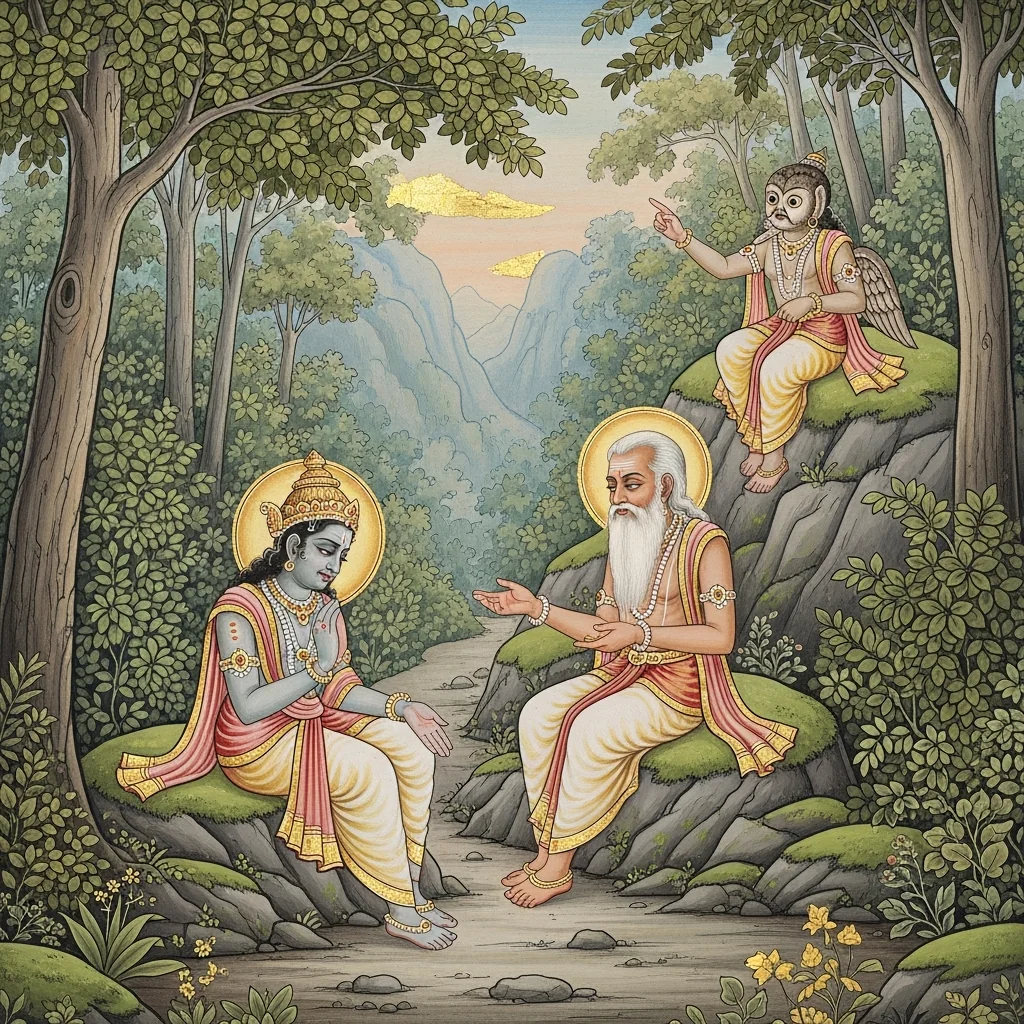
Chapter 8 unfolds a multi-voiced theological discussion on moral duty and the power of devotion. Nārada describes a king (with Indradyumna as the reference point) shaken after hearing a harsh pronouncement attributed to Mārkaṇḍeya. The dialogue elevates satya (truthfulness) and mītra-dharma (the ethics of friendship): once a vow or promise is given, it is morally binding even at personal cost, and exemplars of truth-commitment sharpen the ethical stakes. Turning away from self-immolation, the group chooses a practical pilgrimage toward Śiva’s realm, traveling to Kailāsa and consulting an owl named Prākārakarṇa. The owl—formerly a brāhmaṇa called Ghaṇṭa—explains that his extraordinary longevity arose from worship of Śiva through unbroken offerings of bilva leaves and tri-kāla (three-times) devotion. Śiva then appears and grants a boon. The narrative pivots to a social-ethical rupture: a forced gandharva-style marriage results in a curse that transforms him into an owl, with the label “night-roamer” newly interpreted. The curse carries a condition for restoration—helping to identify Indradyumna becomes the trigger to regain his original form. Thus the chapter braids ritual instruction (bilva-leaf liṅga-pūjā), karmic causality (boon and curse), and normative ethics (promise-keeping, marriage norms, and accountability).
Shlokas
Verse 1
नारद उवाच । नाडीजंघबकेनोक्तां वाचमाकर्ण्यभूपतिः । मार्कंडेयेन संयुक्तो बभूवातीव दुःखितः
Nārada said: “Hearing the words spoken by Nāḍījaṃgha-baka, the king—accompanied by Mārkaṇḍeya—became exceedingly sorrowful.”
Verse 2
तं निशम्य मुनिर्भूपं दुःखितं साश्रुलोचनम् । समानव्यसनः प्राह तदर्थं स पुनर्बकम्
Observing the king grieving with tear-filled eyes, the sage—sharing a similar affliction—spoke again to the crane in order to clarify the matter.
Verse 3
विधायाशां महाभाग त्वदंतिकमुपागतौ । आवां चिरायुर्ज्ञातांशाविन्द्रद्युम्नमिति द्विज
“Placing our hope in you, O fortunate one, we have come near you. We two—I and Cirāyu—recognize you as Indradyumna, O twice-born.”
Verse 4
निष्पन्नं नास्य तत्कार्यं प्राणानेष मुमुक्षति । वह्निप्रवेशेन परं वैराग्यं समुपागतः
“His purpose has not been fulfilled; now he wishes to give up his life-breath. By entering the fire, he has come to supreme dispassion.”
Verse 5
तन्मामुपागतोऽहं च त्वां सिद्धं नास्य वांछितम् । तदेनमनुयास्यामि मरणेन त्वया शपे
Therefore I too have come to you, O accomplished one; his desire has not been fulfilled. Hence I shall follow him into death—by your sworn oath.
Verse 6
आशां कृत्वाभ्युपायातं निराशं नेक्षितुं क्षमाः । भवंति साधवस्तस्माज्जीवितान्मरणं वरम्
The good cannot bear to look upon one who came with hope and has become hopeless; therefore, for them death is preferable to life.
Verse 7
प्रार्थितं चामुना हृत्स्थं मया चास्मै प्रतिश्रुतम् । त्वां मित्रं तत्परिज्ञाने धृत्वा हृदि चिरायुषम्
What he sought was heartfelt, and I promised it to him. Keeping you in my heart as a friend to understand that matter, I—Cirāyu—have come.
Verse 8
असंपादयतो नार्थं प्रतिज्ञातं ममायुषा । कलुषेणार्थिना माशापूरकेण सखेधुना
If I fail to accomplish the promised aim, my very life is forfeit—because of this tainted supplicant, this fulfiller of hope, this companion who has now become a cause of grief.
Verse 9
प्रतिश्रुतं कृतं श्लाघ्या दासतांत्यजपक्वणे । हरिश्चंद्रस्येव नृणां न श्लाघ्या सत्यसंधता
To keep a promise once given is truly praiseworthy—even in one who has matured by renouncing servile dependence. Yet among men, steadfast devotion to truth is not praised as it should be, though it is like that of King Hariścandra.
Verse 10
मित्रस्नेहस्य पर्यायस्तच्च साप्तपदं स्मृतम् । स्नेहः स कीदृशो मित्रे दुःखितो यो न दृश्यते
A friend’s affection is said to be called “sāptapada,” the seven steps taken together. But what sort of affection is it, if when a friend is in sorrow he is not seen—if one does not stand by him?
Verse 11
तदवश्यमहं साकमधुना वह्निसाधनम् । करिष्ये कीर्तिवपुषः कृते सत्यमिदं सखे
Therefore, O friend, I shall surely undergo the ordeal by fire now, together with you (or for your sake). This is the truth, my friend—for the sake of the one whose very body is fame, that is, for honor.
Verse 12
अनुजानीहि मामेतद्दर्शनं तव पश्चिमम् । त्वया सह महाभाग नाडीजंघ द्विजोत्तम
Grant me leave—this sight of you will be my last. O greatly blessed Nāḍījaṃgha, best among the twice-born, let me depart together with you.
Verse 13
नारद उवाच । वज्रवद्दुःसहां वाचं मार्कंडेयसमीरिताम् । शुश्रुवान्स क्षणं ध्यात्वा प्रतीतः प्राह तावुभौ
Nārada said: Hearing the thunderbolt-hard, unbearable words spoken by Mārkaṇḍeya, he reflected for a moment; then, satisfied, he addressed them both.
Verse 14
नाडीजंघ उवाच । यद्येवं तदिदं मित्रं विशंतं ज्वलनेऽधुना । निवारय मुनिश्रेष्ठ मत्तोऽस्ति चिरजीवितः
Nāḍījaṃgha said: If it is so, O best of sages, then restrain this friend who is now about to enter the blazing fire. A long span of life still lies before him (more than before me).
Verse 15
प्राकारकर्णनामासावुलूकः शिवपर्वते । स ज्ञास्यति महीपालमिंद्रद्युम्नं न संशयः
On Śiva’s mountain there is an owl named Prākārakarṇa. He will recognize and point out King Indradyumna—of this there is no doubt.
Verse 16
तस्मादहं त्वया सार्धममुना च शिवालयम् । व्रजामि तं शिखरिणं मित्रकार्यप्रसिद्धये
Therefore I shall go with you and with him to Śiva’s abode—to that mountain peak—so that a friend’s purpose may be successfully fulfilled.
Verse 17
इत्येव मुक्त्वा ते जग्मुस्त्रयोऽपि द्विजपुंगवाः । कैलासं ददृशुस्तत्र तमुलूकं स्वनीडगम्
Having spoken thus, those three foremost brāhmaṇas set out. There they beheld Kailāsa, and also that owl in its own nest.
Verse 18
कृतसंविदसौ तेन बकः स्वागतपूजया । पृष्टश्च तावुभौ प्राह तत्सर्वमभिवांछितम्
After establishing understanding through welcome and honor, that bird Baka was questioned; and he told both of them everything they wished to know.
Verse 19
चिरायुरसि जानीषे यदीन्द्रद्युम्नभूपतिम् । तद्ब्रूहि तेन ज्ञानेन कार्यं जीवामहे वयम्
You are long-lived. If you know King Indradyumna, then tell us; by that knowledge our purpose will be fulfilled, and we shall live on.
Verse 20
इति पृष्टः स विमना मित्रकार्यप्रसाधनात् । कौशिकः प्राह जानामि नेन्द्रद्युम्नमहं नृपम्
Thus questioned, he grew downcast, for he could not fulfill his friend’s purpose. Kauśika said, “I do not know King Indradyumna.”
Verse 21
अष्टाविंशत्प्रमाणा मे कल्पा जातस्य भूतले । न दृष्टो न श्रुतो वासाविंद्रद्युम्नो नृपः क्षितौ
I have lived upon the earth for a span measured in twenty-eight kalpas; yet on this earth I have neither seen nor even heard of a king named Indradyumna.
Verse 22
तच्छ्रुत्वा विस्मितो भूपस्तस्यायुरतिमात्रतः । दुःखितोऽपि तदा हेतुं पप्रच्छासौ तदायुषः
Hearing that, the king was astonished at his exceedingly great lifespan; and though distressed, he then asked him the reason for that longevity.
Verse 23
एवमायुर्यदि तव कथं प्राप्तं ब्रवीहि तत् । उलूकत्वं कथमिदं जुगुप्सितमतीव च
If such is your lifespan, tell me how you obtained it. And how did you come to be an owl—so repulsive indeed?
Verse 24
प्राकारकर्ण उवाच । श्रृणु भद्र यथा दीर्घमायुर्मेशिवपूजनात् । जुगुप्सितमुलूकत्वं शापेन च महामुनेः
Prākārakarṇa said: “Listen, O good one—how I gained long life through the worship of Śiva, and how this loathsome state of being an owl came about through the curse of a great sage.”
Verse 25
वसिष्ठकुलसंभूतः पुराहमभवं द्विजः । घंट इत्यभिविख्यातो वाराणस्यां शिवेरतः
Formerly I was a brāhmaṇa, born in the lineage of Vasiṣṭha, famed by the name “Ghaṇṭa,” devoted to Śiva in Vārāṇasī.
Verse 26
धर्मश्रवणनिष्ठस्य साधूनां संसदि स्वयम् । श्रुत्वास्मि पूजयामीशं बिल्वपत्रैरखंडितैः
In the assembly of the virtuous, steadfast in hearing dharma, having listened to their teaching, I myself worshipped the Lord with unbroken bilva leaves.
Verse 27
न मालती न मंदारः शतपत्रं न मल्लिका । तथा प्रियाणि श्रीवृक्षो यथा मदनविद्विषः
Neither mālatī nor mandāra, neither the hundred-petalled lotus nor mallikā—none are so dear to the Foe of Madana (Śiva) as the śrīvṛkṣa, the bilva tree.
Verse 28
अखंडबिल्वपत्रेण एकेन शिवमूर्धनि । निहितेन नरैः पुण्यं प्राप्यते लक्षपुष्पजम्
By placing even a single unbroken bilva leaf upon Śiva’s head, a person gains merit equal to that produced by offering a hundred thousand flowers.
Verse 29
अखंडितैर्बिल्वपत्रैः श्रद्धया स्वयमाहृतैः । लिंगप्रपूजनं कृत्वा वर्षलक्षं वसेद्दिवि
Having performed complete worship of the Śiva-liṅga with unbroken bilva leaves, personally gathered with faith, one dwells in heaven for a hundred thousand years.
Verse 30
सच्छास्त्रेभ्य इति श्रुत्वा पूजयाम्यहमीश्वरम् । त्रिकालं श्रद्धया पत्रैः श्रीवृक्षस्य त्रिभिस्त्रिभिः
Hearing this from the true scriptures, I worship the Lord—three times each day, with faith—offering three leaves each time from the sacred bilva tree.
Verse 31
ततो वर्षशतस्यांते तुतोष शशिशेखरः । प्रत्यक्षीभूय मामाह मेघगंभीरया गिरा
Then, at the end of a hundred years, Śaśiśekhara (Śiva) was pleased. Manifesting before me, he spoke in a voice deep as thunderclouds.
Verse 32
ईश्वर उवाच । तुष्टोस्मि तव विप्रेंद्राखंडबिल्वदलार्चनात् । वृणीष्वाभिमतं यत्ते दास्यम्यपि च दुर्लभम्
Īśvara said: “O best of brāhmaṇas, I am pleased by your worship with unbroken bilva leaves. Choose whatever boon you desire—I shall grant even what is hard to obtain.”
Verse 33
अखंडबिल्वपत्रेण महातुष्टिः प्रजायते । एकनापि यथान्येषां तथा न मम कोटिभिः
By a single unbroken bilva leaf, great satisfaction arises in me. With one such leaf, I am pleased as others might be by many offerings; for me, even crores of other gifts do not compare.
Verse 34
इत्युक्तोऽहं भगवता शंभुना स्वमनः स्थितम् । वृणोमि स्म वरं देव कुरु मामजरामरम्
Thus addressed by the Blessed Śambhu, I chose the boon that lay in my heart: “O Lord, make me free from old age and death.”
Verse 35
अथ लीलाविलासो मां तथेत्युक्त्वाऽविचारितम् । ययावदर्शनं प्रीतिमहं च महतीं गतः
Then the sportive Lord, saying, “So be it,” without hesitation, vanished from sight; and I attained great joy.
Verse 36
कृतकृत्यं तदात्मानमज्ञासिपमहं क्षितौ । एतस्मिन्नेव काले तु भृगुवंश्योऽभवद्द्विजः
On earth, I then knew myself to be fulfilled in purpose. And at that very time, a twice-born brāhmaṇa was born in the lineage of Bhṛgu.
Verse 37
अवदातत्रिजन्मासवक्षविच्चाक्षरार्थवित् । सुदर्शनेति प्रथिता प्रिया तस्याभवत्सती
His virtuous wife, famed as Sudarśanā, became his beloved—pure and radiant, learned in the meanings of words and syllables, and well-versed in the essence of sacred speech.
Verse 38
अतीव मुदिता पत्युर्मुखं प्रेक्ष्यास्य दर्शनात् । तनया देवलस्यैपा रूपेणाप्रतिमा भुवि
Greatly delighted upon beholding her husband’s face, she bore this daughter of Devala—one whose beauty on earth was without equal.
Verse 39
तस्यां तस्मादभूत्कन्या निर्विशेषा निजारणेः । निवृत्तबालभावाभूत्कुमारी यौवनोन्मुखी
From her and from him a daughter was born—an extraordinary maiden, incomparable in her own lineage. Having outgrown childhood, the young girl stood poised at the threshold of youth.
Verse 40
नालं बभूव तां दातुं तनयां गुणशालिनीम् । कस्यापि जनकः सा च वयःसंधौ मयेक्षिता
Her father found no one worthy to whom he might give that virtuous daughter. And at the meeting-point of ages—on the very cusp of youth—I beheld her.
Verse 41
प्रविश्द्यौवनाभोगभावैरतिमनोहरा । निर्वास्यमानैरपरैस्तिलतंदुलिताकृतिः
Entering fully into the delights and moods of youth, she became exceedingly enchanting; as other features blossomed forth, her form appeared slender and delicate—like a sesame creeper swayed by the wind.
Verse 42
क्रीडमाना वयस्याभिर्लावण्यप्रतिमेव सा । व्यचिंतयमहं विप्र तां निरीक्ष्य सुमध्यमाम्
Playing with her companions, she seemed like the very image of beauty. Seeing that slender-waisted maiden, O brāhmaṇa, I began to ponder.
Verse 43
अनन्याकृतिमन्योऽसौ विधिर्येनेति निर्मिता । ततः सात्त्विकभावानां तत्क्षणादस्मि गोचरम्
“Surely some other Creator must have fashioned her,” I thought—so unique was her form. From that very moment, I fell within the range of sāttvic emotions: tenderness and inward stirring.
Verse 44
प्रापितो लीलयाहत्य बाणैः कुसुमधन्विना । ततो मया स्खलद्वालं पृष्टा कस्येति तत्सखी
Playfully struck by the arrows of the Flower-bowed one (Kāma), I was overcome. Then, with faltering speech, I asked her friend, “Whose daughter is she?”
Verse 45
प्राहेति भृगुवंश्यस्य कन्येयं द्विजजन्मनः । अनूढाद्यापि केनापि समायातात्र खेलितुम्
Her companion replied: “This maiden is the daughter of a twice-born brāhmaṇa of the Bhṛgu lineage. She is still unmarried, and has come here to play with her friends.”
Verse 46
ततः कुसुमबाणेन शरव्रातैर्भृशं हतः । पितरं प्रणतो गत्वा ययाचे तां भृगूद्वहम्
Then, grievously struck by volleys of flower-arrows, I went to her father, bowed down before him, and begged him for her in marriage—him, the foremost of the Bhṛgus.
Verse 47
स च मां सदृशं ज्ञात्वा शीलेन च कुलेन च । अतीव चार्थिनं मह्यं ददौ वाचा पुरः क्रमात्
Recognizing me as a suitable match—both in conduct and in family—and seeing my earnest request, he gave her to me by his spoken word, in due and proper order.
Verse 48
ततः सा तनया तस्य भार्गवस्या श्रृणोदिति । दत्तास्मि तस्मै विप्राय विरूपायेति जल्पताम्
Then that Bhārgava’s daughter overheard them saying: “I have been given to that brāhmaṇa—one who is ugly,” she muttered in complaint.
Verse 49
रोरूयमाणा जननीमाह पश्य यथा कृतम् । अतीवानुचितं दत्त्वा जनकेन तथा वरे
Weeping, she said to her mother, “Look at what has been done—my father has given me away in marriage in a manner utterly improper, and to such a bridegroom.”
Verse 50
विषमालोड्य पास्यामि प्रवेक्ष्यामि हुताशनम् । वरं न तु विरूपस्योद्वोढुर्भार्या कथंचन
“I will drink poison, or I will enter the sacred fire; but I will never, in any way, become the wife of a misshapen bridegroom.”
Verse 51
ततः संबोध्य जननी तां सुतामाह भार्गवम् । न देयास्मै त्वया कन्या विरूपायेति चाग्रहात्
Then the mother, consoling her daughter, spoke insistently to the Bhārgava: “Do not give this maiden to him—especially to that misshapen man.”
Verse 52
स वल्लभावचः श्रुत्वा धर्मशास्त्राण्यवेक्ष्य च । दत्तामपि हरेत्पूर्वां श्रेयांश्चेद्वर आव्रजेत्
Hearing his beloved’s words and consulting the dharma-texts, he concluded: “Even if she has been given elsewhere, one may take her back, if a worthier bridegroom presents himself.”
Verse 53
अर्वाक्छिलाक्रमणतो निष्ठा स्यात्सप्तमे पदे । इति व्यवस्य प्रददावन्यस्मै तां द्विजः सुताम्
He decided thus: “Before the marital bond is finalized—held to be firm at the seventh step—it may be altered.” Having determined this, the brāhmaṇa gave his daughter to another.
Verse 54
श्वोभाविनि विवाहे तु तच्च सर्वं मया श्रुतम् । ततोतीव विलक्ष्योहं वयस्यानां पुरस्तदा
When the wedding was to take place the next day, I heard all of that. Then, in the presence of my companions, I became deeply ashamed and self-conscious.
Verse 55
नाशकं वदनं भद्र तथा दर्शयितुं निजम् । कामार्तोतीव तां सुप्तामर्वाग्निशि तदाहरम्
O good one, I could not show my face like that. Overcome by desire, I carried her away at night while she slept.
Verse 56
नीत्वा दुर्गतमैकांतेऽकार्षमौद्वाहिकं विधिम् । गांधर्वेण विवाहेन ततोऽकार्षं हृदीप्सितम्
Taking her to a secluded place, I performed the marriage procedure; by a Gāndharva marriage, I then fulfilled what my heart desired.
Verse 57
अनिच्छंतीं तदा बालां बलात्सुरतसेवनम् । अथानुपदमागत्य तत्पिता प्रातरेव माम्
Though she was a young girl unwilling, I forced the act of sexual union. Then, arriving immediately afterward, her father came to me in the morning.
Verse 58
निश्वस्य संवृतो विप्रास्तां वीक्ष्योद्वाहितां सुताम् । शशाप कुपितो भद्र मां तदानीं स भार्गवः
Sighing deeply, the brāhmaṇa—seeing his daughter thus ‘married off’—became enraged, O good one, and at that very time the Bhārgava cursed me.
Verse 59
भार्गव उवाच । निशाचरस्य धर्मेण यत्त्वयोद्वाहिता सुता । तस्मान्निशाचरः पाप भव त्वमविलंबितम्
Bhārgava said: “Since, following the custom of a night-roaming being, you married off your daughter, therefore—O sinful one—become a niśācara yourself at once, without delay.”
Verse 60
इति शप्तः प्रण्म्यैनं पादोपग्रहपूर्वकम् । हाहेति च ब्रुवन्गाढं साश्रुनेत्रं सगद्गदम्
Thus cursed, he bowed to him, first clasping his feet; and crying “Alas! Alas!”, he spoke in anguish—his eyes brimming with tears and his voice choked with grief.
Verse 61
ततोहमब्रवं कस्माददोषं मां भवानिति । शपते भवता दत्ता मम वाचा पुरा सुता
Then I said, “Why do you curse me though I am without fault? By your word earlier, your daughter had been promised to me.”
Verse 62
सोद्वाहिता मया कन्या दानं सकृदिति स्मृतिः । सकृज्जल्पंति राजानः सकृज्जल्पंति पण्डिताः
“That maiden has been married by me; tradition remembers that a gift is made only once. Kings speak but once; scholars too speak but once.”
Verse 63
सकृत्कन्याः प्रदीयंते त्रीण्येतानि सकृत्सकृत् । किं च प्रतिश्रुतार्थस्य निर्वाहस्तत्सतां व्रतम्
“A maiden is given only once; these three are ‘once-only’ acts. And further, the fulfillment of what has been promised—this is the vow of the virtuous.”
Verse 64
भवादृशानां साधूनां साधूनां तस्य त्यागो विगर्हितः । प्रतिश्रुता त्वया लब्धा तदा कालमियं मया
“For good men like you, such abandonment is blameworthy. She was obtained for me by your promise then; now, in due time, I have come to claim it.”
Verse 65
उद्वोढा चाधुना नाहमुचितः शापभाजनम् । वृथा शपन्ति मह्यं च भवंतस्तद्विचार्यताम्
Now that she has been duly married, I am not fit to be the recipient of a curse. You curse me in vain—pray consider this well.
Verse 66
यो दत्त्वा कन्यकां वाचा पश्चाद्धरति दुर्मतिः । स याति नरकं चेति धर्मशास्त्रेषु निश्चितम्
He who, having given a maiden by a pledged word, later takes her back—being of wicked mind—goes to hell; thus it is firmly settled in the Dharmaśāstras.
Verse 67
तदाकर्ण्य व्यवस्यासौ तथ्यं मद्वचनं हृदा । पश्चात्तापसमोपेतो मुनिर्मामित्यथाब्रवीत्
Hearing this, the sage discerned in his heart that my words were true. Then, filled with remorse, the muni spoke to me as follows.
Verse 68
न मे स्यादन्यथा वाणी उलूकस्त्वं भविष्यति । निशाचरो ह्युलूकोऽपि प्रोच्यते द्विजसत्तम
My word cannot be otherwise: you shall become an owl. For even an owl is called a ‘niśācara’, a night-roamer, O best of the twice-born.
Verse 69
यदेंद्रद्युम्नविज्ञाने सहायस्तंव भविष्यसि । तदा त्वं प्रकृतिं विप्र प्राप्स्यसीत्यब्रवीत्स माम्
He said to me: “When you become a helper in the matter of recognizing Indradyumna, then, O brāhmaṇa, you shall regain your own natural state.”
Verse 70
तद्वाक्यसमकालं च कौशिकत्वमिदं मम । एतावंति दिनान्यासीदष्टाविंशद्दिनं विधेः
From the very moment those words were spoken, the state of being “Kauśika” came upon me; it endured only for that many days—twenty-eight days, O one ordained by fate.
Verse 71
बिल्वीदलौरिति पुरा शशिशेखरस्य संपूजनेन मम दीर्घतरं किलायुः । संजातमत्र च जुगुप्सितमस्य शापात्कैलासरोधसि निशाचररूपमासीत्
Formerly, by worshipping Śaśiśekhara (Śiva) with bilva leaves, my lifespan was indeed extended. Yet here, through his curse, a loathsome fate arose: upon the slopes of Kailāsa I became a night-roaming being, in demonic form.