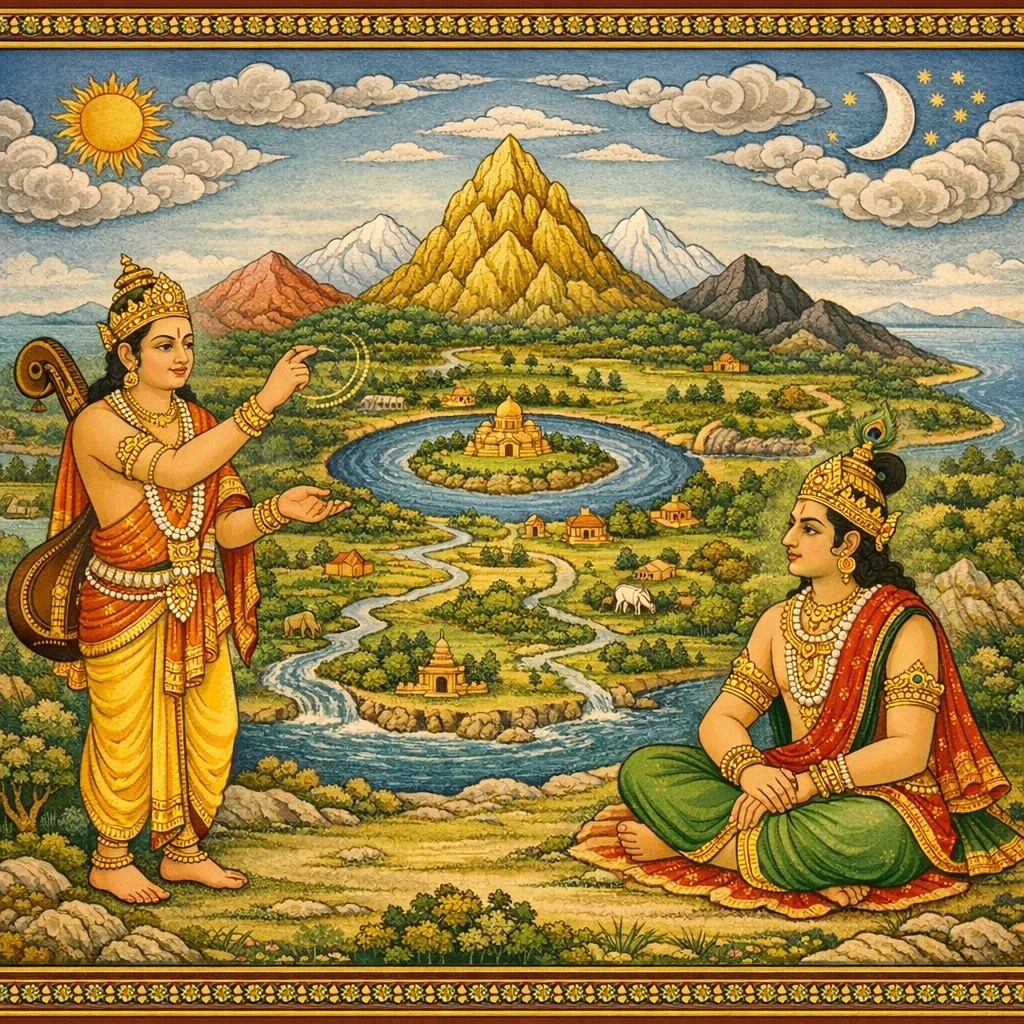
Adhyaya 37
The chapter begins with Nārada’s vow to tell Arjuna the māhātmya of the Barbarī/Barbaree tīrtha, introducing Barbarikā—also called Kumārī—and declaring the Kaumārikākhaṇḍa to bestow the four aims of life. Arjuna asks for Kumārī’s story in full, and also for an explanation of how the cosmos arises, how beings become differentiated through karma, and how Bhārata-khaṇḍa is formed. Nārada replies with a technical cosmogony: from the unmanifest (avyakta) and the paired principles pradhāna and puruṣa emerge mahat, then ahaṅkāra in three guṇic modes, followed by tanmātras, bhūtas, the eleven indriyas including manas, and the complete set of twenty-four tattvas. The teaching then turns to cosmography: the brahmāṇḍa as a bubble-like cosmic egg, a three-tiered habitation—devas above, humans in the middle, nāgas/daityas below—and the seven dvīpas with surrounding oceans of differing substances. It details Meru’s measurements, its directional mountains, forests and lakes, boundary ranges, and the varṣa divisions of Jambūdvīpa, explaining Bhārata’s name from Bharata (descended from Ṛṣabha, son of Nābhi). Other dvīpas—Śāka, Kuśa, Krauñca, Śālmali, Gomeda, Puṣkara—are outlined with their rulers, regions, and characteristic devotions (japa/stuti) to Vāyu, Jātavedas/Agni, Āpaḥ, Soma, Sūrya, and Brahman-contemplation, concluding by leading toward the arrangement of the higher worlds.
Shlokas
Verse 1
श्रीनारद उवाच । बर्बरीतीर्थमाहात्म्यमथो वक्ष्यामि तेऽर्जुन । यथा बर्बरिका जाता शतश्रृंगा नृपात्मजा
Śrī Nārada said: Now, O Arjuna, I shall tell you the greatness of Barbarī Tīrtha—how Barbarikā was born, the daughter of King Śataśṛṅga.
Verse 2
कुमारिकेति विख्याता तस्या नाम्ना प्रकथ्यते । इदं कौमारिकाखंडं चतुर्वर्गफलप्रदम्
She became renowned as “Kumārikā,” and by her very name this section is so called. This Kaumārikā Khaṇḍa bestows the fruits of the four aims of life.
Verse 3
यया कृता पृथिव्यां च नानाग्रामादिकल्पना । इदं भरतखंडं च यया सम्यक्प्रकल्पितम्
By her, upon the earth, diverse arrangements such as villages and settlements were established; and by her this Bhārata-khaṇḍa, too, was duly fashioned and set in order.
Verse 4
धनंजय उवाच । महदेतन्ममाश्चर्यं श्रोतव्यं परमं मुने । कुमारीचरितं सर्वं ब्रूहि मह्यं सविस्तरम्
Dhanaṃjaya said: This is a great wonder to me, O sage—supremely worthy of being heard. Tell me in full detail the entire sacred account of the Maiden (Kumārī) and all her deeds.
Verse 5
कथं विश्वमिदं जातं कर्मजातिप्रकल्पितम् । कथं वा भारतं खंडं शुश्रूषेय सदा मम
“How did this universe come into being—this ordered world shaped in accordance with karma and the varieties of birth? And how is it that the region called Bhārata-khaṇḍa is ever to be served and revered by me?”
Verse 6
नारद उवाच । अव्यक्तोऽस्मिन्निरालोके प्रधानपुरुषावुभौ । अजौ समागतावेकौ केवलं श्रृणुमो वयम्
Nārada said: “In this unmanifest, lightless state, both Pradhāna (primordial Nature) and Puruṣa (conscious Spirit) were present—unborn and together as one. Hear from us this account as it is.”
Verse 7
ततः स्वभावकालाभ्यां स्वरूपाभ्यां समीरितम् । ईक्षणेनैव प्रकृतेर्महत्तत्त्वमजायत
“Then, stirred by its own inherent nature and by Time—both operating according to their proper forms—through mere ‘glancing’ (intentional awareness), from Prakṛti arose the principle of Mahat (cosmic intelligence).”
Verse 8
महत्तत्त्वाद्विकुर्वाणादहंतत्त्वं व्यजायत । त्रिधा तन्मुनिभिः प्रोक्तं सत्त्वरासतामसम्
“From Mahat, as it underwent transformation, arose the principle of ‘I’-ness (Ahaṃtattva). The sages declare that it is threefold—sāttvika, rājasa, and tāmasa.”
Verse 9
तामसात्पंच जातानि तन्मात्राणि वुदुर्बुधाः । तन्मात्रेभ्यश्च भूतानि वेशेषाः पंच तद्भवाः
“From the tāmasa aspect, the wise know that the five subtle elements (tanmātras) were produced. And from those tanmātras arose the five differentiated gross elements (bhūtas) as their effects.”
Verse 10
सात्त्विकाच्चाप्यहंकाराद्विद्वि कर्मेद्रियाणि च । एकादशं मनश्चैव राजसं च द्वयोर्विदुः
From the sāttvika aspect of egoity (ahaṃkāra), they say, arise the sense faculties and the organs of action; and as the eleventh stands the mind (manas). The rājasa factor is known as that which sets both into motion.
Verse 11
चतुर्विशतितत्त्वानि जातानीति पुरा विदुः । सदाशिवेन वै पुंसा तानि दृष्टानि भारत
Thus, in ancient teaching, they know that the twenty-four principles (tattvas) came to be. These were beheld by the Person who is Sadāśiva, O Bhārata.
Verse 12
बुद्बुदाकारतां जग्मुरंडं जातं ततः शुभम् । शकतोटिप्रमाणं च ब्रह्मांडमिदमुच्यते
They assumed the form of a bubble; then the auspicious “egg” (aṇḍa) came into being. This is called the Brahmāṇḍa—vast beyond count, immense as though made of countless cartloads.
Verse 13
आत्मास्य कथितो ब्रह्मा व्यभजत्स त्रिधा त्विदम् । ऊर्ध्वं तत्र स्थिता देवा मध्ये चैव च मानवाः
Brahmā—spoken of as the ātman, the animating principle of this—then divided this cosmos into three parts. Above, the gods were established; and in the middle, indeed, were human beings.
Verse 14
नागा दैत्याश्च पाताले त्रिधैतत्परिकल्पितम् । ऐकैकं सप्तधाभूय ततस्तेन प्रकल्पितम्
In Pātāla, the netherworld, dwell the Nāgas and the Daityas; this realm is conceived as threefold. Then each of those divisions becomes sevenfold—thus has it been arranged.
Verse 15
पातालानि च द्वीपानि स्वर्लोकाः सप्तसप्त च । सप्त द्वीपानि वक्ष्यामि श्रृणु तेषां प्रकल्पनाम्
There are seven nether regions (Pātālas), seven continents (dvīpas), and likewise seven heavenly worlds. Now I shall describe the seven dvīpas—listen to their ordering.
Verse 16
लक्षयोजनविस्तारं जंबूद्वीपं प्रकीर्त्यते । सूर्यबिंबसमाकारं तावत्क्षारार्णवावृतम्
Jambūdvīpa is said to extend for a hundred thousand yojanas. Shaped like the disc of the sun, it is encircled to the same extent by the salt ocean.
Verse 17
शाकद्वीपं द्विगुणतो जंबूद्वीपात्ततः परम् । तावता क्षीरतोयेन समुद्रेण परीवृतम्
Beyond Jambūdvīpa lies Śākadvīpa, twice its size; and it is surrounded, to the same extent, by an ocean of milk.
Verse 18
सुरातोयेन दैत्यानां मोहकार्यर्णवेन हि । पुष्करं तु ततो द्वीपं द्विगुणं तावता वृतम्
Then comes Puṣkaradvīpa, twice the size of the preceding. It is enclosed to the same extent by an ocean of surā (intoxicating liquor), an ocean that becomes a cause of delusion for the Daityas.
Verse 19
कुशद्वीपं द्विगुणतस्ततस्तत्परतः स्मृतम् । दधितोयेन परितस्तावदर्णवसंवृतम्
Beyond that is remembered Kuśadvīpa, twice in size; and on all sides it is enclosed, to the same measure, by an ocean of curds (dadhi).
Verse 20
ततः परं क्रौञ्चसंज्ञं द्विगुणं हि घृताब्धिना । ततः शाल्मलिद्वीपं च द्विगुणं तावतैव च
Beyond that lies the continent called Krauñca, double in extent, encircled by an ocean of ghee (ghṛta). Thereafter comes Śālmalidvīpa also, likewise twice as large, in the same manner.
Verse 21
इक्षुसारस्वरूपेण समुद्रेण परिवृतम् । गोमेदं तस्य परितो द्विगुणं तावता वृतम्
It is surrounded by an ocean whose very nature is the essence of sugarcane-juice. Around it lies Gomeda-dvīpa, twice as large, enclosed to the same extent.
Verse 22
स्वादुतोयेन रम्येण समुद्रेण समंततः । एवं कोटिद्वयं पार्थ लक्षपंचाशतत्रयम्
On every side it is encompassed by a delightful ocean of sweet water. Thus, O Pārtha, the total measure comes to two koṭis and three times fifty lakṣas.
Verse 23
पंचाशच्च सहस्राणि सप्तद्वीपाः ससागराः । दशोत्तराणि पंचैव अंगुलानां शतानि च
The seven continents together with their oceans amount to fifty thousand (in measure). And in finer reckoning there are also five hundreds of aṅgulas plus ten.
Verse 24
अपां वृद्धिक्षयो दृष्टः पक्षयोः शुक्लकृष्णयोः । ततो हेममयी भूमिर्दशकोट्यः कुरूद्वह
The waxing and waning of the waters is observed in the bright and dark fortnights. Beyond that lies a golden region of earth, extending for ten koṭis, O bull among the Kurus.
Verse 25
देवानां क्रीडनस्थानं लोकालोकस्ततः परम् । पर्वतो वलयाकारो योजनायुतविस्तृतः
Beyond that lies Lokāloka, revered as the playground of the gods—a ring-shaped mountain range spread across ten thousand yojanas.
Verse 26
अस्य बाह्ये तमो घोरं दुष्प्रेक्ष्यं जीववर्जितम् । पंचत्रिंशत्स्मृताः कोट्यो लक्षाण्येकोनविंशतिः
Outside it lies a dreadful darkness, hard to behold and devoid of living beings. Its extent is remembered as thirty-five koṭis and nineteen lakṣas.
Verse 27
चत्वारिंशत्सहस्राणि योजनानां च फाल्गुन । सप्तसागरमानस्तु गर्भोदस्तदनंतरम्
It measures forty thousand yojanas, O Phālguna. Immediately beyond it is the Garbhoda ocean, whose measure equals that of the seven seas.
Verse 28
कोटियोजनविस्तारः कटाहऋ संव्यवस्थितः । ब्रह्मणोंऽडं कटाहेन संयुक्तं मेरुमध्यतः
There a vast ‘cauldron’ (enclosure) is set, spreading for a koṭi of yojanas. Within that cauldron the Egg of Brahmā (Brahmāṇḍa) is contained, with Meru standing at its center.
Verse 29
पंचाशत्कोटयो ज्ञेया दशदिक्षु समंततः । जंबुद्वीपस्य मध्ये तु मेरुनामास्ति पर्वतः
It should be understood to extend for fifty koṭis in all directions across the ten quarters. And in the middle of Jambūdvīpa stands the mountain named Meru.
Verse 30
स लक्षयोजनो ज्ञेयो ह्यधश्चोर्ध्वं प्रमाणतः । षोडशैव सहस्राणि योजनानामधः स्थितः
Meru is to be known as measuring one lakh yojanas, in due proportion both below and above. Of this, sixteen thousand yojanas lie beneath the level of the earth.
Verse 31
उच्छ्रयश्चतुराशीतिर्द्वात्रिंशन्मूर्ध्नि विस्तृतः । त्रिभिः शृंगैः समायुक्तः शरावाकृतिमस्तकः
Its height is eighty-four thousand yojanas, and at the summit it spreads to thirty-two thousand. It is endowed with three peaks, and its top is shaped like a shallow dish.
Verse 32
मध्यशृंगे ब्रह्मवास ऐशान्यां त्र्यंबकस्य च । नैरृत्ये वासुदेवस्य हेमशृंगं च ब्रह्मणः
On the central peak is Brahmā’s abode; on the northeastern peak is that of Tryambaka (Śiva). On the southwestern peak is the abode of Vāsudeva, and there is also a golden peak associated with Brahmā.
Verse 33
रत्नजं शंकरस्यापि राजतं केशवस्य च । मेरुदिक्षु चतसृषु विष्कंभा गिरयः स्मृताः
There is also a jewel-formed peak for Śaṅkara and a silver peak for Keśava. In the four directions of Meru are remembered the supporting mountains (viṣkambhas).
Verse 34
पूर्वेण मंदरो नामदक्षिणे गंधमादनः । विपुलः पश्चिमो ज्ञेयः सुपार्श्वस्तु तथोत्तरे
To the east is the mountain called Mandara; to the south is Gandhamādana. Know Vipula to be on the west, and likewise Supārśva to the north.
Verse 35
कदंबो मंदरे ज्ञेयोजंबुर्वै गंधमादने । अश्वत्थो विपुले चैव सुपार्श्वेच वटोमतः
On Mount Mandara, know the Kadamba tree; on Gandhamādana, indeed, the Jambu tree. On Vipula stands the Aśvattha, and on Supārśva the Vaṭa, the sacred banyan, is held to be present.
Verse 36
एकादशशतायामाश्चत्वारो गिरिकेतवः । एतेषां संति चत्वारि वनानि जयमूर्धसु
These four peaks, like mountain-banners, extend for eleven hundred yojanas. Upon their lofty summits are four forests.
Verse 37
पूर्वं चैत्ररथं नामदक्षिणे गंधमादनम् । वैभ्राजंपश्चिमे ज्ञेयमुदक्चित्ररथं वनम्
To the east is the forest named Caitraratha; to the south, Gandhamādana. Know Vaibhrāja to be in the west, and to the north the forest called Citraratha.
Verse 38
सरांसि चापि चत्वारि चतुर्दिक्षु निबोध मे । प्राच्येऽरुणोदसंज्ञं तु मानसं दक्षिणे सरः
Know also of four lakes in the four directions. In the east is the one called Aruṇoda; in the south is the lake Mānasa.
Verse 39
प्रत्यक्छीतो दकंनाम उत्तरे च महाह्रदः । विष्कंभगिरयो ह्येत उच्छ्रिताः पंचविंशतिः
In the west is the lake named Śīta; there is also the lake called Daka; and in the north is the great lake Mahāhrada. These are the Viṣkambha mountains, rising to a height of twenty-five yojanas.
Verse 40
योजनानां सहस्राणि सहस्रं पिंडतः स्मृतम् । अन्ये च संति बहुशस्तत्र वै केसराचलाः
Its mass is remembered as a thousand thousands of yojanas. And there, indeed, are many other mountains as well, called Kesarācala.
Verse 41
मेरोर्दक्षिणतश्चैव त्रयो मर्यादपर्वताः । निषधो हेमकूटश्च हिमवानिति ते त्रयः
To the south of Meru are three boundary mountains: Niṣadha, Hemakūṭa, and Himavān—these are the three.
Verse 42
लक्षयोजनदीर्घाश्च विस्तीर्णा द्विसहस्रकम् । त्रयश्चोत्तरतो मेरोर्नीलः श्वेतोऽथ श्रृंगवान्
They are a hundred thousand yojanas in length and two thousand in breadth. And to the north of Meru are three mountains: Nīla, Śveta, and Śṛṅgavān.
Verse 43
माल्यवान्पूर्वतो मेरोर्गंधाख्यः पश्चिमे तथा । इत्येते गिरयः प्रोक्ता जंबुद्वीपे समंततः
To the east of Meru is Mālyavān, and likewise to the west is the mountain called Gandha. Thus these mountains are declared to stand all around in Jambūdvīpa.
Verse 44
गंधमादनसंस्थाया महागजप्रमाणतः । फलानि जंबवास्तन्नाम्ना जंबूद्वीपमिति स्मृतम्
From the Jambu-tree that stands upon Gandhamādana—whose fruits are as large as mighty elephants—this region is remembered by that very name as Jambūdvīpa.
Verse 45
आसीत्स्वायंभुवोनाम मनुराद्यः प्रजापतिः । आसीत्स्त्री शतरूपा तामुदुवोढ प्रजापतिः । प्रियव्रतोत्तानपादौ तस्याऽस्तां तनयावुभौ
There was the primal Prajāpati named Svāyambhuva Manu, the first Manu. His wife was Śatarūpā, whom the Prajāpati took in marriage. From them were born two sons, Priyavrata and Uttānapāda.
Verse 46
ध्रुवश्चोत्तानपादस्य पुत्रः परमधार्मिकः । भक्त्या स विष्णुमाराध्य स्थानं चैवाक्षयं गतः
Dhruva, the son of Uttānapāda, was supremely righteous. By devotion (bhakti) he worshiped Viṣṇu and attained an imperishable station.
Verse 47
प्रियव्रतस्य राजर्षेरुत्पन्ना दश सूनवः । त्रयः प्रव्रजितास्तत्र परंब्रह्म समाश्रिताः
To the royal sage Priyavrata were born ten sons. Of them, three renounced the world and took refuge in the Supreme Brahman.
Verse 48
सप्त सप्तसु द्वीपेषु तेन पुत्राः प्रतिष्ठिताः । जंबूद्वीपाधिपो ज्येष्ठ आग्नीध्र इति विश्रुतः
He established his sons as rulers in the seven islands (dvīpas). The eldest, renowned as Āgnīdhra, became the lord of Jambūdvīpa.
Verse 49
तस्यासन्नव सुताः पार्थ नववर्षेश्वराः स्मृताः । तेषां नाम्ना च ते वर्षास्तिष्ठंत्यद्यापि चांकिताः
O Pārtha, he had nine sons, remembered as the lords of the nine varṣas (regions). Even today those varṣas remain distinguished by their names.
Verse 50
योजनानां सहस्राणि नव प्रत्येकशः स्मृताः । मेरोश्चतुर्दशं खंडं गंधमाल्यवतोर्द्वयोः
Each (division) is remembered as extending nine thousand yojanas. Of Mount Meru, its fourteenfold division is described in connection with the Gandhamādana and Mālyavat ranges.
Verse 51
अंतरे हेमभूमिष्ठमिलावृतमिहोच्यते । माल्यवत्सागरांतस्य भद्राश्वमिति प्रोच्यते
In the midst lies Ilāvṛta, established upon the golden land. And the region bounded by the ocean near Mālyavat is called Bhadrāśva.
Verse 52
गंधवत्सागरांतस्य केतुमालमिति स्मृतम्
The region reaching to the ocean by Gandhavata is remembered as Ketumāla.
Verse 53
श्रृंगवज्जलधेरंतः कुरुखंडमिति स्मृतम् । श्रृंगवच्छ्वेतमध्ये च खण्डं प्रोक्तं हिरण्मयम्
Within the ocean by Śṛṅgavat is remembered the division called Kuru-khaṇḍa. And between Śṛṅgavat and Śveta, the division named Hiraṇmaya is declared.
Verse 54
सुनीलश्वेतयोर्मध्ये खंडमाहुश्च रम्यकम् । निषधो हेमकूटश्च हरिखंडं तदंतरा
Between the Sunīla and Śveta mountains lies the delightful region called Ramyaka. And between the Niṣadha and Hemakūṭa ranges is said to be the land known as Harikhaṇḍa.
Verse 55
हिमवद्धिमकूटांतः खण्डं किंपुरुषं स्मृतम् । हिमाद्रिजलधेरन्तर्नाभि खण्डमिति स्मृतम्
From Himavat up to Hemakūṭa, that region is remembered as Kimpuruṣa. And the tract between the Himālaya range and the ocean is recalled as the land called Nābhikhaṇḍa.
Verse 56
नाभिखण्डं च कुरवो द्वे वर्षे धनुपाकृती । हिमवांश्च गिरिश्रृंगी ज्यास्थाने परिकीर्तितौ
Nābhikhaṇḍa and Kuru are two varṣas shaped like a bow. Himavān and Giriśṛṅgī are proclaimed to stand in the place of the bowstring.
Verse 57
नाभेः पुत्रश्च ऋषभ ऋषभाद्बरतोऽभवत् । तस्य नाम्ना त्विदं वर्षं भारतं चेति कीर्त्यते
Nābhi’s son was Ṛṣabha; from Ṛṣabha was born Bharata. By his very name this region is celebrated as Bhārata.
Verse 58
अत्र धर्मार्थकामानां मोक्षस्य च उपार्जनम् । अन्यत्र भोगभूमिश्च सर्वत्र कुरुनंदन
Here, the attainments of dharma, artha, kāma, and also mokṣa are cultivated. Elsewhere, the regions are chiefly grounds for enjoyment alone—everywhere, O joy of the Kurus.
Verse 59
शाकद्वीपे च शाकोऽस्ति योजनानां सहस्रकः । तस्य नाम्ना च तद्वर्षं शाकद्वीपमिति स्मृतम्
In Śākadvīpa there is a śāka-tree extending for a thousand yojanas. From its name that region is remembered as Śākadvīpa.
Verse 60
तस्य च प्रियव्रत एवाधिपतिर्नाम्ना मेधातिथिरिति
And the sovereign of that land is Priyavrata, known by the name Medhātithi.
Verse 61
तस्य पुरोजवमनोजववेपमानधूम्रानीकचित्ररेफबहुरूपविश्वचारसंज्ञानि पुत्रनामानि सप्त वर्षाणि
His sons’ names—Purojava, Manojava, Vepamāna, Dhūmrānīka, Citrarepha, Bahurūpa, and Viśvacāra—are also the names of the seven regions (varṣas).
Verse 62
शाकद्वीपे च वर्ष ऋतव्रतसत्यव्रतानुव्रतनामानो वाय्यवात्कमं भगवंतं जपंति
And in Śākadvīpa, in the regions named Ṛtavrata, Satyavrata, and Anuvrata, they worship by japa the Blessed Lord Vāyyavātkama.
Verse 63
अंतः प्रविश्य भूतानि यो विभज्यात्मकेतुभिः । अंतर्यामीश्वरः साक्षात्पातु नो यद्वशे जगत्
May the Lord—the Antaryāmin, manifest as the inner ruler—protect us: He who enters within all beings and differentiates them by the signs of the Self, and under whose dominion the entire world abides.
Verse 64
इति जपः । कुशद्वीपे कुशस्तंबो योजनानां सहस्रकः । तच्चिह्नचिह्नितं तस्मात्कुशद्वीपं ततः स्मृतम्
Thus is the mantra-recitation. In Kuśadvīpa there is a kuśa-grass thicket extending for a thousand yojanas; marked by that distinguishing sign, it is therefore remembered as “Kuśadvīpa.”
Verse 65
तद्द्वीपपतिश्च प्रैयव्रतो हिरण्यरोमा तत्पुत्रवसुवसुदानदृढकविनाभिगुप्तसत्यव्रतवामदेवनामांकितानि सप्त वर्षाणि । वर्णाश्च कुलिशकोविदाभियुक्तकुलकसंज्ञा जातवेदसं भगवंतं स्तुवंति
The lord of that island is the Praiyavrata king Hiraṇyaromā. There are seven varṣas, named after his sons—Vasu, Vasudāna, Dṛḍha, Kavi, Nābhi, Gupta, Satyavrata, and Vāmadeva. The social orders there—called Kuliśa, Kovida, Abhiyukta, and Kulaka—sing praises to the Blessed Lord Jātavedas (Agni).
Verse 66
परस्य ब्रह्णः साक्षाज्जातवेदासि हव्यवाट् । देवानां पुरुषांगानां यज्ञेन पुरुषं यजः
You are Jātavedas (Agni), the manifest presence of the Supreme Brahman, the bearer and consumer of oblations. Through sacrifice (yajña) you worship the Cosmic Person, Puruṣa, and you yourself are a limb of the gods’ universal body.
Verse 67
इति स्तुतिः । क्रौंचद्वीपे क्रौंचनामा पर्वतो योजनायतः । योऽसौ गुहेन निर्भिन्नस्तच्चिह्नं क्रौंचद्वीपकम्
Thus ends the hymn. In Krauñcadvīpa there is a mountain named Krauñca, extending for a yojana; that mountain—split open by Guha (Skanda)—is the distinguishing mark by which Krauñcadvīpa is known.
Verse 68
तत्र च प्रैयव्रतो घृतपृष्टिनामा तत्पुत्राममधुरुहमेघपृष्ठस्वदामऋताश्वलोहितार्णववनस्पतिइतिसप्तपुत्रनामांकितानि सप्त वर्षाणि
There, the Praiyavrata ruler is named Ghṛtapṛṣṭha. The seven regions (varṣas) are named after his seven sons: Mamadhuruha, Meghapṛṣṭha, Svadāma, Ṛtāśva, Lohitārṇava, Vanaspati, and one more completing the seven.
Verse 69
वर्णाश्च गुरुऋषभद्रविणदेवकसंज्ञाः
And the social orders there are designated as Guru, Ṛṣabha, Draviṇa, and Devaka.
Verse 70
आपोमयं भगवंतं स्तुवंति
They praise the Blessed Lord, whose very nature is water.
Verse 71
आपः पुरुषवीर्याश्च पुनंतीर्भूर्भूवःस्वश्च । तैः पुनरमीवघ्नाःसंस्पृशेतात्मना भुवः
The waters—endowed with the Puruṣa’s potency—purify Bhūḥ, Bhuvaḥ, and Svaḥ. By touching them again, one becomes a destroyer of disease and, through one’s own being, sanctifies the worlds.
Verse 72
इति जपः । शाल्मलेर्नाम वृक्षस्य तत्रवासः सहस्रं योजनानां तच्चिह्नं शाल्मलिद्विपमुच्यते
Thus is the mantra-recitation. There, the tree named Śālmali extends for a thousand yojanas; marked by that sign, it is called Śālmalidvīpa.
Verse 73
तस्याधिपतिः प्रैयव्रतो यज्ञबाहुस्तत्पुत्रसुरोचनसौमनस्यरमणकदेवबर्हिपारिभद्राप्यायनाभिज्ञाननामानि सप्तवर्षाणि
Its ruler is the Praiyavrata king Yajñabāhu. The seven varṣas are named after his sons: Surocana, Saumanasya, Ramaṇaka, Deva, Barhi, Pāribhadra, Āpyāyana, and Abhijñāna.
Verse 74
वर्णाश्च श्रुतधरवीर्यवसुंधरैषंधरसंज्ञा भगवंतं सोमं यजंति
And the varṇas known as Śrutadhara, Vīrya, Vasuṃdharā, and Eṣaṃdhara worship the Blessed Lord Soma.
Verse 75
स्वयोनिः पितृदेवेभ्यो विभजञ्छुक्लकृष्णयोः । अधः प्रजानां सर्वासां राजा नः सोमोस्तु
Self-born Soma, who apportions his course into the bright and the dark fortnights for the Pitṛs and the Gods—may Soma be our king over all creatures in this lower world.
Verse 76
इति जपः गोमेदनामा प्लक्षोस्ति सुरम्यो यस्य च्छायया । मोदोवृद्धिं गतं लौल्याद्गोमेदं द्वीपमुच्यते
“Thus is the japa (sacred recitation).” There stands a delightful plakṣa tree named Gomeda; by its shade, joy swells through fond delight—therefore that island is called Gomeda-dvīpa.
Verse 77
तत्र प्रैयव्रत इध्मजिह्वः पतिस्तत्पुत्रसिवसुरम्यसुभद्र शांत्यशप्तमृताभयनामांकितानि सप्त वर्षाणि
There, the Praiyavrata ruler is Idhmajihva; and his sons—Śiva, Suramya, Subhadra, Śāṃtya, Śapta, Mṛtābhaya—lend their names to the seven regions (varṣas).
Verse 78
वर्णाश्च हंसपतंगोर्ध्वांचनसत्यांगसंज्ञाश्चत्वारो भगवंतं सूर्यं यजंते
And there are four varṇas—called Haṃsa, Pataṃga, Ūrdhvāṃcana, and Satyāṃga—who worship the Blessed Lord Sūrya.
Verse 79
प्रश्रस्य विष्णुरूपंयत्तत्रोत्थस्य ब्रह्मणोऽमृतस्य च । मृत्योश्च सूर्यमात्मानं धीमहि
We meditate upon Sūrya, the very Self—who bears the form of Viṣṇu, who is the source of Brahmā and of immortality, and who also transcends death.
Verse 80
इति जपः । स्वर्णपत्राणि नियुतं योजनानां सहस्रकम् । पुष्करं ज्वलदा भाति तच्चिह्नं द्वीपपुष्करम्
Thus is the japa. A lotus with golden petals shines like fire, spanning a thousand yojanas; by that emblem it is known as Puṣkara-dvīpa.
Verse 81
तस्याधिपतिः प्रैयव्रतो वीतहोत्रनामा तत्पुत्रौ रमणकघातकौ
Its ruler is a Praiyavrata named Vītahotra, and his two sons are Ramaṇaka and Ghātaka.
Verse 82
तन्नामचिह्नतं खंडद्वयम्
Those two divisions are marked by their names.
Verse 83
तयोरंतरालेमानसाचलो नाम वलयाकारः पर्वतो यस्मिन्भ्रमति भगवान्भास्कर इति
In the space between them is a ring-shaped mountain called Mānasācala, upon which the Blessed Bhāskara—the Sun—is said to move in his course.
Verse 84
तत्र वर्णाश्च न संति केवलं समानास्ते ब्रह्म ध्यायंति
There, distinctions of varṇa do not exist at all; all are equal, and they meditate only upon Brahman.
Verse 85
यद्यत्कर्ममयं लिंगं ब्रह्मलिंगं जनोर्चयन् । भेदेनैकांतमद्वैतं तस्मै भगवते नमः
Whatever liṅga people worship as constituted of ritual action—this is the Brahma-liṅga—which, though approached through distinctions, is in truth the utterly non-dual One. Salutations to that Blessed Lord.
Verse 86
इति जपः । नैषु क्रोधो न मात्सर्यं पुण्यपापार्जनेन च । अयुतं द्विगुणं चापि क्रमादायुः प्रकीर्तितम्
Thus is the japa. Among them there is no anger and no envy, and no earning of merit or sin. Their lifespan is declared to be, in due order, ten thousand—and even double that.
Verse 87
जपंतः कामिनीयुक्ता विहरंत्यमरा इव । अथ ते संप्रवक्ष्यामि ऊर्ध्वलोकस्य संस्थितिम्
Engaged in japa, accompanied by celestial consorts, they sport like the immortals. Now I shall explain to you the order and condition of the higher worlds.