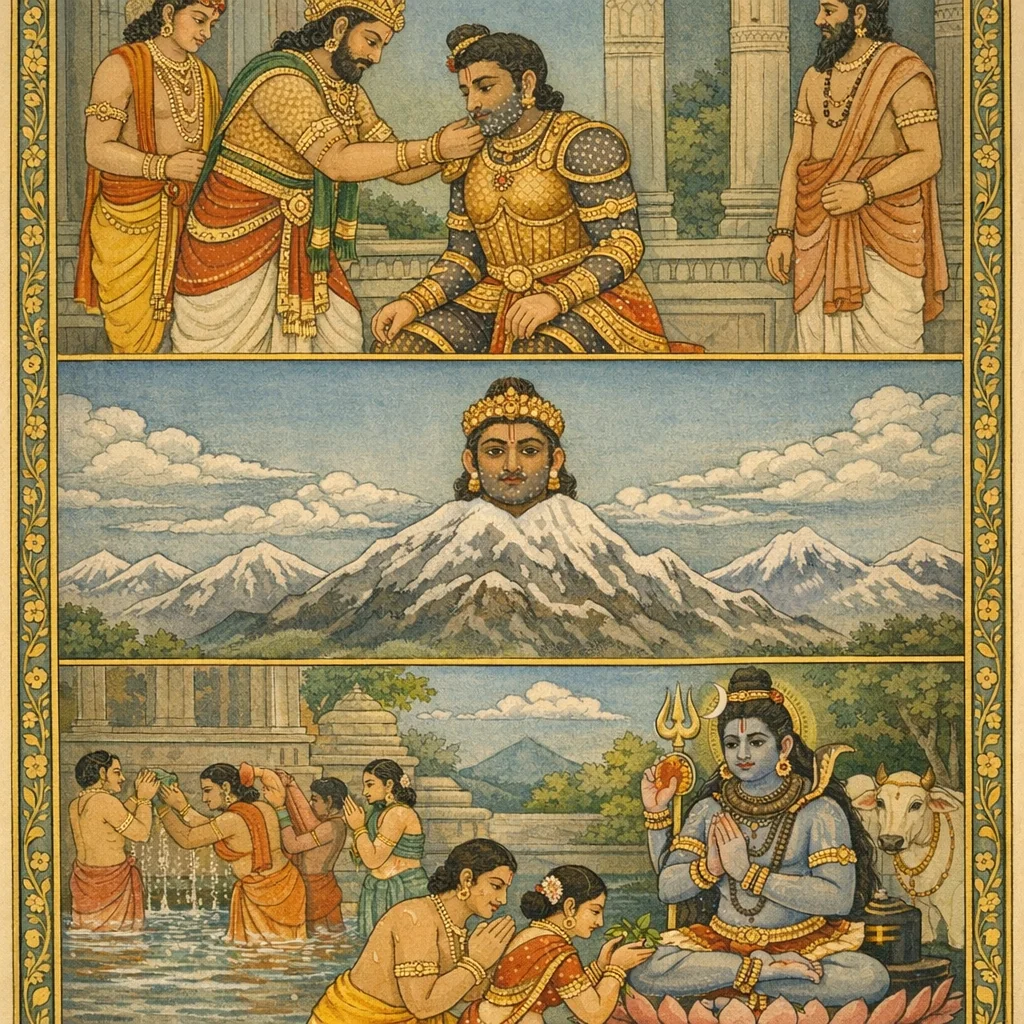
Adhyaya 66
Chapter 66, narrated by Sūta, unfolds as a discourse in the war-camp. After thirteen years the Pāṇḍavas and Kauravas assemble at Kurukṣetra; heroes are counted and claims about how soon victory will come are debated. Arjuna challenges the elders’ pledges about the war’s duration and asserts his decisive power. Barbarīka—Bhīma’s grandson, also known as Sūryavarcāḥ—then steps forward, declaring he can finish the conflict within a muhūrta. He demonstrates a technique: with a special arrow he marks the vulnerable vital points (marmas) of both armies, leaving ash/blood-like signs on critical places while sparing only a chosen few. Kṛṣṇa, however, beheads Barbarīka with the Sudarśana discus, creating an ethical and theological turning point. Devī and attendant goddesses appear to explain that an earlier cosmic plan to lighten the earth’s burden required Kṛṣṇa to preserve the ordained course of the war, and that Brahmā’s prior curse made Barbarīka’s death inevitable. Barbarīka’s head is revived and granted perpetual veneration; it is stationed on a mountain peak to witness the war, and devotees are promised long-lasting worship and healing blessings. The chapter then turns to tīrtha-mahātmya, praising Guptakṣetra, Koṭitīrtha, and Mahīnagaraka. Sacred bathing (snāna), śrāddha, dāna, and hearing/reciting the account are taught as means to purification, prosperity, and liberation, with motifs of Rudraloka and Vishṇuloka. A long stotra to Barbarīka follows, and the phalaśruti concludes by codifying the merits of listening to this chapter.
Shlokas
Verse 1
सूत उवाच । ततस्त्रयोदशे वर्षे व्यतीते समये तदा । उपप्लवे संगतेषु सर्वराजसु पांडवाः
Sūta said: When the thirteenth year had passed and the appointed time had come, and when all the kings had assembled at Upaplava, the Pāṇḍavas too were present there.
Verse 2
योद्धुमागत्य संतस्थुः कुरुक्षेत्रं महारथाः । कौरवाश्चापि संतस्धुर्दुर्योधनपुरोगमाः
The great chariot-warriors came to fight and took their stand at Kurukṣetra. The Kauravas too took their positions, led by Duryodhana.
Verse 3
ततो भीष्मेण प्रोक्तां च नरैः श्रुत्वा युधिष्ठिरः । रथातिरथसंख्यां तु राज्ञां मध्ये वचोऽब्रवीत्
Then Yudhiṣṭhira, having heard from the men what Bhīṣma had declared—the count of warriors classed as rathas and atirathas—spoke a word in the midst of the kings.
Verse 4
भीष्मेण विहिता कृष्ण रथातिरथवर्णना । ततो दुर्योधनोऽपृच्छदिदं स्वीयान्महारथान्
O Kṛṣṇa, thus was the description of rathas and atirathas set forth by Bhīṣma. Thereupon Duryodhana asked this question of his own great chariot-warriors.
Verse 5
ससैन्यान्पांडवानेतान्हन्यात्कालेन केन कः । मासेन तु प्रतिज्ञातं भीष्मेण च कृपेण च
“Who would slay these Pāṇḍavas together with their armies—and in how much time?” For Bhīṣma and Kṛpa had indeed pledged: “within a month”.
Verse 6
पक्षं द्रोणेन चाह्नां च दशभिर्द्रौणिना रणे । षड्भिः कर्णेन च तथा सदा ममभयंकृता
By Droṇa—in a fortnight; by Drauṇi (Aśvatthāman)—in ten days upon the battlefield; and likewise by Karṇa—in six days. Thus have they ever been a cause of fear to me.
Verse 7
तदहं स्वांश्च पृच्छामि केन कालेन हंति कः । एतच्छ्रुत्वा वचो राज्ञः फाल्गुनो वाक्यमब्रवीत्
Therefore I ask my own men: who will slay them, and in what time? Hearing the king’s words, Phālguna (Arjuna) spoke in reply.
Verse 8
अयुक्तमेतद्भीष्माद्यैः प्रतिज्ञातं युधिष्ठिर । ततो जये च विजये निश्चयो हि मृषैव तत्
O Yudhiṣṭhira, this pledge made by Bhīṣma and the others is unfitting. Therefore any certainty about victory or defeat is indeed false.
Verse 9
तवापि ये संति नृपाः सन्नद्धा रणसंस्थिताः । पश्यैतान्पुरुषव्याघ्रान्कालकल्पान्दुरासदान्
Even on your side there are kings—armoured and arrayed for battle. Behold these tiger-like men, formidable as Time itself, impossible to assail.
Verse 10
द्रुपदं च विराटं च धृष्टकेतुं च कैकयम् । सहदेवं सात्यकिं च चेकितानं च दुर्जयम्
(I behold) Drupada and Virāṭa; Dhṛṣṭaketu and the king of Kaikaya; Sahadeva and Sātyaki; and also Cekitāna and the unconquerable Durjaya.
Verse 11
धृष्टद्युम्नं सपुत्रं च महावीर्यं घटोत्कचम् । भीमादींश्च महेष्वासान्केशवं चापराजितम्
“I behold Dhṛṣṭadyumna together with his son, and Ghaṭotkaca of great might; and Bhīma and the other great bowmen, and Keśava too—unvanquished.”
Verse 12
मन्येहमेकस्त्वेतेषां हन्यात्कौरववाहिनीम् । सन्नद्धाः प्रतिदृश्यंते भीष्माद्या बहवो रथाः
“I think that even one among these could strike down the Kaurava host. Yet, fully armed, many chariots are seen—Bhīṣma and the rest.”
Verse 13
तेभ्यो भयं न कार्यं ते फल्गवोऽमी मृगा इव
“Do not fear them; these men are like deer, O Phālgava.”
Verse 14
अस्माकं धनुषां घोषैरिदानीमेव भारत । कौरवा विद्रविष्यंति सिंहत्रस्ता मृगा इव
“By the thunder of our bows—even now, O Bhārata—the Kauravas will scatter, like deer terrified by lions.”
Verse 15
वृद्धाद्भीष्माद्द्विजाद्वृद्धाद्द्रोणादपि कृपादपि । बालिशात्किं भयं द्रौणेः सूतपुत्राच्च दुर्मतेः
“What fear could there be from aged Bhīṣma, from the aged Brahmin Droṇa, or from Kṛpa? And what fear from the foolish son of Droṇa, or from the charioteer’s son of evil intent?”
Verse 16
अथवा चित्तनिर्वृत्यै ज्ञातुमिच्छसि भारत । शत्रूणां प्रत्यनीकेषु संधावच्छृणु मे वचः
Or, if you wish to know this for the settling of your mind, O Bhārata—listen to my words as I swiftly run through the enemy battle-formations.
Verse 17
एकोऽहमेव संग्रामे सर्वे तिष्ठंतु ते रथाः । एकाह्ना क्षपये सर्वान्कौरवान्सैन्यसंयुतान्
I alone will fight in the battle; let all your chariots stand back. In a single day I shall destroy all the Kauravas together with their armies.
Verse 18
इत्यर्जुनवचः श्रुत्वा स्मयन्दामोदरोऽब्रवीत् । एवमेतद्यथा प्राह फाल्गुनोऽयं मृषा न तत्
Hearing Arjuna’s words, Dāmodara spoke with a smile: “So it is, just as this Phālguna has said—this is not false.”
Verse 19
ततश्च शंखान्भेरीश्च शतशश्चैव पुष्करान् । निवार्य राजमध्यस्थो बर्बरीको वचोऽब्रवीत्
Then, restraining the conches and kettledrums and the hundreds of trumpets, Barbarīka—standing in the midst of kings—spoke these words.
Verse 20
येन तप्तं गुप्तक्षेत्रे येन देव्यः सुतोषिताः । यस्यातुलं बाहुबलं तेन चोक्तं निशम्यताम्
Hear what is being declared by that very hero—by whom austerity was performed in Guptakṣetra, by whom the Goddesses were fully pleased, and whose arm-strength is matchless.
Verse 21
यद्ब्रवीमि वचः सत्यं शृणुध्वं तन्नराधिपाः । आत्मनो वीर्यसदृशं केवलं न तु दर्पतः
O kings, listen: the words I speak are true. I speak only what accords with my own valor, not from empty pride.
Verse 22
यदार्येण प्रतिज्ञातमर्जुनेन महात्मना । न मर्षयामि तद्वाक्यं कालक्षेपो महानयम्
I will not tolerate that utterance which the noble, great-souled Arjuna has vowed; this delay is a grievous waste of time.
Verse 23
सर्वे भवंतस्तिष्ठंतु सार्जुनाः सहकेशवाः । एको मुहूर्ताद्भीष्मादीन्सर्वान्नेष्ये यमक्षयम्
All of you remain here, together with Arjuna and Keśava. I alone, within a single muhūrta, shall send them all—beginning with Bhīṣma—to Yama’s abode.
Verse 24
मयि तिष्ठति केनापि शस्त्रग्राह्यं न क्षत्रियैः । स्वधर्मशपथो वोऽस्तु मृते ग्राह्यं ततो मयि
So long as I stand here, no kṣatriya may take up weapons against anyone. Let your oath to your own dharma be this: only after I am slain may you then take up arms against me.
Verse 25
पश्यध्वं मे बलं बाह्वोर्देव्याराधनसंभवम् । माहात्म्यं गुप्तक्षेत्रस्य तथा भक्तिं च पांडुषु
Behold the strength of my arms, born of worship of the Devī. Behold also the greatness of Guptakṣetra, and my devotion toward the sons of Pāṇḍu.
Verse 26
पश्यध्वं मे धनुर्घोरं तूणीरावक्षयौ तथा । खड्गं च देव्या यद्दत्तं ततो वच्मि वचस्त्विदम्
Behold my fearsome bow, and these inexhaustible quivers; and this sword bestowed by the Devī herself. Therefore, I now speak these words.
Verse 27
इति तस्य वचः श्रुत्वा क्षत्रिया विस्मयं ययुः । अर्जुनश्च कटाक्षेपे लज्जितः कृष्णमैक्षत
Hearing his words, the kṣatriyas were struck with amazement; and Arjuna, embarrassed by the sidelong glances, looked toward Kṛṣṇa.
Verse 28
तमाह ललितं कृष्णः फाल्गुनं परमं वचः । आत्मौपयिकमेवेदं भैमि पुत्रोऽभ्यभाषत
Then Kṛṣṇa spoke gently to Phālguna (Arjuna) these excellent words: “This speech is only for his own purpose,” said the son of Bhīmī (Draupadī).
Verse 29
नवकोटियुतोऽनेन पलाशी निहतः पुरा । क्षणादेव च पाताले श्रूयते महदद्भुतम्
Formerly, by him, Palāśī—attended by nine koṭis—was slain; and in a mere instant he was cast down to Pātāla. This is heard as a great wonder indeed.
Verse 30
पुनः प्रक्ष्यामदे त्वेनं क्वेनोपायेन कौरवान् । मुहूर्ताद्धंसि ब्रूहीति पृच्छयतां चाह तं जयः
Then they questioned him again: “By what means will you destroy the Kauravas in but a moment? Tell us!”—and, as they asked, Jaya addressed him.
Verse 31
ततः स्मरन्यादवेंद्रो भैमिपुत्रमभाषत
Then Yādavendra (Kṛṣṇa), recalling the matter, spoke to the son of Bhīma.
Verse 32
भीप्मद्रोणकृपद्रौणिकर्णदुर्योधनादिभिः । गुप्तां त्र्यंबकदुर्जेयां सेनां हंसि कथं क्षणात्
Guarded by Bhīṣma, Droṇa, Kṛpa, Drauṇi, Karṇa, Duryodhana and others—an army deemed unconquerable even by Tryambaka (Śiva)—how will you destroy it in an instant?
Verse 33
अयं महान्विस्मयस्ते वचसो भैमिनंदन । संभूतः सर्वराज्ञां च फाल्गुनस्य च धीमतः
O son of Bhīma, great amazement has arisen at your words—among all the kings, and even in the wise Phālguna (Arjuna).
Verse 34
तद्ब्रूहि केनोपायेन मुहूर्ताद्धंसि कौरवान् । उपायवीर्यं ते ज्ञात्वा मंस्यामो वयमप्युत
Therefore tell us: by what means will you destroy the Kauravas in a moment? Knowing the power of your method, we too shall form our judgment.
Verse 35
सूत उवाच । इत्युक्तो वासुदेवेन सर्वभूतेश्वरेण च । सिंहवक्षाः पर्वताभो नानाभूषणभूषितः
Sūta said: Thus addressed by Vāsudeva, the Lord of all beings, he—lion-chested, mountain-like in form, adorned with many ornaments—stepped forth.
Verse 36
घटास्यो घटहासश्च ऊर्ध्वकेशोऽतिदीप्ति मान् । विद्युदक्षो वायुजवो यश्चेच्छेन्नाशयेज्जगत्
With a pot-like face and a pot-like laugh, his hair standing upright, blazing with great radiance; lightning-eyed and swift as the wind—one who, if he so wished, could destroy the world.
Verse 37
देवीदत्तातुलबलो बर्बरीकोऽभ्यभाषत । यदि वो मानसं वीरा उपायस्य प्रदर्शने
Barbarīka, of incomparable strength bestowed by the Goddess, spoke: “O heroes, if your minds are set on seeing the method…”
Verse 38
तदहं दर्शयाम्येष पश्यध्वं सहकेशवाः । इत्युक्त्वा धनुरारोप्य संदधे विशिखं त्वरन् । निःशल्यं चापि संपूर्णं सिंदूराभेण भस्मना
“Then I shall show it—behold, along with Keśava!” Saying so, he swiftly strung his bow and fitted an arrow; and that arrow was complete and unimpeded, empowered with vermilion-hued sacred ash.
Verse 39
आकर्णमाकृप्य च तं मुमोच मुखादथोद्भूतमभूच्च भस्म
Drawing it back to the ear, he released it; and then, from his mouth, ash burst forth.
Verse 40
सेनाद्वये तच्च पपात शीघ्रं यस्यैव यत्रास्ति च मृत्युमर्म । सर्वरोमसु भीष्मस्य कंठे राधेयद्रोणयोः
That blazing mark fell swiftly upon both armies—exactly upon the spot where each one’s fatal vital point (marma) lay: upon Bhīṣma, over all the hairs of his body; and upon Rādheya (Karna) and Droṇa, upon the throat.
Verse 41
ऊरौ दुर्योधनस्यापि शल्यस्यापि च वक्षसि । कंठे च शकुनेर्दीप्तं भगदत्तस्य चापतत्
It fell upon Duryodhana’s thigh, Śalya’s chest, Śakuni’s throat, and the blazing mark also fell upon Bhagadatta.
Verse 42
कृष्णस्य पादतल लके कंठे द्रुपदमत्स्ययोः । शिखंडिनस्तथा कट्यां कंठे सेनापतेस्तथा
For Kṛṣṇa, it marked the sole of his foot; for Drupada and the Matsya King, the throat; for Śikhaṇḍin, the waist; and for the commander, the throat.
Verse 43
पपात रक्तं तद्भस्म यत्र येषां च मर्म च । केवलं चैव पांडूनां कृपद्रोण्योश्च नास्पृशत
That blood-red ash fell exactly on their vital points, yet it did not touch the Pāṇḍavas, nor Kṛpa and Droṇa.
Verse 44
इति कृत्वा ततो भूयो बर्बरीकोऽभ्यभाषत । दृष्टं भवद्भिरेवं यन्मया मर्म निरीक्षितम्
Having done this, Barbarīka spoke again: "You have now witnessed how I have identified the vital points."
Verse 45
अधुना पातयिष्यामि मर्मस्वेषां शिताञ्छरान् । देवीदत्तानमोघाख्यान्यैर्मरिष्यंत्यमी क्षणात्
"Now I shall release sharp arrows upon their vital points—arrows granted by the Goddess, known as unfailing—by which these men shall perish instantly."
Verse 46
शपथा वः स्वधर्मस्य शस्त्रं ग्राह्यं न वः क्वचित् । मुहूर्तात्पातयिष्यामि शत्रूनेताञ्छितैः शरैः
By the oath of your own dharma: do not take up weapons anywhere. Within a single muhūrta I shall strike down these enemies with keen arrows.
Verse 47
ततो विस्मितचित्तानां युधिष्ठिरपुरोगिणाम् । आसीन्निनादः सुमहान्साधुसाध्विति शंस ताम्
Then, among those whose minds were astonished—Yudhiṣṭhira and the rest—there arose a very great roar of acclaim, praising him: “Excellent! Excellent!”
Verse 48
वासुदेवश्च संक्रुद्धश्चक्रेण निशितेन च । एवं ब्रुवत एवास्य शिरश्छित्त्वा न्यपातयत्
But Vāsudeva, angered, with his sharp discus—while he was still speaking thus—cut off his head and cast it down.
Verse 49
ततः क्षणात्सर्वमासीदाविग्रं राजमं डलम् । व्यलोकयन्केशवं ते विस्मिताश्चाभवन्भृशम्
Then, in a moment, the entire royal assembly became still and free of tumult. Gazing at Keśava, they were exceedingly astonished.
Verse 50
किमेतदिति प्राहुश्च बर्बरीकः कुतो हतः । पांडवाश्चापि मुमुचुरश्रूणि सहपार्थिवाः
“What is this?” they cried; “From where has Barbarīka been slain?” The Pāṇḍavas too, along with the assembled kings, let their tears fall.
Verse 51
हाहा पुत्रेति च गृणन्प्रस्खलंश्च पदेपदे । घटोत्कचोऽपतद्दीनः पुत्रोपरि विमूर्छितः
Crying, “Alas, my son!,” and stumbling at every step, the sorrowful Ghaṭotkaca fell, fainting upon his son.
Verse 52
एतस्मिन्नंतरे देव्यश्चतुर्दश समाययुः
Just then, fourteen goddesses arrived together.
Verse 53
सिद्धांबिका क्रोडमाता कपाली तारा सुवर्णा च त्रिलोकजेत्री । भाणेश्वरी चर्चिका चैकवीरा योगेश्वरी चंडिका त्रैपुरा च
They were Siddhāmbikā, Kroḍamātā, Kapālī, Tārā, Suvarṇā, and Trilokajetrī; Bhāṇeśvarī, Carcikā, Ekavīrā, Yogeśvarī, Caṇḍikā, and Traipurā.
Verse 54
भूतांबिका हरसिद्धिस्तथामूः संप्राप्य तस्थुर्नृपविस्मयंकराः । श्रीचंडिकाऽश्वास्य ततौ घटोत्कचं प्रोवाच वाक्यं महता स्वरेण
Bhūtāmbikā, Harasiddhi, and the others arrived and stood there, astonishing the kings. Then Śrī Caṇḍikā, having consoled Ghaṭotkaca, spoke words in a mighty voice.
Verse 55
शृणुध्वं पार्थिवाः सर्वे कृष्णेन विदितात्मना । हेतुना येन निहतो बर्बरीको महाबलः
“Listen, all you kings: by the discerning Kṛṣṇa, for a particular reason, the exceedingly powerful Barbarīka was slain.”
Verse 56
मेरुमूर्ध्नि पुरा पृथ्वी समवेतान्दिवौकसः । भाराक्रांता जगादैतान्भारोऽप ह्रियतां हि मे
Long ago, upon the summit of Meru, the Earth—crushed by the burden—addressed the assembled gods: “Let my burden indeed be removed.”
Verse 57
ततो ब्रह्मा प्राह विष्णुं भगवंस्त्वमिदं शृणु । देवास्त्वानुगमिष्यंति भारं हर भुवः प्रभो
Then Brahmā said to Viṣṇu: “O Blessed Lord, hear this. The gods will follow you—remove the burden of the Earth, O Master.”
Verse 58
ततस्तथेति तन्मेने वचनं विष्णुरव्ययः । एतस्मिन्नंतरे बाहुमुद्धृत्योच्चैरभाषत
Thereupon the imperishable Viṣṇu accepted that command, thinking, “So be it.” At that moment, raising his arm, he spoke aloud.
Verse 59
सूर्यवर्चेति यक्षेंद्रश्चतुराशीतिकोटिपः । किमर्थं मानुषे लोके भवद्भिर्जन्म कार्यते
“O Sūryavarcā,” said the lord of the Yakṣas—commander of eighty-four crores—“for what purpose is birth to be undertaken by you in the human world?”
Verse 60
मयि तिष्ठति दोषाणामनेकानां महास्पदे । सर्वे भवंतो मोदंतु स्वर्गेषु सह विष्णुना
Since I remain here as a great abode of many faults, may all of you rejoice in the heavens together with Viṣṇu.
Verse 61
अहमेकोऽवतीर्यैतान्हनिष्यामि भुवो भरान् । स्वधर्मशपथा वो वै संति चेज्जन्म प्राप्स्यथ
I alone shall descend and strike down these burdens upon the earth. If your vows sworn upon your own dharma still stand firm, then indeed you shall obtain birth in this world.
Verse 62
इत्युक्तवचने ब्रह्मा क्रुद्धस्तं समभाषत । दुर्मते सर्वदेवानामविषह्यं महाभरम्
When those words were spoken, Brahmā, angered, addressed him: “O evil-minded one! This great burden is unbearable even for all the gods.”
Verse 63
स्वसाध्यं ब्रूषे मोहात्त्वं शापयोग्योऽसि बालिश । देशकालोचितं स्वीयं परस्य च बलं हृदा
Deluded, you speak of what is ‘easy for you to accomplish’; you are fit to be cursed, O foolish one. In your heart, weigh what is proper to place and time—your own strength and also the strength of others.
Verse 64
अविचार्यैव प्रभुषु वक्ति सोऽर्हति दंडनम् । तस्माद्भूभारहरणे युद्धस्योपक्रमे सति
He who speaks to his superiors without reflection deserves punishment. Therefore, when the undertaking of war is at hand for removing the earth’s burden—
Verse 65
शरीरनाशं कृष्णात्त्वमवाप्स्यसि न संशयः । एवं शप्तो ब्रह्मणाऽसौ विष्णुमेतदयाचत
“You shall meet bodily destruction at the hands of Kṛṣṇa—of this there is no doubt.” Thus cursed by Brahmā, he then requested this boon from Viṣṇu.
Verse 66
यद्येवं भविता नाशस्तदेकं देव प्रार्थये । जन्मप्रभृति मे देहि मतिं सर्वार्थसाधनीम्
If destruction is indeed to be so, then I ask one thing, O Lord: from my very birth, grant me an understanding that accomplishes every rightful aim.
Verse 67
ततस्तथेति तं प्राह केशवो देवसंसदि । शिरस्ते पूजयिष्यंति देव्याः पूज्यो भविष्यसि
Then Keśava said to him in the assembly of the gods, “So be it. Your head will be worshipped, and you shall become one worthy of worship by the Goddess.”
Verse 68
इत्युक्त्वा चावतीर्णोऽसौ सह देवैर्हरिस्तदा । हरिर्नाम स कृष्णोऽसौ भवंतस्ते तथा सुराः
Having said this, Hari then descended along with the gods. He—Kṛṣṇa—was named ‘Hari’; and you too became the gods in that same manner by descending.
Verse 69
सूर्यवर्चाः स चायं हि निहतो भैमिपुत्रकः । प्राक्छापं ब्रह्मणः स्मृत्वा हतोनेन महात्मना । तस्माद्दोषो न कृष्णेऽस्मिन्द्रष्टव्यः सर्वभू मिपैः
That radiant one—Bhīma’s son—has indeed been slain. Remembering Brahmā’s former curse, he was killed by this great-souled Kṛṣṇa. Therefore, by all kings of the earth, no fault should be seen in this Kṛṣṇa.
Verse 70
श्रीकृष्ण उवाच । यदुक्तं भूमिपा देव्या तत्तथैव न संशयः
Śrī Kṛṣṇa said: “O king, what the Goddess has spoken is exactly so—of this there is no doubt.”
Verse 71
यद्येनमधुना नैव हन्यां ब्रह्मवचोऽन्यथा । ततो भवेदिति स्मृत्वा मयासौ विनिपातितः
“If I did not strike him down now, Brahmā’s word would be otherwise, unfulfilled. Remembering what would follow from that, I have felled him.”
Verse 72
गुप्तक्षेत्रे मयैवाऽसौ नियुक्तो देव्यनुस्मृतौ । पूर्वं दत्तं वरं स्वीयं स्मरता देवसंसदि
“In the secret sacred region, Guptakṣetra, I myself appointed him for the Goddess’ remembrance. Recalling his own boon earlier granted in the assembly of the gods, he acted accordingly.”
Verse 73
इत्युक्ते चंडिका देवी तदा भक्तशिरस्त्विदम् । अभ्युक्ष्य सुधया शीघ्रमजरं चामरं व्यधात्
When this was said, the Goddess Caṇḍikā swiftly sprinkled this devotee’s head with nectar and made it ageless and deathless.
Verse 74
यथा राहुशिरस्तद्वत्तच्छिरः प्रणनाम तान् । उवाच च दिदृक्षामि युद्धं तदनुमन्यताम्
Like the head of Rāhu, that head bowed to them and said, “I wish to behold the battle; please grant permission for that.”
Verse 75
ततः कृष्णो वचः प्राह मेघगंभीरवाक्प्रभुः । यावन्मही सनक्षत्रा यावच्चंद्रदिवाकरौ
Then Kṛṣṇa, the lord whose speech was deep like thunderclouds, spoke: “As long as the earth endures with its stars, and as long as the moon and the sun endure…”
Verse 76
तावत्त्वं सर्वलोकानां वत्स पूज्यो भविष्यसि । देवीलोकेषु सर्वेषु देवीवद्विचरिष्यसि
So long, dear one, you will be worthy of worship in all the worlds; and in every realm of the Goddess you will move about like the Goddess herself.
Verse 77
स्वभक्तानां च लोकेषु देवीनां दास्यसे स्थितिम् । बालानां ये भविष्यंति वातपित्तकफोद्भवाः । पिटकास्ताः सुखेनैव शामयिष्यसि पूजनात्
And in the worlds of the Goddess and of her own devotees, you will grant well-being. The boils that arise in children from vāta, pitta, and kapha—you will easily pacify them through worship offered to you.
Verse 78
इदं च शृंगमारुह्य पश्य युद्धं यथा भवेत्
And climbing this peak, watch the battle as it unfolds.
Verse 79
धावंतः कौरवास्त्वस्मान्वयं यामस्त्वमूनिति । इत्युक्ते वासुदेवेन देव्योऽथांबरमाविशन्
“The Kauravas are rushing toward us; we shall go against them—you do thus.” When Vāsudeva spoke in this way, the Goddesses then entered the sky.
Verse 80
बर्बरीकशिरश्चैव गिरिशृंगमवाप्य तत् । देहस्य भूमिसंस्काराश्चाभवच्छिरसो नहि । ततो युद्धं महदभूत्कुरुपांडवसेनयोः
Barbarīka’s head indeed reached the mountain peak. Funeral rites of burial were performed for his body, but not for the head. Thereafter a great battle arose between the armies of the Kurus and the Pāṇḍavas.
Verse 81
अष्टादशाहेन हता ये च द्रोणवृषादयः । दुर्योधने हते क्रूरे अष्टादशदिनात्यये
Within eighteen days Droṇa, Vṛṣa, and the rest were slain; and when the cruel Duryodhana was killed—at the completion of the eighteen days—the war came to its end.
Verse 82
युधिष्ठिरो ज्ञातिमध्ये गोविंदं समभाषत । पुरुषोत्तम संग्रामममुं संतारिता वयम्
Yudhiṣṭhira, amid his kinsmen, addressed Govinda: “O Puruṣottama, by you we have been carried across this battle.”
Verse 83
त्वयैव नाथेन हरे नमस्ते पुरुषोत्तम । श्रुत्वा तस्यापि सासूयमिदं भीमो वचोऽब्रवीत्
“By you alone as our Lord, O Hari—salutations to you, O Puruṣottama!” Hearing even that, Bhīma—tinged with jealousy—spoke these words.
Verse 84
येन ध्वस्ता धार्तराष्ट्रास्तं निराकृत्य मां नृप । पुरुषोत्तमं कृष्णमिति ब्रवीषि किमु मूढवत्
“O King, setting me aside—though it was by me that the Dhārtarāṣṭras were crushed—why do you speak of Kṛṣṇa as ‘Puruṣottama’, as if in foolishness?”
Verse 85
धृष्टद्युम्नं फाल्गुनं च सात्यकिं मां च पांडव । निराकृत्य ब्रवीष्येव सूतं धिक्त्वा युधिष्ठिर
“O Pāṇḍava, disregarding Dhṛṣṭadyumna, Phālguna, Sātyaki, and me, you speak as though only the charioteer mattered—shame on you, Yudhiṣṭhira!”
Verse 86
अर्जुन उवाच । मैवं मैवं ब्रूहि भीम न त्वं वेत्सि जनार्दनम् । न मया न त्वया पार्थ नान्येनाप्यरयो हताः
Arjuna said: “Do not speak so, Bhīma—do not speak so. You do not truly know Janārdana. The foes were slain not by me, not by you, O Pārtha, nor by anyone else.”
Verse 87
अहं हि सर्वदाग्रस्थं नरं पश्यामि संयुगे । निघ्नंतं शात्रवांस्तत्र न जाने कोऽप्यसाविति
“For in battle I always behold a certain Man in the forefront, striking down the foes there—yet I do not know who that one is.”
Verse 88
भीम उवाच । विभ्रांतोऽसि ध्रुवं पार्थ नात्र हंता नरोऽपरः । अथ चेदस्ति त्वत्पौत्रमुच्चस्थं वच्मि हंत कः
Bhīma said: “Surely you are deluded, Pārtha; here there is no other ‘Man’ as slayer. But if there is one, I shall tell you—who is that lofty one? Is he your grandson?”
Verse 89
उपसृत्य ततो भीमो बर्बरीकमपृच्छत । ब्रूह्येते केन निहता धार्तराष्ट्रा हि शत्रवः
Then Bhīma approached Barbarīka and asked: “Tell me—by whom were these enemies, the Dhārtarāṣṭras, slain?”
Verse 90
बर्बरीक उवाच । एको मया पुमान्दृष्टो युध्यमानः परैः सह । सव्यतः पंचवक्त्रः स दक्षिणे चैकवक्त्रतः
Barbarīka said: “I saw a single man fighting against many opponents. On his left he appeared five-faced, and on his right he appeared with only one face.”
Verse 91
सव्यतो दशहस्तश्च धृतशूलाद्युदायुधः । दक्षिणे च चतुर्हस्तो धृतचक्राद्युदायुधः
On the left he was ten-armed, bearing the trident and other uplifted weapons; on the right he was four-armed, holding the discus and other raised weapons.
Verse 92
सव्यतश्च जटाधारी दक्षिणे मुकुटोच्चयः । सव्यतो भस्मधारी च दक्षिणे धृतचंदनः
On the left he wore matted locks, while on the right he bore a lofty crown. On the left he was smeared with sacred ash, and on the right he was adorned with sandal paste.
Verse 93
सव्यतश्चंद्रधारी च दक्षिणे कौस्तुभद्युतिः । ममापि तद्दर्शनतो महद्भयमजायत
On the left he bore the moon, and on the right he shone with the splendor of the Kaustubha jewel. Even I, upon seeing that form, was seized by great fear.
Verse 94
ईदृशो मे नरो दृष्टो न चान्यो यो जघान तान् । इत्युक्ते पुष्पवर्षं तु खादासीत्सुमहाप्रभम्
Never have I seen a man like this, nor anyone else who could strike them down. When he had said this, a magnificent shower of flowers fell from the sky, blazing with great radiance.
Verse 95
सस्वनुर्देववाद्यानि साधुसाध्विति वै जगुः । विस्मिताः पांडवाश्चासन्प्रणेमुः पुरुषोत्तमम्
The divine instruments resounded, and they cried, “Well done! Well done!” The Pāṇḍavas, astonished, bowed down to the Supreme Person, Purushottama.
Verse 96
विलक्षश्चाभवद्भीमो निश्वासांश्चाप्यमुंचत । तं ततः केशवः स्वामी समादाय करे दृढे
Bhīma grew bewildered and heaved heavy breaths. Then Lord Keśava firmly took him by the hand.
Verse 97
कुरुशार्दूल एहीति प्रोच्य सस्मार काश्यपिम् । आरुह्य गरुडं पश्चात्स्मृतमात्रमुपस्थितम्
Saying, “O tiger among the Kurus, come,” he then remembered Kāśyapī. Thereafter he mounted Garuḍa, who appeared the moment he was remembered.
Verse 98
भीमेन सहितो व्योम्नि प्रयातो दक्षिणां दिशम् । ततोऽर्णवमतीत्यैव सुवेलं च महागिरिम्
Accompanied by Bhīma, he traveled through the sky toward the southern direction; then, crossing the ocean, he passed by the great mountain Suvela.
Verse 99
लंकासमीपे दृष्ट्वैव सरः कृष्णोऽब्रवीद्वचः । कुरुशार्दूल पश्येदं सरो द्वादशयोजनम्
Near Laṅkā, as soon as he saw a lake, Kṛṣṇa spoke: “O tiger among the Kurus, look at this lake—its expanse is twelve yojanas.”
Verse 100
यदि शूरोऽसि तच्छीघ्रमानयास्यतलान्मृदम् । इत्युक्तो गरुडाच्छीघ्रं न्यपतत्तज्जले बली
“If you are truly a hero, then quickly bring up earth from the bottom of this lake!”—thus addressed, the mighty one swiftly leapt down from Garuḍa into that water.
Verse 101
योजनं वायुजवाद्गच्छन्नधो नांतमपश्यत । ततो भीमो विनिःसृत्य भग्नवीर्योऽभ्यभाषत
Though he descended with the speed of the wind for a yojana, he did not behold the end. Then Bhīma came forth, his pride of strength shaken, and spoke.
Verse 102
अगाधमेतत्सुमहत्सरः कैश्चिन्महाबलैः । अहं खादितुमारब्धः कथंचिच्चापि निर्गतः
“This vast lake is unfathomable, and it is guarded by certain beings of great might. I was seized and nearly devoured—somehow I managed to escape.”
Verse 103
एवमुक्तो हसन्कृष्ण उच्चिक्षेप महत्सरः । स्वेनांगुष्ठेन तेजस्वी तदर्धार्धमजायत
Thus addressed, Kṛṣṇa smiled and, radiant with power, lifted the great lake with his own thumb; it was reduced to a mere fraction of its former measure.
Verse 104
तदृष्ट्वा विस्मितः प्राह किमिदं कृष्ण ब्रूहि मे
Seeing this, he was astonished and said, “What is this, O Kṛṣṇa? Tell me.”
Verse 105
श्रीकृष्ण उवाच । कुम्भकर्ण इति ख्यातः पूर्वमासीन्निशाचरः । रामबाणहतस्याभूच्छिरश्छिन्नं सुदुर्मतेः
Śrī Kṛṣṇa said: “Formerly there was a night-roaming demon known as Kumbhakarṇa. When that wicked one was slain by Rāma’s arrows, his head was severed.”
Verse 106
शिरसस्तस्य तालुक्यखंडमेतद्वृकोदर । योजनद्वादशायामं मृदु क्षिप्तं विचूर्णितम्
O Vṛkodara, this is a fragment of the palate of his head—twelve yojanas in extent—softened, cast down, and crushed.
Verse 107
विधृतस्त्वं च यैस्ते तु सरोगेयाभिधाः सुराः । त्रिकूटस्य शिला भिश्च चूर्णिता ये च कोटिशः
And you were held back by those gods called the Sarogeyas; and countless stones of Trikūṭa were crushed as well.
Verse 108
एते हि विश्वरिपवो निहताः स्युरुपायतः । गच्छामः पांडवान्भीम द्रौणिर्हि त्वरते दृढम्
Indeed, these enemies of the world would be slain by such a means. Come, Bhīma—let us go to the Pāṇḍavas, for Drauṇi is pressing forward with determination.
Verse 109
ततो भीमः प्रणम्याह मनोवाक्कायवृद्धिभिः । कृतमाजन्मतः सव कुकृतं क्षम केशव
Then Bhīma bowed and said: “O Keśava, forgive all the wrongdoing I have committed from birth—through mind, speech, and body.”
Verse 110
पुरुषोत्तम भवान्नाथ बालिशस्य प्रसीद मे । ततः क्षांतमिति प्रोच्य भीमेन सहितो हरिः
“O Puruṣottama, O Lord—be gracious to me, for I am childish and ignorant.” Then Hari, accompanied by Bhīma, replied, “Let it be forgiven.”
Verse 111
रणाजिरं भूय एत्य बर्बरीकं वचोऽब्रवीत् । चरन्नेवं सुहृदय सर्वलोकेषु नित्यशः
Returning again to the battlefield, he spoke these words to Barbarīka: “Move about in this manner, O kind-hearted one, constantly through all the worlds.”
Verse 112
पूजितः सर्वलोकैस्त्वं यच्छंस्तेषां वरान्वृतान् । गुप्तक्षेत्रं च न त्याज्यं सर्वक्षेत्रोत्तमोत्तमम्
“Worshipped by all the worlds, you shall grant them the boons they seek. And you must not abandon Guptakṣetra—supreme among the best of all sacred fields.”
Verse 113
देहिस्थल्यां तथा वासी क्षमस्व दुष्कृतं च यत् । इत्युक्तस्तान्नमत्कृत्य भैमिः स्वैरं ययौ मुदा
“And dwelling at Dehisthalī as well, forgive whatever wrongdoing there may have been.” Thus addressed, Bhīma bowed to them and went on his way freely, rejoicing.
Verse 114
वासुदेवोऽपि कार्याणि सर्वाण्यूर्ध्वमकारयत् । इति वो वर्णितोत्पत्तिर्बर्बरीकस्य वाडवाः । स्तवं चास्य प्रवक्ष्यामि येन तुष्यति यक्षराट्
Vāsudeva, too, had all the necessary arrangements carried out thereafter. Thus, O descendants of Vaḍavā, I have described to you Barbarīka’s origin. Now I shall proclaim his hymn of praise, by which the Yakṣa-king is pleased.
Verse 115
जयजय चतुरशीतिकोटिपरिवार सूर्यवर्चाभिधान यक्षराज जय भूभारहरणप्रवृत्त लघुशापप्राप्तनैरृतियोनिसंभव जय कामकटंकटाकुक्षिराजहंस जय घटोत्कचानंदवर्धन बर्बरीकाभिधान जय कृष्णोपदिष्टश्रीगुप्तक्षेत्रदे वीसमाराधनप्राप्तातुलवीर्य जय विजयसिद्धिदायक जय पिंगलारेपलेन्द्रदुहद्रुहानवकोटीश्वर पलाशनदावानल जय भूपातालांतराले नागकन्यापरि हारक जय भीममानमर्दन जय सकलकौरवसेनावधमुहूर्तप्रवृत्त जय श्रीकृष्णवरलब्धसर्ववरप्रदानसामर्थ्य जयजय कलिकालवंदितनमोनमस्ते पा हिपाहीति
Victory, victory to you—O Yakṣa-king Sūryavarcā, attended by eighty-four crores of followers! Victory to you, born in the Naiṛti lineage through a minor curse, and engaged in removing the burden of the earth. Victory, royal haṃsa sprung from the womb of Kāma-kaṭaṃkaṭā. Victory, O Barbarīka, increaser of Ghaṭotkaca’s joy. Victory to you of incomparable might, obtained by worship of the Goddess of holy Guptakṣetra as instructed by Kṛṣṇa. Victory, bestower of triumph and success. Victory, blazing like a forest-fire at Palāśa-nadā, the lord of countless koṭīs associated with Piṅgalāre and Repalendra, and the slayer of Druhaṇa. Victory, remover of obstacles even between earth and the netherworlds, and deliverer of the Nāga-maidens. Victory, crusher of Bhīma’s pride. Victory, swift in the annihilation of the entire Kaurava host. Victory to you who, by Śrī Kṛṣṇa’s boon, possess the power to grant every boon. Victory, victory—revered in the Kali age—salutations to you; protect, protect!
Verse 116
अनेन यः सुहृदयं श्रावणेऽभ्यर्च्य दर्शके । वैशाखे च त्रयोदश्यां कृष्णपक्षे द्विजोत्तमाः । शतदीपैः पूरिकाभिः संस्तवेत्तस्य तुष्यति
O best of brāhmaṇas, whoever worships this compassionate-hearted deity with this hymn on the Amāvāsyā (new-moon day) in Śrāvaṇa, and again on the thirteenth day of the dark fortnight in Vaiśākha, praising him with a hundred lamps and offerings of pūrikā, makes him pleased.
Verse 117
ततो विप्रा नारदश्च समाराध्य महेश्वरम् । महीनगरके पुण्ये स्थापयामास शंकरम्
Then the brāhmaṇas, together with Nārada, duly propitiated Maheśvara and established Śaṅkara in the sacred place called Mahīnagaraka.
Verse 118
लोकानां च हितार्थाय केदारं लिङ्गमुत्तमम् । अत्रीशादुत्तरे भागे महापापप्रणाशनम्
For the welfare of the worlds, the supreme liṅga named Kedāra was established on the northern side of Atrīśa, the destroyer of great sins.
Verse 119
अत्र कुण्डे नरः स्नात्वा श्राद्धं कृत्वा यथाविधि । अत्रीशं च नमस्कृत्य केदारं च प्रपश्यति
Here, after bathing in the sacred pond, a man should perform śrāddha according to rule; then, having bowed to Atrīśa, he should behold Kedāra as well.
Verse 120
मातुः स्तन्यं पुनर्नैव स पिबेन्मुक्तिभाग्भवेत् । ततो रुद्रो नीलकण्ठो नारदाय महात्मने
He would never again drink his mother’s milk, and he would become a sharer in liberation (mokṣa). Thereupon Rudra, the Blue-throated Lord Nīlakaṇṭha, spoke to the great-souled Nārada.
Verse 121
वरं दत्त्वा स्वयं तस्थौ महीनगरके शुभे । कोटितीर्थे नरः स्नात्वा नीलकण्ठं प्रपश्यति
Having granted a boon, he himself remained in the auspicious Mahīnagaraka. Whoever bathes at Koṭitīrtha beholds Nīlakaṇṭha (Śiva).
Verse 123
न तेषां वंशनाशोऽस्ति जयादित्यप्रसादतः । तेषां कुले न रोगः स्यान्न दारिद्र्यं न लाञ्छनम्
By the grace of Jayāditya, their lineage is not destroyed. In their family there will be no disease, no poverty, and no disgrace.
Verse 124
पुत्रपौत्रसमायुक्ता धनधान्यसमायुताः । भुक्त्वा भोगानिह बहून्सूर्यलोके वसन्ति ते
Endowed with sons and grandsons, and furnished with wealth and grain, they enjoy many pleasures here, and thereafter they dwell in the world of Sūrya.
Verse 125
इति प्रोक्तं मया विप्रा गुप्तक्षेत्रं समासतः । सप्तक्रोशप्रमाणं च क्षेत्रस्यास्य पुरा द्विजाः । स्वयंभुवा प्रोक्तमिदं सर्वकामार्थसिद्धिदम्
Thus, O brāhmaṇas, I have briefly described the Guptakṣetra. Long ago, O twice-born ones, the extent of this sacred region was declared to be seven krośas. This was taught by Svayaṃbhū (Brahmā) and it bestows the fulfillment of all aims and desires.
Verse 126
इति वो वर्णितः पुण्यो महीसागरसम्भवः । शृण्वन्संकीर्तयंश्चैव सर्वपापैः प्रमुच्यते
Thus has been described to you this sacred Mahīsāgarasambhava. One who listens to it, and likewise recites it aloud, is freed from all sins.
Verse 127
य इदं श्रावयेद्विद्वान्महामाहात्म्यमुत्तमम् । सर्वपापविनिर्मुक्तो रुद्रलोकं स गच्छति
The learned one who causes this supreme and exalted māhātmya to be heard is freed from all sins and goes to Rudra’s world.
Verse 128
गुप्तक्षेत्रस्य माहात्म्यं सकलं श्रावयेद्यदि । सर्वैश्वर्यमवाप्नोति ब्रह्महत्यां व्यपोहति
If one has the entire māhātmya of Guptakṣetra recited for others to hear, one attains all prosperity and removes even the sin of brahma-hatyā (killing a brāhmaṇa).
Verse 129
कोटितीर्थस्य माहात्म्यं महीनगरकस्य च । शृणोति श्रावयेद्यस्तु ब्रह्मभूयाय कल्पते
But one who listens to, or causes others to hear, the māhātmya of Koṭitīrtha and Mahīnagaraka becomes fit for brahma-bhūya—the attainment of the Brahman-state.
Verse 130
कोटितीर्थे नरः स्नात्वा श्राद्धं कृत्वा प्रयत्नतः । दानं दद्याद्यथाशक्त्या शृणुध्वं तत्फलं हि मे
After bathing at Koṭitīrtha, one should carefully perform śrāddha and give charity according to one’s capacity. Hear from me the fruit of that.
Verse 131
स्वर्गपातालमर्त्येषु यानि तीर्थानि सन्ति वै । तेषु दानेषु यत्पुण्यं तत्फलं प्राप्यते नरैः
Whatever tīrthas exist in heaven, the netherworld, and the human realm, people obtain here the very same fruit that is gained by charity performed at those tīrthas.
Verse 132
अश्वमेधादिभिर्यज्ञैरिष्टैश्चैवाप्तदक्षिणैः । सर्वव्रततपोभिश्च कृतैर्यत्पुण्यमाप्यते
Whatever merit is gained by sacrifices beginning with the Aśvamedha, by rites duly performed with proper dakṣiṇā (priestly fees), and by undertaking every kind of vow and austerity—
Verse 133
तत्पुण्यं प्राप्यते विप्राः कोटितीर्थे न संशयः
That very merit is attained at Koṭitīrtha, O brāhmaṇas—of this there is no doubt.
Verse 134
इदं पवित्रं खलु पुण्यदं सदा यशस्करं पापहरं परात्परम् । शृणोति भक्त्या पुरुषः स पुण्यभागसुक्षये रुद्रसलोकतां व्रजेत्
This account is truly purifying—ever bestowing merit, granting fame, removing sin, and supremely transcendent. Whoever hears it with devotion, when his store of merit is exhausted, attains the world of Rudra.
Verse 135
धन्यं यशस्यं नियतं सुपुण्यं स्वर्मोक्षदं पापहरं नराणाम् । शृणोति नित्यं नियतः शुचिः पुमान्भित्त्वा रविं विष्णु पदं प्रयाति
Blessed, fame-giving, unfailing, and exceedingly meritorious—granting heaven and liberation, and removing the sins of men. A disciplined and pure person who hears it daily passes beyond the sun and reaches the supreme abode of Viṣṇu.