Adhyaya 2
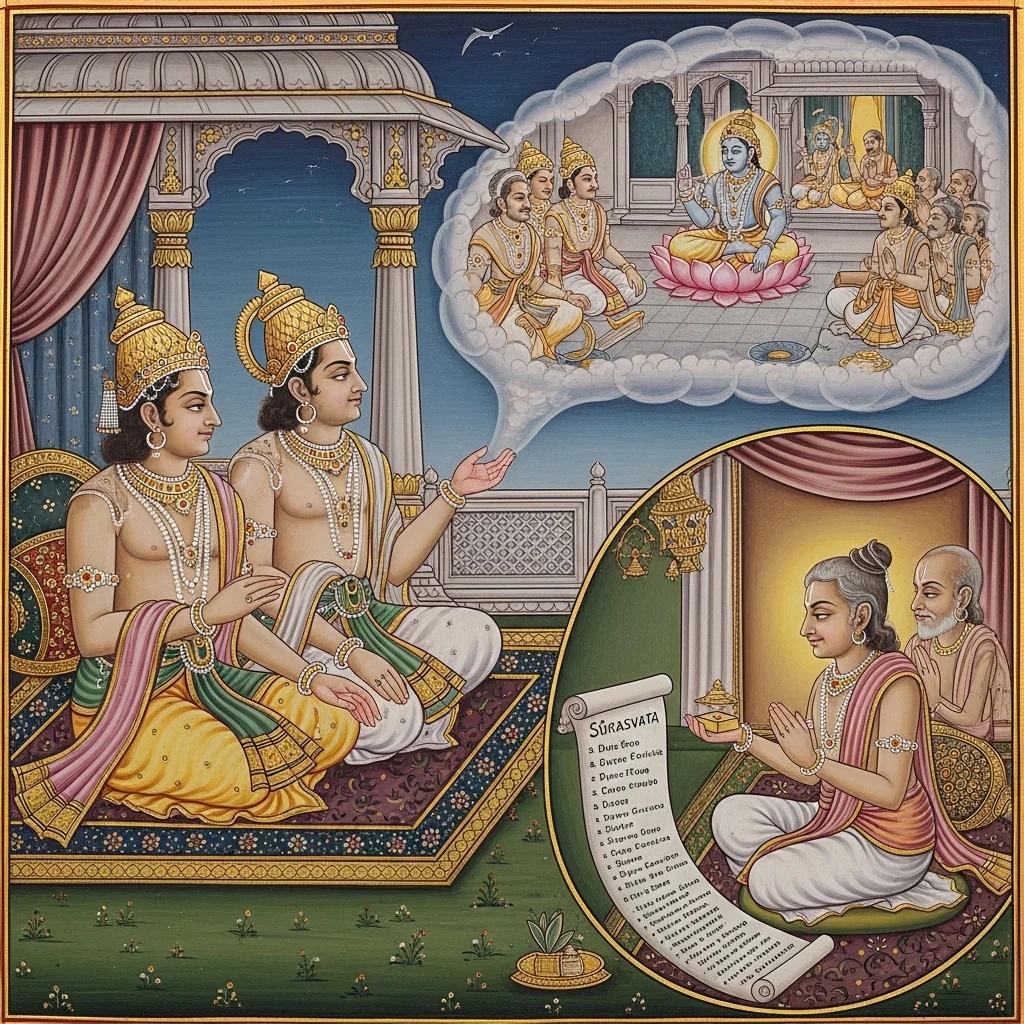
Chapter 2 presents a layered theological dialogue on the ethics of pilgrimage (tīrtha-yātrā) and the discipline of giving (dāna). Sūta recounts Arjuna’s approach to the deva-honored sage Nārada, who praises Arjuna’s dharma-guided intellect and asks whether twelve years of pilgrimage have produced weariness or irritation—thereby stating the central thesis that tīrtha-fruit depends on disciplined use of hands, feet, and mind, not on travel alone. Arjuna affirms the superiority of direct contact with a sacred place and requests the qualities (guṇa) of the present holy setting. Nārada replies by weaving in a cosmographic report: in Brahmaloka, Brahmā questions messengers about wondrous events that bestow merit even by being heard. Suśravas relates Kātyāyana’s inquiry on the bank of the Sarasvatī, where Sārasvata teaches a realistic view of worldly instability and prescribes refuge in “Sthāṇu” (Śiva) through devotion, and especially through dāna. A sustained argument follows: giving is the hardest and most socially verifiable discipline because it requires relinquishing hard-earned wealth; it brings increase rather than loss, serves as a “boat” across saṃsāra, and must be regulated by place, time, the recipient’s worthiness, and purity of mind. Examples of renowned donors reinforce the norm, and the chapter closes with Nārada’s reflection on his own poverty and the practical difficulty of performing dāna, underscoring that ethical intention and discernment are the heart of the practice.
Shlokas
Verse 1
सूत उवाच । ततो द्विजौः परिवृतं नारदं देवपूजितम् । अभिगम्योपजग्राह सर्वानथ स पाण्डवः
Sūta said: Then the Pāṇḍava approached Nārada—honoured even by the gods and surrounded by twice-born sages—and duly greeted them all.
Verse 2
ततस्तं नारदः प्राह जयारातिधनंजय । धर्मे भवति ते बुद्धिर्देवेषु ब्राह्मणेषु च
Then Nārada said to him: “O Dhanaṃjaya, subduer of foes, your understanding is set upon dharma—toward the gods and toward the brāhmaṇas as well.”
Verse 3
कच्चिदेतां महायात्रां वीर द्वादशवारषिकीम् । आचरन्खिद्यसे नैवमथ वा कुप्यसे न च
O hero, as you undertake this great pilgrimage of twelve years, are you not growing weary—nor becoming angered?
Verse 4
मुनीनामपि चेतांसि तीर्थयात्रासु पांडव । खिद्यंति परिकृप्यंति श्रेयसां विघ्नमूलतः
O Pāṇḍava, even the minds of sages grow weary and distressed during pilgrimages to holy fords, because obstacles arise at the very root of their spiritual welfare.
Verse 5
कच्चिन्नैतेन दोषेण समाश्लिष्टोऽसि पांडव । अत्र चांगिरसा गीतां गाथामेतां हि शुश्रुम
O Pāṇḍava, I ask—are you not ensnared by this fault? For here we have indeed heard this very instructive verse sung by an Āṅgirasa.
Verse 6
यस्य हस्तौ च पादौ च मनश्चैव सुसंयतम् । निर्विकाराः क्रियाः सर्वाः स तीर्थफलमश्नुते
He whose hands, feet, and mind are well-restrained—whose every action is free from distortion and passion—he truly enjoys the fruit of pilgrimage.
Verse 7
तदिदं हृदि धार्यं ते किं वा त्वं तात मन्यसे । भ्राता युधिष्ठिरो यस्य सखा यस्य स केशवः
Therefore keep this teaching held in your heart. What do you think, dear one—when your brother is Yudhiṣṭhira and your friend is Keśava?
Verse 8
पुनरेतत्समुचितं यद्विप्रैः शिक्षणं नृणाम् । वयं हि धर्मगुरवः स्थापितास्तेन विष्णुना
Moreover, it is fitting that brāhmaṇas instruct people; for we are teachers of dharma, established in that role by Viṣṇu himself.
Verse 9
विष्णुना चात्र श्रृणुमो गीतां गाथां द्विजान्प्रति
And here we hear a verse sung by Viṣṇu, addressed to the twice-born.
Verse 10
यस्यामलामृतयशःश्रवणावगाहः सद्यः पुनाति जगदा श्वपचाद्विकुंठः । सोहं भवद्भिरुपलब्ध सुतीर्थकीर्तिश्छद्यां स्वबाहुमपि यः प्रतिकूलवर्ती
He whose immersion in hearing the stainless, deathless fame—Vikuṇṭha—purifies the world at once, even to the outcaste: I am that very one, known by you as renowned for the true holy fords (tīrthas), who would even cut off my own arm if it were to act against dharma.
Verse 11
प्रियं च पार्थ ते ब्रूमो येषां कुशलकामुकः । सर्वे कुशलिनस्ते च यादवाः पांडवास्तथा
And, O Pārtha, we tell you what is pleasing: all those for whom you wish well are safe and flourishing—both the Yādavas and the Pāṇḍavas alike.
Verse 12
अधुना भीमसेनेन कुरूणामुपतापकः । शासनाद्धृतराष्ट्रस्य वीरवर्मा नृपो हतः
Just now, Bhīmasena has slain King Vīravarmā—who had been a torment to the Kurus—by the command of Dhṛtarāṣṭra.
Verse 13
स हि राज्ञामजेयोऽभूद्यथापूर्वं बलिर्बली । कंटकं कंटकेनेव धृतराष्ट्रो जिगाय तम्
For he had been unconquerable among kings, like mighty Bali of old; yet Dhṛtarāṣṭra overcame him—like removing a thorn with another thorn.
Verse 14
इत्यादिनारदप्रोक्तां वाचमाकर्ण्य फाल्गुनः । अतीव मुदितः प्राह तेषामकुशलं कुतः
Hearing these words spoken by Nārada, Phālguna (Arjuna), greatly delighted, replied: “How could any misfortune ever arise for such people?”
Verse 15
ये ब्राह्मणमते नित्यं ये च ब्राह्मणपूजकाः । अहं च शक्त्या नियतस्तीर्थानि विचरन्ननु
Those who ever abide by the counsel of the Brāhmaṇas, and those who honor the Brāhmaṇas with worship—while I too, as far as my strength allows, continually journey among the sacred tīrthas…
Verse 16
आगतस्तीर्थमेतद्धि प्रमोदोऽतीव मे हृदि । तीर्थानां दर्शनं धन्यमवगाहस्ततोऽधिकः
Indeed I have reached this sacred tīrtha, and my heart overflows with joy. Blessed is the mere sight of tīrthas—but immersion in them is even more fruitful.
Verse 17
माहात्म्यश्रवणं तस्मादौर्वोपि मुनिरब्रवीत् । तदहं श्रोतुमिच्छामि तीर्थस्यास्य गुणान्मुने
Therefore even the sage Aurva spoke of listening to a tīrtha’s greatness. So I wish to hear, O sage, the virtues of this sacred place.
Verse 18
एतेनैव श्राव्यमेतद्यत्त्वयांगीकृतं मुने । त्वं हि त्रिलोकीं विचरन्वेत्सि सर्वां हि सारताम्
This indeed should be recounted, since you have consented, O sage; for you, roaming through the three worlds, know the very essence of all things.
Verse 19
तदेतत्सर्वतीर्थेभ्योऽधिकं मन्ये त्वदा हृतम्
Therefore I deem this to surpass all other tīrthas—a greatness brought forth and made manifest by you.
Verse 20
नारद उवाच । उचितं तव पार्थैतद्यत्पृच्छसि गुणिन्गुणान् । गुणिनामेव युज्यन्ते श्रोतुं धर्मोद्भवा गुणाः । साधूनां धर्मश्रवणैः कीर्तनैर्याति चान्वहम्
Nārada said: “O Pārtha, it is fitting that you ask about the excellences of the virtuous. Indeed, only the virtuous are worthy to hear the virtues born of dharma; and by daily listening to dharma and by its recitation and praise, the lives of the good advance day by day.”
Verse 21
पापानामसदालापैरायुर्याति यथान्वहम् । तदहं कीर्तयिष्यामि तीर्थस्यास्य गुणान्बहून्
“Just as the wicked squander their life day by day through worthless talk, so now I shall recount the many virtues of this sacred tīrtha.”
Verse 22
यथा श्रुत्वा विजानासि युक्तमंगीकृतं मया । पुराहं विचरन्पार्थ त्रिलोकीं कपिलानुगः
“So that, upon hearing, you may understand that my assent is well-founded: once, O Pārtha, I wandered through the three worlds, following Kapila.”
Verse 23
गतवान्ब्रह्मणो लोकं तत्रापश्यं पितामहम् । स हि राजर्षिदेवर्षिमूर्तामूर्तैः सुसंवृतः
“I went to the world of Brahmā, and there I beheld the Grandsire (Pitāmaha). He was indeed surrounded by royal seers and divine seers—by beings both embodied and unembodied.”
Verse 24
विभाति विमलो ब्रह्मा नक्षत्रैरुडुराडिव । तमहं प्रणिपत्याथ चक्षुषा कृतस्वागतः
Pure Brahmā shone forth like the moon amid the stars. Bowing to him, I was then welcomed by him with a gracious, approving glance.
Verse 25
उविष्टः प्रमुदितः कपिलेन सहैव च । एतस्मिन्नंतरे तत्र वार्तिकाः समुपागताः
Seated in joy together with Kapila, at that very moment the messengers bearing tidings arrived there.
Verse 26
प्रहीयंते हि ते नित्यं जगद्द्रष्टुं हि ब्रह्मणा । कृतप्रणामानथ तान्समासीनान्पितामहः
For they are ever dispatched by Brahmā to observe the worlds. Then Pitāmaha (Brahmā), seeing them seated after offering obeisance, addressed them.
Verse 27
चक्षुषामृतकल्पेन प्लावयन्निव चाब्रवीत् । कुत्र कुत्र विचीर्णं वो दृष्टं श्रुतमथापि वा
As though bathing them with a nectar-like gaze, he spoke: “Where, where have you roamed? What have you seen—or even heard—along the way?”
Verse 28
किंचिदेवाद्भुतं ब्रूत श्रवणाद्येन पुण्यता । एवमुक्ते भगवता तेषां यः प्रवरो मतः
“Tell me something truly wondrous—by hearing which one gains merit.” When the Blessed One had spoken thus, the foremost among them stepped forward.
Verse 29
सुश्रवानाम ब्रह्माणं प्रणिपत्येदमूचिवान् । प्रभोरग्रे च विज्ञप्तिर्यथा दीपो रवेस्तथा
One named Suśravā bowed to Brahmā and said: “O Lord, my report before you is as a lamp before the sun.”
Verse 30
तथापि खलु वाच्यं मे परार्थं प्रेरितेन ते । मुनिः कात्यायनोनाम श्रुत्वा धर्मान्पुनर्बहून्
Yet I must speak—urged by you—for the sake of a higher purpose. There is a sage named Kātyāyana who, having heard many teachings on dharma again and again…
Verse 31
सारजिज्ञासया तस्थावेकांगुष्ठः शतं समाः । ततः प्रोवाच तं दिव्या वाणी कात्यायन श्रृणु
Longing to know the very essence, he stood poised upon a single toe for a hundred years. Then a divine voice spoke to him: “Kātyāyana, listen.”
Verse 32
पुण्ये सरस्वतीतीरे पृच्छ सारस्वतं मुनिम् । स ते सारं धर्मसाध्यं धर्मज्ञोऽभिवदिष्यति
“On the holy bank of the Sarasvatī, ask the sage Sārasvata. That knower of dharma will declare to you the essence—what is to be accomplished through dharma.”
Verse 33
इति श्रुत्वा मुनिवरो मुनिश्रेष्ठमुपेत्य तम् । प्रणम्य शिरसा भूमौ पप्रच्छेदं हृदि स्थितम्
Hearing this, the excellent sage approached that best of sages; bowing with his head to the ground, he asked the very question that had long rested in his heart.
Verse 34
सत्यं केचित्प्रशंसंतितपः शौचं तथा परे । सांख्यं केचित्प्रशंसंति योगमन्ये प्रचक्षते
Some praise truthfulness; others extol austerity and purity. Some commend Sāṃkhya, while others declare Yoga to be the highest path.
Verse 35
क्षमां केचित्प्रशंसंति तथैव भृशमार्ज्जवम् । केचिन्मौनं प्रशंसंति केचिदाहुः परं श्रुतम्
Some praise forbearance (kṣamā), and likewise great straightforwardness. Some praise silence, while others declare that sacred Śruti, the revealed Veda, is the highest.
Verse 36
सम्यग्ज्ञानं प्रशंसंति केचिद्वैराग्यमुत्तमम् । अग्निष्टोमादिकर्माणि तथा केचित्परं विदुः
Some praise right knowledge; some praise supreme dispassion (vairāgya). Others deem rites such as the Agniṣṭoma sacrifice and similar works to be the highest.
Verse 37
आत्मज्ञानं परं केचित्समलोष्टाश्मकांचनम् । इत्थं व्यवस्थिते लोके कृत्याकृत्यविधौ जनाः
Some hold Self-knowledge (ātma-jñāna) to be supreme—where clod, stone, and gold are regarded alike. Thus, in this world as it stands, people become divided about what should and should not be done.
Verse 38
व्यामोहमेव गच्छंति किं श्रेय इति वादिनः । यदेतेषु परं कृत्यम् नुष्ठेयं महात्मभिः
Arguers who debate, “What is truly beneficial?” fall only into confusion. Therefore, among these, whatever is the highest duty should be practiced by the great-souled.
Verse 39
वक्तुमर्हसि धर्मज्ञ मम सर्वार्थसाधकम्
O knower of dharma, you ought to tell me that which accomplishes all aims for me.
Verse 40
सारस्वत उवाच । यन्मां सरस्वती प्राह सारं वक्ष्यामि तच्छृणु । छायाकारं जगत्सर्वमुत्पत्तिक्षयधर्मि च । वारांगनानेत्रभंगस्वद्वद्भंगुरमेव तत्
Sārasvata said: Hear the essence that Sarasvatī spoke to me, which I now proclaim. This whole world is shadow-like, bearing the nature of arising and perishing; truly it is fragile, like the fleeting play of a courtesan’s sidelong glance.
Verse 41
धनायुर्यौवनं भोगाञ्जलचंद्रवदस्थिरान् । बुद्ध्या सम्यक्परामृश्य स्थाणुदानं समाश्रयेत्
Wealth, lifespan, youth, and enjoyments are unsteady like the moon’s reflection in water. Having rightly reflected with discernment, one should take refuge in giving—offering dāna to Sthāṇu (Śiva).
Verse 42
दानवान्पुरुषः पापं नालं कर्तुमिति श्रुतिः । स्थाणुभक्तो जन्ममृत्यू नाप्नोतीति श्रुति स्तथा
Scripture declares that a person who gives in charity is not fit to commit sin. Likewise, scripture declares that one devoted to Sthāṇu (Śiva) does not fall into birth and death.
Verse 43
सावर्णिना च गाथे द्वे कीर्तिते श्रृणु ये पुरा । वृषो हि भगवान्धर्मो वृषभो यस्य वाहनम्
Hear the two gāthās once recited long ago by Sāvarṇi: “Dharma is indeed the blessed Bull; and He whose vehicle is the bull…”
Verse 44
पूज्यते स महादेवः स धर्मः पर उच्यते । दुःखावर्ते तमोघोरे धर्माधर्मजले तथा
That Great God, Mahādeva, is to be worshipped—this is declared to be the highest Dharma. In the whirlpool of sorrow, in dreadful darkness, and in the waters of dharma and adharma that sweep beings along, He alone is the refuge.
Verse 45
क्रोधपंके मदग्राहे लोभबुद्बदसंकटे । मानगंभीरपाताले सत्त्वयानविभूषिते
In the mire of wrath, amid the crocodile of intoxication, in the perilous surge of greed’s bubbles, and in the deep netherworld of pride—fearsome is this ocean of saṃsāra, though it be adorned with the “vehicle” of sattva (apparent goodness).
Verse 46
मज्जंतं तारयत्येको हरः संसारसागरात् । दानं वृत्तं व्रतं वाचः कीर्तिधर्मौ तथायुषः
Hara (Śiva) alone rescues the one who is drowning from the ocean of saṃsāra. Charity, right conduct, vows, disciplined speech, good repute and Dharma—and even longevity—are upheld and fulfilled through refuge in Him.
Verse 47
परोपकरणं कायादसारात्सारमुद्धरेत् । धर्मे रागः श्रुतौ चिंता दाने व्यसनमुत्तमम्
From this perishable body one should draw forth the essence: service to others. Love for Dharma, reflection upon sacred teaching, and a noble “addiction” to giving (charity)—these are best.
Verse 48
इंद्रियार्थेषु वैराग्यं संप्राप्तं जन्मनः फलम् । देशेऽस्मिन्भारते जन्म प्राप्य मानुष्यमध्रुवम्
Dispassion toward the objects of the senses (vairāgya) is the true fruit of birth. Having been born in this land of Bhārata and having gained an impermanent human life, one should strive for that higher aim.
Verse 49
न कुर्यादात्मनः श्रेयस्तेनात्मा वंचतश्चिरम् । देवासुराणां सर्वेषां मानुष्यमतिदुर्लभम्
If one does not pursue one’s own true good, one deceives oneself for a long time. For all—gods and asuras alike—human birth is exceedingly difficult to obtain.
Verse 50
तत्संप्राप्य तथा कुर्यान्न गच्छेन्नरकं यथा । सर्वस्य मूलं मानुष्यं तथा सर्वार्थसाधकम्
Having obtained this human birth, one should act so as not to fall into hell. Human life is the root of all things, and likewise the means for accomplishing every true aim.
Verse 51
यदि लाभे न यत्नस्ते मूलं रक्ष प्रयत्नतः । महता पुण्यमूल्येन क्रीयते कायनौस्त्वया
Even if you do not strive for further gain, at least guard the principal with effort. For this “boat of the body” is purchased by you at the great price of accumulated merit (puṇya).
Verse 52
गंतुं दुःखोदधेः पारं तर यावन्न भिद्यते । अविकारिशरीरत्वं दुष्प्राप्यं वै ततः
To reach the far shore of the ocean of sorrow, cross over while (this body, this means) is not yet broken. For thereafter, a body free from change and decay is indeed hard to obtain.
Verse 53
नापक्रामति संसारादात्महा स नराधमः । तपस्तप्यन्ति यतयो जुह्वते चात्र यज्विनः । दानानि चात्र दीयंते परलोकार्थमादरात्
He who does not withdraw from saṃsāra is a killer of his own Self—such a one is the lowest of men. Here, ascetics practice tapas; sacrificers pour oblations; and gifts are given with reverence for the sake of the world beyond.
Verse 54
कात्यायन उवाच । दानस्य तपसो वापि भगवन्किं च दुष्करम् । किं वा महत्फलं प्रेत्य सारस्वत ब्रवीहि तत्
Kātyāyana said: “O revered one, between charity (dāna) and austerity (tapas), what is truly difficult to perform? And what yields the greatest fruit after death? O Sārasvata, tell me that.”
Verse 55
सारस्वत उवाच । न दानाद्दुष्करतरं पृथिव्यामस्ति किंचन । मुने प्रत्यक्षमेवैतद्दृश्यते लोकसाक्षिकम्
Sārasvata said: “On this earth, nothing is more difficult than sacred giving (dāna). O sage, this is seen directly—witnessed by the world itself.”
Verse 56
परित्यज्य प्रियान्प्राणान्धनार्थे हि महाभयम् । प्रविशंति महालोभात्समुद्रमटवीं गिरिम्
For the sake of wealth, people abandon even their beloved lives; driven by great greed, they enter dreadful perils—the ocean, the wilderness, and the mountains.
Verse 57
सेवामन्ये प्रपद्यंते श्ववृत्तिरिति या स्मृता । हिंसाप्रायां बहुक्लेशां कृषिं चैव तथा परे
Some take up service—called in the Smṛti a “dog-like livelihood”; others, too, take up farming, fraught with harm and many hardships.
Verse 58
तस्य दुःखार्जितस्येह प्राणेभ्योपि गरीयसः । आयासशतलब्धस्य परित्यागः सुदुष्करः
Wealth earned here through suffering—dearer even than one’s life—is exceedingly hard to relinquish, especially when gained through hundreds of exertions.
Verse 59
यद्ददाति यदश्नाति तदेव धनिनो धनम् । अन्ये मृतस्य क्रीडंति दारैरपि धनैरपि
Whatever a wealthy person gives away, and whatever he consumes—only that is truly his wealth. When he dies, others play with what remains: with his family and with his riches.
Verse 60
अहन्यहनि याचंतमहं मन्ये गुरुं यथा । मार्जनं दर्पणस्येव यः करोति दिनेदिने
I regard the one who begs day after day as a teacher; like the daily polishing of a mirror, he causes a person to cleanse himself each day.
Verse 61
दीयमानं हि नापैति भूय एवाभिवर्धते । कूप उत्सिच्यमानो हि भवेच्छुद्धो बहूदकः
What is given away does not diminish; rather, it increases all the more. A well, when regularly replenished, becomes clear and full of water.
Verse 62
एकजन्मसुखस्यार्थे सहस्राणि विलापयेत् । प्राज्ञो जन्मसहस्रेषु संचिनोत्येकजन्मनि
For the pleasures of a single lifetime, one may squander the gains of thousands. But the wise, in one lifetime, gathers merit that supports thousands of births.
Verse 63
मूर्खो हि न ददात्यर्थानिह दारिद्र्यशंकया । प्राज्ञस्तु विसृजत्यर्थानमुत्र तस्य शंकया
The fool does not give wealth here, fearing poverty; but the wise gives away wealth, fearing poverty in the world beyond.
Verse 64
किं धनेन करिष्यंति देहिनो भंगुराश्रयाः । यदर्थं धनमिच्छंति तच्छरीरमशाश्वतम्
What will embodied beings—resting on a fragile support—ever accomplish with wealth? For the sake of that very body they desire riches, yet that body itself is impermanent.
Verse 65
अक्षरद्वयमभ्यस्तं नास्तिनास्तीति यत्पुरा । तदिदं देहिदेहिति विपरीतमुपस्थितम्
The two-syllabled refrain once practiced was “There is not, there is not.” Now that very pair has appeared in reverse as “Give, give!”
Verse 66
बोधयंति च यावंतो देहीति कृपणं जनाः । अवस्थेयमदानस्य मा भूदेवं भवानपि
However many people may admonish a miser saying, “Give!”, the disgrace of not giving remains. Let not such a fate be yours as well.
Verse 67
दातुरेवोपकाराय वदत्यर्थीति देहि मे । यस्माद्दाता प्रयात्यूर्ध्वमधस्तिष्ठेत्प्रतिग्रही
A supplicant says, “I need it—give to me,” for the benefactor’s own good; for the giver rises upward, while the mere receiver remains below.
Verse 68
दरिद्रा व्याधिता मूर्खाः परप्रेष्यकराः सदा । अदत्तदानाज्जायंते दुःखस्यैव हि भाजनाः
Poverty, disease, dull-wittedness, and constant subservience to others arise from charity withheld; indeed, such people become vessels of suffering alone.
Verse 69
धनवंतमदातारं दरिद्रं वाऽतपस्विनम् । उभावंभसि मोक्तव्यौ कंठे बद्धा महाशिलाम्
A wealthy man who does not give, and a poor man who performs no austerity—both deserve to be cast into the waters with a great stone tied to the neck.
Verse 70
शतेषु जायते शूरः सहस्रेषु च पंडितः । वक्ता शतसहस्रेषु दाता जायेत वा न वा
Among hundreds a hero is born; among thousands, a learned man. Among hundreds of thousands, an eloquent speaker arises—but a true giver may be born, or may not be born at all.
Verse 71
गोभिर्विप्रैश्च वेदैश्च सतीभिः सत्यवादिभिः । अलुब्धैर्दानशीलैश्च सप्तभिर्धार्यते मही
The earth is upheld by seven: cows, brāhmaṇas, the Vedas, chaste women, truth-speakers, the ungreedy, and those devoted to charity.
Verse 72
शिबिरौशीनरोङ्गानि सुतं च प्रियमौरसम् । ब्राह्मणार्थमुपाकृत्य नाकपृष्ठमितो गतः
Śibi, the son of Uśīnara, offered even his own limbs and his beloved natural-born son for the sake of a brāhmaṇa, and from here attained the heights of heaven.
Verse 73
प्रतर्द्दनः काशिपति प्रदाय नयने स्वके । ब्राह्मणायातुलां कीर्तिमिह चामुत्र चाश्नुते
Pratarddana, the lord of Kāśī, by giving his own eyes to a brāhmaṇa, attained incomparable fame—both in this world and in the next.
Verse 74
निमी राष्ट्रं च वैदेहो जामदग्न्यो वसुंधराम् । ब्राह्मणेभ्यो ददौ चापि गयश्चोर्वीं सपत्तनाम्
Vaideha Nimi gave away his kingdom; Jāmadagnya (Paraśurāma) gave away the earth; and Gaya too bestowed the land—together with its dependent revenues—upon the Brāhmaṇas.
Verse 75
अवर्षति च पर्जन्ये सर्वभूतनिवासकृत् । वसिष्ठो जीवयामास प्रजापतिरिव प्रजाः
When the rain-clouds withheld their showers, Vasiṣṭha—guardian of the dwelling-place of all beings—sustained and revived the people, even as Prajāpati sustains his creatures.
Verse 76
ब्रह्मदत्तश्च पांचाल्यो राजा बुद्धिमतां वरः । निधिं शंखं द्विजाग्र्येभ्यो दत्त्वा स्वर्गमवाप्तवान्
Brahmadatta, the Pāñcāla king—foremost among the wise—attained heaven after gifting to the best of the twice-born a treasure known as Śaṅkha.
Verse 77
सहस्रजिच्च राजर्षिः प्राणानिष्टान्महायशाः । ब्राह्मणार्थे परित्यज्य गतो लोकाननुत्तमान्
Sahasrajit, the illustrious royal sage, renounced even his beloved life for the sake of the Brāhmaṇas, and thus went to unsurpassed worlds.
Verse 78
एते चान्ये च बहवः स्थाणोर्दानेन भक्तितः । रुद्रलोकं गता नित्यं शान्तात्मानो जितेन्द्रियाः
These—and many others—through devoted giving offered to Sthāṇu (Śiva), have gone to Rudra’s world, ever peaceful in soul and masters of their senses.
Verse 79
एषां प्रतिष्ठिता कीर्तिर्यावत्स्थास्यति मेदिनी । इति संचिंत्य सारार्थी स्थाणुदानपरो भव
Their fame stands established as long as the earth endures. Reflecting thus, O seeker of the highest essence, be devoted to charity offered to Sthāṇu (Śiva).
Verse 80
सोऽपि मोह परित्यज्य तथा कात्यायनोऽभवत्
He too, casting off delusion, thus became a true follower in the lineage of Kātyāyana.
Verse 81
नारद उवाच । एवं सुश्रवसा प्रोक्तां कथामाकर्ण्य पद्मभूः । हर्षाश्रुसंयुतोऽतीव प्रशशंस मुहुर्मुहुः
Nārada said: Hearing this account as spoken by Suśravas, Padmabhū (Brahmā) was filled with tears of joy and praised him again and again.
Verse 82
साधु ते व्याहृतं वत्स एवमेतन्न चान्यथा । सत्यं सारस्वतः प्राह सत्या चैवं तथा श्रुतिः
“Well spoken, dear child—so it is, and not otherwise. Sārasvata declared it as truth; and Śruti, the sacred revelation, likewise affirms it as true.”
Verse 83
दानं यज्ञानां वरूथं दक्षिणा लोके दातारंसर्वभूतान्युपजीवंति दानेनारातीरंपानुदंत दानेन द्विषंतो मित्रा भवंति दाने सर्वं प्रतिष्ठितं तस्माद्दानं परमं वदंतीति
“Charity (dāna) is the very safeguard of sacrifices; it is the sacred dakṣiṇā in the world. All beings depend upon the giver through giving. By charity one drives away adversities; by charity even the hostile become friends. Everything stands established in charity—therefore they declare charity to be supreme.”
Verse 84
संसारसागरे घोरे धर्माधर्मोर्मिसंकुले । दानं तत्र निषेवेत तच्च नौरिव निर्मितम्
In this dreadful ocean of worldly existence, churned by the waves of righteousness and unrighteousness, one should practice dāna (charitable giving); for there it is fashioned like a boat for crossing over.
Verse 85
इति संचिंत्य च मया पुष्करे स्थापिता द्विजाः । गङ्गायमुनयोर्मध्ये मध्यदेशे द्विजाः सृते
Thus reflecting, I established brāhmaṇas at Puṣkara; and brāhmaṇas were also settled in Madhyadeśa, in the land between the Gaṅgā and the Yamunā.
Verse 86
स्थापिताः श्रीहरिभ्यां तु श्रीगौर्या वेदवित्तमाः । रुद्रेण नागराश्चैव पार्वत्या शक्तिपूर्भवाः
By the two revered Haris and by auspicious Gaurī, the foremost knowers of the Vedas were established; by Rudra the Nāgaras were settled, and by Pārvatī those of Śaktipura origin were set in place.
Verse 87
श्रीमाले च तथा लक्ष्म्या ह्येवमादिसुरोत्तमैः । नानाग्रहाराः संदत्ता लोकोद्धरणकांक्षया
Likewise in Śrīmāla, and by Lakṣmī—and by such other exalted deities—many agrahāras (endowed settlements) were granted, out of a desire to uplift the world.
Verse 88
न हि दानफले कांक्षा काचिन्नऽस्ति सुरोत्तमाः । साधुसंरक्षणार्थं हि दानं नः परिकीर्तितम्
O best of the gods, we have no desire whatsoever for the fruit of giving; for our dāna is declared to be for the protection of the righteous (sādhus).
Verse 89
ब्राह्मणाश्च कृतस्थाना नानाधर्मोपदेशनैः । समुद्धरंति वर्णांस्त्रींस्ततः पूज्यतमा द्विजाः
Brāhmaṇas, being duly established, uplift the three varṇas through diverse instructions in dharma; therefore the twice-born (dvijas) are most worthy of honor.
Verse 90
दानं चतुर्विधं दानमुत्सर्गः कल्पितं तथा । संश्रुतं चेति विविधं तत्क्रमात्परिकीर्तितम्
Charity is fourfold: (1) dāna, direct giving; (2) utsarga, a public endowment; (3) kalpita, giving that is assigned and provided; and (4) saṃśruta, giving that is promised and pledged. Thus it is taught in due order.
Verse 91
वापीकूपतडागानां वृक्षविद्यासुरौकसाम् । मठप्रपागृहक्षेत्रदानमुत्सर्ग इत्यसौ
The endowing of wells, stepwells, ponds, trees, places of learning, and divine dwellings—as well as monasteries, water-houses, shelters, and land—this is called ‘utsarga’.
Verse 92
उपजीवन्निमान्यश्च पुण्यं कोऽपि चरेन्नरः । षष्ठमंशं स लभते यावद्यो विसृजेद्द्विजः
Even one who merely lives by relying on these endowments may gain some merit; he obtains a sixth share, so long as the donor—O brāhmaṇa—has not revoked or relinquished the grant.
Verse 93
तदेषामेव सर्वेषां विप्रसंस्थापनं परम् । देवसंस्थापनं चैव धर्मस्तन्मूल एव यत्
Therefore, among all these forms of giving, the supreme act is the proper establishment and support of brāhmaṇas; and likewise the establishment of the gods—temple worship. For dharma is rooted precisely in that foundation.
Verse 94
देवतायतनं यावद्यावच्च ब्राह्मणगृहम् । तावद्दातुः पूर्वजानां पुण्यांशश्चोपतिष्ठति
So long as the deity’s temple endures—and so long as a brāhmaṇa’s house endures—so long does a share of merit accrue to the donor’s ancestors.
Verse 95
एतत्स्वल्पं हि वाणिज्यं पुनर्बहुफलप्रदम् । जीर्णोद्धारे च द्विगुणमेतदेव प्रकीर्तितम्
This ‘trade’ asks but little effort, yet it bestows abundant fruits; and in restoring what has fallen into disrepair, this very merit is proclaimed to be doubled.
Verse 96
तस्मादिदं त्वहमपिब्रवीमि सुरसत्तमाः । नास्ति दानसमं किंचित्सत्यं सारस्वतो जगौ
Therefore I too declare this, O best of the gods: nothing whatsoever equals charity. Truly, thus spoke Sārasvata.
Verse 97
नारद उवाच । इति सारस्वतप्रोक्तां तथा पद्मभुवेरिताम् । साधुसाध्वित्यमोदंत सुराश्चाहं सुविस्मिताः
Nārada said: “Thus, at the words spoken by Sārasvata and likewise affirmed by Padmabhū (Brahmā), the gods and I—greatly astonished—rejoiced, crying ‘Well said! Well said!’”
Verse 98
ततः सभाविसर्गांते सुरम्ये मेरुमूर्धनि । उपविश्य शिलापृष्ठे अहमेतदचिंतयम्
Then, when the assembly was dismissed, upon the lovely summit of Mount Meru, I sat down on a slab of stone and reflected on this matter.
Verse 99
सत्यमाह विरंचिस्तु स किमर्थं तु जीवति । येनैकमपि तद्धृत्तं नैव येन कृतार्थता
“Virañci (Brahmā) spoke truly; but for what purpose does one live—he by whom not even a single act of that charity is undertaken, and by whom life is not made meaningful?”
Verse 100
तदहं दानपुण्यं हि करिष्यामि कथं स्फुटम् । कौपीनदण्डात्मधनो धनं स्वल्पं हि नास्ति मे
Therefore, how shall I clearly accomplish the merit of charity? My wealth is only a loincloth and a staff—indeed, I do not possess even a little money.
Verse 101
अनर्हते यद्ददाति न ददाति तथार्हते । अर्हानर्हपरिज्ञानाद्दानधर्मो हि दुष्करः
When one gives to the unworthy and does not give to the worthy—because discerning the worthy from the unworthy is difficult—indeed the dharma of charity becomes hard to fulfill.
Verse 102
देशेकाले च पात्रे च शुद्धेन मनसा तथा । न्यायार्जितं च यो दद्याद्यौवने स तदश्नुते
He who, with a pure mind, gives what has been righteously earned—considering place, time, and a fit recipient—enjoys its fruit even in youth.
Verse 103
तमोवृतस्तु यो दद्यात्क्रोधात्तथैव च । भुंक्ते दान फलं तद्धि गर्भस्थो नात्र संशयः
But he who gives while veiled in darkness (delusion), or likewise out of anger—he experiences the fruit of that charity while still in the womb; of this there is no doubt.
Verse 104
बालत्वेऽपि च सोऽश्राति यद्दत्तं दम्भकारणात् । दत्तमन्यायतो वित्तं वै चार्थकारणम्
Even in youth a man comes to ruin if he gives in charity out of hypocrisy; and wealth obtained by injustice, when given for worldly gain, likewise leads only to downfall.
Verse 105
वृद्धत्वे हि समश्राति नरो वै नात्र भविष्यति । तस्माद्देशे च काले च सुपात्रे विधिना नरः । शुभार्जितं प्रयुञ्जीत श्रद्धया शाठ्यवर्जितः
In old age a man surely falls into decline—there is no doubt of it. Therefore, in the proper place and at the proper time, to a worthy recipient, one should lawfully offer what has been rightly earned, with faith and free from deceit.
Verse 106
तदेतन्निर्धनत्वाच्च कथं नाम भविष्यति । सत्यमाहुः पुरा वाक्यं पुराणमुनयोऽमलाः
But how could this be possible when one is poor?—Thus people wonder. Yet the stainless sages of old spoke a saying in the Purāṇas, and it is true.
Verse 107
नाधनस्यास्त्ययं लोको न परश्च कथंचन । अभिशस्तं प्रपश्यंति दरिद्रं पार्श्वतः स्थितम्
For the man without wealth, neither this world nor the next seems to exist at all; people look upon the poor standing beside them as though he were cursed and condemned.
Verse 108
दारिद्र्यं पातकं लोके कस्तच्छंसितुमर्हति । पतितः शोच्यते सर्वैर्निर्धनश्चापि शोच्यते
Poverty is treated in the world as though it were a sin—who could praise such a thing? The fallen are pitied by all, and the destitute too are pitied.
Verse 109
यः कृशाश्वः कृशधनः कृशभृत्यः कृशातिथिः । स वै प्रोक्तः कृशोनाम न शरीरकृशः कृशऋ
He whose horses are meagre, whose wealth is meagre, whose servants are meagre, and whose hospitality to guests is meagre—he alone is called ‘truly meagre’, not merely one who is thin in body.
Verse 110
अर्थवान्दुष्कुलीनोऽपि लोके पूज्यतमो नरः । शशिनस्तुल्यवंशोऽपि निर्धनः परिभूयते
Even a man of low lineage, if he has wealth, becomes most honored in the world; but even one of moon-like noble lineage, if poor, is despised and humiliated.
Verse 111
ज्ञानवृद्धास्तपोवृद्धा ये च वृद्धा बहुश्रुताः । ते सर्वे धनवृद्धस्य द्वारि तिष्ठन्ति किंकराः
Those advanced in knowledge, advanced in austerity, and elders learned in many scriptures—all of them stand at the door of the wealthy man like servants.
Verse 112
यद्यप्ययं त्रिभुवने अर्थोऽस्माकं पराग्नहि । तथाप्यन्यप्रार्थितो हि तस्यैव फलदो भवेत्
Even if this wealth is not truly ours in the three worlds, still, when it is asked for by another, giving it becomes fruitful for that very giver, bringing merit.
Verse 113
अथवैतत्पुरा सर्वं चिंतयिष्यामि सुस्फुटम् । विलोकयामि पूर्वं तु किंचिद्योग्यं हि स्थानकम्
Or else, first I shall think through all of this very clearly; and before anything, I will look for some suitable place, fit for the intended act.
Verse 114
स चिंतयित्वेति बहुप्रकारं देशांश्च ग्रामान्नगराणि चाश्रमान् । बहूनहं पर्यटन्नाप्तवान्हि स्थानं हितं स्थापये यत्र विप्रान्
Thinking in many ways, and surveying regions, villages, cities, and hermitages, I wandered far; yet I did not find a truly beneficial place where I might establish the brāhmaṇas.