Adhyaya 35
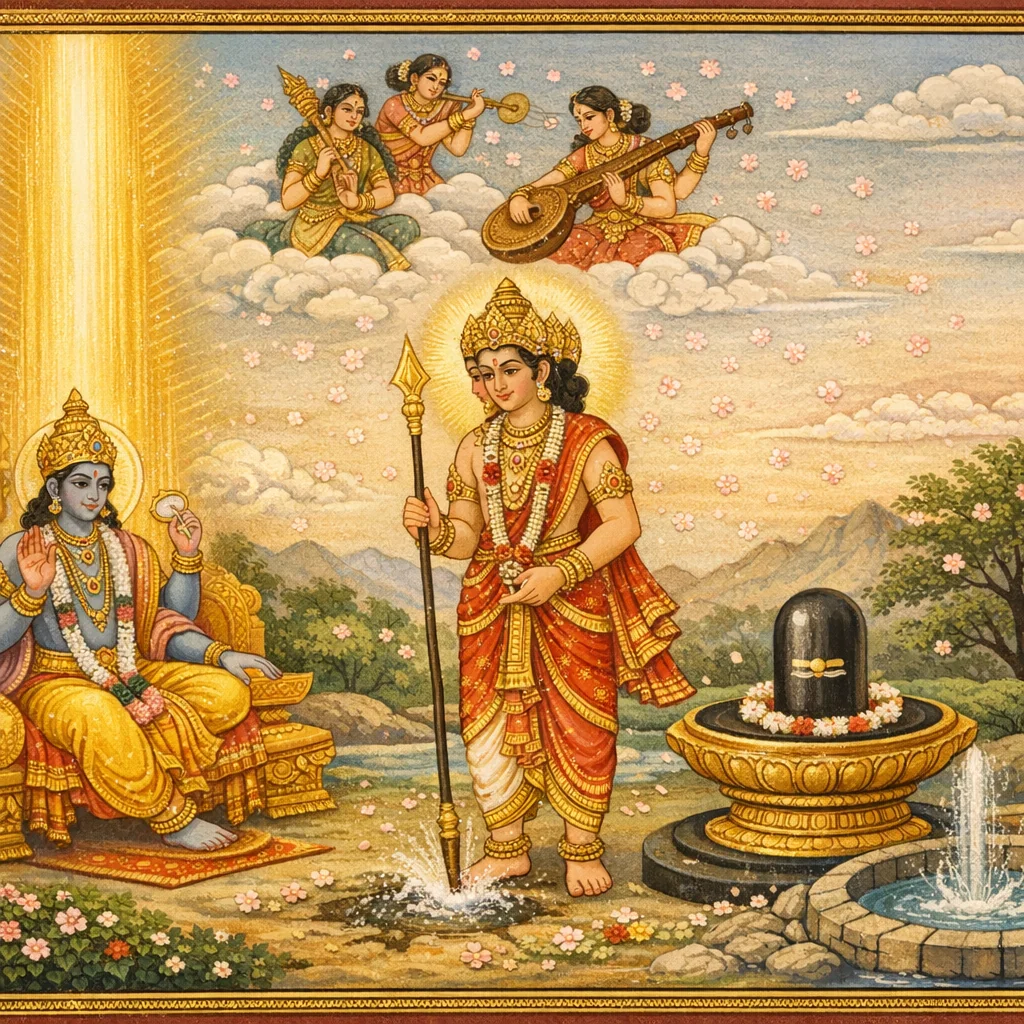
This chapter unfolds a ritual-theological episode framed by Nārada’s inquiry. The gods approach Skanda (Guhā) with folded hands and petition him, citing the victors’ custom that one who conquers enemies in battle should erect a victory-marked pillar (stambha-cihna). To commemorate Skanda’s triumph they propose an excellent pillar, fashioned by Viśvakarman and linked with an eminent liṅga tradition. Skanda agrees, and the devas led by Śakra/Indra install on the battlefield a radiant, jāmbūnada-gold-like pillar; the ritual ground is adorned like a jewel-filled precinct. Apsarases and divine hosts rejoice with song and dance; Viṣṇu is portrayed as providing musical accompaniment, and flowers rain from the sky as a sign of divine approval. The narrative then turns from monument to deity: Skanda, son of the Three-Eyed Lord, establishes Stambheśvara, a liṅga-form of Śiva. Nearby he creates a well (kūpa), from whose depths Gaṅgā is said to arise, joining the sanctity of water with the sanctity of the liṅga. The chapter prescribes ancestral rites: on the fourteenth day of the dark fortnight of Māgha, one who bathes in the well and offers pitṛ-tarpaṇa gains merit equal to Gayā-śrāddha. The phalaśruti adds that worship of Stambheśvara with fragrance and flowers yields lofty merit likened to the Vājapeya, and that śrāddha on new-moon/full-moon days—especially in the imagery of earth meeting ocean—together with Stambheśvara worship satisfies the ancestors, destroys sins, and leads to exaltation in Rudra’s realm. The chapter closes by attributing the teaching to Rudra for Skanda’s delight and affirming that the establishment was successful and praised by all the gods.
Shlokas
Verse 1
नारद उवाच । कुमारेण स्थापितोऽत्र कुमारेशस्ततः सुराः । प्रणम्य गुहमूचुश्च प्रबद्धकरसंपुटाः
Nārada said: Here Kumāreśa was established by Kumāra (Skanda). Then the gods, bowing with palms joined, spoke to Guha (Skanda).
Verse 2
किंचिद्विज्ञापयष्यामो वयं त्वां श्रृणु तत्त्वतः । पूर्वप्रसिद्ध आचारः प्रोच्यते जयिनामयम्
We wish to submit something to you—listen to it in truth. This is an ancient, well-known observance, declared for those who seek victory.
Verse 3
जयंति ये रणे शत्रूंस्तैः कार्यः स्तंभचिह्नकः । तस्मात्तव जयोद्द्योतनिमित्तं स्तंममुत्तमम्
Those who conquer their enemies in battle should set up a pillar as a victory-mark. Therefore, to proclaim your triumph, let an excellent victory-pillar be raised.
Verse 4
नक्षिपाम वयं यावत्त्मनुज्ञातुमर्हसि । विश्वकर्मकृतं यच्च तृतीयं लिंगमुत्तमम्
We shall set it (here) as soon as you grant permission—together with that excellent third Liṅga fashioned by Viśvakarman.
Verse 5
तस्य स्तंभाग्रतसतं च संस्थापय शिवात्मज । एवमुक्ते सुरैः स्कन्दस्ततेत्याह महामनाः
O son of Śiva, establish a hundred (sacred emblems) before that pillar. Thus addressed by the gods, Skanda, the great-souled one, replied, “So be it.”
Verse 6
ततो हृष्टाः सुरगणाः शक्राद्याः स्तंभमुत्तमम् । जांबूनदमयं शुभ्रं रणभूमौ विनिक्षिपुः
Then the hosts of gods—Indra and the rest—rejoicing, set down upon the battlefield an excellent pillar, radiant and made of Jāmbūnada gold.
Verse 7
परितः स्थंडिलं दिक्षु सर्वरत्नमयं तु ते । तत्र हृष्टाश्चाप्सरसो ननृतुर्दशधा शुभाः
All around, in the directions, they made a sacred level ground adorned with every kind of jewel. There the auspicious Apsarases, delighted, danced in tenfold array.
Verse 8
मातरो मंगलान्यस्य जगुः स्कन्दस्य नंदिताः । इंद्राद्या ननृतुस्तत्र स्वयं विष्णुश्च वादकः
The Mothers, gladdened for Skanda’s sake, sang auspicious songs. Indra and the others danced there, and Viṣṇu himself served as the musician.
Verse 9
पेतुः खात्पुष्पवर्षाणि देववाद्यानि सस्वनुः । एवं स्तंभं समारोप्य जयाख्यं विश्वनंदकः
Showers of flowers fell from the sky, and the instruments of the gods resounded. Thus, having set up the pillar named “Jaya” (Victory), Skanda—the delight of the worlds—proceeded onward.
Verse 10
स्तम्भेश्वरस्ततो देवः स्थापितस्त्र्यक्षसूनुना । विरिंचिप्रमुखैर्देवैर्जातानन्दैः समं तदा
Then the Lord Stambheśvara was installed by the son of the Three-Eyed (Śiva), and at that time the gods, led by Viriñci (Brahmā), rejoiced together.
Verse 11
हरिहरादित्युक्तैस्तैः सेन्द्रैर्मुनिगणैरपि । तस्यैव पश्चिमे भागे शक्त्यग्रेण महात्मना
Together with the divinities spoken of as Hari, Hara, and Āditya—along with Indra and the hosts of sages—on the western side of that very sanctuary, the great-souled one, going forth at the fore with his Śakti (sacred spear), performed further rites.
Verse 12
गुहेन निर्मितः कूपो गंगा तत्र तलोद्भवा । माघस्य च चतुर्दश्यां कृष्णायां पितृतर्पणम्
There Guha (Skanda) made a well, and from its depths the Gaṅgā arose. And on the fourteenth lunar day of the dark fortnight in Māgha, the tarpaṇa—libations offered to the Pitṛs (ancestors)—is to be performed there.
Verse 13
कूपे स्नानं नरः कृत्वा भक्त्या यः पांडुनंदन । गयाश्राद्धेन यत्पुण्यं तत्फलं लभते स्फुटम्
O son of Pāṇḍu, whoever devoutly bathes in that well clearly attains the very same merit that is gained by performing the śrāddha rites at Gayā.
Verse 14
स्तंभेश्वरं ततो देवं गन्धपुष्पैः प्रपूजयेत् । वाजपेयफलं प्राप्य मोदते रुद्रसद्मानि
Then one should worship the god Staṃbheśvara with fragrances and flowers; gaining the fruit of the Vājapeya sacrifice, one rejoices in the abodes of Rudra.
Verse 15
पौर्णमास्याममावास्यां महीसागरसंगमे । श्राद्धं कृत्वा च योऽभ्यर्च्चेंत्स्तंभेश्वरमकल्मषः
At the confluence of the Mahī River and the ocean, on the full-moon day or the new-moon day, whoever performs śrāddha and then worships Staṃbheśvara becomes free from impurity.
Verse 16
पितरस्तस्य तृप्यंति तृप्ता यच्छंति चाशिषः । स भित्त्वा सर्वपापानि रुद्रलोके महीयते
His ancestors are satisfied, and, being satisfied, they bestow blessings upon him. Having shattered all sins, he is honored in Rudra’s world.
Verse 17
इत्याह भगवान्रुद्रः स्कन्दस्य प्रीतये पुरा । एवमेव चतुर्थं च स्थापितं लिंगमुत्तमम्
Thus, long ago, the Blessed Rudra spoke for Skanda’s delight. In this very manner, a fourth excellent liṅga was also established.
Verse 18
प्रणेमुर्देवताः सर्वे साधुसाध्विति ते जगुः
All the deities bowed down, and they exclaimed, “Well done! Well done!”