Adhyaya 36
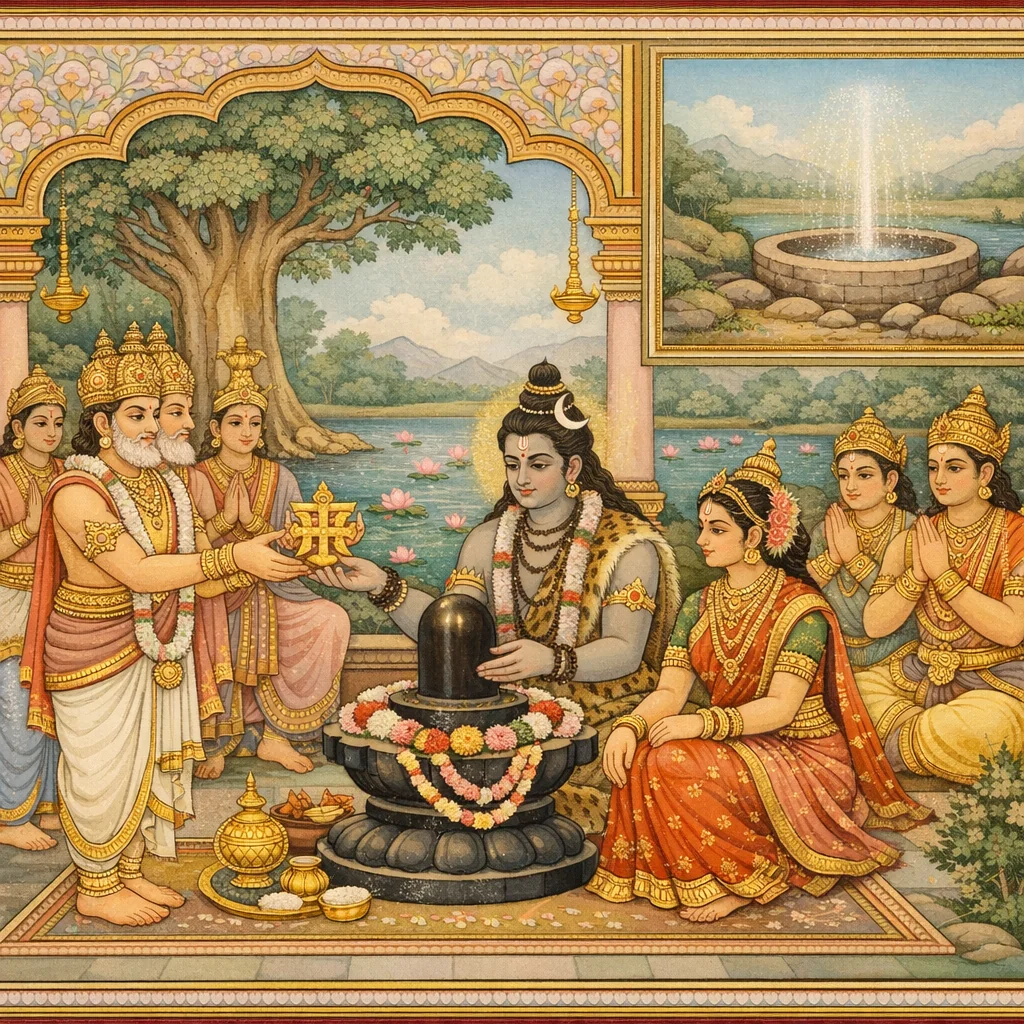
This adhyāya unfolds a connected series of kṣetra-formation themes. Seeing the many liṅgas earlier established by Skanda at the meeting of land and sea, the assembled devas—led by Brahmā, Viṣṇu, and Indra—reflect on the difficulty of scattered worship and resolve to found one auspicious liṅga for collective devotion and the stability of the region. With Maheśvara’s consent they install a liṅga made by Brahmā; Guha names it Siddheśvara, and a sacred pond is dug and filled with tīrtha waters. The narrative then turns to a crisis in Pātāla: the nāgas report the demon Pralamba’s ravages after fleeing the Tāraka war. Skanda sends his śakti to the netherworld; she pierces the earth, slays Pralamba, and the resulting fissure fills with the purifying waters of the Pātāla-Gaṅgā. Skanda names the place Siddhakūpa and prescribes observances—especially on kṛṣṇāṣṭamī and caturdaśī—bathing, worship of Siddheśvara, and śrāddha, promising the removal of sins and enduring ritual fruit. The chapter further establishes the kṣetra by installing Siddāmbikā, appointing kṣetrapālas (including a set of sixty-four Mahēśvaras), and founding Siddhivināyaka to ensure success in all beginnings. A concluding phalāśruti praises recitation or hearing as bestowing prosperity, protection, and ultimately nearness to Ṣaṇmukha’s realm.
Shlokas
Verse 1
नारद उवाच । एवं दृष्ट्वा क्षितौ तानि लिंगानि हरसूनुना । हरिब्रह्मेंद्रप्रमुखा देवाः प्रोचुः परस्परम्
Nārada said: Seeing those liṅgas upon the earth, established by Hara’s son, the gods—led by Hari, Brahmā, and Indra—spoke among themselves.
Verse 2
अहो धन्यः कुमारोऽयं महीसागरसंगमे । येन चत्वारी लिंगानि स्तापितानि सुदुर्लभे
Ah! Blessed is this Kumāra at the confluence of the Mahī and the Ocean, by whom four liṅgas—so rare to obtain—have been established.
Verse 3
वयमप्यत्र शुद्ध्यर्थं तोषार्थं स्कन्दरुद्रयोः । साध्वर्थे चात्मलाभाय कुर्मो लिंगपरंपराम्
We too, for purification here, for the satisfaction of Skanda and Rudra, for the good, and for our own spiritual gain, shall establish a succession of liṅgas.
Verse 4
अथवा कोटिशो देवा मुनयो नैव संख्यया । सर्वे चेत्स्थापयिष्यंति लिंगान्यत्र महीतटे
Or else, gods in crores and sages beyond counting—if all of them were to establish liṅgas here on this riverbank—(the place would become supremely sanctified).
Verse 5
पूजा तेषां कतं भावि बहुत्वाच्चात्र पठ्यते । यस्य राष्ट्रे रुद्रलिंगं पूज्यते नैव शक्तितः
“How can their worship be properly carried out? For they are many, as is recounted here. In whatever kingdom the Rudra-liṅga is not worshipped with due capacity and devotion,”
Verse 6
तस्य सीदति तद्राष्ट्रं दुर्भिक्षव्याधितस्करैः । संभूय स्थापयिष्यामो लिंगमेकं ततः शुभम्
Then that kingdom declines, afflicted by famine, disease, and thieves. Therefore, assembling together, we shall establish one auspicious liṅga.
Verse 7
इति कृत्वा मतिं सर्वे प्राप्यानुज्ञां महेश्वरात् । प्रहर्षिता सुहश्चैव हरिब्रह्ममुखाः सुराः
Having thus formed this decision, and obtaining permission from Maheśvara, the gods—led by Hari and Brahmā—became joyful and pleased.
Verse 8
भूमिभागं शुभं वीक्ष्य विजने लिंगमुत्तमम् । स्थापयामासुरथ ते स्वयं ब्रह्मविनिर्मितम्
Then, after observing an auspicious tract of land in a solitary place, they installed the supreme liṅga—one fashioned by Brahmā himself.
Verse 9
सिद्धार्थैः स्तापितं यस्मा द्देवैर्ब्रह्मादिभिः स्वयम् । सिद्धेश्वरमिति प्राह नाम लिंगस्य वै गुहः
Because it was installed for the accomplishment of divine purposes by the gods themselves—headed by Brahmā—Guha (Skanda) declared the name of that liṅga to be ‘Siddheśvara’.
Verse 10
सर्वैर्देवैस्तत्र लिंगे खानितं सर उत्तमम् । सर्वतीर्थोदकैः शुभ्रैः पूरितं च महात्मभिः
There, by all the gods, an excellent lake was dug near that liṅga, and it was filled by the great-souled ones with pure waters brought from all sacred bathing-places.
Verse 11
एतस्मिन्नंतरे पार्थ पातालाच्छेषनंदनः । कुमुदोनाम आगत्य प्राह शेषाहिपन्नगान्
At that very moment, O Pārtha, Kumuda by name—the son of Śeṣa—rose up from Pātāla and addressed the serpents, the nāgas of Śeṣa’s lineage.
Verse 12
अस्मिंस्तारकयुद्धे तु प्रलंबोनाम दानवः । पलायित्वा स्कंदभीत्या पापः पातालमाविशत्
In this war with Tāraka, a dānava named Pralaṃba—sin-stained and terrified of Skanda—fled and entered Pātāla.
Verse 13
स वो वसूनि पुत्रांश्च भार्याः कन्या गृहाणि च । विध्वंसयति नागेंद्राः शीघ्रं धावतधावत
“He is laying waste to your wealth, your sons, your wives, your daughters, and your homes. O lords of the nāgas—quickly, run, run!”
Verse 14
शेषात्मजस्य तद्वाक्यं कुमदस्य निशम्यते । औत्सुक्यमापुर्नागेंद्रा यामयामेति वादिनः
Hearing those words of Kumuda, the son of Śeṣa, the nāga-lords grew anxious and, saying “Let us go, let us go,” they hastened to act.
Verse 15
तान्निवार्य ततः स्कंदः क्रुद्धः शक्तिमथाददे । पातालाय मुमोचाथ प्रोच्य दैत्यो निहन्यताम्
Restraining them, Skanda, wrathful, took up his sacred spear (śakti). He hurled it down toward Pātāla, declaring, “Let that daitya be slain.”
Verse 16
ततः स्कंदभुजोत्सृष्टा भुवं निर्भिद्य वेगतः । प्रविष्टा सहसा शक्तिर्यथा दैवं नरं प्रति
Then the spear, released from Skanda’s arm, swiftly pierced the earth and suddenly entered the nether regions—as destiny rushes upon a man.
Verse 17
सा तं हत्वा प्रलंबं च कोटिभिर्दशभिर्वृतम् । नंदयित्वा गता नागाञ्जलकल्लोपूर्विका
That spear slew him, and also Pralamba, who was surrounded by ten crores of attendants. Having gladdened the Nāgas, it went on toward Jalakallopūrvikā.
Verse 18
यांत्या शक्त्या तया पार्थ यत्कृतं विवरं भुवि । पातालगंगातोयेन पूरितं पापहारिणा
O Pārtha, the opening that was made in the earth by that departing spear was filled with the water of the Pātāla-Gaṅgā—water that removes sin.
Verse 19
तस्य नाम ददौ स्कंदः सिद्धकूप इति स्मृतः । कृष्माष्टम्यां चतुर्दश्यामुपवासी नरः स्वयम्
Skanda bestowed a name upon it; it is remembered as “Siddhakūpa” (the Well of Attainment). On Kṛṣṇāṣṭamī and on the fourteenth lunar day, a man should himself observe fasting.
Verse 20
स्नात्वा कूपेऽर्चयेदीशं सिद्धेश्वरमनन्यधीः । प्रभूतभवसंभूतपापं तस्य विलीयते
Having bathed in the well, let one worship the Lord Siddheśvara with undivided mind. The abundant sins born of worldly existence for that person dissolve away.
Verse 21
सिद्धकुंडे च यः स्नात्वा श्राद्धं कुर्याद्विचक्षणः । सर्वकल्मषनिर्मुक्तो भक्तियोग्यो भवेभवे
Whoever, being discerning, bathes in Siddhakuṇḍa and performs śrāddha is freed from all defilements and becomes fit for the yoga of devotion, life after life.
Verse 22
वृश्चाप्यक्षयस्तस्य तुष्टो रुद्रो वरं ददौ । प्रयाग वटतुल्योऽयमेतत्सत्यं न संशयः
Even his (ancestral) offering becomes inexhaustible; pleased, Rudra granted this boon: “This place is equal to the Akṣayavaṭa of Prayāga—this is true, without doubt.”
Verse 23
अत्रागत्य महाभागः क्षाद्धं कुर्यात्सुभक्तितः । पितॄणामक्षयं तच्च सर्वेषां पिंडपातनम्
Coming here, O fortunate one, let a person perform śrāddha with true devotion. That becomes an inexhaustible benefit for the Pitṛs, and it serves as the offering of piṇḍas for all one’s ancestors.
Verse 24
ततो ब्रह्मादयो देवाः स्कंदेन सहितास्तदा । सिद्धांबिकां महाशक्तिं प्रार्थयामासुरीश्वरीम्
Then Brahmā and the other gods, together with Skanda, prayed to the sovereign Goddess—Siddhāmbikā, the Great Power (Mahāśakti).
Verse 25
त्वयाविष्टो हि भगवान्मत्स्यरूपी जनार्दनः । जगदुद्धारणार्थाय चक्रे कर्माम्यनेकशः
Indeed, Janārdana, taking the form of the Fish (Matsya), was impelled by you; for the sake of rescuing the world, he performed many mighty deeds.
Verse 26
इति तां प्रार्थयामासुरत्र त्याज्यं न ते शुभे । अत्र स्थिताः सर्व इमे क्षेत्रपाला महाबलाः
Thus they implored her: “O auspicious one, do not forsake this place. Here stand all these mighty guardians of the sacred field (kṣetrapālas).”
Verse 27
अष्टम्यां वा चतुर्दश्यां बलिपुष्पैश्च त्वां शुभे । ये पूजयंति ते पाल्याः सर्वापत्सु च या सदा
“O auspicious one, those who worship you on the Aṣṭamī or on the Caturdaśī—offering bali and flowers—are to be protected by you at all times, in every adversity.”
Verse 28
एवमुक्ता सिद्धमाता तथेति प्रत्यपद्यत । स्थापयामासुरथ तां लिंगादुत्तरभागतः
Thus addressed, Siddhamātā assented, saying, “So be it.” Then they installed her to the north of the Liṅga.
Verse 29
ततः क्षेत्रपतीन्देवाश्चतुःषष्टिं महेश्वरम् । सिद्धेयं नाम क्षेत्रस्य रक्षार्थं निदधुः स्वयम्
Thereafter, the gods themselves appointed sixty-four great lords, Mahēśvaras, as kṣetrapatis (rulers and guardians) for the protection of the kṣetra called Siddheyā.
Verse 30
त्वां च ये पूजयिष्यंति कार्यारभेषु सर्वदा । वर्षे वर्षे राजमाषबलिना च विशेषतः
And those who will worship you at the commencement of their undertakings, always—especially year after year with an offering of black gram (rājamāṣa) as bali—
Verse 31
तानसौ पालयेत्तुष्टः पिता लोकानिव स्वकान् । सिद्धिकृतो देवास्तत्र सिद्धिविनायकम्
Pleased, he will protect those people, as a father protects his own children. There the gods—bestowers of success—also established Siddhivināyaka.
Verse 32
कपर्दितनयं प्रार्थ्य स्थापयाचक्रिरे मुदा । तं च ये पूजयंत्यत्र कार्यारंभेषु सर्वदा
Having invoked Kapardita’s son, they joyfully installed him. And those who worship him here, always at the start of their undertakings—
Verse 33
तेषां सिद्धिं ददात्येष प्रबलो विघ्नराड्भवः । यद्यत्र पूजयेद्यस्तु सततं सिद्धसप्तकम्
—to them this mighty Lord of obstacles, Vighnarāj, grants success. And whoever here continually worships the “Siddha-saptaka”, the Seven Siddha presences—
Verse 34
पश्येद्वा स्मरते वापि सर्वदोषैर्विमुच्यते । सिद्धेश्वरः सिद्धवटश्च साक्षात्सिद्धांबिका सिद्धविनायकश्च । सिद्धेयक्षेत्राधिपतिश्च सिद्धसरस्तथा सिद्धकूपश्च सप्त
Whether one beholds them or even remembers them, one is freed from all faults. The Seven are: Siddheśvara, the Siddha-vaṭa, Siddhāmbikā herself, Siddhivināyaka, the Lord of Siddheyā-kṣetra, Siddha-saras (the sacred lake), and Siddha-kūpa (the holy well).
Verse 35
अत्र तुष्टो ददौ रुद्रः सुराणां दुर्लभान्वरान् । वैशाखमासस्याष्टम्यां कृष्णायां सिद्धकूपके
Here, being pleased, Rudra granted boons difficult to obtain even for the gods—at Siddhakūpa, on the Aṣṭamī, the eighth lunar day of the dark fortnight in the month of Vaiśākha.
Verse 36
स्नात्वा पिंडान्वटे कृत्वा पूजयन्मां च सिद्धभाक् । सदा योऽभ्यर्चयेन्मां च ब्रह्मचारी जितेंद्रियः
Having bathed, and having offered piṇḍa-oblations at the banyan tree, and worshipping Me, he becomes a recipient of siddhi. Whoever always worships Me—abiding in brahmacarya and with senses conquered—attains that fulfillment.
Verse 37
अष्टाविष्टकरा नित्यं भवेयुस्तस्य सिद्धयः । मंत्रजाप्यं बलिं होममत्र यः कुरुते नरः
His accomplishments become ever “eight-and-twentyfold” in effect. The man who, at this place, performs mantra-recitation, offerings (bali), and fire-oblation (homa) attains such siddhis.
Verse 38
एकचित्तः शुचिर्भूत्वा सोऽभूष्टां सिद्धिमाप्नुयात् । समाहितमनाश्चाथ सिद्धेशं यस्तु पश्यति
Becoming pure and one-pointed in mind, he attains the desired accomplishment. And then, with a collected mind, whoever beholds Siddheśa, the Lord of Siddhi, gains the fruit.
Verse 39
तस्य सिद्धिर्भवत्येव विघ्नैर्यदि न हन्यते । सिद्धांबिका महादेवी ह्यत्र संनिहितास्ति या
For him, success surely arises—provided it is not struck down by obstacles. For here abides Siddhāmbikā, the great Goddess, present in this very place.
Verse 40
सिद्धिदा साधकेंद्राणां महाविद्यां जपंति ये । धीरेभ्यो ब्रह्मचारिभ्यः सत्यचित्तेभ्य एव च
She is the giver of siddhi to the foremost of practitioners—those who repeat the Mahāvidyā. She grants it to the steadfast, to brahmacārins, and indeed to those whose minds are rooted in truth.
Verse 41
मंत्रजाप्याद्ददात्येषा सर्वसिद्धीर्यथोप्सिताः । पातालस्य बिलं चैतद्गुहशक्त्या कृतं महत्
Through mantra-recitation, She bestows all siddhis exactly as desired. Moreover, this great cavern of Pātāla has been made by the power of Guha (Skanda).
Verse 42
सिद्धां बिकाप्रसादेन विघ्नक्षेत्रपयोर्मम । प्रत्यक्षं भविता यत्र नानाश्चर्याणि भूरिशः
By the grace of Siddhāmbikā, at this field where obstacles are overcome and at this sacred water, many and varied wonders will become directly manifest.
Verse 43
अत्र सिद्धिं प्रयास्यंति कोटिशः पुरुषाः सुराः । विद्याधरत्वं देवत्वं गंधर्वत्वं च नागता
Here, millions of beings—men and even gods—strive for and attain siddhi. Here one gains the state of a Vidyādhara, divine status, the condition of a Gandharva, and even Nāga-nature.
Verse 44
यक्षत्वं चामरत्वं च प्राप्स्यंत्यत्र च साधकाः । अत्र वै विजयोनाम स्थंडिलस्य प्रभावतः
Here, practitioners also attain Yakṣa-hood and even Amara-hood (immortal divine status). Indeed, this occurs by the power of the altar-ground called Vijaya.
Verse 45
सिद्धांबिकां समाराध्य सिद्धिमाप्स्यति दुर्लभाम् । यो मां द्रक्ष्यति चात्रस्थं यश्च मां पूजयिष्यति । वादप्रचारतो वापि पुण्यावाप्तिर्भविष्यति
Having duly worshipped Siddhāmbikā, one attains a rare and difficult-to-obtain spiritual success (siddhi). Whoever beholds me established here, and whoever worships me—indeed, even by speaking of this and spreading its account—will gain merit (puṇya).
Verse 46
नारद उवाच । त्र्यंबकेण वरेष्वेवं दत्तेष्वपि सुरोत्तमाः
Nārada said: Even after Tryambaka (Śiva) had thus granted the boons, the foremost of the gods…
Verse 47
प्रहृष्टाः समपद्यंत गाथां चेमां जगुस्तदा । तेन यज्ञैर्जपैःस्तोत्रैस्तपो भिस्तोषिता वयम्
Rejoicing, they gathered together and then sang this hymn: “By those sacrifices, recitations (japa), praises, and austerities, we have been satisfied.”
Verse 48
सर्वे देवाः सिद्धिलिंगं यो नरः पूजयिष्यति । सर्वकामफलावाप्तिरित्येवं शंकरोऽब्रवीत्
“All the gods are pleased: the man who worships the Siddhiliṅga will obtain the fruits of all desired aims.” Thus Śaṅkara declared.
Verse 49
इत्युक्त्वा ते जयं प्राप्ताः स्कंदेन सहिताः सुराः । काराय्यं रम्यप्रासादान्रम्यैस्तारकसंभवैः
Having spoken thus, those gods—accompanied by Skanda—attained victory. They had splendid mansions built, adorned with beautiful treasures obtained from the defeat of Tāraka’s lineage.
Verse 50
चतुर्वर्गफलावाप्तिं दत्त्वा क्षेत्रस्य संययुः । केचित्स्कंदं प्रशंसंतस्तीर्थमन्ये हरिं परे
Having bestowed upon that sacred region the attainment of the fruits of the four aims of life (dharma, artha, kāma, mokṣa), they departed. Some praised Skanda; others praised the tīrtha; and others praised Hari.
Verse 51
केचिल्लिंगानि पंचापि युद्धं केचिद्दिवं ययुः । ततोंऽतरिक्षे चालिंग्य महासेनं हरोऽब्रवीत्
Some took up all five liṅgas; some went to battle; and some went to heaven. Then, in mid-air, embracing Mahāsena, Hara spoke.
Verse 52
सप्तमे मारुतस्कंधे व स नित्यं प्रियात्मज । कार्येष्वहं त्वया पुत्र संप्रष्टव्यः सदैव हि
“In the seventh division—within the Māruta-skandha—this will be taught continually, O beloved son. In all undertakings, my child, you should always consult me.”
Verse 53
दर्शनान्मम भक्त्या च श्रेयः परमवाप्स्यसि । स्तंभतीर्थे च वत्स्येऽहं न विमोक्ष्यामि कर्हिचित्
“By my darśana and by devotion to me, you will attain the highest good. And at the Staṃbha-tīrtha I shall dwell—I will never abandon it at any time.”
Verse 54
इत्युक्त्वा विससर्जैनं परिष्वज्य महेश्वरः । ब्रह्मविष्णुमुखांश्चैव भक्त्या तैरभिनंदितः
Having said this, Maheśvara embraced him and then dismissed him. And Brahmā, Viṣṇu, and the others honored him with devotion.
Verse 55
विसर्जिताः सुराजग्मुः स्वानिस्वान्यालयानि च । शर्वो जगाम कैलासं स्कंधं वै सप्तमं गुहः
Thus dismissed, the gods departed each to their own abodes. Śarva (Śiva) went to Kailāsa, and Guha (Skanda) proceeded to the seventh Skandha (peak/region).
Verse 56
इत्येतत्कथितं पार्थ लिंगपंचकसंभवम् । यः पठेत्स्कंदसंबद्धां कथां मर्त्यो महामतिः
Thus, O Pārtha, the origin connected with the five Liṅgas has been declared. Any wise mortal who recites this account related to Skanda—
Verse 57
श्रृणुयाच्छ्रावयेद्वापि स भवेत्कीर्तिमान्नरः । बह्वायुः सुभगः श्रीमान्कांतिमाञ्छुभदर्शनः
Whether one listens to it or causes it to be heard, that person becomes renowned. He gains long life, good fortune, prosperity, radiance, and an auspicious presence.
Verse 58
भूतेभ्यो निर्भयश्चापि सर्वदुःखविवर्जितः । शुचिर्भूत्वा पुमान्यश्च कुमारेश्वरसन्निधौ
He becomes fearless even of spirits and is freed from every sorrow. And any person who becomes pure in the presence of Kumāreśvara—
Verse 59
श्रृणुयात्स्कंदचरितं महाधनपतिर्भवेत् । बालानां व्याधिदुष्टानां राजद्वारोपसेविनाम्
By listening to the deeds of Skanda, one may become a great lord of wealth. (This narration is especially beneficial) for children, for those afflicted by disease, and for those who must attend upon royal courts.
Verse 60
इदं तत्परमं धन्यं सर्वदोषहरं सदा । तनुक्षये च सायुज्यं षण्मुखस्य व्रजेन्नरः
This indeed is supremely blessed and ever removes all faults. And when the body falls away, the person attains sāyujya—union with Ṣaṇmukha (Skanda).
Verse 61
वरमेनं ददुर्देवाः स्कंदस्याथ गता दिवम्
Then the gods granted him that boon for Skanda’s sake, and afterward they went to heaven.