Adhyaya 61
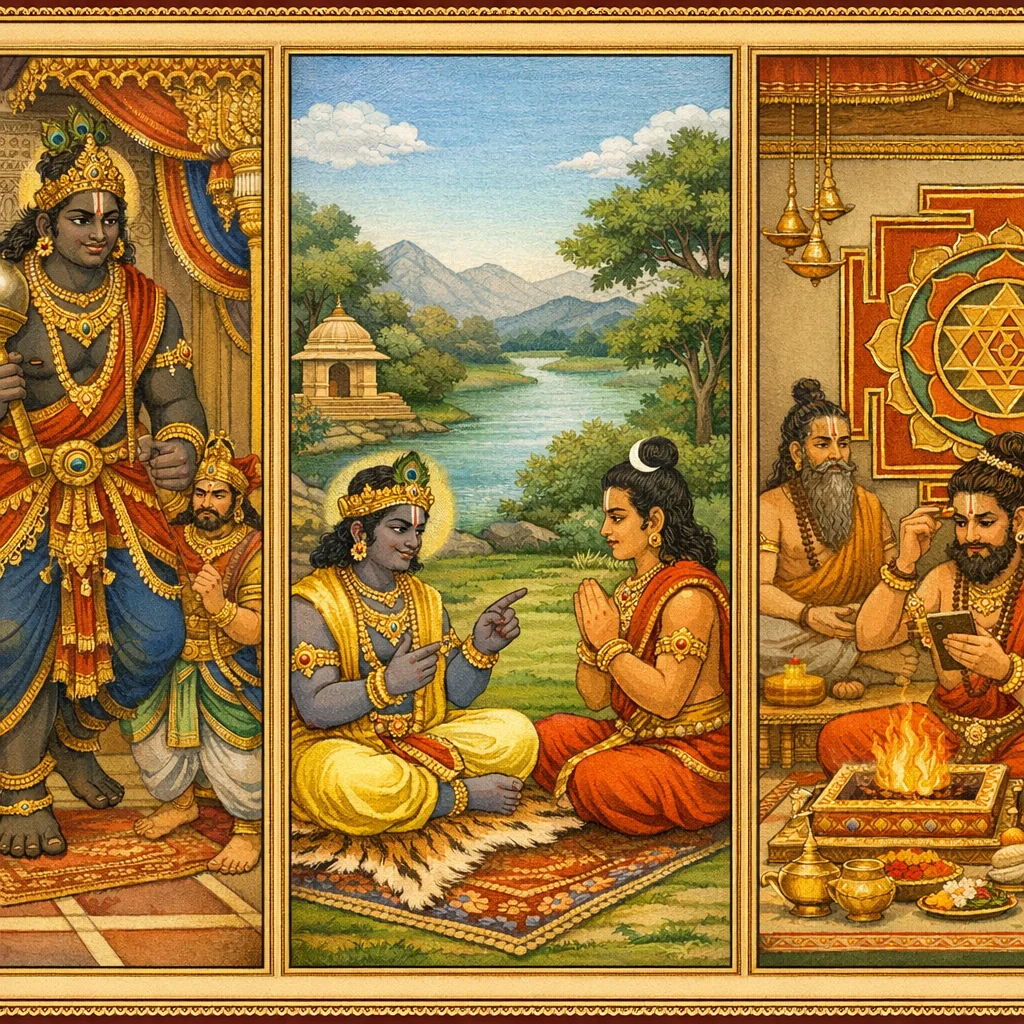
Adhyāya 61 opens with a courtly, theological episode in Dvārakā and then turns to practical ritual instruction. Ghaṭotkaca arrives with his son Barbarīka and is first mistaken for a hostile rākṣasa, but is recognized as a devotee seeking audience. In the assembly Barbarīka asks Śrī Kṛṣṇa what true “śreyas” is amid rival claims—dharma, austerity, wealth, renunciation, enjoyment, and liberation. Kṛṣṇa answers with a varṇa-based ethic: brāhmaṇas for study, restraint, and tapas; kṣatriyas for trained strength, chastising the wicked and protecting the good; vaiśyas for pastoral/agricultural and commercial knowledge; śūdras for service and crafts that support the twice-born, along with basic devotional duties. Since Barbarīka is kṣatriya-born, Kṛṣṇa directs him first to gain unsurpassed bala through Devī-ārādhana at Guptakṣetra, worshipping many goddesses (digdēvīs and Durgā forms) with offerings and hymns. Their satisfaction is said to bestow strength, prosperity, fame, family welfare, heaven, and even mokṣa. Kṛṣṇa names him “Suhṛdaya” and sends him there; after sustained tri-kāla worship the goddesses appear, empower him, and advise continued residence for victorious association. A brāhmaṇa named Vijaya then comes seeking vidyā-siddhi; by dream-oracle the goddesses instruct him to enlist Suhṛdaya’s help. The chapter concludes with a detailed night-ritual sequence—fasting, shrine worship, mandala construction, protective stakes, weapon consecration, and an extensive Gaṇapati mantra with tilaka/pujā/homa procedures to remove obstacles and accomplish intended aims—ending with the chapter colophon.
Shlokas
Verse 1
सूत उवाच । ततो घटोत्कचो मुक्त्वा तत्र कामकटंकटाम् । पुत्रेणानुगतो धीमान्वियता द्वारकां ययौ
Sūta said: Then the wise Ghaṭotkaca, leaving Kāmakataṅkaṭā there, set out through the sky for Dvārakā, accompanied by his son.
Verse 2
आगच्छन्तं च तंदृष्ट्वा राक्षसं राक्षसानुगम् । द्वारकावासिनो योधाश्चक्रुरत्युल्बणं रवम्
Seeing that rākṣasa approaching, attended by other rākṣasas, the warriors dwelling in Dvārakā raised a very fierce outcry.
Verse 3
ग्रामे ग्रामे सुसंनद्धा नवलक्षमिता रथाः । राक्षसौ द्वौ समायातौ पात्येतां विशिखैरिति
In village after village, well-armed chariots—countless in number—were made ready, saying, “Two rākṣasas have come; let them be felled with arrows.”
Verse 4
तान्गृहीतायुधान्दृष्ट्वा यदुवीरान्घटोत्कचः । प्रगृह्य विपुलं बाहुं जगौ तारस्वरेण सः
Seeing the Yadu heroes with weapons in hand, Ghaṭotkaca lifted his mighty arm and spoke out in a loud, clear voice.
Verse 5
राक्षसं वित्त मां वीरा भीमपुत्रं घटोत्कचम् । सुप्रियं वासुदेवस्य प्रणामार्थमुपागतम्
“Know me, heroes: I am the rākṣasa Ghaṭotkaca, son of Bhīma—dear to Vāsudeva—who has come here to offer salutations.”
Verse 6
निवेदयत मां प्राप्तं यादवेन्द्राय सात्मजम् । इति तस्य वचः श्रुत्वा ते कृष्णाय न्यवेदयन्
“Announce to the lord of the Yādavas that I have arrived, together with my son.” Hearing his words, they reported it to Kṛṣṇa.
Verse 7
आह देवः सभास्थश्च शीघ्रमत्राव्रजत्वसौ । ततः प्रवेशयामासुर्द्वारकां ते घटोत्कचम्
The Lord, seated in the assembly, said, “Let him come here at once.” Then they ushered Ghaṭotkaca into Dvārakā.
Verse 8
सपुत्रः सोऽपि रम्याणि वनान्युपवनानि च । क्रीडाशैलांश्च हर्म्याणि संपश्यन्नागतः सभाम्
He too, together with his son, beheld the delightful forests and gardens, the pleasure-hills and palatial mansions, and then arrived at the assembly hall.
Verse 9
स तत्र उग्रसेनं च वसुदेवं च सात्यकिम् । अक्रूररामप्रमुखान्ववन्दे कृष्णमेव च
There he bowed to Ugrasena, to Vasudeva, and to Sātyaki; to Akrūra and to Rāma and the other chiefs—and also to Kṛṣṇa himself.
Verse 10
तं पादयोर्निपतितं समालिंग्य सहात्मजम् । साशिषं स्वसमीपस्थमुपवेश्येदमब्रवीत्
When he fell at his feet, Kṛṣṇa embraced him along with his son, blessed him, seated him nearby, and then spoke as follows.
Verse 11
पुत्र राक्षसशार्दूल कुरूणां कुलवर्धन । कुशलं सर्वतः कच्चित्किमर्थस्ते समागमः
“O son—tiger among the Rākṣasas, increaser of the Kuru lineage—are you well in every way? For what purpose have you come here?”
Verse 12
घटोत्कच उवाच । देव युष्मत्प्रसादेन सर्वतः कुशलं मम । श्रूयतां कारणं स्वामिन्यदर्थमहमागतः
Ghaṭotkaca said: O Lord, by your grace I am well in every way. Hear now, O Master, the reason—the purpose for which I have come.
Verse 13
देवोपदिष्ट भार्यायां जातोऽयं तनयो मम । स च प्रश्नं वक्ष्यति त्वां श्रूयतामागतस्त्वतः
From the wife granted by divine instruction, this son of mine was born. He will put a question to you—please hear it; for that reason I have come to you.
Verse 14
श्रीकृष्ण उवाच । वत्स मौर्वेय ब्रूहि त्वं सर्वं पृच्छ यदिच्छसि । यथा घटोत्कचो मह्यं सुप्रियश्च तथा भवान्
Śrī Kṛṣṇa said: Dear child, son of Mūrvi—speak freely; ask whatever you wish. Just as Ghaṭotkaca is very dear to me, so too are you.
Verse 15
बर्बरीक उवाच । प्रणम्य त्वामादिदेवं मनोबुद्धिसमाधिभिः । प्रक्ष्यामि केन श्रेयः स्याज्जंतोर्जातस्य माधव
Barbarīka said: Having bowed to you, the primordial Lord, with mind, understanding, and collected contemplation, I ask: By what does the highest good come to a being who is born, O Mādhava?
Verse 16
केचिच्छ्रेयो धर्ममाहुरैश्वर्यं त्यागभोजनम् । केचिद्दमं तपो द्रव्यं भोगान्मुक्तिं च केचन
Some declare dharma to be the highest good; others say sovereignty and prosperity, or living by renunciation and simple fare. Some speak of self-restraint, austerity, wealth, enjoyment—and some even of liberation from enjoyment.
Verse 17
तदेवं शतसंख्येषु श्रेयस्सु पुरुषोत्तम । मम चैवं कुलस्यास्य श्रेयो यद्ब्रूहि निश्चितम्
Thus, among hundreds of so-called “highest goods,” O Puruṣottama, tell me decisively what is truly the highest good for me—and for this lineage as well.
Verse 18
श्रीकृष्ण उवाच । वत्स पृथक्पृथक्प्रोक्तं वर्णानां श्रेय उत्तमम् । ब्राह्मणानां तपो मूलं दमोऽध्ययनमेव च
Śrī Kṛṣṇa said: Dear child, the supreme good has been taught separately for each social order. For Brāhmaṇas, the root is austerity (tapas), together with self-restraint and sacred study.
Verse 19
धर्मप्रकटनं चापि श्रेय उक्तं मनीषिभिः । बलं साध्यं पूर्व मेव क्षत्रियाणां प्रकीर्तितम्
The wise also declare that making dharma manifest and upholding it is a highest good. And for Kṣatriyas, strength—first and foremost—has been proclaimed as what must be cultivated.
Verse 20
दुष्टानां शासनं चापि साधूनां परिपालनम् । पाशुपाल्यं च वैश्यानां कृषिर्विज्ञानमेव च
Also: the punishment of the wicked and the protection of the virtuous. For Vaiśyas, herding and care of cattle, agriculture, and practical knowledge are indeed praised duties.
Verse 21
शूद्रस्य द्विजशुश्रूषा तया जीवन्वणिग्भवेत् । शिल्पैर्वा विविधैर्जीवेद्द्विजातिहितमाचरन्
For a Śūdra, service to the twice-born (dvija) is the proper livelihood; by that he may even prosper as a trader. Or he may live by various crafts, always acting for the welfare of the twice-born.
Verse 22
भार्यारतिर्भृत्यपोष्टा शुचिः श्रद्धा परायणः । नमस्कारेण मन्त्रेण पंचयज्ञान्न हापयेत्
Let him be devoted to his wife, sustain his dependents and servants, remain pure, and stand firm in faith. With reverent salutations and mantra, let him not neglect the five daily sacrifices.
Verse 23
तद्भवान्क्षत्रियकुले जातोऽसि कुरु तच्छृणु । बलं साधय पूर्वं त्वमतुलं तेन शिक्षय
Since you are born in a Kṣatriya lineage, do as I say—listen well. First, cultivate incomparable strength; by that very strength, train and discipline yourself.
Verse 24
दुष्टान्पालय साधूंश्च स्वर्गमेवमवाप्स्यसि । बलं च लभ्यते पुत्र देवीनां सुप्रसादतः
Restrain and govern the wicked, and protect the virtuous—thus you will attain heaven. Strength too, my son, is gained through the gracious favor of the Goddesses.
Verse 25
तद्भवान्बलप्राप्त्यर्थं देव्याराधनमाचर
Therefore, for the sake of obtaining strength, you should practice the worship of the Goddess (Devī).
Verse 26
बर्बरीक उवाच । कस्मिन्क्षेत्रे च कां देवीं कथमाराधयाम्यहम् । एतत्प्रसादप्रवणं मनः कृत्वा निवेदय
Barbarīka said: In which sacred region, which Goddess, and in what manner should I worship? With my mind inclined toward her grace, please explain this to me.
Verse 27
सूत उवाच । इति पृष्टः क्षणं ध्यात्वा प्राह दामोदरो विभुः । वत्स क्षेत्रं प्रवक्ष्यामि यत्र तप्स्यसि तत्तपः । गुप्तक्षेत्रमिति ख्यातं महीसागरसंगमे
Sūta said: Thus questioned, the mighty Dāmodara reflected for a moment and replied: “Dear child, I shall tell you the sacred region where you will perform that austerity. It is known as Guptakṣetra, at the confluence of land and ocean.”
Verse 28
तत्र त्रिभुवने याश्च संति देव्यः पृथग्विधाः । नारदेन समानीतास्ताश्चैक्यं सुमहात्मना
There, the many forms of Goddesses found throughout the three worlds were brought together by Nārada, and by a great-souled power they became united as one.
Verse 29
चतस्रस्तस्य दिग्देव्यो नव दुर्गाश्च संति याः । समाराधय ता गत्वा तासामैक्यं हि दुर्लभम्
There are four guardian Goddesses of the directions there, and nine Durgās as well. Go and worship them well—for the unified presence of these powers is indeed rare to obtain.
Verse 30
नित्यं पूजय ताः पुत्र पुष्पधूपविलेपनैः । स्तुतिभिश्चोपहारैश्च यथा तुष्यति तास्तव
Worship them daily, my son, with flowers, incense, and fragrant unguents; and with hymns and offerings as well—so that they may be pleased with you.
Verse 31
तुष्टासु देवीषु बलं धनं च कीर्तिश्च पुत्राः सुभगाश्च दाराः । स्वर्गस्तथा मुक्तिपदं च सत्सुखं न दुर्लभं सत्यमेतत्तवोक्तम्
When the Goddesses are pleased, strength, wealth, fame, worthy sons, and auspicious wives arise; even heaven, the state of liberation, and true well-being are not hard to attain. What you have said is indeed true.
Verse 32
सूत उवाच । एवमुक्त्वा बर्बरीकं कृष्णः प्राह घटोत्कचम् । घटोत्कचार्य पुत्रस्ते दृढं सुहृदयो ह्यसौ
Sūta said: Having thus spoken to Barbarīka, Kṛṣṇa addressed Ghaṭotkaca: “O noble Ghaṭotkaca, your son is indeed a true friend, steadfast of heart.”
Verse 33
तस्मात्सुहृदयेत्येवं दत्तं नाम मया द्विकम् । एवमुक्त्वा समालिंग्य संतर्ज्य विविधैर्धनैः
“Therefore I have bestowed upon him this twofold name, ‘Suhṛdaya’.” Having said so, he embraced him and further honored him with various gifts of wealth.
Verse 34
गुप्तक्षेत्राय भगवान्बर्बरीकं समादिशत् । सोऽथ कृष्णं नमस्कृत्य पितरं यादवांश्च तान्
Then the Lord instructed Barbarīka to proceed to Guptakṣetra. Thereupon he bowed in reverence to Kṛṣṇa, to his father, and to those Yādavas.
Verse 35
अनुज्ञाप्य च तान्सर्वान्गुप्तक्षेत्रं समाव्रजत् । घटोत्कचोऽपि कृष्णेन विसृष्टः स्ववनं ययौ
After taking leave of them all, he departed for Guptakṣetra. Ghaṭotkaca too, dismissed by Kṛṣṇa, returned to his own forest abode.
Verse 36
स्मरन्पुत्रगुणान्पत्न्या स्वराज्यं समपालयत् । ततः सुहृदयो धीमान्दग्धस्थल्यां कृताश्रमः
Remembering the virtues of his son and his wife, he continued to govern his own kingdom. Then the wise Suhṛdaya established his hermitage at Dagdhasthalī.
Verse 37
त्रिकालं पूजयामास देवीः कर्मसमाधिभिः । नित्यं पुष्पैश्च धूपैश्च उपहारैः पृथग्विधैः
Three times a day he worshipped the Goddesses with disciplined ritual concentration, daily offering flowers, incense, and many kinds of sacred gifts.
Verse 38
तस्याराधयतो देव्यस्तुतुषुर्हायनैस्त्रिभिः । ततः प्रत्यक्षतो भूत्वा बलात्तस्य महात्मनः
As he continued in worship, the Goddesses were satisfied within three years. Then, appearing before him in visible form, they were ready to grant power to that great-souled one.
Verse 39
बलं यत्त्रिषु लोकेषु कस्यचिन्नास्ति दुर्लभम् । ऊचुश्च कंचित्कालं त्वं वसात्रैव महाद्युते
They said: “We shall grant you a strength that is unparalleled in the three worlds. And for some time, O greatly radiant one, dwell right here.”
Verse 40
संगत्या विजयस्य त्वं भूयः श्रेयो ह्यवाप्स्यसि । इत्युक्तः सर्वदेवीभिः स तत्रैव व्यवस्थितः
“By association with victory, you will attain still greater good.” Thus instructed by all the Goddesses, he remained established there itself.
Verse 41
आजगामाथ विजयो नाम्ना मागधब्राह्मणः । स सर्वां पृथिवीं कृत्वा पादाक्रांतां द्विजोत्तमः
Then a Magadhan brāhmaṇa named Vijaya arrived—an excellent twice-born—who had traversed the whole earth, placing it, as it were, beneath his feet.
Verse 42
काश्यां विद्याबलं प्राप्य साधनार्थमुपाययौ । गुहेश्वरमुखान्येष सप्तलिंगान्यपूजयत्
Having gained the strength of mantra-knowledge in Kāśī, he went to that place to accomplish his sādhana; beginning with Guheśvara, he worshipped seven liṅgas.
Verse 43
आराधयामास चिरं देवीर्विद्याफलाप्तये । ततस्तुष्टास्तस्य देव्यः स्वप्ने प्रोचुरिदं वचः
For a long time he propitiated the Goddesses to obtain the fruit of mantra-knowledge. Then, pleased with him, the Goddesses spoke these words to him in a dream.
Verse 44
विद्यां साधय त्वं साधो सिद्धमातुः पुरोंऽगणे । अयं भक्तः सुहृदयः साहाय्यं ते करिष्यति
“O good man, accomplish your mantra-knowledge in the courtyard before Siddhamātā. This devoted, kind-hearted one will render you assistance.”
Verse 45
ततस्तद्वचनं श्रुत्वा विजयः स्वप्नमध्यतः । उत्थाय गत्वा देव्यास्तं वव्रे भीमात्म जात्मजम्
Hearing those words, Vijaya awoke from the midst of his dream; rising and going forth, he sought as his helper that son of a mighty-natured man, as the Goddess had indicated.
Verse 46
सोऽपि देवीवचः श्रुत्वा मेने साहाय्यकारणम् । ततः कृष्णचतुर्दश्यामुपोष्य विजयः शुचिः
He too, hearing the Goddess’s words, understood that he was meant to be the cause of assistance. Then, on the fourteenth lunar day of the dark fortnight, Vijaya—purified—undertook a fast.
Verse 47
स्नात्वाभ्यर्च्यैव लिंगानि देवीश्चैवार्चयत्पृथक् । कृत्वा स्नानमुपोष्यैव बर्बरीकोंऽतिकेऽभवत्
After bathing, he worshipped the liṅgas, and separately worshipped the Goddesses as well. Having thus bathed and observed the fast (upavāsa), he came into the presence of Barbarīka.
Verse 48
प्रथमायां ततो रात्रौ ययौ सिद्धांबिकापुरः । मंडलं तत्र कृत्वा च भगाकारं करान्नव
Then, on the first night, he went before Siddhāmbikā. There he drew a maṇḍala, making it in the form of a yoni (bhaga) with nine ‘doors’ (divisions).
Verse 49
अष्टदिक्ष्वष्टकीलांश्च निखन्यैव ससूत्रकान् । कृष्णाजिनधरो भूत्वा बर्बरीकसमन्वितः
In the eight directions he drove in eight pegs, each bound with threads. Wearing a black antelope-skin and accompanied by Barbarīka, he proceeded with the rite.
Verse 50
शिखामाबद्ध्य दिग्बंधं कृत्वा रेभे ततो विधिम् । मध्ये वै मंडलस्यापि कुंडे शुभ्रे त्रिमेखलं
Tying up his topknot (śikhā) and establishing the directional protection (digbandha), he then began the prescribed rite. In the very center of the maṇḍala, in a clean white fire-pit (kuṇḍa), he prepared the tri-girdled arrangement (trimēkhala).
Verse 51
समर्प्य च ततः खड्गं खादिरं मंत्रतेजितम् । संस्थाप्य कीलानभितो बर्बरीकमथाब्रवीत्
Then, after presenting the khadira-wood sword empowered by mantra, and fixing pegs all around, he addressed Barbarīka.
Verse 52
शुचिर्विनिद्रः संतिष्ठ स्तवं देव्याः समुद्गिरन् । यावत्कर्म करोम्येष यथा विघ्नं न जायते
Remain pure and fully awake, standing and reciting the Goddess’s hymn, until I complete this rite—so that no obstacle may arise.
Verse 53
इत्युक्ते संस्थिते तत्र बर्बरीके महाबले । विजयः शोषणं दाहं प्लावनं कृतवान्यमी
When this was said and the mighty Barbarīka stood stationed there, Vijaya then performed the acts of drying up, burning, and flooding, as required.
Verse 54
ततः सुखासनो भूत्वा गुंगुरुभ्यो नमः इति । मंत्रमष्टोत्तरशतं जप्त्वा गुरुभ्यः प्रणम्य च । ततो गणेश्वरविधानमारब्धवान्
Then, seated comfortably, saying “Obeisance to the venerable gurus,” he recited the mantra one hundred and eight times; bowing to the gurus, he then began the ordinance of Gaṇeśvara.
Verse 55
अथातः संप्रवक्ष्यामि मंत्रं गणपतेः परम्
Now, therefore, I shall proclaim the supreme mantra of Gaṇapati.
Verse 56
सर्वकार्यकरं स्वल्पं महार्थं सर्वसिद्धिदम्
It accomplishes all undertakings; it is brief yet of great import, and it bestows every attainment.
Verse 57
ओंगांगींगूंगैंगौंगः सप्ताक्षरोऽयं महामंत्रः । ओंगणपतिमंत्रस्य गणको नाम ऋषिः विघ्नेश्वरो देवता गं बीजम् ओंशक्तिः पूजार्थे जपार्थे वा तिलकार्थे वा मनस ईप्सितार्थे होमार्थे वा विनियोग इति । साध कस्य पूर्वं तिलककरणम् । ओंगांगणपतये नमः । इति तिलकस्योपरि अक्षतान्दद्यात् अनेन मन्त्रेण । ॐ गांगणपतये नमः । इति तिलकमंत्रः । ओंगां गणपतये नमः । अनेन मंत्रेण गणेशाय पुष्पांजलित्रयं दद्यात् । मूलमंत्रेणात्र चंदनगंधपुष्पधूपदीपनैवेद्यपूगीफल तांबूलादिकं दद्यात् । अत ऊर्ध्वं मूलमन्त्रेण जपं कुर्यात् । अष्टोत्तरशतं सहस्रं लक्षं कोटिं चेति यथाशक्ति जप्त्वा दशांशहोमार्थे गणेशाग्नये आवाहयामीति अग्निमावाह्य । ॐ गां गणपतये स्वाहेति मन्त्रेण गुग्गुलगुटिकाभिर्होमं विदध्याद्विनियोगं चेति गाणेश्वरो ताकल्पः । य एवं सर्व विघ्नेषु साधयेन्मन्त्रमुत्तमम् । सर्वविघ्नानि नश्यंति मनोभीष्टं च सिध्यति
“Oṃ gāṃ gīṃ gūṃ gaiṃ gauṃ gaḥ”—this is the great seven-syllabled mantra. For the Oṃ–Gaṇapati mantra, Gaṇaka is the seer (ṛṣi); Vighneśvara is the deity; “gaṃ” is the seed (bīja); and “oṃ” is the power (śakti). Its rite of application is for worship, for japa, for making the forehead tilaka, for attaining desired aims by the mind, and for homa. First the sādhaka should make the tilaka; then, upon the tilaka, place akṣata (unbroken rice) while saying, “Oṃ gāṃ gaṇapataye namaḥ.” With this mantra one should offer three handfuls of flowers to Gaṇeśa; and with the root-mantra one should present sandal, fragrance, flowers, incense, lamp, naivedya (food-offering), areca-nut, fruits, betel, and the like. Thereafter one should perform japa with the root-mantra—108, 1,000, 100,000, or even a koṭi, according to capacity—and then perform a tenth-part homa, invoking the Gaṇeśa fire. With the mantra “Oṃ gāṃ gaṇapataye svāhā,” one should offer guggulu pellets into the fire. This is the Gaṇeśvara ritual procedure. One who thus employs this excellent mantra amid all obstacles—every hindrance is destroyed, and the heart’s desire is fulfilled.
Verse 58
डाकिन्यो यातुधानाश्च प्रेताद्याश्च भयंकराः । शत्रूणां जायते नाशो वशीकरणमेव च
Dākinīs, yātudhānas, and terrifying beings such as pretas are subdued; enemies are brought to ruin, and mastery over hostile forces is attained.
Verse 59
इमं गाणेश्वरं कल्पं विजानन्विजयोऽपि च । तिलकं विधिना कृत्वा जप्त्वा चाष्टोत्तरं शतम्
Knowing this Gaṇeśvara ritual procedure, Vijaya too—having duly applied the tilaka—recited (the mantra) one hundred and eight times.
Verse 60
दशांशं गुटिका हुत्वा पूज्य सिद्धिविनायकम् । सिद्धेयक्षेत्रपालस्य चक्रे पूजां ततो निशि
Having offered guggulu pellets as the one-tenth homa portion and worshipped Siddhi-Vināyaka, he then, at night, performed worship of the accomplished Yakṣa guardian of the sacred precinct.
Verse 61
इति श्रीस्कांदे महापुराण एकाशीतिसाहस्र्यां संहितायां प्रथमे माहेश्वरखण्डे कौमारिकाखण्डे महाविद्यासाधने गाणेश्वरकल्पवर्णनंनामैकषष्टितमोऽध्यायः
Thus ends the sixty-first chapter, called “The Description of the Gāṇeśvara Kalpa,” in the Mahāvidyā-sādhana portion of the Kaumārikākhaṇḍa, within the first Māheśvarakhaṇḍa of the Śrī Skanda Mahāpurāṇa (of the eighty-one-thousand-verse recension).