Adhyaya 13
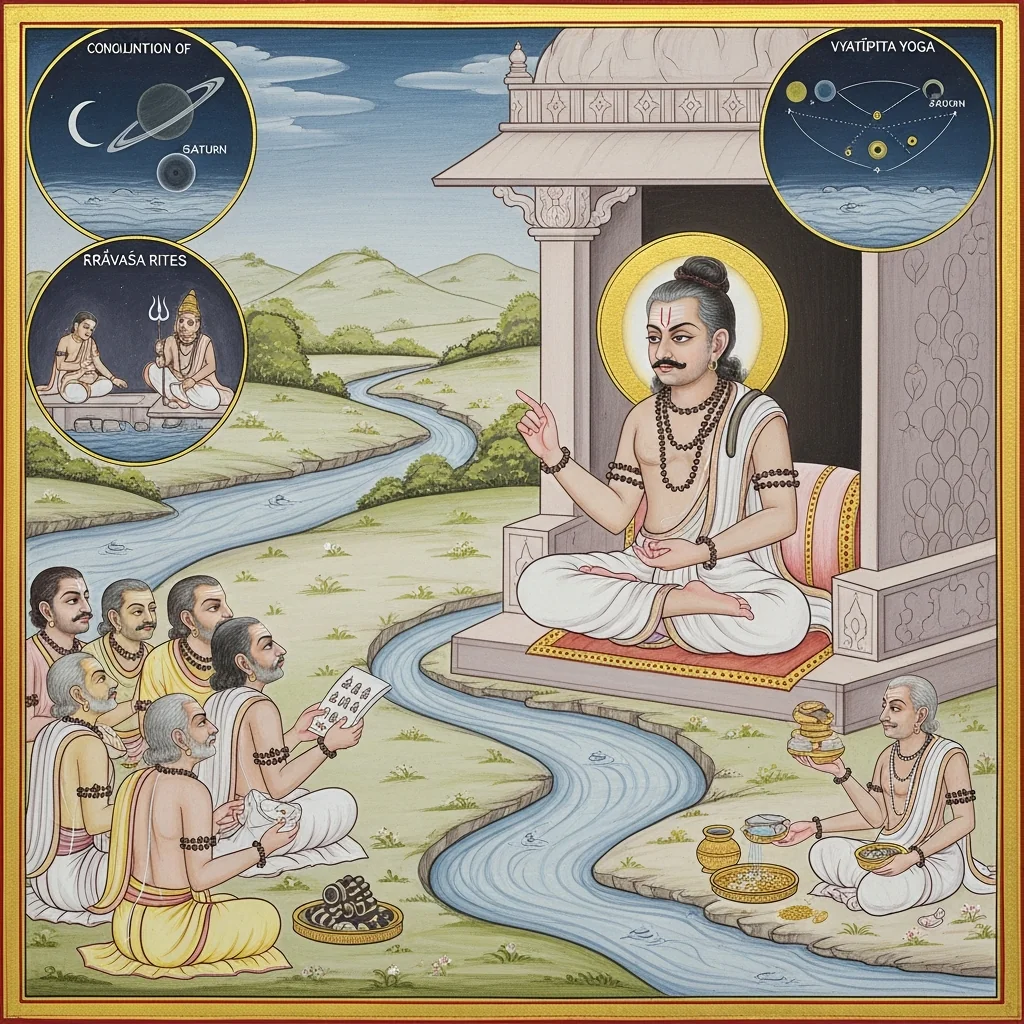
This adhyāya unfolds as a multi-voiced theological discourse, moving from personal devotion to the sanctification of place and the laying down of ritual observances. It opens with a king’s resolve to remain near the sage Loṃaśa and to receive Śiva-dīkṣā for liṅga-worship, while sat-saṅga (holy company) is praised as greater even than tīrtha. A group of beings—especially in bird/animal forms—seek release from a curse and ask for a site that grants the fruit of all tīrthas. Nārada directs them to consult the yogin Saṃvarta in Vārāṇasī, giving a distinctive sign by which he may be recognized on the road at night. Saṃvarta proclaims the supremacy of Mahī–Sāgara-saṅgama, extols the sanctity of the Mahī river, and declares that bathing and allied rites there equal or surpass the merits of famed places such as Prayāga and Gayā. The chapter also supplies calendrical and ritual-technical details: amāvāsyā occurring with Śani, special yogas like vyatīpāta; offerings to Śani and Sūrya; arghya-mantras; and a juridical-style truth-test rite involving raising the right hand from water. Through the extended Yājñavalkya–Nakula exchange, harsh speech is censured and ethical discipline is upheld, teaching that learning without restraint is inadequate. The narrative culminates in the installation and naming of the liṅga as Indradyumneśvara (also linked with Mahākāla), with Śiva’s direct boon promising sāyujya/sārūpya-like attainments to devotees and affirming the confluence’s exceptional salvific power.
Shlokas
Verse 1
। नारद उवाच । इति तस्य मुनींद्रस्य भूपतिः शुश्रुवान्वचः । प्राह नाहं गमिष्यामि त्वां विहाय नरं क्वचित्
Nārada said: Having thus heard the words of that great sage, the king replied, “O revered one, leaving you behind, I shall not go anywhere at all.”
Verse 2
लिंगमाराधयिष्येऽद्य सर्वसिद्धिप्रदं नृणाम् । त्वयैवानुगृहीतोऽद्य यांतु सर्वे यथागतम्
Today I shall worship the Liṅga, bestower of all attainments for humankind. Since today I have been graced by you, let everyone now depart as they came.
Verse 3
तद्भूपतिवचः श्रुत्वा बको गृध्रोऽथ कच्छपः । उलूकश्च तथैवोचुः प्रणता लोमशं मुनिम्
Hearing the king’s words, the crane, the vulture, the tortoise, and the owl likewise spoke, bowing down before the sage Lomaśa.
Verse 4
स च सर्वसुहृद्विप्रस्तथेत्येवाह तांस्तदा । प्रणोद्यान्प्रणतान्सर्वाननुजग्राह शिष्यवत्
And that brāhmaṇa, friendly to all, then said to them, “So be it.” Having acknowledged all who had bowed, he accepted them with kindness, like disciples.
Verse 5
शिवदीक्षाविधानेन लिंगपूजां समादिशत् । तेषामनुग्रहपरो मुनिः प्रमतवत्सलः । तीर्थादप्यधिकं स्थाने सतां साधुसमागमः
By the proper rite of Śiva-initiation, the sage instructed them in worship of the Liṅga. Intent on granting them grace, that muni—affectionate toward the devoted attendants—declared: “In any place, the gathering with the virtuous is even greater than a tīrtha.”
Verse 6
पचेलिमफलः सद्यो दुरंतकलुपापहः । अपूर्वः कोऽपि सद्गोष्ठीसहस्रकिरणोदयः
It yields fruit at once, removing even grievous and long-standing sins—an unprecedented dawn, as it were, of a thousand rays arising from holy fellowship.
Verse 7
य एकांततयात्यंतमंतर्गततमोपहः । साधुगोष्ठीसमुद्भूतसुखामृतरसोर्मयः
Through single-minded absorption it utterly dispels the innermost darkness; and waves of bliss, nectar-flavored, arise—born from the assembly of sādhus.
Verse 8
सर्वे वराः सुधाकाराः शर्करामधुषड्रसाः । ततस्ते साधुसंसर्गं संप्राप्ताः शिवशासनात्
All blessings become nectar-like—sweet as sugar and honey, rich with the six tastes. Therefore, by Śiva’s command, they attained the companionship of sādhus.
Verse 9
आरेभिरे क्रियायोगं मार्कंडनृपपूर्वकाः । तेषां तपस्यतामेवं समाजग्मे कदाचन । तीर्थयात्रानुषंगेन लोमशालोकनोत्सुकः
Led by King Mārkaṇḍa, they began kriyā-yoga, the disciplined path of sacred practice. While they were thus engaged in austerity, at one time Lomaśa—eager to see them—arrived, as part of his circuit of pilgrimage to the tīrthas.
Verse 10
मुख्या पुरुषयात्रा हि तीर्थयात्रानुषंगतः । सद्भिः समाश्रितो भूप भूमिभागस्तथोच्यते
“Indeed, the foremost ‘journey’ is the journey to noble persons; pilgrimage to tīrthas is secondary to that. O king, that region of earth which is resorted to by the good is spoken of as truly blessed.”
Verse 11
कृतार्हणातिथ्यविधिं विश्रांतं मां च फाल्गुन । प्रणम्य तेऽथ पप्रच्छुर्नाडीजंघपुरः सराः
O Phālguna, after they had duly performed the rites of honoring a guest and I had rested, the residents of Nāḍījaṅgha—having bowed in reverence—then questioned me.
Verse 12
त उचुः । शापभ्रष्टा वयं ब्रह्मंश्चत्वारोऽपि स्वकर्मणा । तन्मुक्तिसाधनार्थाय स्थानं किंचित्समादिश
They said: “O Brahman, by our own deeds we four have fallen from our former state through a curse. Command for us some place that may serve as the means to gain release from that condition.”
Verse 13
इयं हि निष्फला भूमिः शपलं भारतं मुने
“For this land seems fruitless to us, O sage; this Bhārata appears beset with curse and fault.”
Verse 14
तत्रापि क्वचिदेकत्र सर्वतीर्थफलं वद । इति पृष्टस्त्वहं तैश्च तानब्रवमिदं तदा
“Even there, tell us of some single spot where the fruit of all tīrthas is obtained.” Thus questioned by them, I spoke to them then as follows.
Verse 15
संवर्तं परिपृच्छध्वं स वो वक्ष्यति तत्त्वतः । सर्वतीर्थफलावाप्तिकारकं भूप्रदेशकम्
“Go and question Saṃvarta; he will tell you the truthfully grounded answer—revealing that tract of land by which the fruit of all tīrthas is attained.”
Verse 16
त उचुः । कुत्रासौ विद्यते योगी नाज्ञासिष्म वयं च तम् । संवर्तदर्शनान्मुक्तिरिति चास्मदनुग्रहः
They said: “Where is that yogī to be found? We do not know him. And it is said that liberation comes from the very sight of Saṃvarta—this would be your grace upon us.”
Verse 17
यदि जानासि तं ब्रूहि सुहृत्संगो न निष्फलः । ततोऽहमब्रवं तांश्च विचार्येदं पुनःपुनः
“If you know him, tell us—association with a well-wisher is never fruitless.” Then, having considered the matter again and again, I spoke to them.
Verse 18
वाराणस्यामसावास्ते संवर्तो गुप्तलिंगभृत् । मलदिग्धो विवसनो भिक्षाशी कुतपादनु
“Saṃvarta dwells in Vārāṇasī, bearing the liṅga in concealment. Smeared with grime, unclothed, living on alms, he moves about with a rag as his covering.”
Verse 19
करपात्रकृताहारः सर्वथा निष्परिग्रहः । भावयन्ब्रह्म परमं प्रणवाभिधमीश्वरम्
He takes his food from his hand as his bowl, wholly without possessions, and he continually contemplates the Supreme Brahman—Īśvara who is named as the Pranava (Oṃ).
Verse 20
भुक्त्वा निर्याति सायाह्ने वनं न ज्ञायते जनैः । योगीश्वरोऽसौ तद्रूपाः सन्त्यन्ये लिंगधारिणः
After eating, he goes out in the late afternoon into the forest and is not recognized by people. He is a lord among yogīs; and there are other liṅga-bearers too who look like him.
Verse 21
वक्ष्यामि लक्षणं तस्य ज्ञास्यथ तं मुनिम् । प्रतोल्या राजमार्गे तु निशि भूमौ शवं जनैः
“I shall tell you his distinguishing marks, by which you will recognize that sage. At night, on the royal road near the city-gate, people should place a corpse upon the ground.”
Verse 22
अविज्ञातं स्थापनीयं स्थेयं तदविदूरतः । यस्तां भूमिमुपागम्य अकस्माद्विनिर्वतते
It should be placed there so that others do not recognize it, and you should stand not far from it. Whoever, upon coming to that spot, suddenly turns back—
Verse 23
स संवर्तो न चाक्रामत्येष शल्यमसंशयम् । प्रष्टव्योऽभिमतं चासावुपाश्रित्य विनीतवत्
—he is Saṃvarta; he will not step over it—this is certain. Then, approaching him with humility, you should ask him whatever you desire.
Verse 24
यदि पृच्छति केनाहमाख्यात इति मां ततः । निवेद्य चैतद्वक्तव्यं त्वामाख्यायाग्निमाविशत्
If he asks, “By whom was I pointed out to you?”, then, after informing me, you should say this: “Having identified you, he entered the fire.”
Verse 25
तच्छ्रुत्वा ते तथा चक्रुः सर्वेपि वचनं मम । प्राप्य वाराणसीं दृष्ट्वा संवर्तं ते तथा व्यधुः
Hearing this, they all acted exactly according to my words. Reaching Vārāṇasī and seeing Saṃvarta, they did just as instructed.
Verse 26
शवं दृष्ट्वा च तैर्न्यस्तं संवर्तो वै न्यवर्तत । क्षुत्परीतोऽपि तं ज्ञात्वा ययुस्तमनु शीघ्रगम्
Seeing the corpse placed there by them, Saṃvarta indeed turned back. Though afflicted by hunger, they recognized him and hurriedly followed after him as he moved swiftly.
Verse 27
तिष्ठ ब्रह्मन्क्षणमिति जल्पंतो राजमार्गगम् । याति निर्भर्त्सयत्येष निवर्तध्वमिति ब्रुवन्
Calling out on the royal road, they said, “O Brāhmaṇa, stay for a moment.” Yet he went on, rebuking them: “Turn back!”
Verse 28
समया मामरे भोऽद्य नागंतव्यं न वो हितम् । पलायनमसौ कृत्वा गत्वा दूरतरं सरः । कुपितः प्राह तान्सर्वान्केनाख्यातोऽहमित्युत
“You all made an agreement with me—today you should not come; it is not for your good.” Fleeing, he went to a more distant lake, and in anger said to them all, “By whom was I identified?”
Verse 29
निवेदयत शीघ्रं मे यथा भस्म करोमि तम् । शापाग्निनाथ वा युष्मान्यदि सत्यं न वक्ष्यथ
“Tell me quickly, so that I may burn him to ashes; otherwise, if you do not speak the truth, with the fire of my curse I shall burn you.”
Verse 30
अथ प्रकंपिताः प्राहुर्नारदेनेति तं मुनिम् । स तानाह पुनर्यातः पिशुनः क्व नु संप्रति
Then, trembling, they said to the sage, “It was Nārada.” He replied, “Has that slanderous one come again—where is he now?”
Verse 31
लोकानां येन सापाग्नौ भस्मशेषं करोमि तम् । ब्रह्मबंधुमहं प्राहुर्भीतास्ते तं पुनर्मुनिम्
“He by whose power I can reduce worlds to mere ashes in the fire—him I declare to be a ‘brahma-bandhu’ (a Brahmin only by lineage).” Frightened, they then addressed that sage again.
Verse 32
त ऊचुः । त्वं निवेद्य स चास्माकं प्रविष्टो हव्यवाहनम् । तत्कालमेव विप्रेंद्र न विद्मस्तत्र कारणम्
They said: “O best of Brahmins, after you proclaimed it, he entered the sacrificial fire (Agni) before our very eyes. At that very moment we did not understand the reason.”
Verse 33
संवर्त उवाच । अहमप्येवमेवास्य कर्ता तेन स्वयं कृतम् । तद्ब्रूत कार्यं नैवात्र चिरं स्थास्यामि वः कृते
Saṃvarta said: “I too thought, ‘Surely I am the doer of this’—but it was done by him himself. Therefore tell me what is to be done; I will not remain here long even for your sake.”
Verse 34
अर्जुन उवाच । यदि नारद देवर्षे प्रविष्टोऽसि हुताशनम् । जीवितस्तत्कथं भूय आश्चर्यमिति मे वद
Arjuna said: “O Nārada, divine seer—if you entered the blazing fire, how then are you alive? Explain to me again this wonder.”
Verse 35
नारद उवाच । न हुताशः समुद्रो वा वायुर्वा वृक्षपर्वतः । आयुधं वा न मे शक्ता देहपाताय भारत
Nārada said: “Neither fire, nor ocean, nor wind, nor even trees and mountains—nor any weapon—has the power to bring about my bodily fall, O Bhārata.”
Verse 36
पुनरेतत्कृतं चापि संवर्तो मन्यते यथा । अहं सन्मानितश्चेति वह्निं प्राप्याप्यगामहम्
And again, as Saṃvarta supposed that this deed was done by him, I—thinking, “I have been duly honored”—went on, even after reaching the fire.
Verse 37
यथा पुष्पगृहे कश्चित्प्रविशत्यंग फाल्गुन । तथाहमग्निं संविश्य यातवानुत्तरं श्रृणु
Just as someone might enter a house of flowers, O dear Phālguna, so did I enter the fire and pass through it. Now hear what happened next.
Verse 38
संवर्तस्तान्पुनः प्राह मार्कंडेयमुखानिति । विशल्यः पंथाः क्षुधितोऽहं पुनः पुरीम् । भिक्षार्थं पर्यटिष्यामि प्रश्रं प्रब्रूत चैव मे
Saṃvarta spoke to them again, beginning with Mārkaṇḍeya: “The road is free from danger. I am hungry and will go again to the city to seek alms. Tell me your question clearly as well.”
Verse 39
त ऊचुः । शापभ्रष्टा वयं मोक्षं प्राप्स्यामस्तवदनुग्रहात् । प्रतीकारं तदाख्याहि प्रणतानां महामुने
They said: “Cast down by a curse, we shall attain liberation through your grace. O great sage, declare the remedy for us who bow before you.”
Verse 40
यत्र तीर्थे सर्वतीर्थफलं प्राप्नोति मानवः । तत्तीर्थं ब्रूहि संवर्त तिष्ठामो यत्र वै वयम्
“Tell us, O Saṃvarta, which sacred tīrtha is that where a person gains the fruit of all tīrthas. Declare that tīrtha, for we wish to remain there.”
Verse 41
संवर्त उवाच । नमस्कृत्य कुमाराय दुर्गाभ्यश्च नरोत्तमाः । तीर्थं च संप्रवक्ष्यामि महीसागरसंगमम्
Saṃvarta said: “O best of men, having bowed to Kumāra and to the Durgās, I shall now proclaim the sacred tīrtha—the confluence where the Mahī River meets the ocean.”
Verse 42
अमुना राजसिंहेन इंद्रद्युम्नेन धीमता । यजनाद्द्व्यंगुलोत्सेधा कृतेयं वसुधायदा
By that lion among kings, the wise Indradyumna—when he performed the yajña—this earth then rose by two finger-breadths.
Verse 43
तदा संताप्यमानाया भुवः काष्ठस्य वै यथा । सुस्राव यो जलौघश्च सर्वदेवनमस्कृतः
Then, as the earth was heated—like wood set to burn—there flowed forth a flood of water, revered by all the gods.
Verse 44
महीनाम नदी च पृथिव्यां यानिकानिचित् । तीर्थानि तेषां सलिलसंभवं तज्जलं विदुः
On earth, whatever sacred fords (tīrthas) there are—and also the river named Mahī—know that their waters arise from that very sacred outflow.
Verse 45
महीनाम समुत्पन्ना देशे मालवकाभिधे । दक्षिणं सागरं प्राप्ता पुण्योभयतटाशिवा
The river called Mahī arose in the region known as Mālavaka; reaching the southern ocean, she is auspicious—holy on both her banks.
Verse 46
सर्वतीर्थमयी पूर्वं महीनाम महानदी । किं पुनर्यः समायोगस्तस्याश्च सरितां पतेः
The great river named Mahī is, from the beginning, filled with the essence of all tīrthas. How much greater, then, is her confluence with the lord of rivers—the ocean.
Verse 47
वाराणसी कुरुक्षेत्रं गंगा रेवा सरस्वती
Vārāṇasī, Kurukṣetra, the Gaṅgā, the Revā (Narmadā), and the Sarasvatī—
Verse 48
तापी पयोष्णी निर्विध्या चन्द्रभागा इरावती । कावेरी शरयूश्चैव गंडकी नैमिषं तथा
The Tāpī, Payoṣṇī, Nirvindhyā, Candrabhāgā, and Irāvatī; and likewise the Kāverī, the Śarayū, the Gaṇḍakī, and Naimiṣa—
Verse 49
गया गोदावरी चैव अरुणा वरुणा तथा । एताः पुण्याः शतशोन्या याः काश्चित्सरितो भुवि
Gayā, the Godāvarī, and also the Aruṇā and Varuṇā; these and hundreds of other holy rivers—whatever rivers there are upon the earth—
Verse 50
सहस्रविंशतिश्चैव षट्शतानि तथैव च । तासां सारसमुद्भुतं महीतोयं प्रकीर्तितम्
Twenty-one thousand, and also six hundred more—of those (holy rivers and tīrthas), the essence that arises is celebrated as the water of the Mahī.
Verse 51
पृथिव्यां सर्वतीर्थेषु स्नात्वा यत्फलमाप्यते । तन्महीसागरे प्रोक्तं कुमारस्य वचो यथा
Whatever fruit is obtained by bathing in all the sacred tīrthas upon the earth—that very merit is declared to arise at Mahīsāgara, according to the word of Kumāra (Skanda).
Verse 52
एकत्र सर्वतीर्थानां यदि संयोगमिच्छथ । तद्गच्छथ महापुण्यं महीसागरसंगमम्
If you long for the confluence of all sacred tīrthas in a single place, then go to the supremely meritorious meeting of waters called Mahīsāgara.
Verse 53
अहं चापि च तत्रैव बहून्वर्षगणान्पुरा । अवसं चागतश्चात्र नारदस्य भयात्तथा
I too once dwelt there itself for many years; and then I came here as well—truly out of fear of Nārada.
Verse 54
स हि तत्र समीपस्थः पिशुनश्च विशेषतः । मरुत्तः कुरुते यत्नं तस्मै ब्रूयादिदं भयम्
For he is nearby there, and is especially a bearer of tales; King Marutta is making efforts—one should tell him of this fear.
Verse 55
अत्र दिग्वाससां मध्ये बहूनां तत्समस्त्वहम् । निवसाम्यतिप्रच्छन्नो मरुत्तादतिभीतवत्
Here, among many digvāsa ascetics, sky-clad, I remain as one of them, dwelling deeply concealed—like one exceedingly afraid of Marutta.
Verse 56
पुनरत्रापि मां नूनं कथयिष्यति नारदः । तथाविधा हि चेष्टास्य पिशुनस्य प्रदृश्यते
Even here again, surely Nārada will speak about me; for such is the observed conduct of that tale-bearer.
Verse 57
भवद्भिश्च न चाप्यत्र वक्तानां कस्यचित्क्वचित् । मरुत्तः कुरुते यत्नं भूपालो यज्ञसिद्धये
And you too must not speak of this to anyone, anywhere, here. King Marutta is striving for the successful completion of the sacrifice (yajña).
Verse 58
देवाचार्येण संत्यक्तो भ्रात्रा मे कारणां तरे । गुरुपुत्रं च मां ज्ञात्वा यज्ञार्त्विज्यस्य कारणात्
I was cast aside by the preceptor of the gods, and even by my own brother, because of my mother; and though he knew me to be his guru’s son, he did so for the sake of serving as an officiating priest in the sacrifice (yajña).
Verse 59
अविद्यांतर्गतैर्यज्ञकर्मभिर्न प्रयोजनम् । मम हिंसात्मकैरस्ति निगमोक्तैरचेतनैः
For me there is no purpose in sacrificial acts enclosed within ignorance—rites quoted from the Vedas yet performed without awareness, mechanically, and of a violent nature.
Verse 60
समित्पुष्पकुशप्रायैः साधनैर्यद्यचेतनैः । क्रियते तत्तथा भावि कार्यं कारणवन्नृणाम्
If an act is performed with means that are largely mere fuel-sticks, flowers, and kuśa-grass—things without awareness—then the result for men will arise accordingly, like an effect dependent on its cause.
Verse 61
तद्यूयं तत्र गच्छध्वं शीघ्रमेव नृपानुगाः । अस्ति विप्रः स्वयं ब्रह्मा याज्ञवल्क्यश्च तत्र वै
Therefore, you royal attendants, go there at once—quickly. A brāhmaṇa is there indeed: Yājñavalkya, who is like Brahmā himself.
Verse 62
स हि पूर्वं मिथेः पुर्यां वसन्नाश्रममुत्तमम् । आगच्छमानं नकुलं दृष्ट्वा गार्गीं वचोऽब्रवीत्
Formerly, while dwelling in an excellent hermitage in the city of Mithā, he saw a mongoose approaching and spoke these words to Gārgī.
Verse 63
गार्गि रक्ष पयो भद्रे नकुलोऽयमुपेति च । पयः पातुं कृतिमतिं नकुलं तं निराकुरु
“Gārgī, protect the milk, dear one—this mongoose is coming. Clever as it is to drink the milk, drive that mongoose away.”
Verse 64
इत्युक्तो नकुलः क्रुद्धः स हि क्रुद्धः पुराऽभवत् । जमदग्नेः पूर्वजैश्च शप्तः प्रोवाच तं मुनिम्
Thus addressed, the mongoose became angry—for it had been angry before as well. Cursed by the forebears of Jamadagni, it spoke to that sage.
Verse 65
अहो वा धिग्धिगित्येव भूयो धिगिति चैव हि । निर्लज्जता मनुष्याणां दृश्यते पापकारिणाम्
“Alas! Fie, fie—again, fie indeed! Shamelessness is seen among men who commit sin.”
Verse 66
कथं ते नाम पापानि प्रकुर्वंति नराधमाः । मरणांतरिता येषां नरके तीव्रवेदना
“How do such vile men commit sins at all, when after death there awaits for them intense torment in hell?”
Verse 67
निमेषोऽपि न शक्येत जीविते यस्य निश्चितम् । तन्मात्रपरमायुर्यः पापं कुर्यात्कथं स च
When even a single moment of life is not assured, how could one whose span is limited to that very measure still commit sin?
Verse 68
त्वं मुने मन्यसे चेदं कुलीनोऽस्मीति बुद्धिमान् । ततः क्षिपसि मां मूढ नकुलोऽयमिति स्मयन्
O sage, if you deem yourself wise and of noble lineage, then why, in folly, do you insult me, smiling as you say, “This is a mongoose”?
Verse 69
किमधीतं याज्ञवल्क्य का योगेश्वरता तव । निरपराधं क्षिपसि धिगधीतं हि तत्तव
What have you truly studied, O Yājñavalkya, and what lordship of yoga is yours? You insult one who is innocent—shame upon such learning of yours!
Verse 70
कस्मिन्वेदं स्मृतौ कस्यां प्रोक्तमेतद्ब्रवीहि मे । परुषैरिति वाक्यैर्मां नकुलेति ब्रवीषि यत्
Tell me: in which Veda, in which Smṛti, is it taught that you should address me with harsh words, calling me “mongoose”?
Verse 71
किमिदं नैव जानासि यावत्यः परुषा गिरः । परः संश्राव्यते तावच्छंकवः श्रोत्रतः पुनरा
Do you not understand this: as many harsh words as you make another hear, so many spikes are driven again and again into the ears.
Verse 72
कंठे यमानुगाः पादं कृत्वा तस्य सुदुर्मतेः । अतीव रुदतो लोहशंकून्क्षेप्स्यंति कर्णयोः
For that wicked-minded one, Yama’s attendants will set a foot upon his throat; and while he cries out bitterly, they will thrust iron spikes into his ears.
Verse 73
वावदूकाश्च ध्वजिनो मुष्णंति कृपणाञ्जनान् । स्वयं हस्तसहस्रेण धर्मस्यैवं भवद्विधाः
Chatterers and showy men bearing flags of status rob the poor and helpless; thus do people like you, with a thousand hands, plunder Dharma itself.
Verse 74
वज्रस्य दिग्धशस्त्रस्य कालकूटस्य चाप्युत । समेन वचसा तुल्यं मृत्योरिति ममाभवत्
To me it seemed that death itself is no different from a smooth-tongued word—like the thunderbolt, like a poisoned weapon, like the deadly Kālakūṭa.
Verse 75
कर्णनासिकनाराचान्निर्हरंति शरीरतः । वाक्छल्यस्तु न निर्हर्तुं शक्यो हृदिशयो हि सः
Arrows lodged in the ear or nose can be pulled out of the body; but the thorn of speech cannot be removed, for it lies embedded in the heart.
Verse 76
यंत्रपीडैः समाक्रम्य वरमेष हतो नरः । न तु तं परुषैर्वाक्यैर्जिघांसेत कथंचन
Better that a man be killed by crushing tortures of instruments than that one should ever seek to slay him with harsh words.
Verse 77
त्वया त्वहं याज्ञवल्क्य नित्यं पंडितमानिना । नकुलोसीति तीव्रेण वचसा ताडितः कुतः
O Yājñavalkya, why have I been struck again and again by you—who deem yourself a scholar—with the cutting remark, “You are a nakula, a mongoose”?
Verse 78
संवर्त उवाच । इति श्रुत्वा वचस्तस्य भृशं विस्मितमानसः । याज्ञवल्क्योऽब्रवीदेतत्प्रबद्धकरसंपुटः
Saṃvarta said: Hearing his words, Yājñavalkya—astonished in his heart—spoke thus, with hands joined in reverent salutation.
Verse 79
नमोऽधर्माय महते न विद्मो यस्य वै भवम् । परमाणुमपि व्यक्तं कोत्र विद्यामदः सताम्
Homage to mighty Adharma—whose power we cannot fathom! When even the truth of a single atom is not clearly known, where can pride of learning abide among the wise?
Verse 80
विरंचिविष्णुप्रसमुखाः सोमेंद्रप्रमुखास्तथा । सर्वज्ञास्तेऽपि मुह्यति गणनास्मादृशं च का
Even Brahmā and Viṣṇu at their head, and likewise Soma and Indra at theirs—though hailed as all-knowing—still fall into delusion; what then is to be said of reckoning folk like us?
Verse 81
धर्मज्ञोऽस्मीति यो मोहादात्मानं प्रतिपद्यते । स वायुं मुष्टिना बद्धुमीहते कृपणो नरः
Whoever, out of delusion, imagines himself to be “a knower of dharma,” is a pitiable man—he strives to bind the wind with his fist.
Verse 82
केचिदज्ञानतो नष्टाः केचिज्ज्ञानमदादपि । ज्ञानं प्राप्यापि नष्टाश्च केचिदालस्यतोऽधमाः
Some are ruined by ignorance; some even by the intoxication of learning. And some, though they have obtained knowledge, still perish—the base ones, through laziness.
Verse 83
वेदस्मृतीतिहासेषु पुराणेषु प्रकल्पितम् । चतुःपादं तथा धर्मं नाचरत्यधमः पशुः
That four-footed dharma, as set forth in the Vedas, Smṛtis, Itihāsas, and Purāṇas—the lowest, beast-like man does not practice it.
Verse 84
स पुरा शोचते व्यक्तं प्राप्य तच्चांतकं गृहम् । तथाहि गृह्यकारेण श्रुतौ प्रोक्तमिदं वचः
Later, having reached that “final house,” death, he surely grieves; for thus this saying is declared in the Śruti by the author of the Gṛhya tradition.
Verse 85
नकुलं सकुलं ब्रूयान्न कंचिन्मर्मणि स्पृशेत् । प्रपठन्नपि चैवाहमिदं सर्वं तथा शुकः
One should speak what is harmless and well-befitting, and should not touch anyone at a sensitive spot. Even if I recite all this, I too am only like a parrot.
Verse 86
आलस्येनाप्यनाचाराद्वृथाकार्येकमंग तत्
Even through laziness, through misconduct—this becomes a single ‘limb’ of futile action.
Verse 87
केवलं पाठ मात्रेण यश्च संतुष्यते नरः । तथा पंडितमानी च कोन्यस्तस्मात्पशुर्मतः
A man who is satisfied with mere recitation alone—and who fancies himself a scholar—who else is deemed more beast-like than he?
Verse 88
न च्छंदांसि वृजिनात्तारयंति मायाविनं माययाऽवर्तमानम् । नीडं शकुंता इव जातपक्षाश्छंदास्येनं प्रजहत्यंतकाले
The Vedic meters do not ferry across from sin the deceitful man who lives by deceit. Like birds that, once their wings have grown, abandon the nest—so the Vedas abandon him at the time of death.
Verse 89
स्वार्गाय बद्धकक्षो यः पाठमात्रेण ब्राह्मणः । स बालो मातुरंकस्थो ग्रहीतुं सोममिच्छति
The brāhmaṇa who girds himself for heaven by mere recitation alone is like a child sitting in his mother’s lap, wishing to seize the Soma.
Verse 90
तद्भवान्सर्वथा मह्यमनयं सोढुमर्हसि । सर्वः कोऽपि वदत्येवं तन्मयैवमुदाहृतम्
Therefore, you should wholly forgive this impropriety of mine. Anyone at all speaks in this way—so I too have spoken thus.
Verse 91
नकुल उवाच । वृथेदं भाषितं तुभ्यं सर्वलोकेन यत्समम् । आत्मानं मन्यसे नैतद्वक्तुं योग्यं महात्मनाम्
Nakula said: “This speech of yours is pointless—no different from the talk of ordinary people everywhere. If you deem yourself noble, such words are not fit to be spoken by great-souled persons.”
Verse 92
वाजिवारणलोहानां काष्ठपाषाणवाससाम् । नारीपुरुषतोयानामंतरं महदंतरम्
Between horses, elephants, and metals; between wood, stone, and cloth; and between women, men, and water—there are great and essential differences.
Verse 93
अन्ये चेत्प्राकृता लोका बहुपापानि कुर्वते । प्रधानपुरुषेणापि कार्यं तत्पृष्ठतोनु किम्
Even if other ordinary people commit many sins, what then? Should a foremost person also follow behind them and do the same?
Verse 94
सर्वार्थं निर्मितं शास्त्रं मनोबुद्धी तथैव च । दत्ते विधात्रा सर्वेषां तथापि यदि पापिनः
The scriptures were fashioned for every purpose, and mind and intellect too were granted by the Creator to all. Yet if people still become sinful…
Verse 95
ततो विधातुः को दोषस्त एव खलु दुर्भगाः । ब्राह्मणेन विशेषेण किं भाव्यं लोकवद्यतः
Then what fault is there in the Creator? They alone are truly unfortunate. And why should a brāhmaṇa—especially—behave like the common crowd?
Verse 96
यद्यदाचरति श्रेष्ठस्तत्तदेवेतरो जनः । स यत्प्रमाणं कुरुते लोकस्तदनुवर्तते
Whatever the excellent person practices, that very thing others do. Whatever standard he establishes, the world follows.
Verse 97
तस्मात्सदा महद्भिश्च आत्मार्थं च परार्थतः । सतां धर्मो न संत्याज्यो न्याय्यं तच्छिक्षणं तव
Therefore, the great should always—both for their own good and for the good of others—never abandon the dharma of the virtuous. Your instruction in this is right.
Verse 98
यस्मात्त्वया पीडितोऽहं घोरेण वचसा मुने । तस्माच्छीघ्रं त्वां शप्स्यामि शापयोग्यो हि मे मतः
Since I have been tormented by your harsh words, O sage, therefore I shall quickly curse you—for in my view you are deserving of a curse.
Verse 99
नकुलोऽसीति मामाह भवांस्तस्मात्कुलाधमः । शीघ्रमुत्पत्स्यसे मोहात्त्वमेव नकुलो मुने
You called me ‘Nakula’; therefore you are a disgrace to your lineage. Quickly, through delusion, you yourself will be born as a nakula (mongoose), O sage.
Verse 100
संवर्त उवाच । इति वाचं समाकर्ण्य भाव्यर्थकृतनिश्चयः । याज्ञवल्क्यो मरौ देशे विप्रस्याजायतात्मजः
Saṃvarta said: “Hearing these words, and having resolved upon what was to come, Yājñavalkya was born in the desert region as the son of a brāhmaṇa.”
Verse 101
दुराचारस्य पापस्य निघृणस्यातिवादिनः । दुष्कुलीनस्य जातोऽसौ तदा जातिस्मरः सुतः
He was born as the son of a man of evil conduct—sinful, pitiless, and given to harsh speech—of ignoble lineage; yet at that very time, the child became one who remembered his previous births.
Verse 102
सोऽथ ज्ञानात्समालोक्य भर्तृयज्ञ इति द्विजः । गुप्तक्षेत्रं समापन्नो महीसागरसंगमम्
Then, through inner knowledge, that brāhmaṇa named Bhartṛyajña discerned his course and reached Guptakṣetra, the sacred confluence where the Mahī meets the ocean.
Verse 103
तत्र पाशुपतो भूत्वा शिवाराधनतत्परः । स्वायंभुवं महाकालं पूजयन्वर्ततेऽधुना
There he became a Pāśupata devotee, wholly intent on the worship of Śiva; and even now he continues, worshipping Mahākāla—the self-manifest (Svayambhū) Lord.
Verse 104
यो हि नित्यं महाकालं श्रद्धया पूजयेत्पुमान् । स दौष्कुलीनदोषेभ्यो मुच्यतेऽहिरिव त्वचः
Indeed, the person who worships Mahākāla daily with faith is freed from the faults of ignoble lineage—like a serpent shedding its skin.
Verse 105
यथायथा श्रद्धयासौ तल्लिंगं परिपश्यति । तथातथा विमुच्येत दोषैर्जन्मशतोद्भवैः
In whatever measure one beholds that Liṅga with faith, in that same measure one is released from defects born of hundreds of lifetimes.
Verse 106
भर्तृयज्ञस्तु तत्रैव लिंगस्याराधनात्क्रमात् । बीजदोषाद्विनिर्मुक्तस्तल्लिंगमहिमा त्वसौ
Bhartṛyajña, there itself, by duly worshipping that Liṅga in due order, became completely freed from the defect in his very “seed” (root cause/lineage-karma). Such indeed is the greatness of that Liṅga.
Verse 107
बभ्रुं च नकुलं प्राह विमुक्तो दुष्टजन्मतः । यस्मात्तस्मादिदं तीर्थं ख्यातं वै बभ्रु पावनम्
And he said to Babhru and Nakula: “I have been freed from an evil birth.” Therefore this tīrtha is indeed renowned as “Babhru-pāvana,” the purifier of Babhru.
Verse 108
तस्माद्व्रजध्वं तत्रैव महीसागरसंगमम् । पंच तीर्थानि सेवन्तो मुक्तिमाप्स्यथ निश्चितम्
Therefore go—there itself—to the confluence of the Mahī River and the ocean. By resorting to and serving the five tīrthas, you will assuredly attain liberation.
Verse 109
इत्येवमुक्त्वा संवर्तो ययावभिमतं द्विजः । भर्तृयज्ञं मुनिं प्राप्य ते च तत्र स्थिताभवन्
Having spoken thus, the brāhmaṇa Saṃvarta went to the place he desired. And having met the sage Bhartṛyajña, they too remained there.
Verse 110
ततस्तानाह स ज्ञात्वा गणाञ्ज्ञानेन शांभवान् । महद्वो विमलं पुण्यं गुप्तक्षेत्रे यदत्र वै
Then, having recognized those attendants (gaṇas) through Śāmbhava knowledge, he spoke to them: “Great and stainless is the sacred merit found here indeed, in Guptakṣetra.”
Verse 111
भवन्तोऽभ्यागता यत्र महीसागरसंगमः । स्नानं दानं जपो होमः पिंडदानं विशेषतः
You have arrived at the confluence of the Mahī River and the ocean. Here, bathing, charitable giving, mantra-recitation (japa), fire-offerings (homa), and especially the offering of piṇḍas to the ancestors are enjoined.
Verse 112
अक्षयं जायते सर्वं महीसागर संगमे । कृतं तथाऽक्षयं सर्वं स्नानदानक्रियादिकम्
At the confluence of the Mahī and the ocean, all fruits become imperishable (akṣaya). Whatever is performed there—bathing, charity, and other sacred observances—yields unfailing merit.
Verse 113
यदात्र स्तानकं चक्रे देवर्षिर्नारदः पुरा । तदा ग्रहैर्वरा दत्ताः शनिना च वरस्त्वसौ
Formerly, when the divine sage Nārada performed a holy observance here, the planets (grahas) granted boons; and Śani (Saturn) in particular bestowed a boon upon him.
Verse 114
शनैश्चरेण संयुक्ता त्वमावास्या यदा भवेत् । श्राद्धं प्रकुर्वीत स्नानदानपुरः सरम्
When the new-moon day (Amāvāsyā) is conjoined with Śanaiścara (Saturn), one should perform śrāddha, preceded by bathing and charitable giving.
Verse 115
यदि श्रावणमासस्य शनैश्चरदिने शुभा । कुहूर्भवति तस्यां तु संक्रांतिं कुरुते रविः
If, in the month of Śrāvaṇa, the auspicious Kuhū tithi falls on Saturn’s weekday, and on that very day the Sun makes a saṅkrānti (zodiacal ingress)…
Verse 116
तस्यामेव तिथौ योगो व्यतीपातो भवेद्यदि । पुष्करंनाम तत्पर्व सूर्यपर्वशताधिकम्
If, on that very tithi, the Vyatīpāta yoga also occurs, that festival is called “Puṣkara”—worth more than a hundred solar festivals.
Verse 117
सर्वयोगसमावापः सथंचिदपि लभ्यते । तस्मिन्दिने शनिं लोहं कांचनं भास्करं तथा
On that day, the confluence of many auspicious yogas is obtained, at least in some measure. Therefore, on that day one should honour Śani with iron, and likewise honour the Sun with gold.
Verse 118
महीसागरसंसर्गे पूजयीत यथाविधि । शनिमंत्रैः शनिं ध्यात्वा सूर्यमंत्रैर्दिवाकरम्
At the confluence of the Mahī and the ocean, one should worship according to rule—meditating on Śani with Śani-mantras, and on the Sun (Divākara) with Sūrya-mantras.
Verse 119
अर्घ्यं दद्याद्भाकरस्य सर्वपापप्रशांतये । प्रयागादिधिकं स्नानं दानं क्षेत्रात्कुरोरपि
One should offer arghya to the Sun for the pacification of all sins. Bathing here is said to be superior even to Prayāga, and charity superior even to the sacred field of Kuru.
Verse 120
पिंडदानं गयाक्षेत्रादधिकं पांडुनंदन । इदं संप्राप्यते पर्व महद्भिः पुण्यराशिभिः
O son of Pāṇḍu, the offering of piṇḍas here surpasses even that of Gayā. This sacred occasion is attained only by those who possess vast accumulations of merit.
Verse 121
पितॄणामक्षया तृप्तिर्जायते दिवि निश्चितम् । यथा गयाशिरः पुण्यं पितॄणां तृप्तिदं परम्
It is certain that the Pitṛs attain unfailing satisfaction in heaven. Just as sacred Gayāśiras is supremely meritorious and grants satisfaction to the ancestors, so too is it here (affirming the same Pitṛ-pleasing merit).
Verse 122
तथा समधिकः पुण्यो महीसागरसंगमः
Likewise, the confluence of the Mahī and the Ocean is even more meritorious for sacred rites.
Verse 123
अग्निश्च रेतो मृडया च देहे रेतोधा विष्णुरमृतस्य नाभिः । एवं ब्रुवञ्छ्रद्धया सत्यवाक्यं ततोऽवगाहेत महीसमुद्रम्
“Agni is the seed; in the body, by Rudra’s grace; Viṣṇu bears that seed and is the navel of immortality.” Saying this with faith and truth, one should then bathe at the Mahī–Ocean confluence.
Verse 124
मुखं च यः सर्वनदीषु पुण्यः पाथोधिरंबा प्रवरा मही च । समस्ततीर्थाकृतिरेतयोश्च ददामि चार्घ्यं प्रणमामि नौमि
To that sacred “mouth” among all rivers, and to the Ocean—the mother of waters—and to the excellent Mahī, whose form embodies all tīrthas: to them I offer arghya; I bow down; I praise.
Verse 125
ताम्रा रस्याः पयोवाहाः पितृप्रीतिप्रदाः शभाः । सस्यमाला महासिन्धुर्दातुर्दात्री पृथुस्तुता । इन्द्रद्युम्नस्य कन्या च क्षितिजन्मा रावती
Tāmrā, Rasyā, Payovāhā, Pitṛprītipradā, Śabhā; Sasyamālā, Mahāsindhu, Dātṛ, Dātrī, Pṛthustutā; Indradyumna’s daughter, Kṣitijanmā, and Rāvatī—these are the sacred names to be remembered.
Verse 126
महीपर्णा महीशृंगा गंगा पश्चिमवाहिनी । नदी राजनदी चेति नामाष्टाशमालिकाम्
Mahīparṇā, Mahīśṛṅgā, Gaṅgā, Paścimavāhinī, Nadī, Rājanadī—thus continues the garland of sacred names, numbering eighty-eight.
Verse 127
स्नानकाले च सर्वत्र श्राद्धकाले पठेन्नरः । पृथुनोक्तानि नामानि यज्ञमूर्तिपदं व्रजेत्
At the time of bathing—wherever it may be—and at the time of śrāddha, a man should recite the names spoken by Pṛthu; thereby he attains the state of Yajña embodied, the supreme sacrificial goal.
Verse 128
महीदोहे महानंदसंदोहे विश्वमोहिनि । जातासि सरितां राज्ञि पापं हर महीद्रवे । इत्यर्घ्यमंत्रः
“O goddess born from the milking of the Earth, treasury of great bliss, enchantress of the worlds; O queen among rivers, you have arisen—O flowing Mahī, remove sin!”—this is the arghya-mantra.
Verse 129
कंकणं रजतस्यापि योऽत्र निक्षिपते नरः । स जायते महीपृष्ठे धनधान्ययुते कुले
Whoever deposits here even a silver bangle is born again upon the earth in a family endowed with wealth and grain.
Verse 130
महीं च सागरं चैव रौप्यकंकण पूजया । पूजयामि भवेन्मा मे द्रव्यानाशो दरिद्रता
By worship with a silver bangle, I worship both Mahī and the Ocean. May there not be for me loss of wealth or poverty.
Verse 131
कंकणक्षेपणम् । यत्फलं सर्वतीर्थेषु सर्वयज्ञैश्च यत्फलम् । तत्फलं स्नानदानेन महीसागरसंगमे
The rite called “casting of the bracelet” (kaṅkaṇa-kṣepaṇa): whatever merit is gained at all sacred bathing-places, and whatever fruit arises from all sacrifices—those very fruits are obtained by bathing and giving charity at the confluence of the Mahī River and the Ocean.
Verse 132
विवादे च समुत्पन्ने अपराधी च यो मतः । जलहस्तः सदा वाच्यो महीसागरसंगमे
When a dispute arises and one is deemed the offender, at the confluence of the Mahī and the Ocean he should always undergo the sacred ‘water-hand’ ordeal (jala-hasta) as the test.
Verse 133
संस्नाप्याघोरमंत्रेण स्थाप्य नाभिप्रमाणके । जले करं समुद्धृत्य दक्षिणं वाचयेद्द्रुतम्
Having bathed him with the Aghora mantra and stationed him in water up to the navel, he should lift the hand out of the water and swiftly recite the invocation for the right hand.
Verse 134
यदि धर्मोऽत्र सत्योऽस्ति सत्यश्चेत्संगमस्त्वसौ । सत्याश्चेत्क्रतुद्रष्टारः सत्यं स्यान्मे शुभाशुभम्
“If dharma here is true; if this very confluence is true; if the seers and witnesses of sacrifice are true—then let the truth of my good or evil (innocence or guilt) be made manifest.”
Verse 135
एवमुक्त्वा करं क्षिप्य दक्षिणं सकलं ततः । निःसृतः पापकारी चेज्ज्वरेणापीड्यते क्षणात्
Having spoken thus, he should extend the right hand fully; then, when he comes out, if he is a doer of sin, he is afflicted by fever in an instant.
Verse 136
सप्ताहाद्दृश्यते चापि तावन्निर्दोषवान्मतः । अत्र स्नात्वा च जप्त्वा च तपस्तप्त्वा तथैव च
If no sign of affliction is seen even after a week, then up to that point he is regarded as faultless. Here, having bathed, having performed japa, and likewise having undertaken tapas…
Verse 137
रुद्रलोकं सुबहवो गताः पुण्येन कर्मणा । सोमवारे विशेषेण स्नात्वा योत्र सुभक्तितः
By such meritorious deeds, many have gone to Rudra’s world. In particular, whoever bathes here on a Monday with true devotion…
Verse 138
पंच तीर्थानि कुरुते मुच्यते पंचपातकैः । इत्याद्युक्तं बहुविधं तीर्थमाहात्म्यमुत्तमम्
He attains the merit of five tīrthas and is freed from the five great sins. Thus, and in many other ways, the supreme greatness of this sacred place is proclaimed.
Verse 139
भर्तृयज्ञः शिवस्यो च तेषामाराधने क्रमम् । शिवागमोक्तमादिश्य पूजायोगं यथाविधि
He explained the bhartṛ-yajña and the worship of Śiva, and the proper sequence for their propitiation—teaching the rite of worship exactly as set forth in the Śivāgamas.
Verse 140
शिवभक्तिसमुद्रैकपूरितः प्राह तान्मुनिः । न शिवात्परमो देवः सत्यमेतच्छिवव्रताः
Filled as though by the very ocean of devotion to Śiva, the sage spoke to them: “There is no deity higher than Śiva—this is the truth, O keepers of Śiva’s vows.”
Verse 141
शिवं विहाय यो ह्यान्यदसत्किंचिदुपासते । करस्थं सोऽमृतं त्यक्त्वा मृगतृष्णां प्रधावति
Whoever abandons Śiva and worships some other unreal thing forsakes the nectar already in his hand and runs after a mirage.
Verse 142
शिवशक्तिमयं ह्येतत्प्रत्यक्षं दृश्यते जगत् । लिंगांकं च भगांकं च नान्यदेवांकितं क्वचित्
This world, seen plainly before our eyes, is filled with Śiva and Śakti. Everywhere it bears the marks of the Liṅga and the Bhaga (yoni); nowhere is it stamped with the sign of any other deity.
Verse 143
यश्च तं पितरं रुद्रं त्यक्त्वा मातरमं बिकाम् । वर्ततेऽसौ स्वपितरं त्यक्तोदपितृपिंडकः । यस्य रुद्रस्य माहात्म्यं शतरूद्रीयमुत्तमम्
Whoever forsakes Rudra, the Father, and Ambikā, the Mother, lives as one who has cast off his own sire, as one who offers no piṇḍa to the ancestors. The supreme Śatarudrīya proclaims the greatness of that Rudra.
Verse 144
श्रृणुध्वं यदि पापानामिच्छध्वं क्षालनं परम् । ब्रह्मा हाटकलिंगं च समाराध्य कपर्दिनः
Listen—if you seek the highest cleansing of sins: Brahmā, having duly worshipped Kapardin (Śiva) at the golden Liṅga, attained purification.
Verse 145
जगत्प्रधानमिति च नाम जप्त्वा विराजते । कृष्णमूले कृष्णलिंगं नाम चार्जितमेव च
By chanting the Name ‘Jagatpradhāna’, the worshipper shines forth. And at Kṛṣṇamūla, the Liṅga known as ‘Kṛṣṇa-liṅga’ was indeed established/obtained.
Verse 146
सनकाद्यैश्च तल्लिंगं पूज्याजयुर्जगद्गतिम् । दर्भांकुरमयं सप्त मुनयो विश्वयोनिकम्
Sanaka and the others worshipped that Liṅga and attained the world’s course/goal—the highest destiny. The seven sages also worshipped the ‘Viśvayonika’ Liṅga made of sprouts of darbha-grass.
Verse 147
नारदस्त्वंतरिक्षे च जदद्बीजमिदं गृणन् । वज्रमिद्रो लिंगमेवं विश्वात्मानं च नाम च
Nārada, in the mid-sky, praised this (Śiva) as the “Seed of the world.” Indra worshipped a vajra (diamond/thunderbolt) Liṅga, chanting also the Name “Viśvātman.”
Verse 148
सूर्यस्ताम्रं तथा लिंगं नाम विश्वसृजं जपन् । चंद्रश्च मौक्तिकं लिंगं जपन्नाम जगत्पतिम्
Sūrya worshipped a copper Liṅga, chanting the name “Viśvasṛj”. And Candra worshipped a pearl Liṅga, chanting the name “Jagatpati”.
Verse 149
इंद्रनीलमयं वह्निर्नाम विश्वेश्वरं जपन् । पुष्परागं गुरुलिंगं विश्वयोनिं जपन्हरम्
Agni worshipped a Liṅga made of indranīla (sapphire), chanting the name “Viśveśvara”. He also worshipped a puṣparāga (topaz) Guru-liṅga, chanting “Viśvayoni”, the Name of Hara.
Verse 150
पद्मरागमयं शुक्रो विश्वकर्मेति नाम च । हेमलिंगं च धनदो जपन्नाम्ना तथेश्वरम्
Śukra worshipped a Liṅga made of padmarāga (ruby), chanting the name “Viśvakarman”. And Dhanada (Kubera) worshipped a golden Liṅga, likewise chanting the name “Īśvara”.
Verse 151
रौप्यजं विश्वदेवाश्च नामापि जगतांपतिम् । वायवो रीतिजं लिंगं शंभुमित्येव नाम च
The Viśvedevas worshipped the silver-made Liṅga, naming it “Jagatāṃpati” (Lord of the worlds). The Vāyus worshipped the Liṅga formed of rīti (a metal alloy), calling it “Śambhu”, the auspicious Lord.
Verse 152
काशजं वसवो लिंगं स्वयंभुमिति नाम च । त्रिलोहं मातरो लिंगं नाम भूतेशमेव च
The Vasus worship a liṅga fashioned of kāśa-grass, calling it “Svayaṃbhu” (Self-manifest). The Mothers (Mātṛkās) worship a liṅga of three metals, naming it “Bhūteśa” (Lord of beings).
Verse 153
लौहं च रक्षसां नाम भूतभव्यभवोद्भवम् । गुह्यकाः सीसजं लिंगं नाम योगं जपंति च
The Rākṣasas worship an iron liṅga, invoking the name “Bhūtabhavyabhavodbhava” (Source of beings past, future, and present). The Guhyakas worship a liṅga made of lead, and they also chant the name “Yoga”.
Verse 154
जैगीषव्यो ब्रह्मरंध्रं नाम योगेश्वरं जपन् । निमिर्नयनयोर्लिंगे जपञ्शर्वेति नाम च
Jaigīṣavya, worshipping the liṅga called “Brahmaraṃdhra”, chants the name “Yogeśvara” (Lord of Yoga). And King Nimi, worshipping the liṅga in his eyes, chants the name “Śarva”.
Verse 155
धन्वंतरिर्गोमयं च सर्वलोकेश्वरेश्वरम् । गंधर्वा दारुजं लिंगं सर्वश्रेष्ठेति नाम च
Dhanvantari worships a liṅga made of cow-dung, invoking Śiva as “Sarvalokeśvareśvara”—the Lord of all the rulers of worlds. The Gandharvas worship a wooden liṅga, naming it “Sarvaśreṣṭha” (Best of all).
Verse 156
वैडूर्यं राघवो लिंगं जगज्ज्येष्ठेति नाम च । बाणो मारकतं लिंगं वसिष्ठमिति नाम च
Rāghava worships a cat’s-eye gem (vaiḍūrya) liṅga, naming it “Jagajjyeṣṭha” (Eldest of the world). Bāṇa worships an emerald (mārakata) liṅga, naming it “Vasiṣṭha”.
Verse 157
वरुणः स्फाटिकं लिंगं नाम्ना च परमेश्वरम् । नागा विद्रुमलिंगं च नाम लोकत्रयंकरम्
Varuṇa worships a crystal (sphāṭika) liṅga, invoking it as “Parameśvara,” the Supreme Lord. The Nāgas worship a coral liṅga, naming it “Lokatrayaṃkara,” Benefactor of the three worlds.
Verse 158
भारती तारलिंगं च नाम लोकत्रयाश्रितम् । शनिश्च संगमावर्ते जगन्नाथेति नाम च
Bhāratī (Sarasvatī) worships the star-like (tāra) liṅga, naming it “Lokatrayāśrita,” Refuge of the three worlds. And Śani worships a liṅga at the whirlpool of a confluence (saṃgamāvarta), naming it “Jagannātha,” Lord of the universe.
Verse 159
शनिदेशे मध्यरात्रौ महीसागरसंगमे । जातीजं रावणो लिंगं जपन्नाम सुदुर्जयम्
In Śani’s region, at midnight, where land meets ocean, Rāvaṇa worships a liṅga made of jāti-wood, chanting the name “Sudurjaya,” the Unconquerable.
Verse 160
सिद्धाश्च मानसं नाम काममृत्युजरातिगम् । उंछजं च बलिर्लिंगं ज्ञानात्मेत्यस्य नाम च
The Siddhas worship the mind-born (mānasa) liṅga, naming it “Kāmamṛtyujarātiga,” He who transcends desire, death, and old age. And Bali worships a liṅga made from gleaned grains (uṃchaja), naming it “Jñānātman,” whose essence is Knowledge.
Verse 161
मरीचिपाः पुष्पजं च ज्ञानगम्येति नाम च । शकृताः शकृतं लिंगं ज्ञानज्ञेयेति नाम च
The Marīcipas fashioned a flower-born Liṅga and proclaimed its name “Jñānagamya,” Reachable through true knowledge. The Śakṛtas fashioned a dung-made Liṅga and declared its name “Jñānajñeya,” That which is to be known through knowledge.
Verse 162
फेनपाः फेनजं लिंगं नाम चापि सुदुर्विदम् । कपिलो वालुकालिंगं वरदं च जपन्हरम्
The Phenapas fashioned a foam-born Liṅga, whose very name was exceedingly hard to fathom. Kapila fashioned a sand-made Liṅga, calling it “Varada” (Bestower of boons) and “Japa-hara” (Remover of the burden of japa, bringing it to fulfillment).
Verse 163
सारस्वतो वाचिलंगं नाम वागीश्वरेति च । गणा मूर्तिमयं लिंगं नाम रुद्रेति चाब्रुवन्
Sārasvata fashioned the “Vācila” Liṅga and called it “Vāgīśvara” (Lord of Speech). The Gaṇas fashioned a form-embodied Liṅga and proclaimed its name as “Rudra.”
Verse 164
जांबूनदमयं देवाः शितिकण्ठेति नाम च । शंखलिंगं बुधो नाम कनिष्ठमिति संजपन्
The gods fashioned a Liṅga of jāmbūnada-gold and bestowed on it the name “Śitikaṇṭha” (Blue-throated One). Budha fashioned a conch-made Liṅga and, while reciting, named it “Kaniṣṭha” (the Younger).
Verse 165
अश्विनौ मृन्मयं लिंगं नाम्ना चैव सुवेधसम् । विनायकः पिष्टलिंगं नाम्ना चापि कपर्दिनम्
The Aśvin twins fashioned a clay-made Liṅga and named it “Suvedhasa” (the Wise, the Most Intelligent). Vināyaka fashioned a paste-made Liṅga and also named it “Kapardin” (the Matted-haired Lord).
Verse 166
नावनीतं कुजो लिंगं नाम चापि करालकम् । तार्क्ष्य ओदनलिंगं च हर्यक्षेति हि नाम च
Kuja fashioned a butter-made Liṅga and named it “Karālaka” (the Terrific One). Tārkṣya fashioned a rice-offering Liṅga and indeed gave it the name “Haryakṣa.”
Verse 167
गौडं कामस्तथा लिंगं रतिदं चेति नाम च । शची लवणलिंगं तु बभ्रुकेशेति नाम च
Kāma fashioned a Liṅga of jaggery and named it “Ratida,” the Giver of delight. Śacī fashioned a Liṅga of salt and named it “Babhrukeśa”.
Verse 168
विश्वकर्मा च प्रासादलिंगं याम्येति नाम च । विभीषणश्च पांसूत्थं सुहृत्तमेति नाम च । वंशांकुरोत्थं सगरो नाम संगतमेव च
Viśvakarmā made a palace-like Liṅga and named it “Yāmya.” Vibhīṣaṇa made a dust-born Liṅga and named it “Suhṛttama,” the Best of friends. Sagara made a Liṅga arising from a bamboo-sprout, and its name was “Saṅgata,” the Well-joined.
Verse 169
राहुश्च रामठं लिंगं नाम गम्येति कीर्तयन् । लेप्यलिंगं तथा लक्ष्मीर्हरिनेत्रेति नाम च
Rāhu made a “Rāmaṭha” Liṅga, praising it as “Gamya,” the Easily approachable. Likewise Lakṣmī made a coated Liṅga and named it “Harinetra,” the Eye of Hari—or Śiva whose eye is Hari (Viṣṇu).
Verse 170
योगिनः सर्वभूतस्थं स्थाणुरित्येव नाम च । नानाविधं मनुष्याश्च पुरुषंनाम नाम च
The yogins fashioned a Liṅga abiding in all beings and gave it the very name “Sthāṇu,” the Immovable. Human beings, in many different ways, fashioned (liṅgas) and named them “Puruṣa,” the Supreme Person.
Verse 171
तेजोमयं च ऋक्षाणि भगं नाम च भास्वरम् । किंनरा धातुलिंगं च सुदीप्तमिति नाम च
The Ṛkṣas (celestial beings) fashioned a Liṅga of pure radiance; it is renowned by the name “Bhaga,” the Luminous. The Kiṃnaras fashioned a mineral, metallic Liṅga; it is celebrated by the name “Sudīpta,” the Brilliantly Ablaze.
Verse 172
देवदेवेति नामास्ति लिंगं च ब्रह्मराक्षसाः । दंतजं वारणा लिंगं नाम रंहसमेव च
The Brahmarākṣasas too established a Liṅga; its name is Devadeva, “God of gods.” The elephants established a Liṅga fashioned from tusk; it is indeed known as Raṃhasa, “the Swift/Impelling One.”
Verse 173
सप्तलोकमयं साध्या बहूरूपेति नाम च । दूर्वांकुरमयं लिंगमृतवः सर्वनाम च
The Sādhyas established a Liṅga embodying the seven worlds; it is named Bahurūpa, “the Many-Formed.” The Seasons (Ṛtus) established a Liṅga made of tender dūrvā shoots; it is known as Sarvanāman, “He of all names.”
Verse 174
कौंकुममप्सरसो लिंगं नाम शंभोः प्रियेति च । सिंदूरजं चोर्वशी च नाम च प्रियवासनम्
The Apsarases established a Liṅga made of saffron; it is called Śambhoḥ Priyā, “Beloved of Śambhu.” Urvaśī established a Liṅga made of vermilion; it is known as Priyavāsana, “He whose fragrance/garment is dear.”
Verse 175
ब्रह्मचारि गुरुर्लिंगं नाम चोष्णीषिणं विदुः । अलक्तकं च योगिन्यो नाम चास्य सुबभ्रुकम्
The Brahmacārin Gurus established a Liṅga; the wise know it as Uṣṇīṣin, “the Crowned One.” The Yoginīs established a Liṅga of red lac; its name is Subabhruka, “the Auspicious Tawny/Golden-Hued One.”
Verse 176
श्रीखंडं सिद्धयोगिन्यः सहस्राक्षेति नाम च । डाकिन्यो मांस लिंगं च नाम चास्य च मीढुषम्
The Siddha-Yoginīs established a Liṅga of sandalwood paste; it is named Sahasrākṣa, “the Thousand-Eyed.” The Ḍākinīs established a flesh-made Liṅga; its name is Mīḍhuṣa, “the Bestower/Gracious Giver.”
Verse 177
अप्यन्नजं च मनवो गिरिशेति च नाम च । अगस्त्यो व्रीहिजं वापि सुशांतमिति नाम च
The Manus established a Liṅga fashioned from food-grain; it is named Giriśa, “Lord of the Mountain.” Agastya too established a rice-made Liṅga; it is called Suśānta, “the Perfectly Peaceful.”
Verse 178
यवजं देवलो लिंगं पतिमित्येव नाम च । वल्मीकजं च वाल्मीकिश्चिरवासीति नाम च
Devala established a barley-made Liṅga; it is named Pati, “the Lord.” Vālmīki established a Liṅga formed from an anthill; it is called Ciravāsī, “the Ever-Abiding.”
Verse 179
प्रतर्दनो बाणलिंगं हिरण्यभुजनाम च । राजिकं च तथा दैत्या नाम उग्रेति कीर्तितम्
Pratardana established a Liṅga made of arrows; it bears the name Hiraṇyabhuja, “the Golden-Armed.” Likewise, the Daityas established a mustard-seed Liṅga; it is famed by the name Ugra, “the Fierce.”
Verse 180
निष्पावजं दानवाश्च लिंगनाम च दिक्पतिम् । मेघा नीरमयं लिंगं पर्जन्यपतिनाम च
The Dānavas established a Liṅga made of niṣpāva (a kind of pulse); it is named Dikpati, “Lord of the Directions.” The clouds established a water-formed Liṅga; it is called Parjanyapati, “Lord of Rain.”
Verse 181
राजमाषमयं यक्षा नाम भूतपतिं स्मृतम् । तिलान्नजं च पितरो नाम वृषपतिस्तथा
The Yakṣas worship a Liṅga made of rājamāṣa (a kind of bean), remembering it by the name Bhūtapati, “Lord of beings.” And the Pitṛs worship a Liṅga born of a sesame-rice offering, known also as Vṛṣapati.
Verse 182
गौतमो गोरजमयं नाम गोपतिरेव च । वानप्रस्थाः फलमयं नाम वृक्षावृतेति च
Gautama worships a liṅga made of cow-dust; indeed it is called Gopati, the Lord of cows. The forest-dwelling vānaprasthas worship a liṅga made of fruits, called Vṛkṣāvṛta, the One enveloped by trees.
Verse 183
स्कंदः पाषाणलिंगं च नाम सेनान्य एव च । नागश्चाश्वतरो धान्यं मध्यमेत्यस्य नाम च
Skanda worships a stone liṅga, called Senānī, the Commander. And the Nāga named Aśvatara worships a liṅga made of grain, whose name is Madhyama, the Middle One.
Verse 184
पुरोडाशमयं यज्वा स्रुवहस्तेति नाम च । यमः कालायसमयं नाम प्राह च धन्विनम्
A yajvā, the sacrificer, worships a liṅga made of puroḍāśa (the sacrificial cake), called Sruvahasta, “He whose hand holds the ladle.” Yama worships a liṅga made of dark iron and calls it Dhanvin, “the Archer.”
Verse 185
यवांकुरं जामदग्न्यो भर्गदैत्येति नाम च । पुरूरवाश्चाश्चान्नमयं बहुरूपेति नाम च
Jāmadagnya worships a liṅga made of barley-sprouts, named Bhargadaitya. And Purūravas worships a liṅga made of cooked food, named Bahurūpa, “the Many-formed.”
Verse 186
मांधाता शर्करालिंगं नाम बाहुयुगेति च । गावः पयोमयं लिंगं नाम नेत्रसहस्रकम्
Māndhātṛ worships a liṅga made of sugar, called Bāhuyuga, “He of paired arms.” The cows worship a liṅga made of milk, called Netrasahasraka, “He of a thousand eyes.”
Verse 187
साध्या भर्तृमयं लिंगं नाम विश्वपतिः स्मृतम् । नारायणो नरो मौंजं सहस्रशिरनाम च
The Sādhyas worship a liṅga that embodies the Lord as husband and master, remembered by the name Viśvapati, Lord of the universe. Nārāyaṇa and Nara worship a liṅga fashioned of muñja-grass, known as Sahasraśiras, the Thousand-headed.
Verse 188
तार्क्ष्यं पृथुस्तथा लिंगं सहस्रचरणाभिधम् । पक्षिणो व्योमलिंगं च नाम सर्वात्मकेति च
Tārkṣya (Garuḍa) and Pṛthu worship a liṅga called Sahasracaraṇa, the Thousand-footed. And the birds worship a sky-like liṅga, named Sarvātman, the Self of all.
Verse 189
पृथिवी मेरुलिंगं च द्वितनुश्चास्य नाम च । भस्मलिंगं पशुपतिर्नाम चास्य महेश्वरः
The Earth worships the Meru-liṅga, whose name is Dvitanu, the Two-bodied. And the liṅga of sacred ash is called Paśupati; his name is Maheśvara.
Verse 190
ऋषयो ज्ञानलिंगं च चिरस्थानेति नाम च । ब्राह्मणा ब्रह्मलिंगं च नाम ज्येष्ठेति तं विदुः
The Ṛṣis worship the liṅga of knowledge, named Cirasthāna, the Long-abiding. The Brāhmaṇas worship the Brahma-liṅga, and they know it by the name Jyeṣṭha, the Eldest.
Verse 191
गोरोचनमयं शेषो नाम पशुपतिः स्मृतम् । वासुकिर्विषलिंगं च नाम वै शंकरेति च
Śeṣa is remembered as a liṅga made of gorocanā, the radiant yellow pigment, and is called Paśupati. Vāsuki is said to be of poison-nature, and that liṅga is indeed named Śaṅkara.
Verse 192
तक्षकः कालकूटाख्यं बहुरूपेति नाम च । हालाहलं च कर्कोट एकाक्ष इति नाम च
Takṣaka is called “Kālakūṭa” and also bears the name “Bahurūpa” (many-formed). Karkoṭa is called “Hālāhala” and is also named “Ekākṣa” (one-eyed).
Verse 193
श्रृंगी विषमयं पद्मो नाम धूर्जटिरेव च । पुत्रः पितृमयं लिंगं विश्वरूपेति नाम च
Śṛṅgī is “poison-formed.” Padma is named “Dhūrjaṭi.” The “Son” is the liṅga formed as the Father, and it is also called “Viśvarūpa” (universal-formed).
Verse 194
पारदं च शिवा देवी नाम त्र्यम्बक एव च । मत्स्याद्याः शास्त्रलिंगं च नाम चापि वृषाकपिः
Pārada (quicksilver) is called “Śivā Devī,” and it is also “Tryambaka.” The Matsya and other forms are the “Śāstra-liṅga,” and it is also named “Vṛṣākapi.”
Verse 195
एवं किं बहुनोक्तेन यद्यत्सत्त्वं विभूतिमत् । जगत्यामस्ति तज्जातं शिवाराधनयोगतः
Why say more? Whatever being in the world possesses splendor and power—know that it has arisen from the discipline of worshipping Śiva.
Verse 196
भस्मनो यदि वृक्षत्वं ज्ञायते नीरसेवनात् । शिवभक्तिविहीनस्य ततोऽस्य फलमुच्यते
If even ash could be known to become a tree by being watered, then the result for one devoid of devotion to Śiva is accordingly declared—fruitless and barren.
Verse 197
धर्मार्थकाममोक्षाणां यदि प्राप्तौ भवेन्मतिः । ततो हरः समाराध्यस्त्रिजगत्याः प्रदो मतः
If one’s aim is to attain dharma, artha, kāma, and mokṣa, then Hara (Śiva) should be duly worshipped, for he is regarded as the giver to the three worlds.
Verse 198
य इदं शतरुद्रीयं प्रातःप्रातः पठिष्यति । तस्य प्रीतः शिवो देवः प्रदास्यत्यखिलान्वरान्
Whoever recites this Śatarudrīya morning after morning—pleased with him, Lord Śiva will grant all boons without exception.
Verse 199
नातः परं पुण्यतमं किंचिदस्ति महाफलम् । सर्ववेदरहस्यं च सूर्येणोक्तमिदं मम
Nothing is more supremely meritorious than this, nor anything more greatly fruitful. This is the secret essence of all the Vedas, spoken to me by Sūrya.
Verse 200
वाचा च यत्कृतं पापं मनसा वाप्युपार्जितम् । पापं तन्नाशमायाति कीर्तिते शतरुद्रिये
Whatever sin is committed by speech, or accumulated even in the mind—when the Śatarudrīya is recited, that sin comes to destruction.