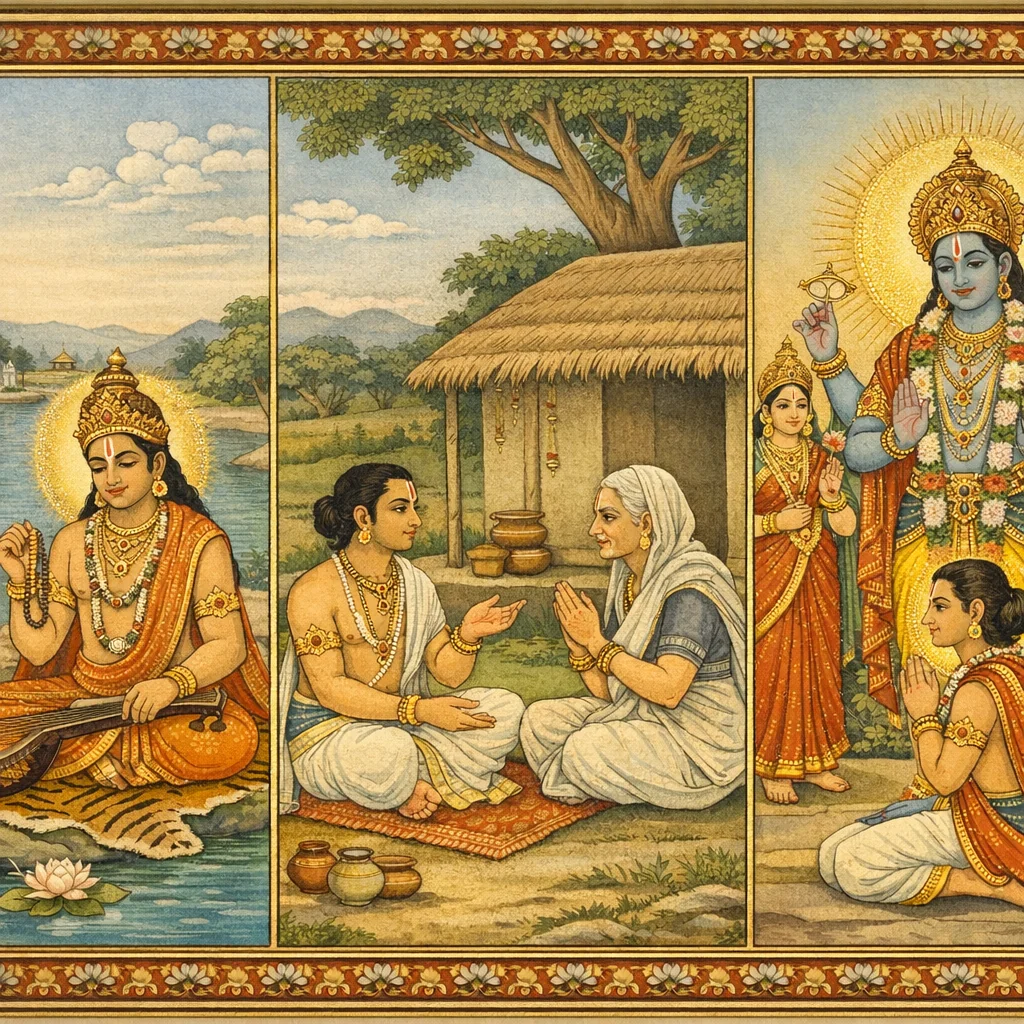
Adhyaya 42
Chapter 42 unfolds in three linked movements. (1) Nārada teaches a tīrtha-theology: a sacred place is incomplete without Vāsudeva. After prolonged yogic worship with aṣṭākṣara-japa, he asks that a “kalā” of Viṣṇu be established there for the welfare of all; Viṣṇu agrees and is installed, giving the site a local epithet and ritual authority. (2) The chapter then prescribes an Ekādaśī observance (Kārttika, śukla pakṣa): bathing in designated waters, pañcopacāra worship, fasting, night vigil with music/recitation, avoidance of anger and pride, and dāna. It lists ideal devotional and ethical qualities, culminating in the claim that one who perfects the vigil “is not born again” (punar na jāyate). (3) A didactic exemplum follows: Arjuna asks about Aitareya; Nārada recounts his lineage, his seeming muteness from continuous mantra-japa, and household tensions. Aitareya teaches the pervasive duḥkha of embodied life, the inadequacy of outer purification without inner purity (bhāva-śuddhi), and the progression nirveda → vairāgya → jñāna → Viṣṇu-realization → mokṣa. Viṣṇu manifests, receives his stotra, grants boons, names its power “aghā-nāśana,” and directs him to Koṭitīrtha and a Harimedhas ritual context; Aitareya later fulfills his duties and attains liberation through constant remembrance of Vāsudeva.
Shlokas
Verse 1
नारद उवाच । ततो मया स्थापिते च स्थाने कालांतरेण ह । चिंतितं हृदये भूयो द्विजानुग्रहकाम्यया
Nārada said: After I had established it in its place, some time later I reflected again in my heart—desiring the welfare and favor of the twice-born (brāhmaṇas).
Verse 2
वासुदेवविहीनं हि तीर्थमेतन्न रोचते । असूर्यं हि जगद्यद्वत्स हि भूषण भूषणम्
For this tīrtha does not please me if it is devoid of Vāsudeva—just as the world without the sun is joyless; for He is the ornament of all ornaments.
Verse 3
यत्र नैव हरिः स्वामी तीर्थे गेहेऽथ मानसे । शास्त्रे वा तदसत्सर्वं हांसं तीर्थं न वायसम्
Where Hari, the Lord, is not present—whether in a tīrtha, in a home, in one’s mind, or even in scripture—there all becomes barren. A tīrtha should be like a swan’s (pure and discerning), not like a crow’s.
Verse 4
तस्मात्प्रसाद्य वरदं तीर्थेऽस्मिन्पुरुषोत्तमम् । आनेष्ये कलया साक्षाद्विश्वनुग्रहकाम्यया
Therefore, having propitiated the boon-giving Puruṣottama at this sacred ford, I shall bring him here—manifest in a divine portion of himself—openly, out of the wish to bestow grace upon the whole world.
Verse 5
इति संचिंत्य कौरव्य ततोऽहं चात्र संस्थितः । ज्ञानयोगेन योगींद्रं शतं वर्षाण्यतोषयम्
Thus having reflected, O Kauravya, I remained firmly established here; and through the discipline of the Yoga of knowledge I satisfied the Lord of Yogins for a hundred years.
Verse 6
अष्टाक्षरं जपन्मंत्रं संनिगृह्येंद्रियाणि च । वासुदेवमयो भूत्वा सर्वभूतकृपापरः
Chanting the eight-syllabled mantra and restraining the senses, I became wholly suffused with Vāsudeva, intent upon compassion toward all beings.
Verse 7
एवं मयाराध्यमानो गरुडं हरिरास्थितः । गणकोटिपरिवृतः प्रत्यक्षः समजायत
Thus worshipped by me, Hari—seated upon Garuḍa—became directly visible, surrounded by hosts in crores.
Verse 8
तमहं प्रांजलिर्भूत्वा दत्त्वार्घ्यं विधिवद्धरेः । प्रत्यवोचं प्रमम्याथ प्रबद्धकरसं पुटः
Then, with palms joined, I offered arghya to Hari according to rule; and having bowed in reverence, I addressed him, my hands held in folded salutation.
Verse 9
श्वेतद्वीपे पुरा दृष्टं मया रूपं तव प्रभो । अजं सनातनं विष्णो नरनारायणात्मकम्
Formerly, in Śvetadvīpa, I beheld your form, O Lord—unborn and eternal, O Viṣṇu—whose very nature is Nara and Nārāyaṇa.
Verse 10
तद्रूपस्य कलामेकां स्थापयात्र जनार्दन । यदि तुष्टोऽसि मे विष्णो तदिदं क्रियतां त्वया
O Janārdana, establish here a single divine portion of that very form. If you are pleased with me, O Viṣṇu, then let this be done by you.
Verse 11
एवं मया प्रार्थितोऽथ प्रोवाच गरुडध्वजः । एवमस्तु ब्रह्मपुत्र यत्त्वयाभीप्सितं हृदि
Thus prayed to by me, the Lord with Garuḍa as his banner spoke: “So be it, O son of Brahmā—what you have desired in your heart.”
Verse 12
तत्तथा भविता सर्वमप्यत्रस्थं सदैव हि । एवमुक्त्वा गते विष्णौ निवेश्य स्वकलां प्रभो
“All of that shall indeed come to pass, and it shall abide here forever.” Having spoken thus, when Viṣṇu had departed, the Lord established his own divine portion.
Verse 13
मया संस्थापितो विष्णुर्लोकानुग्रहकाम्यया । यस्मात्स्वयं श्वेतद्वीपनिवास्यत्र हरिः स्थितः
By me Viṣṇu was established here, out of the desire to bless the worlds—so that Hari himself, the indweller of Śvetadvīpa, abides in this place.
Verse 14
वृद्धो विश्वस्य विश्वाख्यो वासुदेवस्ततः स्मृतः । कार्तिके शुक्लपक्षे या भवत्ये कादशी शुभा
He is remembered as Vāsudeva—the Ancient One of the universe, renowned throughout the worlds. Therefore, the auspicious Ekādaśī that occurs in the bright fortnight of Kārttika is especially sacred.
Verse 15
स्नानं कृत्वा विधानेन तोयप्रस्रवणादिषु । योर्चयेदच्युतं भक्त्या पंचोपचारपूजया
Having bathed according to rule at water-outflows—springs and the like—whoever, with devotion, worships Acyuta by the fivefold offerings (pañcopacāra),
Verse 16
उपोष्य जागरं कुर्याद्गीतवाद्यं हरेः पुरः । कथां वा वैष्णवीं कुर्याद्दंभक्रोधविवर्जितः
Having fasted (upavāsa), one should keep vigil (jāgara), singing and playing instruments before Hari; or one should recite Vaiṣṇava sacred narratives, free from hypocrisy and anger.
Verse 17
दानं दद्याद्यथाशक्त्या नियतो हृष्टमानसः । अनेकभवसंभूतात्कल्मषादखिलादपि
One should give charity (dāna) according to one’s capacity, disciplined and joyful at heart; thereby—even from the entire mass of sins accumulated through many births—
Verse 18
मुच्यतेऽसौ न संदेहो यद्यपि ब्रह्मघातकः । गारुडेन विमानेन वैकुंठं पदमाप्नुयात्
—he is freed, without doubt, even if he be a slayer of a brāhmaṇa. Carried in Garuḍa’s aerial chariot (vimāna), he attains the abode of Vaikuṇṭha.
Verse 19
कुलानां तारयेत्पार्थ शतमेकोत्तरं नरः । श्रद्धायुक्तं मुदा युक्तं सोत्साहं सस्पृहं तथा
O Pārtha, that person delivers one hundred and one lineages. Let the observance be endowed with faith (śraddhā), joined with joy, with enthusiasm, and with earnest longing for the Lord.
Verse 20
अहंकारविहीनं च स्नानं धूपानुपनम् । पुष्पनैवेद्यसंयुक्तमर्घदानसमन्वितम्
Let there be bathing free of ego, together with the offering of incense; accompanied by flowers and naivedya (food-offerings), and completed with arghya-offering and gifts.
Verse 21
यामेयामे महाभक्त्या कृतारार्तिकसंयुतम् । चामराह्लादसंयुक्तं भेरीनादपुरस्कृतम्
At each watch of the night, with great devotion, perform ārati; accompanied by the delight of fanning with cāmara, and led by the sound of kettledrums.
Verse 22
पुराणश्रुतिसंपन्नं भक्तिनृत्यसमन्वितम् । विनिद्रंक्षृत्तृषास्वादस्पृहाहीनं च भारत
O Bhārata, enriched with Purāṇic recitation and sacred hearing, accompanied by devotional dance; sleepless, and free from craving for taste, hunger, thirst, and indulgent desires—
Verse 23
तत्पादसौरभघ्राणसंयुतं विष्णुवल्लभम् । सगीतं सार्चनकरं तत्क्षेत्रगमनान्वितम्
—delighting in the fragrance of His feet, dear to Viṣṇu; with singing, engaged in worship (arcana); and accompanied by pilgrimage to His sacred precincts.
Verse 24
पायुरोधेन संयुक्तं ब्रह्मचर्यसमन्वितम् । स्तुतिपाठेन संयुक्तं पादोदकविभूषितम्
It is joined with bodily restraint and endowed with the discipline of brahmacarya; accompanied by the recitation of hymns, and adorned with the sanctified water from the Lord’s feet (pādodaka).
Verse 25
सत्यान्वितं सत्ययोगसंयुतं पुण्यवार्तया । पंचविंशतिभिर्युक्तं गुणैर्यो जागरं नरः । एकादश्यां प्रकुर्वीत पुनर्न जायते भुवि
That sacred vigil, filled with truth, joined to the discipline of truth-yoga and upheld by holy discourse—endowed with twenty-five virtues—whoever keeps such wakefulness on Ekādaśī is not born again upon the earth.
Verse 26
अत्र तीर्थवरे पूर्वमैतरेय इति द्विजः । सिद्धिं प्राप्तो महाभागो वासुदेवप्रसादतः
Formerly, at this most excellent sacred ford, a twice-born one named Aitareya—greatly fortunate—attained spiritual accomplishment by the grace of Vāsudeva.
Verse 27
अर्जुन उवाच । ऐतरेयः कस्य पुत्रो निवासः क्वास्य वा मुने । कथं सिद्धिमागाद्धीमान्वासुदेवप्रसादतः
Arjuna said: “O sage, whose son was Aitareya, where was his dwelling, and how did that wise man attain accomplishment through the grace of Vāsudeva?”
Verse 28
नारद उवाच । अस्मिन्नेव मम स्थाने हारीतस्यान्वयेऽभवत्
Nārada said: “Here itself, in this very place of mine, he was born in the lineage of Hārīta.”
Verse 29
मांडूकिरिति विप्राग्र्यो वेदवेदांगपारगः
There was a foremost brāhmaṇa named Māṇḍūkī, who had mastered the Vedas and the Vedāṅgas.
Verse 30
तस्यासी दितरा नाम भार्या साध्वीगुणैर्युता । तस्यामुत्पद्यत सुतस्त्वैतरेय इति स्मृतः
He had a wife named Ditarā, endowed with the virtues of a noble and faithful woman. From her was born a son, remembered by the name Aitareya.
Verse 31
स च बाल्यात्प्रभृत्येव प्राग्जन्मन्यनुशिक्षितम् । जजापमंत्रं त्वनिशं द्वादशाक्षरसंज्ञितम्
And from childhood itself, instructed from a previous birth, he constantly repeated a mantra known as the “twelve-syllabled” formula.
Verse 32
न श्रृणोति न वक्त्येव मनसापि च किंचन । एवंप्रभावः सोऽभूच्च बाल्ये विप्रसुतस्तदा
He neither listened nor spoke—indeed, not even mentally engaging with anything. Such was his extraordinary condition while he was still a brāhmaṇa’s child.
Verse 33
ततो मूकोऽयमित्येव नानोपायैः प्रबोधितः । पित्रा यदा न कुरुते व्यवहाराय मानसम्
Therefore, thinking, “This one is mute,” his father tried to rouse him by many methods. Yet when he would not even turn his mind toward ordinary dealings of life—
Verse 34
ततो निश्चित्य मनसा जडोयमिति भारत । अन्यां विवाहयामास दारान्पुत्रांस्तथादधे
Then, concluding in his mind, “This one is dull-witted, O Bhārata,” he married another woman, and from her he obtained a fulfilled household blessed with sons.
Verse 35
पिंगानाम च सा भार्या तस्याः पुत्राश्च जज्ञिरे । चत्वारः कर्मकुशला वेदवेदांगवादिनः
That wife was named Piṅgā, and from her were born four sons, skilled in sacred rites and accomplished expounders of the Veda and its Vedāṅgas (auxiliary limbs).
Verse 36
यज्ञेषु शांतिहोमेषु द्विजैः सर्वत्र पूजिताः । ऐतरेयोपि नित्यं च त्रिकालं हरिकंदिरे
In sacrifices (yajñas) and in pacificatory fire-offerings (śānti-homas), they were honored everywhere by the twice-born (dvijas). And Aitareya too, each day at the three times, ever remained in the temple of Hari.
Verse 37
जजाप परमं जाप्यं नान्यत्र कुरुते श्रमम् । ततो माता निरीक्ष्यैव सपत्नीतनयांस्तथा
He repeated in japa the supreme mantra fit for recitation, and exerted himself in nothing else. Then the mother, merely observing the sons of the co-wife as well, was stricken with distress.
Verse 38
दार्यमाणेन मनसा तनयं वाक्यमब्रवीत् । क्लेशायैव च जातोऽसि धिग्मे जन्म च जीवितम्
With a heart torn by anguish, she spoke to her son: “You have been born only for suffering. Fie upon my birth and my life!”
Verse 39
नार्यास्तस्या नृलोकेऽत्र वरैवाजननिः स्फुटम् । विमानिता या भर्त्रास्यान्न पुत्रः स्याद्गुणैर्युतः
Among women in this human world, that other mother is plainly the better one. A wife who is slighted by her husband—how could her son be endowed with virtues?
Verse 40
पिंगेयं कृतपुण्या वै यस्याः पुत्रा महागुणाः । वेदवेदांगतत्त्वज्ञाः सर्वत्राभ्यर्चिता गुणैः
This Piṅgā is truly one of accumulated merit, for her sons are greatly virtuous—knowers of the principles of the Veda and Vedāṅgas—honored everywhere for their qualities.
Verse 41
तदहं पुत्र दुर्भाग्या महीसागरसंगमे । निमज्जीष्ये वरं मृत्युर्जीविते किं फलं मम । त्वमप्येवं महामौनी नन्द भक्तो हरेश्चिरम्
Therefore, my son, I—unfortunate—shall plunge into the confluence of land and ocean; death is better. What fruit is there in my living? And you too—O great silent one, O Nanda—have long been a devotee of Hari.
Verse 42
नारद उवाच । इति मातुर्वचः श्रुत्वा प्रहसन्नैतरेयकः
Nārada said: Hearing thus his mother’s words, Aitareyaka smiled.
Verse 43
ध्यात्वा मुहुर्तं धर्मज्ञो मातरं प्रणतोऽब्रवीत् । मातर्मिथ्याभिभूतासि अज्ञाने ज्ञानवत्यसि
After reflecting for a moment, the knower of dharma bowed to his mother and said: “Mother, you are overcome by error; in ignorance you imagine yourself wise.”
Verse 44
अशोच्ये शोचसि शुभे शोच्ये नैवाऽपि शोचसि । देहस्यास्य कृते मिथ्यासंसारे किं विमुह्यसि
O auspicious one, you grieve for what is not truly to be grieved for, and you do not grieve for what is truly worthy of grief. For the sake of this body, why are you bewildered in this false, delusive round of worldly existence?
Verse 45
मूर्खाचरितमेतद्धि मन्मातुरुचितं न हि । अन्यत्संसारसारं च सारमन्यच्च मोहिताः
This indeed is the conduct of the foolish; it is not fitting for my mother. Deluded people take one thing to be the ‘essence’ of worldly life, while the true essence lies elsewhere.
Verse 46
प्रपश्यंति यथा रात्रौ खद्योतं दीपवत्स्थितम् । यदिदं मन्यसे सारं श्रृणु तस्याप्यसारताम्
Just as at night people may mistake a firefly for a lamp, so too what you take to be ‘essential’—listen now to its very lack of essence.
Verse 47
एवंविधं हि मानुऽयमा गर्भादिति कष्टदम् । अस्थिपट्टतुलास्तम्भे स्नायुबन्धेन यंत्रिते
Such is this human embodiment—painful from the very womb onward—like a framework of bone-boards and pillars, held and constrained by cords of sinew.
Verse 48
रक्तमांसमदालिप्ते विण्मूत्रद्रव्यभाजने । केशरोमतृणच्छन्ने सुवर्णत्वक्सुधूतके
Smeared with blood and flesh, a vessel holding filth and urine—covered over with hair like grass—yet washed and disguised with a ‘golden skin’ veneer.
Verse 49
वदनैकमहाद्वारे षड्गवाक्षवितभूषिते । ओष्ठद्वयकाटे च तथा दंतार्गलान्विते
With the mouth as its single great doorway, adorned with six ‘windows’; with the two lips as its door-leaves, and furnished with teeth as its bolts.
Verse 50
नाडीस्वेदप्रवाहे च कालवक्त्रानलस्थिते । एवंविधे गृहे गेही जीवो नामास्ति शोभने
In such a house—where the nāḍī-channels and streams of sweat flow, and where the fire of Time abides in its devouring mouth—within that dwelling, O fair one, there lives the ‘householder’ called the jīva.
Verse 51
गुणत्रयमयी भार्या प्रकृतिस्तस्य तत्र च । बोधाहंकारकामाश्च क्रोधलोभादयोऽपि च
There, his ‘wife’ is Prakṛti, constituted of the three guṇas; and there too are awareness, ego (ahaṃkāra), and desire—along with anger, greed, and the rest.
Verse 52
अपत्यान्यस्य हा कष्टमेवं मूढः प्रवर्तते । तस्य योयो यथा मोहस्तथा तं श्रृणु तत्त्वतः
Alas—‘children’ that are not truly his! Thus the deluded one continues to act. Whatever forms his delusions take as they arise, hear them from me in their real truth.
Verse 53
स्रोतांसि यस्य सततं प्रस्रवंति गिरेरिव । कफमूत्रादिकान्यस्य कृते देहस्य मुह्यति
His bodily streams flow ceaselessly, like waters from a mountain; yet for the sake of this body—filled with phlegm, urine, and the like—he falls into delusion.
Verse 54
सर्वाशुचिनिधानस्य शरीरस्य न विद्यते । शुचिरेकप्रदेशोऽपि विण्मूत्रस्य दृतेरिव
In this body—an accumulation of every kind of impurity—there is not even a single spot that is truly clean, like a leather bag filled with excrement and urine.
Verse 55
स्पृष्ट्वा स्वदेहस्रोतांसि मृत्तोयैः शोध्यते करः । तथाप्यशुचिभांडस्य न विरज्यति किं नरः
After touching the outlets of his own body, a man cleanses his hand with earth and water; yet how does he not grow dispassionate toward this impure vessel—the body?
Verse 56
कायः सुगन्धतोयाद्यैर्यत्नेनापि सुसंस्कृतः । न जहाति स्वकं भावं श्वपुच्छमिव नामितम्
Even if the body is carefully tended with fragrant waters and the like, it does not abandon its own nature—like a dog’s tail that will not stay straight even when pressed.
Verse 57
स्वदेहाशुचिगंधेन न विरज्यति यो नरः । विरागे कारणं तस्य किमन्यदु पदिश्यते
If a man does not become dispassionate even from the foul odor of his own body’s impurity, what other cause for detachment could possibly be taught to him?
Verse 58
गन्धलेपापनोदार्थं शौचं देहस्य कीर्तितम् । द्वयस्यापगमात्पश्चाद्भावशुद्ध्या विशुध्यति
Bodily cleanliness is taught as that which removes odor and filth; but after these two are removed, one becomes truly purified only through purity of intention (bhāva).
Verse 59
गंगातोयेन सर्वेण मृद्भारैः पर्वतोपमैः । आ मृत्योराचरञ्छौचं भावदुष्टो न शुध्यति
Even if one were to practice bodily cleansing until death—using all the waters of the Gaṅgā and heaps of earth like mountains—one whose inner disposition is corrupt does not become pure.
Verse 60
तीर्थस्नानैस्तपोभिर्वा दुष्टात्मा नैव शुध्यति । स्वेदितः क्षालितस्तीर्थे किं शुद्धिमधिगच्छति
Neither by bathing at sacred tīrthas nor by austerities does one of wicked mind become pure. If he only sweats and washes in a tīrtha, what true purity does he really attain?
Verse 61
अंतर्भावप्रदुष्टस्य विशतोऽपि हुताशनम् । न स्वर्गो नापपर्गश्च देहनिर्दहनं परम्
For one whose inner being is defiled, even entering the sacred fire yields neither heaven nor liberation—only the body’s final burning.
Verse 62
भावशुद्धिः परं शौचं प्रमाणं सर्वकर्मसु । अन्यथालिंग्यते कांता भावेन दुहिताऽन्यथा
Purity of intention is the highest cleanliness and the true measure in all deeds. Otherwise, through a mistaken inner attitude, one may embrace the beloved as though she were a daughter—or the daughter as though she were another.
Verse 63
अन्यथैव स्तनं पुत्रश्चिंतयत्यन्यथा पतिः । चित्तं विशोधयेत्तस्मात्किमन्यैर्बाह्यशोधनैः
A son regards the breast in one way, while a husband regards it in another. Therefore purify the mind—what use are other outward cleansings?
Verse 64
भावतः संविशुद्धात्मा स्वर्गं मोक्षं च विंदति । ज्ञानामलांभसा पुंसः सद्वैराग्यमृदा पुनः
By right inner disposition the self is thoroughly purified, and one attains both heaven and liberation. The stain of ignorance is washed away by the clear water of true knowledge, and the ground of the heart is made firm again by enduring dispassion (vairāgya).
Verse 65
अविद्यारागविण्मूत्रलेपगंधविशोधनम् । एवमेतच्छरीरं हि निसर्गादशुचि विदुः
This body must be cleansed of the foulness born of ignorance and attachment—of filth, urine, smears, and stench. Thus the wise know: by its very nature the body is impure.
Verse 66
त्वङ्मात्रसारनिःसारं कदलीसारसंनिभम् । ज्ञात्वैवं दोषवद्देहं यः प्राज्ञः शिथिलीभवेत्
Knowing the body to be hollow—its ‘essence’ only skin—like the pith of a banana plant, the wise, seeing this defect-laden frame, loosen their grasp and attachment.
Verse 67
स निष्क्रामति संसारे दृढग्राही स तिष्ठति । एवमेतन्महाकष्टं जन्म दुःखं प्रकीर्तितम्
One who loosens his grasp departs from saṃsāra; one who clings firmly remains. Thus this great hardship is proclaimed: birth itself is suffering.
Verse 68
पुंसामज्ञातदोषेण नानाकर्मवशेन च । यथा गिरिवराक्रांतः कश्चिद्दुःखेन तिष्ठति
Not knowing their own faults, and driven by many kinds of karma, people remain in suffering—like one crushed beneath a mighty mountain, unable to rise.
Verse 69
यथा जरायुणा देही दुःखं तिष्ठति वेष्टितः । पतितः सागरे यद्वद्दृःखमास्ते समाकुलः
As an embodied being, wrapped in the fetal membrane (jarāyu), abides in misery; so too—like one fallen into the ocean—he remains distressed, overwhelmed by suffering.
Verse 70
गर्भोदकेन सिक्तांगस्तथाऽस्ते व्याकुलः पुमान् । लोहकुम्भे यथान्यस्त पच्यते कश्चिदग्निना
Soaked in the fluids of the womb, the person abides there in agitation. Like one set in an iron pot and cooked by fire, he is as though being cooked.
Verse 71
गर्भकुम्भे तथा क्षिप्तः पच्यते जठराग्निना । सूचीभिरग्निवर्णाभिर्विभिन्नस्य निरन्तरम्
Cast into the pot-like womb, he is cooked by the fire of the belly; and ceaselessly he is, as it were, pierced by needle-like pains blazing like fire.
Verse 72
यद्दुःखं जायते तस्य तद्गर्भेऽष्टगुणं भवेत् । इत्येतद्गर्भदुःखं हि प्राणिनां परिकीर्तितम्
Whatever suffering arises for a being, that very suffering becomes eightfold in the womb. Thus is this ‘womb-suffering’ of living creatures declared.
Verse 73
चरस्थिराणां सर्वेषामात्मगर्भानुरूपतः । तत्रस्थस्य च सर्वेषां जन्मनां स्मरणं भवेत्
For all beings—moving and unmoving—according to the nature of their own womb-state, the one who abides there gains remembrance of all births.
Verse 74
मृतश्चाहं पुनर्जातो जातश्चाहं पुनर्मृतः । नानायोनिसहस्राणि मया दृष्टान्वनेकधा
I have died and been born again; and having been born, I have died again. In many ways have I witnessed thousands of different wombs and births.
Verse 75
अधुना जातमात्रोऽहं प्राप्तसंस्कार एव च । ततः श्रेयः करिष्यामि येन गर्भो न संभवेत्
Now I am newly born, and once more I have come under the sway of worldly saṃskāras. Therefore I shall seek the highest good—by which there will be no further entry into the womb.
Verse 76
अध्येष्यामि हरेर्ज्ञानं संसारविनिवर्तनम् । एवं संचिंतयन्नास्ते मोक्षोपायं विचिन्तयन्
“I shall study the saving knowledge of Hari, which turns one back from saṃsāra.” Thinking thus, he remains absorbed, contemplating the means to liberation.
Verse 77
गभात्कोटिगुणं दुःखं जायमानस्य जायते । गर्भवासे स्मृतिर्यासीत्सा जातस्य प्रणश्यति
At birth, suffering arises a millionfold beyond that of the womb. And whatever memory existed while dwelling in the womb is lost once one is born.
Verse 78
स्पृष्टमात्रस्य बाह्येन वायुना मूढता भवेत् । संमूढस्य स्मृतिभ्रंशः शीघ्रं संजायते पुनः
The moment one is touched by the outer air, delusion arises. And for one thus bewildered, loss of memory quickly occurs again.
Verse 79
स्मृतिभ्रंशात्ततस्तस्य पूर्वकर्मवशेन च । रतिः संजायते तूर्णं जंतोस्तत्रैव जन्मनि
Then, through the loss of memory and under the compulsion of past karma, desire quickly arises in that very birth for the embodied being.
Verse 80
रक्तो मूढश्च लोकोयमकार्ये संप्रवर्तते । तत्रात्मानं न जानाति न परं न च दैवतम्
This world—stained by passion and deluded—rushes into what ought not be done. There it knows neither the Self, nor the Supreme, nor even the Divine.
Verse 81
न श्रृणोति परं श्रेयः सति चक्षुषि नेक्षते । समे पथि समैर्गच्छन्स्खलतीव पदेपदे
He does not listen to the supreme good; though he has eyes, he does not see. Even while walking on an even road with others, he stumbles as if at every step.
Verse 82
सत्यां बुद्धौ न जानाति बोध्यमानो बुधैरपि । संसारे क्लिश्यते तेन रागमोहवशानुगः
Even with sound intelligence, he does not understand—though instructed even by the wise. Therefore he suffers in saṃsāra, following the domination of passion and delusion.
Verse 83
गर्भस्मृतेरभावेन शास्त्रमुक्तं महर्षिभिः । तद्दृःखकथनार्थाय स्वर्गमोक्षप्रसाधकम्
Because the memory of the womb is absent, the great seers proclaimed the śāstra—to describe that suffering and to establish the means that lead to heaven and liberation (mokṣa).
Verse 84
ये शास्त्रज्ञाने सत्यस्मिन्सर्वकर्मार्थसाधके । न कुर्वंत्यात्मनः श्रेयस्तदत्र परमद्भुतम्
Those who possess true scriptural knowledge—knowledge that accomplishes the aims of all rightful actions—yet still do not pursue their own highest good (śreyas): that indeed is the greatest wonder here.
Verse 85
अव्यक्तेन्द्रियवृत्तित्वाद्बाल्ये दुःखं महत्पुनः । इच्छन्नपि न शक्नोति वक्तुं कर्तुं च किञ्चन
Because the functions of the senses are still unmanifest and undeveloped, childhood brings great suffering; even when the child wishes, he cannot speak or accomplish anything at all.
Verse 86
दंतोत्थाने महद्दुःखं मौलेन व्याधिना तथा । बालरोगैश्च विविधैः पीडा बालग्रहैरपि
There is great pain when the teeth erupt, and likewise illness of the head; there is affliction from various childhood diseases, and even torment from child-seizing spirits (bālagrahas).
Verse 87
तृड्बुभुक्षापरीतांगः क्वचित्तिष्ठति रारटन् । विण्मूत्रभक्षणाद्यं च मोहाद्बालः समाचरेत्
Overcome by thirst and hunger, the child sometimes stands crying out; and, through delusion, he may even engage in acts such as eating excrement and drinking urine.
Verse 88
कौमारे कर्णवेधेन मातापित्रोर्विताडनैः । अक्षराध्ययनाद्यैश्च दुःखं स्याद्गुरुशासनात्
In boyhood, there is pain from ear-piercing, from the punishments of mother and father, and from learning letters and the like; suffering also arises from the discipline imposed by the teacher.
Verse 89
प्रमत्तेंद्रियवृत्तैश्च कामरागप्रपीडनात् । रागोद्वृत्तस्य सततं कुतः सौख्यं हि यौवने
In youth, with the senses behaving recklessly and with the torment caused by desire and passion—how could there be happiness for one continually driven into agitation by craving?
Verse 90
ईर्ष्यया सुमहद्दुःखं मोहाद्रक्तस्य जायते । मत्तस्य कुपितस्यैव रागो दोषाय केवलम्
From jealousy arises exceedingly great suffering for one whose mind is stained by delusion. For the intoxicated and the angry, passion becomes only a fault—nothing else.
Verse 91
न रात्रौ विंदते निद्रा कामाग्निपरिखेदितः । दिवापि हि कुतः सौख्यमर्थोपार्जनचिंतया
At night, one scorched by the fire of desire finds no sleep; and by day, how could there be happiness when the mind is anxious about acquiring wealth?
Verse 92
नारीषु त्वनुभूतासु सर्वदोषाश्रयासु च । विण्मुत्रोत्सर्गसदृशं सौख्यं मैथुनजं स्मृतम्
And with women—once experienced and seen as abodes of every fault—the pleasure born of sexual union is remembered to be like the relief of discharging feces and urine.
Verse 93
सन्मानमपमानेन वियोगेनेष्टसंगमः । यौवनं जरया ग्रस्तं क्व सौख्यमनुपद्रवम्
Honor is followed by dishonor; union with loved ones is followed by separation. Youth is seized by old age—where, then, is happiness that is free from disturbance?
Verse 94
वलीपलितकायेन शिथिलीकृतविग्रहः । सर्वक्रियास्वशक्तश्च जरयाजर्ज्जरीकृतः
With the body marked by wrinkles and grey hair, the frame grows slack; powerless in all activities, a man is utterly worn down by old age.
Verse 95
स्त्रीपुंसोर्यौवनं रूपं यदन्योन्याश्रयं पुरा । तदेवं जरया ग्रस्तमुभयोरपि न प्रियम्
The youth and beauty of woman and man, once upheld by mutual dependence, when seized by old age, cease to be pleasing to either.
Verse 96
जराभिभूतःपुरुषः पत्नीपुत्रादिबांधवैः । अशक्तत्वाद्दुराचारैर्भृत्यैश्च परिभूयते
A man overpowered by old age is, through helplessness, slighted and oppressed by his wife, sons, other relatives—and even by ill-conducted servants.
Verse 97
धर्ममर्थं च कामं च मोक्षं च नातुरो यतः । शक्तः साधयितुं तस्माद्युवा धर्मं समाचरेत्
Because one not afflicted by age or disease can accomplish dharma, wealth, pleasure, and even liberation, therefore, while young, one should practice dharma.
Verse 98
वातपित्तकफादीनां वैषम्यं व्याधिरुच्यते । वातादीनां समूहश्च देहोऽयं परिकीर्तितः
The imbalance of vāta, pitta, kapha and the like is called “disease”; and this body is described as a mere assemblage of such factors beginning with vāta.
Verse 99
तस्माद्व्याधिमयं ज्ञेयं शरीरमिदमात्मनः । रोगैर्नानाविधैर्यांति देहे दुःखान्यनेकशः
Therefore one should understand this body as pervaded by disease; through many kinds of ailments, countless sufferings arise within the body.
Verse 100
तानि न स्वात्मवेद्यानि किमन्यत्कथयाम्यहम् । एकोत्तरं मृत्युशतमस्मिन्देहे प्रतिष्ठितम्
Those inner afflictions are not even fully knowable by oneself—what more need I say? In this very body there abides ‘a hundred deaths and one’—innumerable causes of death.
Verse 101
तत्रैकः कालसंयुक्तः शेषास्त्वागंतवः स्मृताः । ये त्विहागंतवः प्रोक्तास्ते प्रशाम्यन्ति भेषजैः
Among these, one alone is bound up with Time (Kāla) and is thus inevitable; the rest are remembered as adventitious. Those here called adventitious can be pacified by medicines.
Verse 102
जपहोमप्रदानैश्च कालमृत्युर्न शाम्यति । विविधा व्याधयः शस्ताः सर्पाद्याः प्राणिनस्तथा
Even by japa, homa, and charitable gifts, death that comes by Time does not subside. Many kinds of diseases, wounds by weapons, and creatures such as serpents too serve as causes leading to death.
Verse 103
विषाणि चाभिचाराश्च मृत्योर्द्वाराणि देहिनाम् । पीडितं सर्परोगाद्यैरपि धन्वंतरिः स्वयम्
Poisons and sorceries (abhicāra) are doors to death for embodied beings. Even Dhanvantari himself was afflicted by serpent-bite, disease, and the like.
Verse 104
स्वस्थीकर्तुं न शक्नोति कालप्राप्तं हि देहिनम् । नैषधं न तपो मंत्रा न मित्राणि न बांधवाः
When the embodied being’s appointed time has arrived, nothing can restore him to well-being—neither medicine, nor austerity (tapas), nor mantras, nor friends, nor even relatives.
Verse 105
शक्नुवंति परित्रातुं नरं कालेन पीडितम् । रसायनतपोजप्यैर्योगसिद्धैर्महात्मभिः
Only great souls perfected in Yoga—through rasāyana disciplines, austerity (tapas), and sustained japa—may be able to protect a man afflicted by the pressure of Time.
Verse 106
कालमृत्युरपि प्राज्ञैर्नीयते नापि संयुतैः । नास्ति मृत्युसमं दुःखं नास्ति मृत्युसमं भयम्
Even wise and well-equipped people cannot ward off Time-death. There is no sorrow equal to death, and no fear equal to death.
Verse 107
नास्ति मृत्युसमस्रासः सर्वेषामपि देहिनाम् । सद्भार्यापुत्रमित्राणि राज्यैश्वर्यसुखानि च
For all embodied beings, there is no terror equal to death—though one may have a virtuous wife, children, friends, and the pleasures of kingdom and prosperity.
Verse 108
आबद्धानि स्नेहपाशैर्मृत्युः सर्वाणि कृंतति । किं न पश्यसि मातस्त्वं सहस्रस्यापि मध्यतः
Death cuts down all who are bound by the nooses of affection. Mother—why do you not see it, even while living in the midst of thousands?
Verse 109
जनाः शतायुषः पंचभवंति न भवन्ति वा । अशीतिका विपद्यन्ते केचित्सप्ततिका नराः
Some people may live to a hundred—perhaps even beyond, or perhaps not. Some die at eighty, and some men even at seventy.
Verse 110
परमायुः स्थिता षष्टिस्तदप्यस्ति न निष्ठितम् । तस्य यावद्भवेदायुर्देहिनः पूर्वकर्म भिः
The “highest lifespan” is said to be sixty—yet even that is not assured. An embodied being lives only so long as is shaped by prior actions (karma).
Verse 111
तस्यार्धमायुषो रात्रिर्हरते मृत्युरूपिणी । बालभावेन मोहेन वार्धके जरया तथा
Half of that lifespan is taken away by night itself—death in that form. And what remains is lost in childhood through immaturity and delusion, and in old age through decay as well.
Verse 112
वर्षाणां विंशतिर्याति धर्मकामार्थवर्जितः । आगन्तुकैर्भवैः पुंसां व्याधिशोकैरनेकधा
Twenty years pass away devoid of Dharma, pleasure, and prosperity; and in many ways a man is further consumed by unforeseen conditions—diseases and griefs.
Verse 113
ह्रियतेर्द्धं हि तत्रापि यच्छेषं तद्धि जीवितम् । जीवितांतेच मरणं महाघोरमवाप्नुयात्
Even there, a portion is carried away; whatever remains is what is truly ‘life’. And at the end of life, one meets death—most dreadful indeed.
Verse 114
जायते योनिकोटीषु मृतः कर्मवशात्पुनः । देहभेदेन यः पुंसां वियोगः कर्मसंख्यया
Driven by karma, the one who has died is born again among millions of wombs. For human beings, the separation called “death” is merely a change of body, occurring according to the tally and force of one’s deeds.
Verse 115
मरणं तद्विनिर्द्दिष्टं न नाशः परमार्थतः । महातमःप्रविष्टस्य च्छिद्यमानेषु मर्मसु
This is what is called “death”: not annihilation in the ultimate sense. It is the state of one who has entered great darkness, as the vital points are being cut and broken.
Verse 116
यद्दुःखं मरणं जंतोर्न तस्येहोपमा क्वचित् । हा तात मातर्हा कांते क्रंदत्येवं सुदुःखितः
The suffering that is death for a living being has no comparison anywhere in this world. In that intense misery one cries out, “Alas, father! Alas, mother! Alas, beloved!”
Verse 117
मण्डूक इव सर्पेण गीर्यते मृत्युना जनः । बांधवैः संपरित्यक्तः प्रियैश्च परिवारितः
Like a frog swallowed by a serpent, a person is swallowed by Death—abandoned by some kinsmen, yet surrounded by loved ones.
Verse 118
निःश्वसन्दीर्घमुष्णं च मुकेन परिशुष्यता । चतुरंतेषु खट्वायाः परिवर्तन्मुहुर्मुहुः
Breathing out long and hot, with the face drying up, one keeps turning again and again on the four corners of the bed.
Verse 119
संमूढः क्षिपतेत्यर्थं हस्तपादावितस्ततः । खट्वातो वांछते भूमिं भूमेः खट्वां पुनर्महीम्
Deluded, he flings about his hands and feet in every direction. From the bed he longs for the ground; from the ground again he longs for the bed—then again for the earth.
Verse 120
विवस्त्रो मुक्तलज्जश्च विष्ठानुलेपितः । याचमानश्च सलिलं शुष्ककण्ठोष्ठतालुकः
Naked, with shame cast away, smeared with filth, he begs for water—his throat, lips, and palate utterly parched.
Verse 121
चिंतयानः स्ववित्तानि कस्यैतानि मृते मयि । पंचावटान्खनमानः कालपाशेन कर्षितः
Brooding over his wealth—“Whose will these be when I am dead?”—he is dragged by Time’s noose, as though digging up hidden hoards.
Verse 122
म्रियते पश्यतामेव गले घुर्घुररावकृत् । जीवस्तृणजलूकेव देहाद्देहं विशेत्क्रमात्
He dies even as people look on, a gurgling rising in his throat. The jīva passes from body to body in sequence, like a leech moving from one blade of grass to another.
Verse 123
संप्राप्योत्तरमंशेन देहं त्यजति पूर्वकम् । मरणात्प्रार्थना दुःखमधिकं हि विवेकिनः
Having reached the next portion—the next embodiment—one abandons the former body. For the discerning, the anguish of pleading and entreaty is even greater than death itself.
Verse 124
क्षणिकं मरणे दुःखमनंतं प्रार्थनाकृतम् । ज्ञातं मयैतदधुना मृतो भवति यद्गुरुः
The pain of dying is but momentary; yet the suffering born of begging and craving is without end. I know this clearly now—because my very guide, my guru, has met with death.
Verse 125
न परः प्रार्थयेद्भूयस्तृष्णा लाघवकारणम् । आदौ दुःखं तथा मध्ये ह्यन्त्ये दुःखं च दारुणम्
Therefore one should not repeatedly implore others—craving makes a person small and contemptible. It is painful at the beginning, painful in the middle, and at the end it brings dreadful pain indeed.
Verse 126
निसर्गात्सर्वभूतानामिति दुःखपरंपरा । क्षुधा च सर्वरोगाणां व्याधिः श्रेष्ठतमः स्मृतः
By nature, for all living beings, there runs a succession of sufferings. And hunger is remembered as the foremost ‘disease’ among all diseases.
Verse 127
स चान्नौषधिलेपेन क्षणमात्रं प्रशाम्यति । क्षुद्ध्याधेर्वेदना तीव्रा निःशेषबलकृन्तनी
Even that (hunger) is soothed only for a moment by food, medicine, or ointments. The torment of the ‘disease’ of hunger is fierce, cutting down one’s strength completely.
Verse 128
तयाभिभूतो म्रियते यथान्यैर्व्याधिभिर्न्नरः । राज्ञोऽभिमानमात्रं हि ममैव विद्यते गृहे
Overpowered by it (hunger), a man dies—just as he dies from other diseases. In my house there is only the mere pride of royalty, nothing more.
Verse 129
सर्वमाभरणं भारं सर्वमालेपनं मम । सर्वं प्रलापितं गीतं नित्यमुन्मत्तचेष्टितम्
All my ornaments are a burden; all my cosmetics are pointless. All my chatter and song are mere babble—constant, like the gestures of a madman.
Verse 130
इत्येवं राज्यसंभोगैः कुतः सौख्यं विचारतः । नृपाणां व्यग्रचित्तानामन्योन्यविजिगीषया
Thus, upon reflection, where is happiness in the enjoyments of kingship? For the minds of kings are ever restless, driven by the wish to conquer one another.
Verse 131
प्रायेण श्रीमदालेपान्नहुषाद्या महानृपाः । स्वर्गं प्राप्यापि पतिताः कः श्रियो विंदते सुखम्
Indeed, great kings such as Nahuṣa—seemingly anointed with the glitter of prosperity—have fallen even after reaching heaven. Who, by fortune alone, truly finds happiness?
Verse 132
उपर्युपरि देवानामन्योन्यातिशये स्थितम् । नरैः पुण्यफलं स्वर्गे मूलच्छेदेन भुज्यते
Higher and higher among the gods, each stands surpassing the other. In heaven, men enjoy the fruit of merit, yet in enjoying it they cut off the root—consuming their accumulated merit.
Verse 133
न चान्यत्क्रियते कर्म सोऽत्र दोषः सुदारुणः । छिन्नमूलतरुर्यद्वदवशः पतते क्षितौ
And no other action is undertaken—this is the grievous fault of that state. Like a tree whose root has been cut, one falls helplessly to the earth.
Verse 134
पुण्यमूलक्षये तद्वत्पातयंति दिवौकसः । इति स्वर्गेपि देवानां नास्ति सौख्यं विचारतः
When the very root of merit is exhausted, the dwellers of heaven are cast down in the same way. Thus, upon reflection, even in heaven the gods do not possess lasting happiness.
Verse 135
तथा नारकिणां दुःखं प्रसिद्धं किं च वर्ण्यते । स्थावरेष्वपिदुःखानि दावाग्निहिमशोषणम्
Likewise, the suffering of those in hell is already well known—what more need be spoken? Even among immobile beings there are pains: the forest-fire, the cold, and the withering drought.
Verse 136
कुठारैश्ठेदनं तीव्रं वल्कलानां च तक्षणम् । पर्णशखाफलानां च पातनं चंडवायुना
There is the fierce cutting by axes, the stripping away of bark, and the falling of leaves, branches, and fruits driven down by violent winds.
Verse 137
अपमर्दश्च सततं गजैर्वन्यैश्च देहिभिः । तृड्बुभुक्षा च सर्पाणां क्रोधो दुःखं च दारुणम्
There is constant crushing and trampling by wild elephants and other embodied creatures. For serpents too there are torments—thirst and hunger, and fierce anger that itself becomes dreadful suffering.
Verse 138
दुष्टानां घातनं लोके पाशेन च निबन्धनम् । एवं सरीसृपाणां च दुःखं मातर्मुहुर्मुहुः
In the world, the wicked are slain, and others are bound with nooses. Thus, O Mother, the creeping creatures too meet suffering again and again.
Verse 139
अकस्माज्जन्ममरणं कीटादीनां तथाविधम् । वर्षाशीतातपैर्दुःखं सुकष्टं मृगपक्षिणाम्
For insects and the like, birth and death come suddenly in that manner. For deer and birds, suffering is severe—tormented by rain, cold, and scorching heat.
Verse 140
क्षुत्तृट्क्लेशेन महता संत्रस्ताश्च सदा मृगाः । पशुनागनिकायानां श्रृणु दुःखानि यानि च
Beasts are ever terrified, afflicted by the great torment of hunger and thirst. Now hear also the sufferings that befall the communities of cattle and elephants.
Verse 141
क्षुत्तृट्छीतादिदमनं वधबन्धनताडनम् । नासाप्रवेधनं त्रासः प्रतोदांकुशताडनम्
There is subduing by hunger, thirst, cold, and the like; slaughter, captivity, and beating; the piercing of the nose, constant fear, and blows from goads and elephant-hooks.
Verse 142
वेणुकुन्तादिनिगडमुद्गरांऽकुशताडनम् । भारोद्वहनसंक्लेशं शिक्षायुद्धादिपीडनम्
There are fetters of bamboo, spears, and the like; beatings with clubs and hooks; the misery of carrying heavy burdens; and torment through training, warfare, and other ordeals.
Verse 143
आत्मयूथवियोगश्च वने च नयनादिकम् । दुर्भिक्षं दुर्भगत्वं च मूर्खत्वं च दरिद्रता
There is separation from one’s own herd, and in the forest the loss of eyes and other limbs. There is famine, misfortune, stupidity, and poverty as well.
Verse 144
अधरोत्तरभावश्च मरणं राष्ट्रविभ्रमः । अन्योन्याभिभवाद्दुःखमन्योन्यातिशयात्पुनः
In this world there is the rise and fall of status, death, and the ruin of kingdoms. Sorrow comes from mutual overpowering, and again from the restless rivalry of mutual superiority.
Verse 145
अनित्यता प्रभावाणामुच्छ्रयाणां च पातनम् । इत्येवमादिभिर्दुःखैर्यस्माद्व्याप्तं चराचरम्
The powers of the world are impermanent, and every rise ends in a fall. Thus, by such sufferings and the like, all that moves and does not move is pervaded.
Verse 146
निरयादिमनुष्यांतं तस्मात्सर्वं त्यजेद्बुधः । स्कन्धात्सकन्धं नयेद्भारं विश्रामं मन्यतेन्यथा
Therefore the wise should renounce everything—beginning with hellish states and ending with human life. Otherwise, like a man shifting a load from one shoulder to the other, he mistakes mere transfer for true rest.
Verse 147
तद्वत्सर्वमिदं लोके दुःखं दुःखेन शाम्यति । एवमेतज्जगत्सर्वमन्योन्यातिशयोच्छ्रितम्
So too, everything in this world is suffering, and suffering is quieted only by suffering. Thus all this universe stands propped up on competitive excess—each surpassing the other.
Verse 148
दुःखैराकुलितं ज्ञात्वा निर्वेदं परमाप्नुयात् । निर्वेदाच्च विरागः स्याद्विरागाज्ज्ञानसंभवः
Knowing that the world is agitated by sufferings, one should attain profound disenchantment. From disenchantment arises dispassion, and from dispassion the birth of liberating knowledge.
Verse 149
ज्ञानेन तं परं ज्ञात्वा विष्णुं मुक्तिमवाप्नुयात् । नाहमेतादृशे लोके रमेयं जननि क्वचित्
By knowledge, having realized that Supreme Viṣṇu, one attains liberation. ‘In such a world as this, O Mother, I would never delight anywhere.’
Verse 150
राजहंसो यथा शुद्धः काकामेध्यप्रदर्शकः । श्रृणु मातर्यत्र संस्थो रमेयं निरुपद्रवः
As the royal swan is pure and makes known the impure amid the crows, so listen, O Mother: only in that place where I may dwell without disturbance shall I find joy.
Verse 151
अविद्यायनमत्युग्रं नानाकर्मातिशाखिनम् । संकल्पदंशमकरं शोकहर्षहिमातपम्
It is a terrifying vehicle of ignorance, with manifold actions as its far-spreading branches; with intentions as biting gadflies and sharks; and with grief and joy as its cold and heat.
Verse 152
मोहांधकारतिमिरं लोभव्यालसरीसृपम् । विषयानन्यथाध्वानं कामक्रोधविमोक्षकम्
Its gloom is the darkness of delusion, and greed is its serpentine beasts. Its path runs inevitably toward sense-objects, and it is loosened only through desire and anger—ever hurling one onward.
Verse 153
तदतीत्य महादुर्गं प्रविष्टोऽस्मि महद्वनम् । न तत्प्रविश्य शोचंति न प्रदुष्यंति तद्विदः
Crossing that great and formidable stronghold, I have entered the vast forest. Those who truly know it—having entered there—neither grieve nor become defiled.
Verse 154
न च बिभ्यति केषांचिन्नास्य बिभ्यति केचन
Some do not fear at all; and none fear this place.
Verse 155
तस्मिन्वने सप्तमहाद्रुमास्तु सप्तैव नद्यश्च फलानि सप्त । सप्ताश्रमाः सप्त समाधयश्च दीक्षाश्च सप्तैतदरण्यरूपम्
In that forest are seven great trees, seven rivers, and seven kinds of fruits. There are seven hermitages, seven samādhis, and seven initiations (dīkṣā)—such is the very form of that sacred woodland.
Verse 156
पंचवर्णानि दिव्यानि चतुर्वर्णानि कानिचित् । त्रिद्विवर्णैकवर्णानि पुष्पाणि च फलानि च
There are divine blossoms and fruits of five colors; some of four colors; and others of three, two, or even a single color.
Verse 157
सृजंतः पादपास्तत्र व्याप्य तिष्ठन्ति तद्वनम्
There, the trees, ever producing and growing, stand spread out, pervading the whole forest.
Verse 158
सप्त स्त्रियस्तत्र वसंति सत्यस्त्ववाङ्मुख्यो भानुमतो भवंति । ऊर्ध्वं रसानाददते प्रजाभ्यः सर्वाश्च तास्तत्त्वतः कोपि वदे
Seven true women dwell there; with faces turned upward they shine radiant like the sun. From living beings they draw forth essences, lifting them on high; and who can fully speak of their reality as it truly is?
Verse 159
सप्तैव गिरयश्चात्र धृतं यैर्भुवनत्रयम् । नद्यश्च सरितः सप्त ब्रह्मवारिवहाः सदा
Here too are seven mountains by which the three worlds are upheld. And there are seven rivers and streams, ever bearing Brahman’s sacred waters.
Verse 160
तेजश्चाभयदानत्वमद्रोहः कौशलं तथा । अचापल्यम थाक्रोधः प्रियवादश्च सप्तमः
Radiance; the gift of fearlessness; non-malice and skillfulness; steadiness, freedom from anger, and as the seventh—pleasant, kindly speech.
Verse 161
इत्येते गिरयो ज्ञेयास्तस्मिन्विद्यावने स्थिताः । दृढनिश्चयस्तथा भासा समता निग्रहो गुणः
These, then, are to be known as the “mountains” established in that Vidyāvana: firm resolve, illumination, equanimity, self-restraint, and virtue.
Verse 162
निर्ममत्वं तपश्चात्र सन्तोषः सप्तमो ह्रदः । भगवद्गुणविज्ञानाद्भक्तिः स्यात्प्रथमा नदी
Here are non-possessiveness and austerity (tapas); contentment is the seventh lake. From understanding the Lord’s qualities arises devotion (bhakti)—this is the first river.
Verse 163
पुष्पादिपूजा द्वितीया तृतीया च प्रदक्षिणा । चतुर्थी स्तुतिवाग्रूपा पञ्चमी ईश्वरार्पणा
Worship with flower-offerings and the like is the second; circumambulation (pradakṣiṇā) is the third. The fourth is praise in the form of sacred speech; the fifth is offering everything to the Lord.
Verse 164
षष्ठी ब्रह्मैकता प्रोक्ता सप्तमी सिद्धिरेव च । सप्त नद्योऽत्र कथिता ब्रह्मणा परमेष्ठिना
The sixth is declared to be oneness with Brahman, and the seventh indeed is siddhi, accomplishment. Here, seven sacred rivers are spoken of—so taught by Brahmā, the supreme Parameṣṭhin.
Verse 165
ब्रह्मा धर्मो यमश्चाग्निरिंद्रो वरुण एव च
Brahmā, Dharma, Yama, Agni, Indra, and Varuṇa as well—these are the names spoken here.
Verse 166
धनदश्च ध्रुवादीनां सप्तकानर्चयंत्यमी । नदीनां संगमस्तत्र वैकुंठसमुपह्वरे
And Dhanada (Kubera) too—these worship the sevenfold groups beginning with Dhruva. There, in the lofty precinct near Vaikuṇṭha, lies the confluence of the rivers.
Verse 167
आत्मतृप्ता यतो यांति शांता दांताः परात्परम् । केचिद्द्रुमाः स्त्रियः केचित्केचित्तत्त्वविदोऽपरे
Content in the Self, peaceful and self-restrained, they go to the Supreme beyond the beyond. Some are as if trees, some are women, and others are knowers of reality.
Verse 168
सरितः केचिदाहुः स्म सप्तैव ज्ञानवित्तमाः । अनपेतव्रतकामोऽत्र ब्रह्मचर्यं चरामि च
Some—excellent in knowledge and insight—say that these are indeed seven rivers. Here, desiring the vow without falling away, I practice brahmacarya as well.
Verse 169
ब्रह्मैव समिधस्तत्र ब्रह्माग्निर्ब्रह्म संस्तरः । आपो ब्रह्म गुरुब्रह्म ब्रह्मचर्यमिदं मम
There, the fuel-sticks are Brahman alone; the fire is Brahman; the sacred seat and spreading are Brahman. The waters are Brahman; the guru is Brahman—such is this brahmacarya of mine.
Verse 170
एतदेवेदृशं सूक्ष्मं ब्रह्मचर्यं विदुर्बुधाः । गुरुं च श्रृणु मे मातर्यो मे विद्याप्रदोऽभवत्
The wise know that brahmacarya of this very kind is subtle and inwardly profound. And hear of my guru, O Mother—he became the giver of knowledge to me.
Verse 171
एकः शास्ता न द्वितीयोऽस्ति शास्ता हृद्येव तिष्ठन्पुरुषं प्रशास्ति । तेनाभियुक्तः प्रणवादिवोदकं यता नियुक्तोस्मि तथाचरामि
There is one Ruler; no second ruler exists. Abiding in the heart, that Ruler disciplines the person. Commissioned by Him, like water set in motion by the primal sound (praṇava), I act exactly as I am directed.
Verse 172
एको गुरुर्नास्ति तथा द्वितीयो हृदि स्थितस्तमहं नृ ब्रवीमि । यं चावमान्यैव गुरुं मुकुन्दं पराभूता दानवाः सर्व एव
There is one Guru; likewise there is no second. That One dwelling in the heart—of Him I speak to men. And by scorning that Guru, Mukunda, all the Dānavas were utterly defeated.
Verse 173
एको बंधुर्नास्ति ततो द्वितीयो हृदी स्थितं तमहमनुब्रवीमि । तेनानुशिष्टा बांधवा बंधुमंतः सप्तर्षयः सप्त दिवि प्रभांति
There is one true Kinsman; beyond Him there is no second. That One who abides in the heart—Him I proclaim. Instructed by Him, the kinsmen who possess the true Kinsman—the seven Ṛṣis—shine as seven in heaven.
Verse 174
ब्रह्मचर्यं च संसेव्यं गार्हस्थ्य श्रृणु यादृशम् । पत्नी प्रकृतिरूपा मे तच्चित्तो नास्मि कर्हिचित्
Having duly practiced brahmacarya, now hear what my householder-life is like. My wife is of the very form of Prakṛti (Nature), yet my mind is never bound to her.
Verse 175
मच्चित्ता सा सदा मातर्मम सर्वार्थसाधनी । घ्राणं जिह्वा च चक्षुश्च त्वक्च श्रोत्रं च पंचमम्
O Mother, she is ever intent on me and accomplishes all purposes for me. Yet the nose, the tongue, the eyes, the skin, and the ear as the fifth—these are the instruments at work.
Verse 176
मनो बुद्धिश्च सप्तैते दीप्यंते पावका मम । गंधो रसश्च रूपं च शब्दः स्पर्शश्च पंचमम्
Mind and intellect—together with these seven—are my fires that blaze. Fragrance, taste, form, sound, and touch as the fifth—these are their objects.
Verse 177
मंतव्यमथ बोद्धव्यं सप्तैताः समिधो मम । हुतं नारायणध्यानाद्भुंक्ते नारायणः स्वयम्
This is to be contemplated and rightly understood: these seven are my fuel-sticks. What is offered through meditation on Nārāyaṇa—Nārāyaṇa Himself consumes that oblation.
Verse 178
एवंविधेन यज्ञेन यजाम्यस्मि तमीश्वरम् । अकामयानस्य च सर्वकामो भवेदद्विषाणस्य च सर्वदोषः
By such a sacrifice I worship that Lord. For one who is free from desire, all desired ends are fulfilled; and for one who is without hatred, every fault is removed.
Verse 179
न मे स्वभावेषु भवंति लेपास्तोयस्य बिंदोरिव पुष्करेषु । नित्यस्य मे नैव भवंत्यनित्या निरीक्षमाणस्य बहुस्यभावात्
No stains cling to my nature—like a drop of water upon a lotus leaf. For me, who abide in the Eternal, the non-eternal do not truly arise, for I behold the manifold as mere changing states.
Verse 180
न सज्जते कर्मसु भोगजालं दिवीव सूर्यस्य मयूखजालम्
Amid actions, the net of enjoyments does not cling to him—just as the web of the sun’s rays does not cling in the sky.
Verse 181
एवंविधेन पुत्रेण मा मातर्दुःखिनी भव । तत्पदं त्वा च नेष्यामि न यत्क्रतुशतैरपि
O Mother, do not be sorrowful, for you have such a son. I shall lead you too to that state which cannot be attained even by hundreds of Vedic sacrifices.
Verse 182
इति पुत्रवचः श्रुत्वा विस्मिता इतराभवत् । चिंतयामास यद्येवं विद्वान्मम सुतो दृढम्
Hearing these words of her son, the mother was astonished. She reflected: “If my son is indeed so firmly established in wisdom…”.
Verse 183
लोकेषु ख्यातिमायाति ततो मे स्याद्यशः परम् । इत्यादि चिंतयंत्यां च रजन्यां भगवान्हरिः
“He will gain fame in the worlds; then my renown too will be supreme”—while she was thinking thus and more, at night the Blessed Lord Hari appeared.
Verse 184
प्रहृष्टस्तस्य तैर्वाक्यैर्विस्मितः प्रादुरास च । मूर्तेः स्वयं विनिष्क्रम्य शंखचक्रगदाधराः
Delighted by his words and struck with wonder, the Lord manifested—emerging of His own accord from the mūrti, bearing the conch, discus, and mace.
Verse 185
जगदुद्भासयन्भासा सूर्यकोटिसमप्रभः । ततो निष्पत्य धरणीं हृष्टरोमाश्रुद्गदः
Illuminating the whole world with His radiance—splendor equal to ten million suns—he then sprang down to the earth, with hair standing on end, tears flowing, and voice choked with joy.
Verse 186
मूर्ध्नि बद्धांजलिं धीमानैतरेयोऽथ तुष्टुवे
Then the wise Aitareya, placing his joined palms upon his head, began to hymn the Lord in praise.
Verse 187
नमस्तुभ्यं भगवते वासुदेवाय धीमहि । प्रद्युम्नायानिरुद्धाय नमः संकर्षणाय च
Salutations to You, the Blessed Lord Vāsudeva—on whom we meditate. Salutations to Pradyumna and Aniruddha, and also to Saṅkarṣaṇa.
Verse 188
नमो विज्ञानमात्राय परमानंदमूर्तये । आत्मारामाय शांताय निवृत्तद्वैतदृष्टये
Homage to Him who is pure consciousness alone, whose very form is supreme bliss; to the Self-delighting, the tranquil One, whose vision has withdrawn from all duality.
Verse 189
आत्मानंदानुरुद्धाय सम्यक्तयक्तोर्मये नमः । हृषीकेशाय महते नमस्तेऽनंतशक्तये
Homage to Him who abides in the bliss of the Self, whose waves of worldly agitation are perfectly stilled; homage to the great Hṛṣīkeśa—salutations to You of infinite power.
Verse 190
वचस्युपरते प्राप्यो य एको मनसा सह । अनामरूपचिन्मात्रः सोऽव्यान्नः सदसत्परः
When speech falls silent, He alone is attainable—together with the mind’s inward reach: pure consciousness beyond name and form. May that One, transcending both being and non-being, protect us.
Verse 191
यस्मिन्निदं यतश्चेदं तिष्ठत्यपैति जायते । मृन्मयेष्विव मृज्जातिस्तस्मै ते ब्रह्मणे नमः
In whom this universe exists, from whom it arises, by whom it endures, into whom it departs, and from whom it is born again—just as all earthen things are but clay—salutations to that Brahman, to You.
Verse 192
यं न स्पृशंति न विदुर्मनोबुद्धींद्रियासवः । अंतर्बहिश्च विततं व्योमवत्प्रणतोऽस्म्यहम्
Whom mind, intellect, senses, and the vital breaths can neither grasp nor truly know—yet who is spread within and without like space—before Him I bow down.
Verse 193
देहेंद्रियप्राणमनोधियोऽमी यदंशब्द्धाः प्रचरंति कर्मसु । नैवान्यदालोहमिव प्रतप्तं स्थानेषु तद्दृष्टपदेन एते
These—body, senses, life-breaths, mind, and intellect—move about in actions only because they are bound to a portion of Him. Apart from that, they are nothing else—like iron that can burn only when made red-hot; thus, in their respective stations, they proceed by the power of His presence.
Verse 194
चतुर्भिश्च त्रिभिर्द्वाभ्यामेकधा प्रणमामि तम् । पूर्वापरापरयुगे शास्तारं परमीश्वरम्
With fourfold, threefold, twofold, and single-minded prostrations, I bow to Him—the Supreme Lord, the eternal Teacher—present through the earlier and later ages.
Verse 195
हित्वा गतीर्मोक्षकामा यं भजंति दशात्मकम् । तं परं सत्यममलं त्वां वयं पर्युपास्महे
Abandoning all other paths, seekers of liberation worship You—the tenfold One. You are the supreme Truth, stainless and pure; You we continually adore.
Verse 196
ओंनमो भगवते महापुरुषाय महानुभावाय विभूतिपतये सकलसात्वतपरिवृढनिकरकरकमलोत्पलकुड्मलोपलालितचरणारविंदयुगल परमपरमेष्ठिन्नमस्ते
Oṁ—salutations to the Blessed Lord, the Great Person, the One of vast majesty; to the Master of all divine powers—whose twin lotus-feet are gently adored by the lotus-bud hands of the foremost hosts of devotees. O Supreme of the supreme, I bow to You.
Verse 197
तवाग्निरास्यं वसुधांघ्रियुग्मं नभः शिरश्चंद्ररवी च नेत्रे । समस्तलोका जठरं भुजाश्च दिशश्चतस्रो भगवन्नमस्ते
Your mouth is fire; the earth is Your pair of feet; the sky is Your head; the moon and the sun are Your eyes. All worlds are Your belly; Your arms are the directions—O Lord, salutations to You.
Verse 198
जन्मानि तावंति न संति देव निष्पीड्य सर्वाणि च सर्वकालम् । भूतानि यावंति मयात्र भीमे पीतानि संसारमहासमुद्रे
O God, there are not so many births as I have endured at all times, crushed again and again—nor so many beings as I have, in this dreadful ocean of worldly existence, been forced to ‘drink in’ (suffer and undergo).
Verse 199
संपच्छिलानां हिमवन्महेंद्रकैलासमेर्वादिषु नैव तादृक् । देहाननेकाननुगृह्णतो मे प्राप्तास्ति संपन्महती तथेश
Even the wealth of mountains—Himavat, Mahendra, Kailāsa, Meru, and the rest—is not like this. As You have graciously granted me countless bodies, so too, O Lord, I have obtained immense prosperity (again and again).
Verse 200
न संतिते देव भुवि प्रदेशा न येषु जातोऽस्मि तथा विनष्टः । भूत्वा मया येषु न जंतवश्च संभक्षितो वा न च भूतसंघैः
O God, there is no place on earth where I have not been born and then perished; and there is no place where, having lived, I have not devoured creatures—or been devoured by hosts of beings.