Adhyaya 51
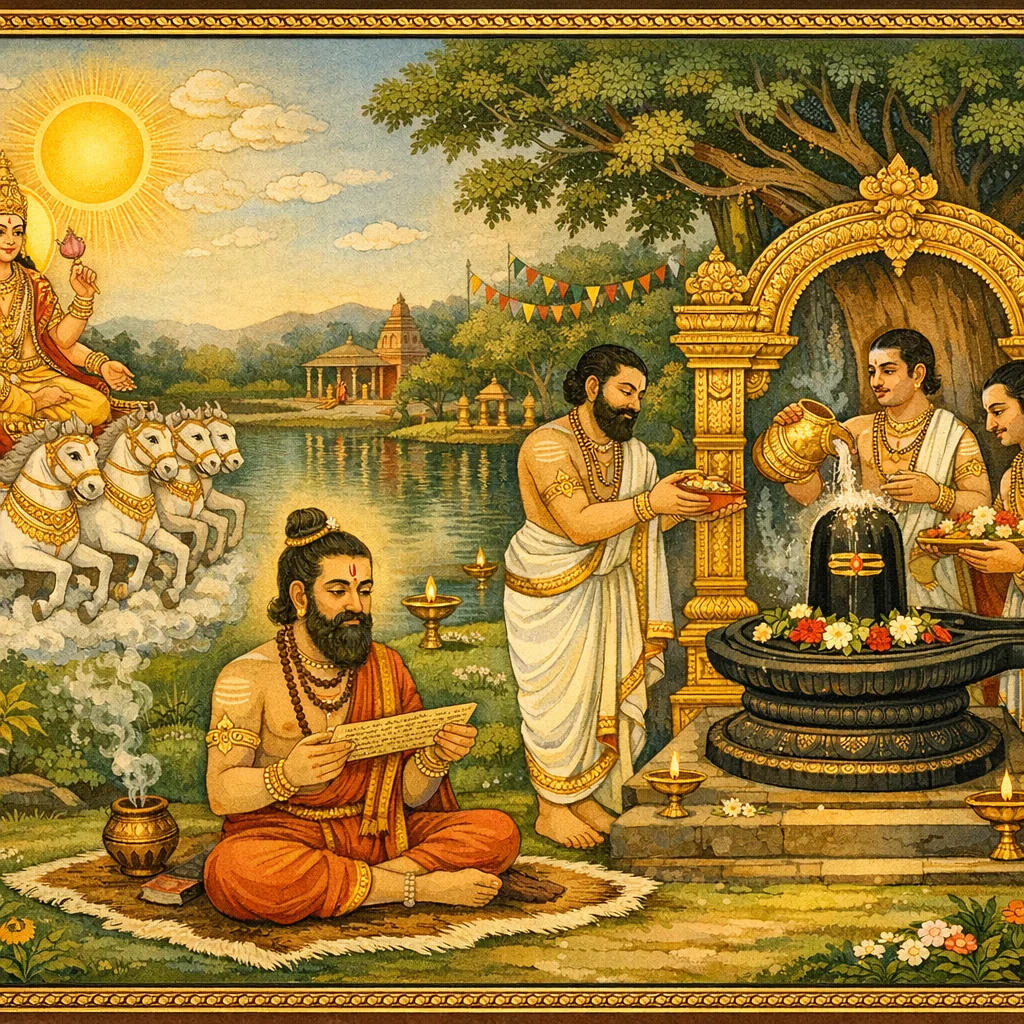
The chapter moves in three closely linked parts. (1) To answer doubts about the afterlife, Kamatha systematizes the “marks of karma’s fruit” (karma-phala lakṣaṇas) as an instructive catalogue: visible embodied conditions—disease, disability, and social marginality—are correlated with specific transgressions such as violence, theft, deceit, sexual misconduct, disrespect toward teachers, and harm done to cows or sacred persons. (2) A dharma-centered didactic close follows: happiness in both worlds arises from dharma, while adharma yields suffering; even a short life with “white” (pure) action is preferable to a long life opposed to the good of both worlds. (3) The narrative then turns to sacred establishment. Nārada and the brāhmaṇas praise Kamatha’s discourse; Sūrya appears, approves, and offers a boon. Asked to remain permanently, Sūrya agrees and becomes known as Jayāditya, promising relief from poverty and disease to worshippers. After Kamatha recites a formal hymn (Jayādityāṣṭaka-style), Sūrya prescribes ritual times (especially Sundays and the month of Āśvina), offerings, bathing at Koṭitīrtha, and the resulting purification and attainment of Sūryaloka; the chapter ends by equating this practice’s merit with that of renowned tīrthas.
Shlokas
Verse 1
अतिथिरुवाच । यदेतत्परलोकस्य स्वरूपं व्याहृतं त्वया । आगमं समुपाश्रित्य तत्तथैव न संशयः
Atithi said: “What you have explained about the true nature of the other world, relying on the Āgamas, is indeed exactly so—of this there is no doubt.”
Verse 2
किंत्वत्र नास्तिकाः पापाः सन्दिह्यन्तेऽल्पचेतनाः । तेषां निःसंशयकृते वद कर्मफलं हि यत्
Yet even here, sinful unbelievers of little understanding still harbor doubt. To remove their uncertainty, declare plainly what the true fruit of actions (karma) is.
Verse 3
इहैव कस्य कस्यैव कर्मणः पापकस्य च । प्रभावात्कीदृशो जायेत्कमठैतद्वदास्ति चेत्
And in this very life, by the influence of which particular sinful deeds is one born with what kind of bodily condition? O Kamaṭha, speak of this, if it can be known.
Verse 4
कमठ उवाच । सर्वमेतत्प्रवक्ष्यामि स्थिरो भूत्वा शृणुष्व तत् । यथा मम गुरुः प्राह यन्मे चेतसि संस्थितम्
Kamaṭha said: “I shall explain all this; be steady and listen. I will speak just as my teacher taught me—what is firmly established in my mind.”
Verse 5
ब्रह्महा क्षयरोगी स्यात्सुरापः श्यावदंतकः । सुवर्णचौरः कुनखी दुश्चर्मा गुरुतल्पगः
A slayer of a brāhmaṇa becomes afflicted with consumption; a drinker of liquor becomes dark-toothed; a stealer of gold becomes deformed-nailed; and one who violates the teacher’s bed becomes diseased of skin.
Verse 6
संसर्गी सर्वरोगी स्यात्पंचपातकिनस्त्वमी । निंदामाकर्ण्य साधूनां बधिरः संप्रजायते
One who associates with such sinners becomes afflicted with every disease; these are the five great sinners. And one who listens to slander of holy persons is born deaf.
Verse 7
स्वयं प्रकीर्तयेच्चापि मूकः पापोऽभिजायते । आज्ञालोपी गुरूणां च अपस्मारी भवेन्नरः
One who praises himself is born a sinful mute. And a man who violates the commands of his teachers becomes afflicted with epilepsy.
Verse 8
अवज्ञाकारकस्तेषां कृमिरेवाभिजायते । उपेक्षतः पूज्यकार्यं दुष्प्रज्ञत्वं च जायते
One who shows contempt toward them is born as a worm. And from neglecting what ought to be done for the venerable, dull-wittedness arises.
Verse 9
चौर्याय साधुद्रव्याणां दद्याद्यावत्पदानि च । तावद्वर्षाणि पंगुत्वं स प्राप्नोति नराधमः
For stealing the property of holy persons—in proportion to as many steps as he takes—for that many years that vile man attains lameness.
Verse 10
दत्त्वा हरति तद्भूयो जायते कृकलासकः । कुपितानप्रसाद्यैव पूज्यान्स्याच्छीर्षरोगवान्
Having given, if one takes it back again, he is born as a lizard. And if, without seeking reconciliation, he leaves the venerable displeased, he becomes one afflicted with diseases of the head.
Verse 11
रजस्वलामभिगच्छंश्च चंडालः संप्रजायते । वस्त्रापहारी चित्री स्यात्कृष्णकुष्ठी तथाग्निदः
One who approaches a woman during her menses is born as an outcaste. A thief of garments becomes afflicted with a blotched skin-disease; likewise, one who causes fire (arson) becomes a sufferer of black leprosy.
Verse 12
दर्दुरो रूप्यहारी स्यात्कूटसाक्षी मुखारुजः । परदारांश्च कामेन द्रष्टा स्यादक्षिरोगवान्
A stealer of silver is born as a frog. A false witness suffers disease of the mouth. One who, in lust, looks upon another’s spouse is afflicted with diseases of the eyes.
Verse 13
प्रतिज्ञायाप्रयच्छन्यो ह्यल्पायुर्जायते नरः । विप्रवृत्त्यपहारी स्यादजीर्णी सर्वदाऽधमः
A man who makes a pledge and then does not give what he promised is born short-lived. One who steals a brāhmaṇa’s livelihood is ever indigested and is regarded as base.
Verse 14
नैष्ठिकान्नाशनाद्भूयो निवृत्तो रोगवान्सदा । पत्नीबहुत्वे त्वेकस्यां रेतोमोक्षः क्षयी भवेत्
One who repeatedly turns away from feeding a steadfast renunciant becomes ever diseased. And one who has many wives, yet emits with only one, falls into wasting decline.
Verse 15
स्वामिना धर्मयुक्तो यस्त्वन्यायेन समाचरेत् । स्वयं वा भक्षयेद्द्रव्यं स मूढः स्याज्जलोदरी
Even when employed by a righteous master, one who acts unjustly—or who consumes the entrusted goods himself—becomes deluded and is afflicted with dropsy (swelling from fluid).
Verse 16
दुर्बलं पीड्यमानं यो बलवान्समुपेक्षते । अंगहीनः स च भवेदन्नहृत्क्षुधितो भवेत्
A strong man who ignores a weak person being oppressed becomes maimed. And one who steals food remains ever hungry.
Verse 17
व्यवहारे पक्षपाती जिह्वारोगी भवेन्नरः । धर्मप्रवृत्तिं सञ्चार्य पत्न्यादीष्टवियोगकृत्
A man who is partial in judgments becomes afflicted with disease of the tongue. And one who disrupts the practice of dharma becomes the cause of separation from beloveds—wife and others.
Verse 18
स्वयं पाकाग्रभोजी यो गलरोगमवाप्नुयात् । पंचयज्ञानकृत्वैव भुञ्जानो ग्रामशूकरः
One who eats first from the cooking, before serving others, incurs disease of the throat. And one who eats without performing the five daily sacrifices becomes like a village pig.
Verse 19
पर्वमैथुन कृन्मेही परित्यज्य स्वगेहिनीम् । वेश्यादिरक्तो मूढात्मा खल्वाटो जायते नरः
A man who indulges in intercourse on forbidden occasions becomes afflicted with urinary or sexual ailments. Abandoning his own wife and becoming attached to prostitutes and the like, that deluded man is born bald.
Verse 20
परिक्षीणान्मित्रबन्धून्स्वामिनं दयितानुगान् । अवमन्य निवृत्तात्मा क्लिष्टवृत्तिः सदा भवेत्
One who, with a turned-away heart, insults weakened friends and relatives, as well as his master and devoted dependents, lives always in a troubled and afflicted condition of life.
Verse 21
छद्मनोपचरेद्यस्तु पितरौ स्वामिनं गुरून् । प्राप्तव्यार्थस्यातिकष्टात्परिभ्रंशोर्थजो भवेत्
Whoever behaves deceitfully toward his parents, his master, or his teachers—though he strives hard to obtain prosperity—suffers the ruin of that very wealth, born of his own wrongdoing.
Verse 22
विश्रब्धस्यापहारी तु दुःखानां भाजनं भवेत् । धार्मिके क्षुद्रकारी यो नरः स वामनो भवेत्
He who steals from one who trusts him becomes a vessel of sorrows. And the man who acts meanly toward a righteous person is reborn as a dwarf.
Verse 23
दुर्बलवृषवाही यः कटिलूती भवेत्स च
He who drives or overloads a weak bull is reborn as a kaṭilūtī, a low creeping, parasite-like being.
Verse 24
जात्यंधश्चापि यो गोघ्नो निःपशुर्दुःखकृद्गवाम् । निर्दयो गोषु घाताद्यैः सदा सोध्वसु कष्टगः
He who kills cows, deprives others of cattle, and causes suffering to bovines—mercilessly injuring them in various ways—is born blind and ever meets hardship on the roads of travel and the paths of life.
Verse 25
निस्तेजकः सभायां यो गलगण्डी स जायते । सदा क्रोधी च चंडालः पूतिवक्त्रश्च सूचकः
He who diminishes another’s dignity in an assembly is born with goitre. The ever-angry one becomes a caṇḍāla; and the informer is born foul-mouthed, with a fetid mouth.
Verse 26
अजविक्रयकृद्व्याधः कुण्डाशी भृतको भवेत् । नास्तिकस्तिल पिंडी स्यादश्रद्धो गीतजीवनः
The butcher who lives by selling goats is reborn as a kuṇḍāśī—an eater of impure fare—and as a hired servant. The atheist becomes a tila-piṇḍī, a pitiable diminished being; and the faithless lives by singing, mere performance without inner conviction.
Verse 27
अभक्ष्यादो गण्डमाली स्त्रीखादी चाऽसुतस्य कृत् । अन्यायतो ज्ञानग्राही मूर्खो भवति मानवः
He who eats what is forbidden falls into disease, bearing swollen glands like a garland of tumors. He who violates women becomes the cause of childlessness. And the man who grasps knowledge by unjust means becomes a fool.
Verse 28
शास्त्रचौरः केकराक्षः कथां पुण्यां च द्वेष्टि यः । कृमिवक्त्रः स च भवेद्विभ्रष्टो नरकात्कुधीः
A thief of the śāstras becomes cross-eyed. He who hates sacred, merit-bearing discourse is born with a mouth eaten by worms; that evil-minded one, though released from hell, comes forth thus afflicted.
Verse 29
देवद्विजगवां वृत्तिहारको वांतभक्षकृत् । तडागारामभेत्ता यो भवेद्विकलपाणिकः
He who deprives the gods, brāhmaṇas, or cows of their livelihood; he who eats vomit; and whoever destroys ponds and gardens, is born with crippled, disabled hands.
Verse 30
व्यवहारे च्छलग्राही भृत्यग्रस्तो भवेन्नरः । सदा पुरुषरोगी स्यात्परदाररतो नरः
A man who resorts to fraud in dealings becomes oppressed by servants and dependents. And the man devoted to another’s wife is ever afflicted with fierce diseases.
Verse 31
वात रोगी कुवैद्यः स्याद्दुश्चर्मा गुरुतल्पगः । मधुमेही खरीगामी गोत्रस्त्रीमैथुनोऽप्रसूः
One afflicted with vāta becomes a quack physician. The violator of the teacher’s bed is born with diseased skin. One who has intercourse with a donkey becomes diabetic. And one who has intercourse with a woman of his own lineage becomes childless—these are said to be the outward marks of sin.
Verse 32
स्वसारं मातरं पुत्रवधूं गच्छन्नबीजवान् । कृतघ्नः सर्व कार्याणां वैफल्यं समुपाश्नुते
He who goes to his own sister, his mother, or his son’s wife becomes without seed (impotent or infertile). Moreover, the ungrateful person meets with failure in all undertakings.
Verse 33
इत्येष लक्षणोद्देशः पापिनां परिकीर्तितः । चित्रगुप्तोऽपि मुह्येत सकलस्यानुवर्णने
Thus has a brief indication of the marks of sinners been declared. Even Citragupta himself would be bewildered were he to describe them all in full.
Verse 34
एते नरक विभ्रष्टा भुक्त्वा योनीः सहस्रशः । एवंविधैश्चिह्निताश्च जायंते लक्षणैर्नराः
These, having fallen away from hell after experiencing thousands of births, are born among men marked by such signs and characteristics.
Verse 35
ये हि धर्मं न मन्यंते तथा ये व्यसनैर्जिताः । अनुमानेन बोद्धव्यं यदेते शेषपापिनः
Those who do not honor dharma, and those conquered by addictions and vices—by inference one should understand that they are sinners with a remaining residue of sin.
Verse 36
येषां त्वंतगतं पापं स्वर्गाद्वा ये समागताः । सर्वव्यसननिर्मुक्ता धर्ममेकं भजन्ति ते
But those whose sin has come to an end, or who have returned from heaven—freed from all vices—devote themselves to dharma alone.
Verse 37
भवंति चात्र श्लोकाः । धर्मादनवमं सौख्यमधर्माद्दुःखसम्भवः । तस्माद्धर्मं सुखार्थाय कुर्यात्पापं विवर्जयेत्
And here are verses: From dharma arises unfailing happiness; from adharma arises the birth of suffering. Therefore, for the sake of happiness, one should practice dharma and avoid sin.
Verse 38
लोकद्वयेऽपि यत्सौख्यं तद्धर्मात्प्रोच्यते यतः । धर्ममेकमतः कुर्यात्सर्वकार्यार्थसिद्धये
Whatever happiness there is in both worlds is said to arise from dharma. Therefore one should practice dharma alone for the accomplishment of every aim and undertaking.
Verse 39
मुहूर्तमपि जीवेत नरः शुक्लेन कर्मणा । न कल्पमपि जीवेत लोकद्वयविरोधिना
Let a man live even for a moment by pure, bright action; let him not live even for an aeon by conduct that is hostile to both worlds.
Verse 40
इति पृष्टं त्वया विप्र यथाशक्त्या मयेरितम् । असूक्तं सूक्तमथवा क्षंतव्यं किं वदामि च
Thus, O brāhmaṇa, what you asked has been answered by me to the best of my ability. Whether it was spoken well or ill, forgive it—what more can I say?
Verse 41
नारद उवाच । कमठस्यैतदाकर्ण्य अष्टवर्षस्य भाषितम् । भगवान्भास्करः प्रीतो बभूवातीव विस्मितः
Nārada said: Hearing these words spoken by Kamaṭha, the eight-year-old, the blessed Sun-god Bhāskara became pleased and exceedingly astonished.
Verse 42
प्रशशंस च तान्विप्रान्हारीतप्रमुखांस्तदा । अहो वसुमती धन्या द्विजैरेवंविधोत्तमैः
Then he praised those brāhmaṇas, with Hārīta foremost among them: “Ah! Blessed is the earth, graced by such excellent twice-born ones!”
Verse 43
अथ प्रजापतिर्धन्यो यन्मर्यादाभिपाल्यते । अमीभिर्ब्राह्मणवरैर्धन्या वेदाश्च संप्रति
Indeed, Prajāpati is blessed, since the sacred boundaries of dharma are preserved; and through these excellent brāhmaṇas, even the Vedas are blessed and upheld today.
Verse 44
येषां मध्ये बालबुद्धिरियमेतादृशी स्फुटा । हारीतप्रमुखानां हि का वै बुद्धिर्भविष्यति
If, among them, even a child’s understanding is so clear and articulate, what then must be the wisdom of those led by Hārīta—what indeed will their discernment be like!
Verse 45
असंशयं त्रिलोकस्थमेषामविदितं न हि । यथैतान्नारदः प्राह भूयस्तस्मादमी बहु
Without doubt, nothing that exists in the three worlds is unknown to them. Just as Nārada spoke about them, so indeed these sages are abundantly endowed with knowledge and virtue.
Verse 46
इति प्रशस्य तान्विप्रान्प्रहृष्टो रविरव्रवीत् । अहं सूर्यो विप्रमुख्या युष्माकं दर्शनात्कृते
Having thus praised those brāhmaṇas, Ravi (the Sun), delighted, spoke: “O foremost among brāhmaṇas, I am Sūrya; I have come for the sake of beholding you.”
Verse 47
समागतः सूर्यलोकात्प्राप्तं नेत्रफलं च मे । भवद्विधैर्विप्रमुख्यैः संजल्पनसहासनात्
I have come from Sūryaloka, and I have gained the fruit of my eyes—the reward of beholding—through conversing and sitting together with foremost brāhmaṇas such as you.
Verse 48
अंत्यजा अपि पूयन्ते किं पुनर्मादृशा द्विजाः । सर्वथा नारदो धन्यो योऽसौ त्रैलोक्यतत्त्ववित्
Even the low-born are purified by contact with the holy; how much more, then, we who are dvija! Blessed in every way is Nārada, for he knows the truth of the three worlds.
Verse 49
युष्माभिर्बध्यते श्रेयो यस्य वै धूतकिल्विषैः । प्रणमामि च वः सर्वान्मनोबुद्धिसमाधिभिः । तपो विद्या च वृत्तं च यतो वार्द्धक्यकारणम्
By you—whose sins have been shaken off—well-being is secured and firmly established. I bow to you all with mind, intellect, and concentrated devotion. For austerity, sacred learning, and noble conduct are the causes of true, venerable maturity.
Verse 50
वरं मत्तो वृणीध्वं च दुर्लभं यं हृदीच्छत । यूयं स्वयं हि वरदा मत्संगो मास्तु निष्फलः
Choose a boon from me—whatever rare gift you desire in your hearts. For you yourselves are bestowers of boons; let my association with you not be fruitless.
Verse 51
देवतानां हि संसर्गो निष्फलो नोपजायते । तस्मान्मत्तो वरं किंचिद्वृणुध्वं प्रददामि वः
Association with the gods never arises without fruit. Therefore, choose some boon from me—I shall grant it to you.
Verse 52
श्रीनारद उवाच । इति सूर्यवचः श्रुत्वा प्रहृष्टास्ते द्विजोत्तमाः
Śrī Nārada said: Hearing these words of Sūrya, those best of the twice-born sages were filled with joy.
Verse 53
संपूज्य परया भक्त्या पाद्यार्घ्यस्तुतिवंदनैः । मंडलादीन्महाजप्यान्गृणंतः प्रोचिरे रविम्
Worshipping with supreme devotion—offering water for the feet (pādya) and arghya, with hymns and reverent salutations—and reciting great mantras beginning with the Maṇḍala hymns, they then addressed Ravi, the Sun.
Verse 54
जयादित्य जय स्वामिञ्जय भानो जयामल । जय वेदपते शश्वत्तारयास्मानहर्पते
Victory to you, Jayāditya! Victory, O Lord! Victory, O Bhānu! Victory, O Stainless One! Victory, Lord of the Vedas—ever save us, O Lord of the Day!
Verse 55
विप्राणां त्वं परो देवो विप्रसर्गोऽपि त्वन्मयः । नितरां पूतमेतन्नः स्थानं देव त्वयेक्षितम्
For the brāhmins you are the supreme deity, and even the very community of brāhmins is pervaded by you. This place of ours, O God, has become exceedingly purified by your gaze.
Verse 56
अद्य नः सफला वेदा अद्य नः सफलाः क्रियाः । अद्य नः सफलं गेहं त्वया संगम्य गोपते
Today our Vedas have borne fruit; today our rites have borne fruit. Today our very home is fruitful, having met with you, O Lord and Protector.
Verse 57
वरं यदि प्रदातासि तदेनं प्रवृणीमहे । आस्माकीनमिदं स्थानं न हि त्याज्यं कथंचन
If You are to grant a boon, we choose this: that this place belonging to us should never be abandoned in any way.
Verse 58
श्रीसूर्य उवाच । यस्माद्भवद्भिः पूर्वं हि जयादित्येति चोदितम् । जयादित्य इति ख्यातस्तस्मात्स्थास्येऽत्र सर्वदा
Śrī Sūrya said: Because you earlier acclaimed Me with the words ‘Jayāditya’, I shall be renowned as ‘Jayāditya’; therefore I will dwell here always.
Verse 59
यावन्मही समुद्राश्च पर्वता नगराणि च । तावत्स्थानमिदं विप्रा न हि त्यक्ष्यामि कर्हिचित्
So long as the earth endures—with its oceans, mountains, and cities—so long, O brahmins, will this place endure; I shall never abandon it at any time.
Verse 60
दारिद्र्यरोगसंघातान्दद्रवो मंडलानि च । कुष्ठादीन्नाशयिष्यामि भजतामत्र संस्थितः
Abiding here, I shall destroy for those who worship—crushing poverty and masses of diseases, including ringworm-like eruptions and even leprosy and the like.
Verse 61
यो मामत्र स्थितं चापि पूजयिष्यति मानवः । सूर्यलोकमिवागम्य पूजां तस्य भजाम्यहम्
Whoever, being human, worships Me as I am established here—having (as it were) reached the realm of the Sun, I Myself accept and partake of that person’s worship.
Verse 62
श्रीनारद उवाच । एवमुक्ते भगवता हारीताद्या द्विजोत्तमाः । मूर्तिं संस्थापयामासुर्वेदोदितविधानतः
Śrī Nārada said: When the Lord had spoken thus, the best of the twice-born sages—Hārīta and the others—installed the sacred icon, in accordance with the rites enjoined in the Vedas.
Verse 63
ततो द्विजाः प्राहुरेवं कमठं त्वत्कृते रविः । अत्र स्वामी स्थितस्तस्मात्प्रथमं स्तुहि त्वं रविम्
Then the brāhmaṇas said to Kamaṭha: “For your sake, Ravi (the Sun) is present here as the Lord. Therefore, first praise the Sun.”
Verse 64
इत्युक्तो ब्राह्मणैः सर्वैः कमठो वाग्ग्मिनां वरः । प्रणिपत्य जयादित्यं महास्तोत्रमिदं जगौ
Thus addressed by all the brāhmaṇas, Kamaṭha—foremost among eloquent speakers—bowed down to victorious Āditya and recited this great hymn.
Verse 65
न त्वं कृतः केवलसंश्रुतश्च यजुष्येवं व्याहरत्यादिदेव । चतुर्विधा भारती दूरदूरं धृष्टः स्तौमि स्वार्थकामः क्षमैतत्
O Primeval God, You are not something made, nor merely something heard of—yet the Yajus Veda speaks of You thus. Speech in its fourfold forms reaches only from afar; still, driven by my own need, I boldly praise You—please forgive this.
Verse 66
मार्तंडसूर्यांशुरविस्तथेन्द्रो भानुर्भगश्चार्यमा स्वर्णरेताः
You are Mārtaṇḍa, Sūrya, Aṃśu, Ravi, and also Indra; You are Bhānu, Bhaga, Aryaman, and the golden-seeded, the radiant one.
Verse 67
दिवाकरो मित्रविष्णुश्च देव ख्यातस्त्वं वै द्वादशात्मा नमस्ते । लोकत्रयं वै तव गर्भगेहं जलाधारः प्रोच्यसे खं समग्रम्
O God, You are famed as Divākara, as Mitra, and as Viṣṇu; indeed You are of twelvefold nature—obeisance to You. The three worlds are truly the chamber of Your womb; You are called the support of the waters, and the entire sky is Your all-encompassing expanse.
Verse 68
नक्षत्रमाला कुसुमाभिमाला तस्मै नमो व्योमलिंगाय तुभ्यम्
Adorned with garlands of constellations, wreathed as if with flowers—salutations to You, the Sky-Liṅga (Vyoma-liṅga).
Verse 69
त्वं देवदेवस्त्वमनाथनाथस्त्वं प्राप्यपालः कृपणे कृपालुः । त्वं नेत्रनेत्रं जनबुद्धिबुद्धिराकाशकाशो जय जीवजीवः
You are the God of gods; You are the refuge of the refuge-less. You are the protector of those who come to You, compassionate to the helpless. You are the eye of the eye, the intelligence within people’s intelligence; You are the radiance of space—victory to You, O very life of all living beings.
Verse 70
दारिद्र्यदारिद्र्य निधे निधीनाममंगलामंगल शर्मशर्म । रोगप्ररोगः प्रथितः पृथिव्यां चिरं जयादित्य जयाप्रमेय
O treasure among treasures—You who remove poverty and even the poverty of poverty; O auspiciousness of the auspicious, O peace of peace; O famed remedy for diseases upon the earth—victory to You, O Āditya; victory, O immeasurable One, for a long time.
Verse 71
व्याधिग्रस्तं कुष्ठरोगाभिभूतं भग्न प्राणं शीर्णदेहं विसंज्ञम् । माता पिता बांधवाः संत्यजंति सर्वैस्त्यक्तं पासि कोस्ति त्वदन्यः
Afflicted by disease, overwhelmed by leprosy, with life-breath failing, the body wasted, and consciousness lost—when even mother, father, and relatives abandon such a one, You alone protect the forsaken. Who else is there apart from You?
Verse 72
त्वं मे पिता त्वं जननी त्वमेव त्वं मे गुरुर्बान्धवाश्च त्वमेव । त्वं मे धर्मस्त्वं च मे मोक्षमार्गो दासस्तुभ्यं त्यज वा रक्ष देव
You are my father; You are my mother—You alone. You are my teacher and my kin. You are my dharma, and You are the path to liberation. I am Your servant—O Deva, abandon me or protect me, as You will.
Verse 73
पापोऽस्मि मूढोऽस्मि महोग्रकर्मा रौद्रोऽस्मि नाचारनिधानमस्मि । तथापि तुभ्यं प्रणिपत्य पादयोर्जयं भक्तानामर्पय श्रीजयार्क
I am sinful; I am deluded; my deeds are fiercely dreadful. I am harsh, and not a repository of right conduct. Yet, bowing down at Your feet, O glorious Jayārka, grant victory and well-being to Your devotees.
Verse 74
नारद उवाच । एवं स्तुतो जयादित्यः कमठेन महात्मना । स्निग्धगंभीरया वाचा प्राह तं प्रहसन्निव
Nārada said: Thus praised by the great-souled Kamaṭha, Jayāditya spoke to him in a voice both tender and profound, as though smiling.
Verse 75
जयादित्याष्टकमिदं यत्त्वया परिकीर्तितम् । अनेन स्तोष्यते यो मां भुवि तस्य न दुर्लभम्
This ‘Jayādityāṣṭaka’ that you have recited—whoever on earth praises Me with it, for him nothing is hard to obtain.
Verse 76
रविवारे विशेषेण मां समभ्यर्च्य यः पठेत् । तस्य रोगा न शिष्यंति दारिद्र्यं च न संशयः
Especially on Sundays, whoever worships Me properly and recites this—his diseases do not remain, and poverty too departs, without doubt.
Verse 77
त्वया च तोषितो वत्स तव दद्मि वरंत्वमुम् । सर्वज्ञो भुवि भूत्वा त्वं ततो मुक्तिमवाप्स्यसि
Beloved child, you have pleased Me; therefore I grant you this boon: becoming all-knowing upon the earth, you shall thereafter attain liberation (mokṣa).
Verse 78
त्वत्पिता स्मृतिकारश्च भविष्यति द्विजार्चितः । स्थानस्यास्य न नाशश्च कदाचित्प्रभविष्यति
Your father too will become a composer of a Smṛti, honored by the dvija (twice-born); and the destruction of this sacred place shall never come to pass at any time.
Verse 79
न चैतत्स्थानकं वत्स परित्यक्ष्यामि कर्हिचित् । एवमुक्ता स भगवान्ब्राह्मणैरर्चितः स्तुतः
And, beloved child, I shall never abandon this holy abode. Having spoken thus, that Blessed Lord was worshipped and praised by the brāhmaṇas.
Verse 80
अनुज्ञाप्य द्विजेद्रांस्तांस्तत्रैवांतर्दधे प्रभुः । एवं पार्थ समुत्पन्नो जयादित्योऽत्र भूतले
Having taken leave of those best of the dvija, the Lord vanished there itself. Thus, O Pārtha, Jayāditya manifested here upon the earth.
Verse 81
आश्विने मासि संप्राप्ते रविवारे च सुव्रत । आश्विने भानुवारेण यो जयादित्यमर्चयेत्
O you of noble vow, when the month of Āśvina has arrived and it is Sunday—whoever, on a Sunday in Āśvina, worships Jayāditya, the Victorious Sun …
Verse 82
कोटितीर्थे नरः स्नात्वा ब्रह्महत्यां व्यपोहति । पूजनाद्रक्तमाल्यैश्च रक्तचंदनकुंकुमैः
Having bathed at Koṭitīrtha, a man washes away even the sin of brahma-slaughter. And by worship—using red garlands, red sandal paste, and kuṅkuma (sacred saffron)—
Verse 83
लेपनाद्गंधधूपाद्यै नैवेद्येर्घृतपायसैः । ब्रह्मघ्नश्च सुरापश्च स्तेयी च गुरुतल्पगः
By anointing the deity, by fragrances, incense and the like, and by food-offerings such as ghee and sweet rice—(even) a brahma-slayer, a drinker of liquor, a thief, and one who violates the teacher’s bed—
Verse 84
मुच्यते सर्वपापेभ्यः सूर्यलोकं च गच्छति । पुत्रदारधनान्यायुः प्राप्य सां सारिकं सुखम्
…is freed from all sins and goes to the world of the Sun. Obtaining sons, spouse, wealth, and longevity, he enjoys happiness in worldly life as well.
Verse 85
इष्टकामैः समायुक्तः सूर्यलोके चिरं वसेत्
Endowed with his desired wishes, he dwells for a long time in the world of the Sun.
Verse 86
सर्वेषु रविवारेषु जयादित्यस्य दर्शनम् । कीर्तनं स्मरणं वापि सर्व रोगोपशांतिदम्
On every Sunday, beholding Jayāditya—and likewise praising him or even remembering him—brings the pacification of all diseases.
Verse 87
अनादिनिधनं देवमव्यक्तं तेजसां निधिम् । ये भक्तास्ते च लीयंते सौरस्थाने निरामये
That Deity is without beginning or end, unmanifest, a treasury of splendors. Those who are devoted likewise merge into the Sun’s abode, free from all affliction.
Verse 88
सूर्योपरागे संप्राप्ते रविकूपे समाहितः । स्नानं यः कुरुते पार्थ होमं कुर्यात्प्रयत्नतः
When a solar eclipse arrives, O Pārtha, one who, with a concentrated mind at Ravikūpa, performs the sacred bath should also, with earnest effort, perform homa—the fire-offering.
Verse 89
दानं चैव यथाशक्त्या जयादित्याग्रतः स्थितः । तस्य पुण्यस्य माहात्म्यं शृणुष्वैकमना जय
And, standing before Jayāditya, one should give charity according to one’s capacity. Hear, with single-pointed mind, O Jaya, the greatness of that merit.
Verse 90
कुरुक्षेत्रेषु यत्पुण्यं प्रभासे पुष्करेषु च । वाराणस्यां च यत्पुण्यं प्रयागे नैमिषेऽपि वा । तत्पुण्यं लभते मर्त्यो जयादित्यप्रसादतः
Whatever merit is found at Kurukṣetra, at Prabhāsa, and at Puṣkara; whatever merit is found at Vārāṇasī, or at Prayāga, or even at Naimiṣa—that very merit a mortal obtains through the grace of Jayāditya.