Adhyaya 41
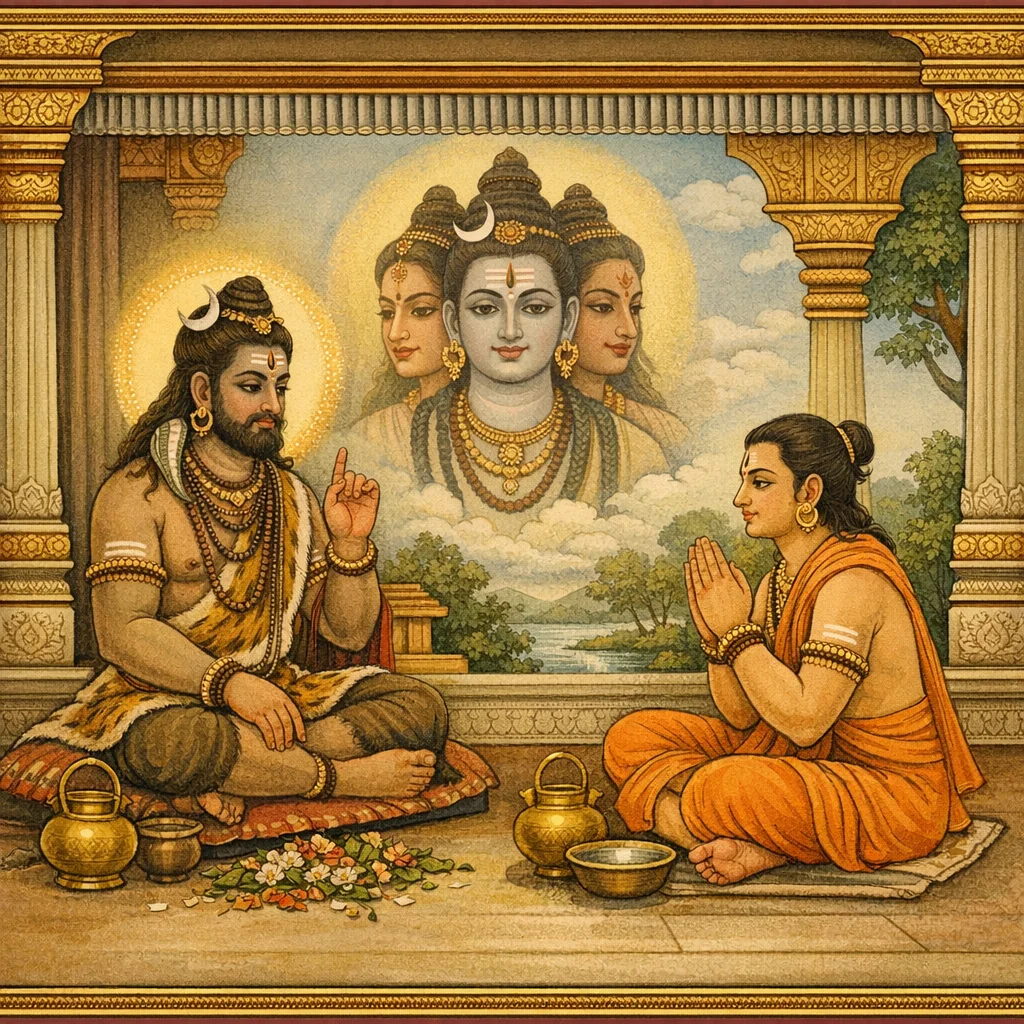
The chapter presents a structured theological and ethical instruction spoken by Mahākāla in reply to Karaṇḍhama. It first addresses debates about the “superiority” of deities—some extol Śiva, others Viṣṇu, others Brahmā as the means to mokṣa—and warns against simplistic hierarchy, recalling an earlier Naimiṣāraṇya episode where sages sought a verdict and received affirmations honoring multiple divine forms. It then lays out a detailed classification of sin: misdeeds of mind, speech, and body, with hostility toward Śiva marked as especially grave. Degrees of wrongdoing are traced from major sins (mahāpātaka) to secondary offenses (upapātaka) and broader social-ethical violations such as deceit, cruelty, exploitation, and slander. The teaching turns to ritual prescription with an abridged yet technical Śiva-pūjā: proper times, purification (including bhasma), entering and cleansing the shrine, water-vessels (gaḍuka), offerings, dhyāna, mantra practice (including a stated mūlamantra), arghya, dhūpa-dīpa-naivedya, nīrājana, and concluding hymns with requests for forgiveness. Finally, an extensive ācāra compendium sets out daily discipline for the householder-devotee—sandhyā observance, restraint in speech, bodily purity, reverence toward elders and sacred beings, and practical rules to safeguard dharma and spiritual progress. The chapter ends with a divine assembly honoring Mahākāla, affirming the renown of the liṅga and its associated tīrtha, and declaring benefits for those who hear, recite, or worship in accordance with these teachings.
Shlokas
Verse 1
करधम उवाच । केचिच्छिवं समाश्रित्य विष्णुमाश्रित्य वेधसम् । वर्णयंति परे मोक्षं त्वं तु कस्मात्तु मन्यसे
Karadhama said: “Some, taking refuge in Śiva; others, taking refuge in Viṣṇu; and others, in Vedhas (Brahmā), speak of the highest liberation. But what do you consider to be the true basis of mokṣa?”
Verse 2
महाकाल उवाच । अपारवैभवा देवास्त्रयोऽप्येते नरर्षभ । योगींद्राणामपि त्वत्र चेतो मुह्यति किं मम
Mahākāla said: “These three gods are of boundless majesty, O best among men. In this matter, even the minds of the greatest yogins become bewildered—what then of me?”
Verse 3
पुरा किलैवं मुनयो नैमिषारण्यवासिनः । संदिह्यांतः श्रेष्ठतायां ब्रह्मलोकमुपागमन्
Long ago, sages dwelling in Naimiṣāraṇya, doubting as to who is supreme, went to Brahmaloka.
Verse 4
तस्मिन्क्षणे विरिंचोऽपि श्लोकं प्रह्वोऽब्रवीत्किल । अनंताय नमस्तस्मै यस्यांतो नोपलभ्यते
At that very moment, even Viriñca (Brahmā), bowing humbly, is said to have uttered this verse: “Homage to that Infinite One, whose end can never be found.”
Verse 5
महेशाय च भक्ते द्वौ कृपायेतां सदा मयि । ततः श्रेष्ठं च तं मत्वा क्षीरोदं मुनयो ययुः
“May those two—Maheśa and the devotee—ever show compassion to me.” Then the sages, deeming that realm the most excellent, went to the Ocean of Milk (Kṣīroda).
Verse 6
तत्र योगेश्वरः श्लोकं प्रबुध्यन्नमुमब्रवीत् । ब्रह्माणं सर्वभूतेषु परमं ब्रह्मरूपिणम्
There, the Lord of Yoga, awakening their understanding, spoke this verse: “Brahmā, abiding within all beings, is the Supreme—bearing the very form of Brahman.”
Verse 7
सदाशिवं च वंदे तौ भवेतां मंगलाय मे । ततस्ते विस्मिता विप्रा अपसृत्य ययुः पुनः
“And I bow to Sadāśiva; may those two become auspicious for me.” Then those brāhmaṇa sages, astonished, withdrew and departed again.
Verse 8
कैलासे ददृशुः स्थाणुं वदंतं गिरिजां प्रति । एकादश्यां प्रनृत्यानि जागरे विष्णुसद्मनि
On Kailāsa they beheld Sthāṇu (Śiva) speaking to Girijā (Pārvatī). And on Ekādaśī, in the abode of Viṣṇu, dance-performances were offered during the night-vigil (jāgara).
Verse 9
सदा तपस्यां चरामि प्रीत्यर्थं हरिवेधसोः । श्रुत्वेति चापसृत्यैव खिन्नास्ते मुनयोऽब्रुवन्
(He said:) “I ever practice austerity (tapas) for the pleasure of Hari and Vedhas (Brahmā).” Hearing this, those sages withdrew at once and spoke in dejection.
Verse 10
यद्वा देवा न संयांति पारं ये च परस्परम् । तत्सृष्टसृष्टसृष्टेषु गणना काऽस्मदादिषु
If even the gods cannot reach one another’s farthest limit, then amid creations born of creations upon creations—what counting or comparison could there be for beings like us?
Verse 11
उत्तमाधममध्यत्वममीषां वर्णयंति ये । असत्यवादिनः पापास्ते यांति निरयं ध्रुवम्
Those who speak of these divine beings as ‘highest, lowest, or middling’—sinful liars—surely go to hell.
Verse 12
एवं ते निश्चियामासुर्नैमिषेया स्तपस्विनः । सत्यमेतच्च राजेंद्र ममापीदं मतं स्फुटम्
Thus the ascetic sages of Naimiṣa reached their conclusion: “This indeed is true, O best of kings; this is clearly my own view as well.”
Verse 13
जापकानां सहस्राणि वैष्मवानां तथैव च । शैवानां च विधिं विष्णुं स्थाणुं चाप्यन्वमूमुचन्
Thousands of japa-practitioners—Vaiṣṇavas as well as Śaivas—followed and revered Vidhi (Brahmā), Viṣṇu, and Sthāṇu (Śiva) too.
Verse 14
तस्माद्यस्य मनोरागो यस्मिन्देवे भवेत्स्फुटम् । स तं भजेद्विपापः स्यान्ममेदं मतमुत्तमम्
Therefore, whichever deity a person’s heart is clearly drawn toward—let that person worship that very deity; he becomes freed from sin. This is my highest considered view.
Verse 15
करंधम उवाच । कानि पापानि विप्रेंद्र यैस्तु संमूढचेतसः । न वेदेषु न धर्मेषु रतिमापद्यते मनः
Karaṃdhama said: O best of brāhmaṇas, what are those sins by which a person’s mind becomes deluded, so that it finds no delight either in the Vedas or in dharma?
Verse 16
महाकाल उवाच । अधर्मभेदा विज्ञेयाश्चित्तवृत्तिप्रभेदतः । स्थूलाः सूक्ष्मा असूक्ष्माश्च कोटिभेदैरनेकशः
Mahākāla said: The divisions of adharma are to be understood according to the differing modes of the mind. They are many—gross, subtle, and intermediate—manifesting in countless varieties.
Verse 17
तत्र ये पापनिचयाः स्थूला नरकहेतवः । ते समासेन कथ्यंते मनोवाक्कायसाधनाः
Among these, the gross accumulations of sin that become causes of hell are now stated briefly—those performed through mind, speech, and body.
Verse 18
परस्त्रीद्रव्यसंकल्पश्चेतसानिष्टचिंतनम् । अकार्याभिनिवेशश्च चतुर्द्धा कर्म मानसम्
Mental action is fourfold: coveting another’s wife or another’s wealth, brooding on what is harmful, and obstinate fixation on what ought not to be done.
Verse 19
अनिबद्धप्रलापित्वमसत्यं चाप्रियं च यत् । परापवादपैशुन्यं चतुर्धा कर्म वाचिकम्
Verbal action is fourfold: incoherent or frivolous talk, falsehood, harsh or unpleasant speech, and slanderous backbiting against others.
Verse 20
अभक्ष्यभक्षणं हिंसा मिथ्या कामस्य सेवनम् । परस्वानामुपादानं चतुर्धा कर्म कायिकम्
Bodily action is fourfold: eating what is forbidden, violence, indulgence in illicit desire, and taking what belongs to others.
Verse 21
इत्येतद्द्वादशविधं कर्म प्रोक्तं त्रिसंभवम् । अस्य भेदान्पुनर्वक्ष्ये येषां फलमनंतकम्
Thus this twelvefold karma—arising from the three avenues (mind, speech, and body)—has been described. I shall again explain its further subdivisions, whose consequences are without end.
Verse 22
ये द्विषंति महादेवं संसारार्णवतारकम् । सुमहात्पातकोपेतास्ते यांति नरकाग्निषु
Those who hate Mahādeva—the one who ferries beings across the ocean of saṃsāra—are laden with exceedingly great sins; they go into the fires of hell.
Verse 23
महांति पातकान्याहुर्निरंतरफलानि षट् । नाभिनंदंति ये दृष्ट्वा शंकरं न स्तुवंति ये
They declare six great sins whose fruits are unbroken. Among them are those who, on seeing Śaṅkara, do not rejoice, and those who do not praise him.
Verse 24
यथेष्टचेष्टा निःशंकाः संतिष्ठंति रमंति च । उपचारविनिर्मुक्ताः शिवस्य गुरुसंनिधौ
In the presence of Śiva’s Guru, they act as they please—free from fear—standing or sporting about, unburdened by formal courtesies and external ritual etiquette.
Verse 25
शिवाचारं न मन्यंते शिवभक्तान्द्विषंति षट् । गुरुमार्त्तमशक्तं वा विदेशप्रस्थितं तथा
Six are they who do not honor Śaiva discipline and who hate the devotees of Śiva: those who abandon the Guru when he is in distress, when he is powerless, or when he has set out for a distant land, and others of that kind.
Verse 26
अरिभिः परिभूतं वा यस्त्यजति स पापकृत् । तद्भार्यापुत्रमित्रेषु यश्चावज्ञां करोति वा
Whoever abandons the Guru when he is humiliated by enemies is a doer of sin; likewise, whoever shows contempt toward his wife, children, or friends also incurs fault.
Verse 27
इत्येतत्पातकं ज्ञेयं गुरुनिंदासमं महत् । ब्रह्मघ्नश्च सुरापश्च स्तेयी च गुरुतल्पगः
This sin should be known as a great offense equal to reviling the Guru. The slayer of a brāhmaṇa, the drinker of liquor, the thief, and the violator of the Guru’s bed—
Verse 28
महापातकिनस्त्वेते तत्संसर्गी च पंचमः । क्रोधाद्द्वेषाद्भयाल्लोभाद्ब्राह्मणस्य वदंति ये
These indeed are great sinners (mahāpātakins), and as a fifth is counted one who associates with them. Those who, out of anger, hatred, fear, or greed, speak against a brāhmaṇa—
Verse 29
मर्मांतिकं महादोषं ब्रह्मघ्नः स प्रकीर्तितः । ब्राह्मणं यः समाहूय याचमानमकिंचनम्
He is declared a slayer of a brāhmaṇa—one who commits a grievous, heart-piercing wrong—who summons a brāhmaṇa that is begging and destitute, having nothing at all.
Verse 30
पश्चान्नास्तीति यो ब्रूयात्स च वै ब्रह्महा स्मृतः । यश्च विद्याभिमानेन निस्तेजयति सद्द्विजम्
And he too is remembered as a slayer of a brāhmaṇa who later says, ‘There is nothing (to give).’ And whoever, through pride in learning, strips a virtuous brāhmaṇa of his dignity and radiance—
Verse 31
उदासीनः सभामध्ये ब्रह्महा स प्रकीर्तितः । मिथ्यागुणैः स्वमात्मानं नयत्युत्कर्षतां बलात्
He is proclaimed a slayer of a brāhmaṇa who sits indifferent in the midst of an assembly. And one who, by false virtues, forcibly pushes himself into a position of superiority—
Verse 32
विरुद्धं गुरुभिः सार्धं ब्रह्मघ्नः स प्रकीर्तितः । क्षुत्तृष्णातप्तदेहानां द्विजानां भोक्तुमिच्छताम्
He is proclaimed a slayer of a brāhmaṇa who stands in opposition together with (or against) the Gurus. (And regarding) twice-born brāhmaṇas whose bodies are scorched by hunger and thirst, who wish to eat—
Verse 33
यः समाचरते विघ्नं तमाहुर्ब्रह्मगातकम् । पिशुनः सर्वलोकानां छिद्रान्वेषणतत्परः
One who deliberately creates obstruction is called a killer of a brāhmaṇa. A tale-bearer—ever intent on searching out the faults of all people—
Verse 34
उद्वेगजननः क्रूरः स च वै ब्रह्महा स्मृतः । गवां तृषाभिभूतानां जलार्थमुपसर्पताम्
He who is cruel and causes distress is indeed regarded as a slayer of a Brahmin—especially one who obstructs cattle, tormented by thirst, as they approach for water.
Verse 35
यः समाचरते विघ्नं तमाहुर्ब्रह्मघातकम् । परदोषं परिज्ञाय नृपकर्णे जपेत यः
He who deliberately creates obstacles is called a slayer of Brahmins; and likewise is he who, knowing another’s fault, whispers it like a secret japa into the king’s ear.
Verse 36
पापीयान्पिशुनः क्रूरस्तमाहुर्ब्रह्मघातकम् । न्यायेनोपार्जितं विप्रैस्तद्द्रव्यहरणं च यत्
The more sinful, cruel tale-bearer is called a slayer of Brahmins; and likewise is the taking away of wealth that Brahmins have rightfully earned.
Verse 37
छद्मना वा बलाद्वापि ब्रह्महत्यासमं मतम् । अधीत्य यश्च शास्त्राणि परित्यजति मूढधीः
Whether by deceit or even by force, such conduct is held to be equal to brahmahatyā. And he who, after studying the śāstras, abandons them through deluded understanding is likewise blameworthy.
Verse 38
सुरापानसमं ज्ञेयं जीवनायैव वा पठेत् । अग्निहोत्रपरित्यागः पंचयज्ञोपकर्मणाम्
It should be known to be equal to drinking liquor: when one recites scripture merely for livelihood. Likewise, abandoning the Agnihotra and the observances connected with the five great sacrifices (pañca-yajña).
Verse 39
मातृपितृपरित्यागः कूटसाक्षी सुहृद्वधः । अभक्ष्यभक्षणं वन्यजंतूनां काम्यया वधः
Abandoning one’s mother and father, bearing false witness, killing a friend, eating what is forbidden, and killing wild creatures out of desire—these are grievous sins.
Verse 40
ग्रामं वनं गवावासं यश्च क्रोधेन दीपयेत् । इति घोराणि पापानि सुरापानसमानि च
Whoever, in anger, sets fire to a village, a forest, or a cow-shelter—such dreadful sins are deemed equal to the sin of drinking liquor.
Verse 41
दीनसर्वस्वहरणं नरस्त्रीगजवाजिनाम् । गोभूरत्नसुवर्णानामौषधीनां रसस्य च
To steal the entire livelihood of the helpless—taking away men and women, elephants and horses; cows, land, jewels and gold; medicines and precious essences—this is a grievous sin.
Verse 42
चंदनागरुकर्पूरकस्तूरीपट्टवाससाम् । हस्तन्यासापहरणं स्कमस्तेयसमं स्मृतम्
To take away sandalwood, aloe-wood, camphor, musk, fine silks and garments—and to steal what has been placed in another’s hand in trust—is declared equal to the worst kind of theft.
Verse 43
कन्यानां वरयोग्यानामदानं सदृशे वरे । पुत्रमित्रकलत्रेषु गमनं भगिनीषु च
Not giving in marriage a maiden of marriageable age to a suitable groom, and committing sexual misconduct with a son’s wife, a friend’s wife, or one’s own sister—these are grievous sins.
Verse 44
कुमारीसाहसं घोरमंत्यजस्त्रीनिषेवणम् । सवर्णायाश्च गमनं गुरुतल्पसमं स्मृतम्
Violating a maiden, consorting with a woman of an outcaste community, and approaching a woman of one’s own close kin-group—these are remembered as equal in gravity to the sin of violating the teacher’s bed.
Verse 45
द्विजायार्थं प्रतिश्रुत्य न प्रयच्छति यः पुनः । न च चस्मारयते विप्रं तुल्यं तदुपपपातकम्
Whoever, having promised something for a twice-born (brāhmaṇa), does not give it, and does not even remind or carry it through with the brāhmaṇa—this is deemed an upapātaka of the same kind, a grave subsidiary sin.
Verse 46
अभिमानोतिकोपश्च दांभिकत्वं कृतघ्नता । अत्यंतविषयासक्तिः कार्पण्यं शाठ्यमत्सरम्
Pride and excessive anger, hypocrisy and ingratitude; extreme attachment to sense-objects, miserliness, deceit, and envy—these are censured as blameworthy traits.
Verse 47
भृत्यानां च परित्यागः साधुबंधुतपस्विनाम् । गवां क्षत्रियवैश्यानां स्त्रीशूद्राणां च ताडनम्
Abandoning dependents and forsaking the company of the virtuous, one’s kin, and ascetics; and striking cows, kṣatriyas, vaiśyas, women, and śūdras—these are censured as blameworthy acts.
Verse 48
शिवाश्रमतरूणां च पुष्पारामविनाशनम् । अयाज्यानां याजनं चाप्ययाच्यानां च याचनम्
Destroying the trees of Śiva’s hermitages and ruining flower-gardens; performing sacrifices for those unfit to be officiated for, and begging from those from whom one should not beg—these are censured as blameworthy deeds.
Verse 49
यज्ञारामतडागादिदारापत्यस्य विक्रयः । तीर्थयात्रोपवासानां व्रतायतनकर्मणाम्
Selling off sacrificial gardens, ponds, and the like—even one’s wife and children; and turning pilgrimages to tīrthas, fasts (upavāsa), and works connected with vows (vrata) and their sacred seats into a means of gain—these are counted among censured behaviors.
Verse 50
स्त्रीधनान्युपजीवंति स्त्रीभिरत्यंतनिर्जिताः । अरक्षणं च नारीणां मद्यपस्त्रीनिषेवणम्
Living off a woman’s wealth, being utterly mastered by women through lack of self-restraint, failing to protect women, drinking intoxicants, and consorting with women in lust—these are censured as blameworthy acts.
Verse 51
ऋणानामप्रदानं च मिथ्याघृद्ध्युपजीवनम् । निंदितानां धनादानं साद्वीकन्योक्तिदूषणम्
Not repaying debts; earning one’s livelihood through falsehood and greed; giving wealth to the censured (the wicked); and maligning the words of a virtuous woman or maiden—these are condemned as blameworthy acts.
Verse 52
विषमारणयंत्राणां प्रोयगो मूलकर्मणाम् । उच्चाटनाभिचाराश्च रागविद्वेषणक्रिया
The use of devices for poisoning and killing; the practice of root-based sorceries; rites of expulsion and black magic; and acts meant to inflame passion or hatred—these are condemned as blameworthy.
Verse 53
जिह्वाकामोपभो गार्थं यस्यारंभः स्वकर्मसु । मूल्येनाध्यापयेद्यस्तु मूल्येनाधीयते च ये
One who undertakes his works merely for the enjoyment of the tongue and sensual desire; and one who teaches for a fee, as well as those who study for a fee—these are counted among censured practices.
Verse 54
व्रात्यता व्रतसंत्यागः सर्वाहारनिषेवणम् । असच्छास्त्राभिगमनं शुष्कतर्काव लंबनम्
Living as an outcaste from Vedic discipline, abandoning sacred vows, indiscriminate eating of all foods, resorting to false scriptures, and clinging to barren sophistry—these are condemned as impure ways of life.
Verse 55
देवाग्निगुरुसाधूनां निंदा गोब्राह्मणस्य च । प्रत्यक्षं वा परोक्षं वा राज्ञां मंडलिनामपि
To slander the gods, the sacred sacrificial fire (Agni), one’s teachers and holy persons—likewise to revile cows and brāhmaṇas—whether openly or in secret, and even to speak ill of kings and rulers, is censured as sinful conduct.
Verse 56
उत्सन्नपतृदेवेज्याः स्वकर्मत्यागिनश्च ये । दुःशीला नास्तिकाः पापा न सदा सत्यवादिनः
Those who let the worship of ancestors and the gods fall into neglect, who abandon their rightful duties, who are of corrupt conduct, unbelieving (nāstika), sinful, and not steadfast in truth—such people are condemned.
Verse 57
पर्वकाले दिवा चाप्सु वियोनौ पशुयोनिषु । रजस्वलास्वयोनौ च मैथुनं यः समाचरेत्
Whoever engages in sexual intercourse at forbidden times, in daytime, in water, in unnatural ways, with animals, or with a menstruating woman—such conduct is censured as sinful.
Verse 58
स्त्रीपुत्रमित्रसुहृदामाशाच्छेदकराश्च ये । जनस्याप्रियवक्तारः क्रूराः समयभेदिनः
Those who shatter the hopes of wife, children, friends, and well-wishers; who speak what people hate to hear; who are cruel; and who break agreements and the codes of trust—such persons are deemed sinful.
Verse 59
भेत्ता तडागकूपानां संक्रमाणांरसस्य च । एकपंक्तिस्थितानां च पाकभेदं करोति यः
Whoever breaks or damages ponds and wells, disrupts public crossings and water-works, or causes discrimination in a common meal line by separating the cooking or food portions—such a person is condemned.
Verse 60
इत्येतैश्च नराः पापैरुपपातकिनः स्मृताः । युक्तास्तदुनकैः पापैः पापिनस्तान्निबोध मे
Thus, by these sins people are known as upapātakins (committers of secondary offenses). Understand from me that those joined to such and similar sins are to be regarded as sinners.
Verse 61
ये गोब्राह्मणकन्यानां स्वामिमित्रतपस्विनाम् । अन्तरं यांति कार्येषु ते स्मृताः पापिनो नराः
Those who interfere in the affairs of cows, brāhmaṇas, and maidens, and who create divisions or obstacles in the matters of one’s master, friends, and ascetics—such men are declared sinful.
Verse 62
परश्रियाभितप्यंते हीनां सवंति ये स्त्रियाम् । पंक्त्यर्थं ये न कुर्वंति दानयज्ञादिकाः क्रियाः
Those who burn with envy at another’s prosperity, who beget children upon a woman of prohibited or low status, and who do not perform acts such as charity and sacrifice for the sake of communal religious obligation—such people are censured.
Verse 63
गोष्ठाग्निजलरथ्यासु तरुच्छायानगेषु च । त्यजंति ये पुरीषाद्यमारामायतनेषु च
Those who relieve themselves—feces and the like—in cow-sheds, near fires, in water, on roads, under the shade of trees, on mountains, and within gardens and temple precincts—are censured for impurity and sin.
Verse 64
गीतवाद्यरता नित्या मत्ताः किलकिलापराः । कूटवेषक्रियाचाराः कूटसंव्यवहारिणः
Those who are ever addicted to songs and instruments, perpetually intoxicated and given to loud, senseless revelry—who adopt counterfeit disguises and deceptive modes of conduct, and who transact their dealings through fraud—are condemned as corrupters of dharma.
Verse 65
कूटशासनकर्तारः कूटयुद्धकराश्च ये । निर्दयोऽतीव भृत्येषु पशूनां दमनश्च यः
Those who frame deceitful ordinances and contrive treacherous wars; who are exceedingly merciless toward servants; and who crush and torment animals—such people stand opposed to the righteous order of dharma.
Verse 66
मिथ्याप्रसादितो वाक्यमाकर्णयति यः शनैः । चपलश्चापिमायावी शठो मिथ्याविनीतकः
He who is swayed by false flattery and listens to counsel only sluggishly; who is fickle, deceitful, a knave, and merely pretends to humility—such a person is censured by the wise as unfit for a dharmic life.
Verse 67
यो भार्यापुत्रमित्राणि बालवृद्धकृशातुरान् । भृत्यानतिथिबंधूंश्च त्यक्त्वाश्राति बुभुक्षितान्
He who abandons wife, children, and friends—neglecting the young, the aged, the emaciated, and the sick—casting aside servants, guests, and kinsmen, and eating while they remain hungry: such a one violates the householder’s dharma.
Verse 68
यः स्वयं मृष्टमश्राति विप्रायान्यत्प्रयच्छति । वृथापाकः स विज्ञेयो ब्रह्मवादिविगर्हितः
He who himself eats refined, choice food but gives something inferior to a brāhmaṇa—know him as one whose cooking is wasted, censured by those who uphold sacred truth.
Verse 69
नियमान्स्वयमादाय ये त्यजंत्यजितेंद्रियाः । ये ताडयंति गां नित्यं वाहयंति मुहुर्मुहुः
Those who take up religious restraints only to abandon them, their senses unconquered; and those who constantly beat cattle and drive them again and again—such conduct is declared blameworthy, opposed to disciplined dharma.
Verse 70
दुर्बलान्नैव पुष्णंति प्रणष्टार्था द्विषंति च । पीडयन्त्यभिचारेण सक्षतान्वाहयंति च
They do not sustain the weak; when their wealth is lost, they turn to hatred. They torment others through malicious rites, and even force the wounded to bear burdens—such people fall into grievous adharma.
Verse 71
तेषा मदत्त्वा चाश्रंति चिकित्संति न रोगिणः । अजाविको माहिषिकः समुद्री वृषलीपतिः
They drink to intoxication and then wail; they do not treat the sick. Here are also indicated marks of fallen conduct: the keeper of goats and sheep, the buffalo-herdsman, the sea-farer, and the husband of a śūdra-woman—thus they are listed in this passage.
Verse 72
हीनवर्णात्मवृत्तिश्च वैद्यो धर्मध्वजी च यः । यश्च शास्त्रमतिक्रम्य स्वेच्छयैवाहरेत्करम्
One who lives by the occupation of a lower social order; a physician who acts without dharmic restraint; the hypocrite who parades religion as a banner; and he who, transgressing the śāstras, collects taxes purely by his own whim—such persons are denounced here as violators of righteous norms.
Verse 73
सदा दण्डरुचिर्यश्च यो वा दण्डरुचिर्न हि । उत्कोचकैरधिकृतैस्तस्करैस्च प्रपीड्यते
Whether one is forever enamored of punishment, or not enamored of punishment at all—he is harassed and oppressed by bribery-taking officials and by thieves.
Verse 74
यस्य राज्ञः प्रजा राष्ट्रे पच्यते नरकेषु सः । अचौरं चौरवत्पश्येच्चौरं वाऽचौररूपिणम्
That king whose subjects in his realm are tormented as though ‘cooked’ in hell—he is the one who judges the innocent as thieves, or treats a thief as though he were not a thief (disguised as innocent).
Verse 75
आलस्योपहतो राजा व्यसनी नरकं व्रजेत् । एवमादीनि चान्यानि पापान्याहुः पुराविदः
A king struck by sloth, and one addicted to vices, goes to hell. The knowers of ancient lore also speak of other sins of this kind.
Verse 76
यद्वातद्वा परद्रव्यमपि सर्षपमात्रकम् । अपहृत्य नरः पापो नारकी नात्र संशयः
Whatever it may be—if a sinful person steals another’s property, even as little as a mustard seed, he becomes hell-bound; of this there is no doubt.
Verse 77
एवमाद्यैर्नरः पापैरुत्क्रान्तैः समनंतरम् । शरीरं यातनार्थाय पूर्वाकारमवाप्नुयात्
Having departed from life with such sins and the like, a person immediately obtains a body of the former kind again—so that he may undergo torment.
Verse 78
तस्मात्त्रिविधमप्येतन्नारकीयं विवर्जयेत् । सदाशिवं च शरणं व्रजेत्सच्छ्रद्धया युतः
Therefore, one should avoid this threefold hell-leading conduct, and—with true faith—take refuge in Sadāśiva.
Verse 79
नमस्कारः स्तुतिः पूजा नामसंकीर्तनं तथा । संपर्कात्कौतुकाल्लोभान्न तस्य विफलं भवेत्
Salutation, praise, worship, and the chanting of the Name—these do not become fruitless for a person, even when done by mere contact, curiosity, or even out of greed.
Verse 80
करंधम उवाच । संक्षेपाच्छिवपूजाया विधानं वक्तुमर्हसि । कृतेन येन मनुजः शिवपूजाफलं लभेत्
Karaṃdhama said: “Pray tell, in brief, the proper rite of Śiva-worship—by performing which a person may obtain the fruit of worshipping Śiva.”
Verse 81
महाकाल उवाच । प्रातर्मध्याह्नसायाह्ने शंकरं सर्वदा भजेत् । दर्शनात्स्पर्शनान्मर्त्यः कृततृत्यो भवेत्स्फुटम्
Mahākāla said: “In the morning, at midday, and in the evening, one should ever worship Śaṅkara. By beholding Him and by touching (His liṅga, His holy sign), a mortal clearly becomes one who has fulfilled his duty.”
Verse 82
आदौ स्नानं प्रकुर्वित भस्मस्नानमथापि वा । आपद्गतः कण्ठस्नानं मन्त्रस्नानमथापि वा
First, one should bathe for purification—either with water, or even with sacred ash (bhasma). If one is in distress, one may perform a ‘neck-bath’ (partial ablution) or even a ‘mantra-bath’, purification through mantra.
Verse 83
आविकं परिदध्याच्च ततो वासः सितं च वा । धातुरक्तमथो नव्यं मलिनं संधितं न च
One should don a woollen garment first, and then wear white clothing. One may also use cloth dyed with mineral-red; yet it should be fresh, not soiled, and not stitched or mended.
Verse 84
उत्तरीयं च संदध्याद्विना तन्निष्फलार्चनम् । भस्मत्रिपुण्ड्रधारी च ललाटे हृति चांसयोः
He should also put on the upper garment; without it, the worship bears no fruit. Wearing the three sacred ash-marks (tripuṇḍra), he should place them upon the forehead, the chest, and the shoulders.
Verse 85
पूजयेद्यो महादेवं प्रीतः पश्यति तं मुहुः । सर्वदोषान्बहिः क्षिप्य शिवायतनमाविशेत्
Whoever worships Mahādeva and, with a gladdened heart, beholds Him again and again—casting all faults outside—should then enter the abode of Śiva, the temple.
Verse 86
प्रविश्य च प्रणम्येशं ततो गर्भगृहं विशेत् । पाणी प्रक्षाल्य तच्चित्तो निर्माल्यमवरोपयेत्
Having entered and bowed to the Lord, he should then go into the garbhagṛha, the inner sanctum. Washing his hands and steadying his mind, he should remove the nirmālya, the earlier offerings.
Verse 87
येन रुद्रायते भक्त्या कुरुते मार्जनक्रियाम् । तस्मान्मार्जयते त्वेवं स्थाणुनैतत्परस्परम्
By the devotion through which one becomes, as it were, Rudra-like and performs the rite of cleansing, by that very devotion the Immovable Lord, Sthāṇu, is as though cleansed; yet in truth this is not a literal, mutual cleansing.
Verse 88
रुद्रभक्त्या च संतिष्ठेनमालिन्यं मार्जयेत्ततः । भक्तिर्देवस्य तिष्ठेन्न मालिन्यं मार्जतः सदा
Standing firm in devotion to Rudra, he should then cleanse away impurity. For devotion to the Lord abides, and impurity does not abide in one who is ever engaged in the cleansing service.
Verse 89
गडुकान्पूरयेत्पश्चान्निर्मलेन जलेन वै । गडुकास्तु समाः सर्वे सर्वे च शुभदर्शनाः
Afterwards, he should fill the water-pots (gaḍuka) with pure water. All the gaḍuka should be uniform, and all should appear auspicious to behold.
Verse 90
निर्व्रणाः सौम्यरूपाश्च सर्वे चोदकपूरिताः । वस्त्रपूतजलैः पूर्णागन्धधूपैश्च वासिताः
They should be free from cracks and blemishes, gentle and pleasing in form, and all filled with water—water strained through cloth, and made fragrant with perfume and incense.
Verse 91
क्षालिताः पूरिता नीताः षडक्षरजपेन च । गडुकाष्चशतं कुर्यादथवाप्यष्टविंशतिः
Washed, filled, and carried in for worship, together with the japa of the six-syllabled mantra—one should arrange a hundred gaḍukas, or else at least twenty-eight.
Verse 92
अष्टादशापि चतुरस्ततोन्यूनं न कारयेत् । पयो दधि घृतं चैव क्षौद्रमिक्षुरसं तथा
Or one may make eighteen, or four—but one should not make fewer than that. (He should also prepare) milk, curd, ghee, honey, and likewise sugarcane juice.
Verse 93
एवं सर्वं च तद्द्रव्यं वामतः संन्यसेद्भवात् । ततो बहिर्विनिष्क्रम्य पूजयेत्प्रतिहारकान्
Thus he should place all those materials to the left of the Lord Bhava. Then, going outside, he should worship the attendants and door-keepers (pratihārakas).
Verse 94
सर्वेषां वाचका मन्त्राः कथ्यंतेऽतः परं क्रमात्
Now, in proper order, the mantras that invoke and signify all (the requisite deities and ritual components) are declared.
Verse 95
ओंगं गणपतये नमः ओंक्षां क्षेत्रपालाय नमः ओंगं गुरुभ्यो नमः इति आकाशे ओंकौं कुलदेव्यै नमः ॐ नंदिने नमः ओंमहाकालाय नमः ओंधात्रे विधात्रै नमः । ततः प्रविस्य लिंगाच्च किञ्चिद्दक्षिणतः शुचिः । उदङ्मुखः क्षणं ध्यायेत्समकायासनस्थितः
“Oṃgaṃ, obeisance to Gaṇapati. Oṃkṣāṃ, obeisance to Kṣetrapāla, Guardian of the sacred precinct. Oṃgaṃ, obeisance to the Gurus.” Then, in the open sky, utter: “Oṃkauṃ, obeisance to the family Goddess”; and: “Oṃ, obeisance to Nandin; Oṃ, obeisance to Mahākāla; Oṃ, obeisance to Dhātṛ and Vidhātṛ.” Thereafter, entering the shrine in purity, stand a little to the right of the liṅga and, facing north, meditate for a moment, seated in a steady posture with the body held firm.
Verse 96
दर्भादिभिः परिवृतं मध्यपद्मार्कमंडलम् । सोममण्डलमध्यस्थं ध्यायेद्वै वह्निमंडलम्
One should visualize the solar maṇḍala as a lotus at the center, encircled with darbha-grass and the like; and within the center of the lunar maṇḍala, one should meditate upon the radiant maṇḍala of Fire.
Verse 97
तन्मध्ये विश्वरूपं च वामाद्यष्टादिशक्तिकम् । पंचवक्त्रं दशभुजं त्रिनेत्रं चंद्रभूषितम्
In its midst, one should contemplate the Lord in the Universal Form (Viśvarūpa), endowed with the eight directional powers beginning with Vāmā; five-faced, ten-armed, three-eyed, and adorned with the moon.
Verse 98
वामांकगिरिजं देवं ध्यायेत्सिद्धैः स्तुतं मुहुः । ततः पूर्वं प्रदद्याच्च पाद्यार्घं शंभवे नृप
One should again and again meditate upon the God who bears Girijā (Pārvatī) on His left side, praised repeatedly by the Siddhas. Then, O king, first offer to Śambhu pādya (water for the feet) and arghya (the reverential offering).
Verse 99
पानीयमक्षता दर्भा गंधपूष्पं ससर्पिषम् । क्षीरं दधि मधु पुनर्नवांगोऽर्घः प्रकीर्तितः
Water, akṣata (unbroken grains), darbha-grass, fragrance and flowers together with ghee; and further, milk, curd, and honey—this is proclaimed as the ninefold arghya.
Verse 100
ततः श्रद्धार्द्रचित्तस्य स्नानं लिंगस्य चाचरेत् । गृहीत्वा गडुकं पूर्वं मलस्नानं समाचरेत्
Then, with a heart softened by faith, one should perform the bathing of the liṅga. First taking a water-pot (gaḍuka), one should carry out the cleansing bath (malasnāna).
Verse 101
अर्द्धेन स्नापयेत्पूर्वं कुर्याच्च मलघर्षणम् । सर्वेण स्नापयेत्पश्चात्पूजयेत्स्नापयेत्ततः
First, one should bathe (the liṅga) with a portion of the water and rub away the impurities. Afterwards one should bathe it fully; then one should worship—and thereafter bathe it again as prescribed.
Verse 102
प्रणम्य च ततो भक्त्या स्नापयेन्मूलमंत्रतः । ओंहूं विश्वमूर्तये शिवाय नम । इति द्वादशाक्षरो मूलमंत्रः
Then, having bowed with devotion, one should bathe (the liṅga) using the root-mantra: “Oṃ hūṃ—obeisance to Śiva, the Universal-Form.” This is declared to be the twelve-syllabled root-mantra.
Verse 103
वारिक्षरदधिक्षौद्रघृतेनेक्षुरसेन च । स्नापयेन्मूलमन्त्रेण जलधूपार्चनात्पृथक्
With water, sugar, curd (dadhi), honey, ghee, and sugarcane-juice as well, one should bathe (the liṅga) with the root-mantra—distinct from the separate acts of offering water, incense, and formal worship.
Verse 104
गडुकैः स्नापयेत्सर्वैः स्नातं गन्धैर्विरूक्षयेत्
One should bathe the deity with all the water-vessels (gaḍukas); and after the bathing, one should gently dry and prepare it with fragrant substances.
Verse 105
विरूक्षितं ततः स्नाप्य श्रीखण्डेन विलेपयेत् । पूजयेद्विविधैः पुष्पैर्विधिना येन तच्छृणु
Then, after letting it dry, one should bathe it again and anoint it with sandal paste. One should worship with various flowers according to the proper rite—listen to that procedure.
Verse 106
आग्नेयपादे ओंधर्माय नमः नैरृतके ओंज्ञानाय नमः वायव्ये ओंवैराग्याय नमः ईशानपादे ओंऐश्वर्याय नमः पूर्वपादे ओंअधर्माय नमः दक्षिणे ओंअज्ञानाय नमः पश्चिमे ओंअवैराग्याय नमः उत्तरे ओंअनैश्वर्याय नमः ओंअनन्ताय नमः ओंपद्माय नमः ओंअर्कमण्डला नमः ओंसोममण्डलाय नमः ओंवह्निमण्डला नमः ओंवामाज्येष्ठादिपंचमन्त्रशक्तिभ्यो नमः ओंपरमप्रकृत्यै देव्यै नमः ओंईशानतत्पुरुषाघोरवामदेवसद्योजातपञ्चवक्त्राय रुद्रसाध्यवस्वादित्यविश्वेदेवादिदेवविश्वरूपाय अण्डजस्वेदजोद्भिज्जजरायुजरूपस्थावरजङ्गममूर्तये परमेश्वराय ओंहूं विश्वमूर्तये शिवाय नमस्त्रिशूलधनुःखड्गकपालदण्डकुठारेभ्यः
At the southeast foot: “Oṁ, salutations to Dharma”; at the southwest: “Oṁ, salutations to Knowledge”; at the northwest: “Oṁ, salutations to Dispassion”; at the northeast: “Oṁ, salutations to Sovereignty.” At the east: “Oṁ, salutations to Adharma”; at the south: “Oṁ, salutations to Ignorance”; at the west: “Oṁ, salutations to Non-dispassion”; at the north: “Oṁ, salutations to Lack of sovereignty.” Salutations to Ananta; salutations to the Lotus; salutations to the Solar orb, the Lunar orb, and the Fiery orb; salutations to the powers of the five-mantra Śaktis beginning with Vāmā and Jyeṣṭhā; salutations to the Goddess as the Supreme Prakṛti; salutations to the Five-faced Lord—Īśāna, Tatpuruṣa, Aghora, Vāmadeva, Sadyojāta—universal in form, God of gods, embodying all beings moving and unmoving, born from egg, sweat, sprout, and womb; salutations to Śiva, the cosmic embodiment, together with the trident, bow, sword, skull, staff, and axe.
Verse 107
ततो जलाधारमुखे चण्डीश्वराय नमः । एवं संपूज्य विधिवत्ततोऽर्घं संनिवेशयेत्
Then, at the mouth of the water-reservoir, offer: “Salutations to Caṇḍīśvara.” Having thus worshipped in due manner, one should then place the arghya offering.
Verse 108
पानीयमक्षताः पुष्पमेतैर्युक्तं फलोत्तमैः । गृहाणार्घ्यं महादेव पूजासंपूर्तिहेतवे
Water, akṣata (unbroken grains), and flowers—together with excellent fruits—are offered. O Mahādeva, accept this arghya, for the completion of the worship.
Verse 109
अर्घादनंतरं शक्तः पूजयेद्वसुपूजया । धूपं दीपं च नैवेद्यं क्रमात्पश्चान्निवेदयेत्
After the arghya, if one is able, one should worship with the “vasu-pūjā” (offering to the Vasus/attendant divinities). Then, in order, one should subsequently present incense, lamp, and naivedya (food-offering).
Verse 110
घण्टां च वादयेत्तत्र ततो नीराजनं चरेत् । भ्रामयेद्देवदेवस्य शंखवादित्रनिःस्वनैः
There one should ring the bell; then perform the nīrājana (waving of sacred lights). With the resounding of conch and instruments, one should circle before Devadeva, the Lord of gods.
Verse 111
नीराजनं च यः पश्ये द्देवदेवस्य शूलिनः । स मुच्येत्पातकैः सर्वैः किं पुनर्यः करिष्यति
Whoever beholds the nīrājana of Devadeva, the trident-bearing Lord, is freed from all sins—how much more so one who performs it!
Verse 112
नृत्यं गीतं च वाद्यं च अलीकमपि यश्चरेत् । तस्य तुष्येदनंतंहि गीतवाद्यफलं यतः
Even if one performs dance, song, and instrumental music imperfectly, Ananta is pleased with that devotee—for from such offerings arise the fruits of sacred singing and music.
Verse 113
स्तोत्रैस्ततश्च संस्तूय दण्डवत्प्रणमेद्भुवि । क्षमापयेच्च देवेशं सुकृतं कुकृतं क्षम
Then, praising the Lord with hymns, one should bow upon the earth in full prostration (daṇḍavat). And one should seek forgiveness from the Lord of gods: “Forgive my good deeds and my misdeeds alike.”
Verse 114
य एवं यजते रुद्रमस्मिंल्लिंगे विशेषतः । पितरं पितामहं चैव तथैव प्रपितामहम्
Whoever worships Rudra in this liṅga with special devotion brings satisfaction and upliftment to his father, his grandfather, and likewise his great-grandfather.
Verse 115
सर्वात्पापात्समुत्तार्य रुद्रलोके वसेच्चिरम् । एवं माहेश्वरो भूत्वा सदाचारव्रतस्थितः
Lifted up from every sin, he dwells long in Rudra’s world. Thus, becoming truly devoted to Maheśvara and established in the vow of right conduct, he attains that state.
Verse 116
पशुपाशविमोक्षार्थं पूजयेत्तन्मना यदि । य एवं यजते रुद्रं तेनैतत्तर्पितं जगत्
If, with a mind absorbed in Him, one worships for the sake of releasing the bound soul (paśu) from its bonds (pāśa)—whoever thus worships Rudra, by him this entire world is as though satisfied and nourished.
Verse 117
किं त्वेतत्सफलं राजन्नाचारयो न लंघयेत् । आचारात्फलते धर्मो ह्याचारात्स्वर्गमश्नुते
But for this to bear fruit, O King, one must not transgress proper conduct. From conduct, dharma becomes fruitful; indeed, through conduct one attains heaven.
Verse 118
आचाराल्लभते ह्यायुराचारो हंत्यलक्षणम् । यज्ञदानतपांसीह पुरुषस्य न भूतये
From right conduct one gains long life; right conduct destroys inauspiciousness. But sacrifice, charity, and austerity here do not bring true flourishing to a man when severed from proper conduct.
Verse 119
भवन्ति यः सदाचारं समुल्लंघ्य प्रवर्तते । तस्य किञ्चित्समुद्देशं वक्ष्ये तं श्रृणु पार्थिव
As for the one who, disregarding good conduct, proceeds as he pleases—of such a person I shall state a brief account; listen to it, O ruler of the earth.
Verse 120
त्रिवर्गसाधने यत्नः कर्तव्यो गृहमेधिना । तत्संसिद्धौ गृहस्थस्य सिद्धिरत्र परत्र च
A householder should strive to accomplish the three aims of life—dharma, artha, and kāma. When these are duly fulfilled, the gṛhastha attains success both in this world and in the world to come.
Verse 121
ब्राह्मे मुहूर्ते बुध्येन धर्मार्थौ चापि चिन्तयेत् । समुत्थाय तथाचम्य दंतधावनपूर्वकम्
In the brāhma-muhūrta, with a lucid mind, one should contemplate dharma and artha. Then, rising, one should perform ācamana, beginning with cleansing the teeth.
Verse 122
सन्ध्यामुपासीत बुधः संशांतः प्रयतः शुचिः । पूर्वां सन्ध्यां सनक्षत्रां पश्चिमां सदिवाकराम्
The wise—calm, disciplined, and pure—should perform sandhyā worship: the morning sandhyā while the stars are still visible, and the evening sandhyā while the sun is still present.
Verse 123
उपासीत यथान्यायं नैनां जह्यादनापदि । वर्जयेदनृतं चासत्प्रलापं परुषं तथा
One should perform it according to proper rule and not abandon it when there is no emergency. One should also avoid falsehood, idle and untrue talk, and harsh speech.
Verse 124
असत्सेवां ह्यसद्वादं ह्यसच्छास्त्रं च पार्थिव । आदर्शदर्शनं दंतधावनं केशसाधनम्
O king, one should avoid the company of the wicked, false speech, and misleading teachings. Likewise, one should refrain from improper or untimely acts such as looking into a mirror, cleansing the teeth, and arranging the hair.
Verse 125
देवार्चनं च पूर्वाह्णे कार्याण्याहुर्महर्षयः । पालाशमासनं चैव पादुके दंतधावनम् । वर्जयेदासनं चैव पदा नाकर्षयेद्बुधः
The great sages declare that worship of the Devas should be performed in the forenoon. One should sit upon a seat of palāśa-wood, wear sandals, and cleanse the teeth in the proper manner. The wise should avoid any disrespect toward the seat and should not drag it about with the foot.
Verse 126
जलमग्निं च निनयेद्यगपन्न विचक्षणः
A discerning person should not carelessly bring water into contact with fire, nor behave in a disorderly or improper manner.
Verse 127
पादौ प्रसारयेन्नैव गुरुदेवाग्निसंमुखौ । चतुष्पथं चैत्यतरुं देवागारं तथा यतिम्
One should never stretch out one’s feet facing the guru, the Devas, or the sacred fire. Likewise, one should show reverence toward the crossroads, the sacred shrine-tree, the temple, and the ascetic.
Verse 128
विद्याधिकं गुरुं वृद्धं कुर्यादेतान्प्रदक्षिणान्
One should reverently circumambulate (pradakṣiṇā) those who excel in knowledge, one’s guru, and the venerable elderly.
Verse 129
आहारनीहारविहारयोगाः सुसंवृता धर्मविदानुकार्याः । वाग्बुद्धिवीर्याणि तपस्तथैव वार्तायुषी गुप्ततमे च कार्ये
Let one’s diet, bodily evacuations and routines, recreation, and yogic discipline be well restrained, following those who know dharma. Let speech, intellect, and strength be governed; practice tapas (austerity), speak what is beneficial, and keep the most confidential matters carefully protected.
Verse 130
उभे मूत्रपुरीषे तु दिवा कुर्यादुदङ्मुखः । दक्षिणाभिमुखो रात्रौ ह्येवमायुर्न रिष्यते
For both urination and defecation, by day one should face north; by night one should face south. Thus one’s vital force and lifespan are not harmed.
Verse 131
प्रत्यग्निं प्रति सूर्यं च प्रति गां व्रतिनं प्रति । प्रति सोमोदकं सन्ध्यां प्रज्ञा नश्यति मेहतः
If one urinates facing the sacred fire (Agni), the sun, a cow, a vowed practitioner (vratin), the holy Soma-water, or the twilight worship (sandhyā), one’s discernment is said to perish.
Verse 132
भोजने शयने स्थाने उत्सर्गे मलमूत्रयोः । रथ्याचंक्रमणे चार्द्रपञ्चकश्चाचमेत्सदा
After eating, after lying down, upon changing place, after evacuating feces or urine, and after walking in the street, one should always perform ācamana (ritual sipping of water) and the prescribed ‘wet five’ acts of water-based cleansing.
Verse 133
न नद्यां मेहनं कुर्यान्न श्मशाने नभस्मनि । न गोमये न कृष्टे च नैवालूने न शाड्वले
One should not urinate in a river, nor in a cremation-ground, nor upon ashes; nor on cow-dung, nor on ploughed land; nor on uncut crops, nor on green grass.
Verse 134
उद्धृत्ताभिस्तथाद्भिस्तु शौचं कुर्याद्विचक्षणः । अंतर्जलाद्देवकुलाद्वल्मीकान्मूषकस्थलात्
A discerning person should perform purification (śauca) with drawn-up earth and with water—especially when impurity arises from contact with water inside a dwelling, from a temple precinct (devakula), from an anthill, or from a place frequented by mice.
Verse 135
अपविद्धापशौचाश्च वर्जयेत्पंच मृत्तिकाः । गन्धलेपापहरणं शौचं कुर्यात्तथा बुधः
One should avoid the five kinds of earth used for cleansing when they are defiled or improperly cast away; the wise should perform purification so that odors and smeared traces are removed.
Verse 136
नात्मानं ताडयेन्नैव दद्याद्दुः खेभ्य एव च । उभाभ्यामपि पाणिभ्यां कण्डूयेन्नात्मनः शिरः
One should never strike oneself, nor surrender oneself to sorrow; and one should not scratch one’s head with both hands.
Verse 137
रक्षेद्दारांस्त्यजेदीष्यां तासु निष्कारणं बुधः । सूर्यास्तं न विनाकाश्चित्क्रिया नैवाचरेत्तथा
A wise man should protect his wife and abandon causeless jealousy toward her; likewise, he should undertake no rite or activity without due regard for sunset and proper timing and propriety.
Verse 138
अद्रोहेणैव भूतानामल्पद्रोहेण वा पुनः । शिवचित्तोर्जयोद्वित्तं न चातिकृपणो भवेत्
By being wholly non-hostile to living beings—or at least by minimizing harm—one should win prosperity with a mind devoted to Śiva, and one should not become excessively miserly.
Verse 139
नेर्ष्युः स्यान्न कृतघ्नः स्यान्न परद्रोहकर्मधीः । न पाणिपादचपलो न नेत्रचपलोऽनृजुः
One should be free from envy, never ungrateful, and never intent on harming others; one should not be restless in hands and feet, nor fickle in the eyes, nor crooked in conduct.
Verse 140
न च वागङ्गचपलो न चाशिष्टस्य गोचरः । न शुष्कवादं कुर्वीत शुष्क्रवैरं तथैव च
One should not be fickle in speech or bodily gesture, nor keep company with the ill-mannered; one should not indulge in empty talk, nor in needless hostility.
Verse 141
उपायैः साधयेदर्थान्दण्डस्त्वगतिका गतिः । भिन्नाशनं भिन्नशय्यां वर्जयेद्भिन्नभाजनम्
One should accomplish one’s aims through proper means; punishment is a course only when no other way remains. One should avoid broken seats, broken beds, and broken vessels.
Verse 142
अंतरेण न गच्छेन द्वयोर्ज्वलनलिंगयोः । नाग्न्योर्न विप्रयोश्चैव न दंपत्योर्नृपोत्तम
O best of kings, one should not pass between two fires; nor between two sacred fires; nor between two Brāhmaṇas; nor between husband and wife.
Verse 143
न सूर्यव्योमयोर्नैव हरस्य वृषभस्य च । एतेषामंतरं कुर्वन्यतः पापमवाप्नुयात्
Nor should one place oneself between the sun and the open sky, nor between Hara (Śiva) and his bull; for by creating separation between these, one incurs sin.
Verse 144
नैकवस्त्रश्च भुंजीत नाग्नौ होममथाचरेत् । न चार्चयेद्द्विजान्नैव कुर्याद्देवार्चनं बुधः
A wise devotee should not eat while wearing only a single garment, nor should he perform fire-offerings (homa) in an improper manner. While in a state that violates the discipline of a Māheśvara observance, he should not render ritual worship to the twice-born (Brāhmaṇas), nor undertake formal deity-worship.
Verse 145
खंडनं पेषणं मार्ष्टिं जलसंशोधनं तथा । रंधनं भोजनं स्वाप उत्थानं गमनं क्षुतम्
Cutting, grinding, sweeping, and likewise straining and purifying water; cooking, eating, sleeping, rising, walking, and even the arising of hunger—these daily acts are to be carefully regulated by one who observes the Māheśvara discipline.
Verse 146
कार्यारंभं समाप्तिं च वचः प्रोच्य तथा प्रियम् । पिबञ्जिघ्रन्स्पृशञ्छृण्वन्विवक्षुर्मैथुनं तथा
Beginning a task and bringing it to completion; speaking words, even pleasing ones; drinking, smelling, touching, hearing, the impulse to speak, and also sexual union—these too are to be restrained and governed within the Māheśvara discipline.
Verse 147
शुचित्वं च जपं स्थाणुं यः कुर्याद्विंशतिं तथा । माहेश्वरः स विज्ञेयः शेषोन्यो नामधारकः
He who maintains purity and performs the japa of Sthāṇu (Śiva) twenty times as prescribed should be known as a true Māheśvara; all others are merely bearers of the name.
Verse 148
स वै रुद्रमयो भूत्वा ततश्चांते शिवं व्रजेत् । परस्त्रियं नाभिभाषेत्तथा संभाषयेद्यदि
Becoming filled with Rudra’s nature, he then, at life’s end, attains Śiva. He should not address another man’s wife; and if he must speak, he should do so only with restraint and propriety.
Verse 149
मातः स्वसरथो पुत्रि आर्येति च वदेद्बुधः । उचछिष्टो नालभेत्किंचिन्न च सूर्यं विलोकयेत्
A wise man should address (women) reverently as “Mother,” “Sister,” “Daughter,” or “Noble lady.” While in the state after eating (with remnants and impurity), he should touch nothing, and he should not gaze upon the sun.
Verse 150
नेन्दुं न तारकाश्चैव नादयेन्नात्मनः शिरः । स्वस्रा दिहित्रा मात्रा वा नैकांतासन माचरेत्
He should not gaze upon the moon or the stars, nor ever strike his own head in agitation or display. And he should not sit in complete seclusion with his sister, his daughter, or even his mother.
Verse 151
दुर्जयो हींद्रियग्रामो मुह्यते पंडितोऽपि सन् । गुरुमभ्यागतं गेहे स्वयमुत्थाय यत्नतः
The multitude of the senses is indeed hard to conquer; even a learned man may be deluded. Therefore, when the guru arrives at one’s home, one should rise personally and attentively to receive him.
Verse 152
आसनं कल्पयेत्तस्य कुर्यात्पादाभिवंदनम् । नोदक्छिराः स्वपेज्जातु न च प्रत्यक्छिरा बुधः
He should prepare a seat for him (the guru) and bow to his feet. A wise man should never sleep with his head toward the north, nor with his head toward the west.
Verse 153
शिरस्यगस्त्यमाधाय तथैव च पुरंदरम् । उदक्यादर्शनं स्पर्शं वर्ज्यं संभाषणं तथा
Keeping Agastya and likewise Purandara (Indra) in mind as revered exemplars, he should avoid seeing a menstruating woman, avoid touching her, and likewise avoid conversation during the period of restriction.
Verse 154
नाप्सु मूत्रं पुरीषं वा मैथुनं वा समाचरेत् । कृत्वा विभवतो देवमनुष्यर्षिसमर्चनाम्
One should not urinate or defecate in water, nor engage in sexual intercourse there. Then, according to one’s means, one should first perform due worship of the Deities, honored humans, and the Ṛṣis.
Verse 155
पितॄणां च ततः शेषं भोक्तुं माहेश्वरोऽर्हति । वाग्यतः शुचिराचांतः प्राङ्मुखोदङ्मुखोऽपि वा
Then the remainder (after the offerings) is fit to be eaten by a devotee of Maheśvara. Restrained in speech, purified, and having performed ācamana (ritual sipping of water), he should eat facing east—or, alternatively, facing north.
Verse 156
अन्तर्जानुश्च तच्चित्तो भुञ्जीतान्नमकुत्सयन् । नोपघातं विना दोषान्न तस्योदाहरेद्बुधः
With knees drawn in and mind intent, he should eat without disparaging the food. A wise person should not point out faults in it unless there is real harm involved.
Verse 157
नग्नस्नानं न कुर्वीत न शयीत व्रजेत वा । दुष्कृतं न गुरोर्ब्रूयात्क्रुद्धं चैनं प्रसादयेत्
He should not bathe naked, nor lie down or wander about improperly. He should not speak of wrongdoing before the guru; and if the guru is angered, he should seek to appease him.
Verse 158
परिवादं न श्रृमुयादन्येषामपि जल्पताम् । सदा चा कर्णयेद्धमास्त्यक्त्वा कृत्यशतान्यपि
He should not listen to slander, even when others are speaking it. Rather, setting aside even hundreds of other tasks, he should always lend his ear to teachings of dharma.
Verse 159
नित्यं नित्यं हि संमार्ष्टि गेहदर्पणयोरिव । शुक्लायां च चतुर्दश्यां नक्तभोजी सदा भवेत्
Indeed, day after day he should keep things well-cleansed, as one polishes a house and a mirror. And on the fourteenth lunar day of the bright fortnight, he should always observe the discipline of eating only at night.
Verse 160
तिस्रो रात्रीर्न शक्तश्चेदेवं माहेश्वरो भवेत् । संयावकृशरामांसं नात्मानमुपसाधयेत्
If he is unable to keep the discipline for three nights, even so he may, in this manner, be regarded as a Māheśvara. Yet he should not indulge himself with rich foods such as saṃyāva, kṛśarā, and meat.
Verse 161
सायंप्रातश्च भोक्तव्यं कृत्वा ह्यतिथि भोजनम् । स्वप्नाध्ययनभोज्यानि संध्ययोश्च विवर्जयेत्
He should eat in the evening and in the morning, having first fed the guest. And at the two sandhyās, the twilight times, he should refrain from sleeping, study, and eating.
Verse 162
भुंजानः संध्ययोर्मोहादसुरावसथो भवेत् । स्नातो न धूनयेत्केशान्क्षुते निष्ठीवितेऽध्वनि
If, out of delusion, one eats during the twilight sandhyās, he becomes a dwelling-place of the asuras. After bathing, one should not shake out the hair; and when sneezing or spitting on a road, one should observe proper restraint and cleanliness.
Verse 163
आलभेद्दक्षिणं कर्णं सर्वभूतानि क्षामयेत् । न चापि नीलीवासाः स्यान्न विपर्यस्तवस्त्रधृक्
He should touch his right ear and seek forgiveness from all beings. He should not wear blue garments, nor wear clothing reversed or improperly arranged.
Verse 164
वर्ज्यं च मलिनं वस्त्रं दशाभिश्च विवर्जितम् । प्रक्षाल्य मुखहस्तौ च पादौ चाप्युपविश्य च
One should avoid soiled garments, and also garments that are defective, lacking proper hems and edges. Having washed the face and hands, and also the feet, one should then sit in a proper manner.
Verse 165
अंतजानुस्त्रिराचामेद्दिर्मुखं परिमार्जयेत् । तोयेन स्पर्शयेत्खानि स्वमूर्धानं तथैव च
Seated with the knees drawn in, one should perform ācamana three times and carefully wipe the face. With water one should touch the sense-openings, and likewise touch one’s own head.
Verse 166
आचम्य पुनराचम्य क्रियाः कुर्वीत सर्वशः । क्षुते निष्ठीविते चैव दंतलग्ने तथैव च
Having performed ācamana, and performing it again as needed, one should carry out all rites. Likewise, after sneezing, after spitting, and when something is stuck between the teeth, one should again perform purification.
Verse 167
पतितानां च संभाषे कुर्यादाचमनिक्रियाम् । अध्येतव्या त्रयी नित्यं भवितव्यं विपश्चिता
And after conversing with the fallen (those who have lapsed from dharma), one should perform the act of ācamana. One should study the Vedic triad daily and strive to become truly discerning.
Verse 168
धर्मतो धनमाहार्य यष्टव्यं चापि यत्नतः । हीनेभ्योपि न युंजीत त्वंकारं कर्हिचिद्बधः । त्वंकारो वा वधो वापि गुरूणामुभयं समम्
Wealth should be acquired through dharma, and sacrifice should be performed with effort and care. One should not employ contemptuous ‘you!’-speech even toward inferiors—such tvaṃkāra is a kind of injury. For the venerable teachers, insolent address and actual violence are alike in gravity.
Verse 169
सत्यं वाच्यं नित्यमैत्रेण भाव्यं कार्यं त्याज्यं नित्यमायासकारि । लोकेऽमुष्मिन्यद्दिनं स्यात्तथास्मिन्नात्मा योगे येजनीयो गभीरैः
Truth should always be spoken; one should ever cultivate a friendly disposition; and one should abandon acts that constantly cause strain and agitation. As one’s day passes in this world, so it shapes the next—therefore the inner self should be worshipped through deep yoga by the wise.
Verse 170
तीर्थस्नानैः सोपवासैर्व्रतैश्च पात्रे दानैर्होमजप्यैश्चयज्ञैः । भवार्चनैर्देवपूजाविशेषैरात्मा नित्यं शोधनीयो मलाक्तः
By bathing at sacred tīrthas, by fasts and vows, by gifts to worthy recipients, by homa, japa, and sacrifices, by worship of Bhava (Śiva) and special forms of deity-worship—thus the self, stained by impurities, should be purified day after day.
Verse 171
यत्रापि कुर्वतो नात्मा जुगुप्सामेति पार्थिव । तत्कर्तव्यसमसंगेन यन्नगोप्यं महाजने
O king, whatever act you perform that does not make your own conscience recoil in disgust—do that, in the company of what is proper; and do what need not be concealed from the public.
Verse 172
इति ते वै समुद्देशः कीर्तितः किंचिदेव च । शेषः स्मृतिपुराणेभ्यस्त्वया श्रोतव्य एव च
Thus, this brief outline has been declared to you. The remainder, indeed, should be heard by you from the Smṛtis and the Purāṇas.
Verse 173
एवमाचरतो धर्मं महेशस्य गृहे सतः । धर्मार्थकामसंप्राप्तौ परत्रेह च शोभनम्
For one who lives in the household of Maheśa (as a devoted follower) and practices dharma in this manner, the attainment of dharma, artha, and kāma is assured; and it is auspicious both here and hereafter.
Verse 174
एवं नानाविधान्धर्मान्महाकालस्य फाल्गुन । वदतो ध्वनिराकाशे सुमहानभ्यजायत
As Mahākāla thus spoke of many kinds of dharma, O Phālguna, a very great reverberation arose in the sky.
Verse 175
यावत्पश्यंति ये तत्र समाजग्मुः श्रृणुष्व तान् । ब्रह्मा विष्णुः स्वयं रुद्रो दे वी रुद्रगणास्तथा
As they looked on there, hear who assembled: Brahmā, Viṣṇu, Rudra himself, the Goddess Devī, and the hosts of Rudras as well.
Verse 176
इंद्रादयस्तथा देवा वसिष्ठाद्या मुनीश्वराः । तुंबरुप्रवराश्चापि गंधर्वाप्सरसां गणाः
Indra and the other gods came too; the lordly sages beginning with Vasiṣṭha; and also the companies of Gandharvas and Apsarases, with Tumburu foremost.
Verse 177
तान्महेशमुखान्सर्वान्महाकालो महामतिः । अर्चयामास बहुधा भक्त्युद्रेकातिपूरितः
Mahākāla, the great-minded one, worshipped them all—Maheśa and the rest—in many ways, overflowing with an upsurge of devotion.
Verse 178
ततो ब्रह्मादिभिर्देवैर्वरे रत्नमयासने । उपविष्टोऽभिषिक्तश्च महीसागरसंगमे
Then, by the gods beginning with Brahmā, he was seated upon an excellent jeweled throne and was anointed (abhiṣeka) at the confluence of the earth and the ocean.
Verse 179
ततो देव्या समालिंग्य नीत्वोत्संगं स्वकं मुदा । पुत्रत्वे कल्पितः पार्थ महाकालो महामतिः
Then the Goddess Devī embraced him and, joyfully placing him upon her own lap, adopted the great-minded Mahākāla as her son, O Pārtha.
Verse 180
उक्तञ्च यावद्ब्रह्माण्डमिदमास्ते शिवव्रत । तावत्तिष्ठ शिवस्थाने शिववच्छिवभक्तितः
And it was declared: “So long as this universe endures, O keeper of Śiva’s vow, remain in Śiva’s abode, devoted to Śiva as Śiva himself.”
Verse 181
देवेन च वरो दत्तस्त्वल्लिंगं योऽर्चयिष्यति । जितेन्द्रियः शुचिर्भूत्वा ऊर्ध्वं मल्लोकमेष्यति
And the Lord granted this boon: “Whoever worships your liṅga, becoming pure and self-controlled, will ascend to my world.”
Verse 182
दर्शनं स्तवनं पूजा प्रणामश्च ततो जपः । दानं चात्र कृतं लिंगे ममातितृप्तिकारणम्
Beholding, praising, worship, prostration, and then japa—and the charity performed here for the liṅga—these are the causes of my supreme satisfaction.
Verse 183
इत्युक्ते विस्मिता देवाः साधु साध्विति ते जगुः । ब्रह्मविष्णुमुखाश्चैव महाकालं प्रतुष्टुवुः
When this was spoken, the gods, astonished, cried, “Well said! Well said!” And Brahmā and Viṣṇu, along with the others, praised Mahākāla.
Verse 184
ततः सुरैःस्तूयमानो वंद्यमानश्च चारणैः । नृत्यद्भिरप्सरोभिश्च कीतैर्गंधर्वजैः शुभैः
Then he was praised by the gods and reverently saluted by the Cāraṇas, while the Apsarases danced and the auspicious Gandharvas sang—thus honoring him in divine celebration.
Verse 185
कोटिकोटिगणैश्चैव स्तुवद्भिः सर्वतो वृतः
And he was surrounded on every side by crores upon crores of hosts, all offering hymns of praise.
Verse 186
महाकालो रुद्रभवनं गतो भवपुरस्सरः । एवमेतन्महालिंगमुत्पन्नं कुरुनंदन
Mahākāla, with Bhava (Śiva) in the lead, went to Rudra’s abode. Thus, O delight of the Kurus, did this great Liṅga come into manifestation.
Verse 187
कूपश्चापि सरः पुण्यं महाकालस्य सिद्धिदम् । अत्र ये मनुजाः पार्थ लिंगस्याराधने रताः
A well and also a sacred lake are here—holy and bestowing accomplishment in relation to Mahākāla. O Pārtha, those people who dwell here, devoted to the worship of the Liṅga—
Verse 188
महाकालः समालिंग्य ताञ्छिवाय निवेदयेत् । एतदत्यद्भुतं लिंगं त्रिषु लोकेषु विश्रुतम्
Mahākāla, embracing them, would present them to Śiva. This most wondrous Liṅga is renowned throughout the three worlds.
Verse 189
दृष्टं स्पृष्टं पूजितं च गतास्ते भवसद्म तत् एवमेतानि लिंगानि सप्त जातानि फाल्गुन
Having seen it, touched it, and worshipped it, they went to the abode of Bhava (Śiva). Thus, O Phālguna, these seven Liṅgas came into being.
Verse 190
ये श्रृण्वंति गृणंत्येतत्तेपि धन्या नरोत्तमाः
Those who hear this account and those who recite it—those best of men are blessed indeed.