Adhyaya 49
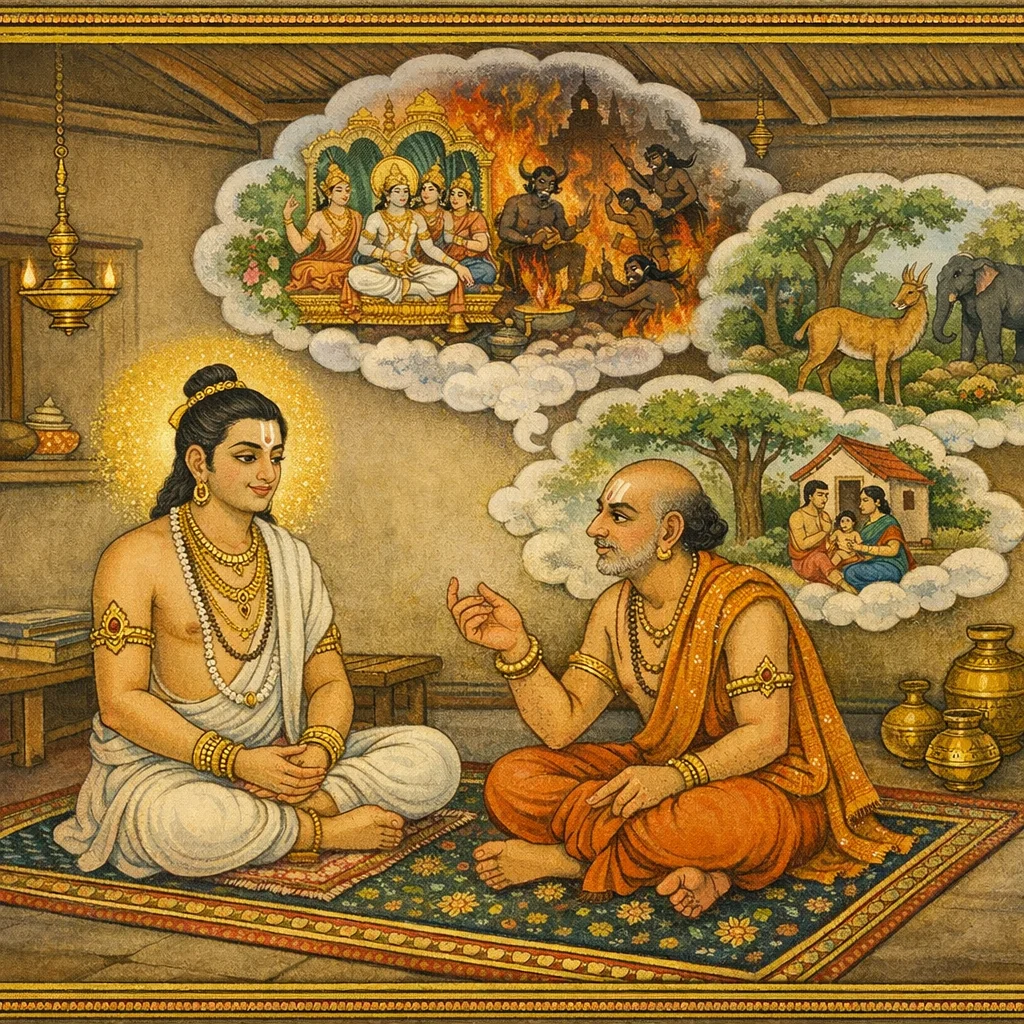
Arjuna asks to hear of the chief tīrthas established at Mahīnagaraka. Nārada introduces the sacred region and extols Jayāditya, a solar manifestation, declaring that remembrance of the Name brings relief from disease and fulfills heartfelt aims, and that even the mere sight of Him is auspicious. Nārada then recounts an earlier episode: he once journeyed to the solar realm, where Bhāskara questioned him about the Brahmins dwelling in the place Nārada had founded. Nārada refuses to praise or blame them, warning that both carry ethical and rhetorical peril, and urges the deity to ascertain the truth directly. Bhāskara assumes the guise of an aged Brahmin and arrives at the riverside near the settlement, where the local Brahmins led by Hārīta receive him as an atithi (honored guest). The guest asks for “parama-bhojana” (supreme food). Hārīta’s son Kamaṭha explains the “twofold food”: ordinary food that satisfies the body, and the supreme food of dharma-instruction—hearing and teaching—which nourishes the ātman/kṣetrajña (the knower of the field). The guest then asks how beings are born and dissolved, and where they go after becoming ash; Kamaṭha answers by classifying karma as sāttvika, tāmasa, or mixed, and by tracing rebirth to heavenly, infernal, animal, and human states. The chapter continues with detailed embryology and the sufferings of the womb, and concludes with a stark, poetic anatomy of the body as a “house” inhabited by the field-knower, where liberation, heaven, and hell are pursued through action and understanding.
Shlokas
Verse 1
अर्जुन उवाच । अत्यद्भुतानि तीर्थानि लिंगानि च महामुने । श्रुत्वा तव मुखांभोजाद्भृशं मे हृष्यते मनः
Arjuna said: “O great sage, these tīrthas and liṅgas are exceedingly wondrous. Hearing of them from your lotus-like mouth, my heart is greatly delighted.”
Verse 2
महीनगरकस्यापि स्थापितस्य त्वया मुने । यानि तीर्थानि मुख्यानि तानि वर्णय मे प्रभो
“O sage, regarding Mahīnagaraka as well—established by you—describe to me, O lord, those tīrthas which are the foremost.”
Verse 3
नारद उवाच । श्रीमन्महीनगरके यानि तीर्थानि फाल्गुन । तानि वक्ष्यामि यत्रास्ते जया दित्यो रविः प्रभुः
Nārada said: “O Phālguna, I shall speak of the tīrthas in glorious Mahīnagaraka—where the sovereign Sun, Jayāditya, the Lord, abides.”
Verse 4
जयादित्यस्य यो नाम कीर्तयेदिह मानवः । सर्वरोगविनिर्मुक्तो लभेत्सोऽपि हृदीप्सितम्
Whoever here sings or recites the name of Jayāditya is freed from all diseases and attains even the heart’s cherished desire.
Verse 5
यस्य संदर्शनादेव कल्याणैरपि पूर्यते । मुच्यते चाप्यकल्याणैः श्रद्धावान्पार्थ मानवः
By his mere sight, O Pārtha, a faithful person is filled with auspiciousness and is released from misfortunes and inauspicious forces.
Verse 6
तस्य देवस्य चोत्पत्तिं शृणु पार्थ वदामि ते । शृण्वन्वा कीर्तयन्वापि प्रसादं भास्कराल्लभेत्
Hear, O Pārtha, as I tell you the origin of that deity. By listening to it—or even by reciting it—one gains the gracious favor of Bhāskara, the Sun.
Verse 7
अहं संस्थाप्य संस्थानमेतत्कालेन केनचित् । प्रयातो भास्करं लोकं दर्शनार्थी यदृच्छया
After establishing this sacred seat in due course, I went—by chance and with the longing to behold him—to the world of Bhāskara, the Sun.
Verse 8
स मां प्रणतमासीनमभ्यर्च्यार्घेण भास्करः । प्रहसन्निव प्राहेदं देवो मधुरया गिरा
As I sat bowed in reverence, Bhāskara honored me with an arghya-offering and then—seemingly with a gentle smile—spoke in sweet words.
Verse 9
कुत आगम्यते विप्र क्व च वा प्रतिगम्यते । क्व चायं नारदमुने कालस्ते विहृतोऽभवत्
“From where have you come, O Brāhmaṇa, and to where will you depart? And where, O sage Nārada, has your time been spent in wandering?”
Verse 10
नारद उवाच । एवमुक्तो भास्करेण तं तदा प्राब्रवं वचः । भारते विहृतः खण्डे महीनगरकादपि । दर्शनार्थं तव विभो समायातोऽस्मि भास्कर
Nārada said: Thus addressed by Bhāskara, I replied: “I have wandered in Bhārata-varṣa, even in the region called Mahīnagaraka; and, O Lord Bhāskara, I have come here for the sake of your darśana.”
Verse 11
रविरुवाच । यत्त्वया स्थापितं स्थानं तत्र ये संति ब्राह्मणाः । तेषां गुणान्मम ब्रूहि किंगुणा ननु ते द्विजाः
Ravi (the Sun) said: “In that holy place you established, which Brāhmaṇas dwell there? Tell me of their qualities—of what virtues, indeed, are those twice-born?”
Verse 12
नारद उवाच । एवं पृष्टो भगवता पुनरेवाब्रवं वचः
Nārada said: Thus questioned by the Lord, I again spoke these words.
Verse 13
यदि तान्भोः प्रशंसामि स्वीयान्स्तौतीति वाच्यता । निंदाम्यनर्हान्कस्माद्वा कष्टमेवोभयत्र च
If I praise them, people will say, “He is extolling his own.” But if I censure those who deserve no blame, why should I do so? Either way, it becomes a hardship.
Verse 14
अथवा पारमाहात्म्ये सति तेषां महात्मनाम् । अल्पे कृते वर्णने स्याद्दोष एव महान्मम
Or else—since those great souls possess boundless greatness—if I were to describe them only briefly, the great fault would indeed be mine.
Verse 15
मदर्चितद्विजेंद्राणां यदि स्याच्छ्रवणेप्सुता । ततः स्वयं विलोक्यास्ते गत्वेदं मे मतं रवे
If you truly wish to hear of those foremost Brāhmaṇas whom I have honored, then go and behold them yourself; this is my considered view, O Ravi.
Verse 16
इति श्रुत्वा मम वचो रविरासीत्सुविस्मितः । स्वयं द्रक्ष्यामि चोवाच पुनःपुनरहर्पतिः
Hearing my words, Ravi was greatly astonished. Then the Lord of the day said again and again, “I shall see them for myself.”
Verse 17
सोऽथ विप्रतनुं कृत्वा मां विसर्ज्यैव भास्करः । प्रतपन्दिवि योगाच्च प्रयातोर्णवरोधसि
Then Bhāskara (the Sun), assuming the body of a brāhmaṇa, dismissed me; and, shining in the sky, by yogic power he departed to the shore of the ocean.
Verse 18
जटां त्रिषवणस्नानपिंगलां धारयन्नथ । वृद्धद्विजो महातेजा ददृशे ब्राह्मणैर्मम
Wearing matted locks (jaṭā), tawny from bathing at the three daily rites, that aged brāhmaṇa of great splendor was then seen by my brāhmaṇas.
Verse 19
ततो हारीतप्रमुखाः प्रहर्षोत्फुल्ललोचनाः । उत्थाय ब्रह्मशालायास्ते द्विजा द्विजमाद्रवन्
Then Hārīta and the others, their eyes blooming with joy, rose up from the brāhmaṇa-hall and ran toward that brāhmaṇa (guest).
Verse 20
नमस्कृत्य द्विजाग्र्यं ते प्रहर्षादिदमब्रुवन्
Having bowed to that foremost brāhmaṇa, they spoke these words in great joy.
Verse 21
अद्य नो दिवसः पुण्यः स्थानमद्योत्तमं त्विदम् । यत्त्वया विप्रप्रवर स्वयमागमनं कृतम्
Today our day is blessed, and this place has become supremely excellent today, since you yourself, O best of brāhmaṇas, have come here.
Verse 22
धन्यस्य हि गृहस्थस्य कृपयैव द्विजोत्तमाः । आतिथ्यवेषेणायांति पावनार्थं न संशयः
Indeed, for a fortunate householder, the best of brāhmaṇas come—out of sheer compassion—wearing the guise of a guest, solely to purify him; of this there is no doubt.
Verse 23
तत्त्वं गेहानि चास्माकं पादचंक्रमणेन च । दर्शनाद्भोजनात्स्थानादस्माभिः सह पावय
Therefore, purify our homes as well—by walking here with your feet, by your very sight, by accepting food, and by staying here with us.
Verse 24
अतिथिरुवाच । भोजनं द्विविधं विप्रा प्राकृतं परमं तथा । तदहं सम्यगिच्छामि दत्तं परमभोजनम्
The Guest said: “O brāhmaṇas, food is of two kinds—ordinary and supreme. Therefore I truly desire the supreme food that is to be offered.”
Verse 25
इत्येतदतिथेः श्रुत्वा हारीतः पुत्रमब्रवीत् । अष्टवर्षं तु कमठं वेत्सि पुत्र द्विजोदितम्
Hearing these words of the guest, Hārīta said to his son: “My son, do you know Kamaṭha, the eight-year-old, spoken of by the brāhmaṇa?”
Verse 26
कमठ उवात्र । तात प्रणम्य त्वां वक्ष्ये तादृक्परमभोजनम् । द्विजं च तर्पयिष्यामि दत्त्वा परमभोजनम्
Kamaṭha said: “Father, bowing to you, I shall explain what such ‘supreme food’ is; and by offering that supreme food, I shall satisfy the brāhmaṇa.”
Verse 27
सुतेन किल जातेन जायते चानृणः पिता । सत्यं करिष्ये तद्वाक्यं संतर्प्यातिथिमुत्तमम्
“Indeed, by the birth of a son a father becomes free from debt. I shall make that saying true—by duly satisfying this excellent guest.”
Verse 28
भोजनं द्विप्रकारं च प्रविभागस्तयोरयम् । प्राकृतं प्रोच्यते त्वेवमन्यत्परमभोजनम्
Food is of two kinds, and this is their division: one is called “prākṛta,” the natural and ordinary; the other is called “parama-bhojana,” the supreme food.
Verse 29
तत्र यत्प्राकृतं नाम प्रकृतिप्रमुखस्य तत् । चतुर्विंशतितत्त्वानां गणस्योक्तं हि तर्पणम्
Of these, what is called “prākṛta” pertains to Prakṛti and to what begins with Prakṛti; it is said to be the “tarpaṇa,” the satisfaction of the group of the twenty-four tattvas.
Verse 30
षड्रसं भोजनं तच्च पंचभेदं वदंति च । येन भुक्तेन तृप्तं स्यात्क्षेत्रं यद्देहलक्षणम्
That food is of six tastes, and it is also spoken of as fivefold in its varieties; by eating it, the “kṣetra”—the body marked as the field—becomes satisfied.
Verse 31
यथापरं परंनाम प्रोक्तं परमभोजनम् । परमः प्रोच्यते चात्मा तस्य तद्भोजनं भवेत्
Just as what is “beyond” is named “supreme,” so too is the “parama-bhojana” spoken of as the supreme food. The Ātman is called “supreme”; therefore that food belongs to It.
Verse 32
ततो नानाप्रकारस्य धर्मस्य श्रवणं हि यत् । तदन्नं प्रोच्यते भोक्ता क्षेत्रज्ञः श्रवणौ मुखम्
Therefore, the hearing of dharma in its many forms is called “food.” The enjoyer is the kṣetrajña, the Knower of the Field, and the two ears are said to be its mouth.
Verse 33
तद्दास्यामि द्विजाग्र्याय पृच्छ विप्र यदिच्छसि । शक्तितस्तर्पयिष्यामि त्वामहं विप्रसंसदि
That I shall offer to the best among the twice-born. Ask, O brāhmaṇa, whatever you desire; according to my capacity I shall satisfy you in the assembly of brāhmaṇas.
Verse 34
नारद उवाच । कमठस्यैतदाकर्ण्य सोऽतिथिर्वचनं महत् । मनसैव प्रशस्यामुं प्रश्नमेनमथाकरोत्
Nārada said: Hearing Kamaṭha’s great words, that guest praised him in his mind and then posed this question.
Verse 35
कथं संजायते जंतुः कथं चापि प्रलीयते । भस्मतामथ संप्राप्य क्व चायं प्रति पद्यते
“How is a living being born, and how does it dissolve? And after reaching the state of ashes, where does it go—where does it attain its next course?”
Verse 36
कमठ उवाच । गुरवे प्राङ्नमस्कृत्य धर्माय तदनंतरम् । छंदोगीतममुं प्रश्नं शक्त्या वक्ष्यामि ते द्विज
Kamaṭha said: “Having first bowed to the Guru, and thereafter to Dharma, I shall answer this question—sung in sacred metre—according to my ability, O brāhmaṇa.”
Verse 37
जनने त्रिविधं कर्म हेतुर्जंतोर्भवेत्किल । पुण्यं पापं च मिश्रं च सत्त्वराजसतामसम्
At the time of birth, the cause determining a creature’s course is said to be threefold karma: meritorious, sinful, and mixed—corresponding to the guṇas of sattva, rajas, and tamas.
Verse 38
तत्र यः सात्त्विको नाम स स्वर्गं प्रतिपद्यते । स्वर्गात्कालपरिभ्रष्टो धनी धर्मी सुखी भवेत्
Among these, one who is called sāttvika attains heaven. When, in the course of time, he falls from heaven, he is born as a wealthy, righteous, and happy person.
Verse 39
तथा यस्तामसो नाम नरकं प्रतिपद्यते । भुक्त्वा बह्वीर्यातनाश्च स्थावरत्वं प्रपद्यते
Likewise, one who is called tāmasa goes to hell. After undergoing many torments, he attains the state of an immobile being, such as a plant or other stationary form.
Verse 40
महतां दर्शनस्पर्शैरुपभोगसहासनैः । महता कालयोगेन संसरन्मानवो भवेत्
Through seeing and touching great souls, sharing their company and even their seats and enjoyments, and by the powerful conjunction of time, the wandering being again becomes human.
Verse 41
सोऽपि दुःखदरिद्राद्यैर्वेष्टितो विकलेंद्रियः । प्रत्यक्षः सर्व लोकानां पापस्यैतद्धि लक्षणम्
He too becomes enveloped by misery, poverty, and the like, with impaired senses—this is indeed the visible sign of sin, evident to all people.
Verse 42
अथ यो मिश्रकर्मा स्यात्तिर्यक्त्वं प्रतिपद्यते । महतामेव संसर्गात्संसरन्मानवो भवेत्
Now, one whose deeds are mixed attains an animal birth. Yet, while wandering on, through association with great souls alone, he again becomes human.
Verse 43
यस्य पुण्यं पृथुतरं पापमल्पं हि जायते । स पूर्वं दुःखितो भूत्वा पश्चात्सौख्यान्वितो भवेत्
One whose merit is abundant and whose sin is slight first becomes sorrowful, and afterward is endowed with happiness.
Verse 44
पापं पृथुतरं यस्य पुण्यमल्पतरं भवेत् । पूर्वं सुखी ततो दुःखी मिश्रस्यैतद्धि लक्षणम्
But one whose sin is greater and whose merit is smaller is happy first and then becomes unhappy—this indeed is the mark of mixed karma.
Verse 45
तत्र मानुषसंभूतिं शृणु यादृगसौ भवेत् । पुरुषस्य स्त्रियाश्चैव शुक्रशोणितसंगमे
Now hear how human conception comes to be—how it arises—when man and woman unite in the meeting of semen and blood.
Verse 46
सर्वदोषविनिर्मुक्तो जीवः संसरते स्फुटम् । गुणान्वितमनोबुद्धिशुभाशुभसमन्वितः
The jīva, free from all inherent defect, clearly wanders in saṃsāra—endowed with the guṇas, with mind and intellect, and accompanied by both auspicious and inauspicious tendencies.
Verse 47
जीवः प्रविष्टो गर्भं तु कलले प्रतितिष्ठति । मूढश्च कलले तत्र मासमात्रं च तिष्ठति
When the individual soul enters the womb, it becomes established in the kalala, the embryo’s fluid mass. Bewildered there within that kalala, it remains for about a month.
Verse 48
द्वितीयं तु तथा मासं घनीभूतः स तिष्ठति । तस्यावयवनिर्माणं तृतीये मासि जायते
In the second month it remains, becoming condensed. In the third month, the formation of its limbs and parts begins.
Verse 49
अस्थीनि च तथा मासि जायंते च चतुर्थके । त्वग्जन्म पंचमे मासि पष्ठे रोम्णां समुद्भवः
In the fourth month, the bones also come into being. In the fifth month, the skin is formed; in the sixth, the growth of body-hair arises.
Verse 50
सप्तमे च तथा मासि प्रबोधश्चास्य जायते । मातुराहारपीतं च सप्तमे मास्युपाश्नुते
In the seventh month, awareness awakens in it. In that seventh month, it also partakes of what the mother eats and drinks.
Verse 51
अष्टमे नवमे मासि भृशमुद्विजते ततः । जरायुणा वेष्टितांगो मुखे बद्धकरांगुलिः
In the eighth and ninth months, it becomes greatly distressed. Wrapped by the caul (jarāyu), with its limbs enclosed, its fingers are bound near its mouth.
Verse 52
मध्ये क्लीबस्तु वामे स्त्री दक्षिणे पुरुषस्तथा । तिष्ठत्युदरभागे च पृष्ठेरग्निमुखः किल
If it is in the middle, it becomes neuter; on the left, female; on the right, male. It abides in the region of the belly, with its face turned toward the mother’s digestive fire (so it is said).
Verse 53
यस्यां तिष्ठत्यसौ योनौ तां च वेत्ति न संशयः । सर्वं स्मरति वृत्तांतं बहूनां जन्मनामपि
In whatever womb it abides, it knows that mother without doubt. It remembers the whole account—the events of many births as well.
Verse 54
अंधे तमसि किं दृश्यो गंधान्मोहं दृढं लभेत् । शीते मात्रा जले पीते शीतमुष्णं तथोष्णके
In blind darkness, what could it possibly see? From smells it falls into firm delusion. When the mother drinks cold water, it feels cold; likewise, when she takes hot things, it feels heat.
Verse 55
व्यायामे लभते मातुः क्लेशं व्याधेश्च वेदनाम् । अलक्ष्याः पितृमातृभ्यां जायंते व्याधयः पराः
When the mother exerts herself, it experiences her strain and also the pain of illness. Moreover, subtle and unseen diseases arise from the father and mother.
Verse 56
सौकुमार्याद्रुजं तीव्रां जनयंति च तस्य ते । स्वल्पमप्यथ तं कालं वेत्ति वर्षशतोपमम्
Because of its tenderness, those afflictions generate intense pain for it. And even a little time there, it experiences as though it were a hundred years.
Verse 57
संतप्यते भृशं गर्भे कर्मभिश्च पुरातनैः । मनोरथांश्च कुरुते सुकृतार्थं पुनःपुनः
In the womb, the embodied being is intensely tormented by the weight of ancient karmas; again and again it forms resolves, longing to accomplish true merit (sukṛta).
Verse 58
जन्म चेदहमाप्स्यामि मानुष्ये जीवितं तथा । ततस्तत्प्रकरिष्यामि येन मोक्षो भवेत्स्फुटम्
“If I obtain birth among humans and likewise a human life, then I shall undertake that very discipline by which liberation (mokṣa) becomes clear and certain.”
Verse 59
एवं तु चिंतयानस्य सीमंतोन्नयनादनु । मासद्वयं तद्व्रजति पीडतस्त्रियुगाकृति
Thus, as it continues to think in this way, after the rite of sīmaṃtonnayana (the parting of the hair), two more months pass for that being—its form cramped and pressed in threefold bends.
Verse 60
ततः स्वकाले संपूर्णे सूतिमारुतचालितः । भवत्यवाङ्मुखो जंतुः पीडामनुभवन्पराम्
Then, when the proper time is fully reached, driven by the birth-winds, the creature turns downward and undergoes extreme pain.
Verse 61
अधोमुखः संकटेन योनिद्वारेण निःसरेत् । पीडया पीडमानोऽपि चर्मोत्कर्तनतुल्यया
Facing downward, it emerges through the narrow doorway of the womb, tormented by a pain comparable to the flaying of skin.
Verse 62
करपत्रसमस्पर्शं करसंस्पर्शनादिकम् । असौ जातो विजानाति मासमात्रं विमोहितः
Newly born, it recognizes touch and contact—like the brushing of a hand or leaf—yet it remains bewildered for about a month.
Verse 63
प्राक्कर्मवशगस्यास्य गर्भज्ञानं च नश्यति । ततः करोति कर्माणि श्वेतरक्तासितानि च
This being, under the sway of former karma, loses the knowledge remembered in the womb; thereafter it performs deeds of every kind—bright, passionate, and dark.
Verse 64
अस्थिपट्टतुलास्तंभस्नायुबंधेन यंत्रितम् । रक्तमांसमृदालिप्तं विण्मूत्रद्रव्यभाजनम्
This body is a contrivance bound by sinews—its beams and posts like boards and pillars of bone—smeared with the clay of blood and flesh, a vessel holding the foul substances of feces and urine.
Verse 65
सप्तभित्तिसुसंबद्धं छन्नं रोम तृणैरपि । वदनैकमहाद्वारं गवाक्षाष्टविभूषितम्
It is like a house well-joined with seven walls, thatched even with hairs like grass; it has the mouth as its single great doorway, and is adorned with eight windows.
Verse 66
ओष्ठद्वयकपाटं च दंतार्गलविमुद्रितम् । नाडीस्वेदप्रवाहं च कफपित्तपरिप्लुतम्
Its double lips are like door-panels, sealed by the bolt of teeth; its channels run with sweat, and it is flooded with phlegm and bile.
Verse 67
जराशोकसमाविष्टं कालवक्त्रानलस्थितम् । रागद्वेषादिभिर्ध्वस्तं षट्कौशिकसमुद्भवम्
Enveloped by old age and grief, set within the fire of Time’s gaping mouth, shattered by passion and hatred and the like—this body is born of the six sheaths.
Verse 68
एवं संजायते पुंसो देहगेहमिदं द्विज । यस्मिन्वसति क्षेत्रज्ञो गृहस्थो बुद्धिगेहिनी
Thus, O twice-born, this “house of the body” comes to be for a man—wherein the Knower of the Field (Kṣetrajña) dwells as a householder in the dwelling of intellect.
Verse 69
मोक्षं स्वर्गं च नरकमास्ते संसाधयन्नपि
He attains liberation, heaven, or hell—even while he is striving and bringing about the results of his own deeds.