Adhyaya 24
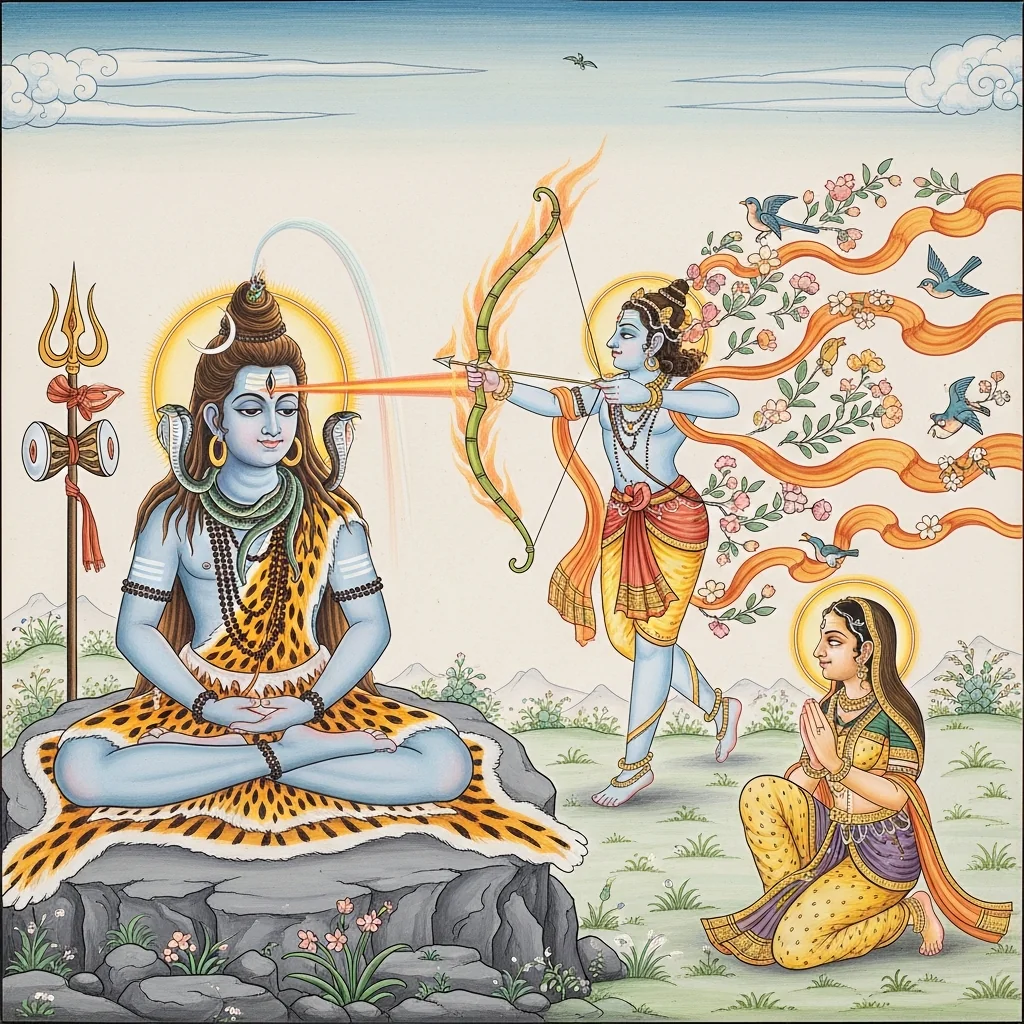
This chapter is framed by Nārada’s report of an earlier exchange with Himālaya: the future goddess’s raised (uttāna) right hand is understood as the abiding gesture of «abhaya», granting fearlessness and protection to all beings. Nārada adds that a great divine work still remains—Śiva must be reunited with the Himalayan-born Devī, Pārvatī, for the sake of cosmic purpose. At Nārada’s prompting, Indra summons Kāma (Manmatha). Kāma raises ethical objections drawn from ascetic critique: in Vedānta and renunciant teaching, desire is often condemned as a veil over knowledge and a persistent foe of the wise. Indra replies with a functional theology of desire, distinguishing Kāma’s three modes (tāmasa, rājasa, sāttvika) and arguing that intention-as-desire (kāmanā) underlies worldly accomplishment, while regulated desire can serve higher ends. Kāma proceeds with Vasanta and Rati to Śiva’s āśrama, beholds Śiva absorbed in deep samādhi, and attempts entry through a subtle disturbance (the pretext of a bee’s hum). Śiva becomes aware, turns, and releases the fire of the third eye, burning Kāma to ashes. The excess flame threatens cosmic conflagration until Śiva apportions it into various loci—moon, flowers, music, bees, cuckoos, and pleasures—explaining the enduring “fire” of longing within beings. Rati laments; Śiva consoles her, affirming Kāma’s continued efficacy in embodied life and foretelling a future restoration: when Viṣṇu is born as Vāsudeva’s son, Kāma will arise as his offspring (the Pradyumna motif), and Rati’s conjugal status will be regained.
Shlokas
Verse 1
नारद उवाच । एवं श्रुत्वा सभार्यः स प्रमोदप्लुतमानसः । प्रणम्य मामिति प्राह यद्येवं पुण्यवानहम्
Nārada said: Hearing this, he—together with his wife—became flooded with joy in his heart. Bowing to me, he said, “If indeed I am so meritorious (puṇyavān)…”
Verse 2
पुनः किंचित्प्रवक्ष्यामि पुत्र्या मे दक्षिणः करः । उत्तानः कारणं किं तच्छ्रोतुमिच्छामि नारद
“Again, I shall say something more: my daughter’s right hand is held upward—what is the reason for that? I wish to hear it, O Nārada.”
Verse 3
इति पृष्टोऽस्मि शैलेन प्रावोचं कारणं तदा । सर्वदैव करो ह्यस्याः सर्वेषां प्राणिनां प्रति
Thus questioned by the Mountain (Himālaya), I then explained the reason: her hand is ever extended toward all living beings.
Verse 4
अभयस्य प्रदाताऽसावुत्तानस्तु करस्ततः । एषा भार्या जगद्भर्तुर्वृषांकस्य महीधर
That upraised hand, therefore, is a bestower of fearlessness. O Mountain-bearer of the earth, she is the wife of the Lord of the world—of Vṛṣāṅka (Śiva, marked by the bull).
Verse 5
जननी सर्वलोकस्य भाविनी भूतभाविनी । तद्यथा शीघ्रमेवैषा योगं यातु पिनाकिना
She is the mother of all the worlds—she who brings welfare, she who becomes a beneficent power for all beings. Therefore, may she swiftly attain union with Pinākin (Śiva, bearer of the bow Pināka).
Verse 6
त्वया विधेयं विधिवत्तथा शैलेन्द्रसत्तम । अस्त्यत्र सुमहतकार्यं देवानां हिमभूधर
You must do so properly, according to the rite, O best of mountain-lords. For here there is a very great task of the gods to be accomplished, O snowy mountain.
Verse 7
इति प्रोच्य तमापृच्छ्य प्रावोचं वासवाय तत् । मम भूयस्तु कर्तव्यं तन्मया कृतमेव हि
Thus having spoken and taking leave of him, I related that matter to Vāsava (Indra). As for anything further that was to be done by me—indeed, it had already been done by me.
Verse 8
किं तु पंचशरः प्रेर्यः कार्यशेषेऽत्र वासव । इत्यादिश्य गतश्चाहं तारकं प्रति फाल्गुन
“But for the remaining part of the task, Pañcaśara (Kāma, the five-arrowed god) must be stirred to action, O Vāsava.” Having instructed thus, I went on toward Tāraka, O Phālguna.
Verse 9
कलिप्रियत्वात्तस्यैनमर्थं कथयितुं स्फुटम् । हिमाद्रिरपि मे वाक्यप्रेरितः पार्वतीं प्रति
Because he delights in strife (kali), it was difficult to tell him this purpose plainly. And Himādri (Himālaya) too—prompted by my words—turned his efforts toward Pārvatī.
Verse 10
भवस्याराधनां कर्तुं ससखीमादिशत्तदा । सा तं परिचचारेशं तस्या दृष्ट्वा सुशीलताम्
Then he instructed her—together with her companion—to perform the worship of Bhava (Śiva). She served that Lord; and seeing her noble conduct and good character, (the narrative moves toward divine approval).
Verse 11
पुष्पतोयफलाद्यानि नियुक्ता पार्वती व्यधात् । महेन्द्रोपि च मद्वाक्यात्स्मरं सस्मार भारत
Commissioned thus, Pārvatī prepared flowers, water, fruits, and the like. And Mahendra (Indra) too—at my very words—remembered and invoked Smara (Kāmadeva), O Bhārata.
Verse 12
स च तत्स्मरणं ज्ञात्वा वसंतरतिसंयुतः । चूतांकुरास्त्रःऋ सहसा प्रादुरासीन्मनोभवः
Kāmadeva, knowing he had been remembered, appeared at once—accompanied by Spring (Vasanta) and Rati—bearing as his weapon the buds of mango blossoms, the mind-born lord of desire.
Verse 13
तमाह च वचो धीमान्स्मरन्निव च तं स्पृशन् । उपदेशेन बहुना किं त्वां प्रति रतिप्रिय
Then the wise one addressed him, as though reminding him and gently touching him: “What need is there for much instruction to you, O beloved of Rati?”
Verse 14
चित्ते वससि तेन त्वं वेत्सि भूतमनोगतम् । तथापि त्वां वदिष्यामि स्वकार्यपरतां स्मरन्
You dwell within the mind; therefore you know what has occurred and what is intended. Even so, I shall speak to you, remembering your steadfast devotion to your appointed work.
Verse 15
ममैकं सुमहत्कार्यं कर्तुमर्हसि मन्मथ । महेश्वरं कृपानाथं सतीभार्यावियोजितम्
“There is one exceedingly great task of mine that you must accomplish, O Manmatha: Mahādeva, the compassionate Lord, has been separated from his wife Satī.”
Verse 16
संयोजय पुनर्देव्या हिमाद्रिगृहजातया । देवी देवश्च तुष्टौ ते करिष्यत इहेप्सितम्
“Join him again with the Goddess born in Himādri’s house (Pārvatī). When the Goddess and the God are pleased, they will grant you your desired aim here.”
Verse 17
मदन उवाच । अलीकमेतद्देवेन्द्र स हि देवस्य पोरतिः । नान्यासादयितव्यानि तेजांसि मुनरब्रवीत्
Madana said: “O Devendra, this is futile. For he is the former consort of the God (Śiva). The sage has declared that such divine fires (powers) are not to be approached or provoked by any other means.”
Verse 18
वेदान्तेषु च मां विप्रा गर्हसंयति पुनःपुनः । महाशनो महापाप्मा कामोऽयम नलो गहान्
“And in the Vedāntas, the brāhmaṇas repeatedly censure me: ‘This Kāma is a great devourer, a great sinner—like fire consuming houses.’”
Verse 19
आवृतं ज्ञानमेतेन ज्ञानिनां नित्यवैरिणा । तस्मादयं सदा त्याज्यः कामऽहिरिव सत्तमैः
“By this desire—the constant enemy of the wise—knowledge becomes veiled. Therefore, the best of people must always cast off Kāma, like a serpent.”
Verse 20
एवं शीलस्य मे कस्मात्प्रतुष्यति महेश्वरः । मद्यपस्येव पापस्य वासुदेवो जगद्गुरः
“Being of such a nature as I am, how could Maheśvara be pleased with me—any more than Vāsudeva, the teacher of the world, would be pleased with a sinful drunkard?”
Verse 21
इंद्र उवाच । मैवं ब्रूहि महाभाग त्वां विनाकः पुमान्भुवि । धर्ममर्थं तथा कामं मोक्षं वा प्राप्तुमीश्वरः
Indra said: “O greatly fortunate one, do not speak thus. Without you, who on earth would be capable of attaining dharma, artha, kāma, or even mokṣa?”
Verse 22
यत्किंचित्साध्यते लोके मूलं तस्य च कामना । कथं कामं विनिंदति तस्मात्ते मोक्षसाधकाः
Whatever is accomplished in the world—its very root is desire (kāmanā). How, then, can kāma be condemned? Therefore even seekers of liberation (mokṣa) make use of it, in a refined form.
Verse 23
सत्यं चापि श्रुतेर्वाक्यं तव रूपं त्रिधागतम् । तामसं राजसं चैव सात्त्विकं चापि मन्मथ
And true indeed is the word of the śruti: O Manmatha, your form is threefold—tāmasa, rājasa, and sāttvika.
Verse 24
अमुक्तितः कामनया रूपं तत्तामसं तव । सुखबुद्ध्या स्पृहा या च रूपं तद्राजसं तव
When desire arises from non-liberation, from a bondage-minded heart, that is your tāmasa form. And the craving that springs from the notion of pleasure—this is your rājasa form.
Verse 25
केवलं यावदर्थार्थं तद्रूपं सात्त्विकं तव । तत्ते रूपत्रयमिदं ब्रूहि नोपासते हि के
But desire only to the extent of what is needed for one’s purpose—that is your sāttvika form. Tell me of this threefold nature of yours: who indeed does not worship and invoke you?
Verse 26
त्वं साक्षात्परमः पूज्यः कुरु कार्यमिदं हि नः । अथ वा पीडितान्दृष्ट्वा सामान्यानपि पंडिताः । स्वप्राणैरपि त्रायांति परमेतन्महाफलम्
You are directly worthy of the highest honor—so accomplish this task for us. Indeed, even the wise, seeing ordinary beings in distress, protect them even at the risk of their own lives; this yields the greatest fruit.
Verse 27
इति संचिंत्य कार्यं त्वं सर्वथा कुरु तत्स्फुटम्
Thus, having reflected, you must surely carry out that task—clearly and without fail.
Verse 28
इत्या कर्ण्य तथेत्युक्त्वा वसंतरतिसंयुतः । पिकादिसैन्यसंपन्नो हिमाद्रिं प्रययौ स्मरः
Hearing this, Smara (Kāma) replied, “So be it,” and—accompanied by Vasanta and Rati, and furnished with forces such as cuckoos and the like—set out for Himādri (the Himalaya).
Verse 29
तत्रापश्यत शंभोः स पुण्यमाश्रममंडलम् । नानावृक्षसमाकीर्णं शांतसत्त्वसमाकुलम्
There he beheld Śambhu’s holy hermitage-enclosure—filled with many kinds of trees and abounding in peaceful beings of tranquil nature.
Verse 30
तत्रापश्यत्त्रिनेत्रस्य वीरकंनाम द्वारपम् । यथा साक्षान्महेशानं गणआंश्चायुतशोऽस्य च
There he saw Vīraka by name, the gatekeeper of the Three-eyed Lord; and he also beheld, as it were Maheśāna himself, countless hosts (gaṇas) belonging to him.
Verse 31
ददर्श च महेशानं नासाग्रकृतलोचनम् । देवदारुद्रुमच्छायावेदिका मध्यमाश्रितम् । समाकायं सुखासीनं समाधिस्थं महेश्वरम्
He beheld Maheśāna, his gaze fixed upon the tip of his nose, seated at ease in perfect composure—Mahādeva abiding in samādhi at the center of a platform shaded by deodāra trees.
Verse 32
निस्तरंगं विनिर्गृह्य स्थितमिंद्रियगोचरान् । आत्मानमात्मना देवं प्रविष्टं तपसो निधिम्
Having restrained the objects of the senses and made the mind wave-less, he stood established within himself—entering, by the Self, into the Deva who is the very treasure-house of austerity (tapas).
Verse 33
तं तथाविधमालोक्य सोंतर्भेदाय यत्नवान् । भ्रमरध्वनिव्याजेन विवेश मदनो मनः
Seeing him in that state, Kāmadeva—eager to break his inward poise—entered through the mind, under the pretext of a humming bee’s sound.
Verse 34
एतस्मिन्नंतरे देवो विकासितविलोचनः । सस्मार नगराजस्य तनयां रक्तमानसः
Just then the Deva opened his eyes; and, with his mind colored by longing, he remembered the daughter of the Mountain-King.
Verse 35
निवेदिता वीरकेण विवेश च गिरेः सुता । तस्मिन्काले महाभागा सदा यद्वदुपैति सा
Announced by Vīraka, the Mountain’s daughter entered. At that time the greatly fortunate one came forward, as she always did, in her accustomed manner.
Verse 36
ततस्तस्यां मनः स्वीयमनुरक्तमवेक्ष्य च । निगृह्य लीलया देवः स्वकं पृष्ठमवैक्षत । तावदापूर्णधनुषमपश्यत रतिप्रियम्
Then, noticing that his own mind had become attached to her, the Deva playfully restrained it and looked behind him. At once he saw Rati’s beloved (Kāmadeva) with bow fully drawn.
Verse 37
तन्नाशकृपया देवो नानास्थानेषु सोऽगमत् । तावत्पस्यति पृष्ठस्तमाकृष्य धनुषः शरम्
Out of compassion, so as not to destroy him, the Deva moved to various places. Yet he still saw him behind—drawing an arrow from the bow.
Verse 38
स नदीः पर्वताश्चैव आश्रमान्सरसीस्तथा । परिभ्रमन्महादेवः पृष्ठस्थं तमवैक्षत
He wandered over rivers, mountains, hermitages, and lakes; and as Mahādeva moved about, he kept seeing him stationed behind him.
Verse 39
जगत्त्रयं परिभ्रम्य पुनरागात्स्वमाश्रमम् । पृष्ठस्थमेव तं वीक्ष्य निःश्वासं मुमुचे हरः
After roaming through the three worlds, he returned again to his own hermitage. Seeing him still behind, Hara released a breath.
Verse 40
ततस्तृतीयनेत्रोत्थवह्निना नाकवासिनाम् । क्रोशतां गमितः कामो भस्मत्वं पांडुनंदन
Then, by the fire that sprang from the Third Eye, Kāmadeva was reduced to ashes—while the dwellers of heaven cried out, O son of Pāṇḍu.
Verse 41
सस तु तं भस्मसात्कृत्वा हरनेत्रोद्भवोऽनलः । व्यजृंभत जगद्दग्धुं ज्वालापूरितदिङ्मुखः
Having reduced him to ashes, that fire born from Hara’s (Śiva’s) eye then flared up, as though to burn the entire world, with every quarter’s face filled with flames.
Verse 42
ततो भवो जगद्धेतोर्व्यभजज्जातवेदसम् । साहंकारे जने चंद्रे सुमनस्सु च गीतके
Then Bhava (Śiva), the cause of the world, apportioned that fire (Jātavedas): into ahaṅkāra (the sense of “I”), into humankind, into the Moon, into flowers, and into song.
Verse 43
भृंगेषु कोकिलास्येषु विहारेषु स्मरानलम् । तत्प्राप्तौ स्नेहसंयुक्तं कामिनां हृदयं किल
The “fire of Smara” (love’s fever) dwells in bees, in cuckoo-throats, and in pleasure-groves; and when it takes hold, the hearts of lovers are indeed bound fast by affection.
Verse 44
ज्वालयत्यनिशं सोऽग्निर्दुश्चिकित्स्योऽसुखावहः । विलोक्य हरनिःश्वासज्वालाभस्मीकृतं स्मरम्
That fire burns without pause—hard to remedy and a bringer of suffering—especially upon seeing Smara reduced to ashes by the flames of Hara’s (Śiva’s) breath.
Verse 45
विललाप रतिर्द्दीना मधुना बंधुना सह । विलपंती सुबहुशो मधुना परिसांत्विता
Rati, wretched with grief, lamented with Madhu, her kinsman; weeping again and again, she was consoled by Madhu.
Verse 46
रत्याः प्रलापमाकर्ण्य देवदेवो वृषध्वजः । कृपया परया प्राह कामपत्नीं निरीक्ष्य च
Hearing Rati’s lament, the God of gods, the Bull-bannered Lord (Śiva), looked upon Kāma’s wife and spoke with supreme compassion.
Verse 47
अमूर्तोऽपि ह्ययं भद्रे कार्यं सर्वं पतिस्तव । रतिकाले ध्रुवं बाले करिष्यति न संशयः
Though he is formless now, O auspicious lady, your husband will accomplish all that must be done. At the destined time of union, O girl, he will surely act—there is no doubt.
Verse 48
यदा विष्णुश्च भविता वसुदेवात्मजो विभुः । तदै तस्य सुतो यः स्यात्सपतिस्ते भविष्यति
When Viṣṇu, the all-powerful Lord, becomes the son of Vasudeva, then the son born to him will become your husband.
Verse 49
सा प्रणम्य ततो रुद्रमिति प्रोक्ता रतिस्ततः । जगाम स्वेच्छया गत्या वसंतादिभिरन्विता
Thus instructed, Rati bowed to Rudra and then departed at her own chosen pace, accompanied by Spring and the rest.