Adhyaya 43
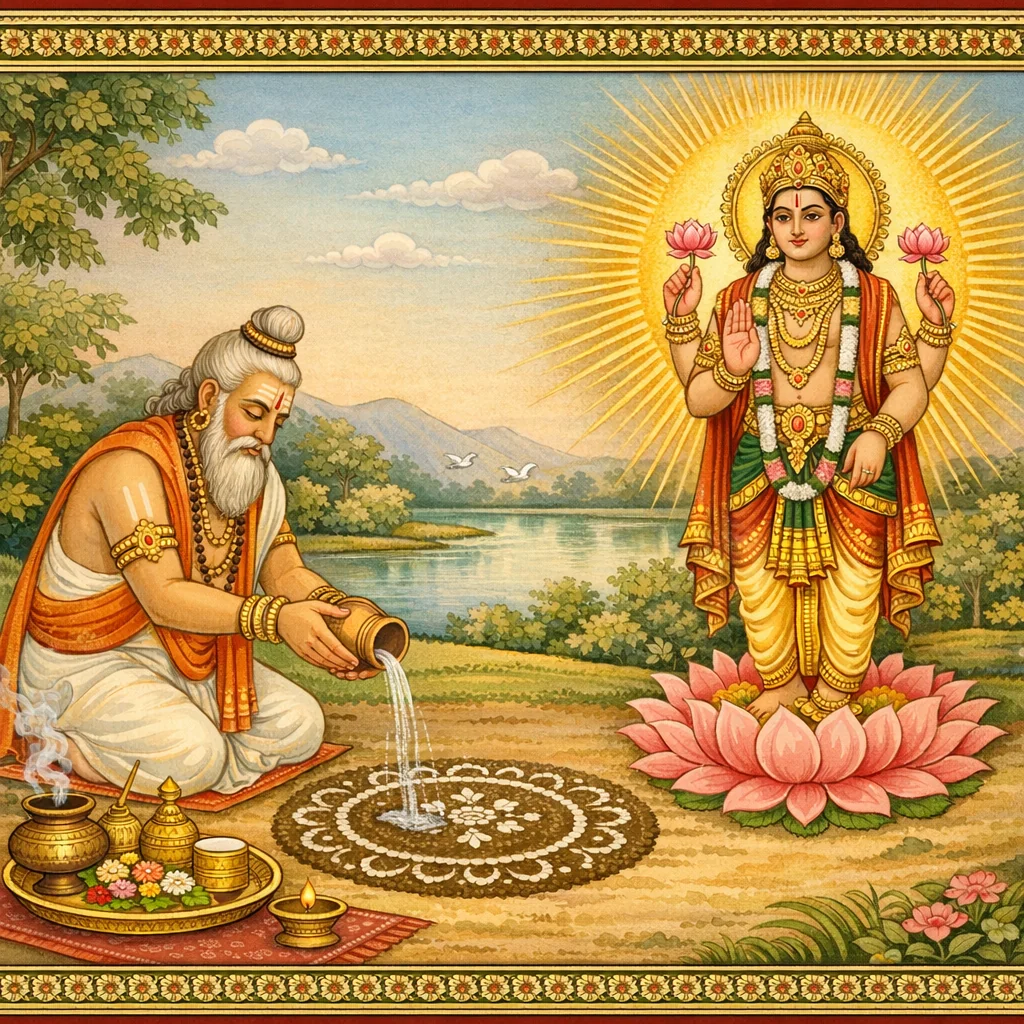
Framed as a dialogue, the chapter has Nārada recount to Arjuna a course of Sūrya-bhakti undertaken at Kāmarūpa for the welfare of the people. It opens by praising the Sun as the universal sustainer and by affirming that remembrance, hymn, and daily worship bestow worldly benefits and protective power. After a long ascetic discipline, Sūrya manifests directly and grants a boon: the deity’s “kāmarūpa-kalā” will remain present in that region. Nārada then installs the deity as Bhattāditya and offers an extended aṣṭottara-śata style hymn of 108 name-epithets, portraying Sūrya as cosmic ruler, healer, upholder of dharma, and remover of affliction. The teaching then turns to ritual detail: at Arjuna’s request, Nārada explains the morning arghya rite—purification, mandala preparation, the arghya vessel and its contents, meditation on Sūrya in twelve forms, invocation formulas, and a sequence of offerings (pādya, snāna, vastra, yajñopavīta, ornaments, unguents, flowers, incense, naivedya), ending with apologies and visarjana. Finally, the sacred geography is set forth: a forest kuṇḍa linked to the kāmarūpa-kalā, auspicious bathing on Māgha-śukla-saptamī, ratha worship and rathayātrā, and fruits equal to great tīrthas—closing with the assurance that Bhattāditya abides there continually, swiftly removing sin and strengthening dharma.
Shlokas
Verse 1
श्रीनारद उवाच । ततोऽहं पार्थ भूयोऽपि जनानुग्रहकाम्यया । प्रत्यक्षदेवं मार्तंडमत्रानेतुमियेष ह
Śrī Nārada said: Then, O Pārtha, once again—desiring the welfare of people—I resolved to bring here Mārtaṇḍa, the visible deity (the Sun), in person.
Verse 2
सर्वेषां प्राणिनां यस्मादुडुपो भगवान्रविः । इहामुत्र च कौंतेय विश्वद्धारी रविर्मतः
Because the blessed Sun (Ravi) is the guiding ‘boat’ for all living beings, O son of Kuntī, Ravi is regarded as the sustainer of the universe—here in this world and in the world beyond as well.
Verse 3
ये स्मरंति रविं भक्त्या कीर्तयंति च ये नराः । पूजयंति च ये नित्यं कृतार्थास्ते न संशयः
Those who remember Ravi with devotion, who praise him, and who worship him daily—such persons are truly fulfilled; of this there is no doubt.
Verse 4
सूर्यभक्तिपरा ये च नित्यं तद्गतमानसाः । ये स्मरंति सदा सूर्यं न ते दुःखस्य भाजिनः
Those who are devoted to Sūrya, whose minds are always absorbed in him, and who constantly remember the Sun—such people are not recipients of sorrow.
Verse 5
भवनानि मनोज्ञानि विविधाभरणाः स्त्रियः । धनं चादृष्टपर्यंतं सूर्यपूजाविधेः फलम्
Delightful homes, women adorned with various ornaments, and wealth extending even to unseen future fortune—these are declared to be the fruits of the prescribed worship of Sūrya.
Verse 6
दुर्लभा भक्तिः सूर्ये वा दुर्लभं तस्य चार्चनम् । दानं च दुर्लभं तस्मै ततो होमश्च दुर्लभः
Rare indeed is devotion to Sūrya; rare also is his worship. Rare is charity offered for him, and rarer still is the performance of fire-offerings (homa) for him.
Verse 7
नमस्कारादिसंयुक्तं रविरित्यक्षरद्वयम् । जिह्वाग्रे वर्तते यस्य सफलं तस्य जीवितम्
For the one upon whose tongue the two-syllabled word ‘Ravi’, joined with salutations and the like, is ever present—his life becomes fruitful.
Verse 8
इत्यहं हृदि संचिंत्य माहात्म्यं रविजं महत् । पूर्णं वर्षशतं पार्थ रविं भक्त्या ह्यतोषयम्
Thus, holding in my heart that great majesty born of Ravi, O Pārtha, I pleased Lord Ravi with devotion for a full hundred years.
Verse 9
जपेन सुविशुद्धेन च्छन्दसां वायुभोजनः । ततः खाद्द्वितीयां मूर्तिं कृत्वा योगबलाद्विभुः
By a thoroughly purified japa of Vedic hymns, sustaining himself on air alone, then—through yogic power—that mighty one fashioned a second form and remained in the sky.
Verse 10
तेजसा दुर्दृशो भास्वान्प्रत्यक्षः समजायत
Then the radiant one—hard to behold because of his blazing splendor—became manifest before him.
Verse 11
तमहं प्रांजलिर्भूत्वा नमस्कृत्य रविं प्रभुम् । सामभिर्विविधैर्देवं पर्यतोषयमीश्वरम्
Beholding him, I stood with folded hands; having bowed to Lord Ravi, I pleased that divine Lord through various Sāman chants.
Verse 12
तुष्टो मामाह वरदो देवर्षे सुचिरं त्वया । तपसाराधितोऽस्मीति वरं वृणु यथेप्सितम्
Pleased, the boon-giving Lord said to me, “O divine seer, you have worshipped Me for a long time through austerity. I am satisfied—choose whatever boon you desire.”
Verse 13
इत्युक्तोऽहं लोकनाथं प्रांजलिः प्रास्तुवं वचः । यदि तुष्टो भवान्मह्यं यदि देयो वरो मम
Thus addressed, I—hands folded in añjali—praised the Lord of the worlds and said: “If you are pleased with me, if a boon is to be granted to me…”
Verse 14
ततस्ते कामरूपे या कला नाथ प्रवर्तते । राजवर्धनराज्ञा याऽराधिता च जनैः पुरा
“Therefore, O Lord, may that manifestation of yours which prevails in Kāmarūpa—the very power once worshipped by King Rājavardhana and by the people in ancient times—be established and continue here.”
Verse 15
तया च कलया भानो सदात्र स्थातुमर्हसि । ततस्तथेति देवेन प्रोक्ते तुष्टेन भारत
“O Bhānu (Sun), with that very manifestation you should abide here forever.” Then, O Bhārata, the pleased deity replied, “So be it.”
Verse 16
अस्थापयमहं सूर्यं भट्टादित्याभिधानकम् । भट्टेनस्थापितं यस्मान्मया तस्माद्रविर्जगौ
I installed the Sun under the name “Bhaṭṭāditya”. Since that Sun was established by me—the Bhaṭṭa—therefore the Sun became renowned there by that name.
Verse 17
ततः संपूज्य तं पुष्पैः कृतावेशमहं रविम् । भक्त्युद्रेकाप्लुतांगोऽथ स्तुतिमेतामथाचरम्
Then, having fully worshipped that Sun with flowers and having invoked his presence, my body was flooded with surging devotion, and I proceeded to perform this hymn of praise.
Verse 18
सर्ववेदरहस्यैश्च नामभिश्च शताष्टभिः । सप्तसप्तिरचिंत्यात्मा महाकारुणिकोत्तमः
With one hundred and eight names—the very secrets of all the Vedas—I praised the Sun: the Lord of seven horses, of inconceivable nature, the supreme embodiment of great compassion.
Verse 19
संजीवनो जयो जीवो जीवनाथो जगत्पतिः । कालाश्रयः कालकर्ता महायोगी महामतिः
He is the Reviver, the Victor, Life itself, the Lord of life, the Master of the universe; the support of Time and the maker of Time—the great Yogi, the great Intelligence.
Verse 20
भूतांतकरणो देवः कमलानन्दनन्दनः । सहस्रपाच्च वरदो दिव्यकुण्डलमण्डितः
The divine One who ends the terrors of beings; the delight of Kamalā (Lakṣmī) and Ānanda; the thousand-rayed Lord, the bestower of boons, adorned with heavenly earrings.
Verse 21
धर्मप्रियोचितात्मा च सविता वायुवाहनः । आदित्योऽक्रोधनः सूर्यो रश्मिमाली विभावसुः
He is the lover of Dharma, of fitting and noble nature; Savitṛ who rides the wind; Āditya, free from wrath; Sūrya, garlanded with rays—Vibhāvasu, the brilliant one.
Verse 22
दिनकृद्दिनहृन्मौनी सुरथो रथिनांवरः । राज्ञीपतिः स्वर्णरेताः पूषा त्वष्टा दिवाकरः
He is the Maker of the day and the Remover of the day’s darkness; the Silent Sage; the Auspicious Charioteer, the best among riders; the Lord of the Queen (the sovereign power), of golden seed and radiance; Pūṣan the Nourisher, Tvaṣṭṛ the Divine Artisan, and Divākara, the Maker of daylight.
Verse 23
आकाशतिलको धाता संविभागी मनोहरः । प्रज्ञः प्रजापतिर्धन्यो विष्णुः श्रीशो भिषग्वरः
He is the Ornament of the sky; Dhātṛ, the Sustainer; the Dispenser who apportions all; the Enchanter of the mind; the Wise; Prajāpati, Lord of creatures; the Blessed and Auspicious; Viṣṇu, the All-pervading Protector; Śrīśa, Lord of prosperity; and the Supreme Physician.
Verse 24
आलोककृल्लोकनाथो लोकपालनमस्कृतः । विदिताशयश्च सुनयो महात्मा भक्तवत्सलः
He is the Maker of illumination, the Lord of the worlds, revered even by the guardians who protect the worlds; the Knower of all hearts; the Guide of the good path; the Great-souled One; and the Tender Lover of devotees.
Verse 25
कीर्तिकीर्तिकरो नित्यो रोचिष्णुः कल्मषापहः । जितानन्दो महावीर्यो हंसः संहारकारकः
He is Glory itself and the Giver of glory; eternal; radiant; the Remover of sin and impurity; the One who has conquered sorrow through bliss; of great valor; the pure Swan (haṃsa); and the Power that brings dissolution at the proper time.
Verse 26
कृतकृत्यः सुसंगश्च बहुज्ञो वचसां पतिः । विश्वपूज्यो मृत्युहारि घृणी धर्मस्य कारणम्
He is the One whose purpose is fulfilled and who fulfills the purposes of others; of noble association; all-knowing; Lord of speech; worshipped by the whole universe; the Remover of death’s terror; Ghṛṇī (the compassionate, radiant one); and the very Cause of dharma.
Verse 27
प्रणतार्तिहरोऽरोग आयुष्यमान्सुखदः सुखी । मङ्गलं पुण्डरीकाक्षो व्रती व्रतफलप्रदः
He removes the suffering of those who bow to him; he is free from disease and bestows health; he grants long life; he gives happiness and is himself blissful; he is auspiciousness; lotus-eyed; steadfast in sacred vows; and the Giver of the fruits of vows.
Verse 28
शुचिः पूर्णो मोक्षमार्गदाता भोक्ता महेश्वरः । धन्वंतरिः प्रियाभाषी धनुर्वेदविदेकराट
He is pure and complete; the Bestower of the path to moksha; the Enjoyer of sacrificial offerings; the Great Lord, Maheśvara; Dhanvantari, healer of the worlds; sweet-speaking; and the unrivaled sovereign who knows the science of archery (Dhanurveda).
Verse 29
जगत्पिता धूमकेतुर्विधूतो ध्वांतहा गुरुः । गोपतिश्च कृतातिथ्यः शुभाचारः शुचिप्रियः
He is the Father of the world; the comet-bannered radiance; the One who shakes off and scatters evil; the Slayer of darkness; the Guru; the Lord and protector of cattle; the One who honors guests; of auspicious conduct; and the Lover of purity.
Verse 30
सामप्रियो लोकबन्धुर्नैकरूपो युगादिकृत् । धर्मसेतुर्लोकसाक्षी खेटतऋ सर्वदः प्रभुः
He delights in Sāma—hymns and harmony; he is the kinsman of the world; of many forms; the maker of the beginnings of the ages; the bridge of dharma; the witness of the world; the bearer of the shining disc; the giver of all; the sovereign Lord.
Verse 31
मयैवं संस्तुतो भानुर्नाम्नामष्टशतेन च । तुष्यतां सर्वलोकानां सर्वलोकप्रियो विभुः
Thus have I praised Bhānu with these one hundred and eight names; may that all-pervading Lord—beloved of all worlds—be pleased, for the welfare of every realm.
Verse 32
इत्येवं संस्तवात्प्रीतो भास्करो मामवोचत । सदात्र कलया स्थास्ये देवर्षे त्वत्प्रियेप्सया
Thus, pleased by this hymn of praise, Bhāskara (the Sun) spoke to me: “O divine sage, wishing to accomplish what is dear to you, I shall ever abide here with a portion of my radiance.”
Verse 33
यो मामत्र महाभक्त्या भट्टादित्यं प्रपूजयेत् । सहस्रशः का मरूपे संपूज्याप्नोति तत्फलम्
Whoever, here, with great devotion worships me as Bhaṭṭāditya, attains the same fruit as though he had worshipped (me) in Kāmarūpa a thousand times.
Verse 34
मामुद्दिश्य च यो विप्रः स्वल्पं वा यदि वा बहु । दास्यतेऽत्राक्षयं तच्च ग्रहीष्ये करजं यथा
And any brāhmaṇa who, intending it for me, gives here—whether little or much—that gift becomes imperishable; I shall accept it as one accepts lawful revenue, a due.
Verse 35
रक्तोत्पलैश्च कह्लारैः केसरैः करवीरकैः । शतत्रयैर्महाप्दमै रविवारेण मानवः
With red lotuses, blue lotuses (kahlāra), saffron, and oleander blossoms—together with three hundred great lotuses—on a Sunday, a person should perform worship.
Verse 36
सप्तम्यामथ षष्ठ्यां वा येऽर्चयिष्यंति मामिह । यान्यान्प्रार्थयते कामांस्तांतान्प्राप्स्यति निश्चितम्
Those who worship me here on the seventh lunar day—or on the sixth—will certainly obtain whatever desires they pray for.
Verse 37
दर्शनान्मम भक्त्या च नाशो व्याधिदरिद्रयोः । प्रणामात्स्वर्गमाप्नोति श्रुत्वा मोक्षं च नित्यशः
By my darśana, and through devotion to me, disease and poverty are destroyed. By prostration one attains heaven; and by hearing (this greatness) continually, one attains liberation as well.
Verse 38
अभक्तिं यश्च कर्ता मे स गच्छेन्निश्चिंतं क्षयम् । अष्टोत्तरशतं नाम ममाग्रे यत्त्वयेरितम्
But whoever acts with irreverence toward me shall, without doubt, go to ruin. And as for my one hundred and eight names that you recited before me—
Verse 39
त्रिकालमेककालं वा पठतः श्रृणुयत्फलम् । कीर्तिमान्सुभगो विद्वान्सुसुखी प्रियदर्शनः
Hear the fruit of one who recites it three times a day, or even but once: he becomes renowned, fortunate, learned, greatly happy, and pleasing to behold.
Verse 40
भवेद्वर्षशतायुश्च सर्वरोगविवर्जितः । यस्त्विदं श्रृणुयान्नित्यं पठेद्वा प्रयतः शुचिः
He shall live a hundred years and be free from every disease—he who, disciplined and pure, regularly hears this or recites it.
Verse 41
अक्षयं स्वल्पमप्यन्नं भवेत्तस्योपसाधितम् । विजयी च भवेन्नित्यं तथा जातिस्मरो भवेत्
Even a small amount of food becomes inexhaustible for him, as though perfectly provided. He becomes ever victorious, and also one who remembers former births.
Verse 42
तस्मादेतत्त्वया जाप्यं परं स्वस्त्ययनं महत् । तथा ममाग्रे कुंडं च कुरु स्नानार्थमुत्तमम्
Therefore you should recite this in japa—the supreme and mighty Svastyayana, a great prayer of auspiciousness. And before me, make also an excellent kuṇḍa for sacred bathing.
Verse 43
कामरूपकला यत्र तत्र कुंडं वने भवेत् । एवं दत्त्वा वरान्भानुस्तत्रैवां तरधीयत
Wherever the power of Kāmarūpa abides, there in the forest a kuṇḍa came into being. Thus having bestowed boons, Bhānu (the Sun Lord) vanished on that very spot.
Verse 44
ततो भास्करवाक्येन सिद्धेशस्य च सव्यतः । वनमध्ये मया कुंडं कृतं दर्भशलाकया
Then, in obedience to the Sun’s word, to the left of Siddheśa, in the heart of the forest, I made a kuṇḍa using a darbha-stalk.
Verse 45
कामरूपभवं कुंडं वृक्षास्ते चापि भारत । संलीनास्तन्महाश्चर्यं ममाजायत चेतसि
O Bhārata, that kuṇḍa born of Kāmarūpa—and even those trees—seemed as though merged into one. From that, a great wonder arose within my mind.
Verse 46
माघमासस्य शुक्लायां सप्तम्यां स्त्री नरोऽपि वा । स्नानं कुंडे शुभं कृत्वा भट्टादित्यं प्रपश्यति
On the bright seventh day of the month of Māgha, whether woman or man, having performed an auspicious bath in the kuṇḍa, one beholds Bhaṭṭāditya (the Sun Lord).
Verse 47
तस्यानंतं भवेत्पुण्यं रथं यश्च प्रपूजयेत् । रथयात्रां च कुरुते यस्मिन्यस्मिन्नसौ पथि
Endless merit arises for the one who duly worships that chariot; and likewise for the one who conducts the ratha-yātrā along whatever path it proceeds.
Verse 48
ये च पश्यंति लोकास्ते धन्याः सर्वे न संशयः । पुत्रधान्यधनैर्युक्ता नीरुजस्तेजसाऽन्विताः
And the people who behold it—every one of them is blessed, without doubt: endowed with children, grain, and wealth; free from illness and filled with radiant splendor.
Verse 49
भविष्यंति नरास्ते ये कारयंति रथोत्सवम् । गंगादिसर्वतीर्थेषु यत्फलं कीर्तितं बुधैः
Those men who arrange and sponsor the ratha-festival will attain the very fruit that the wise proclaim for sacred bathing and worship at all tīrthas, beginning with the Gaṅgā.
Verse 50
भट्टादित्यस्य कुंडे च तत्फलं सप्तमीदिने । तत्र कुंडे च यः स्नात्वा सूर्यार्घ्यं प्रयच्छति । कपिला गोशतस्यासौ दत्तस्य फलमश्नुते
That very fruit is obtained at Bhaṭṭāditya’s kuṇḍa on the Saptamī day. Whoever bathes in that kuṇḍa and offers arghya to the Sun enjoys the reward of having gifted a hundred tawny cows.
Verse 51
अर्जुर उवाच । वासुदेवादयः सर्वे वदंत्येवं महामुने
Arjura said: “O great sage, all authorities, beginning with Vāsudeva, speak in this very way.”
Verse 52
भास्करार्घं विना पातः कृतं सर्वं च निष्फलम् । तस्याहं श्रोतुमिच्छामि विधिं विधिविदां वर
Without offering arghya to Bhāskara, the Sun, all sacred recitation and observances performed become fruitless. Therefore I wish to hear its proper procedure, O best among those who know the rites.
Verse 53
नारद उवाच । यथा ब्रह्मादयो देवा यच्छंत्यर्घं महात्मने । भास्कराय श्रृणु त्वं तं विधिं सर्वाघनाशनम्
Nārada said: Hear the procedure by which Brahmā and the other gods offer arghya to the great-souled Bhāskara. Listen to that rite which destroys all sins.
Verse 54
प्रथमं तावत्प्रत्युषे उदिते सूर्ये शुचिर्भूत्वा गोमयकृतमंडलस्योपरि रक्तचंदनेन मंडलकं कृत्वा ततस्ताम्रपात्रे रक्तचंदनोदकश्वेतचंदनादिद्रव्यैः प्रपूरणं कृत्वा तन्मध्ये हेमाक्षतदूर्वादधिसर्पीषि परिक्षिप्य स्थापयेत्
First, at dawn when the Sun has risen, having become pure, one should draw a small circle with red sandalwood upon a cow-dung-made ritual circle. Then, filling a copper vessel with water mixed with red sandal and other substances such as white sandalwood, one should place it there, sprinkling into it gold-colored akṣata rice, dūrvā grass, curd, and ghee.
Verse 55
स्वशरीरमालभेत् अनेन मंत्रेण । ओंखखोल्काय नमः । सप्तवारानुच्चार्य स्थातव्यम् । तेन शुद्धिरुपसंजायते देहस्यार्चार्हता भवति । पश्चादासनस्थं देवं सवितारं मंडलमध्ये द्वादशात्मकं सुरादिभिः संपूज्यमानं ध्यात्वा पूर्वोक्तमर्घपात्रं शिरसि कृत्वा भूमौ जानुनी निपात्य सूर्याभिमुखस्तद्गतमनाभूत्वार्घमंत्रमुदाहरेत् । तदुच्यते सूर्यवक्त्राद्विनिर्गतमिति
One should touch or anoint one’s own body with this mantra: “Oṃ, obeisance to Khakholkā.” Having recited it seven times, one should remain steady; thereby purity arises and the body becomes fit for worship. Then, meditating upon Savitṛ seated on his seat within the mandala as the twelvefold deity, worshiped by the gods, one should place the prepared arghya vessel upon the head, kneel on the ground facing the Sun with a mind absorbed in him, and recite the arghya-mantra—said to have issued from the Sun’s own mouth.
Verse 56
यस्योच्चारणशब्देन रथं संस्थाप्य भास्करः । प्रतिगृह्णाति चैवार्घ्यं वरमिष्टं च यच्छति
By the very sound of its recitation, Bhāskara sets his chariot in place, accepts the arghya, and grants the desired boon.
Verse 57
ओंयस्याहुः सप्त च्छंदांसि रथे तिष्ठंति वाजिनः । अरुणः सारथिर्यस्य रथवाहोऽग्रतः स्थितः
Oṃ. They say that the seven Vedic metres stand as the steeds in his chariot; and Aruṇa is his charioteer, stationed in front as the driver of the car.
Verse 58
जया च विजया चैव जयंती पापनाशनी । इडा च पिंगला चैव वहंतोऽश्वमुखास्तथा
Jayā and Vijayā, and also Jayantī, the destroyer of sins; likewise Iḍā and Piṅgalā—these too are bearers, having the faces of horses.
Verse 59
डिंडिश्च शेषनागश्च गणाध्यक्षस्तथैव च । स्कंदरेवंततार्क्ष्याश्च तथा कल्माषपक्षिणौ
Ḍiṃḍi, Śeṣanāga, and Gaṇādhyakṣa as well; also Skanda, Revanta, and Tārkṣya; and likewise the two birds called Kalmāṣa—(all are invoked in this retinue).
Verse 60
राज्ञी च निक्षुभा देवी ललिता चैव संज्ञिका । तथा यज्ञभुजो देवा ये चान्ये परिकीर्तिताः
Rājñī, and the goddess Nikṣubhā, and also Lalitā known by name; likewise the gods who partake of sacrifices, and the others who have been enumerated.
Verse 61
एभिः परिवृतो योऽसावधरोत्तरवासिभिः । तमहं लोककर्तारमाह्वयामि तमोपहम्
Surrounded by these beings who dwell above and below, I invoke that maker of the worlds, the remover of darkness.
Verse 62
अम्मयो भगवान्भानुरमुं यज्ञं प्रवर्तयन् । इदमर्घ्यं च पाद्यं च प्रगृहाण नमोनमः
O Bhagavān Bhānu, embodiment of nectar, who sets this sacrifice in motion—please accept this arghya-offering and this water for washing the feet. Reverence, reverence to You.
Verse 63
आवाहनम् । सहस्रकिरण वरद जीवनरूप ते नमः । इति सांनिध्यकरणम् ओंवषट् इत्युच्चार्य सूर्यस्य चरणयुगलं पश्यन् भुवि पद्म्यां पात्रीं निर्वापयेत् पाद्यं तदुच्यते । एवं पाद्यं दत्त्वा बद्धांजलिः सुस्वागतमिति कुर्यात् । स्वागतं भगवन्नेहि मम प्रसादं विधाय आस्यताम् । इह गृहाण पूजां च प्रसादं च धिया कुरु । तिष्ठ त्वं तावदत्रैव यावत्पूजां करोम्यहम्
Invocation (āvāhana): “O thousand-rayed One, bestower of boons, whose very form is life—salutations to You.” Thus one establishes the deity’s presence. Then, uttering “Oṃ vaṣaṭ,” and gazing upon the pair of Sūrya’s feet, one pours water into a lotus-marked vessel placed upon the ground—this is called pādya, the water for washing the feet. Having offered the pādya, with joined palms one should say, “Welcome.” “Welcome, O Bhagavān; come—grant me Your grace and be seated. Accept here this worship and this offering; bestow favor with a benevolent mind. Remain here for as long as I perform the pūjā.”
Verse 64
एवं विज्ञापनं दद्यादनेन मंत्रेण कमलासनम् । तत्कमलासनं कमलनंदन उपाविशति । आसन उपविष्टस्य शेषां पूजां नियोजयेत् अनेन विधानेन । ओंसोममूर्तिक्षीरोदपतये नमः । इति क्षीरादिस्नपनम् । ओंभास्कराय नीरव सिने नमः । इति जलस्नानम् ततो वासोयुगं शुभ्रं दद्यात् अनेन मंत्रेण । इदं वासोयुगं सूर्य गृहाण कृपया मम । कटिभूषणमेकं ते द्वितीयं चांगप्रावरणम्
After thus making the respectful request, one should offer a lotus-seat with this mantra. The Lord who is seated upon the lotus—Sūrya, delight of the lotus—takes His place upon it. When He is seated, one should arrange the remaining worship in this prescribed order. “Oṃ—salutation to the Lord of the Ocean of Milk, whose form is Soma”: thus is the bathing with milk and the like. “Oṃ—salutation to Bhāskara, the tranquil one”: thus is the water-bath. Then one should offer a pair of pure white garments with this mantra: “O Sūrya, graciously accept this pair of cloths from me—one as a waist-ornament, and the second as a covering for the limbs.”
Verse 65
ततो यज्ञोपवीतं दद्यात् अनेन मंत्रेण । सूत्रतंतुमयं शुद्धं पवित्रमिदमुत्तमम् । यज्ञोपवीतं देवेश प्रगृहाण नमोऽस्तु ते
Then one should offer the yajñopavīta (sacred thread) with this mantra: “This excellent yajñopavīta, made of pure threads and supremely sanctifying—O Lord of the gods, accept this sacred thread. Salutations to You.”
Verse 66
ततो यथाशक्ति श्वेतमुकुटमुद्रिकादिभूषणानि दद्यात् अनेन मंत्रेण । मुकुटो रत्ननद्धोऽयं मुद्रिकां भूषणानि च । अलंकारं गृहणेमं मया भक्त्या समर्पितम्
Then, according to one’s capacity, one should offer ornaments such as a white crown and rings, with this mantra: “This crown is set with jewels, along with rings and other ornaments. Please accept this adornment, offered by me in devotion.”
Verse 67
एवमलंकारं निवेद्य पश्चात्केशरकुंकुमकर्पूररक्तचंदनमिश्रमनुलेपनं दद्यात्
After thus presenting the ornaments, one should then offer a fragrant anointing paste blended with saffron (keśara), kuṅkuma, camphor, and red sandalwood.
Verse 68
ओंतवातिप्रिय वृक्षाणां रसोऽयं तिग्मदीधिते । स तवैवोचितः स्वामिन्गृहाण कृपया मम
Oṃ. O sharp-rayed Lord, this essence (rasa) drawn from the trees dear to You is truly fitting for You alone. O Master, in Your compassion accept it from me.
Verse 69
ततश्चंपकजपाकरवीरकर्णककेसरकोकनदादिभिः पूजां कुर्यात्
Then one should perform worship with flowers such as campaka, japā, karavīra, karṇikā, keśara, kokanada, and others.
Verse 70
ओंवनस्पतिरसो दिव्यो गंधाढ्यो गंध उत्तमः । आहारः सर्वदेवानां धूपोऽयं प्रतिगृह्यताम्
Oṃ. This incense is the divine essence of the lords of the forest (trees), rich in fragrance and of supreme scent; it is as nourishment to all the gods. May this incense be accepted.
Verse 71
शल्लकीधूपमंत्रः । ततः पायसादिनिष्पन्नं नैवेद्यं निवेदयेदनेन मंत्रेण । नैवेद्यममृतं सर्वभूतानां प्राणवर्धनम् । पूर्णपात्रे मया दत्तं प्रतिगृह्ण प्रसीद मे
This is the śallakī-incense mantra. Then one should offer naivedya prepared from pāyasa and similar foods with this mantra: “This naivedya is like nectar, increasing the life-force of all beings. Given by me in a full vessel—accept it and be gracious to me.”
Verse 72
ततः शौचोदकतांबूलदीपारार्तिकशीतलिकापुनः पूजादि निवेद्य यथाशक्त्या स्तुत्वा सुकृतं दुष्कृतं वा क्षमस्वेति प्रोच्य विसर्जयेत् । ततो भूयो नमस्य हेमवस्त्रोपवीतालंकारान् ब्राह्मणाय निवेद्य निर्माल्यं संहृत्यांभसि निक्षिपेत्
Then, after offering purifying water, tāmbūla (betel), a lamp, ārati, cooling refreshments, and the rest of the worship—praising as one is able—one should say, “Forgive whatever good or wrong has been done,” and then formally conclude the rite. After bowing again, one should present gold, garments, the sacred thread (upavīta), and ornaments to a brāhmaṇa; gathering the nirmālya (used offerings), one should place them into water.
Verse 73
इत्यर्घ्यदानविधिः य एवं भास्करायार्घ्यं मूर्तौ मंडलकेऽपि वा । नित्यं निवेदयेत्प्रातः स्याद्रवेरात्मवत्प्रियः
Thus is the rite for offering arghya. Whoever, in this manner, presents arghya to Bhāskara—whether to His sacred image or even to a ritual solar maṇḍala—each morning without fail, becomes dear to Ravi, as dear as one’s own self.
Verse 74
अनेन विधिना कर्णो भास्करार्घ्यं प्रयच्छति । ततः सूर्यस्य पार्थासावात्मवद्वल्लभो मतः
By this very procedure Karṇa offers arghya to Bhāskara; therefore that son of Pṛthā is regarded as beloved to Sūrya, dear as his own self.
Verse 75
अशक्तश्चेन्नित्यमेकमर्घ्यं दद्याद्दिवाकृते । ततोऽत्र रथसप्तम्यां कुंडे देयः प्रयत्नतः
If one is unable (to do more), one should at least offer a single daily arghya to the Maker of the Day. But on Rathasaptamī, in this observance, arghya should be offered with special effort into the kuṇḍa, the ritual basin.
Verse 76
अश्वमेधफलं प्राप्य सूर्यलोक मवाप्नुयात् । तस्मात्सर्वप्रयत्नेन दातव्योऽर्घोऽत्र भारत
Gaining the fruit of an Aśvamedha sacrifice, one attains the world of Sūrya. Therefore, O Bhārata, arghya should be offered here with every possible effort.
Verse 77
एवंविधस्त्वसौ देवो भट्टादित्योऽत्र तिष्ठति । भूयानतोऽपि बहुशः पापहा धर्मवर्धनः
Such indeed is that deity—Bhaṭṭāditya—who abides here. Greater still is the benefit: when worshipped again and again, he destroys sin and increases dharma.
Verse 78
दिव्यमष्टविधं चात्र सद्यः प्रत्ययकारकम् । पापानां चोपभुक्तं हि यथा पार्थ हलाहलम्
Here there are eight kinds of divya (divine ordeals) that bring immediate certainty of the truth. They also consume sins—just as, O Pārtha, the halāhala poison was swallowed and rendered harmless.