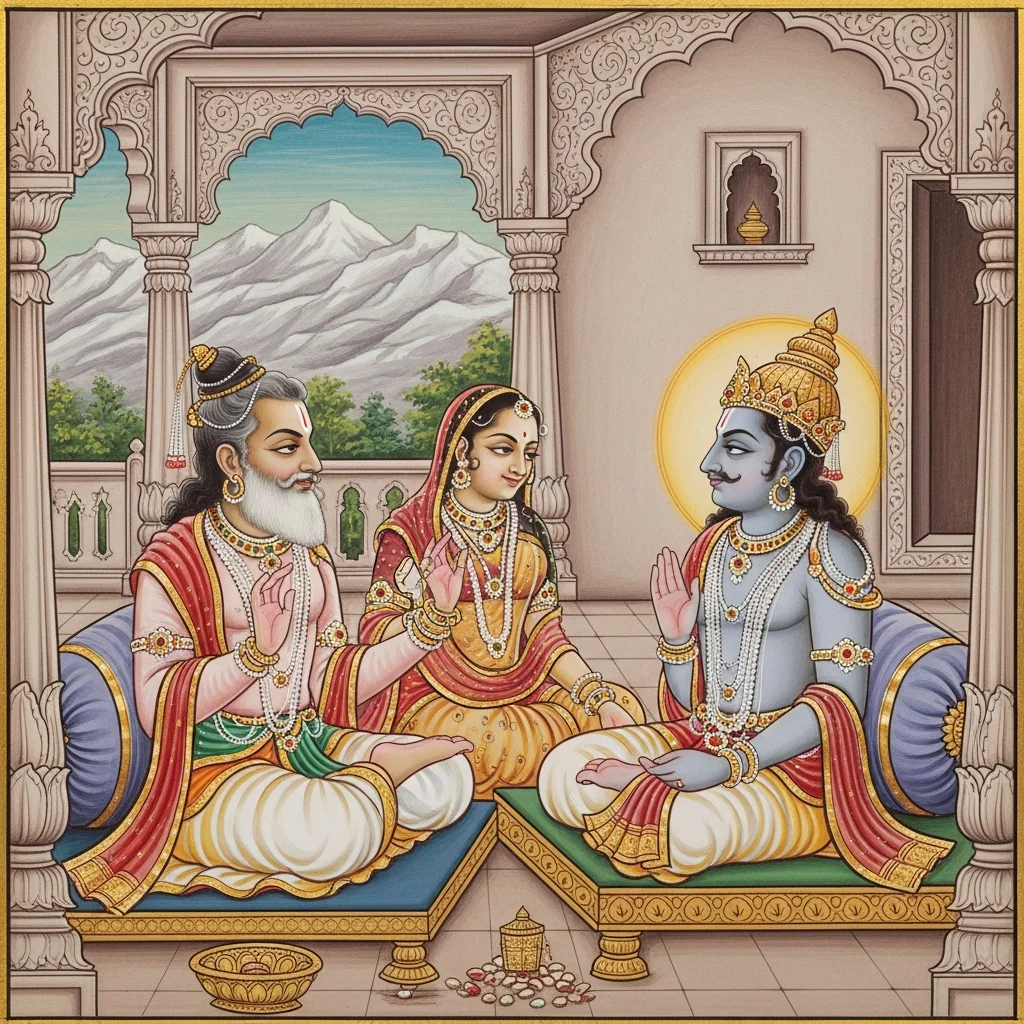
Adhyaya 23
This chapter is framed as a dialogue that joins sacred geography with the dharma of household life. Nārada describes Śailajā Devī (Pārvatī) playfully moving among divine and semi-divine maidens, then recounts how Indra (Śakra) remembers him and summons him to Meru. Indra asks Nārada to promote the union of Śailajā with Hara (Śiva), declaring it the only truly fitting match. Nārada travels to the Himālaya, is honored by Himavat, and praises the mountain as a sustainer of beings through shelter, waters, and resources for ascetic practice—linking place to dharma. Menā arrives with modest devotion, and Pārvatī is introduced as a shy young girl. Nārada blesses Menā with auspicious household virtues and heroic offspring. When Menā asks about Pārvatī’s future husband, Nārada first describes him through paradox—unborn, “naked,” poor, fierce—distressing Himavat and prompting reflection on the rarity of human birth and the difficulty of living dharma in the household state. Nārada then resolves the paradox: Pārvatī is the cosmic Mother, and her destined spouse is the eternal Śaṅkara—unborn yet ever-present, “poor” yet the giver of all—concluding with a theological clarification of Śiva’s transcendence and immanence.
Shlokas
Verse 1
नारद उवाच । ततश्च शैलजा देवी चिक्रीड सुभगा तदा । देवगंधर्वकन्याभिर्नगकिंनरसंभवाः । मुनीनां चापि याः कन्यास्ताभिः सार्धं च शोभना
Nārada said: Then the blessed Goddess Śailajā (Pārvatī), radiant with beauty, played joyfully with the maidens of the Devas and Gandharvas, with those born among the mountain-spirits and the Kiṃnaras, and also with the daughters of the sages—together forming a splendid company.
Verse 2
कदाचिदथ मेरुस्थो वासवः पांडुनंदन । सस्मारा मां ययौ चाहं संस्मृतो वासवं तदा
Once, while Vāsava (Indra) was upon Mount Meru, O son of Pāṇḍu, he remembered me; and I too, thus called to mind, went to Vāsava at that time.
Verse 3
मां दृष्ट्वा च सहस्राक्षः समुत्थायातिहर्षितः । पूजयामास तां पूजां प्रतिगृह्याहमब्रुवम्
Seeing me, the thousand-eyed one (Indra) rose up, exceedingly delighted. He worshipped me; and having accepted that worship, I spoke.
Verse 4
महासुर महोन्मादकालानल दिवस्पते । कुशलं विद्यते कच्चिच्च नंदसि
O lord of the day (Indra), subduer of great Asuras, like a raging Time-fire in battle—does well-being prevail? And are you content?
Verse 5
पृष्टस्त्वेवं मया शक्रः प्रोवाच वचनं स्मयन् । कुशलस्यांकुरस्तावत्संभूतो भुवनत्रये
Thus questioned by me, Śakra (Indra) replied with a smile: “Indeed, the first sprout of well-being has arisen throughout the three worlds.”
Verse 6
तत्फलोदयसंपत्तौ तद्भवान्संस्मृतो मुने । वेत्सि सर्वमतं त्वं वै तथापि परिनोदकः
When that fruitful prosperity arose, O sage, I remembered you. You truly know the views of all, and yet you still question so as to prompt and guide.
Verse 7
निर्वृतिं परमां याति निवेद्यार्थं सुहृज्जने
One attains the highest contentment by conveying one’s purpose to a circle of true friends.
Verse 8
तद्भवाञ्छैलजां देवीं शैलंद्रं शैलवल्लभाम् । हरं संभावय वरं यन्नान्यं रोचयंति ते
Therefore, do you grant your favor and bring about this match: let Śailajā—the Goddess beloved of the Lord of the Mountain—choose Hara (Śiva) as her excellent bridegroom, for no other pleases her.
Verse 9
ततस्तद्वाक्यमाकर्ण्य गतोऽहं शैलसत्तमम् । ओषधिप्रस्थनिलयं साक्षादिव दिवस्पतिम्
Hearing his words, I went to that best of mountains, to the dwelling upon the herb-clad plateau, where the lord of the day seemed present, as if before one’s very eyes.
Verse 10
तत्र हैमे स्वयं तेन महाभक्त्या निवेदिते । महासने पूजितोहमुपविष्टो महासुखम्
There, upon a golden seat that he himself presented with great devotion, I was duly honored and sat upon the great throne in deep contentment.
Verse 11
गृहीतार्घ्यं ततो मां च पप्रच्छ श्लक्ष्णया गिरा । कुशलं तपसः शैलः शनैः फुल्लाननांबुजः
After accepting the arghya offering, he gently questioned me in a soft voice. That mountain—steadfast in austerity—slowly grew radiant, his lotus-like face blooming with joy.
Verse 12
अहमप्यस्य तत्प्रोच्य प्रत्यवोचं गिरीश्वरम् । त्वया शैलेंद्र पूर्वां वाप्यपरां च दिशं तथा
Having replied to his words, I in turn addressed the lord of mountains: “O king of peaks, by you the eastern direction—and likewise the western—has been duly served and upheld.”
Verse 13
अवगाह्य स्थितवता क्रियते प्राणिपालना । अहो धन्योसि विप्रेंद्राः साहाय्येन तवाचल
By those who come to you and dwell in your shelter, the protection of living beings is accomplished. Truly, O mountain, you are blessed—for by your support even the foremost brāhmaṇas are sustained.
Verse 14
तपोजपव्रतस्नानौः साध्यंत्यात्मनः परम् । यज्ञांगसाधनैः कांश्चित्कंदादिफलदानतः
Through austerity, mantra-recitation (japa), vows, and sacred bathing, people attain the highest good of the Self (Ātman). And by providing certain necessities that serve as limbs of sacrifice—by giving roots, fruits, and the like—they also gain merit.
Verse 15
त्वं समुद्धरसि विप्रान्किमतः प्रोच्यते तव । अन्येऽपि जीव बहुधात्वामुपाश्रित्य भूधर
You uplift and sustain the brāhmaṇas—what more need be said in your praise? Indeed, O bearer of the earth, many other beings too live in various ways by taking refuge in you.
Verse 16
मुदिताः प्रतिवर्तंते गृहस्थमिव प्राणिनः । शीतमातपवर्षांश्च क्लेशान्नानाविधान्सहन्
Creatures return to you in gladness, as though coming home to a householder’s dwelling, enduring many kinds of hardships—cold, heat, and rain.
Verse 17
उपाकरोषि जंतूनामेवंरूपा हि साधवः । किमतः प्रोच्यते तुभ्यं धन्यस्त्वं पृथिवीधर
You give aid to living beings—such indeed is the nature of the virtuous. What more can be said to you? Blessed are you, O mountain that bears the earth.
Verse 18
कंदरं यस्य चाध्यास्ते स्वयं तव महेश्वरः । इत्युक्तवति वाक्यं च यथार्थं मयिफाल्गुन
“The cavern in which Maheśvara himself abides—truly, that is your own holy dwelling.” When she spoke thus, her words proved true in my case, O Phālguna.
Verse 19
हिमशैलस्य महिषी मेना आगाद्दिदृक्षया । अनुयाता दुहित्रा च स्वल्पाश्च परिचारिकाः
Menā, the queen of Himālaya, came desiring to behold (him). She was accompanied by her daughter, with only a few attendants.
Verse 20
लज्जयानतसर्वांगी प्रविवेश सदो महत् । ततो मां शैलमहिषी ववंदे प्रणिपत्य सा
With modesty, her whole body bowed, she entered that great assembly hall. Then the Mountain-queen (Pārvatī) prostrated and bowed to me in reverence.
Verse 21
वस्त्रनिर्गूढवदना पाणिपद्मकृतांजलिः । तामहं सत्यरूपाभिराशीर्भिः समवर्धयम्
With her face partly veiled by her garment and her lotus-hands joined in añjali, I blessed her with benedictions shaped by truth, thereby strengthening and uplifting her.
Verse 22
पतिव्रता शुभाचारा सुबगा वीरसूः शुभे । सदा वीरवती चापि भव वंशोन्नतिप्रद
O auspicious one—be devoted to your husband, of noble conduct, fortunate, and a mother of heroes. Be ever endowed with heroic offspring, and become a giver of uplift to your lineage.
Verse 23
ततोऽहं विस्मिताक्षीं च हिमवद्गिरिपुत्रिकाम् । मृदुवाण्या प्रत्यवोचमेहि बाले ममांतिकम्
Then, seeing the daughter of Himavat with eyes wide in wonder, I addressed her in gentle words: “Come, child, come near me.”
Verse 24
ततो देवी जगन्माता बालबावं स्वकं मयि । दर्शयंती स्वपितरं कंठे गृह्यांकमावि शत्
Then the Goddess, the Mother of the world, displaying her own childlike manner before me, took her father by the neck and nestled into his lap.
Verse 25
उवाच वाचं तां मंदं मुनिं वंदय पुत्रिके । मुनेः प्रसादतोऽवश्यं पतिमाप्स्यसि संमतम्
He spoke to her softly: “Daughter, bow to the sage. By the sage’s grace, you will surely obtain the husband you desire and approve of.”
Verse 26
इत्युक्ता सा ततो बाला वस्त्रांतपि हितानना । किंचित्सहुंकृतोत्कंपं प्रोच्य नोवाच किंचन
Thus addressed, the young girl—her face hidden by the edge of her garment—uttered only a slight, trembling sound and said nothing further.
Verse 27
ततो विस्मितचित्तोहमुपचारविदांवरः । प्रत्यवोचं पुनर्देवीमेहि दास्यामि ते शुभे
Then I—my mind astonished, being skilled in proper courtesies—spoke again to the Goddess: “Come, O auspicious one; I will give it to you.”
Verse 28
रत्नक्रीडनकं रम्यं स्तापितं सुचिरं मया । इत्युक्ता सा तदोत्थाय पितुरंकात्सवेगतः
“A delightful jewel-toy has long been kept by me,”—thus told, she at once rose up quickly from her father’s lap.
Verse 29
वंदमाना च मे पादौ मया नीतांक मात्मनः । मन्यता तां जगत्पूज्यामुक्तं बाले तवोचितम्
As she bowed to my feet, I drew her onto my own lap, considering her worthy of the world’s worship; and I said, “Child, this is fitting for you.”
Verse 30
न तत्पश्यामि यत्तुभ्यं दद्म्याशीः का तवोचिता । इत्युक्ते मातृवात्सल्याच्छैलेन्द्र महिषी तदा
“I do not see what blessing I could give you that would truly be fitting for you.” When this was said, the queen of the Lord of Mountains, moved by a mother’s tender affection, responded at that time.
Verse 31
नोदयामास मां मंदमानशीःशंकिता तदा । भगवन्वेत्सि सर्वं त्वमतीतानागतं प्रभो
Then, with a hesitant mind and anxious doubt, she urged me: “O Blessed Lord, you know everything—past and future, O Master.”
Verse 32
तदहं ज्ञातुमिच्छामि कीदृशोऽस्याः पतिर्भवेत् । श्रुत्वेति सस्मितमुखः प्रावोचं नर्मवल्लभः
“Therefore I wish to know: what kind of husband will she have?” Hearing this, I—smiling—replied in a playful, gentle manner.
Verse 33
न जातोऽस्याः पतिर्भद्रे वर्तते च कुलक्षणः । नग्नोऽतिनिर्धनः क्रोधीवृतः क्रूरैश्च सर्वदा
“O gentle lady, her husband has not yet been born; and yet the family-signs are already manifest: he will be unclad, exceedingly poor, quick to anger, and always surrounded by cruel companions.”
Verse 34
श्रुत्वेति संभ्रमाविष्टो ध्वस्तवीर्यो हिमाचलः । मां तदा प्रत्युवाचेदं साश्रुकण्ठो महागिरिः
Hearing this, Himācala was seized with agitation; his courage seemed shattered. Then the great mountain, his throat choked with tears, replied to me.
Verse 35
अहो विचित्रः सं सारो दुर्वेद्यो महतामपि । प्रवरस्त्वपि शक्त्या यो नरेषु न कृपायते
“Ah, how wondrous is worldly existence—hard to fathom even for the great. Even one who is foremost in power may still show no compassion toward people.”
Verse 36
यत्नेन महता तावत्पुण्यैर्बहुविधैरपि । साधयत्यात्मनो लोको मानुष्य मतिदुर्लभम्
By great effort indeed—and even by many kinds of merits—beings attain for themselves the human state, so difficult to obtain.
Verse 37
अध्रुवं तद्ध्रवत्वे च कथंचित्परिकल्प्यते । तत्रापि दुर्लभानाम समानव्रतचारिणी
What is unstable is somehow imagined to be stable. Even there, among rare attainments, one finds a wife who does not follow the same vows and disciplines.
Verse 38
साध्वी महाकुलोत्पन्ना भार्याया स्यात्पतिव्रता । तत्रापि दुर्लभं यच्च तया धर्मनिषेवणम्
A virtuous wife, born in a noble lineage, may indeed be devoted to her husband; yet even then it is rare that she steadfastly practices dharma.
Verse 39
सह वेदपुराणोक्तं जगत्त्रयहितावहम् । एतत्सुदुर्लभं यच्च तस्यां चैव प्रजायते
And along with that, the dharma taught in the Vedas and Purāṇas—beneficial to the three worlds—this too is exceedingly rare: that such true dharmic excellence is actually born in her.
Verse 40
तदपत्यमपत्यार्थं संसारे किल नारद । एतेषां दुर्लभानां हि किंचित्प्राप्नोति पुण्यवान्
O Nārada, in this cycle of worldly existence one indeed seeks offspring for the sake of lineage; yet among these rare attainments, only the truly meritorious person gains even a small share.
Verse 41
सर्वमेतदवाप्नोति स कोपि यदिवा न वा । किंचित्केनापि हि न्यूनं संसारः कुरुते नरम्
Even if one attains all this—or perhaps attains nothing at all—saṃsāra still leaves a man lacking in some way. For worldly existence ever leaves a deficiency behind.
Verse 42
अथ संसारिको दोषः स्वकृतं यत्र भुज्यते । गार्हस्थ्यं च प्रशंसंति वेदाः सर्वेऽपि नारद
Now, the fault that belongs to worldly life is this: in it one must inevitably experience—whether as joy or as suffering—the fruits of one’s own deeds. Yet, O Nārada, all the Vedas nevertheless praise the householder’s stage of life (gārhasthya).
Verse 43
नेति केचित्तत्र पुनः कथं ते यदि नो गृही । अतो धात्रा च शास्त्रेषु सुतलाभः प्रशंसितः
Some there say, “No indeed.” But again—how could it be so, if it were not truly accepted? Therefore the Creator (Dhātṛ) has praised in the śāstras the gaining of worthy offspring as a blessing held in highest esteem.
Verse 44
पुनश्चसृष्टिवृद्ध्यर्थं नरकत्राणनाय च । तत्र स्त्रीणां समुत्पत्तिं विना सृष्टिर्न जायते
And again, for the increase of creation and for deliverance from hell, in that order of generation, without the arising of women, creation does not come into being.
Verse 45
सा च जातिप्रकृत्यैव कृपणा दैन्यभागिनी । तासामुपरि मावज्ञा भवेदिति च वेधसा । शास्त्रेषूक्तमसंदिग्धं वाक्यमेतन्महात्फलम्
“By her very birth and natural condition she is poor and a sharer in hardship. Therefore the Ordainer (Brahmā) has laid down that no contempt should be shown toward such women. This statement is taught in the śāstras without doubt, and it yields great spiritual fruit.”
Verse 46
दशपुत्रसमा कन्या दशपुत्रान्प्रवर्द्धयन् । यत्फलं लभते मर्त्यस्तल्लभ्यं कन्ययैकया
A single daughter is equal to ten sons. Whatever merit a mortal gains by raising and nurturing ten sons, that very fruit is attained by raising even one daughter.
Verse 47
तस्मात्कन्या पितुः शोच्या सदा दुःखविवर्धिनी
Therefore, a daughter is to be pitied by her father, for she is ever a cause of increasing sorrow.
Verse 48
यापि स्यात्पूर्णसर्वार्था पतिपुत्रधनान्विता । त्वयोक्तं च कृते ह्यस्यास्तद्वाक्यं मम शोकदम्
Even if she were to possess every fulfillment—complete in all aims of life, endowed with a husband, sons, and wealth—still, the words you have spoken and done in her regard: that very speech becomes a giver of sorrow to me.
Verse 49
केन दोषेण मे पुत्री न योग्या आशिषामता । न जातोऽस्याः पतिः कस्माद्वर्तते वा कुलक्षणः
“By what fault is my daughter not deemed worthy of the blessings of a good marriage? Why has a husband not yet appeared for her—or why is there no sign of auspicious family destiny for her?”
Verse 50
निर्धनश्च मुने कस्मात्सर्वेषां सर्वदः कुतः । इति दुर्घटवाक्यं ते मनो मोहयतीव मे
“O sage, how can he be ‘without wealth,’ and yet be the giver of everything to all?”—this seemingly impossible statement of yours bewilders my mind.
Verse 51
इति तं पुत्रवात्सल्यात्सभार्यं शोकसंप्लुतम् । अहमाश्वासयं वाग्भिः सत्याभिः पांडुनंदन
Thus, seeing him—together with his wife—overwhelmed by grief out of deep affection for his child, I consoled him, O son of Pāṇḍu, with truthful words.
Verse 52
मा शुचः शैलराज त्वं हर्षस्थानेऽतिपुण्यभाक् । श्रृणु तद्वचनं मह्यं यन्मयोक्तं च ह्यर्थवत्
“Do not grieve, O king of mountains—you are exceedingly meritorious, and this is an occasion for joy. Listen to my words; what I say is indeed meaningful.”
Verse 53
जगन्माता त्वियं बाला पुत्री ते सर्वसिद्धिदा । पुरा भवेऽभवद्भार्या सतीनाम्ना भवस्य या
“This young girl is truly the Mother of the world—your daughter, the bestower of every attainment. Formerly, she became the wife of Bhava (Śiva), known by the name Satī.”
Verse 54
तदस्याः किमहं दद्मि रवेर्दीपमिवाल्पकः । संचिंत्येति महादेव्या नाशिषं दत्तवानहम्
“What could I possibly give her—like a small lamp offered to the sun?” Thinking thus, I gave no ‘blessing’ to the Great Goddess.
Verse 55
न जातोऽभवद्भार्या पतिश्चेति वर्तते च भवो हि सः । न स जातो महादेवो भूतभव्यभवोद्भवः
“He is not ‘born’ in the ordinary sense, and yet he is spoken of as ‘husband’ and ‘wife’—for he is Bhava (Śiva). That Mahādeva is not born, he from whom arise past, future, and all becoming.”
Verse 56
शरण्यः शाश्वतः शास्ता शंकरः परमेश्वरः
He is the refuge of all, eternal, the supreme ruler and teacher—Śaṅkara, the Highest Lord.
Verse 57
सर्वे देवा यत्पदमामनंति वेदैश्च सर्वैरपि यो न लभ्यः । ब्रह्मादिविश्वं ननु यस्य शैल बालस्य वा क्रीडनकं वदंति
All the gods revere his supreme state; yet even all the Vedas together cannot fully attain him. Indeed, the entire universe beginning with Brahmā is said to be, for that Mountain-Child, a mere plaything.
Verse 58
स चामंगल्यशीलोऽपि मंगलां यतनो हरः । निर्धनः सर्वदश्चासौ वेद स्वं स्वयमेव सः
Though he is even described as ‘inauspicious in appearance,’ Hara himself is the very cause of auspiciousness. Though ‘without wealth,’ he is the giver of all; he knows his own true nature by himself alone.
Verse 59
स च देवोऽचलः स्थाणुर्महादेवोऽजरो हरः । भविष्यति पतिः सोऽस्यास्तत्किमर्थं तु शोचसि
And that god—immovable, steadfast, Mahādeva, ageless Hara—will become her husband. Why, then, do you grieve?