Adhyaya 19
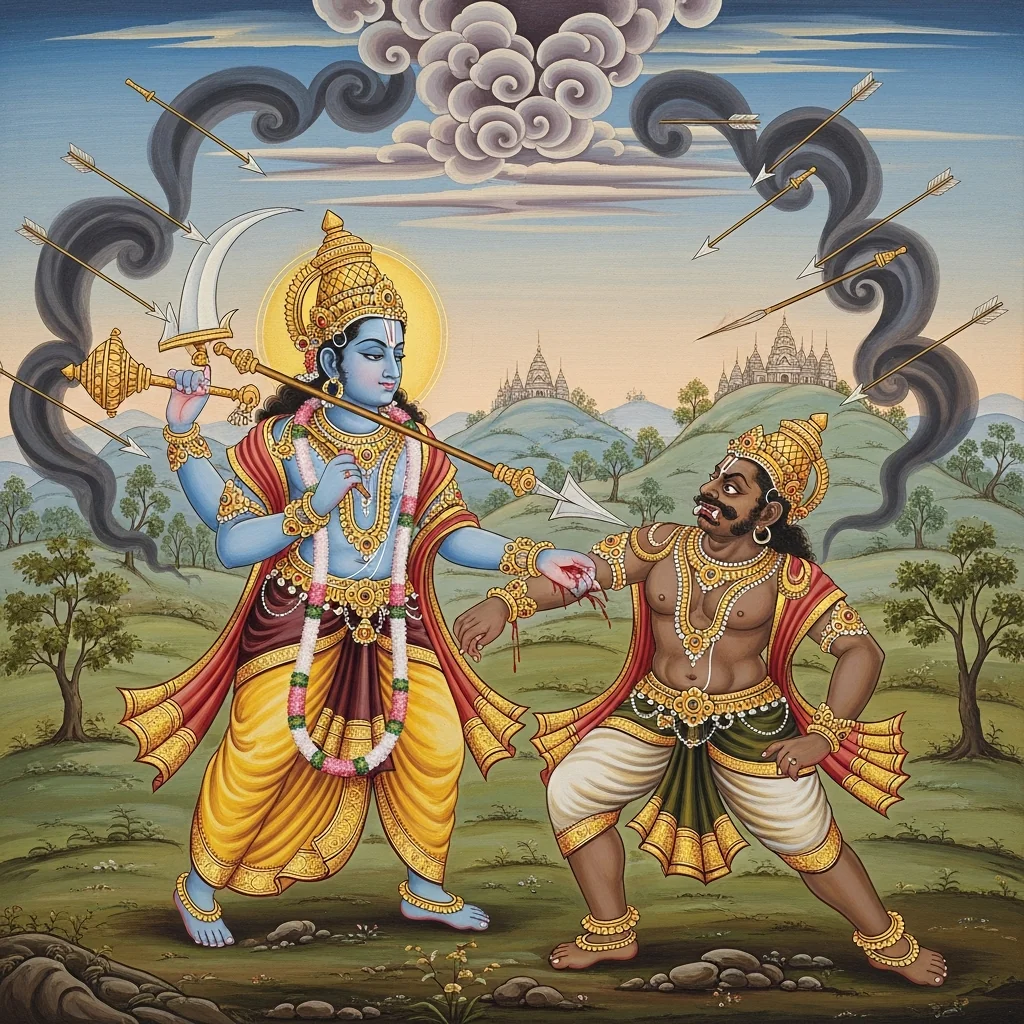
This adhyāya recounts a fierce cosmological battle. Kālanemi, inflamed by anger and mistaken recognition, misreads Nimi’s form and escalates the conflict. At Nimi’s prompting he releases the Brahmāstra, throwing the deva hosts into panic, until a countermeasure renders the weapon powerless. Then Bhāskara (Sūrya) manifests a dreadful, heat-emitting form that devastates the asura ranks, bringing chaos, thirst, and catastrophic losses. Kālanemi next assumes a cloud-like form, reverses the conditions with cold rain to revive asuric morale, and unleashes a storm of weapons that crushes devas and their allies in vast numbers. The twin Aśvins attempt a tactical strike with concentrated arrows and vajra-astra-like force, damaging Kālanemi’s war apparatus; he retaliates with weapons such as a wheel and a mace, and the narrative signals a Nārāyaṇāstra episode. As Indra’s position grows perilous and cosmic omens intensify, the devas formally praise Vāsudeva and seek refuge. Viṣṇu awakens from yoganidrā, arrives upon Garuḍa, absorbs the asuric assault, and engages Kālanemi directly. After exchanges of missiles and close combat, the Lord wounds and subdues Kālanemi with a decisive blow, yet grants a temporary reprieve, foretelling a later final end. Terrified before the Lord of the worlds, Kālanemi’s charioteer withdraws him in haste.
Shlokas
Verse 1
नारद उवाच । कालनेमी रुषाविष्टस्तेषां रूपं न बुद्धवान् । ततो निमिं च दैत्येन्द्रं मत्वा देवं महाजवः
Nārada said: “Kālanemi, overcome by fury, did not recognize their true forms. Then that swift one mistook Nimi—the lord of the asuras—for a god.”
Verse 2
केशेषु गृह्य तं वीरं चकर्ष च ननाद च । ततो निमिरुवाचेदं कालनेमिं महाबलम्
Seizing that hero by the hair, he dragged him and roared aloud. Then Nimi spoke these words to the mighty Kālanemi.
Verse 3
अहं निमिः कालनेमे सुतं मत्वा वधस्व मा । भवता मोहितेनाजौ देवान्मत्वासुराः स्वकाः
“I am Nimi. O Kālanemi, do not slay me, thinking me to be your son. Deluded in battle, you have mistaken the gods for your own asuras.”
Verse 4
सुरैः सुदुर्जयाः कोट्यो निहतादश विद्धि तत् । सर्वास्त्रवारणं मुंच ब्रह्ममस्त्रं त्वरान्वितः
“Know this: ten crores of exceedingly hard-to-conquer forces have been slain by the gods. Quickly release the Brahmā-weapon, the Brahmāstra, which wards off all other missiles.”
Verse 5
स तेन बोधितो दैत्यो मुक्त्वा तं संभ्रमाकुलः । बाणं ब्रह्मास्त्रविहितं मुमोच त्वरयान्वितः
Thus instructed, the demon (daitya), thrown into agitation, swiftly discharged an arrow empowered by the Brahmā-weapon, the Brahmāstra.
Verse 6
ब्रह्मास्त्रं तत्प्रजज्वाल ततः खे सुमहाद्भुतम् । देवानां चाभवत्सैन्यं सर्वमेव भयाकुलम्
That Brahmā-weapon, the Brahmāstra, blazed forth—an astounding marvel in the sky. And the entire army of the gods was seized with fear.
Verse 7
शंबरास्त्रं ततः शांतं ब्राह्मप्रतिहतं तदा । तस्मिन्प्रतिहते ह्यस्त्रे भास्करः प्रभुः
Then the Śambara-weapon was quelled, checked by the Brahmā-weapon, the Brahmāstra. And when that missile was thus neutralized, the lord Bhāskara—the Sun—…
Verse 8
महेंद्रजालमास्ताय चक्रे भीषणां तनुम् । विस्फूर्जत्करसंघातसमाक्रांतजगत्त्रयः
Assuming the great net of Indra’s illusion, he took on a fearsome form; the flashing multitude of his hands seemed to overrun the three worlds.
Verse 9
तताप दानवानीकं गलन्मज्जाङ्घ्रिशोणितम् । चक्षूंषि दानवेन्द्राणां चकारांधानि स प्रभुः
That Lord scorched the host of demons until marrow and blood streamed from their limbs, and he made the eyes of the demon-kings go blind.
Verse 10
गजानामगलन्मेदः पेतुश्चापि रथा भुवि । तुरंगमाः श्वसंतश्च घर्मार्ता रथिनोपि च
Fat melted from the elephants, and chariots fell upon the ground. The horses panted, and even the charioteers were distressed by the burning heat.
Verse 11
इतश्चेतश्च सलिलं प्रार्थयंतस्तृषातुराः । गिरिद्रोणीश्च पादांश्च गिरिणां गहनानि च
Tormented by thirst, they begged for water here and there, rushing to mountain-valleys, foothills, and the deep ravines of the hills.
Verse 12
तेषां प्रार्थयतां शीघ्रमन्योन्यं च विसर्पिणाम् । दावाग्निरज्वलत्तीव्रो घोरो नर्दग्धपादपः
As they ran about, urgently calling out to one another for help, a dreadful forest-fire suddenly blazed up—fierce in its heat—burning down the trees all around.
Verse 13
तोयार्थिनः पुरो दृष्ट्वा तोयं कल्लो लमालितम् । पुरःस्थितमपि प्राप्तुं न शेकुरुपसादितुम्
Though desperate for water, even after seeing it before them—its surface churned by waves and turmoil—they could not reach it, nor even draw near.
Verse 14
अप्राप्य सलिलं भूमावभ्याशे द्रुतमेव ते । तत्रतत्र व्यदृश्यन्त मृता दैत्येश्वराभुवि
Unable to obtain water, they quickly collapsed upon the nearby ground; and on the land of the lord of the Daityas, they were seen lying dead in many places.
Verse 15
रथा गजाश्च पतितास्तुरंगाश्च श्रमान्विताः । स्थिता वमंतो धावंतो गलद्द्रुतवसास्रजः
Chariots and elephants lay fallen; horses, overcome with exhaustion, stood or ran about vomiting, their garlands and trappings loosened, slipping and dripping away.
Verse 16
दानवानां कोटिकोटि व्यदृश्यतमृतं तदा । एवं क्षयो जानवानां तस्मिन्महति वर्तिते
Then crores upon crores of Dānavas were seen to have perished. Thus, when that great devastation occurred, the destruction of those beings came to pass.
Verse 17
प्रकोपोद्भूतताम्राक्षः कालनेमी रुषातुरः । बभूव कालमेधाभः स्फुरद्रोमशतह्रदः
Kālanemi, his eyes reddened by surging fury and tormented by rage, became like a dark cloud of doom; his whole body bristled, his hairs standing on end in hundreds of rippling shudders.
Verse 18
गंभीरास्फोटनिर्ह्रादजगद्धृदयकंपनः । प्रच्छाद्य गगनं सूर्यप्रभां सर्वां व्यनाशयत्
With deep thunderclaps and a roar that shook the very heart of the world, he veiled the sky and utterly blotted out the sun’s radiance.
Verse 19
ववर्ष शीतं च जलं दानवेन्द्रबलं प्रति । दैत्यास्तां वृष्टिमासाद्य समाश्वस्तास्ततः क्रमात्
He poured down cold water upon the army of the Dānava king. When the Daityas received that rainfall, they gradually regained their composure.
Verse 20
बीजांकुरा इव म्लानाः प्राप्य वृष्टिं धरातले । ततः स मेघरूपेण कालनेमिर्महासुराः
As with seed-sprouts that had withered and then revived when rain fell upon the earth, so Kālanemi—the great Asura—then assumed the form of a cloud.
Verse 21
शस्त्रवृष्टिं ववर्षोग्रां देवनीकेषु दुर्जयः । तया वृष्ट्या पीड्यमाना दैत्यैरन्यैश्च देवताः
That unconquerable one rained down a fierce shower of weapons upon the hosts of the gods. Oppressed by that storm of missiles—and by other Daityas as well—the deities suffered grievously.
Verse 22
गतिं कांचिन्न पश्यन्ति गावः शीतार्दिता इव । परस्परं व्यलीयंत गजेषु तुरगेषु च । रथेषु च भयत्रस्तास्तत्रतत्र निलिल्यिरे
Finding no way out—like cattle stricken by winter-cold—they pressed into one another. Terror-driven, they clung to elephants, horses, and even chariots, hiding here and there in sheer panic.
Verse 23
एवं ते लीयमानाश्च निहताः कालने मिना । दृश्यंते पतिता देवाः शस्त्रभिन्नंगसंधयः
Thus, as they were being crushed together, they were slain by Kālanemi. The gods were seen fallen, their limbs and joints split apart by weapons.
Verse 24
विभिन्ना भिन्नमूर्धानस्तथा भिन्नोरुजानवः । विपर्यस्तं रथांगैश्च पतितं ध्वजशक्तिभिः
Heads were split, and so too thighs and knees were shattered. Overturned by the parts of chariots, many lay fallen—struck down by standards and spears.
Verse 25
तुरंगाणां सहस्राणि गजानामयुतानि च । रक्तेन तेषां घोरेण दुस्तरा चाभवन्मही
Thousands of horses and tens of thousands of elephants lay there; and by their dreadful blood the earth became hard to cross.
Verse 26
एवमाजौ महादैत्यः कालनेमिर्महासुरः । जघ्ने मुहुर्तमात्रेण गंधर्वाणां दशायुतम्
So, in the battle, the great Daitya Kālanemi—the mighty Asura—slew, in merely a single muhūrta, a hundred thousand Gandharvas.
Verse 27
यक्षाणां पंचलक्षाणि किंनराणां तथैव च । जघ्ने पिशाचमुख्यानां सप्तलक्षाणि निर्भयः
Fearless, he slew five hundred thousand Yakṣas, and likewise Kinnaras; and of the Piśāca chiefs he destroyed seven hundred thousand.
Verse 28
इतरेषां न संख्यास्ति सुरजातिनिकायिनाम् । जघ्ने स कोटिशः क्रद्धः कालनेमिर्मदोत्कटः
As for the other hosts of celestial races, they were beyond all counting. Enraged, Kālanemi—swollen with pride—slew them in crores.
Verse 29
एवं प्रतिभये भीमे तदामर महाक्षये । संक्रुद्धावश्विनौ वीरौ चित्रास्त्रकवचोज्जवलौ
When such dreadful terror arose, amid that great destruction of the immortals, the two heroic Aśvins grew wrathful—resplendent in wondrous weapons and shining armor.
Verse 30
जघ्नतुस्तौ रणे दैत्यमेकैकं षष्टिभिः शरैः । निर्भिद्य ते महादैत्यं सपुंखा विविशुर्महीम्
In battle those two struck the Daitya—each with sixty arrows. Piercing the great Daitya through, the arrows—still feathered—entered the earth.
Verse 31
ताभ्यां बाणप्रहारैस्तु किंचित्सोऽवाप्तचेतनः । जग्राह चक्रं लक्षारं तैलधौतं रणेऽधिकम्
Struck by the two with volleys of arrows, he regained consciousness a little. Then, in that battle, he seized a razor-edged discus, oil-polished and formidable for combat.
Verse 32
तेन चक्रेण सोश्विभ्यां चिच्छेद रथकूबरम् । जग्राहाथ धनुर्दैत्यः शरांश्चाशीविषोपमान्
With that discus he cut the chariot’s pole (yoke-beam) of the two Aśvins. Then the Daitya seized his bow and took up arrows like venomous serpents.
Verse 33
ववर्ष भिषजोर्मूर्ध्नि संछाद्याकाशगोचरम् । तावप्यस्त्रैः स्मृतैः सर्वाश्छेदतुर्दैत्यसायकान्
He rained missiles upon the heads of the two divine physicians, veiling the whole expanse of the sky. Yet those two, recalling their own weapons, cut down every arrow of the Daitya.
Verse 34
तच्च करम तयोर्दृष्ट्वा विस्मितः कोपमाविशत् । जग्राह मुद्गरं भीम कालदंडविभीषणम्
Seeing that feat of theirs, he was astonished, and then fury entered him. He seized a dreadful mace, fearsome like the rod of Death.
Verse 35
स तदमुद्भ्राम्य वेगेन चिक्षेपास्य रथं प्रति । तं तु मुद्गरमायांतमालोक्यांबरगोचरे
Whirling it with speed, he hurled it toward their chariot. But seeing that mace rushing through the open sky,
Verse 36
मुक्त्वा रथावुभौ वेगादाप्लुतौ तरसाश्विनौ । तौ रथौ स तु निष्पिष्य मुद्गरोऽचलसंनिभः
Abandoning both chariots, the swift Aśvins leapt away at speed. That mountain-like mace then crushed those two chariots.
Verse 37
दारयामास धरणीं हेमजालपरिष्कृतः । तस्य कर्माथ तद्दृष्ट्वा भिषजौ चित्रयोधिनौ
Adorned with a net of gold, it tore open the earth itself. Seeing that deed, the two physician-devas—wondrous warriors—
Verse 38
वज्रास्त्रं च प्रकुर्वाणौ दानवेंद्रमयुध्यताम् । घोरवज्रप्रहारैस्तु दानवः स परिक्षतः
Fashioning the Vajra-weapon, the two Aśvins fought the lord of the Dānavas. Struck by dreadful thunderbolt-blows, that Dānava was grievously wounded.
Verse 39
रथो ध्वजो धनुश्चैव छत्रं च कवचं तथा । क्षणेन शतधा भूतं सर्वसैन्यस्य पश्यतः
His chariot, banner, bow, parasol, and armor as well—within a moment—were shattered into a hundred pieces before the gaze of the entire army.
Verse 40
तद्दृष्ट्वा दुकरं कर्म सोऽश्विभ्यां भीमविक्रमः । नारायणास्त्रं बलवान्मुमोच रणमूर्धनि
Seeing that hard-to-accomplish feat by the Aśvins, he—of dreadful valor—released the mighty Nārāyaṇa-weapon at the very height of battle.
Verse 41
ततः शशाम वज्रास्त्रं कालनेमिस्ततो रुषा । जीवग्राहं ग्राहयितुमश्विनौ तौ प्रचक्रमे
Then the Vajra-weapon was quenched; and Kālanemi, in rage, set about making the two Aśvins fall into the ‘life-seizing’ grasp (a deadly capture).
Verse 42
तावभिप्रायमालक्ष्य संत्यज्य समरांगणम् । पदाती वेपमानांगौ प्रद्रुतौ वासवोयतः
Perceiving his intention, they abandoned the battlefield. Trembling in their limbs and now on foot, they fled in the direction where Vāsava (Indra) had gone.
Verse 43
तयोरनुगतो दैत्यः कालनेमिर्नदन्मुहुः । प्राप्येंद्रस्य बलं क्रूरो दैत्यानीकपदानुगः
Close behind those two followed the Dānava Kālanemi, roaring again and again. Cruel, keeping step with the demon host, he came upon Indra’s forces.
Verse 44
स काल इव कल्पांते यदा वासवमाद्रुतः । तं दृष्ट्वा सर्वभूतानि विविशुर्विह्वलानि तु
When he rushed upon Vāsava, he seemed like Time itself at the end of a kalpa. Seeing him, all beings, shaken and bewildered, sought places of hiding.
Verse 45
हाहारावं प्रकुर्वाणास्तदा देवाश्च मेनिरे । पराजयं महेंद्रस्य सर्वलोकक्षयावहम्
Then the gods, raising cries of “hā hā!”, thought that Mahendra’s defeat would bring ruin upon all the worlds.
Verse 46
चेलुः शिखरिणो मुख्याः पेतुरुल्का नभस्तलात् । जगर्जुर्जलदा दिक्षु संभूतश्च महारवः
The foremost mountains shook; meteors fell from the sky. Thunderclouds roared in every direction, and a great tumult arose.
Verse 47
तां भूताविकृतिं दृष्ट्वा देवाः सेंद्रा भयावहाः । मनसा शरणं जग्मुर्वासुदेवं जगत्पतिम्
Seeing that fearful distortion among beings, the gods—even with Indra—became terrified. In their hearts they took refuge in Vāsudeva, the Lord of the universe.
Verse 48
नमो ब्रह्मण्यदेवाय गोब्राह्मणहिताय च । जगद्धिताय कृष्णाय गोविंदाय नमोनमः
Salutations to the Lord who cherishes dharma, the benefactor of cows and brāhmaṇas; salutations to Kṛṣṇa, to Govinda, who wills the welfare of the whole world—again and again, salutations.
Verse 49
स नो रक्षतु गोविंदो भयार्तास्ते जगुः सुराः । सुराणां चिंतितं ज्ञात्वा भगवान्गरुडध्वजः
“May Govinda protect us!”—thus the gods, distressed by fear, cried out. Knowing what the gods held in their hearts, the Blessed Lord, whose banner is Garuḍa, (responded).
Verse 50
विबुध्यैव च पर्यंकाद्योगनिद्रां विहाय सः । लक्ष्मीकरयुगांभोजलालितांघ्रिसरोरुहः
Awakening at once and rising from his couch, he cast aside his yogic slumber—he whose lotus-feet are gently caressed by the pair of lotus-hands of Lakṣmī.
Verse 51
शारदंबरनीराब्जकांतिदेहच्छविः प्रभुः । कौस्तुभोद्भासिहृदयः कांतकेयूरभास्करः
That Lord shone with the radiance of his body like an autumn sky and a blue lotus. The Kaustubha jewel blazed upon his chest, and his splendid armlets gleamed like suns.
Verse 52
विमृश्य सुरसंक्षोभं वैनतेयमाताह्वयत् । आहूतेऽविस्थितेतस्मिन्गरुडे दुःखिते भृशम्
Reflecting on the turmoil afflicting the gods, the Mother Vinatā summoned Vainateya (Garuḍa). When Garuḍa was thus called, he stood by—deeply distressed.
Verse 53
दिव्यनानास्त्रतीक्ष्णार्चिरारुह्यागात्सुराहवम् । तत्रापश्यत देवेंद्रं भयभीतमभिद्रुतम्
Mounting a radiant, sharp-flaming array of divine weapons as his conveyance, he hastened to the gods’ battlefield. There he beheld Indra—terrified, fleeing as he was pursued.
Verse 54
दानवेंद्रैर्नवांभोदसच्छायैः सर्वथोत्कटैः । यथा हि पुरुषं घोरैरभाग्यैरर्थकांक्षिभिः
By the lords of the Dānavas—dark as fresh rain-clouds and fierce in every way—Indra was sorely pressed, as a man is assailed by dreadful misfortunes that hunger for his wealth.
Verse 55
तत्त्राणायाव्रजद्विष्णुः स्तूयमानो मुहुः सुरैः । अभाग्येभ्यः परित्रातुं सुकृतं निर्मलं यथा
To rescue them, Viṣṇu advanced, praised again and again by the gods—like pure merit (sukṛta) that comes to deliver one from misfortune.
Verse 56
अथापश्यत दैत्येंद्रो वियति द्युतिमंडलम् । स्फुरंतमुदयाच्छीघ्रं कांतं सूर्यशतं यथा
Then the lord of the Daityas saw in the sky a circle of splendor, flashing and rising swiftly—beautiful like a hundred suns.
Verse 57
प्रभवं ज्ञातुमिच्छंतो दानवास्तस्य तेजसः । गरुडं तमथा पश्यन्कल्पांतानलभैरवम्
Wishing to know the source of that brilliance, the Dānavas then beheld Garuḍa—terrifying like the fire at the end of an age.
Verse 58
तत्र स्थितं चतुर्बाहुं हरिं चानुपमद्युतिम् । तमालोक्यासुरेंद्रास्तु हर्षसंपूर्णमानसाः
There they beheld Hari (Viṣṇu), four-armed and of incomparable splendor. Seeing him, the lords of the Asuras were filled with delight in their hearts.
Verse 59
अयं स देवः सर्वेषां शरणं केशवोऽरिहा । अस्मिञ्जिते जिताः सर्वा देवता नात्र संशयः
“This is that very god—Keśava, slayer of foes—the refuge of all. If he is conquered, then all the gods are conquered; of this there is no doubt.”
Verse 60
एनमाश्रित्य लोकेशा यज्ञभागभुजोऽमराः । इत्युक्त्वा ते समागम्य सर्व एव ततस्ततः
“Relying upon him, the lords of the worlds—the immortals who partake of the shares of sacrifice—stand secure.” Having said this, they all gathered together from every side.
Verse 61
तं जघ्नुर्विविधैः शस्त्रैः परिवार्य समंततः । कालनेमिप्रभृतयो दश दैत्यमहारथाः
Surrounding him on every side, ten great Daitya chariot-warriors—beginning with Kālanemi—struck at him with various weapons.
Verse 62
षष्ट्या विव्याधबाणानां कालनेमिर्जनार्दनम् । निमिः शतेन बाणानां मथनोऽशीतिभिः शरैः
With sixty arrows Kālanemi pierced Janārdana (Viṣṇu); Nimi struck him with a hundred arrows, and Mathana with eighty shafts.
Verse 63
जंभकश्चैव सप्तत्या शुंभो दशभिरेव च । शेषा दैत्ये श्वराः सव विष्णुमेकैकशः शरैः
Jambhaka smote Him with seventy arrows, and Śumbha with ten; and the remaining lords of the Dānavas, each in turn, assailed Viṣṇu with their shafts.
Verse 64
दशभिर्दशभिः शल्यैर्जघ्नुः सगरुडं रणे । तेषाममृष्यत्तत्कर्म विष्णुर्दानवसूदनः
In battle they struck Viṣṇu together with Garuḍa, each with ten barbed missiles. Viṣṇu, the slayer of the Dānavas, could not endure that deed of theirs.
Verse 65
एकैकं दानवं जघ्ने षड्भिः पड्भिरजिह्नगैः । आकर्णकृष्टैर्भूयश्च कालनेमिस्त्रिभिः शरैः
He slew the Dānavas one by one with six and six unfaltering arrows; and again Kālanemi was struck with three shafts drawn back to the ear.
Verse 66
विष्णुं विव्याध हृदये रोषाद्रक्तविलोचनः । तस्याशोभंत ते बाणा हृदये तप्तकांचनाः
Red-eyed with fury, he pierced Viṣṇu in the heart. Those arrows shone in His chest like heated gold.
Verse 67
मयूखा इव संदीप्ताः कौस्तुभस्य स्फुरत्त्विषः । तैर्बाणैः किंचिदायस्तो हरिर्जग्राह मुद्गरम्
Blazing like rays and flashing with the radiance of the Kaustubha, those arrows shone. Slightly distressed by them, Hari seized a mace.
Verse 68
स तमुद्ग्राह्य वेगेन दानवाय मुमोच वै । दानवेन्द्रस्तमप्राप्तं वियत्येव शतैः शरैः
Lifting it up, he hurled it with force at the Dānava. But the lord of the Dānavas, before it could reach him, struck it down in midair with hundreds of arrows.
Verse 69
चिच्छेद तिलशः क्रुद्धो दर्शयन्पाणिलाघवम् । ततो विष्णुः प्रकुपितः प्रासं जग्राह भैरवम्
Enraged, he cut it to pieces, displaying the swiftness of his hand. Then Viṣṇu, greatly angered, took up a fearsome spear.
Verse 70
तेन दैत्यस्य हृदयं ताडयामास वेगतः । क्षणेन लब्धसंज्ञस्तु कालनेमिर्महासुरः
With it he struck the Daitya’s heart with great force. In a moment, the great Asura Kālanemi regained consciousness.
Verse 71
शक्तिं जग्राह तीक्ष्णाग्रां हेमघंटाट्टहासिनीम् । तया वामं भुजं विष्णोर्बिभेद दितिनंदनः
He seized a sharp-pointed śakti-weapon, laughing loudly like a golden bell; and with it, Diti’s son pierced Viṣṇu’s left arm.
Verse 72
भिन्नं शक्त्या भुजं तस्य स्रुतशोणितमाबभौ । नीले बला हके विद्युद्विद्योतंती यथा मुहुः
When his arm was split by the spear, blood streamed forth and flashed—again and again—like lightning flickering within a dark rain-cloud.
Verse 73
ततो विष्णुः प्रकुपितो जग्राह विपुलं धनुः । सप्तदश च नाराचांस्तीक्ष्णाग्रान्मर्मभेदिनः
Then Viṣṇu, inflamed with wrath, seized his mighty bow, together with seventeen iron arrows—sharp-pointed, piercing the vital spots.
Verse 74
दैत्यस्य हृदयं षड्भिर्विव्याध च शरैस्त्रिभिः । चतुर्भिः सारथिं चास्य ध्वजं चैकेन पत्रिणा
He pierced the demon’s heart with six arrows; with three more he struck again. With four he wounded the charioteer, and with a single feathered shaft he felled the banner.
Verse 75
द्वाभ्यां धनुर्ज्याधनुषी भुजं चैकेन पत्रिणा । स विद्धो हृदये गाढं दोषैर्मूढो यथा नरः
With two arrows he struck the bow and its string; with one feathered shaft he pierced the arm. Wounded deep in the heart, he became bewildered—like a man deluded by his own faults.
Verse 76
स्रुतरक्तारुणः प्रांशुः पीडाचलितमानसः । चकंपे मारुतेनेव चोदितः किंशुकद्रुमः
Tall and flushed red with flowing blood, his mind shaken by pain, he trembled—like a kiṃśuka tree driven by the wind.
Verse 77
ततः कंपितमालक्ष्य गदां जग्राह केशवः । तां च वेगेन चिक्षेप कालनेमिवधं प्रति
Seeing him trembling, Keśava seized his mace and hurled it with force toward the slaying of Kālanemi.
Verse 78
सा पपात शिरस्युग्रा सहसा कालनेमिनः । संचूर्णितोत्तमां गस्तु निष्पिष्टमुकुटोसुरः
That terrible mace fell suddenly upon Kālanemi’s head. The demon’s noble frame was crushed, and his crown was smashed to pieces.
Verse 79
स्रुतरक्तौघरंध्रश्च स्रुतधातुरिवाचलः । पपात स्वे रथे भग्नो विसंज्ञः शिष्टजीवनः
With his openings streaming torrents of blood, like a mountain oozing minerals, he collapsed—broken—upon his own chariot, senseless, with only a remnant of life left.
Verse 80
पतितस्य रथोपस्थे दानवस्याच्युतोऽरिहा । स्मितपूर्वमुवाचेदं वाक्यं चक्रायुधः प्रभुः
As the demon lay fallen on the seat of his chariot, Acyuta—the slayer of foes—smiling first, spoke these words; the Lord whose weapon is the discus.
Verse 81
गच्छासुर विमुक्तोऽसि सांप्रतं जीव निर्वृतः । ततः स्वल्पेन कालेन अहमेव तवांतकः
“Go, O Asura—you are released for now. Live at ease for the present; yet after a short time, I myself will be your end.”
Verse 82
एवं वचस्तस्य निशम्य विष्णोः सर्वेश्वरस्याथ रथं निमेषात् । निनाय दूरं किल कालनेमिनो भीतस्तदा सारथिर्लोकनाथात्
Hearing those words of Viṣṇu—the Lord of all—Kālanemi’s charioteer, terrified of the Protector of the worlds, in a mere instant drove the chariot far away.